


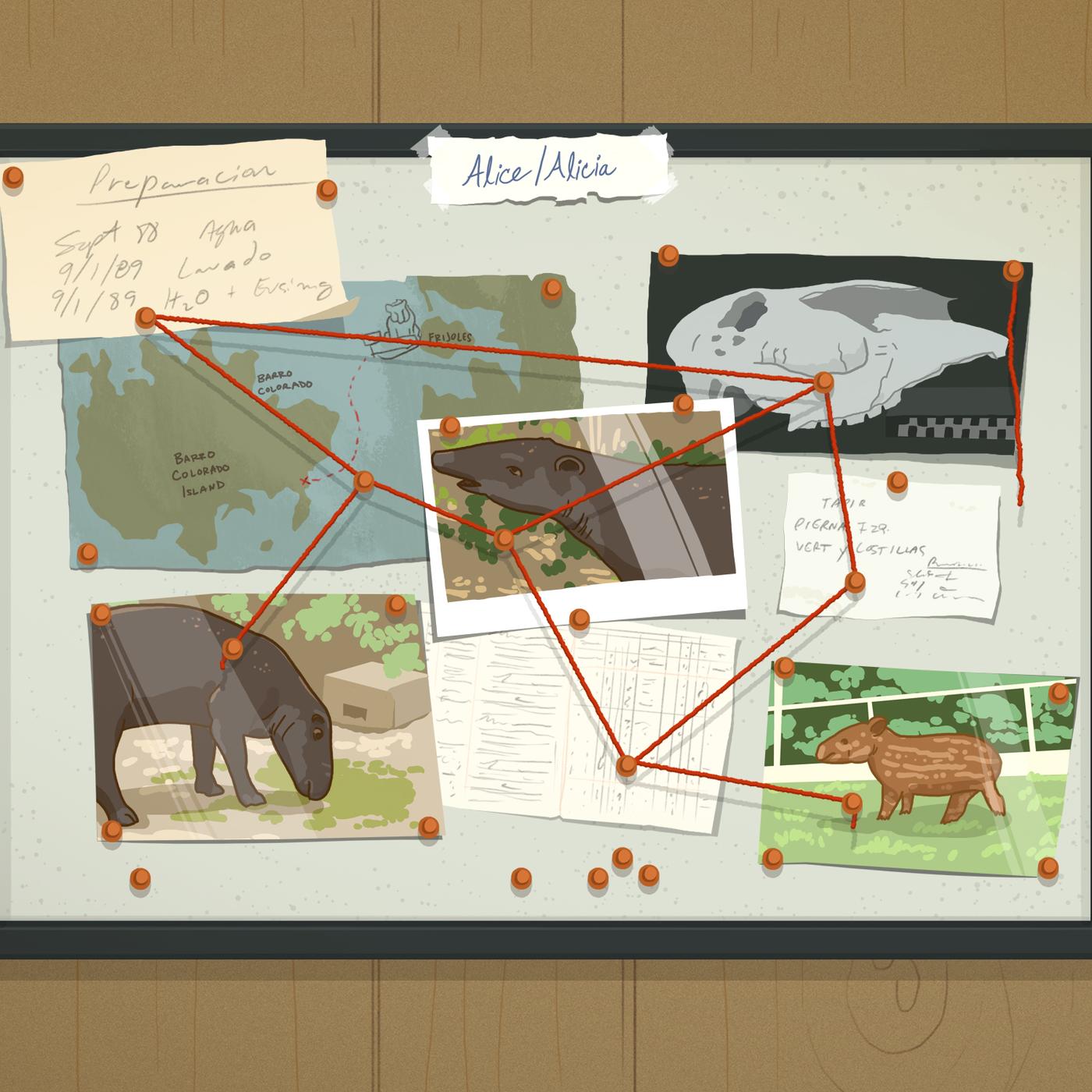
Sidedoor (S12E10) – Tapir Caper final web transcript
Lizzie Peabody: This is Sidedoor, a podcast from the Smithsonian with support from PRX. I'm Lizzie Peabody.
Lizzie: Nina Hirai had just graduated from college when she did what many recent grads do: she got an internship. But unlike many interns, she wasn't sitting at a corporate desk and fetching coffee. Oh no, she was at the Smithsonian Tropical Research Institute in Panama, also known as STRI. And she was in deep storage.
Nina Hirai: I mean, it's a pretty big warehouse. But these collections were in this one big room where it's sort of really like wall to wall boxes of just bones.
Lizzie: Animal bones.
Lizzie: So I'm picturing you, like, looking at the shelf, grabbing a box, opening it up, and it's like, "What will I find in here?"
Nina Hirai: [laughs] Yeah.
Lizzie: Is that kind of what it was like?
Nina Hirai: Yes.
Lizzie: Nina's job as an archaeology intern was to photograph and digitize the contents of these boxes—which was a big job. At her fingertips were thousands of skeletons of all kinds, going back decades. So one morning, Nina went to work as usual.
Nina Hirai: So okay, so it was actually September 18, 2023.
Lizzie: You remember the actual date?
Nina Hirai: [laughs] I—yes.
Lizzie: Nina goes to the wall of boxes, and she sees a big box. It's pretty beaten up, it has some water marks on it. And as she pulls it off the shelf, she realizes it is heavy.
Nina Hirai: Yeah, extremely heavy.
Lizzie: So heavy she needs help carrying it to her work table. And when she opens the lid, she realizes something wonderful. It's a tapir skeleton.
Nina Hirai: Tapirs are one of my favorite animals.
Lizzie: And Nina is thrilled.
Lizzie: Why are tapirs your favorite animal? I had never heard of a tapir before hearing about this story.
Nina Hirai: As a kid, my parents used to tell me that, like, in Japan, there's like a myth that tapirs eat your nightmares.
Lizzie: Really?
Nina Hirai: Yeah. [laughs]
Lizzie: Wow, that's kind of beautiful.
Nina Hirai: I know.
Lizzie: If you're having trouble picturing a tapir, this may help: think of a large pig with the ears of a cartoon mouse and a short, elephant-like trunk. That is a tapir.
Nina Hirai: And in Panama, there are so many wild animals that I had been seeing around, but I had never seen a tapir, because they're really, really shy. And there are also not a lot of wild tapirs. The population is really, really dwindling.
Lizzie: But here was a real live tapir! Okay, actually a real tapir skeleton, but a real tapir! Nina got to work sorting through the bones, and when she hoisted the skull, which was about as wide as her shoulders, out of the box ...
Nina Hirai: That's when I realized, like, oh, this is an interesting specimen.
Lizzie: The skull had holes in it. And not for the eyes and nose and stuff.
Nina Hirai: The holes were on the side of the head.
Lizzie: Six or seven of them.
Nina Hirai: So I guess, like, if it were a human, it would be around the sort of temple area.
Lizzie: And this struck Nina as strange. So she did what any good intern would do, she called over her advisor, Nicole Smith-Guzmán.
Nina Hirai: And so she took a look at the skull, and she was like, yeah ...
Nicole Smith-Guzmán: Shotgun wound.
Lizzie: Nicole had worked at a forensics lab, so right away she recognized what she was seeing.
Nicole Smith-Guzmán: You had several points of impact, and they're all clustered together. This is typical of a shotgun, and this would be a shotgun at a close range, too, because they were somewhat close together.
Lizzie: What's more, she could tell from studying the bone around the holes that the gunshot had almost certainly been the thing that killed this tapir. The edges of the holes were pushed in.
Nicole Smith-Guzmán: Meaning that the bone was still flexible at the time that this perforation was made. And there were no signs of healing around the edges.
Lizzie: But while Nicole had seen a lot of gunshot wounds in her time, she'd never seen one in the collections of the Smithsonian Tropical Research Institute.
Nicole Smith-Guzmán: Yeah, this was something different. This is something unique, and we immediately started thinking about possible scenarios. How did this happen?
Lizzie: Had the tapir been poached? Shot by hunters? Nina was puzzled.
Nina Hirai: Because I assumed that if it had been poached, it wouldn't have ended up in the collection.
Lizzie: Hmm.
Nina Hirai: It would have been sold and somewhere else.
Lizzie: Right, good point. Yeah. Yeah.
Nina Hirai: And so I was confused as to why it was here.
Lizzie: Why was this tapir here? In the bottom of the box was a notecard. And on the notecard, handwritten in ballpoint pen, was a date: September, 1988. But there was nothing about where this tapir had come from.
Nina Hirai: And the fact that it wasn't noted just made me, like, question it. And so that's kind of where the story, like, began. [laughs]
Lizzie: This time on Sidedoor, a tapir caper. We head to the Smithsonian's Tropical Research Institute to learn more about these elusive animals, and search for the truth about Nina's mystery skull. And along the way, we'll meet one very special tapir. That's coming up after the break.
***
Lizzie: Nina Hirai had a mystery on her hands: a tapir skull with what appeared to be bullet holes in it. And a date: 1988. But that was nearly 40 years ago. Nina assumed anyone working at the Smithsonian Tropical Research Institute back then was probably long gone. But when she asked her advisor, Nicole Smith-Guzmán ...
Nina Hirai: Nikki said, "Oh, Yeyo was here during that time. We should go speak to him about it."
Lizzie: Yeyo—whose full name is Aureliano Valencia González—is an archaeological research technician at STRI. And he was just a few doors down the hall, so Nina put down the tapir skull and popped her head in Yeyo's door. And to her astonishment ...
Nina Hirai: Yeyo said, "Oh, you know, I remember receiving this tapir's body."
Aureliano Valencia (Yeyo): Cuando llevamos el tapir ...
Lizzie: Yeyo said back in those days, his boss at STRI was a scientist by the name of Dr. Richard Cooke. And Cooke had a passion for collecting animal skeletons.
Aureliano Valencia (Yeyo): [through translator] Dr. Cooke collected whatever animal he came across. He was a specialist in this.
Lizzie: Yeyo says the two of them would be driving along to some archaeological site when Richard would spot a dead cat.
Aureliano Valencia (Yeyo): [through translator] There's a dead cat there! Let's get it!
Lizzie: They'd screech to a halt ...
Aureliano Valencia (Yeyo): [through translator] Sometimes the cat, the animal, had just died. Other times it had been there several days. And well, what could you do? That's the boss for you. He'd pick up the dead animal, he'd throw it in the back of the car, and we'd drive along the road with a bunch of flies buzzing around.
Lizzie: Local kids would bring him dead lizards and other critters in sacks. One time they brought him a very alive, very angry anteater—which they accepted and then immediately released back into the wild. Another time, a motel owner threatened to throw Richard Cooke out for boiling animal carcasses in the kitchen after hours. And when the Panama Canal had to be drained for cleaning, Panamanian officials called STRI, like, "There are a bunch of dead fish here. You want 'em?" And with Richard, the answer was always "Yeah!"
Lizzie: Now Richard Cooke wasn't just collecting for fun. The mission of Smithsonian Tropical Research Institute is to understand tropical ecosystems. And part of that work is archaeology, looking at how those ecosystems have changed over deep time. With all the bones he picked up, Cooke was creating a tool that would be especially helpful for archaeologists: building STRI's faunal reference collection, basically, a library of modern animal skeletons from tropical America.
Lizzie: Let's say you're an archaeologist, and you dig up something that looks like an ocelot femur—that's a spotted wildcat. And you want to see if the bone belonged to an ocelot and not a common house cat. You could go to the reference library, pull out an ocelot and a house cat femur and compare your bones. Handy dandy! And over the course of five decades, Cooke's fast and furious collecting built STRI's faunal collection to over 2,000 Panamanian species. But when he died unexpectedly in 2023, some institutional knowledge died with him.
Nicole Smith-Guzmán: Because Richard Cooke was one of these people with a photographic memory. You know, he could remember exactly details about every single object in the collection.
Lizzie: Nicole Smith-Guzmán says those details weren't always written down.
Nicole Smith-Guzmán: So when he unexpectedly passed away, we had to do a lot of mystery solving about the collection here in the lab.
Lizzie: That's where Nina came in, working her way through the skeletons of the collection, organizing and digitizing. But when it came to this tapir skull, Yeyo remembered it very well. He said back in 1988, Richard Cooke got a call from Summit Zoo, Panama's National Zoo. And the folks at the zoo said "Hey, we have dead tapir here. Do you want it for the collection?" So off Richard and Yeyo went to the zoo, and when they got there, they learned that this tapir hadn't actually been a zoo animal.
Aureliano Valencia (Yeyo): [through translator] The animal had been ill when it arrived. They just told us that it arrived sick, for treatment by a veterinarian at the Summit National Zoo.
Lizzie: Yeyo was told the animal had died of natural causes, and it wasn't until Yeyo was back at the lab processing the skeleton that he noticed the holes in the animal's skull.
Aureliano Valencia (Yeyo): [through translator] Well, when I was preparing the tapir, I called Dr. Cooke and I said, "Hey, Richard? I think this animal didn't die of natural causes." "Huh?" he said. I said, "No, there are some bullet holes here."
Nina Hirai: And so he at that point was like, "That's interesting." But I don't know if he questioned or pressed on about that.
Lizzie: I asked Yeyo about this, and he said it would have been up to Richard, as his boss, to follow up with the zoo. And Yeyo suspects it might have come off as disrespectful to question what they'd been told. The folks at the zoo had generously donated an animal skeleton. It wasn't their job to investigate the circumstances of its death. So Yeyo went ahead and finished processing the skeleton per protocol. He noted the date on a notecard and put it in the box with the bones. But there was one detail he remembered that he didn't write down on that card, and it gave Nina an important clue.
Nina Hirai: He was told by Summit Zoo that the tapir was a tapir from BCI, which is Barro Colorado Island.
Lizzie: Barro Colorado Island is the flagship research station of the Smithsonian Tropical Research Institute, just a little ways up the Panama Canal from the lab where Nina was working. And it's an island with an unusual history. Barro Colorado Island wasn't always an island—it used to be a hilltop. In 1914, a river was dammed to form the Gatun Lake during the construction of the Panama Canal, and the hill became an isolated island of tropical forest. In the early 1920s, the island was designated as a biological reserve, and soon after became the founding site of the Smithsonian Tropical Research Institute. Today, it's one of the world's oldest, most intensively studied tropical sites, informing long-term research on tropical ecology and evolution.
Lizzie: The island itself is densely wooded and packed with plants and animals of all kinds. Researchers come from all over the world for residencies there, and the research station has the feel of a summer camp: dining hall, sleeping dorms, miles and miles of trails through rainforest, and everywhere you look, experiments of all kinds underway. So Nina started writing to every researcher on record who'd worked there in the late '80s. asking if they remembered anything about a tapir on the island. And to her surprise, she got an email back. And then another. And another. The responses came flooding in.
Nina Hirai: They were like, "Yeah, I remember this tapir, I remember this tapir. I kind of remember this tapir. Let me just reach out to this person." And—and then all of a sudden there was a name.
Lizzie: The name was Alice.
Nina Hirai: I got a flood of emails about Alice from a bunch of people being like, ‘"Oh my gosh, Alice. Alice this, Alice that, Alice this." And I was shocked. This was 35 years ago at this point. To me it felt like there has to be a story behind it, right? If there's a name, there has to be a story.
Lizzie: Who was Alice? And what happened to her? We'll try to answer these questions when we come back. Stick around.
***
Lizzie: To understand who Alice the tapir was, it helps to know a little bit about the history of tapirs in Panama. Tapirs used to roam freely through most of Central America as the region's largest native land mammal. They're slow, and secretive and subtle, browsing the fruits and leaves of the tropical forest and mostly keeping to themselves.
Lizzie: But years of habitat destruction and hunting have made them increasingly rare in the wild. So in the 1950s, the director of STRI, Martin Moynihan, hatched a plan. He set about bringing adult tapirs onto the island, which had guarda bosques—armed guards—patrolling the jungle to keep poachers away. Moynihan figured the tapirs would be safe there, and they could repopulate.
Lizzie: But he also made the decision to feed them, which is a sort of surprising approach when dealing with wildlife in a research setting. A research paper from 1978 explains.
[ARCHIVE CLIP: It was hoped that this food source would discourage the tapirs from traveling to distant parts of the island where they might be hunted by poachers.]
Lizzie: So the tapirs were fed nightly from a large box where the assistant cook would leave food scraps.
Lissy Coley: And generally it was bedlam, because it was right outside the dining room door.
Lizzie: Lissy Coley is one of the scientists Nina called up in her quest for more information. Back in the 1980s Lissy was living on BCI doing PhD and post-doc research on plant defenses and herbivory. She remembers the box of food and the commotion it caused. Here she is on the phone with Nina.
Lissy Coley: The coatis and the spider monkeys also learned that they were putting out food, so there would be spider monkeys squabbling and fighting and pulling coatis by their tails to get them out of the way.
Lizzie: But every night without fail, there was one animal they were sure to see.
Lissy Coley: So Alice was a daily fixture.
Lizzie: Alice.
Lissy Coley: She would saunter in slowly to the lab clearing every night right before dinner when they would put out food for her.
Lizzie: Often she was accompanied by her mate, Louie, lumbering not too far behind.
Lissy Coley: And then sometimes she would bring her offspring from that year. And they were adorable, little spotted, tiny tapirs.
Lizzie: As weird as adult tapirs look—and they do look kind of strange ...
Lissy Coley: Alice was not cute.
Lizzie: ... baby tapirs are adorable! Like a teeny, tiny roly-poly hippo, but with brown and white spots and stripes like a mix between a baby deer and a zebra. They're so cute!
Lissy Coley: It would sort of squeak, make a tiny little squeaking noise, and stick very close to Alice.
Lizzie: The hardcore resident scientists melted over these baby tapirs. They started naming them and keeping track of them in the STRI logbooks. There was Bambi, Max, and my favorite, Scotch.
Lissy Coley: Scotch tapir.
Lizzie: Scotch Tapir! [laughs]
Lizzie: But as soon as the baby tapirs got big enough to be independent, they stopped coming to the breadbox and stayed hidden in the forest. Most tapirs, even those brought to BCI, are very shy and hard to spot.
Lissy Coley: Even though they're there, they're very hard to see. Alice, I guess, gave us a special show.
Lizzie: Yeah!
Lizzie: Unlike her compatriots and offspring, Alice was not at all afraid of humans. But some humans were afraid of her. Lissy was one of them. After all, Alice weighed 600 pounds! And Lissy had a healthy respect for her jaws.
Lissy Coley: I would, like, cower next to the herbarium which was, I don't know, 40 feet away from the dining room door waiting for someone to shield me so I could get to the dining room. She never bit anybody.
Lizzie: Though she did chase the assistant cook around the kitchen one time.
Lissy Coley: Until finally he jumped out the window. [laughs]
Lizzie: But whether they loved her or feared her, everyone on BCI adjusted to her.
Lissy Coley: She was like a mascot for all of us that were there. Just part of life on BCI.
Lizzie: The more Nina learned about Alice, the more and more doubtful she became that the skull in the collections could belong to her. I mean, if Alice was so beloved, so well known, who could possibly have shot her? The tapir in the collections had supposedly come from BCI, but there were other tapirs on BCI. But as she kept digging, she learned that in the late '80s, Alice started to behave differently.
Nina Hirai: You know, was kind of walking a little bit slowly. And she was very ill.
Lizzie: She was an old tapir by then—probably close to 30 years old, which is the upper range for a wild tapir. And so the decision was made to send her off the island and several miles up the canal to Summit National Zoo for treatment. Lissy Coley told Nina ...
Lissy Coley: Even though I was, like, afraid of Alice, basically, it was heartbreaking.
Lizzie: Not long after being sent to the Zoo, they got the news that Alice had died.
Lissy Coley: And we all are kind of convinced she died of a broken heart.
Nina Hirai: Like a broken heart from being taken away from BCI.
Lissy Coley: Yeah.
Lizzie: But the tapir Nina found in the collections had died of a shotgun wound, not a broken heart. But as Nina dug through the STRI archives, she found something that stopped her in her tracks.
Nina Hirai: I found Alice's obituary.
Lizzie: What?
Nina Hirai: Yes. I found her obituary in a STRI newsletter.
Lizzie: And the obituary noted Alice's exact date of death.
Nina Hirai: September 12, 1988. The same exact month and year that is—that was written on the index cards that I had found at the bottom of the box.
Lizzie: The box containing the tapir skeleton with the holes in the skull.
Nina Hirai: Which is kind of what cemented, like, oh, this could really, really be her skeleton.
Lizzie: Nina had to know more. Was there anyone she could talk to who'd been with Alice in her final days? She packed her bag.
Nina Hirai: I actually visited BCI.
Lizzie: She took the ferry to Barro Colorado Island. There, she met up with one of the guarda bosques—the park rangers employed by STRI—the only one still on staff who'd been working there back in Alice's days, in the 1980s.
Nina Hirai: His name is Andres Ramos, who really had an incredible memory of the time at BCI back then.
Lizzie: As they walked around the island together, Andres told her what he remembered about Alice's final days on BCI.
[ARCHIVE CLIP, Andres Ramos: [through translator] She looked very thin. She looked unwell. She looked very unwell. So we realized something was going on, that she was sick. The instruction was that we had to get her to the vet.]
Nina Hirai: He said that him and the other guarda bosques set up a jaula, a cage in the middle of the forest.
Lizzie: They put some food inside.
Nina Hirai: And then they just waited.
[ARCHIVE CLIP, Andres Ramos: [through translator] She, as she was used to doing, went inside to search for the food. There we closed the door securely. Wow, the most difficult part by far was moving her, because the animal, together with the cage, were quite heavy.]
Lizzie: It took a whole team of people to lift the cage onto a trolley down 200 stairs and out to the dock.
Nina Hirai: And then they got it on a boat, and then they boated her all the way across Lake Gatun all the way to Summit Zoo, where that's the last Andres Ramos saw of her.
[ARCHIVE CLIP, Andres Ramos: [through translator] What was happening to Alice was that she had a very, very bad, a very strong infection, right?]
Monica Brenes: She did arrive very close to sundown. It was probably, like, maybe 5:30 or something like that. We didn't have that much light left.
Lizzie: This is Monica Brenes Lynan.
Monica Brenes: I am a veterinarian.
Lizzie: So in 1988, you were the assistant veterinarian at the Summit Zoo in Panama, right?
Monica Brenes: I was the only veterinarian at the Summit.
Lizzie: Monica remembers that night in September, 1988 when a very sick tapir arrived from Barro Colorado Island.
Monica Brenes: She was thin, and apparently she had stopped eating, I guess. Something was wrong with her, and they wanted us to look at her, but we never got the chance.
Lizzie: Alice was too stressed to come out of the cage when she arrived, so the staff made the decision to leave her in her cage overnight.
Monica Brenes: She was dead the next morning.
Lizzie: Wow.
Monica Brenes: Yeah, when we went back to look at her, she was gone.
Lizzie: Did you do an autopsy?
Monica Brenes: We did. And I remember now we never did autopsies at Summit. We always took the body to Corozal, which was the hospital, you know, the army hospital. And I worked there, too, part-time. And we did it over there.
Lizzie: So what did you find?
Monica Brenes: Well, I can't remember exactly, but the only thing I remember was the mouth. You know, like, yeah, we did find, like, she had tooth abscesses. And apparently we did find something else wrong in the liver and kidney, but this was a very old animal.
Lizzie: Neither the hospital at Corozal nor the zoo keep records dating back to the '80s—we checked—so all we have to go on are the recollections of those still around. Monica took a look at the photos of the tapir in the STRI collections and the bullet holes in the skull, and she says there is no way that tapir is Alice.
Monica Brenes: That skull is not hers.
Lizzie: The tapir that came from BCI died of natural causes.
Monica Brenes: A hundred percent.
Lizzie: But Yeyo remembers going to Summit Zoo in 1988, the same month Alice arrived, and receiving a tapir that had bullet holes in its head. So something is not quite adding up. Now at this point I'm beginning to feel like I have holes in my head, so I start to throw ideas around.
Lizzie: Is it possible that there were two tapirs that died at Summit or, you know, came from Summit the same month?
Monica Brenes: No, not at all.
Lizzie: Monica says there was only one other tapir at the zoo in 1988, and it was a young one they'd raised there. Maybe Alice had sustained a bullet-to-the-head injury earlier in her life and survived it, and they only discovered it when they processed her skeleton.
Monica Brenes: There's no way. Whoever that tapir was did not survive that attack. If you looked at it, all those holes go through the brain, so there is absolutely not a chance.
Lizzie: So is it possible that somebody could have euthanized her out of mercy since she was so ill?
Monica Brenes: No.
Lizzie: This was the 1980s. Maybe a gunshot is how you euthanized large animals back then. But Monica felt strongly that was not the case.
Monica Brenes: Absolutely not. Nobody would've been—you know, no. Not even the workers. Nobody. You know, we had everything on a padlock. No, no. No one would have gone there to kill her. No, there's no chance.
Lizzie: Well, what the heck happened then? If Alice was the only tapir that came to the zoo at that time, and she definitely wasn't shot, then how did Yeyo end up with a tapir skull full of bullet holes? Monica offers a suggestion.
Monica Brenes: I do remember in my memory hearing that there was an animal, another tapir, that they had somebody hunt down. And I'm pretty sure it is that skull.
Lizzie: Okay.
Monica Brenes: But I can't remember where it came from.
Lizzie: She says if a tapir had been poached and the poachers were caught, that tapir's body would have been taken to a whole different facility called INRENARE—the National Institute of Renewable Natural Resources—basically, the "nature police," responsible for enforcing forestry policies in Panama. So we looked them up, and their headquarters are only 2.8 miles from Summit Zoo, a seven-minute drive. Maybe Yeyo had misremembered. Maybe he picked up this poached tapir from INRENARE?
Monica Brenes: Or something along that line, yes.
Lizzie: This seems like a very strong explanation. It was nearly 40 years ago, memory is fallible. So I called Yeyo back. This has to be what happened.
Aureliano Valencia (Yeyo): [through translator] Ah, no.
Lizzie: He doubled down.
Aureliano Valencia (Yeyo): [through translator] I'm sure we went to pick up the tapir at Summit National Park.
Lizzie: He's sure of it. Full stop. And Monica is equally sure the tapir skull Nina found ...
Monica Brenes: For sure that one, that skull does not belong to Alice. That's a hundred percent sure.
Lizzie: You're a hundred percent sure?
Monica Brenes: A hundred percent. A hundred and ten, let's put it that way. [laughs]
Lizzie: Okay.
Lizzie: So if somehow the skull in the collections belongs to some different tapir who allegedly came from the same place in the same month ...
Nina Hirai: Then where is Alice?
Lizzie: That's what I don't—like, what happened to Alice? If this is another tapir, what happened to Alice?
Nina Hirai: Exactly.
Lizzie: What would you all have done with—with Alice? Like, what would you have done with that tapir's body?
Monica Brenes: I don't know. Probably cremate it.
Lizzie: Could she have just been cremated at the zoo and not even collected? Having been so beloved? And with a collecting fanatic like Richard Cooke in the mix? I called up research archaeologist Ashley Sharpe, Nina Hirai's other advisor during her internship at STRI.
Lizzie: I mean, we don't know, right? So if you had to guess, do you think the tapir in the collections from '88 is Alice?
Ashley Sharpe: I suspect it is. [laughs] I think I'm the only one who does, though. It just seems all the evidence lines up it's Alice.
Lizzie: The gunshot wound was from close range. This was purposeful.
Ashley Sharpe: Again, it looks like the kind of thing you might do if the animal was—you wanted to take it out of its misery.
Lizzie: Could this just have been a mercy killing for a very old animal suffering from a fatal infection? But Monica Brenes says she's a hundred and ten percent sure that didn't happen. One thing we do know is that everyone involved in this story was working on behalf of the tapirs. Our translator had another theory, though: Maybe Alice was shot by a poacher on BCI, and the guarda bosques didn't want to upset residents with the news, so they spirited her away in a crate.
Lizzie: But that doesn't check out, because Monica Brenes remembers her arriving.
Ashley Sharpe: Yeah.
Lizzie: It's amazing how quickly your mind goes to these, like, conspiracy theories, because, like, we want clarity. We want a tidy resolution. Where is Alice?
Ashley Sharpe: Absolutely.
Lizzie: I'm sorry to say that we don't know where the tapir skull came from. It's still a mystery. But it's not necessarily the end of the road.
Ashley Sharpe: This is—does feel to me, though, like a forensics case. [laughs]
Lizzie: Nina's advisor, Ashley, says DNA could hold the answer.
Ashley Sharpe: There are other skeletons floating around who we suspect we do know who those tapirs were who would've been related to Alice. So if somebody wanted to do DNA, maybe they could actually figure that out.
Lizzie: Maybe someday we'll get a Tapir Caper parte dos. Until then, though, we just don't know. It's frustrating, but Nina says there's a lot of value in practicing our tolerance for uncertainty.
Nina Hirai: In archaeology, oftentimes to sort of impose upon a conclusion does more harm than good. And so it's best to willingly acknowledge that sometimes we don't know. But that doesn't mean that we can't learn or develop from that unknowing. I think it's the process of uncovering that is what really helps us learn.
Lizzie: What we do know, more than anything about her death, is that Alice lived a full, long life. She was beloved by many, and is still remembered nearly 40 years later. And whether or not hers is the skull in the collections, that skull belonged to someone, and every single bone in this collection is an animal that had a life and a story. This is just one of them. Who knows what stories lurk inside the next box?
***
Lizzie: You've been listening to Sidedoor, a podcast from the Smithsonian with support from PRX. Big props to sleuthing intern Nina Hirai for uncovering this story and for all her research. Nina produced a short documentary film about Alice at the end of her internship, which we'll try to share a clip of on our social media, @SidedoorPod.
Lizzie: Thanks also to Ashley Sharpe and Nicole Smith-Guzmán, as well as to Aureliano Valencia González, Andres Ramos, Beth King, and all our friends at the Smithsonian Tropical Research Institute. Thank you to Lissy Coley for sharing her memories of Alice. And thanks to Monica Brenes and folks at the Summit National Zoo in Panama. Big thanks to Budhan Pukazhenthi at the Smithsonian's National Zoo for taking the time to educate me further about tapirs and tapir conservation. There are four main species of tapirs worldwide. They are endangered, and there's tons to learn about them, so check them out. Thanks also to Ellie Tahmaseb and Jen Zoon. Ruth Morris was our translator for this episode.
Lizzie: Our podcast is produced by James Morrison, and me, Lizzie Peabody. Executive producer is Ann Conanan. Our editorial team is Jess Sadeq and Sharon Bryant. Episode artwork is by Dave Leonard. Transcripts are done by Russell Gragg. Fact-checking by Nathalie Boyd. Extra support comes from PRX. Our show is mixed by Tarek Fouda. Our theme song and episode music are by Breakmaster Cylinder. If you want to sponsor our show, please email sponsorship [at] prx [dot] org. I'm your host, Lizzie Peabody. Thanks for listening.
Nina Hirai: From what I've read and heard, they're rather docile creatures aside from, you know, projectile peeing.
Lizzie: What? Excuse me?
Nina Hirai: Yes! [laughs]
Lizzie: Say more.
Nina Hirai: They—from my interviews with everyone at BCI, they have a skill where they can pee backwards, like, projectile it.
Lizzie: Okay, tapirs are my new hero. That's insane! That's amazing.
Nina Hirai: Yes! They're incredible animals! [laughs]
Lizzie: I can't believe you didn't lead with that when you were talking about why they're your favorite.
Nina Hirai: Yeah. I have to save the best for last.
-30-
