

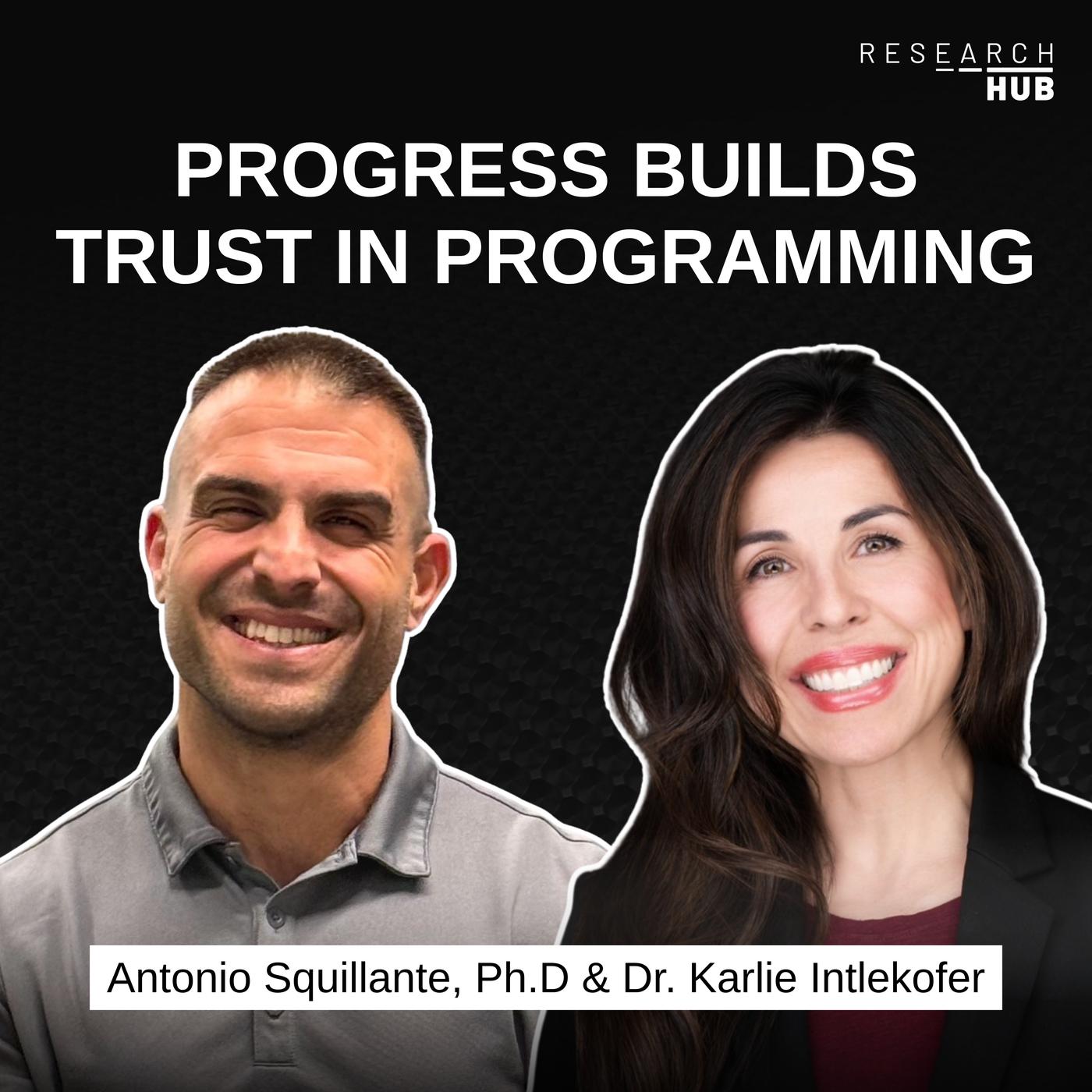
Dr. Karlie Intlekofer: Welcome everyone to the Research Hub podcast where we translate research into action for coaches, gym operators, and anyone leading people through fitness. I'm Dr. Karli Intelkofer and today we're focusing on something that's hitting all the trends. We're talking about muscle and strength. ⁓ We're focusing whether your members are feeling stronger, more capable, and more confident in the gym. ⁓ And we're how muscles adapt to different types of training over time. Now many facilities are focusing on what to do in a single workout, but of course, long-term progression is often neglected. It's of course a structure that's necessary, that takes weeks and months, and it actually determines whether your improvement is actually occurring. Our guest today is Dr. Antonio Spiante, a strength and conditioning coach, a researcher and an educator with experienced training athletes at the high school, the collegiate, and the professional level. He's an assistant professor at Point Loma University in California, as well as on the board of directors for the National Strength and Conditioning Association. And when it comes to athletic performance, he is very used to guiding folks using different strategies that are leveraging both the old research and the new research, and also things like periodized training and velocity-based approaches as well. And this helps his training to better translate into real improvements in force, speed, and power. Dr. Antonio Scrilante,
Antonio Squillante: Thank you, that was a nice introduction. Thank you so much for having me.
Dr. Karlie Intlekofer: So I'm just curious for getting started. Tell me about how you got interested in this field and how did you begin to navigate your career path?
Antonio Squillante: Wow, that's a good question. Well, it all started when I was transitioning high school to college. I grew up in Italy. So undergrad, I to Italy for university. back I was playing football, which is a very unusual sport for Italy, very niche sport. But nevertheless, ⁓ I played well enough that I it to the professional level, which ⁓ nothing compared to the NFL in the States, but it's still a professional sport. So you compete all over Europe and where not. I remember distinctly that ⁓ my first application for university was to major in biology. I wanted to be ⁓ major, ⁓ then I was going through training. I realized that the way that we were coached back then just wasn't working. And just for, for, ⁓ clearance, like the way we were coached back then was pretty bad. in the sense that we didn't have a strength and conditioning coach. So our strength and conditioning program was ⁓ of the assistant coaches coming in the weight room and say, there's a photocopy of the book, Bigger, Faster, Stronger. Just look at the tables, do the same training and you'll be fine. That was a strength and conditioning coach back then. And I figured that wasn't exactly what I needed. Also because I was lucky enough to be fairly strong for my size, but I knew I was missing some aspects of let's call it athletic performance, so power and speed. So I started doing my own research and at the same time I got so interested in it that I changed my major and I went into sports science instead and I joined the NSCA. So I started my with like all the educational paths that the NSCA makes available for practitioners, ⁓ the CSCS and reading papers and all that good stuff. ⁓ that kind of like triggered my career. And then ⁓ that I went into coaching and then after coaching into teaching and it was just... I guess evolution, if you will.
Dr. Karlie Intlekofer: You got to apply what you learned and you also kind of were shoring up some of the deficits I mean we don't all get to have trainers with us, especially when we're younger so I benefited from having informed coaches But of course there's so much more to learn as I just continue to age in my profession about ⁓ how to adapt things and it sounds like you were working with ⁓ Professionals were working with ⁓ elite or at least athletes were playing at a high level What were the sports? Were they all American football players or were there other sports thrown in there that you were coaching strength for? ⁓
Antonio Squillante: ⁓ Yeah, it was a mix. At the beginning it was mostly American football, track and field. And in track and field also more of the sports that require more like strength training like throwers, little bit of jumpers, sprinters. There was lot of, ⁓ well that like the early 2000s in Italy, so was a lot of power ⁓ lifting and body building just because that was the trend, was was ⁓ fashion ⁓ back then. We all trained as ⁓ bodybuilders in a way or the other. It was very basic ⁓ yeah, were the predominant sports. I did some work with rugby, just because requires a lot of strength training. So those athletes were keen to like spend hours in the weight room. And then after I moved to the States, in the States has been American football and track and field with a little bit of experience in there in weightlifting. through my wife because she's a competitor with Lifter herself. But at a collegiate or professional level. was ⁓ collegiate ⁓ American and then I was able to coach for few years track and field at a professional level. And now currently I am with ⁓ the USA national team for track cycling. We just came from World Championship. We got a fourth place with our women team. So that was very good. And that in preparation the Olympics in 2028. ⁓ Truck cycling is a very complex sport. There's endurance and there's power involved. We work predominantly with sprinters. So imagine like wheel lifters that also ride a bike at the velodrome. So it's a very fun sport to coach.
Dr. Karlie Intlekofer: Wow. Yeah, I that's fantastic. Especially because right now is probably strength training continues to be super popular. I think that's great. The culture sports medicine. They come out with a trend based on fitness professionals who they survey and they try to figure out what's the kind of up and coming thing that we all agree is a big deal right now ⁓ and strength training. That was one of the options that you could select that actually made it on the top five in 2025, which is great to see. Now I'm not so sure. ⁓ that they have enough informed survey responders to put specific details about how the muscles could adapt, whether it's power or maximum strength or I'm not exactly sure, right? Cause they had to keep it pretty basic, but in this conversation, we can kind of help to make those more distinct. ⁓ also know that it's not just fitness professionals are into it and who are saying it's a big deal. It's also the members themselves. So if you look at the fitness consumer side, there was a national survey by Lifetime and they surveyed like 3000 US adults and they found that 36 % this year say that building muscle is their top training goal and that's up from 32 % the year before. So that's a sign that more fitness consumers are thinking about strength, muscle, perhaps power, speed and other factors as well, but they're getting more motivated to grow their muscle capacity. in short. in practice, I think there is probably a little murkiness, a little confusion about how to train for different muscle based outcomes. Like, for example, if you're training for muscle size, like you want to be a bodybuilder or have muscle hypertrophy, you're training for muscle strength, which again, power lifters are incredible at, know, strong men and women are incredible at, or even just people training just for power, which has that velocity component. So ⁓ I'm wondering if you can clarify these distinctions.
Antonio Squillante: I will try my best. And that's a very good point. and that's like, know, like surprisingly, that's a question that we get asked a lot from our students. We work with graduate students mostly. So after they completed a bachelor degree already, and most of them come from a background in kinesiology, they have read the books and textbooks and papers, ⁓ they're still somewhat confused about the difference. ⁓ I think a lot of that has to do with not just the rigor or certain definitions, is also the practical experience training those skills because once you've trained someone for years in a specific type of application, it's very intuitive the difference between strength and power. But if you haven't, it makes it more difficult to understand it. So feel like the broad term, can be, ⁓ can say strength training, can say resistant training, we can say weight lifting as two separate words. ⁓ all refer to the same methodology training, which is lifting weights or working against a resistance. That's why it's called resistance training. And that applies to all possible applications of resistance training. can be like a dumbbell, can be a barbell, can be a kettlebell, can be an isotonic machine. It doesn't matter. You're working against resistance. And if we look at that type of training, there are three possible outcomes that, or three type of adaptations that you can elicit. And they're not one competing with the other. They can all occur at the same time. but they are slightly different in the way you go about training. would be, ⁓ said that very well, one would be muscle hypertrophy. So increasing muscle size, growing ⁓ and also comes with like getting heavier overall, getting stronger, so strength, the amount of weight that you can lift, ⁓ or power, able to be more explosive, ⁓ faster in you do. And they intertwine different point of views, but when it comes to actually put pen to paper and write a program, we can be very diligent in preferring one over the other. And I like to explain our students that when it comes to, and I'll keep it very simple, but when it comes to neuromuscular adaptation, which involves our muscles and our brain connected, so structure and function, intensity drives adaptation. So the intensity of the effort we put in the weight room. is going to tell us whether or not we're moving more towards hypertrophy, more towards strength, or more towards power. So to keep it very simple, everything we do in a resistance training or strength training needs to have some sort of prescription, right? Like you need to tell people what to do. And usually we tell them the name of the exercises, how many sets and reps, but the most important thing we give them a number that tells them the intensity at which they're training. That's usually a percentage of one at max. That's the most standard approach to do it. So if we look at that, everything that is 80 % or above, so it's significantly heavy, that's gonna be strain training because you're not gonna be able to move that fast. Like the example that you provided for powerlifting, you're gonna be able to build a whole lot of strength, but not a whole lot of power because you're moving things slowly. And because you're not doing a lot of volume with it, like you're doing sets of like three to five reps, you're not gonna be able to muscles that much. Your muscles are still going to grow a little bit and you're still going to get a little bit more powerful but you're mostly going to get stronger which is awesome for like longevity, metabolic health, injury prevention so there's a lot of good applications for that outside the world of powerlifting. If we scale the weights a little bit well that allows us to move those weights faster if we put the intent in moving them faster so we try to be as explosive as we can. So let's say We lower the weight to roughly 50 to 60 % of 100 max depending on the exercise. And now you're trying to move those weights as fast as possible. Now you're focusing more on power. So it's not the heaviest, it's not even the lightest, but your intent is to move the weight very fast. And then the last piece of the equation would be hypertrophy. Now when it comes to hypertrophy, intensity doesn't really matters that much because we're just trying to get muscle to grow and promote muscle protein synthesis. So whatever load you do, as long as you take those sets to failure or close to failure, and you do as many repetitions as possible for as much volume as possible, and you get very fatigued and you get that sense of like muscle burning, what's going to promote muscle growth. imagine in a weight room, if you're doing strength training, you're probably not going to get very fatigued. The effort is going to be very, very intense because you're lifting a lot of weight, but the sets are very brief. So you're relatively fresh at the end of a session relatively a little bit of fatigue is normal if you're doing power Your muscles are gonna be very fresh But your brain is gonna be fried because everything you try to do is max intent So everything you want to move at the greatest possible velocity Whereas if you do hypertrophy training your brain is gonna be quite rested But your muscles are gonna be burning and sore and crampy. So it's a different type of feeling you're right in the program or you're experiencing that program, it's quite different. But again, they're not competing results. In the world of athletic performance, you're always them all in different percentages. But some people or clients or fitness enthusiasts or even some ⁓ specific there may be a time and a place for each goal to be emphasized. And that depends on what their personal goals are to an extent.
Dr. Karlie Intlekofer: That's a really ⁓ good point. big muscles are great to have, don't get me wrong, but ⁓ I really enjoyed ⁓ training like a power lifter, which again, the term power is confusing there, but I liked my workouts to have like rep schemes that were short. Like I didn't want to do more than five or six. I enjoyed taking breaks between my, not big, but you know, relaxed breaks, yeah.
Antonio Squillante: Longer rest.
Dr. Karlie Intlekofer: I had friends who were training for hypertrophy and they were professional bodybuilders and they had a very different approach and their reps were to me like absurd because it just seemed so tiring me, right? But of course they were after the pump. They wanted the massive size and I was more interested in how much weight I was moving ultimately. So ⁓ I had that goal, ⁓ know, I, ⁓ body adapted in that way, but I didn't see ⁓ big muscle gains that ⁓ that some of my friends did, even women who were training in more of a hypertrophy training way with bigger reps, really getting the arms and legs exhausted, tired. people who out there who go to the gym a lot, they're probably seeing a lot of different styles or approaches. But there's also other factors here. One factor of course is how is the muscle actually moving under the load? So, One of the things that some of your work has highlighted in the past is the importance of eccentric strength. And eccentric in this case, we're talking about the force produced as the muscle is lengthening under the load compared to like a concentric force as the muscle is shortening or an isometric force as the muscle is just in a stable fixed position. You know, there's no ⁓ shortening or extending going on. So the eccentric ⁓ training part has always been really interesting to me because older individuals and children and sometimes what they're lacking in their ability to move is just because of a lack of stability. In other words, maybe the way they're landing, so if they're jumping off the bouldering wall, I'm seeing some of their knees deviate inwards. They're not hurt, but I'm just like, oh, we're gonna work on some controlled, eccentric movements. But anyways, this is yet another factor to layer onto that. Those three different outcomes that we're talking about and of course their distinct outcomes are related, right? So just so everyone's aware it is the case that if your muscles get bigger usually you get stronger You can lift a higher maximum amount so they're related but you can kind of select for what you're really seeking And you may not there may be a case where you actually don't want bigger muscles I know that's hard to imagine today, but ⁓ imagine if you're like in a your specific weight class. So you don't necessarily want to put on two or three pounds of muscle this year because you're trying to stay under that amount so you can still compete in that weight class. there's probably other examples, but my question to you is about this eccentric strength. do you use it? Where do you train it? Why is it so important for people to consider beyond jumping off a bouldering wall, which probably isn't that relatable to the audience?
Antonio Squillante: That's a great question. I did my PhD on eccentric training. That's a topic that I researched quite extensively. it to say that it's probably most confusing field when it comes to terminology because when we look at ⁓ even scientific even the top peer review journals, ⁓ the term eccentric often used to describe things that are too broad and distinct and different in nature. So you said that correctly, we have eccentric muscle contractions when the muscle is exerting force but is lengthening. the way the body adapts to that training depends on, for lack of better terms, how heavy that load is and therefore how long my time under tension during eccentric contraction is. So keep things simple, we look at two different types eccentric training. There are many, but the main one two. ⁓ And it all depends on the load. If the load that you are lifting is below your one rep max, meaning that it is a load that you can concentrically, you just decide to lower it at a slower velocity. That's called sub max eccentric training because above your max and that's usually ideal for two types of outcomes. Muscle hypertrophy, because that eccentric time under tension does two very good things for you. In of itself, Eccentric time under tension promote muscle protein synthesis. So it primes your muscle to grow. wants, it makes them want to grow more, but also it increases muscle damage and the muscle damage is what you also need to promote muscle hypertrophy. So it's excellent for muscle growth. If we look at, be more old school, but like all the traditional bodybuilding type programs. ⁓ Yeah, never lift massive amount weights, but when they're lowering them, they always control the descent to have that little bit of time under tension during the eccentric because that's going to promote muscle growth. you want to take it to an extreme and lower that weight quite a bit to do like a lot of repetitions with long eccentric time under tension, that's optimal for injury prevention and rehabilitation too because that strengthen your tendons. So ⁓ a lot of very good adaptation that you can promote with submaximal eccentric training. When you shift gear and you go above your one-line max, so now you're lifting weights that are much heavier, you can physically move concentrically. So imagine like your one-line max on a back squat is 200 pounds, which means if I put 201, you're not gonna be able to lift it. It's heavier than what you can lift concentrically. Now I'm going at 210, 220, 230 pounds, it's much, much heavier. It's a way that I can only lower, I can't lift it back up. And now we're looking at more applications that are specific for two things. Strength training in general, because we know that eccentric training is optimal to get you even stronger than what concentric training can do. But also in terms of injury prevention, that eccentric component comes in handy with everything that involves deceleration. And we know that we tend to get hurt in sport where we decelerate. That's where like, tendons pops and muscle get damaged. we can imagine like as a almost a strength reserve, if you can get stronger eccentrically, that means that you can tolerate more lower when you decelerate. your chances of getting hurt are ⁓ smaller. can never fully prevent injuries, unfortunately, but you can at least contain the damage ⁓ if stronger, eccentrically. So way I look at that is I, if we look at general fitness and we look at like general like well-being and longevity, I think submaximal eccentric training is by far the best way to go because it promote muscle growth if you need to. And if you do a lot of repetitions and very high volume, it strengthen your tendons, which is always good for longevity in general. I would add, you name it, you said that, I would add as component of the ⁓ or the heavy load eccentric training, not necessarily the lifting aspects of it because they can be a little dangerous when it comes to general population because now we're handling very, very heavy weights. So it might not be ideal for everyone, but what we can do, we can introduce some lending exercises like the one you described where you can teach people just how to lend and stick on lending that in and of itself is sufficient to provide some sort of eccentric overload and learn how to decelerate because again, you can't get hurt on a field of play playing rugby. with a change of direction. But I know plenty of people that got hurt like doing the stairs or catching up from a fall like that can happen anywhere. You don't need to be an athlete to be needed to be protected by that from that eccentric overload. So it's a good thing to have is a good skill to master. ⁓ thing that I won't make it any longer. But in general, if you slow down your tempo, you do your exercise at a slower rate, the risk of injury is generally contained. and you have more time and energy to focus on what you're doing. So that improves motor learning as well and motor control. So I myself use a lot of slow tempo as a teaching tool. Where like if I'm teaching someone how to squat and maybe it's a beginner, so that person can benefit from some hypertrophy, may as well just go bodyweight squats where you go very slow on the way down, a pause at the bottom. So some isometric training as well and slow and control the way up. You're strengthening your tendons. you're building some muscles, but at the same time you're teaching them how to move. So there's a lot of good stuff that can come with eccentric training.
Dr. Karlie Intlekofer: Absolutely, something that you mentioned too is related to falls. I think as we get older and as our population ages and we want to give a better experience to members who join facilities at any age, I think that's going to become increasingly important. And if we think about tendon health, how our tendon, our cartilage, our ligaments, how our connective tissue heals, ⁓ it's slow, unfortunately. It's not a tissue that gets great blood supply. So if you have an injury to attend into a ligament, you know, connective tissue injury, it takes a while. It sounds to me like an additional benefit of that eccentric training, especially if you have a personal trainer who can help you gauge the safe loads to move, is that you get that added benefit of, okay, now maybe you're less susceptible to those Achilles injuries that become so common once we hit our 40s, 50s and beyond. For the record as well, I don't have a great bench. I trained in powerlifting, nothing, ⁓ numbers that I'm like excited to tell you about. ⁓ one way I got through plateaus ⁓ doing super maximal eccentrics. I was lucky to have a very strong partner. ⁓ it wasn't a big deal for them to do the lift off and help me out. And ⁓ was everything I could do to not get crushed or so it felt. Of course it looked very controlled, but inside ⁓ a real battle. So I only mentioned my personal experience because If you want to experience this on your own in a fitness facility near you, take it easy. You don't start with the hardest of the hard, of course. something you mentioned that ties right into that is sometimes you need a movement that's unloaded or just using your body weight as a resistance. So many times we think back to the numbers we used to be able to hit or the weights we used to be able to move. And think one of the best ways to get back into sport after injury or it's been a while or maybe you suffered some other loss or some disruption in life. ⁓ But the point being when you have those disruption and you need to return to sport or to the gym, take it easy. ⁓ Doing a squat with body weight is a lot more ⁓ of a stimulus than most people because in your average day you're ⁓ you're not sitting Deep ever, you know, especially here in the US. We don't get into full squats, you know, but all the way down very often. It's basically just sitting onto a chair or a toilet or a bench. It's never that low. So I think these are all great tips, even if there's someone listening who's just getting kind of inspired to get back into it. So let's talk about your average adult. If we look at adults who are still involved in sports, of course, it's a smaller part of the population as we get older. Most of the time surveys are showing that if there's, you know, a certain percentage of people involved in sports between 20 and 25, that's usually cut in half over the next 20 years as we get busy with, you know, maybe school, work, kids, family, whatever. But this makes me think about those average adults who are training. And here in the U.S., if you ask an adult over 40, what are you training for if it's related to a sport? The things that they pick out are things like golf. pickleball and softball. But in Europe and the UK, of course, we're going to see more soccer or, you know, ⁓ as they call it there in the mix, as as some other some other things. But still, we see like racket sports are common golf, ⁓ these sorts of things. So it's a great point you're making about eccentric abilities being helpful there, because, ⁓ of that's going to help decelerate the body. So I was thinking from a climbing perspective, I'm thinking about landing safely. I was working with teenage boys primarily. So, know, these were ⁓ people that were doing more high impact activities without an issue. ⁓ in all those other cases, of course, you've got to be able to change direction. You've got rotational forces that you're trying to control in golf. And the studies make it quite clear that yes, physical training with a trainer can help your golf game. ⁓ I know John Daly out there may not be the best example of that, but there are so many other great golfers today that are crushing it and really dedicated to their physicality. In all of these ⁓ sports, know, daily movements, you have to have that eccentric skill set. So I'm wondering, do you see that eccentric ⁓ Do you see that translating in other ways? mean, those are just the most popular sports that I'm thinking of. ⁓ Do you use any different training modalities for those types of eccentrics? You know, I was talking about the bench and in that case, I literally just had my ⁓ lifting partner help me with the liftoff, but you're dealing with different athletes and I'm just wondering, is a specific equipment or modalities or is it functional equipment or how are you training in ⁓ that component?
Antonio Squillante: That's a great question. I think I'm to try my best to avoid getting into rabbit hole muscle physiology or whatnot, but just to give the basics. You mentioned that earlier, there are three ways that your muscles can operate against resistance. They shorten, so concentric, they can lengthen, eccentric, or they can somewhat stay the same and that's isometric or all that position. ⁓ So those are all... different ways that you can train for strength, mostly. And if you were to at them in sort of a logical order, it depends on your goal. If your goal is to increase strength and maximize your capacity, which also speaks to that ⁓ strength that you need for injury prevention, then eccentric training with ⁓ forces, so supramaximal eccentric training, would be your bet. then there will be isometric and then there will be concentric. So if you include some eccentric training and maybe some isometric, which is very common in powerlifting where you're eating a plateau, you wanna like go past that, that's gonna make you much, much stronger. And we think of strength and that applies to athletes and general people as well. It's injury prevention. When we're talking about strength, we're looking at being healthy and injury free as long as we possibly can. Of course, if we're competing athletes, Our risk of getting hurt is much bigger so we need a whole lot more strength but for the general population the same principles apply. Like if you want to stay healthy you need to get stronger period. The other side of the situation is functionality or performance which doesn't always mean performance in sport but it means also performance in day to day activities like being able to get up from a chair or climb a set of stairs or Whatever requires muscle effort, that's also important. And when we look at performance, the logical order that we described is flipped. So concentric is better than isometric and then eccentric. Because everything that we do in a concentric manner has more direct transfer to power. So long term, it would make us more powerful. And that power is function. That strength is injury prevention. So you kind of want to combine the two in pretty much every program you do and that applies to everyone. Like I would say that to a beginner, I would say that to an athlete, I would say to like my grandma if she wanted to train. changes is just exercise selection at that point and load. Like if you know what you're doing in a weight room, you have experience lifting and ⁓ overall healthy and somewhat on the younger side of things, then ⁓ and dumbbells are great. If you want to be more on the safer side, maybe isotonic machines are a good option. But there's just a slight twist to the principles. Everything stays the same. So I would look at being very complimentary in the way you design your programs. I always try to, let's say like a three day routine, or when you go to the gym two or three times a week, make sure that you always match something eccentric with something concentric, either in the same day or alternate the days. And some days you put more emphasis on isometric training because that's very good for joint L as well and strength too. So diversity is more important than singling out one element and make sure that everything fits in in a very complimentary, well-rounded, inclusive type of resistance training program where you do something eccentric, very heavy, something eccentric, a little bit lighter with longer time under tension, something concentric, very heavy. something concentric, more explosive, some isometric training and some general muscle hypertrophy type of training with high reps. Cause that's good for many, different reasons. So that would be my go-to approach no matter what, whether it is an athlete or a beginner. Of course, if you're bringing in an experienced lifter, which maybe has, or she has years of experience in resistant training that you can imagine doing like a supramaximal barbell back squat with 140 % of their one at max because it's safe to do that. Maybe a beginner can benefit from like what physical therapist call it two up one down. Like for instance, like a leg press that you lift with two legs, but you only lower with one. So that gives you a chance to lift more weight and less weight because it's with both legs, but lower more weight because you go on a single leg.
Dr. Karlie Intlekofer: and
Antonio Squillante: So you can be very creative in the way you implement these programs as long as you keep the principles place. ⁓ a little bit of everything should capacity, injury prevention, and power as well.
Dr. Karlie Intlekofer: These are great ideas. I about ⁓ trainers out there. I want them to be able to, ⁓ you really build value for the service that they offer. I think with Instagram and all the socials going, a lot of folks may be taking ideas that they see and testing them out themselves and there's nothing wrong with exploring. But you're speaking to a level of programming that is ⁓ really ideal for building the body, especially in the direction if you have a specific goal, right? I think one of the things I see a lot on the gym floor is that you'll have members who are dedicated and consistent and that's awesome. I'm so glad that they're there regularly, but they don't ever mix it up. So it's always the same rep scheme, the same tempo, the same few movements, let's say. ⁓ there are certainly advantages to having someone in your corner who can guide a better progression or guide you towards that effort, that intensity that's actually necessary to get the changes. And I wonder if there's a way for personal to ⁓ make more clear, maybe in marketing efforts, that what they're offering is more guaranteed lead to those positive outcomes that their clients are seeking. Because I think the worst part is when I hear someone who's losing motivation because they aren't seeing any continued adaptations. Do you have any ideas about how trainers can maybe advertise their services or you maybe if there's a gym manager out there who's listening like What is that you wish that members knew about training? ⁓ What you've offered is great info I think your average member may not be able to follow all these terms But how can we better advertise and set up personal trainers? so that they still have that important one-on-one time, that kind of accountability partner. I know some people don't like that term, but it really does work when you know someone's there to watch your lift that day. It really does work. So any thoughts on that?
Antonio Squillante: Let's take a request. So I'm not a marketing expert or a communication expert, but I clearly see that the problem is going to be communication and the way you present your service. And I can give you an example of what we do with our students in class. A lot of them are going to go on and be personal trainers for the rest of their life. Some will be training conditioning coaches or they will go into physical therapy. It depends. But what I always tell them is, look, you can be these smartest person on earth when it comes to book knowledge and science. And you can list on a whiteboard all possible training variables that are going to affect the outcome of your program. mentioned a few, intensity, volume, exercise selection, all that good stuff. Even chat GPT can do that for you. Any software can do that for you. ⁓ you're forgetting the very last and the most ⁓ training variable of them all, which is the person training. you're forgetting the very last and the most ⁓ important training of them all, which is the person All those metrics are never going to give the result that you expect them to give you unless they're specific for the person you're working with. And that can only be the case if you're present in the wire room monitoring the session and see what your program is actually causing to the person that you're training. All those metrics are never going to give the result that you expect them to give you unless they're specific for the person you're working with. And that can only be the case if you're present in the wire room monitoring the session and see what your program is actually causing to the person that you're training. Is it appropriate? Is it too easy? Is it too heavy? Is it challenging enough? Is it not challenging? No one will ever be able to put that on paper. without being present with the personal training. So in personal training is the same. Like I put myself the shoes of like a beginner or someone that wants to approach the gym. Nowadays, it's so easy to get an app that gives you a program and they will tweak the numbers based on your feedback. But that will never ever replace someone that is assessing all possible variables involved in training. And that's a field of research in and of itself in athletic performance that's called athlete. Monitoring which is just as important as program design, which means I put on paper a program that program goes nowhere Unless I am monitoring the response fatigue level technique Accountability is part of that too. So I think like building value in that Important aspect of ⁓ possible results, which is always going to be the person training everything needs to be ⁓ specific for what your needs are in that particular moment of your life or that particular goal and only someone looking over your program and being present with you. I don't want to say every single day because there needs to be some autonomy in any one fitness journey. Like we need to be able to go to the gym by ourselves and survive. But the majority of times having someone that can make sure that whatever program is on paper is actually appropriate for you, that makes us a massive amount of difference. And I feel it comes down to communication. You have to be able to communicate that it's not just about program design, it's about monitoring the entire process that goes into training.
Dr. Karlie Intlekofer: I think that's a really good point and it seems that there's a lot of feedback that you can get from conversations, from reading the person, maybe even numerical scores for how hard they felt something was, and it's all adding up to a better experience because you're listening to what they actually want and how it actually feels and being able to monitor and see. I know I'm always like, I love to be able to see how someone's moving if I'm working with them. Otherwise, I feel like I'm really in the dark because I actually can't see, you know. How does it look? Does the lift actually look good? So I think these are all great because you're building not only a stronger, healthier body, but you're building a firm relationship, a strong relationship there where they can trust you for that feedback, sometimes good and bad as we all have good and bad days, but they also know that you're kind of a sounding board where they can reach out and express themselves and you can listen actively and ask those good follow-up questions. So very good point about how to sell that. Now, one of the huge advantages of working with elite athletes, professional athletes, even collegiate athletes for the most part, is that they come with a lot of motivation. They want to be the best or they wouldn't have gotten to the point where they were recruited by that school or they've gotten the scholarship or whatever. But one of the downsides with the average fitness consumer is that if we just look at members, they might have great adherence for a while and then not as well during other times. Of course, life happens, but we see that The consistency part is more difficult and some of them struggle with exercise motivation. Do you have any cues or reminders or if you notice an athlete who's kind of in a funk or their attitude is not so good, do you have any words of advice or things that you can say to remind them for while they're there or encouragement? Is there anything that you can say that helps them focus on getting back on track?
Antonio Squillante: No, it's a very good point. I feel like it's definitely a matter ⁓ communicating, but I feel like it's about preventing those moments than actually addressing them when they happen in the sense that there's going to be a point in time when even the most motivated athlete will feel quitting or questioning whether or not they should continue doing it, especially when things get a little harder. And I feel like the best way to avoid them prevent them from quitting is to as much as possible a mean to develop intrinsic motivation. Meaning like, I can be the one reminding you to come to the gym. Yes. And can be the one reminding you why that's good for you. ⁓ Absolutely. But I can give you, that's why I say it's preventative. If I can give you short term goals ⁓ that can focus on, clearly name and label and put a stamp on it like, this is the goal that I want to reach by this day and this is the measure that I want to achieve. Whatever the measure is, weight, one rep max, walk, doesn't matter. Whatever goal you give to yourself, you as a coach need be, a personal trainer, need to be able to design those short term goals with your clients or your athletes so that they are in a way achievable and that success ⁓ will intrinsic motivation over time. ⁓ Cause it's... they're not coming to the gym to come to the gym. They're coming to the gym because they've seen progress, they want more, they know that they can achieve it. So I feel like sometimes we just, don't want to say that we tend to over promise and under deliver, but we tend to like focus on the bigger picture and the bigger goal. Let's say the Olympics in four year time. Well, that's clearly the goal. But if you hope to stay motivated for four years, just on that one goal, life throw you. ⁓ all sorts of possible curve balls and you'll need to adapt to it. So it's good to pace through that long journey with smaller, more obtainable goals that are within reach those usually keep your motivation coming. And at that point, I feel like if you've done a good job to put that measurement in place first, then those conversations will just naturally happen. And you'll be able to keep your clients or your athletes more engaged and motivated along the way. Because ⁓ mean, to be honest, the more into performance you get with your programs, more those programs tend to be boring and repetitive in nature. But that's how adaptation happens and that's how you raise the bar quite a bit ⁓ you're working with professional athletes. So always good to give them ⁓ something look forward to and little goals they can achieve to show them and make them feel like what they're doing is producing results. And that to me builds intrinsic motivation. That's the best thing to prevent people from quitting or just giving up on projects.
Dr. Karlie Intlekofer: Yeah, these are great points. It's like you have to reflect back to them to show them where they've come. Of course, you knew that they would get there if they followed the plan and worked to their full capacity, but you have to remind yourself as a trainer to, you got to mention it. Okay, it's been this many weeks. Look at where they've come. You've got to reflect back to them progress. And then that's really building that trust that they have in the programming. So even if it is a real tough week or a real grind of a session, they know that they're working towards something. and that there will be those breadcrumbs along the way that kind of guide them on the right path. So these are all great ⁓ ideas, especially those interpersonal skills that are tougher to develop in part. Like you mentioned, programming is everywhere. You can get an app, they're everywhere for that sort of thing. But actually having someone who can be a leader and help you get to that goal, I think that there's a lot of benefit from that relationship that ⁓ personal trainers can leverage for sure. Is there anything else that you want to leave the listeners with today or how they can stay in touch with you? How do they can find you? I'm just curious, you know, if someone wants to follow what you're up to, how they do that?
Antonio Squillante: ⁓ that's awesome. I would love to connect with people and I hope I'm honest. I think I am, but I don't think I've ever turned down anyone's phone call or email to just have a conversation because I feel like every time you have a conversation with someone, we grow as well as practitioners, no matter how experienced we are. Every time we're faced with a new topic and a new way to communicate, we grow as well. So I'm very happy to talk to people. The easiest way to probably get on all of me would be Instagram, it's my main way connecting with people that might be the US ⁓ or maybe in Europe. I usually work, ⁓ I do a of work in Europe and some work in Australia. So I'm across three different time zones.
Dr. Karlie Intlekofer: Wonderful. Well, rest in peace your inbox because it might be full after this one. But I want to thank you so much for joining us today on the Research Hub podcast. Of course, we explored how these different structures, these progressions and clarity around these terms can really shape a real training outcome. So for trainers out there who are listening, a few reminders, of course, understand your clients goals. And second, you you got to help them understand why that you're programming in certain elements and how to adapt their training to those goals. And then As we just mentioned, we want to reflect back to them the progress they made and those are all wonderful ways to build value for what you do. Lastly, don't forget to include controlled lowering in at least one major exercise each week. I know for me, that's one of the changes I'm going to be making later today. Just to emphasize that we know that eccentric strength is doing a lot for us. It does cause more muscle damage, ⁓ it does give you that added benefit of, you know, ⁓ lot of benefits in the end, a lot of movement control. So understanding these factors, sharing these factors with people that are curious about them, all of that can help build your credibility and build their commitment as they work towards that intrinsic motivation. I'm Dr. Karli Intelkofer and you can always find out more about Matrix and our podcasts on the Matrix Fitness YouTube channel. We'll see you next time.
Antonio Squillante: Thank you.
