
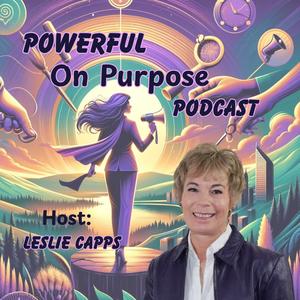

Leslie Capps: Hey, hey, everybody. Welcome to another episode of Powerful on Purpose. I am your host, Leslie Capps and I help experts get known for what they know through the power of the right book. And I wanted to share a little bit of insight today around that, right? And around why I feel so passionate about not only helping people. get the content out of their heads, but also creating systems that help us be better humans. Because before you blame yourself that you can't write the book, you can't make the business work, you can't, whatever it is, maybe we need to examine the system. Because I've come to find that it's usually not us. We're trying to fit ourselves in boxes that weren't built for us. And we spend an enormous amount of time asking what should I be doing? What am I not doing? Like, why can't I make this work? What's wrong with me? And I had this epiphany, I don't want to scare you off too much, but I got involved with an Oracle deck. And it's been fascinating the journey it's taking me on, right? The cards I've pulled, made me realize that behind everything I do is how do we make it simpler, easier? How do we make it so that we get to spend more time being humans, living in the place where our best creativity is instead of doing all these tasks, especially in this age of AI, that could be handled by something else, not. Us right, and the thing for me is friction. Where is the friction hiding? Because friction is information. Sometimes it means it's the wrong thing, but a lot of times it means the system doesn't fit for me. I had a perfect example this week in author lab, right? where one woman who had been coming said, I got some guidance and I've decided to give myself an extra year to write because of all these reasons. And I said, that is great. For me, I want to stab my forking eye out because a month from now, I will be on to 1400. hundred other things. That is how my brain works. And I want to get er done, move on with my life, and have that asset working for me. Two totally opposite points of view and neither one of them wrong, right? But so often we get in systems where you have to do a certain thing. And I think that was true in the case of writing a book in 30 days. Right? I didn't know I could do that, but I knew I had the content and I knew the friction point for me. Cause hand of God, I hate typing. some of you can't see me, but I talk with my hands. And if my hands are typing, they're disconnected from my brain. One. And two, my typing can never keep up with the speed of my brain. Because it connects different things and it says, by the way, I forgot about this. And I was like, well, crikey, I hadn't even gotten down the first thought. So writing in the traditional sense is not a great alternative for me. Now audio to text cha-ching, we got a winner on that one, right? Because I can get the foundation out. Now I can go back and add the squirrel moments, add the stories that I forgot, rearrange things. But getting that foundation out was key for me. Likewise in my business, I'll show people who are watching and those of you who are listening, I got all these little notes right with things scrawled all over them. Well then I would get a pile on my desk and I would have to spend endless time going back again, typing right into my CRM Trying to remember follow-ups, all kinds of stuff. So that was creating a lot of friction, a lot of time, a lot of this pull of I should do it, I don't want to do it, right? It's a soul sucker. So Let's find the system that does work for you. Because whether you're building AI systems or building books, they need to have a clear job, right? Otherwise it becomes a pile of thoughts, it becomes gonna do's, will do's, follow-ups that never happen. we get worn out, we get burned out and it just becomes producers of more noise. And for crying out loud, who needs more noise in this world? And that's why generic books and generic AI don't solve much of anything, right? because the reason AI sounds generic is because you haven't trained it. Now, certainly it has some phrases that we need to knock its head against the wall and try to get those out. But it's incumbent on us to do that training and to push back. And I really encourage everyone to experiment with AI and don't take the generic output. question it. Let it know you. What are the stories? What are the ideas? What are the things that you share that it needs to know? Because a generic AI can't know you. I can use an AI that I haven't used. It's gonna sound generic because it doesn't know me. Now, one I've been using for a long time, absolutely, she can create content that sounds like me. Now I'm not asking her to create the content in a bubble, right? Based on what she knows about me. And I will say up front, I would not allow AI to create the whole book. Only because we need humans in the process. The beauty of AI is I just built a system in my CRM that connects to AI. It does all my admin for me. Freaking hallelujah, right? It literally saved me 10 hours of. physical time and probably 15 hours of mental time a week. But the point is I knew where the friction was. How do I create a system now that helps me get closer to my goal of spending more time creating, spending more time talking with authors, helping them create, helping them see a project that seemed overwhelming be actually attainable and go, wow, when I first started working with you, I thought this was a six month project. And now I can see that I can do this in a couple months. That's what I want to spend my time doing. That doesn't mean every AI is the user's fault and there is no fault here, right? We really were given this amazing tool. We didn't know how to work with it. And we're still learning how to work with it. But I do like to think of AI as a five-year-old with a PhD. She's all excited. She's gonna help you. She's gonna whatever, whatever, She needs very explicit instructions in what you need her to do. I seldom ask what cool things I can do with AI, though I'm sure Appsumo hates me because I test every AI thing and I'm like, nope, that's not what I wanted it to do. Because I'm always asking, what is the problem that I want AI to solve? What is the problem that I want my book to solve? What are the opportunities? Because I don't see it so much as a problem with a book. But what are the opportunities that I want my book to do for myself and my business? Hands down, a book is the greatest personal growth gift you will ever give yourself. You'll learn so much about yourself, you'll learn so much about the way you think, you'll get clarity because you have to, if you're gonna write a book, on the way you think. and who you are and thinking about that reader. You know I get a little geeked out on the books, right? But the goal isn't to make humans better at serving the system, right? The goal is to create systems that better serve humans and better serve us specifically. Because different brains, having worked with a different brain for many years, we need different processes. Not one, go start writing, like stab my eye out with a fork, because that never worked for me. Not in grade school, not in college, not when I first wrote the first book. And even though I had some sort of structure, this sense of getting the words out of my head, how did I do that without the capabilities of technology we have now. So here's my own personal little friction audit, right? So what is repeatedly driving me nuts? And this is also why I created the book system I did too, right? Because I heard this advice, just start writing. Okay. Didn't work for me. It didn't work for 90% of the people that I work with It's Too generic, we end up then with 50,000 words that we don't know what to do with that now, right? And I'll guarantee you your problem isn't writing, your problem isn't time. It's creating the structure and then reverse engineering how much time do we need to implement that structure? Now we can say, it takes X amount of time versus it takes a year. But the second friction point, is there something I genuinely need or want to do? And this is specifically thinking about AI, right? Is there something that I need it to do for me to remove a piece of friction? And if and where exactly does that process break down? So clearly I have this CRM I know how to use it. I have used it for quite a few few years, though it's totally non-intuitive. Not gonna lie about that. but where does the process break down? And how can I remove that breakdown in the process? How much time, energy, attention, or money is this costing me? So it's not only the cost of this system, it's now the cost of us. Creating a structure to write a book, understanding the publishing process, understanding the marketing process, knowing what comes first, knowing what we should have in the book. What about lead magnets? What about, what about, what about? Same with a CRM. I physically know how to get the information in there. That wasn't particularly my hangup. My hang up was then setting aside that time, and I was using time going, ugh, I should be doing that, right? And what do I need to happen instead of it costing me time? For me, it was to build that system where AI and my CRM talked amongst themselves. I told the AI what I needed it to do. She went and did it. Again, that's what I needed to happen. And now, that's what I was able to build. You can tell I'm stoked about that. And what part this is really important, what part still requires my voice, my judgment, knowledge, or humanity? Because granted, I have AI now setting up drafts in my email saying, I told these two people I would connect them. Would you connect them via email? Set me a draft. Because I still as a human, I want to look at that. I want to make sure it's still in my voice. So if any of this friction Has spoken to you whether it's with books, business, and how do we create a system that works for us, right? whether that's AI or not, I've chosen to go that way because why the heck not? Quite honestly. It is available to us. My brain has dropped to its knees and given blessings that we are finally in this age where. robots, can take over some of what we've been doing that has drained the time that we have to be creative. And it did not bring me joy to do that. It brings me lots of joy talking and have AI accomplish those tasks. So I'm doing what I call an AI friction session, whether that's books, business, Or some friction. I'm not sure how and if I could eliminate me, eliminate that. And that's where we start, right? What's the thing driving you nuts? Because I was very clear on what drove me nuts. Figure out what needs to happen, and then let's look at how that could be accomplished. If that's something that calls to you. then reach out to me. Let's have a conversation and see if we can't reduce the friction in your world. Because the world comes with a lot of friction. Let's see if we can't make it simpler for us. So thanks for listening, everybody. on my little rant about let's eliminate friction, let's get our voices out in the world, let's expand our creativity and our ability to do the things we love. And that's help other people. Be sure and subscribe and catch you on the other side.
درباره این اپیزود
What if struggling to write your book or complete something important in your business isn’t a discipline problem?
What if the system simply doesn’t fit the way you work?
In this episode of Powerful on Purpose, Leslie Capps explores friction as useful information.
Sometimes friction tells us we’re pursuing the wrong thing. Other times, the goal is right, but the process we’re trying to force ourselves through was never designed for our brains, energy, or way of creating.
Leslie shares how talking through her ideas helped her write a book in 30 days, while another author chose to give herself a year and why neither approach is wrong. She also explains how connecting ChatGPT to her CRM eliminated at least 10 hours of administrative work each week while removing an even greater amount of mental clutter.
You’ll hear:
• Why “just start writing” doesn’t work for everyone
• How to recognize when the process, not the person, is the problem
• Why generic books and generic AI both create more noise
• How giving AI a clear job produces better results
• Why your voice, judgment, expertise, and humanity still matter
• The questions Leslie uses to identify friction and design a better system
AI should not replace the human. A writing system shouldn’t force every author into the same box. The goal is not to make humans better at serving systems. It’s to create systems that better serve humans.
If you’re experiencing friction around writing your book or somewhere in your business, reach out. Let’s have a conversation about what’s driving you nuts, what needs to happen instead, and whether AI or a different system could make the process easier.
Connect with Leslie: Leslie@lesliecapps.com
Subscribe to Powerful on Purpose for conversations about writing the right book, using AI intentionally, and building systems that fit the humans using them.
CHAPTERS
00:00 When the system doesn’t fit
01:20 Friction is useful information
02:10 Different people need different systems
03:00 Finding a writing process that fits
04:10 Eliminating the administrative drain
05:10 Why generic AI falls short
06:25 Give AI a specific job
08:00 Give your book a job
09:35 Find your biggest friction points
12:10 Protect your human creativity
#PowerfulOnPurpose #NonfictionWriting #AIForBusiness
انگلیسی
ایالات متحده آمریکا
رونوشت 🔗
جستجوی اپیزودهای گذشته
اپیزودهای قبلی Powerful On Purpose را جستجو کن.
سلب مسئولیت: پادکست و آثار هنری تعبیه شده در این صفحه متعلق به Leslie Capps است که متعلق به صاحب آن است و به Listen Notes، Inc وابسته یا تایید نشده است.
ویرایش
از کمک شما برای بروز نگهداشتن پایگاهدادههای پادکست سپاسگزاریم
