


Welcome to Partnered Up: Business Law, Deals, and Dynamics. Welcome back to Partnered Up: Business Law, Deals, and Dynamics with Jeff Fink, Partner at Core and Lichtenstein, LLP and Massachusetts, Jeff advises business owners and partners on formation, growth, and dispute resolution for closely hailed companies. I'm Evan McA today, we're talking about deadlock clauses and what really happens when business partners can't agree on anything, Jeffrey sir. Welcome back. Hey Evan, how you doing? Well, well, Jeff, can you give us an example of a deadlock and a closely hailed business? Are there some kind of decisions that tend to trigger deadlock more than others? So deadlock usually comes up around questions about the future. Fighting over the sale of a business happens a lot. Do we sell? Do we not sell? I had a client who spent well over a million dollars in legal fees trying to resolve that one. Strategy issues, one of the things that comes up there, I mean, sometimes it's just operational strategy, but really it's arguments are not arguments. There are concerns over income or the sale of the business and how do you manage it or you manage it just to get the money out on daily basis or you managing it toward an ultimate sale. It's usually about money but with control issues kind of in the background, but it can be anything. Deadlock mostly comes up with businesses that have operations rather than just financial investments. Other partnerships may have their issues, but they're structured differently, so it comes out differently. And sometimes deadlock happens just because people don't like each other anymore. So how do most partners expect this agreement to get resolved when they're sending up a business? They don't. They don't think about it and they'll just assuming that everything will be great going forward and when it's not, they haven't had some of the hard conversations they probably should have had. It happens a lot. Even when people do bring in lawyers a lot of or they'll pull operating agreement or shareholder agreement forms off the internet. Most boilerplate contracts are either silent about deadlock or just have a boilerplate provision on it that may or may not work for people and they don't think it through. They haven't, nobody's made them sit down and ask these questions and sometimes people don't even know what questions to ask. So what are some examples of how deadlock causes work at a high level when partners reach that impasse that you're talking about? So I'll give you four examples. First one is mediation. A lot of contracts want people to bring in a third party mediator or facilitator of some sort to help smooth things over and sometimes it works. Sometimes it doesn't. Sometimes it's a step toward whatever the next phase of the deadlock clause is and it's actually called a step clause and mediation never hurts because nobody's bound to it. It's just the cost of mediator and the cost of thinking about it in advance. Sometimes you'll have a tiebreaker whether it's some third party who can come in and say this is what you should do or one of the members has a super voting right if there is a deadlock. The tiebreaker provision, well we'll talk about tiebreaker provisions a little more later on but sometimes they work, sometimes they don't. Sometimes you'll see a mandatory sale to a third party basically if somebody wants out they can force a sale. That works okay if you have a defined asset within the business. You own a piece of real estate, for example, if you don't want to run it anymore or one partner wants out, you can say let's put it up for sale. Then of course people can always try to negotiate with each other to divide out. The last one which everybody hates except that nobody can think of a better way to do it. It's called a Texas shootout. You want out, you have to propose a price and either you buy or sell at that price depending on what it is the other person wants to do. So you're giving, you're saying I want out or I don't want to work with you anymore. So I'm giving you the option, do you want to buy me out or do you want to sell to me? So that puts a lot of pressure on both parties, may or may not be the best way to do things. There are variations of that where you're required to, both parties can put in a single bid to some third party who then opens it up and says you're the higher one, you get to buy. Or you have to sell. But there's unfortunately no, there's no one right way to do things with a deadlock clause and nobody really likes them when they get triggered. So what do you often see this deadlock fall short? Can you walk us through a situation where that deadlock clause kind of existed on paper but the business still ended up being stuck? That's a great question. So in one situation with a joint venture, a couple of companies who were involved and they had a tiebreaker come in with the decision and one of the partners, members, JV participants was happier with the result. But the other was so unhappy that it kind of killed cooperation between the two of them. And these two companies that owned the joint venture was running a separate little business but they had done some business with each other in addition kind of outside of this and it affected that as well. So it was all well intentioned technically it solves that problem but it created a lot more. Another situation involved, it took a couple of steps to get there but it required a sale to third parties or to a third party. So they hired somebody to sell the company but as they had to and one of the partners didn't like that concept. And even though he was not supposed to do this, he messed with the process by calling all the likely prospective buyers and said don't bid on this, don't bid on this, I'm going to get this, I'm going to win it. You don't want to be my enemy. And so they backed off. It ended up coming back to bite him because it depressed the price and the other part had brought him out at a lower price than he would have gotten if he had sold to a third party. And actually that was kind of a sad situation because it turns out that the irrational behavior he had was caused by kind of early stage dementia and went downhill pretty fast from there. But people do that even if they don't have those issues but yeah, that cost him. So we talk about it in previous episodes about how emotions dictate things but how do those and personal dynamics between partners go along with that rational thinking and greed to affect whether a deadlock mechanism actually works? Yeah, I mean, you can't discount greed. And you can't discount real rational decision making over what's best for you, what's best for the company. People are making personal decisions if their company is involved in some kind of joint venture. They're making business decisions for them. Not a lot of our decisions aren't rational as much as we want them to be. So if people feel that decisions are bad for the business and bad for them, then all of these factors are factors. They just are. If people don't trust or just don't like their partners anymore, it's going to be a problem. If you have a mediator or a tiebreaker or arbitrator for that matter, and if you will not trust them, it's going to be a problem. The anthropologists say that one of the things that keeps a legal system afloat or any system of rules afloat is that people trust in the process to be fair. And when they're dealing with these deadlock provisions or deadlock mechanisms, sometimes people don't think it's fair. And so that reduces their faith in the whole process. And kind of the last big thing that we do see is, like in that example I mentioned a few minutes ago, if people feel like they can gain the system and they feel like they have the motivation to do it, it may not work. It may not work. So when there isn't a workable deadlock provision, what paths to open up, which is, in which ones create the most damage in your opinion? Another great question of them. Talking is cheap. Literally, negotiating outcome is going to be way, way, way cheaper than anything else that you can do. If you go into anything that involves a court, it's going to ratchet up the cost. And you have to be willing to be on the litigation barrier go around. You need that sometimes. If the parties won't talk to each other, if they won't engage, if there's just a wildly divergent view of what the right outcome is, then you may need a court to step in. Once you do that, though, you have to be concerned about possible personal claims and counterclaims and all that just because lawyers like to have fun. The other thing, and it's an interesting situation, the leading case on this nationally is from Massachusetts concept of manufactured deadlock. You know, I just want out how do I get out? And so you claim there's a deadlock, you do all kinds of things that make it look like a deadlock, but it's not real. And you do that in order to convince a court, it ends the deadlock, you should dissolve this. And the case law lists a whole bunch of factors that the court should look at about whether it's a real deadlock or whether it's a fake deadlock. We've researched it. We've never been able to find a case where the courts have anything other than just cite those factors in the side of the deadlock. So with judicial dissolution, it's not supposed to be a no-fault divorce, but it effectively is. Another thing is there's a possibility of withdrawal or termination or repurchase, depending on what the documents stop you from doing or what they say. There's like a statutory right to withdraw from an LLC in Massachusetts and under certain circumstances and get paid out of a certain amount. And the last answer is, you just live with it and move on. And it might be a good decision. So Jeff, for businesses that want to reduce the risk of getting completely stuck, what kinds of conversations are worth having early before the disagreement started to happen in certain hard and same kind of stuff? Who owns the business? Who gets the money on the sale of the business, which is kind of the same thing? Who gets the money while the business is running? Control stuff. If you're dealing with a business that has individuals involved, you do need to think about the three days in the art, death, disability, divorce, and retirement, and how that's going to affect business and ownership. Do you want an orchard to start off and talk about who runs what and who does what, who has oversight? Sometimes that will work with people kind of to come up with a responsibility checklist of who's doing what. Titles. Titles are important. And sometimes they do the signal control stuff. Sometimes they signal other things, but it's worth thinking about that upfront. And then, you know, you have to ask the question, is it worth the money to develop and document all this stuff that may stop deadlock? Is it worth thinking about what kind of deadlock resolution clause you might want? That's right for you. I would almost always say, yes, I have a bias just because I see things that work, and I see things that don't work. And the ones that don't work don't work. So I would say, yeah, talk to somebody about it upfront and get some advice about what's right for you. Jeff, appreciate your time, sir. Thank you. Have a great day. You too. You too. And that's it for today's episode of Partnered Up. Business Law and Deals and Dynamics. To learn more about Jeff Fink and his work with the business owners and partners at core in Lichtenstein LLP, visit cl-lawgroup.com. Thanks for listening. And be sure to like, leave a review and subscribe to the show so you do not miss the next episode. Thank you so much. We'll see you next time. See you. Thanks for watching. Be sure to hit that like and subscribe button and leave us a review in the comments.
درباره این اپیزود
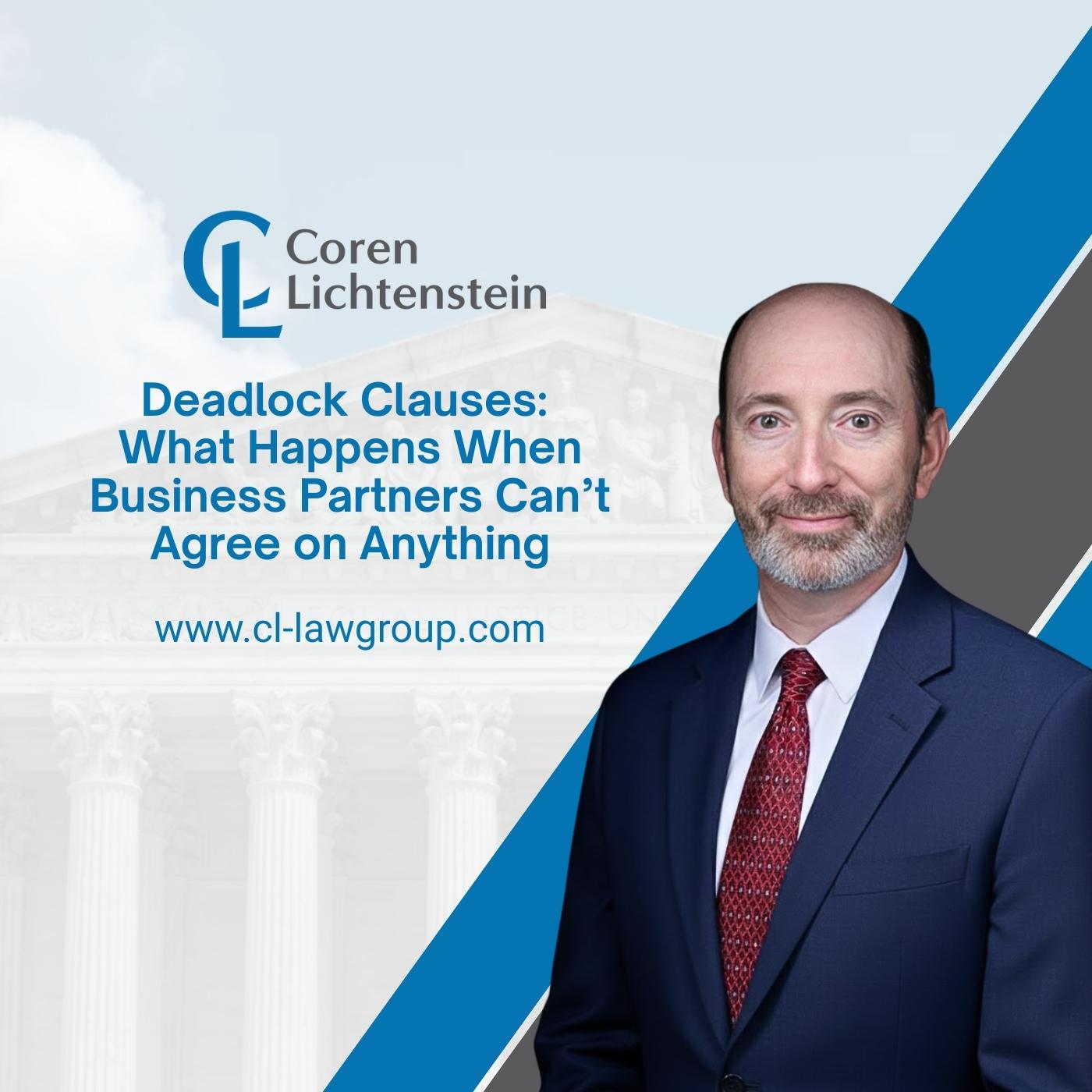
Episode Summary:
In this episode of *Partnered Up: Business Law, Deals, and Dynamics* attorney Jeff Fink delves into the complexities of deadlock clauses in closely held businesses. He highlights how disagreements on critical decisions like business sales and strategies can lead to deadlocks, often exacerbated by control issues and personal dynamics among partners. Jeff also shares insights on common deadlock resolution mechanisms such as mediation, tiebreakers, mandatory sales, and the infamous "Texas shootout." Through real-life examples, he underscores the importance of proactive communication and well-defined agreements to prevent deadlock impasses, offering valuable guidance for navigating partnership challenges.
Key Timestamps:
00:00 – Introduction
01:30 – Types of decisions triggering deadlocks
03:45 – Examples of deadlock scenarios
06:20 – Resolution mechanisms: Mediation, tiebreakers, and more
09:15 – Impact of emotions and personal dynamics on deadlock resolution
11:45 – Consequences of ineffective deadlock provisions
14:00 – Paths to resolution: Negotiation, litigation, and withdrawal
16:30 – Precautionary conversations for preventing deadlocks
About the Show:
*Partnered Up: Business Law, Deals, and Dynamics* explores the intricate dynamics of business partnerships, offering insights on legal strategies, deal-making, and operational challenges. Hosted by Jeff Fink, a seasoned attorney at Coren Lichtenstein LLP, the podcast provides valuable guidance for business owners and partners on navigating complex partnership issues. Tune in for practical advice and in-depth discussions on sustaining successful business collaborations.
انگلیسی
ایالات متحده آمریکا
رونوشت 🔗
جستجوی اپیزودهای گذشته
اپیزودهای قبلی Partnered Up: Business Law, Deals and Dynamics را جستجو کن.
سلب مسئولیت: پادکست و آثار هنری تعبیه شده در این صفحه متعلق به The Legal Podcast Network (LPN) است که متعلق به صاحب آن است و به Listen Notes، Inc وابسته یا تایید نشده است.
ویرایش
از کمک شما برای بروز نگهداشتن پایگاهدادههای پادکست سپاسگزاریم
