
درباره این اپیزود
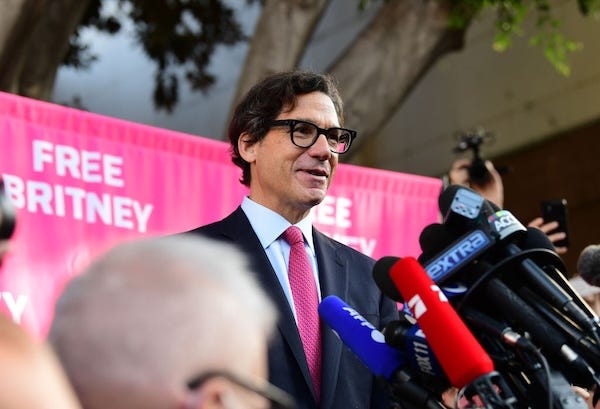
Five years ago this fall, Mathew Rosengart made international headlines when he secured the termination of the 13-year conservatorship of pop icon Britney Spears. But while he might be most famous for how he helped #FreeBritney, Rosengart has litigated many major matters over the years, representing clients ranging from Hollywood celebrities like Sean Penn and Selena Gomez to multinational corporations like Meta and Verizon.
How did Mathew, co-chair of the media and entertainment litigation group at Greenberg Traurig, get to where he is today? Last week, I had the pleasure of interviewing him about his remarkable career. We discussed his clerkship with David Souter, then a justice of the New Hampshire Supreme Court; his service as a federal prosecutor, where he handled several high-profile cases; and his current practice at the highest levels of entertainment law and litigation.
Thanks to Mathew for joining me on this must-listen episode of the Original Jurisdiction podcast.
Show notes:
Mathew S. Rosengart bio, Greenberg Traurig
Mathew Rosengart, Hollywood’s King of Litigators, Talks Britney Spears Conservatorship, Early Legal Influences and Standing Up Against Bullies, by Malina Saval for Variety
The Man of Steel, by Elizabeth Gehrman for BC Law School Magazine
Justice Souter’s book list, by Mathew Rosengart for SCOTUSblog
Sponsored by:
NexFirm helps Biglaw attorneys become founding partners. To learn more about how NexFirm can help you launch your firm, call 212-292-1000 or email careerdevelopment@nexfirm.com.
Three quick notes about this transcript. First, it has been cleaned up from the audio in ways that don’t alter substance—e.g., by deleting verbal filler or adding a word here or there to clarify meaning. Second, my interviewee has not reviewed this transcript, and any transcription errors are mine. Third, because of length constraints, this newsletter may be truncated in email; to view the entire post, simply click on “view entire message” in your email app.
David Lat: Welcome to the Original Jurisdiction podcast. I’m your host, David Lat, author of a Substack newsletter about law and the legal profession also named Original Jurisdiction, which you can read and subscribe to at davidlat.substack.com. You’re listening to the 105th episode of this podcast, recorded on Friday, September 11.
Thanks to this podcast’s sponsor, NexFirm. NexFirm helps small and midsize law firms offer Biglaw-caliber benefits at small-firm prices. To learn how NexFirm can improve your employee benefits program, call 212-292-1002 or email betterbenefits@nexfirm.com. Want to know who the guest will be for the next Original Jurisdiction podcast? Follow NexFirm on LinkedIn for a preview.
My guest today is Mathew Rosengart, co-chair of the media and entertainment litigation group at Greenberg Traurig and one of the nation’s preeminent litigators. His clients over the years have included numerous celebrities, including Sean Penn, Keanu Reeves, Winona Ryder, Steven Spielberg, Eddie Vedder—and, most famously, the singer and pop icon Britney Spears.
In our conversation, Mathew and I discussed his clerkship with then-Justice David Souter of the New Hampshire Supreme Court, a crucial formative experience; Mathew’s service as a federal prosecutor, including his work on a high-profile campaign finance case; and his fascinating and diverse practice as a media and entertainment litigator, representing both high-profile individuals and major corporations. Without further ado, here’s my conversation with Mathew Rosengart.
Mathew, thank you so much for joining me.
Mathew Rosengart: Thank you, David. It’s my pleasure to be here.
DL: Tell us about your background and upbringing. Where did you grow up?
MR: I grew up in Lido Beach, which is a small town on the south shore of Long Island in New York, about 25 minutes east of New York City. I was the jock of my family; my brother today is a very prominent heart surgeon and research scientist, and he was the scholar.
Lido Beach was an idyllic little town. I was fortunate, as an athlete or wannabe professional athlete, because there were about 10 kids in my neighborhood who were just about my age, all of whom were pretty good athletes. Growing up, athletics was my focus, and we’d play basketball or baseball or football after school, depending on the season.
My father was the town OB-GYN, so occasionally I would run into people in restaurants to whom my father might’ve had some nexus or connection. It was a great, idyllic, supportive childhood.
Not to get on the couch too much with you, David, but in thinking about this interview, I reflected on how a defining moment in my life, and maybe to a lesser extent in my career, is how my father, this prominent surgeon, died when I was 13 years old. He was 46 and had an unexpected heart attack. The happy ending to the story is that my mom just a few years later met somebody who was wonderful. He became my stepfather (a term I’ve never really liked), and a few years after that, he put me through law school and my brother through medical school, and he did it with a smile.
DL: I’m glad to hear that that turned out well. So you mentioned your late father was a doctor, and your brother is a doctor. Why did you go to law school?
MR: Well, my brother had the science gene. I think it was pretty clear given that my father was a professional that I was going to be a professional myself and in my household, that meant law or medicine. And I definitely didn’t have the science gene. I was always competitive though; I was a competitive athlete, as I mentioned. I frankly liked to argue, as my friends would say back then, and my colleagues and friends would reaffirm that today.
I love to read. This might not be original—it’s something of a cliché—but when I read To Kill a Mockingbird, I kind of fancied myself as a future Atticus Finch in terms of how he presented himself, as well as the causes that he took on. I also remember very clearly reading Inherit the Wind when I was pretty young, which also made an impression on me. So it was a combination of those factors that led me to pursue becoming a lawyer and carving my own path.
DL: And we’re going to see some parallels between the fictional character of Atticus Finch and your own career. So when you went to BC Law School, did you think then that you wanted to be a courtroom lawyer?
MR: I knew that I wanted to be a trial lawyer. And thinking back—and I was speaking at Harvard Law School not long ago when this came up—when I was in law school, I don’t know about you, you might’ve been more sophisticated than I was, but I felt litigation was it. I didn’t realize that there were so many areas of law and that litigation was actually a small component, because that’s how law school is geared. So I knew that I wanted to be a litigator, I knew that I wanted to be a trial lawyer, but I hadn’t really focused on any particular subject matter at that point in time.
DL: Your first job out of law school definitely set you on the path to being a great trial lawyer. Tell us about that.
MR: I had the great luck—and luck has been a component in my career, and I think the careers of a lot of people—of interviewing with the great Justice David Souter, who at the time was serving on the Supreme Court of New Hampshire. It was shortly before he was elevated to the First Circuit, right before he went to the U.S. Supreme Court. And it’s an interesting story.
I wanted to serve as a law clerk. That was the coin of the realm if you wanted to be a litigator (and I think it still is, to an extent). And I was on the verge of accepting a federal clerkship, which was the prestigious thing to do.
David Souter always took one law clerk from Boston College Law School—where his mentor, former Senator Warren Rudman, went to law school—and one from Harvard. And Justice Souter and I met, and I remember the interview like it was yesterday. And I’ve made some mistakes along the way, as we all do, in terms of judgment calls, but I made the judgment call to go with this relatively obscure state court judge named David Souter rather than taking the federal clerkship. And a lot of the success I’ve had, to the extent I’ve had success, I attribute to that experience.
[UPDATE (4:20 p.m.): I was delayed by a day in posting this episode, mainly because I was down in D.C. to moderate a panel at the SCOTUSblog Summit yesterday, and I apologize for my tardiness. But it did give rise to a felicitous coincidence: I posted this episode on September 17, which happens to be Justice Souter’s birthday.]
In terms of the interview, here’s what I remember. I think I can convey it, although I’ll claim privilege as to some details—and I think this is what got me the job. He asked me point-blank a very difficult question. I wonder what you think of it and what your answer might’ve been—probably more articulate than mine. He said, “Mr. Rosengart”—with that deep Yankee accent—“if you could reverse any Supreme Court decision over the past 50 years, what would it be and why?”
Tough question, right? So I probably had a bead of sweat running down the middle of my forehead as I grappled with the answer—and I still remember what it was. I won’t bore you with the details, but it related to a case that I had just read in my criminal procedure class. But I think what got me the job was I had the temerity to turn the question around on him. I said, “Justice Souter, if you could reverse any decision of the Supreme Court in the past 50 years, what would it be and why?” And he answered the question, true to form, but I’ll claim privilege on what his answer was. But again, I think it was sort of the impudence or confidence that he saw in me in asking him that question that led him to extend the offer.
DL: It’s interesting, the relationship between a judge and a clerk. I recently watched a testimonial he gave for you at the Beverly Hills Bar Association dinner, when you were honored with an award. And even though he was a former Supreme Court justice and you were his law clerk, back when he was on the New Hampshire Supreme Court, he spoke of you very warmly, with great admiration and affection—but really as a peer, as a very close friend.
MR: It was an extraordinary relationship, and I’ve been thinking about it a lot over the past year, since he passed away last May. And in fact, it’s this time of year when we would be getting together for our annual, very small, intimate reunions—with just my co-clerk, myself, and Justice Souter. When he hired law clerks, he really intended for them to become friends. He looked for individuals who were confident, who were smart, and who would be good clerks. But he really wanted to hire people whom he thought he would get along with personally.
My clerkship was an extraordinary year. I clerked from 1987 to 1988, and I remember sitting on my end of the chambers one day, and the headline on the front page of the New York Times was, “New Hampshire Justice Seen as Leading Contender for U.S. Supreme Court.”
Typically, at the end of a clerkship everywhere, but in New Hampshire in particular—where I served, in Concord—you would take your judge to lunch or vice versa, and shake hands and maybe give a hug, and that would pretty much be it. But we had such an alchemy during that extraordinary year, and my co-clerk and I decided that lunch just was not going to be enough.
So with a little bit of subterfuge, we convinced Justice Souter—who, although a lovely, warm, funny, witty, incredibly decent man, had this sort of Yankee veneer and didn’t like a lot of largesse—to let us take him to dinner in Boston, rather than going to a more mundane lunch on Main Street in Concord. What he didn’t know was that we were going to pick him up in a chauffeured limousine, at his sort of ramshackle house in rural New Hampshire. And on the way down, we decided to, at his direction, have drinks at the Ritz-Carlton, which I’m sure you know was on the Public Garden, and then have dinner at his favorite restaurant, the venerable Locke-Ober, which had been there for a couple of hundred years—visited by the Kennedys and Oliver Wendell Holmes and Justice Souter, when he was at Harvard and Harvard Law School.
And every year, starting with that year, after the drinks at the Ritz-Carlton, we would walk across the Public Garden and the Boston Common and admire, right in front of the Massachusetts State House, the beautiful, and frankly very moving, Augustus Saint-Gaudens sculpture of Robert Gould Shaw and the 54th Regiment, and then walk down the street to Locke-Ober and have dinner. And that was preceded every single year, for 30 years or so, by a hike, just the three of us, in the White Mountains. It was a different mountain every year, in the Presidential Range, and it was on those hikes that we would just talk about everything. He was interested and interesting, and it really was a special relationship.
And to the extent, again, that I’ve had success in court or outside of court, I’d chalk it up to that experience and the confidence that it gave me as a lawyer. So thanks for asking; I apologize for the long-winded answer, but I could go on for an hour.
DL: Oh, absolutely—and I could interview you for an hour just on this topic. I would refer people to (and I will put in the show notes) this wonderful essay you wrote for my husband Zach’s publication, SCOTUSblog, containing Justice Souter’s book recommendations. He was a great reader as well as an avid hiker, and I think he had some structural issue in his house because I guess the books were too heavy for the shelves or something like that?
MR: He had so many books that when he retired from the Supreme Court in Washington and moved back to New Hampshire, he was told by an engineer that the house—the ramshackle house that had been in his family for a very long time—could no longer support the books that he had gathered over the years, literally thousands of books. So he had to move.
DL: Exactly. So where did you go after that? That’s a pretty tough act to follow. Where did you go after your clerkship with Justice Souter?
MR: As I said, my brother was the scholar in the family; he was the guy who literally got a 1600 on his SATs and was a heart surgeon at 23 years old. So the clerkship with Justice Souter really was a break for me. As a result of that, I was able to get into the Department of Justice. At the time, it was obviously very, very competitive to get in through the DOJ Honors Program.
I worked at the DOJ Civil Division, and it was great. The downside to me of being in the Civil Division, as terrific as the experience was, was that you don’t really get to court as much as you do as an assistant United States attorney. And that was always the dream—which was, again, cemented during my clerkship year. There was a book that I remember called Main Justice, about what federal prosecutors do, and I’d recommend that to young listeners in the audience. It’s really a job that I held in high esteem.
So I became an assistant U.S. attorney in Florida, after serving for three years in the Civil Division, and was happy as a clam. I was the guy who would try any case: “Let’s give this dog of a case to Matt. He’ll go try it.” Back then, we were in the middle of what was coined the war on drugs. There were so many cases, and there was a real initiative at the time, from the attorney general and the Clinton administration, to try gun and drug cases. And sometimes I would close a case, presenting a summation in the morning, and then maybe deliver an opening statement in a different case that very afternoon.
The cases that I tried in my first year were not particularly complex. But I think I tried 10 or 12 cases in one year—and I was able to do that because, again, they were not sophisticated white-collar cases—and what they did do was give me an opportunity to address judges and juries on my feet. And of course—again, a cliché—I always dreamed of being able to stand in front of the flag and say, “My name is Mathew Rosengart, and I represent the United States of America.” So that was the early part of my career.
While I was an assistant U.S. attorney in Florida, one of my mentors was a lawyer named Mark Jackowski—this legendary, eccentric, quite famous character, who had tried the BCCI case, at the time the largest money-laundering case in the country. Mark asked me to move to Washington, where I worked with him on one of the special-prosecutor—or as they were called back then, independent-counsel—cases.
So that was essentially my tenure at DOJ. I handled one more matter, working out of what was then the Public Integrity Section, a high-profile case called United States v. Riady—something else I can talk about as well for a while, but I’ll leave it at that. But that was really the formative experience of my career and what gave me the tools to become a litigator in any subject-matter area.
DL: Tell us about the Riady case, actually, because I’m old enough to have remembered that case. It was a big deal at the time that it happened.
MR: It was a big deal. It was a fascinating case. I was fortunate to be appointed lead counsel by the supervisor in that unit, who was Bob Conrad—also a legendary litigator and U.S. attorney in North Carolina, who later became a federal judge. James Riady was this sort of mysterious Indonesian billionaire who allegedly gave Bill Clinton a million dollars in cash in the back of a limousine. There were all sorts of fascinating theories on behalf of the FBI agents at the time that Bill Clinton might’ve actually been the Manchurian candidate, because where did James Riady befriend Bill Clinton? Little Rock, Arkansas, of all places, before Clinton even became governor, when he was just an anonymous attorney general.
So it was a really interesting case for many reasons, also because of what it led to: the result of the case was a felony conviction of, again, this Indonesian billionaire, who was essentially beyond the extradition power of the United States. But nevertheless, we somehow got him to plead guilty to a felony and obtained the largest fine in the history of campaign finance cases—I think in part because what we held out through the State Department, which was the prospect of him having the opportunity to come back to the United States to visit friends and family. I don’t know if that carrot ever came to fruition, but I think that’s what enticed him to plead to the felony. [Ed. note: Riady pleaded guilty in 2001; in 2009, he did make two return visits to the U.S.]
Probably the other fascinating matter worth mentioning—at least in terms of what I was able to do there—was working for one of the independent counsels during the Clinton administration. Back then, and I might be dating myself, that’s when Bill Clinton was being investigated by Ken Starr in connection with Whitewater and Monica Lewinsky. I worked on another matter, an independent-counsel investigation of former Secretary of Agriculture Mike Espy. It seemed like almost every cabinet officer had a special prosecutor or independent counsel investigating him or her at the time, which may have led to the amendments that eventually supplanted the independent-counsel statute with the special-prosecutor framework.
But I was at that point being brought up from Florida to detail to the special prosecutor or independent counsel’s office, about 33 years old, and with my colleague Mark Jackowski, took the lead. And within a couple of months—at that young age, as a junior prosecutor who had done just drug and gun and violent-crime cases—I put in the grand jury people like Warren Christopher, the former secretary of state, and Leon Panetta, who at the time was a retired former head of Clinton’s Office of Management and Budget, but was involved in the transition. So he was a relevant witness, as was a gentleman named Webster Hubbell, who was the number-three person at DOJ, and the great Lloyd Cutler, who was head of the White House Counsel’s Office or the White House counsel. So it was very heady stuff for a 33-year-old, ambitious federal prosecutor, and a great experience.
DL: And then where did you go after your time in government?
MR: After my time in government, after deciding to be perhaps the only individual who declined an offer from the Southern District of New York (which is another story), I decided to go into private practice. I felt like I had achieved what I wanted to as a federal prosecutor and working as a trial attorney at DOJ.
I worked at O’Melveny & Myers in New York and had a terrific experience there, but reached the point again where I wanted to carve my own path, focusing on media and entertainment litigation and representing individuals in that space. And that led me to Los Angeles and ultimately Greenberg Traurig, where I am now.
DL: I believe you entered private practice exactly 25 years ago this year—because this is 2026, and you left the government in 2001 or so.
MR: You’re dating me, and as I was thinking about this interview and looking at my notes, somewhere you wrote something about my 40 years of practice, which is a little bit scary, but it’s correct.
DL: Well, I do think that being a great trial lawyer involves just getting your reps. You talked about just having those nine, 10, 12 jury trials in a year. With the advent of AI, people are talking about how junior lawyers are going to learn, and some of this is just a matter of getting your reps and doing things like those very simple drug and gun cases—and that’s what allows you to build up to some of the complex matters that you handle now on behalf of multinational corporations and celebrities.
MR: There’s no doubt about it. These days, people refer to me as a media and entertainment litigator, which I am for sure, but I consider myself a litigator and a proud generalist, which maybe isn’t so common anymore. And to me, I’m a trial lawyer, and if somebody asks me what my specialty is, I don’t necessarily say media and entertainment litigation; I say that being a litigator and being a trial lawyer is a specialty. And it’s those tools that I learned at DOJ, and frankly, just in getting to know Justice Souter so well during the clerkship and after, that gave me the tools to become a litigator and an expert—sometimes for just a short period of time—in any given space.
As I was thinking back in connection with this interview, I remember a case that I tried in New York not that long ago for Credit Suisse, and the case was quite high profile. It was an arbitration and the lead claimant in the case was Ronald Lauder, the well-known billionaire, and about 10 other centimillionaires or billionaires. And the case involved whether my client, Credit Suisse, which back then was in its heyday, had made misrepresentations in offering documents in regard to its alleged promise to provide so-called “sophisticated hedging techniques,” whatever that might mean, to ensure that their investments would perform well.
David, I went back when I got that case and it landed on my desk and I literally did a Google search on what sophisticated hedging techniques were. This is literally rocket science. And I had to learn about things like swaps and all sorts of complex, various sophisticated hedging techniques, which I did not understand at the time—straddles, strangles, interest-rate swaps, and so forth. And what I did was I found a world-class expert and I studied, and I became, for a short period of time, a world-class expert myself in that subject-matter area. And for 15 minutes or maybe a couple of months, nobody in the country knew more about sophisticated hedging techniques than I did, including the expert that Ronald Lauder and the billionaire and centimillionaire claimants had retained. And yes, I cross-examined their expert and won the case, which is probably why I’m telling the story. But the point of the story, to me, is that’s what a litigator does and that’s what a litigator is.
And yes, it’s the experience at DOJ that gave me those tools, which I think are transferable to any particular space. Now, don’t give me a patent case—I think that’s one subject-matter area that I wouldn’t be able to delve into, since as I mentioned, I don’t have the science gene. But whether it’s a securities-fraud case, an entertainment case, a trust case, or a probate case, to me, it’s all litigation.
DL: I have a couple of thoughts. I do think you can handle a patent case. I’ve interviewed a number of IP lawyers over the years, and some of them come from a hard-science background, but some of the most successful ones have not. And they say, “If I can understand the case as someone who doesn’t have a science background, that’s good because then the jury or the judge can understand the case.”
Your point about the Lauder case is a very interesting one because we like to think of the glamour of standing up in court and shredding somebody on cross-examination, but we often overlook how there’s so much preparation that goes into that. You’ve talked in past interviews about how for every hour of time you spend on your feet in court, you are spending many hours preparing and immersing yourself in things like swaps—and I can’t even remember all the other technical terms you bandied about.
MR: I’ve never done the math, but preparation is everything—and I think a lot of my peers and colleagues who’ve had any modicum of success would agree. In my case, it makes up for whatever shortcomings I might have in other areas. It’s what allows you to be confident. It’s what allows you to put yourself and, more importantly, your client in the best position to win. So preparation can make up for a lot, and relatedly, there’s absolutely no substitute for it.
DL: If you’re the managing partner of a boutique or midsize law firm, attracting and retaining great people is your most important responsibility. Competing with Biglaw for talent is difficult when your benefits don’t measure up. NexFirm helps you offer Biglaw-caliber benefits at a price built for smaller firms. To learn more, call 212-292-1002 or email betterbenefits@nexfirm.com.
I recently interviewed another successful trial lawyer, and he said, “I want to be the person in the courtroom who clearly knows more about the case than any lawyer, any witness, anyone—and that just gives me so much credibility with the jury.”
So you talked about becoming an expert in areas that maybe you had no exposure to, which brings me to what is, I think, your most famous case. We’re recording this in September of 2026. Five years ago this month, you won a huge victory when Judge Brenda Penny granted your motion to suspend Jamie Spears immediately from his position as conservator of his daughter, the singer and pop icon Britney Spears. And I believe that you had never handled a case involving probate or conservatorship before you stepped into the most famous probate or conservatorship case of all time.
MR: Yes, it was an extraordinary experience. As I’ve said before, of course I knew where the courthouse was because I had been there so often, but I didn’t know where the courtroom was. And no, I was not an expert in probate law or conservatorship law, but it’s a good example of how so long as you’ve got the litigation tools and you’re willing to put in the work and you’re willing to prepare, you can have the expertise, or gain the expertise, in any subject matter.
I had a team, of course, of colleagues who were experts in probate and conservatorship law. And to me, not having a background in the area turned out to be an asset rather than a detriment. I say that because I came at it from a different perspective; I wasn’t part of that insular bar. And I came at the case, which had a lot of thorny, byzantine issues, from the perspective of an aggressive commercial litigator.
And I think it’s that mindset that enabled me to set a strategy, frankly, that was different than the strategy that might’ve been set by somebody who was more steeped in traditional probate and conservatorship practice. And I came at it like a federal prosecutor would come at it, and I think that’s what helped lead to the result that we obtained in that case.
The first issue that I had to address in court—which was on July 14th, 2021, not that I remember the date—was whether Britney Spears, this iconic person and entertainer who literally had been earning, around that time, tens of millions of dollars performing in Las Vegas, had the right to her own counsel. Up until that point in time and that hearing, she had been deprived of that right, literally deprived of the right to her own counsel, for 13 years, during this very controlling, onerous conservatorship.
Did she have the right to counsel? Should she have the right to counsel? In terms of preparation, I was up until two in the morning many nights before the hearing because it was a condensed period, reading up on cases like Gideon v. Wainwright on those issues. It was just an odd issue to have to address. And the second issue was if in fact Britney Spears, like everybody else, had the constitutional right to counsel, should that counsel be myself.
In terms of how I looked at the case, again, I didn’t do just the ordinary things that a classic probate lawyer would do. For example—and I took some heat at the time for doing this—rather than seeking to terminate the entire conservatorship in my first motion, which is something that would’ve been, if we were playing checkers rather than chess, what we would’ve done or what a traditional probate lawyer would’ve done, we decided to bifurcate the process, which was a strategic decision. And what I mean by that is we sought to remove Britney’s father as conservator, just picking off that piece, which is what led to a much more expeditious unwinding of the conservatorship.
DL: If I recall the timeline, you were retained in July. By September, you had her father removed as conservator. And then by November, you had the entire conservatorship terminated—this onerous 13- or 14-year conservatorship, where Britney did not have control of her own life and her own affairs and the millions she was generating (and by the way, I did see her show in Las Vegas, and she was fantastic). You did that in a matter of months. You ended this onerous 13- or 14-year conservatorship in July, August, September—just a matter of months.
So I do see your point about the constitutional issues. You’ve said in past interviews, and you said just now, that you didn’t really consider this an entertainment law matter per se, even though you are one of the foremost entertainment lawyers or litigators in the country, but it was a case to you that I think had a lot of constitutional and civil-liberties dimensions.
MR: There’s absolutely no doubt about it, and that’s what got me interested in the case in the first place and led me to embark on the endeavor along with Britney. The profound questions included why should this person not have the right to counsel? And I was listening not long ago to an interview that David Boies did, and he used a great phrase, which probably wasn’t original, but it’s the first time I had heard it or the first time it resonated with me. He was asked what he looks for in cases. Not that I’m making the comparison between myself and David, but he said, “At this point in my career”—and he’s 85, or somewhere north of 80—“I try to find cases that move the law.” And I thought this was a case that could actually move the law.
Why shouldn’t Britney Spears have the right to counsel? Why should Britney Spears or anybody in a conservatorship not have the ability to date whom they want to date, to eat what they want to eat, to spend money how they want to spend money? These were all profound questions to me. Another question that occurred to me was, was there a misogynistic component to this case? Was Britney Spears put into the conservatorship and kept within the conservatorship for 13 onerous years, as you rightly said, because she was a woman? Would that have happened to her if she were a man?
So those were all fascinating questions to me that really had nothing to do with entertainment law at all, despite the sensational nature of the case. And I’m happy to say that we worked together, and I always give Britney the credit for what she did in speaking out, which led to my retention and ultimately the removal of her father and the termination of the conservatorship. She was very courageous.
And as a result of this case, in terms of moving the law, Gavin Newsom shortly after we won the case signed legislation, changing the law and empowering conservatees (they’re called wards in New York, but in California, they’re called conservatees). And what I mean by empowering—and I really became steeped in the community—is restoring what I call the dignity of risk to individuals who are wards and conservatees.
The first thing I learned as I studied and again prepared to become an expert in this space was a conservatorship is really supposed to be a last resort. It’s really there for individuals who have some form of dementia and just do not have any capacity to take care of themselves. And what you’re also supposed to do as a conservator controlling the estate on the financial side or the person on the individual side is continually look for an exit plan, an exit strategy. And what I saw at the outset was that had not been done. She was kept in this conservatorship, again, for 13 years.
So it’s a long-winded answer to your question, but that’s the way I and my team attacked it. And I’m proud to say, five years later, that we did move the law in the right direction.
DL: In terms of moving the law, I think you definitely did, because what I would say that we’ve seen in the past five years—and you mentioned of course the California action by Governor Newsom—is a national conversation about conservatorship. There were articles in the New York Times and the New Yorker. There were legislative proposals and actions across the country. Britney’s case was rather unusual because she was a young, famous, wealthy woman, whereas a lot of this falls under the category of elder abuse. But a lot of people who have lives that are nothing like Britney Spears’s also benefited in a way from the change that this case ignited.
MR: There is no doubt about it. And one of the corollary benefits of working on the case and succeeding, which I didn’t expect, is that some charitable and public-interest groups reached out to me. One was Disability Voices United, and they came to me to see if I would be willing to be an advocate, again, to restore dignity to people who were put in this situation. And I was happy to do that and work on legislation along with them that Gavin Newsom, as I mentioned, ultimately signed.
In terms of elder abuse, it’s out there. There is a cottage industry, just speaking more broadly than the Britney case, of individuals throughout the country being placed into guardianships or conservatorships, losing control. And there are people around who control the guardianships or conservatorships who don’t really report to anybody. They theoretically report to a court, but what I learned is courts are often more passive than they should be.
So it was fascinating. I received calls from Congress. The case really became part of the national and international zeitgeist. I received calls from Senator Casey, from Senator Warren. It really was a New York Times case that at some point became a case again that fell within the spheres of entertainment and a really important case. And again, it was terrific working with Britney. And it’s a case that I’ll always be proud of because it shined a light on a real national problem.
DL: To move on from the very serious issues about being deprived of your counsel of choice and conservatorship abuse, because of this media maelstrom, you wound up becoming part of the story in a way….
MR: Not intentionally….
DL: No, not at all; you have always been very respectful and careful in terms of Britney and protecting her privacy and her interests. And I’ll be honest, I think a lot of other lawyers would’ve really milked this. But despite your attempts to exercise some discretion, people were including you in memes, late-night comics were joking that Britney had found herself a nice Jewish lawyer, and people were coming up with nicknames for you like “Rosengod” and “Zaddy” (people can look that one up).
So I guess my question is, after years of representing celebrities, how did it feel to you to become—at least for a time, and maybe from that time since—sort of a celebrity in your own right?
MR: Well, I don’t know if I accept the premise, although I guess that’s been said of me being a celebrity in my own right, but it’s only now that I’m actually coming to terms with some of the really nice things that have been said. Back then, I was in the zone, going back to growing up as an athlete or a wannabe athlete. I’m not sure if the listeners are familiar with that term, but what I mean is I just had an insular or singular, I should say, focus. I remember getting back from court the day of that hearing on July 14th, 2021, and there were dozens of messages. And then I got to maybe the 27th or 28th message. It was from famous network journalists wanting me to go on. And I don’t know why they wanted me rather than Britney, but I made a decision that I wasn’t going to do that.
And then there was a message, maybe number 32, from the head of my firm, and I wasn’t sure if it was going to be a good thing or a bad thing; although he was and is a friend, it wasn’t the norm for him to call. And he said, “Matt, I just got a call from someone at Reuters, who told me, ‘Your partner, Matt Rosengart, is now handling the biggest case in the country.’” And as the CEO of my firm, Brian Duffy, recounted to me what he was told by someone at Reuters, he said, “Matt, I’m just conveying this to you. No pressure, don’t f**k up.” (I hope I can use an epithet on your show; when I told that story in a different way, saying that Brian had said, “Matt, no pressure,” Brian said, “No, Matt, what I said was don’t f**k up.”)
I don’t mean to sound flip, because it was obviously so important, and it was quite intense. But the other thing that Brian told me—which I always kept in mind, and I’d like to think I would’ve known and respected it anyway—was, “Don’t get caught up in that stuff.” At the end of the day, it’s about the facts, the law, the courtroom, and the client, the client, the client. And I’d like to think we all keep that in mind in every case. But when you wake up one day and you receive a call from a friend of yours who’s in Paris, and he says, “Matt, your picture’s on the front page of Le Monde,” it’s all the more important to keep that in mind. And I’d like to think that I really did that throughout the case.
DL: You mentioned that the head of your firm told you, “Don’t mess this up.” This could be a question for the Spears case or it could be a question more generally: Do you get anxious? You have these high-profile cases, they’re in the media, and people are counting on you. Britney Spears was literally counting on you for her personal freedom. Do you get anxious?
MR: I don’t get anxious. Going back to the word we use, “preparation”—preparation to me overcomes any anxiety. What I do get is butterflies before I go to court or even right before I file a brief. I always get that, in every case. And not that I’m comparing myself to Michael Jordan, but Michael Jordan would say the same thing; he was the greatest athlete in the history of sport probably, and he would still have butterflies before game seven of the NBA playoffs. So if you don’t feel that, I think something is wrong, and maybe it’s time to take a step back.
So I would get butterflies; I would not feel nervous or anxious. I would want to be in the courtroom and in the midst of it, but again, blocking that stuff out, focusing again on the law, the facts, the courtroom, and the client, the client, the client.
DL: That’s a good characterization: butterflies. I give talks or speeches, and I wouldn’t say that I get anxious, but I get excited, I get jazzed up, I feel the adrenaline pumping, so I totally get that.
My other follow-up question relates to the media, the global media—because when you’re on the front page of the newspaper of record in France, it’s global. Because of your clientele, a lot of your matters end up in the news. And so my question is, do you have an overall approach to dealing with the media?
The conservative or old-school approach is to speak through your court hearings or your filings. And some very high-profile lawyers whom I’ve had on the show—like Alexandra Shapiro, who represented Sean Combs—have said that that’s their approach. But then I’ve had other guests who say, “Look, in an age of 24/7 media and social media, you’re representing these clients whose livelihood depends in many ways on their public image, so you do need to enter the court of public opinion as well as the court of law.”
Where do you fall on that spectrum of “I speak in court and I speak through my court filings” versus “I’m going to give a press conference every time I emerge from the courthouse”?
MR: It’s a great question and it’s a really timely question, especially given social media, and it’s something that I deal with all the time given the nature of my practice. When I was in law school, I read a book which I’d recommend to your listeners called The Man to See, written by Evan Thomas. And the man to see was Edward Bennett Williams, who obviously founded Williams & Connolly. And I remember when I read that book, and I think I was at DOJ at the time actually, I was very impressed by the elegance of the Williams & Connolly way as articulated by Edward Bennett Williams and later Brendan Sullivan, which was, “We do our talking in the courtroom.”
Again, this was pre-social media, and it was before the 24/7 news cycle—but I just felt like that had an integrity to it, and it still does have an integrity to it. But when you’re working high-profile cases in the age of the 24/7 news cycle, I don’t think you’re doing your job as a litigator if you’re not conscious of media and social media. And I don’t mean that you play to media or social media, but you’ve got to be aware of it, and if you’re not, you’re not zealously representing your client.
And in fact, the United States Supreme Court endorsed, as far back as 1991, the necessity of lawyers to be able to communicate to the press without crossing ethical boundaries in order to discharge their duties zealously and properly. It’s an entirely separate interview to discuss how to deal with the media and how to conduct yourself with the media, but again, it’s important to be cognizant of the media while not necessarily playing to the media.
DL: Yes, and of course I could see a danger in that if you play to the media too much… look, judges are people too. Judges can go on social media; judges can read newspapers and watch television. And if you go too far, judges will notice, and there have been some lawyers who have been reprimanded for their out-of-court statements.
But I see your point about how you could be doing your client a disservice if you ignore the media. And again, we could do a whole episode on dealing with the media, but I’m also sure that in appropriate cases you probably coordinate with publicists, public relations firms, crisis management firms, etc.
MR: Absolutely. And you’re completely correct, of course: It depends on the client. It depends on the case. In the Britney Spears case, obviously it just would’ve been impossible to ignore the media. It was a component of the case. And again, I don’t think I conducted myself any differently, but I was certainly aware of it. But again, I just feel like it’s something you’ve got to be very cognizant of. And if you’re not cognizant of it, and if you don’t make strategic decisions about how, when, and where to communicate with the media, in a strategic way, you’re not doing your job.
But one thing all lawyers need to keep in mind—and I say this to younger lawyers who might listen to this podcast—is that, again, it’s always got to be about the client. If it’s not about the client and you’re potentially elevating your interest above the client’s, not only is that improper, but it’s going to backfire—and, most importantly, it’s not going to serve the client. So I always made sure that anytime I said something, it would always serve some strategic imperative, and I do that in every case. And depending on the client and the case, as you said, sometimes you do it the Edward Bennett Williams way and you just don’t say anything, but sometimes it just doesn’t serve the client or the case.
DL: Speaking of the client, your client list is quite star-studded. In addition to Britney Spears, you have represented or continue to represent Steven Spielberg, Sean Penn, Keanu Reeves, Winona Ryder, Eddie Vedder, Kenneth Lonergan—I could go on. So my overall question is, what is it like to represent celebrity clients? In what ways is it different or challenging? And in what ways are celebrities, as Us Weekly might say, “just like us,” meaning normal clients?
MR: It’s a really interesting question, and I’ll start by saying it’s an honor to represent, trite as this may sound, every client that I’m fortunate enough to represent, whether it’s a large corporation or a celebrity. And my practice is somewhat unique, if that’s not an oxymoronic phrase, in that I represent both: I represent very large corporations and very famous individuals.
There are differences. One of the differences can probably be illustrated by a story that I can tell, and I’ll tell the short version of the story. You mentioned Sean Penn. When you’re on this side of the table—as opposed to when I was at DOJ, where I tried, again, about 10 cases in a year as a young assistant U.S. attorney—not that many cases go to trial when you’re at a firm, particularly at a big firm. So we look for those cases.
I had a case in which I represented Sean Penn and his wonderful—and I’m going to plug it on your podcast, if that’s okay—501(c)(3) disaster relief organization called CORE. It’s the acronym for Community Organized Relief Effort. During the height of Covid-19—and David, of course, you had an unfortunate experience, I’m so glad you got through it—people forget, without getting political in any way, people were dying, and it was scary. But Sean and CORE were at the vanguard of first distributing Covid tests and then converting an operation that they ran at Dodger Stadium here in Los Angeles into a vaccination site. And they were doing a fantastic and much-needed job.
And when vaccinations came out, it was kind of a miracle, regardless of what people think of the politics of it all, and it’s unfortunate that it’s become somewhat politicized. But in any event, the New York Times, or it might’ve been the Los Angeles Times, wrote a very flattering story about Sean Penn and CORE’s operation at Dodger Stadium, first in regard to testing and then in regard to vaccination. CORE literally administered hundreds of thousands of tests and vaccinations—not only in Los Angeles, but throughout the country and ultimately throughout the world—and literally saved lives.
In any case, this story in the Times was very flattering about Sean and the operation, as it should have been. But a labor lawyer in town decided to file an NLRB charge against Sean. There were a couple of comments, anonymous comments that were in the article, from CORE staffers, which complained about the working conditions at the site at Dodger Stadium at the time that Sean and CORE, under his leadership, converted that testing site from a testing site to a vaccination site. And a lot of people would’ve ignored those comments, particularly in light of the very flattering piece.
And the comments, I should add, were not even critical of Sean or CORE. They were actually critical of Mayor Eric Garcetti, but Sean, probably being the best trench partner you could have, was offended by that. He really looked at this as kind of a paramilitary wartime operation. And he decided, in his inimitable way, to write a letter to staffers, and it was a mission statement. It basically said, “If you are not up for this job, in which we’re trying to do something really important under intense pressure, then you don’t have to work for us.”
And the unaggrieved lawyer who filed the charge with the NLRB construed that—under what was, frankly, a novel legal theory—not as a direct threat, but as an “implicit threat,” and therefore an unfair labor practice, and they converted it into an unfair labor claim. In any event, the NLRB decided to follow up on that complaint and actually bring a charge against Sean and the organization.
And to me, when a client of mine gets sued, I feel sort of like I’m getting sued—which is probably a flaw of mine, to take on that burden. What I tell clients is, “I get paid to take on your stress.” So as part of that—not to get on the couch again—I didn’t want Sean to be sued, and I didn’t want his terrific organization to be sued, for various obvious reasons. Who wants to be sued by the United States government? Bruce Springsteen had a great line, when he was indicted federally for a DUI for having a shot of tequila in a national park. He said glibly, after he pleaded, I think, and the case was dismissed, “It’s not a good thing to be on the other side of the v., like United States of America v. Bruce Springsteen? That’s not a pleasant thing.”
So after a year of settlement discussions with the NLRB, we reached what I thought was an absolutely fantastic resolution for Sean and the organization. There was going to be no lawsuit, no fine, no monetary penalty, no admission of wrongdoing. It was a win. If we were in corporate America, any GC would’ve been patting counsel on the back and accepting the settlement agreement so he or she could move on. And I was so proud that I had obtained this result for Sean and the organization.
I remember driving up to Malibu and presenting him with his situation and recommending the settlement. And I’ll never forget Sean looking at me and saying, “Matt, thanks so much. I know you worked so hard, and I know this is an absolutely great result, and there’s part of me that would like to move on and accept it, but….” And I remember him taking a drag off of the cigarette as he said, “Matt, can we go another way?” And I said, “Well, what do you mean, Sean?” And he said, “Can we tell the government”—the NLRB in this case—“to go pound sand?”
And I was kind of taken aback. In other words, he was empowering me to go to trial, to tell the government, “No, I’m not taking this excellent settlement, which any defendant in corporate America would have accepted, and moving on.” And he empowered me to go to trial, and we won the case.
And I guess the point that I’m illustrating is that’s a difference right there. There’s a magic sometimes if you’re dealing with somebody like Sean or another artist, in that they might look at a case differently. They’re not quite as familiar with the system, although they might be brilliant in their own space, and they’re also creative. And I think that’s an example of how representing a corporation could be different from representing an individual who is famous or a celebrity.
DL: Well, that is an excellent example, because I think for corporations, what they would want to do is accept the excellent settlement that you had negotiated and get back to their core business and preserve their reputation. But Sean Penn, as an individual, was concerned about his reputation in a different way. He really had to let the public know that he had done nothing wrong. And even if the settlement as a practical matter didn’t really have negative consequences, even if there was no admission of wrongdoing even, settlement to some people reads differently than, “I went to trial, and I kicked their butt.”
So that does illustrate the difference. The corporation would’ve conducted the cost-benefit analysis and said, “Let’s just take this slap-on-the-wrist, nothing-burger settlement.” But an individual wants to vindicate their reputation in a different way, even if it’s not cost-effective.
MR: You just put your finger on it, David; that’s a very astute observation. Sean looked at a settlement, even though there would’ve been no admission of wrongdoing attached to it, as a compromise that he couldn’t live with. And that’s not necessarily how any given corporation would’ve looked at it.
The settlement in this particular case—and this is all public, so I’m happy to talk about it—would’ve been the equivalent of posting in a kitchen in corporate America what your rights are as an employee. And to turn that down and have the confidence and, frankly, the integrity to do what he did is something he had the ability and the creativity to do, as an individual as opposed to a corporation. Sean, my celebrity client from that side of my practice, empowered me to go out and win. Win, lose, or draw, he would not have second-guessed the decision. And how many cases are there in which your first witness, your star witness, is actually, literally a star?
As it turned out, I didn’t get to call Sean as a witness at the trial because after the government, the NLRB, put on its case, I presented what turned out to be a one-hour motion for a directed verdict. As you know, those are generally pro forma, five-minute motions. I finished at about five o’clock, and Sean asked me that night, “Do I have to testify tomorrow?” And I said, “Yeah, Sean, you don’t win these things. We’re not going to win the motion for a directed verdict. You’re my star witness. You’re my first witness. Be prepared to testify.” And then the judge actually threw the case out on directed verdict.
DL: Wow, that is a great result—although I’m sure that some people in the courtroom were probably sorry to miss testimony from Sean Penn.
MR: Well, the cynic in me told Sean that if nothing else, I think the judge is going to want to see you testify for that reason, if no other, and although I still think we’re going to prevail, I think that it won’t be on directed verdict.
DL: That’s amazing. This Sean Penn matter is fascinating; I urge people to go look it up. I went down a rabbit hole when you told me about it a few weeks ago and read a lot about it.
You’re always working on interesting cases on behalf of fascinating clients. Before we go to the speed round, let me ask you this: What are some of the matters that are keeping you busy these days?
MR: It’s busy times. I’ve got a trial coming up before the end of the year for a woman named Susan Silver, the former manager of the band Soundgarden, which you may or may not be familiar with. She was also the first wife of the iconic rock-and-roll singer and star Chris Cornell. She has a case against Chris Cornell’s second wife involving royalties from Soundgarden, and that’s going to trial in a couple of months.
I just prevailed in a significant motion to dismiss on behalf of Meta, in a matter that’s going to be going to trial over the next several months as well. I’m representing a famous artist known as FKA Twigs in a case that’s probably also going to trial at some point before the end of the year concerning the nullification of an NDA, which we believe violated California’s STAND [Stand Together Against Non-Disclosure] Act. And it’s a good example of another opportunity to justly move the law.
There are several other matters. But those are three that come to mind because each of them is almost certainly going to trial in the near term.
DL: It’s just fascinating: these cases show why your job is so fun—stressful, but fun. You had a probate or conservatorship case; you had a labor law case; you have a case about royalties, which presumably relates to IP; and you have contractual disputes. It really runs the gamut.
MR: It runs the gamut, and it’s why I say that I feel blessed to have the type of diverse practice that I have. I could be talking to a Sean Penn in the morning about something incredibly important, sophisticated, and, frankly, personal—and talking to the head of litigation or general counsel of a Fortune 500 or Fortune 100 company in the afternoon. So I do feel very lucky to be in the position that I’m in, which goes to a question you might ask about sleep, but we’ll get to that later.
DL: And what is the current procedural posture or status of the case in which you represent Selena Gomez that I’ve seen in the headlines?
MR: We filed a motion to dismiss the case a couple of weeks ago. There’s going to be a hearing in a couple of months in federal court in Delaware—again, going to the diverse nature of my practice, which is national in scope—and we’re looking forward to the resolution of that case.
DL: Now let’s turn to my speed round. These are four standard questions, and they’re the same for all my guests. My first question is, what do you like the least about the law? And this can either be the practice of law or law as an abstract system.
MR: I would say, first, the tedium of sometimes having to deal with some adversaries who are overly pedantic or recalcitrant about issues that they really need not be. And that’s particularly prevalent, unfortunately, in the entertainment litigation space, for one reason or another. When you do white-collar work or you come from DOJ, sometimes the stakes are so high—which is not to say the stakes aren’t very high across the board in any subject-matter area—and there’s less showboating in the white-collar space, let’s say, than in this particular space. So I would say that’s one thing. The other thing that comes to mind, particularly now as I get deeper into my career, is the administrative part of practice and litigating at a big firm.
DL: Okay, fair enough. I have two observations on this. First, my husband Zach, who’s a former white-collar lawyer, would sometimes point out the irony that in the white-collar and criminal-defense practice, lawyers often get along, while the civil litigators are often the least civil. Second, on your point about administration, well, we’ll see—maybe AI can help you.
My next question is, what would you be if you were not a lawyer?
MR: That’s very easy: point guard for the New York Knicks. I’ll steal a line from Joe Lieberman, who was, like me, a wannabe professional athlete. I thought I was going to the NBA when I was in junior high school and I was about the same size then as I am now. So I really did think in my megalomania that I had an opportunity, but then as Joe Lieberman said, “I’d characterize my high school team like this: We were short, but we were slow.”
DL: My third question is, how much sleep do you get each night?
MR: I’m not one who takes pride in saying I need only three or four hours of sleep at night and then I’m ready to go the next day. Sleep is hugely important, especially if you do what we do. I need six to seven, ideally eight, hours of sleep a night.
DL: Okay, I’m glad to hear that.
MR: Not that I always get it, but I try to make up for it if I don’t in the short term. When you’re in trial, even heavy motion practice or depositions, it’s a lot less than that. So let’s just say that’s a goal, and I should qualify it by saying I rarely get that consecutively in terms of hours. There are a lot of 3:00 a.m. wake-ups thinking about things.
DL: And my last question is, any final words of wisdom, such as career advice or life advice, for my listeners?
MR: Here’s what comes to mind in terms of career advice, particularly for young listeners who are in law school or early in their careers. I receive a lot of calls or get asked when I’m speaking with students about how to get from Point A to Point B. How do I get to the point you are in your career, to the extent someone wants to try to emulate that? And what I invariably say is, “Don’t overthink it. There is no Point A to Point B.”
I started as a federal prosecutor in Washington, D.C., and I now practice at a big firm in Los Angeles, in the space in which I happen to practice. And there wasn’t really any game plan, other than trying to be excellent, in whatever you do, and showing passion and grit.
When I was speaking at Harvard not long ago, and a student asked a very similar question, I said, “You guys all have a great running head start on your peers, for example, across the river at BC Law School, where I went to law school, by virtue of your education and the diploma on your wall. But what’s going to make the big difference really is grit and caring and passion and coming back to preparation. No matter where you went to law school, you’ve got to have those qualities, in addition to just the technical skills.”
So to answer your question, I say, “Don’t overthink it. Just every step of the way, strive for excellence and be passionate and have that grit.”
DL: Well, despite not overthinking it, you have certainly had a fascinating and distinguished career in the law. So Mathew, thank you so much for joining me.
MR: Thanks, David. It was my pleasure.
DL: Thanks so much to Mathew for joining me. I hope you enjoyed listening to this interview as much as I enjoyed recording it.
Thanks again to NexFirm for sponsoring the Original Jurisdiction podcast. NexFirm helps boutique law firms offer Biglaw-caliber benefits at small-firm prices. To learn how NexFirm can help your firm attract and retain exceptional talent, call 212-292-1002 or email betterbenefits@nexfirm.com.
Thanks to Tommy Harron, my sound engineer here at Original Jurisdiction, and thanks to you, my listeners and readers. To connect with me, please email me at davidlat@substack.com, or find me on Twitter, Facebook, and LinkedIn, at davidlat, and on Instagram and Threads at davidbenjaminlat.
If you enjoyed today’s episode, please rate, review, and subscribe. Please subscribe to the Original Jurisdiction newsletter if you don’t already, over at davidlat.substack.com. This podcast is free, but it’s made possible by paid subscriptions to the newsletter.
The next episode should appear on or about Wednesday, September 30. Until then, may your thinking be original and your jurisdiction free of defects.
Thanks for reading Original Jurisdiction, and thanks to my paid subscribers for making this publication possible. Subscribers get (1) access to Judicial Notice, my time-saving weekly roundup of the most notable news in the legal world; (2) additional stories reserved for paid subscribers; and (3) the ability to comment on posts. You can email me at davidlat@substack.com with questions or comments, and you can share this post or subscribe using the buttons below.