
درباره این اپیزود
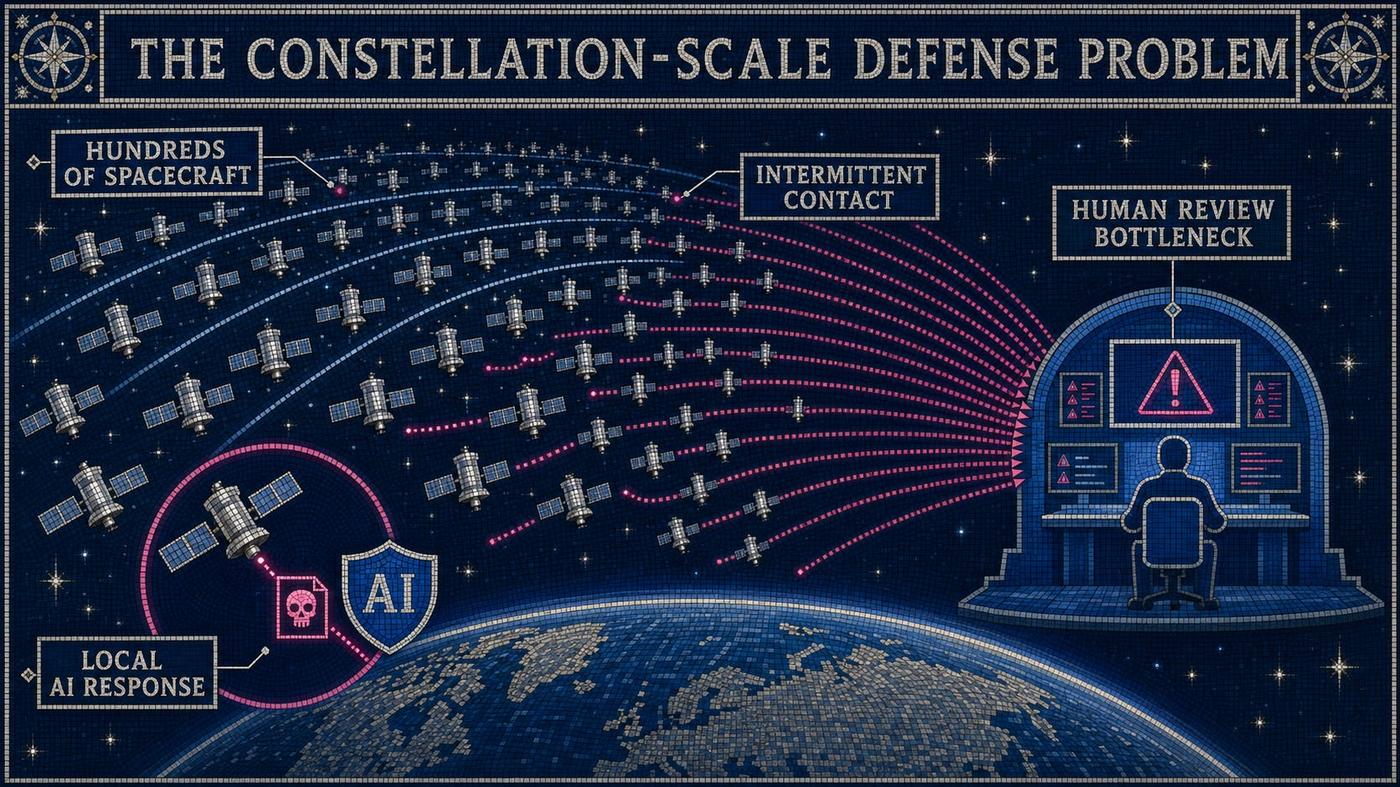
Large satellite constellations are approaching a scale at which human operators cannot investigate every suspicious event within an operationally useful period. A proliferated fleet may produce an immense stream of authentication records, command histories and software alerts. Its spacecraft will also pass through intermittent contact windows. By the time a ground team understands an anomaly, malicious activity may have crossed a satellite link or reached another part of the mission system.
Artificial intelligence offers a plausible response to this timing problem. An onboard or ground-based defensive agent could establish a picture of normal behavior, identify an anomalous command sequence and restrict a suspect credential before the threat spreads. NASA already requires certain missions to consider autonomous telemetry monitoring for unexplained interference under its Space System Protection Standard. The technical step from monitoring to automated containment is substantial, but the operational pressure behind it is clear.
The central difficulty concerns authority rather than detection accuracy alone. Finding a cyber anomaly is an analytic act. Isolating a spacecraft changes the mission architecture. A quarantine might preserve the constellation by containing a genuine compromise. A false alarm could remove a healthy satellite during combat. An adversary could also manufacture suspicious behavior in order to provoke the defender’s own system into denying service.
Autonomous cyber defense should therefore be treated as delegated command. Its permissions must be bounded by mission purpose. Its consequential actions should be reversible. Every automated intervention should create an intelligible record for human review. A separate rule-based safeguard should prevent the defensive model from exceeding a defined operational envelope. These controls impose friction, but friction is often wise when software is permitted to alter military capability.
The near-term path will favor narrow authority. Defensive agents will gain permission to revoke a credential, reject a malformed command or place a short hold on a crosslink. Broader powers will follow only after exercises show that these systems can contain actual threats without becoming an attacker’s remote control for self-inflicted mission loss.
The Operational Requirement for Machine-Speed Defense
The case for autonomy begins with constellation arithmetic. A fleet of several hundred spacecraft contains many endpoints whose software states change over time. Each vehicle participates in a larger mission system that includes a ground segment and external service providers. CISA’s Recommendations to Space System Operators for Improving Cybersecurity treats cyber risk across this full system because an attack does not need to begin in orbit. A compromised administrator account on Earth may become the path to a spacecraft command interface.
Traditional security operations assume that analysts can inspect an endpoint through a stable network connection. Orbital systems violate that assumption. A spacecraft may communicate with a particular ground station for only a short interval. The operator can receive an alert after the relevant event has already ended. This delay changes the value of speed. A brilliant diagnosis delivered after a malicious command has propagated is an autopsy with nicer stationery.
Autonomous defense can place judgment closer to the event. A local agent could compare a command against the spacecraft’s current state. It could determine whether the requesting identity normally issues that kind of command. If the sequence falls outside a permitted pattern, the agent could impose a temporary restriction. The response would occur while the anomaly remains containable.
NASA’s 2026 survey of Ground Data Systems and Mission Operations advises projects to incorporate security early in mission planning and points toward established NIST and CCSDS guidance. That engineering sequence matters. A mission cannot bolt autonomous defense onto the flight computer during its final security review. The vehicle needs trustworthy telemetry. The system needs a defined source of time. Command paths must expose enough context for the defensive agent to distinguish an unusual action from an impossible one.
Constellation scale also changes the purpose of automation. The aim is not to replace every analyst. It is to reserve human attention for decisions that warrant it. Software can process the first wave of routine anomalies. Human operators can examine the smaller set that carries serious mission consequences. This division of labor resembles damage control aboard a ship. Automatic systems may close a valve immediately, while the decision to abandon a compartment remains with command.
The requirement becomes sharper during conflict. An adversary may deliberately create simultaneous disturbances across a fleet. Even harmless alerts can exhaust the ground team’s attention when presented in sufficient volume. An autonomous system that filters those alerts may preserve command capacity. Yet the same filter can hide a genuine intrusion if its assumptions have been poisoned. Scale makes autonomy necessary while giving a single mistaken policy a much wider blast radius.
Detection Is Easier Than Interpretation
An AI model can recognize statistical departure without understanding operational meaning. This distinction is especially dangerous in space systems because legitimate spacecraft behavior may change abruptly. A safe-mode entry can produce an unfamiliar telemetry pattern. A contingency maneuver can alter power demand. A software update can create a new command rhythm. Each event may look hostile to a model trained on routine flight.
The scarcity of representative attack data sharpens the problem. Commercial network defenders can draw upon large collections of observed malware behavior. Orbital systems provide far fewer public examples of confirmed cyber compromise. Mission-specific hardware also limits the value of general datasets. The model is asked to judge rare events using an incomplete history, which is rather like appointing a magistrate whose legal education consisted of reading the courthouse fire drill.
NIST’s Artificial Intelligence Risk Management Framework recognizes that human and machine roles can range from fully manual judgment to autonomous action. The proper arrangement depends on consequence. For constellation defense, a model’s confidence score cannot settle the matter by itself. Operators must define what a particular confidence level permits the system to do.
This requirement leads toward tiered response. A defensive agent might first restrict a single credential. It could then require stronger authentication for a sensitive command. Only a more severe condition would permit isolation of a spacecraft crosslink. Each step should correspond to a known mission cost. The response ladder converts uncertainty into bounded action.
Reversibility is part of this design. A credential restriction can expire after a specified period unless renewed by another trusted authority. A quarantined data path can reopen through a protected recovery channel. The system should preserve enough evidence for the ground team to reconstruct why the action occurred. NIST’s AI Risk Management Framework Playbook stresses defined human oversight and documentation of operational limits. Those concerns become concrete when the model can remove a satellite from service.
Explainability in this setting does not require a philosophical account of machine cognition. The operator needs a concise operational reason. The system should identify the command that triggered its response. It should show which rule or behavior boundary was crossed. It should also state when the restriction will expire. A bare anomaly score is inadequate because commanders cannot compare that number against mission need.
The proper measure of a defensive agent is therefore w…
This is a public episode. If you would like to discuss this with other subscribers or get access to bonus episodes, visit orbitest.substack.com