


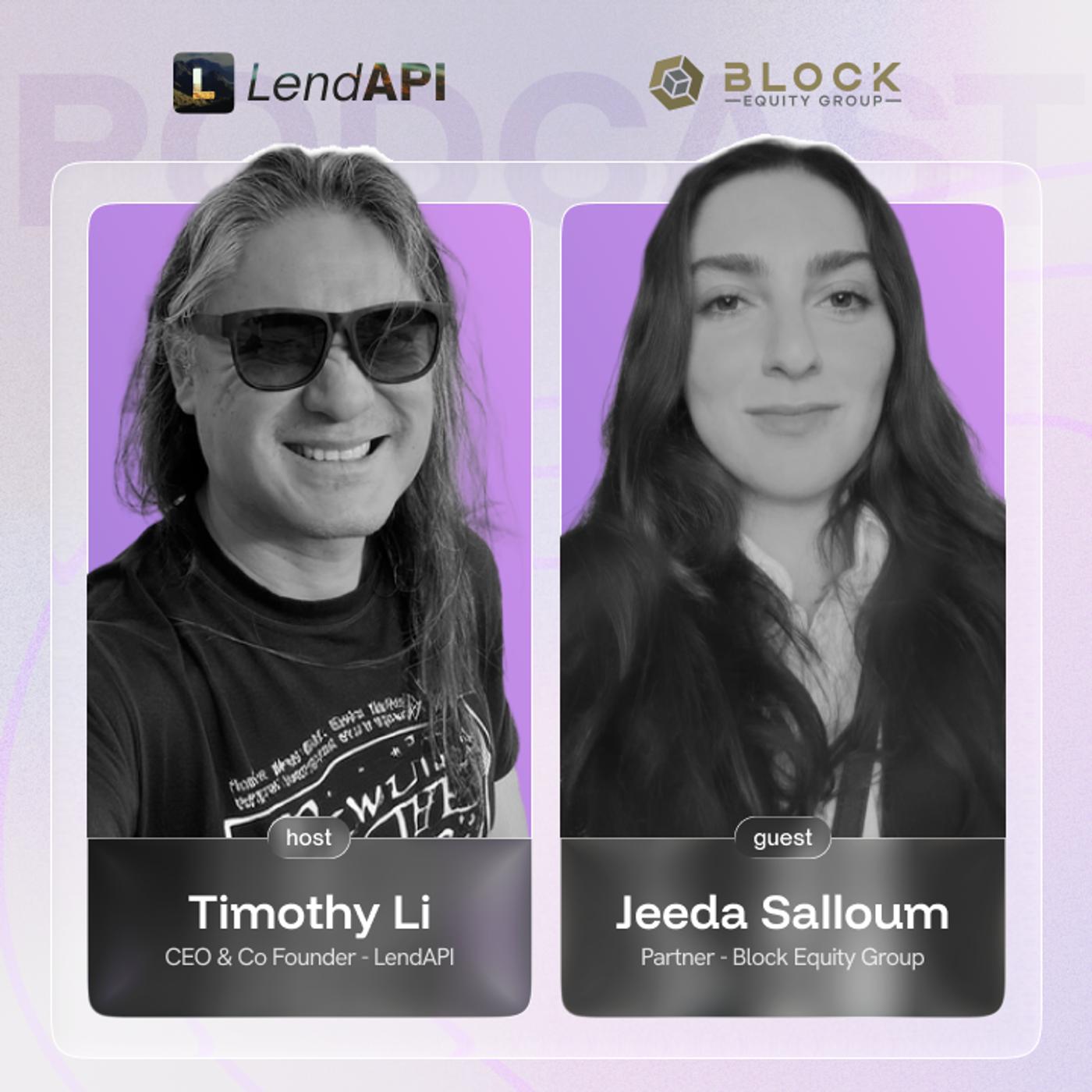
Timothy Li: All right. thanks everybody for coming on our podcast again. This is Tim Lee, CEO and co-founders of Lend API. It's our new season, episode three. Today we have Gita. I'm gonna give her the opportunity to talk all about herself and her company. I had the chance of meeting her in New York City about a month ago, so I extended the invitation and she's given us time today. So welcome Gita, welcome Block Equity. yeah, happy Thursday. We're on Who's made it through this week? What's going on?
Jeeda: Hey Tim, thank you so much for having me. Happy Friday Junior. It really was such
Timothy Li: A nei.
Jeeda: sorry, tell me. Friday
Timothy Li: Friday Eve, that's what we call it.
Jeeda: Eve, exactly. it really was such a pleasure meeting you in New York and thank you so much for having me on. I'm excited to tell you a little bit more about me, about Block Equity Group, and just have a fun conversation.
Timothy Li: Yeah. Yes. You know, I I I sort of snoop on your profile. It's very mysterious. international school, some work with the UN group as well. Maybe we'll start there. What what who i who are you, Gita? Tell us about your your back background upbringing.
Jeeda: Perfect. So I'll give you the whole rundown. I'm actually originally Syrian. I was born and raised there for the first 10 years of my life. And then throughout my entire life, I've lived in nine different countries so far. And hopefully, still counting. And the reason being is my mom has actually pursued her entire career basically with the UN. She's going up on about 35 years with the UN. So we got to live in a few different countries because of that. My dad is also an entrepreneur. entrepreneurship so just growing up I was exposed to kind of both worlds of business and the humanitarian side of things and then just literally getting exposed to the entire world in terms of like different cultures. different schools, different people, just constantly moving, so that
Timothy Li: Yeah.
Jeeda: was pretty fun. up until I was like eighteen so I did the international baccalaureate in Egypt. I was in international schools most of my life and when I did the international baccalaureate in Egypt I decided I kind of like this moving lifestyle and I wanted to pursue it for myself also so I decided to go to school in Amsterdam, University of Amsterdam. And I studied
Timothy Li: Uh-huh. That's four countries, I'm counting already. But go go on.
Jeeda: And I studied psychology over there. And I actually thought that I wanted to become a therapist because I just ever since I was a kid, I always had this like passion for helping people, and psychology was something that was super interested to me. I s super interesting to me. I studied it in IB also. So I was like, I think I want to pursue this a little further, and I ended up studying it at university. Funny enough, it was also a big like a big part of why I wanted to pursue psychology was because it was like far away from numbers. My dad is an engineer, my sister's an engineer, they wanted me to kind of follow the same path, but I was like, no, I'm not really into numbers and physics, and then I ended up in finance, in New York finance. How crazy is that?
Timothy Li: Ha ha ha.
Jeeda: So plot twist there. But yeah, I did my bachelor's in psychology at the University of Amsterdam. And then right after school, I got an internship with the UN. It was a PR in marketing internship, and I thought that I just wanted to pursue that kind of career path, and I moved to New York with that internship. And then a little bit after I was introduced to Block Equity Group through a personal referral, and I was introduced to the two co-founders, and I really liked I like the environment. I liked, and even though it was like a lot of numbers, and they told me from the jump, like, listen, this is like finance, you're getting into the nitty-gritty of numbers, you're like very client-facing, it's literally numbers all day long. I was like, I don't know, guys, so like give it a go. And so I was kind of there on like a trial basis for a month to see if I liked it. I loved it, and now almost two years later, we're still here. So
Timothy Li: Right. We're missing about three, four countries. Maybe maybe that was your UN career. where else have you lived?
Jeeda: So I've lived in Jordan, Germany, Italy, Tunisia, and Egypt.
Timothy Li: Okay. And and you're able to speak about four or five different languages? I'm just guessing here.
Jeeda: So I speak English and Arabic fluently, a little bit of French, a little bit of Dutch from going to school in the Netherlands,
Timothy Li: Right.
Jeeda: and my sister and my dad are fluent in German, so I can kind of like pick up on a few words here and there.
Timothy Li: My my word, when was the last time you visited Syria?
Jeeda: It's been over ten years. It's been like twelve years. The last time I was there was like twenty thirteen, twenty fourteen.
Timothy Li: Right. Well, we all read the news, you know, from one one extent to another. I'm I'm thinking it's probably a different Syria than when you left it. Although you were ten, probably has some memories then, right? Yeah.
Jeeda: Yeah, yeah. I definitely do have some memories there. I used to have some family there, but thankfully now family's kind of like all over and they're doing a little bit better. I still have some friends there. They tell me the good and the bad and actually a couple of our team members here happen to be Syrian too, but they were like born and raised here, still go back and forth and
Timothy Li: Right.
Jeeda: I hear some good stories. I hear it's things
Timothy Li: Yeah.
Jeeda: are starting to look up and hopefully that is the case.
Timothy Li: I haven't been. I've seen pictures. It's beautiful.
Jeeda: Thank you.
Timothy Li: Jordan, I haven't been either. that's like just such a historical historic place as well. yeah, is there a big expat community in New York City of Syrian Yeah? Is that where's that? Okay, great.
Jeeda: my god, yes. Yes. There's a lot of Syrians that moved here maybe like two, three generations ago, and it's like a whole community of Syrians, and then there's some that moved here more recently because of the war, and those are like born and raised there, and then they just live here now. Yeah.
Timothy Li: So it just keeps the culture going, right? Whether you're two, three generations is an American but identify yourself as Syrian Americans or brand new immigrants that's coming in and discover a new way of life or you know, finding a new way of life. That's that's all I think.
Jeeda: Next time you're in New York, we definitely have to take you for some Syrian food.
Timothy Li: I've done my God, thank you so much. I had another guest coming on yesterday from New York City as well. we just got that episode out this morning. And he's like, when you get here, we'll take you out to the best Indian places. I'm like, I'm all s I'm set for the rest my life.
Jeeda: Perfect, we're on a food tour.
Timothy Li: Verywal, you I I had a chance to visit your office and the energy is palpable. There's pets running around, people ringing bells. I'm assuming that made a deal. it just it's it's really fascinating to see. a group of I can I could probably say that young people putting you know business together, making it happen. I know Block Equity was introduced to you through a personal friend and you said it was a trial basis, but now you are a partner in a short span of a year or two. What happened there? Did you want this job? Yeah.
Jeeda: Honestly, the progression and just the entire journey has been nothing short of insane in the best way possible. So when I first joined, I told you it was a little bit more of like a trial basis. I wanted to see if I liked it. And then I really did. I feel like psychology and sales kind of mesh perfectly together because you really understand people. I understand their emotions. I understand what they're scared of. And I'm dealing with business owners all day long. So it's like being client-facing is not something I'm scared of. I love talking to people. I can talk to people. Okay. then to make it even better, as I mentioned, like I always had this passion for helping people, and I feel like this is truly my calling in a way because I'm helping business owners. These are their livelihoods. And you know, I talk to business owners all day long. They're like, This is how I'm gonna feed my family, this is how I'm gonna build a legacy, and they have like all these ideas and everything, and you can see how you're making an impact in real time. So it really is truly wonderful, and we help business owners all day long, and you know, ones that are in Situations that they never kind of saw a way out of, where they'll be, you know, in insane amount of debts, and not like not the kind of debt you want to be in, not the kind
Timothy Li: Right.
Jeeda: of debt that you can like find a way out of. They find themselves in these kind of like black holes and they don't see a way out of it. And through our advisory, we're able to get them on better plans, we're able to get them some sort of refi, we're able to show them the light at the end of the tunnel, and it truly makes a huge, tremendous difference in their business. And then They love us and they're just like, you know, we become top of mind for them. We have that relationship with them. The relationship is super important. And
Timothy Li: That's cool.
Jeeda: Yeah, so
Timothy Li: That's cool.
Jeeda: in terms of the journey itself, I feel like aside from being someone that's like super passionate about helping people and also really being client-facing and having those kind of conversations and learning, I'm also a very competitive person. So when I first joined, I was like, I really want to become their number one sales rep. I'm gonna do it in a very short period of time. And I think by like month two or three, I was already their number one producer. So I was kind of on the co-founder's radar, like, okay, this is our rising star for now. And because it was an industry that I've never experienced before, like I went into this industry with zero previous finance experience, and I was just asking them a million questions, and I'm super grateful to the both of them, and I really am lucky to call them my partners now. But before I would be like that person that's like constantly in their office, like, okay, but what does this mean? And what does this mean? And what's a UCC filing and how can we get through this and
Timothy Li: Right.
Jeeda: all of that stuff? And it's definitely been a journey, and they were never ones to turn me away, and they were never ones to make me feel stupid for asking a certain kind of question. They were never ones that didn't empower my growth in any sort of way. They were always in my corner and they had my back and I'm really grateful for it.
Timothy Li: Yeah, I I met him as well, right? fun loving people. I asked a lot of dumb questions while I was in your office as well and they always had a smile on on are do you are you still craving to work the floor again, talk to the business owners? Maybe you're still doing that do that today, closing calls and things like that. or are you kind of removed from it and work on more technology and process and all that stuff? What's your day to day now?
Jeeda: So it's a little bit of everything. It's funny. I still I'm kind of like embedded in everything and there's this like running joke of like is Jeta even a human at this point? Because like I have hands in everything, I have hands in marketing, I have hands in tech, I have hands in AI implementation, I have hands in hiring, I have hands in sales, I'm like doing a million things at the same time. But like I'm young, I'm building my career, I wanna get exposed to as many different verticals of the business as possible. And thankfully I have like the autonomy and and the like Free range to actually explore all of these interests, figure out what I like for myself. I still love the sales side,
Timothy Li: Yes.
Jeeda: and I get a lot of our reps they come up to me and they're like, let's work on this deal together, or I need help closing this, or whatever the case may be. So I'm still very much involved in a sales capacity and I love doing it.
Timothy Li: Yeah.
Jeeda: It's very much like putting a puzzle together, like talking to the client, figuring out what the best solution for them is, figuring out how to get them the best solution if they're not eligible for it. So I do love that part of the business, but at the same time, on obviously with the way the technology is progressing and the way that this AI race is going, I really want to be involved with that stuff too. So I'm almost like with our CEO, our AI consultant, and we're just figuring out every single way in which we can incorporate AI into the company to make us a lot more efficient. And I it's crazy, but I never thought I would be a finance bro. I never thought I would be a tech bro, and now I'm both of these things, so
Timothy Li: You're both you're missing a vest in the URC if you walk around. well you certainly earn the respects of the team because you were on the ground floor doing the calls, grinding it out, doing the numbers. that's why you're pr you know, well respected in the office and everybody wants you to be on the on the deal. Because you can you can probably give them a higher probability of closing. how many small business owners, small businesses have you helped, have block calculated helped to get through a you know, a bind or a period that they just need some additional capital to get through the holiday season. Hundreds of thousands, tens of thousands. Our a audience love numbers too.
Jeeda: I would say over the past few years, definitely in the tens of thousands, and in terms of volume, just because we did the numbers up until last year and it was like 370 million in like more or less in terms of funding.
Timothy Li: That's incredible. Right. And I'm assuming, I'm just guessing on average, people probably come back to you and for some refinancing opportunities, maybe a second hand to the well right to help grow.
Jeeda: It's funny because I mentioned relationships in the past and how we're very relationship-centered. 80% of our clients are actually repeat clients and we love that stat and we're very proud of it because once you show someone that you do right by them once, they never want to talk to anyone else again. And it's like they're trusting you literally with their baby. Like the the the their business is their baby, and they're like, I want someone that I can trust and someone that will do right by me and not someone that's just trying to get a deal done. So 80% of our customers are actually coming back to us for seconds, whether it's a refi
Timothy Li: That's
Jeeda: or a totally different product. Or just advisory in general. Like if clients bringing something to me, being like, Geta, do you think this is legit? And it's like something maybe completely not related to what we're working on, but they trust you that much that they're bringing things to you. And then other clients that are sending me pictures of their dogs, and I send pictures of my dog back, you know? So she's she's somewhere right here. By the end of it, she'll probably jump in.
Timothy Li: We gotta bring that dog on on camera if if if she's around. Yes. Well yes, I I love to see her again. W well you know, like I love these stories and our audience love these stories as well. Do I mean without diverging too much information, do you remember a situation where the business owner is literally at the end of their robes, right? And calling you guys was their last sort of a resort and you were able to help out or help her out, and now they're X, Y, and Z and successful. Give us some tear jerkers.
Jeeda: Yes, I actually have a few different examples. I'll start
Timothy Li: Yeah.
Jeeda: with one that was a little bit heartbreaking to me because it was one of my clients. So that one hit close to home. But this is one of my clients that I got actually do you see Ella in the background? So
Timothy Li: there you go. There you go. There she is.
Jeeda: it was one of my clients that I got when I was still on the floor, just a BDR, didn't have a team. and It was a trucking company and I had gotten them an SBA loan. It was a great time. It was like a smaller SBA loan, it was a micro loan. So and comparatively to the numbers that they were doing, it didn't move the needle that much, but they were still super grateful. It was like a 10-year term, monthly payments, a great product. Anyway, they get funded for that. And now 30 days every 90 days you're eligible for renewals. And you know, I was just staying on top of the file and checking up on the business owner and all of that stuff. and then I had That he had ended up in the hospital, racked up a lot of credit card debt, and his credit tank. So when time came for renewal, it the situation became a little bit more challenging because his credit is now in a worse spot. So I was able to get him financing to cover that credit card debt and just do a process called a rapid rescore so that we force his credit score to update faster than just waiting for the
Timothy Li: Sure. Right.
Jeeda: full cycle to go to go through. once his credit went back up, we were able to go back into processing for another SBA loan and got him a better and larger round. So that's one example.
Timothy Li: That's crazy. Why did he need needed that micro loan, the first loan from SBA? What was the reason for it?
Jeeda: So the first the first micro loan was because he s when he had first built the trucking business, he was the one that's like always on the road. He was an o an owner but an operator also. And then as he expanded his fleet, he wanted to hire more people. So he put a down payment on a new truck, hired another person, and was just you know in the process of expanding. Exactly.
Timothy Li: Needs a little bit capital to get through. Right. Wow. And what does he do now? A couple more trucks, you think?
Jeeda: A few more trucks for sure. They put on one of it's funny because now we've had multiple different transactions. We helped him set up a factoring facility. We've helped him get more dollars on like two more rounds of SBA funding. And we also got him like a tr a two year term loan, so like non and non SBA product.
Timothy Li: Right.
Jeeda: And he one of his bigger clients that was like he was having a hard time because they were such a large client, you know, they would have like the net thirty, sixty and ninety days. So
Timothy Li: Yep.
Jeeda: He would do the work and he wouldn't get paid for it for a really long time. So the factor really helped. And then
Timothy Li: Okay. Right.
Jeeda: after that was done with the factoring situation we were able to get him more dollars to help stabilize his
Timothy Li: Wow.
Jeeda: cash flow and he was able to put on more clients. So that was an exciting time.
Timothy Li: That's just wow. I mean that's the whole story, right? A budding entrepreneur getting getting you know, he was doing himself, saw the opportunity, expanded his team, doubled in that case. got into a little bit of a personal bond, you were able to help him out to restructure his his personal credit so you can, you know, get him a little bit more to get up get him out of the hospital and get back on on his feet. Now he's growing with bigger clients and that kind of receivable takes a little bit longer to to k to to you know to get paid. So you're you but you were able to help him bridge that gap as well. That's like the whole business life cycle. That's great. You got another one for us? Maybe someone that you actually met in person, pot potentially?
Jeeda: we do meet a lot of our clients in person because we also work nationwide. Some of the clients are just like kind of all over and when they happen to be in town we'll definitely meet them. But there's yeah, I I was actually just down in Florida recently for just because I love being in Miami every now and then. doesn't but I ended up doing like two to three site visits because there was a few of my clients that were down there and I just wanted to say hi to and one of them that comes to mind it's so you know obviously with the political landscape and how things are changing the SBA dialed back their rules on lawful permanent residence so it became almost impossible to get some of our green card clients SBA loans so this one client particularly comes to mind we were able to help them with bridge dollars they had huge payroll expenses coming up and their aesthetics clinic they had pu huge payroll expenses coming up and they just needed like a hundred to two thousand a hundred to two hundred thousand to just kind of cover the gap so we were able to help them secure that and then we got them a conventional term loan to extend the term a little bit longer and just help their cash flow.
Timothy Li: Yep. Virgin will have been there. Wow.
Jeeda: And then the plan was to eventually get them an SBA loan but obviously with the way that the political landscape is just constantly changing we couldn't
Timothy Li: Sure. Yeah.
Jeeda: do it. So we were ki it was kind of heartbreaking because we were halfway through the process and then the rule came out and it was like, okay, yeah, you couldn't you couldn't really do it anymore. So that sucked, but I told them, listen, as an immigrant myself and as someone that understands your situation, we're not just gonna leave you, you know, here, we're gonna figure it out. And we were able to get them onto a different platform that was like investor heavy and people that really understood their mission and just helped facilitate it that help helped facilitate that investor relationship and then now they're kind of in process for that and they're looking to get a lot more than the SBU is willing to give them. So it's
Timothy Li: This is this is crazy. I mean, I mean if there's any politicians or any policymakers listen to this podcast, come on guys, you know, like the owners might be immigrants, but the employees are Americans. Okay, so what are we talking about here?
Jeeda: Yeah. Did you know?
Timothy Li: You know, yeah, well, that's a different podcast. But that's that's that's wonderful that you were able to take some time from your vacation to go see customers that were in need, And sometimes, you know, is out of our hands, but you're able to help help out anyway. That's why people call you and say, Hey, you know, even if block equity couldn't offer you anything, you will find something for them to kind of get through through that thing.
Jeeda: I feel like if if I I really live by if there's a will, there's a way. And even if it has to be 9-10 PM and I'm looking for a local credit union in your area that's willing to take a chance on you, I'm gonna do it. And then you know what? Next time a different block client comes through and they happen to be in that same area and we already have that bank relationship, great. But if it happens to be that it's just to serve that client, I'm still more than happy to do it.
Timothy Li: Crazy. Let's let's let's let's shift your finance bro and ai broad around a little bit. and let's talk about what you've studied. And you know, I have folks, entrepreneurs on my podcast, most of them are, and we always wish that we can ha talk about founders' mental health a little bit. Yeah, you met a lot of those. You are one yourself now, and you're basically working with founders and entrepreneurs all day, every day. What's happening in the world? What's going on? What is people's psyche, psychology now, working the environment we're working on? High inflation. you know, payroll issues, lots of states are go undergoing massive changes in taxation, maybe even medical coverage and things like that. What's what's on people's mind that you see, either as an entrepreneur or a small business owner, that we should be aware of? And if you have any techniques to get to get us through the day, we're all years.
Jeeda: Yeah. Give you a few different perspectives. I
Timothy Li: Okay.
Jeeda: feel like from an employee's perspective, if you're young and trying to get established, or maybe you haven't had that much work experience, you know, and you're fresh out of college, or this is your second work experience, or whatever the case may be, obviously you're gonna be a little bit wary. You might have, you know, the ups and downs, the feeling like, I don't know what I'm doing, I don't know if this is my passion, I don't know if this is my calling. But for that person, what I will say is just whatever it is that you're doing. Do it at 110%. Even if it's not truly your calling. Like I had a bit of an opportunity in between the UN internship and block that I knew wasn't my calling, but I'm like, while I'm there, I'm still gonna be number one. I'm still gonna give it my 110% because I wanna look back and be like, I delivered as best as I could, and if that person didn't see me for how valuable I am, then That's on them, it's not on me. I still, you know, proved myself. I did rise through the ranks, I did everything I could and and then, you know, the rest is figures itself out. So that's what I would say to that person and obviously given the times that we're difficult the times that we're in, whether it's economic difficulties, whether it's economic, like constantly
Timothy Li: With the
Jeeda: changing situations politically, economically, literally in every sense of the framework.
Timothy Li: Sure. Where layoffs headline every day, right? It puts a lot of pressure on young people. Yep.
Jeeda: Every in in every sense of the word. It's tough, but I feel like if you're the kind of person that just kind of puts their head down and works, then you will get what you want. Like I truly believe it as someone I and I listen, I always had it in my head that I was gonna end up in New York. I wanted to come to school here, but my parents were like, we're not sending a 17-year-old 14 hours away from us where they're practically like somewhere we can't really reach them if we needed to, and there was an emergency. So but I always had it in my head, like I'm gonna be in New York, I could like visualize my skyscraper apartment, I could visualize
Timothy Li: Yeah.
Jeeda: like all the things I wanted. If you're that person that has an idea in their head and just goes after it, no matter what noise is around you, you're gonna be able to dial out that noise and go after what you actually want and achieve it one day. Maybe it's gonna take you two years, maybe it takes you six years. But if you're consistently going after what you want, you're gonna be able to get it, regardless of what the environment around you is. But then the second point to that, and that's kind of the founder and entrepreneur point that I have. Environment's the most important thing. Environment truly is the most important thing, especially when you have a lot of noise around you, whether it's people being like, my god, a recession's coming up, or it's like, my god, Trump's gonna get everyone deported, or it's my god, the next administration is is gonna bring this country into doom, or whatever the case may be. Like, there's always gonna be noise. There's always gonna be people saying bad things and just harping on you know, whatever that negative fact they could grab that day. So I would say the most important thing is that you have a solid support system and sometimes it might not be the people you think it is. Like maybe if you're someone that has huge dreams and your family doesn't necessarily understand that or your partner doesn't necessarily understand that, that's totally okay. You might want to join a founders and entrepreneurs group chat or you might want to go to a networking event or whatever. Someone that doesn't think that your dreams are too crazy and someone that actually supports your delusion
Timothy Li: Mm-hmm.
Jeeda: a little bit. Because like you talk to entrepreneurs all day long and there is a little bit of delusion, but when that
Timothy Li: Sure.
Jeeda: delusion becomes your actual reality, people are like, my god, wow, you made it. And it's like, yeah, okay, but two years ago you thought I was crazy for having these thoughts.
Timothy Li: Right.
Jeeda: So you definitely need to be very mindful of your environment. And I'm super grateful For mine, because I could go to like Mike with the craziest idea and be like, This is what I was thinking, and it's like a Saturday night on at like 9 p.m. And he's like, No, I think this is a great idea. Like, let's try it. What's the worst thing that could happen? And it's kind of like you have to live life like it's an improv class. Like, just yes and what's the next step?
Timothy Li: Right.
Jeeda: And never like shoot someone's idea down, never make them feel like they're stupid. Like, if you're that person that's in a position of power, then you need to try to empower other people and not make them feel like their questions are dumb and not make them feel like their ideas are dumb and try and play with it, you know, like go along with it, see what ideas they have, try to implement and if it doesn't work out, it doesn't work out, but you learned a lesson. And if it does work out, then things look up for everyone.
Timothy Li: Right. So as founders you wanna sort of give back a little bit, right? Any budding entrepreneurs coming with some crazy ideas, you you wanna sit down and and give some time or her time to kind of, you know, cultivate a idea, cultivate a delusion, if you will. that's awesome. Are have you ever thought about going back and teach I mean, I guess, you know, teach entrepreneur class maybe NYU or something like that?
Jeeda: it's funny. I actually one of one of our reps here actually was able to make an introduction to a professor at at her school, which is like the either the number one or the number two entrepreneurship school in the States, Babson College. So
Timothy Li: sure, perhaps in college, of course. Yeah.
Jeeda: Yeah. So she made the she made an introduction. She said like one of the partners of the company hears her story, she's super young, she made it, like I feel like it would be,
Timothy Li: Yes, yes.
Jeeda: you know, beneficial for the students to hear from her. So she set that up. It was wonderful. I was super grateful for her setting it up and then I was able to go and teach a class and it really went a long way because I had a few people afterwards reach out and say it was super inspirational. We had a few people that wanted like working opportunities with Block because of the talk and
Timothy Li: Yeah. Of course you.
Jeeda: then we had the professor reach out maybe like a semester or two after to be like, can you actually teach a class? So
Timothy Li: Yeah.
Jeeda: I taught
Timothy Li: Please.
Jeeda: a class on Zoom for like two, three months, give or take. It was like once or twice a week. And it was super interesting because I wasn't like necessarily teaching entrepreneurship, but I was like teaching sales and sales principles and how it applies to Block Equity Group, which I feel like if you're maybe like right now, second to AI, sales is the most important skill you can learn in your life because it's super transferable. You can use it for literally whatever. And if you
Timothy Li: Right.
Jeeda: can talk to people, if you can sell them something, if you can sell them on you, if can sell them on your idea, there's no stopping you. So
Timothy Li: Right. Right.
Jeeda: I do enjoy that aspect too. I think I definitely would and it was actually on my goal list for this year to do a little bit more on the teaching side.
Timothy Li: There you go. Please do. If anybody's listening, please please sh give her a shout out. with all that interaction with the students, you know, younger people, how do you help young people going back to your first point about helping entrepreneurs stay locked in. There's so much influencing going on. There's so much, you know, I want to say some noise, negativity, whatever it might be, you news cycle and things like that. How do you how do you stay locked in, first and foremost? How do you help young people to stay off of certain I don't know platforms and locked in, really devolve their career and do that 10,000 hour proverbial sort of a, you know, just you gotta grind it out and learn it. How do you how do How do people keep insane nowadays?
Jeeda: Honestly, it's It I I would say it's a little bit of a balancing act, but the way that you can do it is by modeling it yourself first. I have a little brother, so this hits close to me, like it's very close to
Timothy Li: That's it.
Jeeda: home and I love him. He's someone that is super sharp, super bright, but he's also only sixteen, seventeen years old. So he's also very moldable. He spends a lot of time on TikTok and Instagram and I've had conversations of like, Okay, listen, like this like TikTok millionaire mentality or like the Instagram sell a course type like Those are not people that are really making money, and like that's not what you want to be, and all that stuff. But you can sit there and say that to a person or a teenager all day long. But if they see you on TikTok all day long or they see you on Instagram, guess what? They're gonna do the exact same thing because they're just emulating whatever behavior you're doing. But my brother was watching me read a book while I was on vacation with them. He was watching me work all day long while I was on vacation with him. He was watching me take phone calls with clients, he was watching me do all that stuff, and then at some point he was like, actually, I deleted Instagram and now I'm reading this, this, and this book. That you recommend it. So I think it comes
Timothy Li: Wow. Wow.
Jeeda: down to the kind of people you surround yourself with. And if you find yourself like as a young person, my advice would be if you find the people around you doing the things that you don't think are pushing you towards your goals and where you want to be, then again, you kind of need to change that environment. And I know it sucks. I'm not saying your friends are bad. Your friends are definitely great people and you want to see them one to two times a week, but the people you want to be spending the majority of your time with are the people that are pushing you closer and closer to your goals. And that could be the person you met at the networking event or it could be the person you met playing pool and they said to you, they're working on starting a new business, or whatever the case may be. It could be someone you met totally out in the wild and they had a crazy story of a business that they started. Like it could be your family member. Our two co-founders are cousins. They literally started this like as a family venture. So it's like I know that those people are around you. You just need to find them and like hunker down and really get obsessed,
Timothy Li: Yeah.
Jeeda: obsessed with the goal, get obsessed with the vision, and then you're gonna get there.
Timothy Li: Right. Yeah. Well thank you for creating an environment for your brother. So lucky of him to see to see a big sister. Crushing it, owning it, locking in. back to the relationship business, which is what block equity is in in some in some ways. There's it's the money business, but it's a relationship business. How do you balance automation AI and relationship? Right? and your your customers are probably busy all day long, probably don't have a whole lot of time to spend with you guys to talk about terms and conditions. what do you find the balance there? What's the what's the next step for block equity to bring in more technology to help you guys in the back office and maybe interfacing with your clients and bring that relationship even f forward further?
Jeeda: So me and our CEO are very AI forward, and I said we love this stuff, we want to implement it in every way we can, but then one of our managing partners is very like, no, I I want the people to be the face of the people. I want it to be a human and human interaction, and I want AI to be involved in some sort of capacity, but still make it very human-forward. So thankfully we kind of found that beautiful like you know balance exactly because probably if it was up to me and the CEO, we'd just be completely robots by now. Not really. Because obviously we sell the people around us and they're great
Timothy Li: Yeah.
Jeeda: people, and you know it's just the AI is only gonna push us forward. But at the same time, I feel like definitely still having that human touch is super important. So we what we've been doing is on a lot of the internal stuff and a lot of like the admin work, you know, like no one no one really likes doing the admin work, or no one really likes doing the bookkeeping, like the all of that stuff that can be very easily automated and is like a tedious task. So all a lot of that has been shifted over to AI agents that have been handling that and it's been handled very smooth it's being handled very smoothly knock on wood so far so we're doing a great job and by the same logic we have put some new partnerships in place one of which we're super grateful that you guys are involved in too where it's like you know you can implement other tech and build out other platforms where you're still doing a lot of it's still person on person attraction because we're building up platform together and that's only gonna further the block platform. More because it's gonna make our doc collection process less tedious and it's gonna help the client because instead of the client having to send me an email three times for a document or having to text it and then email it or
Timothy Li: Is yeah.
Jeeda: whatever, it's all like done automatically. So, but then at the end of the day, if the client's freaking out, guess what? They're not gonna send an email and be like, hey Gita, I'm freaking out. They're picking up the and they're Gita, this is what I need. And at that point, you know I'm gonna pick up and I'm gonna have the conversation, and so it's still very client facing, but then for all the tedious tasks and the things that we can be doing better, we're always looking at how we can become more efficient and how we can make our processes better.
Timothy Li: Yeah. What what was the craziest technology bet you guys you guys put into place in the last couple of years? Didn't think it was it's gonna work, but it's it's paying dividends now. I loved hearing stories.
Jeeda: It's Tim, it's so funny. So
Timothy Li: Yeah.
Jeeda: I actually was in California and it was me and Michael working on something. He was in New York. I was in California and we were like back and forth on this AI agent that we were building together that he was doing most of the building for, honestly, but I was just like, you know, helping and giving ideas and
Timothy Li: Yep. Yep.
Jeeda: everything. He's the mastermind. So I'm, you know, we're back and forth and everything and I'm at a bar, but it was just like, you know, beautiful scenery and I'm like sitting there with my laptop and the bartender looks at me and he goes, What are you doing? And I was like, I'm working. And he's like, it's 7 p.m. Let me guess, are you from New York? And I was like, yeah, you know, work doesn't sleep, I'm sorry.
Timothy Li: Yeah.
Jeeda: And and like we're just back and forth and then he goes, So like what are you actually doing? And I'm like, We're building this AI age and he's like, What does it do? And I'm like, So it starts off by doing this and then it gets you this document and then it analyzes it and then it puts
Timothy Li: Yeah. Yep.
Jeeda: it in a sequence and like all these things and he goes, Holy crap, that's literally someone's job and I'm like, Exactly. So just having that happen like in real life and just seeing the progression of like one day being like, my god, this is actually like A to Z what someone can do and now it's all being
Timothy Li: Right.
Jeeda: done by a robot is kind of crazy and it's keeps getting better. Like when we first built it it was like maybe had two functions and now it has 16 different functions and it analyzes the responses and it responds very well. And sometimes it sounds more like me than me and it's crazy.
Timothy Li: That's right. I I think I was listening to Joe Rogan, one of his guests, literally loaded his friends, you know, YouTube channels, conversations, all that stuff in there and he made him into a bot. So every time he asks a question to that friend that's not available at the moment, the bot will respond, it just sounds just like the friend. It's so crazy. But back to that a a bot that you guys build. you know, we're not replacing folks, right? That person that was doing that job could now be elevated to be on the phone with a client to talk talk finer points. All that tedious things that like you said is all automated, which nobody wants to do to begin with anyway.
Jeeda: It's exactly that. Like no one has been replaced. It's just people's jobs are now a lot more enjoyable because a lot of the tedious tasks they're no longer having to do. So it's pretty cool.
Timothy Li: Right, yeah. Well if you if you can't build one for me, I'm done. Pull me pull me out of my misery.
Jeeda: Let's do it. Let's do it.
Timothy Li: But this is great. I mean like people at the end of the day is still what builds you know, my company, your company. When are you when you hire a new person, what are you looking for today? Like in today's sort of AI world, what is that one thing that you're still looking for that person to kind of join block equity to make a whole to make a difference? I know you talk about AI, you talk about sales, but what are some of the other characteristics and natures a person should have to be successful?
Jeeda: It's funny because we were actually recently having a conversation about this as like the perfect block equity group hire because I told you like I was I'm still very involved on the hiring side also and we were kind of like figuring out the perfect prototype of the people that I've been here and are doing very well and what that looks like. And honestly can look very different person to person, but something that's super important is character and culture fit. So character is like someone that's coming in, maybe they're young, maybe they're not, but they the one thing They have in common is that they're here to learn, they're here to build their career, they're hustlers, and they just want to grow in every sense of the word. Like I have people that have came through and that are like, okay, I want to learn more about commercial finance, I want to learn more about personal finances, I want to learn more about what books you're reading, I want to learn more about what your workout routine is, whatever the case may be, but we're just pushing each other forward, and that's the kind of environment you want to be in. And I'm super grateful for my two partners that are always very like culture forward. They're like, I don't the person could be the top performer at a whole other company that's like a competitor of ours. And even if they're number one, but if they're not a culture fit to us, they don't have a place here. Because culture is very important and maintaining that and preserving that culture is super super important. So definitely being surrounded by like minded people. So that person that has that same mentality and is always looking to grow and looking to develop themselves in literally every matter of the word that's very important to us. I would say Somewhat of competitive sports in the background or just having that sort of competitive edge, like someone that was president of their chess club because they're that competitive person, or someone that was super high up on their lacrosse team because they're very good at sports and are super competitive for like a 17-18-year-old or someone that's even younger to be waking up at 4 or 5 a.m. to go to practice and do that
Timothy Li: Yeah, yeah. Right.
Jeeda: consistently and not go out drinking with their friends because they have to show up to practice the next day. Like that's the kind of dedication you need. to be that locked in person that you were talking about, to do that ten thousand hour rule, to do what you need to do here in order to succeed. So
Timothy Li: Way.
Jeeda: I would say those are a few things we look for.
Timothy Li: Wow. I mean that office I visited is pretty full. Are you guys looking into new real estate expand a little bit?
Jeeda: I'm I'm really trying to shepherd this, you know, block equity, Florida, Miami idea. But let's see. Let's see. Yeah, and and
Timothy Li: I okay, well, we heard it first, you know. I guess you can do this job anywhere, and this flies everywhere anyway, you know.
Jeeda: we're constantly expanding. The office is pretty full. We have two offices right now, but who's to say we're not gonna have a third location in New York City or just in New York in general, maybe even in New Jersey, just to like cover different grounds. And I don't I just feel like it's too good of an opportunity. Like I've been through it myself. I've literally built from the ground up and to just like, you know, you spend more time at work than you do at home. So to be around inspirational people, to have a real opportunity where you can make a good amount of money and learn a lot and be surrounded by like-minded people and people that can be your friends and your coworkers, but also your mentors, like that's huge. So obviously as many people as we can give this opportunity to and as many people as
Timothy Li: Sure.
Jeeda: we can reach and teach, we'd love to do more.
Timothy Li: Yes. A lot of people crave that in culture, in office culture, 'cause that's how you get ideas come across, right? I mean, a cold Slack message doesn't convey anything.
Jeeda: Yeah.
Timothy Li: Yeah, but that's a whole that is a whole different podcast. But for now though, Jeta, my God, from Syria to dominating financial services, I I can imagine what that memoir will look like, you know, 30, 40 years from now. So grateful to meet you. And thank you guys for letting me into your office for a couple of seconds there when I was in New York last time. I'll definitely pay more of a visit next time. But this has been inspirational for
Jeeda: Please, we love that.
Timothy Li: me as well you said a couple of things that made me reflect on my my behavior at home with my children and kids this is really good this is why I love doing my job as well to kind of talk to people that can give me something to think about so but thank you so much have a wonderful week and if if people want to find you is it bloque equity dotai block equity group let us have how we find you
Jeeda: It's yes, it's blockequitygr.com. We're on LinkedIn, we're on Instagram, we're everywhere. You'll be able to find us. And Tim, I
Timothy Li: What could
Jeeda: wanna thank you so much. And really I would love to spend more time with you in New York. We still have to go for Syrian food, so I'm holding you to that. And
Timothy Li: Yes. And
Jeeda: I really I've listened to a few different episodes of this podcast and I've enjoyed every one of them. So thank you for everything that you do.
Timothy Li: thank you. Yeah, thank you. We're here in Southern California. There's sunshine, beach, mountains. If you ever come out here, made out here, please visit our office as well as yours. Thank you so much. Have a good one.
Jeeda: I would love to. Thank you.
Jeeda: Hey Tim, thank you so much for having me. Happy Friday Junior. It really was such
Timothy Li: A nei.
Jeeda: sorry, tell me. Friday
Timothy Li: Friday Eve, that's what we call it.
Jeeda: Eve, exactly. it really was such a pleasure meeting you in New York and thank you so much for having me on. I'm excited to tell you a little bit more about me, about Block Equity Group, and just have a fun conversation.
Timothy Li: Yeah. Yes. You know, I I I sort of snoop on your profile. It's very mysterious. international school, some work with the UN group as well. Maybe we'll start there. What what who i who are you, Gita? Tell us about your your back background upbringing.
Jeeda: Perfect. So I'll give you the whole rundown. I'm actually originally Syrian. I was born and raised there for the first 10 years of my life. And then throughout my entire life, I've lived in nine different countries so far. And hopefully, still counting. And the reason being is my mom has actually pursued her entire career basically with the UN. She's going up on about 35 years with the UN. So we got to live in a few different countries because of that. My dad is also an entrepreneur. entrepreneurship so just growing up I was exposed to kind of both worlds of business and the humanitarian side of things and then just literally getting exposed to the entire world in terms of like different cultures. different schools, different people, just constantly moving, so that
Timothy Li: Yeah.
Jeeda: was pretty fun. up until I was like eighteen so I did the international baccalaureate in Egypt. I was in international schools most of my life and when I did the international baccalaureate in Egypt I decided I kind of like this moving lifestyle and I wanted to pursue it for myself also so I decided to go to school in Amsterdam, University of Amsterdam. And I studied
Timothy Li: Uh-huh. That's four countries, I'm counting already. But go go on.
Jeeda: And I studied psychology over there. And I actually thought that I wanted to become a therapist because I just ever since I was a kid, I always had this like passion for helping people, and psychology was something that was super interested to me. I s super interesting to me. I studied it in IB also. So I was like, I think I want to pursue this a little further, and I ended up studying it at university. Funny enough, it was also a big like a big part of why I wanted to pursue psychology was because it was like far away from numbers. My dad is an engineer, my sister's an engineer, they wanted me to kind of follow the same path, but I was like, no, I'm not really into numbers and physics, and then I ended up in finance, in New York finance. How crazy is that?
Timothy Li: Ha ha ha.
Jeeda: So plot twist there. But yeah, I did my bachelor's in psychology at the University of Amsterdam. And then right after school, I got an internship with the UN. It was a PR in marketing internship, and I thought that I just wanted to pursue that kind of career path, and I moved to New York with that internship. And then a little bit after I was introduced to Block Equity Group through a personal referral, and I was introduced to the two co-founders, and I really liked I like the environment. I liked, and even though it was like a lot of numbers, and they told me from the jump, like, listen, this is like finance, you're getting into the nitty-gritty of numbers, you're like very client-facing, it's literally numbers all day long. I was like, I don't know, guys, so like give it a go. And so I was kind of there on like a trial basis for a month to see if I liked it. I loved it, and now almost two years later, we're still here. So
Timothy Li: Right. We're missing about three, four countries. Maybe maybe that was your UN career. where else have you lived?
Jeeda: So I've lived in Jordan, Germany, Italy, Tunisia, and Egypt.
Timothy Li: Okay. And and you're able to speak about four or five different languages? I'm just guessing here.
Jeeda: So I speak English and Arabic fluently, a little bit of French, a little bit of Dutch from going to school in the Netherlands,
Timothy Li: Right.
Jeeda: and my sister and my dad are fluent in German, so I can kind of like pick up on a few words here and there.
Timothy Li: My my word, when was the last time you visited Syria?
Jeeda: It's been over ten years. It's been like twelve years. The last time I was there was like twenty thirteen, twenty fourteen.
Timothy Li: Right. Well, we all read the news, you know, from one one extent to another. I'm I'm thinking it's probably a different Syria than when you left it. Although you were ten, probably has some memories then, right? Yeah.
Jeeda: Yeah, yeah. I definitely do have some memories there. I used to have some family there, but thankfully now family's kind of like all over and they're doing a little bit better. I still have some friends there. They tell me the good and the bad and actually a couple of our team members here happen to be Syrian too, but they were like born and raised here, still go back and forth and
Timothy Li: Right.
Jeeda: I hear some good stories. I hear it's things
Timothy Li: Yeah.
Jeeda: are starting to look up and hopefully that is the case.
Timothy Li: I haven't been. I've seen pictures. It's beautiful.
Jeeda: Thank you.
Timothy Li: Jordan, I haven't been either. that's like just such a historical historic place as well. yeah, is there a big expat community in New York City of Syrian Yeah? Is that where's that? Okay, great.
Jeeda: my god, yes. Yes. There's a lot of Syrians that moved here maybe like two, three generations ago, and it's like a whole community of Syrians, and then there's some that moved here more recently because of the war, and those are like born and raised there, and then they just live here now. Yeah.
Timothy Li: So it just keeps the culture going, right? Whether you're two, three generations is an American but identify yourself as Syrian Americans or brand new immigrants that's coming in and discover a new way of life or you know, finding a new way of life. That's that's all I think.
Jeeda: Next time you're in New York, we definitely have to take you for some Syrian food.
Timothy Li: I've done my God, thank you so much. I had another guest coming on yesterday from New York City as well. we just got that episode out this morning. And he's like, when you get here, we'll take you out to the best Indian places. I'm like, I'm all s I'm set for the rest my life.
Jeeda: Perfect, we're on a food tour.
Timothy Li: Verywal, you I I had a chance to visit your office and the energy is palpable. There's pets running around, people ringing bells. I'm assuming that made a deal. it just it's it's really fascinating to see. a group of I can I could probably say that young people putting you know business together, making it happen. I know Block Equity was introduced to you through a personal friend and you said it was a trial basis, but now you are a partner in a short span of a year or two. What happened there? Did you want this job? Yeah.
Jeeda: Honestly, the progression and just the entire journey has been nothing short of insane in the best way possible. So when I first joined, I told you it was a little bit more of like a trial basis. I wanted to see if I liked it. And then I really did. I feel like psychology and sales kind of mesh perfectly together because you really understand people. I understand their emotions. I understand what they're scared of. And I'm dealing with business owners all day long. So it's like being client-facing is not something I'm scared of. I love talking to people. I can talk to people. Okay. then to make it even better, as I mentioned, like I always had this passion for helping people, and I feel like this is truly my calling in a way because I'm helping business owners. These are their livelihoods. And you know, I talk to business owners all day long. They're like, This is how I'm gonna feed my family, this is how I'm gonna build a legacy, and they have like all these ideas and everything, and you can see how you're making an impact in real time. So it really is truly wonderful, and we help business owners all day long, and you know, ones that are in Situations that they never kind of saw a way out of, where they'll be, you know, in insane amount of debts, and not like not the kind of debt you want to be in, not the kind
Timothy Li: Right.
Jeeda: of debt that you can like find a way out of. They find themselves in these kind of like black holes and they don't see a way out of it. And through our advisory, we're able to get them on better plans, we're able to get them some sort of refi, we're able to show them the light at the end of the tunnel, and it truly makes a huge, tremendous difference in their business. And then They love us and they're just like, you know, we become top of mind for them. We have that relationship with them. The relationship is super important. And
Timothy Li: That's cool.
Jeeda: Yeah, so
Timothy Li: That's cool.
Jeeda: in terms of the journey itself, I feel like aside from being someone that's like super passionate about helping people and also really being client-facing and having those kind of conversations and learning, I'm also a very competitive person. So when I first joined, I was like, I really want to become their number one sales rep. I'm gonna do it in a very short period of time. And I think by like month two or three, I was already their number one producer. So I was kind of on the co-founder's radar, like, okay, this is our rising star for now. And because it was an industry that I've never experienced before, like I went into this industry with zero previous finance experience, and I was just asking them a million questions, and I'm super grateful to the both of them, and I really am lucky to call them my partners now. But before I would be like that person that's like constantly in their office, like, okay, but what does this mean? And what does this mean? And what's a UCC filing and how can we get through this and
Timothy Li: Right.
Jeeda: all of that stuff? And it's definitely been a journey, and they were never ones to turn me away, and they were never ones to make me feel stupid for asking a certain kind of question. They were never ones that didn't empower my growth in any sort of way. They were always in my corner and they had my back and I'm really grateful for it.
Timothy Li: Yeah, I I met him as well, right? fun loving people. I asked a lot of dumb questions while I was in your office as well and they always had a smile on on are do you are you still craving to work the floor again, talk to the business owners? Maybe you're still doing that do that today, closing calls and things like that. or are you kind of removed from it and work on more technology and process and all that stuff? What's your day to day now?
Jeeda: So it's a little bit of everything. It's funny. I still I'm kind of like embedded in everything and there's this like running joke of like is Jeta even a human at this point? Because like I have hands in everything, I have hands in marketing, I have hands in tech, I have hands in AI implementation, I have hands in hiring, I have hands in sales, I'm like doing a million things at the same time. But like I'm young, I'm building my career, I wanna get exposed to as many different verticals of the business as possible. And thankfully I have like the autonomy and and the like Free range to actually explore all of these interests, figure out what I like for myself. I still love the sales side,
Timothy Li: Yes.
Jeeda: and I get a lot of our reps they come up to me and they're like, let's work on this deal together, or I need help closing this, or whatever the case may be. So I'm still very much involved in a sales capacity and I love doing it.
Timothy Li: Yeah.
Jeeda: It's very much like putting a puzzle together, like talking to the client, figuring out what the best solution for them is, figuring out how to get them the best solution if they're not eligible for it. So I do love that part of the business, but at the same time, on obviously with the way the technology is progressing and the way that this AI race is going, I really want to be involved with that stuff too. So I'm almost like with our CEO, our AI consultant, and we're just figuring out every single way in which we can incorporate AI into the company to make us a lot more efficient. And I it's crazy, but I never thought I would be a finance bro. I never thought I would be a tech bro, and now I'm both of these things, so
Timothy Li: You're both you're missing a vest in the URC if you walk around. well you certainly earn the respects of the team because you were on the ground floor doing the calls, grinding it out, doing the numbers. that's why you're pr you know, well respected in the office and everybody wants you to be on the on the deal. Because you can you can probably give them a higher probability of closing. how many small business owners, small businesses have you helped, have block calculated helped to get through a you know, a bind or a period that they just need some additional capital to get through the holiday season. Hundreds of thousands, tens of thousands. Our a audience love numbers too.
Jeeda: I would say over the past few years, definitely in the tens of thousands, and in terms of volume, just because we did the numbers up until last year and it was like 370 million in like more or less in terms of funding.
Timothy Li: That's incredible. Right. And I'm assuming, I'm just guessing on average, people probably come back to you and for some refinancing opportunities, maybe a second hand to the well right to help grow.
Jeeda: It's funny because I mentioned relationships in the past and how we're very relationship-centered. 80% of our clients are actually repeat clients and we love that stat and we're very proud of it because once you show someone that you do right by them once, they never want to talk to anyone else again. And it's like they're trusting you literally with their baby. Like the the the their business is their baby, and they're like, I want someone that I can trust and someone that will do right by me and not someone that's just trying to get a deal done. So 80% of our customers are actually coming back to us for seconds, whether it's a refi
Timothy Li: That's
Jeeda: or a totally different product. Or just advisory in general. Like if clients bringing something to me, being like, Geta, do you think this is legit? And it's like something maybe completely not related to what we're working on, but they trust you that much that they're bringing things to you. And then other clients that are sending me pictures of their dogs, and I send pictures of my dog back, you know? So she's she's somewhere right here. By the end of it, she'll probably jump in.
Timothy Li: We gotta bring that dog on on camera if if if she's around. Yes. Well yes, I I love to see her again. W well you know, like I love these stories and our audience love these stories as well. Do I mean without diverging too much information, do you remember a situation where the business owner is literally at the end of their robes, right? And calling you guys was their last sort of a resort and you were able to help out or help her out, and now they're X, Y, and Z and successful. Give us some tear jerkers.
Jeeda: Yes, I actually have a few different examples. I'll start
Timothy Li: Yeah.
Jeeda: with one that was a little bit heartbreaking to me because it was one of my clients. So that one hit close to home. But this is one of my clients that I got actually do you see Ella in the background? So
Timothy Li: there you go. There you go. There she is.
Jeeda: it was one of my clients that I got when I was still on the floor, just a BDR, didn't have a team. and It was a trucking company and I had gotten them an SBA loan. It was a great time. It was like a smaller SBA loan, it was a micro loan. So and comparatively to the numbers that they were doing, it didn't move the needle that much, but they were still super grateful. It was like a 10-year term, monthly payments, a great product. Anyway, they get funded for that. And now 30 days every 90 days you're eligible for renewals. And you know, I was just staying on top of the file and checking up on the business owner and all of that stuff. and then I had That he had ended up in the hospital, racked up a lot of credit card debt, and his credit tank. So when time came for renewal, it the situation became a little bit more challenging because his credit is now in a worse spot. So I was able to get him financing to cover that credit card debt and just do a process called a rapid rescore so that we force his credit score to update faster than just waiting for the
Timothy Li: Sure. Right.
Jeeda: full cycle to go to go through. once his credit went back up, we were able to go back into processing for another SBA loan and got him a better and larger round. So that's one example.
Timothy Li: That's crazy. Why did he need needed that micro loan, the first loan from SBA? What was the reason for it?
Jeeda: So the first the first micro loan was because he s when he had first built the trucking business, he was the one that's like always on the road. He was an o an owner but an operator also. And then as he expanded his fleet, he wanted to hire more people. So he put a down payment on a new truck, hired another person, and was just you know in the process of expanding. Exactly.
Timothy Li: Needs a little bit capital to get through. Right. Wow. And what does he do now? A couple more trucks, you think?
Jeeda: A few more trucks for sure. They put on one of it's funny because now we've had multiple different transactions. We helped him set up a factoring facility. We've helped him get more dollars on like two more rounds of SBA funding. And we also got him like a tr a two year term loan, so like non and non SBA product.
Timothy Li: Right.
Jeeda: And he one of his bigger clients that was like he was having a hard time because they were such a large client, you know, they would have like the net thirty, sixty and ninety days. So
Timothy Li: Yep.
Jeeda: He would do the work and he wouldn't get paid for it for a really long time. So the factor really helped. And then
Timothy Li: Okay. Right.
Jeeda: after that was done with the factoring situation we were able to get him more dollars to help stabilize his
Timothy Li: Wow.
Jeeda: cash flow and he was able to put on more clients. So that was an exciting time.
Timothy Li: That's just wow. I mean that's the whole story, right? A budding entrepreneur getting getting you know, he was doing himself, saw the opportunity, expanded his team, doubled in that case. got into a little bit of a personal bond, you were able to help him out to restructure his his personal credit so you can, you know, get him a little bit more to get up get him out of the hospital and get back on on his feet. Now he's growing with bigger clients and that kind of receivable takes a little bit longer to to k to to you know to get paid. So you're you but you were able to help him bridge that gap as well. That's like the whole business life cycle. That's great. You got another one for us? Maybe someone that you actually met in person, pot potentially?
Jeeda: we do meet a lot of our clients in person because we also work nationwide. Some of the clients are just like kind of all over and when they happen to be in town we'll definitely meet them. But there's yeah, I I was actually just down in Florida recently for just because I love being in Miami every now and then. doesn't but I ended up doing like two to three site visits because there was a few of my clients that were down there and I just wanted to say hi to and one of them that comes to mind it's so you know obviously with the political landscape and how things are changing the SBA dialed back their rules on lawful permanent residence so it became almost impossible to get some of our green card clients SBA loans so this one client particularly comes to mind we were able to help them with bridge dollars they had huge payroll expenses coming up and their aesthetics clinic they had pu huge payroll expenses coming up and they just needed like a hundred to two thousand a hundred to two hundred thousand to just kind of cover the gap so we were able to help them secure that and then we got them a conventional term loan to extend the term a little bit longer and just help their cash flow.
Timothy Li: Yep. Virgin will have been there. Wow.
Jeeda: And then the plan was to eventually get them an SBA loan but obviously with the way that the political landscape is just constantly changing we couldn't
Timothy Li: Sure. Yeah.
Jeeda: do it. So we were ki it was kind of heartbreaking because we were halfway through the process and then the rule came out and it was like, okay, yeah, you couldn't you couldn't really do it anymore. So that sucked, but I told them, listen, as an immigrant myself and as someone that understands your situation, we're not just gonna leave you, you know, here, we're gonna figure it out. And we were able to get them onto a different platform that was like investor heavy and people that really understood their mission and just helped facilitate it that help helped facilitate that investor relationship and then now they're kind of in process for that and they're looking to get a lot more than the SBU is willing to give them. So it's
Timothy Li: This is this is crazy. I mean, I mean if there's any politicians or any policymakers listen to this podcast, come on guys, you know, like the owners might be immigrants, but the employees are Americans. Okay, so what are we talking about here?
Jeeda: Yeah. Did you know?
Timothy Li: You know, yeah, well, that's a different podcast. But that's that's that's wonderful that you were able to take some time from your vacation to go see customers that were in need, And sometimes, you know, is out of our hands, but you're able to help help out anyway. That's why people call you and say, Hey, you know, even if block equity couldn't offer you anything, you will find something for them to kind of get through through that thing.
Jeeda: I feel like if if I I really live by if there's a will, there's a way. And even if it has to be 9-10 PM and I'm looking for a local credit union in your area that's willing to take a chance on you, I'm gonna do it. And then you know what? Next time a different block client comes through and they happen to be in that same area and we already have that bank relationship, great. But if it happens to be that it's just to serve that client, I'm still more than happy to do it.
Timothy Li: Crazy. Let's let's let's let's shift your finance bro and ai broad around a little bit. and let's talk about what you've studied. And you know, I have folks, entrepreneurs on my podcast, most of them are, and we always wish that we can ha talk about founders' mental health a little bit. Yeah, you met a lot of those. You are one yourself now, and you're basically working with founders and entrepreneurs all day, every day. What's happening in the world? What's going on? What is people's psyche, psychology now, working the environment we're working on? High inflation. you know, payroll issues, lots of states are go undergoing massive changes in taxation, maybe even medical coverage and things like that. What's what's on people's mind that you see, either as an entrepreneur or a small business owner, that we should be aware of? And if you have any techniques to get to get us through the day, we're all years.
Jeeda: Yeah. Give you a few different perspectives. I
Timothy Li: Okay.
Jeeda: feel like from an employee's perspective, if you're young and trying to get established, or maybe you haven't had that much work experience, you know, and you're fresh out of college, or this is your second work experience, or whatever the case may be, obviously you're gonna be a little bit wary. You might have, you know, the ups and downs, the feeling like, I don't know what I'm doing, I don't know if this is my passion, I don't know if this is my calling. But for that person, what I will say is just whatever it is that you're doing. Do it at 110%. Even if it's not truly your calling. Like I had a bit of an opportunity in between the UN internship and block that I knew wasn't my calling, but I'm like, while I'm there, I'm still gonna be number one. I'm still gonna give it my 110% because I wanna look back and be like, I delivered as best as I could, and if that person didn't see me for how valuable I am, then That's on them, it's not on me. I still, you know, proved myself. I did rise through the ranks, I did everything I could and and then, you know, the rest is figures itself out. So that's what I would say to that person and obviously given the times that we're difficult the times that we're in, whether it's economic difficulties, whether it's economic, like constantly
Timothy Li: With the
Jeeda: changing situations politically, economically, literally in every sense of the framework.
Timothy Li: Sure. Where layoffs headline every day, right? It puts a lot of pressure on young people. Yep.
Jeeda: Every in in every sense of the word. It's tough, but I feel like if you're the kind of person that just kind of puts their head down and works, then you will get what you want. Like I truly believe it as someone I and I listen, I always had it in my head that I was gonna end up in New York. I wanted to come to school here, but my parents were like, we're not sending a 17-year-old 14 hours away from us where they're practically like somewhere we can't really reach them if we needed to, and there was an emergency. So but I always had it in my head, like I'm gonna be in New York, I could like visualize my skyscraper apartment, I could visualize
Timothy Li: Yeah.
Jeeda: like all the things I wanted. If you're that person that has an idea in their head and just goes after it, no matter what noise is around you, you're gonna be able to dial out that noise and go after what you actually want and achieve it one day. Maybe it's gonna take you two years, maybe it takes you six years. But if you're consistently going after what you want, you're gonna be able to get it, regardless of what the environment around you is. But then the second point to that, and that's kind of the founder and entrepreneur point that I have. Environment's the most important thing. Environment truly is the most important thing, especially when you have a lot of noise around you, whether it's people being like, my god, a recession's coming up, or it's like, my god, Trump's gonna get everyone deported, or it's my god, the next administration is is gonna bring this country into doom, or whatever the case may be. Like, there's always gonna be noise. There's always gonna be people saying bad things and just harping on you know, whatever that negative fact they could grab that day. So I would say the most important thing is that you have a solid support system and sometimes it might not be the people you think it is. Like maybe if you're someone that has huge dreams and your family doesn't necessarily understand that or your partner doesn't necessarily understand that, that's totally okay. You might want to join a founders and entrepreneurs group chat or you might want to go to a networking event or whatever. Someone that doesn't think that your dreams are too crazy and someone that actually supports your delusion
Timothy Li: Mm-hmm.
Jeeda: a little bit. Because like you talk to entrepreneurs all day long and there is a little bit of delusion, but when that
Timothy Li: Sure.
Jeeda: delusion becomes your actual reality, people are like, my god, wow, you made it. And it's like, yeah, okay, but two years ago you thought I was crazy for having these thoughts.
Timothy Li: Right.
Jeeda: So you definitely need to be very mindful of your environment. And I'm super grateful For mine, because I could go to like Mike with the craziest idea and be like, This is what I was thinking, and it's like a Saturday night on at like 9 p.m. And he's like, No, I think this is a great idea. Like, let's try it. What's the worst thing that could happen? And it's kind of like you have to live life like it's an improv class. Like, just yes and what's the next step?
Timothy Li: Right.
Jeeda: And never like shoot someone's idea down, never make them feel like they're stupid. Like, if you're that person that's in a position of power, then you need to try to empower other people and not make them feel like their questions are dumb and not make them feel like their ideas are dumb and try and play with it, you know, like go along with it, see what ideas they have, try to implement and if it doesn't work out, it doesn't work out, but you learned a lesson. And if it does work out, then things look up for everyone.
Timothy Li: Right. So as founders you wanna sort of give back a little bit, right? Any budding entrepreneurs coming with some crazy ideas, you you wanna sit down and and give some time or her time to kind of, you know, cultivate a idea, cultivate a delusion, if you will. that's awesome. Are have you ever thought about going back and teach I mean, I guess, you know, teach entrepreneur class maybe NYU or something like that?
Jeeda: it's funny. I actually one of one of our reps here actually was able to make an introduction to a professor at at her school, which is like the either the number one or the number two entrepreneurship school in the States, Babson College. So
Timothy Li: sure, perhaps in college, of course. Yeah.
Jeeda: Yeah. So she made the she made an introduction. She said like one of the partners of the company hears her story, she's super young, she made it, like I feel like it would be,
Timothy Li: Yes, yes.
Jeeda: you know, beneficial for the students to hear from her. So she set that up. It was wonderful. I was super grateful for her setting it up and then I was able to go and teach a class and it really went a long way because I had a few people afterwards reach out and say it was super inspirational. We had a few people that wanted like working opportunities with Block because of the talk and
Timothy Li: Yeah. Of course you.
Jeeda: then we had the professor reach out maybe like a semester or two after to be like, can you actually teach a class? So
Timothy Li: Yeah.
Jeeda: I taught
Timothy Li: Please.
Jeeda: a class on Zoom for like two, three months, give or take. It was like once or twice a week. And it was super interesting because I wasn't like necessarily teaching entrepreneurship, but I was like teaching sales and sales principles and how it applies to Block Equity Group, which I feel like if you're maybe like right now, second to AI, sales is the most important skill you can learn in your life because it's super transferable. You can use it for literally whatever. And if you
Timothy Li: Right.
Jeeda: can talk to people, if you can sell them something, if you can sell them on you, if can sell them on your idea, there's no stopping you. So
Timothy Li: Right. Right.
Jeeda: I do enjoy that aspect too. I think I definitely would and it was actually on my goal list for this year to do a little bit more on the teaching side.
Timothy Li: There you go. Please do. If anybody's listening, please please sh give her a shout out. with all that interaction with the students, you know, younger people, how do you help young people going back to your first point about helping entrepreneurs stay locked in. There's so much influencing going on. There's so much, you know, I want to say some noise, negativity, whatever it might be, you news cycle and things like that. How do you how do you stay locked in, first and foremost? How do you help young people to stay off of certain I don't know platforms and locked in, really devolve their career and do that 10,000 hour proverbial sort of a, you know, just you gotta grind it out and learn it. How do you how do How do people keep insane nowadays?
Jeeda: Honestly, it's It I I would say it's a little bit of a balancing act, but the way that you can do it is by modeling it yourself first. I have a little brother, so this hits close to me, like it's very close to
Timothy Li: That's it.
Jeeda: home and I love him. He's someone that is super sharp, super bright, but he's also only sixteen, seventeen years old. So he's also very moldable. He spends a lot of time on TikTok and Instagram and I've had conversations of like, Okay, listen, like this like TikTok millionaire mentality or like the Instagram sell a course type like Those are not people that are really making money, and like that's not what you want to be, and all that stuff. But you can sit there and say that to a person or a teenager all day long. But if they see you on TikTok all day long or they see you on Instagram, guess what? They're gonna do the exact same thing because they're just emulating whatever behavior you're doing. But my brother was watching me read a book while I was on vacation with them. He was watching me work all day long while I was on vacation with him. He was watching me take phone calls with clients, he was watching me do all that stuff, and then at some point he was like, actually, I deleted Instagram and now I'm reading this, this, and this book. That you recommend it. So I think it comes
Timothy Li: Wow. Wow.
Jeeda: down to the kind of people you surround yourself with. And if you find yourself like as a young person, my advice would be if you find the people around you doing the things that you don't think are pushing you towards your goals and where you want to be, then again, you kind of need to change that environment. And I know it sucks. I'm not saying your friends are bad. Your friends are definitely great people and you want to see them one to two times a week, but the people you want to be spending the majority of your time with are the people that are pushing you closer and closer to your goals. And that could be the person you met at the networking event or it could be the person you met playing pool and they said to you, they're working on starting a new business, or whatever the case may be. It could be someone you met totally out in the wild and they had a crazy story of a business that they started. Like it could be your family member. Our two co-founders are cousins. They literally started this like as a family venture. So it's like I know that those people are around you. You just need to find them and like hunker down and really get obsessed,
Timothy Li: Yeah.
Jeeda: obsessed with the goal, get obsessed with the vision, and then you're gonna get there.
Timothy Li: Right. Yeah. Well thank you for creating an environment for your brother. So lucky of him to see to see a big sister. Crushing it, owning it, locking in. back to the relationship business, which is what block equity is in in some in some ways. There's it's the money business, but it's a relationship business. How do you balance automation AI and relationship? Right? and your your customers are probably busy all day long, probably don't have a whole lot of time to spend with you guys to talk about terms and conditions. what do you find the balance there? What's the what's the next step for block equity to bring in more technology to help you guys in the back office and maybe interfacing with your clients and bring that relationship even f forward further?
Jeeda: So me and our CEO are very AI forward, and I said we love this stuff, we want to implement it in every way we can, but then one of our managing partners is very like, no, I I want the people to be the face of the people. I want it to be a human and human interaction, and I want AI to be involved in some sort of capacity, but still make it very human-forward. So thankfully we kind of found that beautiful like you know balance exactly because probably if it was up to me and the CEO, we'd just be completely robots by now. Not really. Because obviously we sell the people around us and they're great
Timothy Li: Yeah.
Jeeda: people, and you know it's just the AI is only gonna push us forward. But at the same time, I feel like definitely still having that human touch is super important. So we what we've been doing is on a lot of the internal stuff and a lot of like the admin work, you know, like no one no one really likes doing the admin work, or no one really likes doing the bookkeeping, like the all of that stuff that can be very easily automated and is like a tedious task. So all a lot of that has been shifted over to AI agents that have been handling that and it's been handled very smooth it's being handled very smoothly knock on wood so far so we're doing a great job and by the same logic we have put some new partnerships in place one of which we're super grateful that you guys are involved in too where it's like you know you can implement other tech and build out other platforms where you're still doing a lot of it's still person on person attraction because we're building up platform together and that's only gonna further the block platform. More because it's gonna make our doc collection process less tedious and it's gonna help the client because instead of the client having to send me an email three times for a document or having to text it and then email it or
Timothy Li: Is yeah.
Jeeda: whatever, it's all like done automatically. So, but then at the end of the day, if the client's freaking out, guess what? They're not gonna send an email and be like, hey Gita, I'm freaking out. They're picking up the and they're Gita, this is what I need. And at that point, you know I'm gonna pick up and I'm gonna have the conversation, and so it's still very client facing, but then for all the tedious tasks and the things that we can be doing better, we're always looking at how we can become more efficient and how we can make our processes better.
Timothy Li: Yeah. What what was the craziest technology bet you guys you guys put into place in the last couple of years? Didn't think it was it's gonna work, but it's it's paying dividends now. I loved hearing stories.
Jeeda: It's Tim, it's so funny. So
Timothy Li: Yeah.
Jeeda: I actually was in California and it was me and Michael working on something. He was in New York. I was in California and we were like back and forth on this AI agent that we were building together that he was doing most of the building for, honestly, but I was just like, you know, helping and giving ideas and
Timothy Li: Yep. Yep.
Jeeda: everything. He's the mastermind. So I'm, you know, we're back and forth and everything and I'm at a bar, but it was just like, you know, beautiful scenery and I'm like sitting there with my laptop and the bartender looks at me and he goes, What are you doing? And I was like, I'm working. And he's like, it's 7 p.m. Let me guess, are you from New York? And I was like, yeah, you know, work doesn't sleep, I'm sorry.
Timothy Li: Yeah.
Jeeda: And and like we're just back and forth and then he goes, So like what are you actually doing? And I'm like, We're building this AI age and he's like, What does it do? And I'm like, So it starts off by doing this and then it gets you this document and then it analyzes it and then it puts
Timothy Li: Yeah. Yep.
Jeeda: it in a sequence and like all these things and he goes, Holy crap, that's literally someone's job and I'm like, Exactly. So just having that happen like in real life and just seeing the progression of like one day being like, my god, this is actually like A to Z what someone can do and now it's all being
Timothy Li: Right.
Jeeda: done by a robot is kind of crazy and it's keeps getting better. Like when we first built it it was like maybe had two functions and now it has 16 different functions and it analyzes the responses and it responds very well. And sometimes it sounds more like me than me and it's crazy.
Timothy Li: That's right. I I think I was listening to Joe Rogan, one of his guests, literally loaded his friends, you know, YouTube channels, conversations, all that stuff in there and he made him into a bot. So every time he asks a question to that friend that's not available at the moment, the bot will respond, it just sounds just like the friend. It's so crazy. But back to that a a bot that you guys build. you know, we're not replacing folks, right? That person that was doing that job could now be elevated to be on the phone with a client to talk talk finer points. All that tedious things that like you said is all automated, which nobody wants to do to begin with anyway.
Jeeda: It's exactly that. Like no one has been replaced. It's just people's jobs are now a lot more enjoyable because a lot of the tedious tasks they're no longer having to do. So it's pretty cool.
Timothy Li: Right, yeah. Well if you if you can't build one for me, I'm done. Pull me pull me out of my misery.
Jeeda: Let's do it. Let's do it.
Timothy Li: But this is great. I mean like people at the end of the day is still what builds you know, my company, your company. When are you when you hire a new person, what are you looking for today? Like in today's sort of AI world, what is that one thing that you're still looking for that person to kind of join block equity to make a whole to make a difference? I know you talk about AI, you talk about sales, but what are some of the other characteristics and natures a person should have to be successful?
Jeeda: It's funny because we were actually recently having a conversation about this as like the perfect block equity group hire because I told you like I was I'm still very involved on the hiring side also and we were kind of like figuring out the perfect prototype of the people that I've been here and are doing very well and what that looks like. And honestly can look very different person to person, but something that's super important is character and culture fit. So character is like someone that's coming in, maybe they're young, maybe they're not, but they the one thing They have in common is that they're here to learn, they're here to build their career, they're hustlers, and they just want to grow in every sense of the word. Like I have people that have came through and that are like, okay, I want to learn more about commercial finance, I want to learn more about personal finances, I want to learn more about what books you're reading, I want to learn more about what your workout routine is, whatever the case may be, but we're just pushing each other forward, and that's the kind of environment you want to be in. And I'm super grateful for my two partners that are always very like culture forward. They're like, I don't the person could be the top performer at a whole other company that's like a competitor of ours. And even if they're number one, but if they're not a culture fit to us, they don't have a place here. Because culture is very important and maintaining that and preserving that culture is super super important. So definitely being surrounded by like minded people. So that person that has that same mentality and is always looking to grow and looking to develop themselves in literally every matter of the word that's very important to us. I would say Somewhat of competitive sports in the background or just having that sort of competitive edge, like someone that was president of their chess club because they're that competitive person, or someone that was super high up on their lacrosse team because they're very good at sports and are super competitive for like a 17-18-year-old or someone that's even younger to be waking up at 4 or 5 a.m. to go to practice and do that
Timothy Li: Yeah, yeah. Right.
Jeeda: consistently and not go out drinking with their friends because they have to show up to practice the next day. Like that's the kind of dedication you need. to be that locked in person that you were talking about, to do that ten thousand hour rule, to do what you need to do here in order to succeed. So
Timothy Li: Way.
Jeeda: I would say those are a few things we look for.
Timothy Li: Wow. I mean that office I visited is pretty full. Are you guys looking into new real estate expand a little bit?
Jeeda: I'm I'm really trying to shepherd this, you know, block equity, Florida, Miami idea. But let's see. Let's see. Yeah, and and
Timothy Li: I okay, well, we heard it first, you know. I guess you can do this job anywhere, and this flies everywhere anyway, you know.
Jeeda: we're constantly expanding. The office is pretty full. We have two offices right now, but who's to say we're not gonna have a third location in New York City or just in New York in general, maybe even in New Jersey, just to like cover different grounds. And I don't I just feel like it's too good of an opportunity. Like I've been through it myself. I've literally built from the ground up and to just like, you know, you spend more time at work than you do at home. So to be around inspirational people, to have a real opportunity where you can make a good amount of money and learn a lot and be surrounded by like-minded people and people that can be your friends and your coworkers, but also your mentors, like that's huge. So obviously as many people as we can give this opportunity to and as many people as
Timothy Li: Sure.
Jeeda: we can reach and teach, we'd love to do more.
Timothy Li: Yes. A lot of people crave that in culture, in office culture, 'cause that's how you get ideas come across, right? I mean, a cold Slack message doesn't convey anything.
Jeeda: Yeah.
Timothy Li: Yeah, but that's a whole that is a whole different podcast. But for now though, Jeta, my God, from Syria to dominating financial services, I I can imagine what that memoir will look like, you know, 30, 40 years from now. So grateful to meet you. And thank you guys for letting me into your office for a couple of seconds there when I was in New York last time. I'll definitely pay more of a visit next time. But this has been inspirational for
Jeeda: Please, we love that.
Timothy Li: me as well you said a couple of things that made me reflect on my my behavior at home with my children and kids this is really good this is why I love doing my job as well to kind of talk to people that can give me something to think about so but thank you so much have a wonderful week and if if people want to find you is it bloque equity dotai block equity group let us have how we find you
Jeeda: It's yes, it's blockequitygr.com. We're on LinkedIn, we're on Instagram, we're everywhere. You'll be able to find us. And Tim, I
Timothy Li: What could
Jeeda: wanna thank you so much. And really I would love to spend more time with you in New York. We still have to go for Syrian food, so I'm holding you to that. And
Timothy Li: Yes. And
Jeeda: I really I've listened to a few different episodes of this podcast and I've enjoyed every one of them. So thank you for everything that you do.
Timothy Li: thank you. Yeah, thank you. We're here in Southern California. There's sunshine, beach, mountains. If you ever come out here, made out here, please visit our office as well as yours. Thank you so much. Have a good one.
Jeeda: I would love to. Thank you.
