


Shakeel Aslam: I'd probably pop my own hamstrings to win a race. Psychologically, I'm pretty normal the rest of the time, but give me a big stage, a fight, a challenge, and something happens. It's mostly about pain, it's about what he went through. Get this, my laziness was actually making me stronger. Mardona was left out of Argentina's 1978 World Cup squad and he found a word for it. On that day, the saddest of my career, I swore I would get my revenge. It was as if a pair of rocket boosters had been strapped to my spikes. Three years ago I started this life. Three years I've been injured. Is this really working? Should I really continue? As the legendary American sprinter Jesse Owens once said, it's a lifetime of training for just ten seconds. I live for big championships. That's where I come alive. In a normal race, I get fired up. I'm eager to win because I'm so damn competitive. But the real desire and passion isn't there. Not fully. It's only during a major meet that I'm really sharp and determined and have the edge I need to be an Olympic gold medalist or a world record breaker. Psychologically, I'm pretty normal the rest of the time. But give me a big stage, a fight, a challenge, and something happens. I get real. I walk an inch taller, I move a split second faster. I'd probably pop my own harm hamstrings. I'd probably p I'd probably pop my own hamstrings to win a race. So that's Usain Bo and that's him opening up in his autobiography. ⁓ this is a book by Usain Bo, Faster than Lightning, My Story, International Bestseller. Great book, and ⁓ I'm gonna speak to you about some of the things that I found most interesting in his ⁓ in his book. But I think in that quote that I just mentioned, in his first breath, he's telling you that he was pretty ordinary most of the time, that he would really, really get competitive when you know a major meet would happen. And so you wouldn't actually be like that all the time. And so these are some of the things that I want to speak to you about. One of the things that I kept noticing was that gap between what the camera showed and what he actually wrote down in the book. Because if you've watched any of his races, if you watched his interviews, you'll know that he's quite a showman. Like he'll he'll have a laugh, he'll joke about and, you know, he'll row up to the start line and he'll just win for fun. He'll make it look easy. Some of the times he's he's ending the race but he's not even taking it seriously, he's smiling or he's looking at his opponents. But The interesting thing about this book is actually it's mostly about pain. It's about what he went through. It's about the fact that he had scoliosis, which is a it means that he's got a curved spine, something that I never knew. And then for three straight years he he he was almost about to walk away from the sport. So I want to start from the beginning where he grew up in Trelawney and he was described as the most hyperactive child anyone's ever seen. No sofa was safe, no cupboard was out of reach, and the best furniture at home became a climbing frame for me to play on. I wouldn't sit still. I couldn't stand in one place for longer than a second. So then his parents took him to a doctor to find out what was wrong with him and they realized that there was nothing wrong and that he would grow out of it but he didn't and it sounded like he had ADHD. And what I want to speak about is his body as well and his physique. ⁓ you know, you'd see him as as a sprinter in his peak. Maybe not right now, now I think he's gained a bit of weight, but at his peak he was almost freakish. The great thing about all these athletes is that they all have this in common. And ⁓ so this is what Usain Boat did when he was younger that must have played a part for when he was older, and it was all about the chores he did. As I got older and stronger I was made to do more physical work around the house, and that I hated. We had no pipe water back then, so it became my job to carry buckets from the nearby stream to the family yard. Every week I was ordered to fill them up and that was bad news because each drum had twelve buckets, which meant forty eight trips to the ri river and back. It was tough work as those buckets were heavy, and I would do anything to get out of carrying them. Eventually I figured that I couldn't be doing 48 trips to fill the drums. It took too long, so instead I would hold two at a time and struggle home with double the weight. In my mind I was cutting corners, but carrying two buckets at a time developed me physically. I could feel my arms, back and legs getting bigger with every week. The chores soon built up my muscles, and without ever going to the gym or using weights, I was taking my first steps towards helping building some serious muscle. Get this, my laziness was actually making me stronger. That's interesting. So because he's trying to cut corners, he's he's trying to I guess shorten them out the shorten the time that he's spending on it by carrying twice the amount and then he'll he'll he'll do it in half the time. ⁓ and and it reminded me of Maradona. So he he didn't the exact same thing as a young as a youngster. He had to go down the street to get buckets of water for his mum to wash, cook, clean, everything. And you know, it's it's funny because all these little things that all these little disadvantages that they have when they're younger, obviously in the first world country, nobody's doing that in the first world country. ⁓ so he so all these things play a part and make them stronger in ways that they wouldn't even know until way down the line. And and and that and that example actually is progressive overload. If you're thinking about bodybuilding terms, that's what you would call it. And one of the things that he noticed was that he one of the things that he notes was that he loved cricket when he was younger. He wanted to be a test bowler. He was quite fasty nippy And then he he went to William Nib High School and they had other ideas and turned him away from the wicket and they pushed him towards athletics and specifically the track. And then on the track, even as a boy, he already had the signature, he won everything and he loved showing off doing it. The boys at William Nib had to line up against me in an event, any event, knowing that first place had already been taken. And here's the part that you'll never know, and you'll only know it from what I said earlier, is that he was lazy, genuinely lazy like all the time. And he said this because my raw talent was out of this world, I used to cruise through practice and get by. And he'd sometimes skip sessions to play video games in the games room. And his his cousin snitched on him once, his dad, who got him up at half past five in the morning, brought him out and he he he according to Usain Poe, he brought out the Wippas. And so that laziness had a cost and ⁓ there was a boy named Keith Spence who went to the gym and was packed muscle and he kept beating Usein Bo and he was getting annoyed. Losing to Keith Spence was just as painful to me as those 700 stomach crunches. So after yet another defeat at a regional track meet in 2000, I decided enough was enough. I got furious, and the annoyance gave me focus. And that fury is the same engine I keep running into, and it's one that reminds me of Diego Maradona again. Maradona was left out of Argentina's 1978 World Cup. squad and he found a word for it. When I found out I hadn't been selected, I cried a lot. On that day, the saddest of my career, I swore I would get my revenge. It marked me forever. It defined me. At that point, when I was left out of the final squad of twenty-two, I realized that bronca or anger was a fuel for me. It really got me revved up. I played best when I was after revenge. And Bolt found His Bronca against a more muscular 13-year-old. He trained harder, he grew, and a year later he took Spence apart on the corner of the race and built the rule that would govern the rest of his life. If I beat you in a big meet, you're not going to beat me again. And that was his rule. That was his confidence. That's where his confidence came from. That in a big meet, that's where it really matters. And that's where he will outshine you. And then I want to speak about the first real proof that he was different. It was the 2002 World Junior Championships. In Kingston, in front of his own people, he was only 15 years old and he was racing 18 and 19 year olds and he fell apart. This is what he says. I tried to get into the first one, but for some reason I didn't fit. I pulled and pulled at the heel, desperately trying to work my toes further into the shoe, no give. I jammed my fingers in there and loosened the tongue, still no give. It was only when I looked down at my feet and after two minutes or so of fiddling that I realized I stuck my left foot into my right spike. That's how nervous I was. So he was putting his shoes on the wrong way around and that's how nervous he was. He froze in the blocks and he came out dead last. And then this other thing happened. All I can say is that it felt as if somebody or something was pushing me down the track. There was a guiding force behind me. It was as if a pair of rocket boosters had been strapped to my spikes. And he won. So he was fifteen years old. He was a world junior champion and he was carrying the nation's hopes after putting his sho shoes on the wrong foot. And he walked off that track, changed, and he found the thing that the book is named for, the p capacity to get bigger at the big moment, not smaller. And so here's the part where it nearly ended where he was pushed way too hard, and he was clearly overtraining. And it was because this coach Coleman, who ran him through a brutal p background program is what they call it, and it consisted of endless runs of five hundred meters, six hundred meters, seven hundred meters, and It was the same plan that worked for everyone else, but it didn't work for you, Sam Bolt. At times it felt as if a fork had been stuck into my lower back and my hamstrings were being twisted around its teeth like spaghetti. So he kept telling people something was wrong, but nobody would believe him. They always thought he was being lazy. And they kept telling him that the times improved that the training. And he they kept saying that the times that he was running proved that the training was right. But then he tore a hamstring, and then the doctor gave him the real answer. Mr. Bolt. You have scoliosis. It's basically a curvature of the spine and it's quite common. For a lot of people, this dysfunction is treatable with corrective physiotherapy, but I am afraid that yours is a serious one. The curvature of your spine is very severe. And so then he listened and he tried to understand what it meant for his own body. In my case, the spine was curved and my right leg was half an inch shorter than my left. The back pain had experienced was the primary symptoms. It was also the reason for my hamstring injuries and the continual discomfort in my legs. So the 200 meters with its lean into the curve because you're running around a bend, it meant that it was a lot more difficult for him. And it was just about the worst event for someone with his back. Like a hundred meter sprint wouldn't have that problem. But for the two hundred meters, it really caused him a lot of pain. So now I want to speak to you about when he hit rock bottom. It was a 2004 Athens Olympics and he was injured week. He was almost sure that he'd finished last and he gave his place In the next round away to an athlete beside him and he you walked off. And by 2006, he was being booed in his own national stadium. And the doubts were no longer about the race, they're about whether to have a life in the sport at all and to continue being a runner. Three years ago, I started this life. Three years I've been injured. Is this really working? Should I really continue? All these things that I do, no matter how hard I try, this might not be for me. So this is a moment where it was real. If you can actually picture it He's a young man, he's in chronic pain from a spine that's only gonna get worse. And he's been booed by his own countrymen who's trying to make proud. And then with he had three years of evidence that the work wasn't working, and nobody would have blamed him for stopping. And he nearly did, but he didn't. And that's what makes the greatest the greatest. Because think about it, nobody, I bet you nobody listening to this would know that he had scoliosis. I certainly didn't. And the fact that he overcame that and trained the right away and was injured for three years and came back is really, really impressive to me and admirable and it's again, it's one of the things that make him one of the greatest. It's not just that he had he may have had physical advantages. In fact, we'll get into that in another episode, but being tall as a sprinter is actually considered a disadvantage because it takes longer for you to get out of the blocks, as they say, to start off the sprint. It's actually better if you're shorter and you have shorter strides and you're more explosive. And That was another defining factor that made him different. And so when I want to speak about like this sort of fight or flight situation that Hussein's going through about whether he should quit or not, there's an answer to a moment like this where you come out fighting and it reminded me of Kobe Bryant, and he said it plainly. ⁓ and he was an 18-year-old, he'd just lost a playoff game for the Lakers, and that was by shooting four air balls in a row. And that is the kind of public Failure that ends careers, and this is what happened. When the game is on the line and you're put in that situation and your back's against the wall, I come out fighting. It's that fight or flight mentality, and I've always been a fighter. And what did he do next? What did Kobe do next? He went straight to the gym that same night and shot until the early hours of the morning. And the the so the failure wasn't the story. That's not what made him great. That's not what pushed him forward. It was the response to failure. That's what he did. And Bolt's response was a change in coach and a principle of training. And so he he hired this coach called Glenn Mills, Coach Glenn Mills. And the first thing he understood was the thing Coleman Coach Coleman never had. Some sprinters might respond to training hard. Others can only train easy. But it's no good trying to push both groups through the same program. The athletes who can't train tough are going to burn out quickly. And so here's the principle that he carried through the middle of his career. And it's coach had taught me a way of embracing the pain. He called that overwhelming rush. of heart, the moment of no return. A point of pure agony when the body told an athlete to quit to rest because the pain was so damn tough. He reckoned that if an athlete dropped in the moment, then all the pain that went before it was pointless. And the reason it mattered in Coach Mill's own words was this. You might feel a pain in the final of the Olympics, and if you haven't come to understand it in training, you might stop when the sensation is only temporary rather than debilitating. If you stop, you'll have lost your chance of an Olympic gold medal. Maybe forever. And UC Bo lived it by, you know, he was vomiting on the track and he was he was constantly running reps after rep. And you know, it reminds me that idea of the moment of a return, I definitely resonate with that. And I think everyone here will for example, I recently started running and my aim is to achieve a 25 minute 5k ⁓ by the end of this year. And slowly I've been improving, improving, and I got I think I started off with only running the s second 5k of my life and it was done in 30 minutes. And since then, in the space of, you know, eight weeks where I've been following ⁓ a pretty solid training plan where I'm running four to six times a week, I just ran my PB of twenty-six minutes, eleven seconds just the other day. And And I was reminded of this thing of moment of no return because I had plenty of moments in that run where I was thinking, I was making excuses for myself that my back is sore, my feet are sore, like I should stop, I should save myself for tomorrow. And there were a number of times where I wanted to quit and thought, you know, and I wouldn't have felt too bad quitting, I would have justified it. But I didn't because of that reason, is that I already went through all of the agony, I'd already ran fifteen or twenty minutes. I only had you know, six or seven minutes to go and I had to keep going, otherwise everything that went before it was wasted. And I would have to do all of it again tomorrow anyway. And so I think the lesson is if you're if you're pushing yourself to become better, when you're actually in that moment, make sure you push yourself to somewhere where you shouldn't be, to somewhere where you didn't think you could be. And that's something I'll definitely carry forward and it's one of the main lessons of this book is that this idea of the moment of no return, always push past it, always push past it and always try and do better. And the you know, rehearsing and you know, there's a similar idea that I found reading in Michael Phelps' book as well. And he would basically what he'd do is he'd rehearse disaster, rehearse the worst situations in practice so that he could be prepared for it if it ever happened in one of his races. And he said this, I can also visualize the worst race, the worst circumstances That's what I do to prepare myself for what might happen. It's a good thing to visualize the bad stuff. It prepares you. Maybe you dive in and your goggles fill with water. What do you do? How do you respond? What is important right now? You have to have a plan. And so he wrote that before Beijing, and then in the 200 butterfly final, this is what happened. At 100, things started getting more and more bloody. Just after that, with perhaps 75 meters to go in the race, the cups of the goggles filled entirely. I could not see. I could not see the line on the bottom of the pool. I could not see anybody else in any other lane. This was an Olympic final. I had to go. I was the farthest thing from freaked out. This very thing had happened to me just the year before. It happened sometimes in swimming. It was happening to me now. And so the amazing thing is Michael Phelps won. He won blind and he set a world record. It shows you don't need to rise to the occasion. You have to fall to the level of what you've already survived in training. And that's the lesson, that's one of the main lessons. So going back to you saying Boat, the other thing that Coach Mills fixed was you know the anxiety and the pressure that Boat was going through in his head. And so when the Kingston crowd booed, this is what happened. You also have to understand that you're doing this thing for yourself and no one else. The country comes second. You can't sit down and worry about what other people think. So what you say bolt saying there is that. You know, you can't rely on other people's adulation, other people's applause. You have to do things for yourself. You have to you need to be your own biggest fan, and that's who's gonna be most proud of you. And so he he he he he used that as a sort of a mental way of blocking out the booze that he was getting, is that he he was doing this for himself and to and it was his way of blocking out the noise. And he actually he he c he created a ⁓ a mantra out of it. It was that don't think about them, just do. And so slowly he came back into races because what relaxed him was the absence of fear of disappointing anyone. I knew that to smash the top teams an athlete had to be chilled, relaxed and definitely smooth. Setting ambitions as grand as a world record time before any race only heaped unnecessary pressure on a guy. And so he watched what pressure did to one of his countrymen, Asafa Pow. Who broke the world record by but ten stop at every major final and never delivered when it counted. And Bo understood the inverse of his own gift is that the big moment that lifted him crushed other men and he couldn't let that happen to him. And so I want to speak to you about the defining moment in Beijing 2008 Olympics. Before he even got there, he left himself a message on the plane, and this I find fascinating. Yo, I'm going to Beijing, I'm going to run fast, I'm going to win three gold medals. I'm going to come home a hero. And so he said it before he even started. And then he made it true. In the call room before the 100 meters final, ⁓ it was the most watched race on earth, and he was lucid enough to perform. This is what he said. Coach gave me one last pat on the back to set me going. But I was so hyped that I decided to fool around one last time. A camera was trained on my face. The images were long beamed around the world and onto a huge TV screen in the arena. As his palm landed squarely on my shoulder blades, I threw myself toward forward with a scream, fallen to the floor, my face screwed up in mock agony. The camera zoomed in on me. To the watching world, Coach had injured the hundred meters world record holder during the build-up to the biggest sporting event on earth. I couldn't stop myself from laughing. I was so relaxed. My mindset was perfect. And ⁓ so that's the kind of mindset that he had, and that's what you the camera showed. No one would have thought he was anxious and nervous. And thinking about the crowd booing him. No, he always played around and he always had fun and he was relaxed. And you know what? It's a credit to I guess the Jamaican lifestyle is that they're very relaxed people and they love having a laugh. And so to end that race, he won the 100 meters in 9.69 seconds. And it was a world record, and that too, his laces were undone. And at the end, his arms were already spreading celebrations. And then He ran the 200 meters race and he completed that in 19.3 seconds. So I was three races that he ran. It was the hundred meters, two hundred meters, and a relay race. Three races, three golds, three world records. And he said this: like I predicted on my homemade video message on the flight, I was going home a hero. Amazing. And again, it's this thing we see with all the great athletes as well, is the art of visualization and the law of attraction as well. So he said something And he's almost brainwashing himself and to believe in it. And then imagine that feeling of watching that back and realizing that you actually achieved what you said you would. And so and then this there's this third word that completes him. ⁓ and it was relentless. So it's the the idea that the that the playful man who was hurt for years was relentless underneath. And so the morning after Beijing, so the morning after Beijing, he's on a high, he's just broken The world record, he's got three gold medals. And then his coach says something strange. He says that the hard work started now. And so Bolt laughed and he asked, What's he been doing for the last four years? And he we already knew the answer. And he'd carry it into Berlin a year later, where he ran a nine point five eight in the hundred meters and a nineteen point one nine in the two hundred meters. Times that still sit at the top of the sport. And he says, improvements can always be made, Bolt. That's what his coach said. And again, it takes me back to the idea. Stagnation is regression. He'd built the body, he'd beaten his issue with scoliosis, he survived all the doubt that he went through, and he won everything. And the only thing left was that he could be faster still. So I want you to list down one more time in his own words on what the whole thing actually costs. He's quoting one of the greats who came before him. Like most athletes, I was in pain nearly all of the time, and every day I felt pain. After pain, after pain. Gem was pain, sprinting was pain. Core work was pain, all of it was pain. As the legendary American sprinter Jesse Owens once said, it's a lifetime of training for just ten seconds. But the pain had to be worth it in my mind. It had to be. And I think that's incredible. That says a lot. It's a lifetime of training for just ten seconds. Wow. And that's the man that the cameras never showed. It was someone that was very graceful, but it was manufactured from years of agony and the decision not to quit and to run one more rep. Constantly over and over again. And again, the reason why he was relaxed was because he already paid the price in training. He'd already done all of the hard graft. So that when you turn up on the day, it's almost easy. And he found the hundred meters very easy because it was over in a flash. He found the two hundred meters a little bit more difficult and he found the four hundred meters dreadful. So a lot of credit goes out to the four hundred meter runners out there because if you say insane it's hard, then it must be. So that Is everything that I want to speak to you about in this book, Faster Than Lightning, My Story. It's only 277 pages long. It's not a long read. ⁓ would highly recommend ⁓ getting one and putting it on your bookshelf ⁓ if you're interested in in athletics or if you're interested in the mind of great athletes. So that's all. Stay tuned in for my next episode. Thanks for listening. That's one legend down, the work continues.
درباره این اپیزود
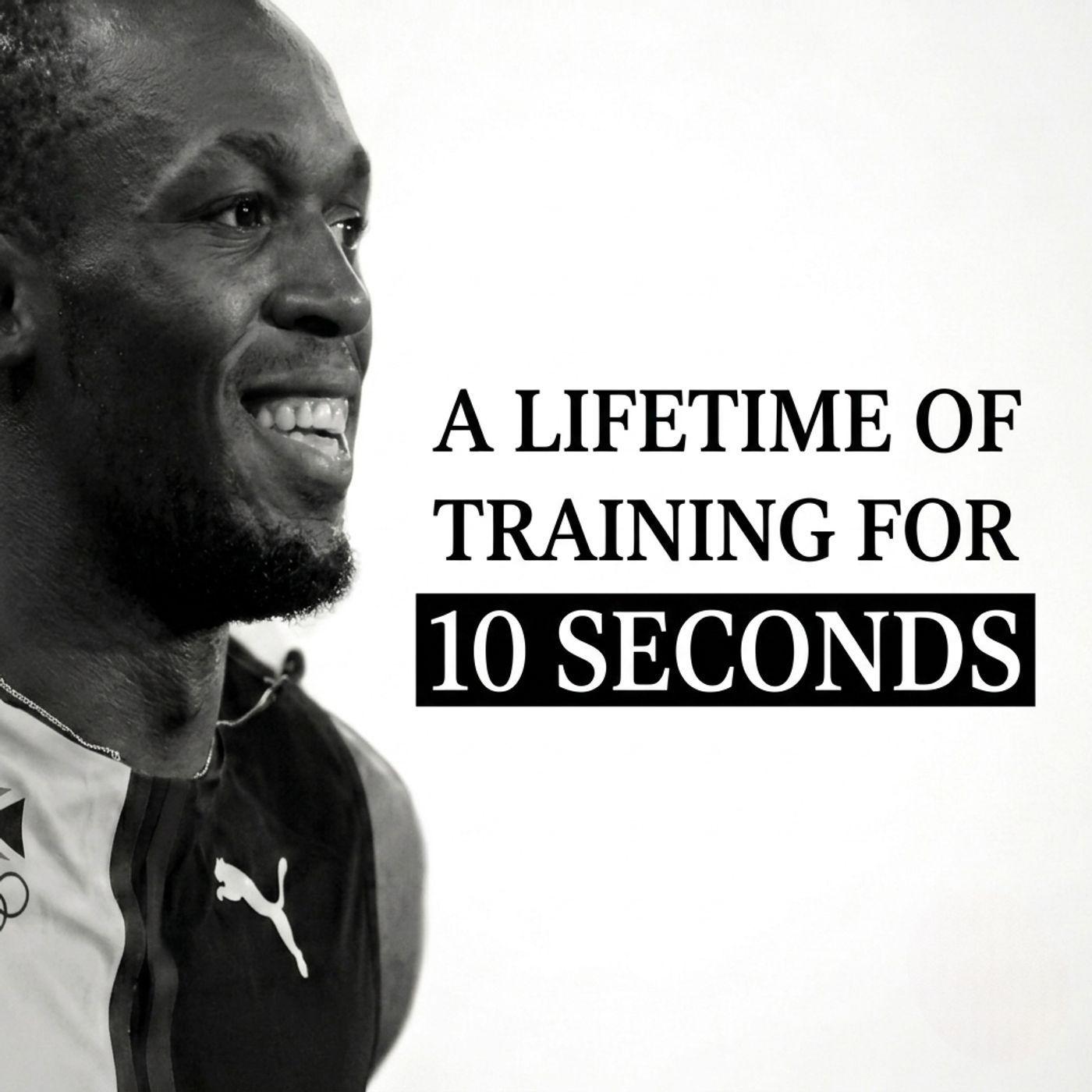
The cameras showed a showman winning for fun. His own book tells a different story, and most of it is about pain.
This episode follows Bolt from a hyperactive kid in Trelawny whose childhood chores quietly built his body, through the teenage rival who lit the fire, to the diagnosis that nearly ended everything.
A severe curve in his spine, one leg shorter than the other, three years of injury, and a home crowd that booed him.
It sits his story beside Kobe Bryant, Michael Phelps and Maradona, and the coach who taught him a way of embracing pain he called the moment of no return.
A study of how the most relaxed man in sport was built from years of agony and the decision not to quit.
انگلیسی
ایالات متحده آمریکا
رونوشت 🔗
جستجوی اپیزودهای گذشته
اپیزودهای قبلی Legends Podcast را جستجو کن.
سلب مسئولیت: پادکست و آثار هنری تعبیه شده در این صفحه متعلق به Shakeel Aslam است که متعلق به صاحب آن است و به Listen Notes، Inc وابسته یا تایید نشده است.
ویرایش
از کمک شما برای بروز نگهداشتن پایگاهدادههای پادکست سپاسگزاریم
