

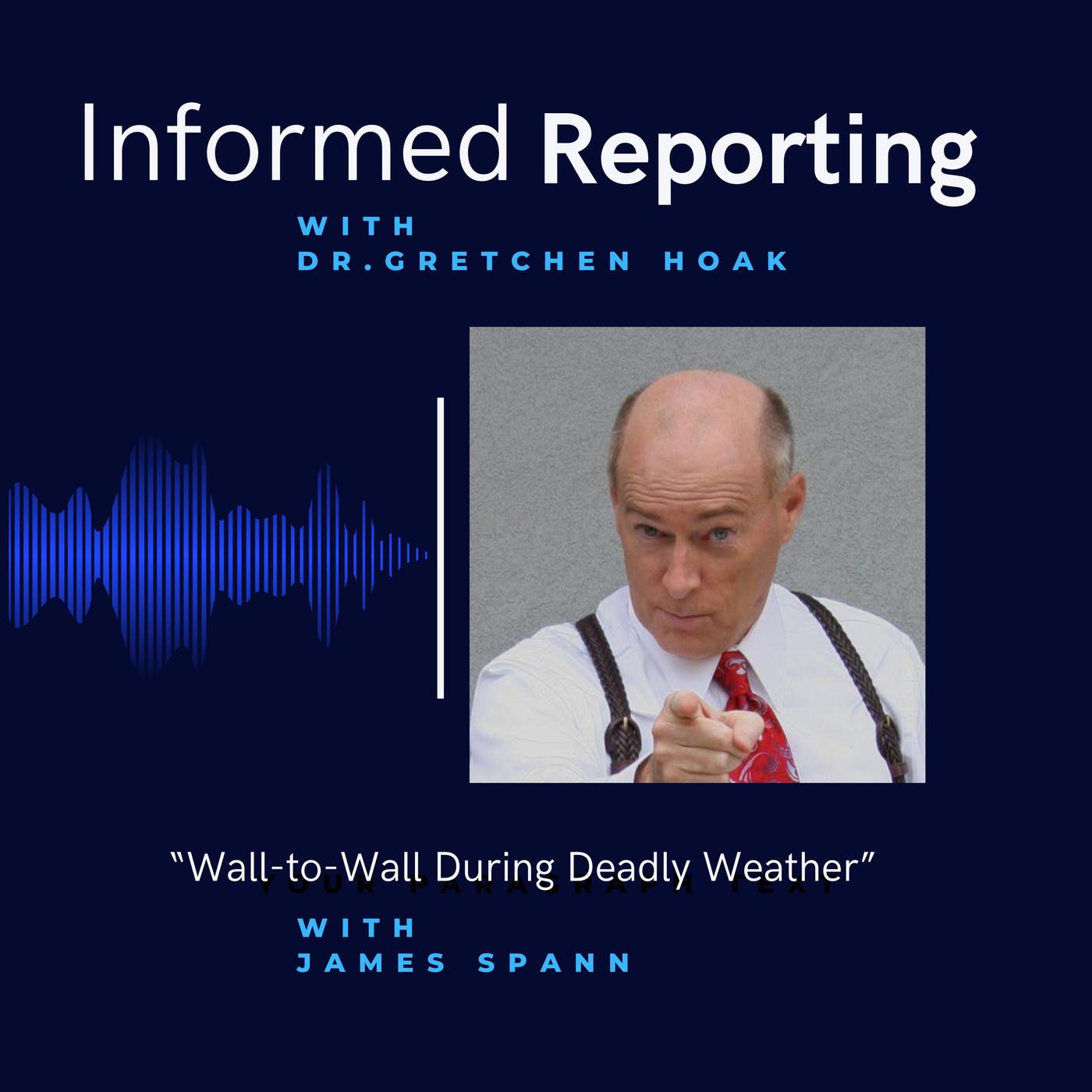
Gretchen Hoak: Meteorologist James Spann, thank you so much for giving me a bit of your time today. When we spoke before, I think you might be the busiest man I have ever met. You've got quite the schedule, so I appreciate you putting me on it.
James: I'm here to serve. I think the last time I slept a decent amount of hours was in 1973.
Gretchen Hoak: you You know, sleep is overrated, I think, at the end of the day.
James: It is. It is.
Gretchen Hoak: Well, to introduce yourself to those of you who don't know you, you are a bit of a legend in the meteorology community, but talk about your career path as a local meteorologist and how you ended up as sort of the premier meteorologist in Alabama for basically 30 years.
James: Well, I don't know. ⁓ goodness, I just love weather. You you have to follow your passion in life to be successful. And my passion in life is weather. Why? I don't know. Nobody else in my family really cares about it, ⁓ to be able to wake up and do what you love for 48 years. Goodness gracious. What a blessing is, is that's my wish for everybody's that they wake up and they cannot wait to go to work or do what they do. School academics, whatever athletics. ⁓ but, ⁓ I've never. you know, had an interest in, you know, working at some high level and broadcasting. I've never had any interest in any of that. It's just helping people during high impact weather events. And it's changed so much. And I got to live the Ron Burgundy era, literally the, if you've ever seen the movie Anchorman, I lived it. And, ⁓ of course, what's so sad, it's almost over the, the, the old
Gretchen Hoak: Hahaha.
James: know, Ron Burgundy newscast days that those days have pretty much passed us by. And so we've made some shifts on that and it's just great. And again, here I am all these years later. So it's not a quest for making a paycheck or anything else. It's just a matter of being able to talk about what you love to talk about. And for me, it's weather.
Gretchen Hoak: Welcome to Informed Reporting Podcast, where we connect research and the real world to have real conversations about life as a journalist. I'm your host, Dr. Gretchen Hoke, a former local TV journalist, turned university professor and researcher. I'm so excited to bring you this week's guest. If you have any interest in weather, this is the episode for you. I'm talking with legendary local TV meteorologist James Spann. He's been in local TV for forty-seven years. And you have spent almost all of your career in Alabama, correct?
James: Yes, I was born here. I will die here. I'll be buried here. I did spend a little time in Texas. I was the chief meteorologist for the CBS affiliate in Dallas in the mid 80s. And this was an, again, that was the peak of the Ron Burgundy era. Those stations were making so much money. They didn't know what to do with it. The number one prime time show in America was Dallas. And I was working in Dallas.
Gretchen Hoak: spending nearly all of that in Alabama. He's most well known for his unflappable coverage during a once-in-a-generation tornado outbreak in 2011, when 62 tornadoes tore across Alabama, killing more than 250 people. We talk about what it was like to be on the air that day, the mental health toll it took on him, and why he still grieves those victims all these years later. We also talk moving forward, taking care of yourself, and being strong as an ox as he approaches 70. You've been listening the Informed Reporting Podcast with me, Dr. Gretchen Hoak. If you liked you heard today, please like and follow us on Spotify or Apple podcasts and feel free to leave us a positive review. To keep the conversation going and for more information and content between shows,
James: for the station that ran that program. think they were charging $8,000 for a 30 second commercial and getting it and they stayed sold out. I mean, it was just a different time, but yeah, other than those years in Dallas, I've been here the whole time.
Gretchen Hoak: Plus, we talk about his new innovative weather endeavor, the Alabama Weather Network, and his determination to protect everyone in the state. Just a quick note before we get started, this episode was recorded a few weeks ago, so keep that in mind when he makes mention of weather coverage from the night before. Please follow us on Instagram @ informedreportingpodcast. Our music is Casual Fridays by 1000 Handz, through a Creative Commons license from Free Music Archive. This podcast is produced independently of my teaching and research roles in the School of Media and Journalism at Kent State University. The information shared here reflects my views and those of my guests and is not reflective of the views or official policies of my institution. And something, when we spoke before that I learned that I didn't realize, Alabama is an incredibly volatile weather market. It's even more so than sort of like the traditional tornado alley. So it's a pretty heavy duty tornado market. Why is that? What is it about Alabama that makes it so volatile and, ⁓ know, such a magnet for severe weather?
James: Well, there's really two zones of maximum tornado occurrence in the United States. One, it's the Great Plains. And most people, if you go to Chicago, Boston, Los Angeles, ask them where the tornadoes happen, what do they say? Oklahoma, because it's in the movies. ⁓ The second zone of high occurrence is the deep south, Mississippi, Alabama, Tennessee, Arkansas. ⁓ And this is nothing to brag on.
Gretchen Hoak: If you have any questions or ideas for guests or topics, please email us at informedreportingpodcast@gmail.com.
James: but we have more strong violent tornadoes than they do and it's not even close. Not that who cares about it being competition, but, and this is nothing new, it's always been this way. And then the other thing that happens here is opposed to the Great Plains, we deal with tropical weather. Alabama has a beautiful Gulf Coast and so in the summer, ⁓ instead of having an off season, we have hurricane season. And yet at the same time at our latitude, we can have crippling winter storms and ice storms. Ice storms can be nasty at this latitude. So it's fascinating. And I'm telling you, some of the best atmospheric scientists in the world come from Alabama because of the diversity of weather they experienced growing up as a child. And at some point, some big event will affect you and suck you into this. It did for me and it did for a lot of others.
Gretchen Hoak: It really seems like it makes not that local meteorologists aren't important, but especially in a place like Alabama, the weather can turn so quickly and there are just such, there is such potential for such, ferocious storms that it makes sort of your responsibility as a local meteorologist that much bigger because you really are dealing with potentially life's threatening, clearly, property destroying storms quite often.
James: And what is important and a lot of people don't talk about that. It's simple, a simple matter of trust. You're not going to trust somebody unless you spend time with them. You're not going to have a relationship with somebody unless you spend time with them. And that's why I think it's important to stay in one spot for a long time. And again, other than that little stint in Dallas, I've been here for 48 years and people get to know me. They know my strengths. They know my weaknesses. They can read my body language. They can read my tone of voice. They know when I'm serious, they know when I'm not serious. And I think that's really important. And especially when you've got tornadoes flying or a major flood event or whatever, ⁓ you've got to have a relationship with the people you serve. You cannot effectively serve a market doing television unless you understand the people, the culture, the geography and the microclimates. And that just takes time, it takes time.
Gretchen Hoak: So you're probably most well known or the first you were put on the map in terms of your notoriety was because of ⁓ the massive super tornado outbreak that was on 27th of 2011. ⁓ 252 people died in that outbreak and it was tornadoes if memory serves. ⁓ you described that event is sort of generational that type of thing doesn't happen. ⁓ all the time. What was it about the conditions made thing happen and made it such a big deal?
James: Right. And again, those tip, those events typically happen here once every 40 years, and we call it generational. ⁓ we had a day like that in 1974. had a day like that in 1932. had a day like that in 1884, the enigma outbreak. And I was not covering that one. ⁓ but there's probably a checklist of maybe 60, 65 parameters that we look for. And
Gretchen Hoak: Hahaha
James: It involves so many different variables. quite frankly, there's a lot of things we don't know. Let me tell you what, as an old guy, I've been doing this a long time. What I've learned is how much we don't know. You know, when you're young, you think you have to know everything. And there's so much about severe local convective storms we don't understand. Which ones produce tornadoes, which ones don't. Under the same circumstances, it can be baffling. on that, going into that, everything was just off the chart. You need buoyancy. You need the ability of air parcels to rise freely. You need some type of lifting mechanism, whether that's a surface front and upper trough. You need a very strong, diffluent flow aloft that tends to pull air up from below. You need a very strong veering of the wind with altitude. You need very strong wind fields. You don't necessarily need a large capping inversion. And I could go on and on and on. And, ⁓ in the days leading up to that, we just started seeing all the flags. mean, literally 50, 60 of the flags were there. But even with that, you still don't know what the atmosphere is going to deliver. Predicting the future is hard. It really is. I tell people all the time, if you don't believe me, you fill out a March Madness Bracket and let's see how you do. It's the same kind of thing. All the variables that can go wrong. But going into it, we knew that it could be a bad day. we tried to advertise, this is a day where you've got to hear warnings. You have to be able to hear warnings. And that we have the potential of violent long track tornadoes. And, uh, again, of course, 15 years ago, we didn't have the knuckleheads on social media and the AI, the bots that constantly feed nonsense hyperbole. But still I, I know how to use strong language and I think people latched onto that. And I think they were ready despite that high loss of life. And again, with the numbers you were using there, that's just for my state. had tornadoes and adjacent states, but for my state, the one day we had 62 tornadoes, 252 people were killed on my watch. And I grieve them almost every single day. I'll never get over that day. And we have to be better. We have to be better. We, just learned that I don't know as much as I should know about communication, messaging, and human behavior. That's what was missing. And that the warnings were great for every one of those things. All 62 tornadoes. In some cases, the lead time was 30, 40 minutes, which is typically it's lead times 12, 15 minutes. And so, ⁓ we learned a lot that day. Let me rephrase that, I learned a lot that day.
Gretchen Hoak: It was a long day. So storms started firing, very early that morning, like 3 a.m. and you had your colleague on the air and then ⁓ you came in and by the time this was all over because there was storms and then you had a little break and then things really started picking up again, by the time all of this was done, how long had you been on the air ⁓
James: think that if you, you can, we were live for several hours in the morning and then live for a long time in the afternoon and evening. There's a little mid morning break that quite frankly we needed. ⁓ but I would say between the two, was about, ⁓ 12 hours. And again, we've done it before that, that this is a very aggressive, severe weather market. The two most aggressive, severe weather markets in the country are Birmingham and Oklahoma city. ⁓ we both are very aggressive, very long form. So we're used to that. type of work. It's not that unusual, but what was unusual, the number of tornadoes and the intensity of the tornadoes and the humanitarian crisis that evolved.
Gretchen Hoak: I've watched some of the coverage, some of your stuff on air from that day. And if anybody wants to see it, it is on YouTube. It was amazing to watch how you're talking about this one tornado with a debris ball. And ⁓ by the way, here's another tornado on the ground with a debris. You know, there was just seems like, ⁓ and over again, there was multiple storms, multiple really, really big tornadoes that you were trying to bounce between. What are some of the emotions that you were going through as you're seeing these really big storms take shape and you can see them on your cameras? What's going through your mind or what do you feel in those moments?
James: I felt nothing. Listen, that's a beautiful thing. I felt nothing. I had no emotion, no emotional tie during the event. And that's a godsend because if that would have been the case, it would have been so distracting. But I was too busy. I missed it. I missed the history of the day. I missed the emotion of the day. missed the, I missed it because I was so busy. People don't know what it's like to stand on that green wall. When you've got so much information overload you're dealing with, you've got a chat session with the Weather Service in Birmingham, the Weather Service in Huntsville, Weather Service in Jackson, Weather Service in Memphis, Weather Service in Atlanta, constantly dinging. You got a chat session with your own volunteer weather spotters. You've got a producer in your ear. You've got multiple live streams from people in the field. And I'm having to process all of this in real time. And we did have social media back then and I was getting images and video from that. And you're having to process that in real time. And there's only so many CPU cycles we have in our brain. And it took every one of them to get through that, which meant that I just didn't get hung up in the emotion of it until later. And I'm very thankful for that. was, ⁓ I just didn't get distracted by that. just, you have, have to stay locked and focused in telling a coherent story and take all this information and process that in real time. And let me say this, there's no book and there's no manual on how to handle that. ⁓ you know, handling one or two tornadoes that great, but when you've got three, four down at the same time and, and they are, they're all the upper end violent long track tornadoes that are capable of just killing dozens of people. Which one do you focus on? How long do you focus on that one? How long do you focus on that one? We've got a camera on this one, but we've got a spotter on this one. you know, history will judge me for what I did that day, whether it's right or wrong, but you just, and I tell Jason, the guy with me in there, we did the best we could do under the circumstances. And we have to learn from what mistakes we made and get better. But I didn't feel anything because I was too busy.
Gretchen Hoak: And it's amazing what a trick of the mind that is because some of the video, I mean, those tornadoes were huge and you your ability to just sort of recognize, yeah, that's a big dangerous storm. Anybody in the path of this thing needs to get the heck, you know, into a safe place. but still be processing and still be sort of like coherently explaining to people what's happening as you're seeing those pictures of what you know to be very, very terrible storms. it's almost a blessing that your mind couldn't process anything else because of, ⁓ the magnitude of you were seeing.
James: Yeah, and I would see out of the corner of my eye, of course, there's multiple screens in there and you can see all these feeds coming in from the field and you would see this horrific damage, horrific damage. But I couldn't go to those live feeds because we had tornadoes on the ground that are in the process of moving into areas where they could kill people. And I can't show this damage because I've got to focus on trying to protect these people and you're making really hard decisions. And some of that video is compelling. And you get a producer in your ear saying, we got a live shot in, in Windham Springs. got a live shot in, in Webster's chapel. got a light here with all this tornado damage, but no, no, we're not taking that. We're just the, the, one thing I tell the producers, all these journalists and I know nothing about journalism, nothing zero, but I tell all the producers. directors, news directors, whatever they are, news department. When there's tornadoes flying around here, I'm the sheriff. I don't mean to be ugly, but I'm the sheriff. I'm calling the shots. Every other day you call the shots, but on these days, you don't understand it, I do. And let us take it. again, I've been very, very blessed to work for people over the years that understand that and they give us the freedom to do what we need to do.
Gretchen Hoak: That seems like ⁓ an incredible amount of responsibility to Kerry. How do you, I guess, handle that, for lack of better way to put it, knowing that you are the sheriff, you are the one who knows everything and the most of what's happening, and it is kind of your job. Like, that's why you're there.
James: Well, you know, after a big event like that, ⁓ we're much like ⁓ a dispatcher, a 911 dispatcher. They go through trauma. ⁓ People don't think about them, but they do. in our position, public facing, on camera, meteorologists, we kind of had the same problem. And it takes a while to process a day like that. I'll shoot straight with you. It is 15 years later. I've not processed that day yet. I had 252 people that died on my watch. And that's inexcusable. I can't accept that. And what's helped me, I've memorized the names of the people that have died. I know their surviving family members. I know their stories. I wonder what they would be doing now 15 years later, especially the infants and the children that were killed on that day. ⁓ I know there should be a day to celebrate the lives saved by the warning process. There should be. I'm just not ready to do that yet. And the thing I regret, if you have any regrets about it, I didn't seek professional mental health counseling. ⁓ We have to get past that. It's not a sign of weakness. That's a sign of strength. Because I needed about six months to go through a grieving process. You go through some depression and anger and that's not me. Anybody that knows me, I'm upbeat, positive, just go get them. And I needed that and I didn't do that. And so the one thing a lot of us in the weather enterprise are trying to do, including those that work for the government, the national weather service and the private sector folks like us, it just have a support network after one of these big things happens. And I think we're a lot better at it today than we were 15 years ago. We don't pay attention to mental health. We don't in this country. I volunteered in healthcare for 21 years. I am the chairman of the board of a large hospital and I did it for a selfish reason. I wanted to learn how people die in tornadoes. I wanted to learn how people are seriously hurt in tornadoes and that allowed me to spend time with these ER and trauma docs. But I just kind of fell in love with the hospital and the people and the mission. even within our hospital structure, we're large hospital. I don't like where we are with our mental health program and we're going to get there. That's my priority on that side and we have to remember that too for people that do what we do for a living. And that's the one regret I had. I didn't seek professional help and I really needed it after that.
Gretchen Hoak: Was it hard? Was it a hard, ⁓ months after this happened, looking back you said you wish you would have ⁓ sought ⁓ some professional to you through it. What was that like just trying to ⁓ move through that grief
James: It wasn't good. the, the, the depressed and then, and then you get angry and, here's what helped. And I, you know, I didn't really think it was going to help, but we, ⁓ at the time our youngest son was about 14. He played baseball and I liked to coach baseball. I'm good at it. And we took a travel team, a baseball team into one of the hardest hit areas and, ⁓ with chainsaws, heavy equipment, dads, moms. ⁓ and I know this, I know this state and my concern, it's the rural parts of the state in the city. Everybody knew about Tuscaloosa and Birmingham, but they didn't know about places like Cordova, ⁓ or Barton's chapel. And so we went out in the country and, ⁓ we found a family where we. helped them and we just started a process and that was very therapeutic and I will tell you for anybody that's going through a tough time mentally when you take some energy and help somebody else doesn't matter maybe you buy them a hamburger at the McDonald's it could be as simple as that but for us helping that family try to get back on their feet again after losing everything everything every possession gone and these are lower income families That was just a tremendous boost to me. You talk about a high, releasing endorphins, goodness gracious. So that's the one thing I've learned is that that's the way to kind of get back on track and it really helped me.
Gretchen Hoak: That's great. And I imagine that as a meteorologist, you probably aren't out in the field you're not usually the person out there doing the stories and that kind of thing. So I imagine how kind of being able to get out there and just sort of see it and try to understand it more ⁓ could be very helpful after something like that.
James: Yeah. And I took, ⁓ my wife and our two boys, ⁓ out to see things that they needed to see why I do what I do. What I do is hard. It was easy. Everybody would do it. And they just needed to see it. You can look at these videos all day, the video that for tornadoes, you can look at things like that, but you've got to experience it in person with your eyes. You have to, to, understand it. So I kind of took them into some places for them just to see some things. And quite frankly, it was hard. It's really hard. But I think it helped them maybe understand what my calling in life is. We all have a passion, everybody. they know mine is weather. And I just think they needed to see that side of it. again, that is part of the joy of what I do in a normal day. I speak in schools every day. what I like to do on the journey these schools, and some days I'll be on the road seven hours. I'll be three and a half hours down, three and a half hours back. It might be in Dothan or Mobile or whatever. I got the whole state, ⁓ but I'll stop in Dollar Generals. You've probably never been in a Dollar General.
Gretchen Hoak: ⁓ no, we have those. Yes. I do not frequent them. Yeah.
James: I, but you've probably never been in one. See, I hang out in these things. This is where real people hang out. You want to understand the people that you serve, go to a Walmart, a dollar general, a family dollar, because we have to serve people that don't look like me, that don't think like me, that don't have the same education. And you do this for all these years and you hang out at places like that. And so, so again, after a tornado, when I go into these areas, people welcome me. They know that I'm not there to show boat or to, you know, I want to be some big news man and show video that they welcome me because they know that I feel the pain that they feel. We're family.
Gretchen Hoak: Does that help you build credibility as well? So when you are on the air saying, hey, this is bad, people believe you, people listen.
James: Yeah, and again, it's a matter of developing a relationship. And relationships can be hard and they can be messy. And you can have ups and downs in any relationship. But that's pretty much what I feel like I have with people of the state of Alabama. You can ask anybody in this state, you know, who I am, and they'll tell you who I am and what I do. you know, beyond that, you can ask them, what do you think about the guy? I mean, who knows what they'll say, but they know that If nothing else, I'll always be there. I will always be there when there's tornadoes flying. I will be there. And now I've got the whole state with this new digital thing we're doing. And I will, I know where they live. They know, they know it. They know it. I'm not looking at some map. it'd be me, it'd be like me doing weather in Minnesota. I'd be looking at a map, calling out names and county roads. And I've never been there. I'm just calling out. But they know that I've been to their town. I've been to their school. I've been to their church. ⁓ I taught them, I taught their kids and they, there's some trust there and there's some trust. And that's really important. I think in the communication process with severe storms, need that trust and that relationship. it, again, it takes time, but that's what I try and do every day. Again, my first open date for a talk about whether it's in 2028. ⁓ you know, most old people slow down. No, I speed up.
Gretchen Hoak: That was going to be my next question. You really take pride and feel that it's very important to take care of yourself. You are just as passionate about that as you are about weather. Talk a little bit about what you do to take care of yourself, but also why you feel like that's so important.
James: Well, let's get real. So I turned 70 next month, 70 years old. know, when I was a kid, I couldn't imagine living to 70. I couldn't imagine living to 20. and I feel better now than I felt when I was 25 and I'm 70 years old. And the one thing that I didn't do was take care of myself for a long time. with no sleep, bad diet, horrible hours, stress,
Gretchen Hoak: He
James: I felt I was physically dying about 15 years ago when I was in my mid fifties and I knew something had to change. And so our son, he played high school baseball. He was training at a facility literally right across the street from the TV station where I worked. And I found out that they had a little section for regular people. thought it was just athletes that went over there. And ⁓ so I went over there and the first time was horrible. I couldn't breathe. I had to stop every 30 seconds. After the third session, I came back to the TV station and vomited. mean, my body rejected the whole thing, but then I started getting into it and I felt better. And, ⁓ so for about the last, I don't know, 10, 15 years, I pay attention to my physical health. And here's the deal to do what I do for a living. have to have very, very strong cognitive skills.
Gretchen Hoak: Hahaha
James: And I honestly believe, and again, I hang out with clinicians with my volunteer job at the hospital. There is a direct link between your physical health and your mental cognitive state. And if I'm calling out a wrong street, when there's a tornado warning, a tornado emergency, a wrong neighborhood, a wrong Walmart, a wrong barbecue joint, that could kill somebody. And the minute I lose that cognitive skill, I'm done. I know that's when it's time to stop, but I'm sharper now mentally than I was. when I was 25 and I know that, ⁓ and that has a lot to do with my physical health. So I do the CrossFit thing, ⁓ at least three times a week. And you have to be very disciplined because again, I'm so busy. It's easy to just blow it off and go add another school program or a talk, but, I'm, I'm strong as an ox. mean, I back squatted 260 pounds the other day and for an old man, that's not bad. If you know, if you're 20, that's okay.
Gretchen Hoak: That's not bad for a young man either.
James: And you know, it's, just, I played tennis on Sunday evening. I'm disciplined and I do that. And, ⁓ it's just, ⁓ I'm very blessed. Most people my age, they look horrible. They don't do anything. They retired, they do nothing. And I know that if I stopped doing this, I won't live much longer. So again, my, I'm still, I'm just getting started. ⁓ but you've got to take care of yourself physically. And that's a priority that that's a, it's hard. But you've got to be disciplined and you have to allow a lot some time to do that.
Gretchen Hoak: Do you think that also helps, like being physically healthy also helps with those stressful times when are dealing with very weather situations and just trying to be able to process all that and get through it, is being physically healthy also kind of help you bounce back from those?
James: ⁓ sure. mean, goodness last night, ⁓ I was on the wall for nine hours and you know, know some 70 year old men that can't stand for 15 minutes, much less nine hours. And, ⁓ again, you, you, ⁓ I think the physical part of this is just critical for what I do. mean, people just expect, we did a ⁓ 12 hour session, ⁓ a couple of months ago, an overnight session was 8pm to 8am.
Gretchen Hoak: Hey.
James: And I felt great. I felt great coming off that overnight session. It, it doesn't bother me. Yeah. You're a little fatigued, but that's just, you know, human. yeah, if you're not in good physical condition, you're in trouble. You cannot do that. You've got to take care of yourself. And I think that's true for anybody, no matter what they do. I've seen some clinicians, physicians, surgeons, greatest in the world, but they don't take care of themselves because they're so busy. They work harder than me. and they just don't spend any time on their physical health and I've had to fuss at some of these ⁓ these men and women you've got to take care of yourself
Gretchen Hoak: With new endeavor, you have moved from traditional local broadcast news to the Alabama Weather Network, basically a 24-hour weather network ⁓ online specifically on Alabama. Talk a little bit about that. Why the move? Why go out and ⁓ start this venture? And what are you hoping to do with that?
James: Well, to be successful. again, my, was born, I was born to mitigate loss of life when there are tornadoes flying around here. As strange as that sounds. And I need resources to do that successfully. I need resources. need hardware equipment. ⁓ I need people. I need cameras. ⁓ I need, I need a lot of things to do it right. And People are not going to watch an old man standing in front of a radar for eight hours anymore. Nobody will watch that. Nobody. And that's fine. It's just the way society is. It's not bad. It's just the way it is. You have to make it visually interesting. what we've been in the local television stations and listen, I've worked in local television since 1978. mean, I'm coming up on 48 years next month, which is insane. And during the glory days, I was there. They were making money. They didn't know how to spend it. I mean, when I was in Dallas, I got a call from the news director about 11 o'clock one morning. said, you got a live shot today. And I said, great. Where? said, the national hurricane center. said, yeah, right. Where is it? And he said, the national hurricane center. They had a Learjet waiting on me at the Addison airport, flew me to the hurricane center in Miami, did the weather, you know, at five, six and 10, flew me back. That's how it was back then. They had the resources, but now When people go home, they don't watch ABC, CBS, NBC. They watch ⁓ Amazon Prime, Netflix, Hulu, YouTube. And primetime ratings are just negligible. Some of the shows don't have enough audience to measure. And so you can't get advertising dollars for that. Local newscast audiences have declined tremendously, tremendously over the years. And this is a national trend as people are moving away from Ron Burgundy and getting their news. from a source that they like that's digital. And so the local stations just don't have the resources anymore. And so we wanted to build an entity that would have that. So for example, last night when we did our long form coverage, I had six meteorologists in studio A, six. If you watch the YouTube video in 2011, how many did I have? Two. It me and Jason Simpson. God bless Jason. ⁓ But I've got six, six in there. ⁓ One full-time person, he ingests the viewer submitted videos and photographs from social media. That's a full-time job. In some cases, you'll have five, 6,000 that come in for one event. I used to have to do that by myself on the fly on the wall. I've got one full-time person in charge of cameras. We've got, I think, 82 fixed sky cams. That's a full-time job. I've got a person to do that full-time. I've got one guy doing radar. I've never had this freedom before. And then in the field, we had six teams, six. Normally with the old broadcast days, we'd have two or three, maybe, maybe. And these guys in the field, they have dash cams and they have drones. Go to the Alabama Weather Network and you can watch the coverage from last night. It was just stunning as how good it is. So we built something. for the next generation. It's the best of what I've done for all these years and the best of Ryan Hall and Max Velocity. And I don't know if you know who these guys are. They're YouTubers. And now when there's a major national weather event, people don't watch the Weather Channel or Fox Weather and I've got friends at both. The dominant force, it's these YouTubers in their basement. Ryan Hall is a good friend of mine in Kentucky and Max Schuster uses Max Velocity on the air. He's a good friend of mine.
Gretchen Hoak: Yeah.
James: And we're taking the best of what they do and the best of what I've done and merging into this new form, which I think it's, it's really interesting to watch. And that's what we want. We want people to stay in there and stay with us. And, ⁓ and understand it takes business sense to make this happen. That this is a big business to pay all these people and to pay for all these cameras and to pay for all these teams in the field and all this equipment in the studio. You can't go to Joe's lawnmower shop and get a hundred dollars a month. sponsorship and pay for all this stuff. You've got to have major, major players behind you. And, ⁓ we've been able to do that. major entities. I, I probably shouldn't say who they are. can see Coca-Cola and things like that, but, ⁓ they made an investment and for them, it's a win for them because they get this massive audience that we can deliver on the social platforms and the digital platforms that they will never get on television.
Gretchen Hoak: Ha ha ha ha!
James: It's a way for them to get their message out and it's a way for us to monetize the whole thing. So it's been a beautiful thing to see come together.
Gretchen Hoak: Are you better able now you think with the resources that you have and the setup that you have to warn people and reach more people when you have to, when severe weather hits?
James: There's no doubt. There's no doubt during the glory days of television in our, and again, in this market and back, you know, in the old school way of thinking, you television markets in our new world, there's no TV markets, but, ⁓ know, you, might reach maybe, I don't know on a good day, 400, 500,000 people. ⁓ I think last night, the numbers we saw, we were at 12 million and that was a relatively, this was not a major outbreak for us, but goodness gracious, that's more than most of these cable networks have in prime time. ⁓ And so we're reaching more people than ever before in a way that's interesting and relevant to them. And ⁓ so yes, there's no doubt we believe that people will be safer because of the new entity that we have built here. And I think another beautiful thing about this is that we're going to take care of everybody, this whole state. I tell people all the time, it doesn't matter where you live. If live in a big city or you live out in the sticks, if you are high income, if you're low income, if you, doesn't matter what TV market you're in, what weather service office issues, the warnings, we've got your back. The commitment will be live every time there's a tornado warning every single time. So for these rural places, you know, a lot of the big TV state, the old TV way of thinking was diaries and meters and ratings and The minute it gets away from the city where there are no meters or diaries, they go back to freak of the week or whatever's on TV programming and they leave the rural people out of it and they don't get adequate coverage. And we fix that problem. I'm from rural Alabama. I'm from Butler County, Alabama, Greenville, rural South Alabama. That's my heart and my passion. And I love the fact that we're going to take care of them just like we take care of people that do live in a big city.
Gretchen Hoak: Are there things that you do now in terms of how you communicate to your audience and how you cover severe weather that you learned from the events back in 2011?
James: Yeah, you what we did and what I realized is obviously I'm not good as I think I am after that many people die in one day. And what I learned is that I don't know enough about human behavior. I do physical science. My first major in college was electrical engineering. I was a double E major for three years and finished in meteorology. I've never taken a class in communication, doing a podcast, you know, ⁓ public speaking, I don't understand any of this. I've just tried to learn it on the fly. And so we went to social scientists, these brilliant women and men that understand human behavior, that study it and that can quantify our needs and help us. And we work with them to make it an interdisciplinary approach to severe weather coverage, combining physical science and social science to make us better and stronger. And I think we are better and stronger now. And we know now why most people died. The number one reason people died was the notion that you should hear a siren, which is total nonsense. I didn't think it was that bad, but we learned that in that most people honestly thought they were going to hear a siren in their house, in their business, in their car, like a world war two vintage air raid siren. Are you kidding me? ⁓ That killed more people than anything else. And we learned that from the social scientists. so needless to say, we've been strongly messaging that for the last 15 years. And then the second reason people died really has to do with the clinical side of this. Most people didn't have a helmet on. Most people that lose their life in tornadoes, it's blunt force trauma above the shoulders. And by putting on an $8 Walmart bicycle helmet, that increases your chance of survivability by up to 70%. And you know, I didn't mention that once, not once, and shame on me for that. If you got all that YouTube coverage, not once. And I knew it. I knew it and I just was so busy I didn't say it. And we also learned that our false alarm ratio was out of control. We had too many false alarms. And we don't issue the warnings, that's the National Weather Service, but we're all family in the weather enterprise. And we all went to work back to basic science and... ⁓ I'm proud to Kevin laws, who's the science operations officer here for the weather service. ⁓ he's got the false alarm ratio from 0.83. That's 83 % of warnings were false alarms down in the 2030 % range. I never thought it would be this good, but those, those are some examples of the things we learned after 2011 that we really, really worked on. People didn't understand how warnings are issued. If you ask anybody what my standard saying is, it's three words, respect the polygon. Now, if you're not in a severe prone market, you don't know what that means. You go to anybody in this state, they know what that means and they attribute that to me. That was born out of social science because people in 2011 thought that tornado warnings were issued by counties. You don't need to warn a whole county for a tornado. Tornadoes are small. Counties are big. We went to a storm based polygon system. I would say 06, 07, something like that. that's, we're trying to say things that help teach people.
Gretchen Hoak: Yeah
James: how the process works so they can be better prepared the next time we have one. And the other thing I could go on and on, but we did not do a good job with some people groups. We did a horrible, horrible job with low income families. And again, shame on us. I come from a low income family ⁓ and we should have done some things to help them. We didn't do enough for people that live in manufactured housing trailers. They have some special needs and that you can't stay in a trailer. There's no safe place. It's a death trap. They needed more lead time. They needed to arrange transportation. They needed a place to go. They needed some help in making decisions and we didn't help them with that. Those that don't speak English, they couldn't understand anything we were saying and they didn't understand all these colors on these maps. We did nothing to help them. And so all of this is now baked into what we do today to make us better.
Gretchen Hoak: do you like you're maybe doing a better job of that now? Does it feel like you are having more of an impact now than now that you know all of these things and what you've learned? Do feel like you're ⁓ making the impact that you wish you could have made back then?
James: Yeah, I think there's no doubt that we're making a bigger impact in sending a bigger message and reaching more people now than we were in 2011. And of course we have more communication channels and a lot of that has to do with social. And I know that some people can't stand it and I know there's negatives, but yet at the same time, that's where people are. They're on their phones. You go into an airport, you go into a anywhere and people are just staring at that phone and that's where they live. And being able to reach them through that piece of glass, that's Good for us. It's a tool for us. so we, social media was new back in 2011. The iPhone came along in 07 and it was four years old. In fact, all my pictures were on an iPhone 4 from 2011. You can look and see the metadata and see what it is. But I think there's no doubt we're reaching more people with a clear message now that we did back in 2011 in terms of getting people ready for tornado days.
Gretchen Hoak: Yeah.
James: And I think one good example, we, five years ago, we had a tornado that hit our house on March 25th, 2021. And tornadoes happened to real people at a real place at a real time. And, ⁓ this was a very, very densely populated part of Birmingham. And we did not have one fatality, not one. And that's the only metric I care about. And I'm a numbers guy. Fatalities was zero. because they heard the message on prepping for the day. They heard the warning, they responded, they did the right thing. The damage was horrible, but we had notice of loss of life. And I think that was a sign we've come a long way.
Gretchen Hoak: I remember when we spoke before, you did mention that you ⁓ were the air when that happened and you knew how ⁓ Scott That ⁓ had be unusual for lack of a better way to put it. ⁓ Yeah.
James: That was, that was bad. That was bad. It was, you know, it was, was the most distracting thing ever. And I'm sure that my performance that day was not good. ⁓ cause you just wonder, I knew my wife was okay because we have a tornado shelter that's, know, we can have an EF five come through here and she's okay. But do you have a house? You know, is the roof on the house? Do you have walls standing? What's left? You just don't know. And you're, you're playing mental gymnastics. while you're trying to tell a coherent tornado story involving other places and other people. But you've just got to stay focused. You've got to stay focused on having a servant's heart to do this job. You have to have a servant's heart. Look after the needs of others before your own needs. And if you can stay locked in on that, and that can be, we're all selfish. We are all selfish, inherently selfish. But if you can stay locked in on the concept of being a servant, You can get through days like that, which it was hard.
Gretchen Hoak: Yeah, I can only imagine sort of the superhuman effort it would have taken to know what was going on and see it on the radar and know where it's at and know where your house is, but still stay focused on everything else and trying to communicate to everyone else what was happening. I can only imagine the superhuman emotional focus that must have taken just to be able to do it.
James: Yeah, it just, was not a good day. And I'm thankful. I don't know if you've ever watched good morning America, the meteorologist for ABC news and who does good morning America is a woman by the name of Ginger Z. Ginger is one of my kids. She interned with me in 2000, 26 years ago. And Ginger was here working for ABC and she walked.
Gretchen Hoak: Mm-hmm. ⁓ wow.
James: over a mile through trees and debris just to check on on my wife. And I'm so thankful. I look back on the heroes of that day, like a ginger Z or names ginger Zeitgeist. We gave her that name, ginger Z. ⁓ and, ⁓ goodness, Steve Shaw, he was the director of officiating for the southeastern conference. ⁓ he, all these people that walked through this horrific debris. to check on my wife and to kind of check on things. And they communicated with me to give me some level of comfort knowing the roof stayed on your house. Man, that was outstanding. To this day, I need to find out the guy that put the roof on that house and buy him a nice dinner because ⁓ so many of our neighbors, the roof came off and in a tornado and a violent updraft, typically what happens is that the roof will be taken up and away and then the walls go away. And then you'll be in a hotel for a year.
Gretchen Hoak: haha
James: So we were able to live in the house while they fixed it, which was quite the blessing.
Gretchen Hoak: That's amazing. that was sort of my next question was how much damage you still had some damage, but at least it wasn't as bad as, you know, neighbors and other folks in the area.
James: Right. We roof, we have trees all over the house and the roof was in bad shape, but it stayed on. And what's funny to this day, in fact, about two months ago, we found another leak from the tornado five years ago. ⁓ It's a long recovery process. ⁓ Goodness, but I choose to look at the positive. We get a great sunset view now. We never had before.
Gretchen Hoak: Hahaha Yeah
James: ⁓ but we live in a pretty wooded area in, in while the trees were taken out. Now you get a nice sunset view. And, ⁓ but you know, the, one thing I'll never forget, ⁓ the, the next day, this army of people just showed up. I didn't know most of them. had heavy equipment. They started getting trees off the house. They started to restore order and give you some hope and goodness that that's.
Gretchen Hoak: Yeah
James: I can't tell you what that meant to me and my wife. those were just angels. Those were heroes and they would not take any money. And, ⁓ they, they spent from daylight to dusk out here working so hard that day and goodness gracious. I look back at, were just so many heroes after our tornado. And I'd like to think that it works that way for all tornadoes. And it was a good sign. was just good. It doesn't matter if you're, you know, Democrat, Republican or whatever. everybody was just pitching in to help everybody else and that was very refreshing. It was very, very good.
Gretchen Hoak: ⁓ just the relief that something that would have brought knowing that you are now not going to have to deal with so much of things like trees all over the house and you know that these people are going to show up and kind of, get the ball rolling so I can imagine the relief that must have been, especially after having been on the air and sort of watched your house, get hit and not knowing how your wife was doing just to have something like that. I can see how how it would have been very, very helpful. ⁓
James: And then they have like chopped up and made firewood, you know, out of all these trees that were down, we had firewood for like two years after that thing was over. that, and they took, take, they all took some of it home, but we had enough firewood for a village after that thing.
Gretchen Hoak: Yeah. you That is amazing. You mentioned a little bit about this, said that, ⁓ making sure that meteorologists and folks work in weather understand that mental health is important. Do you think that there is more of a conversation about that now and the impact that big events can have on meteorologists like yourself? Is that a conversation that's happening more than it used to?
James: It is. ⁓ One of my dear friends is Rick Smith. Rick is the, what's called the WCM, the warning coordination meteorologist in Norman, Weather Service in Norman, Oklahoma, Oklahoma City. And that's the other major tornado market in the country. And they've been through a lot and we've been through a lot. In Rick's heart, it's to help professionals on the mental health side, mental health side after these big events, letting them know first off, How you get help this is what you need to do. This is who you need to talk to we can arrange it for you let us help you and ⁓ Rick in a group from the Weather Service they've done an amazing job and it's discussed often papers have been presented at some of our AMS meetings and NWA meetings and I know that it's also a priority at the National level one of my good friends Ken Graham Ken is the director of the National Weather Service. He feels the same way And Dr. Neil Jacobs, he is the administrator of NOAA, another very good friend of mine, ⁓ understands the critical nature of maintaining good mental health for employees in the National Weather Service and NOAA and those in the private sector. And of course, for those in the private sector, we're ⁓ little separate, but we're still part of the same family. when we come together for an AMS meeting, that's American meteorological society or an NWA national weather association meeting. We'll have these papers presented on maintaining your mental health ⁓ understand it's not just ⁓ a major tornado event where you've got tremendous loss of life and you're traumatized, You've seen things, these survey teams, they see things they don't need to see. You've had loss of life because of something that you did or maybe something that you didn't do, but you can have mental health issues on sunny day. Anybody can, and I think it's important for all of us to understand that we all go through ups and downs. Life is messy, and this is how you get help, and some corporations are good at it. Some are not. But anyway, it is it is one of the priorities within the weather enterprise now, and I'm very thankful for that... and part of that came out of April 27, 2011.
Gretchen Hoak: Well, it's nice to hear because I think it's maybe easy for sort of the regular person, if you will, not to even think twice about, well, that person is just at the weather wall and they're just talking about what they see on the radar. But I think it'd be easy for. people who don't do what you do to overlook the fact that there is a tremendous amount of stress and impact when you know what's happening and you can see it and you have the knowledge to read the terrible things that are happening on that radar, there's absolutely stress associated with that. it's...
James: ⁓ goodness. It's like, you know, so there's a tornado down and it's approaching an elementary school and you spoke to the kids at that school, you know, three weeks ago, or it's approaching a neighborhood where your in-laws live or it's a, when you live in a place for a long time, you develop relationships with so many people and you can connect neighborhoods in cities and small towns with people that you know, and it becomes overwhelming. Because again, in your mind, you want to play these mind games. ⁓ no, I can't believe this because my good friend lives in that neighborhood and it's coming and it's a challenge. It can wear on you mentally very quickly. the other problem too is that now of course we deal with trolls and it's really hard for women. ⁓ I can't tell you how bad it is.
Gretchen Hoak: Yeah.
James: how they are harassed during tornado events. They'll be harassed about their body, what they're wearing. It's insanity. It's horrible. I've been told I should have been aborted by a coat hanger. I it's like, I tell people all the time, I have no feelings left to hurt. You can't hurt me. what these young women, especially the younger women are dealing with, it's during tornado events. And I got all kinds of hate last night. I got all kinds of good hate mess. could read hate messages here all day and some of them are pretty threatening. mean, they'll, ⁓ you know, they will threaten you with violence, physical violence, and that can get up in your mind. And just after a while, you just need to find somebody to talk to that's a professional that can guide you and getting better. You're just, need some help. like when you get sick.
Gretchen Hoak: make a great point. ⁓ You already ⁓ serve or you've such an role as a meteorologist during a severe weather event ⁓ and there is enough to juggle having to worry about trolls and the nonsense that the bad side of social media will bring. ⁓ And absolutely, I think you're right. think. that it's hard to ignore that. And it's one more stressor on top of an already stressful job that carries a great deal of responsibility, especially in an area as prone to severe weather as something like Alabama.
James: Right. And it's, I worry that you just can't get distracted by that. When you've got a big event coming up, you've got a tornado threat and the trolls come out and they will come after you full force. Now, some are bots. They're not human. Some are. Some of the people that come after you are mentally ill. ⁓ Some are just mean and some have a violent past and their threats are credible and you have to turn those into law enforcement. You know, that, we just don't need, it would be nice not having to deal with that because we're slightly busy that the, the one thing that's changed over the years, it used to be that the most exhausting part of a tornado event was working the event, working the event itself. Now it's the days leading up to the event where you've got to put information out across all these social platforms, all the digital platforms, old school television, answer questions. If you're responsive to people that send you questions on social media, which I am. And by the time the tornado event starts, you are drop dead exhausted and you've got to have some gas left in the tank and you've got to learn time management and the management of your energy. We've only got so much, even if you're strong as an ox, like I am, you can still wear out. so, that's an acquired skill set. It's something that you learn.
Gretchen Hoak: Yeah, I would think that balance would definitely be something you'd have to kind of figure out and figure out how to leave, leave that time for yourself so you can kind of check out from, the responsibility of it and all of the communication coming at you that that's just part of the job
James: It's, and it is, and listen, I don't want people to think in a negative way about what we do for, for, anybody that loves weather. This is the greatest job in the world. They're paying you to do what you love to do and forget the no sleep and the truth. Forget that stuff. It doesn't matter. It really doesn't. It just doesn't matter. It's a joy. It is a thrill. The thrill is still there. The thrill ain't gone for me. It's still there after all these years. And, ⁓ I don't want people to think that I perceive anything I do as negative. It's very positive and all the negative sides of this, you put that in a compartment and you just put it over there and it's just, it's great. mean, I cannot, to this day, I cannot believe I've had a chance to live the dream for all these years. It's outstanding. It really is.
Gretchen Hoak: Well, James, you've been ⁓ so fascinating to talk to and you've got so much experience and so much insight on news and weather and serving the public in the way that you do. Do you have any ⁓ advice for people love weather, who are working towards being ⁓ a meteorologist or people in the business? do you have any advice from ⁓ your long career to ⁓ to them as they're of starting off?
James: Well, when I hire a meteorologist, and I've hired many over the years, ⁓ the first skill set I'm looking for, it's not how you do derivatives and differential equations, it's not how you do synoptic or mesoscale, it's your people skill. If you don't have that, everything else doesn't mean that much. You've got to have good people skill. That's the number one thing. And not just among your friends and your peers. You need to have a good relationship be able to have a good relationship with people that don't look like you that don't think like you that don't vote like you That's why I take interns into a Walmart in a working-class part of the city when they get here To see if they can communicate with people in that Walmart and if you can't do it You probably need to go into research where you're not a front-facing person like that. So people skill It's it's number one. That's the big one and then number two quite frankly, it's a work ethic ⁓ I, I'm good at nothing. I am good at nothing, but I will work harder than anybody else to accomplish a goal. And you can overcome weakness with a work ethic. I'm looking for that. course, needless to say, I'm looking for knowledge of the science. I love this next generation. I love this next generation. I think they're brilliant. And, ⁓ there's so many things we don't know and they need to have a natural curiosity about how the the atmosphere works and they need to be able to ask questions and challenge us. ⁓ the knowledge of the science is absolutely critical. And the other thing is to have that servant's heart. When somebody comes to apply for a job for me, what's the first thing I do? I look at their social media feeds. I will hunt you down. I don't care if you protect that, I will find you. I will hunt you down. I will see everything you've posted. And if it's a bunch of... You know, constant potty mouth, political rhetoric, and I'm a big first amendment guy. It's great. But if you feel so strongly about that, just go run for office or go work for a political candidate. That's fine. We're here to serve everybody. You got to be careful with that. And, and I've seen some candidates, ⁓ I'll look at their Instagram feed and the, and the last 100 photographs they posted were photographs of themselves. And we all take selfies, but when you post a hundred in a row, you're telling people it's all about you. No, no, no, no, no, it's not about you. It's about the people we serve. And you have to have that mindset going in that will help you stay strong when you're on that green wall for 15 hours that will help you stay strong when you're in the field after a horrible tornado and you're looking people in the eyes. So those are the things I'm looking for. I just think this next generation is great. I love them. And I speak in college campuses every year. ⁓ goodness, I try and do two a year, two college campus visits a year at weather symposiums or conferences. And I just love this crop that's coming up through here. So don't you dare let any old person talk bad about your generation. love this generation.
Gretchen Hoak: my students will definitely enjoy hearing that for sure. ⁓ Well, thank you so much. It's been really fascinating. It's been such a joy to get to know you and to hear about your experiences and your thoughts And I appreciate your view of servant's heart and serving the public in what do. So I appreciate your time today.
James: My pleasure, thanks for the time, it was fun.
