

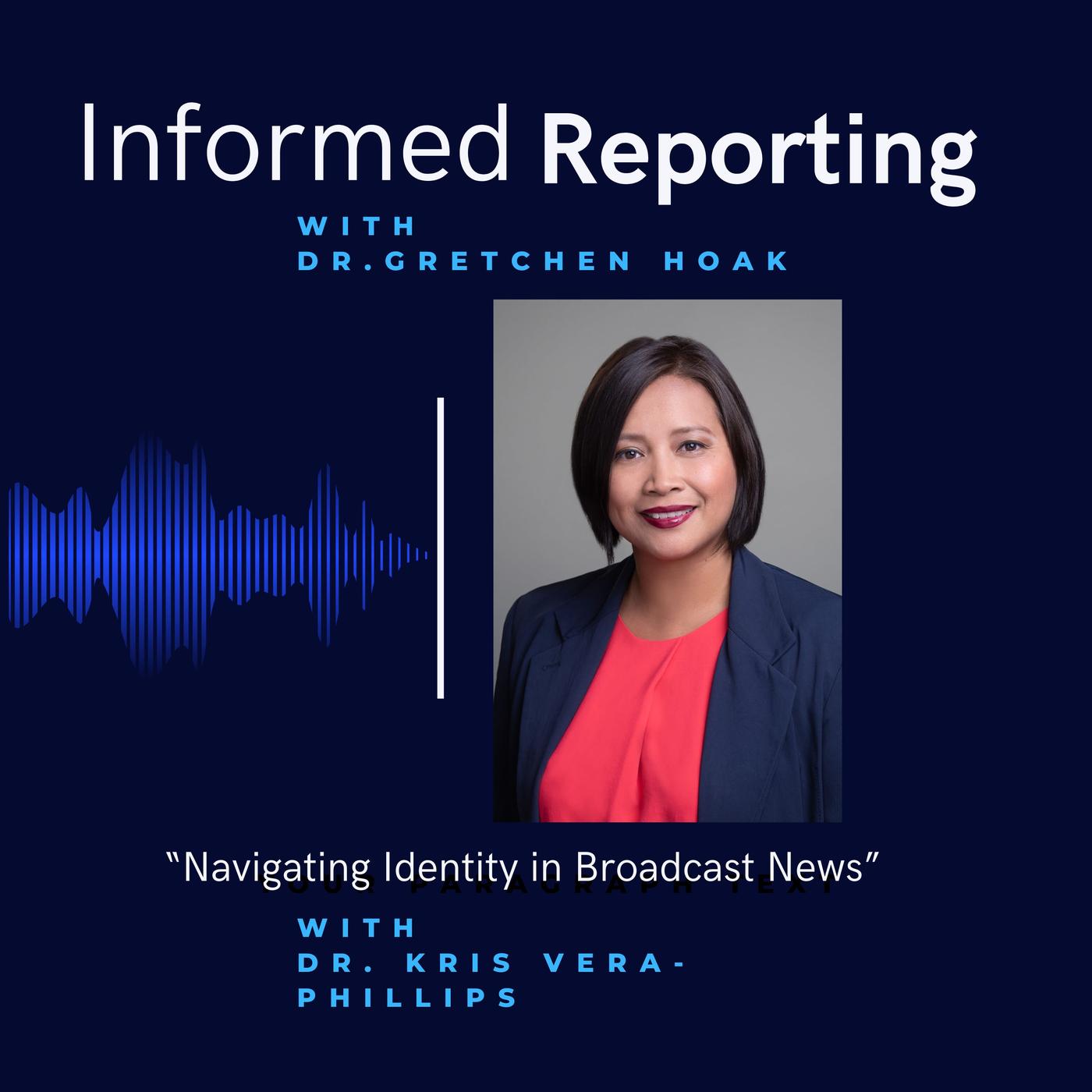
Gretchen Hoak: Dr. Kris Vera Phillips, thank you so for joining me on the today. I really appreciate your
Kris Vera-Phillips: Thank you for having me.
Gretchen Hoak: To start off, tell us a bit about your career in news before you got into academia. Welcome to Informed Reporting Podcast, where we connect research and the real world to have real conversations about life as a journalist and how to make it better. I'm your host, Dr. Gretchen Hoke, a former local TV journalist, turned university professor and researcher. For this episode, I speak with Dr. Chris Vera Phillips. She's an Emmy Award-winning journalist with more than 14 years in broadcast journalism as a producer. She worked in multiple markets, including Sacramento, San Francisco, and San Diego.
Kris Vera-Phillips: Yeah, that's always fun to talk about because I can tell you this goes back to something like sixth grade. ⁓ I remember when I was watching, you when you're watching television and you're you take in all the sitcoms, the comedies, cartoons and what have you. And honestly, back then, back in the day, I really didn't see myself reflected in any of that. Yeah, they made me laugh, made me cry, made me wonder why did that happen?
Gretchen Hoak: She is currently an assistant professor of journalism in the Meadows School of the Arts at Southern Methodist University. On this episode, we discuss her recently published study, Don't Risk Your Life: How BIPOC Journalists Navigate Identity, Newsroom Routines, and Safety in U.S. Broadcast Newsrooms, which was published in the journal Journalism and Media in March 2026. Her study was based on interviews with 28 current and former journalists who are members of minority communities.
Kris Vera-Phillips: But for the most part, I remember seeing Connie Chung actually ⁓ on the news actually reporting like, wait a minute, she's Asian. ⁓ up. ⁓ not in a restaurant. She's ⁓ not taking care of patients and she's not cleaning things. So that's amazing. And when I watched her a little more, especially on CBS, just realized, wow, she gets to tell other people's stories. And furthermore, she's holding the powerful accountable.
Gretchen Hoak: Her findings shed light on how life as journalists and a member of a minority community differs from their non minority colleagues. One final note we had some difficulties with audio during recording, so please excuse the few places where that is noticeable.
Kris Vera-Phillips: I probably didn't know it was powerful and accountable back then, but she had an opportunity to go into all these different spaces as an Asian woman, to be able to ask these really interesting questions and to hold people accountable to us, the people who are watching. So I decided journalism is the way to go. And it's funny coming from, especially a Filipino family, you have a couple options here to go STEM.
Gretchen Hoak: You've been listening the Informed Reporting Podcast with me, Dr. Gretchen Hoak. If you liked you heard today, please like and follow us on Spotify or Apple podcasts and feel free to leave us a positive review. To keep the conversation going and for more information and content between shows, Please follow us on Instagram @ informedreportingpodcast. Our music is Casual Fridays by 1000 Handz, through a Creative Commons license from Free Music Archive. This podcast is produced independently of my teaching and research roles in the School of Media and Journalism at Kent State University. The information shared here reflects my views and those of my guests and is not reflective of the views or official policies of my institution.
Kris Vera-Phillips: whether it's nursing, something with math. And so I was considered a little bit of the black sheep in the family when I just let everyone know I'm going into journalism and they're like, what's your backup? That's pretty much it. So I went to ⁓ college. I got into UC Berkeley, which was also a surprise to the family. ⁓ But I went to Berkeley where they didn't have an undergraduate program for ⁓
Gretchen Hoak: Hahaha Ha If you have any questions or ideas for guests or topics, please email us at informedreportingpodcast@gmail.com. Ha ha.
Kris Vera-Phillips: for journalism. So I ended up reporting with the college radio station there, which gave me some, my first interview was ⁓ with the future speaker of the house, Nancy Pelosi, and it gave me some opportunities to actually really get my, ⁓ really dive into the idea of reporting, interviewing, ⁓ highly placed officials, but also covering the campus as well. I loved it. But I also recognize that again, going back to television was something that
Gretchen Hoak: ⁓ wow.
Kris Vera-Phillips: I wanted to be a part of because I felt the ⁓ full story should be told visually in what we hear and what we see and what we read. And I felt television was the best medium to do that at that time. So eventually, continued with my undergraduate studies. ⁓ After I graduated, I started working in tech support to help with my brother going through college, went back to graduate school at Medill Northwestern to work on my degree there. And I remember I was the only person on the producing track out there. So it was a little confusing when you had all these other students worried about how their hair looks and their makeup looks. I'm like, I just need your scripts ⁓ for the most part. But that gave me an opportunity also to do things like ⁓ travel out to London, did a residency at Reuters out there. ⁓ I also had an opportunity to work in their DC bureau. At the time, it was the President Bush versus a
Gretchen Hoak: Ha Hahaha
Kris Vera-Phillips: John Kerry that election. I was there for the inauguration. had an opportunity. of the my press pass got me into an interview for the junior senator from Illinois, Barack Obama. So I got an interview with him. ⁓ So I took advantage of those opportunities, put together a reel and eventually ⁓ after graduation landed my first job in ⁓ in broadcast news in Topeka, Kansas, where I was the 171st Filipino-American to move to the market according to the US Census Bureau numbers. I met 169, so I know who she is. And that's pretty much it. I loved producing simply because there was an opportunity to take a big picture of the show, to really set the agenda of like, what do our viewers need to know? And furthermore, to work with all these different reporters and cameras and photographers and really really delve into these issues.
Gretchen Hoak: Ha ha.
Kris Vera-Phillips: So that was commercial news, that for quite some time. ⁓ By the time I met from Topeka to Sacramento, to San Francisco, and I was also married at the time, I was married during this whole time to be able to handle the fabulous prices, the salary that you get from a small market. So I had a husband who helped me live this dream. But by the time we got to San Francisco, I recognized ⁓
Gretchen Hoak: Yeah.
Kris Vera-Phillips: I wanted something a little more stable and I wanted to start a family. And I didn't think I could do that in the San Francisco market where their schedule is always, or in any big market, your schedule is always in flux. And ⁓ so I found an opportunity with KPBS down in San Diego, the public media station down there, NPR and PBS, and found a more regular ⁓ lifestyle. And then, ⁓ We just kept at it, had a baby ⁓ and just kept producing shows. So that's basically how I got into news.
Gretchen Hoak: Well, you definitely have some really interesting early track record interviews. Like you really got in front of some people there early on. That's great. So what made you move into academia then?
Kris Vera-Phillips: Yeah. the reason ⁓ why I moved into started with real estate and the idea that our house in Diego was about to be sold we couldn't afford to buy it. But it also made me recognize, what else do I want to do with my life? Do I want to jump into ⁓ another rental agreement, into another station, get another side hustle and make this work? But the other experiences I had while ⁓ I was ⁓ doing journalism was also the opportunity to work with college students. And ⁓ these programs like the Asian American Journalists Association, the Next Generation Fellowship, as well as a previous PBS NewsHour Student Reporting Labs with high school students. I really enjoyed mentoring them, helping them shape their stories, and actually seeing the world through their eyes because ⁓ they have a different way of understanding what is normal, what is right, and what we need to make society better. That was super exciting to work with. And I realized, you know what? I think I want to try to get into teaching. ⁓ I remember farther back I was doing my masters at Medill, professors told us, like, look, if you got a master's, ⁓ could actually teach as well. That's us. A lot of them were professors of practice as well. ⁓ But then I had a conversation with Dr. Bill Silcock from Arizona State just because I was checking out different journalism and programs. And ⁓ introduced me to the idea, like, I probably have some questions that would work for really good research as well. And he was right. ⁓ After working so long in broadcast news, there were things that my supervisors would do, our news directors would do, that we would decide collectively as an editorial team that this is the way we're supposed to go. And I always wanted some time to say, well, why is that? Why should we go in this direction? My best example of that is when ⁓ we were interviewing people who spoke English with an accent. I had a supervisor who would always say, person needs captions. That person needs like little lower thirds. So we understand them. like, understood him. I grew up in Southern California. grew up surrounded by different languages, people with different accents. And that was what America sounded like to me. That sounded like home. And, you know, I would push back and like, we don't need, we don't need captions on this person because they speak with an accent. The supervisor disagreed and said, well, I don't understand them. Our audience wouldn't understand them. And I questioned, well, who's our audience? So that was like the beginning of my questioning of like, why is this considered normal? And Dr. Silcox suggested, you know what? Potentially answer that with the research. so that's, It's okay.
Gretchen Hoak: It's so funny that you bring that up. Sorry to interrupt because I had a similar experience when I was reporting in local news and I remember it wasn't my story, but I was watching it air and we had put subtitles on this guy who had been interviewed and I remember standing next to somebody and I'm like, isn't he speaking English? Am I missing something here? And it was like, yeah, they thought nobody would understand them. I was like, I...
Kris Vera-Phillips: Mm-hmm. Yes.
Gretchen Hoak: I understand them. what's... So it's funny. I just remembered that happening and I'm like, ⁓ my gosh, apparently that wasn't just unique to where I worked.
Kris Vera-Phillips: No, and it's still happening now. I remember watching the coverage on the ⁓ camp, ⁓ pro-Palestine camps, Southern California coverage. And once again, they were interviewing students on campus for the Southern California market, and they were still putting captions on those kids who were speaking English. Yeah.
Gretchen Hoak: Mm-hmm. Wow. That's really interesting. So questions like that are what drove you to pursue a PhD and head into academia?
Kris Vera-Phillips: Yes, it was a combination of like having those questions, but at the same time also wanted the opportunity to continue teaching college students and help basically having a role in shaping the next generation of journalists.
Gretchen Hoak: Do you find that your research and your own kind of experiences ⁓ inform teaching and ⁓ with students?
Kris Vera-Phillips: I think so ⁓ ⁓ as I said before, ⁓ when I went to journalism school ⁓ a graduate student, I didn't have anything that was the ideal producing ⁓ class. We were all just tossed together with ⁓ other folks who wanted to be on air. So my goal was to create the conditions for the most awesome ⁓ producing class I could put together for students. I started teaching in spring of 2020. that was, right? Right. So if you could bring yourself back to spring of 2020. And that was the time where I was a brand new like news producing professor at ASU.
Gretchen Hoak: ⁓ geez. Yeah.
Kris Vera-Phillips: ⁓ And I remember we had spring break, ⁓ the shelter in place order started coming down and we were told, you know what, you got 48 hours to turn your class from in-person to Zoom. And I was just like, how am I going to do that? But you made it work, right? I mean, like, especially for a news producer, that's kind of like my approach to teaching classes is like, you know what, this is like, I have a set amount of time to get these learning objectives. I have these students, I need to be able to read the room and see what's going to land. what's going to make sense and where I need to put it. But that was my make it work moment, right? So I had this control room challenge for students that I wanted to give students a chance to be able to produce a show within a classroom environment before I toss them into a literal control room. ⁓ Because ⁓ I remember ⁓ professors would tell me, know, it's trial by fire. You're either going to figure this out or you're going to crash and burn. like, why does it have to be that way? Why do I have to reproduce the conditions of a toxic newsroom that expects new people to the rise to the challenge or suffer trauma? ⁓ Right, so this was my opportunity to like, we did the control room challenge still over Zoom. And when I talked to my colleagues ⁓ working at newsrooms and it's still producing, they're like, ⁓ yeah, we're still doing that. We had to also produce a show over Zoom. So it was interesting that ⁓ that activity was actually mimicking what was happening in real time.
Gretchen Hoak: Hahaha. Yeah.
Kris Vera-Phillips: during the COVID-19 pandemic.
Gretchen Hoak: let's talk a little bit about your recently published study. was published in Journalism and Media in March. It was called Don't Risk Your Life, How BIPOC Journalists Navigate Identity, Newsroom Routines, and Safety in U.S. Broadcast News. So talk a little bit about ⁓ what your goal with that study and how did you carry it out?
Kris Vera-Phillips: I'm so glad you asked about that because this particular paper is actually part of a bigger project. It was my dissertation study essentially. And I wanted to know more about the definitions of fairness in American broadcast newsrooms. Again, going back to those questions about why we do what we do. And I recognize, you know, after you're the literature review and after, ⁓ you know, just also looking at my own personal experience and anecdotal experiences from my colleagues, you know, it all comes down to like definitions of fairness. And also like the journalism routines that are supposed to hold us accountable, including objectivity, gatekeeping, and framing. And there are also these newsroom routines that ⁓ basically force ⁓ journalists to get the content out and hit the deadlines, hit those show times. Don't let us ever go to black, right? So from that study, I interviewed 28 journalists who worked in American broadcast newsrooms, either on air, or behind the scenes. Also, I'll talk to folks who were in leadership positions, news directors, managing editors, executive producers, and what have you. And I started off with these questions about, what is fairness? How do you define fairness in American broadcast news? And how is fairness enacted in your reporting and in your work? And furthermore, how is fairness not enacted in your reporting and the work you do? And from there, that's where these conversations started coming out about their experiences of negotiating their identity, negotiating these newsroom routines and trying to find a balance of like the good to the newsroom, the good to the show and also being able to take care of yourself.
Gretchen Hoak: So throughout the study, had some ⁓ great conclusions and just lots of really interesting thoughts on some of the challenges that minority journalists face in the newsroom. I want to go through a few of those and have you kind of expand on them. ⁓ First, you about the idea that journalists are rewarded for their willingness to absorb risk and trauma as evidence of their personal commitment. ⁓ And that resonated with me as ⁓ a ⁓ prior Police reporter. ⁓ And I think there's a lot of research that supports that idea. Can you explain a little bit more about what you were thinking with that?
Kris Vera-Phillips: Yes, I'll start ⁓ with some personal experience first, ⁓ because as a producer, you had to send people into some crazy situations, right? ⁓ One really good example of that would be the Occupy protests, Occupy Wall Street. We want to go all the way back then. I remember in the San Francisco Bay Area when I was working there, ⁓ it got so bad in terms of ⁓ the relations with our live crews going out into the field. And the protesters are going out and basically protesting them even being there, questioning like, you know, what are you doing here? And whatever the politics is, but it became very ⁓ dangerous for live crews to get out there. And the Photographers Union negotiated to eventually have their ⁓ security guards assigned to them as they move into places that were deemed very, very dangerous. And I remember one of my live reporters was wrapping up a live report for the noon show. And they're like, you know, I'm, you know, I'm so-and-so reporting live from da-da-da-da. And bam, her camera fell over. And we're like, what was going on? And we later learned, because I wasn't in the control room at the time. I was just watching inside the newsroom. But we learned that, ⁓ somebody jumped the photographer and then grabbed the camera and ran. So that was right. then, yeah, so there was that. There was also, I can take you back to 2016.
Gretchen Hoak: ⁓ my gosh.
Kris Vera-Phillips: Yes, it was 2016. Candidate Trump was in San Diego at the time. I was inside my newsroom, you know, I volunteered, hey, I could be one of the field producers out there, you know, cover for the protest or the fans, whatever, whatever, just put me where you need me. As we got closer to that time and we started seeing what was happening to other protests around the country. especially what was happening to people of color or journalists of color at these scenes. I was pregnant at the time and I had to make a decision where, you know what, I'm not, I'm gonna pull myself out of this assignment because I just couldn't take that chance. I wasn't the only reporter doing that. I remember there was another producer who also had to pull herself out of covering a Trump rally because she was also pregnant at the time too. So these are just like some experience I remember personally. ⁓ then when we come to the, back to your question about this willingness to absorb risk and trauma, we also see that in the participants in the study, these questions of like, what am I willing to do to get to the next level? And whether that's the crazy hours we ask you to work. ⁓ sometimes on weekends, know, overnight and what have you. But furthermore also, like what, what, where are we putting into places where you potentially feel threatened? And I think we see that a lot with multimedia journalists, doing the job of multiple Sometimes they're setting up their camera, they're getting ready to go live, they're making sure their makeup is on. ⁓ And then sometimes they're also setting up their shots too, right? ⁓ And certain markets, ⁓ that's not just a market thing, that's across the board, potentially from small ⁓ to large markets. ⁓ We're asking them to all that, and there's no backup. There's no eyes looking around to see what could possibly happen... happen to you? And that's the risk that they're willing... not necessarily willing to take, but that's the expectation they have to do because of the decisions that have been made at the executive level that this is, this is what we see as an acceptable risk. And the issue is that oftentimes it's the priority is not the safety of the journalists, it's the safety of the gear. I've had several MMJs tell me in this study, they're like, that's a $10,000 camera. Don't let it drop. Like, okay, but this is a human being who could also get shot. So what's up? Right? So there is that as well.
Gretchen Hoak: kind of related to that, you talk about how newsrooms tend to place that burden of safety on the journalists themselves, kind of leave it to the journalists to figure out how they stay safe out in a potentially dangerous situation. Is there an extra sort of layer or an extra burden for journalists of color, depending on where they may be sent to?
Kris Vera-Phillips: Mm-hmm. 100%. And that's simply because we know this is not just journalism, but this is in real life. That sometimes as you're walking out into certain situations, certain neighborhoods, I guess the easiest way to say is like, sometimes you're not welcome, or there's a suspicious nature of that. I think the best example of that would be, I had one MMJ working who refused to do door knock stories, because this participant also identified as as a black woman, as an immigrant, and they have seen what happens when you happen to be in the wrong place at the wrong door and the person inside may be armed and responding differently. There's a ⁓ real risk and a real fear of what would happen when that door opens. So she would always push back against doing those particular stories. I guess the other example I had was Confederate flag rallies or white nationalist rallies as well. And when you send a journalist of color into that space, you just wonder, where's the backup? Who's going to be watching their back if this goes sideways? I'm not to say they all go violent. At least for the example I have for the Confederate flag rally, that journalist felt very welcome, but also felt the need that she needed to get a backup plan and make sure her sister knows where she was in case something went wrong.
Gretchen Hoak: It's really interesting because when I read that anecdote from the black journalist who was talking about the door knocking, that was really fascinating to me because as a former reporter, I hated the door knocking, but it wasn't because I felt unsafe. It was just because it's just a hard thing to do and you don't want to get yelled at. And there's just so much wrapped up in that type of thing that you have to do. But I'm...
Kris Vera-Phillips: Mm-hmm. ⁓ yeah.
Gretchen Hoak: not someone of color. was never scared for my safety, but when I read that, was like, wow, never, of course, some, you know, someone of color might be afraid because the perception and you don't know the neighborhood you're in, you don't know what that person is thinking behind the door. else that popped up in your study was discussing things some of the significant mental health challenges that journalists can face doing their work. And there's a lot of research that has begun to support that. ⁓ Are things like PTSD and ⁓ other mental health challenges Are those different for journalists of color? Are they more susceptible to those types of things as a result of journalistic work?
Kris Vera-Phillips: don't know if it's the question of more susceptible, ⁓ I can honestly say there challenges for ⁓ doing this type of work ⁓ a journalist of color, ⁓ because we just don't the resources in place to support ⁓ these reporters, these journalists, ⁓ whether you're on camera or the scenes. ⁓ And ⁓ some of that because the newsrooms we work in. ⁓ research and data has shown it's oftentimes ⁓ it's primarily a white newsroom. So just even being able to have the shared experiences of like ⁓ growing up, the culture, ⁓ the schooling or what have you, it's different, right? ⁓ I could tell you like from personal experience, just like walking into these spaces. ⁓ I think the best example of that would be ⁓ Virginia Tech. That shooting that happened there and the shooter was a Korean student was on campus. And the newsroom I was working in the time thought, you know, would it be a good idea? Let's send a reporter crew to this university here. Let's interview all the Koreans there and see how they feel about this. And I wasn't at the editorial meeting at the time, but when I came back the next day, I'm like, ⁓ we thought that was a good idea. And ⁓ simply because it's just like, ⁓ just because they're Asian or Korean, they're going to have
Gretchen Hoak: Yeah Yeah.
Kris Vera-Phillips: some type of connection to the mass shooters. That was a bit disturbing, but there was no one I could talk to about that experience. ⁓ Yeah, so that's what we have. I would also say that in my study, for participants who are willing to talk about the mental health challenges they had, I had one participant who felt the need, you know what, had to be a specific type of psychiatrist that they were going to, someone who understands the experience of a person of color as well as the immigrant experience. And because that was, you know, that's the other thing, right? We are all different people. So therefore the mental health treatment that we have should also rise up to the type of experiences we have. So that's something that was important there as well.
Gretchen Hoak: There has been a lot of discussion recently in ⁓ of journalism teaching spaces about building resilience. And you had a really interesting thought where you argued that resilience isn't simply a personal quality, but it's a response to ⁓ and gendered organizational pressures. ⁓ I just thought that was really interesting. Can you explain a little bit more of what you meant there?
Kris Vera-Phillips: I think what happens is because we don't have enough leadership representing diverse communities in the news markets here in the United States. We are left with this idea of what is considered normal, what is considered ⁓ ideal for broadcast news that doesn't reflect the diverse perspectives and the people of diverse communities. My best example of that would be for, this was primarily from the women journalists in my study who talked about The hiring process, the idea that you have to send out your tape, you gotta make sure everything looks good. You have an awesome banging live shot or the live shot like a collage that's gonna catch somebody's attention. But oftentimes instead of talking about ⁓ the reporting, the story, the editing, ⁓ all of that, the hiring manager, whether it's the news director, the assistant news director, whatever, would tell someone from her participants, ⁓ don't wear that makeup again, or you should cut your hair, or let your hair go long. just like all this really superficial ⁓ stuff that shows. And I recognize it's a visual medium. Yes, you are looking for the ideal person to be on camera, but you're also looking for the ideal person who may not be from a diverse community. Another example, I had another participant talking about Asian male reporters specifically ⁓ who are not making it to the anchor desk simply because they are not considered, again, part of this ideal. um, a deal news team that you want to see on television. They've actually, uh, he worked with, um, the Asian American journals association and UCLA to put out the study about, um, the, number of Asian men who are, are in anchor positions. And it certainly did not reflect, um, the population numbers that we see saw in the United States at the time. And it was, it was, it was, it wasn't good. It wasn't good. We've seen, we've seen changes now, obviously, um, but There's still a long way to go to actually ⁓ bring up Asian male anchors up to the forefront
Gretchen Hoak: we talked a little bit about the ⁓ the journalists who didn't want to do the door knocks because she she felt unsafe Another anecdote and actually it might have been the the same person that really stuck out to me, too She was talking about how she had been she was doing a what should have been a fun live shot at an awards show ⁓ and actually got spit on ⁓ and kind of attacked while she was there and
Kris Vera-Phillips: Mm-hmm. Yes. Yes.
Gretchen Hoak: the trauma of it was less about the fact that she had been attacked, because she'd been spit on because of her race, that was the specific motivation for why this person hit him when he did. ⁓ And that struck me as really interesting too, because I feel like there's another layer of risk or potential trauma that someone of color faces that if it had been a white person doing that live shot, they would not have had to even think that something like that would happen.
Kris Vera-Phillips: Mm-hmm. ⁓ Yeah, absolutely. It was the same person who was resisting doing the door knocks. So this particular journalist, you know, I think basically it was a really good example of showing ⁓ there are some things we can't change about who we are, especially about how we look. ⁓ And maybe, who knows what could have happened to potentially avoid us. But unfortunately, that particular attacker at the time got into his head. She is a black woman. That's my target. And doesn't belong here, should not be here. And that's where the cursing happened, the spitting happened. And we learned later on that that person was also armed at the time. I think the other thing that was crazy about it was that her newsroom saw what was happening in real time. She was just getting ready to go live for her report. And there was people inside the control room, and they saw the attack happening. So there was this idea of witnessing what was happening to a Black woman journalist in the middle of a live shot. mean, that was one specific example. ⁓ also ⁓ we've had, ⁓ going back to COVID-19 ⁓ that ⁓ and the fact that ⁓ Asians were ⁓ were a scapegoat specifically. Chinese people were also the scapegoat based on the narratives that were coming out that they were to blame for this pandemic coming to the United States to begin with. ⁓ Anyone wearing ⁓ mask, what have you. And we can't change other people's minds about who we are and what we look like. And I don't think that's taken into consideration when we are deploying reporting crews to a particular area, reporters, the producers, the live shot operators, the photographers. I remember one other participant was also talking about going into a neighborhood, I think it was like either after a wildfire disaster or some kind of natural disaster. and they just need to get some B-roll and talk to some people in the field in this particular neighborhood. And then Simon Desk editor told her, you know what, why don't you stay in the car and let your photographer do that for you? And she said, well, what do you mean? She's like, oh, because of what you look like. And she was a Latina journalist. And she tried getting her to say, well, what does that mean? But ultimately, it came down to it. It's because you look, you are a Latino journalist, you could be a target. So that was interesting that we're also conscious of that, but they couldn't articulate that during the conversation. They just had to tell her, you are different, you are other. And I think that's something that lots of journalists of color experience in the newsroom where they're like, there's something about you that's not like us.
Gretchen Hoak: and and it's a shame really because I mean journalism is important, but it is hard ⁓ and got you know, there are many many ⁓ really talented journalists of color out there and And it's almost extra hard for them You know There's just this extra layer of things that they have to put up with or be mindful about or or you know have to deal with in a career that's already hard
Kris Vera-Phillips: Mm-hmm. I know. it's crazy because it's hard enough to get into the business to begin with, right? We are hustling. are sending our tapes out. Or stop saying tapes. We're sending out our YouTube links, right? To just capture the attention of whoever's hiring and to make a decision that, yes, you want to go with us. And by the time you make it into that position, you want to hang on to your job or make it to the next better day part.
Gretchen Hoak: Yeah, I do it all the time. Yep.
Kris Vera-Phillips: And there's so much you're willing to do. Like I'm willing to work those crazy hours. I'm willing to work in the middle of the rain or the snow or the aftermath of a wildfire to make this happen and show you I'm ready to go. And I think the other issue is that it's because, and maybe this is because I'm a daughter of immigrants. My parents are from the Philippines, but there's also the sense that we're always having to prove ourselves. And I remember growing up and My parents would say, yeah, you're American. You sound American. You were born and raised here and went to American schools. But when people look at you, they're not going to see an American. And that was their justification where I had to work harder. I had to work so much harder than my classmates, my coworkers, to prove myself because it's not enough to just be qualified. You have to be more than qualified to deserve being here.
Gretchen Hoak: Some of the conclusions that you ⁓ got from your study were also really interesting and ⁓ sort of they touch a lot on what you were just talking about. First, you talk about how your participants' responses really show how ⁓ realities ⁓ different. from the perspectives and expectations of the newsroom managers. And you've touched a little bit about that, but are there other examples where there is a mismatch between the expectations of the management and the realities and how those manifest for a journalist of color?
Kris Vera-Phillips: When I was working in, and this, the Atlanta Spod Business Shootings, and this is what happened was back in 2021, March of 2021, walked into a man, walked into several small businesses in the Atlanta area, opened fire, ended up shooting and killing eight people, including six Asian women. This particular example, a lot of my Asian-American participants kept coming back to in this particular study. But what I knew at that time in 2021, when I was serving in leadership with the Asian-American Journalists Association, we knew that there were AHA members who were trying to investigate the shooting, to cover the shooting, and they've received pushback from their newsrooms. ⁓ Basically, some newsroom managers said, ⁓ you know, you're too close to the story, or you can't be objective while covering the story because you are Asian. ⁓ So that would be one example I would give you in regards to the reality not syncing up, because oftentimes, and I'm sorry to say this, but when a white reporter wants to cover a shooting by a white attacker, that question doesn't come up about being objective or being too close to the story.
Gretchen Hoak: ⁓ it's almost as ⁓ it's an automatic, you're not going to be able to be objective because this person ⁓ shares your genetic in some way. And it seems very short sighted to assume that just because someone is black, they couldn't cover.
Kris Vera-Phillips: Mm-hmm.
Gretchen Hoak: something that is related in the black community or like you said, someone who's Asian can't cover those spa shootings. It seems incredibly short-sighted to focus just on that and feel like that journalist who's been trained to do their job can't suddenly, is suddenly unable to be objective.
Kris Vera-Phillips: I think the other flip side of that from the study now, I can give you some examples. I had a participant talking who part of their beat was covering diverse communities. There are communities who are more vulnerable. And oftentimes when they're focusing on these stories of people they interviewed who were part of communities of color, oftentimes they would have an editor who would say, they said this one statement here. let's find a more objective source to qualify that statement, to be able to show both sides. And the pushback the journalist would point out is like, why can't we just accept this person's statement as fact, that this was authentic to their experience? Why do we need a more objective source removed from it to be able to make this a legitimate news story? So this question of like, who is considered the voices of authority, voices of expertise, and the voices of witness that are accepted as normalized, because again, If that person was white, there wouldn't, I would suggest, and I believe the participant also would suggest that the editor would not bring up that issue again of having to find a more objective source to qualify the state.
Gretchen Hoak: Another finding that came out of your study is sort of specifically related to safety and mental health. you talk about and I'll actually sort of quote ish, if you will, from the study, because I think it's it's just really an interesting way that you put it. said that newsrooms have to move beyond reactive approaches to things like safety and mental health and that it should be reimagining. We should be imagining journalist safety as more of a collective structural thing that is part of more
Kris Vera-Phillips: Mm-hmm.
Gretchen Hoak: of a more sort of sustainable newsroom culture. What do you envision when you think about what a newsroom should look like that does have a more collective approach to things like safety and mental health? What are some things that you think a newsroom could be doing or I guess your vision of what that might look like?
Kris Vera-Phillips: Mm-hmm. Well, let me bring it back to like when we were when we were working in newsrooms. And one, how many times would you take a lunch break when you were on ship?
Gretchen Hoak: Never. can't even. Lunch? What? Yeah. I ⁓ eat while I type, you know.
Kris Vera-Phillips: Right. Yeah, many of us, whether you were reporting, producing, especially if you were on the assignment desk, ⁓ oftentimes you are eating while you were working. There's not this idea that you could ever unplug from that news. And now, especially with all of our phones that can function as like little computers, there's also this expectation you're checking your email as well. And maybe, maybe, and it's just interesting with technology, it makes everything so much easier to stay plugged in. But we should be questioning. Is that healthy to continue being plugged in? Actually, have one assignment desk editor in the study who came to the point where like, you know what? I don't listen to the news as I drive into work. I don't check my email. And that's a rarity. I would argue that's a rarity for someone to feel like they don't have to be continuously plugged in 24-7 for the assignment desk editor. So there's this idea that we should also consider like, is to be sustainable to continue? producing high quality work, we need to take care of ourselves first. And I would suggest that starts with a break. What we've seen, at least a handful of the journals who served in management positions ⁓ would prioritize breaks, especially for the photographers. ⁓ One who was working in the Southwest, know, where the summers are unbearable. We're talking like 120 degree weather. And they're always reminded, like, look at those photographers who are like lugging all that gear around.
Gretchen Hoak: Yeah.
Kris Vera-Phillips: make sure you get them a burger, make sure they have an air conditioned position where they could take a break. And then also, you know, there's women who are pregnant while they're reporting as well. I remember talking to me and this is anecdotally to my colleagues who have been pregnant and finding very creative ways to take care of their business when there's no bathrooms around as well. So that's just that's just the baseline of a system of being sustainable. I think the next step is recognizing what
Gretchen Hoak: Heh. Yeah.
Kris Vera-Phillips: What do we need to do the show we need to do, but also protect the safety of our crews? And that's especially when we are in developing news, whether it's wildfires, mass shootings, and what have you. ⁓ Do the producers in the booth, do you really need that live hit at the beginning of your show, right? While you have a reporter and a photographer who want to go and either gather information, gather reports. ⁓ There seems to be a disconnect about what's needed for the show, what's best for the show, and what is best for the reporting crew. Especially when between drones to other technology, there's other ways we could get that video or to get that interview. maybe can we do is, and we've seen this during COVID-19, the pandemic, plenty of stations have like, okay, we'll take the Zoom, right? Okay, we're gonna figure out how to do this to make.
Gretchen Hoak: you
Kris Vera-Phillips: to be safe, but I think we're moving away from that again because we're not in the pandemic anymore. So why not ramp up to that level where we're working our crews to the point of exhaustion and potential risk of anything else.
Gretchen Hoak: Yeah, and I think you're right. mean, that's definitely something that I don't know has changed much because even back when I was reporting, I remember thinking, OK, you want a live shot, but I'm only going to get there maybe like with two minutes. What am I going to say? I, you know, what am going to talk about? You know, if I just get there, there was always that sort of like, you know, like you said, a disconnect between what is what's happening out there to me in the field and what that, you know,
Kris Vera-Phillips: Mm-hmm.
Gretchen Hoak: what the newsroom wants to serve the show.
Kris Vera-Phillips: why go live in the field anyway if it's going to be a dark field, right? Not even police tape up. what is the sense of urgency of being out here at 4.30 AM when even the police haven't set up a staging ground yet? Yeah.
Gretchen Hoak: Yeah. Yep, absolutely. Well, it was a really interesting paper, and I really enjoyed reading it. I thought there was a lot of really great perspectives and thoughts that came out of it. Do you have any more research on the horizon? Are there irons in the fire that you're working on?
Kris Vera-Phillips: Yes, a couple things. I should say that I'm working on a book proposal for the bigger dissertation study. ⁓ So this was just a section of the section, this particular study. I'm hoping to be able to share more of those insights and findings in a book form. ⁓ And currently, I'm in a revised resubmit ⁓ period for the Popular Culture Studies Journal. I answered a call ⁓ for a special call for research on Star Trek Enterprise, the show. because part of my research agenda is also looking at identity, power, and representation in popular culture, which again, just going back to like, where are images of people like me? And science fiction has always been a fascinating part for that. So I'm looking at the Asian officer in that show and her roles in these power dynamics in an alternate universe.
Gretchen Hoak: That sounds great and I love that you have that sort of lens that you can kind of turn not just to news but to things like popular culture. That sounds great and kind of a lot fun to sort of dig into.
Kris Vera-Phillips: Yeah, I think it's fun. ⁓ you know, I love that, you know, academia has given me this opportunity to look at, not just reflectively on the experience I had, but also looking at what are those narratives and framings that we're putting out there in the world about my community, my community, other people's communities as well. Because that's just as powerful in shaping like what our collective knowledge of how the world works.
Gretchen Hoak: Well, Chris, thank you so much. It's been a pleasure talking to you about your study and your work and reminiscing a little bit about news and our days in broadcast, which are it's always fun to talk about. So thank you so much for your time today.
Kris Vera-Phillips: ⁓ thank you. This has been a pleasure.
Gretchen Hoak: me.
