


00:00:07
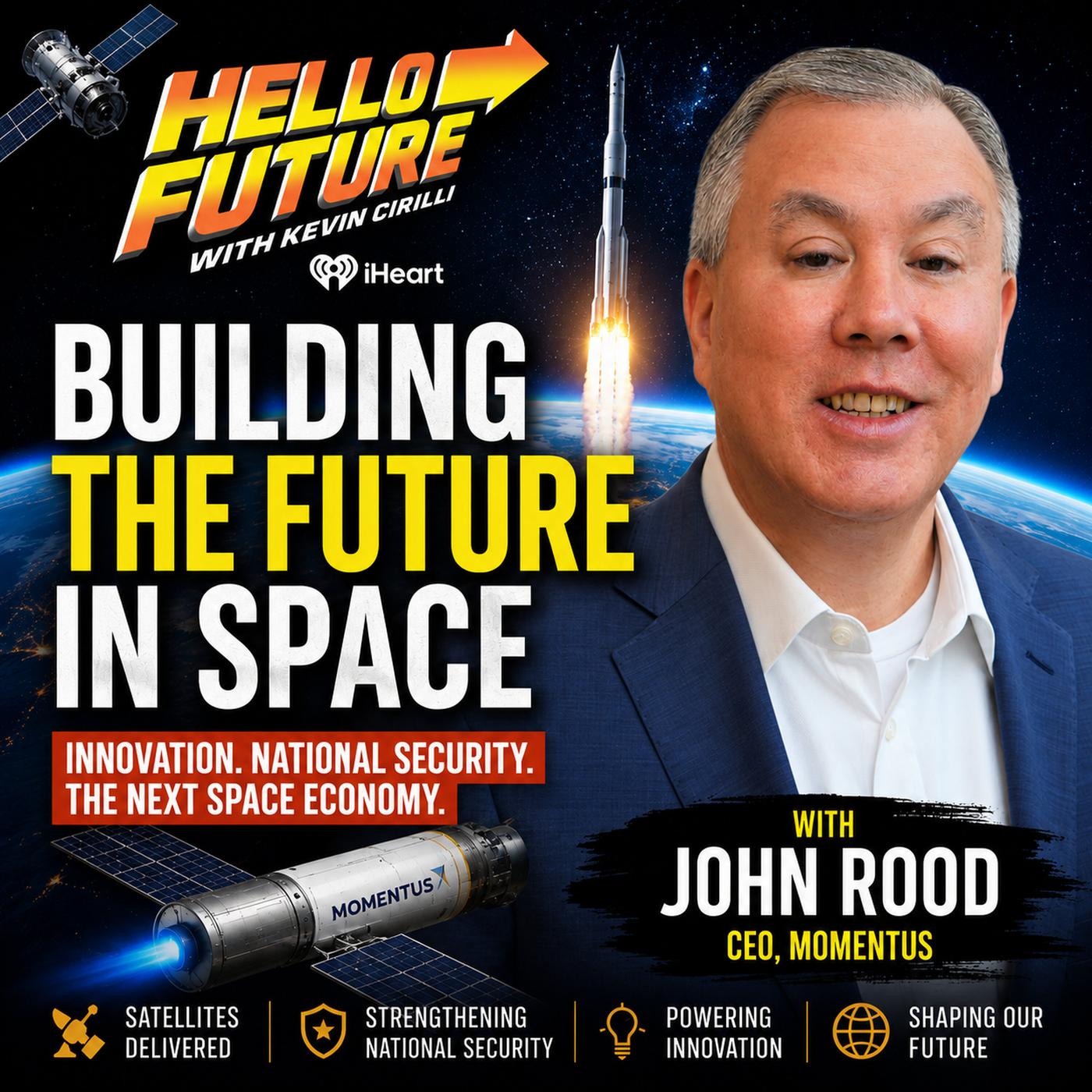
Speaker 1: By now you've probably become familiar with the word payload and what it means in the space domain. Basically, it's putting it super super simply a locker for scientific stuff to go up into space and be researched. But you won't believe all of the stuff that is getting researched in outer space. Hello Future, it's me keV. This is a dispatch from the Digital Frontier the planet Desert. The year is twenty twenty six. My name is Kevin Surrilli, and remember you can listen to all of the latest Hello Future episodes however you get your podcasts and of course on the iHeartMedia app. My guest today is the CEO of a major innovative space company. He also is someone who has served in the military. He's worked with companies like Lockheed Martin and Raytheon and I'm thrilled to have him the CEO of Momentous Space rud John. Thank you so much for being here, sir.
00:01:04
Speaker 2: Oh it's great to be with you. Kevin A big fan of your newsletters and podcasts, so it's just great to be invited on.
00:01:10
Speaker 1: Well, thank you so much. Before we talk about all of the great things that momentous space is doing. I want to get into your career for a little bit because you've had a fascinating trajectory. Take us back to when you were a kid growing up and how you've ascended to the upper echelons as CEO of a major space company in America.
00:01:29
Speaker 2: Well, I'll tell you what, Kevin, it didn't happen by plan. I mean, I forget the person that said it. You know that life is what happens while you're making plans, and that definitely applies to my career planning. I grew up in Phoenix, Arizona, and I didn't know what I wanted to do. But my mother was a single mom teacher and said, you know, you got to get a scholarship. So I got admitted to the Air Force Academy. The day that I got admitted, I hurt my ankle, showed up in a cast and crutches, and the major that was the liaison there said, you know, I need you to go out to Luke Air Force and get that looked at and they disqualified me. Wow. So I went to my local school, Arizona State, great school. I still wanted to find something that would attract me to service or to interesting things or be challenged. And one day I was taking a class and a professor from it was an IBM professor on loan to the school. He came and would I was talking about internships, said, I was over at the career center, and there's an internship at CIA if you're interested. So I went over and in those days, there was a physical book and I read the page and I took out my pen and I filled out the application and mailed it in. Several months later, I got a call and was brought to Washington for interviews, and that's how I became an intern at cias in the analytic cores. And they assigned me to a branch at that time that was doing chemical weapons work. But I didn't like it. But I met the guy that headed the missilin space branch, who was also an Arizona State grad and the next summer he had me back, and so I started doing that work, and after graduation they hired me and I was an analyst there for a little over ten years, following missile and space programs, you know. For example, I followed North Korea's missile and space programs. Other countries around the world, assigned to support things like the Gulf War and fight with Iraq, and then later I got sent, you know, random thing they do directed assignments there at CIA. I was coming back from a job briefing downtown at the White House and the head of my section said, hey, I've nominated you to be a hard nominee to be a Congressional fellow, which, by the way, is just a euphemism. Whenever I was told you've been nominated for something, I was dumb enough the first three or four times to say, well, how many nominees are they, and they'd always say, well, there's one, it's you. It's just a polite way of saying you're going to do this job. And so I want to be a congressional fellow. And I worked for a senator from Arizona and went from Mississippi, John Kyle and Thad Cochran, and they were both very interested in missile defense advanced programs that the Defense Department was developing, including in space. After the President, George W. Bush was elected, I called around and talked to some friends and said, you know, I'd like to work at the National Security Council. And I found a way to get introduced to one of the people heading a director there and did an interview, and so I went to the White House and I ended up doing two tours there under Conde. Lisa Rice. One over at the Defense Department is a Deputy Assistant Secretary of Defense for forces policy, which included space forces at that time, nuclear forces, conventional forces. At some point after being at the White House as a special assistant to the President, Connedy Rice asked me to come over to the State Department, and I did, and first as an Assistant Secretary for International Security, and then I became the acting Under Secretary, one of six, and then you know, at the end of the administration, for the first time, I didn't start my career as a political point I was at GS five when I started. I became a political pointee. And so I went to work in industry and spent eleven years at both Raytheon and Lockheed Martin doing business development or international business. At Lockheed Martin as a senior vice president, and then you know, I felt the call to go back. When Jim Mattis was the Secretary of Defense, I just couldn't shape this feeling that while I'm very happy in industry. I know I could serve and I could help. So I went back as the Undersecretary for Policy, which is sort of the number three civilian in the Pentagon, for two years before leaving and doing board work and consulting. And one of my clients was a venture capital firm that had invested in Momentous. They were going through a foreign ownership a discussion or negotiation with the US government. They said, you know about that, John, and I started helping them, and after they finished negotiating their agreement, they told me, well, we need a new CEO. Do you know some people. I started introducing them to various people, and at some point along the way, I would always explain what the company needed and why I thought this person was a match. And at some point along the way they said, well, what's the matter with you? Why don't you want the job? And we'd really like you to consider being the CEO. And so that's what led me to this place. And I've been at Momentous about five years now.
00:06:21
Speaker 1: Well, it's really fascinating to watch your career because I think it really illustrates everything that I try to not just cover but convene on. And I'm fascinated by, which is I don't think there's any other industry right now in America that's so best illustrates the American spirit then the space industry. I mean it literally is if you're a storyteller, if you're a scientist, if you're someone who loves our country and wants to preserve and protect its national security, but also if you're a business entrepreneur. I mean it is literally talk about the ultimate paylofe. I mean, this is a capsule for the future. And so your career really illustrates all of the different buckets that I believe are gonna are gonna lead us to the next two hundred and fifty years of our country's great greatness and hope and optimism. What is it about outer space in particular that really inspires you? And you know you're leading. You're one of the leaders of what I like to call space collar jobs and this renaissance in the American economy, I mean space collar jobs. I grow up outside of Pennsylvania. I gotta be honest, John, I'm not as smart as you, okay, but I add those glow in the dark stars that my mom would tack up on my ceiling them. Only in America can we give the middle class that hope, that optimism, that you can dream big and look up at the moon and think, you know what, I can go there. It would be ordinary to go there. These extraordinary things are actually what America does best is take the extraordinary and make it ordinary for everybody. What is it about the cosmos and outer space that really pushes you and feeds your professional passion?
00:08:03
Speaker 2: Well, first of all, I really resonate with what you're talking about. I mean, I was blessed to be born in this country, but my mother wasn't. And you know the pride she felt as an immigrant that how hard she worked to get to this country and how much it meant to her to be an American, and how important it was for her children to have all the benefits of that. And one of them was what you're talking about, which is you can be anything you want to be here, and we can dream big but also work hard and it's possible to do those things. And you know, she drilled that into us as children and as adults, and so you know, space always called to me. But I always love the idea of being some part of something bigger than yourself. And that's partly what really attracted me to government service, or to larger organizations, or to organizations that were trying to do something different that I wanted to I wanted my contribution to matter. Even though sometimes my contribution on the team was very modest, I still understood I was part of something bigger, that team that was doing something pushing the boundaries, either to protect the country or to advance what we knew about our knowledge or our exploration. And I think there's something inherent inside us that wants to do new things, that wants to learn new things, that wants to be challenged as a people, and I think we find it to be parochial for a minute. It's stronger, more strongly felt in America than elsewhere, are having traveled so broadly. It's one of the wonderful things I think is about our national character and that we enable people to do that. Occasionally, sometimes in all the cacophony with social media and other things, I think sometimes these fundamentals get lost. But I really think they're present and still strong, and I see it in our young people that are coming to work at momentous by the way, not just older generation. It didn't skip a generation and it doesn't exactly get passed down in the blood, but I think it's part of our national culture.
00:09:59
Speaker 1: Then there's something about the space industry. You know. I used to be a political correspondent. I'm a recovering political correspondent, I like to say. And the thing about the green rooms of Washington, DC is you're kind of conditioned to act like you're the smartest person in the room. And I think that's very evident when folks are watching cable news, regardless of what channel they're watching, it's a bunch of performance of people pretending that they're the smartest people in the room. And the thing I love about the space industry is every room I walk into, I'm the dumbest guy there, and I'm learning something every single day, and I'm never going to be able to compete with the astronauts and the astrophysicists and all of these people. But I agree with you, John, because the young people in the space collar job revolution, they don't care what party they're in, They don't care about any of that. They just are like, when are we building a colony on the moon? When can we all go to the moon. You know that explorer spirit is something that is just so missing right now that people are it's raving, and I really commend all of the space industry for really showing us a way out, a way through this hyper partisan time. And again that's not a reflection on what anyone believes. I don't do politics, but the space industry. I mean, that's splash down from Artemis two was just so moving on My phone was blowing up from people of all different political backgrounds because they were so excited by that. So okay, momentous space. You guys put very simply. A lot of folks who listen to me they love space. We're not experts, So I'm going to be the everyday idiot and tell us in Layman's terms, John, what does Momentus Space do.
00:11:39
Speaker 2: We're a small Silicon Valley company. We build small satellites that function as satellites to do unique things, but also that are basically a space truck in space. In addition to being a traditional satellite for things like communication, missile tracking, and the like. Basically, we're like the ups of space where we can carry just about anything, can move you to the right orbits you want to be too. We can support cutting edge experiments, all very flexibly. And one of the things that I love about, you know, today's space industry is when I first started watching space, I mean, you'd be lucky if there was one launch in the United States per month. And now just this ability to access space, so many new things are being done because the ability to access access to launches has populated. The cost per pound or per kilogram, whatever your metric is, has gone down dramatically, you know, according to McKenzie by like over ninety five percent in the last twenty years. And then what you can do. You know, there's there's been massive developments in technology like that you cover so well with microelectronic smaller powerful systems that can be placed in space and operate effectively. And so you have these two mega trends, the cost per kilogram coming way down and the access to launch, and then you can do so much more with smaller bespoke systems, and it's really led to this proliferation of activities in space. And you know, sometimes I get this from people that don't fallow space very actively, saying, well, that's interesting, but you know, we have problems on Earth.
00:13:15
Speaker 1: And something makes me more angry than when people, I say, bring it on, to go ahead. I'm curious how you answer that question. I have to keep myself calm when I hear that, because I just want to say, don't you understand that the solutions to our problems on Earth are out there in the Cosmos period, and the science that's going to get us there is going to extend life, create solutions, create economic opportunity, and create and unleash the power of the American economy. I mean, don't even John, you don't want to get me started to go ahead? I can't help it.
00:13:48
Speaker 2: I mean, we're doing things in space for the benefit of our lives on Earth, yes, and for the benefit of ourselves, and it's tremendously important to our economy and to the betterment of our lives. So you know, occasionally I'll say, well, what was that in your hand? Where do you think that data on your phone comes from? Where do you think the time on your Apple watch or what have you that all comes from space? Youthn't used to be able to do that. I still remember the days walking up to the counter and handing somebody like a paper bill. And yes, we could do those things before, but it's much better it's much faster today, and so all of those innovations came from space.
00:14:23
Speaker 1: Thank god for the US Space Force because they're protecting all of that. I mean. The other thing that gets me really mad is when people say they don't, oh, the militarization is space. I go, these are the same people that want to get rid of police officers and firefighters, and I mean, it is so illogical. John Read, CEO of a Mensa Space, You're going to come back on. Thank you so much for being here. This has been a fascinating conversation about leadership, about what momentus space does, and coming up in our next episode he's going to tell us specifically about some of the functions of what these space trucks. I love that analogy, the ups of the ups of space, what these you of space, payloads of momentous space, what they actually do. Thanks for listening to Hello Future. My name is Kevin SURREALI have a great tomorrow Today
Speaker 1: By now you've probably become familiar with the word payload and what it means in the space domain. Basically, it's putting it super super simply a locker for scientific stuff to go up into space and be researched. But you won't believe all of the stuff that is getting researched in outer space. Hello Future, it's me keV. This is a dispatch from the Digital Frontier the planet Desert. The year is twenty twenty six. My name is Kevin Surrilli, and remember you can listen to all of the latest Hello Future episodes however you get your podcasts and of course on the iHeartMedia app. My guest today is the CEO of a major innovative space company. He also is someone who has served in the military. He's worked with companies like Lockheed Martin and Raytheon and I'm thrilled to have him the CEO of Momentous Space rud John. Thank you so much for being here, sir.
00:01:04
Speaker 2: Oh it's great to be with you. Kevin A big fan of your newsletters and podcasts, so it's just great to be invited on.
00:01:10
Speaker 1: Well, thank you so much. Before we talk about all of the great things that momentous space is doing. I want to get into your career for a little bit because you've had a fascinating trajectory. Take us back to when you were a kid growing up and how you've ascended to the upper echelons as CEO of a major space company in America.
00:01:29
Speaker 2: Well, I'll tell you what, Kevin, it didn't happen by plan. I mean, I forget the person that said it. You know that life is what happens while you're making plans, and that definitely applies to my career planning. I grew up in Phoenix, Arizona, and I didn't know what I wanted to do. But my mother was a single mom teacher and said, you know, you got to get a scholarship. So I got admitted to the Air Force Academy. The day that I got admitted, I hurt my ankle, showed up in a cast and crutches, and the major that was the liaison there said, you know, I need you to go out to Luke Air Force and get that looked at and they disqualified me. Wow. So I went to my local school, Arizona State, great school. I still wanted to find something that would attract me to service or to interesting things or be challenged. And one day I was taking a class and a professor from it was an IBM professor on loan to the school. He came and would I was talking about internships, said, I was over at the career center, and there's an internship at CIA if you're interested. So I went over and in those days, there was a physical book and I read the page and I took out my pen and I filled out the application and mailed it in. Several months later, I got a call and was brought to Washington for interviews, and that's how I became an intern at cias in the analytic cores. And they assigned me to a branch at that time that was doing chemical weapons work. But I didn't like it. But I met the guy that headed the missilin space branch, who was also an Arizona State grad and the next summer he had me back, and so I started doing that work, and after graduation they hired me and I was an analyst there for a little over ten years, following missile and space programs, you know. For example, I followed North Korea's missile and space programs. Other countries around the world, assigned to support things like the Gulf War and fight with Iraq, and then later I got sent, you know, random thing they do directed assignments there at CIA. I was coming back from a job briefing downtown at the White House and the head of my section said, hey, I've nominated you to be a hard nominee to be a Congressional fellow, which, by the way, is just a euphemism. Whenever I was told you've been nominated for something, I was dumb enough the first three or four times to say, well, how many nominees are they, and they'd always say, well, there's one, it's you. It's just a polite way of saying you're going to do this job. And so I want to be a congressional fellow. And I worked for a senator from Arizona and went from Mississippi, John Kyle and Thad Cochran, and they were both very interested in missile defense advanced programs that the Defense Department was developing, including in space. After the President, George W. Bush was elected, I called around and talked to some friends and said, you know, I'd like to work at the National Security Council. And I found a way to get introduced to one of the people heading a director there and did an interview, and so I went to the White House and I ended up doing two tours there under Conde. Lisa Rice. One over at the Defense Department is a Deputy Assistant Secretary of Defense for forces policy, which included space forces at that time, nuclear forces, conventional forces. At some point after being at the White House as a special assistant to the President, Connedy Rice asked me to come over to the State Department, and I did, and first as an Assistant Secretary for International Security, and then I became the acting Under Secretary, one of six, and then you know, at the end of the administration, for the first time, I didn't start my career as a political point I was at GS five when I started. I became a political pointee. And so I went to work in industry and spent eleven years at both Raytheon and Lockheed Martin doing business development or international business. At Lockheed Martin as a senior vice president, and then you know, I felt the call to go back. When Jim Mattis was the Secretary of Defense, I just couldn't shape this feeling that while I'm very happy in industry. I know I could serve and I could help. So I went back as the Undersecretary for Policy, which is sort of the number three civilian in the Pentagon, for two years before leaving and doing board work and consulting. And one of my clients was a venture capital firm that had invested in Momentous. They were going through a foreign ownership a discussion or negotiation with the US government. They said, you know about that, John, and I started helping them, and after they finished negotiating their agreement, they told me, well, we need a new CEO. Do you know some people. I started introducing them to various people, and at some point along the way, I would always explain what the company needed and why I thought this person was a match. And at some point along the way they said, well, what's the matter with you? Why don't you want the job? And we'd really like you to consider being the CEO. And so that's what led me to this place. And I've been at Momentous about five years now.
00:06:21
Speaker 1: Well, it's really fascinating to watch your career because I think it really illustrates everything that I try to not just cover but convene on. And I'm fascinated by, which is I don't think there's any other industry right now in America that's so best illustrates the American spirit then the space industry. I mean it literally is if you're a storyteller, if you're a scientist, if you're someone who loves our country and wants to preserve and protect its national security, but also if you're a business entrepreneur. I mean it is literally talk about the ultimate paylofe. I mean, this is a capsule for the future. And so your career really illustrates all of the different buckets that I believe are gonna are gonna lead us to the next two hundred and fifty years of our country's great greatness and hope and optimism. What is it about outer space in particular that really inspires you? And you know you're leading. You're one of the leaders of what I like to call space collar jobs and this renaissance in the American economy, I mean space collar jobs. I grow up outside of Pennsylvania. I gotta be honest, John, I'm not as smart as you, okay, but I add those glow in the dark stars that my mom would tack up on my ceiling them. Only in America can we give the middle class that hope, that optimism, that you can dream big and look up at the moon and think, you know what, I can go there. It would be ordinary to go there. These extraordinary things are actually what America does best is take the extraordinary and make it ordinary for everybody. What is it about the cosmos and outer space that really pushes you and feeds your professional passion?
00:08:03
Speaker 2: Well, first of all, I really resonate with what you're talking about. I mean, I was blessed to be born in this country, but my mother wasn't. And you know the pride she felt as an immigrant that how hard she worked to get to this country and how much it meant to her to be an American, and how important it was for her children to have all the benefits of that. And one of them was what you're talking about, which is you can be anything you want to be here, and we can dream big but also work hard and it's possible to do those things. And you know, she drilled that into us as children and as adults, and so you know, space always called to me. But I always love the idea of being some part of something bigger than yourself. And that's partly what really attracted me to government service, or to larger organizations, or to organizations that were trying to do something different that I wanted to I wanted my contribution to matter. Even though sometimes my contribution on the team was very modest, I still understood I was part of something bigger, that team that was doing something pushing the boundaries, either to protect the country or to advance what we knew about our knowledge or our exploration. And I think there's something inherent inside us that wants to do new things, that wants to learn new things, that wants to be challenged as a people, and I think we find it to be parochial for a minute. It's stronger, more strongly felt in America than elsewhere, are having traveled so broadly. It's one of the wonderful things I think is about our national character and that we enable people to do that. Occasionally, sometimes in all the cacophony with social media and other things, I think sometimes these fundamentals get lost. But I really think they're present and still strong, and I see it in our young people that are coming to work at momentous by the way, not just older generation. It didn't skip a generation and it doesn't exactly get passed down in the blood, but I think it's part of our national culture.
00:09:59
Speaker 1: Then there's something about the space industry. You know. I used to be a political correspondent. I'm a recovering political correspondent, I like to say. And the thing about the green rooms of Washington, DC is you're kind of conditioned to act like you're the smartest person in the room. And I think that's very evident when folks are watching cable news, regardless of what channel they're watching, it's a bunch of performance of people pretending that they're the smartest people in the room. And the thing I love about the space industry is every room I walk into, I'm the dumbest guy there, and I'm learning something every single day, and I'm never going to be able to compete with the astronauts and the astrophysicists and all of these people. But I agree with you, John, because the young people in the space collar job revolution, they don't care what party they're in, They don't care about any of that. They just are like, when are we building a colony on the moon? When can we all go to the moon. You know that explorer spirit is something that is just so missing right now that people are it's raving, and I really commend all of the space industry for really showing us a way out, a way through this hyper partisan time. And again that's not a reflection on what anyone believes. I don't do politics, but the space industry. I mean, that's splash down from Artemis two was just so moving on My phone was blowing up from people of all different political backgrounds because they were so excited by that. So okay, momentous space. You guys put very simply. A lot of folks who listen to me they love space. We're not experts, So I'm going to be the everyday idiot and tell us in Layman's terms, John, what does Momentus Space do.
00:11:39
Speaker 2: We're a small Silicon Valley company. We build small satellites that function as satellites to do unique things, but also that are basically a space truck in space. In addition to being a traditional satellite for things like communication, missile tracking, and the like. Basically, we're like the ups of space where we can carry just about anything, can move you to the right orbits you want to be too. We can support cutting edge experiments, all very flexibly. And one of the things that I love about, you know, today's space industry is when I first started watching space, I mean, you'd be lucky if there was one launch in the United States per month. And now just this ability to access space, so many new things are being done because the ability to access access to launches has populated. The cost per pound or per kilogram, whatever your metric is, has gone down dramatically, you know, according to McKenzie by like over ninety five percent in the last twenty years. And then what you can do. You know, there's there's been massive developments in technology like that you cover so well with microelectronic smaller powerful systems that can be placed in space and operate effectively. And so you have these two mega trends, the cost per kilogram coming way down and the access to launch, and then you can do so much more with smaller bespoke systems, and it's really led to this proliferation of activities in space. And you know, sometimes I get this from people that don't fallow space very actively, saying, well, that's interesting, but you know, we have problems on Earth.
00:13:15
Speaker 1: And something makes me more angry than when people, I say, bring it on, to go ahead. I'm curious how you answer that question. I have to keep myself calm when I hear that, because I just want to say, don't you understand that the solutions to our problems on Earth are out there in the Cosmos period, and the science that's going to get us there is going to extend life, create solutions, create economic opportunity, and create and unleash the power of the American economy. I mean, don't even John, you don't want to get me started to go ahead? I can't help it.
00:13:48
Speaker 2: I mean, we're doing things in space for the benefit of our lives on Earth, yes, and for the benefit of ourselves, and it's tremendously important to our economy and to the betterment of our lives. So you know, occasionally I'll say, well, what was that in your hand? Where do you think that data on your phone comes from? Where do you think the time on your Apple watch or what have you that all comes from space? Youthn't used to be able to do that. I still remember the days walking up to the counter and handing somebody like a paper bill. And yes, we could do those things before, but it's much better it's much faster today, and so all of those innovations came from space.
00:14:23
Speaker 1: Thank god for the US Space Force because they're protecting all of that. I mean. The other thing that gets me really mad is when people say they don't, oh, the militarization is space. I go, these are the same people that want to get rid of police officers and firefighters, and I mean, it is so illogical. John Read, CEO of a Mensa Space, You're going to come back on. Thank you so much for being here. This has been a fascinating conversation about leadership, about what momentus space does, and coming up in our next episode he's going to tell us specifically about some of the functions of what these space trucks. I love that analogy, the ups of the ups of space, what these you of space, payloads of momentous space, what they actually do. Thanks for listening to Hello Future. My name is Kevin SURREALI have a great tomorrow Today
