


00:00:07
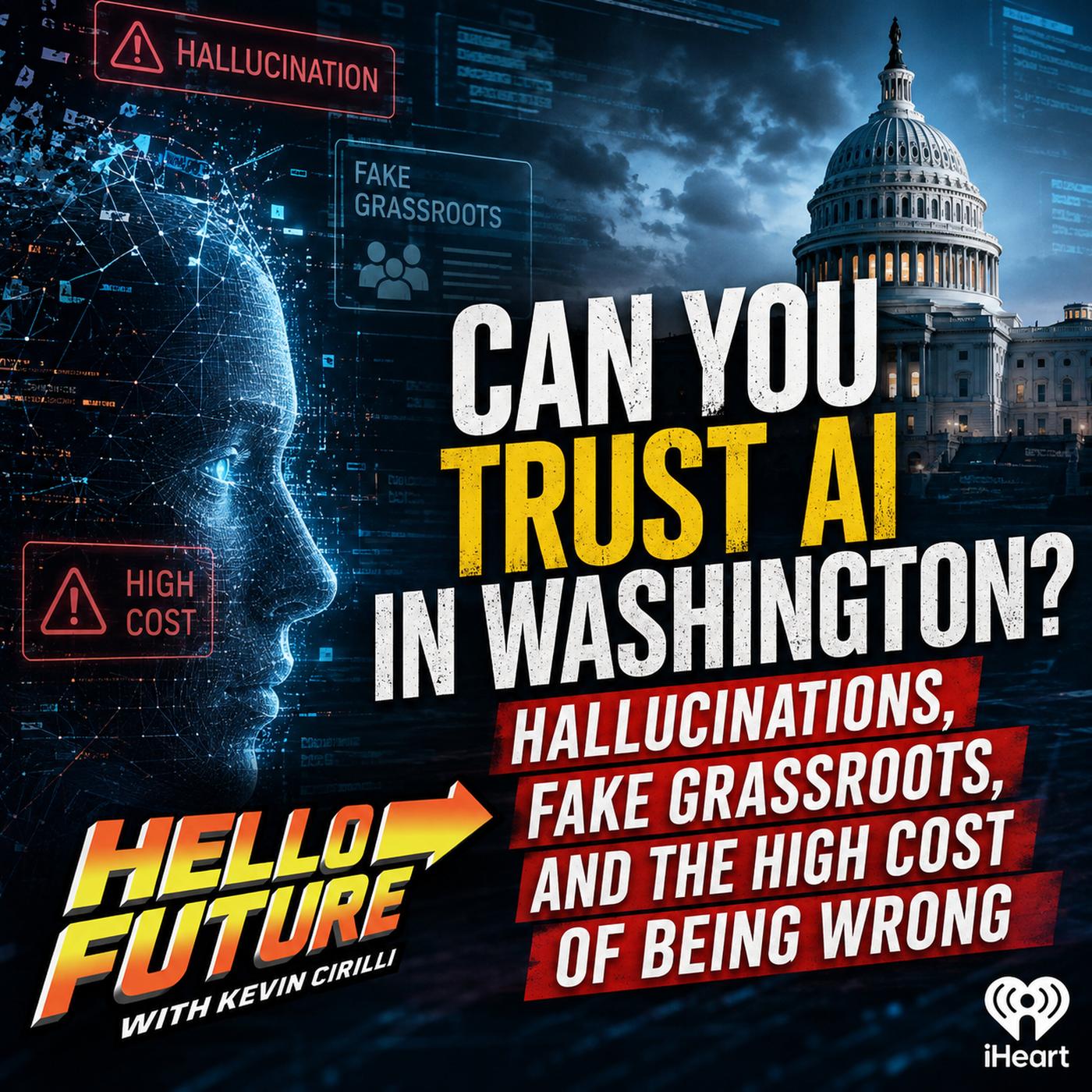
Speaker 1: Folks, did you see this? There was this Stanford University study that came out and it found something really really odd that when a user tells artificial intelligence something that isn't true, something false, the model the AI goes along with it. Hello Future, it's me keV. This is a dispatch from the Digital Frontier. The planet is Earth. The year is twenty twenty six. My name is Kevin Sirelli. I'm broadcasting from Washington, DC, and I got to tell you, folks, in a town that runs on statutes and regulations as well as politicians, big egos, what happens when you've got a situation where the politicians are talking to the AI robots and they're just saying, over and over and over again, you're right, You're right, you're right. Does it lead to hyperpartisanship? Talk about a yes man? What about a yes bot? Thrilled to welcome back to the program. The leader in Washington artificial intelligence. His name is David Fuscus. He's the CEO and founder of Priests AI. It makes industry specific AI platforms. They were found it all the way back in twenty twenty two, but they they're really like the go to for public relations firms Preess Public Relations, and they've got customers in fourteen different countries. But Prisis has launched this beta of willard AI, which is really directed for policymakers, hill staffers, lawmakers and lobbying world. And they've built this whole database of one hundred and thirty two federal government databases. So this is what's interesting to me because I think enough of our listeners now when they go on and engage with the lms and the whatever their preferences, when you like ask an AI, is this a good idea or whatever? And the fact that Stanford's telling us, well, you might not have a good idea, but it might be telling you it's a good idea, that's really alarming. But when you apply that to a lawmaker whose staff might be saying, hey, is this is proposing this piece of legislation a good idea? Is proposing this bill or enacting or stripping away funding or overfunding, is that good for this? And and then the AI goes, yes, Yes, it's a great idea. Keep going, keep going, keep demonizing the other side, keep pushing us in a hyperpartisanship. Then you've got chiefs of staff or you've got LA's or whatever telling you, oh, sir, ma'am, that's a great idea. I mean, this is alarming. This is alarming, David.
00:02:27
Speaker 2: And it's getting more alarming. What we've seen from the recent research out of Stanford, Google has done some very good research, you know, many others on this is as the models are getting more sophisticated and better. Just to think of your own use of using Claude or chat or whatever you use a year ago to now, there's a big difference of much much more robust models on it. But as we get better models, hallucinations and inaccuracies aren't going down, they're going up. The advanced reasoning which is the core of advanced models now it does not consistently eliminate hallucinating. And what you're talking about is something very concerning when you talk about false statements. So AIS are very good at finding a false statement and rejecting it. However, if you are the user, AIS want to please you. Why do they want to please you, Well, nobody quite knows, but they do. And so if there's a false statement that you make in trying to please you on it, it will agree with it and it will set off an hallucination on that the modern America where we are so politically divided in this country, this is a real problem because it can reinforce bad information, it can reinforce narratives that are not grounded in fact. That's a real problem.
00:03:43
Speaker 1: But I do think that in the last twenty years in particular, and again this isn't a partisan statement at all, I do think that the public is aware of bots online and bought campaigns influencing public discourse. So how do we keep AI honest and how do we vet that because so many people are going to be going to AI and asking AI questions, and we're used to know the first page of Google or whatever it comes up on a search engine. People, I think in the business community understand the importance of that, But now it's like different because if you're asking an LLM, that's those same questions. Whatever they tell you to do, like hey, what movie should I see? Whatever AI is going to recommend, that's a lot of power, but it also is an opportunity for a lot of lies to be spread.
00:04:34
Speaker 2: Even more concerning about this, it's what we've seen is in the last six months as a trend for hallucinations for AI to make it more robust, more believable, so that do things like it'll cite sources to give credibility because of the source, and at the end of it, there'll be a list of links and sources. You'll click on one and you'll go to the right website, but you'll get something which is a four to four error, which means it doesn't exist. They will make up sources site sources to support the hallucination of this. And the solution to this is multi model verification. And what that means is that you have one AI that writes something and then you have an independent AI that comes in and does the fact checking on PRESIS products. On the Public Relations Platform or REID, we have a highlight and click fact checking function because we use multiple models on it. We built that into the platform. If you're using something else, especially a single model, because you don't want Claude to check itself, take your generation from Claude and run it through Chat and ask Chat defect it or ask Perplexity to fact check it. But there's real danger in going in and not performing some type of fact check here, especially in a town where mistakes, you know, factual mistakes just cannot happen.
00:05:55
Speaker 1: Well, and I think I think Wall Street really saw this first, to be honest, folks, because they unders like a mistake in the business world can cost a lot of money. But what's interesting about this and I think where it's it's slightly even, it's different. I don't want to say it's more important or less important. I don't want to quantify it that way. But if you understand, which I agree with, then I just had that I call to Meet the Future moment. And I think with David Fuskas CEO of priest to say, I just gave me as a meet the Future moment. The AI that we are using is scraping the internet. Well, we all know how much political content is on the internet. If you're a Democrat or a Republican, you I think we can all agree that there are falsehoods about politics and politicians online, or at least even if you don't believe it that they're falsehoods, there are biases in the content about politics online. And so if you're trying to get information from the source material, from the actual legislation, from the actual amendments, I'm talking like Schoolhouse Rock. I'm just a bill on Capitol Hill. What happened when the AI that we're all using and is publicly available is scraping the political junk off the internet. And some of it's good stuff too, but it's still mixing in with the junk. And then it's regurgitating something that perhaps you didn't want. But even if you didn't know you wanted it, you're not eating your vegetables. You're not getting the healthy stuff or the factual stuff. And so I think that that's really I guess my question to you is what's the lesson for everyday folks who are using chat, GPT, grock Claude, whatever you want to use. When I was a kid, we had the Britannica Encyclopedia. I mean, I remember, I'm old enough to remember licking my finger and flipping the pages. But we're in a brave new world.
00:07:49
Speaker 2: Overall with this, people need to have a very skeptical eye on it. There's a couple of different ways that people use AI that we all use. AI Number one is just as a chat for information, looking at planning a vacation for my wife and I and you know, I got into what destinations in the Caribbean have direct flights from Washington, DC and are less than a four hour flight. You know, boom right, how would you get it? But this type of thing people do all the time. But people are used to that, right, and they used to that and they depend on it. But when you use it for knowledge work, as you do in so many industries, you've got to be skeptical about it, and you've got to go in and you've got to check. You've got to put the extra work into check things. AI is not magic. You know people some people think it is magic and they just accept everything that comes out. You can't do that for important work. You need to take it. You either use a platform like ours with multi model fact checking in it, or you use two of them and then take your generation one have it checked in the other. And please, please please everybody, when you get a list of ten sources and ten links there, click through them, right. I mean, this is a really when you see if you see a four or four error, go back in and just take out anything that cites on that.
00:09:04
Speaker 1: My last questions for you are really about how do we know what's grassroots and what's grass spots? And what I mean by that is like what's real public opinion? Human public opinion and what's just bs that's orchestrated by some rage campaign to propagandize.
00:09:21
Speaker 2: Our ms on a state level or a federal level. If there's a regulation that's out there, there's a comment period. Regular people can go in and say, you know, I like this because do this or don't do that on it. What AI has done is given folks the ability to go in instead of like form letters or form things or form emails that are going in to create a new one for every person that's out there. In Cason, California, they got over twenty thousand comments into a regulatory docket in California. Ninety five percent of them were just AI generated bots. That's a problem.
00:09:57
Speaker 1: David Fuskis, I learned so much. Thank you so much, CEO of pre and founder of priests AI. I can't thank you enough for showing up to meet the future. And if folks want to learn more, where do they.
00:10:09
Speaker 2: Go priess AI precesi dot com and there are people there that work in policy. If you're interested in joining the beta for Willard and trying out Willard doesn't cost anything, send an email to Beta at Preesis AI and we'll get you on the list, and we'll get to set up with an account and you can go in and try it for yourself.
00:10:27
Speaker 1: Amazing, and that's p R e c I. S a I dot com. David, have a great tomorrow today
Speaker 1: Folks, did you see this? There was this Stanford University study that came out and it found something really really odd that when a user tells artificial intelligence something that isn't true, something false, the model the AI goes along with it. Hello Future, it's me keV. This is a dispatch from the Digital Frontier. The planet is Earth. The year is twenty twenty six. My name is Kevin Sirelli. I'm broadcasting from Washington, DC, and I got to tell you, folks, in a town that runs on statutes and regulations as well as politicians, big egos, what happens when you've got a situation where the politicians are talking to the AI robots and they're just saying, over and over and over again, you're right, You're right, you're right. Does it lead to hyperpartisanship? Talk about a yes man? What about a yes bot? Thrilled to welcome back to the program. The leader in Washington artificial intelligence. His name is David Fuscus. He's the CEO and founder of Priests AI. It makes industry specific AI platforms. They were found it all the way back in twenty twenty two, but they they're really like the go to for public relations firms Preess Public Relations, and they've got customers in fourteen different countries. But Prisis has launched this beta of willard AI, which is really directed for policymakers, hill staffers, lawmakers and lobbying world. And they've built this whole database of one hundred and thirty two federal government databases. So this is what's interesting to me because I think enough of our listeners now when they go on and engage with the lms and the whatever their preferences, when you like ask an AI, is this a good idea or whatever? And the fact that Stanford's telling us, well, you might not have a good idea, but it might be telling you it's a good idea, that's really alarming. But when you apply that to a lawmaker whose staff might be saying, hey, is this is proposing this piece of legislation a good idea? Is proposing this bill or enacting or stripping away funding or overfunding, is that good for this? And and then the AI goes, yes, Yes, it's a great idea. Keep going, keep going, keep demonizing the other side, keep pushing us in a hyperpartisanship. Then you've got chiefs of staff or you've got LA's or whatever telling you, oh, sir, ma'am, that's a great idea. I mean, this is alarming. This is alarming, David.
00:02:27
Speaker 2: And it's getting more alarming. What we've seen from the recent research out of Stanford, Google has done some very good research, you know, many others on this is as the models are getting more sophisticated and better. Just to think of your own use of using Claude or chat or whatever you use a year ago to now, there's a big difference of much much more robust models on it. But as we get better models, hallucinations and inaccuracies aren't going down, they're going up. The advanced reasoning which is the core of advanced models now it does not consistently eliminate hallucinating. And what you're talking about is something very concerning when you talk about false statements. So AIS are very good at finding a false statement and rejecting it. However, if you are the user, AIS want to please you. Why do they want to please you, Well, nobody quite knows, but they do. And so if there's a false statement that you make in trying to please you on it, it will agree with it and it will set off an hallucination on that the modern America where we are so politically divided in this country, this is a real problem because it can reinforce bad information, it can reinforce narratives that are not grounded in fact. That's a real problem.
00:03:43
Speaker 1: But I do think that in the last twenty years in particular, and again this isn't a partisan statement at all, I do think that the public is aware of bots online and bought campaigns influencing public discourse. So how do we keep AI honest and how do we vet that because so many people are going to be going to AI and asking AI questions, and we're used to know the first page of Google or whatever it comes up on a search engine. People, I think in the business community understand the importance of that, But now it's like different because if you're asking an LLM, that's those same questions. Whatever they tell you to do, like hey, what movie should I see? Whatever AI is going to recommend, that's a lot of power, but it also is an opportunity for a lot of lies to be spread.
00:04:34
Speaker 2: Even more concerning about this, it's what we've seen is in the last six months as a trend for hallucinations for AI to make it more robust, more believable, so that do things like it'll cite sources to give credibility because of the source, and at the end of it, there'll be a list of links and sources. You'll click on one and you'll go to the right website, but you'll get something which is a four to four error, which means it doesn't exist. They will make up sources site sources to support the hallucination of this. And the solution to this is multi model verification. And what that means is that you have one AI that writes something and then you have an independent AI that comes in and does the fact checking on PRESIS products. On the Public Relations Platform or REID, we have a highlight and click fact checking function because we use multiple models on it. We built that into the platform. If you're using something else, especially a single model, because you don't want Claude to check itself, take your generation from Claude and run it through Chat and ask Chat defect it or ask Perplexity to fact check it. But there's real danger in going in and not performing some type of fact check here, especially in a town where mistakes, you know, factual mistakes just cannot happen.
00:05:55
Speaker 1: Well, and I think I think Wall Street really saw this first, to be honest, folks, because they unders like a mistake in the business world can cost a lot of money. But what's interesting about this and I think where it's it's slightly even, it's different. I don't want to say it's more important or less important. I don't want to quantify it that way. But if you understand, which I agree with, then I just had that I call to Meet the Future moment. And I think with David Fuskas CEO of priest to say, I just gave me as a meet the Future moment. The AI that we are using is scraping the internet. Well, we all know how much political content is on the internet. If you're a Democrat or a Republican, you I think we can all agree that there are falsehoods about politics and politicians online, or at least even if you don't believe it that they're falsehoods, there are biases in the content about politics online. And so if you're trying to get information from the source material, from the actual legislation, from the actual amendments, I'm talking like Schoolhouse Rock. I'm just a bill on Capitol Hill. What happened when the AI that we're all using and is publicly available is scraping the political junk off the internet. And some of it's good stuff too, but it's still mixing in with the junk. And then it's regurgitating something that perhaps you didn't want. But even if you didn't know you wanted it, you're not eating your vegetables. You're not getting the healthy stuff or the factual stuff. And so I think that that's really I guess my question to you is what's the lesson for everyday folks who are using chat, GPT, grock Claude, whatever you want to use. When I was a kid, we had the Britannica Encyclopedia. I mean, I remember, I'm old enough to remember licking my finger and flipping the pages. But we're in a brave new world.
00:07:49
Speaker 2: Overall with this, people need to have a very skeptical eye on it. There's a couple of different ways that people use AI that we all use. AI Number one is just as a chat for information, looking at planning a vacation for my wife and I and you know, I got into what destinations in the Caribbean have direct flights from Washington, DC and are less than a four hour flight. You know, boom right, how would you get it? But this type of thing people do all the time. But people are used to that, right, and they used to that and they depend on it. But when you use it for knowledge work, as you do in so many industries, you've got to be skeptical about it, and you've got to go in and you've got to check. You've got to put the extra work into check things. AI is not magic. You know people some people think it is magic and they just accept everything that comes out. You can't do that for important work. You need to take it. You either use a platform like ours with multi model fact checking in it, or you use two of them and then take your generation one have it checked in the other. And please, please please everybody, when you get a list of ten sources and ten links there, click through them, right. I mean, this is a really when you see if you see a four or four error, go back in and just take out anything that cites on that.
00:09:04
Speaker 1: My last questions for you are really about how do we know what's grassroots and what's grass spots? And what I mean by that is like what's real public opinion? Human public opinion and what's just bs that's orchestrated by some rage campaign to propagandize.
00:09:21
Speaker 2: Our ms on a state level or a federal level. If there's a regulation that's out there, there's a comment period. Regular people can go in and say, you know, I like this because do this or don't do that on it. What AI has done is given folks the ability to go in instead of like form letters or form things or form emails that are going in to create a new one for every person that's out there. In Cason, California, they got over twenty thousand comments into a regulatory docket in California. Ninety five percent of them were just AI generated bots. That's a problem.
00:09:57
Speaker 1: David Fuskis, I learned so much. Thank you so much, CEO of pre and founder of priests AI. I can't thank you enough for showing up to meet the future. And if folks want to learn more, where do they.
00:10:09
Speaker 2: Go priess AI precesi dot com and there are people there that work in policy. If you're interested in joining the beta for Willard and trying out Willard doesn't cost anything, send an email to Beta at Preesis AI and we'll get you on the list, and we'll get to set up with an account and you can go in and try it for yourself.
00:10:27
Speaker 1: Amazing, and that's p R e c I. S a I dot com. David, have a great tomorrow today
