


00:00:00
Speaker 1: I can remember vividly just not not having enough yeah energy making the right decisions, and.
00:00:06
Speaker 2: Those decisions can be life or death s.
00:00:08
Speaker 1: That's terrified, that's right, and it's physically like it's a physical thing. So I've just got to keep pushing because I don't want to be the I'll never be the person that can't do it.
00:00:17
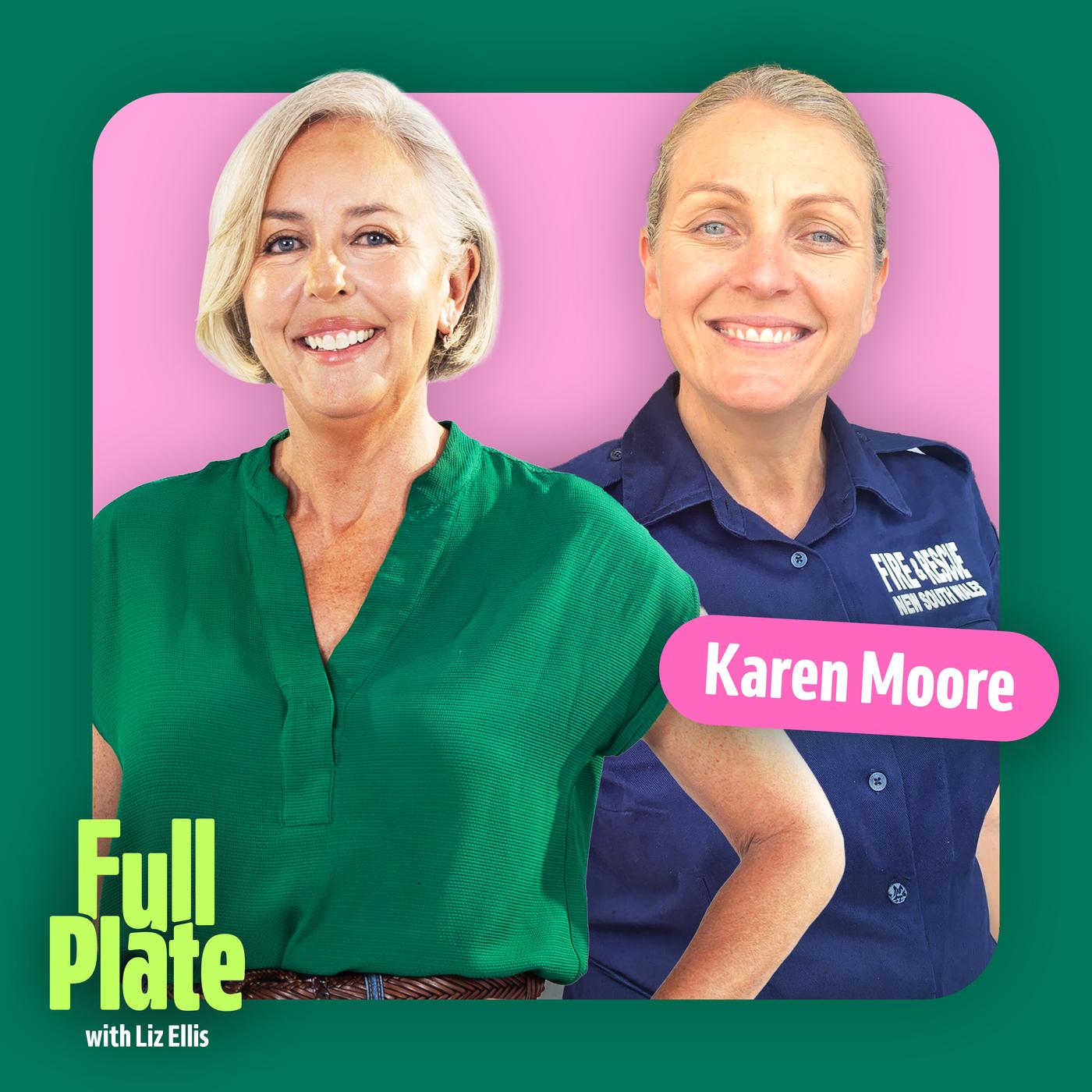
Speaker 2: Hi. Everyone, I'm Lizellos and welcome to Full Plate. For over fifteen years, my world was all about elite sport. I was lucky enough to play fifteen seasons of netball for Australia, winning three World Cups and two Commonwealth Games gold medals along the way. Back then, my plate was overflowing with high stakes game on moments. Cut to today and life is just as packed. But these days game on means juggling a crazy travel schedule, helping my husband run out farm, and trying to stop at two kids, school and sports calendars from completely colliding. On this series, we aren't here to tell you what you should eat. We're here to explore how some of the most impressive people in the country actually feed themselves they can maintain their high pressure lives. Today we're talking to Karen Moore, a fire fighter stationed in western Sydney. Now, Karen didn't start out in this crueling career. She made the leap at forty three after a decade in a corporate office. Now her game time can happen at three am, wearing twenty kilograms of gear in extreme heat. But the struggle doesn't end when the shift does. Karen is mum to a large family, and despite the physical toll of her job, she's still the one heading home to cook and manage the household. We're going to dive into how she manages the mental load of a twenty four hour shift, how she still finds the energy to feed her crowd at home, and the one survival hack she uses to wake up her brain when she's at one hundred percent capacity. Easy one to start with. What did you have for Breky today?
00:01:52
Speaker 1: For Brecky today, I had oats with banana, very simple.
00:01:55
Speaker 2: Is that what you have every day?
00:01:56
Speaker 1: Oh? Mostly, I'm a bit of a creature of habit with breakfast.
00:02:00
Speaker 2: I think most people are right, they do something different for dinner every night.
00:02:03
Speaker 1: But Brecky's pretty standard. Yeah.
00:02:05
Speaker 2: I wonder if it's because in the mornings you can't think.
00:02:07
Speaker 1: Probably, Yeah, it's easy, easiest thing I can grab that I know that I enjoy. That works. Yeah.
00:02:14
Speaker 2: Are you a coffee or a tea drinker in the morning?
00:02:15
Speaker 1: In the morning?
00:02:16
Speaker 2: Yeah, did it first stuff?
00:02:18
Speaker 1: Or like, do you wait a little bit, wait a little while? Yeah?
00:02:22
Speaker 2: See, not one of these people who can't function with that.
00:02:24
Speaker 1: No, I'm not too bad. I can go and do gym or something before it, and then coffee after as a reward if I need to.
00:02:29
Speaker 2: Oh, wow, so you can wait that long?
00:02:31
Speaker 1: Yeah I can if I need to. Oh, you are all.
00:02:32
Speaker 2: Disciplined, and we'll find out why you disciplined a little bit later. But do you want to tell me a little bit about your life right now in terms of what's on your plate, so figuratively more than literally. Yeah.
00:02:41
Speaker 1: Yeah, So I still work full time. I do shift work. I've got three adult teen daughters still living at home, plus some of their partners here and there, and the husband and family.
00:02:55
Speaker 2: What a shift work?
00:02:55
Speaker 1: Did you exhaust me? Doesn't it? But I just keep going regardless.
00:03:02
Speaker 2: What do you rely on when you've got to keep going? But what do you think about when you're really exhausted?
00:03:07
Speaker 1: Oh? I just keep myself busy, just with anything. Any I'll do random tasks just to keep myself busy, even though I know I should be resting and recuperating at the vice I want to do. Yeah.
00:03:16
Speaker 2: Yeah, So how do you work twenty four hours on and then you have a day off and then work twenty four hours on. Does that smash your sleep as well?
00:03:26
Speaker 1: Yeah? It does sometimes. I mean some nights are not so busy, but yeah, mostly it's very unbroken sleep. And yeah, so it's quite exhausting.
00:03:34
Speaker 2: So how does that affect then? I guess how you approach what's on your plate every day when you finish work and you come home and you know you've got things that you have to do, and you haven't had sleep, and maybe you haven't been able to eat properly. How do you balance that plate?
00:03:50
Speaker 1: I just I sort of try and keep myself calm, and if everything around me is calm and organize, then I don't get so stressed about it. So I'd like to plan ahead and make sure I have a plan for the day so that I'm not running around frantically trying to organize stuff. Oh, a plan for the day that I do? Yeah?
00:04:07
Speaker 2: Are you like, are you a list maker? Do you write it all out.
00:04:10
Speaker 1: I know, just in my head though, I know what I have to do.
00:04:13
Speaker 2: Yeah, do you have a little reward at the end if you get through it all?
00:04:17
Speaker 1: I know, not really. Oh I don't think I've ever got through it all.
00:04:20
Speaker 2: Oh that's very much a woman thing to say. It never finishes. So how do you define game time in your life today? When is game on for you?
00:04:30
Speaker 1: Probably the first day of my days off is when things click into gear.
00:04:35
Speaker 2: And when you're at work? Is there a time at work that is game time? When you go into Okay, I'm fully focused on what I'm doing.
00:04:43
Speaker 1: Yeah, well, we're pretty much always on call for anything, so that's most of the time. So I think even rest at work is not as RESTful as rest is at home. Yeah, because you're just not sure what's happening next. No, will you work in an industry where game time can be three am, that's right, or three pm?
00:05:01
Speaker 2: So how do you manage that mental load of being sort of constantly ready and still trying to maintain a human routine at work?
00:05:10
Speaker 1: I don't know. I don't know how I do it, to be honest, It just I guess it's a learned behavior as well. It takes a while to get used to used to that because I didn't come from this industry obviously, it's something I started about ten years ago. So prior to that, my life was very different. So I think it's just as times progressed. I've just learned how to cope with it.
00:05:30
Speaker 2: So when you started, you're forty three, so not a lot of people start a new career, let alone a career that is so grueling mentally and physically. Were their habits that you had to learn so that you could be game ready at three am or five am or.
00:05:44
Speaker 1: Yeah, I just have to just be physically healthy, was the main one of the main things. Yeah, that's probably, yeah, the most important.
00:05:52
Speaker 2: And where does your food fit into that?
00:05:55
Speaker 1: So I'm really organized with food, with basically with shopping and having food at home. So we just generally, as a rule, we don't buy dinners out or anything like that. We have fresh food and we just as long as it's home and available in the fridge, it's easy for us to just grab whatever we need. So you're organized at home, organized at home?
00:06:15
Speaker 2: What about on the job, So when you go out to a call and you're exhausted and you come back and you know, it's been a long call. What do you feel like when you finally walk back into the station kitchen? Probably feel like something bad. But we've always got food.
00:06:30
Speaker 1: I've always got food organized, so I'll have something like some I try to cook stuff so I don't have to like cook it when I get back. Yeah, so it'll be a sturfry that I've made up already or something in the fridge that's ready.
00:06:42
Speaker 2: Are the other people at the station like that or do they look at your sturfries with a bit of envy? Yes?
00:06:47
Speaker 1: Sometimes they do. Yeah, So some people are happy just to buy a dinner every time. So there's plenty of places around, Like I work out in Western Sydney. There's a lot of choice, But I find that that sort of food doesn't help me. Then if we do get up at three am, that's the last thing that I need fueling me. Yeah.
00:07:03
Speaker 2: Okay, so you guys, there's no is there any sort of like there's obviously it must be a communal eating area.
00:07:10
Speaker 1: Yeah, Like do you cook together or we do depending on and if our whole crew is there, because we're like we basically live together for the two whole shifts. So yeah, if we can manage, we'll cook up. We do a lot of Mexican cookups because that's easy to sort of grab and go and please everyone, you know, spag bowl, all the basics. Yeah, and does.
00:07:28
Speaker 2: That contribute to sort of team cohesion?
00:07:30
Speaker 1: Oh definitely yeah. Yeah.
00:07:32
Speaker 2: What do you think, Like, I know that your family eats dinner together most nights when you're home. Yeah, what do you think it is about that communal eating and communal cooking that helps your team?
00:07:42
Speaker 1: It's just communication and I think yeah, like a little bit of team building, same as that, Like we have a rule at home no phones at the table still with adult children, but so that we can communicate. So I guess it's the same thing in a team environment. And plus we're relying on each other, you know, in some bad situations, so it's good to know that you can all pitch in and do what needs to be done, even in the kitchen.
00:08:04
Speaker 2: Have you never noticed that there's a correlation between someone's ability to cook and their ability to remain calm in a situation. Yeah?
00:08:12
Speaker 1: Yeah.
00:08:14
Speaker 2: Some people are more natural, right, and some people need to be really assessed the situation, and some people we.
00:08:21
Speaker 1: Can just get straight into focus on the task.
00:08:23
Speaker 2: Yeah, Like, so do you currently do you Are you the leader in that regard? Are you saying right guys that's cook ups in Mexican or are there different people that do it?
00:08:29
Speaker 1: Yeah, it's probably mostly me. I can't leave that at home. I try not to. I try not to be the mum, but it's really hard.
00:08:40
Speaker 2: Well, what's the rules around cleaning then after a big station cookup.
00:08:43
Speaker 1: I know we all pitch in and clean or if someone predominantly cooks, then everyone else cleans up. Yeah, that's fair. Yeah, I like that.
00:08:50
Speaker 2: One of the things that you have to be I guess in your occupation is you're going to have resilience, right, the ability to keep going when things are tough in the middle of a twenty four hour shift. Is there one thing that keeps the mental gears turning for you?
00:09:07
Speaker 1: I have a very like I communicate a lot with my family when I'm at work as well, and I like to keep abreast of what they're doing, and they contact me constantly, So I think that's probably if that makes sense, that's a lot of the thing that keeps me focused because I know how important it is for me to be going home after the shifts. Yeah, so yeah, possibly that My goodness.
00:09:28
Speaker 2: So many people don't have to think about that, do they, But in your occupation you do.
00:09:32
Speaker 1: Yeah. Yeah, so that keeps me focused on doing my job well and properly so that I can ye give back to what they need. Do they?
00:09:41
Speaker 2: Are you in life three sixty? Do you guys like, do your kids check where you are? Mum's off to a fire here or fire?
00:09:46
Speaker 1: Yeah, We've got yeah, find my phone or something so they can see. They can see if it's I can't lines I had a crazy shift.
00:09:52
Speaker 2: If I didn't, you're there or is there like a snack that you relied in the middle of that twenty four hour shift. You focus on your family, but you've got to feed your brain. Is there something that you just like you go to? I need to keep my brain in gear when I'm hungry.
00:10:07
Speaker 1: Yeah, I'll just go like banana or you know, cottage cheese, corn, things that kind of you know, fifty year old food I'm supposed to be eating.
00:10:16
Speaker 2: There's nothing wrong with it. You're very healthy. Have you always been like that? Have you always been so switched on with your nutrition and your health? Yeah?
00:10:22
Speaker 1: Well, previously I was a personal trainer for ten years before I got into firefighting, so it's kind of been on my radar, which is kind of what led me into the role.
00:10:33
Speaker 2: Yeah, so you were training for ten years to be a firefighter pretty much? Yeah, I wonder before that.
00:10:38
Speaker 1: I just had like a nine to five office job before that, so yeah, yeah.
00:10:45
Speaker 2: Did you ever envisage that when you like think back to when you're in your nine to five job, one day you'd be you'd be a firefighter.
00:10:51
Speaker 1: You never badass? Never, And I wish i'd considered it earlier. Oh really Yeah, but I never. And now it's on it like my family's radar as well the girl. But yeah, for me, it was never considered. I think you have to know someone to even consider something like that, Yeah, I think.
00:11:08
Speaker 2: So is it hard to get into it? Was it hard for you?
00:11:09
Speaker 1: Yeah? It's hard. Yeah. So they have like cognitive online ability tests and then it's the physical test, so yeah, it's pretty tough. What was the thing that made you decide to do it. I've just had people, well one person in particular, who mentioned it to me and said you should do it, and I'm like, oh, I'm too old for that, So I just gave it a go, and yeah, it's great, it's changed my life.
00:11:32
Speaker 2: That's interesting. The self talk. I'm too old for that.
00:11:36
Speaker 1: Yeah.
00:11:36
Speaker 2: Was there something that made you say, Karen, stop speaking to yourself like that. What's the thing that made your brain go, Actually, I'm not too old.
00:11:43
Speaker 1: I might give it again. Yeah. Well, probably just my three daughters like, well, they you know, I should do this, prove that you can do whatever you want. And it's you know, tenfold, it's worked because they're all successful in what they're doing.
00:11:57
Speaker 2: So yeah, and one of your daughters is a carpenter, right, so she's sort of backed the system of what Yes, you expect, that's right.
00:12:03
Speaker 1: Yeah. And it's still tough. It's still a traditionally male field, but yeah, it's it's rewarding. Yeah.
00:12:10
Speaker 2: Yeah, and it sounds to me like the kitchen and the eating component when you're at work is a bit of a leveler levels of playing field amongst your team.
00:12:18
Speaker 1: Oh definitely, yeah, yeah, definitely does.
00:12:20
Speaker 2: Yeah, it's a full on job and you are away a couple of nights a week. How does I mean you've clearly got a really great connection with your husband and your three daughters. How does food help that connection for you guys at.
00:12:34
Speaker 1: Home, Well, we all love food so and we all love cooking and contributing so and it's a big part of our life. So we all have meals together. Whoever's at home, we eat meals together. So that's important. We don't, yeah, we don't go out and eat out and we sit at the dining table and yeah, we communicate and chat about our days and yeah, so that's a big.
00:12:57
Speaker 2: And no screens, screens.
00:13:02
Speaker 1: Television.
00:13:02
Speaker 2: Yeah, So when the kids were sort of screen ages, were they was that hard?
00:13:07
Speaker 1: That's hard. Yeah, they just have to quickly duck off, duck off from the table to do something, so quickly check their snapchats or whatever. But whatever it is. Yeah, But now like they're all at an age now where I think they appreciate it and we'll sit for an hour and a half or something. No one's in a hurry to leave. So that's just something that we've that we love to do.
00:13:26
Speaker 2: So yeah, and it's a beautiful, Yeah, it's a beautiful way to keep connected. Yeah, when we come back, you'll hear about how Karen balances the demands of her high pressure job as a firefighter with her need to stay grounded with her family at home, stay with us. Someone said to me once when our kids were little, that you can forget about you know, expensive tutorials and you know all the things that people spend money on. The thing that is a massive determinant of you staying co p as a family and the kids being connected to you is having dinner together.
00:14:04
Speaker 1: Yeah.
00:14:05
Speaker 2: So is that a conscious decision when the kids were little or is it something that evolved with you and your partner.
00:14:09
Speaker 1: Yeah. I think we both grew up in households that did eat dinner at the table. I think as the girls got a little bit older and we'd go out with other groups of families and the kids were all on their screens, and I it was something that I just did not like, and we wouldn't let the girls. And we're sort of those people that didn't like sit and talk or go and play or something. So I think it just sort of, yeah, we agreed that that was what we wanted.
00:14:36
Speaker 2: Yeah, we're the same, but you feel like you do the hard yards dat. You know, when you see parents sitting quietly having a glass of wine and the kids are on screens and we're like trying to go on just talk, sit up straight. Yeah, that's right. So you do the hard yards. But I think the benefits a crew, like when your girls are your age now.
00:14:53
Speaker 1: And we'll sit down now for a meal, and they eat most things and we enjoy the same sort of foods as them, and you know, they don't pick through their food. They appreciate it, and they appreciate how hard we work to, you know, not just to provide that food. But yeah, the environment. We're all there, we're still talking, we're doing it together.
00:15:11
Speaker 2: Have you tried to introduce to screen free meal times at the fire station?
00:15:16
Speaker 1: No, if that's not I'm not the mum. I'm allowed to be mum there for that. I would like to.
00:15:22
Speaker 2: I find it frustrating.
00:15:23
Speaker 1: But you're all adults.
00:15:24
Speaker 2: So yeah, let's go to you as a firefighter. You're wearing twenty kilograms plus of gear in extreme heat. How do you pre feel for that? Like when I think about being an athlete, your game time set. You know when you're going to train, you know when you're going to play. You can start to hydrate at the appropriate moments. You know before a game, I'd eat a larger meal at lunchtime and then a snack in the afternoon game that I was going to play at seven. How do you do that because you don't know when your game time it's right? So what's your approach during the course of a twenty four hour shift about getting enough water and hydration and food into.
00:15:57
Speaker 1: Your Yeah, yeah, it's not as easy to plan and as you said, but I do. I try and eat like I know, oats in the morning and it tied me over for longer if we happen to get called out. And then we have plenty of water, so I'm always hydrated, and we have the energy thing called quench thirst first, Quench.
00:16:13
Speaker 2: First, quen cheah, that's it.
00:16:15
Speaker 1: Yeah, So we have those things with us if we need them, and we do have hydration packs, and we've got access to protein bars and things on the truck if we're in a long duration callah. Yeah. So I just snack all day, my key, So I won't let it get to lunchtime, wait till lunch time to eat. If I've got time before that, I'll have a snack. What you go to snack? Just yogurt, bananas? Yeah, just I just pack a eski full of food for the day and I'll just snack all day. Yeah, just in case.
00:16:42
Speaker 2: I think it's easy sometimes to think of snacks as chips or musley bars or stuff that's pre prepared that you can grab. But like, with a little bit of planning, it feels like particularly you do this, your snacks can be really good for you. Doesn't take it a huge amount of planning, just a small amount.
00:16:58
Speaker 1: Of plan Yeah. No. And so normally when we're cutting up, if I'm cutting up dinner at night the night before I go to work, and the girls take things to work as well, we'll just cut up extra salad, extra you know, veggies and things like that to take them for snacks. We don't buy a lot of packet snacks. It's expensive, yeah it is. Yeah, And they don't do anything for me at the fire station. I'm gonna eat a bag of chips. It's not going to give me the energy I need to do my job.
00:17:23
Speaker 2: No, it's just going to give you a whole lot of regret.
00:17:24
Speaker 1: That's indigestion. Yeah, exactly. So is there a station snack draw, No, there's Yeah, there's chocolate bars and ice creams and soft drinks. You don't go near them, not really.
00:17:37
Speaker 2: Yeah, how do you keep yourself away from that, particularly after I imagine you have a high adrenaline coll and you come back and your body's sort of buzzing. Yeah, do you think to yourself, Oh my god, I just save five lives. I think I'll have an ice creamy.
00:17:51
Speaker 1: They're not my go to Yeah, not really. I don't really eat sweet stuff like that.
00:17:54
Speaker 2: So, so do you get cravings after a big call A do you get back and go I need it or I need sugar, or I need salt or I need probably salt.
00:18:04
Speaker 1: Yeah, probably salt's the main thing because obviously sweating and yeah, hydration, But but I wouldn't say that I put salt. You know, I don't have anything salty per se.
00:18:14
Speaker 2: It's excuse seats. Have you ever in your in your work, have you been to a kitchen disaster?
00:18:21
Speaker 1: Kitchen fires? Yeah? All the time? Oh really, Yeah, very common are they? Yeah? What goes wrong? I just people leave. They'll put stuff on the on the stove and just leave, go out and leave it on with whatever's in the pot. Most of the time we can't even recognize what it was. That happens all the time. That's where probably fifty percent of fires start is in the kitchen.
00:18:42
Speaker 2: Ah, yeah, has that changed your approach to what are you doing in the kit Yeah?
00:18:46
Speaker 1: I'm terrible like reminding them. Did you turn the pan off? Have you? Yeah?
00:18:54
Speaker 2: You know it's funny that you say that, Like I'm thinking of all the times that I just wonder out and do stuff at home and gumpy the kids up at training or whatever you do, and you don't think about it.
00:19:04
Speaker 1: Yeah.
00:19:04
Speaker 2: Do you ever leave anything on the stove or have you just seen enough to go? No?
00:19:08
Speaker 1: Just take everything on. Nothing's even near the stove, you know, the bread bag or anything. Everything has a wide berth, because I've just seen a lot.
00:19:16
Speaker 2: Doesn't take much, does it. No? Do you remember that the ad?
00:19:19
Speaker 1: You're a little bit younger than me.
00:19:20
Speaker 2: But the added the lady who was cooking chips and she had put the hot oil on and put the chips in, and then outswer the phone and turned because back then it was before mobiles.
00:19:30
Speaker 1: I was against the wall and.
00:19:32
Speaker 2: She turned around and the whole kitchen was on fine, and it went like that, and the tagline was, oh my goodness, the chips. Do you remember that? So that's true? Like that happens?
00:19:42
Speaker 1: Yeah? Yeah, yeah, So keep looking while cooking. That's one of our big campaigns because people will do that, they'll often get distracted quite easily. You see the straighteners, you know all those things. Oh yeah, yeah.
00:19:55
Speaker 2: Well I don't cook with my hair straight Hey, you've talked about it a little bit. But when I asked you before about how do you make sure that you're ready in case you get the call out and you've had enough to.
00:20:08
Speaker 1: Eat and you're hydrated.
00:20:10
Speaker 2: Do you have to be a bit more engineered about that than the guys to maintain that peak physical performance? Is there something different between being a woman in your role or a guy in your role?
00:20:21
Speaker 1: Possibly? Possibly, I just just physically probably takes a little bit more effort. Plus I'm older, yeah as well, so I recognize that. So I know that I have to, you know, probably be a little bit more careful with what I can't eat a big greasy meal or anything like that and expect that I'm going to be able to do my job properly. So yeah, yeah, absolutely, Whereas they can probably eat and cup a burger and it doesn't affect them.
00:20:46
Speaker 2: Particularly they're twenty five year old men.
00:20:48
Speaker 1: That's exactly right.
00:20:50
Speaker 2: Is there like gyms and stuff in the.
00:20:52
Speaker 1: Yeah, or fire stations have a gym, so we can use that whenever do you get there? Music? Yeah we do, Yeah, we try. We've got a basketball ring as well. Some stations play pickaball volleyball, so it's part of our fitness trying to keep everyone fit.
00:21:08
Speaker 2: Yeah, and I would imagine it's also killing time when you.
00:21:10
Speaker 1: Yeah, that's right. Yeah, Yeah, we can have some long days where we're looking for things to.
00:21:15
Speaker 2: Do when you do get home after if you do a four day rotation or something like that, and you've got that full plate of haven trying to compress everything that you've seen and done at work, and then you get home, you got right, I've got all these jobs. How do you what's the first thing you do to reclaim your space in the kitchen, particularly if your girls or your husband's been cooking in there.
00:21:34
Speaker 1: Oh, clean it up. I have to start fresh. Yeah, clean it up.
00:21:40
Speaker 2: Do they leave a mess very often?
00:21:42
Speaker 1: No, they're pretty They're pretty good, but it's probably not quite to standard. And then I'll go and buy fruit and beags or something.
00:21:50
Speaker 2: So are you the grocery shopper for the family?
00:21:52
Speaker 1: Yeah? How do you?
00:21:53
Speaker 2: Where's your list? Where do you keep on the fridge on the fridge.
00:21:56
Speaker 1: Yeah, everyone just adds to it.
00:21:57
Speaker 2: We've got our fridge is like it's not magnetic, but it's like a whiteboard. Oh right, Yeah, so I noticed this weeek. My kids are younger than yours, and I'd written a list, and then my daughter had written one pony. I was like, child, you might not getting a pony, so I write minus minus the pony, one pony. Yeah. You know when you go and do the grocery shopping, is that something that if you come off for a three or four day rotation and you go to supermarket, is that almost a moment to decompress and to sort of sign out a bit as well?
00:22:26
Speaker 1: Yeah. Yeah, I love walking around the fruit market. It's nice just to drive there and wander around. And yeah, think about food. Think about food.
00:22:35
Speaker 2: Yeah, your family's food. It's a different thing, isn't it. It's a great way to take your mind off all the other things.
00:22:40
Speaker 1: Yeah, and there's a lot I mean, there can be seven adults in our house for dinner sometimes, so there's a lot of We need a lot of food, So you need a huge amount of food. Yeah.
00:22:48
Speaker 2: How much planning do you do or how do you do your planning.
00:22:51
Speaker 1: We pretty much have similar rotations, which is quite boring but sort of basic. I don't cook anything too extravagant.
00:23:00
Speaker 2: An example of your rotations. I'm writing these down because I like, so we have.
00:23:05
Speaker 1: But we'll have like steak and veggies, yep, and we'll have salmon and salad. Normally we might do a rice with it, or every now and then we'll do some sort of potatoes with our salmon spag bowl. Yeah, but that's only probably every two weeks. Now we're getting we get a little bit sick of that winter. That'll get back in. But we put veggies in it as well. To say, do you put vegies? Yeah, vee is not hidden. We don't hide them anymore. They're not baby vege I can see. Yeah, we usually have we'll have a Mexican and we have all variations of because everyone likes different types of things like that. And then we normally do some sort of curry chicken curry or yeah. So it's very basic, but it doesn't need to be fancy.
00:23:48
Speaker 2: Well, do you know, I'm just thinking it's a bit of a few moment because mine's exactly the same. Yeah, and I reckon like you say it's basic, but it's actually the stuff you know is good.
00:23:58
Speaker 1: Yeah, yeah, it doesn't have to be hard eating vegetables, no, yeah. Yeah.
00:24:03
Speaker 2: And when we were traveling, I have little family for a year in a caravan on holidays, and my motto was, if we can't barbecue, we're not eating it. Yeah, so every day it's going to be on the barbecue.
00:24:16
Speaker 1: And the barbecue is great because I just hand the plate out the door, yep, and then I just prepare the young stuff.
00:24:21
Speaker 2: Yeah, the barbecue fairy goes. Yes, that's right, that's fantastic. So you do your grocery shopping and you get home and you clean the kitchen. So you're clear the master of your domain or the mistress of your domain. But who nurtures you from a food point of view.
00:24:37
Speaker 1: My husband does. He will cook, like if I'm obviously when I'm at work, he'll cook for the family. So he cooks for the girls, and he does all the barbecuing and stuff. So yeah, he'll make me breakfast when I come off shit. Yeah, so that might be a weekend. We'll have eggs and something different to the norm. But yeah, so he does look after me with that. Oh no, do you get fomo when he's at home with the girls. Yeah, especially weekends and everyone's home. Yeah. Yeah, but it's good that they're older. Yeah, I know that they're okay. Yeah. Yeah.
00:25:09
Speaker 2: After this short break, you're going to hear about just how high the steaks are for a fire fighter like Karen, and the lessons she learned the hard way to stay with us. Karen, you sound really organized about your food and particularly when you're at work. But was it always that way or was there a shift or a couple of shifts where you ate the greasy burger, or you didn't eat enough, or you didn't think and prepare enough about your food needs at work. Was there a time where that happened and you thought to yourself, I can't let this happen again.
00:25:42
Speaker 1: Yeah. I've had times where I haven't eaten enough, or I haven't I can remember time I hadn't had breakfast, oh, because I hadn't brought it with me and we had an early call and it was probably well after lunchtime. And they do provide us with food if we've been at an incident for a certain amount of time, but it's always McDonald or something like that, which I can't eat that when I'm working, Like, I'll eat it if I have to, but it's life or death. But yeah, so I've I'd never want to feel like I've not had enough to eat again because you just have no energy. Yeah, so it's really hard to keep pushing when there's nothing available.
00:26:17
Speaker 2: Yeah, and so what working? What was a practical outcome of that for you?
00:26:20
Speaker 1: Then?
00:26:22
Speaker 2: Headache?
00:26:23
Speaker 1: Yeah, headache pretty much after that and just took me a long time to recover.
00:26:28
Speaker 2: Oh that's interesting. So it's not just in the moment, it's hours.
00:26:33
Speaker 1: Yeah. Yeah, so just just more fatiguing. And I guess we're mostly working in hot conditions too, so that makes it a lot harder.
00:26:40
Speaker 2: And you've got to make split second decisions, which is difficult when you haven't fed your brain.
00:26:45
Speaker 1: Yeah yeah, so yeah, I can remember vividly just not not having enough yeah energy making the right decisions. Those decisions can be life or death. Yea, that's right, And it's physically like, it's a physical thing. So I've just got to keep pushing because I don't want to be the I'll never be the person that can't do it. Yeah, but yeah, it does take a toll.
00:27:04
Speaker 2: That's a steep learning curve it is.
00:27:05
Speaker 1: Yes, it's probably happened more than once.
00:27:09
Speaker 2: We won't tell anyone.
00:27:10
Speaker 1: Yeah.
00:27:10
Speaker 2: Is there a survival hack you've learned from a veteran fire fighter about keeping your energy up during a major incident that's not found in a textbook? Is there something hacky that you've learned, that someone's told you, or that you've discovered yourself if you're in a long incident and you find yourself, you know, going for a bit of a spacewalk.
00:27:29
Speaker 1: Ah. Probably just cold water really, yeah, because we take we have like frozen water bottles that we take. That's fairly boring, but yeah, if you drink and really cold water, it can really perk you up. We've tried coffee, you've tried soft drink. It doesn't give you any buzz, but you kind of get that almost a brain freeze reaction and it kind of.
00:27:49
Speaker 2: Kicks you from cold water a bit.
00:27:52
Speaker 1: Ha.
00:27:53
Speaker 2: I've never thought about that.
00:27:55
Speaker 1: And we have to just use what we have in hand. So yeah, because.
00:27:59
Speaker 2: When we were playing, we used to have to drink ambient water. Yeah, right, because the body uses a bit of energy, Yeah, bring it back down.
00:28:06
Speaker 1: But I guess when you want your energy to spike like that in that way wake you up a bit. And the cold, Yeah, don't have splashed on your face, you just stick. If I was to look in your locker, do you have a locker? Do you have an emergency stash at the moment? What's in there? There's fish sauce.
00:28:25
Speaker 2: Because we bought it.
00:28:27
Speaker 1: We have different shifts and we all cook different things, and sometimes we'll get something that we just want to keep for ourselves and not share with everyone else.
00:28:34
Speaker 2: That's not the answer I thought i'd looking for like that, you know, the one item that saves you a long night.
00:28:38
Speaker 1: Yeah, I've got that. There are some coffee sashet in coffee Sarah emergency. Ye, my whole shift shares those, so we just add to them. So that's in there.
00:28:48
Speaker 2: Tiner tuna and rice cups tin tunor is underappreciated.
00:28:53
Speaker 1: Yeah, that's just staple. Everyone has it, do they? Everyone has rice and tuna in their locker. And the cooked rice you just the one the cups that putting the mic awave. Yeah, and that's just just in case you forget your lunch or we can't get out to get lunch or whatever.
00:29:09
Speaker 2: But yeah, I love it. Yeah, I think I think the rice cup and the tin tuna are under oppressure. Yeah, what's the Karen Moore signature meal for that first night back at home? You've done your shopping, you've cleaned your kitchen, you've reclaimed your space, you know the girls are going to be at home. What's your signature meal.
00:29:30
Speaker 1: It'd definitely be salmon on the barbecue, because we all love fresh salmon on the barbecue. I do a nice salad, I make a potato dish. Your potato it's potato, bacon and mushroom. Yeah. Yeah, So what's your salad? Cook that up?
00:29:46
Speaker 2: Just a toss salad, yeah, and just barbecue salaon. Yeah, it's so simple, but it sounds so delicious.
00:29:52
Speaker 1: That's my favorite. That would be probably all our favorites. Easy, but we love salmon, so yeah.
00:29:57
Speaker 2: Have a glass of wine with that. No, I don't, you don't, No, wonder you look good?
00:30:03
Speaker 1: Yeah. I don't really drink that much anymore.
00:30:06
Speaker 2: So, Yeah, you are super healthy. I'm so impressed. I'm inspired. If it was going to be your last meal, or you've just been rescued from a desert island and you've been dreaming about your favorite meal.
00:30:16
Speaker 1: What would it be. It'd probably be similar to something anything on the barbecue. Yeah, something barbecued fresh salad. Family, we don't do dessert, so we just be happy to do.
00:30:28
Speaker 2: You allay yourself a little bit of chocolate or something every now and then, Yeah, don't we try not to buy it, because none of us really we buy it.
00:30:36
Speaker 1: We probably eat it.
00:30:37
Speaker 2: So I'm looking for your weakness, carrot. I do like chocolate.
00:30:40
Speaker 1: Yeah, if you give it to me.
00:30:43
Speaker 2: So your family's there, your husband, the three girls, any other guests.
00:30:47
Speaker 1: Yeah, so the two girls boyfriend Like, the two older girls have got steady boyfriends, so yeah, they're always Is there a dish that you've personally cooked that you're most proud of? Oh, every now and then I get a little bit adventurous. I'll get out the get out the cookbook and have a little look. So I have attempted a pie. The chicken and leak pie was the last sort of thing that I delved into. It wasn't great, but everyone everyone enjoyed it.
00:31:10
Speaker 2: How do you go, like, if you cook out something like that and your kids give you the it was okay.
00:31:15
Speaker 1: Yeah, it's okay. Well, there was there was no bottom on the pie. So I'm not sure what happened to that kind of did you put it here? There was a bottom in there when I started, but it still worked out. Okay. We managed to play it up and it looked okay. Yeah. Nice.
00:31:29
Speaker 2: So you don't take it personally like I get really upset with the kids, like, maham, this is delicious.
00:31:33
Speaker 1: Yeah yeah, no, they're pretty good. They're pretty good at making me feel good about it. All right.
00:31:38
Speaker 2: Now, I've got a few quick questions for you. Just the first thing that comes into your mind. What's your road trip snack from the survey?
00:31:47
Speaker 1: Oh? Aren't you no where there's caramels?
00:31:54
Speaker 2: Oh, yes, that's a good one.
00:31:57
Speaker 1: I see that. Yeah.
00:31:58
Speaker 2: Your favorite takeaway sushi? Yeah, the spice. You can't live without chili flags Yeah, yeah. Your Sunday brunch order.
00:32:09
Speaker 1: Oh, eggs with smoked salmon.
00:32:15
Speaker 2: Oh yeah that is good.
00:32:18
Speaker 1: Yeah, what sort of eggs?
00:32:19
Speaker 2: How do you have your eggs poached? I reckon. That's how you tell a good cafe, isn't it. Yeah, whether they poach the eggs properly, they don't taste like vinegar.
00:32:27
Speaker 1: Yeah yeah, I can't do it myself. I'm terrible at it. Yeah, I'm trying to get better of it.
00:32:33
Speaker 2: We've got chickens, so I've had our farm, so I eggs a lot, and I reckon I've Yeah.
00:32:39
Speaker 1: I'm still not. You should come over, Okay.
00:32:42
Speaker 2: One of the things I can do your cinema snack chop top or popcorn or both?
00:32:47
Speaker 1: Oh? Probably chock top.
00:32:49
Speaker 2: Not a fan of popcorn? None, not the cinema. Do you buttery pineapple and pizza or not?
00:32:57
Speaker 1: No?
00:32:58
Speaker 2: Yeah? I Karen. Okay, what's your favorite dial at the supermarket?
00:33:03
Speaker 1: Oh? Probably the dairy really, yeah, just out of interest, just all the different yogurts and cheeses. I don't necessarily buy it, but I love browsing it, all the different things you can get.
00:33:19
Speaker 2: Well, Karen Moore, thank you so much. Just been fascinating learning about the life and food of a firefighter.
00:33:24
Speaker 1: Thank you.
00:33:25
Speaker 2: And it sounds like your family have a really beautiful connection to food and even when your plate is full, the time that you make with your family.
00:33:34
Speaker 1: Helps you keep that connection. It certainly does. Yeah, it does. Thanks for having me in this pretty time. Great talking.
00:33:42
Speaker 2: It is fascinating to hear how Karen manages that switch from the physical and mental intensity of a fire station to coming home and being mum. Whether it's her three am cold boarder brain freeze hack or her commitment to a screen free dinner table, Karen is a brilliant example of how a bit of planning helps you survive even the fullest plate. My big takeaway today it doesn't have to be fancy to be effective. Karen's creature of habit breakfast and her reliable station staples prove that food is a tool for resilience and connection. If you want to try the meal that saves Karen's family on that first night back from a rotation, we've put the recipe for Karen's potatoes. That's her roast potato, bacon and mushroom dish yam in the show notes. Thanks for joining us. I'm Liz Ellis and I'll see you next time on full Plate.
