


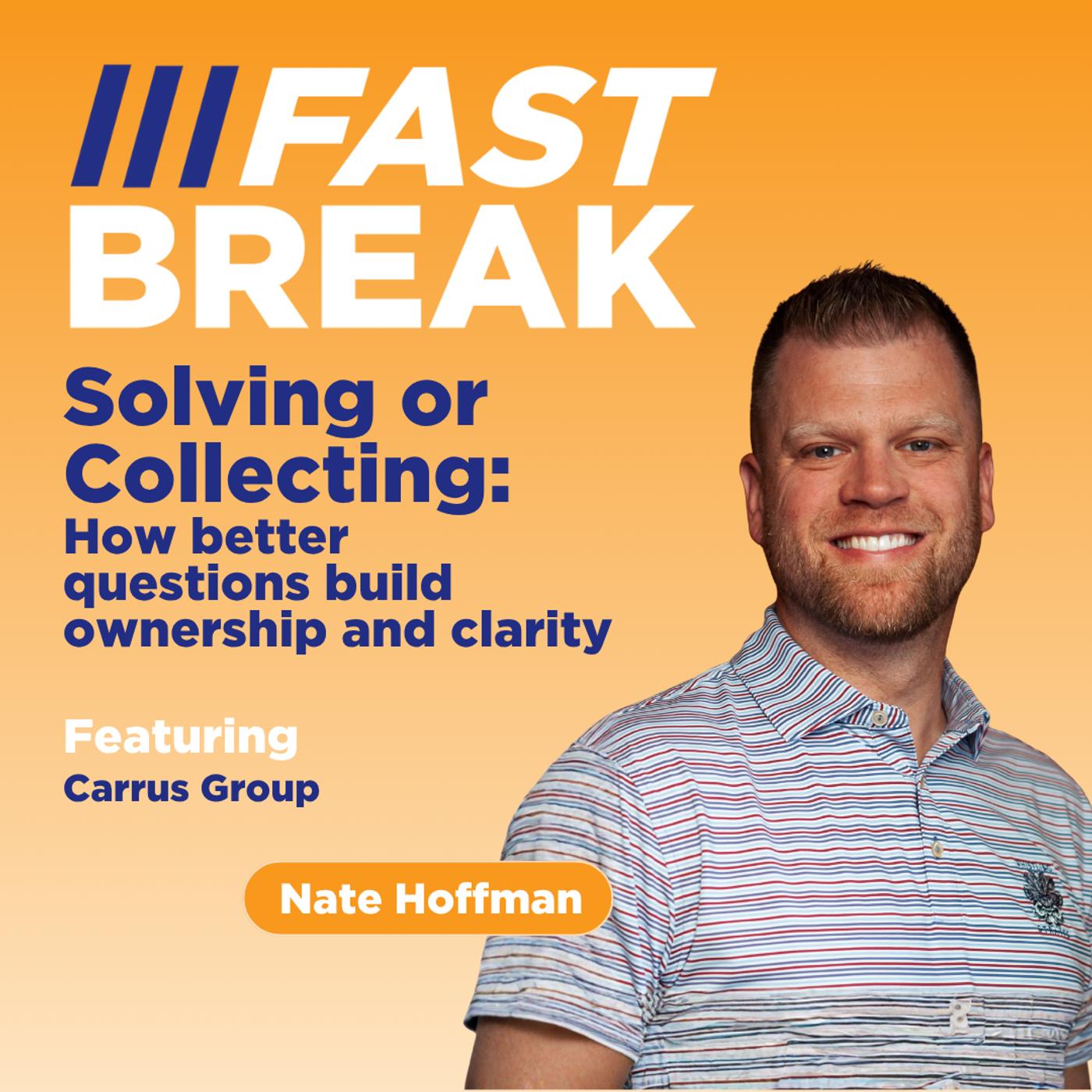
speaker-0: Welcome back to another episode of Fast Break, where leaders share the plays that drive clarity, alignment, and impact in today's rapidly changing business world. Today we're talking about something that sounds simple, but is incredibly rare, especially in leadership. Great questions. In a world obsessed with speed, certainty, and having the right answers, the leaders who consistently win are the ones who know how to slow down, get curious, and ask. better questions. And there's no one better to unpack that than today's guest. Nate Hoffman is the founder and president of Keras Group. Nate has worked in the manufacturing industry for the entirety of his 20-year career. He's passionate about bringing business principles to engineering solutions that improve manufacturing operations. He started his career working with Atlas Copco and has worked on thousands of applications with some of the largest manufacturing companies throughout the U.S. Nate, welcome to Fast Break. Okay, let's dive in. Let's let's start our time, Nate, together with you, giving us some perspective on your work at Keras Group and why you believe asking the right questions has become such a passion for you.
speaker-1: Thanks, Matt. Thanks for having me. ⁓ Yeah. ⁓ you know, the hard thing about ⁓ questions is knowing when to ask them and how to ask them. And often ⁓ in the fast paced world that we're a part of, it's so easy for leaders to default to getting the the answer quick. I'll I'll have a problem, I'll get a quick answer, we'll get right back on track and ⁓ everything's fine. And they don't pause for a moment just to look, is there something behind the problem that's causing it? Is there a route to this problem? Or am I just solving a symptom? Yeah. And we see this all the time, ⁓ where people just operate quick and on the first assumption. And often that's, you know, not the right, ⁓ the right one to drive to the ultimate conclusion that they want to get to. It's a very big part of what we do at Keras Group is is listening to our clients and then asking them a clarifying question to gain alignment and better understanding of what they're actually trying to solve.
speaker-0: Yeah. Do you was there a specific point in your ⁓ leadership journey where this sort of came like the like an aha moment where you realize like the power of questions?
speaker-1: To be honest, I I always joke with people, I'm not a very naturally smart person. I'm not. I was always that kid that just said, Hang on, I don't understand. Hang on, I don't understand. And when I did that, I realized, wait a minute, there's a lot of other people in this room that also don't understand. Yeah. I'm like, am I the only one that's bold enough to say, Hey, I'm I'm not that smart. I need to know this better. And I still do that to this day. We'll hear things like this came up in a round table. Somebody used the term ERP.
speaker-0: Yes.
speaker-1: But somebody's like, what does that even stand for? Yeah. And you'd be amazed how many executives were like, I don't know. I know what it is, but I don't even know what it stands for. We just commonly use these phrases and it's like understanding the meaning behind them. So not growing up a like I said, a naturally smart person and just having a curious mind. I always asked what I still call to this day kindergarten questions. Yeah. Like if you understand something that well, you should be able to explain it to a kindergartner where they even understand it. Yeah. But we talk so high and so smart too often. That it's really like it almost puts pressure on people. Like if you don't get it, then you're just not that smart. It's like, well, hang on a second. No. If you were understood this well enough, you could speak in a a language that everybody would understand.
speaker-0: I Nate, I love it. And I think the first sort of lesson today for our audience is curious beats smart every day and twice on Sunday, right? Yeah. And absolutely. And I think having the another word that I would use is having the courage to be the person that's curious. Because sometimes, you know, whether it became popular with, you know, one of my favorite shows, Ted Lasso or all those things where it was, hey, be curious, not judgmental, right? And and everyone's like, ⁓ yeah, curious is great again. That's only one half of it. You have to. Not just have that thing in your head that's curious. You have to be willing to say it out loud in a room where there's a risk of like, does everybody else know what this is? Am I the only one? And like you said, ⁓ every experience that I've had where I've been brave enough to put my hand up, somebody has either said right away or later, I'm so glad you asked that because I didn't know either. Right. And I think that's why we want to have this conversation today, because I think for leaders to, you know. Have them walk away from listening to our conversation with a a curious mind and a courageous mind, I think will be fantastic. And and part of why I think Nate, this is so important is it feels very countercultural, right? It feels like people, leaders are rewarded early in their careers for having the answers, for being decisive, ⁓ being seen as confident, being right. But as you shared, you've built a lot of your career around the idea that questions.
speaker-1: And the reality is is people think that, hey, I need to be fast with this ⁓ because everything depends on it. And the reality is is very few problems are that significant. We're not in an ER, you know, where the patient comes in and you have to triage and make a life or death situation, ⁓ decision at the spur of the moment. You know, business, although it moves fast, we have time and we need to understand that time is something that ⁓ isn't as scarce as we often think. Being a leader is a tricky position. ⁓ you know, you're the boss, you're the founder, you're at the top of the organization, which means a lot of things. One is like all your jokes are funny. Your clothes always look great, even if they don't. ⁓ and when you have an answer, people are gonna follow you. ⁓ and the the hard thing about that is it's kind of like that old adage of, Are you the smartest person in the room? And that's something I think leaders really struggle with is they surround themselves with people that maybe lean into their confirmation bias. Like I'm thinking we should do A. And you look around the room and there's a bunch of, you know, people nodding. Yes, A is the best thing. And it's not asking the question of not even discussing A. Yeah. Just guys, we're in this situation. What are some paths forward that we could we could ⁓ potentially go down to correct it? So I always say our number one job as a leader is to define reality for your team. So understand the reality of the situation. And as best you can not interject your ego into it to distort the view of like, well, okay, my boss is saying this. ⁓ what does he want me to say in return? It's like that's what we're trying to get rid of. It's like what he's trying to do is engage you, you know, into the curious situation of we're stuck here or we need to make a decision. I'm looking at 10 people in the room. Collectively, we can navigate our way out of this better. How do I pull that out of you? And really get them involved. And when you do that, now they're invested in it. So they really want the solution to come to fruition. And they're they're going to be a huge champion in working that forward instead of I want you to do this because you have to and I pay you.
speaker-0: Yeah. That's so that's such a good call out, Nate. And and you know, just to re-emphasize a couple of the points you made there. One, you know, how as leaders sort of defining that reality as it is, not as we w wish it was. ⁓ right. ⁓ being able to say the hard things, being able to you know, call that out for your team, I think is really ⁓ a testament to obviously the success that you've had personally with Keras Group and in your life, but also as people listening today, you know, that's something to think about. Because sometimes as leaders we can get caught up with being right. ⁓ there's a phrase that ⁓ a leader that I really respect and admire says where people will follow rather follow a leader who's real than one who's right. And I think that's something that that stuck out to me when you you offered that. And then as a leader, your responsibility necessarily isn't to have the right answer. It's to create the right environment that the right answer can come out. Right. That's a fundamental shift. In thinking for some people. And again, requires that curiosity. It requires courage to have that environment where as the leader, you're not wanting to hear like how awesome you are or how your idea is the right one, but actually to have people say, Nate, I I don't know if that's right. Can I ask another question? Can I can I get a clarifying question? Why do you think it's A? We
speaker-1: Recently had this. ⁓ so I was looking at our team and I'm like, we should do some continuous education. We should train our staff to make sure we're sharpest on, you know, operational efficiency, project management, whatever, all the different facets of what we do. And I could have just told them, hey guys, there's this book, there's this training course. I want you guys to sign up. I want you to read it. And they would do it. Instead, I asked our team, what can we do to stay? On top of our game and to continually learn. And we have one person in our organization who's a little bit more focused on, you know, in he just naturally gravitates towards team growth. Yeah. He goes, I kind of got a crazy idea. What if we started something as silly as a book club? And I was like, what do you mean by that? And he's like, Well, we have all these books here. What if we picked a book collectively read through it, and then every other week just come together for a half hour? What did we learn? And I'm like, that sounds great. Let's do it. Yeah. And I gave the authority back to him to go create it. So now he's ordering all of the books. He's making sure they're distributed. He's telling everybody. He's and and everybody's a part of it. It wasn't a top down, you have to do this. It was an organic, like, yeah, this would make us all better. And it came from within.
speaker-0: you know, for me that calls out is using questions to allocate ownership. So, you know, if if you have, you know, that employee in that situation who who brings, you know, who responds to that question or or that idea with a question, you not just running to, yeah, okay, we can do that. And here's what I'm gonna do and here's what versus if they're willing to ask it, ⁓ encouraging them with a you take it and run with it. Right. It it seems like there's a natural passion and in there for it. And those questions allow that ownership to not all just sit with you as a leader, but to empower your team to show you all the different skills and talents and potential that that they have.
speaker-1: Yeah, well, and as a leader, you get what you tolerate, right? And I hear so many times from people, man, I have to answer so many questions. Everybody comes to me with their problems. I'm like, well, then stop solving them. Yes. You're they're gonna keep coming to you because you're giving them the authority. You're tolerating them coming to you and saying, I have this, what should I do? I have this, what should I do? And you're not reframing it back to them, going, That's really interesting. What have you thought of so far? Yes. What are some options you've considered? Yes. Is there something within this that I'm not understanding? Yeah. To gain again clarity and alignment. Right. And you're training them that, hey, not only ⁓ are you smart enough to handle this yourself and you don't have to come with me, but you're equipping them to grow. Yeah. And to think different.
speaker-0: It's funny, Nate, that you bring that up. One of the things I've used this example a whole bunch this year in different circumstances and different leaders. And it's a super silly analogy, but it seems to strike people. And it was something that I learned early on in my leadership journey, which is when you have somebody on your team that walks into your office with a problem, imagine it almost like a monkey on their shoulder. And you know, what they want to do, sometimes unintentionally, is give you the monkey. ⁓ because then they don't have the monkey anymore. And right. And ⁓ and so what happens is, you know, when I was young in my leadership, I certainly made this mistake because somebody would come in and say, Hey, I got a problem with this thing or this person. And my immediate reaction was, let me solve that for you. I will fix it because I want to be the guy with the cape and the, you know, that sort of flies in and fixes everything. Right. And then they walk out and they feel really good.
speaker-1: You do It's your problem though. Right. Yep.
speaker-0: Because they don't have the problem anymore. I now have it. Right. And so what they don't see when the door closes, though, is now I've got like 20 monkeys in my office and I I I can't solve them all. I can't manage all of that. The way that you said it is beautiful, which is if somebody comes in with a monkey on their shoulder, it's, hey Nate, ⁓ thanks for trusting me with this. I really appreciate that. What if you already tried to do already to address this? Hey, what did so and so say when you talked to them about it? ⁓ you didn't do that? Right. Hey, let's go try that.
speaker-1: Thank you for inviting me into this. Let's solve it together. Sure. You know, walk alongside of them and get those training opportunities. And when you see the opportunity to immediately solve it, it's really anybody can do that. Yes. The hard part is pausing and going, how can I get them to understand this themselves? So you're guiding them to the solution by asking those questions. And when they discover it themselves, you get that ownership of like, ⁓ wait a minute. I I did this. And you're like, yes, that's what I'm giving you. Yes. I'm not giving the right answer. I'm teaching you how to get to the right answer.
speaker-0: Hey. In ⁓ what I've learned, Nate too, is that their answer might actually that they get to might actually be better than the one that I have.
speaker-1: Right. I know it's amazing how many times they think there's like this playbook. Yeah. Like I'll give it to him and he'll have the right answer because he'll look it up in his book. So there isn't a magic book, and we'd have this at home too with our kids. There's no one right way or wrong way to raise children. There's some guidelines, there's some things that have been proven over time, but sometimes it just comes down to I have to make the best out of a crappy situation. We have one kid going that way for soccer, we have one going for volleyball. How are we going to make this work? No, no. But the we're put a plan in place, we'll ask the right questions and we'll just do it. Like, but it's not as as black and white as some people think.
speaker-0: Yeah, absolutely. So, Nate, let's build on that with a with my next question. And you know, we've talked a little bit about that ⁓ that trigger response as leaders being a question. That's because great questions don't just gather information, they change the environment and they slow people down. As we talked about, they invite ownership and potentially creative solutioning. They surface things that wouldn't come out otherwise. From your experience at Keras group, what have you actually seen shift inside a team or an organization? When leaders make that decision to move from telling to asking.
speaker-1: Yeah, that's a great question. ⁓ a lot of it is ownership. We have these Karas Group bumper stickers, we call them. And one of my most common ones is ⁓ the statement that anybody who's looking for a half inch drill bit doesn't actually need the half inch drill bit. What they need is the half inch hole. And usually when I say this, I get one of two responses. I get yours, which is a head nod, or what we call a doggy head tilt where your head leans a little bit to one direction, or I get the audible, huh? Sure. Or people like, you're right. The drill bit's one way of getting it there, but what's important about the whole that I'm not understanding? Cause there's probably 372 different ways to get it there. So when we invite people into that thinking process and we gain that alignment, it's like you're okay. Now let's continue the conversation from a standpoint of curiosity. Yeah. And it really breaks down titles. Now it doesn't matter because we're we're hypothesizing around what is the importance of our overall objective, right? And it invites more people in. And ultimately the process that you go through yields a better result. And and that those are the things that we're trying to do a lot more with our clients, is we'll hear an objection and like we need this. And it's like, okay, and I get it, the five whys, whatever. But there's a lot of truth to that. Or it's like, all right, I'm coming from a point of naivety. I don't understand and live in your environment as much as you do. Right. Can you tell me more about why you you think you need In this example, that hole. Right. Does it even have to be there? Right. If we can engineer it out, great. One less thing. Right. Right. But if we can understand clearly what its function is and how it fits to the overall form, then we can take a reverse approach to be like, all right, now how should we get it there? And more people are involved in that process.
speaker-0: Yeah. What stops leaders from doing this more consistently? W why is this not something that, you know, you we see in common practice more when we know that the return, the rewards for doing it are so high? Yeah.
speaker-1: ⁓ I mean it's ⁓ it it's a big part of time. And we're not trained. We're not trained that way. Too often though, you know, the answer is just the easy part. We hear this all the time. You know what? It's just easier if I do it. Right. I think a big part of it too could be ego. I want the I want to be the solution. I'm smart enough. I'll tell people what they need to do. And that is effective. It's highly effective. The question is, is is it efficient? Yeah. Because you can't, like you said to your earlier point, you can't wear the cape every single time. You're just one person limited by 24 hours if within a day. You have to create more of you, and that's the best way to do it. so it does take time, it does take training for sure. Right. But I found just having canned questions really helps. Like what are some key questions I can lean back on? And they're different for everybody. Yeah. Can I ask a clarifying question? Is another Keras group upper sticker. And what we're trying to do there is gain alignment. Like what are we all? What's the reality of where we're sitting? You know, and and that's a very non-threatening way to almost tell somebody, hey, I'm disagreeing with you. Yeah. But I'm not going to say I disagree with you because I don't want to deal with your horns. So what I'm going to do is say, I have I have a clarifying question. Yeah. Explain to me this from like a kindergarten standpoint. Right. Because I don't want to make any assumptions. Cause that's a bad position to make decisions from. So explain it to me in a way that Even a not smart guy like me can understand. It really invites people into a conversation more than here's your one line answer. Yeah.
speaker-0: Yeah. And it's it's something powerful there, Nate. You sort of talked about assumptions. Yeah. And and I think that's such a big part of it. And oftentimes we don't even know that we're making those assumptions. ⁓ but when we actually check ourselves, it's like, well, no, I'm assuming that there is a a need for the half-inch hole and that there isn't another solution. I'm assuming that even just in that sort of basic example. And so as leaders, you know, when people listen in today. Maybe think about what are the assumptions that you make.
speaker-1: You really have to be careful not to interject your ego. So in that drill bit example, I really think the drill bit is the right answer. But I'm gonna buy into what Matt and Nate are saying and I'm gonna ask the question. Somebody comes up, why don't we cut it on a fiber laser? And you're like, I don't like that. I like my idea better. Like you can't have ownership like that. No, you really have to be humble, hold on to things loosely, and go, what are we again aligning to? The best solution. Okay, great. Yeah. Ask as many questions as you want about something because we're both trying to get to the same goal. That's right. I want the best way to get that hole into that part. And I want all of us to think about it. I have some assumptions. I think personally it's a drill bit. It might not be. If I have a disagreement, great opportunity to ask more of those clarifying questions. And how can you educate me so that I can see it through your lens? And then once we get there, we got our alignment. Yeah. And then ultimately we're going to get to a better end product because of it.
speaker-0: Yes. Yeah. I love that. It reminds me of the ⁓ the analogy of you when people are offering their perspectives, it's kind of like if we set, you know, an elephant in the room and then we put people at five different vantage points, like somebody's like close enough to touch it, somebody's, you know, ⁓ five steps away, somebody's half a mile away. Everybody see if you need said, Hey, describe what you see, they wouldn't all say elephant. Like the person who's so close would be like, I I'm seeing kind of like grayscales, I'm seeing Someone who's further away is like, ⁓ I see the L. And sometimes we don't stop to consider and reflect on where are they coming from with that perspective.
speaker-1: Right. And the the the big key to this too is it has to be one hundred percent genuine. ⁓ people can smell out a fake sales pitch. I get it. He's just asking these because he read a book and he doesn't really care, those types of things. But when you're genuinely curious about the person's opinion that you're asking, yes, if you don't care, it's not gonna work.
speaker-0: Right. And and maybe that's a great place, Nate, to lead into maybe my last question for you. One of the things on Fast Break we try and r you know do is make this as practical as possible, wherever people are right now. If somebody wants to start building this muscle, because I think that's a great sort of analogy, right? It's kind of like, hey, unless you actually use it, it doesn't get bigger, it doesn't get better, it doesn't get stronger. Where would you encourage somebody who's like, I get it, this is this is not a strength for me right now as a leader. Where would you encourage them to start? What's one small shift they could make today, this week, that would immediately change the way that they they lead their teams?
speaker-1: Yeah, I think that's a great point because all this is wonderful, but it's like, how do I put it into action? I think being aware of the opportunity. So your example of the monkey, great example. Somebody comes to you, picture that monkey, and be like, ⁓ crap, I'm in this situation. I might not know how to respond, but if I'm aware of the situation, it's helping educate me. So the next time this happens, I'll be better prepared. So you have to be aware and you have to start the canned questions that I talked about, seek clarity. ⁓ be curious, like seek understanding instead of you know wanting to jump to the conclusion because it's easier if I do this. I need to be the smartest, I need to be the most eloquent. No, no, you don't. You need to be curious and you need to really allow your brain to go, there are no limitations. Think like a second grader for a minute. But if you took that into your work, into your business, into your clients, just a small part of that to be like, I do want to understand this more. And this person probably knows a lot more than me, which makes me naturally curious. I would like to have a conversation with you about that.
speaker-0: I I I love that. ⁓ Nate. I think that's a there's been so much of our conversation today that's been so practical and and so powerful. A phrase that I love is you know, the caliber of your questions determines the caliber of your life. ⁓ and I I think, you know, that's that's something that ⁓ as you have helped us today think about this topic that ⁓ you know, when we were planning for this conversation, I was so excited because it's it's one of those pieces that I just it's so needed. ⁓ and I think if we all committed to getting 1% better at this, if we all committed to leading, you know, with questions, ⁓ not answers or responses, think what that would do to our to our businesses, to our clients, our families, ourselves, right? And and I think what you've called us out to today are are thinking about things like authenticity. How do you make it seem like there's a genuineness to that not Hey, I'm doing this because I went to a leadership class or listened to a podcast and they tell me to ask questions. Don't do it. ⁓ because people will sniff that out, right? They will. Questioning your assumptions, even the ones that maybe you don't even know that you have in those specific situations and just taking a breath, putting more space between that, that response and that reaction. We talked about courage. ⁓ we talked about, you know, being willing to be brave enough to put your hand up and say, I don't understand, or I'd like to have that. In a different way. I talked about curiosity ⁓ and having the ability to just think differently and not allow things to pass by ⁓ in last and maybe most powerfully. You know, we talked about ownership, having that using questions to as a leadership initiative to be able to help people grow and realize their own potential. And so, Nate, thank you so much. This conversation has been so powerful. And if For our audience, before we wrap today, if they have interest in learning more about you and what you do at Keris Group and engaging with you that way, give our audience the the the commercial on Keris Group and where they can find out more about you.
speaker-1: Yeah, absolutely, Matt. ⁓ well, first of all, is our website, ⁓ Keris Dash Group.com. The other one is ⁓ we we try to post a lot of content on LinkedIn. ⁓ and it's not bragging about Keris Group, but it's more showcasing the the client work that we're doing. ⁓ really cool stuff there. So we try to be pretty regular. So look Nate Hoffman ⁓ on LinkedIn or ⁓ Keris Group and and ⁓ reach out. Love it.
speaker-0: To everyone listening today, pay attention to the questions you're asking today, this week, take an inventory. They might be shaping your results more than you realize. So until next time, this is Matt and Nate, and this has been fast.
speaker-1: Thanks, Matt. Thanks for having me. ⁓ Yeah. ⁓ you know, the hard thing about ⁓ questions is knowing when to ask them and how to ask them. And often ⁓ in the fast paced world that we're a part of, it's so easy for leaders to default to getting the the answer quick. I'll I'll have a problem, I'll get a quick answer, we'll get right back on track and ⁓ everything's fine. And they don't pause for a moment just to look, is there something behind the problem that's causing it? Is there a route to this problem? Or am I just solving a symptom? Yeah. And we see this all the time, ⁓ where people just operate quick and on the first assumption. And often that's, you know, not the right, ⁓ the right one to drive to the ultimate conclusion that they want to get to. It's a very big part of what we do at Keras Group is is listening to our clients and then asking them a clarifying question to gain alignment and better understanding of what they're actually trying to solve.
speaker-0: Yeah. Do you was there a specific point in your ⁓ leadership journey where this sort of came like the like an aha moment where you realize like the power of questions?
speaker-1: To be honest, I I always joke with people, I'm not a very naturally smart person. I'm not. I was always that kid that just said, Hang on, I don't understand. Hang on, I don't understand. And when I did that, I realized, wait a minute, there's a lot of other people in this room that also don't understand. Yeah. I'm like, am I the only one that's bold enough to say, Hey, I'm I'm not that smart. I need to know this better. And I still do that to this day. We'll hear things like this came up in a round table. Somebody used the term ERP.
speaker-0: Yes.
speaker-1: But somebody's like, what does that even stand for? Yeah. And you'd be amazed how many executives were like, I don't know. I know what it is, but I don't even know what it stands for. We just commonly use these phrases and it's like understanding the meaning behind them. So not growing up a like I said, a naturally smart person and just having a curious mind. I always asked what I still call to this day kindergarten questions. Yeah. Like if you understand something that well, you should be able to explain it to a kindergartner where they even understand it. Yeah. But we talk so high and so smart too often. That it's really like it almost puts pressure on people. Like if you don't get it, then you're just not that smart. It's like, well, hang on a second. No. If you were understood this well enough, you could speak in a a language that everybody would understand.
speaker-0: I Nate, I love it. And I think the first sort of lesson today for our audience is curious beats smart every day and twice on Sunday, right? Yeah. And absolutely. And I think having the another word that I would use is having the courage to be the person that's curious. Because sometimes, you know, whether it became popular with, you know, one of my favorite shows, Ted Lasso or all those things where it was, hey, be curious, not judgmental, right? And and everyone's like, ⁓ yeah, curious is great again. That's only one half of it. You have to. Not just have that thing in your head that's curious. You have to be willing to say it out loud in a room where there's a risk of like, does everybody else know what this is? Am I the only one? And like you said, ⁓ every experience that I've had where I've been brave enough to put my hand up, somebody has either said right away or later, I'm so glad you asked that because I didn't know either. Right. And I think that's why we want to have this conversation today, because I think for leaders to, you know. Have them walk away from listening to our conversation with a a curious mind and a courageous mind, I think will be fantastic. And and part of why I think Nate, this is so important is it feels very countercultural, right? It feels like people, leaders are rewarded early in their careers for having the answers, for being decisive, ⁓ being seen as confident, being right. But as you shared, you've built a lot of your career around the idea that questions.
speaker-1: And the reality is is people think that, hey, I need to be fast with this ⁓ because everything depends on it. And the reality is is very few problems are that significant. We're not in an ER, you know, where the patient comes in and you have to triage and make a life or death situation, ⁓ decision at the spur of the moment. You know, business, although it moves fast, we have time and we need to understand that time is something that ⁓ isn't as scarce as we often think. Being a leader is a tricky position. ⁓ you know, you're the boss, you're the founder, you're at the top of the organization, which means a lot of things. One is like all your jokes are funny. Your clothes always look great, even if they don't. ⁓ and when you have an answer, people are gonna follow you. ⁓ and the the hard thing about that is it's kind of like that old adage of, Are you the smartest person in the room? And that's something I think leaders really struggle with is they surround themselves with people that maybe lean into their confirmation bias. Like I'm thinking we should do A. And you look around the room and there's a bunch of, you know, people nodding. Yes, A is the best thing. And it's not asking the question of not even discussing A. Yeah. Just guys, we're in this situation. What are some paths forward that we could we could ⁓ potentially go down to correct it? So I always say our number one job as a leader is to define reality for your team. So understand the reality of the situation. And as best you can not interject your ego into it to distort the view of like, well, okay, my boss is saying this. ⁓ what does he want me to say in return? It's like that's what we're trying to get rid of. It's like what he's trying to do is engage you, you know, into the curious situation of we're stuck here or we need to make a decision. I'm looking at 10 people in the room. Collectively, we can navigate our way out of this better. How do I pull that out of you? And really get them involved. And when you do that, now they're invested in it. So they really want the solution to come to fruition. And they're they're going to be a huge champion in working that forward instead of I want you to do this because you have to and I pay you.
speaker-0: Yeah. That's so that's such a good call out, Nate. And and you know, just to re-emphasize a couple of the points you made there. One, you know, how as leaders sort of defining that reality as it is, not as we w wish it was. ⁓ right. ⁓ being able to say the hard things, being able to you know, call that out for your team, I think is really ⁓ a testament to obviously the success that you've had personally with Keras Group and in your life, but also as people listening today, you know, that's something to think about. Because sometimes as leaders we can get caught up with being right. ⁓ there's a phrase that ⁓ a leader that I really respect and admire says where people will follow rather follow a leader who's real than one who's right. And I think that's something that that stuck out to me when you you offered that. And then as a leader, your responsibility necessarily isn't to have the right answer. It's to create the right environment that the right answer can come out. Right. That's a fundamental shift. In thinking for some people. And again, requires that curiosity. It requires courage to have that environment where as the leader, you're not wanting to hear like how awesome you are or how your idea is the right one, but actually to have people say, Nate, I I don't know if that's right. Can I ask another question? Can I can I get a clarifying question? Why do you think it's A? We
speaker-1: Recently had this. ⁓ so I was looking at our team and I'm like, we should do some continuous education. We should train our staff to make sure we're sharpest on, you know, operational efficiency, project management, whatever, all the different facets of what we do. And I could have just told them, hey guys, there's this book, there's this training course. I want you guys to sign up. I want you to read it. And they would do it. Instead, I asked our team, what can we do to stay? On top of our game and to continually learn. And we have one person in our organization who's a little bit more focused on, you know, in he just naturally gravitates towards team growth. Yeah. He goes, I kind of got a crazy idea. What if we started something as silly as a book club? And I was like, what do you mean by that? And he's like, Well, we have all these books here. What if we picked a book collectively read through it, and then every other week just come together for a half hour? What did we learn? And I'm like, that sounds great. Let's do it. Yeah. And I gave the authority back to him to go create it. So now he's ordering all of the books. He's making sure they're distributed. He's telling everybody. He's and and everybody's a part of it. It wasn't a top down, you have to do this. It was an organic, like, yeah, this would make us all better. And it came from within.
speaker-0: you know, for me that calls out is using questions to allocate ownership. So, you know, if if you have, you know, that employee in that situation who who brings, you know, who responds to that question or or that idea with a question, you not just running to, yeah, okay, we can do that. And here's what I'm gonna do and here's what versus if they're willing to ask it, ⁓ encouraging them with a you take it and run with it. Right. It it seems like there's a natural passion and in there for it. And those questions allow that ownership to not all just sit with you as a leader, but to empower your team to show you all the different skills and talents and potential that that they have.
speaker-1: Yeah, well, and as a leader, you get what you tolerate, right? And I hear so many times from people, man, I have to answer so many questions. Everybody comes to me with their problems. I'm like, well, then stop solving them. Yes. You're they're gonna keep coming to you because you're giving them the authority. You're tolerating them coming to you and saying, I have this, what should I do? I have this, what should I do? And you're not reframing it back to them, going, That's really interesting. What have you thought of so far? Yes. What are some options you've considered? Yes. Is there something within this that I'm not understanding? Yeah. To gain again clarity and alignment. Right. And you're training them that, hey, not only ⁓ are you smart enough to handle this yourself and you don't have to come with me, but you're equipping them to grow. Yeah. And to think different.
speaker-0: It's funny, Nate, that you bring that up. One of the things I've used this example a whole bunch this year in different circumstances and different leaders. And it's a super silly analogy, but it seems to strike people. And it was something that I learned early on in my leadership journey, which is when you have somebody on your team that walks into your office with a problem, imagine it almost like a monkey on their shoulder. And you know, what they want to do, sometimes unintentionally, is give you the monkey. ⁓ because then they don't have the monkey anymore. And right. And ⁓ and so what happens is, you know, when I was young in my leadership, I certainly made this mistake because somebody would come in and say, Hey, I got a problem with this thing or this person. And my immediate reaction was, let me solve that for you. I will fix it because I want to be the guy with the cape and the, you know, that sort of flies in and fixes everything. Right. And then they walk out and they feel really good.
speaker-1: You do It's your problem though. Right. Yep.
speaker-0: Because they don't have the problem anymore. I now have it. Right. And so what they don't see when the door closes, though, is now I've got like 20 monkeys in my office and I I I can't solve them all. I can't manage all of that. The way that you said it is beautiful, which is if somebody comes in with a monkey on their shoulder, it's, hey Nate, ⁓ thanks for trusting me with this. I really appreciate that. What if you already tried to do already to address this? Hey, what did so and so say when you talked to them about it? ⁓ you didn't do that? Right. Hey, let's go try that.
speaker-1: Thank you for inviting me into this. Let's solve it together. Sure. You know, walk alongside of them and get those training opportunities. And when you see the opportunity to immediately solve it, it's really anybody can do that. Yes. The hard part is pausing and going, how can I get them to understand this themselves? So you're guiding them to the solution by asking those questions. And when they discover it themselves, you get that ownership of like, ⁓ wait a minute. I I did this. And you're like, yes, that's what I'm giving you. Yes. I'm not giving the right answer. I'm teaching you how to get to the right answer.
speaker-0: Hey. In ⁓ what I've learned, Nate too, is that their answer might actually that they get to might actually be better than the one that I have.
speaker-1: Right. I know it's amazing how many times they think there's like this playbook. Yeah. Like I'll give it to him and he'll have the right answer because he'll look it up in his book. So there isn't a magic book, and we'd have this at home too with our kids. There's no one right way or wrong way to raise children. There's some guidelines, there's some things that have been proven over time, but sometimes it just comes down to I have to make the best out of a crappy situation. We have one kid going that way for soccer, we have one going for volleyball. How are we going to make this work? No, no. But the we're put a plan in place, we'll ask the right questions and we'll just do it. Like, but it's not as as black and white as some people think.
speaker-0: Yeah, absolutely. So, Nate, let's build on that with a with my next question. And you know, we've talked a little bit about that ⁓ that trigger response as leaders being a question. That's because great questions don't just gather information, they change the environment and they slow people down. As we talked about, they invite ownership and potentially creative solutioning. They surface things that wouldn't come out otherwise. From your experience at Keras group, what have you actually seen shift inside a team or an organization? When leaders make that decision to move from telling to asking.
speaker-1: Yeah, that's a great question. ⁓ a lot of it is ownership. We have these Karas Group bumper stickers, we call them. And one of my most common ones is ⁓ the statement that anybody who's looking for a half inch drill bit doesn't actually need the half inch drill bit. What they need is the half inch hole. And usually when I say this, I get one of two responses. I get yours, which is a head nod, or what we call a doggy head tilt where your head leans a little bit to one direction, or I get the audible, huh? Sure. Or people like, you're right. The drill bit's one way of getting it there, but what's important about the whole that I'm not understanding? Cause there's probably 372 different ways to get it there. So when we invite people into that thinking process and we gain that alignment, it's like you're okay. Now let's continue the conversation from a standpoint of curiosity. Yeah. And it really breaks down titles. Now it doesn't matter because we're we're hypothesizing around what is the importance of our overall objective, right? And it invites more people in. And ultimately the process that you go through yields a better result. And and that those are the things that we're trying to do a lot more with our clients, is we'll hear an objection and like we need this. And it's like, okay, and I get it, the five whys, whatever. But there's a lot of truth to that. Or it's like, all right, I'm coming from a point of naivety. I don't understand and live in your environment as much as you do. Right. Can you tell me more about why you you think you need In this example, that hole. Right. Does it even have to be there? Right. If we can engineer it out, great. One less thing. Right. Right. But if we can understand clearly what its function is and how it fits to the overall form, then we can take a reverse approach to be like, all right, now how should we get it there? And more people are involved in that process.
speaker-0: Yeah. What stops leaders from doing this more consistently? W why is this not something that, you know, you we see in common practice more when we know that the return, the rewards for doing it are so high? Yeah.
speaker-1: ⁓ I mean it's ⁓ it it's a big part of time. And we're not trained. We're not trained that way. Too often though, you know, the answer is just the easy part. We hear this all the time. You know what? It's just easier if I do it. Right. I think a big part of it too could be ego. I want the I want to be the solution. I'm smart enough. I'll tell people what they need to do. And that is effective. It's highly effective. The question is, is is it efficient? Yeah. Because you can't, like you said to your earlier point, you can't wear the cape every single time. You're just one person limited by 24 hours if within a day. You have to create more of you, and that's the best way to do it. so it does take time, it does take training for sure. Right. But I found just having canned questions really helps. Like what are some key questions I can lean back on? And they're different for everybody. Yeah. Can I ask a clarifying question? Is another Keras group upper sticker. And what we're trying to do there is gain alignment. Like what are we all? What's the reality of where we're sitting? You know, and and that's a very non-threatening way to almost tell somebody, hey, I'm disagreeing with you. Yeah. But I'm not going to say I disagree with you because I don't want to deal with your horns. So what I'm going to do is say, I have I have a clarifying question. Yeah. Explain to me this from like a kindergarten standpoint. Right. Because I don't want to make any assumptions. Cause that's a bad position to make decisions from. So explain it to me in a way that Even a not smart guy like me can understand. It really invites people into a conversation more than here's your one line answer. Yeah.
speaker-0: Yeah. And it's it's something powerful there, Nate. You sort of talked about assumptions. Yeah. And and I think that's such a big part of it. And oftentimes we don't even know that we're making those assumptions. ⁓ but when we actually check ourselves, it's like, well, no, I'm assuming that there is a a need for the half-inch hole and that there isn't another solution. I'm assuming that even just in that sort of basic example. And so as leaders, you know, when people listen in today. Maybe think about what are the assumptions that you make.
speaker-1: You really have to be careful not to interject your ego. So in that drill bit example, I really think the drill bit is the right answer. But I'm gonna buy into what Matt and Nate are saying and I'm gonna ask the question. Somebody comes up, why don't we cut it on a fiber laser? And you're like, I don't like that. I like my idea better. Like you can't have ownership like that. No, you really have to be humble, hold on to things loosely, and go, what are we again aligning to? The best solution. Okay, great. Yeah. Ask as many questions as you want about something because we're both trying to get to the same goal. That's right. I want the best way to get that hole into that part. And I want all of us to think about it. I have some assumptions. I think personally it's a drill bit. It might not be. If I have a disagreement, great opportunity to ask more of those clarifying questions. And how can you educate me so that I can see it through your lens? And then once we get there, we got our alignment. Yeah. And then ultimately we're going to get to a better end product because of it.
speaker-0: Yes. Yeah. I love that. It reminds me of the ⁓ the analogy of you when people are offering their perspectives, it's kind of like if we set, you know, an elephant in the room and then we put people at five different vantage points, like somebody's like close enough to touch it, somebody's, you know, ⁓ five steps away, somebody's half a mile away. Everybody see if you need said, Hey, describe what you see, they wouldn't all say elephant. Like the person who's so close would be like, I I'm seeing kind of like grayscales, I'm seeing Someone who's further away is like, ⁓ I see the L. And sometimes we don't stop to consider and reflect on where are they coming from with that perspective.
speaker-1: Right. And the the the big key to this too is it has to be one hundred percent genuine. ⁓ people can smell out a fake sales pitch. I get it. He's just asking these because he read a book and he doesn't really care, those types of things. But when you're genuinely curious about the person's opinion that you're asking, yes, if you don't care, it's not gonna work.
speaker-0: Right. And and maybe that's a great place, Nate, to lead into maybe my last question for you. One of the things on Fast Break we try and r you know do is make this as practical as possible, wherever people are right now. If somebody wants to start building this muscle, because I think that's a great sort of analogy, right? It's kind of like, hey, unless you actually use it, it doesn't get bigger, it doesn't get better, it doesn't get stronger. Where would you encourage somebody who's like, I get it, this is this is not a strength for me right now as a leader. Where would you encourage them to start? What's one small shift they could make today, this week, that would immediately change the way that they they lead their teams?
speaker-1: Yeah, I think that's a great point because all this is wonderful, but it's like, how do I put it into action? I think being aware of the opportunity. So your example of the monkey, great example. Somebody comes to you, picture that monkey, and be like, ⁓ crap, I'm in this situation. I might not know how to respond, but if I'm aware of the situation, it's helping educate me. So the next time this happens, I'll be better prepared. So you have to be aware and you have to start the canned questions that I talked about, seek clarity. ⁓ be curious, like seek understanding instead of you know wanting to jump to the conclusion because it's easier if I do this. I need to be the smartest, I need to be the most eloquent. No, no, you don't. You need to be curious and you need to really allow your brain to go, there are no limitations. Think like a second grader for a minute. But if you took that into your work, into your business, into your clients, just a small part of that to be like, I do want to understand this more. And this person probably knows a lot more than me, which makes me naturally curious. I would like to have a conversation with you about that.
speaker-0: I I I love that. ⁓ Nate. I think that's a there's been so much of our conversation today that's been so practical and and so powerful. A phrase that I love is you know, the caliber of your questions determines the caliber of your life. ⁓ and I I think, you know, that's that's something that ⁓ as you have helped us today think about this topic that ⁓ you know, when we were planning for this conversation, I was so excited because it's it's one of those pieces that I just it's so needed. ⁓ and I think if we all committed to getting 1% better at this, if we all committed to leading, you know, with questions, ⁓ not answers or responses, think what that would do to our to our businesses, to our clients, our families, ourselves, right? And and I think what you've called us out to today are are thinking about things like authenticity. How do you make it seem like there's a genuineness to that not Hey, I'm doing this because I went to a leadership class or listened to a podcast and they tell me to ask questions. Don't do it. ⁓ because people will sniff that out, right? They will. Questioning your assumptions, even the ones that maybe you don't even know that you have in those specific situations and just taking a breath, putting more space between that, that response and that reaction. We talked about courage. ⁓ we talked about, you know, being willing to be brave enough to put your hand up and say, I don't understand, or I'd like to have that. In a different way. I talked about curiosity ⁓ and having the ability to just think differently and not allow things to pass by ⁓ in last and maybe most powerfully. You know, we talked about ownership, having that using questions to as a leadership initiative to be able to help people grow and realize their own potential. And so, Nate, thank you so much. This conversation has been so powerful. And if For our audience, before we wrap today, if they have interest in learning more about you and what you do at Keris Group and engaging with you that way, give our audience the the the commercial on Keris Group and where they can find out more about you.
speaker-1: Yeah, absolutely, Matt. ⁓ well, first of all, is our website, ⁓ Keris Dash Group.com. The other one is ⁓ we we try to post a lot of content on LinkedIn. ⁓ and it's not bragging about Keris Group, but it's more showcasing the the client work that we're doing. ⁓ really cool stuff there. So we try to be pretty regular. So look Nate Hoffman ⁓ on LinkedIn or ⁓ Keris Group and and ⁓ reach out. Love it.
speaker-0: To everyone listening today, pay attention to the questions you're asking today, this week, take an inventory. They might be shaping your results more than you realize. So until next time, this is Matt and Nate, and this has been fast.
