
درباره این اپیزود
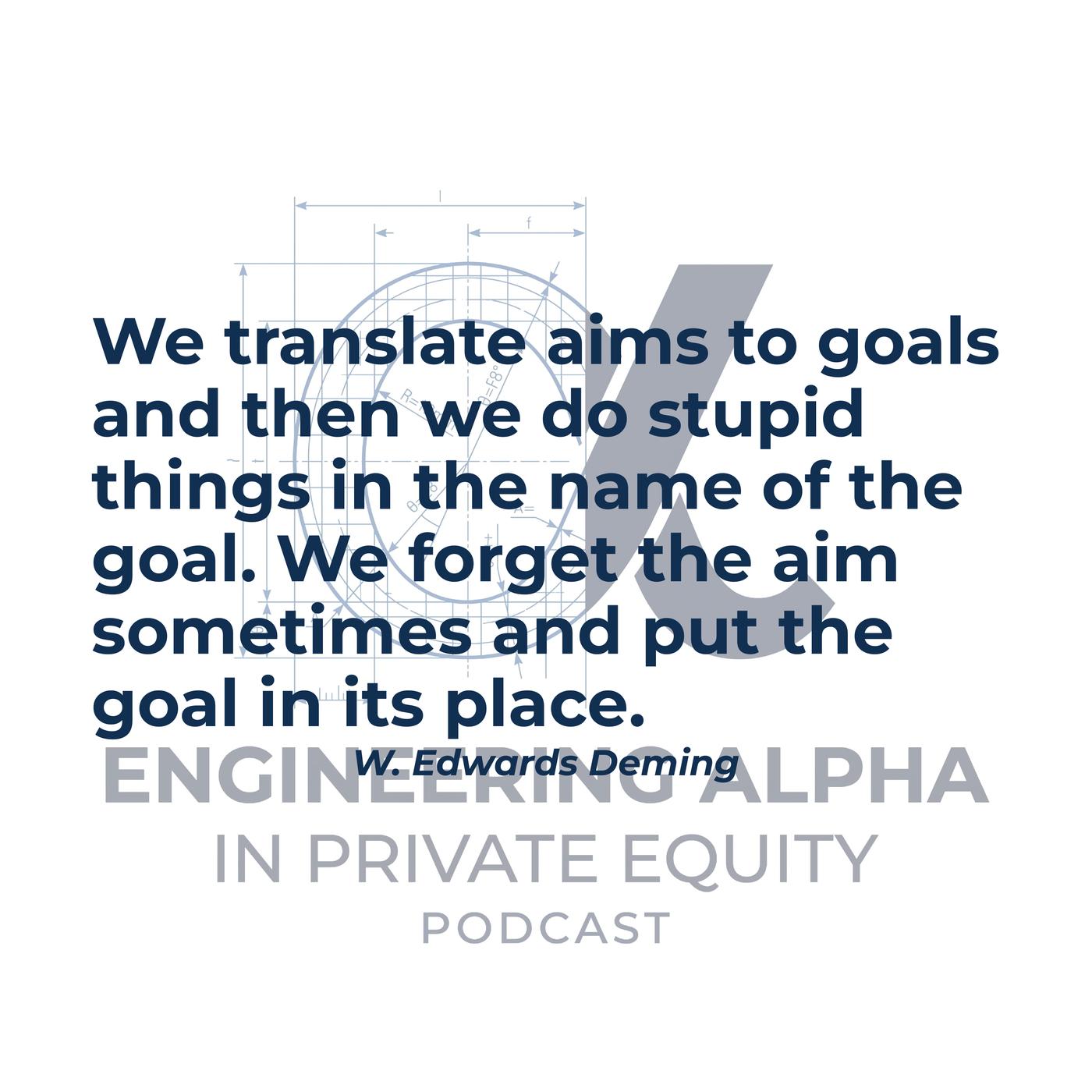
When PE backed companies attempt to drive AI R&D performance, they often set local targets—like story point velocity or code commit volume that inadvertently trigger perverse incentives and operational chaos. In Episode 18 we examine organizational incentives in the age of AI through an economic lens. Quoting W. Edwards Deming’s famous warning: "I achieved my goal, but not my aim", we break down the crucial difference between rigid tactical goals and overarching strategic aims.
Paul and Dave explore how elite software companies use AI not just to write bulk code, but to dramatically accelerate product discovery experiments in partnership with product management. Drawing on frameworks from Marty Cagan (Silicon Valley Product Group), Teresa Torres, Ant Murphy, and Marc Benioff’s Salesforce V2MOM model, this episode provides listeners with a blueprint for aligning engineering output directly with hold-period EBITDA expansion.
Key Takeaways:
Deming’s Warning on Aims vs. Goals: "We translate aims to goals and then we do stupid things in the name of the goal." When management incentivizes arbitrary outputs (e.g., commit counts or strict deadlines), teams optimize for the metric rather than the business aim, resulting in costly fire drills, unmonetized code inventory, and burned-out staff.
AI as an Experimentation Engine: The highest ROI on AI code generation comes from enabling rapid product discovery experiments. Instead of wasting months of developer capacity on unvalidated features, AI allows teams to test market hypotheses in days—provided continuous delivery (CD) pipelines are in place.
Learning vs. Shipping (Ant Murphy’s Dilemma): If an engineering organization cannot ship software continuously, market learning stalls. Unblocking delivery bottlenecks shifts the competitive constraint from engineering capacity to market learning velocity.
Cascading Alignment via Salesforce V2MOM: How Marc Benioff’s V2MOM framework ensures that every individual contributor—from senior architects to junior devs—understands how their daily work directly supports the CEO's top-line vision and the board's financial targets.
Dynamic Incentives Across the Hold Period: Value creation aims evolve over the investment lifecycle—from foundational platform cleanup early in the hold period to margin optimization pre-exit. Management must dynamically adjust system incentives rather than enforcing static KPIs.
Referenced Resources:
- Ant Murphy’s Essay about Would you rather be able to learn faster than you can ship, or ship faster than you can learn? (https://www.antmurphy.me/newsletter/fix-delivery-first)
- Marty Cagan / Silicon Valley Product Group (SVPG)
- Teresa Torres: Continuous Discovery Habits (https://a.co/d/033dZekt)