

درباره این اپیزود
I Thought We Had More Time....
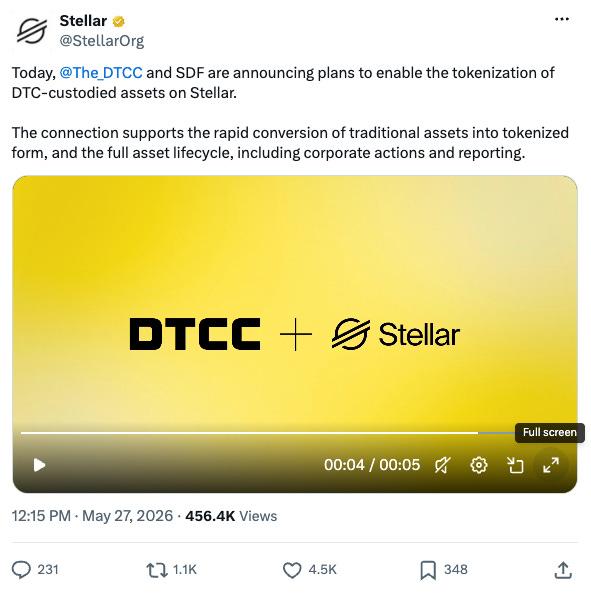
It feels like not too long ago, when I published my article and 5th episode of the Digital Dopamine podcast, “Tokenizing Private Credit, Real Estate, National Debt, and Everything Else“, where I warned about institutional efforts t start tokenizing assets and little did I know, some major players were relatively low key but making move swiftly. The biggest players are The DTCC and Stellar Foundation, who inked a deal to enable the tokenization of DTC-custodied assets on Stellar’s blockchain.
This news in itself is actually pretty cool, in my opinion. My bias stems from knowing Stellar’s past and how far they’ve come since the inception and initial release in 2014. They set out to be one of the few blockchains that wanted to bridge the gap between traditional finance and exchange by making products that allowed people who had family in underdeveloped nations to supply their family members funds almost instantly with little to no fees as well as no major worry about exchange rate. This of course sounds amazing and you’d think everyone would be on board with this adaptation but, as you can probably tell, the Society for Worldwide Interbank Financial Telecom (SWIFT), would not be a fan of losing it’s grip on international exchanges. SWIFT is a Belgium based cooperative that is essentially owned by the banks and other member firms that use its service. Which further supports evidence that the banking system fights so hard to stonewall blockchain based companies in order to make their own similar product to then move their customers on before they lose them to new and leaner companies working natively in blockchain.
Now some might say that this isn’t really a “bank vs blockchain” situation and more so a question of if SWIFT can do what Stellar and XRP does, but in house. That’s the thing though, if SWIFT wanted to do it in house, why wouldn’t they try to stall regulations? You can’t convince me otherwise that the massive opposition and lobbying around regulatory frameworks for crypto isn’t influenced by big banks trying to keep money flowing through their pipelines.
Link to article -> https://www.ccn.com/education/crypto/xrp-xlm-face-challenge-50-banks-back-swift-new-payments-framework/
I digress, though; The point of this article is to address the rapid adoption of tokenization. The deal the DTCC did with Stellar isn’t the first and probably won’t be the last deal it has done with Layer 1 and Layer 2 blockchains.
Before Stellar, DTCC partnered with Digital Asset on the Canton Network to tokenize DTC-custodied U.S. Treasury securities, with DTCC serving as co-chair of the Canton Foundation alongside Euroclear. That MVP targeted the first half of 2026, and in July 2025 a broad industry group already completed live 24/7 trades with onchain intraday and after-hours financing using tokenized Treasuries on Canton.
Separately, DTCC named Chainlink as the data and orchestration layer for its forthcoming tokenized collateral platform — another distinct partnership worth a mentioning.
DTCC also has a concrete platform timeline independent of any single chain: limited production trades begin in July 2026 with a full platform launch in October, covering Russell 1000 stocks, ETFs, and Treasuries under an SEC no-action letter obtained in December 2025.
So the DTCC is not new to this, they true to this. But they aren’t the only ones in the race to tokenized assets. You have ICE, the Intercontinental Exchange, not the useless and corrupt Immigration and Customs Enforcement agency. The Intercontinental Exchange is the owner of the NYSE and they are backing tokenized securities initiatives tied to OKX . Then you have the Nasdaq developing infrastructure for blockchain based stocks with Kraken parent company Payward. There are plenty more examples of big players making moves but the problem is that no one knows about it!
I can go up to almost any one of my family or friends, intelligent folks, and 90% of them would not know that these institutions and depositories are trying to tokenize let alone know what the tokenization of assets even is. So we need more education around this subject and hopefully folks can start to pay attention to who’s making deals with who around these major changes, so that you can plan accordingly to either shuffle your assets around, learn more about blockchain and crypto to maybe invest in blockchain companies doing REAL and PROVEN work to improve our financial systems and railways, or just so that you understand it and not surprised when you see weird changes in your retirement account in terms of allocations and processes.
Wait, We DO Have More Time....
With these changes, it doesn’t mean we don’t still have time to learn a bit about them and about the companies behind them. So I’m gonna focus on the 2 main players of this article, Stellar and the DTCC.
Stellar (XLM)
Stellar was launched in 2014 by Jed McCaleb and Joyce Kim. McCaleb was a notable figure in early crypto history — he had previously created the Mt. Gox bitcoin exchange and co-founded Ripple (XRP) before a falling out with Ripple’s other co-founders led him to start a new project. Stellar’s codebase initially forked from Ripple’s protocol, but the team rewrote the consensus mechanism, resulting in the Stellar Consensus Protocol (SCP) — a federated Byzantine agreement system designed to be more open and decentralized than Ripple’s approach.
Unlike many crypto projects with a profit-driven corporate structure, Stellar is steered by the Stellar Development Foundation (SDF), a non-profit. You can probably see why I actually respect this blockchain company and strongly believe they deserve a role in our financial systems future. From the outset, its stated mission was explicitly aimed at financial inclusion and cross-border payments — connecting “people, payment systems, and banks” and serving populations underserved by traditional banking.
Between it’s inception in 2014 to 2018, Stellar was making major moves inking partnerships and implementing their protocol overhaul. The amount of real world business deals made were a clear sign to me that this company will be insanely successful, and they were! Now I wasn’t invested in crypto during this time since I was still very new to the space. I was young and broke as well, so investing wasn’t the first thing I did with the bit of extra cash I had (even though I should have 😭). But from 2014-2018, Stellar exploded +7000%........... yeah i know, I’m salty as about it too.
Even today, as of 6/13/026, its up 5,990% since it’s inception. The era of legit blockchain companies going to the moon like this is long gone. But that’s not to say this is no longer a good company to invest in. If anything, it might be an even better time since you wont have to worry about it being a really risky bet anymore. It’s intertwined in so many partnerships with new and legacy business alike, from a partnership with IBM to launch “World Wire,” a cross-border payments network built on Stellar’s rails, involving a number of banks experimenting with stablecoin-based settlement, to the expansion of anchors (regulated on/off ramps) across Latin America, Africa, and Southeast Asia, where remittance use cases gained the most traction.
Even more with stablecoins, Stellar has become one of the better networks for stablecoin issuance due to its low transaction fees and quick settlement times. USDC, a stablecoin owned by Circle (ticker: CRCL), is a great example if a stablecoin issued via Stellar, given the fact that they are a pretty big public company now. And again, that’s just some of the partnerships and use cases it had BEFORE 2024. In 2024 they then released their next huge update, which was the launch of Soroban. Soroban was Stellar’s smart contract platform, in a way similar to how Ethereum has smart contracts. That’s about the only thing Stellar and Ethereum’s smart contracts have in common, the fact that they are smart contracts lol. Ethereum smart…
Get full access to Digital Dopamine at digitaldopaminellc.substack.com/subscribe