
درباره این اپیزود
Today I want to talk about something older than writing. The writer today, and I do consider myself a writer, still holds that position and still keeps that practice. I want to add something to it as well. The human inside and outside the loop, in the age of mythos.
Enheduanna
Enheduanna is the answer to a question in the air just now.
The oldest writer whose name we know was a woman. I have written about her before. I first met her as a cuneiform tablet in a dusty, forgotten corner of a Brussels museum. That tablet had been written six hundred years after Enheduanna died. She lived around 2400 BCE. So her songs went on being copied for six centuries, and were cut into clay, and that is why I could find one of them on a day when I was in Brussels to talk to people there about the Disinfolklore analytical method.
Enheduanna lived in the city of Ur. In the marshland the Greeks would later call Mesopotamia, some four thousand three hundred years ago. That is the same Mesopotamia Peter Jukes, the writer and artist, refers to in his recent piece in Byline Times, “The Tyranny of Literacy: How Writing Only Scratches the Surface”.
She was the daughter of Sargon, the first monarch to bind Sumer and Akkad into one dominion. She was high priestess of Nanna, the moon god.
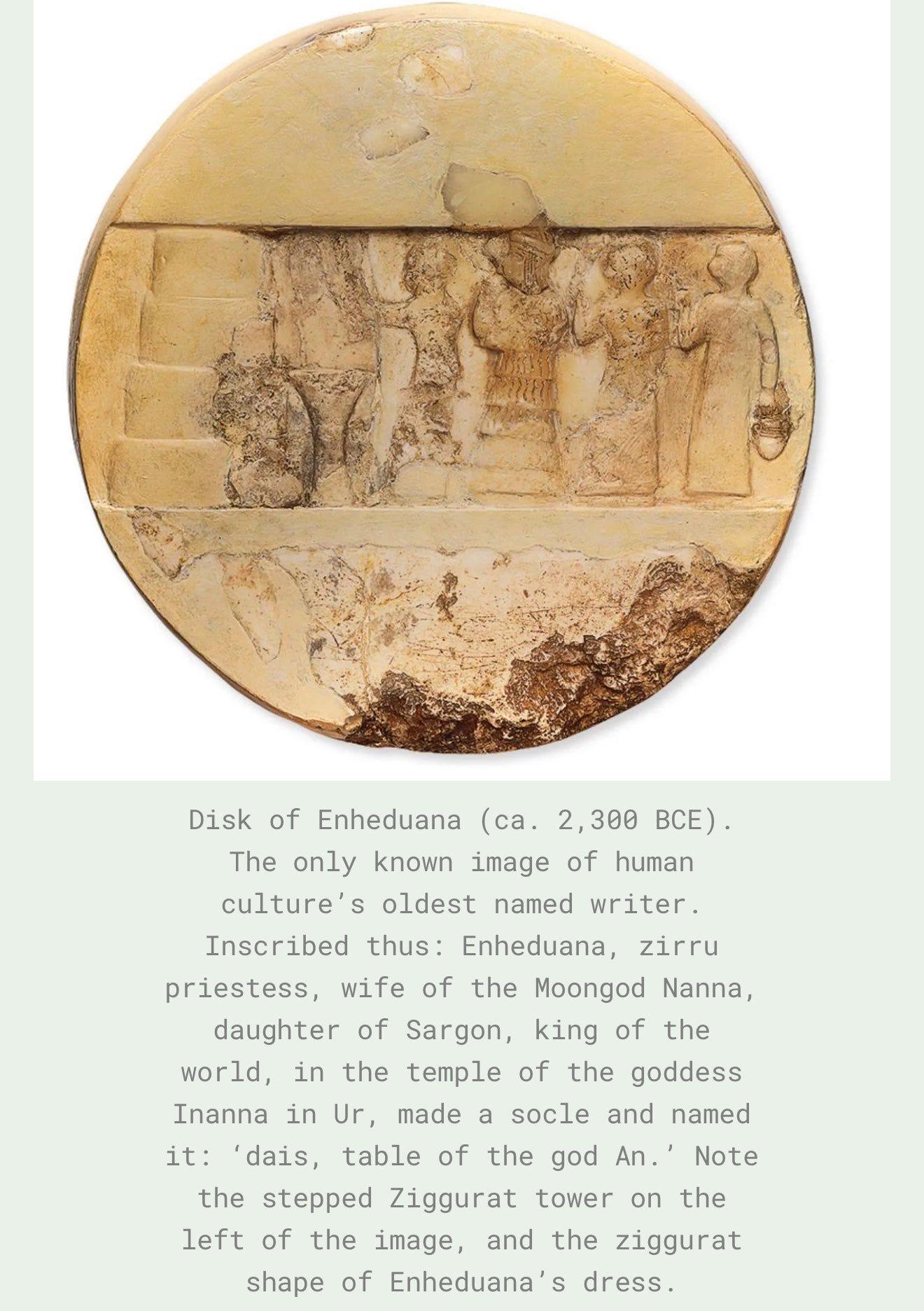
There is an alabaster disc of her in the Penn Museum in Philadelphia. Penn is where my grandfather went to university. It is also where Donald Trump went, but we will not hold that against it. I have not managed to visit the Penn Museum yet and I am desperate to. The disc was carved in her lifetime, and I will post a picture of it beside this piece. On it she stands larger than the men around her. That stone still catches the light after four millennia. The way a full moon does.
What Enheduanna did, as the first named author in human culture, was not in the end to describe her world. It was to intervene in it. She used words to set her world right. A usurper defiled the temple she served, a ziggurat of the kind the Bible remembers as the Tower of Babel. She did not merely record the outrage. She wrote against it. Her writing outlived him.
The averaging engine
We are told reading and writing are dying. In truth, as Peter Jukes recently put it in Byline Times, they are exploding. There is more of both than in any century before ours.
The real worry his essay raises is subtler. These new machines, the large language models we hear so much about, produce fluent text at stunning speed. One thing they do is predict the likeliest next word from billions already written. They are, as his piece has it, “avatars of the average”. They “produce nothing new but predict the old”.
There is a counterweight worth putting beside that. One of the founders (@importai) of Anthropic wrote on X this weekend that the idea of these models as stochastic parrots has in many ways ruined our capacity to understand their real power.
That landed with me.
Until last November I thought I parroted the stochastic parrot line myself. They do predict the next word. But at the level of meaning they do not predict in that same stochastic way, and that is where the mystery sets in.
Jukes’s warning still stands. If we lean on them too hard we may learn to average too. We may mistake the plausible for the true. His piece ends on a line that resonates. “The trouble with our moment is not that we grant our machines too much mind, but that we grant ourselves too little.”
Every word of that is right.
It is also one half of an alabaster disc. I have been holding the other half in my hands and in my mind all summer. The whole disc begins where writing itself begins, with a woman writing to the moon, to the moon god Nanna. It travels a road older than the machines. Older than the essay as a form. Older than cuneiform, which was used six hundred years after Enheduanna’s death to record what she had once sung as a prayer.
It is older than writing.
What a writer is for
Something subtle is buried in the word writer.
A writer’s job, as I have come to understand my own, is to recouple two things that power, that mana, is forever trying to prise apart. What is legally right, and what is morally right.
The tools for that work are hidden in the vocabulary of the work itself. We right the world by writing. We set down words that act in a reader’s mind like a writ, a summons, a binding instrument. Right, write, writ, word. Say them. Write them. You will hear one sound under all four. An R with a hard stop behind it. R-T-.
These are not plays on words. They are clues. They are clues to the early Indo-European mind, and to the minds that fed into it, out of which our whole culture comes.
That same sound surfaces in the Vedic ṛta and the old Iranian arta. Both are Indo-European languages, attested very early in writing. Both mean truth, the true order of things. And the sound is in truth itself. Look at it closely. Strip its vowels and the skeleton sits there. T-R-T. The second letter and the second to last. The same two consonants, R and T, hiding inside an English word, one language family away and two thousand six hundred years from the rock inscriptions at Behistun in Iran, where arta stands carved in the living rock from around 500 BCE.
And the sound is in writing nine centuries before Behistun. Around 1400 BCE the monarchs of Mitanni, on Mesopotamia’s northern rim, bore Indo-Aryan names built on arta-. Artatama: his abode is truth. Artashumara: he remembers it.
That little R-T- skeleton has travelled again and again through the languages from Ireland to India. It is ṛta in the Ganges valley. Arta in Persia. Rectus in Rome. Recht and right and truth in the Germanic languages, like English and, well, German. It never quite keeps the same letters around it. It never once lets go of the same meaning. Rightness.
The words a writer works with are made at their root, another R-T- word, of the truth sound. To write is, etymologically, to true the world. To make the crooked line straight. Enheduanna did it with a hymn. I try to do it in podcasts, tweets, essays, posts and pieces like this one. The instruments a writer uses change. The office does not. I hold the same office as Enheduanna, grand as that may sound, and it is the truth.
The sound a writer cannot un-hear
This is the discovery I have spent six years chasing. It started, as things usually start for writers and for artists, with getting snagged on the material. There is an R-T- in started, and in writer, and in artist.
Years ago the sound of a word stopped me the way a knot in the grain stops a hand. The word was Manu, the first human and first monarch of the oldest Indian tradition. A crowd of other words came with it, uninvited, all carrying the same two consonants in the same order. M, then N.
Say them slowly. Moon. Month. Mind. Meaning. Memory. Human. Money. Mana. Karman.
The thing in the night sky. The span of time it measures. The organ that measures the world within us. The meaning that organ makes. The memory it keeps. The human who does all of this. The woman who makes that human, and you might look on PowerofMana.net for “The Moon, the Menses and the Maternal”. And the sacred power once thought to run through all of it. Mana.
One small sound, M-N-, sitting beneath the deepest things a person can name.
A writer’s first duty here, as ever and everywhere, is suspicion. So I followed the sound. Through thousands of scholarly papers. Across tens of thousands of kilometres between Ireland and India, again and again, in travels I recount in Finding Manuland.
What I found is this. The oldest recoverable word for the moon in the ancestral tongue behind English, and behind all living Indo-European languages including Persian and Vedic and Sanskrit and Hindi, does not mean “the bright one”. It is not Luna, and it is not the sound inside lunacy. It is méh₁nōt, and it means the measurer.
So many of these sounds sound alike that I would ask you to read along as you listen, if you can. Not if you are driving. Not if you are on your bicycle. If you are walking the dog, or the cat, you can probably manage it.
The moon was named for the one thing it does that matters to a farmer, to a priest, to a woman tracking her own body. It measures time. It is the first clock, hung in the sky. Once you see that, the crowd of words stops being a coincidence and becomes a pattern. The word for the sky’s measurer was lent to the mind that measures within, and to the human being who is, above every animal, the measurer.
Who made the pattern
Who created this pattern, which every speaker of a living Indo-European language uses almost every time they say one of these M-N- words?
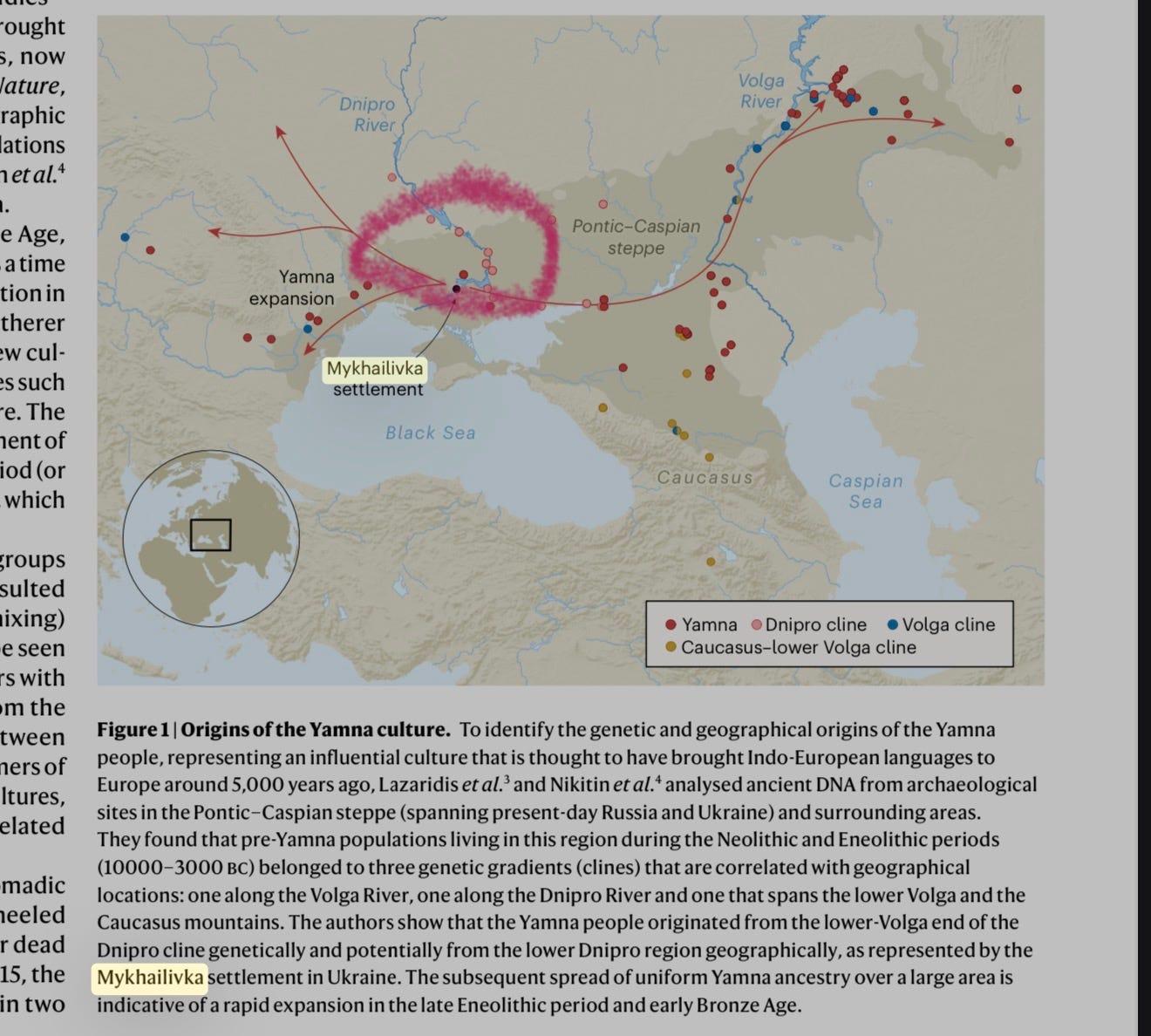
A people called the Yamna. There is an M-N- in Yamna too. Their community was centred on the Dnipro river just south of the Ukrainian city of Zaporizhzhia.
The Yamna, according to peer-reviewed research published in Nature on 4 February 2025, were the precursors of all living Indo-European languages. Both papers are here: the first and the second. One involved Russian state-funded archaeogeneticists and the other involved Ukrainian archaeogeneticists.
A word about that. Vladimir Putin chairs the Russian Academy of Sciences. We cannot trust anything that emanates from it. It is more than an archaeologist’s life is worth to publish what the evidence says, which is that all living Indo-European languages come from a village called Mykolaivka on the Dnipro, almost directly across the water from the Zaporizhzhia nuclear power plant, brutally occupied by the Russians since 4 March 2022.
Those two papers in Nature, humanity’s pre-eminent scientific journal, reached that finding using archaeogenetics. It is a young science. It first showed what it could do in 2015, in another Nature paper, published around the time I arrived in Ukraine to work as a diplomat. That arrival started me on the journey that leads to what I am telling you now.
Archaeologists named the Yamna for the pit graves, the yamna, in which they buried their monarchs on the grasslands by the Dnipro. Their community took shape there some six thousand years ago. From that one community, and there is an M-N- in community, grew the mother tongues of nearly half of humanity, spoken today between Ireland and India.
If you can understand these words, you are part of that family.
Six founders out of eight
Across that whole vast family the founder keeps the moon-sound.
Manu in India. Aryaman, the oath-and-kinship god of old Iran. Mannus, forefather of the Germanic peoples, and there is an M-N- in Germanic as well. I made six podcasts on him, asking which came first, Mannus or Manu, and they are on PowerofMana.net from last year. Minos in Crete, with his brother Rhadamanthys, and both of them carry it. Menua, monarch of the Armenian highlands. And at the far western edge of the world, Manannán, Ireland’s pre-eminent pre-Christian deity, and Érimón, the first high king of all Ireland.
Six of the Indo-European language family’s eight branches name their founder with the moon-sound. One is a charming accident. Six out of eight is a system.
The two that clinch it are Manu in the far east and Mannus in the Germanic west. They stand at opposite ends of the earth the family ever reached. They are far too far apart to have traded the idea of naming a founder with that sound, or to have copied one another. So, by the practice established in Indo-European studies for over a century and set down very lucidly by the great Indo-Europeanist Bruce Lincoln, both must have inherited it from one common source. The Yamna, by the Dnipro.
It is not the sound alone
What I am speaking about is not just the sound M-N-. It is the sound together with its meaning.
Look at the founders. Then look at the common meaning you will find in moon, human, karman, mind, memory, money, mana and month. They come from one semantic field. Spirit, or light shining through a mind. Light shining through a human.
In karman it is the repository of one’s karma. Karma itself comes out of karman. So it is the subtle energy that lights a human, and that continues through different embodiments in Indo-European and Buddhist religious thought.
So we are not talking about sound alone. We are talking about phonosemantic bundles. Sound and meaning travelling together through time, in the founders, across the Indo-European cultures, and in almost every sentence we speak.
The anomaly
This summer I put that pattern to a proper test, on a database of a hundred languages. Other scholars built it, for their own reasons. It had never heard of me, or of what I had noticed and followed for years.
The test asked how often the two consonants, M and N, in either order, land on the family of meanings they keep company with. Moon and month. Mind and memory. Measure and man. And the act of naming, where the M-N- runs the other way round as N-M-.
The number that came back is the reason this piece exists. The odds of the pattern arising by chance are not one in a thousand, or a million, or a billion. Written out, the number has sixty-five zeros in it. It is the same order of chance as winning the EuroMillions jackpot eight times in a row, on a single ticket each time.
I had a friend at school whose family was quite rich, and whose mother won the EuroMillions twice. Not the zillions. Fifty million euros or so each time, which is a huge whack of money. But she did not win it eight times, and it was a different ticket each time. To believe in a coincidence like that you would have to be not sceptical but simply reckless.
The M-N- watermark is real, measurable, and six thousand years old. It lies under the surface that writing only scratches.
What I discovered, put modestly, is an anomaly.
Linguistics puts a different root behind moon and behind mind. Another root again for meaning and memory. Another for human. Another for money. Another for mana. Another for karman. If specialists notice the shared M-N- at all, across all the living Indo-European languages and all the ways those words decline, the answer is that it is a coincidence. You say, look, there is an M-N- in every one of them, so they must come from the same word. And the answer comes back: no, sorry, mate, they do not.
The alternative is to believe that this sound-and-meaning bundle comes from one source underneath. We know about the Yamna community at Mykolaivka in Zaporizhzhia Oblast, in today’s Ukraine. So we can at least imagine that they had a word, and I believe that word was méh₁nōt, meaning moon. Out of that one word comes the idea of light shining through a rock in the sky, used as the metaphor that separates a human from a stone. Light shining through a human. Light shining through their mind. The energy and the light of a human being, rarefied into money, into mana, into energy.
Instead of eight separate roots, and given what the statistics say, it is simpler and more logical to think they come from one.
Manuland
To follow the M-N- and the R-T- I have spent years travelling across and inside the area between Mane, overlooking the Spiti Valley in India, and Emain Macha, Ireland’s holiest site.
Spiti is the limit of the Indo-European range. Stand there and you meet people with every cultural characteristic of Tibetans, and Tibet is just over the top of the valley, close enough to see. Look closely and they look Indo-European. You get the reverse as well. Half the people are ethnically Indo-European and half are Sino-Tibetan, half speak and live culturally as Tibetans and half as Indians. Once you get your eye in there it is a wonderful place. That is why I keep going back.
I call the project Finding Manuland, and you will find it on PowerofMana.net. The first five foundational Finding Manuland Atlas podcasts are up now, and they range over the whole Manuland zone. Over the next few years I will be describing my travels through its different parts, including the Spiti Valley.
Menua’s canal still runs
About halfway between Ireland and India as the crow flies lies the historical and the real Armenia. I have travelled there too.
High in the mountains, on the shore of Lake Van, which the Urartians called Tushpa, a saltwater lake in the east of Anatolia now inside Türkiye, a monarch named Menua reigned some two thousand eight hundred years ago. He is one of the founders whose name carries the moon-sound. He was the builder-monarch of the realm the ancients called Urartu, the seed of historic and present-day Armenia. Though Urartu is not what its own people called it. They called themselves the Biainili. B-I-A-I-N-I-L-I.
Menua cut a canal out of the high rock to carry water to his city. When I stood in Van last January I saw it. The waters still flow along Menua’s canal. Three thousand years on, the measurer-monarch’s channel is still carrying water into that valley and into the lake. It is a monument that does not sit in a museum. It works. It is still measuring water into a community, long after the empire that dug it passed into inscription and into today’s Armenia.
The crossroads
Van, and the exact ground Menua’s canal runs along, is the old boundary between ancient Armenia and Mesopotamia. The same Mesopotamia Peter Jukes writes of in his piece. That area south of Van, down to the Iraqi and Syrian borders, lies today in Türkiye. If you get a chance to go there, you must. I spend as much time in it as I can. I call it the crossroads, and soon I will make an episode of Finding Manuland by that name, to say what it is like to be there.
It is the place where great empires have ground against each other for millennia. Kura-Araxes. Hatti. The Hurrians. Akkad. The Indo-European Hittites. The Mitanni, with their Indo-European gods. Assyria. Urartu. The Cimmerians out of Crimea, and the Scythians out of Ukraine and out of Iran. The Medes. Armenia. Persia. Greece. Parthia. Rome. Byzantium. The Sasanians. The Caliphate. The Seljuks. The Mongols. The Safavids. The Ottomans. Even the Ruschistswere there, and in 1921 they gave this part of Armenia away to the sultan.
The archaeological, textual, linguistic and cultural legacies of all of them, Indo-European and not, and yes, the Yamna were there too, are visible in the ground, in the museums, and even in the sky at night. The moon. The different words for the moon. What the moon meant.
That area is the seam where the moon-sound world of the Indo-Europeans met the world of Enheduanna’s clay. At Harran, where I have also been, they worshipped the moon god as she did, and well into the historical era.
That geographical space, around which all those empires radiated like a wheel, is not a backwater of my response to Peter Jukes’s excellent essay. It is its axis.
Kin beneath the sound
A boundary is where power does its prising apart of the legal from the moral. This is contested ground. It has been soaked in contest.
It is precisely here, around the southern shores of Lake Van, running down into the plains of Mesopotamia, that the deep pattern does something a mere curiosity never could. It shows the peoples the map sets against each other to be kin beneath the sound.
The Armenians carry the moon-sound in their oldest names. So do the Turkic peoples who later settled the same land. Osman, whose name founded the Ottoman dominion, wears the M-N- in the founder’s place. His name reached the Türk, I contend, not through the Arabic. Uthman has no etymology there, even according to Semitic etymologists. I do not believe Osman came through Arabic all the way across Anatolia, past the Caspian, into the Central Asian Turkic heartland of Kazakhstan. I contend it came through the millennia of interaction between the Yamna’s descendants and Osman’s forebears on the Kazakh steppe. That is how Osman got the M-N- in his name.
Manas, the founder-hero of the Kyrgyz, made much of since the end of communism, also carries it. Zaman is the Turkish word for time, which is the moon’s own gift. And Iran wears the M-N- in the empire’s own name. Achaemenid preserves Haxāmaniš, the founder Achaemenes, having a friend’s mind. Another founder-name built on the moon-sound, and it stands carved in the same Behistun rock as arta, truth and cosmic order, set against druj, the lie, the usurper.
When the Turkic conquerors took the Armenian city of Ani, the first governor they installed was named Manuchihr. The moon-sound appearing again, in a Turkic name, set over Armenians who bore the moon-sound in their own name. Armenian. The Turkic tongues carry the rule-sound too, the hard R-T-, in the very word Türk.
The Mesopotamians, four thousand years ago, had a name for the Indo-Europeans arriving on their frontier from the north. The Umman Manda. Which is to say, near enough, the M-N- people.
They did it twice, once for each of the two great sounds. Urartu, the realm Menua ruled, is the name its Semitic-speaking neighbours to the south gave it. Urarṭu in the Assyrian records. That is the very name the Hebrew Bible preserves as Ararat, the mountain range where Noah’s ark came to rest. Or rather, Ararat is what we say now. The Bible’s own letters spell only r-r-ṭ. Biblical Hebrew wrote no vowels. Say the consonants. R-T-, the rule-sound, the same skeleton that runs through write and writ and writer.
The Armenian scholar Armen Petrosyan has argued that the ruling line of Urartu, Menua’s own house, were Indo-Europeans. If he is right, and who am I to argue with one of the greatest Indo-Europeanists, the R-T- pattern closes with a satisfying click.
Mesopotamia’s Semitic tongues, listening across the frontier to the peoples to their north, caught the two sounds those communities carried deepest. M-N- and R-T-. They turned each into a name. The founder-sound became the newcomers’ name, Umman Manda, the M-N- people. The rule-sound became the highland realm’s name, Urarṭu, Ararat, the R-T- land.
What a people’s neighbours call them is testimony of a rare kind. It records what strangers heard. And what Mesopotamia heard, four thousand years ago and three, were the moon-sound and the rule-sound. The same two sounds this piece has been tracing through mind and human and measure, right and writer, all along.
Ani
Ani’s ruined cathedrals stand within sight of a closed border, with a watchtower on the far side. I recorded my testimony to what it means to be a writer today there, last January. You can see it at Disinfolklore.eu/About, or on PowerofMana.net as “What I Do as a Writer”. The ravine behind me in it has been a bitterly disputed seam in the region. Today Armenia and Türkiye look set to rebuild jointly the bridge connecting their two great states.
There the M-N- and the R-T- testify to a shared inheritance older than every grievance.
This is where the writer’s office that Enheduanna and I share comes right back in. Legal questions about borders belong to international lawyers. The moral questions, like whether the peoples on either side are strangers or kin, are answered plainly by the sounds. They are kin. My work as a writer is to keep saying so. To recouple the legal with the moral by pointing, patiently, at the common root under the divided ground.
Manuland, my name for the whole reach of the Indo-European languages from Ireland to India, is not a claim of ownership. It is an argument for kinship. It says we have far more in common than the map admits. The proof is in our own mouths. In almost every sentence we speak we pronounce words carrying these consonantal skeletons, sometimes through a thinly veiled shift from R-T- to R-D-. From right to word.
Reversion to the M-N-
So, back to the machines. The Tyranny of Literacy‘s well-measured fear and my six years chasing these sounds meet at the same door from opposite sides.
The fear is that the large language model is an averaging engine that teaches us to average too, until the plausible crowds out the true. Peter Jukes essay in Byline Times cites a fine piece of science to sharpen it. Brain scans show the human mind is nothing like a next-word predictor. It is a meaning-organiser that leaps sideways at the edges of phrases in ways no machine forecasts. The mind, it says, “doesn’t optimise. It explores.”
There is an arch joke buried in the name of one of my main projects. Reversion to the M-N-. It began as Reversion to the Moon, and it belongs exactly to this argument.
It is my play on the phenomenon in data analytics and statistics, reversion to the mean. And in Disinfolklore, my other project, Disinfolklore itself is a manifestation of that reversion to the mean, as in the angry manu. The angry spirit. The meanness we see so often in today’s information space.
Reversion to the mean is the statistical recurrence at the very core of how these artificial neural networks work. Everything is pulled back towards the average, using standard deviation at the level of individual artificial neurons, whose weights are expressed as a function of the deviation from the mean. Everything pulled back towards the average, the expected, the already seen.
The joke folds in on itself twice. Mean wears the M-N- sound, and is clearly related to its etymon in the reconstructed forebear of all living Indo-European languages, the méh₁ measure component of méh₁nōt, the moon. So does etymonitself, the technical word for a root, the very unit whose rules kept the pattern invisible.
You see, once you get your eye in. Part of my job is to help you get your eye in, not only to these micro components in the words we communicate the world with, but to the macro. And that M-N- pops up again and again in every sentence we speak.
The phenomenon I have spent six years documenting is the opposite of a decay towards the average. It is the M-N- regenerating itself, everywhere you look, across six thousand years. It surfaces again and again, carrying the same semantic field, in places that root-by-root etymology could never predict and was never going to find.
Root-by-root etymology is what Indo-European linguists practise today. It traces each etymon down its own permitted pathway. This M-N- pattern lives at exactly the level that lens excludes. It is an empirical pattern the etymologists’ own rules prevented them from seeing. Their method was not wrong. It was a lens ground for a different task. That is why it waited for a writer.
The word man
This summer I spent a great deal of time proving an assertion I had long wanted to prove, using state of the art data analytics.
I thought I had found a solution. What I needed was a means of proving it. The solution was to the Oxford English Dictionary’s crisp explanation of the origin of the word man. So this is not merely about words with no common meaning. This is the very designation for our species.
The OED gives man as “a word inherited from Germanic”, whose “pre-Germanic etymology of the word is problematic”.
If you have the time and the energy, go back to those six podcasts asking which came first, Manu or Mannus.
I stood exactly where the OED and a machine cannot go. And I used the machine to get there faster than any writer working alone ever could.
What the instrument did, and what it did not
Every idea in my tests was mine. The etymologists, with their old-fashioned toolkit and their strict rules, keep these words apart even when their senses overlap. Asking whether they should be kept apart was my question.
Not one idea came from the neural network model. For all its power it originated nothing. What it did, superbly, was test. It ran in an afternoon the checks that would have cost me a year by hand. It told me plainly when I was wrong. It killed several of my favourite ideas outright.
That is exactly what a true instrument is for. I explored. It measured. I brought the possibilities. It supplied the probabilities. Those are not rivals. They are the two halves of that sentence about the mind, finally set to work together instead of one impersonating the other.
The human outside the loop
I would name the good half of the alabaster disc the human outside the loop.
The anxious picture of our moment puts a person inside a machine’s process, nodding its outputs through, slowly deskilled. Turn it inside out. Put the human on the outside, holding the machine the way an astronomer holds a telescope. The theory, the questions, the wild sideways guess belong to the human. The instrument only lets her see further.
The model, powerful as it is, could not have got here without visiting Menua’s canal. It is the most capable yet built, the generation its makers call Mythos, perhaps humanity’s finest ever instrument, and it is now available to a solitary writer in their garret.
It is not, and cannot be, the decider.
The measurement, in full
I am a writer chasing an idea, and here is what the measurement found.
On the NorthEuraLex database of 43,251 Indo-European word-forms across 1,016 meanings, words for the pre-registered meaning field carry the M-N- skeleton at 20.8 per cent, against 3.46 per cent for all other meanings.
The pre-registered field was: moon, month, mind, think, memory, remember, meaning, measure, count, man, human, spirit, and name.
The odds ratio is 8.0. A word on that field is eight times more likely to carry the frame than a word taken at random from the language.
Fisher’s exact test returns p = 5.60 × 10⁻⁶⁶. It stands first of 182 co-occurrence frames tested.
Or, in writerly language: the probability that this pattern is a coincidence is nought point, and then sixty-five zeros.
If sound and meaning had nothing to do with each other, you could rerun this experiment on fresh data every second, once a second, since the Big Bang. That is about 4 × 10¹⁷ replays. You would still be short of one expected fluke by a factor of four hundred billion trillion trillion trillion.
All of this worked because I did the six years’ work first. I was able to put to the Mythos model the question that had been puzzling me for years. I had noticed the pattern. I had formed the ideas. I had read thousands of papers and walked the road to Van and Mesopotamia and back and around, several times, all before the machines could do anything useful at all.
The model amplified a prepared mind. It could not have prepared one.
The other half is that she is equipped
Peter Jukes’s diplomatically expressed warning is real. Surrender your thinking to the averaging engine before you have any of your own, and you will indeed become an avatar of the average.
That is only half the story.
The other half is that a writer who has spent her life looking hard, and that is the hard R-D-, into the material of her craft, into the sounds and the roots and the meanings and the buried systems beneath the plainest words she writes the world with, is not necessarily diminished by these machines.
She is, for the first time, equipped.
The lonely figure in the attic, pram in the hallway, alone with the page, can now reach past the edge of what any single lifetime could grasp at, in one afternoon. Not by handing over her mind. By keeping it, and pointing the instrument at what she alone can see.
The cure for granting ourselves too little mind is to go and use the mind we have, with better tools than any writer before us has owned.
The office has not changed
Four thousand three hundred years ago Enheduanna heaped the coals in the censer, prepared the offering, which we can see on that alabaster disc, and in her own phrase conceived the word. A hymn from the moon god Nanna’s house, written to true a world a usurper had wronged.
The office has not changed one jot since. The writer still exists to recouple the legal with the moral. To right the world through writing. To point at the common root under divided ground. Writers have always had the mana to bring communities together rather than to divide them.
What has changed, only now, in the age of mythos these machines have opened, is how far a single prepared mind can reach while doing it.
Enheduanna righted her city with a song. She had only her own two hands and a reed to press it into clay. I have the whole span of Manuland to walk, and an instrument steady enough to test my hypotheses.
For both halves of the alabaster disc, and for both halves of the work, this era has opened. The machine and the mind. The sounds beneath our words and the buried patterns beneath our politics. And the strong, slightly vertiginous sense that I am only getting started.
At bottom, tyranny or not, the writer’s job in Mesopotamia, as in Europe today, has not changed.
Only our reach, and the stakes.
I’m Decoding Trolls. I write at Disinfolklore.net and PowerofMana.net, and as Decoding Trolls on Substack, X, Bluesky and Mastodon. Please feel free to subscribe to my work for free. For those who pay for it, you’re amazing. I never thank you, so I am thanking you here.
I’ll see you soon.
Principles of Infolklore
Ep 1 - Aug 20
Ep 2 - Aug 27
Ep 3 - 3 Sept
Ep 4 - 10 Sept
Ep 5 - 17 Sept
Get full access to Decoding Trolls at www.decodingtrolls.net/subscribe