


WEBVTT
1
00:00:00.100 --> 00:00:14.700
[ on-hold music] This episode of Content Briefly is brought to you by our friends at Ahrefs. Do you want to make your business discoverable in search, AI, and beyond?
2
00:00:15.360 --> 00:00:23.880
See what people want, fix what holds you back, ship what wins, and track your growth. That's what a marketing platform should do, and that's exactly what Ahrefs does.
3
00:00:24.580 --> 00:00:34.340
Start for free with Ahrefs Webmaster Tools and get access to three powerful tools. Web Analytics, which provides insights about your website's traffic data, visitors, and sources in real time.
4
00:00:34.980 --> 00:00:42.170
Site Audit, which scans your website for more than one hundred and seventy common technical and on-page SEO issues and helps you fix them.
5
00:00:42.200 --> 00:00:47.750
And Site Explorer, which shows you pages and keywords bringing you the most organic traffic and who links to your website.
6
00:00:48.540 --> 00:00:57.360
Sign up for Ahrefs Webmaster Tools with the link in the show notes to improve your website's SEO performance and grow your traffic from search. Hey, and thanks for tuning in to another episode of Content Briefly.
7
00:00:57.400 --> 00:01:03.080
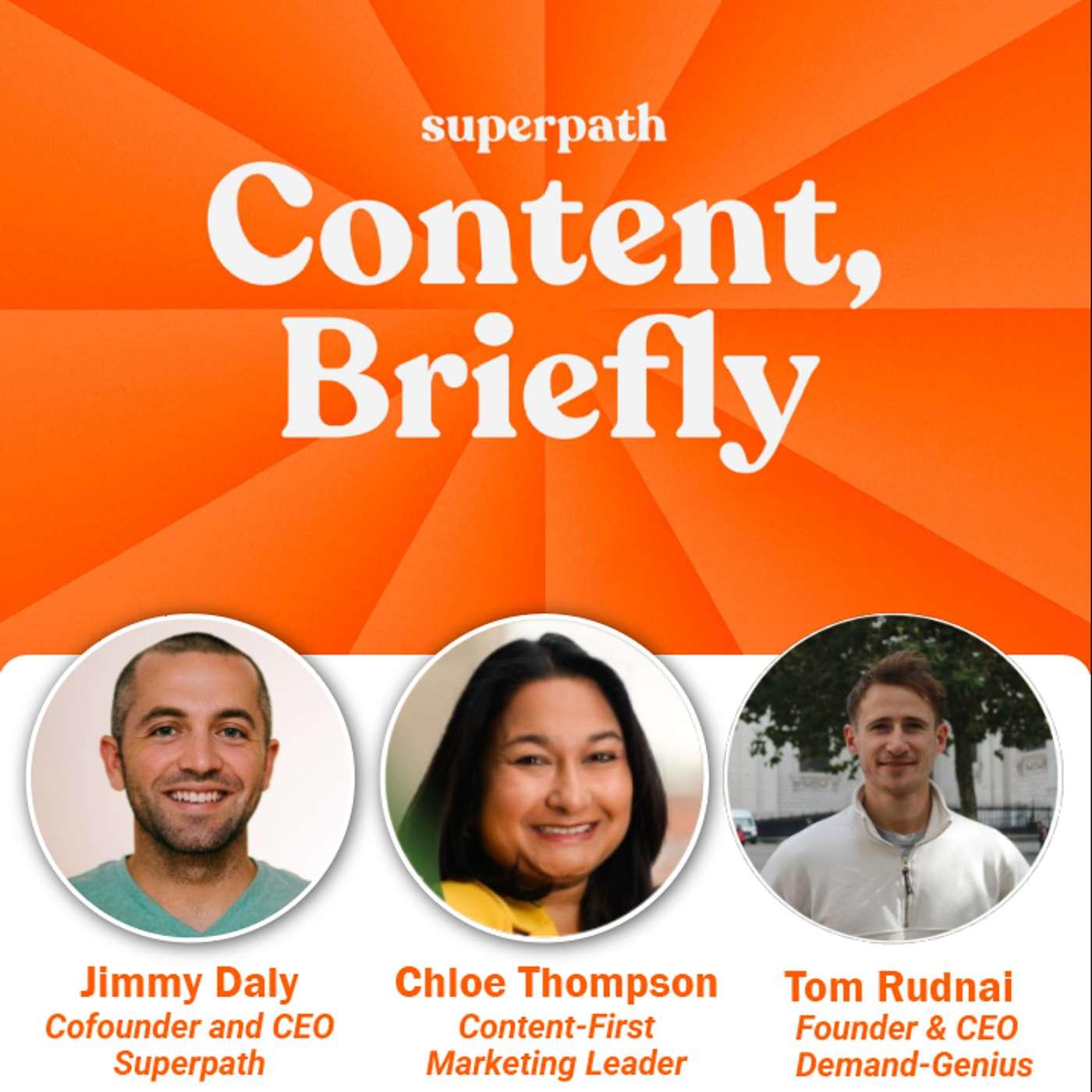
Today, Chloe and I are chatting with Tom Rodden, who's the founder of Demand Genius, which is a content attribution SaaS tool.
8
00:01:03.620 --> 00:01:11.190
Demand Genius and Superpath recently partnered up to publish a report on content attribution, the results of which were very interesting.
9
00:01:11.720 --> 00:01:19.500
A lot of-- I guess my main takeaway from that is that there's a lot of really amazing things that content teams do that they don't get any credit for.
10
00:01:19.510 --> 00:01:27.460
And so that's a lot of what we're talking about today is like, why is it that way? What are some ways that we can start chipping away to make sure that content folks are getting credit?
11
00:01:27.880 --> 00:01:35.180
You know, what are the things content teams frankly could do better at? And then we do talk a little bit about Demand Genius. They've been an awesome partner to Superpath.
12
00:01:35.240 --> 00:01:41.520
We're extremely appreciative of their support, and they have a tool that's purpose-built to solve this exact thing. So Tom does talk a little bit about that as well.
13
00:01:42.160 --> 00:01:50.440
I won't tease too much more because there's a lot in the episode itself. Quick plug, though, for Superpath Pro. Attribution, interestingly, has been a big topic in the Slack group lately.
14
00:01:50.940 --> 00:01:56.740
I feel that AI is making it even more important than it used to be. It's being stress tested a bit.
15
00:01:57.120 --> 00:02:03.720
Content is being stress tested, and having good data and being able to speak to that data is becoming more and more important.
16
00:02:04.180 --> 00:02:11.100
Like, especially as teams are getting smaller, I think content budgets, they're sort of all over the place right now. Like you hear some people saying like, "Yeah, you know, we're fine.
17
00:02:11.160 --> 00:02:19.280
We're doing the same amount of content we used to do." Some are being squeezed, some are actually expanding. It, it's a little bit chaotic out there right now. If you are feeling the...
18
00:02:19.320 --> 00:02:24.600
You know, if you're sort of feeling that chaos, you're certainly not alone, so come commiserate with us.
19
00:02:24.660 --> 00:02:35.820
You know, in addition to the Slack group, you get monthly one-on-one calls, monthly group calls, monthly AI show and tells, which have been very cool to see like what things people are building with AI, vibe coding, workflows, et cetera.
20
00:02:36.120 --> 00:02:42.140
So you can learn all about that at superpath.co. All right, I'll get out of the way. Enjoy this episode with Chloe and Tom Rodden. Take care.
21
00:02:42.180 --> 00:02:51.500
Everybody, Jimmy from Superpath here today with another episode of Content Briefly. Happy to have Chloe back, and we also have our friend Tom Rodden, founder of Demand Genius. So thank you both for being here.
22
00:02:52.020 --> 00:03:00.860
You've both been on the podcast, so maybe let's just do quickie, quickie intro for Tom in particular. Superpath and Demand Genius recently partnered up to do this report, The State of Content Attribution.
23
00:03:00.920 --> 00:03:07.340
Obviously, there will be a link in the show notes for people to go read it. You should go read it. We're gonna talk, as you might expect, about content attribution today.
24
00:03:07.420 --> 00:03:11.370
I think it's like the most important thing that nobody's talking about right now.
25
00:03:11.380 --> 00:03:20.269
But maybe as we kick this off, Tom, would you say hello, quick intro of yourself and Demand Genius, and then, like, talk for a second about attribution and kinda like, where are you at on this right now?
26
00:03:20.320 --> 00:03:24.090
Like, why do you feel like this is such an important topic at this moment? Yeah, sure.
27
00:03:24.120 --> 00:03:34.520
So, hey, everyone, founder of Demand Genius, and we've been going about two years as a company now, so I feel like I'm probably one of the few people out there that is talking about attribution in a pretty relentless and probably quite annoying way.
28
00:03:35.080 --> 00:03:45.840
Yeah, in terms of why, like why do I think it's so important, I think for me, so the way I've always come at content is from a, a slightly roundabout way, which is I was working as an enterprise sales rep in the B2C content world.
29
00:03:46.280 --> 00:04:00.360
And what we took from that was the depth of opportunity to be more intelligent with how we use content in our world, and kind of apply it to our own context where sales reps aren't getting engagement from their buyers anymore, and that's kind of how we view it is.
30
00:04:01.120 --> 00:04:16.050
In a world where seventy-five percent of B2B buyers don't wanna talk to sellers anymore, content becomes a critical vehicle not just to engage people right at the top of the funnel, but to actually educate, talk to them, build relationships with them, and ultimately convert them through.
31
00:04:16.070 --> 00:04:21.560
And you've seen that a lot with the rise of a lot of product-led growth businesses. But product-led growth for most is an aspiration.
32
00:04:22.380 --> 00:04:31.360
For more companies, they are always gonna be sales led to a degree, but there is a strong focus on making that sales led motion much more efficient, and that's where content has a smarter role to play.
33
00:04:31.460 --> 00:04:44.380
If you can't measure attribution in terms of revenue impact and specifically really actionable insights into how content performs further down funnel, then you can't optimize content for that new role.
34
00:04:45.440 --> 00:04:55.890
Just a quick follow-up on that, Tom. I feel like we're at a very interesting point in terms of PLG because I, I think SaaS is in this, like, very experimental phase right now. There's so many new tools out there.
35
00:04:55.940 --> 00:05:06.000
Everybody wants to try them, so pretty much everybody has to have freemium, free trial, et cetera, something so that people can actually get their hands on, especially these AI tools, right?
36
00:05:06.060 --> 00:05:22.220
At the exact same time, I think we're about to see this wave of procurement oversight as, like, companies, like, actually adopt these tools, not just, like, early adopters tinkering, but, like, you know, the company is now going to use AI tool that they have never had access to before.
37
00:05:22.640 --> 00:05:27.760
And I feel like these two things are just gonna collide with each other. My point is, I think attribution actually become quite...
38
00:05:28.000 --> 00:05:31.640
A- as I said, I already think it's, like, one of the most important things that's, like, not really being discussed right now.
39
00:05:31.700 --> 00:06:08.722
I think it's about to become a lot more important because, like, as the kinda, like, the, the magic of AI fades a bit and it turns back into, like, regular SaaS, companies are going to then turn back to kinda regular marketing, and then we're all gonna be like, "Oh, wait, we can't just get, like, a million people to sign up for this, and we don't really even care where that-- how to attribute it because we were just riding this wave of AI interest," and now it's like the rubber's gonna meet the road again, as it does every now and then.And people are gonna have some explaining to do about, like, "Does our marketing work, or was this just, like, a macro trend that we were able to cash in on for a little while?"
40
00:06:09.572 --> 00:06:17.562
Yeah, I mean, without taking us on too much of a tangent, I think that's a super interesting point, actually. I think AI has mostly lived within the realms of, like, experimental budget up until now. Yeah.
41
00:06:17.592 --> 00:06:27.972
We're starting to see a lot more procurement oversight. Well, what drove the initial change away from the sales rep model being effective and efficient initially was exactly that happening, right?
42
00:06:28.012 --> 00:06:36.842
So in the old traditional world, you had departmental heads of marketing, sales, customer success, product. They were empowered to...
43
00:06:36.872 --> 00:06:40.792
Because it was, you know, a different environment, the days b- it- it was the good times.
44
00:06:41.012 --> 00:06:51.952
They were empowered to make independent decisions for their own department, and that meant a sale, the p- sales process was relatively linear, and a sales rep could realistically go and sell, 'cause they were selling to one person.
45
00:06:52.012 --> 00:06:58.342
Right. When you sell to one, and as much as we don't like thinking of ourselves in this way, your buyer journey is quite linear.
46
00:06:58.392 --> 00:07:07.872
What then happened is times weren't so good, and there was a lot more oversight over regular SaaS purchases, and it made life impossible for a sales rep because now you've got eight people.
47
00:07:07.972 --> 00:07:15.012
None of those eight people want to own it in quite the same way, but as a sales rep, you have the exact same expectations of you in terms of weekly check-ins.
48
00:07:15.472 --> 00:07:23.692
So that's what, to me, made content so much more important to the regular SaaS purchasing journey or, or sales motion, however you wanna think of it.
49
00:07:23.992 --> 00:07:29.552
And it's a really fair point that for all of these AI companies, they're probably gonna go on a similar journey. Yeah, absolutely.
50
00:07:29.682 --> 00:07:39.202
Yeah, we were just before the podcast talking about open AI rolling out some, like, Teams features and projects that folks can collaborate. It just felt like such bread and butter SaaS. I was like, "Oh, we're...
51
00:07:39.232 --> 00:07:47.352
Okay, we're not just gonna talk about AI can do your job for you. Now we have to get back to talking about, like, why should you choose this tool over that tool?" [laughs] You know, it feels like...
52
00:07:47.372 --> 00:07:54.172
It was, kind of felt like coming back down to earth after this like year plus long, like, frenzy and hype around all this stuff.
53
00:07:54.752 --> 00:08:07.672
So there were a lot of interesting things I think in this report, but the one thing that jumped out to me and wasn't that surprising but is also still kind of terrifying is how content teams are looking at their North Star.
54
00:08:07.832 --> 00:08:13.072
I have a lot of thoughts on this, but I'm curious about the both of your thoughts. There's such a scattered approach.
55
00:08:13.132 --> 00:08:23.232
Some teams were measuring MQLs, some are still looking at traffic, pipeline revenue, really small percentage looking at revenue. Like, why do you think that is? Jimmy, I'll start with you.
56
00:08:23.872 --> 00:08:28.752
I find this to be pretty surprising as well because we have industry standard ways to do just about everything.
57
00:08:28.872 --> 00:08:34.692
Or, or I, I'll say it like this, we did have industry standard ways to do just about everything, and then, like, much has changed recently.
58
00:08:35.392 --> 00:08:51.212
I've always been surprised that there is not an industry standard way to attribute content, and so that's why I think you find these teams sort of falling into different buckets, and you can kind of like tease out the different business models dictate different types of content strategies, which dictate different ways of measuring it.
59
00:08:51.252 --> 00:09:01.712
Like, I can appreciate that, but each one I think gets, like, a little too specific on one thing without measuring the full picture, and we definitely saw that in the responses to this survey as well.
60
00:09:01.832 --> 00:09:10.212
Like, most people, I think the number was 71%, feel like their current reporting only captures some of the value that their team provides.
61
00:09:10.272 --> 00:09:19.892
So like while I totally get why measuring MQLs for some teams makes sense, and I totally get why measuring something else for another team makes sense, in both cases, there's more...
62
00:09:19.912 --> 00:09:29.752
There, there's a bigger story that's not being covered. Yeah. And I, I don't have like a great answer on like h- how... Like, why it is this way and why it isn't better, you know? Uh, Tom, what do you think?
63
00:09:30.652 --> 00:09:35.452
Yeah, I mean, my, so my first reaction, it's interesting how we come at this from different angles, right? I'm imposing my bias.
64
00:09:35.532 --> 00:09:47.412
I straightaway look at this and I'm like, "9% treat revenue as their North Star," which to me for a function that sits within the revenue function is crazy, right? That should, my- That was my first thought too. Yeah.
65
00:09:47.452 --> 00:09:53.212
My general take should be, would be that that should be everyone's North Star. I think it should- Why do you think we measure...
66
00:09:53.692 --> 00:10:01.302
Yeah, like, how have we gotten to the point where, like, we just measure things, like, a few steps away from it? Is it because- Well-... it's just difficult to do, so teams choose something else?
67
00:10:01.872 --> 00:10:11.992
I personally think it's because the teams that I've been on in the past, when you have, like, different team pockets have different goals and different...
68
00:10:12.032 --> 00:10:31.472
It's almost like I almost wanna slot in this attribution for reporting because I feel like people answered this question in terms of what are you reporting on, and I still find a lot of content teams are reporting specifically and measuring themself on traffic, which, like, I fully believe is a vanity metric.
69
00:10:31.592 --> 00:10:43.652
I think it's important to be aware of all of these pieces that we've mentioned in the report, but in terms of, like, your North Star, I don't ever think that traffic should be your North Star.
70
00:10:43.772 --> 00:10:46.112
I don't ever think that MQL should be your North Star.
71
00:10:46.372 --> 00:10:56.532
I think that everything involving revenue should be your North Star 'cause it doesn't matter if people are downloading content, engaging with it if they're not eventually gonna become customers.
72
00:10:56.852 --> 00:11:08.572
You're not creating the most impactful content. Like, so that's where I struggled a little bit with how this question I think was positioned, and that's where I think maybe the scattershot approach came from.
73
00:11:09.212 --> 00:11:20.322
That's interesting, right? 'Cause there's, on here there are four leading KPIs and one ultimate goal, right? So revenue is the goal, and everything else is a leading metric. That much.
74
00:11:20.352 --> 00:11:30.812
So you should be tracking those, but I guess it's interesting that the North Star was the phrasing, and you would expect if people are taking that literally, it would be a lot more targeted to revenue.
75
00:11:31.532 --> 00:11:45.852
And I think what they... My guess is they interpreted the question as saying, "What is the most important thing that my team is measuring as an individual?" And I would argue that probably for content,
76
00:11:46.772 --> 00:11:55.312
probably gonna be leads that you're looking at, depending on your content strategy, depending on, like, how you're working with your demand gen team.
77
00:11:55.372 --> 00:12:06.672
So I wasn't super surprised by the scattershot approach when I took a step back and actually, like, looked at the question 'cause I think every marketing team's North Star should be revenue in general, so...
78
00:12:06.732 --> 00:12:14.015
I feel like this is partially a case of the defaultTools that we use and the default metrics that they show us become really important.
79
00:12:14.176 --> 00:12:19.556
Like everyone adopted Google Analytics, it's free, and the thing it shows us is page views.
80
00:12:20.086 --> 00:12:27.436
Like if the thing that rolled out that was free that everybody used was a tool to measure revenue, then we all would've just used that instead.
81
00:12:27.606 --> 00:12:35.656
The way it actually played out is like hundreds, thousands of content teams are all looking at Google Analytics being like, "Oh, well we have this data, it goes up and down.
82
00:12:35.816 --> 00:12:47.336
We can like sort of see like if we do X, Y happens. You know, if we wanna make this better, like we have to basically scrap this." You know, like I've been on several content teams where,
83
00:12:48.256 --> 00:12:59.116
you know, you go down this insane rabbit hole of like trying to make Google Analytics better and it just doesn't work. Or not to make it better, just like to make it do something that it's like not really designed to do.
84
00:12:59.536 --> 00:13:06.236
You know, like it's meant to tell you how many people go on your website. It's not really meant to tell you how many people signed up for something, you know? Yeah.
85
00:13:06.276 --> 00:13:09.116
It makes me think of a like LinkedIn post that I did recently.
86
00:13:09.456 --> 00:13:20.016
One of the tricks that a load of different platforms have played on marketers as a whole is convincing us that their metrics are our metrics, and there's loads of different examples of that, right?
87
00:13:20.156 --> 00:13:21.716
G- the Google Analytics is one.
88
00:13:21.996 --> 00:13:33.816
I thought of paid advertising is actually the best one, where they've all convinced whole teams to adopt cost per click as a metric and a KPI, and then it allows them a load of things to send you down the wrong path, right?
89
00:13:33.876 --> 00:13:38.136
So they say turn on dynamic targeting and it will lower cost per click by however much.
90
00:13:38.156 --> 00:13:46.936
And what they then go and do is they dynamically target really popular terms that aren't very relevant to you during quiet periods and ensures that they never run out of ad inventory.
91
00:13:46.996 --> 00:13:54.386
So what they're actually meaning is, "We're gonna sell you the complete wrong thing at the wrong time, and we've given you this metric that's gonna make us both look really smart out of that."
92
00:13:54.396 --> 00:14:11.016
And I think th- that's a very extreme example, but I think you see examples of that throughout marketing reporting in general where there's leading KPIs people have convinced us correlate to the north star, which is revenue in a different way to how they actually do.
93
00:14:11.756 --> 00:14:18.036
That's so fascinating. I feel like this actually gets into another point I wanted to ask you about, Tom, which is leadership buy-in.
94
00:14:19.165 --> 00:14:24.896
Y- you know, like content is the only marketing discipline where this matters [chuckles], you know what I mean? Like maybe brand.
95
00:14:24.916 --> 00:14:32.876
May- maybe that's true of brand as well, but like there's, in content there's this idea that like you need belief. You know what I mean?
96
00:14:32.916 --> 00:14:45.576
It's sort of a funny thing because it's like this implicit acknowledgement that like we can't really prove if it works or not, but we think it does, so if you have a CMO that kind of believes in it and supports you, your life will be easier.
97
00:14:45.616 --> 00:14:52.696
And actually probably you'll do better work and it probably will have more impact, but like the actual number, like we're not really sure, you know.
98
00:14:52.716 --> 00:14:58.476
And so one of the, w- we asked about this in the survey, 36% of people said they get full support from leadership.
99
00:14:58.916 --> 00:15:04.876
You know, but Tom, you've talked about how that support is actually quite fragile, and I would love for you to speak to that a little bit, like,
100
00:15:05.976 --> 00:15:16.276
you know, support sounds great, you know, belief sounds nice, but like these are terms that if the going gets tough, possibly just get tossed out the window. Yeah.
101
00:15:16.336 --> 00:15:27.536
Well, I think that was one of the positives that I took from this report actually, was more people seem to believe they have buy-in from leadership than I would've expected, or at least less people felt completely cut adrift than I would've expected.
102
00:15:28.156 --> 00:15:32.776
Like, but I guess it would just be like w- what is the depth of that buy-in that you actually have?
103
00:15:32.896 --> 00:15:38.696
Because to me, content marketing has always been put in this kind of box, which is it's a top of fun- it's top of funnel.
104
00:15:38.756 --> 00:15:49.696
It's a nice to have, and when times get tough, it tends to be the one that budgets start to get diverted away from in favor of more what people perceive to be more measurable channels.
105
00:15:49.976 --> 00:16:05.596
But I thought it was really interesting that people do seem to feel that buy-in, and it seems quite disconnected from the rest of the results of the survey, which show that generally speaking, we aren't able to prove the impact of what we're doing by the metrics that leadership care about.
106
00:16:05.996 --> 00:16:12.296
So I don't really have an answer for that, but it doesn't... There was one thing that didn't quite add up to me. It makes me wonder,
107
00:16:13.336 --> 00:16:25.196
and again, you'd have to like go back, slice and dice the data, individually ask people to be like, "Hey, what are the, what's your content channel mix? Like, help us kind of understand your baseline strategy."
108
00:16:25.556 --> 00:16:41.976
But it makes me wonder if the people that are saying that they have leadership buy-in are the ones that are experimenting more with more of this like LinkedIn founder brand or like executive voice presence that we're seeing pop up a lot more in content strategies.
109
00:16:42.056 --> 00:16:54.876
Because if you're doing that and you're dependent on, you know, your C-suite, your executives that are trying to support you with your content strategy, then automatically you're going to think that you have buy-in because they're helping you.
110
00:16:54.956 --> 00:17:03.536
So again, to me it's like a what is the definition of buy-in here? Is the definition of buy-in that they're like, "What you're doing is making a difference.
111
00:17:04.076 --> 00:17:16.696
We don't really know how, but we don't wanna get rid of it, so keep going." Or is buy-in, "We love what you're doing. This is critical to our business. We wanna add more money to it. We want to experiment."
112
00:17:16.736 --> 00:17:19.456
I think it's the difference between businesses that,
113
00:17:20.416 --> 00:17:30.016
just generally speaking, are more like marketing led versus sales led versus product led, because I mean, I don't think you, like you can't have marketing without content.
114
00:17:30.516 --> 00:17:42.616
So for people to say content's not important, I mean obviously I'm biased, but [chuckles] I'm sort of just like, that doesn't make sense, 'cause what did you just build that entire campaign with? Yeah.
115
00:17:42.816 --> 00:17:50.206
Hopes and wishes, you know? [chuckles] So... May- maybe I can add a bit of perspective here just as a founder, right? Because one thing that I do feel- Mm-hmm...
116
00:17:50.416 --> 00:17:57.476
is that a lot of people conflate attention and impact, and those two things are very different things. I will tell you as a founder, attention feels great.
117
00:17:57.886 --> 00:18:03.456
Emotionally speaking, building a business, you love when you're getting some attention onto it because it just makes you...
118
00:18:03.896 --> 00:18:11.596
It's a roller coaster being a founder, and when people are talking about your business, you kind of feel like you're doing something worth doing and not wasting your life.
119
00:18:12.056 --> 00:18:23.468
So I think there is an element of if you're successfully generating and proving attention, and social is where-You're gonna be able to do that, then you will have a level of executive buy-in because it emotionally is important to them.
120
00:18:23.948 --> 00:18:32.328
But the challenge at the moment that I think a lot of content marketers are facing is that buy-in is getting stress tested quite a lot because- Mm-hmm...
121
00:18:32.398 --> 00:18:40.448
if we say, okay, traditionally we've measured ourselves by vanity metrics, well, that was okay at one point if you could at least show that the vanity metrics are going up and to the right.
122
00:18:40.988 --> 00:18:50.828
But in a world where increasingly even the vanity metrics are going down, then you're gonna start testing the depth of the buy-in quite a lot. That's so interesting.
123
00:18:50.868 --> 00:18:54.918
I feel like content is also subject to this other factor, which is
124
00:18:55.948 --> 00:19:05.718
I think there's different versions of content which can be, you know, inexpensive and easy to scale, and then other types that are highly differentiated, and slow and expensive.
125
00:19:06.668 --> 00:19:10.448
And I feel like the buy-in kind of floats between those two things as well.
126
00:19:10.528 --> 00:19:19.088
Meaning like, I think it's actually relatively easy to get buy-in on like a cheap, easy to scale style of content, whereas it's harder to get buy-in for like a big editorial project.
127
00:19:19.128 --> 00:19:23.408
Like the big experiment is it's not like running an AB test with a subject line, you know.
128
00:19:23.448 --> 00:19:35.118
It's like, "Oh, we actually have to pour like huge resources into this writing design or whatever to bring it to life, and even then it will be difficult for us to prove whether it's worth it or not." And I feel like
129
00:19:36.088 --> 00:19:46.148
my guess is a lot of teams are gonna be having this exact conversation right now. Like, just as an example, I'm doing a consulting project with a client right now. We are using a lot of AI to help create the content.
130
00:19:46.628 --> 00:19:54.688
Right now, it's not really faster. I think once we get the process down, it will be quite a bit faster, and then we're gonna have to have this discussion of like, is this just one type of content we do?
131
00:19:55.408 --> 00:20:00.148
And like, can I take a big, bold bet, and can I have some money to go off and do it [chuckles]?
132
00:20:00.208 --> 00:20:23.848
And like that, to your point, that like, that's gonna stress test this again because I think the differentiation is going to become really important and if you want the budget to do it, you're gonna have to be able to prove whether or not it worked so that it's not just a one-off thing, like a beautiful creative project that didn't result or maybe it did result in business impact but you have no idea, and now you're back to cheap, highly scalable content.
133
00:20:23.988 --> 00:20:24.168
Yeah.
134
00:20:24.208 --> 00:20:38.668
I mean, it makes me think that at my previous company, one of the biggest, you know, revenue drivers within the content world at least were more of like our proprietary reports that were very like, very data-driven, brought in client voices.
135
00:20:39.088 --> 00:20:46.508
You know, we worked with an external agency to come up with all the survey questions, came up with more of like the headlines from a PR perspective.
136
00:20:46.568 --> 00:20:59.308
So it was definitely an involved project, but I think because it was an involved project, there was more attention paid from the wider marketing team in terms of how are we gonna track this?
137
00:20:59.388 --> 00:21:11.388
And we were able to, I would say, pretty easily track the fact that even on an organic side of things, the report brought in, you know, millions of dollars in like pipeline and then opportunity.
138
00:21:11.398 --> 00:21:22.268
And then that kind of fed in a whole, you know, six-month-long campaign for the marketing team, where the report was sliced and diced, looked at different perspectives, brought in different people.
139
00:21:22.708 --> 00:21:43.628
And so I think the other piece of the attribution puzzle is are we looking at the revenue or whatever that attributed to only that one piece, or are we considering that piece a larger part of the puzzle, and in that case you're looking at all of the paid support, the content syndication, everything that went through into that.
140
00:21:43.638 --> 00:21:55.508
And I think that's where I've struggled to be like is should this just be on content shoulders, or is this more of a marketing team wide effort to just be like, are we doing the right things, and are we saying the right things?
141
00:21:55.568 --> 00:22:03.868
And it's like as baseline as that. That's such a great point. That's such a great point. Tom, there was another data point I wanted to queue you up on.
142
00:22:03.928 --> 00:22:09.508
So th- I think I mentioned this one earlier, but 71% of people said their attribution data is sort of accurate but not the full picture.
143
00:22:09.908 --> 00:22:18.688
Th- to me, that like sums up the problem with attribution so beautifully that like it's... some of it's there, but like the team is probably doing a bunch of work that's not getting any credit.
144
00:22:19.228 --> 00:22:28.488
So I guess the question for you is, okay, assuming that the tools themselves aren't broken, and that HubSpot and Google Analytics and whatever, like they can track the data points, what's the problem?
145
00:22:28.528 --> 00:22:39.087
Like why is that value going unattributed? And honestly, like without a full on product demo, like how are you approaching this at Demand Genius to make sure that the content team is getting credit for the work?
146
00:22:39.808 --> 00:23:03.108
Yes, there's a couple of points, and actually it's exactly what I was thinking about from the point you just made as well, Chloe, which is even when we feel attrib- or when content teams feel that attribution is being done to a good point, to a good level, and they're getting credit for the work that they've done, so you said we were able to track X amount of revenue and pipeline, it's still specific milestones within the buyer journey, and there's still a lot that's getting missed in there, right?
147
00:23:03.568 --> 00:23:10.648
You're tracking this one metric to it, but there's also all of the kind of leading revenue KPIs the content is influencing, right?
148
00:23:10.728 --> 00:23:45.508
You're influencing product adoption, you're influencing retention, you're influencing the kind of leading KPIs within the sales process because there's gonna be a load of touch points in between MQL or SQL and the p- deal closing in a sale, in a kind of enterprise sales environment that it still goes unattributed, and that was what I kind of thought when I looked at that stat that you were referring to or that chart that you were referring to, is a lot of it, it-- I think the resounding thing seems to be we have some level of attribution, but I know for a fact there are gaps in it, and impact that we have is getting missed.
149
00:23:45.968 --> 00:23:52.668
Which gives me two... like, I'll answer your question in a second, but it must, first of all, it must be a really difficult mentally environment to operate in, right?
150
00:23:52.708 --> 00:24:03.408
It's not a very nice feeling thinking that there's all of these people out there who just feel kind of underappreciated, and I don't like that very much. I contrast it to other functions, right? And it would be crazy.
151
00:24:03.608 --> 00:24:14.688
I think back to my time in enterprise sales, and I always refer to myself as a recovering sales rep. When... im- like imagine sales rep, you work a deal for ages and then it just gets cut off. Like, "Oh, did it close?"
152
00:24:14.838 --> 00:24:25.048
"Eh, we're not gonna tell you. Who knows?" It's like laughable in any other function, but it's kind of the uncertainty and just that constant doubt over whether we are having an impact that, that you have to deal with.
153
00:24:25.508 --> 00:24:27.428
I think to go back, sorry, a very long-winded monologue.
154
00:24:27.608 --> 00:24:37.444
To go back to, to answer your question, one, one of the things we've tried to focus-Measuring impact on particular events is very much just get your ducks in a row from a data perspective. It is not complicated.
155
00:24:37.484 --> 00:24:46.084
I think the big thing that holds a lot of companies back is that the data sets are siloed, so you need data from two places. You need web engagement data and you need CRM data.
156
00:24:46.124 --> 00:24:53.244
You need to connect those two things with a unique identifier so that we can map a web session to a person in the CRM and track when they close.
157
00:24:53.324 --> 00:25:03.444
If you have HubSpot for absolutely everything, that's fine, they'll solve that problem for you. The vast majority of people don't. Those two things are disconnected, and that's where Demand Genius comes in from a...
158
00:25:03.624 --> 00:25:10.204
getting technical here. We just sit as a layer in between the two and connect those really easily. You can do it if you're very fancy with Looker and stuff like that.
159
00:25:10.624 --> 00:25:13.824
Generally speaking, it's gonna be cheaper and easier not to and just to buy us.
160
00:25:14.204 --> 00:25:21.084
But the other thing that we've put a lot of thought into, going back to the point that we've made here, is trying to quantify the halo effect.
161
00:25:21.444 --> 00:25:31.864
And when you have that working properly, where you have those two pieces of data connected, you can start looking, okay, we drove an MQL here. We... It went on the close here. That's great.
162
00:25:32.124 --> 00:25:33.794
But how many touch points were there in between?
163
00:25:33.864 --> 00:26:07.024
And if we extrapolate that across all of our content strategy and look at deals with one touch point with content versus two, versus three, versus four, we can start to quantify the halo effect of what happens if we go from two to four content interactions during the sales process, or we go from one to two different stakeholders that engage with our content, or engage just with our webinars, or just with this specific type of content in this specific stage, what impact does that have on all of the leading revenue indicators that CROs care about, CEOs care about, the board cares about?
164
00:26:07.444 --> 00:26:16.964
And if you can start talking in those terms easily as a content marketer, that's when buy-in survives a test, I guess. That's awesome, that's awesome.
165
00:26:17.004 --> 00:26:30.014
I've had a chance to play around with the tool, like, you know, not to, like, just plug it too much, but it is great and we appreciate that, like, Tom, that you're, like, trying, like, and, and are solving this, like, really big, hairy problem for content marketers.
166
00:26:30.144 --> 00:26:35.084
It's quite good. Like, it's sort of a breath of fresh air to be like, "Oh, this is like purpose-built for the thing that I really need it for." Not
167
00:26:36.244 --> 00:26:44.084
the way I've always done it, which is taking these other tools and trying to, like, duct tape them all together to make it say something that, like, it just probably wasn't meant to say.
168
00:26:44.664 --> 00:26:51.184
And I think it helps too to have clear ownership over that tool or whatever tool that you're using.
169
00:26:51.324 --> 00:27:10.084
I think also with attribution and data polls, it can be a lot of like too many cooks in the kitchen, so trying to understand, like, what is the actual story we're trying to tell in terms of, and Tom you kinda touched on this, like what are the touch points from, you know, from a conversion to an actual sale, and kind of seeing that piece.
170
00:27:10.174 --> 00:27:24.044
So I think that also gets to a different data point in the report. So I think this gets to this point in terms of just like ownership, and I think a lot of content marketers are reliant on other people in the team.
171
00:27:24.244 --> 00:27:36.424
I myself have been speaking with marketing ops, and I think that if you have too many cooks in the kitchen, you kind of already are muddying the data up in terms of like what tools you're using, what story are you trying to tell.
172
00:27:36.864 --> 00:27:48.444
And there was a data point that kind of supported this in the report saying, "Are you able to get this data yourself or do you rely on a data person or team?" And most teams are sitting in the middle of this.
173
00:27:48.504 --> 00:27:57.004
Around a third of them said they use a mix, but only 23% said, "I can do it myself," which is actually equal on relying on the data team.
174
00:27:57.444 --> 00:28:13.244
So I guess my question is should this sit within, you know, the content team to be pulling all of this data, and is there a case for, you know, only having like marketing ops do this or only having like one owner?
175
00:28:13.904 --> 00:28:19.624
Is this the right way to be doing things? I'm interested to hear from Jimmy, Jimmy first, 'cause I think I have a bit of an answer, but.
176
00:28:20.364 --> 00:28:29.804
I have a couple of different thoughts which are somewhat, like, in contrast with each other. I think the ideal scenario is that the content marketer can do everything themselves.
177
00:28:30.344 --> 00:28:38.224
I also at the same time appreciate why a company wants a data person or team to have ownership over data in general at the company.
178
00:28:38.284 --> 00:28:45.553
So like at the, this consulting client I'm working with right now, they have a data person. He's awesome. You can get him on Slack whenever you need. He can answer any question you want,
179
00:28:46.484 --> 00:28:53.884
all the product data, the marketing data, the CRM data. He has access to everything. He'll spin you up a report. Like, it's awesome. Y- you know what I mean?
180
00:28:54.084 --> 00:29:03.284
For me, especially coming in as like a consultant, like it's so ni- like they're not gonna give me access to all this stuff, so like yeah, it's awesome just to ask the data person and just get whatever I want very quickly.
181
00:29:03.844 --> 00:29:13.084
For an in-house content team, I think it's just vitally important to have more ownership than that, you know? Like, you can't...
182
00:29:13.104 --> 00:29:22.264
Like a CMO can't realistically expect a content team to make, quote unquote, "data-driven decisions" without ownership of the data, you know?
183
00:29:22.304 --> 00:29:32.964
So if you're constantly having to like, ask somebody else who's frankly, like, their priority is probably not content marketing, like you're just always kind of working with this disadvantage.
184
00:29:33.264 --> 00:29:42.844
So it's like I sort of get how it ends up the way it is. The ideal scenario is the content team, they just, they're good. They can do what they need to do. What do you think, Tom? Yeah.
185
00:29:42.884 --> 00:29:47.304
Well, I think there's what should happen and what the reality that we have to live in, right?
186
00:29:47.464 --> 00:30:02.204
So yes, what should happen is that content marketers have access to marketing ops resources in the way that they need so that they can focus on what they do best and have support with getting insight and information as needed.
187
00:30:02.484 --> 00:30:11.584
That's not the reality most people operate in, so I suspect where the mix of both comes in is a lot of people get help. I think there's two jobs for attribution.
188
00:30:11.684 --> 00:30:20.084
One is to prove your impact and the other is to improve it. So I think a lot of people will get help proving their impact because that's a C-level priority.
189
00:30:20.504 --> 00:30:29.384
I think improving it is where there generally becomes this battle for resources that, that for some reason content teams don't seem to generally win.
190
00:30:29.404 --> 00:30:55.000
And you need that, to me, in order to build a strategic roadmap that maximizes-The, the impact that you have, you need to understand where are the gaps, not just in terms of topics that we're covering and stuff like that, but in our buyer journey, as people go through it, different personas, where do they and don't they have content that serves them, particularly as content is more important to the persuasion job within that journey, right?
191
00:30:55.060 --> 00:31:00.780
So I think you can't just look at that as an enablement job anymore. I mean, it's something that marketers and content marketers should have a role in.
192
00:31:01.420 --> 00:31:29.820
I love how you rolled that up into those two points because I think that the improving, like the impact and improving your strategy, like I've had, I wouldn't call it a battle, but es- particularly as well, when you talk to people that are in, you know, business insights or analytics, that's their entire job, they don't understand why I'm asking the questions that I'm asking because I sort of already have some sort of hypothesis or some sort of like story in my head, right?
193
00:31:29.880 --> 00:31:36.960
That I'm trying to get the data to be like, "Is this accurate? Can we create a content piece out of this?"
194
00:31:37.300 --> 00:31:56.580
A lot of it, for me, has been, and this is I think getting away from the attribution, but in terms of just using data to tell a story, talking to the BI team to understand more of like how our clients are using like the products that we have because that's like a massive story and a massive content piece that you could do.
195
00:31:57.120 --> 00:32:08.080
And so when I go to them with sort of like these black and white requests, they don't understand the potential impact of getting those answers. Mm. Right? Because they just see it as like this one-off question.
196
00:32:08.100 --> 00:32:16.480
They're like, "I don't really get it." It's interesting because, and you said this too, it's like that's not their job to understand content marketing.
197
00:32:16.800 --> 00:32:38.100
But in a sense, I think maybe what we're getting to is just teams need to be explaining more of like the why behind certain resource needs or data polls or attribution reports and like, "Here's how this will help me do X" so that it's not just order taking across the team and their respective responsibilities.
198
00:32:38.780 --> 00:32:41.980
Yeah. Well, and one, I'm hoping this isn't too kind of...
199
00:32:42.020 --> 00:32:57.340
I ho- I'm hoping I don't offend people here, but one thing I've noticed coming in as a little bit of an outsider almost into the world of content that I find interesting is it's a group of people who the core skill is storytelling, and they're very, very good at doing that externally, and they're really, really bad at doing that internally.
200
00:32:57.870 --> 00:33:06.740
And I think that's kind of what's taken shape over quite a long time. They've failed to build the internal narrative over the impact that their work does have and could have.
201
00:33:07.120 --> 00:33:19.620
And if you are a functional leader, then your job is to do that. And so going back to the point of y- it's to prove and improve, if the proving isn't happening for you, you do have to take ownership of that.
202
00:33:19.720 --> 00:33:20.620
I do agree with that.
203
00:33:20.780 --> 00:33:38.020
I think based on my experience, that's something that I've really learned and grown into, is making sure that like what my team is doing is visible to the rest of the company and sort of threading that, that through line of just like, "Here's why we're doing what we're doing.
204
00:33:38.360 --> 00:33:39.440
Here is the impact."
205
00:33:39.740 --> 00:33:55.340
Things like, you know, even asides in a Salesforce where I would talk to the sales team and be like, "Hey, it's really helpful for my team because we'll create more of what you need if you mention like a piece of content that the prospect mentioned on the call."
206
00:33:55.720 --> 00:34:17.980
So then it's like I would comb through Salesforce notes, or we had these Slack notifications, and it would say very specifically in closed one, they mentioned this case study, they mentioned this, they mentioned that, and then all of a sudden you're looking at, you know, a 40,000 Australian dollar deal that I can directly be like, "Hey, this impacted this revenue."
207
00:34:18.420 --> 00:34:29.640
So I definitely agree with you, but I think that there are kind of quick wins, I guess, that content teams can have to try to get closer to sales. And to me, that's all about just like breaking down silos.
208
00:34:29.680 --> 00:34:31.860
So like I think the attribution
209
00:34:32.980 --> 00:34:48.340
dilemma, I don't know, maybe a dilemma, is about breaking down silos within your marketing team, and then I think to understand the impact and the visibility on the wider scale is breaking down the silos outside of marketing as well.
210
00:34:48.960 --> 00:34:50.420
I think that's such a good example.
211
00:34:50.680 --> 00:35:16.590
That's such a good example, though, of attribution done right and the impact that it can have, though, because to, like to go back to the point earlier about quantifying the halo effect, if you can go to your sales team and say, "Okay, typically if you go from one to two content interactions between demo and close, then you close that deal three days faster at 4K higher ACV, and it's twice as likely to close," or whatever the numbers end up being, they're gonna share your content.
212
00:35:17.120 --> 00:35:19.740
So that's where attribution can be used, not...
213
00:35:19.780 --> 00:35:29.340
I think a lot of people are hesitant when it comes to attribution because it feels self-promotional, but it can be used to do your job better and to create the right behaviors and work better with the people around you.
214
00:35:30.040 --> 00:35:36.300
Yeah. Yeah, and we looked into, well, my old company actually invested in an enablement platform that
215
00:35:37.260 --> 00:35:49.280
did help look at even before the conversion, like the prospect journey as well in terms of, you know, what the SDRs and what the sales team were sending out and then trying to understand what potential prospects we're engaging with.
216
00:35:49.400 --> 00:35:54.660
So we could look at even before you landed on the website, like what kind of content was resonating.
217
00:35:54.780 --> 00:36:11.280
So the idea behind that was exactly what you just said, to create kind of a best practice model of like, you know, super, like an army of super SDRs or super salespeople, and it was like, "This is your content playbook across the mix."
218
00:36:12.060 --> 00:36:15.700
Can I ask you both a question then? I don't know, Jimmy, if, if you're trying to wrap us up here, just, just cut it out.
219
00:36:15.740 --> 00:36:26.380
If so, do you think, because it's something that's always struck me as weird, do you think there's a... Why do you think there's a distinction between content marketing and sales enablement? Wow, that's interesting.
220
00:36:26.880 --> 00:36:37.976
I think probably because the charter of most content teams in the last 10 to 15 years has been primarily about awareness-And traffic.
221
00:36:39.016 --> 00:36:44.656
I think, you know, I think this is-- I do-- I can't speak for everyone, but my personal experience with this has been,
222
00:36:45.556 --> 00:36:54.376
like, in content jobs I had in twenty fifteen and twenty eighteen, kind of like that, like, it was all about, like, just keep, get people on the site. That's all we really care about, you know.
223
00:36:54.516 --> 00:37:08.956
Run this SEO playbook, get them on the site. And I feel like this idea of content and sales alignment, at least for me, only became really obvious and important later on. Maybe that's just my own career trajectory.
224
00:37:09.016 --> 00:37:18.496
I'm not certain if that's, like, a larger trend. But I think that, you know, so many of us were cashing in on organic traffic for so long, it just, like, didn't really feel that important.
225
00:37:18.796 --> 00:37:27.066
It was like, you know, we can kind of pay the bills with all this organic traffic, and we'll figure the rest out later. And then the later is now here, you know [laughs].
226
00:37:27.086 --> 00:37:36.956
And I think that those relationships, not the individual relationships, but, like, from a company-wide perspective, like, this is relatively new that a content and a sales team would have to,
227
00:37:38.036 --> 00:37:49.246
you know, or actually could both benefit from sitting down and collaborating, you know. And while I agree with Jimmy, I also think that's wild because that has not been my experience [laughs].
228
00:37:49.296 --> 00:37:58.306
I think because I didn't really, you know. I talk about this on LinkedIn all the time, but, like, I grew up on the story part of it, not necessarily the SEO part of it.
229
00:37:58.626 --> 00:38:11.616
So I was always looking for, like, content that moved the needle, content that drove impact. And so for me, the connection was, I don't want to say obvious, but definitely, like, a learned, a learned observation.
230
00:38:11.656 --> 00:38:19.786
And also, I was sick of trying to fight an uphill battle by creating content that no one in my organization cared about.
231
00:38:20.196 --> 00:38:29.476
So the best way to get around that was to go straight to the sources of the people who were, quite frankly, the loudest in the organization and say like, "Hey, what do you think?"
232
00:38:29.556 --> 00:38:38.216
Because we're all coming at it from different perspectives and different expertise, but at the end of the day, you're trying to make the company more money.
233
00:38:38.636 --> 00:38:48.396
So if you're butting heads over, you know, how you're trying to get there, your sales team has incredibly valuable things to say. And, like, I would argue,
234
00:38:49.396 --> 00:39:01.396
I think, and Jimmy, we've talked about this before too, it's like I feel like content has to move in a more strategic direction. Like, it can't just be the doers with the awareness play.
235
00:39:01.456 --> 00:39:05.276
Like, it has to be across the entire full funnel.
236
00:39:05.436 --> 00:39:19.536
And while I think there's a distinction between sales enablement, like, you know, the one-pagers, the decks, this, which is really more around the, you know, the post-conversion and trying to get them to actually buy, I do think those are different content pieces.
237
00:39:19.716 --> 00:39:33.616
I think content marketing needs to understand that world because there's also a lot of things that you can very likely take from the sales enablement team and resurface it up to potentially get people to convert faster.
238
00:39:33.996 --> 00:39:49.556
And so my perspective has always been, again, just like smash the silos and go see what other people are working on and go talk to them because the faster you can get to creating the content that actually helps them do their job better, that's a win to me.
239
00:39:49.736 --> 00:39:53.276
So I have, like, a wildly different perspective- Yeah... on all. No, that's so interesting.
240
00:39:53.416 --> 00:40:03.886
You know, I was so fortunate in my time at Animals to be able to run sales for two years, and so it was, like, not something I ever planned on doing. But having, like, ten years of content in the bank and then,
241
00:40:04.836 --> 00:40:13.876
you know, having the chance to be the salesperson was just fascinating. And it was a relatively sp- at the time, it was a very small company, so, like, I was also doing most of the marketing as well.
242
00:40:14.476 --> 00:40:23.016
And I was disappointed in my own marketing [laughs], you know, because I suddenly, as the salesperson, felt like, "This is the most important thing happening at the business. Why isn't anyone helping me?"
243
00:40:23.656 --> 00:40:33.636
Y-you know what I mean? And I had never had that feeling as a marketer, you know. And that it became very clear to me then that, you know, marketing exists to make sales easier.
244
00:40:33.666 --> 00:40:44.846
And, n-you know, I didn't really-- If someone had said that to me prior to that experience, it would've been like, I would've completely disagreed. A-after having done sales, I completely agree [laughs].
245
00:40:44.916 --> 00:40:53.026
Like, if we're not making money, what are we doing here? So yeah, no, it's like I appreciate, like, not everyone's gonna have the experience of, like, actually, like, being the salesperson on the call.
246
00:40:53.676 --> 00:41:01.916
Very enlightening, though. And, like, luckily, like, Gong and tools like this, like, they're making it easier and easier for teams to collaborate, even if it's still sort of passive. You know what I mean?
247
00:41:01.936 --> 00:41:03.416
And maybe that can be, like, the bridge.
248
00:41:03.776 --> 00:41:13.556
Like, you listen to the sales call, you have some follow-up questions, you reach out to the pers- the salesperson running that call, and, like, that's the catalyst for what could become hopefully, like, a very productive relationship between content and sales.
249
00:41:14.256 --> 00:41:14.996
And that's what I used to do.
250
00:41:15.056 --> 00:41:25.726
I used to run quarterly sessions with some of our SDRs and SDR leads in each of the markets to be like, "Okay, here's what I'm hearing on the calls, but, like, you talk to me, like, what's going on?"
251
00:41:26.256 --> 00:41:36.796
And some of the best ideas came out of those conversations. That's awesome. Yeah, I think there's, if you work in a sales at business, then basically everyone's job in that business is to support sales, right?
252
00:41:36.876 --> 00:41:50.136
That just is your job. But you can do that without becoming a sales support function, and I think that's where you have kind of two routes to support sales while still being a kind of empowered strategic operator.
253
00:41:50.596 --> 00:41:57.536
One is talk to them, probably your best route. But also you could, there's, there's hacks there, right? Use Gong. You can ease-- It's so easy now.
254
00:41:57.656 --> 00:42:06.376
Feed all the Gong transcripts into an LLM and have it spit out a weekly report. Like, it's very easy to create that passive communication, and the other one is data.
255
00:42:07.076 --> 00:42:17.116
Julian Savage just posted from Cordial, just posted, like, an amazing playbook on this in terms of proving that, like, your narrative and your messaging is working.
256
00:42:17.496 --> 00:42:28.996
He just published something that I thought was fascinating that was exactly, like, an AI-driven playbook in terms of pulling the right pieces from sales calls to be like, "Is my messaging actually landing?"
257
00:42:29.016 --> 00:42:37.916
That's a whole other topic, the difference between content marketing and sales enablement. Like, I have thoughts on that. So that's cool that you brought that up, though. Chloe, if you find that link, send it to me.
258
00:42:37.976 --> 00:42:46.236
I'll make sure it ends up in the show notes. That's really interesting. Yeah. And speaking of show notes, there'll be lots in there today. Obviously, we'll have a link to the report.
259
00:42:46.356 --> 00:42:55.186
We'll have a link to everybody's LinkedIn. We'll have a link to Demand Genius. Tom, you've been a wonderful partner to Superpath for, you know, most of twenty twenty-five.
260
00:42:55.216 --> 00:43:05.476
We truly appreciate that, and we also truly appreciate that you're trying to solve this problem that has plagued us for years and years. So thank you. Thank you for all of that, and thank you both for being here.
261
00:43:06.216 --> 00:43:17.526
No, thanks for having me, Jimmy. This has been a conversation that I wasn't quite sure I was gonna get this fired up on, but it's clear that attribution needs to be on the minds of more content marketers.
262
00:43:17.936 --> 00:43:27.876
I hope when you run this report next year, we have definitely different results in terms of people just feeling more confident about where they're getting their numbers from and also revenue as the North Star.
263
00:43:27.916 --> 00:43:33.116
Come on, people. Thank you for having us. Thank you for all the hard work that, that you guys put on producing a really interesting report as well.
264
00:43:33.296 --> 00:43:50.886
And thank you, Chloe, for bringing your dog and introducing him to us all. [laughs] Awesome. Thank you, guys. We'll see you next time. Thanks so much. See you guys. [outro jingle]
