

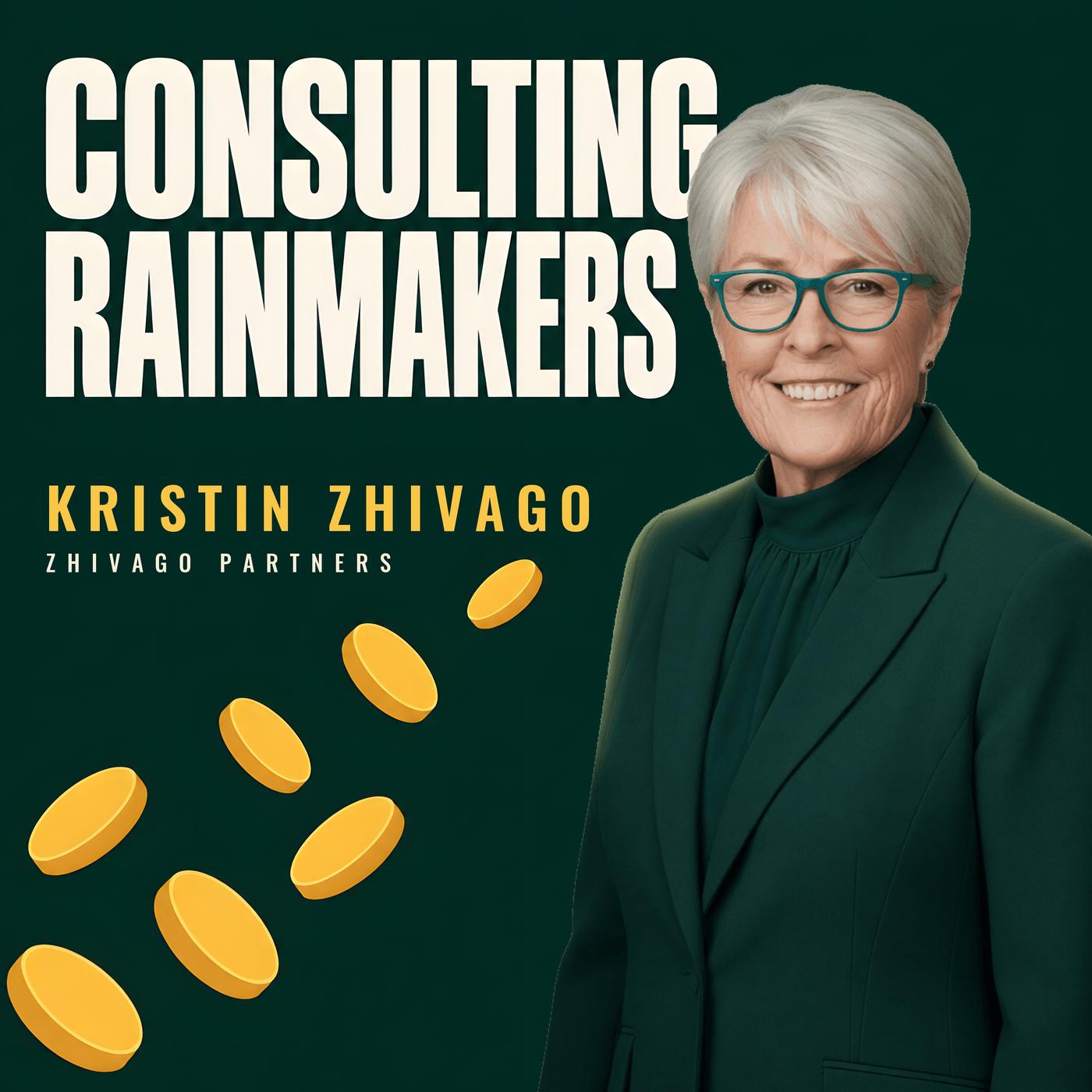
Mikulas: Welcome to Consulting Rainmakers. my guest today is Kristin Zivago, the CEO at Zivago Partners. What a coincidence, right? Kristen,
Kristin Zhivago: Yeah.
Mikulas: it's it's good to have you.
Kristin Zhivago: Thanks, I'm glad to be here.
Mikulas: So tell me after all of those years what what brought you into what you do today and if you could give us like a quick brief on w what who you are and what you do.
Kristin Zhivago: Okay, started out in Silicon Valley at the beginning of tech. So I've been in tech for decades. opened up an ad agency with my husband, and we did that together very successfully until ninety one when the Mac came out. And I looked at him and said, They're all gonna go in house. He was our graphics person. I said, Why don't you go retire and invent things? Which is what he did. He made functional things. These speakers back here are some of his work. mostly out of wood. Made a lot of different things. anyway, fascinating guy. loved him to death. then I reinvented myself as a revenue coach, and I started helping CEOs and entrepreneurs how to make more money by understanding how their customers wanted to buy. So The basic idea, and I have a book out called Roadmap to Revenue How to Sell the Way Your Customers Want to Buy. And that sums it all up. It sums up the way you find that out. I've given that away because I want everybody to do it. And the doing it is interviewing your customers, the people who have already bought from you, and finding out why and how they bought from you. Now, typically they'll tell me interviewing them more than they would to a CEO or founder. But if you don't have the budget for that, I gave away all my secrets in the book. I also talk about the different buying journeys and how you have to align your selling process with their buying process. Because the minute you start a company you stop thinking like a buyer. You start thinking like a seller and you're you're All everything you think about is going to be out of alignment with what they want. And I'll give you another big topic, which is the mindset of the customer when they set out to buy, is the most important thing. People are into personas and AI and all this data and research. They've been, they've been lately analyzing all the sales touches that have happened with their customers. But customers never tell you. what they're thinking when they're being sold to. Now
Mikulas: Mm.
Kristin Zhivago: we tend to work in B2B just because it's more interesting and I love it. mostly tech companies. But when you're being sold to, you just you don't you don't say what you're thinking because you don't want the salesperson to talk you out of your objections, which are actually not objections, but real important things that need to be addressed. And your mindset, the buyer's mindset, consists of their desires, what they want, their concerns, and their questions. And these are very specific. If you're trying to make them up or have AI write them for you, it's not gonna work. People know when you get them. They know when you care. They know when you've listened. So I get these these facts basically out of customer in-depth customer conversational interviews and then report all that back to management. Now I should finish my little why what got you here. By 2017, I realized there were a lot of companies out there who were being bested by more digitally savvy competitors. So I started Chivago Partners. And we can do all the research, the market research, customer research and all that, but we can also help you find the sales stoppers in the long sales cycle that's where people are dropping off. And we can help you rebuild your revenue growth engine. Those are the two things that we do. I have a wonderful team.
Mikulas: Mm-hmm.
Kristin Zhivago: I've been enjoying working with them for these years. And it's it's really good, it's a good life.
Mikulas: That's very interesting. And you know, I think a lot of people underestimate the the value in in customer interviews and interactions. So to make this practical, how you actually conduct a customer interview when you're working with a tech company? What's kind of the main points that you look for?
Kristin Zhivago: Well, the first thing is getting the right list. Now, the interesting thing about this work is I don't have to talk to 40 people. Siemens once insisted that I talk to 40 people, but I kept telling them you're gonna waste your money because by the seventh or tenth person, even by the fifth to seventh person of a given type, with this in-depth interviewing process, you get the trends. You see what the commonalities are between people and People will use the exact same phrase to describe the company's brand, which is what people say about you when you're not in the room. I have this famous saying, which is that marketing makes promises on behalf of the company. That's branding. Your brand is whether you keep or break those promises. And you have to align your company. You have to build a company that will keep those promises that you've made. And you have to make the right promises, the promises that customers actually care about. If you don't do that, you lose them right off the bat. The promise doesn't relate to them, so they're gone. If you make generic, homogenized sort of AI kind of promises, they're also going to disappear. Your company is unique. You're trying to find your special sauce. So the first part is getting the customers, and it's always taken way longer than I wish to get that list together because it is a small sampling, and so you have to be careful with which people you choose. In B2B, it's a lot easier because you're saying, okay, I want five CEOs, five users, five purchasing people, something like that. Then we reach out to them. The CEO introduces us, we reach out to them, my assistant makes appointments, and then we're off and running. And it's 30 minutes. Sometimes people talk longer than that. I used to talk for an hour, but now everybody's so time crunched, they manage to fit it all in into the 30 minutes. We then create reports, a conversation word-for-word transcription, a conversation transcription for the customers. We also interview the people inside the company. who work with customers. And that way we get those sales stopping things where they're frustrated trying to help customers and a bad policy or a bad management behavior or something will make that difficult. So it's a very detailed report. We summarize the insiders because we don't want people to identify them. We tell the customers up front it's anonymous. And we do anonymize the whole report. Then we do a summary, then we do recommendations. And then the second part is, of course, rebuilding that revenue growth engine. So the messages are correct, the promises are correct, the websites correct, the socials correct, all the things are aligned with those very important promises. That's the process.
Mikulas: Hmm. Are there any repeated kind of commonalities when it comes to the sales stoppers that you mentioned earlier? Like what if you look at kind of who you worked with, do the sales stoppers like repeat?
Kristin Zhivago: Yes and no. I would say that they fall into several categories. And I I used to talk about the five Ps, I think. There's product or service, whatever you're offering. There's processes, people, policies, passion. Is the CEO really passionate about this? Does he really care? He or she. In my experience. The people, now this is high tech, mostly, mostly B2B, but the people are usually very good. They're they're up there. I've actually never walked, I've went I've worked with hundreds of companies and I've never walked in and thought, man, these people are not very smart. I've never had that experience. They were well-meaning and hardworking and wanted to do the right thing. And with the right management, of course, they would. but the biggest problem is processes, and that includes IT and integration with your apps talking to each other and repeated data and you know siloed data, the all of those problems are are within the IT spectrum. Processes are where most companies fall apart.
Mikulas: Hmm. Now, how do you handle like because I assume that when you go in and when you are consulting with or interviewing, sorry, the customers, there must be like a lot of them that give you like very shallow kind of one-word answers and how do you kind of go go deep on that because if you're for example running a discovery process before the sale actually happens there is a lot of times where people you know explain their pain but it's not very specific so how you how are you able to get into The nitty gritty, if I may say it like that.
Kristin Zhivago: You would be surprised at how seldom that's a problem. They they they and even if somebody says it was okay, I'll say, can you drill down? And the next thing I know, they're they're on often running for a page worth of data. People are surprisingly educated or familiar with or detailed about their buying process. And if you think about it, Especially in B2B, where their job depended on making the right decision. Embarrassment, the fear of embarrassment is one of the biggest sales stoppers of all because nobody wants to be that guy that brought in something that turned out to be a disaster. When I used to do marketing and sales turnarounds as a revenue coach, the first thing that happened. First I'd have to calm myself down by about 80% because I'm an entrepreneur and you go into the corporate environment and it's a very different kind of pace and everybody has to approve everything. So that was lesson one. Lesson two was when you first walk in, you get this invisible whiteboard around your neck. It's like hanging from your neck. And every time you make a mistake, there's a black mark on your whiteboard. Nobody forgets the black marks on your whiteboard. They accumulate. They don't get erased. So if somebody gets too many black marks on their whiteboard, after a while, in a meeting, they'll say something and everybody will go, mm-hmm, and they completely ignore it. He bec the person becomes invisible and dismissible. It's a very bad place to be. You really shouldn't, if you're in that position, you need to go find
Mikulas: Mm-hmm.
Kristin Zhivago: another job and start over. Okay. So fear of embarrassment is a big deal. And so they really work hard on how what's the best way to deal with this? Am I asking the right questions? If I go to my boss and say, I've I think this is the one, here's my short list, and this one's the best, he's gonna start, he or she's gonna start asking me questions. Rapid fire, you know, well, does it have this? Did you check for that? What about that last time we did that and the trouble we got into? You gotta be ready with your answers. So they have thought about this a great deal. Even when I I I I did a lot of work in B2C for a while, but even a woman buying lipstick is gonna be able to talk for paragraph after paragraph about why she chose that particular lipstick and what else she tried and things like that. So it's very seldom that you
Mikulas: Mm.
Kristin Zhivago: get a one-word answer. And if you do, you just drill down and suddenly they open up.
Mikulas: Yeah, yeah. Okay, so you conduct the customer interviews, then you create a rapport, you get the information, you get the sales stoppers. now tell me more about kind of the other part, which is building that revenue engine.
Kristin Zhivago: What's happening these days because of AI is CEOs and founders have decided that they're going to take marketing into their own hands. Because they're they're tired of being frustrated with selling and marketing and not getting the answers they want. And so they're hiring vendors and sometimes they'll bring people in-house, but mostly they're hiring outside people to do specific things like SEO or like search engine optimization or social or email marketing or whatever. And then they try to make them all operate as a team. Now, what we've done is we've built the team. They are like one team coordinated, no silos. Everybody knows each other. We have weekly meetings. It's a company that brought together. We brought together the best we could find in these areas. And some of them have been with me since the very beginning. We're we've we have a very nice place. It's a safe place for nice people to work. That's one of my goals as a manager. So we've got this team, and what's happening is CEOs are trying to decide where they should put their message. And all these vendors can help with that. But if the message is wrong, they're wasting everything they're spending. I mean, I've been saying 80 to 90%, but I honestly, it's more like 100%. You you're wasting everything. The space, because you're not saying things that appeal to customers. And everybody seems to have lost that. They, as buyers, they forget it. As I mean, as sellers, they forget it. As buyers, they know exactly what I'm talking about. You know exactly what you want. And you know immediately if the customer, if the buyer, sorry, the seller understands that and can help you with it. So Everything has to be built there first and then you go out and pick channels and start spending money. That's the method. That's the roadmap to revenue that I've been helping people realize and raise their ROI and get that revenue going up like a hockey stick. That's that's how it happens.
Mikulas: Yeah, and you know, after five decades or however long, you know that
Kristin Zhivago: Yeah, like I said, I stopped counting.
Mikulas: you've been you know telling founders that their customers already have the answers, they have them in front of them. Yeah.
Kristin Zhivago: That's very good. That's the right way to say it. I'm gonna quote you on that.
Mikulas: What's one thing that now that you're kind of looking back at at kind of your career doing this, what what would you do differently now if you would have started in today's day and age? What kind of advice would you give to your younger Christine?
Kristin Zhivago: Well, the first thing is you have to embrace AI, of course. I mean, we're we're swimming in the AI pool up to our eyeballs, okay? It's just daily and and it does a wonderful job of analyzing and summarizing data. There's there's so many ways you can use AI to help with this process. And we do use AI to do some market research, competitive landscape research for clients. It's very helpful. Good macro view. It has to be checked. Because it does hallucinate still, but it's getting better. I I'd make sure that that they they took this to heart. Okay. You can you can waste years of effort and money and time and people just talking about the wrong stuff. And unfortunately, marketing's not like manufacturing, where you walk in and if the if something's broken in the factory, you see it right away. or accounting or any of the other elements of business, you can see the problems pretty quickly. Marketing, you can go for months or even years hobbling along, thinking that you're doing all the right stuff. And if the message is wrong, you're just missing the mark. You may as well just go into a high rise building and start throwing money out the window. It it's that's what gets me up in the morning. Is that I keep seeing all this waste. And and maybe your next question, since you're a smart guy, would be, what's keeping them from doing this? And I've been asking myself this question for decades. It's
Mikulas: Yeah.
Kristin Zhivago: like, what is it? Are you I and I think a lot of it is they're afraid customers will tell them something that makes it very difficult for them to change. And that has not been my experience. My experience has been that the product's pretty good, the people are good, the processes definitely need work, but the basic thing they're selling is marketable. And if they present
Mikulas: Mm.
Kristin Zhivago: it properly, then you're in good shape. My famous, my favorite rather story about this is about Kentucky fried chicken. There was a a client I knew who was sitting in front of his engineers and saying, What makes us special? And they were telling him bits and bites and feeds and speeds. And here this was the hardest thing for us to do, you know, but we pulled it off. And he said, you know, not a single one of you, if you were selling Kentucky fried chicken, your date your data sheet would be dead chicken parts fried in grease at 200 or 400 degrees. That's what you're doing right now. You not one of you would have thought of finger licking good. Which is what I consider to be the peak moment of satisfaction when you have Kentucky Fried Chicken. You haven't gotten indigestion yet. You're licking your fingers. It's the it's it's the epitome, the wonderfulness. And people that run companies are sitting on that Kentucky fried chicken finger-licking good moment, and they don't even realize it. That's what people want.
Mikulas: Hmm.
Kristin Zhivago: That's what people are buying. They're not buying dead chicken parts. So it this is really
Mikulas: Yeah.
Kristin Zhivago: sad. Your customers are a gold mine. And here's one more thing. AI, when it goes out and writes copy for you, it's it's scrapes all of your competitors' copy. And it comes back with copy that's very similar. Even a competitor selling exactly the same thing as you is different than you are. They're Processes are different, their people are different, the decisions they make, the way they treat customers, the promises they make, all of that is unique. So homogenized copy does not
Mikulas: Yeah.
Kristin Zhivago: help you. You need to be specific.
Mikulas: Mm. Yeah, that's totally true. And you know, I think us as humans, we a lot of the times have all of the answers kind of in front of us. But we
Kristin Zhivago: Yeah.
Mikulas: rather look at kind of the new and shiny stuff that we haven't tried yet, when in reality it's it's all there. what's what's kind of next for you, Kristin, in terms of you know where you want to Take the firm.
Kristin Zhivago: What I've been doing is building building up. There are two people that I work with who I really respect and I believe that I can rise up more to the strategic level and delegate more. I've been doing that very carefully this whole year. I attended this wonderful class called the CEO Accelerator course, and I highly recommend it. it's for founders and CEOs who want to 10X their companies. And really changed I have to say it changed my working life because I've been very hard, hands-on kind of manager my whole life. And this made me say, wait a minute, it's time for me to come up here, because I do sort of operate at the visionary level, and just have the whole company run by these two very capable people. And then at some point I'll probably bow out and let them, you know, put keep getting the method out there and and helping people learn from their customers. So that's where I'm going.
Mikulas: very cool. Well until customers are people, you're all good, at least your business, right? Until the the the interview is the the interviewee is the the real human. Christine, if people would like to reach out to you or you know see what you're doing. where can they do so?
Kristin Zhivago: the easiest thing, first of all, you can Google or AI me and I'm all over the place there. So just my name gets you what you need to see. My website is chivagopartners dot com. I do a lot of podcasting. and I'm on social, LinkedIn, you know, the usual places. I also the
Mikulas: Sounds good.
Kristin Zhivago: book the book is on Amazon and I need to get an audible book out there because everybody's doing that these days. But anyway, it's roadmap to revenue, how to sell the way your customers want to buy.
Mikulas: Wow, that's that's a very compelling title, I must say. All right, well I will leave links down below and thank you Kristen for joining to today's episode.
Kristin Zhivago: My pleasure, you did a great job. Thank you.
Kristin Zhivago: Yeah.
Mikulas: it's it's good to have you.
Kristin Zhivago: Thanks, I'm glad to be here.
Mikulas: So tell me after all of those years what what brought you into what you do today and if you could give us like a quick brief on w what who you are and what you do.
Kristin Zhivago: Okay, started out in Silicon Valley at the beginning of tech. So I've been in tech for decades. opened up an ad agency with my husband, and we did that together very successfully until ninety one when the Mac came out. And I looked at him and said, They're all gonna go in house. He was our graphics person. I said, Why don't you go retire and invent things? Which is what he did. He made functional things. These speakers back here are some of his work. mostly out of wood. Made a lot of different things. anyway, fascinating guy. loved him to death. then I reinvented myself as a revenue coach, and I started helping CEOs and entrepreneurs how to make more money by understanding how their customers wanted to buy. So The basic idea, and I have a book out called Roadmap to Revenue How to Sell the Way Your Customers Want to Buy. And that sums it all up. It sums up the way you find that out. I've given that away because I want everybody to do it. And the doing it is interviewing your customers, the people who have already bought from you, and finding out why and how they bought from you. Now, typically they'll tell me interviewing them more than they would to a CEO or founder. But if you don't have the budget for that, I gave away all my secrets in the book. I also talk about the different buying journeys and how you have to align your selling process with their buying process. Because the minute you start a company you stop thinking like a buyer. You start thinking like a seller and you're you're All everything you think about is going to be out of alignment with what they want. And I'll give you another big topic, which is the mindset of the customer when they set out to buy, is the most important thing. People are into personas and AI and all this data and research. They've been, they've been lately analyzing all the sales touches that have happened with their customers. But customers never tell you. what they're thinking when they're being sold to. Now
Mikulas: Mm.
Kristin Zhivago: we tend to work in B2B just because it's more interesting and I love it. mostly tech companies. But when you're being sold to, you just you don't you don't say what you're thinking because you don't want the salesperson to talk you out of your objections, which are actually not objections, but real important things that need to be addressed. And your mindset, the buyer's mindset, consists of their desires, what they want, their concerns, and their questions. And these are very specific. If you're trying to make them up or have AI write them for you, it's not gonna work. People know when you get them. They know when you care. They know when you've listened. So I get these these facts basically out of customer in-depth customer conversational interviews and then report all that back to management. Now I should finish my little why what got you here. By 2017, I realized there were a lot of companies out there who were being bested by more digitally savvy competitors. So I started Chivago Partners. And we can do all the research, the market research, customer research and all that, but we can also help you find the sales stoppers in the long sales cycle that's where people are dropping off. And we can help you rebuild your revenue growth engine. Those are the two things that we do. I have a wonderful team.
Mikulas: Mm-hmm.
Kristin Zhivago: I've been enjoying working with them for these years. And it's it's really good, it's a good life.
Mikulas: That's very interesting. And you know, I think a lot of people underestimate the the value in in customer interviews and interactions. So to make this practical, how you actually conduct a customer interview when you're working with a tech company? What's kind of the main points that you look for?
Kristin Zhivago: Well, the first thing is getting the right list. Now, the interesting thing about this work is I don't have to talk to 40 people. Siemens once insisted that I talk to 40 people, but I kept telling them you're gonna waste your money because by the seventh or tenth person, even by the fifth to seventh person of a given type, with this in-depth interviewing process, you get the trends. You see what the commonalities are between people and People will use the exact same phrase to describe the company's brand, which is what people say about you when you're not in the room. I have this famous saying, which is that marketing makes promises on behalf of the company. That's branding. Your brand is whether you keep or break those promises. And you have to align your company. You have to build a company that will keep those promises that you've made. And you have to make the right promises, the promises that customers actually care about. If you don't do that, you lose them right off the bat. The promise doesn't relate to them, so they're gone. If you make generic, homogenized sort of AI kind of promises, they're also going to disappear. Your company is unique. You're trying to find your special sauce. So the first part is getting the customers, and it's always taken way longer than I wish to get that list together because it is a small sampling, and so you have to be careful with which people you choose. In B2B, it's a lot easier because you're saying, okay, I want five CEOs, five users, five purchasing people, something like that. Then we reach out to them. The CEO introduces us, we reach out to them, my assistant makes appointments, and then we're off and running. And it's 30 minutes. Sometimes people talk longer than that. I used to talk for an hour, but now everybody's so time crunched, they manage to fit it all in into the 30 minutes. We then create reports, a conversation word-for-word transcription, a conversation transcription for the customers. We also interview the people inside the company. who work with customers. And that way we get those sales stopping things where they're frustrated trying to help customers and a bad policy or a bad management behavior or something will make that difficult. So it's a very detailed report. We summarize the insiders because we don't want people to identify them. We tell the customers up front it's anonymous. And we do anonymize the whole report. Then we do a summary, then we do recommendations. And then the second part is, of course, rebuilding that revenue growth engine. So the messages are correct, the promises are correct, the websites correct, the socials correct, all the things are aligned with those very important promises. That's the process.
Mikulas: Hmm. Are there any repeated kind of commonalities when it comes to the sales stoppers that you mentioned earlier? Like what if you look at kind of who you worked with, do the sales stoppers like repeat?
Kristin Zhivago: Yes and no. I would say that they fall into several categories. And I I used to talk about the five Ps, I think. There's product or service, whatever you're offering. There's processes, people, policies, passion. Is the CEO really passionate about this? Does he really care? He or she. In my experience. The people, now this is high tech, mostly, mostly B2B, but the people are usually very good. They're they're up there. I've actually never walked, I've went I've worked with hundreds of companies and I've never walked in and thought, man, these people are not very smart. I've never had that experience. They were well-meaning and hardworking and wanted to do the right thing. And with the right management, of course, they would. but the biggest problem is processes, and that includes IT and integration with your apps talking to each other and repeated data and you know siloed data, the all of those problems are are within the IT spectrum. Processes are where most companies fall apart.
Mikulas: Hmm. Now, how do you handle like because I assume that when you go in and when you are consulting with or interviewing, sorry, the customers, there must be like a lot of them that give you like very shallow kind of one-word answers and how do you kind of go go deep on that because if you're for example running a discovery process before the sale actually happens there is a lot of times where people you know explain their pain but it's not very specific so how you how are you able to get into The nitty gritty, if I may say it like that.
Kristin Zhivago: You would be surprised at how seldom that's a problem. They they they and even if somebody says it was okay, I'll say, can you drill down? And the next thing I know, they're they're on often running for a page worth of data. People are surprisingly educated or familiar with or detailed about their buying process. And if you think about it, Especially in B2B, where their job depended on making the right decision. Embarrassment, the fear of embarrassment is one of the biggest sales stoppers of all because nobody wants to be that guy that brought in something that turned out to be a disaster. When I used to do marketing and sales turnarounds as a revenue coach, the first thing that happened. First I'd have to calm myself down by about 80% because I'm an entrepreneur and you go into the corporate environment and it's a very different kind of pace and everybody has to approve everything. So that was lesson one. Lesson two was when you first walk in, you get this invisible whiteboard around your neck. It's like hanging from your neck. And every time you make a mistake, there's a black mark on your whiteboard. Nobody forgets the black marks on your whiteboard. They accumulate. They don't get erased. So if somebody gets too many black marks on their whiteboard, after a while, in a meeting, they'll say something and everybody will go, mm-hmm, and they completely ignore it. He bec the person becomes invisible and dismissible. It's a very bad place to be. You really shouldn't, if you're in that position, you need to go find
Mikulas: Mm-hmm.
Kristin Zhivago: another job and start over. Okay. So fear of embarrassment is a big deal. And so they really work hard on how what's the best way to deal with this? Am I asking the right questions? If I go to my boss and say, I've I think this is the one, here's my short list, and this one's the best, he's gonna start, he or she's gonna start asking me questions. Rapid fire, you know, well, does it have this? Did you check for that? What about that last time we did that and the trouble we got into? You gotta be ready with your answers. So they have thought about this a great deal. Even when I I I I did a lot of work in B2C for a while, but even a woman buying lipstick is gonna be able to talk for paragraph after paragraph about why she chose that particular lipstick and what else she tried and things like that. So it's very seldom that you
Mikulas: Mm.
Kristin Zhivago: get a one-word answer. And if you do, you just drill down and suddenly they open up.
Mikulas: Yeah, yeah. Okay, so you conduct the customer interviews, then you create a rapport, you get the information, you get the sales stoppers. now tell me more about kind of the other part, which is building that revenue engine.
Kristin Zhivago: What's happening these days because of AI is CEOs and founders have decided that they're going to take marketing into their own hands. Because they're they're tired of being frustrated with selling and marketing and not getting the answers they want. And so they're hiring vendors and sometimes they'll bring people in-house, but mostly they're hiring outside people to do specific things like SEO or like search engine optimization or social or email marketing or whatever. And then they try to make them all operate as a team. Now, what we've done is we've built the team. They are like one team coordinated, no silos. Everybody knows each other. We have weekly meetings. It's a company that brought together. We brought together the best we could find in these areas. And some of them have been with me since the very beginning. We're we've we have a very nice place. It's a safe place for nice people to work. That's one of my goals as a manager. So we've got this team, and what's happening is CEOs are trying to decide where they should put their message. And all these vendors can help with that. But if the message is wrong, they're wasting everything they're spending. I mean, I've been saying 80 to 90%, but I honestly, it's more like 100%. You you're wasting everything. The space, because you're not saying things that appeal to customers. And everybody seems to have lost that. They, as buyers, they forget it. As I mean, as sellers, they forget it. As buyers, they know exactly what I'm talking about. You know exactly what you want. And you know immediately if the customer, if the buyer, sorry, the seller understands that and can help you with it. So Everything has to be built there first and then you go out and pick channels and start spending money. That's the method. That's the roadmap to revenue that I've been helping people realize and raise their ROI and get that revenue going up like a hockey stick. That's that's how it happens.
Mikulas: Yeah, and you know, after five decades or however long, you know that
Kristin Zhivago: Yeah, like I said, I stopped counting.
Mikulas: you've been you know telling founders that their customers already have the answers, they have them in front of them. Yeah.
Kristin Zhivago: That's very good. That's the right way to say it. I'm gonna quote you on that.
Mikulas: What's one thing that now that you're kind of looking back at at kind of your career doing this, what what would you do differently now if you would have started in today's day and age? What kind of advice would you give to your younger Christine?
Kristin Zhivago: Well, the first thing is you have to embrace AI, of course. I mean, we're we're swimming in the AI pool up to our eyeballs, okay? It's just daily and and it does a wonderful job of analyzing and summarizing data. There's there's so many ways you can use AI to help with this process. And we do use AI to do some market research, competitive landscape research for clients. It's very helpful. Good macro view. It has to be checked. Because it does hallucinate still, but it's getting better. I I'd make sure that that they they took this to heart. Okay. You can you can waste years of effort and money and time and people just talking about the wrong stuff. And unfortunately, marketing's not like manufacturing, where you walk in and if the if something's broken in the factory, you see it right away. or accounting or any of the other elements of business, you can see the problems pretty quickly. Marketing, you can go for months or even years hobbling along, thinking that you're doing all the right stuff. And if the message is wrong, you're just missing the mark. You may as well just go into a high rise building and start throwing money out the window. It it's that's what gets me up in the morning. Is that I keep seeing all this waste. And and maybe your next question, since you're a smart guy, would be, what's keeping them from doing this? And I've been asking myself this question for decades. It's
Mikulas: Yeah.
Kristin Zhivago: like, what is it? Are you I and I think a lot of it is they're afraid customers will tell them something that makes it very difficult for them to change. And that has not been my experience. My experience has been that the product's pretty good, the people are good, the processes definitely need work, but the basic thing they're selling is marketable. And if they present
Mikulas: Mm.
Kristin Zhivago: it properly, then you're in good shape. My famous, my favorite rather story about this is about Kentucky fried chicken. There was a a client I knew who was sitting in front of his engineers and saying, What makes us special? And they were telling him bits and bites and feeds and speeds. And here this was the hardest thing for us to do, you know, but we pulled it off. And he said, you know, not a single one of you, if you were selling Kentucky fried chicken, your date your data sheet would be dead chicken parts fried in grease at 200 or 400 degrees. That's what you're doing right now. You not one of you would have thought of finger licking good. Which is what I consider to be the peak moment of satisfaction when you have Kentucky Fried Chicken. You haven't gotten indigestion yet. You're licking your fingers. It's the it's it's the epitome, the wonderfulness. And people that run companies are sitting on that Kentucky fried chicken finger-licking good moment, and they don't even realize it. That's what people want.
Mikulas: Hmm.
Kristin Zhivago: That's what people are buying. They're not buying dead chicken parts. So it this is really
Mikulas: Yeah.
Kristin Zhivago: sad. Your customers are a gold mine. And here's one more thing. AI, when it goes out and writes copy for you, it's it's scrapes all of your competitors' copy. And it comes back with copy that's very similar. Even a competitor selling exactly the same thing as you is different than you are. They're Processes are different, their people are different, the decisions they make, the way they treat customers, the promises they make, all of that is unique. So homogenized copy does not
Mikulas: Yeah.
Kristin Zhivago: help you. You need to be specific.
Mikulas: Mm. Yeah, that's totally true. And you know, I think us as humans, we a lot of the times have all of the answers kind of in front of us. But we
Kristin Zhivago: Yeah.
Mikulas: rather look at kind of the new and shiny stuff that we haven't tried yet, when in reality it's it's all there. what's what's kind of next for you, Kristin, in terms of you know where you want to Take the firm.
Kristin Zhivago: What I've been doing is building building up. There are two people that I work with who I really respect and I believe that I can rise up more to the strategic level and delegate more. I've been doing that very carefully this whole year. I attended this wonderful class called the CEO Accelerator course, and I highly recommend it. it's for founders and CEOs who want to 10X their companies. And really changed I have to say it changed my working life because I've been very hard, hands-on kind of manager my whole life. And this made me say, wait a minute, it's time for me to come up here, because I do sort of operate at the visionary level, and just have the whole company run by these two very capable people. And then at some point I'll probably bow out and let them, you know, put keep getting the method out there and and helping people learn from their customers. So that's where I'm going.
Mikulas: very cool. Well until customers are people, you're all good, at least your business, right? Until the the the interview is the the interviewee is the the real human. Christine, if people would like to reach out to you or you know see what you're doing. where can they do so?
Kristin Zhivago: the easiest thing, first of all, you can Google or AI me and I'm all over the place there. So just my name gets you what you need to see. My website is chivagopartners dot com. I do a lot of podcasting. and I'm on social, LinkedIn, you know, the usual places. I also the
Mikulas: Sounds good.
Kristin Zhivago: book the book is on Amazon and I need to get an audible book out there because everybody's doing that these days. But anyway, it's roadmap to revenue, how to sell the way your customers want to buy.
Mikulas: Wow, that's that's a very compelling title, I must say. All right, well I will leave links down below and thank you Kristen for joining to today's episode.
Kristin Zhivago: My pleasure, you did a great job. Thank you.
