


Michelle Choairy: Welcome to Complex Kids Simple Solutions, the podcast for parents raising complex and neurodivergent kids who are doing their best in systems that don't always make things easy. I'm Michelle Shoeidi, founder of Special Education Concierge, a mom to a complex kid, a speaker, and an advocate. This space isn't about perfection. It's about real life, the hard days, the small wins. The moments where you wonder if you're doing enough, and the moments where you realize you are. Here we talk honestly, share practical insight, and simplify what feels overwhelming. One conversation at a time, you are your child's hero. Hi everyone, welcome back to Complex Kids Simple Solutions. I'm so excited to have Holly today on the show. And Holly and I met through a really weird way online, which the majority of the people that I bring use from online, but I'm very excited to talk to her. So welcome, Holly. Thank you. So excited to be here. Yes. All right, so there is a reason that I brought you on the show. And so tell us that reason and where you come from and what you're doing. Well, I probably occupy a very small niche in ⁓ education and more specifically special education, in that ⁓ my expertise is in handwriting and more specifically in ⁓ handwriting acquisition by really young children. ⁓ my expertise is not in special needs, nor am I an OT, but ⁓ because the two worlds intersect, I find myself talking a lot to parents and teachers with special needs kids, and I have a great network of OTs that I ⁓ am in contact with on a regular basis. We we ⁓ network together, and so I have ⁓ access to all kinds of opinions and ideas and ⁓ ways to help kids through handwriting ⁓ practice, even those that struggle in this area. Yeah. And I love that. And the reason why ⁓ I was like immediately like, I got it. Send her a message. Is because my son, my son's handwriting is not where it needs to be at all. He's in sixth grade and he barely writes and reads. So I wanted to bring you on so we could talk about this because I think that this is a problem. ⁓ you know, around the the country and the world. I feel like we are so used now to ⁓ type on a phone, or even my son, he can get through with Siri to do anything that he wants. So he doesn't really have to write. I don't think that it's a choice on his writing, but you know, we are moving away from handwriting also. So there's a lot to unpack here on what we're gonna talk about. So let's start. ⁓ tell us like how how let's say you get a kiddo and you go, okay, how do how do you help him? How do you start? Well, there's a lot of questions to ask before I can answer that. So things that need to be considered. ⁓ first of all, ⁓ age is a very big deal. And the reason it's a very big deal is because like any motor skill, if you have been handwriting for a long time, it's ingrained in your muscle memory, the way you do it, even if you do it poorly. And if you were taught poorly, or not taught at all, just expected to do it. With very little explicit instruction, then the likelihood that you've mastered handwriting is pretty low. Because we where we start sets us up on a trajectory for improvement or struggle. And likely, because of the age of your son, he did not get the ⁓ probably step-by-step explicit instruction necessary for starting correctly. So he finds himself not only at a place where he can't write well, he finds himself at a place he can't improve because he doesn't know differently. He only knows what he knows and he only knows what he's practiced for the last, you know, eight years of his life. So so I think ⁓ knowing that your son is in sixth grade and has been doing this for a very long time, my next question would have to do with his special needs. ⁓ physical needs and cognitive needs both need to be considered when you do Yes. ⁓ when you try to teach a child handwriting. Yeah, and definitely like he has dyspraxia. So motor planning is a really hard thing for him. ⁓ motor planning and even for his speech, he has childhood approxy of speech. So it it's still that motor planning, the dyspraxia that comes ⁓ with it. And of course, like he can't read and he's in sixth grade. So there is that into you know intellectual disability that's also playing a role here. But ⁓ you know, I do remember Holly ⁓ as you were talking and I remember my son has been getting those to this day. He's like tracing, right? So the teacher will write something and he goes over it and he traces that. So now it's like on the highlighting and he does that. He's still trying to learn how to keep the dots together. And he's been doing this for years since pre K. So much I wan I just I wish I could just meet your son and Okay. Well, let's do that. We're gonna do that. But that is like I mean i and and this is one of the reasons why I was so excited to talk to you because it seems to me like everything that they're doing it's just repetition, repetition, repetition. But we've been repetitioning for, you know, eight years and it's not getting anywhere. It is. Yeah. Yes. It's not right for him. That's not right for him. And and it's not just about him, right? It's about the kids that are out there and they still Can't write. Like we're talking to special needs moms here, right? And there's always gonna be a little bit of something going on. They either, you know, they're neurodivergent, they have autism, they have dyspraxia, they have Down syndrome. And and I know that all of this plays a role, but what are we doing? It's just it's if things are not helping, we need to change. And so I would love to hear when you see something like this. And we can go back to the early intervention in just a little bit, but let's finish this conversation here. But like what would you do in a situation like this? And what do you think about the tracing? Yeah, okay, such good questions. Let's see. ⁓ first of all, any any kid that comes to me, especially neurodivergent, ⁓ I I want to know why. the caregivers, parents, special interventionists, why they want the child to handwrite. And I am listening for specific answers. If it if they don't know why a child should handwrite, then I need them to know why it's important that a child handwrites. And if they think that speaking and ⁓ speaking and typing is enough Then I want to know why we're pushing handwriting if a child can communicate the other way. There's so many, there is not a right and a wrong way, Michelle, so I just want to be really clear because it depends on the child. But let's speak broadly about what handwriting does for the brain and in some ways for the motor skills. Because a lot of these neurodivergence kiddos have issues on one or both. Of those sides. And I do like to split handwriting into those two major components, which is why our program is so unique, our resources are so unique, because it takes into account motor skill separate from letter knowledge and ability. Because you know, transcription skill is two part. We've got the we've got the mechanical part of getting words on paper, and then we have the cognitive part of even understanding the words that are getting onto paper. the the sound to the grapheme to phoneme ⁓ correspondence that ⁓ that you start with. So so obviously it's pretty complex, there's a lot to it, and non divergent kids present their own issues. So they have to be ⁓ they have to be treated as such. So if your kids can hold a pencil And if your kids can recognize letters, then yes, we can learn to map letters onto paper using the kinesthetic connection we call handwriting. And if we can ⁓ break it down for those kiddos, then we can determine what piece of the handwriting monster is stopping them up. And it could be physical impairment. It could be a visiospatial issue. It could be an orientation issue, which is visiospatial, or it could be eye-hand coordination. So the depending on where those bumps are in a child's handwriting attempts, we will then use activities and repetition through those activities to build the neuropathways necessary to reconnect whatever is disconnected. And ⁓ so as parents, ⁓ one of the things I I'll just throw out a few activities you can try and see if this is an issue. First of all, it's really important to figure out, and a lot of parents already know this, especially in sixth grade, if the difficulty is in holding ⁓ a writing instrument. If it is a if it's difficulty in holding a writing instrument, there's a lot of exercises and activities you can do that have nothing to do with holding a writing instrument that might improve hand strength, that might improve eye hand coordination. And a lot of those things are large motor skill exercises like like ⁓ doing pull ups on a on a pull up bar. I'm I'm speaking to sixth six sixth grader. Of course playing on a playground or doing the monkey bars. Balance also helps that you know the vestibular side of things where you're like trying to orientate things in your head and your eyes and ⁓ wobble boards are a good way of of starting to connect the brain to the body in special ways. Yes. There's also going No continue. No, continue, continue. Just a couple other thoughts this is real quick. So cool. Things like dot to dot. I would recommend this for your son. I don't know if you've done this yet, maybe you have. But ⁓ dot to dot is interesting in that, and you don't think about it until because when you're when you're not challenged, ⁓ it seems to come pretty naturally. But one of the weird things about dot to dot is you if you trace a line, and this is speaks to the letter tracing that your son's doing, if you trace a line, just think about where your pencil and your eye start. And where your pencil and your eye go. And you can see that your eye is attached to your pencil, right? As you're moving across the page. Yes. Dot to dot with no tracing line means that your eye has to go before your hand. And you have to move your eyeball and plan your move. And a lot of us do that, it seems very, very naturally. Kids like your s your son need practice doing that. And the harder the the closer the dots are, the easier it is for them to do it. The further those dots get apart, the harder it is. So oddly enough, when if somebody would were to say, hey, he needs to do more dot to dot, and he's doing super complicated dot to dots, sometimes that makes it easier for them because it's all, you know, very tiny. But when you start asking them to to draw longer trajectories, it gets harder. It it's much harder for them. You can do that on a flat plane like pencil to paper. You can also do it on a vertical plane, like you might do if you were drawing out in in a board. Yes, on a board or out in nature and you've got an easel and you're drawing those kinds of things. So yeah so those are those are just a couple really quick ⁓ Thoughts in terms of breaking down where are we, where are we finding the problems? Yeah. You know, I and you were talking about you know, basically if you need to know where it is and you have to plan where you're gonna go, that is the motor planning, correct? That is what you're doing. And when the motor planning is not quite there, that's probably where the the breakdown is coming from. And I and I understand that. It's actually I would love for you to take a look at it because like I said, you know, we've been really doing the same things ever since he was in pre-K. Yeah. Right. And so and now, just so you know, just to kind of round this area, this part of the conversation, he's actually we have moved on to trying to get him to type on a keyboard. Because how's his finger dexterity? ⁓ fine. He's he's still using, you know, two fingers or whatever. But he's, you know, he can find the letters on the keyboard now. And ⁓ you know, he's I mean, I can show you the work that he's doing. He's still going over highlighted things with his pencil, like it's you know, it's still doing a lot of a lot of that. So, but anyway, what what drives me crazy is when you know the the school system is just they just keep doing the same thing over and over again, expecting a different result. It's insanity. And so, you know, it's just and I get insane too because I'm like, we gotta move on from this. And so ⁓ you know, I just had a thought. One of the things that I have noticed in handwriting. And I think this is with everybody in general. Excuse me. Is that when you use a sharpie or something that's a little thicker, it looks so much better. So like for example and and a sharp like my son, when he used a sharpie, it looks so much better. And maybe it's just because the the lines are not so thin for you to see, but One other way that I've seen that his handwriting is a little bit better is also with an apple pencil. So as he draws it, and I don't know if it's just the way that the pen or the pencil like the pen glides on the screen or if it's the Sharpie or something like that. I don't know. Have you ever noticed that? If you haven't, you should know you should tr you should see that because it's it's a very interesting to me. He can like his his letters look so much better when he is using like the Apple Pencil or Sharpie. And maybe it's because we can't see it as much. Obviously it would be very hard to write an essay with a Sharpie. So of course we're talking somebody who is, you know, still working on comfortable formation and that kind of stuff. And yes, you can ⁓ you Size of lettering is a little bit weird because we when you get to younger kids, it's actually a little bit harder for them to do it bigger because they don't have the control to ⁓ to make straight lines. You know, they're still kind of wiggly and but it is different. That's why at the very beginning I said age is such a big deal because the ability to control your large motor skills and hone your smaller motor skills ⁓ varies depending on how long you've been using your motor skills. Of course. ⁓ so it and when it comes to the the glass writing with the stylus, ⁓ yes, there's a lot of talk about that, not a huge amount of research on this. ⁓ there's a ⁓ a common thought that ⁓ textural stuff teaches sensory better or ⁓ so There's ⁓ that the friction that's caused ⁓ by a pencil being on paper is thought to be a better sensory input, a stronger sensory input, especially for newer kids. Again, I can't point to specific research on this. It's probably out there, but I I can't readily recall it in my brain. but I would say for older kids, it probably just ⁓ has a lot more to do with exposure and frequent use. So if he is more used to using a stylus and working on on, you know, that that whatever it is on glass, ⁓ it probably has a lot to do with the practice he's been doing. Yeah. He hasn't been. Like we we haven't introduced that. He's still trying to write on paper and doing all of that. Okay. So we talked a little bit about the older kids. Let's talk a little bit about the early intervention, which is probably the mean time that you are seeing the kiddos, correct? Right. Right. Yes. Okay, let's talk about that. Tell us. So the really great thing about catching about introducing handwriting early is that it's a lot like learn learning a language or a a an instrument or a sport. where you have these huge open windows, tons men ⁓ billions of neurons, you know, floating around trying to find meaning and and and connection. And they do that through sensory input. And handwriting is just such a good sensory input. so I think I touched on the idea that we split motor skill from letter learning. So when we're very young, when we're working with kids very young, We are really focusing on the motor skills because that's gonna come first. And and that is because motor skill is different from cognitive knowledge and cognition develops differently, starting with very concrete understandings, one-to-one correspondence of the physical environment. So any parent would know that we we just automatically start pointing to things and calling them what they are, right? A cat, brother, cup, you know, whatever, table. And the kids really pick that up very early, like before the age of two. They're starting to say water or, you know, things that they that they are exposed to on a regular basis. What is harder for a kid to understand is a sound to symbol ⁓ understanding. So that that it that shape you see on the on the paper is called a B. That's easy for them. Over time that's the first thing that they get is you see the B, you say the B, ⁓ that's what that is called. So they're basically naming a shape. But knowing that that B symbolizes b and spells a word and formulates a thought, that gets way more complicated. So when it comes to handwriting, it's just better for the kids if you're gonna start early and To separate those two things and make sure you're working on the motor skills needed for handwriting and while you're working on the letter knowledge needed for handwriting. The our squiggle squad is the is the curriculum that I have written. I did this on purpose because this is not the way handwriting is taught. And we're asking three and four-year-olds to write letters and they have no idea what a letter is. They can't hold a pencil, they can't control their muscles. So you are basically Creating this frustration because kids really want to understand. They naturally are seeking connection. They're naturally seeking to please you and do what the teacher's asking. But when you ask too much, they can't do it. And so it's no wonder to me that that kids often say they hate writing because we walk them into it in such a weird way and just expect them to pick it up. When you're working with neurodivergent kids. you have to be especially mindful of the of the ⁓ different needs of each of those kids and and really ⁓ intuit what ⁓ aspects of handwriting instruction are needed to be targeted. So in a young child we that's what we do. We separate motor skill and the at the same time they're learning what a letter looks like, what it says and they're and then on the other hand they're learning All of the they're gaining muscle strength, dexterity, eye hand coordination, all those things that are gonna be necessary to put them all together and create what we call hate. Yeah. ⁓ you know, it's interesting because you know, kids so you look at the school, at the school system, and this is what they do, right? They go through, okay, this these are the letters, ⁓ these are the sounds, be b b ball, you know, c cat and it goes into the phonics, right? And then they go into that. But and and it's it it seems like it's easier to verbalize things than to think about it and put it on paper. It is. And so yeah, it's it and so it I think that and and if I get what you're saying is that usually comes before the handwriting actually even really starts. It should, but schools try to introduce it all at once. ⁓ so that's what you're saying. It shouldn't be that way. We should break it up. Yep. Developmentally they're not ready to take it all at once. They're learning all these component parts that are necessary for, you know, for them to be able to do it. But when you throw it all together, you really gum up the the all all the systems. And the the that cognitive you know, what's referred to as cognitive overload presents an obstacle to the kids trying to learn. Okay. So as a parent, all right, like for me, I would have never thought to go look for somebody who can teach my kid how to handwrite. Okay. Exactly. I know because because he's getting OT school. And he has school, right? So you think that it's being taken care of. Right. So how would you as a parent know that you like 911 here on the handwriting? What is going on and how like I need like how would you know what are the cues? What are the things that we should be looking for? ⁓ to that we need extra help? That we would need to come to you. Well, you actually opened with the problem. The problem and the big red flag is if you are not seeing improvement. If you are, even over the course of a year, handwriting should improve. Now and and ⁓ let me make this clear. I do not when I refer to handwriting, I am not referring to penmanship. And I think that that is a really important thing. We need legibility, yes. Do we need Spencerian script? No. And it I mean honestly, Michelle, I'll be I wish I could. My my handwriting is not pretty. My handwriting I'm not I'm not about calligraphy. We're not about beautiful penmanship. What's that? It's functional. It's functional and ⁓ and more importantly, it is a tool. for the user to help them think deeply. And we have lost sight of the fact that that brain hand connection creates a different process in the brain that helps you think better. It makes you smarter. And I think so we are so one thing is ⁓ illegibility is an issue. If you cannot read your own writing And other people you're trying to communicate with cannot read your writing, then yeah, that needs to be worked on. There's a few other aspects that we're looking for, however. We are looking for efficiency. Does every letter you write take forever to write? This was ha happening to me when I was teaching up in fifth grade. I would ask the kids to write something, and it would take forever. And I'm thinking to myself, These kids should be writing essays, and I can hardly get them to write a sentence, let alone a paragraph, because it's so slow. And by the way, they couldn't keyboard either. They're, you know, doing the tap, tap, tap, tap. So transcription skills, because handwriting is ultimately a transcription skill. We're getting the invisible visible on paper. That is the ultimate goal, is hone your thought, make it clear, get it visible to read. Yes. Whether you're you know, whether you do that on on typing or handwriting is, you know, that's that's neither here nor there at this point. But the idea is transcript transcribing our thoughts. So so anyway, that's that if if they are struggling to do that, we go back to the why. Why are they struggling to do that? And when we map the letters onto paper, we start to understand the letters better. And when we map words onto paper, we start to understand words better. And when we map sentences on to paper, we start to understand thought better. And we as educators have got to understand the build up. And that's why starting young is so great, but you have to build it up. And to your question about what what parents should do, I I I feel for parents because I am struggling right now to ⁓ to help educators understand why what they're doing is not do they're not doing it well. And I do want to be quick to say that it's not educators' fault. This is not being taught in teachers' colleges. This isn't even being taught in OT schools. OT is about ⁓ much about the the the mechanical and brains. connection that happens between the hand. But when it comes to actually instructing how to make letters and teach letters and put letters together to string them together and to make words and thoughts, that's not a that is not touched on. And it's a it ⁓ teachers' colleges is, you know, where they first just sort of disappeared, the art of handwriting instruction. And and and now schools ⁓ admin, et cetera. They're gone into that. Yeah. Well no well, here's the thing. They first pushed all of this hard, you know, STEM computers, et cetera. So they pushed out handwriting. They pushed out the instructions teaching the teachers. And now they're pushing out the technology, but they're not showing the teachers how to teach them. Yes. Yeah. So now the poor teachers are they're There it's like whiplash for these teachers. They're I just feel for them so, so much. But anyway, there's an art to it. There's a yes, there's a good way and there's very wrong way to it. Yes. So, you know, one of the interesting things. So I ⁓ just a little fun fact, but I was born and raised in Brazil. I I came out to the I came out to the United States when I was seventeen years old. Wow. And our our handwriting, I I write cursive. And once I got here to the United States, I my handwriting kinda changed a little bit. And so it's kind of a mix now. And I have awful handwriting. I really do. Like i it it is it functional? Yes, it is. But I am not I but I used to I used to write a journal. So I used to write every night and I have a bunch of journals in in some boxes here, right? That I brought from home. And there's a lot of that. And also I do ⁓ When I first moved to the United States, I needed to learn English, right? And so learning English, ⁓ it wasn't just learning English. So when I came up, I ha I had a little bit of basic basic knowledge of English. And I'm getting to a point, I promise. But we so I decided to take a class in college here because I had finished high school. So I took a I can't remember what it was. Was it economics or social something, I can't remember. But basically the first time that I read through, I would have to highlight the the words that I didn't know, look it up. And then one of the things that I that I realized is that and and it's like this to this day, okay, is that once I read something, when I write something, that is when I make the connection and I start learning. Yes. Because it is, it's the the you know, it's in my head and I am putting it down on paper and I have to think about what it is that I'm writing. And I I don't know how things are today in the school system. But for example, my my daughter, she actually she's in third grade, so they are learning how to cursive. ⁓ and so she is starting to kind of use more cursive than she did before. but all the the majority of the learning, it's crazy. It's it's on computer, right? And I I and of course they do some. Her her teacher is old school and so she still has all the the prints and and things like that. But you know, we are getting away. We're not a society of handwriting anymore. You pull out your phone and you put your notes in. ⁓ you know you that's how we are getting away from that handwriting. And it makes me s I I I think it's crazy because what if technology goes away, right? Like what if if zombie world comes and and everything stops and we lose power, you know, whatever. So we need to be able to do that. We're gonna have to be able to ⁓ you know. So can I jump on real quick? Of course, please. I think it's more tragic than that. I think it's more tragic than than than we know. Because b not being able to handwrite if technology goes away is one thing. But not being able to think because we've never handwritten is another issue. We're actually not When you take away handwriting, you just touched on it. And English language learners is a perfect example of how handwriting helps you learn better. Because I I all I speak Spanish. And a hundred percent when I am trying to learn something, understand something better, if I write it, not only do I learn it better, I remember it better. Yes. And that is true in your own native language as well. And it requires that you process your thoughts differently when you handwrite. So if we were to never if we were to learn handwriting and then not use it, we would still be better humans than if we were to have never learned to handwrite. Yeah. Yeah, it makes sense. We would be smarter, more intelligent because it is a learning tool. Yeah. If we take it away from children in the elementary schools, we are taking away a brain tool, a brain training tool that they need to learn how to master language. Yeah. So okay, I know that you ⁓ because I I really want to make sure that the listeners get this right. So if you are listening, what are the signs that they should be looking for that they need that extra help for their kiddos? Let's talk about that. Yeah, but this is a good this is a good ⁓ exercise for me too. So ⁓ not knowing of course all the needs of your your audience's children, ⁓ I would first look at the struggle. If your child always gets anxiety when they have to write, if they are stressed because you've told them that they have to write something instead of speak it or write something instead of instead of type it. Then I think that that is a your first red flag. And my quick advice for that is to stop making them do two jobs at once. So oftentimes you have an assignment where you're learning, let's let's just give an example. You're learning ⁓ about bats. And and the whole objective of the lesson is to understand how bats live, where they live, what they eat, and etc. And you want them to handwrite. Now you've just added a layer of complexity to them learning about bats. My suggestion would be that you separate the two. If they are struggling with handwriting, you need to work on handwriting. But don't make them learn something else while they are practicing handwriting. So ⁓ and this can be very short. ⁓ assignments during a a day, but you treat it almost like you would treat ⁓ a physical education. ⁓ where you are giving them something easy that they already know that then they are required to write. And again you break it down where is is their hand hurting? Are they holding their pencil wrong? etc. So that would be my first thing is break it apart. If you really, really want them to learn about bats, then ⁓ Go easy on the handwriting part of it. Maybe you maybe you give them a sentence and they copy it. ⁓ if if that's part of handwriting practice, but again, you're not asking them to learn something while they're practicing handwriting. Hope that I didn't go too deep into that. I mean too, you know. ⁓ no, no, no. That's great. Cause, you know, par part of part of one of the cre curriculums that my they're using with my son right now. It used to be called ULS. I I think it's something else now. But part of the curriculum is you listen to the story, you formulate a sentence about the story. Like there's either a question or something like that. And then you answer it and then you need to write that. It's not So that is what ULS is doing. And so usually what happens is he listens, there's a question, or what was the story about, or you know, who like what did the duck do when you know, whatever. And then he write he he thinks of the the sentence, he says the sentence, and then he writes it. And so I really, really like I've been trying to learn a little bit more about these types of curriculums because I feel like well I mean, let's just be honest, the majority of curriculums that they have used with my son have failed, right? ⁓ because let's let's be honest, he's in sixth grade. And so but I but you know I I think that there are different ways, and that's exactly what you were saying before. I don't think teachers are being taught how to teach in the world that we're in. I think that the majority of like for example, my daughter has to do this Gigi is what it's called, the damn Gigi. It's ⁓ you know, the the I mean And if you don't do it by the end and and all she does is stand like in front of the computer and it's about shapes and where the shapes go. Or, you know, then now it's into math and fractions and things like that. But it's all about it's all on the computer. And I and she's behind. She's nine. She's in third grade. You know, but this is what they do. Like they're just putting kids in front of the computer and and doing those things. And and it's part of their quote unquote curriculum because they have to do this. So anyway, ⁓ my my whole thing here is and I just went on a totally different tangent and I apologize, Holly. But you know, I think that teachers need to learn how to teach. And just like you said. The sad thing is I think the teachers need to be allowed to teach. Or maybe not. I I don't know that a lot of them know how to teach handwriting, but a lot of them know how to teach. And they just are not given the the setup, the prep time, the the the like allowing them to figure out what the objectives of the learning should be. They are told what the objectives are. It doesn't matter where the kids are or what they need. The teachers are told that they have to they have to do this. And then they're like ⁓ And I just I know this because I was in third, fourth, and fifth grade when I left the classroom and I I was just aching for these kids. I I'm like what you guys are making us do in the classroom is not helping this child, this one right here, that I know what she needs and it's not this. And and that's where the IEPs come in, right? But it's almost like we should be doing an IEP for each child because it's whole I I will tell you, Michelle, it's whole class instruction is a problem right now. It's not just the special needs kids. They have they have enough needs of their own and and the and teachers have struggles with, you know, the ones that that are needing ⁓ a different kind of approach. But it is it's really sad. And it's why a lot of teachers are leaving the classroom. Because they see that the needs of the neurotypical are not being met. Are not being met. Yeah, it's crazy. My daughter has state testing all next week and she's all stressed out about it. And that's such a bad place to start. Like how do you test a child that's stressed? ⁓ That's right. It's just It's just like what if I don't pass? What if I don't pa I'm like, Rio, you you've been Yeah, like she's great. Like she's so good. Like it this this little girl is amazing. She does things on her own. She's super independent and all of that. But you know, like and but she's stressed out about it. So anyway. Yeah. Okay, so we're getting to the end here. I I usually ask a question at the end. So if there was one thing that the moms and the parents who are listening right now that they should get out of today's and that you want them to understand, tell them what that is. Well just hearkening back to the things that we talked about, I think it really is important for can I say two things? Yes, you can say two things. The first would be start them well by by decoupling the different components or aspects of handwriting instruction. And give them a chance to practice, practice, practice, and make sure that they're practicing correctly. And by that I mean like directionality is important. Don't have them writing their name bottom to top if eventually you want them to write top to bottom. Because those are motor skills that are ingrained into their muscle memory. And the automatic movement is the more you do it, the more it becomes automatic, whether it's right or wrong. So start them correctly. The second and more important, I think, more to to your situation and possibly those that are parents of older kids in elementary school or even ⁓ even older is don't beat the dead horse. If something is not going right, you see you see value. Let's just stick on handwriting. Let's say that you see value in handwriting. Even if you can't exactly say why you do see the value in handwriting, but handwriting is a struggle, then We need to look at it from a different angle and figure out a better approach to helping your child. Yeah. Well, thank you, Holly. Thank you for being here. I really appreciate it. Tell everybody how they can find you and ⁓ if you do things online, if you only do it in person, give us your Yeah. I'm I'm not providing ⁓ tutoring services at this time except locally ⁓ to parents that come into my place. But ⁓ my curriculum is called squiggle squad and that's because it is coupled with ⁓ little animals that ⁓ encourage kids to move in stroke directions conducive to letter formation. So lines the lemur, bubbles the bunny, slide the seal, etc. And the kids learn to move and then those ⁓ animals come together to play, which means the movements come together to put ⁓ the to make the letters, to form the letters in the correct way. And that is for pre-K through about second grade. So ⁓ four years old to about seven or eight years old. And that's you can find me at squigglesquad.com. You can email me directly, it comes right to my inbox at holly at squigglesquad.com and ⁓ find us on Instagram. At Squiggle Squad Handwriting. And lastly, and maybe importantly, ⁓ for those readers out there, I do a Substack ⁓ articles through Holly on handwriting. So you can find my research articles on on Substack. Awesome. That's awesome. Holly, it's been so good to have you. Thank you for taking the time to come here. And ⁓ everybody out there we will see. Alright, so there is that I brought you on the show. And so tell me to solve everything today and where you have to come from and what you're doing. If this also happens. probably occupy a very small niche in ⁓ education and more specific special education in that ⁓ my expertise is in handwriting and more specifically in ⁓ handwriting acquisitions by really young children. ⁓ my expertise is not in special needs nor am I an OT ⁓ because the
درباره این اپیزود
You know that feeling when your child has been practicing handwriting for years… and somehow, it still feels painfully hard?
The tracing.
The worksheets.
The repetition.
The tears.
The frustration.
And yet, nobody seems to stop and ask the real question:
What if the problem is not effort… but the way handwriting is being taught?
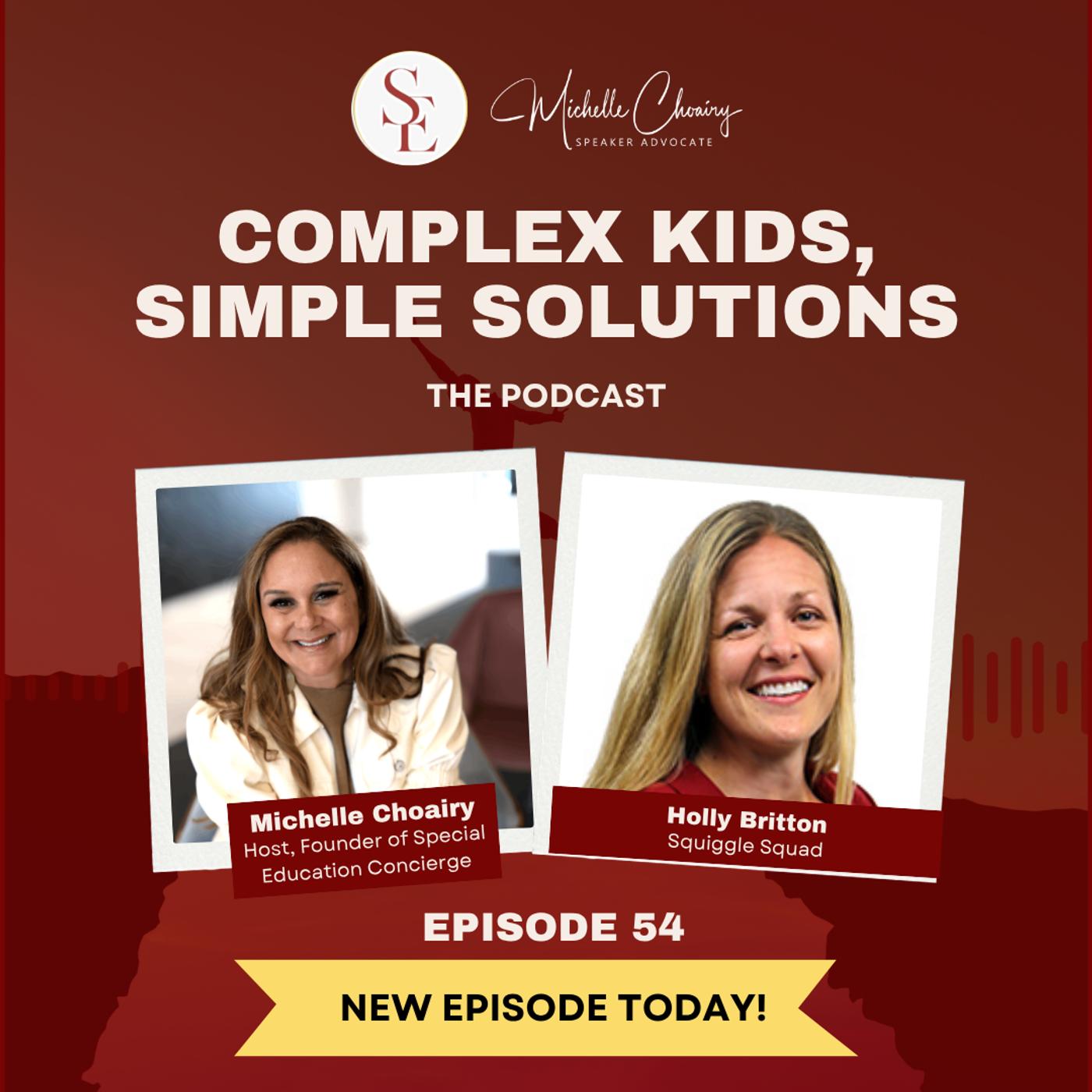
This week on the Complex Kids, Simple Solutions podcast, I sat down with handwriting specialist Holly Britton from Squiggle Squad, and this conversation honestly opened my eyes in a completely different way.
Because handwriting is not just about “pretty writing.”
It is about:
- Motor planning
- Brain-to-hand connection
- Learning pathways
- Processing language
- Building thought organization
- Coordination and sensory integration
And for many neurodivergent kids — especially kids with dyspraxia, apraxia, autism, ADHD, Down syndrome, or learning disabilities — handwriting struggles are often much deeper than schools realize.
One thing Holly said really stuck with me:
“If something is not improving, stop beating the dead horse.”
That hit hard.
Handwriting is not just a communication tool. It is a brain development tool.
Writing by hand helps children:
- process information differently
- strengthen memory
- organize thoughts
- improve language learning
- deepen understanding
And if your child is struggling, that does not automatically mean they are lazy or incapable.
It may simply mean they need a different approach.
Holly also shared practical things parents can watch for:
- anxiety around writing tasks
- hand fatigue
- difficulty planning movements
- slow writing speed
- inability to improve over time
- frustration during handwriting assignments
- better performance with larger tools like markers or styluses
- struggling more when copying from a distance
If your child has been stuck in the same handwriting cycle for years, this episode is one you absolutely do not want to miss.
🎧 Listen to the full episode here:
https://www.squigglesquad.com
You can also connect with Holly here:
- LinkedIn: https://www.linkedin.com/in/hollyhandwriting/
- Instagram: https://www.instagram.com/squigglesquadhandwriting/
- Substack: https://substack.com/@hollyonhandwriting
And as always, if you are feeling overwhelmed trying to figure out whether your child’s IEP, supports, therapies, or interventions are truly helping…
You do not have to figure it out alone.
Book your free 30-minute Match Call here:
https://specialeducationconcierge.com/contact-us
انگلیسی
ایالات متحده آمریکا
رونوشت 🔗
جستجوی اپیزودهای گذشته
اپیزودهای قبلی Complex Kids, Simple Solutions را جستجو کن.
سلب مسئولیت: پادکست و آثار هنری تعبیه شده در این صفحه متعلق به Michelle Choairy است که متعلق به صاحب آن است و به Listen Notes، Inc وابسته یا تایید نشده است.
ویرایش
از کمک شما برای بروز نگهداشتن پایگاهدادههای پادکست سپاسگزاریم
