


WEBVTT
00:00:03.725 --> 00:00:05.586
We have to stop emissions.
00:00:06.065 --> 00:00:11.586
We have to accelerate and improve and maximise the potential of our natural ecosystems.
00:00:12.156 --> 00:00:26.765
And we create that when we create that balance of stopping emissions and stopping the sources of global warming and enhancing our natural systems to, to do what they do best, which is have a natural carbon cycle, we can actually stop and reverse global warming.
00:00:26.765 --> 00:00:27.635
That that's the point.
00:00:27.635 --> 00:00:28.295
That's the premise here.
00:00:29.044 --> 00:00:33.274
Good morning, good afternoon, or good evening, wherever you are in the world.
00:00:33.844 --> 00:00:43.054
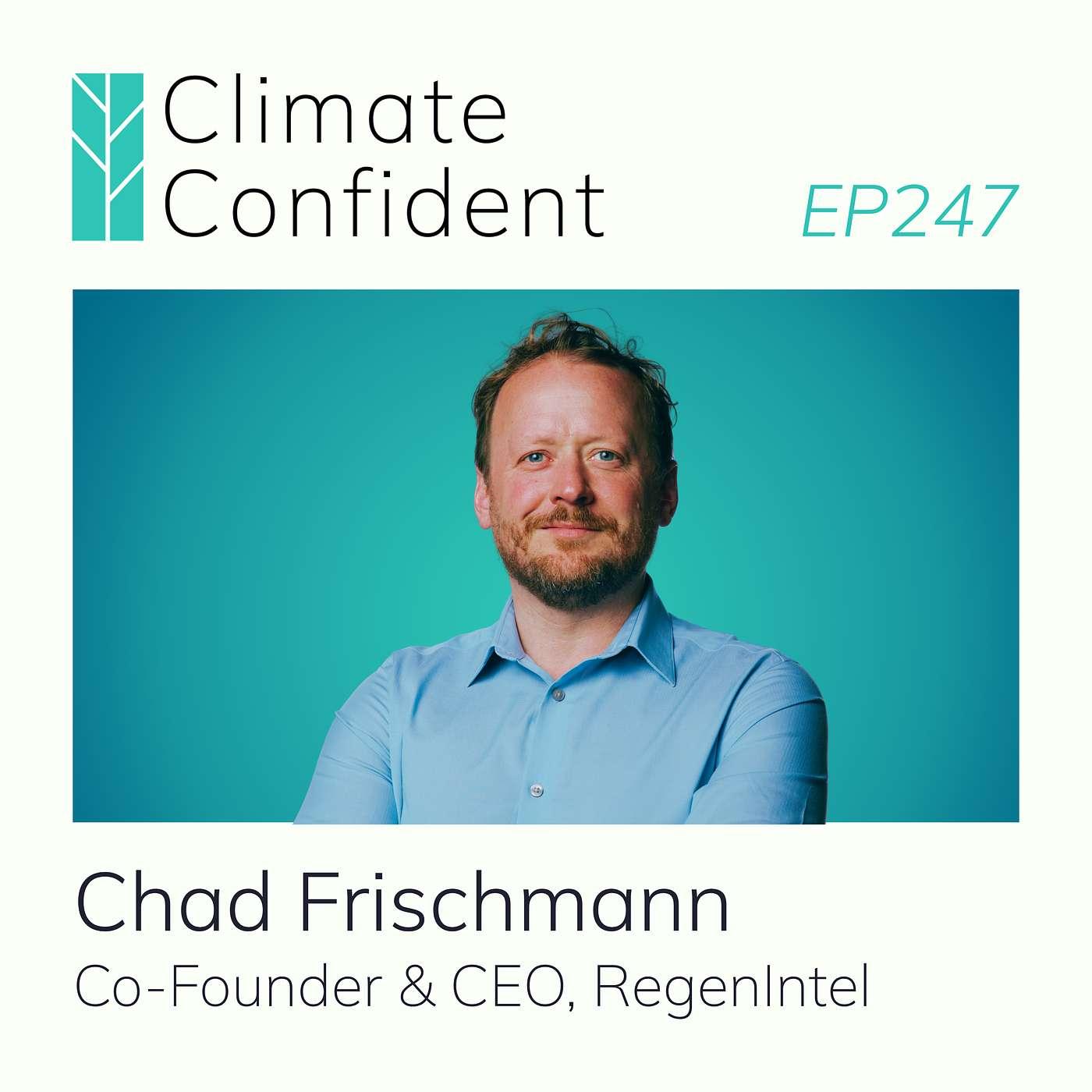
Welcome to episode 247 of the Climate Confident Podcast, the go-to show for leaders who want to cut emissions and build what comes next.
00:00:43.923 --> 00:00:47.734
I'm your host, Tom Raftery, and before we get started, a quick reminder.
00:00:48.304 --> 00:00:57.783
For five euros or dollars a month, you can unlock the full back catalog of hundreds of in-depth conversations with the leaders shaping the climate transition.
00:00:58.503 --> 00:01:05.793
Subscribers also get a shout out here on the show and direct access to me for guest pitches, new directions, et cetera.
00:01:06.483 --> 00:01:16.293
Everyone else still gets the most recent 30 days for free, but if you want the full archive and a seat at the table, hit the subscribe link in the show notes.
00:01:17.134 --> 00:01:33.603
Now for today's conversation, and it's a big one, we talk constantly about emissions, cuts, targets, pathways 1.5 degrees C, but we rarely talk about the other half of the equation, restoring the natural systems that actually keep the planet stable.
00:01:34.353 --> 00:01:41.164
My guest this week has spent his career trying to bring that missing half back into the center of the climate discussion.
00:01:42.618 --> 00:01:49.278
Chad Frischmann is the co-creator of Project Drawdown and a leading voice in regenerative systems thinking.
00:01:49.879 --> 00:01:50.808
His message is blunt.
00:01:51.528 --> 00:01:58.129
Stopping global warming requires eliminating emissions and maximizing the power of ecosystems.
00:01:58.998 --> 00:02:01.099
And neither works without the other.
00:02:02.088 --> 00:02:05.179
This episode goes beyond technologies and policy.
00:02:05.688 --> 00:02:10.639
It's about mindsets, systems, and the future we're actually trying to build.
00:02:11.359 --> 00:02:13.609
Chad, welcome to the podcast.
00:02:13.609 --> 00:02:15.528
Would you like to introduce yourself?
00:02:16.199 --> 00:02:16.560
Hi Tom.
00:02:16.560 --> 00:02:18.250
Thanks so much for having me on today.
00:02:18.644 --> 00:02:19.783
My name is Chad Frischmann.
00:02:19.804 --> 00:02:24.516
I work at the intersection of climate sustainability and regenerative systems transformation.
00:02:24.947 --> 00:02:28.306
I was the co-creator of an organisation called Project Drawdown.
00:02:28.546 --> 00:02:35.326
Which mapped, measured, and modeled all the technologies and practices that exist in the world today that can stop and begin to reverse global warming.
00:02:35.627 --> 00:02:46.576
And since then, I've started a couple new organisations, Regenerative Intelligence, which is an education and advisory company and the Global Solutions Alliance, which is a nonprofit creating a new knowledge system for regenerative future.
00:02:47.907 --> 00:02:48.598
Okay.
00:02:48.647 --> 00:02:49.307
Very good.
00:02:49.437 --> 00:02:53.127
And why, as in,
00:02:53.752 --> 00:02:53.972
Why?
00:02:54.046 --> 00:02:55.847
What, which, which part?
00:02:55.847 --> 00:02:58.097
Which, which is the why in that question.
00:03:00.237 --> 00:03:06.598
what made you wake up one morning and decide, I gotta work in this space, I gotta do Project Drawdown, I gotta do Regen Intel.
00:03:06.717 --> 00:03:10.557
I got, you know what, what's the, the thinking, what's the motivation?
00:03:11.582 --> 00:03:11.802
Why?
00:03:12.752 --> 00:03:13.051
Yeah.
00:03:13.171 --> 00:03:31.674
Well, you know, Tom, a lot of people who encounter my work over the last 15 years, the first thing they see or they think about is Project Drawdown of course, this has become, you know, one of the world's leading resources on climate solutions and behind Drawdown is a systematic scientific study ,looking at tens of thousands of data points.
00:03:31.674 --> 00:03:33.473
And I was the head of research there.
00:03:33.473 --> 00:03:42.984
And so everybody assumes, you know, Chad, you've got to be a data scientist or an atmospheric physicist, you know, like a standard climate scientist.
00:03:43.044 --> 00:03:50.033
And the reality is that I'm not actually, I'm actually an historian, an historian of political economy as it happens.
00:03:50.929 --> 00:03:51.739
Obviously right.
00:03:51.739 --> 00:03:52.609
The connection's right there.
00:03:53.058 --> 00:03:58.158
But a historian of political economy, language art, and storytelling.
00:03:58.878 --> 00:04:01.519
In short, I was a historian of propaganda.
00:04:02.299 --> 00:04:06.949
Now, I was doing my PhD work and my, my master's work at, the University of Oxford.
00:04:07.429 --> 00:04:16.278
Looking at systems change and the use of art, language, and stories in how institutions form and change and systems kind of develop over time.
00:04:17.137 --> 00:04:26.137
That's not a traditional path you might think that brings you to, you know, climate science and data assessments of, of all these different solutions and technologies.
00:04:26.737 --> 00:04:32.269
But I went on sabbatical when I was four years into my, PhD at Oxford and I went on a sabbatical.
00:04:32.300 --> 00:04:37.423
I was invited to a, royal wedding in Zambia, one of the larger tribes in Zambia.
00:04:37.423 --> 00:04:37.754
Right.
00:04:37.783 --> 00:04:43.124
And I said to myself, well, who could say no to a royal wedding in Zambia?
00:04:43.124 --> 00:04:43.483
Right?
00:04:43.824 --> 00:04:45.824
I've never said no to a royal wedding in Zambia.
00:04:46.329 --> 00:04:48.009
I know, I mean, who could say no?
00:04:48.428 --> 00:04:50.019
So I was like, you know, I'm gonna do this right?
00:04:50.019 --> 00:04:55.809
And I took two months to backpack, not only in Zambia, but also Tanzania, Mozambique, and Malawi.
00:04:56.228 --> 00:05:00.988
Now, during that two months of backpacking I met a lot of amazing people along the way.
00:05:01.048 --> 00:05:04.738
A lot of local people, a lot of indigenous people, local communities.
00:05:04.949 --> 00:05:09.598
I'm a fairly sociable guy, and I just really fell in love with the joy.
00:05:10.004 --> 00:05:21.144
The comradery, the, the community connection that these people had, that's was so different than northern European or the United States where I was come, come from.
00:05:22.045 --> 00:05:23.545
But I also fell in love with the environment.
00:05:23.694 --> 00:05:30.865
I fell in love with the biodiversity, the, the landscape that is very rare these days in Sub-Saharan Africa.
00:05:30.865 --> 00:05:33.735
There are places in India, places all over the world, but they're they're shrinking.
00:05:34.694 --> 00:05:42.915
And that was the point because I also saw the degradation and destruction of that environment and of the communities that I was really falling in love with.
00:05:43.875 --> 00:05:52.665
And so these just, this destruction degradation was coming from the very systems I was studying the formation of from an historical context.
00:05:53.264 --> 00:05:54.855
So anyway, I flew back to Oxford.
00:05:55.454 --> 00:05:59.985
Five days after landing I put my PhD on suspension.
00:06:00.375 --> 00:06:03.634
I quit my full-time job and I flew to Berkeley, California.
00:06:04.394 --> 00:06:17.745
And at that moment, I decided to dedicate my life and my career to looking at that intersection between indigenous people's rights and wellbeing, environmental conservation, and sustainable development.
00:06:19.274 --> 00:06:26.185
Well, Tom, as you know, as you probably guess, and maybe a lot of your listeners might know this these are the frontline issues in a changing climate.
00:06:27.115 --> 00:06:30.264
Our biodiversity, our non-human species and environments.
00:06:31.540 --> 00:06:38.230
The indigenous peoples and local communities, and the world's populations experiencing the most poverty and inequities in the world.
00:06:38.230 --> 00:06:40.930
They are already experiencing climate change.
00:06:41.980 --> 00:06:48.579
They're experiencing it today, and they're gonna experience it far worse in the years to come than we can even imagine.
00:06:49.389 --> 00:06:59.410
So very quickly working in that space, I started to work on climate mitigation adaptation strategies, weaving conservation, and indigenous rights and wellbeing.
00:06:59.410 --> 00:07:03.956
And how do we improve people's livelihoods into how we approach climate?
00:07:04.257 --> 00:07:13.726
And that actually is what drew me to create Project Drawdown with Paul Hawkin and Amanda Ravenhill, to map, measure, model all the solutions that can stop and reverse global warming.
00:07:15.343 --> 00:07:15.973
Fascinating.
00:07:16.273 --> 00:07:16.783
Fascinating.
00:07:17.233 --> 00:07:25.062
And so looking at the current climate conversations, where do you see them falling short?
00:07:25.925 --> 00:07:32.165
Current climate conversations are falling short, particularly in, let's just be straightforward in the last nine months.
00:07:32.170 --> 00:07:36.334
These climate, climate conversations are falling short because it's become almost a dirty word.
00:07:36.915 --> 00:07:39.134
We fought very long for decades.
00:07:39.134 --> 00:07:43.814
We've been fighting to, have climate change as part of the discourse.
00:07:43.814 --> 00:08:00.495
And actually let's, take a step back here because of course we have to understand that climate change is a response of earth systems, to something that we are actually doing, which is global warming, which we're increasing greenhouse gas emissions through all sorts of reasons, and that causes global warming.
00:08:00.524 --> 00:08:03.264
And so climate change is a response to that.
00:08:03.384 --> 00:08:03.834
Right.
00:08:04.105 --> 00:08:10.725
So, the climate discourse is kind of forgetting this really fundamental fact, which is we have to stop emissions.
00:08:11.204 --> 00:08:16.725
We have to accelerate and improve and maximise the potential of our natural ecosystems.
00:08:17.295 --> 00:08:31.610
And we create that when we create that balance of stopping emissions and stopping the sources of global warming and enhancing our natural systems to, to do what they do best, which is have a natural carbon cycle, we can actually stop and reverse global warming.
00:08:31.610 --> 00:08:32.480
That that's the point.
00:08:32.480 --> 00:08:33.139
That's the premise here.
00:08:33.350 --> 00:08:39.169
So we're kind of missing, I think the point here in the climate discourse is what do we actually need to do?
00:08:39.440 --> 00:08:52.129
What are the actions, the ways we can be implementing those actions that can have a tangible result in the physical world and then have all of these other cascading benefits to human wellbeing and our non-human wellbeing, human and non-human wellbeing, right?
00:08:52.460 --> 00:08:55.009
So, so I think that's kind of been missing in the dialogue a lot.
00:08:55.009 --> 00:08:56.245
And then of course, as I said.
00:08:56.840 --> 00:09:09.330
We've fought long to even get that concept into the vernacular of, of everyday discourse and society across the finance sector, business sector, policy sector, community sectors, all across the board.
00:09:09.909 --> 00:09:20.215
And now with with the new political economic systems that are taking shape in parts of the world, particularly in the United States with the, with the Trump administration and others apart across the world.
00:09:20.514 --> 00:09:31.642
What we're seeing is that all of that hard work is coming into question as the very words and the language that we've been using are coming into question as I said, and becoming almost a dirty word.
00:09:31.731 --> 00:09:32.662
I'm saying it left and right.
00:09:32.662 --> 00:09:38.017
Across all those areas, all those sectors that have made such headway, they're starting to pull back and I think that's a real danger.
00:09:39.149 --> 00:09:41.500
How do we reverse that?
00:09:42.581 --> 00:09:43.991
Well, I think there's a couple things.
00:09:44.042 --> 00:09:48.572
First of all, been getting the language right, like going back to the really, the point is what are the actions?
00:09:48.692 --> 00:09:49.861
What are the things that we could do?
00:09:49.861 --> 00:09:55.802
What are the technologies, the practices, the behavior changes that we need that can solve not only for climate?
00:09:56.581 --> 00:10:02.162
That's important point is like when I designed the Drawdown Solutions framework and looking at all these different technologies.
00:10:02.986 --> 00:10:06.557
The point of them is that you can't do any one of them independently.
00:10:07.126 --> 00:10:10.246
You have to do them all as part of a system, a system of solutions.
00:10:10.756 --> 00:10:25.570
And the catch here, and this is the work I do now with Regenerative Intelligence and the Global Solutions Alliance is, that system of solutions can not only solve for the climate crisis that we're in, the reducing, mitigating and eventually reversing global warming.
00:10:25.870 --> 00:10:31.389
It does that, but it also helps protect and preserve biodiversity.
00:10:31.389 --> 00:10:32.919
It improves human health and wellbeing.
00:10:33.220 --> 00:10:36.250
it improves livelihoods across the board, across the board.
00:10:36.250 --> 00:10:42.700
It provides a more just, equitable, and resilient economy and society for today.
00:10:42.700 --> 00:10:45.039
And in the short, medium, and long term.
00:10:45.039 --> 00:10:47.590
These are just win-win, win, win, win win solutions.
00:10:48.220 --> 00:10:48.340
Right.
00:10:48.370 --> 00:10:51.100
And I think that's the point is how do we change this?
00:10:51.100 --> 00:10:52.480
How do we change this as you described?
00:10:52.480 --> 00:10:53.919
I mean, talk about other things.
00:10:54.504 --> 00:10:57.865
I mean, what we try to teach at RegenIntel is it's like a prism.
00:10:57.865 --> 00:11:12.475
It's like a, when you look at its prism, each part of the lens through which you look at these, the same sets of solutions, again, the different technology practice and behavior changes and mindset shifts can have tangible results on whatever issue area matters to you.
00:11:12.745 --> 00:11:24.355
So if we're talking about disaster preparedness and disaster relief, disaster recovery, same sets of solutions that can actually, if we do that right, can also reduce emissions.
00:11:24.565 --> 00:11:30.205
If we're talking about how do we preserve, protect our precious biodiversity and non-human species, those are the same sets of solutions.
00:11:30.205 --> 00:11:37.715
If we talk about avoiding refugee crisis or improved child wellbeing, health and well, health and wellbeing, same sets of solutions.
00:11:37.715 --> 00:11:43.085
If we're talking about if, if rights of human rights are part, are the, the lens with which we need to look, those are the solutions.
00:11:43.445 --> 00:11:50.044
But you know what if we wanna talk about just pure ROI, long-term RO, I return on investment.
00:11:51.065 --> 00:11:52.565
Right, we did the math here.
00:11:52.865 --> 00:12:09.058
That system of solutions that solve through all these cascading problems, all these cascading challenges, that system of solutions has a hundred approximately 190 to $120 trillion return on that investment over a 30 year period.
00:12:09.749 --> 00:12:17.068
Like, I mean, I call it the duh factor, like duh, like anybody who's looking at that, whatever lens you wanna do, if you wanna look at it from a financial lens.
00:12:17.818 --> 00:12:19.769
These are the right sets of solutions.
00:12:20.548 --> 00:12:27.168
And that's even if you not considering the risk component, right?
00:12:27.168 --> 00:12:38.298
The, the short, medium, and long-term risk to your business, risk, to your financial portfolio risk, to your constituencies and your communities of which you are reliant upon as a policymaker.
00:12:38.808 --> 00:12:44.778
If you don't even include those risks and you just look at the basic economics, it's a no-brainer.
00:12:45.859 --> 00:12:48.589
Adding those risk factors and it's like, well, why aren't we doing it?
00:12:49.740 --> 00:12:50.460
Why aren't we doing it?
00:12:51.528 --> 00:12:52.938
Entrenched interests, right?
00:12:53.131 --> 00:12:54.032
We have to be reasonable.
00:12:54.032 --> 00:13:04.886
We have a very small group of extremely wealthy individuals at the helms of a very small collection of very powerful, wealthy corporations.
00:13:05.822 --> 00:13:12.871
That want to continue business as usual because they're making extreme profit and they understand that.
00:13:13.351 --> 00:13:16.652
And they have a mindset that looks in short-term gains.
00:13:17.371 --> 00:13:18.782
What's gonna happen in the next quarter?
00:13:18.991 --> 00:13:20.611
What's gonna happen in year two?
00:13:20.701 --> 00:13:23.581
They're not thinking about three, even three to four years into the future.
00:13:23.881 --> 00:13:25.442
They're not thinking about 10 years in the future.
00:13:25.442 --> 00:13:31.562
They're certainly not thinking about these small group of extremely wealthy, powerful individuals and corporations.
00:13:32.101 --> 00:13:33.272
They're not thinking about.
00:13:33.856 --> 00:13:37.006
Where is my company in 30 years from now?
00:13:37.277 --> 00:13:38.326
What is my company?
00:13:38.326 --> 00:13:40.876
What does that business look like 50 years from now?
00:13:41.326 --> 00:13:42.197
What's it doing?
00:13:42.917 --> 00:13:43.937
Is it thriving?
00:13:44.413 --> 00:13:52.724
If it's a family owned business, for example, Tom, what is my, what are my children and grandchildren leading in 50 years from now?
00:13:53.504 --> 00:13:54.913
Where's the legacy I'm leaving.
00:13:55.423 --> 00:13:56.714
They're not thinking about that.
00:13:56.714 --> 00:13:59.024
And a small group of them are, are not doing this.
00:13:59.653 --> 00:14:10.524
So I think, I think that's where we're seeing the biggest barriers to implementing these solutions that could really be transformative to the economy and to our society and to our environments.
00:14:11.955 --> 00:14:30.460
Right, and I mean, you talk about how emissions reduction isn't the only thing we need to do, and here on this podcast, I say that the podcast is about highlighting successful emissions reduction stories and strategies.
00:14:31.720 --> 00:14:32.799
So I'm missing a trick, right?
00:14:34.009 --> 00:14:36.139
Oh, no, I think the, the, the, so, so.
00:14:37.355 --> 00:14:50.735
Mitigating emissions, which means I actually, not even like the word mitigate, I think it's like, it means to lessen, and I think we just need to eliminate emissions and we, we, you know, there's always gonna be maybe some, and that's, that's just the reality of life.
00:14:50.794 --> 00:14:58.090
In fact, when you breathe, you breathe, you are, you know, you're brain really in oxygen and you're, you're, you're exhaling carbon dioxide.
00:14:58.090 --> 00:15:07.929
I mean, there's a natural things that are gonna happen, of course, but we can, we can get that to, you know, within, within our industries, within our sectors, we can get that down to almost zero.
00:15:08.289 --> 00:15:23.940
And when you balance that out with ecological restoration, protection, and restoration of our land and our marine and, and, and water systems our natural ecosystems have a process called photosynthesis.
00:15:24.850 --> 00:15:35.549
Magic and a miracle of photosynthesis converting carbon dioxide and in some cases methane to soil organic carbon to biomass to store that safely.
00:15:35.759 --> 00:15:42.179
And we have that technology because it's been around for hundreds of millions of years, that, that, that, that is, that's basic.
00:15:42.179 --> 00:15:44.610
So we need to reduce those emissions, sure.
00:15:44.610 --> 00:15:48.240
But we also need to maximise the potential of our ecosystems.
00:15:48.240 --> 00:16:01.450
Now part of the challenge Tom, is when you degrade ecosystems, when you destroy and degrade our marine and terrestrial environments you're releasing carbon from the atmosphere.
00:16:01.480 --> 00:16:03.580
All that stored carbon gets released in the atmosphere.
00:16:03.909 --> 00:16:15.460
So the challenge that we're facing right now is that we're still emitting a lot of greenhouse gases across the board, and we are degrading our environment at record pace.
00:16:16.188 --> 00:16:20.688
So we're reducing the capacity of our natural systems to actually mitigate that problem.
00:16:20.928 --> 00:16:30.631
Now, beyond just the mitigation sequestration lens, these solutions have what we call at, RegenIntel cascading benefits.
00:16:31.261 --> 00:16:34.652
Not just co-benefits, like, so we also did a mapping.
00:16:34.652 --> 00:16:39.741
We looked at all the solutions for draw down solutions that can stop global warming.
00:16:39.841 --> 00:16:42.422
And we mapped them to achieve all the sustainable development goals.
00:16:43.052 --> 00:16:56.642
So my team and I did a research, we did analysis and basically through indirect or direct or indirect means nearly every technology and every practice has co-benefits that allow us to achieve all of the SDGs.
00:16:57.721 --> 00:16:58.831
Like, wow.
00:16:59.162 --> 00:16:59.402
Right.
00:16:59.402 --> 00:17:00.392
So these are co-benefits.
00:17:00.392 --> 00:17:03.448
This is, when you think about solar energy, right?
00:17:03.448 --> 00:17:09.648
If you think about solar energy solely solar photovoltaics solely as a technology about reducing emissions.
00:17:09.648 --> 00:17:12.423
You're missing a huge part of the picture.
00:17:12.663 --> 00:17:19.854
This is creating a resilient, distributed energy system that allows us to deal with shocks in our system, right?
00:17:19.854 --> 00:17:23.634
By having a di diversified and renewable source of, of energy.
00:17:24.094 --> 00:17:28.953
It allows for extension or electrification in areas that they currently don't have access to it.
00:17:28.953 --> 00:17:30.364
So it improves livelihoods.
00:17:30.794 --> 00:17:33.134
Is also a much healthier option, right?
00:17:33.638 --> 00:17:39.493
We, we, we all know about coal, oil and gas producing noxious fumes that are a detriment to our human health.
00:17:40.023 --> 00:17:55.189
And if we start thinking about the 800 million people on the planet that don't have access to electricity today and are using kerosene lamps for cooking and for lighting, and just imagine replacing that with solar.
00:17:55.219 --> 00:18:00.019
You're improving health outcomes for millions and mil, hundreds of millions of people.
00:18:00.858 --> 00:18:15.055
And at the same time, you know what you also do, Tom, you improve educational outcomes because students who are, studying with kerosene lambs and having health problems, which is seen all over the world, suddenly don't have those health problems.
00:18:15.055 --> 00:18:15.414
And you know what?
00:18:15.414 --> 00:18:16.548
They, do better in school.
00:18:17.328 --> 00:18:19.878
And they attain, you have better lives overall.
00:18:20.028 --> 00:18:23.479
So this is what we mean by all of these co-benefits.
00:18:23.959 --> 00:18:29.989
And then when you start mapping them Tom, to systems, thinking about systems of solutions and how the benefits of the system.
00:18:31.038 --> 00:18:32.778
You see what we call cascading benefits.
00:18:32.778 --> 00:18:44.811
These are feedback loop, virtuous feedback loops that create greater abundance across social, financial, ecological capital, the many different forms of capital they start to expand.
00:18:44.811 --> 00:18:54.737
When you start looking at these solutions as part of systems with cascading benefits that enhance and reinforce each other and, and create more abundance without extracting and exploiting.
00:18:54.886 --> 00:19:01.519
So, so that's what I, what I really wanna hone in on for your listeners, thinking about climate as an opportunity, right?
00:19:01.519 --> 00:19:18.576
Thinking about how we solve the climate crisis by, stopping global and reversing global warming, but then see that as an opportunity to design a better future for all, a better future for all our fellow humans and all our non-human kin.
00:19:19.863 --> 00:19:24.363
And just picking up a tiny little point there from that as well.
00:19:24.363 --> 00:19:37.262
I mean, the addition of solar to families who are using kerosene also reduces their spend on kerosene de facto, which gives them more disposable income for other things.
00:19:37.563 --> 00:19:42.303
So it increases the economic benefits to them and their community as well, right?
00:19:43.317 --> 00:19:43.826
Precisely.
00:19:44.217 --> 00:19:44.817
Absolutely.
00:19:45.146 --> 00:19:45.537
Absolutely.
00:19:46.376 --> 00:19:54.051
You know, you know, Tom, you know, I wanna ask you, like, if you think about solar, do you think solar is the one and only answer to, to a renewable energy future?
00:19:54.752 --> 00:19:55.067
Of course not.
00:19:56.051 --> 00:19:56.942
What other things have we got?
00:19:58.488 --> 00:20:00.407
I mean, there's wind as well, obviously.
00:20:00.718 --> 00:20:01.587
There's batteries.
00:20:01.887 --> 00:20:23.167
So those three together are a huge, huge lever not just in the developed world, but also in the developing world because it gives access to microgrids, for example, for communities and allows them massive economic development, which wouldn't have been possible in the absence of energy before.
00:20:25.166 --> 00:20:26.817
Got it right on point.
00:20:27.207 --> 00:20:27.416
Right.
00:20:27.416 --> 00:20:58.967
It precisely that, Tom, I mean,'cause a lot of folks will say Solar, solar, solar, solar.
00:20:58.967 --> 00:21:04.336
And then you get the, the critics say, oh, well we can't just have it all be solar, because the sun.
00:21:04.336 --> 00:21:05.507
Sun doesn't shine all the time.
00:21:05.507 --> 00:21:06.346
And you get these silly things.
00:21:06.346 --> 00:21:19.062
We just, just recently there is a debate amongst gubernatorial debate in New Jersey where the two New Jersey candidates, democrat, republican Republicans, said, you know, we can't do wi we, we can't just focus on solar because sun doesn't shine all the time.
00:21:19.842 --> 00:21:26.682
Well, look, that's why no one's saying that we gotta, we gotta focus on a diversified portfolio of energy sources.
00:21:26.741 --> 00:21:29.261
Wind, solar, geothermal.
00:21:30.366 --> 00:21:31.717
Perennial biomass.
00:21:31.717 --> 00:21:38.616
So how do we grow the right kind of biomass and process that biomass creating economies of renewable economies of life?
00:21:38.707 --> 00:21:40.177
That's why I like to call it renewable economies of life.
00:21:40.687 --> 00:21:46.507
So how do we do that in a diversified portfolio that creates such resilience, right?
00:21:46.507 --> 00:21:51.014
That that in and of itself has, whether the sun isn't shining, the wind is blowing.
00:21:51.014 --> 00:21:53.144
If neither are there, you've got geothermal.
00:21:53.354 --> 00:21:57.354
If you don't have that at that time or place, you've got biomass.
00:21:57.624 --> 00:22:04.104
And these are all micro economies that reinforce each other, that create resilience, independence, and, and thriving livelihoods.
00:22:04.344 --> 00:22:07.254
I mean, these are the cascading benefits we talk about.
00:22:07.985 --> 00:22:08.674
yeah, yeah, yeah.
00:22:08.674 --> 00:22:16.654
tidal is another one, but the other one as well that people don't mention enough, I think, is the grid.
00:22:16.775 --> 00:22:26.375
Because it's not true to say the sun doesn't always shine or the wind doesn't always blow, because yes, the sun does always shine.
00:22:26.375 --> 00:22:29.015
'cause if the sun stopped shining tomorrow, we'd all be dead.
00:22:29.345 --> 00:22:30.755
So yes, the sun is always shining.
00:22:30.934 --> 00:22:44.404
Maybe not where you are at that moment in time, but you do interconnections to places where the sun is shining, and that way you get solar energy from your next door neighbor.
00:22:44.674 --> 00:22:52.985
You know, if you've cloud over your solar farm, your next door neighbor might not have, and so on and so on, and you grow that out and you make massive super grids.
00:22:53.285 --> 00:23:13.664
I mean, in China they have huge gigawatt scale solar farms in the desert, and they transport that energy to the coastal cities four and a half thousand kilometers over HVDC, UHVDC lines, ultra high voltage DC lines with minimal losses.
00:23:14.745 --> 00:23:18.225
And you look at that and you say, why isn't everybody doing that for God's sake?
00:23:19.699 --> 00:23:24.229
There's so, you know, tell I feeling like there are so many duh actors, you know, reference that.
00:23:24.558 --> 00:23:30.499
Like there's like, I used to go on stages all the time and I used to do this thing where I'd be like, you know, so where these are win, win, win, win.
00:23:30.709 --> 00:23:36.828
It's like we've gotta get, people start to have these mindset shifts when they go uhhuh, uhhuh.
00:23:39.724 --> 00:23:40.894
And by the, by the fifth or sixth.
00:23:40.923 --> 00:23:41.433
Aha.
00:23:41.584 --> 00:23:42.334
Oh yeah.
00:23:42.663 --> 00:23:45.034
It becomes, duh, like, we should be doing this.
00:23:45.334 --> 00:23:49.984
We need a lot more of that in our education and in our communication about what these are.
00:23:49.984 --> 00:23:53.374
It's not just do this and you will reduce emissions.
00:23:53.374 --> 00:23:55.534
It's getting all of those aha factors.
00:23:55.824 --> 00:23:59.094
Until you get the switch that happens and it makes a a duh.
00:23:59.484 --> 00:24:01.673
Like, why aren't we looking at smart grids?
00:24:01.673 --> 00:24:12.969
Why aren't we looking at, right now my mind is slipping about the exact percentage, but we lose 30, 40% of all energy just in distribution before it even, before it even gets to when we turn on our lights.
00:24:13.764 --> 00:24:15.744
Just imagine that loss.
00:24:16.354 --> 00:24:19.514
The thing is we know we can be more efficient with it.
00:24:19.784 --> 00:24:21.163
We have better technology.
00:24:21.433 --> 00:24:29.474
One of the benefits of of AI, one really good benefit of AI is that it allows us to have smarter grids that can move things around.
00:24:29.864 --> 00:24:36.824
So the combination of technology that reduces that distribution losses with a smart grid technology that allows us create those super grids.
00:24:38.038 --> 00:24:39.463
I mean, this is the future.
00:24:39.463 --> 00:24:44.864
This is, this is, this is exactly, this has been written about in science fiction novels for decades.
00:24:44.864 --> 00:24:52.279
And yet some few people are making a lot of money in infrastructure that they've invested in over a long period of time.
00:24:52.279 --> 00:24:57.650
And they won't get out of it 'cause you're just gonna make as much money as they can before, before they have to.
00:24:58.250 --> 00:25:03.170
And there, that's what I wanna maybe, maybe wanna also talk a little bit about is there's gonna be a time.
00:25:03.725 --> 00:25:07.894
Tom when we just can't continue to do it.
00:25:08.431 --> 00:25:09.000
Yeah, yeah, yeah.
00:25:09.631 --> 00:25:10.770
Before we get there,
00:25:11.195 --> 00:25:11.404
Yeah.
00:25:12.631 --> 00:25:19.831
you were talking a while ago about solutions, plural, but we really only mentioned the solar as being one of the solutions.
00:25:19.831 --> 00:25:20.490
What are some of the others?
00:25:21.470 --> 00:25:22.009
Oh my goodness.
00:25:22.009 --> 00:25:23.809
Well, I mean, there's, there's, there's tons of solutions.
00:25:23.809 --> 00:25:30.640
I mean, my, my team and I mapped, measured, modeled about a hundred or 90 plus solutions across every area of human activity.
00:25:30.640 --> 00:25:32.710
So, I mean, we can talk about anything you'd like.
00:25:33.200 --> 00:25:39.985
One of the most important sectors that I think often gets missed out is that natural or, or our ecosystem based solutions.
00:25:39.985 --> 00:25:46.615
And that is inclusive of not only how we manage our land and marine systems, but also our, our food.
00:25:46.745 --> 00:25:57.205
You know, how we produce food what we're producing, and then ultimately how we look at the supply chain getting it from production all the way to our mouths.
00:25:57.684 --> 00:26:03.299
And then at the end of the day, when, because so much gets wasted throughout that system, how it gets disposed of.
00:26:03.690 --> 00:26:12.994
So I always like to talk about the food system because it's also really, Tom it's like a microcosm or it's like a nice lens that looks at every part of the system.
00:26:12.994 --> 00:26:20.463
You could, you could do a systemic look at every, every sector and the food system's so interesting because it touches upon every sector.
00:26:21.784 --> 00:26:23.554
As does almost every other sector.
00:26:23.554 --> 00:26:35.487
And that's one of the beautiful things that we, teach through regenerative intelligent our education programs is how to see how each sector is actually an interconnected system of systems and they all intersect with each other.
00:26:35.487 --> 00:26:37.855
But let's take, let's take food as an example.
00:26:38.273 --> 00:26:42.038
Well, food's a great example we all have to eat.
00:26:42.803 --> 00:26:44.873
So it's something massively relatable?
00:26:45.586 --> 00:26:45.876
yeah.
00:26:46.692 --> 00:26:47.082
Absolutely.
00:26:47.082 --> 00:26:50.042
Like hopefully three times a day people get to eat.
00:26:50.042 --> 00:26:50.402
Right.
00:26:50.882 --> 00:26:53.221
You know, it's, and we all do it.
00:26:53.221 --> 00:26:53.822
And you know what?
00:26:55.382 --> 00:26:58.802
When you eat Tom, what do you experience when you eat?
00:27:00.748 --> 00:27:02.368
Well good question.
00:27:03.048 --> 00:27:07.668
Mostly joy, because I tend to eat with company.
00:27:08.748 --> 00:27:14.087
So for me, eating isn't just functional, it's also social.
00:27:15.814 --> 00:27:19.084
Tom, it's like we're in some kind of mind meld right now.
00:27:19.264 --> 00:27:19.534
Joy.
00:27:21.124 --> 00:27:23.284
Joy is one of my favorite words.
00:27:23.314 --> 00:27:24.004
It really is.
00:27:24.064 --> 00:27:25.324
And it's, it's one of our core values.
00:27:25.953 --> 00:27:32.384
'cause I think when we really break it down, humanity down we exist for two reasons.
00:27:32.474 --> 00:27:35.809
Well, well, what we, we, we experience existence in two reasons, two ways.
00:27:36.160 --> 00:27:38.380
To, to survive, and to find joy.
00:27:39.049 --> 00:27:40.205
These are the two things.
00:27:40.715 --> 00:27:42.515
How do we survive in the world that we live in?
00:27:42.545 --> 00:27:45.154
And then how do we find some joy in that?
00:27:45.154 --> 00:27:58.095
And that joy factor is getting used and abused by our exploitative, extractive, capitalist, corporate capitalists system that markets and advertises the extreme excessive joy.
00:27:58.980 --> 00:28:00.960
But at the core, it's how we experience joy.
00:28:01.259 --> 00:28:04.440
So when you say like, food experience is joy, that is it.
00:28:04.470 --> 00:28:11.450
We experience joy when we consume food and I couldn't have, like, we could've couldn't have planted that word better from, from you.
00:28:11.450 --> 00:28:11.870
Thank you.
00:28:13.220 --> 00:28:14.450
Because it's so important.
00:28:14.480 --> 00:28:15.920
'cause that's why it's so relatable.
00:28:16.380 --> 00:28:21.570
But then we start to look at the system and we think about like you, like you, you, I dunno, I dunno about you Tom, but me.
00:28:22.170 --> 00:28:26.745
I love taking a piece of bread, and dipping it in some olive oil.
00:28:26.955 --> 00:28:27.315
Hmm.
00:28:28.275 --> 00:28:31.154
I mean, so good, right?
00:28:31.785 --> 00:28:33.795
It's like there's some, or like that butter.
00:28:33.855 --> 00:28:35.924
Ooh, I just love it.
00:28:35.924 --> 00:28:36.465
I love it.
00:28:36.914 --> 00:28:45.240
Now if we think about that crust of bread, we think about drop of oil that we're consuming, taking so much joy in, and we trace that back.
00:28:45.630 --> 00:28:52.000
We trace that to the olive trees and the orchards that are producing the olives and the, the wheat.
00:28:52.000 --> 00:28:55.690
And that's, that gets converted into, that gets, processed into flour and so on.
00:28:56.110 --> 00:28:57.519
We take that from the beginning.
00:28:57.670 --> 00:29:02.410
How we produce those crops matters.
00:29:02.920 --> 00:29:06.670
And we could do that with regenerative agriculture, multistory agroforestry.
00:29:07.195 --> 00:29:19.088
We can produce that butter if we want, with a silvopasture, which these are all just three solutions just to, you know and there's a host of other agricultural solutions that are regenerative.
00:29:19.088 --> 00:29:29.078
And, but it matters how you do it, how you implement those, how you do it right to create greater productive, more productive soil, reduced pesticides and fertilizer used, et cetera, et.
00:29:30.219 --> 00:29:39.818
Right there is a whole host of solutions in how we're producing that material, that input that goes into that bread and that olive oil, well, then we have to process it.
00:29:39.818 --> 00:29:42.189
We have to harvest it and we have to process it.
00:29:42.189 --> 00:29:51.328
So again, we go through a processing stage that converts that to flour and ultimately bakes the bread and, processes the olives and makes the olive oil.
00:29:51.869 --> 00:29:53.009
But then what do we do next?
00:29:54.028 --> 00:30:05.794
We have factories all over the world that are churning out emissions to produce cardboard, tin, glass, plastics to put that food in.
00:30:06.693 --> 00:30:21.324
And then what we do, we put that onto trucks trains boats, and sadly planes to fly luxury commodities all over the world in refrigerated containers using hydrofluorocarbons.
00:30:22.433 --> 00:30:26.004
Which is hundreds to thousands times more potent a greenhouse gas than carbon dioxide.
00:30:26.663 --> 00:30:33.774
And we ship them all over the world, spewing out long dead fossilised phytoplankton to move this food all around the world.
00:30:34.224 --> 00:31:03.084
'cause remember, that's what it is, really fossilised, phytoplankton that we're, we're burning and exerting, putting in the atmosphere, and then we put 'em into grocery stores where they overstocked due to the advertising, marketing industries desire to create this sense of abundance for their consumers, so they get overstocked, but only the perfect food that looks really good because we can't do the imperfect stuff because somehow the advertising world tells us we don't want that.
00:31:04.284 --> 00:31:09.354
Then we, then we over consume because also a lot of those grocery stores oversell.
00:31:09.354 --> 00:31:12.443
So they give you big giant bags of things and whatever.
00:31:12.653 --> 00:31:20.874
So you overstock and we, consumers, we take three, we take 30% of what we purchase at the store, we waste.
00:31:21.234 --> 00:31:30.494
It's like taking, it's like driving home with three bags of groceries and then you go, you go home and you take one of those bags and you throw it in the bin.
00:31:31.544 --> 00:31:36.399
Paper, tin, plastic, all, you just throw it under the bin and say bye.
00:31:37.479 --> 00:31:44.939
And then we have trucks pick up that garbage and put it into a waste, into a landfill where it emits methane now.
00:31:45.629 --> 00:31:54.934
So that was just a little story of the food system, that regenerative agriculture, tons of solutions that we have there and how to manage our food production.
00:31:55.640 --> 00:32:06.193
Far better ways that reduce emissions, create better livelihoods, healthier soils, increase biodiversity help reduce the decimation of our, bees and pollinators around our tons.
00:32:06.193 --> 00:32:09.374
We have tons of solutions in how we process our food.
00:32:09.403 --> 00:32:17.784
We have solutions in how we package our food using different types of materials that are grown instead of produced through synthetic means.
00:32:18.094 --> 00:32:26.653
And that are, that are done in more responsible and even in fact regenerative ways, regeneratively producing biomaterials that could be used for packaging.
00:32:27.104 --> 00:32:37.994
There's so many examples that we, I mean, I could list a bunch of them, but then we keep going on down the line and how we change our refrigerated containers to move away from hydrofluorocarbons to more natural alternatives.
00:32:38.024 --> 00:32:38.923
There are solutions there.
00:32:39.163 --> 00:32:41.328
There are solutions in how we transport our food.
00:32:42.249 --> 00:32:42.788
Right.
00:32:43.179 --> 00:32:45.548
They're... you're getting my point.
00:32:45.578 --> 00:32:45.849
Right.
00:32:45.849 --> 00:32:52.298
And there's solutions, of course, to across the board from, from all the way to the point where consumers just buy less.
00:32:52.989 --> 00:32:55.298
They buy what they're gonna consume, and that's it.
00:32:56.229 --> 00:33:01.419
So I see these as like a host of amazing opportunities.
00:33:02.514 --> 00:33:09.374
If I'm an advertiser marketer, there are, there are ways I can actually, change the culture around food consumption.
00:33:09.602 --> 00:33:25.485
If I, if I'm managing the waste of a city or, or a municipality, I can figure out alternative ways to recycle, reuse, to compost, to, even as a last resort, landfill, methane capture or, or waste to energy as a very, very, very last resort.
00:33:26.199 --> 00:33:28.769
If I am in packaging, tons of solutions.
00:33:28.919 --> 00:33:40.979
So across the board there are so many, and each one of those are opportunities for a business, opportunities for innovation, opportunities for investment, and there are opportunities to create a future we actually bloody want.
00:33:41.570 --> 00:33:42.400
Mm-hmm.
00:33:42.419 --> 00:33:42.683
That's it.
00:33:43.480 --> 00:33:43.720
Yeah.
00:33:43.930 --> 00:33:44.049
Yeah.
00:33:44.049 --> 00:34:01.059
And you talk about regenerative agriculture, but you also talk about regenerative, lots of other things as well that, I've had lots of episodes on this podcast talking about regenerative agriculture, but not about other regenerative things.
00:34:01.059 --> 00:34:06.080
So talk to me about the expanded definition of regenerative.
00:34:07.014 --> 00:34:09.324
Well, you know, that's a great, great question, Tom.
00:34:09.324 --> 00:34:14.224
'cause you know, regenerative is a regenerative systems as we, we like to call it regenerative economies.
00:34:14.224 --> 00:34:15.003
Regenerative systems.
00:34:15.393 --> 00:34:24.083
Regenerative is a, is a, a lens, it's a, at the core of it is how do we create systems that have place life at the center of our decision making.
00:34:24.083 --> 00:34:29.114
So how do we emulate our natural systems in which we are actually part of?
00:34:29.114 --> 00:34:29.324
Right?
00:34:29.324 --> 00:34:31.514
So we are ourselves a regenerative system.
00:34:31.967 --> 00:34:33.706
Your body is a regenerative system.
00:34:34.226 --> 00:34:37.646
The environments and the ecologies that we live in are regenerative systems.
00:34:37.916 --> 00:34:39.327
This is their natural world.
00:34:39.662 --> 00:34:48.392
But how do we take our human systems and mirror that so that at the core end goal, we're creating a system that regenerates life.
00:34:49.967 --> 00:34:59.146
That continues to create these, the, you know, ensuring that life, the conditions for life to thrive in its fullest capacity are in place.
00:34:59.746 --> 00:35:09.467
So regenerative agriculture's an important thing because at the core of what regenerative agricultural means, how to produce food in ways that ensure life thrives in abundance.
00:35:10.757 --> 00:35:14.237
That that's what its core regenerative agriculture is all about.
00:35:14.537 --> 00:35:16.097
Now, regenerative energy systems.
00:35:16.126 --> 00:35:23.086
How do we create and design diversified energy portfolios that place life at the center of that, right?
00:35:23.086 --> 00:35:46.172
How do we ensure that we reduce the exploitation and extraction, the degradation of our natural systems and our remember our bodies, so our human, like our actual like exploitation of people, but get that to end that exploitation and create a regenerative system where that our bodies, our lives are thriving, our environments are thriving, other species are thriving.
00:35:46.561 --> 00:36:09.809
So designing those renewable energy systems that we just talked about earlier, it becomes a regenerative system when we are creating energy systems that don't decimate our pollinators, that don't destroy the health and livelihood of our outcomes of our most marginalised populations in both low income countries or, what we might wanna call it, the global majority of places.
00:36:10.260 --> 00:36:13.500
'cause you gotta remember the global majority, but even in the global minority.
00:36:14.414 --> 00:36:25.275
Even in places like the United States and, and in, you know, in part there neighborhoods in Los Angeles that themselves are experiencing a degradation of, of human health outcomes from energy systems just around the corner.
00:36:25.275 --> 00:36:34.851
So when I talk about regenerative energy systems, I'm talking about energy systems that allow life to thrive and you know, regenerative built environment.
00:36:35.581 --> 00:36:45.182
So how do we create buildings that are living, that are contributing to the wellbeing and the welfare of our human bodies and our non-humans kin.
00:36:46.142 --> 00:36:55.282
Transportation systems even our human education and health systems and health somehow feels like logical, right?
00:36:55.311 --> 00:37:01.432
'cause regenerative healthcare, that's actually a thing that often is associated with longevity thing.
00:37:02.041 --> 00:37:21.025
But I work with a lot of health professionals, doctors former health policy makers who aren't focused on the longevity side, but regenerative health for them means how do we create institutions and so, and systems within healthcare that ensure that we are, preventing disease as opposed to treating disease.
00:37:21.295 --> 00:37:24.615
And that prevention of disease is seen as regenerative.
00:37:24.644 --> 00:37:31.815
'cause we're actually, we're actually regenerating, not necessarily a, a limb or something like this, but we're regenerating our wellbeing.
00:37:32.054 --> 00:37:32.385
Right.
00:37:32.385 --> 00:37:38.085
We're, we're, we're, we're allowing that to to have systems regenerating the system itself, the institutions themselves.
00:37:38.085 --> 00:37:48.675
So when I think about regeneration or regenerative systems, I think far beyond just planting trees, which is important, particularly making sure you do the right species.
00:37:49.275 --> 00:37:51.005
In the right place on the right time.
00:37:51.525 --> 00:37:52.875
Really, really important.
00:37:53.385 --> 00:37:59.775
But also, you know, in, in agriculture and regenerative ocean systems, these are all sort of our natural systems that make a lot of sense.
00:38:00.135 --> 00:38:16.485
But we need to look across the board all areas of human activity and place that regenerative lens on them, and let's maximise the cascading benefits that creates these virtuous regenerative cycles of abundance, wellbeing, and justice.
00:38:17.358 --> 00:38:26.110
And are you seeing any signs of this shift already from policy makers, or markets, or anything at all?
00:38:26.963 --> 00:38:33.383
first of all, Tom regenerative as a concept, regeneration as a concept has a very long legacy.
00:38:34.012 --> 00:38:39.092
We're talking about Buckminster Fuller, you know, Bucky, Bucky Fuller we're talking about Danella Meadows.
00:38:39.467 --> 00:38:57.434
We're talking about Carol Sandford, a whole host of thinkers and doers spending decades who've been talking about regenerative systems, either using that term or around or adjacent vernacular that have evolved over time.
00:38:58.485 --> 00:39:01.454
So this is, this isn't something new, right?
00:39:01.514 --> 00:39:03.434
I mean, Janine, Benny is biomimicry.
00:39:03.554 --> 00:39:05.865
There's so many John Fullerton regenerative economics.
00:39:05.865 --> 00:39:09.644
There's, this is a long lineage of folks who've been working in this space and, you know, we're part of it.
00:39:10.487 --> 00:39:19.742
So what I wanna say there is this concept of life-affirming systems has, influence in many of, you know, in sustainability.
00:39:19.771 --> 00:39:29.463
For example, if you unpack Danella Meadows systems approach to an understanding of sustainability, it is essentially a regenerative system that she's talking about, right?
00:39:29.733 --> 00:39:35.043
So it really has had a lot of influence across the board in a lot of the movements that take have taken shape.
00:39:35.643 --> 00:39:42.460
Now that being said how much of our system is actually regenerative in the way we're defining it?
00:39:43.090 --> 00:39:45.250
Well, how much of it's actually sustainable?
00:39:46.030 --> 00:39:47.800
How much of it's actually climate solutions?
00:39:48.130 --> 00:39:49.210
We're talking about a tiny fraction.
00:39:49.720 --> 00:39:53.170
Very, very small percentage of the system is actually operating in that way.
00:39:53.170 --> 00:40:03.050
And that's because of the wealth, power, and prestige of the people and organisations that are existing in that extractive, exploitative system now.
00:40:03.050 --> 00:40:08.000
But what I am seeing here is a system in its death throws, right?
00:40:08.000 --> 00:40:14.659
I'm seeing a world in which, our earth systems are slapping our human systems right in the face.
00:40:15.230 --> 00:40:16.400
And it's already been happening.
00:40:16.400 --> 00:40:17.809
It's gonna get much worse.
00:40:17.929 --> 00:40:19.519
I call these the great catastrophes.
00:40:21.050 --> 00:40:22.179
And I'm not a dooomer.
00:40:22.200 --> 00:40:23.309
I'm not a gloomer, right?
00:40:23.309 --> 00:40:24.300
I'm the optimist guy.
00:40:24.300 --> 00:40:25.320
I'm the solutions guy.
00:40:25.320 --> 00:40:30.240
I, I really think that we've got it and we can do it, but I'm not disillusioned.
00:40:30.585 --> 00:40:32.760
I, I am not an ostrich putting my head in the sand.
00:40:33.599 --> 00:40:36.945
I wanna be grounded in reality and then build towards that future now.
00:40:37.875 --> 00:40:39.405
We have already emitted so much.
00:40:39.405 --> 00:40:42.677
We've already destroyed so much of our natural ecosystems.
00:40:42.677 --> 00:41:01.095
We've already disrupted our hydrological cycles to such an extent that even if we switched everything overnight, we'd still have built in tipping points built in catastrophes already in the system, which is why I often say, Tom, the idea of incorporating climate risk is ridiculous.
00:41:02.085 --> 00:41:04.184
There's no such thing as climate risk.
00:41:04.575 --> 00:41:15.012
There's just climate reality, We should not be feeling the risk of these significant catastrophes in, various natural and human sectors and systems.
00:41:15.581 --> 00:41:16.392
It's already built in.
00:41:17.782 --> 00:41:18.922
We need to lessen that.
00:41:19.309 --> 00:41:21.885
And eventually get through it and thrive.
00:41:21.885 --> 00:41:24.164
I call it thriving through the catastrophes.
00:41:24.164 --> 00:41:25.605
How do we thrive through this?
00:41:26.235 --> 00:41:27.615
And I think we can do that.
00:41:27.615 --> 00:41:41.010
And that means building up the capacity of these regenerative systems, regenerative companies, regenerative portfolios, financial portfolios, regenerative communities, regenerative systems, the models all over the world.
00:41:41.039 --> 00:41:49.530
If we can get to 20, 30%, I think we have the capacity to thrive through the builtin catastrophes that are, are looming.
00:41:50.340 --> 00:41:54.280
Again, I don't wanna scare people'cause I, I'm not a doomer.
00:41:54.280 --> 00:41:58.980
I'm not talking about the end of civilization and humans are off gonna be extinct from the planet.
00:41:58.980 --> 00:42:05.206
I mean, Bill Gates recently said much, to my regret, he discounted climate and said, focus on human health and wellbeing.
00:42:05.206 --> 00:42:12.317
And I, I, I think it's ridiculous that he said that, but one thing he got right is that climate change isn't going to wipe out humanity.
00:42:13.382 --> 00:42:29.943
But it's going to cause an unprecedented level of destruction, death, impoverishment that sense of joy that you experienced, that we talked about earlier, was gonna be diminished for billions of people so greatly if we don't make these changes.
00:42:29.943 --> 00:42:35.233
So I, I guess my point in saying here is, is a long-winded way of saying we're not there yet.
00:42:35.862 --> 00:42:42.452
We have the potential because there's regenerative companies and initiatives and systems popping up all over the world.
00:42:42.813 --> 00:42:44.103
We need to accelerate that.
00:42:44.103 --> 00:42:53.512
We need to invest in that and see ourselves as a society, a system of societies, 'cause there's many different societies.
00:42:54.023 --> 00:42:58.793
But see all these societies operating in 50 years from now and thriving, imagine that.
00:42:58.793 --> 00:42:59.842
And then we build towards it.
00:42:59.842 --> 00:43:18.777
And I think that's really the key here, is we gotta, we gotta have architects and designers and business leaders who want to see their company, their investment portfolio, their community thriving 50 years from now, based on the reality of what, What's right in front of us, which is earth systems, slapping the human systems right in the face.
00:43:21.148 --> 00:43:21.518
Okay.
00:43:21.998 --> 00:43:26.887
For people who are listening who want to act on regeneration, where should they begin?
00:43:28.362 --> 00:43:33.041
I'm gonna do a little bit of a self plug there because I think it's what I dedicate my life to.
00:43:33.101 --> 00:43:35.412
So Regenerative Intelligence is an education company.
00:43:35.601 --> 00:43:46.152
And we think, think ourselves as an education company, not only to educate and train and upskill individuals to be current and future leaders of that next economy that we've just talked about.
00:43:46.152 --> 00:43:47.652
Like how do we do that today?
00:43:48.041 --> 00:44:02.746
But we also advise companies, funds and communities on how to plan and strategise for that future, how to become that company 30 years from now, that's thriving and the leader of the economy, not a laggard who's struggling, right?
00:44:02.746 --> 00:44:03.527
So how do we do that?
00:44:03.856 --> 00:44:06.586
So Regen Intel offers that, and we see this as education, right?
00:44:06.586 --> 00:44:07.456
We see this as training.
00:44:07.517 --> 00:44:08.447
We see the skill building.
00:44:08.927 --> 00:44:20.085
So go to www.regenintel.earth and learn about our education platform, which has been described as the only master's course on regeneration in the world today.
00:44:20.360 --> 00:44:27.480
We have trained over 180 fellows and leaders from around the world all of them launching amazing projects in the world that are regenerative projects.
00:44:27.480 --> 00:44:36.840
So the more we come through that program, the more projects that we can unleash into the world and get to the point where we can thrive through what's in front of us.
00:44:37.905 --> 00:44:41.025
Lovely, lovely left field question.
00:44:42.346 --> 00:44:54.706
If you could have any person or character, alive or dead, real or fictional as a champion for a regenerative future, who would it be and why?
00:44:56.570 --> 00:45:02.630
Wow, Tom, that's a question I've never been asked or thought of.
00:45:04.235 --> 00:45:12.724
If a real or fiction who could be a champion of a regenerative future and why?
00:45:13.235 --> 00:45:14.284
Well, I got it.
00:45:14.284 --> 00:45:17.500
So in my mind it's very clear we need to have Gandalf,
00:45:19.775 --> 00:45:20.385
Brilliant.
00:45:20.929 --> 00:45:21.740
We need to have Gandalf.
00:45:22.360 --> 00:45:29.845
Gandalf because Gandalf, you know, he, he represents in Tolkien's world of the Lord of the Rings.
00:45:29.845 --> 00:45:49.112
For those who don't know that, Gandalf represents a an entity, a being that helps guide and steward the end and destruction of an extractive exploitative system to enhance and strengthen one that is better for all life.
00:45:49.563 --> 00:45:51.753
And he has one really important principle.
00:45:52.302 --> 00:45:53.472
I actually adopt this.
00:45:53.472 --> 00:45:55.423
What's really funny, you bring this up 'cause I, now I think about it.
00:45:55.793 --> 00:45:59.293
I just wrote a peace on this because it's something I call the Suaron principle.
00:45:59.293 --> 00:46:05.383
Now, for those, again, who don't know Lord of the Rings, Sauron is the antagonist in, in, in the Lord of the Rings story.
00:46:05.383 --> 00:46:10.133
He's the, architect of all that is evil and exploitative, and extractive in the world.
00:46:11.137 --> 00:46:16.807
But he creates these rings of power and, and there's one ring to rule them all.
00:46:16.867 --> 00:46:24.217
And the whole point of the entire set of novels is that this one, Sauron is trying to get this one ring to rule over all of the world.
00:46:24.889 --> 00:46:33.440
And I think Gandalf, what Gandalf does is he leads this fellowship of the ring to destroy the that one ring so that we could not have one ring to rule them all.
00:46:33.800 --> 00:46:39.079
Now, I actually use this analogy, Tom, all the time when I talk about regenerative systems.
00:46:39.440 --> 00:46:39.920
All the time.
00:46:39.920 --> 00:46:43.880
I just wrote a piece on it and where I say, you know, the Anti-Sauron Principle.
00:46:44.570 --> 00:46:54.912
We need to build our systems to be interoperable, collaborative, working collectively and in, in, in constructive overlap instead of competition.
00:46:55.331 --> 00:47:05.211
And instead of trying to get to be the one platform, the one approach, the one model, the one framework to rule them all.
00:47:05.601 --> 00:47:12.575
So the Anti-Sauron principle is really fundamental to a regenerative future and regenerative economies.
00:47:12.965 --> 00:47:19.153
And that's why I would have Gandalf be our champion for, for a better future for all.
00:47:20.335 --> 00:47:21.085
Fantastic.
00:47:21.385 --> 00:47:22.255
Chad, that's been great.
00:47:22.315 --> 00:47:28.700
If people would like to know more about yourself or any of the topics we discussed on the podcast today, where would you have me direct them?
00:47:30.552 --> 00:47:35.182
Well, I'd say as the first go-to is again, www regen Intel dot Earth.
00:47:35.182 --> 00:47:37.362
That is really the core of my work these days.
00:47:37.423 --> 00:47:40.088
We also have a nonprofit called the Global Solutions Alliance.
00:47:40.827 --> 00:47:43.737
Www dot GSA Earth.
00:47:44.217 --> 00:47:50.807
I also have my own podcast called Chad's Climate Quest, which Tom, I'd like to invite you on for one of my episodes.
00:47:52.090 --> 00:47:52.460
Great.
00:47:52.460 --> 00:47:53.019
Brilliant.
00:47:53.019 --> 00:47:53.409
Love it.
00:47:53.490 --> 00:47:54.090
Look forward to it.
00:47:54.740 --> 00:47:55.929
Chad that's been fascinating.
00:47:55.950 --> 00:47:57.575
Thanks a million for coming on the podcast today.
00:47:58.458 --> 00:47:59.327
Thank you so much, Tom.
00:47:59.327 --> 00:47:59.967
It's been a pleasure.
00:48:00.858 --> 00:48:01.427
See you soon.
00:48:02.164 --> 00:48:04.034
Okay, we've come to the end of the show.
00:48:04.755 --> 00:48:05.865
Thanks everyone for listening.
00:48:06.724 --> 00:48:14.795
If you'd like to know more about the Climate Confident podcast, feel free to drop me an email to tomraftery at outlook.
00:48:15.045 --> 00:48:18.525
com or message me on LinkedIn or Twitter.
00:48:19.095 --> 00:48:27.335
If you like the show, please don't forget to click follow on it in your podcast application of choice to get new episodes as soon as they're published.
00:48:27.965 --> 00:48:30.925
Also, please don't forget to rate and review the podcast.
00:48:31.125 --> 00:48:33.655
It really does help new people to find the show.
00:48:34.744 --> 00:48:35.195
Thanks.
00:48:35.865 --> 00:48:36.784
Catch you all next time.
