

Speaker A
00:00:00
I think it starts with the me first though.
Speaker A
00:00:01
I think one thing you have to do three things.
Speaker A
00:00:03
I think I do.
Speaker A
00:00:04
One is you have to bet on yourself.
Speaker A
00:00:06
So it's all about becoming the best version of yourself.
Speaker A
00:00:08
If you're not the best version of yourself, you can't deliver for others.
Speaker A
00:00:12
So there is a bit of a sequence and it goes on.
Speaker A
00:00:14
I can't jump into go giving.
Speaker A
00:00:16
I can certainly go do that.
Speaker A
00:00:18
But I'm not going to be as effective unless Derrick Lewis really understands what his best version of himself can be.
Speaker B
00:00:24
Hey, friends, welcome to the Changing Work podcast.
Speaker B
00:00:27
We are so glad you're here.
Speaker A
00:00:29
My name is Nick.
Speaker B
00:00:30
And I'm Scott.
Speaker A
00:00:31
And this is the podcast where we talk about changing work from the inside out.
Speaker B
00:00:35
So if you're into making the workplace and the world a better experience via conscious business practices, stick around.
Speaker B
00:00:42
This is for you.
Speaker B
00:00:44
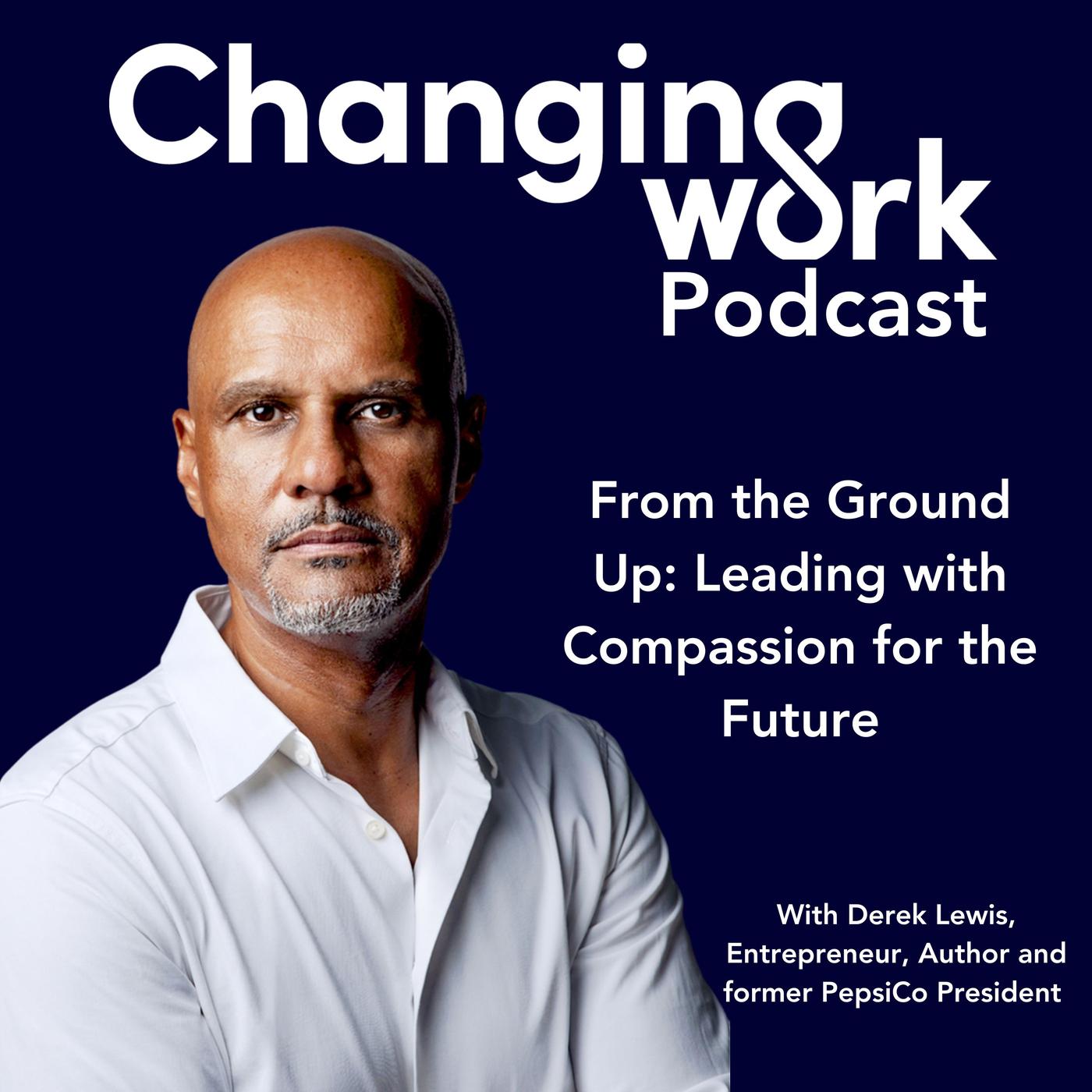
Hi everybody, it's Scott from Changing Work and I'm super excited to have Derek Lewis here with us.
Speaker B
00:00:50
Hi Derek, how are you doing?
Speaker B
00:00:53
Derek, if you don't know, is amazing human.
Speaker B
00:00:56
He was a former president at PepsiCo and is the author of a recently re released book, congratulations called Survive and Advance, which is a memoir about his journey from a challenging childhood in the Washington D.C.
Speaker B
00:01:09
area to achieving unparalleled success and becoming a national catalyst for gender and racial equity.
Speaker B
00:01:16
So thank you for being here.
Speaker B
00:01:17
I appreciate you, appreciate your work.
Speaker A
00:01:19
I appreciate you having me here.
Speaker A
00:01:20
Scott, thank you so much at Changing Work.
Speaker B
00:01:23
We recently released a book called Leading with Compassion.
Speaker B
00:01:26
Derek wrote the foreword to this book.
Speaker B
00:01:28
Thank you again for that.
Speaker B
00:01:30
Derek, in the forward you talked about one of your, I assume it's one of your first jobs.
Speaker B
00:01:34
You were in high school and you were working at a residential school and hospital for children and adults that had intellectual disabilities.
Speaker B
00:01:44
I'm just thinking about myself at however old you were, 17, 16, 18 and headed to something like that.
Speaker B
00:01:50
Could you tell us a little bit more about that experience and the role and why was that role important to you?
Speaker A
00:01:57
Well, it was a remarkable experience and writing a book brought back so many great memories of Forest Haven, which now is closed and the way it closed.
Speaker A
00:02:06
Obviously there were a lot of concerns about the way things had shut down there.
Speaker A
00:02:10
But back when I was there, it was one of my first summer jobs.
Speaker A
00:02:14
It wasn't my first, but in high school I was 16 and I was headed to my senior year and I was happy to get the job.
Speaker A
00:02:21
I mean any job that I was able to get for the summer, you know, just you were just excited to have a Job.
Speaker A
00:02:25
And so I would get dropped off down there on H Street downtown.
Speaker A
00:02:30
And then I would have.
Speaker A
00:02:31
They would have a van, a shuttle, take, you know, probably four of us out to the facility every day, which is out actually in Laurel, and then bring us back at the end of the day right there at 8th Street.
Speaker A
00:02:43
So the first day I went out there, I noticed that, you know, three of the other summer interns were escorted to the admin building, and then I was escorted back to one of the residence halls.
Speaker A
00:02:54
And so, you know, starting out, I knew my work was going to be directly with.
Speaker A
00:02:58
They called the children.
Speaker A
00:02:59
You know, they were all adults in there, but again, because of intellectual challenges, they would.
Speaker A
00:03:03
They call them children.
Speaker A
00:03:04
It was a children's center.
Speaker A
00:03:05
They actually referred to the place as.
Speaker A
00:03:07
So I was assigned to the children's center.
Speaker A
00:03:09
And there I would, you know, get to, you know, interact with the residents there, you know, helping them do things like put their clothes on, bathing, bathroom needs, feeding them, getting cigarettes out form, retrieving things, games, cutting the TV on, cleaning up after them.
Speaker A
00:03:31
And it's just whatever's required.
Speaker A
00:03:33
And so I really, you know, one recognize that despite how challenging I thought my circumstances were every day when I was a child, getting up every day, that I didn't quite have it as bad as them.
Speaker A
00:03:45
They couldn't do anything for themselves.
Speaker A
00:03:46
They needed someone to do basically everything for them.
Speaker A
00:03:49
I didn't obviously have that, but I could.
Speaker A
00:03:50
I could do things myself.
Speaker A
00:03:52
I had a life.
Speaker A
00:03:53
I could eat every day.
Speaker A
00:03:54
If it was a bowl of cereal, you know, I could eat that every day.
Speaker A
00:03:57
I could make that for myself every day.
Speaker A
00:03:59
And so I recognize one, that there are other people also in life who are also challenging.
Speaker A
00:04:04
You're not the only one doing it.
Speaker A
00:04:05
And the difference now is here you can actually play a role in making their lives a little bit better.
Speaker A
00:04:09
So every day you come in, you know, put a smile on your face.
Speaker A
00:04:13
The work is hard.
Speaker A
00:04:14
The work is not pleasant in any way, shape or form.
Speaker A
00:04:17
But what I did get out of it was I put smiles on faces.
Speaker A
00:04:20
I could actually get them to laugh on occasion.
Speaker A
00:04:23
There's one guy named Martin who.
Speaker A
00:04:24
Who I thought was a pretty tough character.
Speaker A
00:04:26
I was always trying to find ways to get him to laugh and smile, and he was able to.
Speaker A
00:04:30
He really couldn't talk, but I know his facial expressions meant a lot, and I could tell when he wasn't happy, but I also can tell when he was happy, and I can give him the smile now and then, and so that brought a lot of joy.
Speaker A
00:04:40
To me that I could help the residents assist themselves.
Speaker A
00:04:44
I could.
Speaker A
00:04:45
They're good.
Speaker A
00:04:47
So back to, you know, the children's center in Martin.
Speaker A
00:04:50
I think it was, it was, you know, it was transformative for me in terms of having to show up for other people, for people being reliant upon me every day, even the staff there, because I could see the.
Speaker A
00:05:02
How burdened they were every day.
Speaker A
00:05:04
I could see the mental and emotional grind that they had dealing with, you know, the type of work they were having to do.
Speaker A
00:05:11
Everything because it was, you know, satisfaction was just making sure they got fed, they got bathed, you cleaned the place up properly.
Speaker A
00:05:19
And it was just a continuous cycle of that, you know, basically 24, 7.
Speaker A
00:05:24
And I could see when I was there Monday through Friday, I could, I could feel that grind and that, that taxing environment.
Speaker A
00:05:30
But I also every day left somewhat fulfilled in that I put smiles on faces.
Speaker A
00:05:36
I assisted the staff members there who were again under a lot of pressure to deliver there.
Speaker A
00:05:43
And, you know, I felt like I was working really, really hard, you know, to make things better for people that couldn't do things for themselves otherwise, you know, and that, that put a lot of gratification into me and it gave me a perspective is that life now is a way of.
Speaker A
00:05:59
It's about people and taking care of people and serving people and showing up for people is actually more important than anything else that we may think about or talk about.
Speaker A
00:06:11
That's the most important thing.
Speaker A
00:06:12
To show up for people.
Speaker A
00:06:12
I had to show up for my brothers every day.
Speaker A
00:06:14
I had to show up for my mom every day.
Speaker A
00:06:15
I had to show up for myself every day.
Speaker A
00:06:18
And so being there for other people meant more to me than anything else that I could go do for myself.
Speaker A
00:06:25
It was all about satisfying others.
Speaker A
00:06:27
And I sort of carried that mantra throughout my life.
Speaker A
00:06:29
But I think that job really framed up for me in that you may have it difficult.
Speaker A
00:06:35
Other people have more difficult.
Speaker A
00:06:37
What's your responsibility?
Speaker A
00:06:38
What's your role?
Speaker A
00:06:39
Where's your compassion for serving others and helping others get out of the situation and make me a better person for that?
Speaker A
00:06:46
And I felt like that was making me a better person.
Speaker B
00:06:48
That's great.
Speaker B
00:06:49
That's a powerful experience.
Speaker B
00:06:51
Sometimes I find that when we are in service to others, it makes us forget some of our own challenges and we can actually find joy like what you're talking about.
Speaker B
00:07:00
The actual job itself does not sound like a fun thing to do if you're trying to tell a 16 year old, hey, this is going to be amazing.
Speaker B
00:07:09
But because you felt that Sense of service.
Speaker B
00:07:12
It sounds like it was really rewarding.
Speaker B
00:07:13
My question, my wonder is, did you have.
Speaker B
00:07:18
Who were your role models in this time that made you into that person who could have that emotional intelligence or that compassion, or were you just wired that way?
Speaker A
00:07:28
I think it just had to be wired that way because I really, you know, when I looked at my life, what was going around.
Speaker A
00:07:33
My mom was very, very hard worker.
Speaker A
00:07:36
So what I learned from her was just the grit and the grind.
Speaker A
00:07:39
Right.
Speaker A
00:07:40
And just being able to go produce.
Speaker A
00:07:41
Right.
Speaker A
00:07:42
She was such into providing.
Speaker A
00:07:44
She went out and hustled every day.
Speaker A
00:07:45
You know, my.
Speaker A
00:07:46
My maternal grandmother taught me how to read.
Speaker A
00:07:48
And so I think there was a certain sort of intellectual sort of bump that I got out of being around her.
Speaker A
00:07:54
We played Scrabble a lot together.
Speaker A
00:07:56
And so she was.
Speaker A
00:07:57
She was a teacher, you know, at one point in her life, in her career, before she started having children, she was a teacher.
Speaker A
00:08:03
And so I got a lot of the sort of intellectual academia stuff out, I think, out of her, you know, so I think that those.
Speaker A
00:08:12
I felt like those pieces were in place in terms of, you know, what you're asking me.
Speaker A
00:08:17
I think, you know, I think I was sort of just wired that way.
Speaker A
00:08:20
Given the responsibility I had with my younger brothers in the household situation I was in and taking care of my mom or being the co head of household with her, I think sort of forced me to step into that, either embrace it and step into it.
Speaker A
00:08:34
And if I didn't step into it, I can't imagine how the house would have run because no one else was there to run it.
Speaker A
00:08:39
So we would have really been in a very difficult situation.
Speaker A
00:08:42
I don't think I understood it quite as dramatic as I'm explaining it now, but I feel like if I didn't do my part to hold it up, we would have been.
Speaker A
00:08:50
It would have been a disaster, you know, disaster.
Speaker A
00:08:53
So I'm thankful I was able to figure it out and get wired in a way where I can take some emotional, intellectual, you know, curiosity from a grandmother.
Speaker A
00:09:02
I could take the grit and grind from my mom.
Speaker A
00:09:06
I can take what not to do, what I learned from my dad, you know, and then the care concern of two younger brothers and siblings who I love dearly.
Speaker A
00:09:15
For me to be there for them and care for them, for me to accept that responsibility is sort of how I put my life together.
Speaker A
00:09:22
And that was my package.
Speaker B
00:09:23
Sure.
Speaker B
00:09:24
Well, it sounds like, well, probably you wouldn't or many people wouldn't have chosen your circumstances.
Speaker B
00:09:29
They were powerful teachers and that Grit, that commitment to education allowed you to really thrive in the world.
Speaker B
00:09:37
Could you tell us a little bit about Pepsi and especially the last role you were in?
Speaker A
00:09:41
Oh, well, I mean, the Pepsi experience was fantastic.
Speaker A
00:09:43
Again, it was 35 year run, remarkable career.
Speaker A
00:09:47
I started really at the ground level, learning the business, running a route and working my way up through various sales, sales operation roles.
Speaker A
00:09:55
Got a chance to spend time in regional headquarters, the national headquarters, big operating jobs, things that I really aspired to do.
Speaker A
00:10:02
I got to do pretty much everything.
Speaker A
00:10:04
So it was a real fun ride.
Speaker A
00:10:07
Company taught me a lot.
Speaker A
00:10:09
Obviously, I got a lot of training through a lot along the way.
Speaker A
00:10:12
And so their investment in people was very, very strong.
Speaker A
00:10:16
Throughout my entire career, there was investment put behind you.
Speaker A
00:10:19
And in return, you were supposed to pay off that investment by driving high performance results, driving high results in culture, driving high results outside the organization.
Speaker A
00:10:27
Right.
Speaker A
00:10:27
And so it was a very good understanding about what your role was and what their role was.
Speaker A
00:10:31
It was complete clarity around that.
Speaker A
00:10:33
And the more work you put in, the more effort you put in, I think the more rewards and upside that you saw, not only from, you know, from a career perspective, but also from a development perspective.
Speaker A
00:10:42
So that stood to be true for me throughout my entire career.
Speaker A
00:10:45
I always felt like despite me giving it my all, they were giving it their all and it was just a match that was very strong and produced a significant amount of results over a three and a half decade timeframe.
Speaker A
00:10:58
Gave me great living experiences.
Speaker A
00:10:59
I moved around the country a lot.
Speaker A
00:11:01
While that can create some chaos and complexity with your family, it also, I think, also allows you to mature faster, allowed our family to grow strongly together.
Speaker A
00:11:11
I don't think we would be as tight as we call ourselves Team Lewis, had we not moved away from our main family and been 2,000, 2,000, 2,500 miles away from them for more than a decade.
Speaker A
00:11:23
So we, we found ways to survive on our own, advance on our own, and I think that made us strong.
Speaker A
00:11:28
So I owe the company a ton of that.
Speaker A
00:11:31
The last role, you know, we think about 2020 and all the events that transpired that year with the pandemic and George Floyd and all the racial inequities and things of that nature.
Speaker A
00:11:42
It was a time that, you know, as a business we were just trying to obviously survive.
Speaker A
00:11:47
I looked at as opportunity now to thrive.
Speaker A
00:11:49
So really engaging in a way that not only drove our business and our service levels of where they needed to be to take care of the pandemic situation, but also use it a way to connect the Community and our culture and our company.
Speaker A
00:12:04
And so making sure our associates and the people that in the communities that we live work played in were equally being supported.
Speaker A
00:12:13
And we were bringing high collaboration.
Speaker A
00:12:15
We were meeting their needs.
Speaker A
00:12:16
We were very attentive to their feelings, their sentiment.
Speaker A
00:12:20
We're able to really do that and also leverage our partnerships, our customer relationships to bring about the best in terms of programs, resources to help those who were feeling the anxiety and the stress and the economic situation of 2020.
Speaker A
00:12:38
And so what happened from that really is our business as we came out of it, started to really thrive, thrive in a tremendous way.
Speaker A
00:12:45
We were the top performing geography in the company.
Speaker A
00:12:48
And I give a lot of credit to obviously the team, my team and all the associates in the organization.
Speaker A
00:12:54
And also the way that we're able to really, you know, lock in on this sort of collaborative effort that, you know, let's focus on the consumer and winning consumer back and being there for the consumer during a tough time, but also make sure they're there for our company and our culture and it's also make sure we're there for the community.
Speaker A
00:13:10
Right.
Speaker A
00:13:10
And so having so that triangular approach to running the business, I think gave us the best results in all those areas, gave us best results with the consumer and engagement there.
Speaker A
00:13:22
It gave us really good results with our associates and satisfaction in a very difficult time.
Speaker A
00:13:27
Our associates felt protected, they felt valued.
Speaker A
00:13:30
They felt like we were investing in them at a really difficult time to help them get through obviously one of the most tough times, toughest times, their lives.
Speaker A
00:13:37
And then we had a community feel like we were listening to what the needs were.
Speaker A
00:13:40
It wasn't all just about, yeah, economic impact was certainly a main pillar there.
Speaker A
00:13:46
But also there were different causes that were needed and we were listening to them, we were reacting to that.
Speaker A
00:13:52
So it wasn't just us pushing one of our programs on the community.
Speaker A
00:13:55
We were very much about listening to what the community voice was and integrating that to programs that made the most sense for them and also some of our customer partnerships and where associates wanted to participate.
Speaker A
00:14:06
So having that engagement, that strong really one supported the business case for what was going on, but also supported the, you know, the, I call it the, the right thing to do case.
Speaker A
00:14:17
Right.
Speaker A
00:14:18
The social case for your community, for your associates and then the company.
Speaker A
00:14:22
Because of how successful we were, I was asked to create that, that role, that new role to help scale that effort up across the entire North American business.
Speaker A
00:14:32
So that's what happened in 2022.
Speaker B
00:14:35
Fantastic.
Speaker B
00:14:37
So I describe conscious business as one that is supporting all of its stakeholders.
Speaker B
00:14:42
And that's basically what you described.
Speaker A
00:14:44
Yes.
Speaker B
00:14:44
You have to have a strong bottom line.
Speaker A
00:14:46
Yes.
Speaker B
00:14:46
We're going to get great results and we're going to take care of our employees and we're going to support the broader community that we live in.
Speaker B
00:14:53
It sounds like Pepsi was really embracing that ethos with the changes that we're seeing in the world.
Speaker B
00:15:01
Do you think that's still the case at Pepsi and at lots of companies?
Speaker B
00:15:04
Do you think we're seeing a change or is it kind of happening outside of the boardrooms?
Speaker A
00:15:09
I don't know what I assume because of Pepsi's history there.
Speaker A
00:15:12
When I was there, I could speak to that timeframe was very strong and rich.
Speaker A
00:15:16
And I would anticipate that the effort would continue as it's continued for almost 80 years, going back to 1940s.
Speaker A
00:15:22
So the work has been sound for eight plus decades.
Speaker A
00:15:26
I don't know why I wouldn't continue, but I don't, I don't have an official obviously position with that.
Speaker A
00:15:29
Sure.
Speaker A
00:15:30
In terms of what's going on the rest of the market, there's a real leadership moment I call needed right now.
Speaker A
00:15:37
Right.
Speaker A
00:15:37
And because there's a lot of chaos, a lot of complexity that I talked about and it's time for the leadership effort to really pay off.
Speaker A
00:15:45
Right.
Speaker A
00:15:45
It's not a time for us to continuously go back and look back at playbooks and tactics that were used many, many decades ago when times were a lot different.
Speaker A
00:15:54
Right.
Speaker A
00:15:54
Where laws are being broken, huge social norms changing rapidly.
Speaker A
00:16:01
I think we're at a place now where, yeah, there's still issues out there, there's no doubt about it.
Speaker A
00:16:04
But we're at a time where, you know, there has been notable progress, but we now must modernize.
Speaker A
00:16:10
I think a lot of the playbooks that were in play and bring them to a future forward look and set up the next generations for this.
Speaker A
00:16:18
So I think there needs to be things that need to be what I call more comprehensive so it looks out for the greater good.
Speaker A
00:16:23
It's not just focused on any one individual cohort.
Speaker A
00:16:26
It's focused on cohorts across the organization across America.
Speaker A
00:16:31
Number two, I think it needs to be a lot more collaborative.
Speaker A
00:16:33
You know, everybody has their own lanes and standalone lanes.
Speaker A
00:16:36
And I think those lanes kept getting longer and longer and deeper and deeper, but not wide enough.
Speaker A
00:16:40
And I think now we need to have an environment where there's massive collaboration on the work, on the topics, on the conversations, on the resources.
Speaker A
00:16:49
Need to be much more collaborative nature.
Speaker A
00:16:51
And then I think the last thing that one is most important to me is, is compassion.
Speaker A
00:16:55
We're dealing with people here.
Speaker A
00:16:56
And so as you make these abrupt changes, as leaders have come out and said, or organizations have come out and said, we're stopping this.
Speaker A
00:17:04
Well, you're stopping this.
Speaker A
00:17:05
What are you doing in terms of that?
Speaker A
00:17:06
Because I go back to the business case, Are you also saying you're stopping trying to drive revenue and profit with these same cohorts?
Speaker A
00:17:13
Because last time I looked, all cohorts mattered, and especially the minority cohort.
Speaker A
00:17:18
As the pendulum keeps shifting from a population demographic standpoint, I would imagine everybody in their strategic plan is saying, we need to win with the demographic shifts.
Speaker A
00:17:27
We need to ensure we're locked in on all these cohorts that are growing family size, that are growing in terms of income contribution spent.
Speaker A
00:17:35
We need to make sure we're flourishing with these consumers.
Speaker A
00:17:37
I can't imagine anybody's strategic business plan is not talking about that.
Speaker A
00:17:41
So if you're still dialed in from a revenue and profit standpoint, which is the business case, which actually in my mind is the front and center reason why you're doing the things that you're doing, why is that not translating to how you treat associates inside your organization and how you spend resources against the community you live in, work and play in, all those things, all connected.
Speaker A
00:18:03
So if you keep that lens of the business case and the culture and the community and make sure that's all intertwined, to me, you wouldn't have to go, we're cutting this, we're cutting that.
Speaker A
00:18:14
To me, it's.
Speaker A
00:18:15
It's one sort of loop, one sort of one business case that's integrated, that's moving all in the right direction, that's accommodating everybody, that's looking after the greater good, that's creating wins for everybody, that's not using the words mandates and carve outs and, you know, special needs or things like that.
Speaker A
00:18:33
It's basically you're running the play that you're running to drive the revenue profit, and you're extending that out to how you look inside the organization, how you recruit, how you develop, how you accelerate positions, and then also where you spend money inside the community to help certainly the most underserved areas get lifted up to make them thrive better so that in turn can deliver back into your business proposition.
Speaker A
00:18:54
It keeps everybody whole, it keeps everybody happy.
Speaker A
00:18:56
But leaders, to me, aren't talking about that before they make statements about we're cutting something.
Speaker A
00:19:01
If you cut something, just say that again, you're repurposing monies.
Speaker A
00:19:07
And your challenge, the organization, is to modernize the current thinking and playbook on this.
Speaker A
00:19:12
So it's going to look a little different, it's going to feel a lot different in terms of nature, but it's going to be more comprehensive, it's going to be more collaborative, it's going to be more compassionate.
Speaker A
00:19:22
So the work isn't going away, it's just being reimagined for the future generations to be successful and for our company to be successful, because you do owe shareholders a top line and a bottom line proposition.
Speaker A
00:19:33
So it's okay to talk about that because that's not going away.
Speaker A
00:19:36
Even if you look at votes and we just had an election, right?
Speaker A
00:19:39
There were conversations around winning votes with all cohorts.
Speaker A
00:19:42
Matter of fact, it was highlighted where there might have been some additional gains in pockets of cohorts that are minority, that are different than the rest of the world.
Speaker A
00:19:51
So from an election standpoint, performance standpoint, yeah, those cohorts matter.
Speaker A
00:19:55
So why does that flow through all the other work?
Speaker A
00:19:58
That's, that's my point.
Speaker A
00:20:00
So it's really a leadership moment.
Speaker A
00:20:01
We're not going to have one leader get up and make a statement and everybody follows that leader anymore.
Speaker A
00:20:05
We're not in that time.
Speaker A
00:20:06
We need leaders now to work in communities together.
Speaker A
00:20:10
We need leaders to work in cities together, we need leaders to work in states together.
Speaker A
00:20:14
And then those efforts can lift and shift and branch out to something much bigger.
Speaker A
00:20:17
So the challenge with me is on, if you're a local leader in your community, in a big business, and you have experience with this, this, this sort of space, time to dig in with your counterparts across all lines to create this new model playbook that I think can be built for many, many generations to come.
Speaker A
00:20:37
So I think the work is easy to get there.
Speaker A
00:20:40
I think the work is easy to do.
Speaker A
00:20:41
The playbooks are easy to build.
Speaker A
00:20:43
I think getting everybody to understand the value of making that step is what is the challenge right now?
Speaker B
00:20:48
Sure, I hear you make the case for as part of the business model, we treat our people right, our employees right.
Speaker B
00:20:57
So if I came from a place, if I'm a manager who has worked in a command and control style environment, I come in, I work for you.
Speaker B
00:21:04
Like, what does that even mean?
Speaker B
00:21:06
How do I put that into practice?
Speaker B
00:21:07
What are the best, best practices of a good, compassionate leader?
Speaker A
00:21:11
Look, I think one leaders, all good leaders may have compassion or conviction for what they believe in, what they do.
Speaker A
00:21:17
I think all the good leaders have ownership of their business and of People.
Speaker A
00:21:21
So you look at the business in terms of three legged stool.
Speaker A
00:21:25
I look at the business proposition, the customers and consumers that I have to take care of every day.
Speaker A
00:21:29
I look at my company and culture in terms of my associates and I look at my community in terms of where we live, work, eat and play, making sure I'm staying those up.
Speaker A
00:21:37
I think you're looking at it from that standpoint.
Speaker A
00:21:39
I think you're a leader, you're a person of action.
Speaker A
00:21:42
I can make statements, but if I don't back those statements up, I'm not walking the talk.
Speaker A
00:21:46
Then my leadership is, you know, my null and void because I'm not really creating action.
Speaker A
00:21:50
I think there's a consistency in it.
Speaker A
00:21:52
I think you can't, you know, as a leader you have to be consistent on your principles and your value set.
Speaker A
00:21:58
I don't think you can be somebody that it's student body left this month and student body right next month.
Speaker A
00:22:03
And because somebody changed office, you're doing this and you're doing that.
Speaker A
00:22:06
I think you have to really be a leader that is sort of convict conviction, the ownership, the action and the consistency over time.
Speaker A
00:22:15
The last thing is hustle.
Speaker A
00:22:16
We want leaders that work hard, man to go to grind, that set the example that are knocking barriers down for the organization.
Speaker A
00:22:22
So as their people approach milestones and approach opportunities to be successful, a lot of the things that you've done, you've created spaces for them to be successful.
Speaker A
00:22:30
And some of that space we're talking about now is a space that by taking things away, are you actually creating a space for them to be successful in?
Speaker A
00:22:37
Are you now making it harder for them to be successful?
Speaker A
00:22:40
I would pose that question.
Speaker A
00:22:41
A lot of leaders have made some of these statements on pulling back on something without talking about where they're going.
Speaker B
00:22:46
Yeah, you have a mantra of moving from go getter to go giver.
Speaker B
00:22:52
Can you tell me about that and when did that happen in your career?
Speaker A
00:22:56
I mean, I think it happened in the latter part of my career.
Speaker A
00:23:00
I mean mid career I was probably still in go getting mode.
Speaker A
00:23:02
Year 17 to 20, I was still in go getter mode.
Speaker A
00:23:07
But I think what I saw is I started getting more and more responsibility and there became less dependency on me driving the business.
Speaker A
00:23:15
I had to now take a more strategic approach and an elevated leadership approach to business.
Speaker A
00:23:19
When you have tens of thousands of associates underneath you now, you can't be the one out there solving all the problems.
Speaker A
00:23:25
You have to be very strategic in your think thought process.
Speaker A
00:23:28
You have to be very empowering.
Speaker A
00:23:29
You have to be awesome at talent selection and you continue to obviously be great at execution and what you go do.
Speaker A
00:23:36
But your idea, leadership, your influence leadership has to go through the roof now because you're moving mountains in terms of the size and scale of what you're doing.
Speaker A
00:23:44
And I was always programmed to go do that in a better, better way.
Speaker A
00:23:47
But once I recognized, I started Realiz that hey, your legacy now is going to be people.
Speaker A
00:23:51
Nobody's ever going to talk about a volume number, a revenue number, profit number you hit when you're out of this business.
Speaker A
00:23:57
They will talk about though the people that you affected, the change that you affected, that affected people.
Speaker A
00:24:02
And so the switch came on for me is that your legacy now is going to be in people.
Speaker A
00:24:07
And I was always robust at developing teams and high talented teams and powerful teams, but I didn't necessarily make that the number one thing.
Speaker A
00:24:13
And later in my career, outside of getting all the results and everything, I started to understand if you make people better and you grow their careers and you grow their personal lives and help them grow their personal lives along with their professional lives, if you're impacting people in the community, if you're making customers better at what they do, that's going to be a legacy that carries on for many, many years beyond your, your playing days, as I would say.
Speaker A
00:24:38
And so that switch cut on, it changed the whole paradigm for me and my whole vision of getting up every day wasn't about Derrick Lewis anymore.
Speaker A
00:24:47
It was about, it was about people.
Speaker B
00:24:48
Yeah, I call this the journey from me to we.
Speaker B
00:24:51
And it often happens for people mid career as you say, like we have some success and then we can kind of look around.
Speaker B
00:24:58
How can you train or that's not the right word.
Speaker B
00:25:01
How do you give advice to a young comer, upper right, the 22 year old you who's still trying to, you know, make rent and make a name for themselves.
Speaker B
00:25:10
How do you convince them that the we is more important than the me?
Speaker A
00:25:13
Well, I think it starts with the me first though.
Speaker A
00:25:15
I think to one thing you have to do three things.
Speaker A
00:25:17
I think I do.
Speaker A
00:25:18
One is you have to bet on yourself.
Speaker A
00:25:21
So it's all about becoming the best version of yourself.
Speaker A
00:25:23
If you're not the best version of yourself, you can't deliver for others.
Speaker A
00:25:27
So there is a bit of a sequence and it goes on.
Speaker A
00:25:29
I can't jump into go giving, I can certainly go do that, but I'm not going to be as effective unless Derrick Lewis really understands what his best version of himself can be.
Speaker A
00:25:38
And that's an ongoing thing, by the way.
Speaker A
00:25:39
So it's a constant thing.
Speaker A
00:25:40
It's not just a point in time where I stop and go.
Speaker A
00:25:42
I'm my best version now.
Speaker A
00:25:44
I'm going to shift, I'm going to obviously keep moving that forward.
Speaker A
00:25:46
But I would say better in yourself, believe in yourself and be yourself.
Speaker A
00:25:50
So what I mean by that, you have to invest in yourself to be the best version of yourself if you're going to be able to move others.
Speaker A
00:25:56
You can't.
Speaker A
00:25:57
If I'm not my best version or I'm not investing in myself, how can I expect to move the needle with others without doing it for myself?
Speaker A
00:26:03
To believe in yourself, you got to have a lot of confidence.
Speaker A
00:26:05
You got to take risk.
Speaker A
00:26:06
You have to absolutely believe you can get done.
Speaker A
00:26:08
You have to have a vision and be able to see forward.
Speaker A
00:26:10
You have to manifest a success.
Speaker A
00:26:13
You have to really put that effort in to do that.
Speaker A
00:26:15
I think that absolutely transforms your way of thinking and it gives you a confidence level that is going to be uniquely positioned for your, for your dream, your world, your lane that you're playing in.
Speaker A
00:26:25
And I think this whole notion about be yourself goes back to this authenticity.
Speaker A
00:26:28
Who are you?
Speaker A
00:26:29
You know, from a very young child I said I wanted to be myself.
Speaker A
00:26:32
I want to be this authentic, bold, courageous, you know, very direct, energetic, high energetic leader that wanted to go change the world, right?
Speaker A
00:26:41
And I never have come off of that.
Speaker A
00:26:43
Even through challenging times or the greatest of times, I stay very true to my, my vision.
Speaker A
00:26:48
So I look at those three Bs as a real catalyst there.
Speaker A
00:26:52
And then I would say from that, once you're there, continuously dream big, continuously sort of reinvent yourself, you know, sort of like, you know, building, investing yourself, be a continuous learner.
Speaker A
00:27:03
Don't just think that you know it all and I think go out and go tear it up.
Speaker A
00:27:08
On the performance side, right.
Speaker A
00:27:09
I use three R's results, relationships, reputation.
Speaker A
00:27:12
I talk about making sure that you are grooved and excelling in those three areas to provide the greatest results framework for yourself not only on the professional side, but also the personal side.
Speaker B
00:27:23
And you know, I know you talk a lot about and really believe in community.
Speaker B
00:27:27
So if each one of us are, we're focused on ourselves, right?
Speaker B
00:27:32
You have, you gave a beautiful framework on how to develop ourselves, become the best version of ourselves.
Speaker B
00:27:37
I think sometimes people tend to then only focus on themselves.
Speaker B
00:27:41
What is this power of community?
Speaker B
00:27:43
And then how can I use that best version of myself to either receive or give back?
Speaker A
00:27:48
What is the power, the power in the three Rs is in the relationships results.
Speaker A
00:27:54
I'm a go getter relationships now.
Speaker A
00:27:57
I'm building environment of trust.
Speaker A
00:27:59
I'm building an environment of teamwork, I'm building environment of transparency, a building environment of win wins.
Speaker A
00:28:07
And so to me, the relationships pillar of the three Rs is the most important pillar in that house.
Speaker A
00:28:14
It's purposely in the middle of my house because it's the center.
Speaker A
00:28:17
The results are going to fluctuate over time.
Speaker A
00:28:20
Macros can affect change and the world we live in, reputation the same way, you have a lot more control over that.
Speaker A
00:28:26
But sometimes outside perceptions matter.
Speaker A
00:28:29
What you can ultimately hone in on and lock in on day in and day out of the relationships that you built.
Speaker A
00:28:34
Those will never let you down.
Speaker A
00:28:36
The right ones done the right way have a lot of longevity to them.
Speaker A
00:28:41
And quite frankly, since I retired, the relationship pillar had delivered more than I ever would have imagined.
Speaker A
00:28:47
And so laying the seeds over three and a half decades or whatever number of years inside those 35 years with the people that I build those relationships with has paid off exponentially.
Speaker A
00:28:57
Once I decide to leave the company to help me with my next chapter.
Speaker A
00:29:00
Whether it's writing a book, whether it's getting a new become an entrepreneur, whether it's, you know, more serving and more giving on nonprofit spaces and causes and things like that.
Speaker A
00:29:11
And so the floodgates in my mind have opened all because of the relationship management part that I think sometimes is undervalued.
Speaker A
00:29:19
And I talk about that in my book and people have made comments to me about that part, understanding how important that part is.
Speaker A
00:29:26
And they wish they had learned that a little bit earlier in their career.
Speaker A
00:29:29
And some that are younger realizing that, hey, thank you for letting me know that's going to be the most.
Speaker A
00:29:33
One of the most important parts of my journey is the relationship management side of it.
Speaker A
00:29:37
So that in my mind is how you, how you get there.
Speaker A
00:29:41
You can't get there without the relationships.
Speaker A
00:29:43
Beautiful.
Speaker B
00:29:46
What I see in my own life, among others, is when things get hard, we move into self preservation mode, right?
Speaker B
00:29:52
Like an animal.
Speaker B
00:29:53
We're animals.
Speaker B
00:29:54
But like a cat that gets injured, they go hide under the bed, right?
Speaker B
00:29:58
Versus being out and being brave and being strong.
Speaker B
00:30:01
And when things get hard, it's hard to see the big picture.
Speaker B
00:30:03
It's hard to see some of these broader community structures.
Speaker B
00:30:08
How can we summon our compassionate selves, our best selves when times are hard?
Speaker A
00:30:13
When times are really hard, it's not easy to do.
Speaker A
00:30:16
But I would use an example for myself is doing the 2020 scenario where I'm the lead executive certainly for the African American cohort inside of Pepsi.
Speaker A
00:30:27
And, you know, everything that was going on, you can imagine the calls, the outreach, the sentiment, people were feeling extremely down, very challenged emotionally.
Speaker A
00:30:38
And they were, it was a lot of hardship, I think, going on.
Speaker A
00:30:42
They were looking for leadership.
Speaker A
00:30:45
And, you know, I have my own personal challenge I'm dealing with, like, what if my kids are put in a very similar situation?
Speaker A
00:30:51
Or what if I was driving around, you know, in a certain part of the country and I was by myself, what could happen to me?
Speaker A
00:30:58
And, and so I had these thoughts as I'm listening to TV every day, being reminded how difficult circumstances are.
Speaker A
00:31:03
But then I like to switch one off one day saying, look, you're, you got to be a time of a leader now.
Speaker A
00:31:08
You have to, you have to step into this storm.
Speaker A
00:31:11
You can't like, try to outrun it.
Speaker A
00:31:13
So I say some people think when the storm is coming, they, they run from it.
Speaker A
00:31:17
They go, they get in the car and they retreat.
Speaker A
00:31:18
They go as fast as they can away from the storm.
Speaker A
00:31:21
I decide I want to go into the storm.
Speaker A
00:31:24
One, because I want to take a head on.
Speaker A
00:31:26
I want to see how, you know, how powerful it was and how tough it was.
Speaker A
00:31:30
But two, I want to show the people that are behind me that believe in me, that bet on me, that count on me, know that I have the courage, the boldness, the strength to take on the most tough time.
Speaker A
00:31:43
And so I was, I go in the storm and I deal with the storm and I'm in the storm.
Speaker A
00:31:47
The storm is hard, but I'm coming out of the storm.
Speaker A
00:31:50
I'm in the storm and I'm developing solutions and ideas and plans and, and, and I'm fighting and I'm.
Speaker A
00:31:55
And people are going, wow, we have a leader that actually is in the middle of the storm.
Speaker A
00:31:59
He's not running away from it.
Speaker A
00:32:01
When he's asked a question, he's not retreating, he's not saying, well, the company put out a statement and he's, he's taking his head on.
Speaker A
00:32:06
Hey, I'm scared.
Speaker A
00:32:07
I am scared.
Speaker A
00:32:07
Being in the storm, I was scared.
Speaker A
00:32:09
I wasn't like telling you, you was easy to go into it, but I went into it knowing that because I've been blessed and because of where I've been put in my life, that I was the one that had to go into the storm.
Speaker A
00:32:19
I couldn't expect anybody else to go do it.
Speaker A
00:32:21
So I'm looking around, I'm going, waking up, going, hey, Hello.
Speaker A
00:32:24
You've got to go through the storm, man.
Speaker A
00:32:26
This is your.
Speaker A
00:32:26
This is your job now.
Speaker A
00:32:27
This is everything I've given you at this point.
Speaker A
00:32:30
This is the reason why I've given you all these tools, is because now they're most needed for not only for yourself, your family, but for all the people that you lead, all people that you can affect change with.
Speaker A
00:32:39
So get in there and do what you need to go do.
Speaker A
00:32:41
And I did it when in the storm.
Speaker A
00:32:43
It was difficult.
Speaker A
00:32:44
A lot of difficult nights, a lot of difficult thoughts, a lot of difficult times and challenges, but I was able to leave clear.
Speaker A
00:32:50
I got in the storm, and actually I saw a very clear picture of what the future could look like, of how to navigate and how to lead people out of this.
Speaker A
00:33:00
And so by going in the storm, it enabled me to actually lead people out of the storm.
Speaker A
00:33:04
Had I run from the storm and keep running from the storm, I would have never gained the tenacity, the capability, the strength, the muscle, the desire even to lead people through it.
Speaker A
00:33:16
So I had to go into it.
Speaker A
00:33:17
And so I would ask, sometimes people take on the storm, take it on not from a standard.
Speaker A
00:33:22
You're trying to fight it, but you're trying to learn.
Speaker A
00:33:25
You're learning through it.
Speaker A
00:33:26
You're being tested.
Speaker A
00:33:27
And so it's a great test for you to take all the things that you've learned, to go into these dark times or go into these moments of uncertainty and call your shot.
Speaker A
00:33:36
Call your shot again.
Speaker A
00:33:38
Better in yourself.
Speaker A
00:33:39
Believe in yourself.
Speaker A
00:33:39
Be yourself.
Speaker A
00:33:40
I didn't waver when I got in the storm.
Speaker A
00:33:42
Like, I'm gonna be myself.
Speaker A
00:33:43
I'm gonna bet on myself, you know, I'm gonna believe in myself in the storm.
Speaker A
00:33:46
And guess what?
Speaker A
00:33:47
I did that.
Speaker A
00:33:47
And guess what?
Speaker A
00:33:48
A lot of great things came out of that.
Speaker A
00:33:49
A lot of great things.
Speaker A
00:33:51
Beautiful.
Speaker B
00:33:52
You've given us some really good examples.
Speaker B
00:33:54
And really, you model this really well.
Speaker B
00:33:57
Self, responsibility, compassion, drive, clarity.
Speaker B
00:34:02
All these things that we talk about when we.
Speaker B
00:34:04
When I talk about conscious leadership, conscious business, I see a lot of leaders that are perhaps not role models of this particular set of values.
Speaker B
00:34:16
Do you see leaders who are.
Speaker B
00:34:18
And who is getting it right?
Speaker B
00:34:19
Like, who can we help lift up during these times?
Speaker A
00:34:24
You know, it's about, who.
Speaker A
00:34:25
Who can we help lift up the leaders?
Speaker A
00:34:26
Or are you talking about the cohort?
Speaker B
00:34:28
Well, I'm talking about.
Speaker B
00:34:30
I want to know who's getting it right.
Speaker B
00:34:32
I want to celebrate those leaders in the world that are getting it right in terms of being conscious leaders in this moment right now.
Speaker A
00:34:38
Yeah.
Speaker A
00:34:39
I think there are many leaders and many organizations that are doing the right thing.
Speaker A
00:34:47
And again, I think a lot of it starts with the business case and the strategic journey at making sure I have a business case for why I, I want to win with everybody.
Speaker A
00:34:57
And then that is now translating inside my organization, with my associates and my leaders, and it's also translating in the community.
Speaker A
00:35:04
There are many organizations, I think, that are, that are doing it right and leaders are doing it right.
Speaker A
00:35:08
I think there are many that, that are challenged to figure it out because their bias in this or their sense of this is being reaction, being reactionary.
Speaker A
00:35:19
Right.
Speaker A
00:35:19
Being either resisting it or being reactionary to it.
Speaker A
00:35:22
I don't.
Speaker A
00:35:23
I think either one of those places is not a good place.
Speaker A
00:35:24
I think you have to be a point where you have to sort of reimagine this space.
Speaker A
00:35:30
You have to look to reap growth out of this.
Speaker A
00:35:33
I look at this as a time of growth.
Speaker A
00:35:35
I actually don't look at it as a time of turmoil.
Speaker A
00:35:37
While it can feel like that.
Speaker A
00:35:39
I'm also looking at, we get to do this playbook all over again.
Speaker A
00:35:42
We get to actually reinvent this playbook and do it so that.
Speaker A
00:35:44
Setting up the next future generation of leaders.
Speaker A
00:35:47
So when we're not here one day, and this is 30, 40, 50 years from now, this era of leadership is developing that strategy for, you know, 10, you know, four or five decades from now.
Speaker A
00:35:59
That, to me is fascinating that you can actually affect the future in that way by the work that you do now.
Speaker A
00:36:05
Now if you just pass it through and complain and boycott and keep your head down and all you do is talk about what's not working and who these people are and that those people are.
Speaker A
00:36:17
That's not going to set up the next, you know, 30, 40, 50 years.
Speaker A
00:36:21
It's time now to really reimagine a new playbook.
Speaker A
00:36:25
That's something exciting to be part of.
Speaker A
00:36:27
That's why I wrote this book, because I wanted to help others.
Speaker A
00:36:30
And guess what?
Speaker A
00:36:31
I don't know how much distribution my book is going to be in 50 years.
Speaker A
00:36:34
I hope it's on a family member shelf.
Speaker A
00:36:36
You know, at some point, you know, the great grandchildren at some point, the kids maybe still be living, obviously, hopefully.
Speaker A
00:36:44
And, you know, and, and so I hope people at that time pull that out and go, let's understand it from a leader back in, you know, grew up in the 70s, when things weren't, when things were actually very, very difficult, and how this leader took on his life to create a better future for himself and for his family members.
Speaker A
00:36:59
Right.
Speaker A
00:37:00
So this is a time for opportunity and I'm excited about what I can now go do.
Speaker A
00:37:04
The now that I'm outside of a company where I can speak freely and I can be independent at who I want to be living and building off a lot of the values and disciplines I learned inside the company.
Speaker A
00:37:16
But now also.
Speaker A
00:37:17
But I'm being independent in my thought and my perspective, in my actions.
Speaker A
00:37:21
I love this space I'm in now because I can go do more for change than ever.
Speaker A
00:37:27
I'm not afraid to take people on.
Speaker A
00:37:28
I know there'll be a lot of criticisms inside even our own culture about the things that I say and things I do.
Speaker A
00:37:34
I don't care.
Speaker A
00:37:36
I don't need to prove my authenticity to anybody.
Speaker A
00:37:39
I'm the real.
Speaker A
00:37:40
I'm a real one and read my story.
Speaker A
00:37:42
I'm a real one.
Speaker A
00:37:43
It's not going to compare myself against other people, but I'm a real one.
Speaker A
00:37:46
So I don't need my credentials validated.
Speaker A
00:37:49
I'm a person of action.
Speaker A
00:37:51
I want to get in a room with you.
Speaker A
00:37:52
If you have some different thoughts, there's some different ways of doing it.
Speaker A
00:37:55
I respect that.
Speaker A
00:37:56
Let's have those conversations and together walk out with action for others to take on.
Speaker A
00:38:01
That's inclusive of new ideas, old ideas, different ideas, future ideas.
Speaker A
00:38:07
Let's do that together.
Speaker A
00:38:08
Let's do that.
Speaker A
00:38:08
Work together.
Speaker A
00:38:09
So my challenge for all leaders to come together now, put the differences aside.
Speaker A
00:38:14
Build something collaborative, comprehensive and compassionate for the generations of the future to be successful.
Speaker B
00:38:20
Beautiful.
Speaker B
00:38:21
Derek Lux, you've written this book, Survive in Advance, recently released.
Speaker B
00:38:26
I hope everybody goes and gets a copy.
Speaker B
00:38:29
What.
Speaker B
00:38:29
What are you up to now and how can people find you?
Speaker A
00:38:32
Well, people can follow me.
Speaker A
00:38:33
I'm on all social platforms, so.
Speaker A
00:38:35
Ealderic Lewis R E A L D E R E K L E W I s that's Instagram, it's Facebook, Twitter, LinkedIn.
Speaker A
00:38:43
So I use those platforms pretty consistently.
Speaker A
00:38:45
So you can follow me to social to find out what's going on.
Speaker A
00:38:48
I'd love for you all to read the book.
Speaker A
00:38:49
I have a website, realdereklewis.com that also has a lot more detail about some of the communications and conversations I've had, certainly recently within the last few years.
Speaker A
00:38:59
And so I encourage readers and followers, go out, check out the pages, check out the sites, let me know your thoughts.
Speaker A
00:39:05
I hope you have a chance to read the book.
Speaker A
00:39:07
It is for other people and take certainly a lot of satisfaction that for those that have already read it, have commented they feel like it's been an inspirational change for them, a lot of lessons they can learn.
Speaker A
00:39:19
And that gives me goosebumps because this is all about helping others be successful in pursuit of resiliency, pursuit of determination, and their pursuit of dreams, the biggest dreams they've had in their life.
Speaker B
00:39:32
Thank you, Derek.
Speaker B
00:39:33
I appreciate your shining your light brightly.
Speaker B
00:39:35
I appreciate your leadership.
Speaker B
00:39:37
Thanks for writing the forward to our book, and thanks for the work you're doing in the world.
Speaker B
00:39:42
Appreciate you, Scott.
Speaker A
00:39:43
Thank you, my man.
Speaker A
00:39:44
Thank you for the opportunity of time and congratulations on your book as well.
Speaker A
00:39:47
And let's find ways to collaborate in the future to help create the kind of change that you and I know is necessary for our future leaders to be successful.
Speaker B
00:39:55
Absolutely.
Speaker B
00:39:57
All right, friends, thank you, Derek.
Speaker B
00:39:58
Friends, thank you for following us here at Changing Work.
Speaker B
00:40:02
Our new book just came out called Leading with Compassion.
Speaker B
00:40:04
Derek wrote the forward.
Speaker B
00:40:05
Would love to both of these copies, both of these amazing books, have them on your shelf for your grandkids to look at.
Speaker A
00:40:12
Yeah.
Speaker A
00:40:12
Read two books at one time.
Speaker A
00:40:13
You can do it.
Speaker B
00:40:14
That's right.
Speaker A
00:40:16
So thanks.
Speaker B
00:40:17
And you can find us at changingwork.org, you can reach out to me at scottangingwork.
Speaker B
00:40:23
Thanks, everybody.
Speaker B
00:40:24
Go out there and be ambassadors for compassion.
Speaker B
00:40:26
Shine your lights brightly.
Speaker B
00:40:27
Love you.
Speaker B
00:40:28
Take care.
Speaker A
00:40:28
God bless.
Speaker A
00:40:29
Thank you.
00:00:00
I think it starts with the me first though.
Speaker A
00:00:01
I think one thing you have to do three things.
Speaker A
00:00:03
I think I do.
Speaker A
00:00:04
One is you have to bet on yourself.
Speaker A
00:00:06
So it's all about becoming the best version of yourself.
Speaker A
00:00:08
If you're not the best version of yourself, you can't deliver for others.
Speaker A
00:00:12
So there is a bit of a sequence and it goes on.
Speaker A
00:00:14
I can't jump into go giving.
Speaker A
00:00:16
I can certainly go do that.
Speaker A
00:00:18
But I'm not going to be as effective unless Derrick Lewis really understands what his best version of himself can be.
Speaker B
00:00:24
Hey, friends, welcome to the Changing Work podcast.
Speaker B
00:00:27
We are so glad you're here.
Speaker A
00:00:29
My name is Nick.
Speaker B
00:00:30
And I'm Scott.
Speaker A
00:00:31
And this is the podcast where we talk about changing work from the inside out.
Speaker B
00:00:35
So if you're into making the workplace and the world a better experience via conscious business practices, stick around.
Speaker B
00:00:42
This is for you.
Speaker B
00:00:44
Hi everybody, it's Scott from Changing Work and I'm super excited to have Derek Lewis here with us.
Speaker B
00:00:50
Hi Derek, how are you doing?
Speaker B
00:00:53
Derek, if you don't know, is amazing human.
Speaker B
00:00:56
He was a former president at PepsiCo and is the author of a recently re released book, congratulations called Survive and Advance, which is a memoir about his journey from a challenging childhood in the Washington D.C.
Speaker B
00:01:09
area to achieving unparalleled success and becoming a national catalyst for gender and racial equity.
Speaker B
00:01:16
So thank you for being here.
Speaker B
00:01:17
I appreciate you, appreciate your work.
Speaker A
00:01:19
I appreciate you having me here.
Speaker A
00:01:20
Scott, thank you so much at Changing Work.
Speaker B
00:01:23
We recently released a book called Leading with Compassion.
Speaker B
00:01:26
Derek wrote the foreword to this book.
Speaker B
00:01:28
Thank you again for that.
Speaker B
00:01:30
Derek, in the forward you talked about one of your, I assume it's one of your first jobs.
Speaker B
00:01:34
You were in high school and you were working at a residential school and hospital for children and adults that had intellectual disabilities.
Speaker B
00:01:44
I'm just thinking about myself at however old you were, 17, 16, 18 and headed to something like that.
Speaker B
00:01:50
Could you tell us a little bit more about that experience and the role and why was that role important to you?
Speaker A
00:01:57
Well, it was a remarkable experience and writing a book brought back so many great memories of Forest Haven, which now is closed and the way it closed.
Speaker A
00:02:06
Obviously there were a lot of concerns about the way things had shut down there.
Speaker A
00:02:10
But back when I was there, it was one of my first summer jobs.
Speaker A
00:02:14
It wasn't my first, but in high school I was 16 and I was headed to my senior year and I was happy to get the job.
Speaker A
00:02:21
I mean any job that I was able to get for the summer, you know, just you were just excited to have a Job.
Speaker A
00:02:25
And so I would get dropped off down there on H Street downtown.
Speaker A
00:02:30
And then I would have.
Speaker A
00:02:31
They would have a van, a shuttle, take, you know, probably four of us out to the facility every day, which is out actually in Laurel, and then bring us back at the end of the day right there at 8th Street.
Speaker A
00:02:43
So the first day I went out there, I noticed that, you know, three of the other summer interns were escorted to the admin building, and then I was escorted back to one of the residence halls.
Speaker A
00:02:54
And so, you know, starting out, I knew my work was going to be directly with.
Speaker A
00:02:58
They called the children.
Speaker A
00:02:59
You know, they were all adults in there, but again, because of intellectual challenges, they would.
Speaker A
00:03:03
They call them children.
Speaker A
00:03:04
It was a children's center.
Speaker A
00:03:05
They actually referred to the place as.
Speaker A
00:03:07
So I was assigned to the children's center.
Speaker A
00:03:09
And there I would, you know, get to, you know, interact with the residents there, you know, helping them do things like put their clothes on, bathing, bathroom needs, feeding them, getting cigarettes out form, retrieving things, games, cutting the TV on, cleaning up after them.
Speaker A
00:03:31
And it's just whatever's required.
Speaker A
00:03:33
And so I really, you know, one recognize that despite how challenging I thought my circumstances were every day when I was a child, getting up every day, that I didn't quite have it as bad as them.
Speaker A
00:03:45
They couldn't do anything for themselves.
Speaker A
00:03:46
They needed someone to do basically everything for them.
Speaker A
00:03:49
I didn't obviously have that, but I could.
Speaker A
00:03:50
I could do things myself.
Speaker A
00:03:52
I had a life.
Speaker A
00:03:53
I could eat every day.
Speaker A
00:03:54
If it was a bowl of cereal, you know, I could eat that every day.
Speaker A
00:03:57
I could make that for myself every day.
Speaker A
00:03:59
And so I recognize one, that there are other people also in life who are also challenging.
Speaker A
00:04:04
You're not the only one doing it.
Speaker A
00:04:05
And the difference now is here you can actually play a role in making their lives a little bit better.
Speaker A
00:04:09
So every day you come in, you know, put a smile on your face.
Speaker A
00:04:13
The work is hard.
Speaker A
00:04:14
The work is not pleasant in any way, shape or form.
Speaker A
00:04:17
But what I did get out of it was I put smiles on faces.
Speaker A
00:04:20
I could actually get them to laugh on occasion.
Speaker A
00:04:23
There's one guy named Martin who.
Speaker A
00:04:24
Who I thought was a pretty tough character.
Speaker A
00:04:26
I was always trying to find ways to get him to laugh and smile, and he was able to.
Speaker A
00:04:30
He really couldn't talk, but I know his facial expressions meant a lot, and I could tell when he wasn't happy, but I also can tell when he was happy, and I can give him the smile now and then, and so that brought a lot of joy.
Speaker A
00:04:40
To me that I could help the residents assist themselves.
Speaker A
00:04:44
I could.
Speaker A
00:04:45
They're good.
Speaker A
00:04:47
So back to, you know, the children's center in Martin.
Speaker A
00:04:50
I think it was, it was, you know, it was transformative for me in terms of having to show up for other people, for people being reliant upon me every day, even the staff there, because I could see the.
Speaker A
00:05:02
How burdened they were every day.
Speaker A
00:05:04
I could see the mental and emotional grind that they had dealing with, you know, the type of work they were having to do.
Speaker A
00:05:11
Everything because it was, you know, satisfaction was just making sure they got fed, they got bathed, you cleaned the place up properly.
Speaker A
00:05:19
And it was just a continuous cycle of that, you know, basically 24, 7.
Speaker A
00:05:24
And I could see when I was there Monday through Friday, I could, I could feel that grind and that, that taxing environment.
Speaker A
00:05:30
But I also every day left somewhat fulfilled in that I put smiles on faces.
Speaker A
00:05:36
I assisted the staff members there who were again under a lot of pressure to deliver there.
Speaker A
00:05:43
And, you know, I felt like I was working really, really hard, you know, to make things better for people that couldn't do things for themselves otherwise, you know, and that, that put a lot of gratification into me and it gave me a perspective is that life now is a way of.
Speaker A
00:05:59
It's about people and taking care of people and serving people and showing up for people is actually more important than anything else that we may think about or talk about.
Speaker A
00:06:11
That's the most important thing.
Speaker A
00:06:12
To show up for people.
Speaker A
00:06:12
I had to show up for my brothers every day.
Speaker A
00:06:14
I had to show up for my mom every day.
Speaker A
00:06:15
I had to show up for myself every day.
Speaker A
00:06:18
And so being there for other people meant more to me than anything else that I could go do for myself.
Speaker A
00:06:25
It was all about satisfying others.
Speaker A
00:06:27
And I sort of carried that mantra throughout my life.
Speaker A
00:06:29
But I think that job really framed up for me in that you may have it difficult.
Speaker A
00:06:35
Other people have more difficult.
Speaker A
00:06:37
What's your responsibility?
Speaker A
00:06:38
What's your role?
Speaker A
00:06:39
Where's your compassion for serving others and helping others get out of the situation and make me a better person for that?
Speaker A
00:06:46
And I felt like that was making me a better person.
Speaker B
00:06:48
That's great.
Speaker B
00:06:49
That's a powerful experience.
Speaker B
00:06:51
Sometimes I find that when we are in service to others, it makes us forget some of our own challenges and we can actually find joy like what you're talking about.
Speaker B
00:07:00
The actual job itself does not sound like a fun thing to do if you're trying to tell a 16 year old, hey, this is going to be amazing.
Speaker B
00:07:09
But because you felt that Sense of service.
Speaker B
00:07:12
It sounds like it was really rewarding.
Speaker B
00:07:13
My question, my wonder is, did you have.
Speaker B
00:07:18
Who were your role models in this time that made you into that person who could have that emotional intelligence or that compassion, or were you just wired that way?
Speaker A
00:07:28
I think it just had to be wired that way because I really, you know, when I looked at my life, what was going around.
Speaker A
00:07:33
My mom was very, very hard worker.
Speaker A
00:07:36
So what I learned from her was just the grit and the grind.
Speaker A
00:07:39
Right.
Speaker A
00:07:40
And just being able to go produce.
Speaker A
00:07:41
Right.
Speaker A
00:07:42
She was such into providing.
Speaker A
00:07:44
She went out and hustled every day.
Speaker A
00:07:45
You know, my.
Speaker A
00:07:46
My maternal grandmother taught me how to read.
Speaker A
00:07:48
And so I think there was a certain sort of intellectual sort of bump that I got out of being around her.
Speaker A
00:07:54
We played Scrabble a lot together.
Speaker A
00:07:56
And so she was.
Speaker A
00:07:57
She was a teacher, you know, at one point in her life, in her career, before she started having children, she was a teacher.
Speaker A
00:08:03
And so I got a lot of the sort of intellectual academia stuff out, I think, out of her, you know, so I think that those.
Speaker A
00:08:12
I felt like those pieces were in place in terms of, you know, what you're asking me.
Speaker A
00:08:17
I think, you know, I think I was sort of just wired that way.
Speaker A
00:08:20
Given the responsibility I had with my younger brothers in the household situation I was in and taking care of my mom or being the co head of household with her, I think sort of forced me to step into that, either embrace it and step into it.
Speaker A
00:08:34
And if I didn't step into it, I can't imagine how the house would have run because no one else was there to run it.
Speaker A
00:08:39
So we would have really been in a very difficult situation.
Speaker A
00:08:42
I don't think I understood it quite as dramatic as I'm explaining it now, but I feel like if I didn't do my part to hold it up, we would have been.
Speaker A
00:08:50
It would have been a disaster, you know, disaster.
Speaker A
00:08:53
So I'm thankful I was able to figure it out and get wired in a way where I can take some emotional, intellectual, you know, curiosity from a grandmother.
Speaker A
00:09:02
I could take the grit and grind from my mom.
Speaker A
00:09:06
I can take what not to do, what I learned from my dad, you know, and then the care concern of two younger brothers and siblings who I love dearly.
Speaker A
00:09:15
For me to be there for them and care for them, for me to accept that responsibility is sort of how I put my life together.
Speaker A
00:09:22
And that was my package.
Speaker B
00:09:23
Sure.
Speaker B
00:09:24
Well, it sounds like, well, probably you wouldn't or many people wouldn't have chosen your circumstances.
Speaker B
00:09:29
They were powerful teachers and that Grit, that commitment to education allowed you to really thrive in the world.
Speaker B
00:09:37
Could you tell us a little bit about Pepsi and especially the last role you were in?
Speaker A
00:09:41
Oh, well, I mean, the Pepsi experience was fantastic.
Speaker A
00:09:43
Again, it was 35 year run, remarkable career.
Speaker A
00:09:47
I started really at the ground level, learning the business, running a route and working my way up through various sales, sales operation roles.
Speaker A
00:09:55
Got a chance to spend time in regional headquarters, the national headquarters, big operating jobs, things that I really aspired to do.
Speaker A
00:10:02
I got to do pretty much everything.
Speaker A
00:10:04
So it was a real fun ride.
Speaker A
00:10:07
Company taught me a lot.
Speaker A
00:10:09
Obviously, I got a lot of training through a lot along the way.
Speaker A
00:10:12
And so their investment in people was very, very strong.
Speaker A
00:10:16
Throughout my entire career, there was investment put behind you.
Speaker A
00:10:19
And in return, you were supposed to pay off that investment by driving high performance results, driving high results in culture, driving high results outside the organization.
Speaker A
00:10:27
Right.
Speaker A
00:10:27
And so it was a very good understanding about what your role was and what their role was.
Speaker A
00:10:31
It was complete clarity around that.
Speaker A
00:10:33
And the more work you put in, the more effort you put in, I think the more rewards and upside that you saw, not only from, you know, from a career perspective, but also from a development perspective.
Speaker A
00:10:42
So that stood to be true for me throughout my entire career.
Speaker A
00:10:45
I always felt like despite me giving it my all, they were giving it their all and it was just a match that was very strong and produced a significant amount of results over a three and a half decade timeframe.
Speaker A
00:10:58
Gave me great living experiences.
Speaker A
00:10:59
I moved around the country a lot.
Speaker A
00:11:01
While that can create some chaos and complexity with your family, it also, I think, also allows you to mature faster, allowed our family to grow strongly together.
Speaker A
00:11:11
I don't think we would be as tight as we call ourselves Team Lewis, had we not moved away from our main family and been 2,000, 2,000, 2,500 miles away from them for more than a decade.
Speaker A
00:11:23
So we, we found ways to survive on our own, advance on our own, and I think that made us strong.
Speaker A
00:11:28
So I owe the company a ton of that.
Speaker A
00:11:31
The last role, you know, we think about 2020 and all the events that transpired that year with the pandemic and George Floyd and all the racial inequities and things of that nature.
Speaker A
00:11:42
It was a time that, you know, as a business we were just trying to obviously survive.
Speaker A
00:11:47
I looked at as opportunity now to thrive.
Speaker A
00:11:49
So really engaging in a way that not only drove our business and our service levels of where they needed to be to take care of the pandemic situation, but also use it a way to connect the Community and our culture and our company.
Speaker A
00:12:04
And so making sure our associates and the people that in the communities that we live work played in were equally being supported.
Speaker A
00:12:13
And we were bringing high collaboration.
Speaker A
00:12:15
We were meeting their needs.
Speaker A
00:12:16
We were very attentive to their feelings, their sentiment.
Speaker A
00:12:20
We're able to really do that and also leverage our partnerships, our customer relationships to bring about the best in terms of programs, resources to help those who were feeling the anxiety and the stress and the economic situation of 2020.
Speaker A
00:12:38
And so what happened from that really is our business as we came out of it, started to really thrive, thrive in a tremendous way.
Speaker A
00:12:45
We were the top performing geography in the company.
Speaker A
00:12:48
And I give a lot of credit to obviously the team, my team and all the associates in the organization.
Speaker A
00:12:54
And also the way that we're able to really, you know, lock in on this sort of collaborative effort that, you know, let's focus on the consumer and winning consumer back and being there for the consumer during a tough time, but also make sure they're there for our company and our culture and it's also make sure we're there for the community.
Speaker A
00:13:10
Right.
Speaker A
00:13:10
And so having so that triangular approach to running the business, I think gave us the best results in all those areas, gave us best results with the consumer and engagement there.
Speaker A
00:13:22
It gave us really good results with our associates and satisfaction in a very difficult time.
Speaker A
00:13:27
Our associates felt protected, they felt valued.
Speaker A
00:13:30
They felt like we were investing in them at a really difficult time to help them get through obviously one of the most tough times, toughest times, their lives.
Speaker A
00:13:37
And then we had a community feel like we were listening to what the needs were.
Speaker A
00:13:40
It wasn't all just about, yeah, economic impact was certainly a main pillar there.
Speaker A
00:13:46
But also there were different causes that were needed and we were listening to them, we were reacting to that.
Speaker A
00:13:52
So it wasn't just us pushing one of our programs on the community.
Speaker A
00:13:55
We were very much about listening to what the community voice was and integrating that to programs that made the most sense for them and also some of our customer partnerships and where associates wanted to participate.
Speaker A
00:14:06
So having that engagement, that strong really one supported the business case for what was going on, but also supported the, you know, the, I call it the, the right thing to do case.
Speaker A
00:14:17
Right.
Speaker A
00:14:18
The social case for your community, for your associates and then the company.
Speaker A
00:14:22
Because of how successful we were, I was asked to create that, that role, that new role to help scale that effort up across the entire North American business.
Speaker A
00:14:32
So that's what happened in 2022.
Speaker B
00:14:35
Fantastic.
Speaker B
00:14:37
So I describe conscious business as one that is supporting all of its stakeholders.
Speaker B
00:14:42
And that's basically what you described.
Speaker A
00:14:44
Yes.
Speaker B
00:14:44
You have to have a strong bottom line.
Speaker A
00:14:46
Yes.
Speaker B
00:14:46
We're going to get great results and we're going to take care of our employees and we're going to support the broader community that we live in.
Speaker B
00:14:53
It sounds like Pepsi was really embracing that ethos with the changes that we're seeing in the world.
Speaker B
00:15:01
Do you think that's still the case at Pepsi and at lots of companies?
Speaker B
00:15:04
Do you think we're seeing a change or is it kind of happening outside of the boardrooms?
Speaker A
00:15:09
I don't know what I assume because of Pepsi's history there.
Speaker A
00:15:12
When I was there, I could speak to that timeframe was very strong and rich.
Speaker A
00:15:16
And I would anticipate that the effort would continue as it's continued for almost 80 years, going back to 1940s.
Speaker A
00:15:22
So the work has been sound for eight plus decades.
Speaker A
00:15:26
I don't know why I wouldn't continue, but I don't, I don't have an official obviously position with that.
Speaker A
00:15:29
Sure.
Speaker A
00:15:30
In terms of what's going on the rest of the market, there's a real leadership moment I call needed right now.
Speaker A
00:15:37
Right.
Speaker A
00:15:37
And because there's a lot of chaos, a lot of complexity that I talked about and it's time for the leadership effort to really pay off.
Speaker A
00:15:45
Right.
Speaker A
00:15:45
It's not a time for us to continuously go back and look back at playbooks and tactics that were used many, many decades ago when times were a lot different.
Speaker A
00:15:54
Right.
Speaker A
00:15:54
Where laws are being broken, huge social norms changing rapidly.
Speaker A
00:16:01
I think we're at a place now where, yeah, there's still issues out there, there's no doubt about it.
Speaker A
00:16:04
But we're at a time where, you know, there has been notable progress, but we now must modernize.
Speaker A
00:16:10
I think a lot of the playbooks that were in play and bring them to a future forward look and set up the next generations for this.
Speaker A
00:16:18
So I think there needs to be things that need to be what I call more comprehensive so it looks out for the greater good.
Speaker A
00:16:23
It's not just focused on any one individual cohort.
Speaker A
00:16:26
It's focused on cohorts across the organization across America.
Speaker A
00:16:31
Number two, I think it needs to be a lot more collaborative.
Speaker A
00:16:33
You know, everybody has their own lanes and standalone lanes.
Speaker A
00:16:36
And I think those lanes kept getting longer and longer and deeper and deeper, but not wide enough.
Speaker A
00:16:40
And I think now we need to have an environment where there's massive collaboration on the work, on the topics, on the conversations, on the resources.
Speaker A
00:16:49
Need to be much more collaborative nature.
Speaker A
00:16:51
And then I think the last thing that one is most important to me is, is compassion.
Speaker A
00:16:55
We're dealing with people here.
Speaker A
00:16:56
And so as you make these abrupt changes, as leaders have come out and said, or organizations have come out and said, we're stopping this.
Speaker A
00:17:04
Well, you're stopping this.
Speaker A
00:17:05
What are you doing in terms of that?
Speaker A
00:17:06
Because I go back to the business case, Are you also saying you're stopping trying to drive revenue and profit with these same cohorts?
Speaker A
00:17:13
Because last time I looked, all cohorts mattered, and especially the minority cohort.
Speaker A
00:17:18
As the pendulum keeps shifting from a population demographic standpoint, I would imagine everybody in their strategic plan is saying, we need to win with the demographic shifts.
Speaker A
00:17:27
We need to ensure we're locked in on all these cohorts that are growing family size, that are growing in terms of income contribution spent.
Speaker A
00:17:35
We need to make sure we're flourishing with these consumers.
Speaker A
00:17:37
I can't imagine anybody's strategic business plan is not talking about that.
Speaker A
00:17:41
So if you're still dialed in from a revenue and profit standpoint, which is the business case, which actually in my mind is the front and center reason why you're doing the things that you're doing, why is that not translating to how you treat associates inside your organization and how you spend resources against the community you live in, work and play in, all those things, all connected.
Speaker A
00:18:03
So if you keep that lens of the business case and the culture and the community and make sure that's all intertwined, to me, you wouldn't have to go, we're cutting this, we're cutting that.
Speaker A
00:18:14
To me, it's.
Speaker A
00:18:15
It's one sort of loop, one sort of one business case that's integrated, that's moving all in the right direction, that's accommodating everybody, that's looking after the greater good, that's creating wins for everybody, that's not using the words mandates and carve outs and, you know, special needs or things like that.
Speaker A
00:18:33
It's basically you're running the play that you're running to drive the revenue profit, and you're extending that out to how you look inside the organization, how you recruit, how you develop, how you accelerate positions, and then also where you spend money inside the community to help certainly the most underserved areas get lifted up to make them thrive better so that in turn can deliver back into your business proposition.
Speaker A
00:18:54
It keeps everybody whole, it keeps everybody happy.
Speaker A
00:18:56
But leaders, to me, aren't talking about that before they make statements about we're cutting something.
Speaker A
00:19:01
If you cut something, just say that again, you're repurposing monies.
Speaker A
00:19:07
And your challenge, the organization, is to modernize the current thinking and playbook on this.
Speaker A
00:19:12
So it's going to look a little different, it's going to feel a lot different in terms of nature, but it's going to be more comprehensive, it's going to be more collaborative, it's going to be more compassionate.
Speaker A
00:19:22
So the work isn't going away, it's just being reimagined for the future generations to be successful and for our company to be successful, because you do owe shareholders a top line and a bottom line proposition.
Speaker A
00:19:33
So it's okay to talk about that because that's not going away.
Speaker A
00:19:36
Even if you look at votes and we just had an election, right?
Speaker A
00:19:39
There were conversations around winning votes with all cohorts.
Speaker A
00:19:42
Matter of fact, it was highlighted where there might have been some additional gains in pockets of cohorts that are minority, that are different than the rest of the world.
Speaker A
00:19:51
So from an election standpoint, performance standpoint, yeah, those cohorts matter.
Speaker A
00:19:55
So why does that flow through all the other work?
Speaker A
00:19:58
That's, that's my point.
Speaker A
00:20:00
So it's really a leadership moment.
Speaker A
00:20:01
We're not going to have one leader get up and make a statement and everybody follows that leader anymore.
Speaker A
00:20:05
We're not in that time.
Speaker A
00:20:06
We need leaders now to work in communities together.
Speaker A
00:20:10
We need leaders to work in cities together, we need leaders to work in states together.
Speaker A
00:20:14
And then those efforts can lift and shift and branch out to something much bigger.
Speaker A
00:20:17
So the challenge with me is on, if you're a local leader in your community, in a big business, and you have experience with this, this, this sort of space, time to dig in with your counterparts across all lines to create this new model playbook that I think can be built for many, many generations to come.
Speaker A
00:20:37
So I think the work is easy to get there.
Speaker A
00:20:40
I think the work is easy to do.
Speaker A
00:20:41
The playbooks are easy to build.
Speaker A
00:20:43
I think getting everybody to understand the value of making that step is what is the challenge right now?
Speaker B
00:20:48
Sure, I hear you make the case for as part of the business model, we treat our people right, our employees right.
Speaker B
00:20:57
So if I came from a place, if I'm a manager who has worked in a command and control style environment, I come in, I work for you.
Speaker B
00:21:04
Like, what does that even mean?
Speaker B
00:21:06
How do I put that into practice?
Speaker B
00:21:07
What are the best, best practices of a good, compassionate leader?
Speaker A
00:21:11
Look, I think one leaders, all good leaders may have compassion or conviction for what they believe in, what they do.
Speaker A
00:21:17
I think all the good leaders have ownership of their business and of People.
Speaker A
00:21:21
So you look at the business in terms of three legged stool.
Speaker A
00:21:25
I look at the business proposition, the customers and consumers that I have to take care of every day.
Speaker A
00:21:29
I look at my company and culture in terms of my associates and I look at my community in terms of where we live, work, eat and play, making sure I'm staying those up.
Speaker A
00:21:37
I think you're looking at it from that standpoint.
Speaker A
00:21:39
I think you're a leader, you're a person of action.
Speaker A
00:21:42
I can make statements, but if I don't back those statements up, I'm not walking the talk.
Speaker A
00:21:46
Then my leadership is, you know, my null and void because I'm not really creating action.
Speaker A
00:21:50
I think there's a consistency in it.
Speaker A
00:21:52
I think you can't, you know, as a leader you have to be consistent on your principles and your value set.
Speaker A
00:21:58
I don't think you can be somebody that it's student body left this month and student body right next month.
Speaker A
00:22:03
And because somebody changed office, you're doing this and you're doing that.
Speaker A
00:22:06
I think you have to really be a leader that is sort of convict conviction, the ownership, the action and the consistency over time.
Speaker A
00:22:15
The last thing is hustle.
Speaker A
00:22:16
We want leaders that work hard, man to go to grind, that set the example that are knocking barriers down for the organization.
Speaker A
00:22:22
So as their people approach milestones and approach opportunities to be successful, a lot of the things that you've done, you've created spaces for them to be successful.
Speaker A
00:22:30
And some of that space we're talking about now is a space that by taking things away, are you actually creating a space for them to be successful in?
Speaker A
00:22:37
Are you now making it harder for them to be successful?
Speaker A
00:22:40
I would pose that question.
Speaker A
00:22:41
A lot of leaders have made some of these statements on pulling back on something without talking about where they're going.
Speaker B
00:22:46
Yeah, you have a mantra of moving from go getter to go giver.
Speaker B
00:22:52
Can you tell me about that and when did that happen in your career?
Speaker A
00:22:56
I mean, I think it happened in the latter part of my career.
Speaker A
00:23:00
I mean mid career I was probably still in go getting mode.
Speaker A
00:23:02
Year 17 to 20, I was still in go getter mode.
Speaker A
00:23:07
But I think what I saw is I started getting more and more responsibility and there became less dependency on me driving the business.
Speaker A
00:23:15
I had to now take a more strategic approach and an elevated leadership approach to business.
Speaker A
00:23:19
When you have tens of thousands of associates underneath you now, you can't be the one out there solving all the problems.
Speaker A
00:23:25
You have to be very strategic in your think thought process.
Speaker A
00:23:28
You have to be very empowering.
Speaker A
00:23:29
You have to be awesome at talent selection and you continue to obviously be great at execution and what you go do.
Speaker A
00:23:36
But your idea, leadership, your influence leadership has to go through the roof now because you're moving mountains in terms of the size and scale of what you're doing.
Speaker A
00:23:44
And I was always programmed to go do that in a better, better way.
Speaker A
00:23:47
But once I recognized, I started Realiz that hey, your legacy now is going to be people.
Speaker A
00:23:51
Nobody's ever going to talk about a volume number, a revenue number, profit number you hit when you're out of this business.
Speaker A
00:23:57
They will talk about though the people that you affected, the change that you affected, that affected people.
Speaker A
00:24:02
And so the switch came on for me is that your legacy now is going to be in people.
Speaker A
00:24:07
And I was always robust at developing teams and high talented teams and powerful teams, but I didn't necessarily make that the number one thing.
Speaker A
00:24:13
And later in my career, outside of getting all the results and everything, I started to understand if you make people better and you grow their careers and you grow their personal lives and help them grow their personal lives along with their professional lives, if you're impacting people in the community, if you're making customers better at what they do, that's going to be a legacy that carries on for many, many years beyond your, your playing days, as I would say.
Speaker A
00:24:38
And so that switch cut on, it changed the whole paradigm for me and my whole vision of getting up every day wasn't about Derrick Lewis anymore.
Speaker A
00:24:47
It was about, it was about people.
Speaker B
00:24:48
Yeah, I call this the journey from me to we.
Speaker B
00:24:51
And it often happens for people mid career as you say, like we have some success and then we can kind of look around.
Speaker B
00:24:58
How can you train or that's not the right word.
Speaker B
00:25:01
How do you give advice to a young comer, upper right, the 22 year old you who's still trying to, you know, make rent and make a name for themselves.
Speaker B
00:25:10
How do you convince them that the we is more important than the me?
Speaker A
00:25:13
Well, I think it starts with the me first though.
Speaker A
00:25:15
I think to one thing you have to do three things.
Speaker A
00:25:17
I think I do.
Speaker A
00:25:18
One is you have to bet on yourself.
Speaker A
00:25:21
So it's all about becoming the best version of yourself.
Speaker A
00:25:23
If you're not the best version of yourself, you can't deliver for others.
Speaker A
00:25:27
So there is a bit of a sequence and it goes on.
Speaker A
00:25:29
I can't jump into go giving, I can certainly go do that, but I'm not going to be as effective unless Derrick Lewis really understands what his best version of himself can be.
Speaker A
00:25:38
And that's an ongoing thing, by the way.
Speaker A
00:25:39
So it's a constant thing.
Speaker A
00:25:40
It's not just a point in time where I stop and go.
Speaker A
00:25:42
I'm my best version now.
Speaker A
00:25:44
I'm going to shift, I'm going to obviously keep moving that forward.
Speaker A
00:25:46
But I would say better in yourself, believe in yourself and be yourself.
Speaker A
00:25:50
So what I mean by that, you have to invest in yourself to be the best version of yourself if you're going to be able to move others.
Speaker A
00:25:56
You can't.
Speaker A
00:25:57
If I'm not my best version or I'm not investing in myself, how can I expect to move the needle with others without doing it for myself?
Speaker A
00:26:03
To believe in yourself, you got to have a lot of confidence.
Speaker A
00:26:05
You got to take risk.
Speaker A
00:26:06
You have to absolutely believe you can get done.
Speaker A
00:26:08
You have to have a vision and be able to see forward.
Speaker A
00:26:10
You have to manifest a success.
Speaker A
00:26:13
You have to really put that effort in to do that.
Speaker A
00:26:15
I think that absolutely transforms your way of thinking and it gives you a confidence level that is going to be uniquely positioned for your, for your dream, your world, your lane that you're playing in.
Speaker A
00:26:25
And I think this whole notion about be yourself goes back to this authenticity.
Speaker A
00:26:28
Who are you?
Speaker A
00:26:29
You know, from a very young child I said I wanted to be myself.
Speaker A
00:26:32
I want to be this authentic, bold, courageous, you know, very direct, energetic, high energetic leader that wanted to go change the world, right?
Speaker A
00:26:41
And I never have come off of that.
Speaker A
00:26:43
Even through challenging times or the greatest of times, I stay very true to my, my vision.
Speaker A
00:26:48
So I look at those three Bs as a real catalyst there.
Speaker A
00:26:52
And then I would say from that, once you're there, continuously dream big, continuously sort of reinvent yourself, you know, sort of like, you know, building, investing yourself, be a continuous learner.
Speaker A
00:27:03
Don't just think that you know it all and I think go out and go tear it up.
Speaker A
00:27:08
On the performance side, right.
Speaker A
00:27:09
I use three R's results, relationships, reputation.
Speaker A
00:27:12
I talk about making sure that you are grooved and excelling in those three areas to provide the greatest results framework for yourself not only on the professional side, but also the personal side.
Speaker B
00:27:23
And you know, I know you talk a lot about and really believe in community.
Speaker B
00:27:27
So if each one of us are, we're focused on ourselves, right?
Speaker B
00:27:32
You have, you gave a beautiful framework on how to develop ourselves, become the best version of ourselves.
Speaker B
00:27:37
I think sometimes people tend to then only focus on themselves.
Speaker B
00:27:41
What is this power of community?
Speaker B
00:27:43
And then how can I use that best version of myself to either receive or give back?
Speaker A
00:27:48
What is the power, the power in the three Rs is in the relationships results.
Speaker A
00:27:54
I'm a go getter relationships now.
Speaker A
00:27:57
I'm building environment of trust.
Speaker A
00:27:59
I'm building an environment of teamwork, I'm building environment of transparency, a building environment of win wins.
Speaker A
00:28:07
And so to me, the relationships pillar of the three Rs is the most important pillar in that house.
Speaker A
00:28:14
It's purposely in the middle of my house because it's the center.
Speaker A
00:28:17
The results are going to fluctuate over time.
Speaker A
00:28:20
Macros can affect change and the world we live in, reputation the same way, you have a lot more control over that.
Speaker A
00:28:26
But sometimes outside perceptions matter.
Speaker A
00:28:29
What you can ultimately hone in on and lock in on day in and day out of the relationships that you built.
Speaker A
00:28:34
Those will never let you down.
Speaker A
00:28:36
The right ones done the right way have a lot of longevity to them.
Speaker A
00:28:41
And quite frankly, since I retired, the relationship pillar had delivered more than I ever would have imagined.
Speaker A
00:28:47
And so laying the seeds over three and a half decades or whatever number of years inside those 35 years with the people that I build those relationships with has paid off exponentially.
Speaker A
00:28:57
Once I decide to leave the company to help me with my next chapter.
Speaker A
00:29:00
Whether it's writing a book, whether it's getting a new become an entrepreneur, whether it's, you know, more serving and more giving on nonprofit spaces and causes and things like that.
Speaker A
00:29:11
And so the floodgates in my mind have opened all because of the relationship management part that I think sometimes is undervalued.
Speaker A
00:29:19
And I talk about that in my book and people have made comments to me about that part, understanding how important that part is.
Speaker A
00:29:26
And they wish they had learned that a little bit earlier in their career.
Speaker A
00:29:29
And some that are younger realizing that, hey, thank you for letting me know that's going to be the most.
Speaker A
00:29:33
One of the most important parts of my journey is the relationship management side of it.
Speaker A
00:29:37
So that in my mind is how you, how you get there.
Speaker A
00:29:41
You can't get there without the relationships.
Speaker A
00:29:43
Beautiful.
Speaker B
00:29:46
What I see in my own life, among others, is when things get hard, we move into self preservation mode, right?
Speaker B
00:29:52
Like an animal.
Speaker B
00:29:53
We're animals.
Speaker B
00:29:54
But like a cat that gets injured, they go hide under the bed, right?
Speaker B
00:29:58
Versus being out and being brave and being strong.
Speaker B
00:30:01
And when things get hard, it's hard to see the big picture.
Speaker B
00:30:03
It's hard to see some of these broader community structures.
Speaker B
00:30:08
How can we summon our compassionate selves, our best selves when times are hard?
Speaker A
00:30:13
When times are really hard, it's not easy to do.
Speaker A
00:30:16
But I would use an example for myself is doing the 2020 scenario where I'm the lead executive certainly for the African American cohort inside of Pepsi.
Speaker A
00:30:27
And, you know, everything that was going on, you can imagine the calls, the outreach, the sentiment, people were feeling extremely down, very challenged emotionally.
Speaker A
00:30:38
And they were, it was a lot of hardship, I think, going on.
Speaker A
00:30:42
They were looking for leadership.
Speaker A
00:30:45
And, you know, I have my own personal challenge I'm dealing with, like, what if my kids are put in a very similar situation?
Speaker A
00:30:51
Or what if I was driving around, you know, in a certain part of the country and I was by myself, what could happen to me?
Speaker A
00:30:58
And, and so I had these thoughts as I'm listening to TV every day, being reminded how difficult circumstances are.
Speaker A
00:31:03
But then I like to switch one off one day saying, look, you're, you got to be a time of a leader now.
Speaker A
00:31:08
You have to, you have to step into this storm.
Speaker A
00:31:11
You can't like, try to outrun it.
Speaker A
00:31:13
So I say some people think when the storm is coming, they, they run from it.
Speaker A
00:31:17
They go, they get in the car and they retreat.
Speaker A
00:31:18
They go as fast as they can away from the storm.
Speaker A
00:31:21
I decide I want to go into the storm.
Speaker A
00:31:24
One, because I want to take a head on.
Speaker A
00:31:26
I want to see how, you know, how powerful it was and how tough it was.
Speaker A
00:31:30
But two, I want to show the people that are behind me that believe in me, that bet on me, that count on me, know that I have the courage, the boldness, the strength to take on the most tough time.
Speaker A
00:31:43
And so I was, I go in the storm and I deal with the storm and I'm in the storm.
Speaker A
00:31:47
The storm is hard, but I'm coming out of the storm.
Speaker A
00:31:50
I'm in the storm and I'm developing solutions and ideas and plans and, and, and I'm fighting and I'm.
Speaker A
00:31:55
And people are going, wow, we have a leader that actually is in the middle of the storm.
Speaker A
00:31:59
He's not running away from it.
Speaker A
00:32:01
When he's asked a question, he's not retreating, he's not saying, well, the company put out a statement and he's, he's taking his head on.
Speaker A
00:32:06
Hey, I'm scared.
Speaker A
00:32:07
I am scared.
Speaker A
00:32:07
Being in the storm, I was scared.
Speaker A
00:32:09
I wasn't like telling you, you was easy to go into it, but I went into it knowing that because I've been blessed and because of where I've been put in my life, that I was the one that had to go into the storm.
Speaker A
00:32:19
I couldn't expect anybody else to go do it.
Speaker A
00:32:21
So I'm looking around, I'm going, waking up, going, hey, Hello.
Speaker A
00:32:24
You've got to go through the storm, man.
Speaker A
00:32:26
This is your.
Speaker A
00:32:26
This is your job now.
Speaker A
00:32:27
This is everything I've given you at this point.
Speaker A
00:32:30
This is the reason why I've given you all these tools, is because now they're most needed for not only for yourself, your family, but for all the people that you lead, all people that you can affect change with.
Speaker A
00:32:39
So get in there and do what you need to go do.
Speaker A
00:32:41
And I did it when in the storm.
Speaker A
00:32:43
It was difficult.
Speaker A
00:32:44
A lot of difficult nights, a lot of difficult thoughts, a lot of difficult times and challenges, but I was able to leave clear.
Speaker A
00:32:50
I got in the storm, and actually I saw a very clear picture of what the future could look like, of how to navigate and how to lead people out of this.
Speaker A
00:33:00
And so by going in the storm, it enabled me to actually lead people out of the storm.
Speaker A
00:33:04
Had I run from the storm and keep running from the storm, I would have never gained the tenacity, the capability, the strength, the muscle, the desire even to lead people through it.
Speaker A
00:33:16
So I had to go into it.
Speaker A
00:33:17
And so I would ask, sometimes people take on the storm, take it on not from a standard.
Speaker A
00:33:22
You're trying to fight it, but you're trying to learn.
Speaker A
00:33:25
You're learning through it.
Speaker A
00:33:26
You're being tested.
Speaker A
00:33:27
And so it's a great test for you to take all the things that you've learned, to go into these dark times or go into these moments of uncertainty and call your shot.
Speaker A
00:33:36
Call your shot again.
Speaker A
00:33:38
Better in yourself.
Speaker A
00:33:39
Believe in yourself.
Speaker A
00:33:39
Be yourself.
Speaker A
00:33:40
I didn't waver when I got in the storm.
Speaker A
00:33:42
Like, I'm gonna be myself.
Speaker A
00:33:43
I'm gonna bet on myself, you know, I'm gonna believe in myself in the storm.
Speaker A
00:33:46
And guess what?
Speaker A
00:33:47
I did that.
Speaker A
00:33:47
And guess what?
Speaker A
00:33:48
A lot of great things came out of that.
Speaker A
00:33:49
A lot of great things.
Speaker A
00:33:51
Beautiful.
Speaker B
00:33:52
You've given us some really good examples.
Speaker B
00:33:54
And really, you model this really well.
Speaker B
00:33:57
Self, responsibility, compassion, drive, clarity.
Speaker B
00:34:02
All these things that we talk about when we.
Speaker B
00:34:04
When I talk about conscious leadership, conscious business, I see a lot of leaders that are perhaps not role models of this particular set of values.
Speaker B
00:34:16
Do you see leaders who are.
Speaker B
00:34:18
And who is getting it right?
Speaker B
00:34:19
Like, who can we help lift up during these times?
Speaker A
00:34:24
You know, it's about, who.
Speaker A
00:34:25
Who can we help lift up the leaders?
Speaker A
00:34:26
Or are you talking about the cohort?
Speaker B
00:34:28
Well, I'm talking about.
Speaker B
00:34:30
I want to know who's getting it right.
Speaker B
00:34:32
I want to celebrate those leaders in the world that are getting it right in terms of being conscious leaders in this moment right now.
Speaker A
00:34:38
Yeah.
Speaker A
00:34:39
I think there are many leaders and many organizations that are doing the right thing.
Speaker A
00:34:47
And again, I think a lot of it starts with the business case and the strategic journey at making sure I have a business case for why I, I want to win with everybody.
Speaker A
00:34:57
And then that is now translating inside my organization, with my associates and my leaders, and it's also translating in the community.
Speaker A
00:35:04
There are many organizations, I think, that are, that are doing it right and leaders are doing it right.
Speaker A
00:35:08
I think there are many that, that are challenged to figure it out because their bias in this or their sense of this is being reaction, being reactionary.
Speaker A
00:35:19
Right.
Speaker A
00:35:19
Being either resisting it or being reactionary to it.
Speaker A
00:35:22
I don't.
Speaker A
00:35:23
I think either one of those places is not a good place.
Speaker A
00:35:24
I think you have to be a point where you have to sort of reimagine this space.
Speaker A
00:35:30
You have to look to reap growth out of this.
Speaker A
00:35:33
I look at this as a time of growth.
Speaker A
00:35:35
I actually don't look at it as a time of turmoil.
Speaker A
00:35:37
While it can feel like that.
Speaker A
00:35:39
I'm also looking at, we get to do this playbook all over again.
Speaker A
00:35:42
We get to actually reinvent this playbook and do it so that.
Speaker A
00:35:44
Setting up the next future generation of leaders.
Speaker A
00:35:47
So when we're not here one day, and this is 30, 40, 50 years from now, this era of leadership is developing that strategy for, you know, 10, you know, four or five decades from now.
Speaker A
00:35:59
That, to me is fascinating that you can actually affect the future in that way by the work that you do now.
Speaker A
00:36:05
Now if you just pass it through and complain and boycott and keep your head down and all you do is talk about what's not working and who these people are and that those people are.
Speaker A
00:36:17
That's not going to set up the next, you know, 30, 40, 50 years.
Speaker A
00:36:21
It's time now to really reimagine a new playbook.
Speaker A
00:36:25
That's something exciting to be part of.
Speaker A
00:36:27
That's why I wrote this book, because I wanted to help others.
Speaker A
00:36:30
And guess what?
Speaker A
00:36:31
I don't know how much distribution my book is going to be in 50 years.
Speaker A
00:36:34
I hope it's on a family member shelf.
Speaker A
00:36:36
You know, at some point, you know, the great grandchildren at some point, the kids maybe still be living, obviously, hopefully.
Speaker A
00:36:44
And, you know, and, and so I hope people at that time pull that out and go, let's understand it from a leader back in, you know, grew up in the 70s, when things weren't, when things were actually very, very difficult, and how this leader took on his life to create a better future for himself and for his family members.
Speaker A
00:36:59
Right.
Speaker A
00:37:00
So this is a time for opportunity and I'm excited about what I can now go do.
Speaker A
00:37:04
The now that I'm outside of a company where I can speak freely and I can be independent at who I want to be living and building off a lot of the values and disciplines I learned inside the company.
Speaker A
00:37:16
But now also.
Speaker A
00:37:17
But I'm being independent in my thought and my perspective, in my actions.
Speaker A
00:37:21
I love this space I'm in now because I can go do more for change than ever.
Speaker A
00:37:27
I'm not afraid to take people on.
Speaker A
00:37:28
I know there'll be a lot of criticisms inside even our own culture about the things that I say and things I do.
Speaker A
00:37:34
I don't care.
Speaker A
00:37:36
I don't need to prove my authenticity to anybody.
Speaker A
00:37:39
I'm the real.
Speaker A
00:37:40
I'm a real one and read my story.
Speaker A
00:37:42
I'm a real one.
Speaker A
00:37:43
It's not going to compare myself against other people, but I'm a real one.
Speaker A
00:37:46
So I don't need my credentials validated.
Speaker A
00:37:49
I'm a person of action.
Speaker A
00:37:51
I want to get in a room with you.
Speaker A
00:37:52
If you have some different thoughts, there's some different ways of doing it.
Speaker A
00:37:55
I respect that.
Speaker A
00:37:56
Let's have those conversations and together walk out with action for others to take on.
Speaker A
00:38:01
That's inclusive of new ideas, old ideas, different ideas, future ideas.
Speaker A
00:38:07
Let's do that together.
Speaker A
00:38:08
Let's do that.
Speaker A
00:38:08
Work together.
Speaker A
00:38:09
So my challenge for all leaders to come together now, put the differences aside.
Speaker A
00:38:14
Build something collaborative, comprehensive and compassionate for the generations of the future to be successful.
Speaker B
00:38:20
Beautiful.
Speaker B
00:38:21
Derek Lux, you've written this book, Survive in Advance, recently released.
Speaker B
00:38:26
I hope everybody goes and gets a copy.
Speaker B
00:38:29
What.
Speaker B
00:38:29
What are you up to now and how can people find you?
Speaker A
00:38:32
Well, people can follow me.
Speaker A
00:38:33
I'm on all social platforms, so.
Speaker A
00:38:35
Ealderic Lewis R E A L D E R E K L E W I s that's Instagram, it's Facebook, Twitter, LinkedIn.
Speaker A
00:38:43
So I use those platforms pretty consistently.
Speaker A
00:38:45
So you can follow me to social to find out what's going on.
Speaker A
00:38:48
I'd love for you all to read the book.
Speaker A
00:38:49
I have a website, realdereklewis.com that also has a lot more detail about some of the communications and conversations I've had, certainly recently within the last few years.
Speaker A
00:38:59
And so I encourage readers and followers, go out, check out the pages, check out the sites, let me know your thoughts.
Speaker A
00:39:05
I hope you have a chance to read the book.
Speaker A
00:39:07
It is for other people and take certainly a lot of satisfaction that for those that have already read it, have commented they feel like it's been an inspirational change for them, a lot of lessons they can learn.
Speaker A
00:39:19
And that gives me goosebumps because this is all about helping others be successful in pursuit of resiliency, pursuit of determination, and their pursuit of dreams, the biggest dreams they've had in their life.
Speaker B
00:39:32
Thank you, Derek.
Speaker B
00:39:33
I appreciate your shining your light brightly.
Speaker B
00:39:35
I appreciate your leadership.
Speaker B
00:39:37
Thanks for writing the forward to our book, and thanks for the work you're doing in the world.
Speaker B
00:39:42
Appreciate you, Scott.
Speaker A
00:39:43
Thank you, my man.
Speaker A
00:39:44
Thank you for the opportunity of time and congratulations on your book as well.
Speaker A
00:39:47
And let's find ways to collaborate in the future to help create the kind of change that you and I know is necessary for our future leaders to be successful.
Speaker B
00:39:55
Absolutely.
Speaker B
00:39:57
All right, friends, thank you, Derek.
Speaker B
00:39:58
Friends, thank you for following us here at Changing Work.
Speaker B
00:40:02
Our new book just came out called Leading with Compassion.
Speaker B
00:40:04
Derek wrote the forward.
Speaker B
00:40:05
Would love to both of these copies, both of these amazing books, have them on your shelf for your grandkids to look at.
Speaker A
00:40:12
Yeah.
Speaker A
00:40:12
Read two books at one time.
Speaker A
00:40:13
You can do it.
Speaker B
00:40:14
That's right.
Speaker A
00:40:16
So thanks.
Speaker B
00:40:17
And you can find us at changingwork.org, you can reach out to me at scottangingwork.
Speaker B
00:40:23
Thanks, everybody.
Speaker B
00:40:24
Go out there and be ambassadors for compassion.
Speaker B
00:40:26
Shine your lights brightly.
Speaker B
00:40:27
Love you.
Speaker B
00:40:28
Take care.
Speaker A
00:40:28
God bless.
Speaker A
00:40:29
Thank you.
