


Speaker A
00:00:00
Recognizing that you're stuck is a real gift.
Speaker A
00:00:03
I know that sounds antithetical, but so many business people just ignore that dissonance that they feel inside or that they're no, something's wrong.
Speaker A
00:00:14
I'm just going to throw myself in the work.
Speaker A
00:00:15
And that could go on for a long time.
Speaker A
00:00:18
So if all of a sudden a leader feels stuck and what they've done in the past is no longer working, that's the wake up call to really look a little more deeply.
Speaker A
00:00:28
And it's an opportunity for growth.
Speaker A
00:00:31
And so I think the first thing I would say is just pay attention to what's not working.
Speaker B
00:00:38
Hey friends, welcome to the Changing Work podcast.
Speaker B
00:00:41
We are so glad you're here.
Speaker C
00:00:43
My name is Nick.
Speaker B
00:00:44
And I'm Scott.
Speaker C
00:00:45
And this is the podcast where we talk about changing work from the inside out.
Speaker B
00:00:49
So if you're into making the workplace and the world a better experience via conscious business practices, stick around.
Speaker B
00:00:56
This is for you.
Speaker C
00:00:59
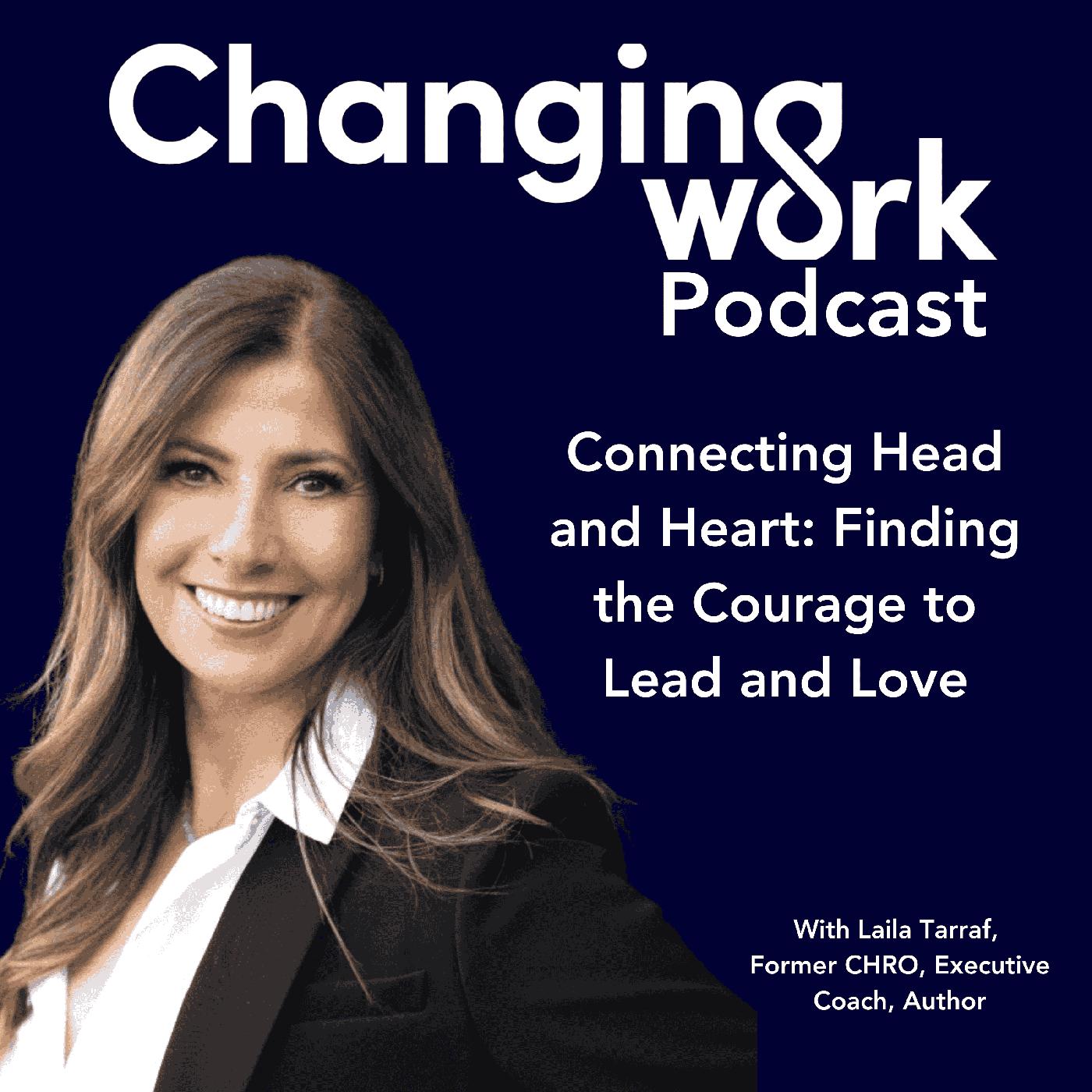
The topic of our conversation today is Connecting Head and Heart, Finding the courage to lead with love.
Speaker C
00:01:04
And Layla, I'm going to read a little bit of your bio up off the top here and then I'm going to open it up to you to maybe share a little bit more about what brings you here today.
Speaker C
00:01:12
But Layla is a senior human resources executive with over 25 years of professional experience.
Speaker C
00:01:18
After graduating with her MBA from the Haas School of Business at the University of California at Berkeley, she went on to serve as the Chief People officer at Walmart, Pete's Coffee and Tea, and most recently allbirds.
Speaker C
00:01:30
Currently, Ms.
Speaker C
00:01:30
Tarof serves as a human capital advisor, mentor and coach to several private equity and venture backed CEOs and their leadership teams.
Speaker C
00:01:39
Her work focuses on building trust and clarity with organizations by supporting leaders to rise to their highest potential so they can create cultures that enable meaningful and successful personal and business goals.
Speaker C
00:01:50
She's also a sought after speaker and executive coach and the author of Strong Like Water which shares her personal journey and hard won insights towards becoming a more compassionate and integrated leader.
Speaker C
00:02:02
Welcome.
Speaker A
00:02:04
Thank you.
Speaker A
00:02:04
I'm happy to be here.
Speaker C
00:02:06
Happy to have you.
Speaker C
00:02:07
So in that bio, what did, what did I miss?
Speaker C
00:02:09
Because I feel like there's always like little, little things we throw into our bios, but we never really get to kind of say exactly what's top of our mind or what's in our hearts in this moment.
Speaker C
00:02:17
Is there anything there that you'd like to add?
Speaker A
00:02:21
I think you captured the big pieces.
Speaker A
00:02:23
I think the only other thing that I would add is that I'm the Same person throughout the whole thing.
Speaker A
00:02:30
Right.
Speaker A
00:02:30
How you show up in at home is how you show up at work.
Speaker A
00:02:34
And that consistency, I think, is what allows me to be able to move across industries and leadership types.
Speaker C
00:02:44
And that's an incredibly powerful statement right there too, because I feel like so many of us, we end up trying to bifurcate or kind of split ourselves off into different types of person versions of ourselves at work or at home.
Speaker C
00:02:55
And that discongruity can cause a lot of problems.
Speaker C
00:02:59
It can cause a lot of, like, heartache.
Speaker C
00:03:02
Has that always been the case for you or did you have to, like, go through some sort of trials and tribulations to get that kind of connection?
Speaker A
00:03:10
No, it has not always been the case.
Speaker A
00:03:12
Absolutely not.
Speaker A
00:03:13
I think like most people, especially people that go to business school, you get out, you're ready to just hit the ground running and add value and achieve.
Speaker A
00:03:21
And it's really very much focused on really yourself.
Speaker A
00:03:26
Even if you want to do good for others or make an impact in the environment that you work in, you want to be successful.
Speaker A
00:03:33
And I think very naturally, subconsciously, we show the parts of us we think are the most desired, and immediately that means you split off from your true and authentic self.
Speaker A
00:03:47
So we just naturally compartmentalize.
Speaker A
00:03:49
If you're having, if you get up, you're having a bad morning, you get to work and everything is great, it's fine.
Speaker A
00:03:54
And you can only do that for, for a certain amount of time.
Speaker A
00:03:59
And then all of a sudden, right.
Speaker A
00:04:00
If you don't express your emotions, all of a sudden, they come out in other ways.
Speaker A
00:04:04
Either you explode or they start leaking out.
Speaker A
00:04:07
It's.
Speaker A
00:04:07
It's not pretty.
Speaker A
00:04:08
And that's what ended up happening with me as well.
Speaker A
00:04:11
And I realized that I could no longer continue to live two separate lives.
Speaker A
00:04:17
Sort of this buttoned up, perfect, nothing's wrong at work and then at home, someone.
Speaker A
00:04:23
Someone different.
Speaker C
00:04:26
Yeah.
Speaker C
00:04:26
Hear, hear.
Speaker C
00:04:27
Yeah.
Speaker C
00:04:27
And I imagine too that as a leader, I mean, that must really have changed your approach and your view of leadership.
Speaker C
00:04:33
I'm kind of curious in the early days of your career, like what your leadership approach or your perspective might have been and how did that evolve and change over time as you had these awarenesses?
Speaker A
00:04:44
I.
Speaker A
00:04:44
There, there's one, there's one situation I had.
Speaker A
00:04:48
It's been so long now.
Speaker A
00:04:50
It's been about 15, 16 years.
Speaker A
00:04:52
And it sticks in my mind because it was a moment where I really learned a very valuable lesson.
Speaker A
00:04:58
It was my very early days@walmart.com and there were maybe 20 people in the whole company.
Speaker A
00:05:05
And we were sitting around the table, and our CEO at the time, who had come from Banana Republic.
Speaker A
00:05:13
Excuse me.
Speaker A
00:05:15
And she was tough, and I was a little scared of her, to be honest.
Speaker A
00:05:18
And we were doing our.
Speaker A
00:05:20
Our operating team meeting, and I was so busy, and I guess I was sort of slouching.
Speaker A
00:05:25
I'm like, oh, God, I've got so much work to do.
Speaker A
00:05:27
I don't have time to be here.
Speaker A
00:05:30
After the meeting, she calls me over.
Speaker A
00:05:31
She's like, come on over.
Speaker A
00:05:33
And I knew I'd done something wrong, but I didn't know what.
Speaker A
00:05:36
And she looked at me and she said, if I ever see you doing that again, they'll be held to pay.
Speaker A
00:05:42
I'm like, what did I do?
Speaker A
00:05:44
And she said, you were so disrespectful in that meeting.
Speaker A
00:05:47
You were rolling your eyes.
Speaker A
00:05:48
You were clearly not engaged.
Speaker A
00:05:50
And she said, the point of those meetings is not getting things done.
Speaker A
00:05:55
It's bringing people along.
Speaker A
00:06:00
I don't even think I'm like, what is she talking about?
Speaker A
00:06:03
That's.
Speaker A
00:06:04
That's heresy.
Speaker A
00:06:05
The point is to get things done, right?
Speaker A
00:06:07
It's to put points on the board.
Speaker A
00:06:10
And I don't think that lesson fully, fully was absorbed for another few years, because it was the first time someone had said that the value was in connecting and bringing others with you.
Speaker A
00:06:24
That's what a leader really does, right?
Speaker A
00:06:27
Not put points on the board.
Speaker A
00:06:29
And this shift, this shift from me to we, as I call it, it's not instinctive, right?
Speaker A
00:06:36
Because the first half of your career, you're focused on building your toolkit and proving that you can add value and that you can drive results.
Speaker A
00:06:46
And then as you start shifting to manage others, then you need to sort of recede in the background and enable others.
Speaker A
00:06:53
And it's a transition, you know, it's not a hard cut from black to white.
Speaker A
00:06:56
And everyone's journey is a little bit different.
Speaker A
00:06:59
And so I think the biggest way that I have changed over the course of my career is I had to recognize that my value doesn't only come from me doing something specifically.
Speaker A
00:07:11
It's by raising up and enabling others.
Speaker A
00:07:13
It sounds intuitive to me now, but it certainly wasn't 20 years ago.
Speaker C
00:07:18
Oh, sure, yeah.
Speaker C
00:07:19
And it makes complete sense, too.
Speaker C
00:07:20
I mean, I speak to so many leaders that on both sides, where they couldn't imagine.
Speaker C
00:07:24
Like we were just talking to David Katz earlier, a couple.
Speaker C
00:07:27
A while ago, a couple interviews ago, and he was saying how he can't even conceive of operating in a way that isn't from A place of compassion.
Speaker C
00:07:34
And, you know, my question, if we had had more time, would have been like, is this a teachable skill?
Speaker C
00:07:39
You know, not everyone necessarily wakes up, comes out of business school, comes into the workplace, and just innately has this as their view.
Speaker C
00:07:46
But do you believe that this is something that's trainable?
Speaker A
00:07:50
Absolutely.
Speaker A
00:07:52
Absolutely it is.
Speaker A
00:07:53
You know, the interesting thing about showing compassion is it's directly correlated with how you feel about yourself.
Speaker A
00:08:00
And I'm hearing this more and more in business these days.
Speaker A
00:08:05
Again, the language around leadership over the last 10 years has changed so dramatically.
Speaker A
00:08:10
I mean, if someone 10, 12 years ago would have said something about empathy or leading with vulnerability, you would have been like, okay.
Speaker A
00:08:18
And so I do think it's teachable, and I do think that the world is beginning to understand that this sort of old school, patriarchal, command and control type of leadership, it's, it's just, it doesn't work right.
Speaker A
00:08:34
It might work in the moment, but it certainly doesn't work in the long run.
Speaker A
00:08:38
And so I think to lead with compassion, and I think you have to lead with courage and compassion.
Speaker A
00:08:43
It's, it's both sides.
Speaker A
00:08:46
Because having compassion actually requires a lot of courage.
Speaker A
00:08:49
And really what it goes down to, what it comes down to is how you, how you hold yourself, how you feel about yourself.
Speaker A
00:08:56
Because if you're beating yourself over the head and you've got a really strong inner critic, you're bound to project that onto others and be really hard on others.
Speaker A
00:09:06
And so to me, this is the lifelong journey of how we begin to understand ourselves better, who we are, be kind to ourselves, and then by extension, you're able to be kind to others.
Speaker C
00:09:20
You know, you mentioned a few words there.
Speaker C
00:09:22
You know, vulnerability, courage, you know, I would add to that, like, authenticity, you know, I feel like has come up quite a bit over the last, say, 10 years or so within the workplace, bringing your whole self to work, which has its own problematic qualities to it.
Speaker C
00:09:35
But, you know, to me, all this speaks to this kind of shift in not just the vernacular, but also the way people are approaching leadership.
Speaker C
00:09:42
And I think to some degree, perhaps younger employees, as they come in, they have a different expectation for leadership and, and what is expected of them.
Speaker C
00:09:50
You know, just given your own experience over the last 10 years, you know, if you were to kind of chart forward a bit, maybe three, five years down the road, you know, where do you see words like this coming more and more into play?
Speaker C
00:10:00
And you know, what the skill sets you feel like is going to be critical for leaders to be able to navigate all of this.
Speaker A
00:10:08
I think it's a really interesting time right now.
Speaker A
00:10:11
Right.
Speaker A
00:10:11
I mean the cultural norms that governed, you know, in the 90s and the 2000s, I think for me it felt like sort of post me too started to begin to crumble.
Speaker A
00:10:24
I do think that the pendulum has swung from one extreme to the other.
Speaker A
00:10:29
I mean in the 2000s when I worked with leaders, a lot of my coaching, I felt like I was the balance where I'm like, oh, easy, you know, just kind of a little softer.
Speaker A
00:10:39
Like let's think about the employees.
Speaker A
00:10:42
And now it's actually shifted the other way where now I think leaders have.
Speaker A
00:10:48
They're not as aggressive for sure, but now they're pulling their punches.
Speaker A
00:10:54
They're not being as clear about what they want.
Speaker A
00:10:58
And so how do we find that middle ground between being really direct and decisive and aggressive and being a little passive and pulling back.
Speaker A
00:11:10
And I think that's the challenge for us moving forward is how do we remain activated and clear in what we want to achieve, to be and along the way treat people in a more human way.
Speaker A
00:11:32
It's really the combination of those two things.
Speaker A
00:11:35
I think it's, it's fairly easy to just be kind and compassionate when you don't have to worry about achieving some big hairy goal.
Speaker A
00:11:44
And I also think it's kind of easy to just put your head down and run through walls to achieve.
Speaker A
00:11:50
Just kind of have a sprint and then just sort of pass out and take care of yourself.
Speaker A
00:11:55
But holding the two together so that as a person and as an organization and as leaders leading others, how to do that so that you're in it for the long run and that it's self generative.
Speaker A
00:12:10
That's the challenge for me, I think and all of us, all leaders, we're all different people are going to have sort of different mix, a different alchemy about how that shows up in their personal style.
Speaker C
00:12:21
Yeah.
Speaker C
00:12:21
And imagine too, you know, as a coach, and I'm also a coach myself, you know, there's going to be more need, I believe, for coaches with this mindset, with this kind of perspective to help leaders kind of bridge that gap.
Speaker C
00:12:34
How do you feel like this is, is this is kind of changing the way that you approach coaching and just like the coaching industry writ large.
Speaker A
00:12:44
Well, it's, it's amazing that coaching has become the mainstream.
Speaker A
00:12:48
That is, is wonderful.
Speaker A
00:12:50
Right.
Speaker A
00:12:51
I think there's much more openness for people for leaders to accept a coach.
Speaker A
00:12:58
And I think that is wonderful.
Speaker A
00:13:01
I guess it's probably like it Was like in the 70s or 80s is you, you wouldn't admit that you had a therapist and now if not, you would have that you have a coach.
Speaker A
00:13:09
I think I try to meet people where they are and see where their set point is and then see if we can kind of expand from that, from that place.
Speaker A
00:13:20
Some, some leaders are more naturally kind and compassionate and giving and maybe need a little bit of help strengthening the, the other side, you know, the head part right now, what are our goals, what are we trying to achieve?
Speaker A
00:13:34
How do we motivate others, set expectations?
Speaker A
00:13:36
Others are great at the sort of left brain, business side and have a harder time moving into their hearts and connecting with people more relationally.
Speaker A
00:13:47
So I take where people come and I try to expand and say, this is awesome, let's build on that.
Speaker A
00:13:53
And how do we, how do we bring you over here too?
Speaker C
00:13:57
Yeah, and I'm kind of curious too for those leaders.
Speaker C
00:14:00
And I get clients like this from time to time.
Speaker C
00:14:02
They'll reach out.
Speaker C
00:14:02
I talk a lot about mental health and well being for employees and toxic workplace environments and the things that needs to change.
Speaker C
00:14:08
I've had more than one leader reach out to me and ask me, like, I think I might be one of those toxic leaders.
Speaker C
00:14:13
Can you help, you know, can you, can you help coach me to not be that way?
Speaker C
00:14:17
And I guess for me, underneath that is this question of like, for those that are curious and that notice that there's a challenge that needs to be addressed, but maybe they feel stuck and not sure about how to make that change.
Speaker C
00:14:29
Specific for leaders, you know, what would your recommendation be or what would your advice be for those folks?
Speaker A
00:14:35
Yeah, it's a great question.
Speaker A
00:14:38
I would say first that recognizing that you're stuck is a real gift.
Speaker A
00:14:44
I know that sounds antithetical, but so many business people just ignore that dissonance that they feel inside or that they're, no, something's wrong, I'm just going to throw myself into work.
Speaker A
00:14:57
And that could go on for a long, long, long time.
Speaker A
00:15:00
So if all of a sudden a leader feels stuck and what they've done in the past is no longer working, that's the wake up call to really look a little more deeply.
Speaker A
00:15:11
And it's an opportunity for growth.
Speaker A
00:15:14
And so I think the first thing I would say is just pay attention to what's not working.
Speaker A
00:15:20
Where exactly do you feel stuck?
Speaker A
00:15:22
Where did you used to get results and now you don't?
Speaker A
00:15:28
And then pay attention to what you might be resisting.
Speaker A
00:15:32
A feeling, a thought or an idea, because we're all very good again at compartmentalizing and pushing it away and pushing it down.
Speaker A
00:15:41
So really making the space to be able to notice what's not working and what you're resisting.
Speaker A
00:15:48
And I think the next step, which is always difficult, especially for action oriented people, is to allow yourself to stay in that discomfort.
Speaker A
00:15:59
So when you allow yourself to stay with that resistance, it's not going to feel good, it's going to bother you, you're not going to be able to make sense of it because it's not in your prefrontal cortex, it's in your body, it's in your heart.
Speaker A
00:16:13
But allowing yourself to stay with that discomfort is where all the information is.
Speaker A
00:16:22
And allowing yourself to feel the feeling, allow the emotion to work its way through your body so you can process it, journal your thoughts, your ideas, and eventually insights will emerge and you will have an aha.
Speaker A
00:16:36
But it's not a linear.
Speaker A
00:16:37
I think what's hard about it, it's not a linear process.
Speaker A
00:16:40
And we like our ABC done and it just isn't.
Speaker A
00:16:45
And then again, I would say throughout the whole thing, sorry, my son is getting me.
Speaker A
00:16:49
Is just to be kind to yourself throughout the whole process.
Speaker A
00:16:53
Right.
Speaker A
00:16:53
Because we have a tendency to.
Speaker A
00:16:55
I don't have time for this.
Speaker A
00:16:57
This used to work.
Speaker A
00:16:58
What's good?
Speaker A
00:16:58
You know, so just easy.
Speaker C
00:17:00
Yeah.
Speaker C
00:17:01
Such a good, important lesson.
Speaker C
00:17:03
You know, the linearity piece or the non linearity piece I think is really interesting as well.
Speaker C
00:17:07
I mean, you know, you look at your resume and you've had such an amazing career so far and you know, imagine you've learned so much along the way.
Speaker C
00:17:14
But so many of the people that I talk to, clients in particular, they get really hung up on this idea of like, well, the trajectory has been uneven.
Speaker C
00:17:21
Right.
Speaker C
00:17:21
Or they have, they've had to take a left turn or a right turn that they weren't expecting and then.
Speaker C
00:17:26
Or maybe there's a gap in their resume or something along those lines that like causes a lot of disconcern.
Speaker C
00:17:32
What, how do you manage that?
Speaker C
00:17:33
Non linearity.
Speaker C
00:17:34
How do you approach that?
Speaker C
00:17:35
And you know, if you were to give advice to somebody that's kind of maybe at a crossroads in their career, how would you suggest they might approach that?
Speaker A
00:17:44
That's a great question.
Speaker A
00:17:45
I think Steve Jobs said in his commencement speech, it's Stanford.
Speaker A
00:17:49
It only makes sense in hindsight.
Speaker A
00:17:51
Like you only connect the dots in hindsight.
Speaker A
00:17:53
It looks like, you know, from, from this direction that I just managed my career and I designed it.
Speaker A
00:17:58
That is not how it happened.
Speaker A
00:18:01
Right.
Speaker A
00:18:01
I would say there is as much learning in the jobs you took or the things you did that you're like, oh, I don't want to do that, as there are in the ones that felt right.
Speaker A
00:18:12
It's just information.
Speaker A
00:18:14
And I would.
Speaker A
00:18:17
What I tell people now who are starting out their career is pay attention to what energizes you, what lights you up, what makes you feel like, oh, this is cool, Even if it doesn't make sense.
Speaker A
00:18:29
Especially if it doesn't make sense.
Speaker A
00:18:32
And also pay attention to what just drains you of energy.
Speaker A
00:18:38
Because the body doesn't lie, right?
Speaker A
00:18:40
If you're energized, there's something there that is meant for you to be doing.
Speaker A
00:18:46
And.
Speaker A
00:18:47
And if you all of a sudden feel heavy, it's not for you.
Speaker A
00:18:51
And I think conventional wisdom was just ignore that.
Speaker A
00:18:56
Just move forward, just work through this problem, just keep going, and you can do that.
Speaker A
00:19:00
And then all of a sudden, you've worked 20 years in industry, and you look back, you're like, I don't really like this.
Speaker A
00:19:05
How did that.
Speaker A
00:19:06
How did 20 years just go by?
Speaker A
00:19:08
And so I think it's.
Speaker A
00:19:10
It's following the juice, right?
Speaker A
00:19:11
It's like, what energizes me and what depletes.
Speaker A
00:19:15
And then don't worry about if you took a job that didn't feel right for you, because even if you don't know it in the moment, you will realize later, like, oh, I see what I learned from that.
Speaker A
00:19:28
I used to have a CEO that said, I learned more from the managers that I didn't like than the managers I liked because I learned what not to do.
Speaker A
00:19:36
So it's kind of having this growth mindset there, really.
Speaker A
00:19:40
I mean, it's easier to say in hindsight, but there really are no mistakes.
Speaker A
00:19:44
It's just all information.
Speaker A
00:19:45
You're just learning and growing.
Speaker A
00:19:47
It's just all we're doing.
Speaker C
00:19:49
Beautiful.
Speaker C
00:19:50
So you have this book, Strong like Water.
Speaker C
00:19:54
Tell us a little bit about the book and kind of what brought you to write it in the first place.
Speaker A
00:20:02
About 15 years ago, I was in my first chief people officer role at Pete's Coffee and Tea.
Speaker A
00:20:10
And really I was just learning how to be an executive of a public company.
Speaker A
00:20:14
And I was a new mom.
Speaker A
00:20:15
I had a toddler.
Speaker A
00:20:17
And in the following four or five years, I lost my husband and my mother and my father in sort of three successive losses.
Speaker A
00:20:25
And those losses ended up being just a tremendous catalyst for.
Speaker A
00:20:30
For personal growth.
Speaker A
00:20:31
And as I said, already up until that time, I was like, head down, achieve every milestone in front of me.
Speaker A
00:20:42
And if Anything bothered me, I was able to kind of tuck it away.
Speaker A
00:20:45
I didn't deal with it.
Speaker A
00:20:47
And I knew in that moment that I could not go to my normal coping mechanisms of intellectualizing or reframing to the positive if I was going to be able to work through not only my grief, but.
Speaker A
00:21:01
But to be able to help my daughter work through it.
Speaker A
00:21:05
And I think for me, that was my wake up call.
Speaker A
00:21:10
Realizing that I had to.
Speaker A
00:21:13
I had to get real and I couldn't compartmentalize my feelings anymore, and I had to allow myself to be more vulnerable.
Speaker A
00:21:22
And so I began to drop my.
Speaker A
00:21:24
My Persona, you know, the facade, the one that we put on to the world.
Speaker A
00:21:28
And then I started making all these insights.
Speaker A
00:21:31
Everything I'm telling you today, I have gone through.
Speaker A
00:21:33
And I started to write them down so I wouldn't forget them.
Speaker A
00:21:36
And as I shared them with friends, they would say, oh, yeah, I do that.
Speaker A
00:21:40
Oh, I understand that.
Speaker A
00:21:41
And I started realizing that while the details of my story were very personal, what I was experiencing, I realized, was sort of the universal journey for all of us of how we really learn who we are, what we're all about, what we're capable of.
Speaker A
00:21:59
So that really was the impetus behind Strong Like Water.
Speaker C
00:22:03
It's beautiful.
Speaker C
00:22:03
And you know, what would be the key lessons that you would want somebody to take away from that book after having a chance to read it?
Speaker A
00:22:12
And you can read the book on many different levels.
Speaker A
00:22:15
At the highest level, it's really.
Speaker A
00:22:17
I'd like readers to take the lesson away that times of adversity in your life are just perfect opportunities for growth.
Speaker A
00:22:25
They really provide you with just an opportunity for you to allow yourself to be present and feel what's coming up.
Speaker A
00:22:33
And I think we all learned that lesson through the pandemic, because allowing yourself to feel the pain associated with loss, rather than making you weak, which is what I thought, it actually makes you stronger by helping you build greater emotional resilience.
Speaker A
00:22:51
I think another lesson is, for me is that being a woman in business, it's easy to adopt the more patriarchal and masculine examples of power, like strength and aggression and driving for results, and then lose touch with the more traditionally feminine qualities of tenderness and nurturance and compassion, which when combined skillfully, can be every bit as powerful.
Speaker A
00:23:16
And again, I think that's what's so beautiful.
Speaker A
00:23:18
What's happening now in the business world is that this idea is really taking root and people are paying attention to it.
Speaker C
00:23:26
Yeah, I'm excited for this as well.
Speaker C
00:23:29
You know, you mentioned earlier this idea of Finding the courage.
Speaker C
00:23:32
Lead with compassion.
Speaker C
00:23:33
But I've also heard you say something similar around finding the courage to lead with love.
Speaker C
00:23:38
And I noticed just right above your head, you've got love written out for a very, very, very prominently for folks to see.
Speaker C
00:23:45
Tell us a little bit about what that means for you, like finding the courage to lead with love.
Speaker C
00:23:49
Love.
Speaker A
00:23:52
Yeah.
Speaker A
00:23:53
When I was at Pete's, we were putting together an employee handbook, and I wanted to call it for the Love of Pete's.
Speaker A
00:23:58
This was back in 2012.
Speaker A
00:24:00
And they're like, oh, no, we can't use the word love.
Speaker A
00:24:03
And I love that love is so present now in business.
Speaker A
00:24:07
I mean, I think in the purest sense, love requires a certain level of vulnerability to be able to love and be loved.
Speaker A
00:24:17
Right.
Speaker A
00:24:17
So leading with love then requires us to self reflect on who we are beyond our stories, and then having the courage to show up authentically and vulnerably, flaws and all, so that others feel like they can do the same.
Speaker A
00:24:37
Because it's not possible to lead others with love if our inner critic is on full tilt.
Speaker A
00:24:44
And as I've been saying, when we're able to be kind to ourselves, we develop greater capacity to be kind with others.
Speaker A
00:24:51
If we're constantly judging ourselves, we won't be able to show any sort of empathy or compassion for others.
Speaker A
00:24:56
So being able to move from judgment to kindness, from humility requires just a little bit of humility, humor.
Speaker A
00:25:05
And that's what I think allows us to lead with love.
Speaker A
00:25:07
And that journey requires courage.
Speaker A
00:25:10
Right.
Speaker A
00:25:10
Courage to look at ourselves honestly and love and accept ourselves and have the courage to show up in our most authentic way possible.
Speaker A
00:25:20
Because that's where we connect more deeply.
Speaker C
00:25:22
With others and from that place of authentic connection.
Speaker C
00:25:26
And you've already mentioned it a little bit already in this interview.
Speaker C
00:25:30
In your book, you have this idea of being strong and soft in business.
Speaker C
00:25:34
Can you expand on that a little bit?
Speaker C
00:25:35
What does that mean for folks?
Speaker A
00:25:39
I think, you know, I used to be called firm yet kind.
Speaker A
00:25:44
Right.
Speaker A
00:25:44
And I think there's this misnomer that you can only be one or the other.
Speaker A
00:25:49
And the reality is that it's.
Speaker A
00:25:52
It's the.
Speaker A
00:25:53
It's.
Speaker A
00:25:53
That's a false paradox.
Speaker A
00:25:55
There's a duality in everything.
Speaker A
00:25:57
And I think strong and soft means you can be direct and set expectations and be clear about what's needed, and then how you lead others can be supportive and kind and enabling.
Speaker A
00:26:14
It's very much like parenting, to be honest.
Speaker A
00:26:16
There's really not a whole lot of difference.
Speaker C
00:26:19
Yeah.
Speaker C
00:26:20
And I Think for me, what came out of the pandemic and so many people have been talking about this is I think a new awareness around mental health, well being, boundaries, work life integration, work life harmony, depending on how you speak about it.
Speaker C
00:26:34
You know, I'm curious, you know, as you look at leadership as kind of an industry or as a, as an area of focus, do you feel like there is more of a shift now over the last few years from more heart and less head driven leadership?
Speaker C
00:26:47
And you know, where do you maybe see this trending going forward?
Speaker A
00:26:53
I mean, I think it depends on the industry.
Speaker A
00:26:56
I do think in general that leaders now have become less performative and more authentic and really focused on the whole person because of the greater recognition that the people skills are the difference maker in your career.
Speaker A
00:27:14
But I think it also depends on the industry that you're in.
Speaker A
00:27:19
I think in finance there's still a little, you know, still dominated by a lot of, you know, alpha energy.
Speaker A
00:27:27
And so it's not as, not as much the norm there.
Speaker A
00:27:33
But I do feel like there is this shift that is moving towards recognizing that we need to see our employees as people first and employees second.
Speaker C
00:27:48
We're coming up close to the end of time.
Speaker C
00:27:50
I have a couple quick questions for you.
Speaker C
00:27:53
I heard in another interview, which by the way, I've been really enjoying just going into your library of stuff out there on the web.
Speaker C
00:27:59
So folks haven't heard a chance to listen to anything else that you've had a chance to share.
Speaker C
00:28:02
Please, by all means, please look her up and check it out.
Speaker C
00:28:05
But a Ram Dass quote I think came up in one of these interviews.
Speaker C
00:28:09
I just wanted to touch on for a moment, see how you reflect on that.
Speaker C
00:28:13
This idea of like we're just all walking each other home.
Speaker C
00:28:16
Where does that fit in, in your awareness of leadership and everything that we're just talking about today?
Speaker A
00:28:23
I love that quote.
Speaker A
00:28:24
When I heard it, it just got me right here.
Speaker A
00:28:28
I mean, for me, kind of stopped me in my tracks because in business at least it's so competitive.
Speaker A
00:28:37
You're always feeling like it's a race and even if you're not competing with others, you're competing with yourself.
Speaker A
00:28:43
Right?
Speaker A
00:28:43
You're just always raising the bar.
Speaker A
00:28:45
Raising the bar, raising the bar.
Speaker A
00:28:47
And I think we lose sight of the fact that it's not a race.
Speaker A
00:28:52
Right.
Speaker A
00:28:53
Because we're all headed to the same place.
Speaker A
00:28:55
Not to be, not, not to be morose.
Speaker A
00:28:58
But look, we get, we get one big beautiful life.
Speaker A
00:29:02
And this life is really just all about connecting with others and Having deep, meaningful relationships with others.
Speaker A
00:29:13
And we spend most of our time at work, so why wouldn't we want to have beautiful, connected relationships at work?
Speaker A
00:29:21
And this idea that in the end we're all just walking each other home, for me, is just a reminder that we're all the same.
Speaker A
00:29:30
We all put our pants on in the morning.
Speaker A
00:29:32
We all have good mornings, we all have bad mornings.
Speaker A
00:29:35
Let's cut each other some slack and see the humanity that ties us all.
Speaker A
00:29:41
Another quote I love by Brene Brown is people are hard to hate.
Speaker A
00:29:44
Close up, it's very easy to think of, you know, sort of a group of people or situation and feel like you're disconnected from them.
Speaker A
00:29:57
But in the end, we're all just the same, right?
Speaker A
00:29:59
And we're all dealing with the same thing.
Speaker A
00:30:01
So why wouldn't you want to support each other?
Speaker C
00:30:05
Such an important message.
Speaker C
00:30:07
You know, I didn't get a chance to ask you at the top, but, you know, you were mentioning this idea of paying attention to the things that spark, you know, spark within you or the things that you particularly enjoy.
Speaker C
00:30:18
What sparks in your heart?
Speaker A
00:30:23
You know, when I was a teenager, I was.
Speaker A
00:30:25
And I was thinking about going to college, and what did I want to major in?
Speaker A
00:30:29
I had this idea.
Speaker A
00:30:30
I really like helping people.
Speaker A
00:30:32
Is that a thing?
Speaker A
00:30:34
I didn't.
Speaker A
00:30:34
I didn't know that that was a thing.
Speaker A
00:30:36
And I decided to go into business.
Speaker A
00:30:42
And, you know, here we are, 25 years later.
Speaker A
00:30:45
I am the closest to helping people as you possibly can be in business.
Speaker A
00:30:52
And so I didn't pay attention to that.
Speaker A
00:30:54
Right.
Speaker A
00:30:54
I didn't.
Speaker A
00:30:54
I didn't know back, you know, when I was a teenager, like, what is this helping thing and what does it mean?
Speaker A
00:31:01
But somehow.
Speaker A
00:31:02
And my undergrad was computer science.
Speaker A
00:31:04
So I went from computer science undergrad, mba, to now being a coach, really, where I'm focused on helping people just happens to be in business.
Speaker A
00:31:14
And so I.
Speaker A
00:31:15
I think that's why I just know this idea of paying attention to the spark.
Speaker A
00:31:20
That's the answer right there.
Speaker A
00:31:22
That's how you find your purpose.
Speaker A
00:31:23
And we talk a lot about finding our purpose these days.
Speaker A
00:31:26
That's it.
Speaker A
00:31:26
Because all of us have a unique talent that when it's combined with the need in the world, that's our purpose.
Speaker C
00:31:35
I love that so much.
Speaker C
00:31:37
We're at time, unfortunately, but I think it's a beautiful place to end on.
Speaker C
00:31:41
Layla, if folks would like to learn more about you or hear more about what you have to share, what's a good place for people to find you at.
Speaker A
00:31:49
LinkedIn.
Speaker A
00:31:50
I'm on LinkedIn.
Speaker A
00:31:51
You can go on my website, which is lailaterraf.com or my email, which is first name@firstandlastname.com.
Speaker C
00:32:01
Well, Layla, thank you so much for being here.
Speaker C
00:32:03
Thanks for all the work that you're doing in the world, and we hope to hear from you again sometime soon.
Speaker C
00:32:08
Have a wonderful rest of your afternoon.
Speaker A
00:32:11
Thank you so much, Nicholas.
00:00:00
Recognizing that you're stuck is a real gift.
Speaker A
00:00:03
I know that sounds antithetical, but so many business people just ignore that dissonance that they feel inside or that they're no, something's wrong.
Speaker A
00:00:14
I'm just going to throw myself in the work.
Speaker A
00:00:15
And that could go on for a long time.
Speaker A
00:00:18
So if all of a sudden a leader feels stuck and what they've done in the past is no longer working, that's the wake up call to really look a little more deeply.
Speaker A
00:00:28
And it's an opportunity for growth.
Speaker A
00:00:31
And so I think the first thing I would say is just pay attention to what's not working.
Speaker B
00:00:38
Hey friends, welcome to the Changing Work podcast.
Speaker B
00:00:41
We are so glad you're here.
Speaker C
00:00:43
My name is Nick.
Speaker B
00:00:44
And I'm Scott.
Speaker C
00:00:45
And this is the podcast where we talk about changing work from the inside out.
Speaker B
00:00:49
So if you're into making the workplace and the world a better experience via conscious business practices, stick around.
Speaker B
00:00:56
This is for you.
Speaker C
00:00:59
The topic of our conversation today is Connecting Head and Heart, Finding the courage to lead with love.
Speaker C
00:01:04
And Layla, I'm going to read a little bit of your bio up off the top here and then I'm going to open it up to you to maybe share a little bit more about what brings you here today.
Speaker C
00:01:12
But Layla is a senior human resources executive with over 25 years of professional experience.
Speaker C
00:01:18
After graduating with her MBA from the Haas School of Business at the University of California at Berkeley, she went on to serve as the Chief People officer at Walmart, Pete's Coffee and Tea, and most recently allbirds.
Speaker C
00:01:30
Currently, Ms.
Speaker C
00:01:30
Tarof serves as a human capital advisor, mentor and coach to several private equity and venture backed CEOs and their leadership teams.
Speaker C
00:01:39
Her work focuses on building trust and clarity with organizations by supporting leaders to rise to their highest potential so they can create cultures that enable meaningful and successful personal and business goals.
Speaker C
00:01:50
She's also a sought after speaker and executive coach and the author of Strong Like Water which shares her personal journey and hard won insights towards becoming a more compassionate and integrated leader.
Speaker C
00:02:02
Welcome.
Speaker A
00:02:04
Thank you.
Speaker A
00:02:04
I'm happy to be here.
Speaker C
00:02:06
Happy to have you.
Speaker C
00:02:07
So in that bio, what did, what did I miss?
Speaker C
00:02:09
Because I feel like there's always like little, little things we throw into our bios, but we never really get to kind of say exactly what's top of our mind or what's in our hearts in this moment.
Speaker C
00:02:17
Is there anything there that you'd like to add?
Speaker A
00:02:21
I think you captured the big pieces.
Speaker A
00:02:23
I think the only other thing that I would add is that I'm the Same person throughout the whole thing.
Speaker A
00:02:30
Right.
Speaker A
00:02:30
How you show up in at home is how you show up at work.
Speaker A
00:02:34
And that consistency, I think, is what allows me to be able to move across industries and leadership types.
Speaker C
00:02:44
And that's an incredibly powerful statement right there too, because I feel like so many of us, we end up trying to bifurcate or kind of split ourselves off into different types of person versions of ourselves at work or at home.
Speaker C
00:02:55
And that discongruity can cause a lot of problems.
Speaker C
00:02:59
It can cause a lot of, like, heartache.
Speaker C
00:03:02
Has that always been the case for you or did you have to, like, go through some sort of trials and tribulations to get that kind of connection?
Speaker A
00:03:10
No, it has not always been the case.
Speaker A
00:03:12
Absolutely not.
Speaker A
00:03:13
I think like most people, especially people that go to business school, you get out, you're ready to just hit the ground running and add value and achieve.
Speaker A
00:03:21
And it's really very much focused on really yourself.
Speaker A
00:03:26
Even if you want to do good for others or make an impact in the environment that you work in, you want to be successful.
Speaker A
00:03:33
And I think very naturally, subconsciously, we show the parts of us we think are the most desired, and immediately that means you split off from your true and authentic self.
Speaker A
00:03:47
So we just naturally compartmentalize.
Speaker A
00:03:49
If you're having, if you get up, you're having a bad morning, you get to work and everything is great, it's fine.
Speaker A
00:03:54
And you can only do that for, for a certain amount of time.
Speaker A
00:03:59
And then all of a sudden, right.
Speaker A
00:04:00
If you don't express your emotions, all of a sudden, they come out in other ways.
Speaker A
00:04:04
Either you explode or they start leaking out.
Speaker A
00:04:07
It's.
Speaker A
00:04:07
It's not pretty.
Speaker A
00:04:08
And that's what ended up happening with me as well.
Speaker A
00:04:11
And I realized that I could no longer continue to live two separate lives.
Speaker A
00:04:17
Sort of this buttoned up, perfect, nothing's wrong at work and then at home, someone.
Speaker A
00:04:23
Someone different.
Speaker C
00:04:26
Yeah.
Speaker C
00:04:26
Hear, hear.
Speaker C
00:04:27
Yeah.
Speaker C
00:04:27
And I imagine too that as a leader, I mean, that must really have changed your approach and your view of leadership.
Speaker C
00:04:33
I'm kind of curious in the early days of your career, like what your leadership approach or your perspective might have been and how did that evolve and change over time as you had these awarenesses?
Speaker A
00:04:44
I.
Speaker A
00:04:44
There, there's one, there's one situation I had.
Speaker A
00:04:48
It's been so long now.
Speaker A
00:04:50
It's been about 15, 16 years.
Speaker A
00:04:52
And it sticks in my mind because it was a moment where I really learned a very valuable lesson.
Speaker A
00:04:58
It was my very early days@walmart.com and there were maybe 20 people in the whole company.
Speaker A
00:05:05
And we were sitting around the table, and our CEO at the time, who had come from Banana Republic.
Speaker A
00:05:13
Excuse me.
Speaker A
00:05:15
And she was tough, and I was a little scared of her, to be honest.
Speaker A
00:05:18
And we were doing our.
Speaker A
00:05:20
Our operating team meeting, and I was so busy, and I guess I was sort of slouching.
Speaker A
00:05:25
I'm like, oh, God, I've got so much work to do.
Speaker A
00:05:27
I don't have time to be here.
Speaker A
00:05:30
After the meeting, she calls me over.
Speaker A
00:05:31
She's like, come on over.
Speaker A
00:05:33
And I knew I'd done something wrong, but I didn't know what.
Speaker A
00:05:36
And she looked at me and she said, if I ever see you doing that again, they'll be held to pay.
Speaker A
00:05:42
I'm like, what did I do?
Speaker A
00:05:44
And she said, you were so disrespectful in that meeting.
Speaker A
00:05:47
You were rolling your eyes.
Speaker A
00:05:48
You were clearly not engaged.
Speaker A
00:05:50
And she said, the point of those meetings is not getting things done.
Speaker A
00:05:55
It's bringing people along.
Speaker A
00:06:00
I don't even think I'm like, what is she talking about?
Speaker A
00:06:03
That's.
Speaker A
00:06:04
That's heresy.
Speaker A
00:06:05
The point is to get things done, right?
Speaker A
00:06:07
It's to put points on the board.
Speaker A
00:06:10
And I don't think that lesson fully, fully was absorbed for another few years, because it was the first time someone had said that the value was in connecting and bringing others with you.
Speaker A
00:06:24
That's what a leader really does, right?
Speaker A
00:06:27
Not put points on the board.
Speaker A
00:06:29
And this shift, this shift from me to we, as I call it, it's not instinctive, right?
Speaker A
00:06:36
Because the first half of your career, you're focused on building your toolkit and proving that you can add value and that you can drive results.
Speaker A
00:06:46
And then as you start shifting to manage others, then you need to sort of recede in the background and enable others.
Speaker A
00:06:53
And it's a transition, you know, it's not a hard cut from black to white.
Speaker A
00:06:56
And everyone's journey is a little bit different.
Speaker A
00:06:59
And so I think the biggest way that I have changed over the course of my career is I had to recognize that my value doesn't only come from me doing something specifically.
Speaker A
00:07:11
It's by raising up and enabling others.
Speaker A
00:07:13
It sounds intuitive to me now, but it certainly wasn't 20 years ago.
Speaker C
00:07:18
Oh, sure, yeah.
Speaker C
00:07:19
And it makes complete sense, too.
Speaker C
00:07:20
I mean, I speak to so many leaders that on both sides, where they couldn't imagine.
Speaker C
00:07:24
Like we were just talking to David Katz earlier, a couple.
Speaker C
00:07:27
A while ago, a couple interviews ago, and he was saying how he can't even conceive of operating in a way that isn't from A place of compassion.
Speaker C
00:07:34
And, you know, my question, if we had had more time, would have been like, is this a teachable skill?
Speaker C
00:07:39
You know, not everyone necessarily wakes up, comes out of business school, comes into the workplace, and just innately has this as their view.
Speaker C
00:07:46
But do you believe that this is something that's trainable?
Speaker A
00:07:50
Absolutely.
Speaker A
00:07:52
Absolutely it is.
Speaker A
00:07:53
You know, the interesting thing about showing compassion is it's directly correlated with how you feel about yourself.
Speaker A
00:08:00
And I'm hearing this more and more in business these days.
Speaker A
00:08:05
Again, the language around leadership over the last 10 years has changed so dramatically.
Speaker A
00:08:10
I mean, if someone 10, 12 years ago would have said something about empathy or leading with vulnerability, you would have been like, okay.
Speaker A
00:08:18
And so I do think it's teachable, and I do think that the world is beginning to understand that this sort of old school, patriarchal, command and control type of leadership, it's, it's just, it doesn't work right.
Speaker A
00:08:34
It might work in the moment, but it certainly doesn't work in the long run.
Speaker A
00:08:38
And so I think to lead with compassion, and I think you have to lead with courage and compassion.
Speaker A
00:08:43
It's, it's both sides.
Speaker A
00:08:46
Because having compassion actually requires a lot of courage.
Speaker A
00:08:49
And really what it goes down to, what it comes down to is how you, how you hold yourself, how you feel about yourself.
Speaker A
00:08:56
Because if you're beating yourself over the head and you've got a really strong inner critic, you're bound to project that onto others and be really hard on others.
Speaker A
00:09:06
And so to me, this is the lifelong journey of how we begin to understand ourselves better, who we are, be kind to ourselves, and then by extension, you're able to be kind to others.
Speaker C
00:09:20
You know, you mentioned a few words there.
Speaker C
00:09:22
You know, vulnerability, courage, you know, I would add to that, like, authenticity, you know, I feel like has come up quite a bit over the last, say, 10 years or so within the workplace, bringing your whole self to work, which has its own problematic qualities to it.
Speaker C
00:09:35
But, you know, to me, all this speaks to this kind of shift in not just the vernacular, but also the way people are approaching leadership.
Speaker C
00:09:42
And I think to some degree, perhaps younger employees, as they come in, they have a different expectation for leadership and, and what is expected of them.
Speaker C
00:09:50
You know, just given your own experience over the last 10 years, you know, if you were to kind of chart forward a bit, maybe three, five years down the road, you know, where do you see words like this coming more and more into play?
Speaker C
00:10:00
And you know, what the skill sets you feel like is going to be critical for leaders to be able to navigate all of this.
Speaker A
00:10:08
I think it's a really interesting time right now.
Speaker A
00:10:11
Right.
Speaker A
00:10:11
I mean the cultural norms that governed, you know, in the 90s and the 2000s, I think for me it felt like sort of post me too started to begin to crumble.
Speaker A
00:10:24
I do think that the pendulum has swung from one extreme to the other.
Speaker A
00:10:29
I mean in the 2000s when I worked with leaders, a lot of my coaching, I felt like I was the balance where I'm like, oh, easy, you know, just kind of a little softer.
Speaker A
00:10:39
Like let's think about the employees.
Speaker A
00:10:42
And now it's actually shifted the other way where now I think leaders have.
Speaker A
00:10:48
They're not as aggressive for sure, but now they're pulling their punches.
Speaker A
00:10:54
They're not being as clear about what they want.
Speaker A
00:10:58
And so how do we find that middle ground between being really direct and decisive and aggressive and being a little passive and pulling back.
Speaker A
00:11:10
And I think that's the challenge for us moving forward is how do we remain activated and clear in what we want to achieve, to be and along the way treat people in a more human way.
Speaker A
00:11:32
It's really the combination of those two things.
Speaker A
00:11:35
I think it's, it's fairly easy to just be kind and compassionate when you don't have to worry about achieving some big hairy goal.
Speaker A
00:11:44
And I also think it's kind of easy to just put your head down and run through walls to achieve.
Speaker A
00:11:50
Just kind of have a sprint and then just sort of pass out and take care of yourself.
Speaker A
00:11:55
But holding the two together so that as a person and as an organization and as leaders leading others, how to do that so that you're in it for the long run and that it's self generative.
Speaker A
00:12:10
That's the challenge for me, I think and all of us, all leaders, we're all different people are going to have sort of different mix, a different alchemy about how that shows up in their personal style.
Speaker C
00:12:21
Yeah.
Speaker C
00:12:21
And imagine too, you know, as a coach, and I'm also a coach myself, you know, there's going to be more need, I believe, for coaches with this mindset, with this kind of perspective to help leaders kind of bridge that gap.
Speaker C
00:12:34
How do you feel like this is, is this is kind of changing the way that you approach coaching and just like the coaching industry writ large.
Speaker A
00:12:44
Well, it's, it's amazing that coaching has become the mainstream.
Speaker A
00:12:48
That is, is wonderful.
Speaker A
00:12:50
Right.
Speaker A
00:12:51
I think there's much more openness for people for leaders to accept a coach.
Speaker A
00:12:58
And I think that is wonderful.
Speaker A
00:13:01
I guess it's probably like it Was like in the 70s or 80s is you, you wouldn't admit that you had a therapist and now if not, you would have that you have a coach.
Speaker A
00:13:09
I think I try to meet people where they are and see where their set point is and then see if we can kind of expand from that, from that place.
Speaker A
00:13:20
Some, some leaders are more naturally kind and compassionate and giving and maybe need a little bit of help strengthening the, the other side, you know, the head part right now, what are our goals, what are we trying to achieve?
Speaker A
00:13:34
How do we motivate others, set expectations?
Speaker A
00:13:36
Others are great at the sort of left brain, business side and have a harder time moving into their hearts and connecting with people more relationally.
Speaker A
00:13:47
So I take where people come and I try to expand and say, this is awesome, let's build on that.
Speaker A
00:13:53
And how do we, how do we bring you over here too?
Speaker C
00:13:57
Yeah, and I'm kind of curious too for those leaders.
Speaker C
00:14:00
And I get clients like this from time to time.
Speaker C
00:14:02
They'll reach out.
Speaker C
00:14:02
I talk a lot about mental health and well being for employees and toxic workplace environments and the things that needs to change.
Speaker C
00:14:08
I've had more than one leader reach out to me and ask me, like, I think I might be one of those toxic leaders.
Speaker C
00:14:13
Can you help, you know, can you, can you help coach me to not be that way?
Speaker C
00:14:17
And I guess for me, underneath that is this question of like, for those that are curious and that notice that there's a challenge that needs to be addressed, but maybe they feel stuck and not sure about how to make that change.
Speaker C
00:14:29
Specific for leaders, you know, what would your recommendation be or what would your advice be for those folks?
Speaker A
00:14:35
Yeah, it's a great question.
Speaker A
00:14:38
I would say first that recognizing that you're stuck is a real gift.
Speaker A
00:14:44
I know that sounds antithetical, but so many business people just ignore that dissonance that they feel inside or that they're, no, something's wrong, I'm just going to throw myself into work.
Speaker A
00:14:57
And that could go on for a long, long, long time.
Speaker A
00:15:00
So if all of a sudden a leader feels stuck and what they've done in the past is no longer working, that's the wake up call to really look a little more deeply.
Speaker A
00:15:11
And it's an opportunity for growth.
Speaker A
00:15:14
And so I think the first thing I would say is just pay attention to what's not working.
Speaker A
00:15:20
Where exactly do you feel stuck?
Speaker A
00:15:22
Where did you used to get results and now you don't?
Speaker A
00:15:28
And then pay attention to what you might be resisting.
Speaker A
00:15:32
A feeling, a thought or an idea, because we're all very good again at compartmentalizing and pushing it away and pushing it down.
Speaker A
00:15:41
So really making the space to be able to notice what's not working and what you're resisting.
Speaker A
00:15:48
And I think the next step, which is always difficult, especially for action oriented people, is to allow yourself to stay in that discomfort.
Speaker A
00:15:59
So when you allow yourself to stay with that resistance, it's not going to feel good, it's going to bother you, you're not going to be able to make sense of it because it's not in your prefrontal cortex, it's in your body, it's in your heart.
Speaker A
00:16:13
But allowing yourself to stay with that discomfort is where all the information is.
Speaker A
00:16:22
And allowing yourself to feel the feeling, allow the emotion to work its way through your body so you can process it, journal your thoughts, your ideas, and eventually insights will emerge and you will have an aha.
Speaker A
00:16:36
But it's not a linear.
Speaker A
00:16:37
I think what's hard about it, it's not a linear process.
Speaker A
00:16:40
And we like our ABC done and it just isn't.
Speaker A
00:16:45
And then again, I would say throughout the whole thing, sorry, my son is getting me.
Speaker A
00:16:49
Is just to be kind to yourself throughout the whole process.
Speaker A
00:16:53
Right.
Speaker A
00:16:53
Because we have a tendency to.
Speaker A
00:16:55
I don't have time for this.
Speaker A
00:16:57
This used to work.
Speaker A
00:16:58
What's good?
Speaker A
00:16:58
You know, so just easy.
Speaker C
00:17:00
Yeah.
Speaker C
00:17:01
Such a good, important lesson.
Speaker C
00:17:03
You know, the linearity piece or the non linearity piece I think is really interesting as well.
Speaker C
00:17:07
I mean, you know, you look at your resume and you've had such an amazing career so far and you know, imagine you've learned so much along the way.
Speaker C
00:17:14
But so many of the people that I talk to, clients in particular, they get really hung up on this idea of like, well, the trajectory has been uneven.
Speaker C
00:17:21
Right.
Speaker C
00:17:21
Or they have, they've had to take a left turn or a right turn that they weren't expecting and then.
Speaker C
00:17:26
Or maybe there's a gap in their resume or something along those lines that like causes a lot of disconcern.
Speaker C
00:17:32
What, how do you manage that?
Speaker C
00:17:33
Non linearity.
Speaker C
00:17:34
How do you approach that?
Speaker C
00:17:35
And you know, if you were to give advice to somebody that's kind of maybe at a crossroads in their career, how would you suggest they might approach that?
Speaker A
00:17:44
That's a great question.
Speaker A
00:17:45
I think Steve Jobs said in his commencement speech, it's Stanford.
Speaker A
00:17:49
It only makes sense in hindsight.
Speaker A
00:17:51
Like you only connect the dots in hindsight.
Speaker A
00:17:53
It looks like, you know, from, from this direction that I just managed my career and I designed it.
Speaker A
00:17:58
That is not how it happened.
Speaker A
00:18:01
Right.
Speaker A
00:18:01
I would say there is as much learning in the jobs you took or the things you did that you're like, oh, I don't want to do that, as there are in the ones that felt right.
Speaker A
00:18:12
It's just information.
Speaker A
00:18:14
And I would.
Speaker A
00:18:17
What I tell people now who are starting out their career is pay attention to what energizes you, what lights you up, what makes you feel like, oh, this is cool, Even if it doesn't make sense.
Speaker A
00:18:29
Especially if it doesn't make sense.
Speaker A
00:18:32
And also pay attention to what just drains you of energy.
Speaker A
00:18:38
Because the body doesn't lie, right?
Speaker A
00:18:40
If you're energized, there's something there that is meant for you to be doing.
Speaker A
00:18:46
And.
Speaker A
00:18:47
And if you all of a sudden feel heavy, it's not for you.
Speaker A
00:18:51
And I think conventional wisdom was just ignore that.
Speaker A
00:18:56
Just move forward, just work through this problem, just keep going, and you can do that.
Speaker A
00:19:00
And then all of a sudden, you've worked 20 years in industry, and you look back, you're like, I don't really like this.
Speaker A
00:19:05
How did that.
Speaker A
00:19:06
How did 20 years just go by?
Speaker A
00:19:08
And so I think it's.
Speaker A
00:19:10
It's following the juice, right?
Speaker A
00:19:11
It's like, what energizes me and what depletes.
Speaker A
00:19:15
And then don't worry about if you took a job that didn't feel right for you, because even if you don't know it in the moment, you will realize later, like, oh, I see what I learned from that.
Speaker A
00:19:28
I used to have a CEO that said, I learned more from the managers that I didn't like than the managers I liked because I learned what not to do.
Speaker A
00:19:36
So it's kind of having this growth mindset there, really.
Speaker A
00:19:40
I mean, it's easier to say in hindsight, but there really are no mistakes.
Speaker A
00:19:44
It's just all information.
Speaker A
00:19:45
You're just learning and growing.
Speaker A
00:19:47
It's just all we're doing.
Speaker C
00:19:49
Beautiful.
Speaker C
00:19:50
So you have this book, Strong like Water.
Speaker C
00:19:54
Tell us a little bit about the book and kind of what brought you to write it in the first place.
Speaker A
00:20:02
About 15 years ago, I was in my first chief people officer role at Pete's Coffee and Tea.
Speaker A
00:20:10
And really I was just learning how to be an executive of a public company.
Speaker A
00:20:14
And I was a new mom.
Speaker A
00:20:15
I had a toddler.
Speaker A
00:20:17
And in the following four or five years, I lost my husband and my mother and my father in sort of three successive losses.
Speaker A
00:20:25
And those losses ended up being just a tremendous catalyst for.
Speaker A
00:20:30
For personal growth.
Speaker A
00:20:31
And as I said, already up until that time, I was like, head down, achieve every milestone in front of me.
Speaker A
00:20:42
And if Anything bothered me, I was able to kind of tuck it away.
Speaker A
00:20:45
I didn't deal with it.
Speaker A
00:20:47
And I knew in that moment that I could not go to my normal coping mechanisms of intellectualizing or reframing to the positive if I was going to be able to work through not only my grief, but.
Speaker A
00:21:01
But to be able to help my daughter work through it.
Speaker A
00:21:05
And I think for me, that was my wake up call.
Speaker A
00:21:10
Realizing that I had to.
Speaker A
00:21:13
I had to get real and I couldn't compartmentalize my feelings anymore, and I had to allow myself to be more vulnerable.
Speaker A
00:21:22
And so I began to drop my.
Speaker A
00:21:24
My Persona, you know, the facade, the one that we put on to the world.
Speaker A
00:21:28
And then I started making all these insights.
Speaker A
00:21:31
Everything I'm telling you today, I have gone through.
Speaker A
00:21:33
And I started to write them down so I wouldn't forget them.
Speaker A
00:21:36
And as I shared them with friends, they would say, oh, yeah, I do that.
Speaker A
00:21:40
Oh, I understand that.
Speaker A
00:21:41
And I started realizing that while the details of my story were very personal, what I was experiencing, I realized, was sort of the universal journey for all of us of how we really learn who we are, what we're all about, what we're capable of.
Speaker A
00:21:59
So that really was the impetus behind Strong Like Water.
Speaker C
00:22:03
It's beautiful.
Speaker C
00:22:03
And you know, what would be the key lessons that you would want somebody to take away from that book after having a chance to read it?
Speaker A
00:22:12
And you can read the book on many different levels.
Speaker A
00:22:15
At the highest level, it's really.
Speaker A
00:22:17
I'd like readers to take the lesson away that times of adversity in your life are just perfect opportunities for growth.
Speaker A
00:22:25
They really provide you with just an opportunity for you to allow yourself to be present and feel what's coming up.
Speaker A
00:22:33
And I think we all learned that lesson through the pandemic, because allowing yourself to feel the pain associated with loss, rather than making you weak, which is what I thought, it actually makes you stronger by helping you build greater emotional resilience.
Speaker A
00:22:51
I think another lesson is, for me is that being a woman in business, it's easy to adopt the more patriarchal and masculine examples of power, like strength and aggression and driving for results, and then lose touch with the more traditionally feminine qualities of tenderness and nurturance and compassion, which when combined skillfully, can be every bit as powerful.
Speaker A
00:23:16
And again, I think that's what's so beautiful.
Speaker A
00:23:18
What's happening now in the business world is that this idea is really taking root and people are paying attention to it.
Speaker C
00:23:26
Yeah, I'm excited for this as well.
Speaker C
00:23:29
You know, you mentioned earlier this idea of Finding the courage.
Speaker C
00:23:32
Lead with compassion.
Speaker C
00:23:33
But I've also heard you say something similar around finding the courage to lead with love.
Speaker C
00:23:38
And I noticed just right above your head, you've got love written out for a very, very, very prominently for folks to see.
Speaker C
00:23:45
Tell us a little bit about what that means for you, like finding the courage to lead with love.
Speaker C
00:23:49
Love.
Speaker A
00:23:52
Yeah.
Speaker A
00:23:53
When I was at Pete's, we were putting together an employee handbook, and I wanted to call it for the Love of Pete's.
Speaker A
00:23:58
This was back in 2012.
Speaker A
00:24:00
And they're like, oh, no, we can't use the word love.
Speaker A
00:24:03
And I love that love is so present now in business.
Speaker A
00:24:07
I mean, I think in the purest sense, love requires a certain level of vulnerability to be able to love and be loved.
Speaker A
00:24:17
Right.
Speaker A
00:24:17
So leading with love then requires us to self reflect on who we are beyond our stories, and then having the courage to show up authentically and vulnerably, flaws and all, so that others feel like they can do the same.
Speaker A
00:24:37
Because it's not possible to lead others with love if our inner critic is on full tilt.
Speaker A
00:24:44
And as I've been saying, when we're able to be kind to ourselves, we develop greater capacity to be kind with others.
Speaker A
00:24:51
If we're constantly judging ourselves, we won't be able to show any sort of empathy or compassion for others.
Speaker A
00:24:56
So being able to move from judgment to kindness, from humility requires just a little bit of humility, humor.
Speaker A
00:25:05
And that's what I think allows us to lead with love.
Speaker A
00:25:07
And that journey requires courage.
Speaker A
00:25:10
Right.
Speaker A
00:25:10
Courage to look at ourselves honestly and love and accept ourselves and have the courage to show up in our most authentic way possible.
Speaker A
00:25:20
Because that's where we connect more deeply.
Speaker C
00:25:22
With others and from that place of authentic connection.
Speaker C
00:25:26
And you've already mentioned it a little bit already in this interview.
Speaker C
00:25:30
In your book, you have this idea of being strong and soft in business.
Speaker C
00:25:34
Can you expand on that a little bit?
Speaker C
00:25:35
What does that mean for folks?
Speaker A
00:25:39
I think, you know, I used to be called firm yet kind.
Speaker A
00:25:44
Right.
Speaker A
00:25:44
And I think there's this misnomer that you can only be one or the other.
Speaker A
00:25:49
And the reality is that it's.
Speaker A
00:25:52
It's the.
Speaker A
00:25:53
It's.
Speaker A
00:25:53
That's a false paradox.
Speaker A
00:25:55
There's a duality in everything.
Speaker A
00:25:57
And I think strong and soft means you can be direct and set expectations and be clear about what's needed, and then how you lead others can be supportive and kind and enabling.
Speaker A
00:26:14
It's very much like parenting, to be honest.
Speaker A
00:26:16
There's really not a whole lot of difference.
Speaker C
00:26:19
Yeah.
Speaker C
00:26:20
And I Think for me, what came out of the pandemic and so many people have been talking about this is I think a new awareness around mental health, well being, boundaries, work life integration, work life harmony, depending on how you speak about it.
Speaker C
00:26:34
You know, I'm curious, you know, as you look at leadership as kind of an industry or as a, as an area of focus, do you feel like there is more of a shift now over the last few years from more heart and less head driven leadership?
Speaker C
00:26:47
And you know, where do you maybe see this trending going forward?
Speaker A
00:26:53
I mean, I think it depends on the industry.
Speaker A
00:26:56
I do think in general that leaders now have become less performative and more authentic and really focused on the whole person because of the greater recognition that the people skills are the difference maker in your career.
Speaker A
00:27:14
But I think it also depends on the industry that you're in.
Speaker A
00:27:19
I think in finance there's still a little, you know, still dominated by a lot of, you know, alpha energy.
Speaker A
00:27:27
And so it's not as, not as much the norm there.
Speaker A
00:27:33
But I do feel like there is this shift that is moving towards recognizing that we need to see our employees as people first and employees second.
Speaker C
00:27:48
We're coming up close to the end of time.
Speaker C
00:27:50
I have a couple quick questions for you.
Speaker C
00:27:53
I heard in another interview, which by the way, I've been really enjoying just going into your library of stuff out there on the web.
Speaker C
00:27:59
So folks haven't heard a chance to listen to anything else that you've had a chance to share.
Speaker C
00:28:02
Please, by all means, please look her up and check it out.
Speaker C
00:28:05
But a Ram Dass quote I think came up in one of these interviews.
Speaker C
00:28:09
I just wanted to touch on for a moment, see how you reflect on that.
Speaker C
00:28:13
This idea of like we're just all walking each other home.
Speaker C
00:28:16
Where does that fit in, in your awareness of leadership and everything that we're just talking about today?
Speaker A
00:28:23
I love that quote.
Speaker A
00:28:24
When I heard it, it just got me right here.
Speaker A
00:28:28
I mean, for me, kind of stopped me in my tracks because in business at least it's so competitive.
Speaker A
00:28:37
You're always feeling like it's a race and even if you're not competing with others, you're competing with yourself.
Speaker A
00:28:43
Right?
Speaker A
00:28:43
You're just always raising the bar.
Speaker A
00:28:45
Raising the bar, raising the bar.
Speaker A
00:28:47
And I think we lose sight of the fact that it's not a race.
Speaker A
00:28:52
Right.
Speaker A
00:28:53
Because we're all headed to the same place.
Speaker A
00:28:55
Not to be, not, not to be morose.
Speaker A
00:28:58
But look, we get, we get one big beautiful life.
Speaker A
00:29:02
And this life is really just all about connecting with others and Having deep, meaningful relationships with others.
Speaker A
00:29:13
And we spend most of our time at work, so why wouldn't we want to have beautiful, connected relationships at work?
Speaker A
00:29:21
And this idea that in the end we're all just walking each other home, for me, is just a reminder that we're all the same.
Speaker A
00:29:30
We all put our pants on in the morning.
Speaker A
00:29:32
We all have good mornings, we all have bad mornings.
Speaker A
00:29:35
Let's cut each other some slack and see the humanity that ties us all.
Speaker A
00:29:41
Another quote I love by Brene Brown is people are hard to hate.
Speaker A
00:29:44
Close up, it's very easy to think of, you know, sort of a group of people or situation and feel like you're disconnected from them.
Speaker A
00:29:57
But in the end, we're all just the same, right?
Speaker A
00:29:59
And we're all dealing with the same thing.
Speaker A
00:30:01
So why wouldn't you want to support each other?
Speaker C
00:30:05
Such an important message.
Speaker C
00:30:07
You know, I didn't get a chance to ask you at the top, but, you know, you were mentioning this idea of paying attention to the things that spark, you know, spark within you or the things that you particularly enjoy.
Speaker C
00:30:18
What sparks in your heart?
Speaker A
00:30:23
You know, when I was a teenager, I was.
Speaker A
00:30:25
And I was thinking about going to college, and what did I want to major in?
Speaker A
00:30:29
I had this idea.
Speaker A
00:30:30
I really like helping people.
Speaker A
00:30:32
Is that a thing?
Speaker A
00:30:34
I didn't.
Speaker A
00:30:34
I didn't know that that was a thing.
Speaker A
00:30:36
And I decided to go into business.
Speaker A
00:30:42
And, you know, here we are, 25 years later.
Speaker A
00:30:45
I am the closest to helping people as you possibly can be in business.
Speaker A
00:30:52
And so I didn't pay attention to that.
Speaker A
00:30:54
Right.
Speaker A
00:30:54
I didn't.
Speaker A
00:30:54
I didn't know back, you know, when I was a teenager, like, what is this helping thing and what does it mean?
Speaker A
00:31:01
But somehow.
Speaker A
00:31:02
And my undergrad was computer science.
Speaker A
00:31:04
So I went from computer science undergrad, mba, to now being a coach, really, where I'm focused on helping people just happens to be in business.
Speaker A
00:31:14
And so I.
Speaker A
00:31:15
I think that's why I just know this idea of paying attention to the spark.
Speaker A
00:31:20
That's the answer right there.
Speaker A
00:31:22
That's how you find your purpose.
Speaker A
00:31:23
And we talk a lot about finding our purpose these days.
Speaker A
00:31:26
That's it.
Speaker A
00:31:26
Because all of us have a unique talent that when it's combined with the need in the world, that's our purpose.
Speaker C
00:31:35
I love that so much.
Speaker C
00:31:37
We're at time, unfortunately, but I think it's a beautiful place to end on.
Speaker C
00:31:41
Layla, if folks would like to learn more about you or hear more about what you have to share, what's a good place for people to find you at.
Speaker A
00:31:49
LinkedIn.
Speaker A
00:31:50
I'm on LinkedIn.
Speaker A
00:31:51
You can go on my website, which is lailaterraf.com or my email, which is first name@firstandlastname.com.
Speaker C
00:32:01
Well, Layla, thank you so much for being here.
Speaker C
00:32:03
Thanks for all the work that you're doing in the world, and we hope to hear from you again sometime soon.
Speaker C
00:32:08
Have a wonderful rest of your afternoon.
Speaker A
00:32:11
Thank you so much, Nicholas.
