


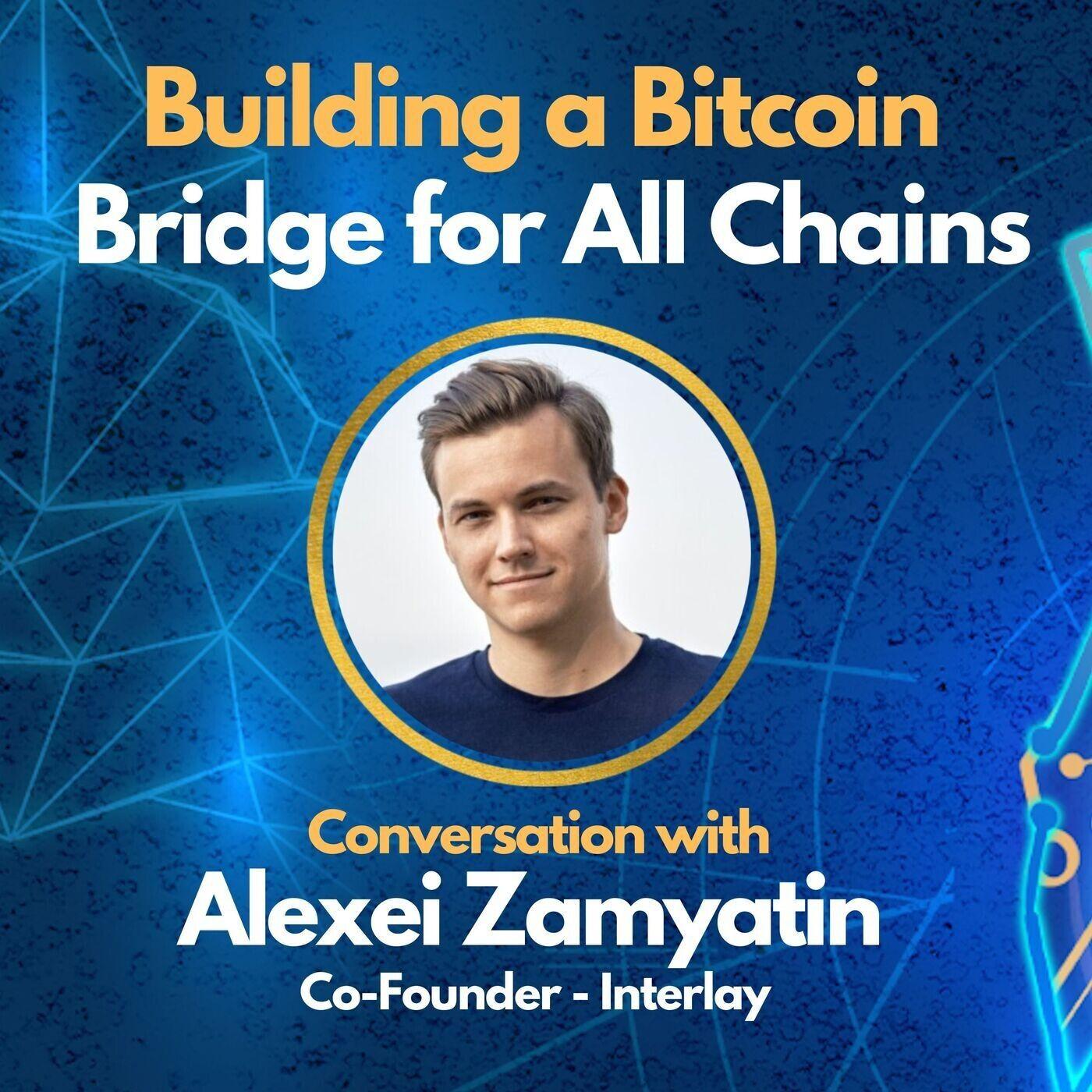
WEBVTT
1
00:00:00.260 --> 00:00:04.840
[upbeat music] What is up, you beautiful people?
2
00:00:05.300 --> 00:00:22.590
Welcome back to the Built On Bitcoin podcast, where we cover all the innovation happening across the Bitcoin ecosystem, mostly talking to the builders who are building their use cases for Bitcoin across Bitcoin, Lightning, Rootstock, Liquid, Stacks.
3
00:00:23.220 --> 00:00:35.320
And as of today, we're expanding to a new ecosystem that I have not covered before, but the way that he's building and the high regard that people hold him in, I had to get him on the podcast.
4
00:00:35.380 --> 00:00:47.880
So without further ado, I am your humble host, Jacob Brown, but you'll see me around on the Interwebs as Jake Blockchain. And today, I have Alexey Zamyatin on the podcast.
5
00:00:48.260 --> 00:01:01.820
Alexey is a Bitcoin researcher and builder who has been in this space for close to a decade now, and he got fascinated by the idea of how to deploy Bitcoin wherever it was needed.
6
00:01:02.200 --> 00:01:11.440
And so this idea of building a decentralized bridge really, really captivated him. And so he's been building this thing called Interlay, uh, for quite a while now.
7
00:01:11.500 --> 00:01:26.600
It's been live on mainnet, the V1, for just about a year, and their V2 just went live a couple of days ago. So it's a fully decentralized, uh, bridge to bridge Bitcoin onto Interlay.
8
00:01:27.040 --> 00:01:34.920
And with the V2, they have new things like lending, borrowing, swapping, et cetera. So super, super fascinating talk.
9
00:01:35.120 --> 00:01:45.240
The way that he thinks about Bitcoin and has a, a neutral stance on certain things, but he's also very principled in the way that he thinks through these things, was really, really refreshing.
10
00:01:45.460 --> 00:01:57.780
I- We need more builders like him that have a very sobering view of things, but also they balance it with the tech, building it right, and also focusing on UX, which we don't have enough of in crypto.
11
00:01:58.120 --> 00:02:11.940
So really excited for this one. I think you guys are gonna like it. You'll definitely learn a lot, I promise you that. But, but before we jump in, we have a new sponsor on the podcast, and I gotta drop some details.
12
00:02:12.080 --> 00:02:24.720
So if you've been paying attention at all, Ordinals have been going crazy, crazy, crazy over the past couple of months, and they're throwing the first Ordinals Conference in Miami in May.
13
00:02:25.200 --> 00:02:41.359
So if you wanna check it out, it's on May 18th. There's a ton of speakers. You just gotta check the website, ordinals2023.com. I mean, heavy, heavy hitters. Casey's coming. Trevor Owens is coming. It goes on and on.
14
00:02:41.400 --> 00:02:46.660
So highly recommend. All the people who have been innovating in Ordinals are gonna be there, and I'll be there.
15
00:02:46.840 --> 00:03:03.400
So if you're interested in going, there's still some early bird tickets available as of this video going live. And if you wanna save 25 bucks on your ticket, you can use the promo code ORD, that's O-R-D, 23JKBLCK.
16
00:03:04.080 --> 00:03:18.920
That's ORD23JKBLCK. So that's it. Without further ado, let's jump into this fabulous, fabulous conversation with Alexey Zamyatin, founder of Interlay.
17
00:03:19.190 --> 00:03:36.200
[upbeat music] Welcome to Built On Bitcoin. Alexey, how are you doing today, my man? Great.
18
00:03:36.700 --> 00:03:43.670
Thanks for having me. Excited to have you on. I appreciate you coming on. Um, I'll be honest, just some, just some context.
19
00:03:43.960 --> 00:04:03.420
I spent most of my time starting in the Stacks ecosystem, and have branched out to Bitcoin, and I don't know much about Interlay, and I've seen your name pop up, but mostly the reason I w- wanted to reach out is because people who I trust keep bringing your name up as a guy to talk to when it comes to building proper things in the proper way.
20
00:04:03.450 --> 00:04:14.720
And so when I hear it like four or five times from somebody, I'm like, "Okay, cool." You know? That's a high s- signal to noise, so I had to reach out. Plus, you guys just launched the V2, so there's a ton to talk about.
21
00:04:15.320 --> 00:04:27.660
But I think just, just to kinda set the stage, could you give us a brief kinda background of, of you and kinda how you got here? Sure. I mean, [chuckles] you're setting the bar very high here.
22
00:04:27.980 --> 00:04:40.780
[laughs] So I'll try to keep up. Um, so yeah. So my name is Alexey. I have a computer science background. I started working on Bitcoin back in 2015. Uh, I got into it by somewhat pure coincidence.
23
00:04:40.880 --> 00:04:46.850
So I was doing computer science and a bachelor's, and I always wanted to focus on IT security. That seemed, like, very exciting.
24
00:04:47.480 --> 00:04:53.730
I had no computer s- or, or very limited computer science background, like, prior to studying it at the university, so I always was interested.
25
00:04:53.780 --> 00:05:00.800
But the thing I liked about IT security is, like, you know, you have to know everything, 'cause you can't just focus on, like, back end or, like, front or C, you have to...
26
00:05:00.820 --> 00:05:09.280
You know, you have to know the full stack to actually be useful in the space. So I, I was looking at, like, obfuscating Tor traffic, um, for my bachelor's thesis.
27
00:05:09.440 --> 00:05:19.900
Obviously, my, my supervisor told me, well, look at, well, the remnants of Silk Road, and he was also just starting to offer crypto, like, blockchain projects for, for, like, um, your thesis.
28
00:05:19.960 --> 00:05:25.140
Like, just ear- very early, like, Bitcoin-focused stuff, and that's how I ended up looking into Namecoin actually.
29
00:05:25.240 --> 00:05:35.620
So I got ex- I learned about Bitcoin, got very excited about, like, the, the idea, the concept, but what I liked the most at that time was the idea of censorship resistance, and I...
30
00:05:35.720 --> 00:05:46.320
That's how I landed in the Namecoin domain, like, Zooko's triangle, like the challenge of, you know, building a decentralized DNS system, um, and looked into why Namecoin didn't work so well.
31
00:05:46.960 --> 00:05:49.200
We w- we were able to link this to merge mining.
32
00:05:49.280 --> 00:05:57.979
Miners just squatting names in Namecoin because, you know, Namecoin wasn't worth too much, so it was speculated that the names one day would be worth a lot, and everything was squatted, basically.
33
00:05:58.080 --> 00:06:06.060
Um, and we kind of looked into merge mining and got really interested in, in, like, okay, how does that actually work? Does it give you all the benefits? Is it cure or curse?
34
00:06:06.100 --> 00:06:15.108
And that was actually the first paper we ever published.Um, and then I kind of went into this research-y direction and ended up doing a PhD at Imperial College in London.
35
00:06:15.928 --> 00:06:29.868
And the topic there initially was, like, looking at how do we improve Bitcoin in the sense of looking at payment channels, but also how we can potentially add upgrades to BTC without being too contentious, without running into issues like forks.
36
00:06:30.328 --> 00:06:50.768
And we looked into something called velvet forks back then, which was basically is a academic term for something that super- subsumes colored coins, merge mining, anything where you write data to the Bitcoin chain, where only a subset of users actually cares about it, which is basically what ordinals and all this rollkit stuff is now doing today.
37
00:06:50.848 --> 00:06:54.068
So it's kind of fun that I can do the whole circle, now it's coming back again.
38
00:06:54.908 --> 00:07:03.768
Then at some point, we started to realize, okay, like it's probably good that Bitcoin is not, you know, constantly upgrading, constantly changing. That actually adds to one of the main kind of selling points.
39
00:07:04.328 --> 00:07:10.228
There's a saying, never change a working system. So obviously you want to be very cautious if it's a multi-billion dollar system that you're running.
40
00:07:11.028 --> 00:07:18.188
So we started looking into, well, how do we get Bitcoin onto other networks? 'Cause like there was a lot of experimentation on Ethereum and other chains, smart contracts.
41
00:07:18.548 --> 00:07:28.768
How do we get BTC over there to allow experimentation without changing Bitcoin? And that's when we kind of came up with this idea of, okay, well, here's how to build a decentralized Bitcoin bridge.
42
00:07:28.798 --> 00:07:44.768
Um, fun fact, we were presenting this bridging concept at Scaling Bitcoin to, like, quite a few very OG Bitcoiners back then, at the same time as Double BTC was announcing their centralized Double BTC concept.
43
00:07:44.788 --> 00:07:48.248
So both of them are pretty much, uh, they came out around the same time.
44
00:07:49.028 --> 00:08:00.148
Um, and yeah, that's basically then we, we s- decided that we would like to build this in production and try to, you know, make it work in practice. Interesting.
45
00:08:00.188 --> 00:08:11.918
So your, your first wheel forward into it was not through Bitcoin per se, but one na- or not one name. That's the, that's the thing that Stacks built on top of, of, uh, Namecoin. Namecoin.
46
00:08:11.928 --> 00:08:21.248
It was na- naming- So Blockstacks... Yeah. Block- Yeah... so, so Blockstack was kind of around, came out around that time as well, um, as one of the alternatives to Namecoin.
47
00:08:21.488 --> 00:08:30.328
But yeah, I, I kind of, I found Namecoin super exciting. The idea behind it and, you know, building decentralized DNS and decentralizing everything just, and, and, and so on.
48
00:08:31.068 --> 00:08:40.768
Um, so yeah, that was-- I mean, obviously it started with Bitcoin, but the, I got really like, you know, technically involved with, with Namecoin, essentially. Very interesting. Okay.
49
00:08:40.868 --> 00:08:56.828
Um, yeah, it's interesting too about the squatting domains, 'cause you see that over and over right now, where it's like ENS pops with like the four-digit, you know, club whatevers, and now BNS is kinda having that, that wave, and also s- the.sat name with ordinals is kind of riding that same wave.
50
00:08:57.088 --> 00:09:06.208
What do you think-- It's crazy to think it's been almost... Well, I, I, I guess first question, could you place me on when the, the one, not one name, Namecoin
51
00:09:07.468 --> 00:09:17.647
was kind of prevalent and, and this kind of like hype was going on around squatting and, and whatnot? I mean, I'm not sure it was prevalent and there was a hype. Namecoin is the first altcoin, right?
52
00:09:17.708 --> 00:09:27.088
So it came out, I think, two thousand, I'm afraid to say wrong date now, two thousand eleven, twelve. Eleven, twelve. Something like that. Um, so it was very, very early, right?
53
00:09:27.108 --> 00:09:39.148
That, and actually Satoshi himself was around back then, and then that's when the whole merge mining idea came up to, you know, let, let's not fragment the mining power, but, you know, keep it in Bitcoin, and then Namecoin just plug, gets the plugs in and can reuse that.
54
00:09:39.948 --> 00:09:45.008
Um, so when I was looking into it, it was already like more the, more a postmortem.
55
00:09:45.408 --> 00:09:56.458
So most of it was squatted, um, and we were looking also like the merge mining hash power distribution, and at some time, like there were times where like miners had more than fifty percent, and Namecoin would try and obfuscate it.
56
00:09:57.068 --> 00:10:02.878
So it was more of a postmortem analysis. Um, that was in two thousand fifteen, sixteen. So I guess, yeah. Got it.
57
00:10:02.878 --> 00:10:10.558
It was very early back then, so you actually, like people were building like browser extensions, so you could, yeah, resolve these, um, domain names.
58
00:10:10.708 --> 00:10:17.128
But yeah, it, it did, unfortunately, it didn't really pick up traction. I think it also was probably a bit too early for its time.
59
00:10:17.728 --> 00:10:31.788
And that's my next question is like, with, with the evolution we're seeing of these decentralized IDs, if you will, and trying to build these persistent, you know, pseudonymous names that are censorship resistant with, you know, Web5 or ENS or BNS.
60
00:10:32.188 --> 00:10:43.688
Are any of them... Are you tracking those? And are any of them stand out to you as like they strike the right balance of good and bad, pro and con? I think there's a inherent problem.
61
00:10:43.768 --> 00:10:53.448
So there is like a paper, and that introduces Lucas' triangle, which I highly recommend reading if you're like working in the space. But basically, there is some impossibility result that like you can't have everything.
62
00:10:53.648 --> 00:10:57.738
It's, basically, it's very hard to make it censor-persistent and prevent squatting at the same time.
63
00:10:58.628 --> 00:11:07.958
So it's very, it's very hard, nearly impossible, to keep a system completely pseudonymous and censorship resistant, but at the same time discourage squatting, right? Got it. Okay.
64
00:11:07.988 --> 00:11:17.628
So you can make the fees very high, but then you're censor- then you result in the tragedy of the commons, where the normal user is affected and can't get an actual registered name, and gets kind of excluded this way.
65
00:11:18.308 --> 00:11:28.138
So I, I think there, the, and yeah, it's, it's a very difficult problem, and there's a lot of, a lot of projects have tried, like different identities. You have like DIDs now, different standards.
66
00:11:28.288 --> 00:11:40.468
Uh, I think it's def- someone's gonna solve it, right? Um, but I think we're still, fortunately, we're, we're still kind of pretty far out of like a perfect solution. Interesting. Okay. Yeah.
67
00:11:41.288 --> 00:11:47.788
I could deep dive on this topic for, for a while, but I'm gonna, I'm gonna go left turn 'cause we got a lot more to talk about with D- DeFi. Um,
68
00:11:49.008 --> 00:11:57.148
and so I, I think maybe to start, could you give me just a brief overview in your, in your estimation of the current state of...
69
00:11:58.968 --> 00:12:08.288
I'm hesitant to say if we should go Bitcoin DeFi, or maybe we should keep it broad for a second and, like if I have Bitcoin, what's the state of deploying my Bitcoin, you know, across the ecosystem?
70
00:12:08.368 --> 00:12:19.680
So you can go Coinbase, and you can go levels of DeFi, from wrapped to something else. Uh, uh, what's the landscape if I'm a Bitcoin holder, I wanna deploy it somewhere?So, so from a Bitcoin holder's perspective.
71
00:12:19.740 --> 00:12:21.920
So I have Bitcoin, I wanna do something with it Yeah.
72
00:12:22.520 --> 00:12:32.160
Um, well, the hard truth is that ninety-nine point nine percent of your options require centralization as of today in terms if you're looking at volume, right, and kind of adoption.
73
00:12:32.180 --> 00:12:36.380
Of course, there's more alternatives that are coming out left and right now, thank God.
74
00:12:36.420 --> 00:12:51.340
But, you know, if you look at the volumes, ninety-nine point nine percent is still centralized despite the fall of FTX, Celsius, BlockFi, Voyager, despite all of these breaking apart still, we're still quite far from, you know, at least some balance.
75
00:12:52.280 --> 00:13:02.200
So if you have BTC and you want to deploy it into DeFi, or like at least... Well, if you want to deploy it into DeFi, DeFi per se, em-emphasize that it's, it has to be decentralized.
76
00:13:02.210 --> 00:13:10.020
So if you're looking at real DeFi, you're limited to a very small subset of, of the applications. And also, I think it's important to point out there's always risk, right?
77
00:13:10.060 --> 00:13:19.320
You, you can't, you know, try to earn on your Bitcoin without taking up some risk. If you don't wanna take up any risk, keep your Bitcoin in your cold wallet and don't touch it, right? That's, that's the thing.
78
00:13:19.400 --> 00:13:27.020
If you're not willing to take up any risk of losing it, because there's either counterparty risk, or you might lose it because, like, the markets move and you get liquidated or something like that.
79
00:13:27.560 --> 00:13:28.900
Now, what you can do is like the...
80
00:13:28.940 --> 00:13:39.840
And that's what most people do, they go to Binance, Coinbase, to these big established centralized exchanges and the, and Kraken, and some of them have now, you know, they're launching proof of reserve schemes or have been doing that.
81
00:13:39.920 --> 00:13:46.560
Some work, some don't. So that's one option I think everybody knows about it, so no need to talk much about this kind of area.
82
00:13:46.620 --> 00:13:54.400
I mean, we know that, you know, some things may seem great, and then they fall apart because, well, they were pro-pro-properly mismanaged in the background.
83
00:13:54.540 --> 00:13:59.860
Then you have the alternative of, um, let's stay in the Bitcoin, like on Bitcoin directly.
84
00:13:59.920 --> 00:14:10.800
So you have things like local Bitcoins, like Hodl Hodl, and a few other smaller shops basically where you could swap peer-to-peer, or you can now lend peer-to-peer BTC against fiat.
85
00:14:11.640 --> 00:14:20.740
But that always is an intersection of decentralized and centralized because, you know, the moment you use any form of fiat rails, you need to centralize.
86
00:14:20.760 --> 00:14:27.369
You need some cus-custodian to attest that the bank transfer was made, 'cause there's no way for us to verify that a bank transfer was made cryptographically.
87
00:14:28.040 --> 00:14:37.300
You have to have somebody who handles disputes in the middle, kind of solving the fair exchange problem. Like you have dollars, I have Bitcoin. I sent you Bitcoin, you never send me dollars.
88
00:14:37.460 --> 00:14:44.750
Well, what do we do now, right? So there's usually somebody in the middle. I send them my BTC. They wait for you to send me dollars. I have to confirm.
89
00:14:44.860 --> 00:14:51.240
If I don't confirm and you're complaining, they will step in and try to resolve the dispute. That's how, like, most of these peer-to-peer exchanges work.
90
00:14:51.660 --> 00:14:56.610
But again, that's not really DeFi because you're doing on off-ramp from Bitcoin to US dollars usually.
91
00:14:57.640 --> 00:15:12.460
And then you have the biggest play in the market, WBTC, which is a way for you to bridge Bitcoin into Ethereum if you're not a retail user. The WBTC is an institutional play. It's meant towards institutions.
92
00:15:12.800 --> 00:15:16.000
So as a retail user, there are... You have to find a merchant
93
00:15:17.040 --> 00:15:32.040
who will KYC you, who will on-ramp you, and then charge you for accepting a Bitcoin that you basically deposit into BitGo custody through one of these merchants after they've KYC'd you, and then you will get the Bitcoin on Ethereum.
94
00:15:32.080 --> 00:15:43.020
And I've interviewed and spoken to at least fifty people by now who have used WBTC, and not one of them, except for funds, but not one individual has actually minted WBTC.
95
00:15:43.700 --> 00:15:52.500
So what usually would happen is if institution minting WBTC, bringing it into the market on Ethereum, and then people just buy it. But it's more of an exposure to Bitcoin.
96
00:15:52.580 --> 00:15:59.160
Yes, it's kind of physically backed, but you can't really redeem it. Like an individual can't really redeem WBTC.
97
00:15:59.260 --> 00:16:05.440
I mean, and you would listen to this interview, plea- I encourage you, please go ahead and try it 'cause, 'cause usually it's not that easy.
98
00:16:06.520 --> 00:16:16.560
And then that's when you had things like renBTC pop up, which is offering an alternative solution. So renBTC was, despite some claims that they made, they were more or less centralized.
99
00:16:16.600 --> 00:16:27.080
It was a multisig setup operating in this gray zone where you'd use them for on off-ramps into WBTC. So WBTC is a multi-billion dollar market cap on Ethereum.
100
00:16:27.120 --> 00:16:36.740
It's like the biggest representation of Bitcoin outside of the Bitcoin chain, but again, only for institutions. How does retail, how do we get in without going through this painful KYC process?
101
00:16:36.860 --> 00:16:50.180
Well, you'd go to Ren, mint renBTC, and then you'd instantly swap against wrapped Bitcoin on a Curve pool, which is a stable swap, which gives you like good, like low slippage trades between, between these two different Bitcoin versions.
102
00:16:51.000 --> 00:17:04.260
Fun fact, Alameda minted hundred thousand out of the two hundred thousand Bitcoin that W- WBTC had on Ethereum at its peak. So fifty percent went through Alameda's emergent. Alameda bought renBTC,
103
00:17:05.580 --> 00:17:14.720
so they basically were controlling both sides of the market more or less. Um, and they were obviously arbitraging the Curve pool whenever it went out of balance.
104
00:17:14.760 --> 00:17:20.080
Too many people went in, too many people went out, they'd arbitrage, make a profit. Um, again, this is based on data.
105
00:17:20.140 --> 00:17:29.820
I mean, it's very hard to link like pseudonymous accounts, but essentially this is like I would believe the common acceptance that this was the case. WBTC is still around, obviously.
106
00:17:29.880 --> 00:17:42.520
BitGo is still, still providing custody services. renBTC was shut down following the FTX fallout. You had similar versions of wrapped Bitcoin on other chains like Solana BTC, which depegged because it was tied to FTX.
107
00:17:43.120 --> 00:17:54.740
You have Avalanche blockchain has a native version, which basically is again, it's a bit more decentralized than WBTC, but it's essentially a few nodes that run like... That save keys in trusted hardware.
108
00:17:55.200 --> 00:18:02.980
So they have like chips running on the servers where- which generate the keys, and supposedly you can trust that nobody will get access to that machine and read the key.
109
00:18:03.020 --> 00:18:12.320
We know that, you know, hopefully it works, and we all pray that it's gonna be stable, but then Intel SGX has been ex-exploited more times than I can count, so it's always a cat and mouse game with these things.
110
00:18:13.240 --> 00:18:14.540
And then you have side chains, right?
111
00:18:14.620 --> 00:18:25.524
So you have the liquid side chain, but I'm not as familiar with the use cases deployed on liquid todayYou have RSK, which now has been growing its ecosystem with Sovereign and money on-chain.
112
00:18:25.584 --> 00:18:36.484
However, also to point out, I mean, the bridge has been working, but it's also a multisig federated bridge, right? So you deposit BTC into a federation, and you have to trust this federation to get your Bitcoin out.
113
00:18:36.524 --> 00:18:39.324
So there is no kind of insurance or kind of built into that.
114
00:18:39.364 --> 00:18:54.404
The federation again runs like sup-- They, they run like trusted hardware, so supposedly keys are, you know, generated by trusted like enclaves in the servers and hopefully nobody gains access to them or is able to read the data or kind of, you know, corrupt these chips.
115
00:18:55.384 --> 00:19:03.004
But that's the state of that bridge. Then you can always try to experiment with some like on-chain solutions.
116
00:19:03.064 --> 00:19:12.584
So there are a few things like Atomic Finance, which offers you some Bitcoin options and covered calls, which is quite interesting using like some multisig setups.
117
00:19:12.644 --> 00:19:24.903
And you have DLC basically, so discrete law contracts coming out, which basically allow you to, you know, um, build oracles for external data on top of Bitcoin, so you can bet on certain things, you can bet on certain price movements.
118
00:19:25.604 --> 00:19:34.944
So there's a few companies working on that. But obviously the oracle you send, like the question is how secure is that oracle who runs this? Is it properly maintained? Because obviously, that's the weakest point.
119
00:19:36.004 --> 00:19:43.924
Also one has to admit that oracles generally are the weak link in the entire DeFi ecosystem, so probably that's an acceptable trade-off if you want to do something like that.
120
00:19:45.144 --> 00:19:51.544
And then you have Interlay, right, which is a project that I'm involved in, which has built a decentralized bridge. The core difference...
121
00:19:51.654 --> 00:19:58.904
But I can, I can get to that in a second, but the core difference is that the BTC that are deposited into the bridge are insured by collateral. So if something goes wrong,
122
00:19:59.984 --> 00:20:03.444
you get the, you, you basically can claim that collateral insurance.
123
00:20:03.644 --> 00:20:13.884
So you know that either you'll get your Bitcoin out or you'll be able to claim that collateral insurance, um, and you know, swap that into BTC through one of the other exchanges.
124
00:20:15.004 --> 00:20:23.724
And then on Interlay, you can basically... I mean, it's, it's a similar setup to like, like Bitcoin on other blockchains. You can use it in different applications.
125
00:20:23.784 --> 00:20:27.244
There's some native swaps and so on, but the concept is similar, right?
126
00:20:27.304 --> 00:20:49.144
I mean, I've gone through a lot of examples, but if you were to take a step back and kind of summarize, you have centralized exchanges, you have very limited to the DeFi on Bitcoin, which is quite restrictive, and then you have B- Bitcoin on other chains, whether it's a federated peg, whether it's a side chain, um, whether it's like Ethereum or, or Interlay using a decentralized bridge.
127
00:20:49.174 --> 00:20:51.944
Whether it's Fedimint, I would also position Fedimint into that.
128
00:20:51.984 --> 00:21:05.324
If there's like a Fedimint setup where you have some swaps on that federated kind of setup, it probably falls into this kind of group where you move Bitcoin onto somewhere else. And everything has its trade-offs.
129
00:21:06.344 --> 00:21:17.484
Um, yeah. And I guess you have to always decide like who do you trust? That's always the question. Perfect. That, that was a fantastic response. I'm definitely listening back to, to that segment.
130
00:21:17.544 --> 00:21:29.864
So it sounds like, just, just to quickly get a pulse and recap, um, centralized exchanges have a ton of total value locked, largely I'm assuming because of the user experience is so much easier to onboard.
131
00:21:30.374 --> 00:21:48.324
And then you have kind of two buckets of DeFi, if you will. But, um, the one that I guess you put as two, two kinds. Wrapped would be the asset is centralized, but they can get deployed onto DeFi apps, if you will.
132
00:21:48.944 --> 00:22:01.724
So there's like a segment there. And then there's like the more peer play, which is still coming up, I'm assuming because the UI/UX is not quite there. Is that, does that feel accurate? Mm.
133
00:22:02.044 --> 00:22:08.404
So I, I would act- So I would make the distinction a bit different. So you have DeFi directly on Bitcoin, where you basically you have...
134
00:22:08.564 --> 00:22:13.164
Like, like DLCs basically allow you to, you know, get some bet, bet on some external events.
135
00:22:13.244 --> 00:22:22.664
So like Bitcoin price changes and you have like some options or like future contracts where you basically, you know, you bet against somebody else on the Bitcoin price. But you need...
136
00:22:22.704 --> 00:22:28.524
At the moment, you need to represent other assets. That doesn't really work with too well on Bitcoin just yet.
137
00:22:28.624 --> 00:22:39.364
So that's if you want to swap it against like USDT or some other stable or other asset, you have to go into this cross-chain domain. Whether cross-chain means a side chain, Ethereum or something else,
138
00:22:40.424 --> 00:22:49.984
all kind of, you, you have to go there, right? And in this domain, in the cross-chain domain, you have two types of kind of approaches. You have swaps, Thorchain, for example.
139
00:22:50.044 --> 00:22:59.814
And again, if I say projects, I'm not en-endorsing anything. These are just examples like documenting what's out there. Please always do your own research and be very careful where you put your Bitcoin. Um,
140
00:23:01.104 --> 00:23:12.204
but you have like swaps like Thorchain, for example, um, and, and some other projects that, you know, basically try to swap your BTC into something else. The methods sometimes work similar to wrapped assets or not.
141
00:23:12.804 --> 00:23:20.104
Um, and then you have this other kind of wrapping, which is more permanent. So you move Bitcoin somewhere else to keep it there for a while, do something, and then go back.
142
00:23:21.024 --> 00:23:30.624
A swap Bit- means you swap Bitcoin for Ethereum. It just changes hands, right? So Bitcoin goes from one account to the other account on Bitcoin. Ethereum goes from one account to the other account on Ethereum, right?
143
00:23:30.684 --> 00:23:41.524
So you just have two transactions that you synchronize. The, the wrapping means you lock Bitcoin. It should not be moving on the Bitcoin side while you're using it on, let's say, Ethereum.
144
00:23:42.314 --> 00:23:52.684
And then when you go back, you want to make sure that any updates, so if you changed ownership, if I sent you the wrapped Bitcoin, well, you should be the one who actually can claim the real BTC on the Bitcoin chain.
145
00:23:53.344 --> 00:23:58.104
That's kind of the two camps. And within those camps, you have different security models, right?
146
00:23:58.184 --> 00:24:06.054
You have centralized, you have something in the middle, um, then you have decentralized ones which work with economics and game theory and try to like, you know, give insurance.
147
00:24:06.664 --> 00:24:08.464
That's kind of more where Interlay positions itself.
148
00:24:08.904 --> 00:24:19.924
You have things which tries to kind of build on statistical security, where you try to get as many people involved as possible, and then you assume that, well, the more people are kind of holding the BTC, the less likely that all of them will collude.
149
00:24:20.724 --> 00:24:29.084
But if they do collude, then it's lost. And then you have the very centralized ones where like, okay, BitGo. If, if BitGo goes down, it's, it's gone, right?Got it.
150
00:24:29.284 --> 00:24:40.204
Okay That's kind of a, a high-level breakdown, uh That... No, that makes a lot of sense. It, it, it's interesting, one of the things a- as a Bitcoin user again, like, I just have native BTC. It's sitting on my ledger.
151
00:24:40.884 --> 00:24:47.184
When I'm looking at the landscape of DeFi, and I've been trying to do this recently, of seeing, like, where can I deploy it easily?
152
00:24:47.864 --> 00:24:57.264
I tried RSK with Sovereign, and then I tried xBTC on Stacks, 'cause I know Stacks well, and that was... That's, that's cumbersome, to say the least.
153
00:24:57.324 --> 00:25:10.804
But RSK was decent, but something that struck me is that when I'm moving my BTC, which feels very, like, pristine, and I move it into any derivative, especially if I don't know that ecosystem well, it feels weird.
154
00:25:10.864 --> 00:25:22.944
It feels risky. Like, rBTC, and LBTC, and xBTC, and iBTC, at first glance, when you just look at them on, like, a side-by-side comparison but you don't know that much about them, they feel very similar.
155
00:25:23.144 --> 00:25:36.004
It's really hard, uh, to do the work to know I have BTC, and why is iBTC better than LBTC? Like, especially if it's not... If you, if it's a lowercase, they look the same, you know? It's like they're very similar.
156
00:25:36.464 --> 00:25:49.884
So there's something about that that I think is, uh... I don't know. It's, I guess it's an education piece, but it's, it's a weird blocker I had in myself where it's like I don't know where to safely deploy it, you know?
157
00:25:49.944 --> 00:25:59.844
Yeah. That's a, that's a very good point, and I think this is... It's a fine balance between being very transparent about how it works, and not everybody is, right?
158
00:26:00.184 --> 00:26:10.444
Obviously, it's because the competition, and you always try to oversell everywhere. I mean, that's, that's how humans are, right? But on the other hand, you have to hide complexity. So it has to feel safe, right?
159
00:26:10.984 --> 00:26:12.804
If I were to tell you, "Look, I mean,
160
00:26:14.024 --> 00:26:22.594
go to a decentralized bridge," but the UX looks crappy and it's, it looks unfinished, you're not gonna trust it, 'cause maybe the tech is decentralized, but, you know, it's, it's a product, right?
161
00:26:22.604 --> 00:26:28.584
And it's a lot of perception. So that's why centralized exchanges are so successful, because it feels secure, right? It feels good.
162
00:26:29.404 --> 00:26:38.374
But in the back, it's all centralized, you're trusting the decisions of a few people, and if they mismanage it, your assets are gone, right? I mean, we've just had the, the biggest example outside of Bitcoin, right?
163
00:26:38.383 --> 00:26:49.544
The reason why Bitcoin exists, we just witnessed it once again, right, with SVB and the whole kind of collapse. So what we're trying to work on is balancing, like, UX and security.
164
00:26:49.684 --> 00:26:58.354
So the user should always know, "Okay, what am I doing? What are my risks?" But it sh- shouldn't be... You... Why would you care about the wrapping process, right?
165
00:26:58.784 --> 00:27:06.644
You don't think about how banks settle in the background when you withdraw cash from an ATM, right? You don't care about that. You just get cash, and you're happy about it.
166
00:27:07.044 --> 00:27:11.944
If you go to a website, you don't care how, like, the traffic is written in the background. You just go to the website and you click around.
167
00:27:13.004 --> 00:27:26.444
So if you use a neobank like Revolut, you don't care how they settle interbank settlements in the background. You just care about the app. In crypto, we're still like, oh yeah, here's this wallet, which is another chain.
168
00:27:26.484 --> 00:27:35.944
You need to generate another pair of keys, and you need to bridge it over, and you need to wrap it, and then you are able to do something, and that, that thing has a different format, so it's gonna look different than what you're used to.
169
00:27:36.344 --> 00:27:47.204
It's, it's, it's very kind of, you know, far, far from, from perfect. So what we're trying to do is kind of, like, for example, for lending, for... 'Cause we have, we'll have lending on Interlay, right?
170
00:27:47.424 --> 00:27:53.524
So ideal case is you deposit Bitcoin, you get your USDT or whatever else, and you don't care that it was a bridge or whatever.
171
00:27:53.584 --> 00:28:01.484
You just care about the product, and it's ex- if you want to read more, it's explained to you, "Look, here's the risks." But you shouldn't think about, like, wrapping and unwrapping and so on.
172
00:28:01.564 --> 00:28:06.104
That, that process needs to be very simple. It's the same challenge that Lightning is having, right?
173
00:28:06.564 --> 00:28:13.974
So how do you balance security, where user knows exactly what's going on and can always get in control, versus usability?
174
00:28:15.164 --> 00:28:20.924
And that's why everything looks the same right now, 'cause everything is like, oh, gee, you have to wrap this, and, like, people are concerned.
175
00:28:21.644 --> 00:28:30.944
And the first one that manages to build a decentralized solution that's stable and has good UX is gonna win. Okay. Perfect. That, that makes a lot of sense, the UI/UX part.
176
00:28:31.524 --> 00:28:41.044
Um, it also struck me as I was kind of trying these different ecosystems, I have to make a new wallet each time, which means I have to hold another private key, which is a lot of responsibility on me.
177
00:28:41.084 --> 00:28:46.843
I might lose that, that thing. So every time I have to make a new wallet, that's, that's a big, uh, responsibility.
178
00:28:47.604 --> 00:28:56.103
So that might be a good segue, then, into what you guys are building, 'cause it seems like it's a good balance of cr- crossing the most amount of boxes.
179
00:28:56.144 --> 00:28:59.284
And you just released your V2 whitepaper, which looks super interesting.
180
00:28:59.664 --> 00:29:11.664
But maybe just to start, kind of take a step back and look at what, what did you guys build, and what was the kind of, like, mission to prove with Interlay V1? And, and what is Interlay? So
181
00:29:12.704 --> 00:29:20.584
we started off with a, with, like... as researchers, right? So I met my co-founder during my PhD, and we're both, like, super excited about Bitcoin.
182
00:29:20.784 --> 00:29:30.124
Dominic was more involved in, like, the stablecoin design space, game theory, um, worked around that kind of, like, smart contract languages. So really, like, early, early DeFi days.
183
00:29:30.184 --> 00:29:38.804
They also, like, found an exploit, him with some, some other colleagues, like, in, in, in MakerDAO. Um, and, like, his former colleagues are also now building their own, like, stablecoin projects.
184
00:29:38.814 --> 00:29:46.624
So he kind of covers that kind of DeFi area. I came from, from, like, Bitcoin, like, low-level protocol design. And what we created was essentially a mix.
185
00:29:47.224 --> 00:29:59.624
So you have a bridging solution where you have a decentralized set of part- participants that secures a bridge, but you also use game theory to, to make sure that people behave and do what you want them to do.
186
00:30:00.324 --> 00:30:08.644
So what I like doing is if people are very familiar with centralized bridges, so it's easier just to start there and then explain step by step how you get to a decentralized solution. So
187
00:30:09.584 --> 00:30:17.664
step one is, okay, you have, you have BitGo centralized, and you trust them. So what you do is you decentralize. You allow anyone to become BitGo.
188
00:30:17.704 --> 00:30:25.724
So instead of one bridge operator, you allow hundreds, thousands of people to become bridge operators, anonymous people on the internet, right?
189
00:30:25.804 --> 00:30:38.189
So now you're sending your Bitcoin, and, you know, they secure itNow, step two is realizing, well, that we made it worse because now these people who are pseudonymous, anonymous, what's their incentive to ever give the Bitcoin back, right?
190
00:30:38.500 --> 00:30:42.020
BitGo has a reputation, you know, it's regulated, you know, they, they, they have to, right?
191
00:30:42.680 --> 00:30:50.600
Then step three is fixing this problem of getting anonymous people to behave in a certain way, is you add incentives and you sprinkle in punishment.
192
00:30:51.320 --> 00:31:02.099
So on Interlay, every single vault operator, and we call vaults, is basically the, the, the role that secures Bitcoin while you use iBTC on the other blockchain.
193
00:31:03.180 --> 00:31:16.540
Every of these operators is over-collateralized, so they deposit assets in USDT, DOTs, or other assets on Interlay, and only then are, are they able to receive Bitcoin from other users, right?
194
00:31:16.680 --> 00:31:29.740
And this collateral must always be worth more in terms of like dollar or euro, whatever Bitcoin value, than the actual BTC that they re- receive. And then what you add then is like you add punishment.
195
00:31:29.840 --> 00:31:35.800
If these operators lose the Bitcoin, their collateral is liquidated and used to reimburse victims.
196
00:31:35.860 --> 00:31:45.560
So if your Bitcoin was lost, you'll get payouts in the collateral, and you can go back to whatever exchange and buy Bitcoin off the market. And that will...
197
00:31:45.640 --> 00:31:58.480
That collateral will come with a premium to cover any transaction costs and so on. Now, the last question is, well, how do we realize whether vaults misbehave? And for this, you use light clients.
198
00:31:58.720 --> 00:32:08.580
So the same thing that you have on your mobile device where you run a Bitcoin wallet, right? You, you don't download the entire Bitcoin blockchain, you don't download all transactions. You...
199
00:32:08.640 --> 00:32:15.260
It-- these wallets run light clients, so they store block headers which contain the meta information that you need to know about every block.
200
00:32:15.300 --> 00:32:25.200
It basically shows you like this chain of Bitcoin blocks, and it allows you to verify whether a transaction was actually included in the Bitcoin blockchain at a certain block height.
201
00:32:26.280 --> 00:32:37.170
And this exact same mechanism is built into the Interlay chain. So the Interlay chain follows the Bitcoin blockchain, reads every single block header, and then accepts proofs for transaction inclusion.
202
00:32:38.100 --> 00:32:51.200
So when a vault operator wants to tell the system, "Hey, I behaved correctly, I returned the Bitcoin to the user," they submit a proof. And if they cannot produce the proof because they misbehaved, they get liquidated.
203
00:32:52.290 --> 00:32:54.080
And that's it. You've got a decentralized bridge.
204
00:32:54.540 --> 00:33:29.060
As a user, you know, I'll deposit my BTC, I can use it in DeFi, and when I want to go back to Bitcoin, the vault operators, one or multiple, will have to send BTC back to the BTC account that I specified, and if they don't do this within a certain amount of time, I can go and liquidate them, and I can claim a ca- payout in cash, so like USDT or other assets that exist on the Interlay chain, right, that are imported from Ethereum or like native Polkadot assets or other USD stable coins, and I can get those, and I can go and sell them on the market to recover my Bitcoin over this path.
205
00:33:29.120 --> 00:33:39.839
And that's how it works. And essentially, this is what Interlay built, and V1 was e- was essentially this bridge. It basically, it has like liquidation, so vault operators also need to keep up the collateral.
206
00:33:40.380 --> 00:33:49.300
Um, it has some fee models built in to motivate people to actually provide this service. So the more bridge volume goes through the bridge, the more revenue these vault operators make.
207
00:33:50.020 --> 00:33:59.760
And we were catering essentially to other DeFi projects. So in V1, we proved you can actually build a decentralized Bitcoin bridge and get it into production.
208
00:33:59.890 --> 00:34:11.749
Um, we had around twelve million vol- dollars worth of Bitcoin volume over the past few months, which is, you know, can be much more obviously if you compare it to giants like BitGo, but it's a David versus Goliath battle, right?
209
00:34:11.780 --> 00:34:14.020
We're, we're doing it the decentralized way.
210
00:34:14.060 --> 00:34:24.100
We're not, you know, making any compromises on that, so obviously it takes a bit longer, but in the end, it's, it's a system where we can say, "Look, this is really like the theoretical best that you can do."
211
00:34:25.200 --> 00:34:39.760
And, well, with V2, we're now essentially adding all those products, so trading, borrowing, lending, that you can do with a decentralized version of this cross-chain BTC. Got it. Okay.
212
00:34:39.840 --> 00:34:51.170
And so, and so the Interlay network is, is running Bitcoin node. And where, where does the Interlay chain live? What, what's that construction like?
213
00:34:52.900 --> 00:34:59.140
So current-- So when we started Interlay, one of the biggest question was, "Okay, well, how do we d- solve consensus?"
214
00:34:59.150 --> 00:35:07.620
'Cause obviously if you run separate chain, you need to solve consensus for the events that happened there. The options were, okay, get your own validators. Do your...
215
00:35:08.040 --> 00:35:17.560
Well, own proof of work was basically qu- quickly out of the way. Merge mining was an option, but we're... The merge mining makes you very dependent on miners, and it's very hard to go back.
216
00:35:18.260 --> 00:35:23.660
And not all miners participate. You're centralizing one or two mining pools, which puts you at the mercy of them.
217
00:35:24.620 --> 00:35:34.800
If you try to run your own proof of stake, you have to find validators, which means you go to the big validator providers, and you centralize around two, three big validators who are merciful enough to onboard a new project.
218
00:35:35.670 --> 00:35:46.110
So what we decided to do is we said, "Okay, we'll plug into Polkadot" which at that time was the best kind of setup in terms of maturity of the code base and, and readiness for us to, to build this.
219
00:35:46.720 --> 00:35:56.360
On a very high level, Polkadot works like roll-ups, right? Essentially, we have validators that we... They are called collators. This is like Polkadot specific lingo.
220
00:35:56.440 --> 00:36:04.400
But they look at the Interlay chain, they process transaction, they build proofs, they submit them to the Polkadot network, where they get validated.
221
00:36:04.430 --> 00:36:15.140
And these collators, this set of collators, it's not one where, which, which is a normal thing with like what you have with like, um, sovereign roll-ups, where you have like a multi-sig or, or something like that.
222
00:36:15.180 --> 00:36:22.220
It's, it's decentralized, so you have like a staking mechanism where people can, you know, s- run a node, and if they're unactive, they get kicked out, and so on.
223
00:36:23.120 --> 00:36:27.210
So the Interlay has like this modular setup where you can plug and play different consensus mechanisms.
224
00:36:27.300 --> 00:36:33.200
Right now, it's plugged into the Polkadot chain, which is one of the biggest proof of stake networks and offers this, like, security.
225
00:36:33.280 --> 00:36:39.280
So we don't have to worry right now of building our own kind of consensus layerIt allows us to long-term, like it...
226
00:36:39.620 --> 00:36:48.130
We focus on the products, and then, you know, long-term, you can decide whether you want to become standalone or re-connect closer to Bitcoin, maybe add merge mining in.
227
00:36:48.800 --> 00:36:52.440
These things, you have, you can worry about them, but we worry about the decentralized bridge.
228
00:36:52.920 --> 00:37:04.140
Now we need the products, and if that works, great, then we can start worrying about this consensus question, 'cause honestly, like, the chances of the Polkadot breaking, there's so many things that will break before that.
229
00:37:04.900 --> 00:37:12.040
You know, the bridge, the wallets, people lose their keys, you have some code bugs, you know. There's so many things you have to worry about. That's kind of...
230
00:37:12.089 --> 00:37:18.480
So you try to balance, like, security versus, like, okay, getting actually to market. Got it. Okay.
231
00:37:19.200 --> 00:37:31.030
And I, I love the idea for step one, it's you wanna keep it open membership as far as vault operators, so that anyone, anyone can, anyone can join. What are the incentives for someone to be a vault operator?
232
00:37:33.120 --> 00:37:40.180
So vault operators earn a fee on the bridge volume, so the more it's bridged back and forth, the more revenue you make as a vault in Bitcoin.
233
00:37:40.880 --> 00:37:50.420
Um, obviously because in early stages you need to subsidize co- I mean, the server costs are marginal, right? It's the capital cost of providing the ca- the collateral insurance that really matters here.
234
00:37:51.000 --> 00:37:56.340
So the treasury is subsidizing vault operation. Um, and
235
00:37:57.920 --> 00:38:13.780
on top of that, with V2 launching, you'll have the trading and lending markets on top of Interlay, and then part of the fees that are generated from these trades and, and loan repayments are routed back to vault operators to basically cover, like, as additional kind of revenue.
236
00:38:14.900 --> 00:38:22.880
So as a vault operator, basically you become a vault operator if you see that, okay, there's high de- you think there's gonna be high demand for Bitcoin DeFi, so you want to provide your...
237
00:38:23.200 --> 00:38:32.160
Like, you run the node, you provide the insurance, or people might be able, so in the near future, to delegate collateral to you, so you can scale up your vault if you're, you know, running a very reliable service.
238
00:38:32.860 --> 00:38:43.780
Um, and then you ear- Like, the more volume the Interlay network, and then also other chains, like, generates, the better for you because that's where the revenue stream comes in. Got it.
239
00:38:44.080 --> 00:38:56.420
A- and how long has V1 been live? So V1 has been live for around a year. So we, we have, like, a two-network model, so, so which makes things even more complicated to explain sometimes.
240
00:38:57.300 --> 00:39:07.660
But we have a so-called Canary network. Same code base, different brand. It's Nigeria's anything new goes first to that network. It's not a test net. It's a main net, but it's experimental.
241
00:39:07.680 --> 00:39:18.660
It's like this middle ground between zero value test net and full, full-fledged main net where you have no limits. It's basically, uh, it's kind of this middle ground thing where we...
242
00:39:18.700 --> 00:39:25.860
It's clear it's experimental, it's real money, so people behave different. People behave adversarial or more carefully, and you can see how things work.
243
00:39:25.900 --> 00:39:35.190
And then we have the Interlay main net, which is actually where you have no limits on deposits and, like, that's meant to scale. Um, so across both networks, it's been live for, for a year now.
244
00:39:35.220 --> 00:39:46.320
On Interlay, it's been live since Au- since last August. We just completed our six security audits. Um, I mean, I think security audits are necessary. They, you know, they don't protect you from bugs though, right?
245
00:39:46.420 --> 00:39:53.160
I think, you know, having it in the wild is what, is where, where you actually test whether things work. Um, so we, we...
246
00:39:53.280 --> 00:40:02.740
So the bridge basically was live during the whole collapse after Luna when the markets crashed, and we were quite happy to see that the collateral ratios and everything's played out well.
247
00:40:02.780 --> 00:40:14.040
We had, like, we didn't really have liquidations during that time. Um, so yeah, we're, we're quite happy with the system. It's been running, chiming, uh, chiming away for a while now, so yeah. Love it.
248
00:40:14.300 --> 00:40:18.940
That's also very interesting about the, the way you guys do your, your deployments.
249
00:40:19.910 --> 00:40:31.480
Uh, I think that, that would be cool to see more often, 'cause the test net is, is in a lot of cases almost, not to say irrelevant, but it doesn't really match the game theory 'cause it's, it, it clearly feels like fun money.
250
00:40:31.600 --> 00:40:42.760
So having, especially when you're doing DeFi where it's so important to get it right, having that one more step where it's like there is some risk involved, so people can, you know, there is some actual, like, loss that can happen.
251
00:40:43.400 --> 00:40:53.020
Um, but it'll, it'll more closely match what the real product will look like before you go full time. That's, that's super interesting. Uh, does anyone else do that besides you guys that you're aware of?
252
00:40:54.150 --> 00:41:00.980
That's a Polkadot thing. I mean, Goerli test net on Ethereum, now it's monetized as well, right? So that's kind of going into that direction.
253
00:41:01.060 --> 00:41:10.600
So but Polkadot has Kusama, which is the same code base, but same model, Canary network. And most projects in this ecosystem d- ta- take this model, and it works quite... So for us, it worked very well.
254
00:41:10.680 --> 00:41:20.220
I mean, yes, it is a bit more effort to run two networks, but it's the same code base. And the cool thing is, like, any bugs we've had so far always hit, like, when they were...
255
00:41:20.280 --> 00:41:24.880
If they really were found and made it, it hit Kensugu, which is great. That's exactly what we're it's for.
256
00:41:25.380 --> 00:41:31.620
Um, and then, you know, the treasury can step in, and if people lost money because of the bug, try to reimburse and really kind of make everybody whole.
257
00:41:31.660 --> 00:41:36.400
But also, you know that if you're operating that area, it's higher risk reward, but it's higher risk.
258
00:41:37.240 --> 00:41:43.980
And the goal is on Interlay really give, give users the feeling and understanding that, okay, this is really mature software that goes there, right?
259
00:41:44.400 --> 00:41:54.100
If it's deployed on Interlay, it's been audited, it's been tested on test net, people have tested, played around with it with real money for a while on Kensugu. Now it's deployed.
260
00:41:54.480 --> 00:42:02.340
So Kensugu is what we call our Canary network. And now it's deployed on Interlay, so it's, you know, it's been through these multiple phases, and what's most important is the perception, right?
261
00:42:02.920 --> 00:42:07.520
If you go on Interlay and we deploy some unfinished software, as a startup you have to sometimes do that, right?
262
00:42:07.560 --> 00:42:13.330
It's not ready or, like, whatever, and it doesn't feel ready, you know, you lose trust, and that's something that you really don't want to do.
263
00:42:13.340 --> 00:42:23.420
You need to, like, have a very clear thing where you know, like, it doesn't change often, it's trustworthy, and people have really done their best and, and it take a while for these changes to be tested.
264
00:42:23.640 --> 00:42:31.640
'Cause we're still in web finance, right? You have to be very careful. It's people's money that, you know, you're dealing with here. Makes sense. Okay.
265
00:42:32.280 --> 00:42:45.752
So that, so that's, that's V1, and that's been then, been humming along fine for the past year. And, uh, yeah, last month, I think on the 15th, you dropped the white paper for V2, which hasSome bold plans.
266
00:42:46.452 --> 00:42:55.642
What, what are you guys working on with V2? What, what's the idea there? So, so with the whitepaper, actually, we, we did it kind of the wrong way around, 'cause the code was...
267
00:42:55.692 --> 00:43:04.212
Like, when we finished the whitepaper, the, the code was done, right? We had already... We were amid- in the middle of the audits, and we've had the testnet run, like, since December.
268
00:43:04.252 --> 00:43:08.382
We just had, like, a testing competition with 500 people, like, playing around, like, experimenting.
269
00:43:08.472 --> 00:43:16.212
Obviously, you know, you get market inefficiencies that you'd never see in real world, like in, in real life because it's play money. Um, but it's going live.
270
00:43:16.332 --> 00:43:24.132
So depending on when this interview airs, either gonna be live or very short before going live on our Canary network. Okay.
271
00:43:25.372 --> 00:43:45.572
And- So it's, it's all there, um, and we're essentially, like, this close, like, before, like, the commu- So the community has to vote and accept that they want this to go live, and once it's, once the community's happy with the state of affairs and they press the, press the button, you'll have fully centralized borrowing, lending, and trading for Bitcoin on, on Interlace.
272
00:43:45.872 --> 00:43:54.072
Canary network first for month two, at least, ideally, and then, I mean, community can obviously decide to deploy sooner to Interlace.
273
00:43:54.132 --> 00:44:05.252
You know, the goal is to keep it there for a while, you know, make sure that it really, that even, like, people try to attack it maybe, and so on, and then it goes to Interlace. Got it. Interesting. Yeah. Okay.
274
00:44:05.402 --> 00:44:09.552
I, I did- I wasn't aware of that. So you guys, you guys have been building your asses off in the background.
275
00:44:09.892 --> 00:44:18.932
The whitepaper is probably mostly typed up but in a Google Doc way to go, and you've just been, like, waiting for it to go live. Uh, so, so what are the new features then?
276
00:44:19.022 --> 00:44:30.552
'Cause the V1 is, like, this rock-solid bridge that is open membership, so anyone can join and be a vault operator. What's the evolution that's coming to V2 as far as new use cases or features?
277
00:44:32.512 --> 00:44:43.452
So V2, basically, on top of the bridge, you add Uniswap V2-like AMM, which is Automate- Automated Maker Decentralized Exchange, the same model that you see on Uniswap.
278
00:44:43.532 --> 00:44:52.332
So a model that's well-tested, people know how to use it. It's, like, the model itself isn't... The g- that's the goal. It's robust, so we can apply it to Bitcoin.
279
00:44:53.232 --> 00:45:02.272
Curve V1 stable swap, again, it's, you know, why is this necessary to pair assets that have a similar price and to give lower slippage when you trade? That's a part of the decentralized exchange.
280
00:45:03.492 --> 00:45:13.391
And then we have a lending protocol, which essentially is, works like Compound V2. Also battle-tested concept, people know how it works, where you can borrow, lend.
281
00:45:13.552 --> 00:45:23.192
You can supply Bitcoin as collateral, borrow against it. Other people can borrow. And what you can then also do, you can combine lending and borrowing to run different strategies. You can go long, short.
282
00:45:23.292 --> 00:45:31.672
You, if you want to go, you can go leveraged. But please, you know, manage your risk properly. Um, you can do whatev- like, basically have all these use cases.
283
00:45:31.712 --> 00:45:43.852
And on top, basic- we provide a toolkit so you can build your own strategies and on, like, on Kintsugi right now, it's, like, just, like, the UI is live, and you can, like, you know, click around it, like, use all the tooling, and the APIs are there.
284
00:45:43.952 --> 00:45:47.532
And for Interlace, we'll be gradually adding more and more, like, one-click solutions.
285
00:45:48.412 --> 00:45:57.892
So you'll see, like, okay, whereas the, on Kintsugi, on the first release, right, you have to maybe bridge first, and then you deploy to lending, and you withdraw USDT, three steps, four steps.
286
00:45:58.632 --> 00:46:08.132
The goal for Interlace, okay, deploy, you, you pick your strategy, deposit BDC, and, like, it handles everything in the background, automates as much as possible to give you the best user experience.
287
00:46:08.292 --> 00:46:13.592
So looks, you can clearly see what's going on, but you don't have to click the button five times. You don't have to come online every half hour.
288
00:46:14.612 --> 00:46:21.932
Kind of try to automate as much as possible to, you know, mimic this user experience that you have on centralized exchanges. And- Got it...
289
00:46:21.972 --> 00:46:31.212
we're also working with on and off-ramp partners to allow you to also then cash out the USDT or USDC, whatever, um, and actually use it. And, and that's ultimately the goal.
290
00:46:31.292 --> 00:46:41.352
The goal is not just to stay in this DeFi bubble and, you know, trade different tokens against each other, but, you know, actually allow people to use BDC for real-world finance.
291
00:46:41.972 --> 00:46:54.302
Borrow stables against it, cash them out against dollars, and go ahead, pay for something, right? Like, use your Bitcoin for, for, for leverage and then don't have capital just sitting around passively.
292
00:46:54.332 --> 00:47:07.092
I mean, of course, everybody's decision, but one thing that I, I think a lot of, like, Bitcoiners forget is that people who are early in the system, they have Bitcoin, they have made some money off it, they have money that's highly liquid, right?
293
00:47:07.552 --> 00:47:15.852
You don't have to sell your BDC. But not everybody's as lucky, right? Not everybody has been in Bitcoin for a while. People who are buying Bitcoin right now at these prices, I mean, that's a lot of money.
294
00:47:16.962 --> 00:47:25.592
And of course you can buy fractions of it and so on, but it's money that you put aside and you cannot touch. You don't earn anything on it. I mean, yes, it, it increases in price, but it goes up and down and...
295
00:47:26.562 --> 00:47:34.312
But you could essentially, you know, you could borrow against it. Of course, you can be very cautious, and you should be cautious, like how much you borrow against your Bitcoin, right?
296
00:47:34.992 --> 00:47:48.912
But if you have one Bitcoin and you borrow some money to buy Ethereum, you know, like the ri- the loan to value ratio is very low, and the risk that Bitcoin, you know, drops so far that, you know, it goes from 24,000 to 1,000 is, like, very, very low chance.
297
00:47:49.632 --> 00:47:54.851
So you can use that capital actually to do stuff, and, and that's essentially the direction we're trying to head with these products.
298
00:47:55.672 --> 00:48:10.862
So bridge the, break out of this constant, like, circular economy that we have in, in crypto and actually, you know, do what Bitcoin and the Bitcoin community is already doing across the world, is really go to local communities and try to really contribute to adoption.
299
00:48:12.712 --> 00:48:13.832
Excellent. Excellent. Yeah.
300
00:48:14.612 --> 00:48:25.972
And on that last point about, uh, you know, Bitcoiners kind of get too dogmatic about, you know, just HODL and leave it alone, I've definitely felt that, where it's like I'm newer, so if I'm exiting fiat,
301
00:48:26.932 --> 00:48:34.452
crypto is like this new... It, it's kind of like it's a hope and a brighter future in some sense, but Bitcoin feels very slow.
302
00:48:34.512 --> 00:48:43.132
Like, I'm not gonna get life-changing wealth unless I HODL for 10 years, is what it feels like. So you get kind of degens that do the crypto thing, and no, no judgment.
303
00:48:43.232 --> 00:48:50.904
You know, you, you do what's best for you and you take on your risk tolerance. But, um-For, for all those use cases, that, that sounds excellent.
304
00:48:50.964 --> 00:48:58.014
When it comes to actually using it, and I'll, I'll leave links below so people can, can play with it. But it sounds like you're kind of...
305
00:48:58.204 --> 00:49:04.084
You're, you're trying to do maybe two styles, where one is like you have a wallet, maybe you always have to have a wallet.
306
00:49:04.604 --> 00:49:16.503
But one eventual case would be where you just have a Bitcoin address that gets spun up, you send your BTC to something, it does some work in the background, and you get the end result.
307
00:49:16.544 --> 00:49:29.404
Is that, is that how, like, abstracted you're trying to make it ideally? Yeah. So you'll always have the techies and the degens who really, you know, go very low level. They run their own strategies.
308
00:49:29.424 --> 00:49:37.964
They wr- wr- write their own bots, and that all, that all works, right? Perfect. But that's how entire crypto works today, and I feel there's a very big gap, right?
309
00:49:37.984 --> 00:49:42.804
I mean, if, if you look at the adoption curve, we're still very early, like early, early innovators, early adopters.
310
00:49:43.384 --> 00:49:57.044
But then if, if you want to bridge the chasm to, to mainstream, and again, in our case, it's even people who are interested in crypto, which is only a fraction of the entire world population, who are willing to, you know, to commit to purchasing Bitcoin and actually, you know, taking the risk.
311
00:49:57.084 --> 00:50:06.004
I mean, with each of these events that we saw with Silicon Valley Bank, more and more people realize, "Hey, there's something better out there. Maybe I should, you know, check it out."
312
00:50:06.584 --> 00:50:13.784
Unfortunately, with unfort- like, often unfortunate events drive more people into crypto. Um, but the goal is how do you onboard these people?
313
00:50:14.024 --> 00:50:23.504
Like, i- i- if I tell them, "Oh look, you have to, you know, write this script here, and you have to, you know, look at the block- blockchain explorer to figure out where it's going, what's happening in the back," they're not gonna do that.
314
00:50:24.124 --> 00:50:34.164
Even the bridging and, and so on, they're not, they're not gonna do that. What people like is, why is, why is Revolut so successful? 'Cause it's so simple to use. It feels nice. It feels easy. It's on your mobile phone.
315
00:50:34.824 --> 00:50:43.984
That's where we have to get to. And essentially, right now we've built the infrastructure and, like, we're finally, you know, we're built... We started very low level. We've built a decentralized bridge.
316
00:50:44.024 --> 00:50:45.664
We've built the DeFi layer.
317
00:50:45.704 --> 00:51:02.464
And now you see also, like, our team finally getting super excited to, okay, now we can finally plug and play into the system, and wrap this in a nice UX, and really focus and talk to users and really help people, you know, get a better user experience, work with wallets, work with mobile applications.
318
00:51:02.924 --> 00:51:11.284
I mean, it's already supported on mobile, through like, one of the wallets we work with, they have a mobile browser, which basically allows you to, through the wallet, access the website and do whatever you want.
319
00:51:11.324 --> 00:51:24.064
So it's, it's, it's coming. It, it's on the way. Um, but that's where our focus will be over the next months after launch. Excellent. Okay. Uh, I want to start to bring this to a close. This has been fantastic.
320
00:51:24.104 --> 00:51:34.464
Thank you for dropping gems. Couple more questions for you, and there'll be kind of a, a shift. Um, Ordinals have gone crazy in the past month or so, and you've been in Bitcoin for a while. So
321
00:51:35.364 --> 00:51:48.364
e- even for me, I've been here two years, Ordinals feels like a culture shift. It's already kind of cool and interesting, but it seems like builder culture and, like, experimentation on Bitcoin is reignited, if you will.
322
00:51:49.144 --> 00:52:00.724
Do you agree with that? Or what... And, and what's your take on, on Ordinals and the shift in culture? Personally, I, I always found the NFT concept interesting, and I can see the value and the high, the potential.
323
00:52:00.824 --> 00:52:07.584
I personally never really collected NFTs, although when I, when I got one, 'cause I was, you know, an early tester, I was always very proud. It's cool.
324
00:52:08.724 --> 00:52:14.934
Kind of, I've always felt this, like, the community aspect of NFT is very interesting. Ordinals on Bitcoin, I mean,
325
00:52:16.333 --> 00:52:28.664
it, I think it's great, and the reason is not because I'm such a big fan of NFTs and people replicating, like, NFTs on Bitcoin, um, but for two reasons. A, more attention to Bitcoin. People are paying attention again.
326
00:52:28.704 --> 00:52:34.264
You see pe- all these people who got into crypto for NFTs, they're learning about Bitcoin now. And there is...
327
00:52:34.724 --> 00:52:40.804
My-- The, the one thing that I'm actually became very, like, I, I aped into it, as you would say, is, like, Taproot Wizards.
328
00:52:41.864 --> 00:52:48.364
So I'm not sure if you've heard about this, but I found that the idea's so, so brilliant, is you, you get people to solve challenges, to use Lightning and so on.
329
00:52:48.404 --> 00:52:57.884
I mean, some of them are pretty, a bit weird, like taking pictures of your [laughs]... Sure. But, but actually the idea is very nice. Like, you get people to, to do stuff in Bitcoin.
330
00:52:57.944 --> 00:53:08.023
And they've, I mean, they've onboarded, like, I mean, I, I, I just read the numbers on Twitter, like 5,010, like, people, which is amazing. Like, I mean, that's the best marketing we've had on Bitcoin for ages.
331
00:53:08.264 --> 00:53:18.484
And so the more we do of, like, of these things... And also people who run Ordinals, they have to sync a node. So you have people running full nodes now. So I think it's, it's a step-by-step.
332
00:53:18.504 --> 00:53:30.984
You know, Bitcoin is, like, seeing a revive of its community, which is, I think, very important. So whether I think that, you know, the concept of NFTs by itself, you know, sure, I'm, I, I remain rather neutral about it.
333
00:53:31.624 --> 00:53:35.884
The fact that it's happening on Bitcoin and that people are using it, that's great.
334
00:53:35.964 --> 00:53:45.504
And I think, um, we can all capitalize on that in the sense of people who are used to use, like, NFTs, they have a much, they have a very different approach to things.
335
00:53:45.564 --> 00:53:54.054
They're used to having better UIs and better user experience already on Ethereum and, and so on. So they bring in this knowledge and this drive to, okay, let's, you know,
336
00:53:55.384 --> 00:54:04.584
let's boost the user experience to at least the state that, that you see on Ethereum. That's still not great, right? Honestly speaking. But that's really, like, you, you, you do step-by-step improvement.
337
00:54:05.524 --> 00:54:17.184
Um, so yeah, I'm overall excited. Very cool. Yeah, Taproot Wizards have been interesting to watch. The, the kind of like make Bitcoin fun again is... It- people seem to like, to like that.
338
00:54:17.224 --> 00:54:26.264
It's like it's not so serious, man. Like, it is money, and it's very important, but it doesn't have to be like all doom and gloom and serious. Um, okay.
339
00:54:26.364 --> 00:54:34.124
La- la- last question for you, and it kind, maybe it dovetails into what you, what you last said, but out of anything you're working on or anything you've read recently, what are you,
340
00:54:35.024 --> 00:54:38.464
what are you most excited about right now with something i- in the Bitcoin space?
341
00:54:42.244 --> 00:54:58.848
I mean, there's so much stuff going on, and I'm obviously biased because, I mean, I work on, I work in a certain area because I find it excitingSo for me personally, and of course this, this whole idea kind of takes a hit a bit with the whole kind of, you know, USD offerings being kind of attacked in the US.
342
00:54:59.468 --> 00:55:11.768
But it's still the, the, the concept and the idea still stands, really bridging this gap between you do something with Bitcoin other than just holding it, and you allow people to do more with it than just payments.
343
00:55:11.828 --> 00:55:15.048
Because most people, the majority of people do not pay with BTC.
344
00:55:15.628 --> 00:55:23.508
There's small communities in, in legislations and countries where, where people don't trust or don't have access to the financial system, and that's where they use Bitcoin.
345
00:55:23.568 --> 00:55:32.608
But still, the majority of the world does not run on BTC, and we can't expect it, like, there to be a, you know, someone to flick the switch and suddenly everything is on Bitcoin. That's, that's not gonna happen.
346
00:55:32.628 --> 00:55:35.088
It's gonna be gradual, it's gonna be painful, it's gonna be a lot of work.
347
00:55:35.928 --> 00:55:45.548
And we hope to contribute, and that's why I get up every morning, is I hope to contribute to this by, you know, unlocking these financial tools for Bitcoin in a decentralized manner.
348
00:55:45.657 --> 00:55:57.748
So, but not just for speculation, but, you know, go, go buy stuff on the... Like, buy your phone, buy your sofa, use Bitcoin as collateral. Of course, manage your risk, have a clear understanding what you're doing there.
349
00:55:57.848 --> 00:56:07.588
Um, of course we can always all only HODL BTC, but that's not gonna get us to where we want to be, right? People don't have the luxury of just, you know, putting capital to the side and holding onto it for ages.
350
00:56:07.928 --> 00:56:18.288
Not everybody can do that. So I think, you know, unlocking these use cases and letting people experiment and try things out, and, you know, find their optimal use for Bitcoin, that's what I'm excited about.
351
00:56:18.368 --> 00:56:27.668
So really, I guess bridging this gap between Bitcoin and the DeFi world, which is very degen, and very s- like, you know, isolated in, like, an echo chamber, I think.
352
00:56:28.308 --> 00:56:38.528
And I think Bitcoin has this potential to, you know, make DeFi less degen, I guess, and, you know, bridge this gap to real world use cases, and actually make it more useful glo- on the global scale.
353
00:56:39.488 --> 00:56:48.448
So yeah, I think, I think that's the way. I love it. Truly trying to rebuild a new financial system in, in, in every shape of the word. That's, that's excellent.
354
00:56:49.128 --> 00:56:59.308
Um, any, any topics or things I didn't ask that you wanna touch on before we close? I mean, I think we've covered a lot. So I mean, I feel I've been speaking for a while now.
355
00:56:59.368 --> 00:57:12.388
[laughs] So, um, no, I think that's covering mostly everything. Um, so I guess, I mean, the only thing is a call to action. So we have a test net, maybe it's gonna be in the links. Um, and there is, I guess, gonna be a
356
00:57:13.428 --> 00:57:24.768
Canary Network deployment, so real work- like, real main net, but experimental lower limits that you can actually try out. Please do your own research. Like, take a look how it works.
357
00:57:24.888 --> 00:57:34.427
If you have any questions, join our Discord, we'll answer any questions you have. Of course, like, do your research before you use your Bitcoin. Um, but then yeah, check it out, let us know what you think.
358
00:57:35.568 --> 00:57:44.788
And, and the best links to g- get to there is interlay.com? Interlay.io..io.
359
00:57:44.848 --> 00:57:55.218
And then if you want to get ear- and then you'll see, like, there's an Early Access button which will take you, um, to, to kind of where you need to be. [laughs] Got it. Okay, perfect.
360
00:57:55.488 --> 00:58:08.588
Well, Aleksey, this has been fantastic. Uh, for my listeners, uh, I think a lot... M- my podcast is heavily Stacks-favored, 'cause I started there, and so there's a lot more, like, degen-ish-esque people there.
361
00:58:08.628 --> 00:58:11.768
There are s- Stacks holders, NFT holders.
362
00:58:12.308 --> 00:58:23.488
But as I've been branching out and trying deploying my Bitcoin with RSK, and I'm gonna try Interlay soon, um, I'll, I'll just call you guys to, to get out, get out of the bubble for a second.
363
00:58:23.648 --> 00:58:33.668
If you, if, if you say you believe in Bitcoin, which we all believe we do, you know, Stacks is the gas token. We do believe it's, you know, got some value, it might go up. But BTC is the asset to care about.
364
00:58:33.688 --> 00:58:49.228
And so I would just encourage them to, to move a little bit of that into, into native BTC, and try something like Interlay and, uh, you know, see where the current state of Bitcoin DeFi is, if this was, you know, a big store of your current wealth, which we all believe it's gonna be in the future.
365
00:58:49.348 --> 00:59:01.628
So, uh, yeah. Links will be in the description. Highly encourage everyone to try this stuff out. I know I will. But Aleksey, thank you so much for taking the time. This has been fantastic. Thanks for having me.
366
00:59:01.668 --> 00:59:18.537
Always a pleasure. [upbeat music] Welcome to Built on Bitcoin. I know that things don't always go your way. But I'll be right here waiting. And I've been waiting now.
367
00:59:18.838 --> 00:59:28.348
I've been trying to figure out a way to make it out. Make it out, 'cause I don't think about. Everything going wrong in my house, oh
1
00:00:00.260 --> 00:00:04.840
[upbeat music] What is up, you beautiful people?
2
00:00:05.300 --> 00:00:22.590
Welcome back to the Built On Bitcoin podcast, where we cover all the innovation happening across the Bitcoin ecosystem, mostly talking to the builders who are building their use cases for Bitcoin across Bitcoin, Lightning, Rootstock, Liquid, Stacks.
3
00:00:23.220 --> 00:00:35.320
And as of today, we're expanding to a new ecosystem that I have not covered before, but the way that he's building and the high regard that people hold him in, I had to get him on the podcast.
4
00:00:35.380 --> 00:00:47.880
So without further ado, I am your humble host, Jacob Brown, but you'll see me around on the Interwebs as Jake Blockchain. And today, I have Alexey Zamyatin on the podcast.
5
00:00:48.260 --> 00:01:01.820
Alexey is a Bitcoin researcher and builder who has been in this space for close to a decade now, and he got fascinated by the idea of how to deploy Bitcoin wherever it was needed.
6
00:01:02.200 --> 00:01:11.440
And so this idea of building a decentralized bridge really, really captivated him. And so he's been building this thing called Interlay, uh, for quite a while now.
7
00:01:11.500 --> 00:01:26.600
It's been live on mainnet, the V1, for just about a year, and their V2 just went live a couple of days ago. So it's a fully decentralized, uh, bridge to bridge Bitcoin onto Interlay.
8
00:01:27.040 --> 00:01:34.920
And with the V2, they have new things like lending, borrowing, swapping, et cetera. So super, super fascinating talk.
9
00:01:35.120 --> 00:01:45.240
The way that he thinks about Bitcoin and has a, a neutral stance on certain things, but he's also very principled in the way that he thinks through these things, was really, really refreshing.
10
00:01:45.460 --> 00:01:57.780
I- We need more builders like him that have a very sobering view of things, but also they balance it with the tech, building it right, and also focusing on UX, which we don't have enough of in crypto.
11
00:01:58.120 --> 00:02:11.940
So really excited for this one. I think you guys are gonna like it. You'll definitely learn a lot, I promise you that. But, but before we jump in, we have a new sponsor on the podcast, and I gotta drop some details.
12
00:02:12.080 --> 00:02:24.720
So if you've been paying attention at all, Ordinals have been going crazy, crazy, crazy over the past couple of months, and they're throwing the first Ordinals Conference in Miami in May.
13
00:02:25.200 --> 00:02:41.359
So if you wanna check it out, it's on May 18th. There's a ton of speakers. You just gotta check the website, ordinals2023.com. I mean, heavy, heavy hitters. Casey's coming. Trevor Owens is coming. It goes on and on.
14
00:02:41.400 --> 00:02:46.660
So highly recommend. All the people who have been innovating in Ordinals are gonna be there, and I'll be there.
15
00:02:46.840 --> 00:03:03.400
So if you're interested in going, there's still some early bird tickets available as of this video going live. And if you wanna save 25 bucks on your ticket, you can use the promo code ORD, that's O-R-D, 23JKBLCK.
16
00:03:04.080 --> 00:03:18.920
That's ORD23JKBLCK. So that's it. Without further ado, let's jump into this fabulous, fabulous conversation with Alexey Zamyatin, founder of Interlay.
17
00:03:19.190 --> 00:03:36.200
[upbeat music] Welcome to Built On Bitcoin. Alexey, how are you doing today, my man? Great.
18
00:03:36.700 --> 00:03:43.670
Thanks for having me. Excited to have you on. I appreciate you coming on. Um, I'll be honest, just some, just some context.
19
00:03:43.960 --> 00:04:03.420
I spent most of my time starting in the Stacks ecosystem, and have branched out to Bitcoin, and I don't know much about Interlay, and I've seen your name pop up, but mostly the reason I w- wanted to reach out is because people who I trust keep bringing your name up as a guy to talk to when it comes to building proper things in the proper way.
20
00:04:03.450 --> 00:04:14.720
And so when I hear it like four or five times from somebody, I'm like, "Okay, cool." You know? That's a high s- signal to noise, so I had to reach out. Plus, you guys just launched the V2, so there's a ton to talk about.
21
00:04:15.320 --> 00:04:27.660
But I think just, just to kinda set the stage, could you give us a brief kinda background of, of you and kinda how you got here? Sure. I mean, [chuckles] you're setting the bar very high here.
22
00:04:27.980 --> 00:04:40.780
[laughs] So I'll try to keep up. Um, so yeah. So my name is Alexey. I have a computer science background. I started working on Bitcoin back in 2015. Uh, I got into it by somewhat pure coincidence.
23
00:04:40.880 --> 00:04:46.850
So I was doing computer science and a bachelor's, and I always wanted to focus on IT security. That seemed, like, very exciting.
24
00:04:47.480 --> 00:04:53.730
I had no computer s- or, or very limited computer science background, like, prior to studying it at the university, so I always was interested.
25
00:04:53.780 --> 00:05:00.800
But the thing I liked about IT security is, like, you know, you have to know everything, 'cause you can't just focus on, like, back end or, like, front or C, you have to...
26
00:05:00.820 --> 00:05:09.280
You know, you have to know the full stack to actually be useful in the space. So I, I was looking at, like, obfuscating Tor traffic, um, for my bachelor's thesis.
27
00:05:09.440 --> 00:05:19.900
Obviously, my, my supervisor told me, well, look at, well, the remnants of Silk Road, and he was also just starting to offer crypto, like, blockchain projects for, for, like, um, your thesis.
28
00:05:19.960 --> 00:05:25.140
Like, just ear- very early, like, Bitcoin-focused stuff, and that's how I ended up looking into Namecoin actually.
29
00:05:25.240 --> 00:05:35.620
So I got ex- I learned about Bitcoin, got very excited about, like, the, the idea, the concept, but what I liked the most at that time was the idea of censorship resistance, and I...
30
00:05:35.720 --> 00:05:46.320
That's how I landed in the Namecoin domain, like, Zooko's triangle, like the challenge of, you know, building a decentralized DNS system, um, and looked into why Namecoin didn't work so well.
31
00:05:46.960 --> 00:05:49.200
We w- we were able to link this to merge mining.
32
00:05:49.280 --> 00:05:57.979
Miners just squatting names in Namecoin because, you know, Namecoin wasn't worth too much, so it was speculated that the names one day would be worth a lot, and everything was squatted, basically.
33
00:05:58.080 --> 00:06:06.060
Um, and we kind of looked into merge mining and got really interested in, in, like, okay, how does that actually work? Does it give you all the benefits? Is it cure or curse?
34
00:06:06.100 --> 00:06:15.108
And that was actually the first paper we ever published.Um, and then I kind of went into this research-y direction and ended up doing a PhD at Imperial College in London.
35
00:06:15.928 --> 00:06:29.868
And the topic there initially was, like, looking at how do we improve Bitcoin in the sense of looking at payment channels, but also how we can potentially add upgrades to BTC without being too contentious, without running into issues like forks.
36
00:06:30.328 --> 00:06:50.768
And we looked into something called velvet forks back then, which was basically is a academic term for something that super- subsumes colored coins, merge mining, anything where you write data to the Bitcoin chain, where only a subset of users actually cares about it, which is basically what ordinals and all this rollkit stuff is now doing today.
37
00:06:50.848 --> 00:06:54.068
So it's kind of fun that I can do the whole circle, now it's coming back again.
38
00:06:54.908 --> 00:07:03.768
Then at some point, we started to realize, okay, like it's probably good that Bitcoin is not, you know, constantly upgrading, constantly changing. That actually adds to one of the main kind of selling points.
39
00:07:04.328 --> 00:07:10.228
There's a saying, never change a working system. So obviously you want to be very cautious if it's a multi-billion dollar system that you're running.
40
00:07:11.028 --> 00:07:18.188
So we started looking into, well, how do we get Bitcoin onto other networks? 'Cause like there was a lot of experimentation on Ethereum and other chains, smart contracts.
41
00:07:18.548 --> 00:07:28.768
How do we get BTC over there to allow experimentation without changing Bitcoin? And that's when we kind of came up with this idea of, okay, well, here's how to build a decentralized Bitcoin bridge.
42
00:07:28.798 --> 00:07:44.768
Um, fun fact, we were presenting this bridging concept at Scaling Bitcoin to, like, quite a few very OG Bitcoiners back then, at the same time as Double BTC was announcing their centralized Double BTC concept.
43
00:07:44.788 --> 00:07:48.248
So both of them are pretty much, uh, they came out around the same time.
44
00:07:49.028 --> 00:08:00.148
Um, and yeah, that's basically then we, we s- decided that we would like to build this in production and try to, you know, make it work in practice. Interesting.
45
00:08:00.188 --> 00:08:11.918
So your, your first wheel forward into it was not through Bitcoin per se, but one na- or not one name. That's the, that's the thing that Stacks built on top of, of, uh, Namecoin. Namecoin.
46
00:08:11.928 --> 00:08:21.248
It was na- naming- So Blockstacks... Yeah. Block- Yeah... so, so Blockstack was kind of around, came out around that time as well, um, as one of the alternatives to Namecoin.
47
00:08:21.488 --> 00:08:30.328
But yeah, I, I kind of, I found Namecoin super exciting. The idea behind it and, you know, building decentralized DNS and decentralizing everything just, and, and, and so on.
48
00:08:31.068 --> 00:08:40.768
Um, so yeah, that was-- I mean, obviously it started with Bitcoin, but the, I got really like, you know, technically involved with, with Namecoin, essentially. Very interesting. Okay.
49
00:08:40.868 --> 00:08:56.828
Um, yeah, it's interesting too about the squatting domains, 'cause you see that over and over right now, where it's like ENS pops with like the four-digit, you know, club whatevers, and now BNS is kinda having that, that wave, and also s- the.sat name with ordinals is kind of riding that same wave.
50
00:08:57.088 --> 00:09:06.208
What do you think-- It's crazy to think it's been almost... Well, I, I, I guess first question, could you place me on when the, the one, not one name, Namecoin
51
00:09:07.468 --> 00:09:17.647
was kind of prevalent and, and this kind of like hype was going on around squatting and, and whatnot? I mean, I'm not sure it was prevalent and there was a hype. Namecoin is the first altcoin, right?
52
00:09:17.708 --> 00:09:27.088
So it came out, I think, two thousand, I'm afraid to say wrong date now, two thousand eleven, twelve. Eleven, twelve. Something like that. Um, so it was very, very early, right?
53
00:09:27.108 --> 00:09:39.148
That, and actually Satoshi himself was around back then, and then that's when the whole merge mining idea came up to, you know, let, let's not fragment the mining power, but, you know, keep it in Bitcoin, and then Namecoin just plug, gets the plugs in and can reuse that.
54
00:09:39.948 --> 00:09:45.008
Um, so when I was looking into it, it was already like more the, more a postmortem.
55
00:09:45.408 --> 00:09:56.458
So most of it was squatted, um, and we were looking also like the merge mining hash power distribution, and at some time, like there were times where like miners had more than fifty percent, and Namecoin would try and obfuscate it.
56
00:09:57.068 --> 00:10:02.878
So it was more of a postmortem analysis. Um, that was in two thousand fifteen, sixteen. So I guess, yeah. Got it.
57
00:10:02.878 --> 00:10:10.558
It was very early back then, so you actually, like people were building like browser extensions, so you could, yeah, resolve these, um, domain names.
58
00:10:10.708 --> 00:10:17.128
But yeah, it, it did, unfortunately, it didn't really pick up traction. I think it also was probably a bit too early for its time.
59
00:10:17.728 --> 00:10:31.788
And that's my next question is like, with, with the evolution we're seeing of these decentralized IDs, if you will, and trying to build these persistent, you know, pseudonymous names that are censorship resistant with, you know, Web5 or ENS or BNS.
60
00:10:32.188 --> 00:10:43.688
Are any of them... Are you tracking those? And are any of them stand out to you as like they strike the right balance of good and bad, pro and con? I think there's a inherent problem.
61
00:10:43.768 --> 00:10:53.448
So there is like a paper, and that introduces Lucas' triangle, which I highly recommend reading if you're like working in the space. But basically, there is some impossibility result that like you can't have everything.
62
00:10:53.648 --> 00:10:57.738
It's, basically, it's very hard to make it censor-persistent and prevent squatting at the same time.
63
00:10:58.628 --> 00:11:07.958
So it's very, it's very hard, nearly impossible, to keep a system completely pseudonymous and censorship resistant, but at the same time discourage squatting, right? Got it. Okay.
64
00:11:07.988 --> 00:11:17.628
So you can make the fees very high, but then you're censor- then you result in the tragedy of the commons, where the normal user is affected and can't get an actual registered name, and gets kind of excluded this way.
65
00:11:18.308 --> 00:11:28.138
So I, I think there, the, and yeah, it's, it's a very difficult problem, and there's a lot of, a lot of projects have tried, like different identities. You have like DIDs now, different standards.
66
00:11:28.288 --> 00:11:40.468
Uh, I think it's def- someone's gonna solve it, right? Um, but I think we're still, fortunately, we're, we're still kind of pretty far out of like a perfect solution. Interesting. Okay. Yeah.
67
00:11:41.288 --> 00:11:47.788
I could deep dive on this topic for, for a while, but I'm gonna, I'm gonna go left turn 'cause we got a lot more to talk about with D- DeFi. Um,
68
00:11:49.008 --> 00:11:57.148
and so I, I think maybe to start, could you give me just a brief overview in your, in your estimation of the current state of...
69
00:11:58.968 --> 00:12:08.288
I'm hesitant to say if we should go Bitcoin DeFi, or maybe we should keep it broad for a second and, like if I have Bitcoin, what's the state of deploying my Bitcoin, you know, across the ecosystem?
70
00:12:08.368 --> 00:12:19.680
So you can go Coinbase, and you can go levels of DeFi, from wrapped to something else. Uh, uh, what's the landscape if I'm a Bitcoin holder, I wanna deploy it somewhere?So, so from a Bitcoin holder's perspective.
71
00:12:19.740 --> 00:12:21.920
So I have Bitcoin, I wanna do something with it Yeah.
72
00:12:22.520 --> 00:12:32.160
Um, well, the hard truth is that ninety-nine point nine percent of your options require centralization as of today in terms if you're looking at volume, right, and kind of adoption.
73
00:12:32.180 --> 00:12:36.380
Of course, there's more alternatives that are coming out left and right now, thank God.
74
00:12:36.420 --> 00:12:51.340
But, you know, if you look at the volumes, ninety-nine point nine percent is still centralized despite the fall of FTX, Celsius, BlockFi, Voyager, despite all of these breaking apart still, we're still quite far from, you know, at least some balance.
75
00:12:52.280 --> 00:13:02.200
So if you have BTC and you want to deploy it into DeFi, or like at least... Well, if you want to deploy it into DeFi, DeFi per se, em-emphasize that it's, it has to be decentralized.
76
00:13:02.210 --> 00:13:10.020
So if you're looking at real DeFi, you're limited to a very small subset of, of the applications. And also, I think it's important to point out there's always risk, right?
77
00:13:10.060 --> 00:13:19.320
You, you can't, you know, try to earn on your Bitcoin without taking up some risk. If you don't wanna take up any risk, keep your Bitcoin in your cold wallet and don't touch it, right? That's, that's the thing.
78
00:13:19.400 --> 00:13:27.020
If you're not willing to take up any risk of losing it, because there's either counterparty risk, or you might lose it because, like, the markets move and you get liquidated or something like that.
79
00:13:27.560 --> 00:13:28.900
Now, what you can do is like the...
80
00:13:28.940 --> 00:13:39.840
And that's what most people do, they go to Binance, Coinbase, to these big established centralized exchanges and the, and Kraken, and some of them have now, you know, they're launching proof of reserve schemes or have been doing that.
81
00:13:39.920 --> 00:13:46.560
Some work, some don't. So that's one option I think everybody knows about it, so no need to talk much about this kind of area.
82
00:13:46.620 --> 00:13:54.400
I mean, we know that, you know, some things may seem great, and then they fall apart because, well, they were pro-pro-properly mismanaged in the background.
83
00:13:54.540 --> 00:13:59.860
Then you have the alternative of, um, let's stay in the Bitcoin, like on Bitcoin directly.
84
00:13:59.920 --> 00:14:10.800
So you have things like local Bitcoins, like Hodl Hodl, and a few other smaller shops basically where you could swap peer-to-peer, or you can now lend peer-to-peer BTC against fiat.
85
00:14:11.640 --> 00:14:20.740
But that always is an intersection of decentralized and centralized because, you know, the moment you use any form of fiat rails, you need to centralize.
86
00:14:20.760 --> 00:14:27.369
You need some cus-custodian to attest that the bank transfer was made, 'cause there's no way for us to verify that a bank transfer was made cryptographically.
87
00:14:28.040 --> 00:14:37.300
You have to have somebody who handles disputes in the middle, kind of solving the fair exchange problem. Like you have dollars, I have Bitcoin. I sent you Bitcoin, you never send me dollars.
88
00:14:37.460 --> 00:14:44.750
Well, what do we do now, right? So there's usually somebody in the middle. I send them my BTC. They wait for you to send me dollars. I have to confirm.
89
00:14:44.860 --> 00:14:51.240
If I don't confirm and you're complaining, they will step in and try to resolve the dispute. That's how, like, most of these peer-to-peer exchanges work.
90
00:14:51.660 --> 00:14:56.610
But again, that's not really DeFi because you're doing on off-ramp from Bitcoin to US dollars usually.
91
00:14:57.640 --> 00:15:12.460
And then you have the biggest play in the market, WBTC, which is a way for you to bridge Bitcoin into Ethereum if you're not a retail user. The WBTC is an institutional play. It's meant towards institutions.
92
00:15:12.800 --> 00:15:16.000
So as a retail user, there are... You have to find a merchant
93
00:15:17.040 --> 00:15:32.040
who will KYC you, who will on-ramp you, and then charge you for accepting a Bitcoin that you basically deposit into BitGo custody through one of these merchants after they've KYC'd you, and then you will get the Bitcoin on Ethereum.
94
00:15:32.080 --> 00:15:43.020
And I've interviewed and spoken to at least fifty people by now who have used WBTC, and not one of them, except for funds, but not one individual has actually minted WBTC.
95
00:15:43.700 --> 00:15:52.500
So what usually would happen is if institution minting WBTC, bringing it into the market on Ethereum, and then people just buy it. But it's more of an exposure to Bitcoin.
96
00:15:52.580 --> 00:15:59.160
Yes, it's kind of physically backed, but you can't really redeem it. Like an individual can't really redeem WBTC.
97
00:15:59.260 --> 00:16:05.440
I mean, and you would listen to this interview, plea- I encourage you, please go ahead and try it 'cause, 'cause usually it's not that easy.
98
00:16:06.520 --> 00:16:16.560
And then that's when you had things like renBTC pop up, which is offering an alternative solution. So renBTC was, despite some claims that they made, they were more or less centralized.
99
00:16:16.600 --> 00:16:27.080
It was a multisig setup operating in this gray zone where you'd use them for on off-ramps into WBTC. So WBTC is a multi-billion dollar market cap on Ethereum.
100
00:16:27.120 --> 00:16:36.740
It's like the biggest representation of Bitcoin outside of the Bitcoin chain, but again, only for institutions. How does retail, how do we get in without going through this painful KYC process?
101
00:16:36.860 --> 00:16:50.180
Well, you'd go to Ren, mint renBTC, and then you'd instantly swap against wrapped Bitcoin on a Curve pool, which is a stable swap, which gives you like good, like low slippage trades between, between these two different Bitcoin versions.
102
00:16:51.000 --> 00:17:04.260
Fun fact, Alameda minted hundred thousand out of the two hundred thousand Bitcoin that W- WBTC had on Ethereum at its peak. So fifty percent went through Alameda's emergent. Alameda bought renBTC,
103
00:17:05.580 --> 00:17:14.720
so they basically were controlling both sides of the market more or less. Um, and they were obviously arbitraging the Curve pool whenever it went out of balance.
104
00:17:14.760 --> 00:17:20.080
Too many people went in, too many people went out, they'd arbitrage, make a profit. Um, again, this is based on data.
105
00:17:20.140 --> 00:17:29.820
I mean, it's very hard to link like pseudonymous accounts, but essentially this is like I would believe the common acceptance that this was the case. WBTC is still around, obviously.
106
00:17:29.880 --> 00:17:42.520
BitGo is still, still providing custody services. renBTC was shut down following the FTX fallout. You had similar versions of wrapped Bitcoin on other chains like Solana BTC, which depegged because it was tied to FTX.
107
00:17:43.120 --> 00:17:54.740
You have Avalanche blockchain has a native version, which basically is again, it's a bit more decentralized than WBTC, but it's essentially a few nodes that run like... That save keys in trusted hardware.
108
00:17:55.200 --> 00:18:02.980
So they have like chips running on the servers where- which generate the keys, and supposedly you can trust that nobody will get access to that machine and read the key.
109
00:18:03.020 --> 00:18:12.320
We know that, you know, hopefully it works, and we all pray that it's gonna be stable, but then Intel SGX has been ex-exploited more times than I can count, so it's always a cat and mouse game with these things.
110
00:18:13.240 --> 00:18:14.540
And then you have side chains, right?
111
00:18:14.620 --> 00:18:25.524
So you have the liquid side chain, but I'm not as familiar with the use cases deployed on liquid todayYou have RSK, which now has been growing its ecosystem with Sovereign and money on-chain.
112
00:18:25.584 --> 00:18:36.484
However, also to point out, I mean, the bridge has been working, but it's also a multisig federated bridge, right? So you deposit BTC into a federation, and you have to trust this federation to get your Bitcoin out.
113
00:18:36.524 --> 00:18:39.324
So there is no kind of insurance or kind of built into that.
114
00:18:39.364 --> 00:18:54.404
The federation again runs like sup-- They, they run like trusted hardware, so supposedly keys are, you know, generated by trusted like enclaves in the servers and hopefully nobody gains access to them or is able to read the data or kind of, you know, corrupt these chips.
115
00:18:55.384 --> 00:19:03.004
But that's the state of that bridge. Then you can always try to experiment with some like on-chain solutions.
116
00:19:03.064 --> 00:19:12.584
So there are a few things like Atomic Finance, which offers you some Bitcoin options and covered calls, which is quite interesting using like some multisig setups.
117
00:19:12.644 --> 00:19:24.903
And you have DLC basically, so discrete law contracts coming out, which basically allow you to, you know, um, build oracles for external data on top of Bitcoin, so you can bet on certain things, you can bet on certain price movements.
118
00:19:25.604 --> 00:19:34.944
So there's a few companies working on that. But obviously the oracle you send, like the question is how secure is that oracle who runs this? Is it properly maintained? Because obviously, that's the weakest point.
119
00:19:36.004 --> 00:19:43.924
Also one has to admit that oracles generally are the weak link in the entire DeFi ecosystem, so probably that's an acceptable trade-off if you want to do something like that.
120
00:19:45.144 --> 00:19:51.544
And then you have Interlay, right, which is a project that I'm involved in, which has built a decentralized bridge. The core difference...
121
00:19:51.654 --> 00:19:58.904
But I can, I can get to that in a second, but the core difference is that the BTC that are deposited into the bridge are insured by collateral. So if something goes wrong,
122
00:19:59.984 --> 00:20:03.444
you get the, you, you basically can claim that collateral insurance.
123
00:20:03.644 --> 00:20:13.884
So you know that either you'll get your Bitcoin out or you'll be able to claim that collateral insurance, um, and you know, swap that into BTC through one of the other exchanges.
124
00:20:15.004 --> 00:20:23.724
And then on Interlay, you can basically... I mean, it's, it's a similar setup to like, like Bitcoin on other blockchains. You can use it in different applications.
125
00:20:23.784 --> 00:20:27.244
There's some native swaps and so on, but the concept is similar, right?
126
00:20:27.304 --> 00:20:49.144
I mean, I've gone through a lot of examples, but if you were to take a step back and kind of summarize, you have centralized exchanges, you have very limited to the DeFi on Bitcoin, which is quite restrictive, and then you have B- Bitcoin on other chains, whether it's a federated peg, whether it's a side chain, um, whether it's like Ethereum or, or Interlay using a decentralized bridge.
127
00:20:49.174 --> 00:20:51.944
Whether it's Fedimint, I would also position Fedimint into that.
128
00:20:51.984 --> 00:21:05.324
If there's like a Fedimint setup where you have some swaps on that federated kind of setup, it probably falls into this kind of group where you move Bitcoin onto somewhere else. And everything has its trade-offs.
129
00:21:06.344 --> 00:21:17.484
Um, yeah. And I guess you have to always decide like who do you trust? That's always the question. Perfect. That, that was a fantastic response. I'm definitely listening back to, to that segment.
130
00:21:17.544 --> 00:21:29.864
So it sounds like, just, just to quickly get a pulse and recap, um, centralized exchanges have a ton of total value locked, largely I'm assuming because of the user experience is so much easier to onboard.
131
00:21:30.374 --> 00:21:48.324
And then you have kind of two buckets of DeFi, if you will. But, um, the one that I guess you put as two, two kinds. Wrapped would be the asset is centralized, but they can get deployed onto DeFi apps, if you will.
132
00:21:48.944 --> 00:22:01.724
So there's like a segment there. And then there's like the more peer play, which is still coming up, I'm assuming because the UI/UX is not quite there. Is that, does that feel accurate? Mm.
133
00:22:02.044 --> 00:22:08.404
So I, I would act- So I would make the distinction a bit different. So you have DeFi directly on Bitcoin, where you basically you have...
134
00:22:08.564 --> 00:22:13.164
Like, like DLCs basically allow you to, you know, get some bet, bet on some external events.
135
00:22:13.244 --> 00:22:22.664
So like Bitcoin price changes and you have like some options or like future contracts where you basically, you know, you bet against somebody else on the Bitcoin price. But you need...
136
00:22:22.704 --> 00:22:28.524
At the moment, you need to represent other assets. That doesn't really work with too well on Bitcoin just yet.
137
00:22:28.624 --> 00:22:39.364
So that's if you want to swap it against like USDT or some other stable or other asset, you have to go into this cross-chain domain. Whether cross-chain means a side chain, Ethereum or something else,
138
00:22:40.424 --> 00:22:49.984
all kind of, you, you have to go there, right? And in this domain, in the cross-chain domain, you have two types of kind of approaches. You have swaps, Thorchain, for example.
139
00:22:50.044 --> 00:22:59.814
And again, if I say projects, I'm not en-endorsing anything. These are just examples like documenting what's out there. Please always do your own research and be very careful where you put your Bitcoin. Um,
140
00:23:01.104 --> 00:23:12.204
but you have like swaps like Thorchain, for example, um, and, and some other projects that, you know, basically try to swap your BTC into something else. The methods sometimes work similar to wrapped assets or not.
141
00:23:12.804 --> 00:23:20.104
Um, and then you have this other kind of wrapping, which is more permanent. So you move Bitcoin somewhere else to keep it there for a while, do something, and then go back.
142
00:23:21.024 --> 00:23:30.624
A swap Bit- means you swap Bitcoin for Ethereum. It just changes hands, right? So Bitcoin goes from one account to the other account on Bitcoin. Ethereum goes from one account to the other account on Ethereum, right?
143
00:23:30.684 --> 00:23:41.524
So you just have two transactions that you synchronize. The, the wrapping means you lock Bitcoin. It should not be moving on the Bitcoin side while you're using it on, let's say, Ethereum.
144
00:23:42.314 --> 00:23:52.684
And then when you go back, you want to make sure that any updates, so if you changed ownership, if I sent you the wrapped Bitcoin, well, you should be the one who actually can claim the real BTC on the Bitcoin chain.
145
00:23:53.344 --> 00:23:58.104
That's kind of the two camps. And within those camps, you have different security models, right?
146
00:23:58.184 --> 00:24:06.054
You have centralized, you have something in the middle, um, then you have decentralized ones which work with economics and game theory and try to like, you know, give insurance.
147
00:24:06.664 --> 00:24:08.464
That's kind of more where Interlay positions itself.
148
00:24:08.904 --> 00:24:19.924
You have things which tries to kind of build on statistical security, where you try to get as many people involved as possible, and then you assume that, well, the more people are kind of holding the BTC, the less likely that all of them will collude.
149
00:24:20.724 --> 00:24:29.084
But if they do collude, then it's lost. And then you have the very centralized ones where like, okay, BitGo. If, if BitGo goes down, it's, it's gone, right?Got it.
150
00:24:29.284 --> 00:24:40.204
Okay That's kind of a, a high-level breakdown, uh That... No, that makes a lot of sense. It, it, it's interesting, one of the things a- as a Bitcoin user again, like, I just have native BTC. It's sitting on my ledger.
151
00:24:40.884 --> 00:24:47.184
When I'm looking at the landscape of DeFi, and I've been trying to do this recently, of seeing, like, where can I deploy it easily?
152
00:24:47.864 --> 00:24:57.264
I tried RSK with Sovereign, and then I tried xBTC on Stacks, 'cause I know Stacks well, and that was... That's, that's cumbersome, to say the least.
153
00:24:57.324 --> 00:25:10.804
But RSK was decent, but something that struck me is that when I'm moving my BTC, which feels very, like, pristine, and I move it into any derivative, especially if I don't know that ecosystem well, it feels weird.
154
00:25:10.864 --> 00:25:22.944
It feels risky. Like, rBTC, and LBTC, and xBTC, and iBTC, at first glance, when you just look at them on, like, a side-by-side comparison but you don't know that much about them, they feel very similar.
155
00:25:23.144 --> 00:25:36.004
It's really hard, uh, to do the work to know I have BTC, and why is iBTC better than LBTC? Like, especially if it's not... If you, if it's a lowercase, they look the same, you know? It's like they're very similar.
156
00:25:36.464 --> 00:25:49.884
So there's something about that that I think is, uh... I don't know. It's, I guess it's an education piece, but it's, it's a weird blocker I had in myself where it's like I don't know where to safely deploy it, you know?
157
00:25:49.944 --> 00:25:59.844
Yeah. That's a, that's a very good point, and I think this is... It's a fine balance between being very transparent about how it works, and not everybody is, right?
158
00:26:00.184 --> 00:26:10.444
Obviously, it's because the competition, and you always try to oversell everywhere. I mean, that's, that's how humans are, right? But on the other hand, you have to hide complexity. So it has to feel safe, right?
159
00:26:10.984 --> 00:26:12.804
If I were to tell you, "Look, I mean,
160
00:26:14.024 --> 00:26:22.594
go to a decentralized bridge," but the UX looks crappy and it's, it looks unfinished, you're not gonna trust it, 'cause maybe the tech is decentralized, but, you know, it's, it's a product, right?
161
00:26:22.604 --> 00:26:28.584
And it's a lot of perception. So that's why centralized exchanges are so successful, because it feels secure, right? It feels good.
162
00:26:29.404 --> 00:26:38.374
But in the back, it's all centralized, you're trusting the decisions of a few people, and if they mismanage it, your assets are gone, right? I mean, we've just had the, the biggest example outside of Bitcoin, right?
163
00:26:38.383 --> 00:26:49.544
The reason why Bitcoin exists, we just witnessed it once again, right, with SVB and the whole kind of collapse. So what we're trying to work on is balancing, like, UX and security.
164
00:26:49.684 --> 00:26:58.354
So the user should always know, "Okay, what am I doing? What are my risks?" But it sh- shouldn't be... You... Why would you care about the wrapping process, right?
165
00:26:58.784 --> 00:27:06.644
You don't think about how banks settle in the background when you withdraw cash from an ATM, right? You don't care about that. You just get cash, and you're happy about it.
166
00:27:07.044 --> 00:27:11.944
If you go to a website, you don't care how, like, the traffic is written in the background. You just go to the website and you click around.
167
00:27:13.004 --> 00:27:26.444
So if you use a neobank like Revolut, you don't care how they settle interbank settlements in the background. You just care about the app. In crypto, we're still like, oh yeah, here's this wallet, which is another chain.
168
00:27:26.484 --> 00:27:35.944
You need to generate another pair of keys, and you need to bridge it over, and you need to wrap it, and then you are able to do something, and that, that thing has a different format, so it's gonna look different than what you're used to.
169
00:27:36.344 --> 00:27:47.204
It's, it's, it's very kind of, you know, far, far from, from perfect. So what we're trying to do is kind of, like, for example, for lending, for... 'Cause we have, we'll have lending on Interlay, right?
170
00:27:47.424 --> 00:27:53.524
So ideal case is you deposit Bitcoin, you get your USDT or whatever else, and you don't care that it was a bridge or whatever.
171
00:27:53.584 --> 00:28:01.484
You just care about the product, and it's ex- if you want to read more, it's explained to you, "Look, here's the risks." But you shouldn't think about, like, wrapping and unwrapping and so on.
172
00:28:01.564 --> 00:28:06.104
That, that process needs to be very simple. It's the same challenge that Lightning is having, right?
173
00:28:06.564 --> 00:28:13.974
So how do you balance security, where user knows exactly what's going on and can always get in control, versus usability?
174
00:28:15.164 --> 00:28:20.924
And that's why everything looks the same right now, 'cause everything is like, oh, gee, you have to wrap this, and, like, people are concerned.
175
00:28:21.644 --> 00:28:30.944
And the first one that manages to build a decentralized solution that's stable and has good UX is gonna win. Okay. Perfect. That, that makes a lot of sense, the UI/UX part.
176
00:28:31.524 --> 00:28:41.044
Um, it also struck me as I was kind of trying these different ecosystems, I have to make a new wallet each time, which means I have to hold another private key, which is a lot of responsibility on me.
177
00:28:41.084 --> 00:28:46.843
I might lose that, that thing. So every time I have to make a new wallet, that's, that's a big, uh, responsibility.
178
00:28:47.604 --> 00:28:56.103
So that might be a good segue, then, into what you guys are building, 'cause it seems like it's a good balance of cr- crossing the most amount of boxes.
179
00:28:56.144 --> 00:28:59.284
And you just released your V2 whitepaper, which looks super interesting.
180
00:28:59.664 --> 00:29:11.664
But maybe just to start, kind of take a step back and look at what, what did you guys build, and what was the kind of, like, mission to prove with Interlay V1? And, and what is Interlay? So
181
00:29:12.704 --> 00:29:20.584
we started off with a, with, like... as researchers, right? So I met my co-founder during my PhD, and we're both, like, super excited about Bitcoin.
182
00:29:20.784 --> 00:29:30.124
Dominic was more involved in, like, the stablecoin design space, game theory, um, worked around that kind of, like, smart contract languages. So really, like, early, early DeFi days.
183
00:29:30.184 --> 00:29:38.804
They also, like, found an exploit, him with some, some other colleagues, like, in, in, in MakerDAO. Um, and, like, his former colleagues are also now building their own, like, stablecoin projects.
184
00:29:38.814 --> 00:29:46.624
So he kind of covers that kind of DeFi area. I came from, from, like, Bitcoin, like, low-level protocol design. And what we created was essentially a mix.
185
00:29:47.224 --> 00:29:59.624
So you have a bridging solution where you have a decentralized set of part- participants that secures a bridge, but you also use game theory to, to make sure that people behave and do what you want them to do.
186
00:30:00.324 --> 00:30:08.644
So what I like doing is if people are very familiar with centralized bridges, so it's easier just to start there and then explain step by step how you get to a decentralized solution. So
187
00:30:09.584 --> 00:30:17.664
step one is, okay, you have, you have BitGo centralized, and you trust them. So what you do is you decentralize. You allow anyone to become BitGo.
188
00:30:17.704 --> 00:30:25.724
So instead of one bridge operator, you allow hundreds, thousands of people to become bridge operators, anonymous people on the internet, right?
189
00:30:25.804 --> 00:30:38.189
So now you're sending your Bitcoin, and, you know, they secure itNow, step two is realizing, well, that we made it worse because now these people who are pseudonymous, anonymous, what's their incentive to ever give the Bitcoin back, right?
190
00:30:38.500 --> 00:30:42.020
BitGo has a reputation, you know, it's regulated, you know, they, they, they have to, right?
191
00:30:42.680 --> 00:30:50.600
Then step three is fixing this problem of getting anonymous people to behave in a certain way, is you add incentives and you sprinkle in punishment.
192
00:30:51.320 --> 00:31:02.099
So on Interlay, every single vault operator, and we call vaults, is basically the, the, the role that secures Bitcoin while you use iBTC on the other blockchain.
193
00:31:03.180 --> 00:31:16.540
Every of these operators is over-collateralized, so they deposit assets in USDT, DOTs, or other assets on Interlay, and only then are, are they able to receive Bitcoin from other users, right?
194
00:31:16.680 --> 00:31:29.740
And this collateral must always be worth more in terms of like dollar or euro, whatever Bitcoin value, than the actual BTC that they re- receive. And then what you add then is like you add punishment.
195
00:31:29.840 --> 00:31:35.800
If these operators lose the Bitcoin, their collateral is liquidated and used to reimburse victims.
196
00:31:35.860 --> 00:31:45.560
So if your Bitcoin was lost, you'll get payouts in the collateral, and you can go back to whatever exchange and buy Bitcoin off the market. And that will...
197
00:31:45.640 --> 00:31:58.480
That collateral will come with a premium to cover any transaction costs and so on. Now, the last question is, well, how do we realize whether vaults misbehave? And for this, you use light clients.
198
00:31:58.720 --> 00:32:08.580
So the same thing that you have on your mobile device where you run a Bitcoin wallet, right? You, you don't download the entire Bitcoin blockchain, you don't download all transactions. You...
199
00:32:08.640 --> 00:32:15.260
It-- these wallets run light clients, so they store block headers which contain the meta information that you need to know about every block.
200
00:32:15.300 --> 00:32:25.200
It basically shows you like this chain of Bitcoin blocks, and it allows you to verify whether a transaction was actually included in the Bitcoin blockchain at a certain block height.
201
00:32:26.280 --> 00:32:37.170
And this exact same mechanism is built into the Interlay chain. So the Interlay chain follows the Bitcoin blockchain, reads every single block header, and then accepts proofs for transaction inclusion.
202
00:32:38.100 --> 00:32:51.200
So when a vault operator wants to tell the system, "Hey, I behaved correctly, I returned the Bitcoin to the user," they submit a proof. And if they cannot produce the proof because they misbehaved, they get liquidated.
203
00:32:52.290 --> 00:32:54.080
And that's it. You've got a decentralized bridge.
204
00:32:54.540 --> 00:33:29.060
As a user, you know, I'll deposit my BTC, I can use it in DeFi, and when I want to go back to Bitcoin, the vault operators, one or multiple, will have to send BTC back to the BTC account that I specified, and if they don't do this within a certain amount of time, I can go and liquidate them, and I can claim a ca- payout in cash, so like USDT or other assets that exist on the Interlay chain, right, that are imported from Ethereum or like native Polkadot assets or other USD stable coins, and I can get those, and I can go and sell them on the market to recover my Bitcoin over this path.
205
00:33:29.120 --> 00:33:39.839
And that's how it works. And essentially, this is what Interlay built, and V1 was e- was essentially this bridge. It basically, it has like liquidation, so vault operators also need to keep up the collateral.
206
00:33:40.380 --> 00:33:49.300
Um, it has some fee models built in to motivate people to actually provide this service. So the more bridge volume goes through the bridge, the more revenue these vault operators make.
207
00:33:50.020 --> 00:33:59.760
And we were catering essentially to other DeFi projects. So in V1, we proved you can actually build a decentralized Bitcoin bridge and get it into production.
208
00:33:59.890 --> 00:34:11.749
Um, we had around twelve million vol- dollars worth of Bitcoin volume over the past few months, which is, you know, can be much more obviously if you compare it to giants like BitGo, but it's a David versus Goliath battle, right?
209
00:34:11.780 --> 00:34:14.020
We're, we're doing it the decentralized way.
210
00:34:14.060 --> 00:34:24.100
We're not, you know, making any compromises on that, so obviously it takes a bit longer, but in the end, it's, it's a system where we can say, "Look, this is really like the theoretical best that you can do."
211
00:34:25.200 --> 00:34:39.760
And, well, with V2, we're now essentially adding all those products, so trading, borrowing, lending, that you can do with a decentralized version of this cross-chain BTC. Got it. Okay.
212
00:34:39.840 --> 00:34:51.170
And so, and so the Interlay network is, is running Bitcoin node. And where, where does the Interlay chain live? What, what's that construction like?
213
00:34:52.900 --> 00:34:59.140
So current-- So when we started Interlay, one of the biggest question was, "Okay, well, how do we d- solve consensus?"
214
00:34:59.150 --> 00:35:07.620
'Cause obviously if you run separate chain, you need to solve consensus for the events that happened there. The options were, okay, get your own validators. Do your...
215
00:35:08.040 --> 00:35:17.560
Well, own proof of work was basically qu- quickly out of the way. Merge mining was an option, but we're... The merge mining makes you very dependent on miners, and it's very hard to go back.
216
00:35:18.260 --> 00:35:23.660
And not all miners participate. You're centralizing one or two mining pools, which puts you at the mercy of them.
217
00:35:24.620 --> 00:35:34.800
If you try to run your own proof of stake, you have to find validators, which means you go to the big validator providers, and you centralize around two, three big validators who are merciful enough to onboard a new project.
218
00:35:35.670 --> 00:35:46.110
So what we decided to do is we said, "Okay, we'll plug into Polkadot" which at that time was the best kind of setup in terms of maturity of the code base and, and readiness for us to, to build this.
219
00:35:46.720 --> 00:35:56.360
On a very high level, Polkadot works like roll-ups, right? Essentially, we have validators that we... They are called collators. This is like Polkadot specific lingo.
220
00:35:56.440 --> 00:36:04.400
But they look at the Interlay chain, they process transaction, they build proofs, they submit them to the Polkadot network, where they get validated.
221
00:36:04.430 --> 00:36:15.140
And these collators, this set of collators, it's not one where, which, which is a normal thing with like what you have with like, um, sovereign roll-ups, where you have like a multi-sig or, or something like that.
222
00:36:15.180 --> 00:36:22.220
It's, it's decentralized, so you have like a staking mechanism where people can, you know, s- run a node, and if they're unactive, they get kicked out, and so on.
223
00:36:23.120 --> 00:36:27.210
So the Interlay has like this modular setup where you can plug and play different consensus mechanisms.
224
00:36:27.300 --> 00:36:33.200
Right now, it's plugged into the Polkadot chain, which is one of the biggest proof of stake networks and offers this, like, security.
225
00:36:33.280 --> 00:36:39.280
So we don't have to worry right now of building our own kind of consensus layerIt allows us to long-term, like it...
226
00:36:39.620 --> 00:36:48.130
We focus on the products, and then, you know, long-term, you can decide whether you want to become standalone or re-connect closer to Bitcoin, maybe add merge mining in.
227
00:36:48.800 --> 00:36:52.440
These things, you have, you can worry about them, but we worry about the decentralized bridge.
228
00:36:52.920 --> 00:37:04.140
Now we need the products, and if that works, great, then we can start worrying about this consensus question, 'cause honestly, like, the chances of the Polkadot breaking, there's so many things that will break before that.
229
00:37:04.900 --> 00:37:12.040
You know, the bridge, the wallets, people lose their keys, you have some code bugs, you know. There's so many things you have to worry about. That's kind of...
230
00:37:12.089 --> 00:37:18.480
So you try to balance, like, security versus, like, okay, getting actually to market. Got it. Okay.
231
00:37:19.200 --> 00:37:31.030
And I, I love the idea for step one, it's you wanna keep it open membership as far as vault operators, so that anyone, anyone can, anyone can join. What are the incentives for someone to be a vault operator?
232
00:37:33.120 --> 00:37:40.180
So vault operators earn a fee on the bridge volume, so the more it's bridged back and forth, the more revenue you make as a vault in Bitcoin.
233
00:37:40.880 --> 00:37:50.420
Um, obviously because in early stages you need to subsidize co- I mean, the server costs are marginal, right? It's the capital cost of providing the ca- the collateral insurance that really matters here.
234
00:37:51.000 --> 00:37:56.340
So the treasury is subsidizing vault operation. Um, and
235
00:37:57.920 --> 00:38:13.780
on top of that, with V2 launching, you'll have the trading and lending markets on top of Interlay, and then part of the fees that are generated from these trades and, and loan repayments are routed back to vault operators to basically cover, like, as additional kind of revenue.
236
00:38:14.900 --> 00:38:22.880
So as a vault operator, basically you become a vault operator if you see that, okay, there's high de- you think there's gonna be high demand for Bitcoin DeFi, so you want to provide your...
237
00:38:23.200 --> 00:38:32.160
Like, you run the node, you provide the insurance, or people might be able, so in the near future, to delegate collateral to you, so you can scale up your vault if you're, you know, running a very reliable service.
238
00:38:32.860 --> 00:38:43.780
Um, and then you ear- Like, the more volume the Interlay network, and then also other chains, like, generates, the better for you because that's where the revenue stream comes in. Got it.
239
00:38:44.080 --> 00:38:56.420
A- and how long has V1 been live? So V1 has been live for around a year. So we, we have, like, a two-network model, so, so which makes things even more complicated to explain sometimes.
240
00:38:57.300 --> 00:39:07.660
But we have a so-called Canary network. Same code base, different brand. It's Nigeria's anything new goes first to that network. It's not a test net. It's a main net, but it's experimental.
241
00:39:07.680 --> 00:39:18.660
It's like this middle ground between zero value test net and full, full-fledged main net where you have no limits. It's basically, uh, it's kind of this middle ground thing where we...
242
00:39:18.700 --> 00:39:25.860
It's clear it's experimental, it's real money, so people behave different. People behave adversarial or more carefully, and you can see how things work.
243
00:39:25.900 --> 00:39:35.190
And then we have the Interlay main net, which is actually where you have no limits on deposits and, like, that's meant to scale. Um, so across both networks, it's been live for, for a year now.
244
00:39:35.220 --> 00:39:46.320
On Interlay, it's been live since Au- since last August. We just completed our six security audits. Um, I mean, I think security audits are necessary. They, you know, they don't protect you from bugs though, right?
245
00:39:46.420 --> 00:39:53.160
I think, you know, having it in the wild is what, is where, where you actually test whether things work. Um, so we, we...
246
00:39:53.280 --> 00:40:02.740
So the bridge basically was live during the whole collapse after Luna when the markets crashed, and we were quite happy to see that the collateral ratios and everything's played out well.
247
00:40:02.780 --> 00:40:14.040
We had, like, we didn't really have liquidations during that time. Um, so yeah, we're, we're quite happy with the system. It's been running, chiming, uh, chiming away for a while now, so yeah. Love it.
248
00:40:14.300 --> 00:40:18.940
That's also very interesting about the, the way you guys do your, your deployments.
249
00:40:19.910 --> 00:40:31.480
Uh, I think that, that would be cool to see more often, 'cause the test net is, is in a lot of cases almost, not to say irrelevant, but it doesn't really match the game theory 'cause it's, it, it clearly feels like fun money.
250
00:40:31.600 --> 00:40:42.760
So having, especially when you're doing DeFi where it's so important to get it right, having that one more step where it's like there is some risk involved, so people can, you know, there is some actual, like, loss that can happen.
251
00:40:43.400 --> 00:40:53.020
Um, but it'll, it'll more closely match what the real product will look like before you go full time. That's, that's super interesting. Uh, does anyone else do that besides you guys that you're aware of?
252
00:40:54.150 --> 00:41:00.980
That's a Polkadot thing. I mean, Goerli test net on Ethereum, now it's monetized as well, right? So that's kind of going into that direction.
253
00:41:01.060 --> 00:41:10.600
So but Polkadot has Kusama, which is the same code base, but same model, Canary network. And most projects in this ecosystem d- ta- take this model, and it works quite... So for us, it worked very well.
254
00:41:10.680 --> 00:41:20.220
I mean, yes, it is a bit more effort to run two networks, but it's the same code base. And the cool thing is, like, any bugs we've had so far always hit, like, when they were...
255
00:41:20.280 --> 00:41:24.880
If they really were found and made it, it hit Kensugu, which is great. That's exactly what we're it's for.
256
00:41:25.380 --> 00:41:31.620
Um, and then, you know, the treasury can step in, and if people lost money because of the bug, try to reimburse and really kind of make everybody whole.
257
00:41:31.660 --> 00:41:36.400
But also, you know that if you're operating that area, it's higher risk reward, but it's higher risk.
258
00:41:37.240 --> 00:41:43.980
And the goal is on Interlay really give, give users the feeling and understanding that, okay, this is really mature software that goes there, right?
259
00:41:44.400 --> 00:41:54.100
If it's deployed on Interlay, it's been audited, it's been tested on test net, people have tested, played around with it with real money for a while on Kensugu. Now it's deployed.
260
00:41:54.480 --> 00:42:02.340
So Kensugu is what we call our Canary network. And now it's deployed on Interlay, so it's, you know, it's been through these multiple phases, and what's most important is the perception, right?
261
00:42:02.920 --> 00:42:07.520
If you go on Interlay and we deploy some unfinished software, as a startup you have to sometimes do that, right?
262
00:42:07.560 --> 00:42:13.330
It's not ready or, like, whatever, and it doesn't feel ready, you know, you lose trust, and that's something that you really don't want to do.
263
00:42:13.340 --> 00:42:23.420
You need to, like, have a very clear thing where you know, like, it doesn't change often, it's trustworthy, and people have really done their best and, and it take a while for these changes to be tested.
264
00:42:23.640 --> 00:42:31.640
'Cause we're still in web finance, right? You have to be very careful. It's people's money that, you know, you're dealing with here. Makes sense. Okay.
265
00:42:32.280 --> 00:42:45.752
So that, so that's, that's V1, and that's been then, been humming along fine for the past year. And, uh, yeah, last month, I think on the 15th, you dropped the white paper for V2, which hasSome bold plans.
266
00:42:46.452 --> 00:42:55.642
What, what are you guys working on with V2? What, what's the idea there? So, so with the whitepaper, actually, we, we did it kind of the wrong way around, 'cause the code was...
267
00:42:55.692 --> 00:43:04.212
Like, when we finished the whitepaper, the, the code was done, right? We had already... We were amid- in the middle of the audits, and we've had the testnet run, like, since December.
268
00:43:04.252 --> 00:43:08.382
We just had, like, a testing competition with 500 people, like, playing around, like, experimenting.
269
00:43:08.472 --> 00:43:16.212
Obviously, you know, you get market inefficiencies that you'd never see in real world, like in, in real life because it's play money. Um, but it's going live.
270
00:43:16.332 --> 00:43:24.132
So depending on when this interview airs, either gonna be live or very short before going live on our Canary network. Okay.
271
00:43:25.372 --> 00:43:45.572
And- So it's, it's all there, um, and we're essentially, like, this close, like, before, like, the commu- So the community has to vote and accept that they want this to go live, and once it's, once the community's happy with the state of affairs and they press the, press the button, you'll have fully centralized borrowing, lending, and trading for Bitcoin on, on Interlace.
272
00:43:45.872 --> 00:43:54.072
Canary network first for month two, at least, ideally, and then, I mean, community can obviously decide to deploy sooner to Interlace.
273
00:43:54.132 --> 00:44:05.252
You know, the goal is to keep it there for a while, you know, make sure that it really, that even, like, people try to attack it maybe, and so on, and then it goes to Interlace. Got it. Interesting. Yeah. Okay.
274
00:44:05.402 --> 00:44:09.552
I, I did- I wasn't aware of that. So you guys, you guys have been building your asses off in the background.
275
00:44:09.892 --> 00:44:18.932
The whitepaper is probably mostly typed up but in a Google Doc way to go, and you've just been, like, waiting for it to go live. Uh, so, so what are the new features then?
276
00:44:19.022 --> 00:44:30.552
'Cause the V1 is, like, this rock-solid bridge that is open membership, so anyone can join and be a vault operator. What's the evolution that's coming to V2 as far as new use cases or features?
277
00:44:32.512 --> 00:44:43.452
So V2, basically, on top of the bridge, you add Uniswap V2-like AMM, which is Automate- Automated Maker Decentralized Exchange, the same model that you see on Uniswap.
278
00:44:43.532 --> 00:44:52.332
So a model that's well-tested, people know how to use it. It's, like, the model itself isn't... The g- that's the goal. It's robust, so we can apply it to Bitcoin.
279
00:44:53.232 --> 00:45:02.272
Curve V1 stable swap, again, it's, you know, why is this necessary to pair assets that have a similar price and to give lower slippage when you trade? That's a part of the decentralized exchange.
280
00:45:03.492 --> 00:45:13.391
And then we have a lending protocol, which essentially is, works like Compound V2. Also battle-tested concept, people know how it works, where you can borrow, lend.
281
00:45:13.552 --> 00:45:23.192
You can supply Bitcoin as collateral, borrow against it. Other people can borrow. And what you can then also do, you can combine lending and borrowing to run different strategies. You can go long, short.
282
00:45:23.292 --> 00:45:31.672
You, if you want to go, you can go leveraged. But please, you know, manage your risk properly. Um, you can do whatev- like, basically have all these use cases.
283
00:45:31.712 --> 00:45:43.852
And on top, basic- we provide a toolkit so you can build your own strategies and on, like, on Kintsugi right now, it's, like, just, like, the UI is live, and you can, like, you know, click around it, like, use all the tooling, and the APIs are there.
284
00:45:43.952 --> 00:45:47.532
And for Interlace, we'll be gradually adding more and more, like, one-click solutions.
285
00:45:48.412 --> 00:45:57.892
So you'll see, like, okay, whereas the, on Kintsugi, on the first release, right, you have to maybe bridge first, and then you deploy to lending, and you withdraw USDT, three steps, four steps.
286
00:45:58.632 --> 00:46:08.132
The goal for Interlace, okay, deploy, you, you pick your strategy, deposit BDC, and, like, it handles everything in the background, automates as much as possible to give you the best user experience.
287
00:46:08.292 --> 00:46:13.592
So looks, you can clearly see what's going on, but you don't have to click the button five times. You don't have to come online every half hour.
288
00:46:14.612 --> 00:46:21.932
Kind of try to automate as much as possible to, you know, mimic this user experience that you have on centralized exchanges. And- Got it...
289
00:46:21.972 --> 00:46:31.212
we're also working with on and off-ramp partners to allow you to also then cash out the USDT or USDC, whatever, um, and actually use it. And, and that's ultimately the goal.
290
00:46:31.292 --> 00:46:41.352
The goal is not just to stay in this DeFi bubble and, you know, trade different tokens against each other, but, you know, actually allow people to use BDC for real-world finance.
291
00:46:41.972 --> 00:46:54.302
Borrow stables against it, cash them out against dollars, and go ahead, pay for something, right? Like, use your Bitcoin for, for, for leverage and then don't have capital just sitting around passively.
292
00:46:54.332 --> 00:47:07.092
I mean, of course, everybody's decision, but one thing that I, I think a lot of, like, Bitcoiners forget is that people who are early in the system, they have Bitcoin, they have made some money off it, they have money that's highly liquid, right?
293
00:47:07.552 --> 00:47:15.852
You don't have to sell your BDC. But not everybody's as lucky, right? Not everybody has been in Bitcoin for a while. People who are buying Bitcoin right now at these prices, I mean, that's a lot of money.
294
00:47:16.962 --> 00:47:25.592
And of course you can buy fractions of it and so on, but it's money that you put aside and you cannot touch. You don't earn anything on it. I mean, yes, it, it increases in price, but it goes up and down and...
295
00:47:26.562 --> 00:47:34.312
But you could essentially, you know, you could borrow against it. Of course, you can be very cautious, and you should be cautious, like how much you borrow against your Bitcoin, right?
296
00:47:34.992 --> 00:47:48.912
But if you have one Bitcoin and you borrow some money to buy Ethereum, you know, like the ri- the loan to value ratio is very low, and the risk that Bitcoin, you know, drops so far that, you know, it goes from 24,000 to 1,000 is, like, very, very low chance.
297
00:47:49.632 --> 00:47:54.851
So you can use that capital actually to do stuff, and, and that's essentially the direction we're trying to head with these products.
298
00:47:55.672 --> 00:48:10.862
So bridge the, break out of this constant, like, circular economy that we have in, in crypto and actually, you know, do what Bitcoin and the Bitcoin community is already doing across the world, is really go to local communities and try to really contribute to adoption.
299
00:48:12.712 --> 00:48:13.832
Excellent. Excellent. Yeah.
300
00:48:14.612 --> 00:48:25.972
And on that last point about, uh, you know, Bitcoiners kind of get too dogmatic about, you know, just HODL and leave it alone, I've definitely felt that, where it's like I'm newer, so if I'm exiting fiat,
301
00:48:26.932 --> 00:48:34.452
crypto is like this new... It, it's kind of like it's a hope and a brighter future in some sense, but Bitcoin feels very slow.
302
00:48:34.512 --> 00:48:43.132
Like, I'm not gonna get life-changing wealth unless I HODL for 10 years, is what it feels like. So you get kind of degens that do the crypto thing, and no, no judgment.
303
00:48:43.232 --> 00:48:50.904
You know, you, you do what's best for you and you take on your risk tolerance. But, um-For, for all those use cases, that, that sounds excellent.
304
00:48:50.964 --> 00:48:58.014
When it comes to actually using it, and I'll, I'll leave links below so people can, can play with it. But it sounds like you're kind of...
305
00:48:58.204 --> 00:49:04.084
You're, you're trying to do maybe two styles, where one is like you have a wallet, maybe you always have to have a wallet.
306
00:49:04.604 --> 00:49:16.503
But one eventual case would be where you just have a Bitcoin address that gets spun up, you send your BTC to something, it does some work in the background, and you get the end result.
307
00:49:16.544 --> 00:49:29.404
Is that, is that how, like, abstracted you're trying to make it ideally? Yeah. So you'll always have the techies and the degens who really, you know, go very low level. They run their own strategies.
308
00:49:29.424 --> 00:49:37.964
They wr- wr- write their own bots, and that all, that all works, right? Perfect. But that's how entire crypto works today, and I feel there's a very big gap, right?
309
00:49:37.984 --> 00:49:42.804
I mean, if, if you look at the adoption curve, we're still very early, like early, early innovators, early adopters.
310
00:49:43.384 --> 00:49:57.044
But then if, if you want to bridge the chasm to, to mainstream, and again, in our case, it's even people who are interested in crypto, which is only a fraction of the entire world population, who are willing to, you know, to commit to purchasing Bitcoin and actually, you know, taking the risk.
311
00:49:57.084 --> 00:50:06.004
I mean, with each of these events that we saw with Silicon Valley Bank, more and more people realize, "Hey, there's something better out there. Maybe I should, you know, check it out."
312
00:50:06.584 --> 00:50:13.784
Unfortunately, with unfort- like, often unfortunate events drive more people into crypto. Um, but the goal is how do you onboard these people?
313
00:50:14.024 --> 00:50:23.504
Like, i- i- if I tell them, "Oh look, you have to, you know, write this script here, and you have to, you know, look at the block- blockchain explorer to figure out where it's going, what's happening in the back," they're not gonna do that.
314
00:50:24.124 --> 00:50:34.164
Even the bridging and, and so on, they're not, they're not gonna do that. What people like is, why is, why is Revolut so successful? 'Cause it's so simple to use. It feels nice. It feels easy. It's on your mobile phone.
315
00:50:34.824 --> 00:50:43.984
That's where we have to get to. And essentially, right now we've built the infrastructure and, like, we're finally, you know, we're built... We started very low level. We've built a decentralized bridge.
316
00:50:44.024 --> 00:50:45.664
We've built the DeFi layer.
317
00:50:45.704 --> 00:51:02.464
And now you see also, like, our team finally getting super excited to, okay, now we can finally plug and play into the system, and wrap this in a nice UX, and really focus and talk to users and really help people, you know, get a better user experience, work with wallets, work with mobile applications.
318
00:51:02.924 --> 00:51:11.284
I mean, it's already supported on mobile, through like, one of the wallets we work with, they have a mobile browser, which basically allows you to, through the wallet, access the website and do whatever you want.
319
00:51:11.324 --> 00:51:24.064
So it's, it's, it's coming. It, it's on the way. Um, but that's where our focus will be over the next months after launch. Excellent. Okay. Uh, I want to start to bring this to a close. This has been fantastic.
320
00:51:24.104 --> 00:51:34.464
Thank you for dropping gems. Couple more questions for you, and there'll be kind of a, a shift. Um, Ordinals have gone crazy in the past month or so, and you've been in Bitcoin for a while. So
321
00:51:35.364 --> 00:51:48.364
e- even for me, I've been here two years, Ordinals feels like a culture shift. It's already kind of cool and interesting, but it seems like builder culture and, like, experimentation on Bitcoin is reignited, if you will.
322
00:51:49.144 --> 00:52:00.724
Do you agree with that? Or what... And, and what's your take on, on Ordinals and the shift in culture? Personally, I, I always found the NFT concept interesting, and I can see the value and the high, the potential.
323
00:52:00.824 --> 00:52:07.584
I personally never really collected NFTs, although when I, when I got one, 'cause I was, you know, an early tester, I was always very proud. It's cool.
324
00:52:08.724 --> 00:52:14.934
Kind of, I've always felt this, like, the community aspect of NFT is very interesting. Ordinals on Bitcoin, I mean,
325
00:52:16.333 --> 00:52:28.664
it, I think it's great, and the reason is not because I'm such a big fan of NFTs and people replicating, like, NFTs on Bitcoin, um, but for two reasons. A, more attention to Bitcoin. People are paying attention again.
326
00:52:28.704 --> 00:52:34.264
You see pe- all these people who got into crypto for NFTs, they're learning about Bitcoin now. And there is...
327
00:52:34.724 --> 00:52:40.804
My-- The, the one thing that I'm actually became very, like, I, I aped into it, as you would say, is, like, Taproot Wizards.
328
00:52:41.864 --> 00:52:48.364
So I'm not sure if you've heard about this, but I found that the idea's so, so brilliant, is you, you get people to solve challenges, to use Lightning and so on.
329
00:52:48.404 --> 00:52:57.884
I mean, some of them are pretty, a bit weird, like taking pictures of your [laughs]... Sure. But, but actually the idea is very nice. Like, you get people to, to do stuff in Bitcoin.
330
00:52:57.944 --> 00:53:08.023
And they've, I mean, they've onboarded, like, I mean, I, I, I just read the numbers on Twitter, like 5,010, like, people, which is amazing. Like, I mean, that's the best marketing we've had on Bitcoin for ages.
331
00:53:08.264 --> 00:53:18.484
And so the more we do of, like, of these things... And also people who run Ordinals, they have to sync a node. So you have people running full nodes now. So I think it's, it's a step-by-step.
332
00:53:18.504 --> 00:53:30.984
You know, Bitcoin is, like, seeing a revive of its community, which is, I think, very important. So whether I think that, you know, the concept of NFTs by itself, you know, sure, I'm, I, I remain rather neutral about it.
333
00:53:31.624 --> 00:53:35.884
The fact that it's happening on Bitcoin and that people are using it, that's great.
334
00:53:35.964 --> 00:53:45.504
And I think, um, we can all capitalize on that in the sense of people who are used to use, like, NFTs, they have a much, they have a very different approach to things.
335
00:53:45.564 --> 00:53:54.054
They're used to having better UIs and better user experience already on Ethereum and, and so on. So they bring in this knowledge and this drive to, okay, let's, you know,
336
00:53:55.384 --> 00:54:04.584
let's boost the user experience to at least the state that, that you see on Ethereum. That's still not great, right? Honestly speaking. But that's really, like, you, you, you do step-by-step improvement.
337
00:54:05.524 --> 00:54:17.184
Um, so yeah, I'm overall excited. Very cool. Yeah, Taproot Wizards have been interesting to watch. The, the kind of like make Bitcoin fun again is... It- people seem to like, to like that.
338
00:54:17.224 --> 00:54:26.264
It's like it's not so serious, man. Like, it is money, and it's very important, but it doesn't have to be like all doom and gloom and serious. Um, okay.
339
00:54:26.364 --> 00:54:34.124
La- la- last question for you, and it kind, maybe it dovetails into what you, what you last said, but out of anything you're working on or anything you've read recently, what are you,
340
00:54:35.024 --> 00:54:38.464
what are you most excited about right now with something i- in the Bitcoin space?
341
00:54:42.244 --> 00:54:58.848
I mean, there's so much stuff going on, and I'm obviously biased because, I mean, I work on, I work in a certain area because I find it excitingSo for me personally, and of course this, this whole idea kind of takes a hit a bit with the whole kind of, you know, USD offerings being kind of attacked in the US.
342
00:54:59.468 --> 00:55:11.768
But it's still the, the, the concept and the idea still stands, really bridging this gap between you do something with Bitcoin other than just holding it, and you allow people to do more with it than just payments.
343
00:55:11.828 --> 00:55:15.048
Because most people, the majority of people do not pay with BTC.
344
00:55:15.628 --> 00:55:23.508
There's small communities in, in legislations and countries where, where people don't trust or don't have access to the financial system, and that's where they use Bitcoin.
345
00:55:23.568 --> 00:55:32.608
But still, the majority of the world does not run on BTC, and we can't expect it, like, there to be a, you know, someone to flick the switch and suddenly everything is on Bitcoin. That's, that's not gonna happen.
346
00:55:32.628 --> 00:55:35.088
It's gonna be gradual, it's gonna be painful, it's gonna be a lot of work.
347
00:55:35.928 --> 00:55:45.548
And we hope to contribute, and that's why I get up every morning, is I hope to contribute to this by, you know, unlocking these financial tools for Bitcoin in a decentralized manner.
348
00:55:45.657 --> 00:55:57.748
So, but not just for speculation, but, you know, go, go buy stuff on the... Like, buy your phone, buy your sofa, use Bitcoin as collateral. Of course, manage your risk, have a clear understanding what you're doing there.
349
00:55:57.848 --> 00:56:07.588
Um, of course we can always all only HODL BTC, but that's not gonna get us to where we want to be, right? People don't have the luxury of just, you know, putting capital to the side and holding onto it for ages.
350
00:56:07.928 --> 00:56:18.288
Not everybody can do that. So I think, you know, unlocking these use cases and letting people experiment and try things out, and, you know, find their optimal use for Bitcoin, that's what I'm excited about.
351
00:56:18.368 --> 00:56:27.668
So really, I guess bridging this gap between Bitcoin and the DeFi world, which is very degen, and very s- like, you know, isolated in, like, an echo chamber, I think.
352
00:56:28.308 --> 00:56:38.528
And I think Bitcoin has this potential to, you know, make DeFi less degen, I guess, and, you know, bridge this gap to real world use cases, and actually make it more useful glo- on the global scale.
353
00:56:39.488 --> 00:56:48.448
So yeah, I think, I think that's the way. I love it. Truly trying to rebuild a new financial system in, in, in every shape of the word. That's, that's excellent.
354
00:56:49.128 --> 00:56:59.308
Um, any, any topics or things I didn't ask that you wanna touch on before we close? I mean, I think we've covered a lot. So I mean, I feel I've been speaking for a while now.
355
00:56:59.368 --> 00:57:12.388
[laughs] So, um, no, I think that's covering mostly everything. Um, so I guess, I mean, the only thing is a call to action. So we have a test net, maybe it's gonna be in the links. Um, and there is, I guess, gonna be a
356
00:57:13.428 --> 00:57:24.768
Canary Network deployment, so real work- like, real main net, but experimental lower limits that you can actually try out. Please do your own research. Like, take a look how it works.
357
00:57:24.888 --> 00:57:34.427
If you have any questions, join our Discord, we'll answer any questions you have. Of course, like, do your research before you use your Bitcoin. Um, but then yeah, check it out, let us know what you think.
358
00:57:35.568 --> 00:57:44.788
And, and the best links to g- get to there is interlay.com? Interlay.io..io.
359
00:57:44.848 --> 00:57:55.218
And then if you want to get ear- and then you'll see, like, there's an Early Access button which will take you, um, to, to kind of where you need to be. [laughs] Got it. Okay, perfect.
360
00:57:55.488 --> 00:58:08.588
Well, Aleksey, this has been fantastic. Uh, for my listeners, uh, I think a lot... M- my podcast is heavily Stacks-favored, 'cause I started there, and so there's a lot more, like, degen-ish-esque people there.
361
00:58:08.628 --> 00:58:11.768
There are s- Stacks holders, NFT holders.
362
00:58:12.308 --> 00:58:23.488
But as I've been branching out and trying deploying my Bitcoin with RSK, and I'm gonna try Interlay soon, um, I'll, I'll just call you guys to, to get out, get out of the bubble for a second.
363
00:58:23.648 --> 00:58:33.668
If you, if, if you say you believe in Bitcoin, which we all believe we do, you know, Stacks is the gas token. We do believe it's, you know, got some value, it might go up. But BTC is the asset to care about.
364
00:58:33.688 --> 00:58:49.228
And so I would just encourage them to, to move a little bit of that into, into native BTC, and try something like Interlay and, uh, you know, see where the current state of Bitcoin DeFi is, if this was, you know, a big store of your current wealth, which we all believe it's gonna be in the future.
365
00:58:49.348 --> 00:59:01.628
So, uh, yeah. Links will be in the description. Highly encourage everyone to try this stuff out. I know I will. But Aleksey, thank you so much for taking the time. This has been fantastic. Thanks for having me.
366
00:59:01.668 --> 00:59:18.537
Always a pleasure. [upbeat music] Welcome to Built on Bitcoin. I know that things don't always go your way. But I'll be right here waiting. And I've been waiting now.
367
00:59:18.838 --> 00:59:28.348
I've been trying to figure out a way to make it out. Make it out, 'cause I don't think about. Everything going wrong in my house, oh
