

Hayley Swords: Today's guest has built his career at the intersection of construction technology, business strategy and innovation. From starting as a VDC modeler to now leading virtual design and construction at Poe Construction, Blake has helped shape BIM standards, drone programs, laser scanning workflows, 4D planning, and technology strategies across major contractors. Today we're exploring what it takes to scale VDC. from supporting projects to becoming a strategic advantage for an entire company. Welcome to another episode of Built for Tomorrow. Today's guest is Blake Greenwald, director of VDC. Blake has built his career helping contractors leverage BIM, VDC, and emerging technologies to improve project delivery and drive business wide innovation. Before we get into it, Blake, you chose construction management with an emphasis in BIM before it became mainstream. What attracted you to digital construction? Beyond us, kinda lucked into it a little bit, but I mean ⁓ what I kinda was looking when I was going into college was that it seemed I was always interested in technology and computers, but ⁓ it seemed like IT was kind of bloated at the time and I wanted to do something different. So I just kinda we had a program at the university I went to for ⁓ building information ⁓ modeling and I just fell into it and end up loving it. So that's how it kind of ended up into that. And looking back, did you always see yourself moved moving into leadership or were you simply following interest in technologies at the time? Yeah, at the time. Yeah, at the time I was really just following interested technologies. The whole leadership thing just kind of happened naturally ⁓ over time. I was always just interested in how to make processes better is where where I was always kind of drawn to. And your career has moved pretty quickly, right? So from V D C modeler to director in under five to six years. Right. What lessons I guess helped you accelerate that journey? ⁓ many. ⁓ I think the biggest thing I've learned over time is, you know, when it comes to careers, just like don't, you know, not force things. Things kinda naturally will happen. You know, there's people out there, you know, career hunting, trying to find things. Things will happen as you go. If you do a good job and and and really, you know, put a good effort forward, you know, things will come naturally. ⁓ I think the other things also just in general for crewers, always be curious, always be looking for, you know, w ways to innovate and kind of do things differently. And if you kind of keep honest to those things, I th all that will kind of come, you know, just naturally. And do you think today's VDC leaders need to understand business just as much as the technology side? I b I believe so. ⁓ when I first got into it, I was really looking at like project point, you know, pain point point solutions kind of the beginning, you know, going through and doing coordination, just trying to figure out thing ways to drive efficiency on those projects. But from from a business perspective, you gotta look at it, you know, org-wide, it's kind of how I look at it now, is really how to drive you know, across the board innovation and and just efficiencies there. ⁓ I believe you do have to have a business mindset for that because that's just gonna really ⁓ branch it up. You know, it's gonna really ⁓ project your career forward there if you think about that, instead of just, you know, isolating things from, you know, just a pain point there. Yeah. No, I agree. I think sometimes when you tunnel vision yourself to just the technology per se. Yeah. And then you kind of silo things too. Yeah. You know, i because if you're looking at, you know, just at like an operational perspective, you might not think about precon, you might not think about everything else. How is this every everything else, especially c construction, it's a whole bunch of different processes linked together. So if you just kind of think from that point solution, you're going to have a hard time implementing across the board. And how has VDC evolved from project support function to something that's influencing company strategies now? I mean, from the beginning, VDC, I mean, when for when I got in, it was mostly, you know, still heavy around BIM. BIM's still a basis within VDC, the modeling side of it, but it was really coordination heavy. It's really gone into putting it in all stages of the project, like I mentioned before, from pre con the operations and you know, eventually project close out. ⁓ so it's really kind of evolved from that whole different spectrum there. Coming in early doing, you know, whatever B4D modeling, you know, then coming in after that and working with the precon team to, you know, do quantity takeoffs through the models or do some type of five D. Then you go into the traditional methods of ⁓ BIM coordination. But then you got reality capture on top of that as well. That's driving ⁓ you know, a lot of ⁓ analytics and insights to how projects are performing. And then now you're going into the whole facility management maintenance side of it, which is a whole new thing. I think ⁓ that's kind of untapped in a lot of markets right now. But I I still it's gonna keep coming and coming. ⁓ it's gonna be more prevalent in the future for sure. And what challenges come with creating standards that work across multiple projects and teams? ⁓ I think trying to look at ⁓ from the different viewpoints of individuals within the organization, not trying to have a closed mind because you know typically we try we we look at stuff from just our viewpoint. We get kind of stuck in that thinking and really trying to think outside of okay, when you're trying to implement a solution, what's that end user thinking is really what you gotta think about there. Cause that if you just come into it be like, ⁓ you know, this is the latest, greatest thing, this is gonna be great. They might not think that you need to come through there and look at their existing processes and really understand what they have going on on their current day to day to really be efficient to deploy that across the board, whatever that piece of technology may be. ⁓ How do you balance consistency with allowing teams also the flexibility to to innovate? Yeah. So there really needs to be like a standard framework for teams to kind of operate in. ⁓ So you have to have some type of guardrail up there, I believe. But you also there has to be you you can once you have that in place, you can then allow for time for innovation and to pilot things there. You know, there's there's a time for at least normal operations to make sure things are going forward, but there also needs to be a side for, you know, some testing, some R D type work there. You just gotta have that framework set up there and just have the expectations of This is the time to do it and this is the time not to do it. You know, sometimes it's not a good idea to pilot some technology on, you know, a very volatile project that's, you know, fast moving or whatever it may be. There there's a whole bunch of different scenarios there, but you have to have that framework in place, I believe. Yeah. No, I agree. We we call them almost like core hours, right? Like if you're gonna innovate, you're gonna work with new technologies, y you're not gonna do it in in the core hours on a major project. It's when there's a bit of a downtime, bit of a downturn. Yeah. Maybe in between projects. Yeah, absolutely. You gotta find those those it might be a special project or you're you know, or a test environment. You just really gotta make sure that you number one, you got the right people there and you just the the right environments are are there for it as well. And when introducing new technologies, where do you begin? Is it Through people, process, or or the software. I really believe it starts at the process, looking at how you're currently doing it or how you did it before and seeing the, you know, the the potential pitfalls there. And then once you understand that, then you could start augmenting it with new technology. But then it also be people, I believe is the second biggest thing there as well with process, is that you gotta have the right people in place to drive the implementation. It really, you know. I can go through there and find a new piece of technology and think I find a process, but you gotta have the right people in place, whether it be superintendents, PMs, whoever it may be, you gotta have people who are willing to work with you or or, you know, willing to test some of this new stuff out. ⁓ that's really gonna really drive that forward there. If you get some people that aren't as willing, and there there's there's time for that. There's people aren't as willing. Maybe that's not the right place to do it. ⁓ But so you really just gotta kinda look at the whole scenario there. But I believe it does start with process, but it also starts with people too, having them in the right seats. Yeah. I I know in speaking to a lot of people, it's that almost changing mindsets, right? It's like great, you've got this, but when you're introducing it to people, it's changing the mindset behind it. Correct. And that might take some time as well to change that mindset. I mean, you're is, you know, there's obviously you know the older generation there and there's there's some of them that really just pick it up and run with it, but there's some others that don't and just kind of take some time to work with some of those individuals as well. And sometimes that might not be the best job to to try something out on. You know, eventually they might come along, but you just gotta kinda pick your battles on on some of those situations. Yeah, no, for sure. ⁓ and you chaired ⁓ technology and innovation committee. What does innovation actually look like inside a construction company for people that don't know? Yeah. So it really starts with looking at your processes overall within within an organization. So it's really going through there and seeing exactly, you know, what what's kind of holding you up along the way there. ⁓ that's really like where those the those committees is where it all begins is is understanding your current processes and then then you're out there looking at those new solutions going forward. But it's all process driven within there. ⁓ You have to understand the current processes to to augment ⁓ your ⁓ your workflows there. You really have to understand what's going on. But that's what that's what innovation looks like within an organization, really, is just understand those key processes. Yes, there's shiny new pieces of technology, but ⁓ it's always process driven. It starts with the process. Perfect. And and how do you avoid chasing them shiny new technologies, as you just mentioned? Yeah, that's always a A common problem within the industry is I've been guilty of this myself, is looking, you know, the new whiz bang thing out there. It's really looking at true ROI on a product. And once again, going back to processes, is this going to reduce time and drive and cost and drive efficiency on on projects? That's really all it comes down to. Really just getting down to the nitty-gritty there of. looking at that true ROI. If you don't look at the true ROI there and and see any value in it, maybe, you know, it might be a great piece of technology, but it just maybe it's inefficient. It doesn't allow teams to work efficiently. You're working and maybe you have to tie in another platform or something and and ⁓ you you really gotta look at the whole overall picture there. But it's it all comes down to actual ROI. Is it going to drive efficiency and streamline our process? Mm-hmm. And what's your framework for deciding whether a new tool i is worth investing in? The framework's really starting with, I believe, a pilot program is really going through there and starting off with some type of test environment, still looking at the process, seeing, you know, is it can we make it more efficient? ⁓ and if yes, there is there is value there, then it's setting up that framework for an actual pilot, then that would be going through Finding a right project, finding the right team, ⁓ or maybe just setting up just a normal test environment and running something through there. ⁓ but really it starts off with a pilot. And have you ever trialed a technology that looked promising at the start, but ultimately like it wasn't right for the business in the end? ⁓ absolutely. I mean that's happened probably a couple of times. I've I've learned my lessons on on a few. ⁓ it once again, You see, and it kind of goes back to the new piece of technology. You really think that something's, you know, ⁓ this is gonna make stuff better. It's gonna make everything, you know, great, and it's gonna drive efficiency there. But then you don't look at the whole picture, you don't look at your project team, who you're bringing on. ⁓ I've had that with one in particular, it kinda comes up in my mind where I didn't have the right the it was a great product, but the project team was not it didn't in the processes that were set up there. I was trying trying to shoehorn that in at that time. And the thing the project was moving too quick. And it's one of those you really got to get some pre planning there ahead of time, bring in the necessary parties to talk about, hey, this is what we're going to do. You have to have that all in place before you can go implement something or you're really just going to fall on your face. Yeah. Yeah. And that makes sense. ⁓ as you mentioned there in the passes Sometimes it's learning the hard way, right? When you're trying to implement something like mid project, but behind that there is loads of pre planning. There's loads of people that fall into that structure and what that looks like. So yeah, that that that's where you you learn from your mistakes though, don't you? That's what it's all about. That's that's all what it's about. If you don't make mistakes, you're gonna make mistakes. You just gotta keep it's how you pick yourself up at the end of the day, is what's really gonna drive, you know, your success there. Yeah, no, I agree. A and what's one technology that's exceeded your expectations? I really think it's ⁓ reality capture in general. I I think reality capture is ⁓ just gonna keep growing going forward. ⁓ there's a lot of different things you can do with reality capture coming forward, especially with with all the different data that's coming in from schedules and the models and everything like that. But from an entry point for ⁓ reality capture as well, ⁓ you know, low hanging fruit, just taking pictures on your cell phone even, or you know, you going out and buying a three sixty camera, going ⁓ buying a off the shelf drone, there's a lot of different things you can do from an entry point there. So different wide spectrum of different technologies you can use there that are really impressive to me. And you've worked extensively with drones, laser scanning, scan to bin. How have these technologies changed project? Delivery. It really drives more effective communication on project is really what it's done. Project delivery, you know, project delivery is project delivery, but really what it drives is these the efficiency and communication of issues early on. ⁓ when you're getting in there, ⁓ you know, pictures worth a thousand words. That's why I say about a lot of this stuff when it comes to reality capture and even the model. Once you're be able to show something that's going on site, like if you do like a progress photogrammetry map with a drone, be able to pull that up during a owner's meeting to understand the progress of what's going on, instead of just sitting there and having a just like maybe a just a scheduled Gantt chart and talking about what's going on. It just when you bring that up and show it, it just drives just more communication across the board. And that's really just kind of goes for different VDC construction technologies in general. It's all communication tools. So just being transparent with everybody so they understand what's going on. It just that's the biggest thing with with ⁓ the driving efficiencies and really what augments, you know, better project delivery with that. And where do you think reality capture is still being underutilized? I think really it's still being underutilized in the big stakes, operations still. ⁓ I still think there's a lot of different use cases you can use it for. ⁓ I think kind of going into the next frontiers, like I talked about before, is is ⁓ augmenting it with different project data, whether it be schedule, model, all that. I think there's a there's a lot of that coming up. But ⁓ really in operations, I think there's a lot of chances for, I mean, if you go out and give ⁓ let's say ⁓ i f you know the pro version of all the iphones with lidars on them. You there's a lot of stuff you can do with that, like with like scanning trenches and and things like that where you can bring that in and have somewhat of a, you know, digital twin of what's actually being performed on site there. And y you just have it right in your pocket. So then you have that forever then. ⁓ so I think there's a lot of different technologies that are being underutilized there for just on the operation side for reality capture that have some great potential. And how valuable are ⁓ digital twins becoming for contractors today? Kind of depends on the definition of digital twin. ⁓ if if you're talking about a digital twin for f facility maintenance management, that's different. But from like an operational perspective. of you know adding data, whether it be schedule model, I think that's going to become more and more important, especially with tighter deadlines, tighter budgets. You're gonna have to have a pulse on your project. And the only way to really get a good pulse is instant feedback from these different reality capture solutions going forward. And then in turn that's going to drive your your end product as well for ⁓ a ⁓ facility maintenance type workflow too. I mean it's all interconnected there. But ⁓ but yeah. What advice would you give to contractors or anyone in the industry that's beginning their reality capture journey? I'd say really don't be f afraid of starting out small. Go go get that off the off the ⁓ shelf, you know, DJI drone Or whatever it may be, what you whatever you can do, go take your your your progress photos. You don't have to do an orthomosaic map. You can just go do some corner shots. That that's a communicative tool there where you can bring up in a meeting or show people what actually progress is going on. Go out and get a 360 camera. They're they're the the 360 camera costs are, you know, are pretty reasonable now. You can go pick one up pretty reasonably. You can go through and start doing just ⁓ panoramic shots of certain areas where things are going on. You don't have to do, you know, go out and buy a, you know, a reality capture specific software to process all those. You can just go get that, go find a free view or something and then share that with with your team. ⁓ so I say don't be afraid of, you know, you have to go get, you know, like wherever it be like a drone deploy or open space, whatever it may may be. Yes, they're great tools, but there's there's other things you can do to start off the least get your toes wet and then then that can even build up a grassroots approach to even to lead into something greater later on down the line. Yeah very much so like you haven't necessarily got to run before you can walk right. I think when people want to implement this they look at the biggest most expensive systems but it's like, well actually how about we just get this, troll this, see the benefits from that. Absolutely and then from there we've got a good foundation that that we can can grow from. ⁓ and sort of five years from now, what does reality capture look like to you? To me, it all comes down to analytics and data insights and connecting everything together. And ⁓ that starts off with ⁓ with the actual captures themselves. ⁓ I believe they're all going to be autonomous. That's what we're pushing towards here at Pogue. ⁓ we have a we use a large number of docs on our sites. We're we're a large purchase of of of doc solutions. We have 16 of them currently looking to purchase more. ⁓ but we want to make that an automatic process where we can fly those potentially on a daily basis. We're already flying them now within, you know, the the legal limits of part 107. but what the idea is going forward when regulations change that it can be automatic there. So we have an aerial perspective of we're always capturing that data, then we can start back comparing to whatever it may be with the schedule and the model. utilizing you know whatever technology out there for ⁓ analytics, whether it be AI powered or something like that. And then moving within side of the building, same thing. ⁓ robotics, I believe, are going to play a big part here in the future as well when it comes to these reality captures, whether it be putting just a 360 camera on there or putting some type of LIDAR on there, ⁓ to go through and really start capturing these progress, these projects on you know a daily basis. So when project shuts down at night or whatever, you have your your robot go through these certain areas and take pictures and it can back compare the schedule and model. So when the next day comes up, you have your superintendent PM knows exactly what's going on that project, the work being performed, all that. It's just it's right there. You actually have that pulse on your project. And I think I think that's going to be the next big thing. And it's already started. It just we're kind of waiting for some of these systems to catch up where we can fully autonomize those workflows. Yeah. Yeah, no, for sure. ⁓ and construction leaders increasingly want measurable outcomes, right? How do you demonstrate the ROIs for V D C I mean it's really to show ROI, are you going to reduce time and money on a project? So can you streamline a ⁓ the the process to make it more efficient is really coming down to and reduce waste. So really I think rework is the biggest thing with ROI is coming back through there and and you know, if something gets missed or something, that that just kills both that with just time and money and just a waste of whatever it may be, be putting up duct work, whatever type of product it is that it was not not installed correctly or whatever it may be. it comes down to that rework, I believe, is showing that you can reduce that and make this and speed up the actual process where things can go to Together quickly, ⁓ especially like from like a BIM coordination perspective and doing like prefabrication and and working with some great trade partners that can that you can work up with, you know, ⁓ a solution to prefab things to make the project go quickly. That's the kind of type of thinking that has to go on going forward here, I believe, to be really successful and make yourself stand out in a market is those kind of that type of thinking of what can you do to make it move. quicker out there to reduce rework. And I think those are the biggest things that you can do right now. And beyond clash detection, where do companies create the the greatest value from BIM? The greatest value from BIM really, in my perspective, it's really from a visualization standpoint, especially from the field teams, just giving them a model to compare with the actual contract documents is just really it's eye opening for a lot of them. I mean it's so little you think it's just like, ⁓ you're just looking at a model. But once they have the context of the model and then the sheets along with it too, especially if you have a solution that can like overlay the sheets on there. I I love solutions ⁓ like that. You know, you got ⁓ Revisto does that well and ⁓ there's another product, Deluxe and all them they they they're able to bring in the sheets and kind of combine all that together. I think really when you combine those two data sets together, that that's a really big thing for for BIM and just general. That's real low-hanging fruit there. Once you give that to your superintendent and they go, ⁓ I can look at a section cut and then overlay the model on top of it and go, ⁓ wow, that's I got extra context there. It just communication. You can really push that, like you can push the ⁓ idea across there of ⁓ a better collaboration and understanding of what the design intent is of what you're trying to construct. How do you communicate the technology value to executives who may not have that technical background? ⁓ really kind of coming in, it it can be difficult. It's coming at the ground floor. And once I said, you know, a picture is worth a thousand words, especially from a BIM perspective, if you can really just come in in layman terms and really show the down and dirty value, just try not to get overly technical about that. You're really you'll you'll get buy-in there. If you can show that ROI there and and and show a streamlined process, you'll get you'll get buy-in for sure. It's just really being strategic about how you come and talk to them is what you gotta think about. And what qualities make someone successful in a VDC team today? I think really thinking Willing to think outside the box, outside the norm. Yes, you got your normal processes there and everyone kinda wanna stay in in that lane. But you really gotta out look outside of that and think, well, is there a better way we can do this? That's one of I think that you can ⁓ understand that. Another ⁓ quality also is just being able to ⁓ go out in the field and understand how things are actually built. ⁓ being able to have people who are interested to to, you know, really go out there and talk with superintendents, talk with these field guys, or even have field experience too, to come in. ⁓ I think with people with those with those that thinking and that experience is really will dri it it's driving really great ⁓ success within VDC department, especially ours. And what qualities, I guess, would you look for in future leaders? And then on the flip side, how do you develop future leaders that you've worked with? Qualities I'm looking for really with my current team is really the, like I said, willingness to think differently about processes and also going back to that that field experience. I I I really think that's something that's lacking the whole technical side, I can teach people yes, you still have to be technical. If you're not technical, you're gonna have a hard time doing stuff. You're just going to but I think that's a quality that I think that's come along naturally kind of with the this progression of technology in general, just in life. It just life is more technical going forward and the younger generations are are more technical. But they're missing that experience out in the field where they don't understand what they're really looking at. And I think if we can get more people out in the field to look at that, those things and understand what's going on, like I said, I can come in and start teaching, you know, the ins and outs of how software and some hardware work, but I can't teach you how, you know, what you learned out in the field. That that that's ⁓ that's invaluable still. So I think that if that that's the big things I I look for anyways. And also for future leaders, if you have those, I think you're gonna be wildly successful. What's one leadership lesson you've had to learn the hard way? ⁓ I'd say just listening, you know, and and and being open to everyone's ideas, ⁓ going back to perspective. We kind of get locked in our own little box, our own little thinking, you know, ⁓ I guess you can call it, ⁓ Main character syndrome. ⁓ You know, you kind of think, ⁓ yeah, you know, I think I'm right and all that, you know, this is the way it should be done. But construction's a team sport. And if you don't come in thinking about others and understanding where people come from and their past experiences, you're gonna fall right on your face. You you gotta have that. If you don't have that, you're gonna struggle in this industry. So ⁓ just come with an open mind, listen to others. Like I said, it's a it is a team sport in general. We're all trying to get to the to the ultimate goal, which is to build great projects for our clients. And we have to do that together. So we gotta listen to each other. Yeah. And I get that. It's very easy, like you said, to be in your own bubble and be like, well, actually, I'm right. This is my experience, this is my background, but it's actually utilizing the team. ⁓ and and picking apart and alleviating everyone's background, like you said, to work for for one goal and that's to deliver great projects, great solutions and and great services to to your end customers. As technology evolves so quickly, how do you keep keep like your your teams learning? Really, I try to find time. I I I promote this with my team is to have time to go through and do research in R and D. You know, it's not at least you know, on a weekly basis to see. I mean, we have our our normal meetings where we sit down, we talk about stuff that's going on outside in just technology in general, whether it be technology outside of construction or whatever, things that are interesting to us, we do we just I try to keep that tea tell my guys to keep an open mind. Look out there. There's so many different things going on that, you know, ⁓ I might look over look something. I don't I want everyone to be on board with that thinking, to have an understanding of where markets are going with different technologies, what's being introduced, what how could that be applied to a construction application? So I really like I said, taking time for you guys just to carve some time out on a weekly basis, just look and see what what's going on. What other people doing. And then then then looking internally at ourselves. Once you look at that and be like, can we apply something like that to our current workflows? But just really just allowing that time there to to reflect and and look. I I come up with some great ideas for with our teammates because of that. And AI is obviously dominating every conversation and and and mostly every industry, right? Where do you see it generally helping construction? So I believe it's at its infancy right now. Obviously it's so it is progressing so fast. ⁓ everything's currently dominated by LLMs and you know LLMs are great for for text and you know, there's some people working for ⁓ you know, to try to get to read drawings. ⁓ but I believe AI is not in its final form. I believe there's so much else coming on down the line where you hear stuff about like world models where the system's looking actually at the physical presence of something instead of text, you know, the actual physical environment. ⁓ So that interests me of where that's gonna go long term, because that seems to be something that's not fully explored yet. ⁓ I think it's useful right now and you know, looking at contracts, some middles, things like that that really speed up kind of those redundant processes. ⁓ I think there's some great things coming when it comes to BIM down the line. I I I think VDC and BIM coordination or just BIM coordination in general is gonna change long term. Especially like with routing of systems and and coordination meetings, eventually that that's gonna do itself, I believe. I don't know what the time frame is at. I know there's organizations working on solutions out there for that. I think that's gonna drive great value there. That's gonna turn things on its head when when it comes. ⁓ so really getting teams be prepared for that on the when that day is, it's it I think it's down the line, whether it be ten years or whatever. ⁓ It's definitely coming. So I ⁓ so I think right now, like said, contract language, text based things are great. The the actual like stuff we do with models and things like that, I think that's coming down the line. We'll see how it progresses with things with like world models and stuff long term, but it it's not going anywhere. It's not gonna, you know, go away anytime soon. So it's it's it's very exciting. ⁓ so let's kind of see how everything plays out. I definitely don't think it's gonna delete that human interaction. I feel like it has to have that human interaction, right? Yep. Yeah. I still think you especially now you y you can augment some things there with it, but it's not to the point where you can totally get rid of the humans out of the loop on the whole thing. It's just not that ain't there yet. And you still need to have, like I said, that human touch two things because you you're gonna think about it differently than Than than those LLMs currently. It's just your R. But it can it make you more efficient and get some of that redundant things out of the way? Absolutely. Yeah. Yeah. I think it's very much that. It's just freeing up your time. Things that you can automate, workflows or processes that we automate some of our things and then that allows us to actually focus on speak to people on the phone, get in front of people, do things like this. It just frees up more time. More complex things going on instead of sitting there and like I said looking at us in the middle. And and and then looking at the specs and trying to you know, things like that are just where it's just it when you think about it, it's like, well, it's such a time waster, you know, it it's the is it necessary? Yes, but it's it there's so many other things that are, you know, more pressing and and bigger that why not automate that if you can? So no, definitely. And what technologies are construction companies, would you say, are overlooking? Still think it goes back to reality capture. I think there's so much low hanging fruit there that you that a lot of people are kind of sleeping on some of the processes. I think. ⁓ really starting if you're not starting to get things in order to have a robust reality capture program later on the line, I think you're really gonna be missing out on a lot of different insights going forward. ⁓ like I said, there's a lot of low-hanging fruit there to start, but ⁓ I really think you're gonna miss out if you don't. get things in order for kind of what's coming up next when it comes to reality capture. How do you see VDC changing over the the next decade? It's gonna be I mean it's gonna be integrated in our processes really. I mean it's just gonna be VDC in theory should just kind of mesh into project management, field operations. Everyone should kind of take a part of that. ⁓ I don't know if it's fully gonna ever be that way. I think you're still gonna have some specialists for some some specialized tools, but a lot of that stuff I think we're doing today is gonna start getting integrated into the project teams and they're just gonna become daily tools eventually over time. that's the idea that I'm kind of pushing here. There's some things that you know they should really our field team should should adopt and And we can kind of peel back and kind of look at more specialized things than ⁓ than some of the things that we're doing today. But it's it's fully going to become, I believe, ⁓ mostly integrated in our processes in the future. Yeah, it'll almost become just sort of industry standard, right? Correct. It's just gonna be part of doing it. Coordination will be normal. It's already becoming mostly normal from you know what I'm especially for what we're doing. ⁓ reality capture will just become of kind of a normal thing. ⁓ you're you're going to go out and take a three sixty photo. You're going to go out and do drone maps. ⁓ it's just going to be kind of the if you're not doing it, you're it's going to be out of the norm. You know, it's you're going to be missing out. You're going to be a a disadvantage when it comes to, you know, your business practices if you don't start ⁓ integrating those those ⁓ solutions within your ⁓ operations. Hmm. ⁓ and if you was building a V D C department from scratch today, what would you do differently? ⁓ boy. I'd say really going back to Listening to people, I think that'd be the biggest thing and and try not to shoehorn solutions. I think, especially when so I came here and started this department and ⁓ thinking when I came in was just trying to, you know, we were already kind of behind to begin with and really trying to force solutions to try to get caught up. You really gotta listen to people and kind of work with the process, you know, work with the people. over time, over time it will come, right? You know, you can't force just a solution on people, I'd say. So you really comes back to understanding the process, listening to people and and and bringing them along the journey instead of trying to shoehorn things. I think we kind of a lot of people get like said myself, I'm guilty of the I was been guilty of this is trying to to try to fit a, you know round peg and a square hole on on some things because you you you truly thought it was gonna gonna push you forward and make everything better there. ⁓ but if you coming back in, I think just really coming with an open mind and this listening some of these teams and I I learned that, you know, the hard way. It you know, real real quick, you figure out real quick, it's like, ⁓ yeah, this isn't this isn't the way this is gonna work if we don't all kind of come along together. So I'd say keeping that in mind. going if I had to come back and do it, I think things would have would have go a lot smoother on on at least one or two projects to begin with, whatever it meant was at the beginning, starting out with. So save yourself a few sleepless nights. Yeah. It'd be yeah. A little bit of sleepless nights, maybe some tough conversations with individuals, definitely. I think there could have been some things that would have been saved by going about that differently. Yeah. ⁓ and what skills should every young sort of construction professional be developing right now? I'd say field. If you can go out there and get some type of field experience, go do it. ⁓ I think that's invaluable. ⁓ like I said obviously you gotta be technical. Like I said, I think that kind of that's kind of coming naturally. If not, if you don't have that skills, do learn to try to be somewhat technical. But the field once you get out there and just you're able to translate that back into the office and kind of a virtual space, ⁓ you're just gonna see great ⁓ success across the board. A lot of the guys I brought in were from the field and and really what they bring to the team is just in how they especially how they communicate with some of the guys out in the field. They they've been in their shoes. So they understand their perspective. And once you're be able to have that that viewpoint, ⁓ the sky's kind of the limit where you can take take your career there and and and really implement those technologies and really make a difference on a job because you've already seen it. And then there's all there's that trust that's built too because they, you know, they they know these teams know that you come from that. So it's just it really drives some great results out in the field from that. So I'd say if you have a chance to go do it, definitely go do it, where it be internships early on or early on a career, being a PE or something. You know, say you couldn't get into V D C right away and you need to go get some fuel experience, go do that. And then then look elsewhere. If you want to get into more construction technology later on, go look at, but from the early at onset, really try to if you can get some fuel experience, I say definitely do it. And what excites you most about where construction is heading? The connection of all the different systems of project data as well, I think, is really exciting. ⁓ you know, where it be connecting the project management data to reality capture data, ⁓ then pushing that all the way through some type of digital twin facility management model at the end of a job or a turnover, just the interconnect connection of all these systems is really exciting because like I said, the the you're we're finally, I think. being able to get a pulse on a job throughout the whole project to get these these data analytic insights that are just going to be invaluable to us going forward. I if you I believe if you don't have all this stuff, you're you're really going to put yourself at a disadvantage on on all your projects because you're going to know exactly if, you know, things happen on a job, say you need more manpower or whatever, you're going to know it right real quick if you're slipping on schedule. If you have everything connected. So ⁓ That's really what excites me. There's just all the with the time with data and AI connecting all these different things and getting, like I said, these real insights is it's really gonna be awesome to see how that all turns out here in the future. A quick fire round from us. You can only choose one of each, BIM or digital twin. ⁓ if I choose one, that's unfair. Yeah. They they supplement they kinda complement each other. I'd say digital twin because BIM is inside of a digital twin. Laser scanning or drones. I think drones from a communication standpoint of what's going on in the field. That that one's unfair. Cause then laser scan's good too because you can communicate things, especially if it's like a remodel. So I got I'm iffy about what but I'd say drones because I'm pretty I got a big drone background. I'd say drones. Four D or five D? I think four D just being able to look at sequencing. I think from a scheduled perspective, I think that that I think that technically could be more valuable than just five D of putting cost to to items in a model. Revis though or Nevisworks? Ooh. I like both. Yeah. Yeah. That's the hard thing. Yeah. It it it depends on the I would say it depends on your project teams too. And what you used there before. I'd have to say Navis works. That's kind of tried and true. I still I like Revisto and and the features of it all. And it depends on who like I said who who's modeling for me too. If I got guys ⁓ drawing up in CAD MEP and stuff still, I still kinda Those workflows go better with NavisWorks. If I got a killer team working in Revit and have all their everything together, Revisto's great. So but I'd say NavisWorks is still tried and true. So biggest productivity killer. Rework. Best construction technology investment. Reality capture. Coffee or energy drink. Coffee for sure. One app you use every day. My smart home app. Everything's interconnected. So I think every day open up garage doors, lock check when the doors are locked, air conditioning, alarm on one thing. So every day I do that. Nice. Best leadership book. Who moved my cheese? Nice. I've not read that one. That one's pretty good. It's kind of a classic. Yep. Yeah, I'll have to give that one a read. Not not come across it before. What is one construction technology you believe will come mainstream that people are currently underestimating? It's been a topic of kind of overall reality capture. I think you just you can't you can't that thing's gonna be it that's gonna become mainstream across the board. I mean you're gonna have to have some sort of it to to utilize analytics here going forward. It's gonna be a main driver, especially with AI coming, all that. If you don't have good data where you're getting data from, you gotta cross reference that with what's actually going on in a project. So it's got to be reality capture. And what's the biggest challenge construction technology leaders will face in the next five years? I think with the rise of AI and everything, it's gonna be sorting through the noise of solutions that are truly bring value to to your company. I think there's a lot of there's a lot of AI hype out there right now. And I think there's a lot of things to sort through on what's going to be a really valuable solution there. ⁓ so I think in the next couple of years it's gonna be which one of those is really gonna drive value and like interconnect systems and things like that. It's just trying to figure out what's what's tried and true, what's actually going to work. Cause I just feel like there's there's a fire hose of things out there right now that people have to sort through. And I think a lot of solutions you got to be careful with right now. I think there's just so much out there. Everyone's trying to get a piece of the pie. And ⁓ yeah I think that that's going to be the biggest things figuring out is with that and your data strategy. of how you're going to interconnect these systems, that's going to be a big one. So picking the right solution to pull the data, the analytics out of that, to give you insights to make sure you have accurate information of how you're actually performing on your jobs and within your organization. So between those two, AI and ⁓ your your data strategy, I think those are going to be vastly important in conjunction with like reality capture going forward. You're gonna have to understand those and sort out all that noise. And what advice would you give someone wanting to become a a leader in this space? do not be afraid to fail. I mean, there's a lot of you're gonna come with some issues or like especially if you start things up from scratch. There's some things you're gonna run into problems and you're gonna try things out and it's just it's not gonna work, you know. So you just gotta make sure you you set up a good plan and guide rails to kind of guide you going forward to try out all these different technologies and and have that in place. And also just working on your communication, be a collaborative partner with everybody. Really listen to everyone out there. Like I said, it's a team sport. If you don't do that and you're closed minded somewhat on that, you're gonna have problems. So one person alone can't implement a technology. I mean, you like the people like to think that it's like, ⁓ I go out and buy whatever off the shelf and put it in there and we're ready to go, wherever it may be. Now it's gonna take a whole team of people, not just yourself, even if you champion it and do all that. You got your end users and the people you who are not end users or maybe just get some d information from it or whatever it may be. You you gotta understand the whole ecosystem of how that all goes works together. So you gotta be able to collaborate and listen to people. Finally, what does building for tomorrow mean to you? It means leaving the world in a better place than what it was introduced to you. And I believe that in a life kind of thing too. When in life you wanna you know, you wanna leave things better off than what you found it. I believe in in what you do in construction and our your work, whatever you do, not even construction, just what you work on. You wanna leave things in a better place. So that's what building for tomorrow means to me. Perfect. Blake, thank you so much for coming on. ⁓ and your brain apart. We really appreciate it. And ⁓ until next time. Yeah, thank you, appreciate it. Thanks, Blake.
درباره این اپیزود
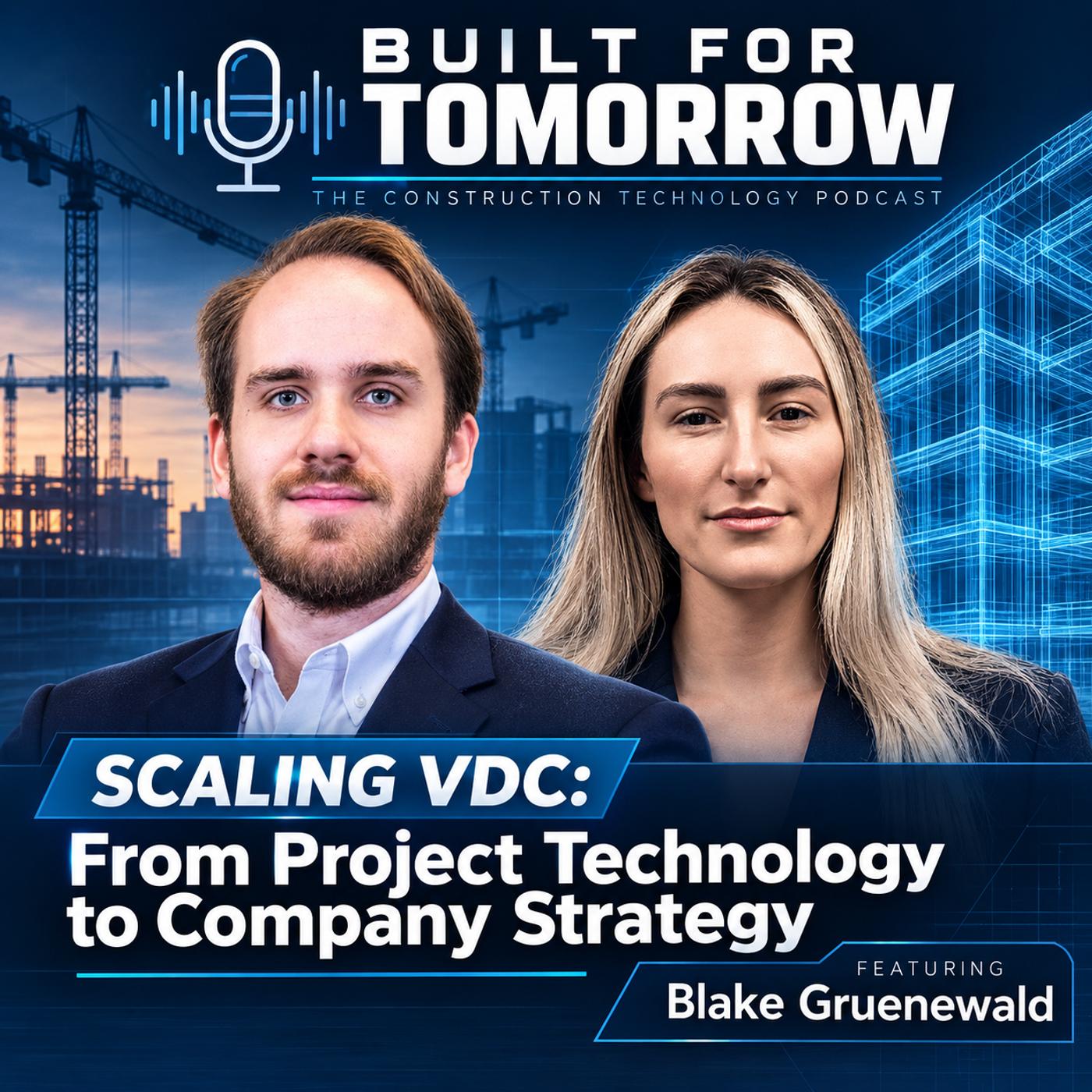
In this episode of Built For Tomorrow, we're joined by Blake Gruenewald, Director of Virtual Design & Construction at Pogue Construction, to explore how VDC is evolving from a project support function into a strategic driver of business performance.
Blake shares his journey from VDC Modeler to Director, discussing the leadership lessons, business mindset, & technology strategies that have shaped his career. We dive into scaling VDC across an organisation, measuring the ROI of BIM, implementing innovation that delivers real value, & the growing role of reality capture, drones, digital twins, & AI in construction.
Whether you're a VDC professional, BIM manager, or construction leader, this episode offers practical insights into building high-performing digital construction teams & preparing for the future of the industry.
انگلیسی
ایالات متحده آمریکا
رونوشت 🔗
جستجوی اپیزودهای گذشته
اپیزودهای قبلی Built For Tomorrow - The Construction Technology Leadership Podcast را جستجو کن.
سلب مسئولیت: پادکست و آثار هنری تعبیه شده در این صفحه متعلق به Hayley Swords است که متعلق به صاحب آن است و به Listen Notes، Inc وابسته یا تایید نشده است.
ویرایش
از کمک شما برای بروز نگهداشتن پایگاهدادههای پادکست سپاسگزاریم
