

**Kellye Richardson**:
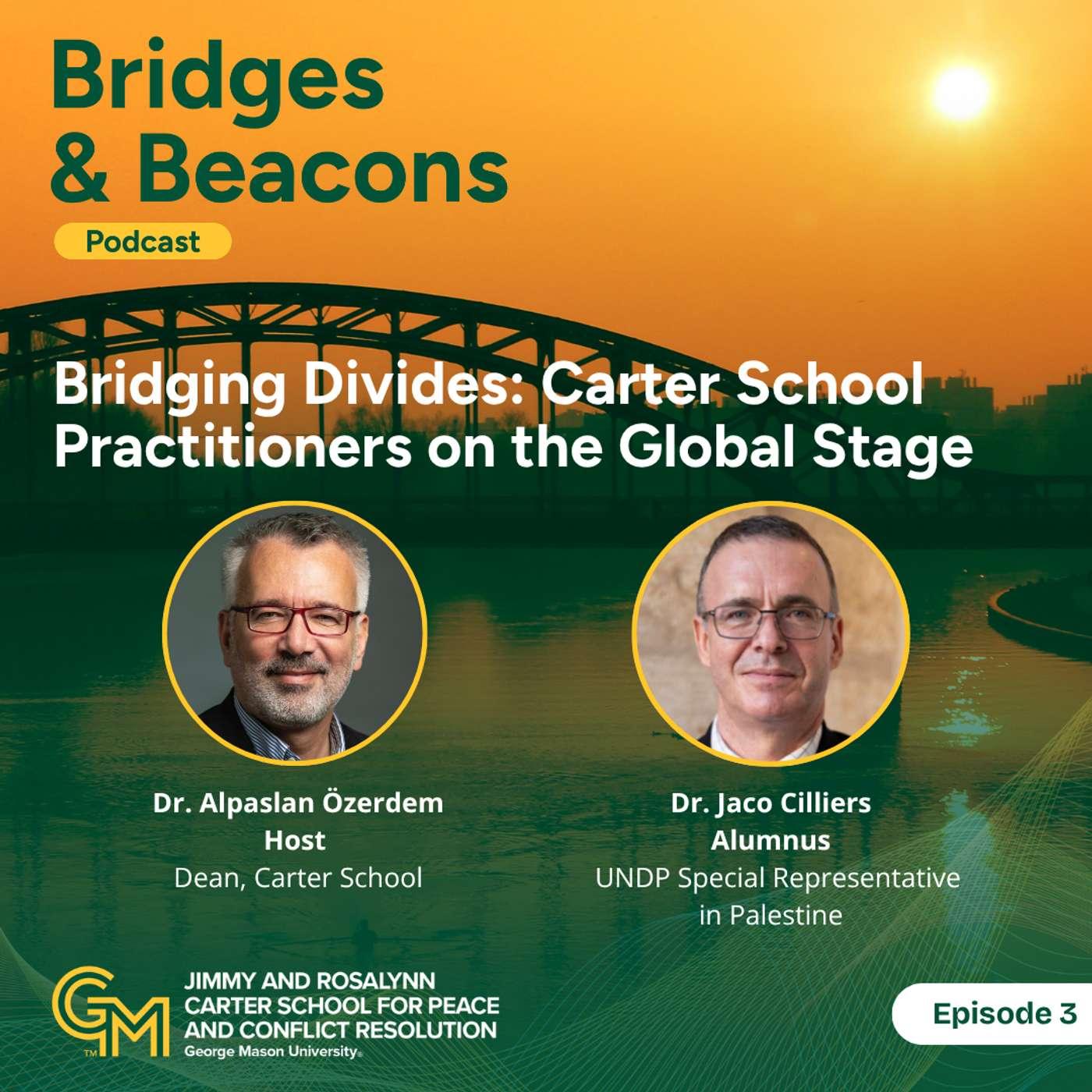
Welcome back to Bridges and Beacons. In this episode, we're exploring bridging divides: Carter School practitioners on the global stage. Joining us as a guest host is Alp Ozerdem, Dean of the Jimmy and Rosalynn Carter School and Professor of Peace and Conflict Studies. With more than 20 years of international field experience, Dr. Ozerdem has worked on conflict resolution, peacebuilding, and post-conflict reconstruction in countries including Afghanistan, El Salvador, Kosovo, Nigeria, the Philippines, Sierra Leone, and Turkey. He has advised and led research projects for organizations including the United Nations and international NGOs, and has published extensively on peace and conflict. He holds a PhD in Peace Studies and Conflict Resolution from the University of York in the UK, a Master of Science degree in Built Environment from South Bank University in London, and an honors degree in Civil Engineering from Istanbul Technical University.
Our alumni guest today is Jaco Cilliers. Dr. Cilliers brings more than 25 years of international experience in development, peacebuilding, and crisis response. Before becoming Special Representative for the UNDP Program of Assistance to the Palestinian People, he served as UNDP Resident Representative in Ukraine and Regional Manager of the UNDP Bangkok Regional Hub. He has also held senior roles in India and Cyprus and worked extensively across conflict and post-conflict settings in Africa, Asia, and Europe. Dr. Cilliers holds a PhD in recovery and peacebuilding from the Carter School and degrees from Nelson Mandela University.
Welcome, Jaco and Alp, to the show. Thank you both for joining us today.
**Dr. Jaco Cilliers**:
Great, Kellye. Thanks. It's nice for me to be here and connect with our colleagues from the Carter School.
**Dr. Alpaslan Özerdem**:
Same here, Kellye. I'm looking forward to the conversation today.
**Kellye Richardson**:
I'm excited to listen to this conversation. But first, Dean Ozerdem, before you talk with our guest about his remarkable journey from the Carter School to the United Nations, tell us why you embarked on this work and what it means to you to witness alumni emerge as influential peace practitioners and leaders on the international stage.
**Dr. Alpaslan Özerdem**:
Thank you again, Kellye. I often say that peace is one of humanity's greatest achievements, yet one of its least understood. Throughout my career as a researcher, practitioner, and now as Dean of the Carter School, I've been driven by a simple question: How can we better understand the conditions that allow societies not only to end conflict, but to build lasting peace?
That's what brought me to this field, and it's what continues to inspire me every day. In other words, Kellye, I'm interested in winning the peace. So perhaps the most rewarding part of this journey has been watching our students and alumni carry that mission into the world. There is no greater privilege than seeing them become mediators, diplomats, humanitarian leaders, and change-makers working on some of the world's most difficult challenges.
Their achievements remind us that a university's greatest impact is measured not only by the knowledge it produces, but by the people it prepares to serve others. So today's conversation is a wonderful opportunity to explore what that journey looks like in practice. Dr. Jaco Cilliers has built an extraordinary career at the intersection of diplomacy, development, and peacebuilding, working on some of the world's most complex challenges.
I'm looking forward to hearing not only about his professional path, but also about the lessons he has learned along the way, how his time at the Carter School helped shape that journey, and what advice he has for the next generation of peacebuilders. So Jaco, welcome. It's wonderful to have you back with us.
**Dr. Jaco Cilliers**:
Thank you very much. I look forward to this discussion.
**Dr. Alpaslan Özerdem**:
Let's start at the beginning. Every peacebuilder has a story about what first drew them to this field. So what inspired you to pursue a career in diplomacy, international development, and peacebuilding, and what eventually led you to the Carter School?
**Dr. Jaco Cilliers**:
Well, it's actually a very interesting journey for me. I'm from South Africa, so I lived as a young person in South Africa during the transition. I was engaged in many community efforts where we were trying to bring people together. There wasn't a lot of hope in the country; there wasn't a lot of optimism. But there were efforts underway in terms of how people can come together and what a better South Africa would look like.
So it was an exciting time, but it was a turbulent time. I recall living in conflict and living sometimes in violence and oppression as well. I was always interested as a student in understanding the dynamics of conflict and ethnic relations, and how they can be improved.
So it was very fortunate actually that two of the alumni from then—I think it was called the Center for Conflict Resolution—John Burton and Jim Laue, came to South Africa and offered a workshop and courses on conflict resolution, and I just found it fascinating. It was the early stages of conflict studies and peacebuilding programs, so I really appreciated their contributions. Then I decided to try to go to the US. Luckily, I got some funding on a Fulbright scholarship and was able to go to the Institute for Conflict Analysis and Resolution and start my graduate studies there.
**Dr. Alpaslan Özerdem**:
Wonderful. In fact, your history is, in a way, aligned with the history of our school. By the way, I love South Africa. What a fantastic country it is. Every time I go there, the buzz that you feel—whether you're in a township, in Cape Town, or Johannesburg—and the people and their vision for the future South Africa really represented a unique beacon to many nations around the world. I just wanted to share that with you.
In terms of your own experience, yes, absolutely—our school started as a center in the early 1980s, then turned into an institute, and then the institute became a school. It was only six years ago, in 2020, that we named our school after two great peacemakers, Jimmy and Rosalynn Carter. So in a way, your story is aligned with the story of the Carter School, and I'm so glad that you came to the Carter School for your education.
**Dr. Jaco Cilliers**:
Just to indicate, I met Jimmy Carter while I was working for the United Nations in Cyprus. He signed one of his books, and it was a great memory to catch up with him and share some experiences. He was a great person.
**Dr. Alpaslan Özerdem**:
Absolutely. Jimmy Carter was an amazing person, and he and his wife did so much for humanity in all different ways. All the people I've met here in the US and beyond haven't said anything different from what you just said. They had this amazing power in the way they engaged with communities affected by the challenges of development, conflict, and security, doing everything possible to generate opportunities for humanity to build more peaceful societies. So in a way, that is really the exciting thing about what we are trying to do here at the Carter School.
One of the defining features of our school is our commitment to combining rigorous academic thinking with practical engagement. I'm curious how that translated into your own experience. Looking back, are there particular courses, experiences, or faculty mentors that had a lasting influence on the way you approach conflict resolution and the work you do today?
**Dr. Jaco Cilliers**:
Yeah, it was really an interesting journey. I was always interested in the practice of conflict resolution: How does it work on the ground? How does it work at the international level, community level, industrial level, and personal level? What do we learn from that?
There was a huge number of people at the Carter School who really influenced me. My mentor and dissertation advisor eventually for my PhD was Chris Mitchell. It was lovely to meet him when I was in Washington a couple of weeks ago and see his continued involvement at the school, setting up a scholarship program or research program and giving back to the school.
I also met many inspiring people not only as teachers, but also as fellow students. Some of those I studied with—Susan Allen, Nan, Mohammed Abu-Nimer—are now in the Washington area doing incredible work in academia as well. So it wasn't only the teachers who influenced you; it was also the students and colleagues around you. We were learning from each other from diverse backgrounds, which was a wonderful feature of the school from the beginning—that it was joint learning, not only from teachers, but from colleagues who had different experiences throughout their lives in dealing with conflict.
My most interesting course at that stage at ICAR was a theory and practice course. I don't know if you still have it at the school, but it took our students in the master's program out into practical experiences. For me, I had the context of South Africa, which was obviously complex and difficult, but I hadn't experienced what communities in America went through. Our program was focused on the Mount Pleasant community where there were a lot of difficulties and racial tensions in the early 1990s. We looked at the influence of why it resulted in conflict and what interventions community leaders, churches, social groups, and NGOs implemented to calm down tensions.
That set me on a path to understanding that different countries and cultures experience conflict differently, but it exists within all of us and within all societies. That is eventually where my journey led me—trying to work in the United Nations and international development to support and help other communities, while constantly learning from a diverse set of experiences throughout the world.
**Dr. Alpaslan Özerdem**:
And that's absolutely the key, isn't it? Because personally, I believe what we do in peace and conflict studies needs to be relevant to people affected by conflict, from here in Arlington to Afghanistan. Within that, the whole learning experience needs to be informed by research, but also by practice. What you just described in terms of that rich learning environment—from your instructors and professors, but also from fellow students—is exact. We get students from different backgrounds and disciplines who bring so much, generating a vibrant environment in the classroom. I'm so glad that was a positive experience for you and prepared you for the challenges you faced in your work environment.
With that, here is my next question, Jaco. Clearly, you've worked in some extraordinarily complex environments where theory meets reality every single day. You are working on some of the world's most sensitive and challenging issues. How have the concepts, skills, and frameworks you developed here at the Carter School helped you navigate difficult diplomatic conversations, particularly in your work related to both Ukraine previously and Palestine right now?
**Dr. Jaco Cilliers**:
Yeah, it's really fascinating. Through your experiences both at George Mason University and in the field, you build up a toolbox of experiences and knowledge that helps you in different contexts, because none of the situations are identical.
As you mentioned, I was in Ukraine previously. I lived there for two years during the war. It was really a shocking experience in terms of the war, the brutality, and the situations people were going through and trying to overcome. Yesterday, I came out of Gaza. I was there for a week, and that was completely different. In Gaza, it's an extreme humanitarian situation; people are surviving. It is an acute emergency. We haven't started the reconstruction process in many ways because it's really about keeping people alive and making sure they have survival opportunities.
There, our humanitarian colleagues are dealing with basic human needs and rights, which links directly to the initial theory I was taught at George Mason around basic human needs theory and how it applies. How do you analyze survival, water, and nutrition needs? How do you deal with health and related well-being issues, and with physical stability and protection for people going through difficult situations? Those are all part of the core conflict theories we discussed and analyzed.
There's always something that comes up which I have the privilege to pull out of my "George Mason toolbox" that is relevant to how I understand the context, appreciate the efforts people are making to support communities, and work to resolve conflicts at all levels.
**Dr. Alpaslan Özerdem**:
When you talk about that George Mason toolbox, it's really fascinating. Considering a practitioner like you working for the United Nations, for a period of time you're in Ukraine dealing with a set of challenges, and now you're working on the humanitarian crisis in Gaza. In that toolbox, the key aspect isn't having ready-made answers for every scenario, but rather the analytical skills and tools to be able to respond dynamically. Could you elaborate on that aspect of learning from the Carter School and how you apply those analytical skill sets to your day-to-day work?
**Dr. Jaco Cilliers**:
Yeah. I try to break it down because we work at different levels depending on our positions, organizations, or roles. I started my international career in Bosnia right at the end of the war. There, I worked with community groups on the ground building joint community centers between different ethnic groups devastated by the war. It was about doing basic things: bringing children together for English courses or activities where they could cross the divides created during the war, and building community structures.
Later on, I was heavily involved in humanitarian efforts, but also in development initiatives—such as in Ukraine—rebuilding societies, repairing damage, and working on governance structures.
I break it down simply into three layers:
1. **Community/Interpersonal Level:** Requires tools focused on building relationships and establishing connections between people.
2. **Organizational/Institutional Level:** Focuses on development efforts, which are essential to conflict resolution. If people lack development opportunities, we aren't meeting their basic human needs.
3. **International/Political Level:** Involves high-level political efforts and mediation to bring peace to communities devastated by war.
Because I work for the United Nations, seeing what mediators do at the international level to bring peace is always an important part of the broader effort.
**Dr. Alpaslan Özerdem**:
This is fascinating stuff, Jaco. It's complex, but your ability to categorize those levels and address them reflects a classic Carter School approach to problem-solving. In fact, when you mentioned starting your career in Bosnia and Herzegovina, that's where I started my academic career—that's where I did my PhD research! I spent a lot of time in the Tuzla region, Mostar, and Sarajevo. As you were talking about those challenges, I was thinking about how much I learned there about conflict response and peacebuilding. Our journeys were linked back then too!
Coming back to your point about addressing the political complexities of these environments: We often tell our students that peacebuilding is both an aspiration and a profession. You don't get that dual nature in every field. The principles we teach matter, but so does learning how to adapt them in complex environments. Peacebuilding often requires balancing ideals with political realities.
What has surprised you most about making that transition from the classroom to international diplomacy? Have there been moments, for example, when your assumptions about peacebuilding evolved through experience? In other words, Jaco, did we prepare you well enough to face those real-world challenges?
**Dr. Jaco Cilliers**:
Yeah, it is a great learning experience. From where I sit now, you sometimes see peacebuilding efforts coming top-down through political decisions between states or institutions. Other times—and I've been privileged to work on these—there are bottom-up efforts where communities come together, drive change, and build relationships on the ground. Linking back to John Paul Lederach's theory, there are also "middle-out" opportunities, where actors have connections to both the national top level and the grass-roots bottom level. Those are the types of structures you need to create.
The reality is that peace must be built practically; it doesn't come just from talking. It is an ongoing effort that must take place at many levels. Understanding the big picture alongside the micro-level is essential to creating practical building blocks toward a peaceful settlement.
It's not an easy task, because you might think you're on the right path, and then suddenly—through a spike in violence or a political shift—you find yourself back at square one. That can be deeply frustrating. The way we build peace is not linear; it is cyclical and constantly changing. Sometimes you move forward, sometimes you stall, and sometimes you regress. But the constant effort is to push things forward to create better conditions for people.
That applies at the international level, within organizations, and even at the interpersonal level. I sometimes joke with my family when my kids or my wife challenge me and say, "What did you really get your PhD in? Was it really in conflict resolution?" Because even at the personal level with family, it's not simple or straightforward like a textbook theory. There are always unexpected dynamics. You're constantly learning, questioning things, and realizing that conflict resolution is a continuous personal and professional challenge.
**Dr. Alpaslan Özerdem**:
I agree, Jaco—practicing conflict resolution within one's own family might be the most difficult context of all!
So far we've been talking about peacebuilding as an intellectually demanding process, but let's talk about the peacebuilder, because this is also deeply personal. Peacebuilding can be emotionally demanding and involves working under intense pressure. Over the years, what have you learned about sustaining yourself in this profession? How do you maintain resilience, avoid burnout, and continue to find purpose in the work?
**Dr. Jaco Cilliers**:
This is really one of the things I've struggled with in our work, and it's something the school should emphasize: taking care of yourself when working in conflict zones.
I use two metaphors:
1. **The Airplane Metaphor:** When an emergency occurs, you must put on your own oxygen mask first before assisting others.
2. **The Vase Metaphor:** My son gave me a great metaphor recently: "You can't pour water out of a vase if there's no water in it." You have to allow yourself to refill.
In a hectic field environment, you can become so focused on helping others that you neglect self-care. I tell my colleagues working in severe crisis settings like Gaza—where staff live in tents without reliable water, sanitation, or housing, yet come to work every day committed to helping others—that if you don't care for yourself, you will burn out and become ineffective.
For me, I try to focus on things outside of work. I enjoy sports, so I make time to go running, go to the gym, or do fun activities. Having a strong family life and personal relationships provides a crucial support system. Creating those support circles has sustained me throughout my life.
**Dr. Alpaslan Özerdem**:
It's so good to hear how you've developed personal strategies to safeguard your physical, emotional, and mental well-being. This isn't just any job; it engages you deeply and exposes you day-to-day to some of the darkest aspects of conflict.
At the same time, seeing affected communities do everything possible to survive and maintain dignity is a profound source of inspiration. That mental balance allows practitioners to show up through both dark and sunny days.
I have a couple more questions for you, Jaco. Many of our students and junior practitioners aspire to careers in the United Nations, international organizations, diplomacy, and humanitarian work. Looking back on your journey, what advice would you give them about building a meaningful career dedicated to peace, justice, and conflict resolution?
**Dr. Jaco Cilliers**:
I would return to the value of practical experience at whatever level or sector you want to engage in. For me, those early field experiences living and working in Bosnia were the foundation for everything I did later. Connecting directly with communities affected by war created empathy and compassion that informed all my future high-level engagements.
My biggest advice is to build a solid, practical background first before trying to move up into senior roles. Don't focus prematurely on climbing a corporate ladder; focus on experiences that build your understanding and capabilities.
When I interview people for positions at the United Nations, that practical body of work is one of the most important things I look for. Has this person been in the field? What experiences have shaped their perspective? That hands-on foundation is invaluable.
**Dr. Alpaslan Özerdem**:
A solid education paired with experiential learning—internships, field practicums, and reflective practice—gives young professionals the skills to navigate these environments responsibly and adhere to the principle of "do no harm."
**Dr. Jaco Cilliers**:
Absolutely. My journey to the United Nations wasn't a straight line—I worked with community groups, NGOs, and academia along the way. It was a zigzag path. Being able to work in this space and support communities is a profound privilege, and the foundation I received at George Mason made that career path possible.
**Dr. Alpaslan Özerdem**:
At the Carter School, we often remind ourselves that peacebuilding is ultimately an act of hope. After everything you have experienced—from your time as a student to your leadership roles in the United Nations in Bosnia, Ukraine, and Palestine—what continues to give you hope about the future of peacebuilding?
**Dr. Jaco Cilliers**:
It's human nature and the inspiring people I've met in every part of the world who are committed to overcoming conflict. I've met so many people who give their heart and soul to improving lives at the community, organizational, and international levels. That's where I see the bright spots.
The journey starts at places like the Carter School, because the people who come here care about more than just earning a degree or building a career. They are investing in something larger.
In my career, I've rarely seen a conflict reach a completely peaceful, harmonious conclusion—even in South Africa, there are still tremendous ongoing societal challenges. But meeting incredible, dedicated people who persist despite immense hardship inspires me every day. That shared commitment ensures that we continue to have hope in our peacebuilding efforts.
**Dr. Alpaslan Özerdem**:
Jaco, thank you. It has been a real pleasure speaking with you. Your journey is an inspiring example of turning education into service. I know our students, alumni, and listeners will take away valuable career advice and a renewed sense of purpose. We are incredibly proud to count you among the Carter School family, and we wish you every success in your vital work around the world.
**Dr. Jaco Cilliers**:
Thank you, Alp. It's been a great privilege, and I really appreciate this trip down memory lane back to where I started at George Mason. Thank you for this wonderful conversation.
**Dr. Alpaslan Özerdem**:
Thank you. And of course, we thank Kellye Richardson, our wonderful host for this podcast.
**Dr. Jaco Cilliers**:
Thank you, Kellye!
**Kellye Richardson**:
It was wonderful to have you both. Whether you're applying analytical skills or drawing from a toolbox that moves from theory to practice, one thing remains true: no two peacebuilding scenarios are ever exactly alike.
From bringing children together across divides created by war to supporting development initiatives and humanitarian efforts, the Carter School continues to prepare practitioners for the local level and the international stage. If you are interested in peacebuilding, come to the Carter School and expand your toolbox.
Finally, remember the advice from our guests today: self-care matters. Make time to care for your emotional and physical well-being. Go for a run, find positive outlets, and build habits that keep you grounded as you do this important work of turning education into service.
