

درباره این اپیزود
Breaking the Silence with Dr. Gregory Williams
Suicide Awareness, Emotional Darkness, and the Courage to Ask for Help with Anthony Gurley
Dr. Gregory Williams battles a technical meltdown to welcome author Anthony Gurley, whose memoir Deadly Dilemma traces a childhood abandonment, a lifelong fear of asking for help, and the suicidal thoughts he carried quietly into old age.
Technical Difficulties and a Live Broadcast
Dr. Gregory Williams opens the program from his home studio in Houston, apologizing upfront for technical problems that have knocked out video and left the broadcast running as audio only. He notes that an unrelated program has mistakenly appeared on the station's Facebook feed and clarifies that he has no connection to its content. Williams tells listeners the show is beginning its seventh year on BBS Radio and Television, reachable by phone at 888-627-6008 or by text, and promises the episode will reach podcast platforms later in the week even if the live stream falters. He stays calm about the glitches, saying live radio simply comes with unpredictable nights, and mentions hopes that the station will soon be available on Roku. He describes the sun setting behind the Texas Medical Center outside his window, using the fading light to introduce the evening's theme of emotional darkness before his guest joins the conversation.
Understanding Emotional Darkness
Before introducing his guest, Williams spends several minutes describing the varieties of darkness people experience, from a room with the lights turned off to caves like Carlsbad Cavern where no light reaches at all, and finally an emotional darkness that can hide behind a smiling face at work or church. He lists grief, rejection, disappointment, loneliness, trauma, betrayal, fear, anxiety, shame and exhaustion as doorways into that darkness, and offers a rule he asks listeners to write down: a person cannot always keep darkness from entering, but can keep it from becoming where they live. He then walks through the first steps for staying out of emotional darkness, comparing a low-fuel warning light on his dashboard that morning to the internal warning signs of sadness, anger and anxiety, and cautioning that, unlike a car's light, these signals rarely start flashing before real danger arrives, so paying attention early matters.
Dont Believe the Darkness, Ask for Help
Williams adds two more principles before bringing on his guest: darkness has a voice that insists a person is alone, unloved and a failure, and that voice should never be trusted to make permanent conclusions from a temporary state. He warns that isolation is one of the fastest routes into emotional darkness and urges listeners to say the three words many people, especially men, resist: I need help. Using the image of two people carrying a heavy table instead of one, he argues that burdens do not get lighter alone, only more bearable when shared with a trusted friend, pastor or counselor. He then introduces Anthony Gurley, author of Deadly Dilemma: Suicide, Faith, and the Search for Identity and Purpose, describing him, in the words of his own publicity materials, as an ordinary person rather than a celebrity or athlete, someone whose book grew out of enduring failure, self-esteem struggles and disappointment rather than fame.
A Fathers Departure and a Lesson in Silence
Gurley explains that the book began as a private project meant only to introduce himself fully to his children and grandchildren, until a friend who edits professionally urged him to publish it for strangers who might recognize themselves in it, imagining a plumber in Dubuque who has never found the courage to face his own story. He recounts coming home from being cut from his school basketball team at age eleven to find his father walking out the door with a suitcase, an image tied to two remembered phrases: being told to stay out of the way because he could not see through muddy water, and being warned, don't ask me for a damn thing. Gurley says he spent his career at a small college for thirty years never once asking for a raise, a promotion or help, a pattern he now traces directly back to that day, and he credits his wife of fifty-four years, whom he proposed to after four months, as something close to providence.
Friends, Choices, and Consequences
After the commercial break, the conversation turns to a mantra Gurley developed for the college students he mentored for decades: friends, choices, consequences. He tells Williams to choose friends carefully and cultivate a small trusted circle, to make choices wisely while accepting that even wise choices sometimes go wrong, and to embrace consequences graciously since a person controls the first two but not the third. Williams connects this to his own grandfather's warning about running with dogs and catching fleas. Gurley describes founding a mentoring program called Motivation Ministry that paired Christian student athletes and artists with adult mentors after he retired from thirty years in financial aid, and recalls repeatedly pointing students toward Philippians 4:8, urging them to post the verse where they would see it each morning as a quiet influence on daily decisions. He admits he never had many close friends himself, something he now regrets, tracing it back to the same childhood instinct to stay out of the way and avoid being noticed.
Suicide Awareness and the Courage to Ask for Help
With September marking Suicide Awareness Month, Williams asks Gurley directly about the suicidal thoughts he describes in the book's unsent letter. Gurley says the thought has flitted through his mind throughout adulthood without ever becoming an attempt, and he now believes far more people share that experience than he once imagined. He describes a recurring image from the book, a snow globe admired from outside but never entered, and asks listeners whether there is a similar adventure they have envied but lacked courage to try. He recalls a high school coach telling him, at a ninetieth birthday party two Saturdays earlier, that asking for help is not weakness but strength, a reframing Gurley says he had never considered. Williams closes by naming the book, Deadly Dilemma: Suicide, Faith, and the Search for Identity and Purpose, pointing listeners to Gurley's website for crisis resources, and repeating the program's closing promise that no matter how dark life gets, there is always hope.
Suicide Awareness, Emotional Darkness, and the Courage to Ask for Help with Anthony Gurley
Dr. Gregory Williams battles a technical meltdown to welcome author Anthony Gurley, whose memoir Deadly Dilemma traces a childhood abandonment, a lifelong fear of asking for help, and the suicidal thoughts he carried quietly into old age.
Technical Difficulties and a Live Broadcast
Dr. Gregory Williams opens the program from his home studio in Houston, apologizing upfront for technical problems that have knocked out video and left the broadcast running as audio only. He notes that an unrelated program has mistakenly appeared on the station's Facebook feed and clarifies that he has no connection to its content. Williams tells listeners the show is beginning its seventh year on BBS Radio and Television, reachable by phone at 888-627-6008 or by text, and promises the episode will reach podcast platforms later in the week even if the live stream falters. He stays calm about the glitches, saying live radio simply comes with unpredictable nights, and mentions hopes that the station will soon be available on Roku. He describes the sun setting behind the Texas Medical Center outside his window, using the fading light to introduce the evening's theme of emotional darkness before his guest joins the conversation.
Understanding Emotional Darkness
Before introducing his guest, Williams spends several minutes describing the varieties of darkness people experience, from a room with the lights turned off to caves like Carlsbad Cavern where no light reaches at all, and finally an emotional darkness that can hide behind a smiling face at work or church. He lists grief, rejection, disappointment, loneliness, trauma, betrayal, fear, anxiety, shame and exhaustion as doorways into that darkness, and offers a rule he asks listeners to write down: a person cannot always keep darkness from entering, but can keep it from becoming where they live. He then walks through the first steps for staying out of emotional darkness, comparing a low-fuel warning light on his dashboard that morning to the internal warning signs of sadness, anger and anxiety, and cautioning that, unlike a car's light, these signals rarely start flashing before real danger arrives, so paying attention early matters.
Dont Believe the Darkness, Ask for Help
Williams adds two more principles before bringing on his guest: darkness has a voice that insists a person is alone, unloved and a failure, and that voice should never be trusted to make permanent conclusions from a temporary state. He warns that isolation is one of the fastest routes into emotional darkness and urges listeners to say the three words many people, especially men, resist: I need help. Using the image of two people carrying a heavy table instead of one, he argues that burdens do not get lighter alone, only more bearable when shared with a trusted friend, pastor or counselor. He then introduces Anthony Gurley, author of Deadly Dilemma: Suicide, Faith, and the Search for Identity and Purpose, describing him, in the words of his own publicity materials, as an ordinary person rather than a celebrity or athlete, someone whose book grew out of enduring failure, self-esteem struggles and disappointment rather than fame.
A Fathers Departure and a Lesson in Silence
Gurley explains that the book began as a private project meant only to introduce himself fully to his children and grandchildren, until a friend who edits professionally urged him to publish it for strangers who might recognize themselves in it, imagining a plumber in Dubuque who has never found the courage to face his own story. He recounts coming home from being cut from his school basketball team at age eleven to find his father walking out the door with a suitcase, an image tied to two remembered phrases: being told to stay out of the way because he could not see through muddy water, and being warned, don't ask me for a damn thing. Gurley says he spent his career at a small college for thirty years never once asking for a raise, a promotion or help, a pattern he now traces directly back to that day, and he credits his wife of fifty-four years, whom he proposed to after four months, as something close to providence.
Friends, Choices, and Consequences
After the commercial break, the conversation turns to a mantra Gurley developed for the college students he mentored for decades: friends, choices, consequences. He tells Williams to choose friends carefully and cultivate a small trusted circle, to make choices wisely while accepting that even wise choices sometimes go wrong, and to embrace consequences graciously since a person controls the first two but not the third. Williams connects this to his own grandfather's warning about running with dogs and catching fleas. Gurley describes founding a mentoring program called Motivation Ministry that paired Christian student athletes and artists with adult mentors after he retired from thirty years in financial aid, and recalls repeatedly pointing students toward Philippians 4:8, urging them to post the verse where they would see it each morning as a quiet influence on daily decisions. He admits he never had many close friends himself, something he now regrets, tracing it back to the same childhood instinct to stay out of the way and avoid being noticed.
Suicide Awareness and the Courage to Ask for Help
With September marking Suicide Awareness Month, Williams asks Gurley directly about the suicidal thoughts he describes in the book's unsent letter. Gurley says the thought has flitted through his mind throughout adulthood without ever becoming an attempt, and he now believes far more people share that experience than he once imagined. He describes a recurring image from the book, a snow globe admired from outside but never entered, and asks listeners whether there is a similar adventure they have envied but lacked courage to try. He recalls a high school coach telling him, at a ninetieth birthday party two Saturdays earlier, that asking for help is not weakness but strength, a reframing Gurley says he had never considered. Williams closes by naming the book, Deadly Dilemma: Suicide, Faith, and the Search for Identity and Purpose, pointing listeners to Gurley's website for crisis resources, and repeating the program's closing promise that no matter how dark life gets, there is always hope.
انگلیسی
ایالات متحده آمریکا
رونوشت 🔗
Are you the producer of this podcast?
Add a podcast transcript
Need Audio-to-Text?
Transcribe with Listen411 in Just 60 Seconds
جستجوی اپیزودهای گذشته
اپیزودهای قبلی Breaking the Silence with Dr. Gregory Williams را جستجو کن.
قسمت های دیگر در این پادکست
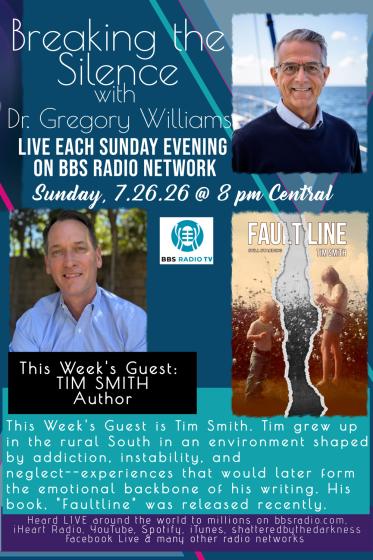
Breaking The Silence with Dr Gregory Williams
Fault Lines, Family Trauma, and the Courage to Still Stand
Dr. Gregory Williams speaks with author Tim Smith about childhood kidnapping, neglect, shame, therapy, memory, identity, and how telling the truth can turn trauma into hope, healing, and person…
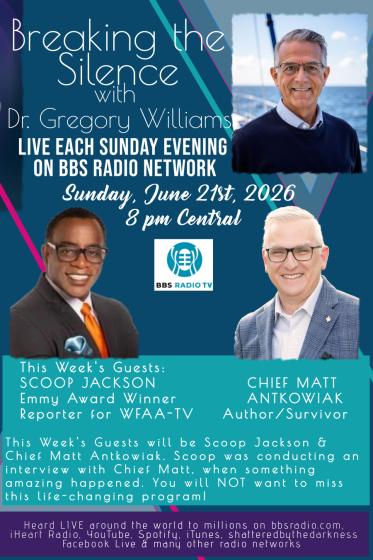
Breaking The Silence with Dr Gregory Williams
Unconquerable: Chief Matt Antkowiak on Trauma, Resilience, Faith, and Becoming a Protector
Guest, Chief Matt Antkowiak, Former Police Chief, Detective, Author and Survivor
This week's guest is Chief Matt Antkowiak, Author and Survivor
Scoop was conduc…
Breaking The Silence with Dr Gregory Williams
Outcry, Healing, and the Courage to Face What Fear Has Hidden
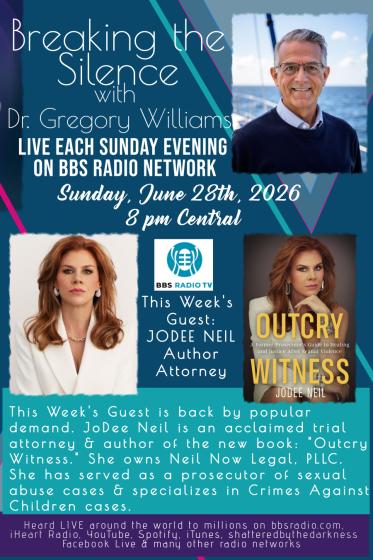
Guest, JoDee Neil, Owner of Neil Now Legal, Prosecutor, Attorney and Author of "Outcry Witness: A Former Prosecutor's Guide to Healing and Justice After Sexual Violence"
This week's guest i…
Breaking The Silence with Dr Gregory Williams
Scars, Service, and Built-to-Lead Resilience: Turning Struggle Into Strength
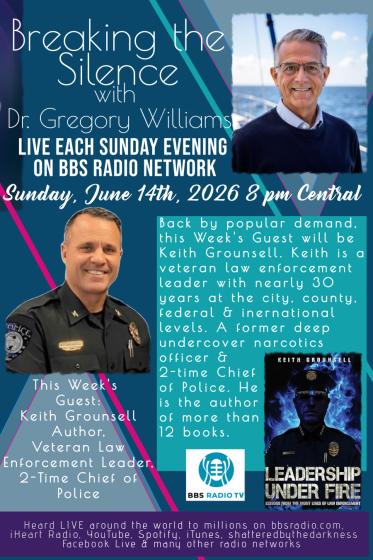
Guest, Keith Grounsell, a 28-year law enforcement veteran, two-time Chief of Police, former DEA Special Agent, international police advisor, entrepreneur, speaker, and multi-b…
Breaking The Silence with Dr Gregory Williams
Breaking Shame and Building a Mission of Healing
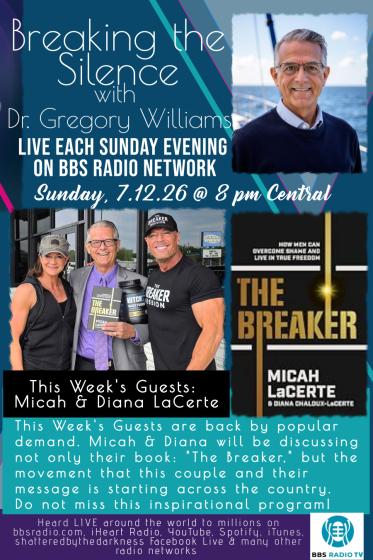
Guests, Diana and Micah LaCerte, Owners of HitchFit and Co-Authors of The Breaker
This week's guests are back by popular demand. Micah and Diana will be discussing not only their book: "The Breaker." bu…
سلب مسئولیت: پادکست و آثار هنری تعبیه شده در این صفحه متعلق به Dr Gregory Williams است که متعلق به صاحب آن است و به Listen Notes، Inc وابسته یا تایید نشده است.
ویرایش
از کمک شما برای بروز نگهداشتن پایگاهدادههای پادکست سپاسگزاریم
