


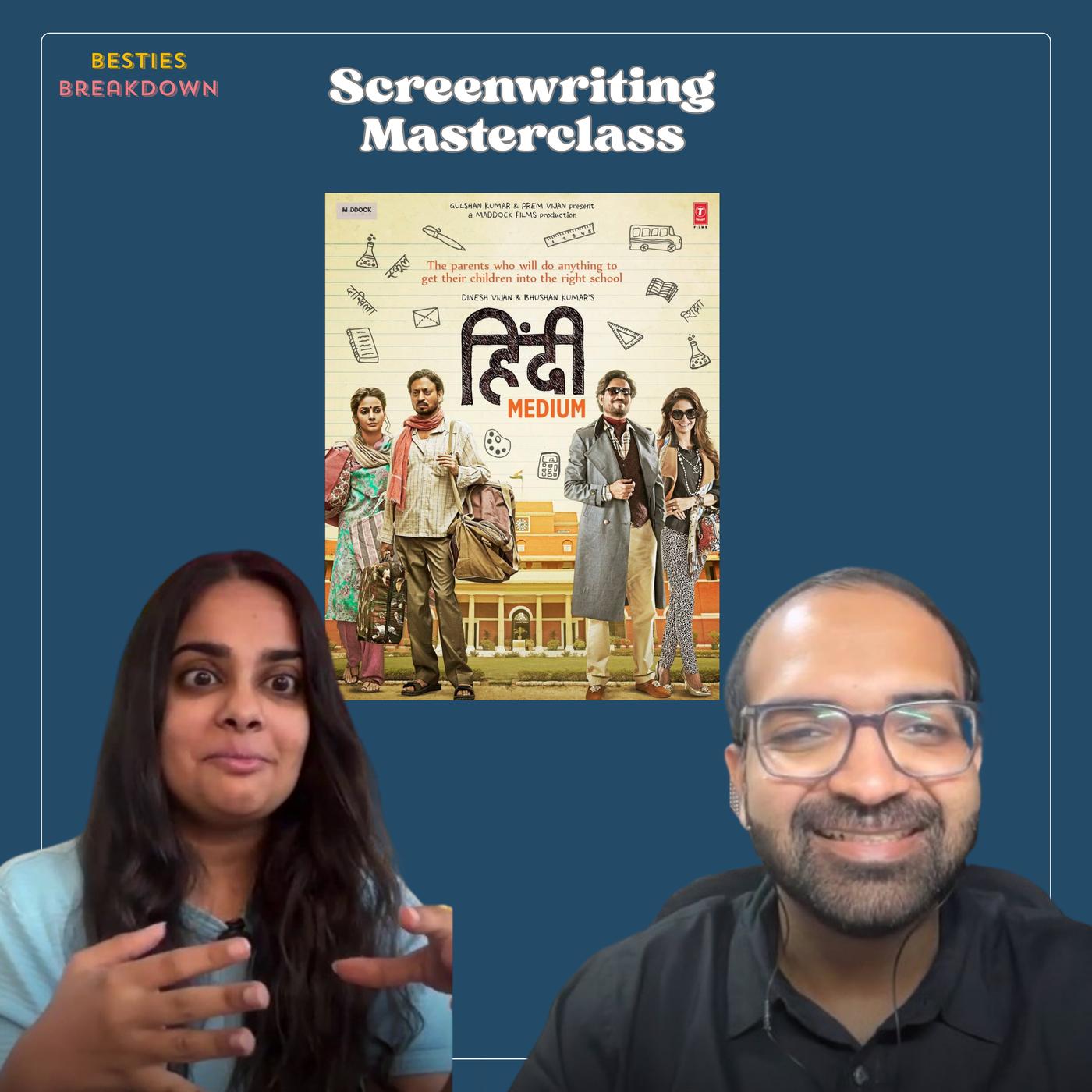
Ananya: Hello everyone and welcome to another episode of the Breakdown Besties podcast. I'm Ananya.
Akshay: I'm a chef.
Ananya: And we are your Breakdown Besties. Together we have more than 14 years of experience writing for shows like Mismatch, Wedding.com, Rana Naidu, Grahan, Ishkin Liyer, Inside Edge and a host of others that have gotten stuck in development hell but will hopefully see the light of day one day. With the Breakdown Besties podcast, our goal is to give you a film school experience where essentially we look at some of the greatest films in Bollywood, study what makes them work, break down all the techniques and then use them in our own writing to create our own phenomenal, iconic Bollywood films. And today the film that we are going to be breaking down is a 2017 fun, popcorn-y theatre film called Hindi Mediums Written by Zeenat Lakhani, Saqib Chaudhry and Amitosh Nagpal. So let's jump right in the way we always do by getting into the log line. So what is your log line? Your log line is your film's guiding light. It is the premise of your film summarized in 40 words or less, which contains the essential elements that allows you to see what your film is really about. Because you know when you're writing a sprawling script 90 pages 120 pages and you get lost in the weeds of the script and you're like I'm in the scene I'm in this dialogue but what is the point of this why am I writing this film ka mudda kya hai? That's when you get back to your log line there's a reason it's so concise it's because it's supposed to point you in a very precise pointed and accurate direction right now why does it work so well it's because it contains these four important elements right the first is your need, flaw, block, wound, whatever you want to call it. This is essentially something that is within the character, a trait, a way of being that stops them from going out and achieving element number two, which is their goal. The goal is the whole reason we're watching the film. We want to this character go on this journey to ultimately achieve something or learn something in the process of achieving or not achieving it. Then we have element number three, which is conflict. Conflict is an external manifestation of your internal need, flaw or block. For example, if you're a coward, you're constantly going to face a tiger and you are going to have to get over your fears and battle the tiger and eventually come out as someone who is brave. So your conflict is why people stay in their seats. It keeps your story moving, keeps people wondering, my God, what's going to happen next? Are they going to defeat this conflict? Are they going to overcome this obstacle? Will they overcome this challenge? And that is your story engine. And finally, you have stakes. Stakes are what your character will lose should they not achieve their goal. It is not them simply not achieving their goal. It is them going one level lower than that. Now, I'll read out to you my logline of Hindi medium. When a novoreish couple wants their daughter admitted to a private school, they must overcome the classist admission process, lest their child fall behind in life.
Akshay: Yeah, sounds right. Yeah.
Ananya: Right? So you have your four elements here, which is first your block or limitation in this case, which is the fact that they are no boorish. So they don't come from like old money, which would open every door for them because of the way they are. And now there's like super poor for people to actually take pity on them and be like, are you enter here? So they are
Akshay: Hmm. Yeah.
Ananya: really in that middle, which is their limitation, whether they're now here or there. And that is the block or limitation.
Akshay: Yeah, I mean, they're like newly wealthy. So like they own like a big
Ananya: Exactly.
Akshay: design studio in Chandni Chowk. But it's
Ananya: Yeah.
Akshay: not what the old Manikyur would call his class. So they're not like
Ananya: Class. Exactly.
Akshay: fluent in English or they just don't have that etiquette sort of thing,
Ananya: Mm-hmm.
Akshay: which would like give them the open the doors for them for these admissions in these schools. Yeah.
Ananya: Exactly, exactly. Then we have their goal, is want their daughter admitted into a private school. Simple. Then we have the conflict, which is overcome the classist admission process, which is while because they belong to a class which is frowned upon, which is neither
Akshay: Yeah.
Ananya: here nor there, they have this classist process where they don't fit into anything. So every time they try, they are coming into obstacles.
Akshay: Yeah.
Ananya: So that is your conflict, one thing after the other. And finally,
Akshay: I'd also written one more thing in conflict was that the whole process is very competitive. So it's not like there
Ananya: Mmm.
Akshay: is a lot of like room anyway for her daughter to come here. So it's because
Ananya: Mm-hmm. Yeah, yeah.
Akshay: the whole system is so competitive. Like one of the things her,
Ananya: Hmm.
Akshay: the consultant says that the parents booked me in their first trimester when they were pregnant, you know? So yeah, go on.
Ananya: Yeah, yeah, yeah. Yeah, and then you have stakes which is the child will fall behind in life.
Akshay: Yeah. Yeah.
Ananya: Great. Okay. That is your log line. Next,
Akshay: Hmm.
Ananya: let's go into your hero's journey. What
Akshay: Let's do it.
Ananya: is your hero's journey? Your hero's journey is your film's structural spine. It is a journey that every character, every human being goes on when they're embarking on something new. We all have goals which we haven't achieved in our lifetimes mostly because something within us isn't geared towards achieving that goal. And when we really put our heads to it and say, okay, we are going to achieve this goal. It's not so much about achieving the goal, but it's about becoming the person who can achieve that goal. So it's only by overcoming your need that you're able to do that. So the hero's journey is a journey in becoming this person. And in becoming someone new, in having this identity shift, we all have natural turning points. There are times when we think we can't do it, there are certain challenges and obstacles we encounter, there are moments when we fall flat and think that this is the end of us, there are people who come to help us. These are all natural turning points in our journey, and these are streamlined into the hero's journey for storytelling purpose within the structural spine of our film. So let's
Akshay: Right.
Ananya: start with your hero's journey over here. And I believe this film has two distinct hero's journeys, much like we discussed in Barfi. So
Akshay: Mmm.
Ananya: in Barfi also, we had one hero's journey with Ileana de Cruz's character and then we have another hero's journey with Priyanka Chopra's character.
Akshay: show press.
Ananya: Right? Where we feel like the film almost restarts. And
Akshay: Hmm.
Ananya: I feel something very similar in Hindi medium. And I think the key word is feel. Because
Akshay: Hmm.
Ananya: these things are to be felt more than
Akshay: Hmm.
Ananya: they are meant to be structured out and beaten out on paper.
Akshay: Yeah.
Ananya: Because and the reason I say this is because your film is an emotional experience.
Akshay: Hmm.
Ananya: So you have to constantly be feeling it at a certain level. And
Akshay: Right.
Ananya: in a film, your graph is, of course it's like this, but even while it's like this, it's going up. But what happens here in Hindi medium is it goes up, it stays here, and it goes like this on a different trajectory almost. And then these two kind of meet.
Akshay: Yeah,
Ananya: So it feels like... two separate journeys are being undergone and honestly if the writers really wanted to explore the two different worlds in which this film is set, set in the world of the rich and then in the world of like the extreme poor, they could have made two separate films. It's
Akshay: Yeah. Yeah.
Ananya: combined into one so it almost feels like two different heroes journeys and then
Akshay: Hmm.
Ananya: they intersect into one.
Akshay: Hmm. I hear you.
Ananya: Hmm.
Akshay: I didn't do that exercise. What you saying was bang on. Like, it did feel like two different films, tonally also, and at the same time, like, in
Ananya: Hmm.
Akshay: terms of the world and in terms of, the plotting also.
Ananya: Hmm.
Akshay: But let's finish yours and maybe I'll summarize it like what I felt it. Yeah.
Ananya: Cool, cool. So let's start with the first part of first hero's journey. So first you have the ordinary world. This is the world in which your characters exist before they go out to achieve their goal. You see the when, where, what, why, and how of their circumstances. And you understand what is the flaw holding them back. Over here, we see that Irfan Khan's character is a... owns a boutique, a first copy sort of boutique of bridal wear. They have made a lot of money doing this. They're well off. But of course they're Chandni Chowk people and you can take a man out of Chandni Chowk. You can't take Chandni Chowk out of a man. Then you have the call to action. The call to action is when his wife tells him that we have to go and get our daughter in one of the best schools in Delhi otherwise she'll fall behind in life. They go on a school tour. She shows him all the different schools. This call to action is essentially when you are called and said come come it's let's go and achieve your goal. Right? Then you have the refusal of the call where either you or someone outside of you says listen no this is not a worthy goal or you cannot pursue it, it's not within your abilities to pursue it. And over here Irfan himself says that, bro, like, do we really need to do this? Like, look at us, we're well to do and we went to government school. So, and
Akshay: Yeah. Yeah. Yeah.
Ananya: the wife is just like, no, no, we have to do this for our daughter. Like
Akshay: Yeah
Ananya: she can't fall behind in life. Then you have meeting the mentor. A mentor is someone you meet who has been on the journey that you're going to go on and says that, okay, let me show you the way. If your goal is slaying the dragon, let me hand you the sword. I don't think we really have a mentor in this section of the film.
Akshay: In the way I tracked this, I thought that the consultant's character, Tilotma Shom's character becomes the mentor for me because she's
Ananya: Hmm.
Akshay: the one who tells them the ropes of this, you know, this is who your kids will be competing with, this is what it is. Like she lays down the whole trajectory for them and by
Ananya: Yeah.
Akshay: the end of that sequence, they are also convinced that okay, yes, like at least Esfahan's character is convinced that we
Ananya: Hmm.
Akshay: need to do this for our daughter. you know, so that's what I felt.
Ananya: Yeah. Hmm. I did write that down. Like I fluctuated, I vacillated between the two. But then
Akshay: Yeah.
Ananya: because I was going into two different heroes journeys then, I said
Akshay: Yeah. Yeah.
Ananya: that that doesn't apply because that essentially becomes a test allies and enemies. Like she is an ally of that world. And I felt
Akshay: Sure. Yeah. Sure.
Ananya: like to step into this new world of the rich, which is when they buy the house, there was no mentor there.
Akshay: Yeah. Yeah. Yeah. Yeah. Fair.
Ananya: Because yeah, there's no one saying let me help you out.
Akshay: Hmm. Hmm. Hmm.
Ananya: So then they cross the threshold. The threshold is where you go into your new world and you say that okay, I am taking an action which can't be reversed. I'm really setting out on this journey to achieve my goal. And that is them essentially buying the new house in Vasanth Vihar so that they don't have to be in Chandni Chowk. They can be amongst the who's who. and go to the school which is close by because the school also only gives admission to people who live in the 3 km radius. Then you have your test allies and enemies. This is the phase of your hero's journey where once you've entered the new world you see what challenges you're going to face, who your friends are, who your enemies are going to be. And over here you have Telotama Shomei's character who is an ally in a mentor trope for sure, she assumes the trope of a mentor.
Akshay: Yeah. Yeah.
Ananya: Then you have the neighbors who are all their enemies, who don't accept them. And you have the various challenges of getting into a private school.
Akshay: Yeah, like they have issues like they can't write the application properly so she gets them a writer. They have to style
Ananya: Hmm.
Akshay: themselves differently. The mock interview. They come across
Ananya: Yeah.
Akshay: this serious type principle of Amrita Singh's character. I think like just realizing the whole admission process is such a big drill in itself. Yeah.
Ananya: Exactly, exactly. So those are the tests and challenges of the phase and
Akshay: Yeah.
Ananya: all these allies and enemies they meet along the way. And finally, despite doing all of this, they don't get into the school. And then finally, they have an underhanded process, which is where someone says that, okay, you want admission, do it through RTE and I will get your documents passed. A Sardarji character comes in and says, I'll help you out. So that is your approach to the innermost cave. Where the approach to the innermost cave is your face, where if your goal is to slay the dragon and to get the bag of gold from under them, then this is when you approach their cave and you take on the dragon and you fight for your bag of gold. So now he's fighting for his bag of gold by going through this whole process of bribery, of fake documents, going under the table and making sure it gets done. Now you think it's almost done, it is sorted, gotten it when the ordeal kicks in. Now what is your ordeal? You've gotten your bag of gold but the dragon is chasing and flying after you and you have to protect yourself from your bag of gold, from the dragon. So this is when an investigation kicks off. They say that a lot of rich people are abusing the RTE quota, the right to education, which is reserved for the poor so that they can circumvent the competitive admissions process. And now the school, Delhi Grammar School, is going to launch an investigation against this. Right? Great. So this is my first hero's journey. And now we go into the second hero's journey. And the reason I say this is now they go into the world of the poor. The call to action now comes when this Sardarji character says that, you know, I can get you a room in this chawl. You can actually fake being poor so that when they investigate you, you are clean. Nothing happens. That is the call to action. The hesitation that Irfan has is his refusal to the call that should we do this, should we not do this. And then they finally decide to do this. They're like, we are going. And
Akshay: Yeah.
Ananya: they tell everyone in the new neighborhood that we are going to Europe for a month.
Akshay: Yeah.
Ananya: I found that sequence so funny where they actually went to a studio and took photos to put on Facebook. That was 10 on 10.
Akshay: Yeah, yeah, yeah, a lot of these things felt very funny in the moment. Yeah.
Ananya: Yeah, yeah, for sure. And then they go into, they cross the threshold into the new world, which is when they go into the new world and there is proper gharibi there. They get into their chawl, they're fighting with rats, people are like, who are you, etc. Then you have test allies and enemies there, where you see that people are suspicious of them or they don't want to help them. Then they have their friend Shyam Prakash who comes in and wants to help them. And side note, but the reason this also felt like a second hero journey is they had such an important character that Shyam Prakash, who's a
Akshay: Yeah. Yeah!
Ananya: fellow Garib, an actual Garib, who acts as
Akshay: Yeah.
Ananya: a foil to essentially Irfan and Meeta's character,
Akshay: Yeah.
Ananya: which is where he's an actual, what trauma or what difficulties an actual like poor person goes through.
Akshay: Yeah.
Ananya: So he's so important and he comes in only in the second half of the film. It really felt like a whole different story starting there.
Akshay: Yeah, yeah
Ananya: So you see all the poor people, how they understand the world of the poor. You have the member of the school who's checking now for the RTE come and ensure that these people are actually poor. In this case, they are almost caught for not being poor because the daughter Pia is eating dominoes etc. But then Shyam Prakash, who is the friend, comes in and says that, they must be newly poor. So earlier when they were newly rich, now they're newly poor, they're all facing the same problem. They don't know how to be rich, they don't know how to be poor. And then you have the approach to the innermost cave where finally it's the final inspection of whether they qualify for RTE or not. And they do qualify for RTE and they say, okay, great. Now you can admit your kid. There is a lottery for it. And in the lottery, Pia, that is Irfan Khan's daughter gets the admission. But the actual poor person who is the foil doesn't get the admission in the lottery. But he's like, know, never mind. We'll still, it's fine. It's okay. Then you have Irfan and Meeta moving
Akshay: Me too.
Ananya: out of the chawl under the guise that they've gotten another job which is closer to the school. And in doing all of this, they also feel a bout of guilt for their privilege and for taking advantage of Shyam Prakash, actually, whose son actually deserved the RTC. So they go fund a public school and Shyam Prakash's son studies in that school. Shyam Prakash is extremely grateful that they funded this. So he tries to find out who has funded this because they fund it anonymously. And then he comes to say thank you to Irfan. He doesn't know who the person is and it ends up being Irfan. And this is where your ordeal begins because he learns that Irfan is actually rich and he is the one. who took advantage of the RTE to get his daughter admitted in the school. And Irfan is like, look, I did what I had to do for my daughter. And now this Shyam Prakash is like, I will do what I need to do for my son. And this is when the two tracks converge, the two heroes journey converge. So now, Shyam, now that Pia is in this school, the ordeal over here is that Shyam Prakash is going to out them. But In going to out them, he meets Pia and Pia is a child. She just sees her Shambhu uncle from the chawl and she's really happy to see him and Shyam Prakash has a moment of reckoning with himself and he's like, no, this is not a child's fault and I am not going to get her kicked out of school and this is your
Akshay: Mmm.
Ananya: reward. Your reward is when you finally get your moment with your bag of gold, you have secured it. and Piyar gets to retain her admission. Now we have the way back, where you're going back to your old world but you still have demons to fight along your way. You've still not made it back home. Irfan has had a reckoning with his conscience and he's like, this is wrong. We can't go ahead with this. So he goes to the principal and he's like, look, I want to out myself. I committed a fraud. And the principal is like, okay, just move this file from the general category, from the RT category to the general category. And he's like, dude, what are you saying? know, like I've done something so wrong and she's like, yeah, whatever. You know, this is how the system kind of works. And he's like, no, I'm going to complain about you. Then she's like, who? The politicians, the police, like all of their kids study here. No one is going to actually admit that this shit happens. And that is when Irfan is at his lowest. Then you have the resurrection. Your resurrection is when your character is at their lowest. but they finally rise from the ashes and to say that you know what I am going to fight this no matter what I am going to fix this problem I going to go back with my bag of gold. This is when you have an annual day performance and at this performance you see all the kids performing and it's a great one there's dancing, music, instruments all of that only for Irfan to later reveal that it is not it wasn't the kids of this Delhi Grammar School but of the government school who were performing and they are as worthy, as good as everyone else. And he gives a big speech on inequality, fraud, blah, blah. Obviously no one supports him, which is the most realistic part of the film. But his wife, who all along has been pandering to the standards of this classist society, finally stands by her husband and says that, okay, no, I am with you. And the two of them leave and they withdraw Pia from school. And then you have your return with the elixir. Your elixir is... Your return with the elixir is when you finally go back into the old world but now you're a new person. And over here the person actually returning as a new person is Meeta, Irfan's wife's character, who was earlier super helicopter mom, wants the best for her daughter and what she believes is the best is like a higher class society. And now they decide to put their kid in the public school which they themselves have funded. and they say that we don't need all these classes and we have changed.
Akshay: Yeah. Yeah. I get what you're saying. Like, yeah, that like these two journeys definitely make sense. I just, for me, the whole sequence of the second half where they go to Bharat Nagar and the the drill behind it, like that should have been actually the entire second act of the movie. You know, they did the whole
Ananya: Yeah. Yeah.
Akshay: first half was so much set up for. just to have nothing, you know, like it could
Ananya: Nothing. Yeah.
Akshay: have been done in a more economical way. Like
Ananya: Hmm, very, very.
Akshay: it's too large of a chunk.
Ananya: Exactly. And the thing is, at least in the first half when you have Tilotama Shome's character, the mentorship that's happening, it's in relation to the school. You know,
Akshay: Yeah.
Ananya: it's in relation to the admissions process. But when they're being, they're learning how to be poor in the second half of the film, it is quite
Akshay: Yeah. Yeah.
Ananya: removed from the admissions process. It is like they're learning
Akshay: Yeah, exactly.
Ananya: how to be poor in general and that will affect the admissions process, but it
Akshay: Yeah. Yeah.
Ananya: has nothing to do directly with it.
Akshay: Yeah.
Ananya: In fact, they should have created a contrast in terms of what sort of interview is done for the poor, what sort
Akshay: Yeah.
Ananya: of mentoring they need there in terms of coming across as poor to the school. Not like,
Akshay: date.
Ananya: okay, there'll be one like interview, one where they just check your documents and check your hands and okay, your hands are dirty and
Akshay: Yeah, yeah.
Ananya: so you're poor. So that's what I think really took me out of the film.
Akshay: Yeah, and also like, it just became a film about everything. You know, they could have really like done
Ananya: Everything, yeah.
Akshay: like more amount of, think, on ground research maybe, where to
Ananya: Hmm.
Akshay: feel like, what is the tenet of education system that
Ananya: Yeah.
Akshay: that strata has to go through? You know, like what we
Ananya: true. Exactly. Yeah.
Akshay: spoke about in the government funded school, like that came at such an afterthought, right?
Ananya: Hmm.
Akshay: So again, logical loopholes, cinema logic.
Ananya: Yes, writing a film is hard. Writing a film is.
Akshay: Yeah, especially a film like this, right? Like it's even harder because you're trying to tackle on ground reality, but as well as give it the lens of cinema. And that's very challenging.
Ananya: Hmm.
Akshay: So hats off for the attempt. I would say I'm like, obviously
Ananya: Yeah.
Akshay: like, pray, but like they succeeded in the attempt because the film is a commercial success.
Ananya: Yeah.
Akshay: And but yeah, it's challenging. Like you said, it's very hard to do that. Yeah.
Ananya: for sure. Great. Let's go into theme next. What is your theme? As an artist, you always have a perspective on the world. You have opinions, you believe the world needs to function a certain way and you want to voice those opinions. That's why you have become an artist. In your film, that is your theme. It is what you want to say about the world through the vehicle of this medium that you have chosen. In films, your theme is usually phrased as a dramatic question. It's a question you ask to your audience and by the way your character behaves, whether they win or lose, you determine what your way of living in the world of your film is, which is your perspective as a filmmaker and as an artist. Now, what does this actually look like? Well, in this film, the theme that I have is Does your social class determine how far you will get in life?
Akshay: Hmm, okay, yeah.
Ananya: And I believe like obviously for the girl, the little daughter's character, that is what they're saying, right? That we need to help her move up. There needs to be social mobility of class here. So because if she moves up, she speaks English, she has certain mannerisms, she will be able to succeed in life. But you also see Irfan and his wife's character being from a certain class and having to navigate. which class they're in and the troubles of being in the middle so that they are able to get this daughter, their daughter the life they want. So this is functioning at two levels for the goals that they have for the daughter as well as for what they are navigating within themselves, right? And throughout it's either you have to be like really rich and really upper class, old money to be able to break into this or you have to be really poor to be able to break into this.
Akshay: Hmm.
Ananya: There is no middle ground. Like for people in the middle, there is nothing. Right? But then, the thematic answer that the film gives at the end is that no class barriers have to be broken. That is what they're saying. does your social class determine how far you'll get in life is the question. But the answer is that social class needs to be broken. Because
Akshay: Hmm.
Ananya: They are still above the government school social class, right? They're not that level of poor socioeconomically. And they still say that, we will put our daughter in this school and we know that she will progress because we will help fund that. So it's almost making a socialist statement. It's going from kind of like this capitalist ideal to a more socialist ideal where they're saying if public resources are funded to break the class system, then everyone will be at the same level. So
Akshay: Hmm.
Ananya: that is, I believe, a very noble thematic choice, which the filmmakers have taken, which is obviously more true to films than it is to real life, because nobody would actually send their kid to a government school, they would want them to progress. But I think this was beautiful commentary. And it was a good thought. And this is
Akshay: Yeah
Ananya: kind of why we also have films, right? So that people
Akshay: Yeah.
Ananya: can take actions that we wouldn't in real life.
Akshay: Yeah.
Ananya: that we at least feel a sense of betterment of society.
Akshay: Yeah, and there was a very nice scene based on a theme you just suggested that when his friend comes to their house and figures out that he is the owner and he says, you know why the rich don't want poor to succeed because who will do your dirty work? So,
Ananya: Yeah. Yeah.
Akshay: so like you don't essentially want the class system to be broken because it doesn't benefit you.
Ananya: broken. Exactly. Exactly. Yes.
Akshay: Yeah. I had another thematic question which I had written for the film
Ananya: Hmm.
Akshay: which was that to what extent one can go to fit in the standard the society has set for them. So
Ananya: Hmm.
Akshay: my breakdown of this is that Irfan's character is put through the ringer at every level to fit in the world that his wife is
Ananya: you
Akshay: claiming to be them in. Right? So
Ananya: Hmm.
Akshay: she's like, oh, we need to do this, we need to do that, we need to... But where is this need coming from? It's the expectation that society has put on her, right? Like you need
Ananya: Mmm.
Akshay: to live here, you need to be this kind of a person, you need to have these kind of... clothes you need to have this kind of a vacation whatever is that you know
Ananya: Hmm.
Akshay: and he answers that in the end by saying that one two things not just him it's actually both of them which is that first he realizes that I need to be just a better human more than any of this so like
Ananya: Yeah. Yeah.
Akshay: I set my own needs essentially that
Ananya: Hmm.
Akshay: this is what is important to me whether or not society expects me to do this or not
Ananya: Yeah.
Akshay: And again, like she also says that I'm going to put my daughter into the government school because now I'm not going to follow society's expectation. Like nobody would expect me to do that, but I will pave my own way now. So I thought
Ananya: Hmm. Hmm. Yeah.
Akshay: that was the theme I took from the movie.
Ananya: Yeah, and they're very similar because society and class are the same thing essentially. Yeah, yeah.
Akshay: Yeah, they're very similar. essentially the same. Yeah, yeah, yeah. Correct. Yeah.
Ananya: Cool, let's go break down the scenes next. The first scene I want to talk about is actually kind of like the cold open of the film which is where they introduce Irfan's character as a much younger boy and how he meets Meeta's character and they fall in love. Now it's not really essential to the film but it's a nice warm opening to the film, right? And even over there what I really like is the push and pull as a technique. because you know that this is a quick sequence, it's a cold open and Raj and Meeta are going to come together at the end of this. But still, it's not like an immediate coming together. Even in that two minute sequence which is scored, which has sung, they still have you going up and down. For example, you establish Meeta's character right off the bat that she wants a deep back ka thing made and she comes to the tailor shop where Raj is an assistant or his dad's tailor shop, whatever it is. And everyone is just like, no, no, no, but Raj is like, you know, no, no, what? I'll help you. You know, I'll do what you want. And Meeta is really grateful. He promises to solve the problem. You think that, okay, done. Like now they are good to go, know, solid. He's helped her out. But you still have the sequence where he's pining over her, all of that, but she's not paying him any heed. So
Akshay: Hmm.
Ananya: finally you have a push initially. They've pulled it back here.
Akshay: Hmm. Hmm.
Ananya: So you've created conflict. Then when it's raining, he helps her out. He leaves an umbrella strategically so that she can use it. And then finally, he fulfills his firm promise and creates the deep back walla dress for her. So then there is a push again. So even in this much, you've created conflict, which is to say that your film really can't function without conflict. And I know earlier on, I have said that, you know, you have montage sequences where you have music and song. because it is usually devoid of conflict.
Akshay: Huh.
Ananya: But even then you have these micro moments of conflict. You'll have
Akshay: Yeah.
Ananya: someone like che doing in a playful way, a little
Akshay: Yeah. Yeah.
Ananya: bit of banter. So there has to be that push and pull otherwise as humans we don't believe too much happiness. We don't believe
Akshay: Yeah.
Ananya: that that's a way of functioning.
Akshay: Yeah. And again, like it sets up who they are as characters. Only this cold open does that, right? Like
Ananya: Yeah.
Akshay: she wants this backless kind of a dress for her, like which society doesn't want or which like the world is telling her that
Ananya: Hmm.
Akshay: this is not up to your class. You you shouldn't wear these things. And he is the
Ananya: Yeah.
Akshay: one. And throughout the film, we'll see Irfan doing this just for his wife, right? Like.
Ananya: just for his wife yeah yeah
Akshay: That's the character he has so I think like even though like you said it's not essential but it's a good foundation to set you know that
Ananya: Hmm... Yeah.
Akshay: So when he also takes a big step in the end and goes against her That's his first time in his life. He's doing that essentially Yeah Yeah, yeah Yeah
Ananya: Yeah, really. You believe that. As an audience, you're like, wow. Which also goes to speak about range, right? Because as we've spoken about before, films really function on range. So if you want something to land impactfully, like if you want a sad moment to land, you need people to be so, so, so happy before that, that you can't imagine the sad moment happening.
Akshay: Yeah.
Ananya: but then the sad moment is logical enough for it to happen and for it to make sense within the world and frame of your film. Similarly here Irfan is really whipped throughout the film. You can see that he does everything for his wife but at the end he has to make a choice between doing it for his wife or being a good human being and there he's like even though he has been whipped he decides to do the bigger thing. So but that
Akshay: Mmm.
Ananya: only lands because we have set up the fact that he only does what his wife wants. So when he doesn't there is impact. There is contrast in range.
Akshay: Yeah.
Ananya: And that also takes us to another technique which is your moral choice.
Akshay: Mmm.
Ananya: A moral choice is doing choosing between what is easy and what is right and that sets up your character. It tells you who they are and what is the moral compass with which they are functioning. Over here we have two characters making a moral choice. First you have Shyam Prakash. who is the actual poor man. Now he has found out that Irfan is actually rich and he can out them to the principal. That is kind of doing what's easy but also kind of doing what's right for himself. Like you wouldn't hate him if he does that. But then he meets Pia, the little girl and he realises that he'll be taking her future away from her and she is blameless in the whole thing. So
Akshay: Yeah.
Ananya: to leave her out of it and for her to have the future she deserves would be doing what is right. So he has to essentially pick between what is easy for himself and what is right for another person. And he chooses to do what is right for another person.
Akshay: Huh.
Ananya: And similarly Irfan is now another conundrum. Where should I do what is easy which is retain the submission, give my wife what she wants, have it all my way or do what is right and fight the system, fight the corruption, fight the fraud. And he decides to do what is right. And this is when we see our characters actually take a stand. This is a defining moment either from the arc standpoint or it is just from a definition standpoint. In
Akshay: Hmm.
Ananya: Irfan's case, it is from an arc standpoint because initially he has no problem doing these immoral grey area sort of things.
Akshay: Yeah.
Ananya: But now he has given a choice again. You know, like, do you want to do this or do you not? And he's like, no, I don't want to do this. So this choice helps you show that a character has also
Akshay: Yeah, I want to talk about the technique of escalation. Okay.
Ananya: Hmm.
Akshay: How can you keep pushing your characters up against the wall in a higher degree? How can you keep making things for them harder and harder in a sequence so that the mudda of the scene comes out in a more sharpened way and a more heightened way?
Ananya: Mm-hmm.
Akshay: The sequence that I'm going to talk about also employs another technique. which is the rule of three. They have tried to escalate something three times. and what that's the rule of three, right? Like to establish a pattern, you do something three times so that the audiences gets the same hit of the emotion as well as they realize that this is what needs to be told to us at this time.
Ananya: Mmm.
Akshay: The sequence I want to talk about is the party sequence. The housewarming party which they throw. once they have moved into this new house in Vasanthihar and they call all their elite neighbours. Now, the point which needs to be made across is that Irfan's character just doesn't fit here and this is going to be a much harder thing for them to do than just signing up and buying a new house. So, the first thing which happens is that a starter tray is being passed around and he takes a bite of something and he realises that this is caviar and he's like What is this? I don't want this. Go get Vada pav. You know, I don't want all this. So we realize,
Ananya: Yeah. Yeah. Yeah.
Akshay: he's not going to be OK with this move immediately. And this was embarrassing
Ananya: Mm-hmm.
Akshay: for the wife because she has essentially planned this whole thing.
Ananya: Hmm.
Akshay: The second thing which happens in this scene, which escalated further, is when guests have come in, which is Neha Dupia's character and Sanjay Suri's character, which
Ananya: Hmm.
Akshay: is that there is couple who was around the neighbourhood and he asks them what would you like to drink? You know? And she's like, well, I have a mojito and he's like, I don't know what that is.
Ananya: Yeah.
Akshay: So he doesn't, so again, like, you know, very close to like him not fitting in. And even when he asks
Ananya: Hmm.
Akshay: Sanjay's character like, make I'll it for you. And that's not the social etiquette there that is
Ananya: Mmm. Yeah.
Akshay: acceptable there. Again, which embarrasses
Ananya: Mm-hmm.
Akshay: the wife again. Now the third thing which happens is that Tare Gingen starts playing on the
Ananya: Huh.
Akshay: system, right? Again, not the most different choice for a song in a setting like this.
Ananya: Yeah.
Akshay: And the daughter is very excited and Irfan goes full guns blazing. Like he takes off
Ananya: Mmm.
Akshay: his jacket, dances with the daughter, all the kids become like his friends there. And it's a very embarrassing moment for the wife that she
Ananya: Hmm.
Akshay: goes and diffuses the light there.
Ananya: Yeah.
Akshay: This is the escalation I was talking about. It couldn't have happened with just one beat.
Ananya: Mm-hmm.
Akshay: They had to face embarrassment on multiple levels so that the
Ananya: of this.
Akshay: wife could have taken this action to stop the party almost.
Ananya: Not bad. Yeah. Absolutely.
Akshay: And again, they try to repeat this technique a little bit when in the second half of the movie where the RT inspection guy comes to their house.
Ananya: Hmm.
Akshay: And three things again happen immediately. First is that he checks Irfan's hands. He realizes that these are not the hands of a worker, like a blue-collared
Ananya: Hmm.
Akshay: worker, because they were perfectly fine.
Ananya: Yeah.
Akshay: Then he goes inside and he sees Bisleri's water waters and he sees these Coke water waters. And he's like, what the hell is this? And the third
Ananya: Mmm.
Akshay: thing which drives the point home is that the daughter is eating pizza.
Ananya: them.
Akshay: and he's like what this is just not
Ananya: Yeah.
Akshay: okay how can you afford 300 rupees pizza
Ananya: Yeah.
Akshay: so escalation again one after the after the other it wouldn't have the point wouldn't have gone across if he had just made his assumption based on his hands right you needed
Ananya: Hmm, yeah.
Akshay: more to this again if it had just stopped at the water bottle they could have made some assumption but the third thing was this pizza you know which sort
Ananya: Hmm. Yeah.
Akshay: of like blew the lid for the inspection. Yeah, so
Ananya: of yeah, yeah, nice.
Akshay: these two sequences escalation and rule of three in both these
Ananya: One more thing I wanted to talk about was a gift which I don't know whether this is actually a gift or not because I don't know if it's true but anyway a gift is something you gave your audience a takeaway for coming to your films. Thank you. You came to this film, you spent your time, now we're going to give you this fact about the real world for you to carry with you. So you can go tell your friends. Now, when they talk about the process of how the under the table work is done to get admissions into this school, they're like, okay, people will carry the papers, put in the right office. Then when it's time for the lottery, the name will be attached to a cold water bottle. The cold shit will then go into the lottery pool. Then the person putting their hand in will feel the temperature of it and pull it out. So I
Akshay: Mm-hmm. Hmm.
Ananya: thought... that actually doesn't feel very constructive to me. feels like, ye toh hota hi hoga life mein. hmm. So
Akshay: Yeah, yeah, yeah, true that true that yeah.
Ananya: I was like, this is a potential gift that, you know, is coming from the film. This is how the under the table process works.
Akshay: Yeah, I feel like multiple things they try to show in the multiple gifts they try to give like even the fact that
Ananya: Hmm.
Akshay: our system has this RTE that 25 % or reservation
Ananya: Yeah.
Akshay: has to happen for underprivileged children. So I think a lot. Yeah, the premise
Ananya: Yeah, the premise is a gift in that sense.
Akshay: is a gift like they essentially trying to uncover the whole system and
Ananya: Hmm.
Akshay: show the people what they don't know.
Ananya: Yeah, yeah, for sure. Definitely.
Akshay: Yeah, yeah.
Ananya: One more thing I wanted to talk about was a conflict which is then doing two things with doing many things with one moment. So for example, when they move into the Chawl, into the Bharat Nagar, Meeta says something in English and it creates a
Akshay: Bye!
Ananya: problem. So that could have been an ordinary moment of conflict and ended there. It's natural to the world, natural to the characters, all of that. But then later that comes back and it furthers the plot where they say that I want you, job, that Shyam Prakash comes in and says, I heard you talking in English and I want you to teach my son English. And that's when the Delhi Grammar School bit comes in that we have also put our son in the admission process, so the RTE. So not only is this creating conflict, it is coming back and furthering the plot. So how
Akshay: Hmm.
Ananya: do you use one moment organically to do many things in your films?
Akshay: Hmm. Yeah. I thought that was a great touch when she says, don't touch, don't touch, you know? I thought that was a
Ananya: Don't touch,
Akshay: great character moment also. Yeah.
Ananya: Yeah,
Akshay: I want to talk about this one technique they've employed in one of the scenes which is of contradiction.
Ananya: Hmm.
Akshay: This technique is used to show whether the position or the stance of the character has changed or in a short word is there any arc which is visible to the characters in the growth
Ananya: Hmm.
Akshay: of these characters. So Irfan and his wife, Raj and Meeta have gone to this consultant. to get advice on how to get that daughter admitted into a school. And in that moment, Raj is really proud of his daughter that you know, she can do anything, like you know she can recite a poem. And he's very excited for his daughter to recite this very simple poem and the daughter refuses in that
Ananya: Yeah.
Akshay: moment. Okay, that moment has passed. But then later on in the same sequence, the consultant takes them around, gives them the tour of what the premises are like.
Ananya: Hmm.
Akshay: And she tells them like, and then she shows them these really overachieving kids, right? This kid who has
Ananya: Yeah
Akshay: like this playing with dinosaurs and like she's very knowledgeable about them. And this other kid above knows multiple languages.
Ananya: No.
Akshay: And at that time the daughter starts reciting the poem
Ananya: You
Akshay: Twinkle Twinkle Little Star. And in that moment Irfan is almost embarrassed that, this is all my daughter knows. So he stops her in that moment. No, no, not needed. Let's go back.
Ananya: Yeah.
Akshay: So I thought, and this showed us the impact this one consultant had, this whole meeting had on
Ananya: Hmm.
Akshay: his character that he was so naive before this that he was like,
Ananya: Mmm.
Akshay: my daughter is great. She can do everything. And suddenly he's almost embarrassed. So I thought this contradiction
Ananya: Yeah.
Akshay: really played out well. And it drove the point
Ananya: Hmm.
Akshay: home that he's also now sort of on this journey where he was
Ananya: Yeah.
Akshay: first At first it was just for his wife, right? Like he wanted to make her happy, but now he himself
Ananya: Hmm.
Akshay: is seeing the merit in it a little bit. So I thought that was a good
Ananya: Yeah, nice.
Akshay: moment to show that. Yeah.
Ananya: Yeah, nice technique.
Akshay: Another sequence I want to talk about is the mock interview sequence. And they have used a technique of intercutting here. Raj and Meeta's character are going for a mock interview with the consultant. And at each time the consultant asks them a question and they have the most outrageous answer. And she guides them that when you are in an actual interview, don't say this, but say this. They could
Ananya: Hmm.
Akshay: have played the sequence and they could have two different scenes. Like first the whole training
Ananya: Mmm.
Akshay: and then the first whole. and then the after the effect of the straining, what happens in the interview.
Ananya: Yeah.
Akshay: But they intercut. So they intercut with one nugget of the consultant with what actually happens in the interview. And
Ananya: Hmm.
Akshay: what this intercutting does is that it creates contrast that whatever they were taught, they just use that blanket. They didn't apply it smartly.
Ananya: Yeah. Yeah, yeah, yeah.
Akshay: And it created humor for that. So,
Ananya: Yeah.
Akshay: first I thought like the technique using of intercutting to create humor was great here. And
Ananya: Hmm, yeah.
Akshay: it's like, you know in drum comps they do expectation versus reality, right? Or like even
Ananya: Yeah.
Akshay: it's the new trend on Instagram that expectation versus reality, like that's exactly what they tried to do there. Which is where
Ananya: Yeah, I'll do, Yeah.
Akshay: she says that if she doesn't want to go to school, you know, ask her what she wants to do, you know?
Ananya: Yeah.
Akshay: And they said a complete different thing about that. And
Ananya: Yeah.
Akshay: they're like, how will you introduce poverty to her? And she's like, why should we introduce? Because she'll see them. And they're like, no,
Ananya: Yes, yeah. Yeah.
Akshay: just say sharing is caring. And Irfan just
Ananya: Get it?
Akshay: goes and blurts it out. Sharing is caring. Sharing is caring.
Ananya: Yeah, he says, getting is shedding.
Akshay: At first, says caring is sharing. So
Ananya: Yeah.
Akshay: I thought, I wish the sequence had one more thing to just
Ananya: Yeah.
Akshay: escalate it really further. But yeah.
Ananya: Yeah,
Akshay: But I thought it was still cold.
Ananya: that shows how deeply the rule of three is encoded, right? Like we naturally
Akshay: Yeah.
Ananya: as humans gravitate towards like a
Akshay: Yeah, like I imagine like the third question would almost be like What if your daughter has a fight with somebody in school? You know, what would you do? And like if fans character was
Ananya: Thank
Akshay: like maybe jockey mark at all. I don't know what he would say, you know
Ananya: Yeah, yeah, yeah.
Akshay: But like just like visually I wanted something more in that scene again
Ananya: dear, yeah.
Akshay: I have one last sena segment. Another technique I want to talk about is the technique of repetition for a comedic riff. This movie does this two things they have done for repetition. One is whenever Mita and Raj are in conflict and he's trying to like give her some nugget. The first thing she was like, do you know even the spelling of this?
Ananya: Yeah.
Akshay: And they've done it multiple times. She's like, first like,
Ananya: Hmm.
Akshay: he's saying, she's like,
Ananya: Yeah.
Akshay: And then she goes again much later on, sometimes, do know the spelling of insult? And
Ananya: yeah.
Akshay: so I thought the constant repetition to create the same joke, Like using the existing
Ananya: Mmm.
Akshay: premise and trying to have multiple punchlines with the same thing.
Ananya: Yeah.
Akshay: So again, works time and again. But this one movie, they've also tried to use this technique with a callback.
Ananya: Hmm.
Akshay: So a callback, as we've discussed earlier, is a moment, dialogue, or any small incident which happens between two characters. And you know when that second moment happens, whether the relationship between them has changed or it has stayed the same. So after all these moments when she called him out, do you know the spelling of this or this or this? He finally says, hey, don't ask me the spelling I don't know, you know, when he's on the stage. So there was a
Ananya: Yeah. Yeah.
Akshay: good callback to that moment that it was almost like an answer and also
Ananya: Hmm.
Akshay: you know that now the relationship has changed because at first like she was calling the shots in the relationship and he's like finally
Ananya: Yeah.
Akshay: saying that please don't do this you know
Ananya: do this, yeah.
Akshay: and another time they do this in the film the same strategy is used when she every time they are in a problem the wife goes on this one big rant that if this will happen and this will happen anxiety will and finally our daughter will so she says this again and again throughout the film
Ananya: You
Akshay: So again, use repetition for humor, number one. And also it keeps propelling Irfan's character to do more in what she is telling them to do.
Ananya: Hmm, yeah.
Akshay: And again, the callback of this happens is when they're in the car and she again goes on the spiel and she's like, So again,
Ananya: Yeah.
Akshay: so now the relationship has changed again because he
Ananya: Yeah.
Akshay: finally answers back and says, it doesn't have to be this bad all the time. Yeah, so
Ananya: Exactly. Yeah.
Akshay: I thought they did that quite good.
Ananya: Very nice, yeah, yeah. I also wanted to talk about the introduction scene of Irfan, which is a technique called admiration piling, as we've discussed before, where you almost
Akshay: Mmmmm
Ananya: want to show your character who's a normal person as a bit of a superhero. So you make them do one good thing after another, after another.
Akshay: Yeah. Yeah.
Ananya: So over here, it starts with his shopkeeper having to deal with a very difficult customer. Now you get it that the shopkeeper is... frustrated and validly so because the customer is very annoying and has their quirks. But then Irfan comes in and he steals the show. So first he puts his own employee in his place. So it shows that he is someone who is not willing, who's willing to admit to mistakes. He's like, my employee is only messing with you. I'll put him to the side. Okay. Then he even, he isn't there. Yeah.
Akshay: Yeah, and also customers are sking there like you like listen to them. Yeah. Yeah.
Ananya: Exactly. Then he has great customer service even though this person is so difficult he is able to manage them. He's like, okay, okay, you're getting married and you're diet coke. Okay, I how much diet coke do you falooda? falooda. That sort of situation.
Akshay: Yeah. Yeah.
Ananya: Then he tries on the lehengas himself. So he's not like, which is a very common like true to the word thing. Anytime you go to try on a lehenga all the male shopkeepers are like, wearing it on themselves.
Akshay: Yeah. Yeah.
Ananya: It's also very nice to see in a film that he's not emasculated. He's doing what he needs to do for his business takeover. And then when his wife calls, he has his priorities set. That my wife is queen, like our customer is king, that my wife is a goddess. So you
Akshay: Yeah, good night.
Ananya: set up the values very well. So they've piled one admiration after another after another. So you really like this character from the get-go. And this also only works because you have two difficult characters there around him. You have the shopkeeper who is not being able to do what Irfan wants to do, what Irfan goes and does. So he can't solve the problem, but Irfan can solve the problem. And B is dealing with the problem itself, which are the annoying customers.
Akshay: Yeah.
Ananya: So when you have these sort of, it's a... technique which in another sense I was taught is called center and eccentrics. Where you have eccentric characters around
Akshay: Mmm.
Ananya: the main character who's actually normal and by showing
Akshay: Huh.
Ananya: the eccentricity you are able to show that the center is more normal. So
Akshay: Mmm.
Ananya: in this case they've shown that by these eccentrics this guy is not just normal but he also knows how to deal with these eccentrics.
Akshay: It's the opposite of actually like how to write an eccentric character which is like make everybody so normal and that eccentric character
Ananya: Nah. So normal.
Akshay: becomes just like so outrageous. Yeah.
Ananya: Yeah, yeah, exactly. Next, I wanted to go into world building. Now this film is obviously built on worlds. It is set on the premises on worlds. That's worlds of two different classes which are the rich and the poor. And I really liked how they've kept this class conflict in mind while even in the dialogue which draws from the world because for example when they are in the rich world and you see this, they're going around the new school and they can be talking about anything but they're talking about English. Then he says that this school has a tie-up with Eton which is in England. Then as you said, spelling is also of the swimming pool. All of these are drawn directly from the world. Similarly, when they go into the world of the poor, it's like they're talking about, okay, like, family poor.
Akshay: Yeah
Ananya: So all of this, like earlier you have like Novo Poor, now you have Novo Rich, now you have Novo Poor. So
Akshay: Yeah.
Ananya: they've really contrasted the dialogue in that sense. And they've also drawn conflict from there very heavily. Like you said, the mojito, the dancing to Taray Gin Gin, the caviar. And similarly over there, it is like filling water, not knowing how to get into a bus, the crowded
Akshay: Yeah
Ananya: B, Delhi Transport Bus, or... not knowing how to work on the assembly line. So in every case, they've kept the dialogue very true to the world and the conflict also very true from the world.
Akshay: Yeah, because this film essentially is about exploring the world, right? Like that's the whole film that it
Ananya: world.
Akshay: wants to uncover this world which we don't know. So
Ananya: But yeah.
Akshay: everything is taken from the world, like the right to education, what the admission process
Ananya: world. Yeah.
Akshay: is like. So essentially they have done as much research as they could and made the plot around it essentially.
Ananya: Yeah, Like fashion.
Akshay: Yeah, like fashion. Yeah.
Ananya: Yeah.
Akshay: Yeah.
Ananya: Let's go into character creation next.
Akshay: Okay, so I want to talk first about Irfan's character, Raj. You spoke very correctly, like, admonition piling they've done in that one scene. But I felt that they've been doing that since the beginning of the movie. That this person has no bone of grey in his life. Like, he's a very simple, sordid guy. Like, he just
Ananya: Hmm.
Akshay: does what is told to him and also, like, he's a very enterprising guy. So...
Ananya: Hmm.
Akshay: from right from the opening, the cold open sequence that, you know, he is different from the people in the Mahalla. Like he doesn't think that this backless dress is not okay. So we know he's cool. He's also like outlier in that.
Ananya: Hmm... Yeah...
Akshay: He is competitive. Like he is not, he's competent that he said, I'm going to do this in four days for you. So we like
Ananya: Hmm.
Akshay: a character who promises also. And he delivers to that.
Ananya: Yeah.
Akshay: We know that he loves his wife immediately in that sequence. And even after the moment where he says, it's my wife is calling. So we love that,
Ananya: Hmm.
Akshay: right? He doesn't shy away from the customer. Very funny in that, you know, so humor as one of the techniques that they've used throughout
Ananya: Hmm.
Akshay: the film for him, you know, because again, they're doing questionable things in the movie going forward, right? Like they're going to lie.
Ananya: Yeah.
Akshay: They're going to put up this pretence. They're going to... they're essentially being try-hards but in a not a very
Ananya: Hmm.
Akshay: honest way. So that can all if these things were not done to establish the character you would constantly
Ananya: Hmm.
Akshay: be on the fence with them that like why are they doing this you know it almost would seem ridiculous. So
Ananya: Yeah. Yeah.
Akshay: and the fact that he loves his daughter so again check
Ananya: Hmm.
Akshay: and then when he's leaving that Chandni Chowk Mahalla he is feeling so sad he cries.
Ananya: No.
Akshay: and the whole Mahalla comes to say goodbye to him. we also,
Ananya: Hmm.
Akshay: the whole locality loves him. So,
Ananya: in mind.
Akshay: and again, we've spoken about this technique, like when other characters in the film tell you that they like this character, so we like this character. So they've
Ananya: Yeah.
Akshay: really padded him right through the movie because also like, he doesn't do the worst things anyway. Like throughout the films,
Ananya: Hmm.
Akshay: he's only doing it for his wife and,
Ananya: Life, yeah.
Akshay: and... He's just been like following orders throughout the movie essentially. And
Ananya: Hmm... Exactly.
Akshay: that also brings me to the wife's character, Mita's character, which is that right from the get-go in the movie, we established that she does feel that she's different, that she does feel out of place, that even when she
Ananya: Hmm.
Akshay: comes to the store as a young woman, that she wants this different kind of a dress for her, like, you
Ananya: Yeah.
Akshay: know, which is not what the society is telling her. So when the moment when she does tell her husband that I need to put my daughter in a bigger school, it essentially she's trying to like not let her daughter go to go through all that she must have gone through, right? Like she doesn't want her
Ananya: Hmm... Yeah...
Akshay: daughter to be subject to these kinds of double standards or like telling that this is not okay for you, this is okay for her. So she wants to provide her daughter this big thinking sort of world. which she thinks she'll get
Ananya: Hmm.
Akshay: in a premium education school. So
Ananya: Hmm.
Akshay: those moments were important because this is what the whole film is based on. Like what is her desperation coming from? Like it's because
Ananya: Yeah. Hmm.
Akshay: she also felt that herself as a character. So even though what you spoke about,
Ananya: Photoshop.
Akshay: like those scenes would not be essential and I agree that cold open is not essential, but it just adds another deeper layer. So hence it doesn't bother you. Like it only adds to the
Ananya: Hmm. Yeah. Yeah. Hmm.
Akshay: moment of the film. and what I like in this dynamic between the husband and the wife is that they've created like a good cop, bad cop.
Ananya: Yeah.
Akshay: they sought at every moment, they're sought off in like contradiction with each other, right? Like she
Ananya: Hmm.
Akshay: wants more, he can't deliver. She blackmails him, he delivers. So this
Ananya: Yeah.
Akshay: sort of gives you that dynamism in their relationship, which also first is not boring to watch.
Ananya: Yeah.
Akshay: And also, you realize how much they are almost co-dependent on each other, right? Like, they
Ananya: Yeah, yeah, yeah.
Akshay: do things for each other, especially he does for her. And she leverages that to get what she wants, you know?
Ananya: Yeah.
Akshay: So again, I thought that was quite realistic in terms
Ananya: Hmm.
Akshay: of how a lot of relationships are. And
Ananya: Hmm.
Akshay: this only lands because there is a full range in their characters. she's an over thinker and he is like the chill guy like don't think so much you know like come on so she's
Ananya: Yeah. Yeah.
Akshay: the anxious one he's like i don't think we need to do this this constant push and pull in their equation only
Ananya: Hmm.
Akshay: happens because the characters have been defined so differently
Ananya: Nice. I also want to talk about Shyam Prakash's character, which is the poor character. And this is a character I call the dog character in all our films. Because essentially this character is the character who does everything right.
Akshay: Hmm.
Ananya: And they will sacrifice themselves to any extent for the benefit of your protagonist. So in this case, when they need to put down a deposit at the school, and Irrfan Khan has to pretend that he doesn't have the deposit. Shyam Prakash throws himself in front of a car to be able to extract money from the driver of the hit and run so that Irrfan Khan can pay his daughter's fees. And this character is selfless. It's the dog. It will do anything for you. And the reason you have a dog character is so that when they finally die, it gives your main character enough incentive to go to the next level, to take an action that earlier they wouldn't have been able to take. So when Shyam Prakash finally, you know, steps back, even though he finds out the truth about Irfan, but he's like, you know what, for the sake of your daughter, I'm going to let this go. I will take the bullet. I will let my son be in a government school. This is what spurs Irfan into action because the dog has died. The dog has taken the bullet and he's like, no, this is the most... innocent, beautiful, marvelous creature to exist and I
Akshay: Uhhh
Ananya: will not let his death go to waste. So
Akshay: Hmm.
Ananya: they've created this dog character and you see this in multiple films where they create this.
Akshay: Yeah, yeah, yeah, yeah, correct. But it sometimes doesn't don't you think it becomes a little bit two dimensional for this character like for that character? Yeah.
Ananya: very, very... character. For sure. In fact, what I like is when they do it rather like a trickster character. Like they've done with Johnny Lever in Koi Mil Gaya or with that character in Inside Out which we've discussed before. Where you don't know on which side they are but they finally take the good action.
Akshay: Yeah. Yeah.
Ananya: But I don't think that would have worked in this film. This film didn't need that. This film needed a two-dimensional poverty porn character. So
Akshay: Yeah.
Ananya: they have gone and done
Akshay: Yeah, I agree. Because it always makes you question that this almost is not a real person, right?
Ananya: Not at all. No, no.
Akshay: because the people in real life are full of contradictions. They and they have
Ananya: Yeah.
Akshay: different emotions, they have different goals, have different insecurities
Ananya: Mmm.
Akshay: at different points of time. Like, even
Ananya: Yeah.
Akshay: though again, very small logic thing, which is that he comes in the ATM. He
Ananya: Hmm.
Akshay: lies that, you know, like I'm coming here to steal the money, but the money has come out of the machine
Ananya: Yeah. Come on. Yeah.
Akshay: and he's still not questioning. that's a bit like
Ananya: Yeah.
Akshay: these are logical loops you will have to take if you end up writing this dog character, which
Ananya: Yeah.
Akshay: is so like removed from the world, you know?
Ananya: Yeah, yeah,
Akshay: That's all I have on Hindi medium.
Ananya: That's all I have on Hindi medium too. So thank you guys for tuning into another episode of the Breakdown Besties podcast. Next week we will be doing Chachore. So if you have the ability to watch it beforehand, give it a go and come join us for the film next Thursday. And you know the drill, any comments, questions, recommendations, leave it down in the comments or write to us on Instagram or email us whatever you'd like to do and we will see you next Thursday on another episode of the Breakdown Besties podcast. Bye.
Akshay: Bye.
Akshay: I'm a chef.
Ananya: And we are your Breakdown Besties. Together we have more than 14 years of experience writing for shows like Mismatch, Wedding.com, Rana Naidu, Grahan, Ishkin Liyer, Inside Edge and a host of others that have gotten stuck in development hell but will hopefully see the light of day one day. With the Breakdown Besties podcast, our goal is to give you a film school experience where essentially we look at some of the greatest films in Bollywood, study what makes them work, break down all the techniques and then use them in our own writing to create our own phenomenal, iconic Bollywood films. And today the film that we are going to be breaking down is a 2017 fun, popcorn-y theatre film called Hindi Mediums Written by Zeenat Lakhani, Saqib Chaudhry and Amitosh Nagpal. So let's jump right in the way we always do by getting into the log line. So what is your log line? Your log line is your film's guiding light. It is the premise of your film summarized in 40 words or less, which contains the essential elements that allows you to see what your film is really about. Because you know when you're writing a sprawling script 90 pages 120 pages and you get lost in the weeds of the script and you're like I'm in the scene I'm in this dialogue but what is the point of this why am I writing this film ka mudda kya hai? That's when you get back to your log line there's a reason it's so concise it's because it's supposed to point you in a very precise pointed and accurate direction right now why does it work so well it's because it contains these four important elements right the first is your need, flaw, block, wound, whatever you want to call it. This is essentially something that is within the character, a trait, a way of being that stops them from going out and achieving element number two, which is their goal. The goal is the whole reason we're watching the film. We want to this character go on this journey to ultimately achieve something or learn something in the process of achieving or not achieving it. Then we have element number three, which is conflict. Conflict is an external manifestation of your internal need, flaw or block. For example, if you're a coward, you're constantly going to face a tiger and you are going to have to get over your fears and battle the tiger and eventually come out as someone who is brave. So your conflict is why people stay in their seats. It keeps your story moving, keeps people wondering, my God, what's going to happen next? Are they going to defeat this conflict? Are they going to overcome this obstacle? Will they overcome this challenge? And that is your story engine. And finally, you have stakes. Stakes are what your character will lose should they not achieve their goal. It is not them simply not achieving their goal. It is them going one level lower than that. Now, I'll read out to you my logline of Hindi medium. When a novoreish couple wants their daughter admitted to a private school, they must overcome the classist admission process, lest their child fall behind in life.
Akshay: Yeah, sounds right. Yeah.
Ananya: Right? So you have your four elements here, which is first your block or limitation in this case, which is the fact that they are no boorish. So they don't come from like old money, which would open every door for them because of the way they are. And now there's like super poor for people to actually take pity on them and be like, are you enter here? So they are
Akshay: Hmm. Yeah.
Ananya: really in that middle, which is their limitation, whether they're now here or there. And that is the block or limitation.
Akshay: Yeah, I mean, they're like newly wealthy. So like they own like a big
Ananya: Exactly.
Akshay: design studio in Chandni Chowk. But it's
Ananya: Yeah.
Akshay: not what the old Manikyur would call his class. So they're not like
Ananya: Class. Exactly.
Akshay: fluent in English or they just don't have that etiquette sort of thing,
Ananya: Mm-hmm.
Akshay: which would like give them the open the doors for them for these admissions in these schools. Yeah.
Ananya: Exactly, exactly. Then we have their goal, is want their daughter admitted into a private school. Simple. Then we have the conflict, which is overcome the classist admission process, which is while because they belong to a class which is frowned upon, which is neither
Akshay: Yeah.
Ananya: here nor there, they have this classist process where they don't fit into anything. So every time they try, they are coming into obstacles.
Akshay: Yeah.
Ananya: So that is your conflict, one thing after the other. And finally,
Akshay: I'd also written one more thing in conflict was that the whole process is very competitive. So it's not like there
Ananya: Mmm.
Akshay: is a lot of like room anyway for her daughter to come here. So it's because
Ananya: Mm-hmm. Yeah, yeah.
Akshay: the whole system is so competitive. Like one of the things her,
Ananya: Hmm.
Akshay: the consultant says that the parents booked me in their first trimester when they were pregnant, you know? So yeah, go on.
Ananya: Yeah, yeah, yeah. Yeah, and then you have stakes which is the child will fall behind in life.
Akshay: Yeah. Yeah.
Ananya: Great. Okay. That is your log line. Next,
Akshay: Hmm.
Ananya: let's go into your hero's journey. What
Akshay: Let's do it.
Ananya: is your hero's journey? Your hero's journey is your film's structural spine. It is a journey that every character, every human being goes on when they're embarking on something new. We all have goals which we haven't achieved in our lifetimes mostly because something within us isn't geared towards achieving that goal. And when we really put our heads to it and say, okay, we are going to achieve this goal. It's not so much about achieving the goal, but it's about becoming the person who can achieve that goal. So it's only by overcoming your need that you're able to do that. So the hero's journey is a journey in becoming this person. And in becoming someone new, in having this identity shift, we all have natural turning points. There are times when we think we can't do it, there are certain challenges and obstacles we encounter, there are moments when we fall flat and think that this is the end of us, there are people who come to help us. These are all natural turning points in our journey, and these are streamlined into the hero's journey for storytelling purpose within the structural spine of our film. So let's
Akshay: Right.
Ananya: start with your hero's journey over here. And I believe this film has two distinct hero's journeys, much like we discussed in Barfi. So
Akshay: Mmm.
Ananya: in Barfi also, we had one hero's journey with Ileana de Cruz's character and then we have another hero's journey with Priyanka Chopra's character.
Akshay: show press.
Ananya: Right? Where we feel like the film almost restarts. And
Akshay: Hmm.
Ananya: I feel something very similar in Hindi medium. And I think the key word is feel. Because
Akshay: Hmm.
Ananya: these things are to be felt more than
Akshay: Hmm.
Ananya: they are meant to be structured out and beaten out on paper.
Akshay: Yeah.
Ananya: Because and the reason I say this is because your film is an emotional experience.
Akshay: Hmm.
Ananya: So you have to constantly be feeling it at a certain level. And
Akshay: Right.
Ananya: in a film, your graph is, of course it's like this, but even while it's like this, it's going up. But what happens here in Hindi medium is it goes up, it stays here, and it goes like this on a different trajectory almost. And then these two kind of meet.
Akshay: Yeah,
Ananya: So it feels like... two separate journeys are being undergone and honestly if the writers really wanted to explore the two different worlds in which this film is set, set in the world of the rich and then in the world of like the extreme poor, they could have made two separate films. It's
Akshay: Yeah. Yeah.
Ananya: combined into one so it almost feels like two different heroes journeys and then
Akshay: Hmm.
Ananya: they intersect into one.
Akshay: Hmm. I hear you.
Ananya: Hmm.
Akshay: I didn't do that exercise. What you saying was bang on. Like, it did feel like two different films, tonally also, and at the same time, like, in
Ananya: Hmm.
Akshay: terms of the world and in terms of, the plotting also.
Ananya: Hmm.
Akshay: But let's finish yours and maybe I'll summarize it like what I felt it. Yeah.
Ananya: Cool, cool. So let's start with the first part of first hero's journey. So first you have the ordinary world. This is the world in which your characters exist before they go out to achieve their goal. You see the when, where, what, why, and how of their circumstances. And you understand what is the flaw holding them back. Over here, we see that Irfan Khan's character is a... owns a boutique, a first copy sort of boutique of bridal wear. They have made a lot of money doing this. They're well off. But of course they're Chandni Chowk people and you can take a man out of Chandni Chowk. You can't take Chandni Chowk out of a man. Then you have the call to action. The call to action is when his wife tells him that we have to go and get our daughter in one of the best schools in Delhi otherwise she'll fall behind in life. They go on a school tour. She shows him all the different schools. This call to action is essentially when you are called and said come come it's let's go and achieve your goal. Right? Then you have the refusal of the call where either you or someone outside of you says listen no this is not a worthy goal or you cannot pursue it, it's not within your abilities to pursue it. And over here Irfan himself says that, bro, like, do we really need to do this? Like, look at us, we're well to do and we went to government school. So, and
Akshay: Yeah. Yeah. Yeah.
Ananya: the wife is just like, no, no, we have to do this for our daughter. Like
Akshay: Yeah
Ananya: she can't fall behind in life. Then you have meeting the mentor. A mentor is someone you meet who has been on the journey that you're going to go on and says that, okay, let me show you the way. If your goal is slaying the dragon, let me hand you the sword. I don't think we really have a mentor in this section of the film.
Akshay: In the way I tracked this, I thought that the consultant's character, Tilotma Shom's character becomes the mentor for me because she's
Ananya: Hmm.
Akshay: the one who tells them the ropes of this, you know, this is who your kids will be competing with, this is what it is. Like she lays down the whole trajectory for them and by
Ananya: Yeah.
Akshay: the end of that sequence, they are also convinced that okay, yes, like at least Esfahan's character is convinced that we
Ananya: Hmm.
Akshay: need to do this for our daughter. you know, so that's what I felt.
Ananya: Yeah. Hmm. I did write that down. Like I fluctuated, I vacillated between the two. But then
Akshay: Yeah.
Ananya: because I was going into two different heroes journeys then, I said
Akshay: Yeah. Yeah.
Ananya: that that doesn't apply because that essentially becomes a test allies and enemies. Like she is an ally of that world. And I felt
Akshay: Sure. Yeah. Sure.
Ananya: like to step into this new world of the rich, which is when they buy the house, there was no mentor there.
Akshay: Yeah. Yeah. Yeah. Yeah. Fair.
Ananya: Because yeah, there's no one saying let me help you out.
Akshay: Hmm. Hmm. Hmm.
Ananya: So then they cross the threshold. The threshold is where you go into your new world and you say that okay, I am taking an action which can't be reversed. I'm really setting out on this journey to achieve my goal. And that is them essentially buying the new house in Vasanth Vihar so that they don't have to be in Chandni Chowk. They can be amongst the who's who. and go to the school which is close by because the school also only gives admission to people who live in the 3 km radius. Then you have your test allies and enemies. This is the phase of your hero's journey where once you've entered the new world you see what challenges you're going to face, who your friends are, who your enemies are going to be. And over here you have Telotama Shomei's character who is an ally in a mentor trope for sure, she assumes the trope of a mentor.
Akshay: Yeah. Yeah.
Ananya: Then you have the neighbors who are all their enemies, who don't accept them. And you have the various challenges of getting into a private school.
Akshay: Yeah, like they have issues like they can't write the application properly so she gets them a writer. They have to style
Ananya: Hmm.
Akshay: themselves differently. The mock interview. They come across
Ananya: Yeah.
Akshay: this serious type principle of Amrita Singh's character. I think like just realizing the whole admission process is such a big drill in itself. Yeah.
Ananya: Exactly, exactly. So those are the tests and challenges of the phase and
Akshay: Yeah.
Ananya: all these allies and enemies they meet along the way. And finally, despite doing all of this, they don't get into the school. And then finally, they have an underhanded process, which is where someone says that, okay, you want admission, do it through RTE and I will get your documents passed. A Sardarji character comes in and says, I'll help you out. So that is your approach to the innermost cave. Where the approach to the innermost cave is your face, where if your goal is to slay the dragon and to get the bag of gold from under them, then this is when you approach their cave and you take on the dragon and you fight for your bag of gold. So now he's fighting for his bag of gold by going through this whole process of bribery, of fake documents, going under the table and making sure it gets done. Now you think it's almost done, it is sorted, gotten it when the ordeal kicks in. Now what is your ordeal? You've gotten your bag of gold but the dragon is chasing and flying after you and you have to protect yourself from your bag of gold, from the dragon. So this is when an investigation kicks off. They say that a lot of rich people are abusing the RTE quota, the right to education, which is reserved for the poor so that they can circumvent the competitive admissions process. And now the school, Delhi Grammar School, is going to launch an investigation against this. Right? Great. So this is my first hero's journey. And now we go into the second hero's journey. And the reason I say this is now they go into the world of the poor. The call to action now comes when this Sardarji character says that, you know, I can get you a room in this chawl. You can actually fake being poor so that when they investigate you, you are clean. Nothing happens. That is the call to action. The hesitation that Irfan has is his refusal to the call that should we do this, should we not do this. And then they finally decide to do this. They're like, we are going. And
Akshay: Yeah.
Ananya: they tell everyone in the new neighborhood that we are going to Europe for a month.
Akshay: Yeah.
Ananya: I found that sequence so funny where they actually went to a studio and took photos to put on Facebook. That was 10 on 10.
Akshay: Yeah, yeah, yeah, a lot of these things felt very funny in the moment. Yeah.
Ananya: Yeah, yeah, for sure. And then they go into, they cross the threshold into the new world, which is when they go into the new world and there is proper gharibi there. They get into their chawl, they're fighting with rats, people are like, who are you, etc. Then you have test allies and enemies there, where you see that people are suspicious of them or they don't want to help them. Then they have their friend Shyam Prakash who comes in and wants to help them. And side note, but the reason this also felt like a second hero journey is they had such an important character that Shyam Prakash, who's a
Akshay: Yeah. Yeah!
Ananya: fellow Garib, an actual Garib, who acts as
Akshay: Yeah.
Ananya: a foil to essentially Irfan and Meeta's character,
Akshay: Yeah.
Ananya: which is where he's an actual, what trauma or what difficulties an actual like poor person goes through.
Akshay: Yeah.
Ananya: So he's so important and he comes in only in the second half of the film. It really felt like a whole different story starting there.
Akshay: Yeah, yeah
Ananya: So you see all the poor people, how they understand the world of the poor. You have the member of the school who's checking now for the RTE come and ensure that these people are actually poor. In this case, they are almost caught for not being poor because the daughter Pia is eating dominoes etc. But then Shyam Prakash, who is the friend, comes in and says that, they must be newly poor. So earlier when they were newly rich, now they're newly poor, they're all facing the same problem. They don't know how to be rich, they don't know how to be poor. And then you have the approach to the innermost cave where finally it's the final inspection of whether they qualify for RTE or not. And they do qualify for RTE and they say, okay, great. Now you can admit your kid. There is a lottery for it. And in the lottery, Pia, that is Irfan Khan's daughter gets the admission. But the actual poor person who is the foil doesn't get the admission in the lottery. But he's like, know, never mind. We'll still, it's fine. It's okay. Then you have Irfan and Meeta moving
Akshay: Me too.
Ananya: out of the chawl under the guise that they've gotten another job which is closer to the school. And in doing all of this, they also feel a bout of guilt for their privilege and for taking advantage of Shyam Prakash, actually, whose son actually deserved the RTC. So they go fund a public school and Shyam Prakash's son studies in that school. Shyam Prakash is extremely grateful that they funded this. So he tries to find out who has funded this because they fund it anonymously. And then he comes to say thank you to Irfan. He doesn't know who the person is and it ends up being Irfan. And this is where your ordeal begins because he learns that Irfan is actually rich and he is the one. who took advantage of the RTE to get his daughter admitted in the school. And Irfan is like, look, I did what I had to do for my daughter. And now this Shyam Prakash is like, I will do what I need to do for my son. And this is when the two tracks converge, the two heroes journey converge. So now, Shyam, now that Pia is in this school, the ordeal over here is that Shyam Prakash is going to out them. But In going to out them, he meets Pia and Pia is a child. She just sees her Shambhu uncle from the chawl and she's really happy to see him and Shyam Prakash has a moment of reckoning with himself and he's like, no, this is not a child's fault and I am not going to get her kicked out of school and this is your
Akshay: Mmm.
Ananya: reward. Your reward is when you finally get your moment with your bag of gold, you have secured it. and Piyar gets to retain her admission. Now we have the way back, where you're going back to your old world but you still have demons to fight along your way. You've still not made it back home. Irfan has had a reckoning with his conscience and he's like, this is wrong. We can't go ahead with this. So he goes to the principal and he's like, look, I want to out myself. I committed a fraud. And the principal is like, okay, just move this file from the general category, from the RT category to the general category. And he's like, dude, what are you saying? know, like I've done something so wrong and she's like, yeah, whatever. You know, this is how the system kind of works. And he's like, no, I'm going to complain about you. Then she's like, who? The politicians, the police, like all of their kids study here. No one is going to actually admit that this shit happens. And that is when Irfan is at his lowest. Then you have the resurrection. Your resurrection is when your character is at their lowest. but they finally rise from the ashes and to say that you know what I am going to fight this no matter what I am going to fix this problem I going to go back with my bag of gold. This is when you have an annual day performance and at this performance you see all the kids performing and it's a great one there's dancing, music, instruments all of that only for Irfan to later reveal that it is not it wasn't the kids of this Delhi Grammar School but of the government school who were performing and they are as worthy, as good as everyone else. And he gives a big speech on inequality, fraud, blah, blah. Obviously no one supports him, which is the most realistic part of the film. But his wife, who all along has been pandering to the standards of this classist society, finally stands by her husband and says that, okay, no, I am with you. And the two of them leave and they withdraw Pia from school. And then you have your return with the elixir. Your elixir is... Your return with the elixir is when you finally go back into the old world but now you're a new person. And over here the person actually returning as a new person is Meeta, Irfan's wife's character, who was earlier super helicopter mom, wants the best for her daughter and what she believes is the best is like a higher class society. And now they decide to put their kid in the public school which they themselves have funded. and they say that we don't need all these classes and we have changed.
Akshay: Yeah. Yeah. I get what you're saying. Like, yeah, that like these two journeys definitely make sense. I just, for me, the whole sequence of the second half where they go to Bharat Nagar and the the drill behind it, like that should have been actually the entire second act of the movie. You know, they did the whole
Ananya: Yeah. Yeah.
Akshay: first half was so much set up for. just to have nothing, you know, like it could
Ananya: Nothing. Yeah.
Akshay: have been done in a more economical way. Like
Ananya: Hmm, very, very.
Akshay: it's too large of a chunk.
Ananya: Exactly. And the thing is, at least in the first half when you have Tilotama Shome's character, the mentorship that's happening, it's in relation to the school. You know,
Akshay: Yeah.
Ananya: it's in relation to the admissions process. But when they're being, they're learning how to be poor in the second half of the film, it is quite
Akshay: Yeah. Yeah.
Ananya: removed from the admissions process. It is like they're learning
Akshay: Yeah, exactly.
Ananya: how to be poor in general and that will affect the admissions process, but it
Akshay: Yeah. Yeah.
Ananya: has nothing to do directly with it.
Akshay: Yeah.
Ananya: In fact, they should have created a contrast in terms of what sort of interview is done for the poor, what sort
Akshay: Yeah.
Ananya: of mentoring they need there in terms of coming across as poor to the school. Not like,
Akshay: date.
Ananya: okay, there'll be one like interview, one where they just check your documents and check your hands and okay, your hands are dirty and
Akshay: Yeah, yeah.
Ananya: so you're poor. So that's what I think really took me out of the film.
Akshay: Yeah, and also like, it just became a film about everything. You know, they could have really like done
Ananya: Everything, yeah.
Akshay: like more amount of, think, on ground research maybe, where to
Ananya: Hmm.
Akshay: feel like, what is the tenet of education system that
Ananya: Yeah.
Akshay: that strata has to go through? You know, like what we
Ananya: true. Exactly. Yeah.
Akshay: spoke about in the government funded school, like that came at such an afterthought, right?
Ananya: Hmm.
Akshay: So again, logical loopholes, cinema logic.
Ananya: Yes, writing a film is hard. Writing a film is.
Akshay: Yeah, especially a film like this, right? Like it's even harder because you're trying to tackle on ground reality, but as well as give it the lens of cinema. And that's very challenging.
Ananya: Hmm.
Akshay: So hats off for the attempt. I would say I'm like, obviously
Ananya: Yeah.
Akshay: like, pray, but like they succeeded in the attempt because the film is a commercial success.
Ananya: Yeah.
Akshay: And but yeah, it's challenging. Like you said, it's very hard to do that. Yeah.
Ananya: for sure. Great. Let's go into theme next. What is your theme? As an artist, you always have a perspective on the world. You have opinions, you believe the world needs to function a certain way and you want to voice those opinions. That's why you have become an artist. In your film, that is your theme. It is what you want to say about the world through the vehicle of this medium that you have chosen. In films, your theme is usually phrased as a dramatic question. It's a question you ask to your audience and by the way your character behaves, whether they win or lose, you determine what your way of living in the world of your film is, which is your perspective as a filmmaker and as an artist. Now, what does this actually look like? Well, in this film, the theme that I have is Does your social class determine how far you will get in life?
Akshay: Hmm, okay, yeah.
Ananya: And I believe like obviously for the girl, the little daughter's character, that is what they're saying, right? That we need to help her move up. There needs to be social mobility of class here. So because if she moves up, she speaks English, she has certain mannerisms, she will be able to succeed in life. But you also see Irfan and his wife's character being from a certain class and having to navigate. which class they're in and the troubles of being in the middle so that they are able to get this daughter, their daughter the life they want. So this is functioning at two levels for the goals that they have for the daughter as well as for what they are navigating within themselves, right? And throughout it's either you have to be like really rich and really upper class, old money to be able to break into this or you have to be really poor to be able to break into this.
Akshay: Hmm.
Ananya: There is no middle ground. Like for people in the middle, there is nothing. Right? But then, the thematic answer that the film gives at the end is that no class barriers have to be broken. That is what they're saying. does your social class determine how far you'll get in life is the question. But the answer is that social class needs to be broken. Because
Akshay: Hmm.
Ananya: They are still above the government school social class, right? They're not that level of poor socioeconomically. And they still say that, we will put our daughter in this school and we know that she will progress because we will help fund that. So it's almost making a socialist statement. It's going from kind of like this capitalist ideal to a more socialist ideal where they're saying if public resources are funded to break the class system, then everyone will be at the same level. So
Akshay: Hmm.
Ananya: that is, I believe, a very noble thematic choice, which the filmmakers have taken, which is obviously more true to films than it is to real life, because nobody would actually send their kid to a government school, they would want them to progress. But I think this was beautiful commentary. And it was a good thought. And this is
Akshay: Yeah
Ananya: kind of why we also have films, right? So that people
Akshay: Yeah.
Ananya: can take actions that we wouldn't in real life.
Akshay: Yeah.
Ananya: that we at least feel a sense of betterment of society.
Akshay: Yeah, and there was a very nice scene based on a theme you just suggested that when his friend comes to their house and figures out that he is the owner and he says, you know why the rich don't want poor to succeed because who will do your dirty work? So,
Ananya: Yeah. Yeah.
Akshay: so like you don't essentially want the class system to be broken because it doesn't benefit you.
Ananya: broken. Exactly. Exactly. Yes.
Akshay: Yeah. I had another thematic question which I had written for the film
Ananya: Hmm.
Akshay: which was that to what extent one can go to fit in the standard the society has set for them. So
Ananya: Hmm.
Akshay: my breakdown of this is that Irfan's character is put through the ringer at every level to fit in the world that his wife is
Ananya: you
Akshay: claiming to be them in. Right? So
Ananya: Hmm.
Akshay: she's like, oh, we need to do this, we need to do that, we need to... But where is this need coming from? It's the expectation that society has put on her, right? Like you need
Ananya: Mmm.
Akshay: to live here, you need to be this kind of a person, you need to have these kind of... clothes you need to have this kind of a vacation whatever is that you know
Ananya: Hmm.
Akshay: and he answers that in the end by saying that one two things not just him it's actually both of them which is that first he realizes that I need to be just a better human more than any of this so like
Ananya: Yeah. Yeah.
Akshay: I set my own needs essentially that
Ananya: Hmm.
Akshay: this is what is important to me whether or not society expects me to do this or not
Ananya: Yeah.
Akshay: And again, like she also says that I'm going to put my daughter into the government school because now I'm not going to follow society's expectation. Like nobody would expect me to do that, but I will pave my own way now. So I thought
Ananya: Hmm. Hmm. Yeah.
Akshay: that was the theme I took from the movie.
Ananya: Yeah, and they're very similar because society and class are the same thing essentially. Yeah, yeah.
Akshay: Yeah, they're very similar. essentially the same. Yeah, yeah, yeah. Correct. Yeah.
Ananya: Cool, let's go break down the scenes next. The first scene I want to talk about is actually kind of like the cold open of the film which is where they introduce Irfan's character as a much younger boy and how he meets Meeta's character and they fall in love. Now it's not really essential to the film but it's a nice warm opening to the film, right? And even over there what I really like is the push and pull as a technique. because you know that this is a quick sequence, it's a cold open and Raj and Meeta are going to come together at the end of this. But still, it's not like an immediate coming together. Even in that two minute sequence which is scored, which has sung, they still have you going up and down. For example, you establish Meeta's character right off the bat that she wants a deep back ka thing made and she comes to the tailor shop where Raj is an assistant or his dad's tailor shop, whatever it is. And everyone is just like, no, no, no, but Raj is like, you know, no, no, what? I'll help you. You know, I'll do what you want. And Meeta is really grateful. He promises to solve the problem. You think that, okay, done. Like now they are good to go, know, solid. He's helped her out. But you still have the sequence where he's pining over her, all of that, but she's not paying him any heed. So
Akshay: Hmm.
Ananya: finally you have a push initially. They've pulled it back here.
Akshay: Hmm. Hmm.
Ananya: So you've created conflict. Then when it's raining, he helps her out. He leaves an umbrella strategically so that she can use it. And then finally, he fulfills his firm promise and creates the deep back walla dress for her. So then there is a push again. So even in this much, you've created conflict, which is to say that your film really can't function without conflict. And I know earlier on, I have said that, you know, you have montage sequences where you have music and song. because it is usually devoid of conflict.
Akshay: Huh.
Ananya: But even then you have these micro moments of conflict. You'll have
Akshay: Yeah.
Ananya: someone like che doing in a playful way, a little
Akshay: Yeah. Yeah.
Ananya: bit of banter. So there has to be that push and pull otherwise as humans we don't believe too much happiness. We don't believe
Akshay: Yeah.
Ananya: that that's a way of functioning.
Akshay: Yeah. And again, like it sets up who they are as characters. Only this cold open does that, right? Like
Ananya: Yeah.
Akshay: she wants this backless kind of a dress for her, like which society doesn't want or which like the world is telling her that
Ananya: Hmm.
Akshay: this is not up to your class. You you shouldn't wear these things. And he is the
Ananya: Yeah.
Akshay: one. And throughout the film, we'll see Irfan doing this just for his wife, right? Like.
Ananya: just for his wife yeah yeah
Akshay: That's the character he has so I think like even though like you said it's not essential but it's a good foundation to set you know that
Ananya: Hmm... Yeah.
Akshay: So when he also takes a big step in the end and goes against her That's his first time in his life. He's doing that essentially Yeah Yeah, yeah Yeah
Ananya: Yeah, really. You believe that. As an audience, you're like, wow. Which also goes to speak about range, right? Because as we've spoken about before, films really function on range. So if you want something to land impactfully, like if you want a sad moment to land, you need people to be so, so, so happy before that, that you can't imagine the sad moment happening.
Akshay: Yeah.
Ananya: but then the sad moment is logical enough for it to happen and for it to make sense within the world and frame of your film. Similarly here Irfan is really whipped throughout the film. You can see that he does everything for his wife but at the end he has to make a choice between doing it for his wife or being a good human being and there he's like even though he has been whipped he decides to do the bigger thing. So but that
Akshay: Mmm.
Ananya: only lands because we have set up the fact that he only does what his wife wants. So when he doesn't there is impact. There is contrast in range.
Akshay: Yeah.
Ananya: And that also takes us to another technique which is your moral choice.
Akshay: Mmm.
Ananya: A moral choice is doing choosing between what is easy and what is right and that sets up your character. It tells you who they are and what is the moral compass with which they are functioning. Over here we have two characters making a moral choice. First you have Shyam Prakash. who is the actual poor man. Now he has found out that Irfan is actually rich and he can out them to the principal. That is kind of doing what's easy but also kind of doing what's right for himself. Like you wouldn't hate him if he does that. But then he meets Pia, the little girl and he realises that he'll be taking her future away from her and she is blameless in the whole thing. So
Akshay: Yeah.
Ananya: to leave her out of it and for her to have the future she deserves would be doing what is right. So he has to essentially pick between what is easy for himself and what is right for another person. And he chooses to do what is right for another person.
Akshay: Huh.
Ananya: And similarly Irfan is now another conundrum. Where should I do what is easy which is retain the submission, give my wife what she wants, have it all my way or do what is right and fight the system, fight the corruption, fight the fraud. And he decides to do what is right. And this is when we see our characters actually take a stand. This is a defining moment either from the arc standpoint or it is just from a definition standpoint. In
Akshay: Hmm.
Ananya: Irfan's case, it is from an arc standpoint because initially he has no problem doing these immoral grey area sort of things.
Akshay: Yeah.
Ananya: But now he has given a choice again. You know, like, do you want to do this or do you not? And he's like, no, I don't want to do this. So this choice helps you show that a character has also
Akshay: Yeah, I want to talk about the technique of escalation. Okay.
Ananya: Hmm.
Akshay: How can you keep pushing your characters up against the wall in a higher degree? How can you keep making things for them harder and harder in a sequence so that the mudda of the scene comes out in a more sharpened way and a more heightened way?
Ananya: Mm-hmm.
Akshay: The sequence that I'm going to talk about also employs another technique. which is the rule of three. They have tried to escalate something three times. and what that's the rule of three, right? Like to establish a pattern, you do something three times so that the audiences gets the same hit of the emotion as well as they realize that this is what needs to be told to us at this time.
Ananya: Mmm.
Akshay: The sequence I want to talk about is the party sequence. The housewarming party which they throw. once they have moved into this new house in Vasanthihar and they call all their elite neighbours. Now, the point which needs to be made across is that Irfan's character just doesn't fit here and this is going to be a much harder thing for them to do than just signing up and buying a new house. So, the first thing which happens is that a starter tray is being passed around and he takes a bite of something and he realises that this is caviar and he's like What is this? I don't want this. Go get Vada pav. You know, I don't want all this. So we realize,
Ananya: Yeah. Yeah. Yeah.
Akshay: he's not going to be OK with this move immediately. And this was embarrassing
Ananya: Mm-hmm.
Akshay: for the wife because she has essentially planned this whole thing.
Ananya: Hmm.
Akshay: The second thing which happens in this scene, which escalated further, is when guests have come in, which is Neha Dupia's character and Sanjay Suri's character, which
Ananya: Hmm.
Akshay: is that there is couple who was around the neighbourhood and he asks them what would you like to drink? You know? And she's like, well, I have a mojito and he's like, I don't know what that is.
Ananya: Yeah.
Akshay: So he doesn't, so again, like, you know, very close to like him not fitting in. And even when he asks
Ananya: Hmm.
Akshay: Sanjay's character like, make I'll it for you. And that's not the social etiquette there that is
Ananya: Mmm. Yeah.
Akshay: acceptable there. Again, which embarrasses
Ananya: Mm-hmm.
Akshay: the wife again. Now the third thing which happens is that Tare Gingen starts playing on the
Ananya: Huh.
Akshay: system, right? Again, not the most different choice for a song in a setting like this.
Ananya: Yeah.
Akshay: And the daughter is very excited and Irfan goes full guns blazing. Like he takes off
Ananya: Mmm.
Akshay: his jacket, dances with the daughter, all the kids become like his friends there. And it's a very embarrassing moment for the wife that she
Ananya: Hmm.
Akshay: goes and diffuses the light there.
Ananya: Yeah.
Akshay: This is the escalation I was talking about. It couldn't have happened with just one beat.
Ananya: Mm-hmm.
Akshay: They had to face embarrassment on multiple levels so that the
Ananya: of this.
Akshay: wife could have taken this action to stop the party almost.
Ananya: Not bad. Yeah. Absolutely.
Akshay: And again, they try to repeat this technique a little bit when in the second half of the movie where the RT inspection guy comes to their house.
Ananya: Hmm.
Akshay: And three things again happen immediately. First is that he checks Irfan's hands. He realizes that these are not the hands of a worker, like a blue-collared
Ananya: Hmm.
Akshay: worker, because they were perfectly fine.
Ananya: Yeah.
Akshay: Then he goes inside and he sees Bisleri's water waters and he sees these Coke water waters. And he's like, what the hell is this? And the third
Ananya: Mmm.
Akshay: thing which drives the point home is that the daughter is eating pizza.
Ananya: them.
Akshay: and he's like what this is just not
Ananya: Yeah.
Akshay: okay how can you afford 300 rupees pizza
Ananya: Yeah.
Akshay: so escalation again one after the after the other it wouldn't have the point wouldn't have gone across if he had just made his assumption based on his hands right you needed
Ananya: Hmm, yeah.
Akshay: more to this again if it had just stopped at the water bottle they could have made some assumption but the third thing was this pizza you know which sort
Ananya: Hmm. Yeah.
Akshay: of like blew the lid for the inspection. Yeah, so
Ananya: of yeah, yeah, nice.
Akshay: these two sequences escalation and rule of three in both these
Ananya: One more thing I wanted to talk about was a gift which I don't know whether this is actually a gift or not because I don't know if it's true but anyway a gift is something you gave your audience a takeaway for coming to your films. Thank you. You came to this film, you spent your time, now we're going to give you this fact about the real world for you to carry with you. So you can go tell your friends. Now, when they talk about the process of how the under the table work is done to get admissions into this school, they're like, okay, people will carry the papers, put in the right office. Then when it's time for the lottery, the name will be attached to a cold water bottle. The cold shit will then go into the lottery pool. Then the person putting their hand in will feel the temperature of it and pull it out. So I
Akshay: Mm-hmm. Hmm.
Ananya: thought... that actually doesn't feel very constructive to me. feels like, ye toh hota hi hoga life mein. hmm. So
Akshay: Yeah, yeah, yeah, true that true that yeah.
Ananya: I was like, this is a potential gift that, you know, is coming from the film. This is how the under the table process works.
Akshay: Yeah, I feel like multiple things they try to show in the multiple gifts they try to give like even the fact that
Ananya: Hmm.
Akshay: our system has this RTE that 25 % or reservation
Ananya: Yeah.
Akshay: has to happen for underprivileged children. So I think a lot. Yeah, the premise
Ananya: Yeah, the premise is a gift in that sense.
Akshay: is a gift like they essentially trying to uncover the whole system and
Ananya: Hmm.
Akshay: show the people what they don't know.
Ananya: Yeah, yeah, for sure. Definitely.
Akshay: Yeah, yeah.
Ananya: One more thing I wanted to talk about was a conflict which is then doing two things with doing many things with one moment. So for example, when they move into the Chawl, into the Bharat Nagar, Meeta says something in English and it creates a
Akshay: Bye!
Ananya: problem. So that could have been an ordinary moment of conflict and ended there. It's natural to the world, natural to the characters, all of that. But then later that comes back and it furthers the plot where they say that I want you, job, that Shyam Prakash comes in and says, I heard you talking in English and I want you to teach my son English. And that's when the Delhi Grammar School bit comes in that we have also put our son in the admission process, so the RTE. So not only is this creating conflict, it is coming back and furthering the plot. So how
Akshay: Hmm.
Ananya: do you use one moment organically to do many things in your films?
Akshay: Hmm. Yeah. I thought that was a great touch when she says, don't touch, don't touch, you know? I thought that was a
Ananya: Don't touch,
Akshay: great character moment also. Yeah.
Ananya: Yeah,
Akshay: I want to talk about this one technique they've employed in one of the scenes which is of contradiction.
Ananya: Hmm.
Akshay: This technique is used to show whether the position or the stance of the character has changed or in a short word is there any arc which is visible to the characters in the growth
Ananya: Hmm.
Akshay: of these characters. So Irfan and his wife, Raj and Meeta have gone to this consultant. to get advice on how to get that daughter admitted into a school. And in that moment, Raj is really proud of his daughter that you know, she can do anything, like you know she can recite a poem. And he's very excited for his daughter to recite this very simple poem and the daughter refuses in that
Ananya: Yeah.
Akshay: moment. Okay, that moment has passed. But then later on in the same sequence, the consultant takes them around, gives them the tour of what the premises are like.
Ananya: Hmm.
Akshay: And she tells them like, and then she shows them these really overachieving kids, right? This kid who has
Ananya: Yeah
Akshay: like this playing with dinosaurs and like she's very knowledgeable about them. And this other kid above knows multiple languages.
Ananya: No.
Akshay: And at that time the daughter starts reciting the poem
Ananya: You
Akshay: Twinkle Twinkle Little Star. And in that moment Irfan is almost embarrassed that, this is all my daughter knows. So he stops her in that moment. No, no, not needed. Let's go back.
Ananya: Yeah.
Akshay: So I thought, and this showed us the impact this one consultant had, this whole meeting had on
Ananya: Hmm.
Akshay: his character that he was so naive before this that he was like,
Ananya: Mmm.
Akshay: my daughter is great. She can do everything. And suddenly he's almost embarrassed. So I thought this contradiction
Ananya: Yeah.
Akshay: really played out well. And it drove the point
Ananya: Hmm.
Akshay: home that he's also now sort of on this journey where he was
Ananya: Yeah.
Akshay: first At first it was just for his wife, right? Like he wanted to make her happy, but now he himself
Ananya: Hmm.
Akshay: is seeing the merit in it a little bit. So I thought that was a good
Ananya: Yeah, nice.
Akshay: moment to show that. Yeah.
Ananya: Yeah, nice technique.
Akshay: Another sequence I want to talk about is the mock interview sequence. And they have used a technique of intercutting here. Raj and Meeta's character are going for a mock interview with the consultant. And at each time the consultant asks them a question and they have the most outrageous answer. And she guides them that when you are in an actual interview, don't say this, but say this. They could
Ananya: Hmm.
Akshay: have played the sequence and they could have two different scenes. Like first the whole training
Ananya: Mmm.
Akshay: and then the first whole. and then the after the effect of the straining, what happens in the interview.
Ananya: Yeah.
Akshay: But they intercut. So they intercut with one nugget of the consultant with what actually happens in the interview. And
Ananya: Hmm.
Akshay: what this intercutting does is that it creates contrast that whatever they were taught, they just use that blanket. They didn't apply it smartly.
Ananya: Yeah. Yeah, yeah, yeah.
Akshay: And it created humor for that. So,
Ananya: Yeah.
Akshay: first I thought like the technique using of intercutting to create humor was great here. And
Ananya: Hmm, yeah.
Akshay: it's like, you know in drum comps they do expectation versus reality, right? Or like even
Ananya: Yeah.
Akshay: it's the new trend on Instagram that expectation versus reality, like that's exactly what they tried to do there. Which is where
Ananya: Yeah, I'll do, Yeah.
Akshay: she says that if she doesn't want to go to school, you know, ask her what she wants to do, you know?
Ananya: Yeah.
Akshay: And they said a complete different thing about that. And
Ananya: Yeah.
Akshay: they're like, how will you introduce poverty to her? And she's like, why should we introduce? Because she'll see them. And they're like, no,
Ananya: Yes, yeah. Yeah.
Akshay: just say sharing is caring. And Irfan just
Ananya: Get it?
Akshay: goes and blurts it out. Sharing is caring. Sharing is caring.
Ananya: Yeah, he says, getting is shedding.
Akshay: At first, says caring is sharing. So
Ananya: Yeah.
Akshay: I thought, I wish the sequence had one more thing to just
Ananya: Yeah.
Akshay: escalate it really further. But yeah.
Ananya: Yeah,
Akshay: But I thought it was still cold.
Ananya: that shows how deeply the rule of three is encoded, right? Like we naturally
Akshay: Yeah.
Ananya: as humans gravitate towards like a
Akshay: Yeah, like I imagine like the third question would almost be like What if your daughter has a fight with somebody in school? You know, what would you do? And like if fans character was
Ananya: Thank
Akshay: like maybe jockey mark at all. I don't know what he would say, you know
Ananya: Yeah, yeah, yeah.
Akshay: But like just like visually I wanted something more in that scene again
Ananya: dear, yeah.
Akshay: I have one last sena segment. Another technique I want to talk about is the technique of repetition for a comedic riff. This movie does this two things they have done for repetition. One is whenever Mita and Raj are in conflict and he's trying to like give her some nugget. The first thing she was like, do you know even the spelling of this?
Ananya: Yeah.
Akshay: And they've done it multiple times. She's like, first like,
Ananya: Hmm.
Akshay: he's saying, she's like,
Ananya: Yeah.
Akshay: And then she goes again much later on, sometimes, do know the spelling of insult? And
Ananya: yeah.
Akshay: so I thought the constant repetition to create the same joke, Like using the existing
Ananya: Mmm.
Akshay: premise and trying to have multiple punchlines with the same thing.
Ananya: Yeah.
Akshay: So again, works time and again. But this one movie, they've also tried to use this technique with a callback.
Ananya: Hmm.
Akshay: So a callback, as we've discussed earlier, is a moment, dialogue, or any small incident which happens between two characters. And you know when that second moment happens, whether the relationship between them has changed or it has stayed the same. So after all these moments when she called him out, do you know the spelling of this or this or this? He finally says, hey, don't ask me the spelling I don't know, you know, when he's on the stage. So there was a
Ananya: Yeah. Yeah.
Akshay: good callback to that moment that it was almost like an answer and also
Ananya: Hmm.
Akshay: you know that now the relationship has changed because at first like she was calling the shots in the relationship and he's like finally
Ananya: Yeah.
Akshay: saying that please don't do this you know
Ananya: do this, yeah.
Akshay: and another time they do this in the film the same strategy is used when she every time they are in a problem the wife goes on this one big rant that if this will happen and this will happen anxiety will and finally our daughter will so she says this again and again throughout the film
Ananya: You
Akshay: So again, use repetition for humor, number one. And also it keeps propelling Irfan's character to do more in what she is telling them to do.
Ananya: Hmm, yeah.
Akshay: And again, the callback of this happens is when they're in the car and she again goes on the spiel and she's like, So again,
Ananya: Yeah.
Akshay: so now the relationship has changed again because he
Ananya: Yeah.
Akshay: finally answers back and says, it doesn't have to be this bad all the time. Yeah, so
Ananya: Exactly. Yeah.
Akshay: I thought they did that quite good.
Ananya: Very nice, yeah, yeah. I also wanted to talk about the introduction scene of Irfan, which is a technique called admiration piling, as we've discussed before, where you almost
Akshay: Mmmmm
Ananya: want to show your character who's a normal person as a bit of a superhero. So you make them do one good thing after another, after another.
Akshay: Yeah. Yeah.
Ananya: So over here, it starts with his shopkeeper having to deal with a very difficult customer. Now you get it that the shopkeeper is... frustrated and validly so because the customer is very annoying and has their quirks. But then Irfan comes in and he steals the show. So first he puts his own employee in his place. So it shows that he is someone who is not willing, who's willing to admit to mistakes. He's like, my employee is only messing with you. I'll put him to the side. Okay. Then he even, he isn't there. Yeah.
Akshay: Yeah, and also customers are sking there like you like listen to them. Yeah. Yeah.
Ananya: Exactly. Then he has great customer service even though this person is so difficult he is able to manage them. He's like, okay, okay, you're getting married and you're diet coke. Okay, I how much diet coke do you falooda? falooda. That sort of situation.
Akshay: Yeah. Yeah.
Ananya: Then he tries on the lehengas himself. So he's not like, which is a very common like true to the word thing. Anytime you go to try on a lehenga all the male shopkeepers are like, wearing it on themselves.
Akshay: Yeah. Yeah.
Ananya: It's also very nice to see in a film that he's not emasculated. He's doing what he needs to do for his business takeover. And then when his wife calls, he has his priorities set. That my wife is queen, like our customer is king, that my wife is a goddess. So you
Akshay: Yeah, good night.
Ananya: set up the values very well. So they've piled one admiration after another after another. So you really like this character from the get-go. And this also only works because you have two difficult characters there around him. You have the shopkeeper who is not being able to do what Irfan wants to do, what Irfan goes and does. So he can't solve the problem, but Irfan can solve the problem. And B is dealing with the problem itself, which are the annoying customers.
Akshay: Yeah.
Ananya: So when you have these sort of, it's a... technique which in another sense I was taught is called center and eccentrics. Where you have eccentric characters around
Akshay: Mmm.
Ananya: the main character who's actually normal and by showing
Akshay: Huh.
Ananya: the eccentricity you are able to show that the center is more normal. So
Akshay: Mmm.
Ananya: in this case they've shown that by these eccentrics this guy is not just normal but he also knows how to deal with these eccentrics.
Akshay: It's the opposite of actually like how to write an eccentric character which is like make everybody so normal and that eccentric character
Ananya: Nah. So normal.
Akshay: becomes just like so outrageous. Yeah.
Ananya: Yeah, yeah, exactly. Next, I wanted to go into world building. Now this film is obviously built on worlds. It is set on the premises on worlds. That's worlds of two different classes which are the rich and the poor. And I really liked how they've kept this class conflict in mind while even in the dialogue which draws from the world because for example when they are in the rich world and you see this, they're going around the new school and they can be talking about anything but they're talking about English. Then he says that this school has a tie-up with Eton which is in England. Then as you said, spelling is also of the swimming pool. All of these are drawn directly from the world. Similarly, when they go into the world of the poor, it's like they're talking about, okay, like, family poor.
Akshay: Yeah
Ananya: So all of this, like earlier you have like Novo Poor, now you have Novo Rich, now you have Novo Poor. So
Akshay: Yeah.
Ananya: they've really contrasted the dialogue in that sense. And they've also drawn conflict from there very heavily. Like you said, the mojito, the dancing to Taray Gin Gin, the caviar. And similarly over there, it is like filling water, not knowing how to get into a bus, the crowded
Akshay: Yeah
Ananya: B, Delhi Transport Bus, or... not knowing how to work on the assembly line. So in every case, they've kept the dialogue very true to the world and the conflict also very true from the world.
Akshay: Yeah, because this film essentially is about exploring the world, right? Like that's the whole film that it
Ananya: world.
Akshay: wants to uncover this world which we don't know. So
Ananya: But yeah.
Akshay: everything is taken from the world, like the right to education, what the admission process
Ananya: world. Yeah.
Akshay: is like. So essentially they have done as much research as they could and made the plot around it essentially.
Ananya: Yeah, Like fashion.
Akshay: Yeah, like fashion. Yeah.
Ananya: Yeah.
Akshay: Yeah.
Ananya: Let's go into character creation next.
Akshay: Okay, so I want to talk first about Irfan's character, Raj. You spoke very correctly, like, admonition piling they've done in that one scene. But I felt that they've been doing that since the beginning of the movie. That this person has no bone of grey in his life. Like, he's a very simple, sordid guy. Like, he just
Ananya: Hmm.
Akshay: does what is told to him and also, like, he's a very enterprising guy. So...
Ananya: Hmm.
Akshay: from right from the opening, the cold open sequence that, you know, he is different from the people in the Mahalla. Like he doesn't think that this backless dress is not okay. So we know he's cool. He's also like outlier in that.
Ananya: Hmm... Yeah...
Akshay: He is competitive. Like he is not, he's competent that he said, I'm going to do this in four days for you. So we like
Ananya: Hmm.
Akshay: a character who promises also. And he delivers to that.
Ananya: Yeah.
Akshay: We know that he loves his wife immediately in that sequence. And even after the moment where he says, it's my wife is calling. So we love that,
Ananya: Hmm.
Akshay: right? He doesn't shy away from the customer. Very funny in that, you know, so humor as one of the techniques that they've used throughout
Ananya: Hmm.
Akshay: the film for him, you know, because again, they're doing questionable things in the movie going forward, right? Like they're going to lie.
Ananya: Yeah.
Akshay: They're going to put up this pretence. They're going to... they're essentially being try-hards but in a not a very
Ananya: Hmm.
Akshay: honest way. So that can all if these things were not done to establish the character you would constantly
Ananya: Hmm.
Akshay: be on the fence with them that like why are they doing this you know it almost would seem ridiculous. So
Ananya: Yeah. Yeah.
Akshay: and the fact that he loves his daughter so again check
Ananya: Hmm.
Akshay: and then when he's leaving that Chandni Chowk Mahalla he is feeling so sad he cries.
Ananya: No.
Akshay: and the whole Mahalla comes to say goodbye to him. we also,
Ananya: Hmm.
Akshay: the whole locality loves him. So,
Ananya: in mind.
Akshay: and again, we've spoken about this technique, like when other characters in the film tell you that they like this character, so we like this character. So they've
Ananya: Yeah.
Akshay: really padded him right through the movie because also like, he doesn't do the worst things anyway. Like throughout the films,
Ananya: Hmm.
Akshay: he's only doing it for his wife and,
Ananya: Life, yeah.
Akshay: and... He's just been like following orders throughout the movie essentially. And
Ananya: Hmm... Exactly.
Akshay: that also brings me to the wife's character, Mita's character, which is that right from the get-go in the movie, we established that she does feel that she's different, that she does feel out of place, that even when she
Ananya: Hmm.
Akshay: comes to the store as a young woman, that she wants this different kind of a dress for her, like, you
Ananya: Yeah.
Akshay: know, which is not what the society is telling her. So when the moment when she does tell her husband that I need to put my daughter in a bigger school, it essentially she's trying to like not let her daughter go to go through all that she must have gone through, right? Like she doesn't want her
Ananya: Hmm... Yeah...
Akshay: daughter to be subject to these kinds of double standards or like telling that this is not okay for you, this is okay for her. So she wants to provide her daughter this big thinking sort of world. which she thinks she'll get
Ananya: Hmm.
Akshay: in a premium education school. So
Ananya: Hmm.
Akshay: those moments were important because this is what the whole film is based on. Like what is her desperation coming from? Like it's because
Ananya: Yeah. Hmm.
Akshay: she also felt that herself as a character. So even though what you spoke about,
Ananya: Photoshop.
Akshay: like those scenes would not be essential and I agree that cold open is not essential, but it just adds another deeper layer. So hence it doesn't bother you. Like it only adds to the
Ananya: Hmm. Yeah. Yeah. Hmm.
Akshay: moment of the film. and what I like in this dynamic between the husband and the wife is that they've created like a good cop, bad cop.
Ananya: Yeah.
Akshay: they sought at every moment, they're sought off in like contradiction with each other, right? Like she
Ananya: Hmm.
Akshay: wants more, he can't deliver. She blackmails him, he delivers. So this
Ananya: Yeah.
Akshay: sort of gives you that dynamism in their relationship, which also first is not boring to watch.
Ananya: Yeah.
Akshay: And also, you realize how much they are almost co-dependent on each other, right? Like, they
Ananya: Yeah, yeah, yeah.
Akshay: do things for each other, especially he does for her. And she leverages that to get what she wants, you know?
Ananya: Yeah.
Akshay: So again, I thought that was quite realistic in terms
Ananya: Hmm.
Akshay: of how a lot of relationships are. And
Ananya: Hmm.
Akshay: this only lands because there is a full range in their characters. she's an over thinker and he is like the chill guy like don't think so much you know like come on so she's
Ananya: Yeah. Yeah.
Akshay: the anxious one he's like i don't think we need to do this this constant push and pull in their equation only
Ananya: Hmm.
Akshay: happens because the characters have been defined so differently
Ananya: Nice. I also want to talk about Shyam Prakash's character, which is the poor character. And this is a character I call the dog character in all our films. Because essentially this character is the character who does everything right.
Akshay: Hmm.
Ananya: And they will sacrifice themselves to any extent for the benefit of your protagonist. So in this case, when they need to put down a deposit at the school, and Irrfan Khan has to pretend that he doesn't have the deposit. Shyam Prakash throws himself in front of a car to be able to extract money from the driver of the hit and run so that Irrfan Khan can pay his daughter's fees. And this character is selfless. It's the dog. It will do anything for you. And the reason you have a dog character is so that when they finally die, it gives your main character enough incentive to go to the next level, to take an action that earlier they wouldn't have been able to take. So when Shyam Prakash finally, you know, steps back, even though he finds out the truth about Irfan, but he's like, you know what, for the sake of your daughter, I'm going to let this go. I will take the bullet. I will let my son be in a government school. This is what spurs Irfan into action because the dog has died. The dog has taken the bullet and he's like, no, this is the most... innocent, beautiful, marvelous creature to exist and I
Akshay: Uhhh
Ananya: will not let his death go to waste. So
Akshay: Hmm.
Ananya: they've created this dog character and you see this in multiple films where they create this.
Akshay: Yeah, yeah, yeah, yeah, correct. But it sometimes doesn't don't you think it becomes a little bit two dimensional for this character like for that character? Yeah.
Ananya: very, very... character. For sure. In fact, what I like is when they do it rather like a trickster character. Like they've done with Johnny Lever in Koi Mil Gaya or with that character in Inside Out which we've discussed before. Where you don't know on which side they are but they finally take the good action.
Akshay: Yeah. Yeah.
Ananya: But I don't think that would have worked in this film. This film didn't need that. This film needed a two-dimensional poverty porn character. So
Akshay: Yeah.
Ananya: they have gone and done
Akshay: Yeah, I agree. Because it always makes you question that this almost is not a real person, right?
Ananya: Not at all. No, no.
Akshay: because the people in real life are full of contradictions. They and they have
Ananya: Yeah.
Akshay: different emotions, they have different goals, have different insecurities
Ananya: Mmm.
Akshay: at different points of time. Like, even
Ananya: Yeah.
Akshay: though again, very small logic thing, which is that he comes in the ATM. He
Ananya: Hmm.
Akshay: lies that, you know, like I'm coming here to steal the money, but the money has come out of the machine
Ananya: Yeah. Come on. Yeah.
Akshay: and he's still not questioning. that's a bit like
Ananya: Yeah.
Akshay: these are logical loops you will have to take if you end up writing this dog character, which
Ananya: Yeah.
Akshay: is so like removed from the world, you know?
Ananya: Yeah, yeah,
Akshay: That's all I have on Hindi medium.
Ananya: That's all I have on Hindi medium too. So thank you guys for tuning into another episode of the Breakdown Besties podcast. Next week we will be doing Chachore. So if you have the ability to watch it beforehand, give it a go and come join us for the film next Thursday. And you know the drill, any comments, questions, recommendations, leave it down in the comments or write to us on Instagram or email us whatever you'd like to do and we will see you next Thursday on another episode of the Breakdown Besties podcast. Bye.
Akshay: Bye.
