


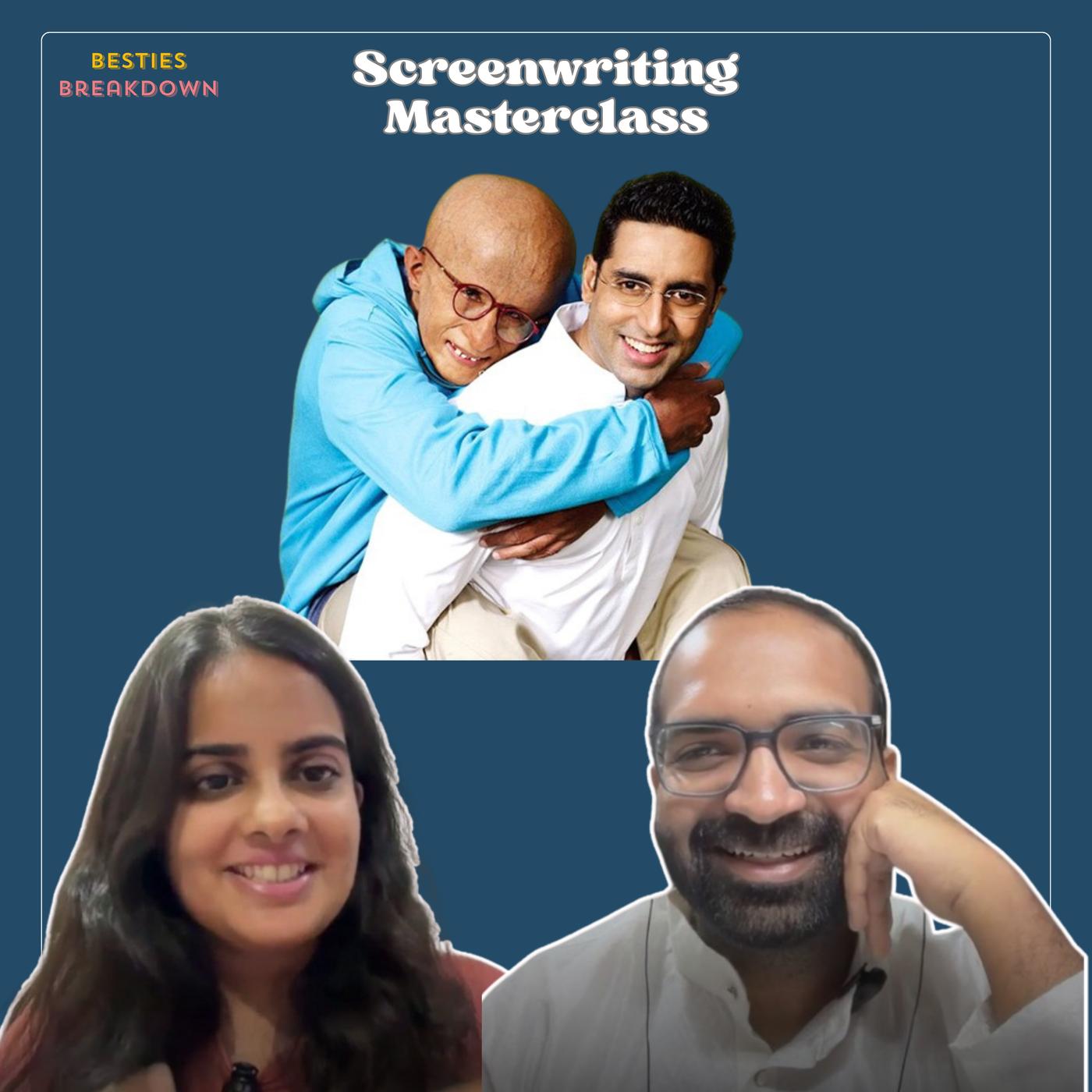
Breakdown Besties Podcast: Hi again bestie. For our next week we're breaking down. ⁓ English Vinglish. Yeah. And it'll be interesting that one of the characters, one of the actors in this film, Pa, has a very delightful cameo in that. So look out for that. Please try and watch it before our episode comes out. so while you're our breakdown, you're up to speed already. See you next Thursday.
Ananya: Hello everyone welcome to another episode of the Breakdown Besties podcast. I'm Ananya. I'm Akshay. And are your Breakdown Besties. Together we 14 years of experience writing for ⁓ like Mismatch, Inside Edge, Rana Naidu, Shark Tank, Grahan and a host of other shows which got stuck in development hell but we'll hopefully see the light of day one day.
Akshay: I'm Akshay
Ananya: With the Breakdown Besties podcast, our endeavor is to bring you a film school experience by breaking down all the tips and the tricks that go behind some of our favorite films and making them work on the page before they work on the screen. This is the film school experience that we didn't have and we're now bringing it to you so that we get to experience it ourselves and you get to come along with us for the ride. today, the movie that we're going to be breaking down ⁓ is ⁓ a 2009 classic and absolute favorite. I haven't seen one like it. It is
Akshay: Woohoo!
Ananya: written by R. Balki and assisted by Rishi Veermani in the writing process. This film was really like a nostalgia trip, no? Don't you think Akshay? Back home, like...
Akshay: It was so cute yaar, like I remember watching it for the first time and like it still hit me, it still gave all the feels and it's just like such a heart-warmingly sad film. Like is this a genre of its own? Like heart-warming but sad. Bittersweet, bittersweet.
Ananya: Yeah. Yeah. Bittersweet, I think. Yeah, man. ⁓ let's get into the first foundational piece and that's the log line. The log line is your entire film summarized in one line. ⁓ your guiding light and it tells you what to look at and what to create when you lose the forest for the trees. ⁓ case you're ever lost in your script and you're wondering ⁓ is your film really about? What's your central conflict? What are you actually writing about? ⁓ back to your log line. And why does the log line work so well? ⁓ it has four foundational elements. which essentially keeps your story running. They are the flaw or the block or the limitation or the wound which is essentially something that the character has within them which is not letting them achieve their goal. Goal brings us to the second piece. It is the motivation, it's the prize at the end of the film, it's what they're going to gain when we come to the journey's conclusion of this film. Then we have the conflict. The conflict is the force that challenges the character's flaw. It stops them every step of the way from achieving what they want. then our final piece is the stakes. The stakes is what our character stands to lose should they not achieve their goal. And it's not ⁓ the fact that they didn't achieve their goal. They stand to lose something additional. And those are your stakes. Right? Cool. So written a logline down for Paa ⁓ ⁓ let's see where we get
Akshay: This time I also tried, honestly.
Ananya: So I'll just read out what I have, can read out what you have and then we'll take it from there, right? Cool. I have a 12 year old boy with progeria wants to visit Rashtrapati Bhavan with a busy politician so that he has a father figure in his life or he can spend some time with someone who feels like a father figure in his life.
Akshay: Is that it?
Ananya: That's it. Like, can break it down. Progeria is essentially the limitation. It's not a flaw or a block, but it's a limitation, which means he has a limited lifespan, all of that. ⁓ Busy politician, busy means like it directly opposes someone with a limited lifespan, because if you're busy, you're not spending time with them. And that's what creates the conflict in the film.
Akshay: Yeah. Yeah. Yeah.
Ananya: Then you have the goal which is visit Rashtrapati Bhavan and the stakes are should he not visit Rashtrapati Bhavan with this man he fails to enjoy the time of the father figurely bit with him so that is what I have and Yeah, you tell me what you have where have I gone wrong?
Akshay: Yeah. I felt you got the flaw slash limitation is the same what I have written. A boy with a rare genetic condition, progeria. Goal is the same, wants to visit Rashtrapati Bhavan with a politician. Like yeah, correct, busy politician is the right word because that essentially ends up becoming the first half of the film. The ⁓ which I have put in is that
Ananya: Hmm. Yeah. Yeah. Yes.
Akshay: He's unaware that the politician is his father. because they established that so early on in the film that and it's one of those audience privilege moments where ⁓ I'll define audience privilege for our audience is that for our listeners and viewers that it's a piece of information which as an audience you know it but the characters themselves don't know in the story and so you are one step ahead of the characters in the film now in this case we Amitabh Bachchan's character Auro doesn't know the truth Abhishek Bachchan's character Amol doesn't know the truth the only person who knows the truth is Vidya's character ⁓ and there is a little bit of mystery not a mystery is the wrong word but like that's what builds the dramatic intrigue of the first half ⁓ so I thought like that becomes the conflict throughout the movie because they're sort of playing on that dance of is is he going to find out when will he find like that intrigue. So, I thought that was the somewhere the conflict of this because I disagree with the fact that he wanted a father figure. I think that is his realization once he comes to know about this.
Ananya: Yeah, yeah, yeah. and out. Yeah, I agree with you, even, yeah.
Akshay: So, so the stake is bang on that should he decide to not do this with this guy, he won't get to spend time with his father figure.
Ananya: Can you read out your logline once so we can just get a sense of how would we construct a logline for this film ⁓ because important part that you have there is that ⁓ as mentioned is audience privilege that we know that ⁓ he Abhishek Bachchan's son but he himself or no one else knows.
Akshay: Huh. Hmm. Hmm. Huh. Yeah, okay, I'll read it out. boy with a rare genetic condition, progeria, wants to visit the Rashtrapati Bhavan with a politician, unaware that the politician is his father. And once he learns the truth, hide this from the politician lest disappoint his mother. So it's a very long, long line.
Ananya: Hmm. Well, ⁓ boy. I think for dramatic purposes, I would end it at, ⁓ who he doesn't know is his father.
Akshay: Huh, yeah, get it, yeah.
Ananya: like yeah and there because if I'm pitching this I'm again thinking of a log line from a pitch point of view because I think that does create the intrigue element and it does add conflict. think what might ⁓ add more one more piece of drama to the log line or conflict would be if we could bring his mother in there too and ⁓ with the father
Akshay: Yeah. Yeah. Hmm.
Ananya: with a busy politician who his mother doesn't want him to know is his father.
Akshay: haa father ya ya ya ya bang on
Ananya: Yeah, because then that adds an additional complication there
Akshay: yeah and also I feel like somewhere your log line has to also be expansive enough to cover ⁓ sort of base you're covering in the movie right like this this movie is essentially a three character piece like ⁓ your log your log line should be able to fit in all the three characters properly so you're right like ⁓ we need to add the mother's ⁓ place in the log line yeah for sure.
Ananya: Cool. Okay. So there we have the log line there, think. we on to our hero's journey next?
Akshay: Yeah, let's do it.
Ananya: So, the hero's journey is the structural spine of your film. It takes your hero and your audience on the same journey. It hits these emotional beats every so often, which delivers hits to your audience that allows them to stay involved in the film. Even if you've not got characters that are too well mapped out or plot that's a little bit here and there, hitting these beats and having these turning points at the right point ensures that your audience is going on a journey. ⁓ Right? This hero's journey was honestly quite difficult for me to map out.
Akshay: I think this was the most difficult hero's journey out of all the episodes we have done so far. Because again, I think this is a film which is not a genre film. Like the others we've had like a sports drama, a sci-fi or like they have like a proper thread. like, and this is a complicated drama, you know, and especially drama which sort of emulates a real life a little bit.
Ananya: care.
Akshay: So it's not heightened for cinema as such too much. Of course it is, but it's not too much. So I feel like in movies like these, Hero's Journey is a complicated ⁓ exercise to do, but I think it's important.
Ananya: to. Right, yeah definitely. Okay, so first we have the ordinary world, our first beat or sequence of the hero's journey, which is where we establish the hero's ordinary life before they go on their journey. What it looks like, the where, what, who, why, all of that. And we see what's their world. So over here we see Auro's world with his mum and his grandma. He's a playful, fun kid. He has progeria. Everyone loves him at school. And he wins a prize for basically by fluke. And he's not too bothered about being deep and or anything. He's just another fun, fun loving 12 year old boy. Right?
Akshay: Peace. Yeah, I want to point out a similarity with this and koi mil gaya that again choices which is very strongly made by the writer filmmaker, which is that even if he has a rare genetic condition, They have friends, people like character to ensure the tone of the film is not dark and heavy. So again,
Ananya: Definitely.
Akshay: But we said that his friends like him, the same was in Koi Mil Gaya. ⁓ that was a ⁓ correlation I could think of.
Ananya: in it. Definitely, which actually affirms what we're doing, right? By watching all these films that it kind of makes you notice the pattern of things that are used across films, across techniques. It turns a thing, an isolated thing into a technique, which is pretty cool. So yeah, like Mil Gaya this is also a happy film. So in a happy film, all your kids have friends. ⁓
Akshay: Yeah. Yeah. Yeah. Yeah.
Ananya: Okay, then the call to action. So the call to action is where the hero is beckoned into their new world. They're like, you've been wanting this journey, come on this journey with us, right? Let's go. So in this, because we don't have a goal up front, the call to action is a little hard because we don't know what he wants, right? So I believe the call to action goes from the sequence.
Akshay: Huh. Huh.
Ananya: where, and can correct me I'm wrong, because chances are I am, Auro is hounded by the media post Abhishek Bachchan's visit to the school, because Abhishek Bachchan is a member of parliament, so there was media, and Auro was exposed in the subsequent media coverage, and given his rare genetic condition, he gets hounded. As he's hounded, he writes a mail saying, hate you, to Abhishek Bachchan. That is him acting on
Akshay: Hmm.
Ananya: an initial call and then Abhishek Bachchan sees the email and he literally calls him and apologizes and then, Auro just being playful says, know what, you wanna kind of get on my right side? Hmm, what can I ask of you? Okay, I see a photo of Rashtrapati Bhavan in my principal's office. Take me to Rashtrapati Bhavan, right? Like, that is the call to action, right?
Akshay: Hmm. Yeah. Same, same I have written that it is the fact that Auro says he wants to see the Rajapati Bhavani.
Ananya: Perfect. So the call comes from himself and from Amol, right? Like both of them.
Akshay: Yeah, I've also thought that this film needs to be mapped out from multiple perspectives a little bit, like, because again, it's a three person drama. And again, it's so much of it is like, ⁓ one person knows the other person doesn't know the third person is somewhere in the middle. So it's also important for a film like this to be tracked on multiple levels. So even like the regular life. perfect about Auro. I also think Amol's life that they have established that you know he's a good politician, wants to do school visit properly, all that stuff also comes part of it and the call to action for his character is little bit where he gets intrigued that this boy has progeria, I need to apologize for him. So it's that confluence of both of these characters call to action moments which makes the call to action for this movie.
Ananya: Yeah. Hmm.
Akshay: essentially yeah
Ananya: Definitely, yeah. Because especially what you're saying is important to note because usually our films have a very distinct A track, B track, C track, right? Over here, Amol, which is Abhishek Bachchan's character, his B track of his political career is quite robust. They have actually, it almost feels like an A track.
Akshay: Yeah. Yeah.
Ananya: ⁓ maybe okay here's this is something that's coming to me right now as we're discussing this because I remember listening an episode of the Screenwriting podcast shout out to Meg and Lorien who have no idea who we are but we love y'all
Akshay: Mm-hmm. We love y'all.
Ananya: And if I'm not mistaken, on this episode I heard a very long time ago, they talk about not a central character but a central relationship. Because you have a central relationship that drives the story and they use obviously the film they worked on together, Inside Out, to demonstrate it.
Akshay: Hmm.
Ananya: and there they show Joy and Sadness and their relationship. So they don't isolate it as know Sadness' is story or Joy's story. It is their story. So maybe in Paa are not looking at Auro's story or Amol's story. We are looking at Auro's and Amol's story. So we ⁓ at the A-track as a combined ⁓ this you know journey. Yeah.
Akshay: Huh. Huh. Hmm. Hmm. journey.
Ananya: So what you said about call to action makes more sense here because you look at it from these two perspectives because it's their joint story.
Akshay: Amazing, what a analysis.
Ananya: My brain remembered something. I was like, oh wow.
Akshay: Yeah, yeah, so cool, so cool.
Ananya: And then in terms of refusal of the call, I believe it's only a singular moment when ⁓ Auro is sending out the email to Abhishek Bachchan and his mum is looking over the shoulder and she's like, that's not okay to send and he's like, it's not okay to look at what other people are emailing other people and she backs off. So that felt like the refusal of the call.
Akshay: Mm-hmm. Hmm. Hmm. ⁓ I actually thought in the larger scheme of things, refusal was when Abhishek Bachchan's character doesn't show up. ⁓ I thought that was like the full... ⁓ but because I am thinking of the story just from these two people's point of view. So, but I could be totally wrong.
Ananya: Okay, let's go along with it and see where we arrive and we can make our justifications. This is going to be a proper film school, like not debate, but discussion episode. What constitutes storytelling? Cool. I don't quite have a mentor ⁓ in ⁓ There's a mentor maybe in Bum.
Akshay: Yeah. Yeah. Yeah. Yeah. Hmm. Hmm, yeah. No
Ananya: in his grandmom who occasionally comes in with sound pieces of advice but there is no structural mentor who says this is what you have to do I will guide you on your journey and then he crosses a threshold which is what the mentor beat is.
Akshay: Hmm. Yeah. Yeah. Yeah, yeah same I've written the same-- Vidya Balan's mom's character but incoherent.
Ananya: Go Inchorent. I feel that they cross the threshold ⁓ they have fixed the of going to Rashtrapati Bhavan. That is my crossing the threshold where because now after crossing the threshold like once this decision is made they've had a video call he said we're going on the next week ⁓ get into ⁓ ⁓ world
Akshay: ⁓ ⁓ Huh.
Ananya: Because in this new world, the reason I thought it's a new world is because of how excited he is. Like he's going to buy a new shirt or t-shirt, whatever, hoodie with bum. He's going to like, he talks about shaving. He tells all his school friends that I'm going and Aree I would take you with me, but I want to make sure it's safe and all of that. So that for me felt like the new world, the little ups and downs of the new world.
Akshay: Hmm. Hmm. Yeah, yeah. Hmm.
Ananya: So this is tests, allies, and enemies, ⁓ And ⁓ then in the meantime, we have Amol's tests, allies and enemies going on where he is trying to get a slum redeveloped and he is caught in hot water with a rival and they're both going at each other, right? ⁓ And in doing so, I think the to the innermost cave goes up
Akshay: Yeah.
Ananya: when ⁓ forgets that in all his ⁓ political ⁓ he forgot to take Auro to Delhi. ⁓ ⁓ he has to deal with that. ⁓ that is the approach to the innermost cave to me that Auro is waiting to be taken to Delhi ⁓ this one ⁓ and ⁓ Then ordeal.
Akshay: Hmm. Hmm. Hmm. Hmm. ⁓
Ananya: ordeal is where you have to bear the consequences of not reaching your goal or reaching your goal but you paid a price. So approach to the innermost cave is going for your bag of gold hidden under the dragon. And you grab the bag of gold and you leave and now the dragon comes flying after you and that is the ordeal. So in this case, they didn't get the bag of gold but there's still an ordeal. And I think the ordeal is Amol reaching out to
Akshay: Hmm. Hmm. Hmm. Hmm. Right. Huh. Huh.
Ananya: Auro and saying, forgive me, please forgive me. And Auro is like, screw you. Like, I'm not going to let you have time of day. And it goes on until Auro is at the cricket. He's playing cricket with his friends and he joins the match and he has an attack of, I don't know what, but he passes out on the cricket stadium and he's taken to the hospital. So your ordeal goes on to there. And then you have the reward. The reward is something you gain.
Akshay: Hmm. Hmm. Hmm.
Ananya: ⁓ Like essentially you get the bag of gold and you're free of the dragon. And it is at this point Auro's reward is learning that Abhishek Bachchan, his character Amol, is his father.
Akshay: Hmm. Hmm.
Ananya: So that is how I have it up to this point.
Akshay: Hmm, very interesting. ⁓
Ananya: Please whack it down.
Akshay: I think again, there's no right or wrong, right? Essentially because it's such a delicately plotted film, it's so small, small things leading to like a big reveal of sorts. So it's like, I don't think we can say one thing or the other is right. ⁓ So until the call to action, we discussed, okay? Now the way I have mapped it is the moment when refusal of the call happens is when Abhishek Bachchan's character is not able to show up for the promise he made. ⁓ And our character, Auro, feels very sad and disappointed about that. So that was my clear refusal for that. Now for me, the crossing of the threshold, comes to the point which is the midpoint of the film which is that he comes to know that this Amol is actually my father when Vidya Balan's character tells him that ⁓ I have a gift for you for your birthday this is the photograph and he says who why is he what is he doing next to you and she's like this is your he is your paa and in my head it also made a little justification sense that koi mil gaya
Ananya: Yeah. ⁓
Akshay: crossing the threshold was a midpoint of the film. I was like, ⁓ this correlates again. So that becomes my crossing threshold because it also, that's the important part of the film, right? Like now that our character knows that this is, he is the father, does he continue to go for his goals or ⁓ to, ⁓ that was for me that.
Ananya: It was also at the midpoint. Yeah.
Akshay: Now, after this, whether it's your test enemies and allies, your approach to the inmost cave, the ordeal, the reward, they're all very tightly interlinked to each other for me. Because again, I've thought of it as one of those films where small, small moments build up to a big thing. So your test allies and enemies is, I thought the subplot of his friend Vishnu, where he says that... my father beats me up, but my father is like this, my father is like that. You know, we are similar, we are different, like which starts of like churning the wheel in Auro's mind that, let me see how me and my father are similar. So he does a little bit of research. He tries to find similarities between the both of them. ⁓ And then approach to the cave comes is when they actually set off on the trip together.
Ananya: Yeah. ⁓ Yeah. Hmm.
Akshay: where it's like he is on the flight together and then I feel the approach to the inmost cave goes on to the point where
Ananya: Yeah.
Akshay: Amol's character has a little disagreement with Auro. It's when Auro refuses to go to Rashtrapati Bhavan and they have that scene in the hotel where it's like, you know how embarrassing it was, people were waiting inside, why did you not come? And I feel a moment like that is very important in a relationship film because only once you have a disagreement in a relationship, the bond gets stronger. So I thought that until that point was the approach to the innermost cave.
Ananya: Yeah.
Akshay: Now the ordeal goes on to be that Amol spends the next day with Auro's character and they have a great time. ⁓ They have that song in the metro. ⁓ Again a little bit more tangibly we can see it when Amol literally sheds his piece of protection which is the bodyguards. We establish that they're now closer to each other and
Ananya: Hmm.
Akshay: Again, there is more honesty, more candor in their conversation. And to me, the reward was they've had a successful trip and it's that small scene of the flight, which is when they're coming together after they've come back. And when they're going back, you have that stay on Amol's face when they do that dance and he just does this like, so you know that this trip has made an impression on him forever. So that's the reward for him.
Ananya: Yeah.
Akshay: So that is what I have of this entire second act.
Ananya: Hmm. ⁓ Yeah, I have nothing to contest that. I can see it fully from your point of view and I can say that that does make sense. So...
Akshay: Yeah, like what I would also do if like if I was one of the writers of the film I would expand the trip a little bit more you know like it just felt like it just came so quickly and just went off so fast. That was my act two.
Ananya: Yeah, I can see it from your perspective and if we say that crossing the threshold is when he receives the photo, right? Is what you're saying. Yeah, that is when he definitely like you can't contest it. He does cross into a new world. And if the conflict is that who his mother...
Akshay: Huh. Yeah. Hmm, hmm.
Ananya: and think and his mother doesn't want him to know that I'm thinking of back to the log line where we added the fact that his mother doesn't want him to know then hmm
Akshay: Yeah. Hmm.
Ananya: I was going to use this to agree with you but now I'm thinking of the logline where we edited it to say that his mother doesn't want him to know ⁓ in that case finding out ⁓ his father is ⁓ the reward. ⁓ I see it from both perspectives like
Akshay: Hmm. Hmm. Hmm. Yeah. Fair. Yeah. Again, it's so thin, no? Like, Vidya Balan's character is also pushed to a corner where she has to say it, right? there is the fact that obviously the mortality angle is, you have to take into consideration. But at the same time, you also have to remember that Auro's character is affected now by Amol's character first hand. So far he wasn't, but the fact that he hasn't showed up, he's felt a little bit sad about it. So now she's also like now he's become part of the world, right? Like, so how much she can like not go for it.
Ananya: Mm-hmm. Yeah. For sure. I like what you said because it's double abandonment, right? Because he got abandoned for Delhi and then he's like, ⁓ he abandoned me in like life. ⁓ So this
Akshay: Hmm. Yeah, yeah, I fully get it why it could be the reward also right like We can we can have two different journeys as long as we're clear in our heads. I think that's that's good. Yeah
Ananya: ⁓ hits. Exactly. Yeah, we have to know what emotional hit each beat has to give us. So as long as we're achieving that, if you can achieve the level of heartbreak or not heartbreak but tension that approach to the innermost cave is supposed to give you. Like, I think approach to the innermost cave is I'm gonna compare it to Johnny Gaddar at this point. It's like, is he going to get that bag?
Akshay: Yeah Hmm. Hmm. Huh. Hmm. Hmm.
Ananya: Is Daya's character going to get that bag, steal that ⁓ bag from Nitin Mukesh? Are they going to have that? That is the tussle. So there's that constant tension there. Right? ⁓ I'm wondering, ⁓ me, the reason I went with that ⁓ intercut of Auro ready and ⁓ Amol carried away in his new life, in his political career.
Akshay: Hmm. Hmm.
Ananya: almost gave me that sense of tension that will he won't he? Will they make it? Won't they make it? Will they make it? Won't they make it? So that and what happens afterwards is the ordeal. So I think from an emotional perspective that made sense to me. But yeah.
Akshay: Hmm. Hmm. Hmm. Hmm. yeah it's great
Ananya: Great. So then my road back is all that you covered in your approach to the innermost cave and stuff, ⁓ where they back to Delhi together. ⁓ They don't into Rashtrapati Bhavan, but they bond. ⁓ Auro tells that I'm taking revenge from you by not going to Rashtrapati Bhavan for a mistake you made the last to last to last time.
Akshay: Hmm. Hmm. Hmm. Hmm. ⁓
Ananya: And Abhishek Bachchan can't for the life of him figure out what that mistake is and he's really invested in that mistake. And it goes all the way to the point that ⁓ Auro goes to school and he hears his friends talking about the definition of bastard and he realizes that he is a bastard and he has a stroke or he has an attack and he's in the hospital. So that is the way back.
Akshay: Hmm. Hmm. Hmm. book
Ananya: Then my resurrection is Amol finds out that Auro is his son because he comes to the hospital and Auro also tells Amol it happens within a beat of each other that you are my father. And Amol goes on to admit his mistakes to the press that I abandoned this woman but now I want to marry her and he is my kid, Auro is my child. And the return with the elixir is... Abhishek Bachchan and Vidya Balan's characters take saath phere around the bed to symbolise marriage.
Akshay: Yeah. Yeah, same. All this is same. All this is same. For me, the road back again was such a very minute moment, which was ⁓ for after they've come back from their trip, everything falls into the place a little bit smoothly, right? know, Amol's character, Auro's character ⁓ is doing a debrief with his mom, like, ⁓ everything was fine. Women, they want to know everything. And
Ananya: Hahaha Hmm.
Akshay: you have that moment of relaxing with Amol's character that he's just lying down and he has a chat with his dad that you know what you must meet Auro. ⁓ So this for me was a road back because again like it felt like a big chunk of the like the journey was complete up to a certain point and they could like ⁓ sit back and like dwell upon what happened and and the resurrection now again comes when like ⁓
Ananya: Hmm. Hmm.
Akshay: when he is in the hospital and the father and son come to know that they are father and son essentially ⁓ and the proposal and the return is the when the final marriage and the tragedy which beholds.
Ananya: Yeah. Yeah. yeah cool so other than the main act two which is maybe the main most important part of the film we agree with each other great
Akshay: You
Ananya: What do you want to go into next? Scene techniques?
Akshay: Yeah, let's do scene techniques.
Ananya: The first I want to talk about is the introduction of Auro. ⁓ And we've talked about intercutting to build tension. ⁓ But I believe Auro's is good show of the technique of intercutting build curiosity.
Akshay: Hmm. Hmm. Hmm.
Ananya: And it works well in a film like this because it is very visual. We're all waiting to see how Auro will look. It's almost like Shah Rukh Khan entering a film. We're waiting for him to reveal himself. So we have Abhishek Bachchan on a stage and Auro in a bathroom which automatically builds visual contrast. One is a very public space talking to a bunch of people, the other is private. And then you intercut, you first go to Auro's legs, you have his back, back to Abhishek Bachchan.
Akshay: Hmm. All Hmm. Hmm.
Ananya: then you move up a little bit back to him and then you finally reveal him as he walks in through the doors of the big assembly hall where all the students are there. So you see him and you see him through Abhishek Bachchan's eyes. So I believe intercutting to create curiosity is also as good a technique as intercutting to create tension.
Akshay: ⁓ yeah. Hmm. Hmm. Yeah, bang on, bang on.
Ananya: Next, want to talk about montages because they've used them here in the film twice. They've used them to establish ⁓ Abhishek Bachchan in Vidya Balan's initial college romance and they've used it to show the beauty of Vidya Balan's pregnancy. And I just want to talk the reason we use montage sequences. Because we use montage sequences when their one-one essential element is missing and that is conflict.
Akshay: Hmm. Hmm. Hmm. Hmm.
Ananya: When you don't have conflicts in scenes, essentially they don't have a place to play in your film. They don't have a part to play. They have to go. And to drive my point home further, I'll also point out that when actual came in, they cut to a scene. So when Vidya told that I'm pregnant, that is a conflict. ⁓ So then they cut to dialogue, they had a proper scene.
Akshay: Hmm.
Ananya: Then when Vidya speaks to the doctor after she gives birth and he says that your son has progeria, this is also conflict. So they cut you out of the montage sequence. So building a montage sequence works when there is little conflict is the point I wanted to make here. And then I wanted to talk about exposition.
Akshay: Hmm. Hmm. Yeah. Wait one more thing because it we talking about montages I had something similar on the concept of montages which is that This film, they expand Abhishek Bachchan's political career so much that it does in some way remind me of a monta... of a technique which is called the montage of preparation which is ⁓ essentially when a character is excited or optimistic about something and it doesn't work out the way they want it to. And this montage of preparation generally follows two other beats which is the beat of a little bit of false hope that we have seen your character prepare for something you have a little bit of a hold which is saying that ⁓ think my god I'm gonna do it but and it is followed by this beat of failure so that we have seen your character passion his drive the excitement which they want to approach this opportunity only to be it come down crashing down. So now they have done this in both of characters of Amol and Auro I thought which is you had all those scenes of ⁓ Amol's political career his ⁓ chat with his father, his chat with the opposing rival, him going to slum dwellers, the opposite ⁓ leader going to the slum dwellers, him having that whole press sequence, right? so all that comes into this and it's also simultaneously intercut with Amitabh Bachchan's character going for shopping. you know, the dates like, ⁓ four more days left, three more days left. And until both of them like collide where he has the final beat realizing that shit today was the day I was supposed to meet him for Ashtrapati Bhavan ⁓ him realizing that, ⁓ you know, he hasn't showed up. So like again, I thought this was the montage of preparation followed by the false hope leading to a failure.
Ananya: Hmm. ⁓ Perfect, yeah, so essentially it's used to drive on the impact of the failure.
Akshay: Yeah, yeah. It's a screenwriting rule, you like if you want a character to not achieve something, show the preparation. If they are going to achieve something, just cut to it directly, like don't do the build up.
Ananya: Yeah. Exactly, yeah, we build it up only to break it down. That is the rule, I think. Cool, nice. Okay, then I just want to get into exposition, which is a very common technique used for exposition, which is giving exposition to the audience at the same time as to the character, because the character is new to the information as well.
Akshay: Yeah, yeah, that's rule, yeah. Hmm. Huh. Hmm.
Ananya: So, we get the exposition of Progeria twice. First, we get a very quick explanation where Abhishek Bachchan's character meets Auro and the principal tells him that he has a condition where he is a 12 year old in mind and heart but he is a 60 year old by body. And then we get another second explanation when Vidya Balan has the baby and the doctor tells her about the more technicalities of the condition.
Akshay: ⁓ Hmm.
Ananya: Both cases Abhishek and Vidya are strangers to the condition. So it doesn't become exposition where the character already knows and the information is being repeated. Tume yaad hai jab doctor ne mujhe kaha tha ki yeh sif bara saal tak jeega nahi. It is them getting the information first hand and so is the audience. terms of exposition. Then...
Akshay: ⁓ Hmm. All right. Hmm. Hmm. Hmm.
Ananya: I wanted to talk about a nice Chekov's gun which I liked which was ⁓ Auro asking his grandmother Bum about the seven pheras. Right? Yeah. So Chekov's gun is when you plant a gun in the beginning of the film and somewhere else in the film it is used at a pertinent moment. So he asks his grandmom what is like the seven pheres, why they go round and round around the fire.
Akshay: That is the same thing.
Ananya: And then we have almost the closing image of the film where Vidya Balan and Abhishek Bachchan's characters go round and round the bed to signify that they have gotten married in ⁓ their dying son's eyes, ⁓ right?
Akshay: Yeah. Yeah.
Ananya: ⁓ I also wanted to talk about unpredictability as a technique which is I'll bring it up in the scene of Vidya Balan telling Abhishek Bachchan that she's had a kid and Abhishek Bachchan is like dude this kid is gonna be the end of my political dreams and your dreams to be medical dreams too to be a doctor so like have an abortion so and she storms out of there going on fine I'll have an abortion but like
Akshay: Mm-hmm.
Ananya: Fuck you too, you know, you and I are not going to be together. So you ended on an emotional high. And then next scene, you cut to an emotional low, which is her crying and saying, well, practically I need to abort this kid, but she's still like crying because she doesn't want to. So it's unpredictable, but it's rooted in a correct emotion.
Akshay: Huh. Huh. Yeah. Yeah. ⁓ Hmm.
Ananya: You bring unpredictability which is also true to the character.
Akshay: Yeah. Hmm. You know, this scene, the entire sequence reminded me of the Band Bajaa Baaraat moment where Anushka Sharma's character had a sort of a confrontation with Ranveer's character. Like, you want us to be bros, we can be bros. So she comes across a little too strong. Like she has a hard exterior in that scene. And immediately in the next scene, we see her crying for the first time that she says, what a stupid fool I was, you know.
Ananya: And then... Yeah.
Akshay: So the fact of using like a harder exterior followed by the soft interior moment like a soft vulnerable moment I thought they replicate like not replicated because it's the same but great moments to like show unpredictability.
Ananya: Yeah. Yeah. And also, think depth of character, right? Like, yeah. ⁓ I wanted to also a special mention to the opening credits of the film ⁓ Right. So the opening credits of the film, you essentially just have Jaya Bachchan sitting down ⁓ and all the names ⁓ directed this one, assisted by this one. ⁓ And thought
Akshay: Yeah. Yeah man, same, I was gonna turn it down, yeah.
Ananya: It is such a good way of telling the audience that this film is going to be a different film. I want you to sit up straight and watch because this is going to be an experience that is unlike anything you've ever seen before, starting from the credits. So, I think if you have the liberty to tell your audience what to do from the get-go in that manner, like, take it, dude.
Akshay: Yeah. Yeah. and it also sets the tone of the film that first of all the way she does it is so heartwarming like you know she takes such beautiful pauses and there is a smile on her face there is it sets the tone that this film is going to be all heart right and I remember this film was marketed as the first time not the first time but like you know Amitabh Bachchan and Abhishek Bachchan not a sort of come together but have almost a role reversal of sorts so it also becomes
Ananya: Yeah.
Akshay: very important that this technique was used for the opening credits because it becomes a full family film which essentially the film is, right? So I thought it was very nicely done. It like brought an immediate smile on my face and I was like, wow, what a thought, what a thought.
Ananya: Yeah. Yeah. Yeah, amazing. Beautifully done. That's all I have on scenes. What do you have?
Akshay: Yeah. Yeah. I think we've covered most of them. want to about the first dinner scene which they have after they reach Delhi they both having khichdi ⁓ in the Taj hotel ⁓ and again now audience knows that these two are father and son ⁓ one of the characters knows they father and son the third character doesn't know and the entire peg of that scene with each dialogue is that ⁓ Auro's character is pushing the ante a little bit just to like I don't know for the kicks of it or something like just to make the scene more engaging like constantly like he's like the scene is pushed onto that like what does your father do? Abhishek Bachchan's character asks and he says I think he
Ananya: Yeah.
Akshay: what he does is dream a lot, you know. So every line of the dialogue is a subtext about just himself, but he's not realizing that. So I thought that I don't know what the technique would be, but I guess ⁓ it's interesting to see when one of the characters knows the core conflict of the movie and the other one doesn't. ⁓
Ananya: Yeah. Yeah. Yeah, I'm trying to think of how you would frame this as a technique too because it's something you it's done across some genres and films, right? So obviously this scene a scene like this is crafted more for the audience's enjoyment than for like truth to the character, you know, like sure it's real like Abhishek Bachchan would ask him like what does your father do? It's normal. It's to that scene but
Akshay: Huh. Yeah, yeah. Huh. Hmm. Yeah. Yeah. Yeah.
Ananya: It is, think, a way for your audience to enjoy the privilege that they've been granted. Like, knowing a secret is one thing. But how do you implement that secret so that the audience can actually feel like, ⁓ something is happening here, know? Like, will they? Won't they? It almost creates tension. So how do you use a secret to create tension is, I think, a good technique here.
Akshay: ⁓ Hmm. Hmm. Hmm. Hmm. tension Hmm.
Ananya: Then, do you want to go into character creation next? ⁓
Akshay: Yeah, we can do that. I have a technique for Amol's character.
Ananya: Cool. Okay, go for it.
Akshay: So I thought from the get-go they have tried to build empathy and likability for this character. whether it comes from the fact that the way he's treating his staff because he gets a bouquet, he turns around, like smiles to his staff, very politely gives it away. uncommon for a politician to see a politician do that. So that automatically feels, ⁓ he's such a nice guy. Then you have a conversation with the principal immediately, which is that the principal says, ⁓ we've shortlisted three or four projects for you so that we don't have to waste time. And he says, you know what? I have time. I'm going to watch all of them. So that again creates another level of ⁓ likability towards him. So this layering ⁓ of one information after the other, it comes from ⁓ his work life, the way he with exterior stakeholders, and even when he's alone, to show that in the same sequence, I thought they really built his character up ⁓ very nicely.
Ananya: Definitely. They've essentially from the get-go shown him as a man who genuinely cares. I think that is the technique they've used. Like how can he genuinely care about everything? Whether it is in the start from like seeing all of Auro's projects, I mean all of the school's projects, to later on even like calling Auro and apologizing. It's not false, it's not fake. He doesn't have to do all of that, but he genuinely cares.
Akshay: Hmm. Hmm. Huh. Hmm. Huh. Yeah. Hmm.
Ananya: They've also shown him to add to what you're saying to make him a character we want to watch. They've shown him as an important person who other people look up to. So you want to watch characters who you admire. You will admire someone important. He is also a man of his word.
Akshay: Hmm. Hmm. Hmm. Hmm. Hmm. Huh.
Ananya: And when he's not a man of his word, he regrets what he says and what he does. And regret is a big attribute. A character who has the ability to admit to a mistake and apologize, you like those characters. So they've built likeability in a lot of ways for him. Right? And also, Auro's character. I think they've built a phenomenal character in him too. A, he is very playful.
Akshay: Hmm. Hmm. Hmm. Hmm, yeah. Uh-huh.
Ananya: He's always playing around. He's not supposed to eat mirchi, but he'll still ask for mirchi. All of that. But he's also very considerate. He's very thoughtful. He puts that mirchi in Vidya's plate and says, just because I'm eating insipid food doesn't mean you also have to eat insipid food. So he plays and then he is actually considerate. He's also smart. Despite having a coughing fit, see him later solve a maths sum and say like, the square is, the sum is 32.
Akshay: Huh. Yeah. Yeah. Yeah.
Ananya: And he has self-respect. He doesn't let anyone make fun of him, which they show us in the C-plot of that girl who got scared seeing him for the first time and ran away, which we'll talk about later. ⁓ She, in that point, he's like, you know what, she treated me badly. I'm not going to, like, I'm not going to feel bad about myself, but I'm not going to let you treat me badly. Like, I'm going to walk away from that situation. So that's one way in which they've built a very likeable character in Auro.
Akshay: ⁓ Yeah. Hmm, Yeah
Ananya: And then one I want to talk about is Vidya Balan's character. ⁓ Just one thing they haven't used in the film, but they've established. ⁓ And this is character deepening technique of showing another layer of the character, ⁓ which is where A, you know she's the mum of someone who has a genetic disorder, condition, all of that. But they've shown a layer of her being a gynaec.
Akshay: ⁓
Ananya: who actually loves kids. So despite the fact that she has this son and her life could be very sad because at any moment now in the next year or two she's going to lose him. She is in fact telling people to have kids. Horrible pro-life plug that was there. That was my...
Akshay: ⁓ Hmm. Yeah, I know. I think the same thing. Yeah.
Ananya: Yeah, so like where she like, oh my God, for our audience, there's a scene in the film where one patient comes to her and her body is like not feeling great. And she's like, yeah, this is your body telling you you need to have a kid. You're 33. You're not having a kid. This is your body telling you this is unnatural. Having a kid is the best thing that can happen to you. I'm like, oh, Jesus Christ. I'm like, I'm glad this movie was like 16 years old. So, but terrible pro-life plug.
Akshay: You Yeah. Yeah. Yeah, terrible.
Ananya: Yeah, but it just shows the depth of her character that despite going through harsh times, she's so optimistic and positive about all of this. So they didn't use it anyway.
Akshay: Yeah. Yeah, like it's, it's her character's truth essentially. hence it doesn't feel so jarring, right? Like, ⁓ and it might just even fly by like a regular viewer, you know, ⁓ but like, no.
Ananya: I think the way they did it that what you're doing is unnatural Like she could have still said I think having a kid is great all of that But having such a strong opinion that like you are a cow. This is your purpose in life So that was Yeah, yeah, yeah ⁓
Akshay: Yeah. Yeah. date. Yeah. Yeah, yeah, I know yeah, I thought I made uncomfortable Yeah
Ananya: Okay, what do you want to talk about next?
Akshay: ⁓ dialogue
Ananya: Sure.
Akshay: I have two dialogues. One is the first dialogue uses the technique of using metaphors which this film does a lot in the sense that they don't... and a metaphor used cleverly becomes subtext. So in the sense that he says, what was the first mistake you made? Oh, I got it. Like I didn't show up.
Ananya: Yeah. ⁓
Akshay: So you're talking about the previous mistake when I got to the media. No, no, no, I'm talking about the previous, the previous to previous to previous mistake. And throughout the film, they don't use these things as like, remember when you didn't come, remember like you didn't, like you got the media. ⁓ coined all of that into just one thing that was a mistake. So even in the end, when he says that, pitchley say pitchley say pitchley mistake, main, that hits you because it doesn't say that I am the kid
Ananya: Hmm. ⁓ yeah. Yeah.
Akshay: who you abandoned with like whatever 14 years ago when you had a fling with my mom like it's none of it is that. It's just cleverly used metaphor throughout the film which becomes subtext so beautifully. So I thought that dialogue was done very nicely. The second line which I actually remembered before watching the second time the film also was Vidya Balan's confrontation line to
Ananya: Yeah. Mmm. ⁓
Akshay: Abhishek Bachchan which she says that just by lending me your bloody sperm doesn't make him your bloody son. Now I love this line because it was again I know like it's a little out there but I feel sometimes your film needs to do stuff like this. Now three four things this dialogue worked for me and like the techniques which have been used for this is that ⁓
Ananya: you
Akshay: There is somewhere a universal truth about this dialogue, right? So the character truly feels about this. It's not... This dialogue was not spoken about by the grandmother, not by Paresh Rawal's character, but it belonged in Vidya's life and it shaped up her life. So it was a truth to her character, which was primary importance of any character, any dialogue. Number two, it's a little bold. So like it goes...
Ananya: Yeah. Yeah. Hmm... Yeah. Yeah.
Akshay: into the territory of like she could have used like ⁓ but you weren't there like to even show up but the usage of words was like she used the word sperm so it's like a like a it shows up her anger a little bit that she's thinking of it in terms of extreme technicality and the fact that it's again a writer's duty to like sometimes make a bold statement like a bold scandalous statement you remember that because
Ananya: Mmm... Yeah. Thank you. Yeah. for a show.
Akshay: Clearly I did, I had first watched the film back in 2010, when it had come out, right? So, the third was repetition of the word use of bloody. She says that just by making him your bloody sperm doesn't make him your bloody son. So, sometimes if used with restraint, repetition has a recall value and it adds a certain rhythm to your dialogue.
Ananya: No. Hmm.
Akshay: and even the word sperm and son there is alliteration here again adds to the rhythm ⁓ of a dialogue so hence for me this was a gold dialogue that like really stood out in the film so
Ananya: Bye. Yeah man, you've examined it from every angle.
Akshay: Yeah man, I was like why do I remember this shit?
Ananya: Yeah, yeah, fair. Fair. Wow. Cool, very cool.
Akshay: Yeah. Yeah.
Ananya: I have one more note in terms of dialogue which is this conversation which Auro is having with his friend Vishnu. And with Vishnu, says that he is talking to Vishnu about his dad and Vishnu starts talking like an adult saying, two men can't live in the same house, it causes a lot of trouble and it's a very funny sequence, right? Now, why does this work in this dialogue? Because comedy is built
Akshay: Yeah
Ananya: on one thing and one thing only. Not one thing, I'm not a comedian, I don't know, but largely built on one thing. Just the unexpected. How can you use the unexpected? You make a character do something that is not going, that is not normal for characters in our world. And you can especially do this with kids' characters. So having a kid talk like an adult and he's saying what his feelings would be.
Akshay: ⁓ Huh. Huh. Huh. Hmm. Uh-huh.
Ananya: that my dad hates me, I don't like living in the same house as him but he's it the way an adult would say it and which is unexpected. So unexpected creates comedy in your dialogues.
Akshay: All right. Hmm. Hmm. Hmm.
Ananya: So yeah, that's what I have on dialogue. Next, I want to talk about the world. ⁓ One is the world of kids, right? And we've touched upon this briefly in Koi Mil Gaya where the conflicts are also derived from that world. And one conflict I really liked in this was when Abhishek Bachchan says, you know, go to Delhi. And then Auro is thinking, hmm.
Akshay: Hmm.
Ananya: Should I ask Vishnu to join me? If I ask Vishnu, have to ask Hitesh also to join me. And this is a conflict that exists in the world of kids. So how do you bring conflict into your story that is true to the world? What problems would a 12 year old have? And this is one of those.
Akshay: Hmm. Hmm.
Ananya: And another one I want to talk about is a bonding moment between Abhishek and Auro, right? Which is where Auro gets tired and Abhishek Bachchan first creates a seat for him with his hands and then carries him on his back. It's essentially a bonding moment but the moment comes from the conflict which is true to the world which is that Auro has the body of a 70 year old. He can't keep standing for that long which lends to this conflict.
Akshay: Huh. ⁓
Ananya: which lends to the scene. So again, derived from the world, very true to the world.
Akshay: hmm hmm hmm yeah
Ananya: Next, I just want to talk about subplots and the way they've been used here. So your subplot is, a B-plot. B-plot or a C-plot, which is a substory going on within your main story and it ultimately ties into your main story. It solves a problem your character is having or it creates more conflict, etc.
Akshay: Hmm. Hmm.
Ananya: I want to talk about the C-plot of the small girl who ⁓ seems to a crush on Auro. ⁓ They've played as a misdirection till the very end where she's always bringing him gifts, where she's always bringing him ⁓ something, calling to him. And you think Auro is just like a nervous 12 year old who's like running away from a girl. Right? This first causes conflict when...
Akshay: ⁓ ⁓ Huh. Huh. Huh. Huh.
Ananya: She runs to him at one point and he decides to be part of the cricket game instead of just like overseeing it, instead of just refereeing it. And because of which he then has an attack and he goes to the hospital and where his where we realize that he may only have another year to live. So I thought that was a good point of the C plot tying into the A plot, playing the function of the serving the function of C plot is supposed to serve. And this plot goes on later.
Akshay: Huh.
Ananya: when she comes to the hospital and they reveal that she had actually seen him on the first day of school, she didn't know him and she got scared looking at him and ran away and Auro was deeply offended and she all this while was apologizing for her mistakes and she says that the one who makes mistakes often suffers more than the one who the mistake was made on.
Akshay: ⁓ Again, wrong but sure.
Ananya: Yeah, Absolutely, though. and Vidya Balan looks at Abhishek Bachchan's character and he's like, ⁓ he made a mistake, but he suffered more. And she's like, I shall forgive him because a seven year old has more wisdom. So I thought this was a good way of the B-plot, of the C-plot tying into the A-plot.
Akshay: you Yeah. Yeah. Yeah, I agree.
Ananya: Anything else.
Akshay: No, I think we've covered everything I had written down for Paa.
Ananya: Same, same, same. That is all I had on Paa. Cool. Well, thank you guys for tuning in to another episode of Breakdown Besties. So like, share, subscribe, any comments you have down there, suggestions, let us know what you want. ⁓ And we will be back next week with another episode of Breakdown Besties. ya.
Akshay: Bye.
Ananya: Hello everyone welcome to another episode of the Breakdown Besties podcast. I'm Ananya. I'm Akshay. And are your Breakdown Besties. Together we 14 years of experience writing for ⁓ like Mismatch, Inside Edge, Rana Naidu, Shark Tank, Grahan and a host of other shows which got stuck in development hell but we'll hopefully see the light of day one day.
Akshay: I'm Akshay
Ananya: With the Breakdown Besties podcast, our endeavor is to bring you a film school experience by breaking down all the tips and the tricks that go behind some of our favorite films and making them work on the page before they work on the screen. This is the film school experience that we didn't have and we're now bringing it to you so that we get to experience it ourselves and you get to come along with us for the ride. today, the movie that we're going to be breaking down ⁓ is ⁓ a 2009 classic and absolute favorite. I haven't seen one like it. It is
Akshay: Woohoo!
Ananya: written by R. Balki and assisted by Rishi Veermani in the writing process. This film was really like a nostalgia trip, no? Don't you think Akshay? Back home, like...
Akshay: It was so cute yaar, like I remember watching it for the first time and like it still hit me, it still gave all the feels and it's just like such a heart-warmingly sad film. Like is this a genre of its own? Like heart-warming but sad. Bittersweet, bittersweet.
Ananya: Yeah. Yeah. Bittersweet, I think. Yeah, man. ⁓ let's get into the first foundational piece and that's the log line. The log line is your entire film summarized in one line. ⁓ your guiding light and it tells you what to look at and what to create when you lose the forest for the trees. ⁓ case you're ever lost in your script and you're wondering ⁓ is your film really about? What's your central conflict? What are you actually writing about? ⁓ back to your log line. And why does the log line work so well? ⁓ it has four foundational elements. which essentially keeps your story running. They are the flaw or the block or the limitation or the wound which is essentially something that the character has within them which is not letting them achieve their goal. Goal brings us to the second piece. It is the motivation, it's the prize at the end of the film, it's what they're going to gain when we come to the journey's conclusion of this film. Then we have the conflict. The conflict is the force that challenges the character's flaw. It stops them every step of the way from achieving what they want. then our final piece is the stakes. The stakes is what our character stands to lose should they not achieve their goal. And it's not ⁓ the fact that they didn't achieve their goal. They stand to lose something additional. And those are your stakes. Right? Cool. So written a logline down for Paa ⁓ ⁓ let's see where we get
Akshay: This time I also tried, honestly.
Ananya: So I'll just read out what I have, can read out what you have and then we'll take it from there, right? Cool. I have a 12 year old boy with progeria wants to visit Rashtrapati Bhavan with a busy politician so that he has a father figure in his life or he can spend some time with someone who feels like a father figure in his life.
Akshay: Is that it?
Ananya: That's it. Like, can break it down. Progeria is essentially the limitation. It's not a flaw or a block, but it's a limitation, which means he has a limited lifespan, all of that. ⁓ Busy politician, busy means like it directly opposes someone with a limited lifespan, because if you're busy, you're not spending time with them. And that's what creates the conflict in the film.
Akshay: Yeah. Yeah. Yeah.
Ananya: Then you have the goal which is visit Rashtrapati Bhavan and the stakes are should he not visit Rashtrapati Bhavan with this man he fails to enjoy the time of the father figurely bit with him so that is what I have and Yeah, you tell me what you have where have I gone wrong?
Akshay: Yeah. I felt you got the flaw slash limitation is the same what I have written. A boy with a rare genetic condition, progeria. Goal is the same, wants to visit Rashtrapati Bhavan with a politician. Like yeah, correct, busy politician is the right word because that essentially ends up becoming the first half of the film. The ⁓ which I have put in is that
Ananya: Hmm. Yeah. Yeah. Yes.
Akshay: He's unaware that the politician is his father. because they established that so early on in the film that and it's one of those audience privilege moments where ⁓ I'll define audience privilege for our audience is that for our listeners and viewers that it's a piece of information which as an audience you know it but the characters themselves don't know in the story and so you are one step ahead of the characters in the film now in this case we Amitabh Bachchan's character Auro doesn't know the truth Abhishek Bachchan's character Amol doesn't know the truth the only person who knows the truth is Vidya's character ⁓ and there is a little bit of mystery not a mystery is the wrong word but like that's what builds the dramatic intrigue of the first half ⁓ so I thought like that becomes the conflict throughout the movie because they're sort of playing on that dance of is is he going to find out when will he find like that intrigue. So, I thought that was the somewhere the conflict of this because I disagree with the fact that he wanted a father figure. I think that is his realization once he comes to know about this.
Ananya: Yeah, yeah, yeah. and out. Yeah, I agree with you, even, yeah.
Akshay: So, so the stake is bang on that should he decide to not do this with this guy, he won't get to spend time with his father figure.
Ananya: Can you read out your logline once so we can just get a sense of how would we construct a logline for this film ⁓ because important part that you have there is that ⁓ as mentioned is audience privilege that we know that ⁓ he Abhishek Bachchan's son but he himself or no one else knows.
Akshay: Huh. Hmm. Hmm. Huh. Yeah, okay, I'll read it out. boy with a rare genetic condition, progeria, wants to visit the Rashtrapati Bhavan with a politician, unaware that the politician is his father. And once he learns the truth, hide this from the politician lest disappoint his mother. So it's a very long, long line.
Ananya: Hmm. Well, ⁓ boy. I think for dramatic purposes, I would end it at, ⁓ who he doesn't know is his father.
Akshay: Huh, yeah, get it, yeah.
Ananya: like yeah and there because if I'm pitching this I'm again thinking of a log line from a pitch point of view because I think that does create the intrigue element and it does add conflict. think what might ⁓ add more one more piece of drama to the log line or conflict would be if we could bring his mother in there too and ⁓ with the father
Akshay: Yeah. Yeah. Hmm.
Ananya: with a busy politician who his mother doesn't want him to know is his father.
Akshay: haa father ya ya ya ya bang on
Ananya: Yeah, because then that adds an additional complication there
Akshay: yeah and also I feel like somewhere your log line has to also be expansive enough to cover ⁓ sort of base you're covering in the movie right like this this movie is essentially a three character piece like ⁓ your log your log line should be able to fit in all the three characters properly so you're right like ⁓ we need to add the mother's ⁓ place in the log line yeah for sure.
Ananya: Cool. Okay. So there we have the log line there, think. we on to our hero's journey next?
Akshay: Yeah, let's do it.
Ananya: So, the hero's journey is the structural spine of your film. It takes your hero and your audience on the same journey. It hits these emotional beats every so often, which delivers hits to your audience that allows them to stay involved in the film. Even if you've not got characters that are too well mapped out or plot that's a little bit here and there, hitting these beats and having these turning points at the right point ensures that your audience is going on a journey. ⁓ Right? This hero's journey was honestly quite difficult for me to map out.
Akshay: I think this was the most difficult hero's journey out of all the episodes we have done so far. Because again, I think this is a film which is not a genre film. Like the others we've had like a sports drama, a sci-fi or like they have like a proper thread. like, and this is a complicated drama, you know, and especially drama which sort of emulates a real life a little bit.
Ananya: care.
Akshay: So it's not heightened for cinema as such too much. Of course it is, but it's not too much. So I feel like in movies like these, Hero's Journey is a complicated ⁓ exercise to do, but I think it's important.
Ananya: to. Right, yeah definitely. Okay, so first we have the ordinary world, our first beat or sequence of the hero's journey, which is where we establish the hero's ordinary life before they go on their journey. What it looks like, the where, what, who, why, all of that. And we see what's their world. So over here we see Auro's world with his mum and his grandma. He's a playful, fun kid. He has progeria. Everyone loves him at school. And he wins a prize for basically by fluke. And he's not too bothered about being deep and or anything. He's just another fun, fun loving 12 year old boy. Right?
Akshay: Peace. Yeah, I want to point out a similarity with this and koi mil gaya that again choices which is very strongly made by the writer filmmaker, which is that even if he has a rare genetic condition, They have friends, people like character to ensure the tone of the film is not dark and heavy. So again,
Ananya: Definitely.
Akshay: But we said that his friends like him, the same was in Koi Mil Gaya. ⁓ that was a ⁓ correlation I could think of.
Ananya: in it. Definitely, which actually affirms what we're doing, right? By watching all these films that it kind of makes you notice the pattern of things that are used across films, across techniques. It turns a thing, an isolated thing into a technique, which is pretty cool. So yeah, like Mil Gaya this is also a happy film. So in a happy film, all your kids have friends. ⁓
Akshay: Yeah. Yeah. Yeah. Yeah.
Ananya: Okay, then the call to action. So the call to action is where the hero is beckoned into their new world. They're like, you've been wanting this journey, come on this journey with us, right? Let's go. So in this, because we don't have a goal up front, the call to action is a little hard because we don't know what he wants, right? So I believe the call to action goes from the sequence.
Akshay: Huh. Huh.
Ananya: where, and can correct me I'm wrong, because chances are I am, Auro is hounded by the media post Abhishek Bachchan's visit to the school, because Abhishek Bachchan is a member of parliament, so there was media, and Auro was exposed in the subsequent media coverage, and given his rare genetic condition, he gets hounded. As he's hounded, he writes a mail saying, hate you, to Abhishek Bachchan. That is him acting on
Akshay: Hmm.
Ananya: an initial call and then Abhishek Bachchan sees the email and he literally calls him and apologizes and then, Auro just being playful says, know what, you wanna kind of get on my right side? Hmm, what can I ask of you? Okay, I see a photo of Rashtrapati Bhavan in my principal's office. Take me to Rashtrapati Bhavan, right? Like, that is the call to action, right?
Akshay: Hmm. Yeah. Same, same I have written that it is the fact that Auro says he wants to see the Rajapati Bhavani.
Ananya: Perfect. So the call comes from himself and from Amol, right? Like both of them.
Akshay: Yeah, I've also thought that this film needs to be mapped out from multiple perspectives a little bit, like, because again, it's a three person drama. And again, it's so much of it is like, ⁓ one person knows the other person doesn't know the third person is somewhere in the middle. So it's also important for a film like this to be tracked on multiple levels. So even like the regular life. perfect about Auro. I also think Amol's life that they have established that you know he's a good politician, wants to do school visit properly, all that stuff also comes part of it and the call to action for his character is little bit where he gets intrigued that this boy has progeria, I need to apologize for him. So it's that confluence of both of these characters call to action moments which makes the call to action for this movie.
Ananya: Yeah. Hmm.
Akshay: essentially yeah
Ananya: Definitely, yeah. Because especially what you're saying is important to note because usually our films have a very distinct A track, B track, C track, right? Over here, Amol, which is Abhishek Bachchan's character, his B track of his political career is quite robust. They have actually, it almost feels like an A track.
Akshay: Yeah. Yeah.
Ananya: ⁓ maybe okay here's this is something that's coming to me right now as we're discussing this because I remember listening an episode of the Screenwriting podcast shout out to Meg and Lorien who have no idea who we are but we love y'all
Akshay: Mm-hmm. We love y'all.
Ananya: And if I'm not mistaken, on this episode I heard a very long time ago, they talk about not a central character but a central relationship. Because you have a central relationship that drives the story and they use obviously the film they worked on together, Inside Out, to demonstrate it.
Akshay: Hmm.
Ananya: and there they show Joy and Sadness and their relationship. So they don't isolate it as know Sadness' is story or Joy's story. It is their story. So maybe in Paa are not looking at Auro's story or Amol's story. We are looking at Auro's and Amol's story. So we ⁓ at the A-track as a combined ⁓ this you know journey. Yeah.
Akshay: Huh. Huh. Hmm. Hmm. journey.
Ananya: So what you said about call to action makes more sense here because you look at it from these two perspectives because it's their joint story.
Akshay: Amazing, what a analysis.
Ananya: My brain remembered something. I was like, oh wow.
Akshay: Yeah, yeah, so cool, so cool.
Ananya: And then in terms of refusal of the call, I believe it's only a singular moment when ⁓ Auro is sending out the email to Abhishek Bachchan and his mum is looking over the shoulder and she's like, that's not okay to send and he's like, it's not okay to look at what other people are emailing other people and she backs off. So that felt like the refusal of the call.
Akshay: Mm-hmm. Hmm. Hmm. ⁓ I actually thought in the larger scheme of things, refusal was when Abhishek Bachchan's character doesn't show up. ⁓ I thought that was like the full... ⁓ but because I am thinking of the story just from these two people's point of view. So, but I could be totally wrong.
Ananya: Okay, let's go along with it and see where we arrive and we can make our justifications. This is going to be a proper film school, like not debate, but discussion episode. What constitutes storytelling? Cool. I don't quite have a mentor ⁓ in ⁓ There's a mentor maybe in Bum.
Akshay: Yeah. Yeah. Yeah. Yeah. Hmm. Hmm, yeah. No
Ananya: in his grandmom who occasionally comes in with sound pieces of advice but there is no structural mentor who says this is what you have to do I will guide you on your journey and then he crosses a threshold which is what the mentor beat is.
Akshay: Hmm. Yeah. Yeah. Yeah, yeah same I've written the same-- Vidya Balan's mom's character but incoherent.
Ananya: Go Inchorent. I feel that they cross the threshold ⁓ they have fixed the of going to Rashtrapati Bhavan. That is my crossing the threshold where because now after crossing the threshold like once this decision is made they've had a video call he said we're going on the next week ⁓ get into ⁓ ⁓ world
Akshay: ⁓ ⁓ Huh.
Ananya: Because in this new world, the reason I thought it's a new world is because of how excited he is. Like he's going to buy a new shirt or t-shirt, whatever, hoodie with bum. He's going to like, he talks about shaving. He tells all his school friends that I'm going and Aree I would take you with me, but I want to make sure it's safe and all of that. So that for me felt like the new world, the little ups and downs of the new world.
Akshay: Hmm. Hmm. Yeah, yeah. Hmm.
Ananya: So this is tests, allies, and enemies, ⁓ And ⁓ then in the meantime, we have Amol's tests, allies and enemies going on where he is trying to get a slum redeveloped and he is caught in hot water with a rival and they're both going at each other, right? ⁓ And in doing so, I think the to the innermost cave goes up
Akshay: Yeah.
Ananya: when ⁓ forgets that in all his ⁓ political ⁓ he forgot to take Auro to Delhi. ⁓ ⁓ he has to deal with that. ⁓ that is the approach to the innermost cave to me that Auro is waiting to be taken to Delhi ⁓ this one ⁓ and ⁓ Then ordeal.
Akshay: Hmm. Hmm. Hmm. Hmm. ⁓
Ananya: ordeal is where you have to bear the consequences of not reaching your goal or reaching your goal but you paid a price. So approach to the innermost cave is going for your bag of gold hidden under the dragon. And you grab the bag of gold and you leave and now the dragon comes flying after you and that is the ordeal. So in this case, they didn't get the bag of gold but there's still an ordeal. And I think the ordeal is Amol reaching out to
Akshay: Hmm. Hmm. Hmm. Hmm. Right. Huh. Huh.
Ananya: Auro and saying, forgive me, please forgive me. And Auro is like, screw you. Like, I'm not going to let you have time of day. And it goes on until Auro is at the cricket. He's playing cricket with his friends and he joins the match and he has an attack of, I don't know what, but he passes out on the cricket stadium and he's taken to the hospital. So your ordeal goes on to there. And then you have the reward. The reward is something you gain.
Akshay: Hmm. Hmm. Hmm.
Ananya: ⁓ Like essentially you get the bag of gold and you're free of the dragon. And it is at this point Auro's reward is learning that Abhishek Bachchan, his character Amol, is his father.
Akshay: Hmm. Hmm.
Ananya: So that is how I have it up to this point.
Akshay: Hmm, very interesting. ⁓
Ananya: Please whack it down.
Akshay: I think again, there's no right or wrong, right? Essentially because it's such a delicately plotted film, it's so small, small things leading to like a big reveal of sorts. So it's like, I don't think we can say one thing or the other is right. ⁓ So until the call to action, we discussed, okay? Now the way I have mapped it is the moment when refusal of the call happens is when Abhishek Bachchan's character is not able to show up for the promise he made. ⁓ And our character, Auro, feels very sad and disappointed about that. So that was my clear refusal for that. Now for me, the crossing of the threshold, comes to the point which is the midpoint of the film which is that he comes to know that this Amol is actually my father when Vidya Balan's character tells him that ⁓ I have a gift for you for your birthday this is the photograph and he says who why is he what is he doing next to you and she's like this is your he is your paa and in my head it also made a little justification sense that koi mil gaya
Ananya: Yeah. ⁓
Akshay: crossing the threshold was a midpoint of the film. I was like, ⁓ this correlates again. So that becomes my crossing threshold because it also, that's the important part of the film, right? Like now that our character knows that this is, he is the father, does he continue to go for his goals or ⁓ to, ⁓ that was for me that.
Ananya: It was also at the midpoint. Yeah.
Akshay: Now, after this, whether it's your test enemies and allies, your approach to the inmost cave, the ordeal, the reward, they're all very tightly interlinked to each other for me. Because again, I've thought of it as one of those films where small, small moments build up to a big thing. So your test allies and enemies is, I thought the subplot of his friend Vishnu, where he says that... my father beats me up, but my father is like this, my father is like that. You know, we are similar, we are different, like which starts of like churning the wheel in Auro's mind that, let me see how me and my father are similar. So he does a little bit of research. He tries to find similarities between the both of them. ⁓ And then approach to the cave comes is when they actually set off on the trip together.
Ananya: Yeah. ⁓ Yeah. Hmm.
Akshay: where it's like he is on the flight together and then I feel the approach to the inmost cave goes on to the point where
Ananya: Yeah.
Akshay: Amol's character has a little disagreement with Auro. It's when Auro refuses to go to Rashtrapati Bhavan and they have that scene in the hotel where it's like, you know how embarrassing it was, people were waiting inside, why did you not come? And I feel a moment like that is very important in a relationship film because only once you have a disagreement in a relationship, the bond gets stronger. So I thought that until that point was the approach to the innermost cave.
Ananya: Yeah.
Akshay: Now the ordeal goes on to be that Amol spends the next day with Auro's character and they have a great time. ⁓ They have that song in the metro. ⁓ Again a little bit more tangibly we can see it when Amol literally sheds his piece of protection which is the bodyguards. We establish that they're now closer to each other and
Ananya: Hmm.
Akshay: Again, there is more honesty, more candor in their conversation. And to me, the reward was they've had a successful trip and it's that small scene of the flight, which is when they're coming together after they've come back. And when they're going back, you have that stay on Amol's face when they do that dance and he just does this like, so you know that this trip has made an impression on him forever. So that's the reward for him.
Ananya: Yeah.
Akshay: So that is what I have of this entire second act.
Ananya: Hmm. ⁓ Yeah, I have nothing to contest that. I can see it fully from your point of view and I can say that that does make sense. So...
Akshay: Yeah, like what I would also do if like if I was one of the writers of the film I would expand the trip a little bit more you know like it just felt like it just came so quickly and just went off so fast. That was my act two.
Ananya: Yeah, I can see it from your perspective and if we say that crossing the threshold is when he receives the photo, right? Is what you're saying. Yeah, that is when he definitely like you can't contest it. He does cross into a new world. And if the conflict is that who his mother...
Akshay: Huh. Yeah. Hmm, hmm.
Ananya: and think and his mother doesn't want him to know that I'm thinking of back to the log line where we added the fact that his mother doesn't want him to know then hmm
Akshay: Yeah. Hmm.
Ananya: I was going to use this to agree with you but now I'm thinking of the logline where we edited it to say that his mother doesn't want him to know ⁓ in that case finding out ⁓ his father is ⁓ the reward. ⁓ I see it from both perspectives like
Akshay: Hmm. Hmm. Hmm. Yeah. Fair. Yeah. Again, it's so thin, no? Like, Vidya Balan's character is also pushed to a corner where she has to say it, right? there is the fact that obviously the mortality angle is, you have to take into consideration. But at the same time, you also have to remember that Auro's character is affected now by Amol's character first hand. So far he wasn't, but the fact that he hasn't showed up, he's felt a little bit sad about it. So now she's also like now he's become part of the world, right? Like, so how much she can like not go for it.
Ananya: Mm-hmm. Yeah. For sure. I like what you said because it's double abandonment, right? Because he got abandoned for Delhi and then he's like, ⁓ he abandoned me in like life. ⁓ So this
Akshay: Hmm. Yeah, yeah, I fully get it why it could be the reward also right like We can we can have two different journeys as long as we're clear in our heads. I think that's that's good. Yeah
Ananya: ⁓ hits. Exactly. Yeah, we have to know what emotional hit each beat has to give us. So as long as we're achieving that, if you can achieve the level of heartbreak or not heartbreak but tension that approach to the innermost cave is supposed to give you. Like, I think approach to the innermost cave is I'm gonna compare it to Johnny Gaddar at this point. It's like, is he going to get that bag?
Akshay: Yeah Hmm. Hmm. Huh. Hmm. Hmm.
Ananya: Is Daya's character going to get that bag, steal that ⁓ bag from Nitin Mukesh? Are they going to have that? That is the tussle. So there's that constant tension there. Right? ⁓ I'm wondering, ⁓ me, the reason I went with that ⁓ intercut of Auro ready and ⁓ Amol carried away in his new life, in his political career.
Akshay: Hmm. Hmm.
Ananya: almost gave me that sense of tension that will he won't he? Will they make it? Won't they make it? Will they make it? Won't they make it? So that and what happens afterwards is the ordeal. So I think from an emotional perspective that made sense to me. But yeah.
Akshay: Hmm. Hmm. Hmm. Hmm. yeah it's great
Ananya: Great. So then my road back is all that you covered in your approach to the innermost cave and stuff, ⁓ where they back to Delhi together. ⁓ They don't into Rashtrapati Bhavan, but they bond. ⁓ Auro tells that I'm taking revenge from you by not going to Rashtrapati Bhavan for a mistake you made the last to last to last time.
Akshay: Hmm. Hmm. Hmm. Hmm. ⁓
Ananya: And Abhishek Bachchan can't for the life of him figure out what that mistake is and he's really invested in that mistake. And it goes all the way to the point that ⁓ Auro goes to school and he hears his friends talking about the definition of bastard and he realizes that he is a bastard and he has a stroke or he has an attack and he's in the hospital. So that is the way back.
Akshay: Hmm. Hmm. Hmm. book
Ananya: Then my resurrection is Amol finds out that Auro is his son because he comes to the hospital and Auro also tells Amol it happens within a beat of each other that you are my father. And Amol goes on to admit his mistakes to the press that I abandoned this woman but now I want to marry her and he is my kid, Auro is my child. And the return with the elixir is... Abhishek Bachchan and Vidya Balan's characters take saath phere around the bed to symbolise marriage.
Akshay: Yeah. Yeah, same. All this is same. All this is same. For me, the road back again was such a very minute moment, which was ⁓ for after they've come back from their trip, everything falls into the place a little bit smoothly, right? know, Amol's character, Auro's character ⁓ is doing a debrief with his mom, like, ⁓ everything was fine. Women, they want to know everything. And
Ananya: Hahaha Hmm.
Akshay: you have that moment of relaxing with Amol's character that he's just lying down and he has a chat with his dad that you know what you must meet Auro. ⁓ So this for me was a road back because again like it felt like a big chunk of the like the journey was complete up to a certain point and they could like ⁓ sit back and like dwell upon what happened and and the resurrection now again comes when like ⁓
Ananya: Hmm. Hmm.
Akshay: when he is in the hospital and the father and son come to know that they are father and son essentially ⁓ and the proposal and the return is the when the final marriage and the tragedy which beholds.
Ananya: Yeah. Yeah. yeah cool so other than the main act two which is maybe the main most important part of the film we agree with each other great
Akshay: You
Ananya: What do you want to go into next? Scene techniques?
Akshay: Yeah, let's do scene techniques.
Ananya: The first I want to talk about is the introduction of Auro. ⁓ And we've talked about intercutting to build tension. ⁓ But I believe Auro's is good show of the technique of intercutting build curiosity.
Akshay: Hmm. Hmm. Hmm.
Ananya: And it works well in a film like this because it is very visual. We're all waiting to see how Auro will look. It's almost like Shah Rukh Khan entering a film. We're waiting for him to reveal himself. So we have Abhishek Bachchan on a stage and Auro in a bathroom which automatically builds visual contrast. One is a very public space talking to a bunch of people, the other is private. And then you intercut, you first go to Auro's legs, you have his back, back to Abhishek Bachchan.
Akshay: Hmm. All Hmm. Hmm.
Ananya: then you move up a little bit back to him and then you finally reveal him as he walks in through the doors of the big assembly hall where all the students are there. So you see him and you see him through Abhishek Bachchan's eyes. So I believe intercutting to create curiosity is also as good a technique as intercutting to create tension.
Akshay: ⁓ yeah. Hmm. Hmm. Yeah, bang on, bang on.
Ananya: Next, want to talk about montages because they've used them here in the film twice. They've used them to establish ⁓ Abhishek Bachchan in Vidya Balan's initial college romance and they've used it to show the beauty of Vidya Balan's pregnancy. And I just want to talk the reason we use montage sequences. Because we use montage sequences when their one-one essential element is missing and that is conflict.
Akshay: Hmm. Hmm. Hmm. Hmm.
Ananya: When you don't have conflicts in scenes, essentially they don't have a place to play in your film. They don't have a part to play. They have to go. And to drive my point home further, I'll also point out that when actual came in, they cut to a scene. So when Vidya told that I'm pregnant, that is a conflict. ⁓ So then they cut to dialogue, they had a proper scene.
Akshay: Hmm.
Ananya: Then when Vidya speaks to the doctor after she gives birth and he says that your son has progeria, this is also conflict. So they cut you out of the montage sequence. So building a montage sequence works when there is little conflict is the point I wanted to make here. And then I wanted to talk about exposition.
Akshay: Hmm. Hmm. Yeah. Wait one more thing because it we talking about montages I had something similar on the concept of montages which is that This film, they expand Abhishek Bachchan's political career so much that it does in some way remind me of a monta... of a technique which is called the montage of preparation which is ⁓ essentially when a character is excited or optimistic about something and it doesn't work out the way they want it to. And this montage of preparation generally follows two other beats which is the beat of a little bit of false hope that we have seen your character prepare for something you have a little bit of a hold which is saying that ⁓ think my god I'm gonna do it but and it is followed by this beat of failure so that we have seen your character passion his drive the excitement which they want to approach this opportunity only to be it come down crashing down. So now they have done this in both of characters of Amol and Auro I thought which is you had all those scenes of ⁓ Amol's political career his ⁓ chat with his father, his chat with the opposing rival, him going to slum dwellers, the opposite ⁓ leader going to the slum dwellers, him having that whole press sequence, right? so all that comes into this and it's also simultaneously intercut with Amitabh Bachchan's character going for shopping. you know, the dates like, ⁓ four more days left, three more days left. And until both of them like collide where he has the final beat realizing that shit today was the day I was supposed to meet him for Ashtrapati Bhavan ⁓ him realizing that, ⁓ you know, he hasn't showed up. So like again, I thought this was the montage of preparation followed by the false hope leading to a failure.
Ananya: Hmm. ⁓ Perfect, yeah, so essentially it's used to drive on the impact of the failure.
Akshay: Yeah, yeah. It's a screenwriting rule, you like if you want a character to not achieve something, show the preparation. If they are going to achieve something, just cut to it directly, like don't do the build up.
Ananya: Yeah. Exactly, yeah, we build it up only to break it down. That is the rule, I think. Cool, nice. Okay, then I just want to get into exposition, which is a very common technique used for exposition, which is giving exposition to the audience at the same time as to the character, because the character is new to the information as well.
Akshay: Yeah, yeah, that's rule, yeah. Hmm. Huh. Hmm.
Ananya: So, we get the exposition of Progeria twice. First, we get a very quick explanation where Abhishek Bachchan's character meets Auro and the principal tells him that he has a condition where he is a 12 year old in mind and heart but he is a 60 year old by body. And then we get another second explanation when Vidya Balan has the baby and the doctor tells her about the more technicalities of the condition.
Akshay: ⁓ Hmm.
Ananya: Both cases Abhishek and Vidya are strangers to the condition. So it doesn't become exposition where the character already knows and the information is being repeated. Tume yaad hai jab doctor ne mujhe kaha tha ki yeh sif bara saal tak jeega nahi. It is them getting the information first hand and so is the audience. terms of exposition. Then...
Akshay: ⁓ Hmm. All right. Hmm. Hmm. Hmm.
Ananya: I wanted to talk about a nice Chekov's gun which I liked which was ⁓ Auro asking his grandmother Bum about the seven pheras. Right? Yeah. So Chekov's gun is when you plant a gun in the beginning of the film and somewhere else in the film it is used at a pertinent moment. So he asks his grandmom what is like the seven pheres, why they go round and round around the fire.
Akshay: That is the same thing.
Ananya: And then we have almost the closing image of the film where Vidya Balan and Abhishek Bachchan's characters go round and round the bed to signify that they have gotten married in ⁓ their dying son's eyes, ⁓ right?
Akshay: Yeah. Yeah.
Ananya: ⁓ I also wanted to talk about unpredictability as a technique which is I'll bring it up in the scene of Vidya Balan telling Abhishek Bachchan that she's had a kid and Abhishek Bachchan is like dude this kid is gonna be the end of my political dreams and your dreams to be medical dreams too to be a doctor so like have an abortion so and she storms out of there going on fine I'll have an abortion but like
Akshay: Mm-hmm.
Ananya: Fuck you too, you know, you and I are not going to be together. So you ended on an emotional high. And then next scene, you cut to an emotional low, which is her crying and saying, well, practically I need to abort this kid, but she's still like crying because she doesn't want to. So it's unpredictable, but it's rooted in a correct emotion.
Akshay: Huh. Huh. Yeah. Yeah. ⁓ Hmm.
Ananya: You bring unpredictability which is also true to the character.
Akshay: Yeah. Hmm. You know, this scene, the entire sequence reminded me of the Band Bajaa Baaraat moment where Anushka Sharma's character had a sort of a confrontation with Ranveer's character. Like, you want us to be bros, we can be bros. So she comes across a little too strong. Like she has a hard exterior in that scene. And immediately in the next scene, we see her crying for the first time that she says, what a stupid fool I was, you know.
Ananya: And then... Yeah.
Akshay: So the fact of using like a harder exterior followed by the soft interior moment like a soft vulnerable moment I thought they replicate like not replicated because it's the same but great moments to like show unpredictability.
Ananya: Yeah. Yeah. And also, think depth of character, right? Like, yeah. ⁓ I wanted to also a special mention to the opening credits of the film ⁓ Right. So the opening credits of the film, you essentially just have Jaya Bachchan sitting down ⁓ and all the names ⁓ directed this one, assisted by this one. ⁓ And thought
Akshay: Yeah. Yeah man, same, I was gonna turn it down, yeah.
Ananya: It is such a good way of telling the audience that this film is going to be a different film. I want you to sit up straight and watch because this is going to be an experience that is unlike anything you've ever seen before, starting from the credits. So, I think if you have the liberty to tell your audience what to do from the get-go in that manner, like, take it, dude.
Akshay: Yeah. Yeah. and it also sets the tone of the film that first of all the way she does it is so heartwarming like you know she takes such beautiful pauses and there is a smile on her face there is it sets the tone that this film is going to be all heart right and I remember this film was marketed as the first time not the first time but like you know Amitabh Bachchan and Abhishek Bachchan not a sort of come together but have almost a role reversal of sorts so it also becomes
Ananya: Yeah.
Akshay: very important that this technique was used for the opening credits because it becomes a full family film which essentially the film is, right? So I thought it was very nicely done. It like brought an immediate smile on my face and I was like, wow, what a thought, what a thought.
Ananya: Yeah. Yeah. Yeah, amazing. Beautifully done. That's all I have on scenes. What do you have?
Akshay: Yeah. Yeah. I think we've covered most of them. want to about the first dinner scene which they have after they reach Delhi they both having khichdi ⁓ in the Taj hotel ⁓ and again now audience knows that these two are father and son ⁓ one of the characters knows they father and son the third character doesn't know and the entire peg of that scene with each dialogue is that ⁓ Auro's character is pushing the ante a little bit just to like I don't know for the kicks of it or something like just to make the scene more engaging like constantly like he's like the scene is pushed onto that like what does your father do? Abhishek Bachchan's character asks and he says I think he
Ananya: Yeah.
Akshay: what he does is dream a lot, you know. So every line of the dialogue is a subtext about just himself, but he's not realizing that. So I thought that I don't know what the technique would be, but I guess ⁓ it's interesting to see when one of the characters knows the core conflict of the movie and the other one doesn't. ⁓
Ananya: Yeah. Yeah. Yeah, I'm trying to think of how you would frame this as a technique too because it's something you it's done across some genres and films, right? So obviously this scene a scene like this is crafted more for the audience's enjoyment than for like truth to the character, you know, like sure it's real like Abhishek Bachchan would ask him like what does your father do? It's normal. It's to that scene but
Akshay: Huh. Yeah, yeah. Huh. Hmm. Yeah. Yeah. Yeah.
Ananya: It is, think, a way for your audience to enjoy the privilege that they've been granted. Like, knowing a secret is one thing. But how do you implement that secret so that the audience can actually feel like, ⁓ something is happening here, know? Like, will they? Won't they? It almost creates tension. So how do you use a secret to create tension is, I think, a good technique here.
Akshay: ⁓ Hmm. Hmm. Hmm. Hmm. tension Hmm.
Ananya: Then, do you want to go into character creation next? ⁓
Akshay: Yeah, we can do that. I have a technique for Amol's character.
Ananya: Cool. Okay, go for it.
Akshay: So I thought from the get-go they have tried to build empathy and likability for this character. whether it comes from the fact that the way he's treating his staff because he gets a bouquet, he turns around, like smiles to his staff, very politely gives it away. uncommon for a politician to see a politician do that. So that automatically feels, ⁓ he's such a nice guy. Then you have a conversation with the principal immediately, which is that the principal says, ⁓ we've shortlisted three or four projects for you so that we don't have to waste time. And he says, you know what? I have time. I'm going to watch all of them. So that again creates another level of ⁓ likability towards him. So this layering ⁓ of one information after the other, it comes from ⁓ his work life, the way he with exterior stakeholders, and even when he's alone, to show that in the same sequence, I thought they really built his character up ⁓ very nicely.
Ananya: Definitely. They've essentially from the get-go shown him as a man who genuinely cares. I think that is the technique they've used. Like how can he genuinely care about everything? Whether it is in the start from like seeing all of Auro's projects, I mean all of the school's projects, to later on even like calling Auro and apologizing. It's not false, it's not fake. He doesn't have to do all of that, but he genuinely cares.
Akshay: Hmm. Hmm. Huh. Hmm. Huh. Yeah. Hmm.
Ananya: They've also shown him to add to what you're saying to make him a character we want to watch. They've shown him as an important person who other people look up to. So you want to watch characters who you admire. You will admire someone important. He is also a man of his word.
Akshay: Hmm. Hmm. Hmm. Hmm. Hmm. Huh.
Ananya: And when he's not a man of his word, he regrets what he says and what he does. And regret is a big attribute. A character who has the ability to admit to a mistake and apologize, you like those characters. So they've built likeability in a lot of ways for him. Right? And also, Auro's character. I think they've built a phenomenal character in him too. A, he is very playful.
Akshay: Hmm. Hmm. Hmm. Hmm, yeah. Uh-huh.
Ananya: He's always playing around. He's not supposed to eat mirchi, but he'll still ask for mirchi. All of that. But he's also very considerate. He's very thoughtful. He puts that mirchi in Vidya's plate and says, just because I'm eating insipid food doesn't mean you also have to eat insipid food. So he plays and then he is actually considerate. He's also smart. Despite having a coughing fit, see him later solve a maths sum and say like, the square is, the sum is 32.
Akshay: Huh. Yeah. Yeah. Yeah.
Ananya: And he has self-respect. He doesn't let anyone make fun of him, which they show us in the C-plot of that girl who got scared seeing him for the first time and ran away, which we'll talk about later. ⁓ She, in that point, he's like, you know what, she treated me badly. I'm not going to, like, I'm not going to feel bad about myself, but I'm not going to let you treat me badly. Like, I'm going to walk away from that situation. So that's one way in which they've built a very likeable character in Auro.
Akshay: ⁓ Yeah. Hmm, Yeah
Ananya: And then one I want to talk about is Vidya Balan's character. ⁓ Just one thing they haven't used in the film, but they've established. ⁓ And this is character deepening technique of showing another layer of the character, ⁓ which is where A, you know she's the mum of someone who has a genetic disorder, condition, all of that. But they've shown a layer of her being a gynaec.
Akshay: ⁓
Ananya: who actually loves kids. So despite the fact that she has this son and her life could be very sad because at any moment now in the next year or two she's going to lose him. She is in fact telling people to have kids. Horrible pro-life plug that was there. That was my...
Akshay: ⁓ Hmm. Yeah, I know. I think the same thing. Yeah.
Ananya: Yeah, so like where she like, oh my God, for our audience, there's a scene in the film where one patient comes to her and her body is like not feeling great. And she's like, yeah, this is your body telling you you need to have a kid. You're 33. You're not having a kid. This is your body telling you this is unnatural. Having a kid is the best thing that can happen to you. I'm like, oh, Jesus Christ. I'm like, I'm glad this movie was like 16 years old. So, but terrible pro-life plug.
Akshay: You Yeah. Yeah. Yeah, terrible.
Ananya: Yeah, but it just shows the depth of her character that despite going through harsh times, she's so optimistic and positive about all of this. So they didn't use it anyway.
Akshay: Yeah. Yeah, like it's, it's her character's truth essentially. hence it doesn't feel so jarring, right? Like, ⁓ and it might just even fly by like a regular viewer, you know, ⁓ but like, no.
Ananya: I think the way they did it that what you're doing is unnatural Like she could have still said I think having a kid is great all of that But having such a strong opinion that like you are a cow. This is your purpose in life So that was Yeah, yeah, yeah ⁓
Akshay: Yeah. Yeah. date. Yeah. Yeah, yeah, I know yeah, I thought I made uncomfortable Yeah
Ananya: Okay, what do you want to talk about next?
Akshay: ⁓ dialogue
Ananya: Sure.
Akshay: I have two dialogues. One is the first dialogue uses the technique of using metaphors which this film does a lot in the sense that they don't... and a metaphor used cleverly becomes subtext. So in the sense that he says, what was the first mistake you made? Oh, I got it. Like I didn't show up.
Ananya: Yeah. ⁓
Akshay: So you're talking about the previous mistake when I got to the media. No, no, no, I'm talking about the previous, the previous to previous to previous mistake. And throughout the film, they don't use these things as like, remember when you didn't come, remember like you didn't, like you got the media. ⁓ coined all of that into just one thing that was a mistake. So even in the end, when he says that, pitchley say pitchley say pitchley mistake, main, that hits you because it doesn't say that I am the kid
Ananya: Hmm. ⁓ yeah. Yeah.
Akshay: who you abandoned with like whatever 14 years ago when you had a fling with my mom like it's none of it is that. It's just cleverly used metaphor throughout the film which becomes subtext so beautifully. So I thought that dialogue was done very nicely. The second line which I actually remembered before watching the second time the film also was Vidya Balan's confrontation line to
Ananya: Yeah. Mmm. ⁓
Akshay: Abhishek Bachchan which she says that just by lending me your bloody sperm doesn't make him your bloody son. Now I love this line because it was again I know like it's a little out there but I feel sometimes your film needs to do stuff like this. Now three four things this dialogue worked for me and like the techniques which have been used for this is that ⁓
Ananya: you
Akshay: There is somewhere a universal truth about this dialogue, right? So the character truly feels about this. It's not... This dialogue was not spoken about by the grandmother, not by Paresh Rawal's character, but it belonged in Vidya's life and it shaped up her life. So it was a truth to her character, which was primary importance of any character, any dialogue. Number two, it's a little bold. So like it goes...
Ananya: Yeah. Yeah. Hmm... Yeah. Yeah.
Akshay: into the territory of like she could have used like ⁓ but you weren't there like to even show up but the usage of words was like she used the word sperm so it's like a like a it shows up her anger a little bit that she's thinking of it in terms of extreme technicality and the fact that it's again a writer's duty to like sometimes make a bold statement like a bold scandalous statement you remember that because
Ananya: Mmm... Yeah. Thank you. Yeah. for a show.
Akshay: Clearly I did, I had first watched the film back in 2010, when it had come out, right? So, the third was repetition of the word use of bloody. She says that just by making him your bloody sperm doesn't make him your bloody son. So, sometimes if used with restraint, repetition has a recall value and it adds a certain rhythm to your dialogue.
Ananya: No. Hmm.
Akshay: and even the word sperm and son there is alliteration here again adds to the rhythm ⁓ of a dialogue so hence for me this was a gold dialogue that like really stood out in the film so
Ananya: Bye. Yeah man, you've examined it from every angle.
Akshay: Yeah man, I was like why do I remember this shit?
Ananya: Yeah, yeah, fair. Fair. Wow. Cool, very cool.
Akshay: Yeah. Yeah.
Ananya: I have one more note in terms of dialogue which is this conversation which Auro is having with his friend Vishnu. And with Vishnu, says that he is talking to Vishnu about his dad and Vishnu starts talking like an adult saying, two men can't live in the same house, it causes a lot of trouble and it's a very funny sequence, right? Now, why does this work in this dialogue? Because comedy is built
Akshay: Yeah
Ananya: on one thing and one thing only. Not one thing, I'm not a comedian, I don't know, but largely built on one thing. Just the unexpected. How can you use the unexpected? You make a character do something that is not going, that is not normal for characters in our world. And you can especially do this with kids' characters. So having a kid talk like an adult and he's saying what his feelings would be.
Akshay: ⁓ Huh. Huh. Huh. Hmm. Uh-huh.
Ananya: that my dad hates me, I don't like living in the same house as him but he's it the way an adult would say it and which is unexpected. So unexpected creates comedy in your dialogues.
Akshay: All right. Hmm. Hmm. Hmm.
Ananya: So yeah, that's what I have on dialogue. Next, I want to talk about the world. ⁓ One is the world of kids, right? And we've touched upon this briefly in Koi Mil Gaya where the conflicts are also derived from that world. And one conflict I really liked in this was when Abhishek Bachchan says, you know, go to Delhi. And then Auro is thinking, hmm.
Akshay: Hmm.
Ananya: Should I ask Vishnu to join me? If I ask Vishnu, have to ask Hitesh also to join me. And this is a conflict that exists in the world of kids. So how do you bring conflict into your story that is true to the world? What problems would a 12 year old have? And this is one of those.
Akshay: Hmm. Hmm.
Ananya: And another one I want to talk about is a bonding moment between Abhishek and Auro, right? Which is where Auro gets tired and Abhishek Bachchan first creates a seat for him with his hands and then carries him on his back. It's essentially a bonding moment but the moment comes from the conflict which is true to the world which is that Auro has the body of a 70 year old. He can't keep standing for that long which lends to this conflict.
Akshay: Huh. ⁓
Ananya: which lends to the scene. So again, derived from the world, very true to the world.
Akshay: hmm hmm hmm yeah
Ananya: Next, I just want to talk about subplots and the way they've been used here. So your subplot is, a B-plot. B-plot or a C-plot, which is a substory going on within your main story and it ultimately ties into your main story. It solves a problem your character is having or it creates more conflict, etc.
Akshay: Hmm. Hmm.
Ananya: I want to talk about the C-plot of the small girl who ⁓ seems to a crush on Auro. ⁓ They've played as a misdirection till the very end where she's always bringing him gifts, where she's always bringing him ⁓ something, calling to him. And you think Auro is just like a nervous 12 year old who's like running away from a girl. Right? This first causes conflict when...
Akshay: ⁓ ⁓ Huh. Huh. Huh. Huh.
Ananya: She runs to him at one point and he decides to be part of the cricket game instead of just like overseeing it, instead of just refereeing it. And because of which he then has an attack and he goes to the hospital and where his where we realize that he may only have another year to live. So I thought that was a good point of the C plot tying into the A plot, playing the function of the serving the function of C plot is supposed to serve. And this plot goes on later.
Akshay: Huh.
Ananya: when she comes to the hospital and they reveal that she had actually seen him on the first day of school, she didn't know him and she got scared looking at him and ran away and Auro was deeply offended and she all this while was apologizing for her mistakes and she says that the one who makes mistakes often suffers more than the one who the mistake was made on.
Akshay: ⁓ Again, wrong but sure.
Ananya: Yeah, Absolutely, though. and Vidya Balan looks at Abhishek Bachchan's character and he's like, ⁓ he made a mistake, but he suffered more. And she's like, I shall forgive him because a seven year old has more wisdom. So I thought this was a good way of the B-plot, of the C-plot tying into the A-plot.
Akshay: you Yeah. Yeah. Yeah, I agree.
Ananya: Anything else.
Akshay: No, I think we've covered everything I had written down for Paa.
Ananya: Same, same, same. That is all I had on Paa. Cool. Well, thank you guys for tuning in to another episode of Breakdown Besties. So like, share, subscribe, any comments you have down there, suggestions, let us know what you want. ⁓ And we will be back next week with another episode of Breakdown Besties. ya.
Akshay: Bye.
