

Chris Troka (00:32)
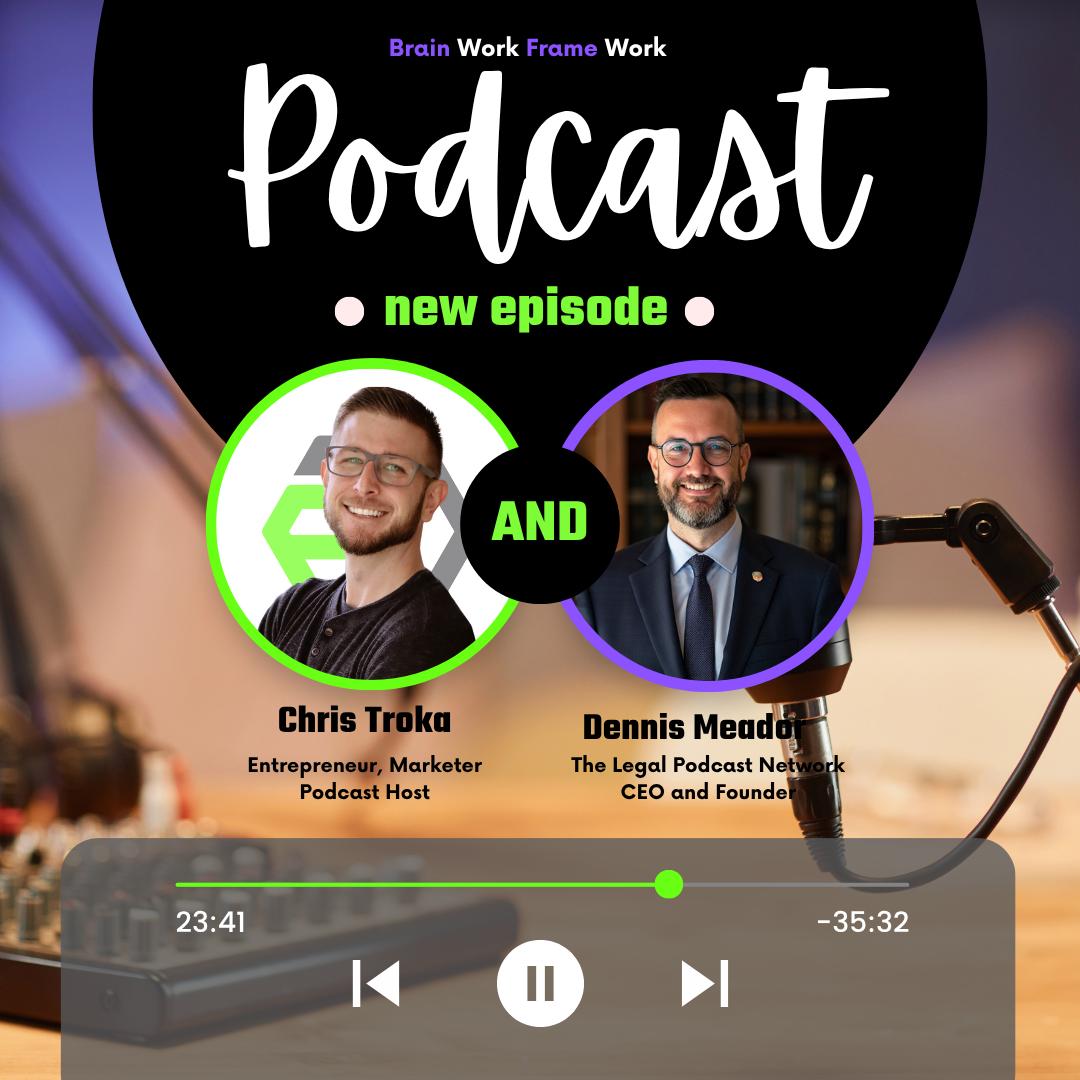
Welcome back to another episode. With us today is the CEO and founder of the Legal Podcast Network, Dennis, AKA DM, Meador. The Legal Podcast Network is a specialized podcast production company designed exclusively for attorneys. Their mission is to help lawyers stand out, build authority, and attract more of their ideal clients through high quality, consistent podcast content. DM, so excited to have you on. How you doing today?
Dennis "DM" Meador (00:55)
Very good. It's a nice day and beautiful Tuesday. and I get to hang out with you, Chris. all around just, I'm
Chris Troka (01:02)
I love it. Great to hear that. We always like to
ask our entrepreneurs, tell us about your journey. What were you doing before that kind of led you into what you're doing today?
Dennis "DM" Meador (01:09)
I've basically been a lifelong entrepreneur. I started at 14, not in marketing, but definitely an entrepreneurial endeavor. And then about 19, I got into marketing, loved it. Didn't go to school for it, actually went to school for theology. By the time I was 23, I believe, I started my first company. It took off, I came up with a concept. Within one year, me and my partner were doing, I think three and a half, almost $4 million.
took off, exploded, and I kind of signed off and ran the business from afar and traveled and kind of saw the world a little bit. And then that's been my journey along the way. I've had an SEO company, I've had lots of little kind of cool, fun ideas that were just things to kind of get me by. I've had some businesses that took off and I sold. My specialty, when I got into digital in 2003, 2005 actually, when I got into digital,
then I actually started working with attorneys because personal injury attorneys were the first movers into the digital market. For me, I found that I loved working with attorneys. I like the logic. I like the fact that they're willing to have a discussion. If you say, well, if you consider this, they don't get mad at you. They're actually willing to have that discussion. I found if I could be logical, if I could come across intelligent, I could do
fairly well with them. And so that's kind of been my main niche. Most of my career is working with the legal industry in marketing. Just before this, I was a partner in an SEO firm for lawyers. And then my contract kind of came up and we didn't renew. And so I launched this May 1st of 2024. Myself, my VA, I bootstrapped this and a guy doing work on the side. Now that VA,
has a department underneath her of three or four other VAs. That guy who was doing this stuff on the side now has almost 40 people, 35, 38 people on his team. And we've got a total of a little over 70 people, 225 or clients. And we put out about 350 episodes a month.
Chris Troka (03:18)
That is incredible. And it's crazy to hear at such an early age, 23, to be making multiple millions. What was that like? Did it feel like you had made it? Like you were early success?
Dennis "DM" Meador (03:31)
I thought I'd figured life out at like 24, 25. Like nobody could tell me a thing. And on top of it, was also like a pastor, a missionary and evangelist. I was like all kinds of leadership, all kinds of the boss. And you you really couldn't tell me much at that time. life has a way of balancing you out. I won't say humbling, although that's definitely what it was. But life has a way of balancing you out. And I'd like to think that in the last 30 years,
Chris Troka (03:33)
Yeah, I would too.
Dennis "DM" Meador (03:55)
or I guess 20 years, I've outgrown that just a little bit. But when you have that huge success at like your early 20s, millions of dollars and you're able to take home hundreds of thousands of dollars a year. And I grew up very poor, like from very, very poor to just poor. That was kind of my two socioeconomic, like when I lived with my mom, very, very poor, moving in with my dad, we were just poor. And then I get out on my own and 19, I think.
From 18 on, I haven't made less than $75,000 a year. And so, you get out in the world and you just, you think you got it figured out.
Chris Troka (04:31)
And with you coming up with that sort of upbringing where you were probably taught more frugal financial habits into kind of having an abundance, has there been a shift in terms of how you kind of look at money, either like money as a tool, but also did your living expenses increase with your wealth or did you try to keep that under control?
Dennis "DM" Meador (04:53)
when I was younger, I saw myself as a conduit. And I began to like start looking at money as more of an energy source versus this thing that you get, because it had come so easy to me. Even like as a teenager, I made my own money. So I had nice clothes and shoes and haircuts and could go out to eat and be on the sports teams and everything, because I had four or five younger kids mowing lawns and running paper routes and I managed it all.
So they did the work, I was the manager. So money always seemed to be easy to me. I also, when I was in my 20s, most of my money went into various church orphanages, building things for ministries and things like that. I've never found a lot of value in things as much as I have experiences. And I try to build my life that way that I can actually
live in the way that I want to live. For example, even though I have a relatively new company last year, as I told you before, I live on an island in Belize. And so that's nice and go out and go to the beach and do all that stuff. And then last year, think around five months, we went to Thailand, we went to Bali, we went to Europe for a while and went to seven, eight countries. that's where I have invested my finances.
is in experiences over big houses, nice cars, things like that. I would say that that upbringing taught me that having money isn't what brings happiness, how you live your life is.
Chris Troka (06:30)
That is very well said, Dennis. And I've seen people struggle with that. Either they're overspending on a lower budget or once they do get that money rolling in, it seems like, the money's burning a hole in their pocket. So they kind of run into some situations where, things aren't aligned as well. But for you specifically, it seems like people not only have issues with money, but kind of like the growth aspect of their business.
How do you go from starting out with just a few clients to validate your concept into the real scaling piece where you have a team and you have hundreds of clients?
Dennis "DM" Meador (07:05)
I've been very fortunate. Most every business that I've taken seriously has just exploded and taken off. I've had three or four companies, this will be my fourth, that I've taken from less than a million to three to five million in one year. So I'm kind of used to that. Actually, if it was slow, I wouldn't know how to handle it. So for me, now I will say this time, every other time I had a partner and I learned a lot of hard life lessons through that,
because I build things in a way where I don't need to be present to run it. So I'd build a product, build a system, train the people, get everything, and then I'd be like, all right, I just need to pay attention to reports now, and then kind of put me in a vulnerable situation with my partners and didn't always end the way that I would have wanted it to. And so now with having this, I didn't have a partner. And
I literally right now could be probably three to five times selling what we're selling. Like I have two sales guys, these guys just sit there, they get fed all day, hot lead this, inbound that, and they're just like converting because we do a lot of, like I do a ton of podcasts, I do a lot of, we do founder led media. So I really put myself out there. I kind of sell who we are, what we're trying to do, what we believe in.
And the scaling part of it, I literally just started less than a month ago, a COO and I could afford it like at first I couldn't afford it. So I just did a little bit of everything myself. And I definitely had some growing pains because on the side of things that I'm great at, everything runs like a top. But on the side of things that I'm not so great at, I was just like, I didn't even know that. And so that's been a big growing pain with this particular one. But
there've been some things in place that have kind of saved our butt, great production value, my team really buys in and cares. And although we fell short in some areas like communication and reporting to our clients initially, once we kind of figured out what was causing friction, we've worked tirelessly to fix that. And now with the right people that have been able to join the team and they have knowledge and a desire to do well in that area, it's starting to shore up. But that definitely was ⁓
a little bit of a growing pain with this particular business.
Chris Troka (09:19)
And there really are pros and cons as far as how you structure your business or who you go into business with. Partnerships can kind of be a challenge because you have, difference of opinions, people work, at different paces and you, you're, seem like a systems and processes guy. you're trying to automate and just run things on autopilot. Whereas another partner feels like being present and just putting in the hours is their production. So you kind of see production value a little bit differently.
Dennis "DM" Meador (09:45)
Right.
Yeah, absolutely. And you talked about that like with partners. One of the people have asked me, what would I recommend like for people who are looking for a partner, especially because I've had a couple of them that it didn't end in the way and it costs a lot of money into my household. And what I tell people is, don't be afraid to really, really vet a partner like, we're kind of crazy as entrepreneurs. We'll like go to lunch with somebody.
and then be like, all right, let's throw in our lives together and like, put our whole families at risk together. And yet like, you're looking for a life partner and you're going to date them. I met my wife and from like, literally when she walked up to the table for our first date, my mind said, there you are. Like I knew I was looking for her. She was the one literally. And we've been together. She, the first night, second, third, fourth night. And then she went home one night.
came back the next day with their dog, and we've been together literally since our first night, one night apart, other than like when we're traveling or whatever. but still, it was two years after we met that we actually got married. And yet the person that we're gonna sit down and make money with, we're gonna cry with, we're gonna have marathon sessions of work with, we're gonna come up against,
people wanting to sue us or whatever else that we come up with. We'll have lunch with them once. So I always tell people like date your business partner, maybe do a three month project with them where it could break off and either benefit both of you together or kind of clip onto whatever you're gonna do business-wise. And like you said, see your workflow, see where the value is. Cause to me, I'm like, okay.
It's not my fault I figured out how to do that in 15 seconds and it takes you 15 hours. if the result is there, the time that it took to get there should be irrelevant in my opinion. And yet some people, find more value in just like, ⁓ I put in, and listen, I've put in my six, like when I was younger, especially like I was all about, like I believed every moment.
must be monetized. And as I've grown, that kind of popped some health things that made me reevaluate kind of how I pace my life. Just picking that partner, we shouldn't be afraid to spend a little bit of time, learn their pacing, learn kind of how they handle things, like you said earlier.
Chris Troka (12:15)
That is so important. What do you think business owners are doing wrong today?
Dennis "DM" Meador (12:20)
I think, is it like 50 % of businesses fail in the first year, 80%, something like that. It's a very high percentage. I wanna say it's 80, but I'm gonna say 50 just to be like super, cause I don't have the stat in front of me. But it's like 50, 50, like up to year five, it's like 50 or 80 or 80. I remember it's like a minuscule percentage that make it to that five year mark. And what I've noticed, and I've had the privilege of doing some like consulting.
some viability consulting, some sales process, development consulting. And where I see more business owners fail than anything else is they just don't get that revenue is king. They are like, I got this great business idea and then they spend six months building a logo, four years building a website, all this crazy stuff, buying equipment, I got it all sitting in their garage. It's one day I'm gonna have this and it's like,
You should have just grabbed a frickin shovel the first day went out and did it and said, okay, I got proof of concept and I'm going to do it more and then build up And obviously if you have financing, it's different. I've always bootstrapped my stuff because I don't like to give away equity. you got that proof of concept. I sold my first hundred clients into this company. I didn't have a salesperson. Matter of fact, one of my salespeople was my appointment center. And he had worked with me in the past and he's like, man, I'd love to work with you. And I was like,
Listen, if you want to come work with me, I'm going to teach you and I'm going to get you to where you can sell because he'd never like been an actual closer. And so I and I said, but when I teach you to sell, it's going to be kind of weird because I don't teach tactics. I don't teach systems. All I teach is how you think. And if you learn to think properly, then you will be a great salesperson. Everything else, all of that, like I don't read sales books, spin selling and
blah blah blah and all this stuff. I don't read those books. I'm just like, just talk to people. Just make it make sense. Just have a logical conversation with them and believe in what you're doing and you're going to put yourself in a good position.
Chris Troka (14:24)
That's probably the best sales advice anyone could ever share with anybody ever. I feel like, yes, people are just focused on, okay, if they say this, I need to say this. Just have a conversation, be a real person, find out the root of the problem and see if you're a good fit. Like you said, if you're a believer in your own product, the selling piece should be easy.
Dennis "DM" Meador (14:42)
Yeah, absolutely. I think that a lot of founders, what they do is they just, they don't take it to market. Or they think, I'll just hire a salesperson, give them 12 % of my money. And they overvalue the idea over actual execution. That's the thing. And it's like, ideas are not worth anything.
They're just like electrical impulses inside your brain. literally, people, I have a million dollar idea. I can't even tell you, you gotta sign an NDA. I'm like, I'm not signing your NDA. Because first of all, like an idea, it has no value unless you're like, some sort of ⁓ Nobel Prize winning scientist who is sitting there solving the physics of the universe. But there's not a lot of people out there like that.
For example, my cousin, when the flushable like clean toilet bowl cleaners came out, he was like, I had that idea three years ago. If I would have done something with it, I would be a millionaire. And I'm like, what would you have done? How would you have done it? Were you going to make a prototype and then like, then send it over to China? And then you were going to get like 500 of them and then like take it to a local store and try to sell it. And then you were going to build a brand. is that what you were doing? Well, no, I just had an idea.
What is that worth? So I think that's what a lot of business owners do is they overvalue their ideas over actual execution, taking it to market, getting in front of clients. I am already...
building my fourth iteration of my product. I started off with the legal podcast network, then it went to 2.0, then it went to what we call ecosystem. So with 2.0, we 10x'd our social media that we built for our clients, and then we started posting it because we were building, producing a show and producing a few assets. And we were saying, here you go, this is some great stuff for you. And they weren't doing anything with it. Or they were, they just throw it up on YouTube, they weren't, just nothing was going on.
And so then I was like, we got to do more. then we 10x the content where daily content goes out. We plug it in, we do up to 10 outlets. And I was like, okay, this is great. And then I was like, all right, what's next? And then we built these two streaming TV channels that actually are available right now, but I'm not quite happy with the look and finish feel of them. But we have a couple of streaming channels, one for attorneys and one from attorneys that you can download like through Roku, Amazon.
And we're doing a guest matching service. have 25 clients in beta where we guest, we help them get on shows. So now we're like, wait a minute, we're not just building a show, we're building an ecosystem. I already know I'm already in talks of the next two things that we're gonna add to this. And so you've got to get out there and listen to your clients and not just listen to your clients, look at your industry. Two years ago, like there was no podcast networks like what I do now.
Like I see pop up, we're a podcast network for financial professionals. We're a podcast network for surgeons. We're a podcast network, like all these like micro, micro niches. But all they're focused on is production and distribution. And I'm like, none of these people benefit by production and distribution. They need marketing. They need ecosystem. They need the opportunity, like with me. Now my attorneys can go, yeah, I have a podcast.
it makes great content for a website, great content for social media. yeah, I also do some guesting on some important shows. ⁓ actually, I have my own stream. I have my own show on a streaming television network. If you download this streaming app on your, know, Roku or Amazon, and our whole thing is building authority, differentiating yourself, showing people that you're not just another, another what? Fill in the blank, lawyer.
and we're launching the authority podcast network as I told you which will mirror because we have all the systems We have a company that literally came to us and we're bolting them on they'll just handle that part of the fulfillment and We'll just keep growing and hopefully that well more than double again is the plan over the next year
Chris Troka (18:46)
I love how through that process you were able to identify some of the missing pieces and the leaks going on with just promotion and distribution. Sure, they had the content and it looked great and the production value was great, but you said something was missing and there has to be more. And with you being systems process focus, you're like, okay, let's dial in. You're reducing or removing friction and then providing value and just delivering on the silver platter like, hey, this is exactly what you need. And I think that's what people want to buy.
Dennis "DM" Meador (19:16)
Well, what I tell my team is, guys, what we do is we sell people what they want so we can give them what they need. And if you have that formula, like, I don't care what industry you're in, if you sell people what they want and give them what they need, like, I don't feel like you can lose. And, you talked about friction and literally our internal company mantra, anybody on my team can tell you this, better, faster, less friction. Internally, externally, product.
clients, marketing, everything. We want it to be better. We want to do it faster and we want less friction in the process in every part possible.
Chris Troka (19:51)
Very well said, definitely appreciate that. Now, DM, where can people find you and connect with you online?
Dennis "DM" Meador (19:58)
Couple different places. So if you're interested in like kind of me as a podcaster, I've done about 125 guest shows. I have a couple of my own shows. As I told you, one of them is an AI animated superhero cartoon. on my own website, that's for my personal brand, right? DMONDEMAND.EXPERT. So that's where you can see me as a podcast guest, podcast host, and podcast network owner.
If you like what we're doing, go to and you think, wow, like maybe this guy could help me with having a podcast and his ecosystem and all this stuff. And hey, I'm happy to talk to you. We were doing authority. So that goes outside of legal. And now we've got legal, obviously kind of I don't want to say I'm locked down, but, we feel very good in that space. It's just very simply thelegalpodcastnetwork.com. or if you want to see the authority side, it's guess what? The
authoritypodcastnetwork.com. keep it simple stupid, right? I don't need this brand that's like essence of authority or whatever, you know what I mean? I'm just me like this is what I do. So that's that's the best way to kind of dig down and connect also LinkedIn like that's like if you want to connect with me personally, I have tons of internet friends.
Chris Troka (20:57)
it.
Dennis "DM" Meador (21:16)
And not the kind that I have to pay for in OnlyFans, real ones, people that I meet and, like have actual, like real sort of connection with. so LinkedIn, very active there, check my inbox, post every day, sometimes three, four, five times a day. And that's grown. We actually see a lot of clients out of that. But those are the three best places, my website, my company website, or LinkedIn.
Chris Troka (21:40)
Wonderful, and we'll have those links available down in the show notes and the description so everyone can get connected here. DM, I wanted to ask you more about, know, kind of more like future focused. What are you looking forward to most in 2026? You have some things in the work, in the works already. You've already built incredible businesses. when are you gonna be, here's my end goal. What's the top of the mountain for you?
Dennis "DM" Meador (22:03)
Top of the Mountain is in five years, 2,500 clients, 30 million a year, basically. that was the plan from day one. I wanted to do it in five to seven years. I think it'll take me closer to seven than five. But really what I want to be, my legacy, is I want people to look back and see what I built and the way I built it. And I want people to say, that guy was like the Henry Ford of professional content. He learned how to do professional content.
at scale that was personalized and actually benefited the people that he worked with. And that's like kind of my desired legacy as far as business goes. My wife, we're having a baby this fall, so there's that. We do travel a lot. I'll be 50 next year. So got a lot of stuff going on like that. We get the chance to travel a lot. even when I travel, I take my laptop, I make sure I have a good internet connection, and I plug in for about an hour or two a day.
Check in on things, check reports, make sure my people are good. Don't do a lot of podcasts while I'm traveling, but other than that, I'm pretty much plugged into everything that's going on. I mean, that's kind of the end goal, the short-term goal. we wanna get these networks out and then the next pieces of my puzzle, and I don't wanna talk about them yet just because the logistics of them and fitting them in, but more things to stack on a thought, I'll just say. One is I'm gonna looking to hire a PR firm where basically,
all of my attorneys and all of my people that are in my authority system, we can, after they've been with us, we could build a sizzle reel and then we just are combing for like local news, local this, local that, and then just being like, hey, here's this guy, here's his sizzle reel, he's available, for this 10 o'clock news segment. Boom, we text him, he jumps on and or she or whatever. So PR and then the next piece that we can bolt on is a book.
So we can use podcasts, they can pull the transcripts and you can use the words of the person from the podcast to build a book pretty easily. There's a couple of systems out there that do it. So these are things I'm looking at. I don't have in place yet, but I really feel like they're kind of the next pieces to the ecosystem to where when people come on, they come in, they start podcasting. And then after they start podcasting, then they start guesting. Then after they start guesting, then We give them the next thing.
And as time progresses, it just builds and builds. And the other thing is like, I don't work with competitors. And what I mean by that is if I have a criminal defense person in Cook County, Chicagoland, like that's my, criminal defense client. I won't work with three of his competitors, like a lot of SEO firms and, especially like directories, they have to work with the competitors because they're trying to show as many options as possible. What I'm trying to show is, Hey,
this attorney, this person, this whatever they do, they are the authority. You can listen to their podcast, you can watch it, you can check out their show, you can see that they've been on all these different news outlets and all these different podcasts. And it's just like puts them head and shoulders above their competition because most professionals have been commoditized in their industry. So I'm trying to come in and say, how do we separate you? This is, I feel like a very good way to do so.
Chris Troka (25:14)
Absolutely, and I love that it follows the natural progression of the authority building because yes, it's like, okay, it needs to happen in steps and layers when it makes sense because you're kind of trying to get the most return on investment, the most leverage, in a way that can scale and that seems to be the perfect fit.
Dennis "DM" Meador (25:31)
Yeah, we have a ton of clients who are like, people come in and they're like, I saw your thing on social media and I checked out your podcast, I listened to a couple of them and I'm ready to work with you. And that's the thing then, the no like trust curve, it bypasses all that. Most professionals, the calls that they get from potential clients right now, from like Google listings and things like that, first question, how much? And there's because,
their industry is commoditized. So for me, if I can take an individual and say, okay, let's just take and just show people because listen, working with attorneys for two decades, here's what they've told me. If I could just get them behind my desk, I tell you what, 80 % conversion rate. Here's the problem. 82 % of people never even come in your office before they wanna hire you. They check you out online, they go to your site, and if they just see that you're Mr. or Ms. Every Attorney,
All things being equal, the only differentiator is cost. So what we're trying to do is say, okay, come here, let's work together. let's take you from, listen, no one cares that you won a mock trial in law school 72 years ago. No one gives a flip about that. But.
They will care that you have a podcast that deals with the and answers the exact problems they have. And they will care that they've seen you on the local news. And they will care that, you know what I mean? Like all the things that we're doing and building with, like they will care. They'll be like, wow, I want that to be my attorney. I want that to be my realtor. I want that to be my insert profession here.
Chris Troka (27:00)
DM, it is so well said. I appreciate you coming on the show to tell us more about your journey, the experience, and everything you've done to grow and scale your business. I wanted to offer you a closing ⁓ argument or anything you want to sign off with to our audience here.
Dennis "DM" Meador (27:16)
Well, you said this is mostly entrepreneurs, things like that. So here's what I would say. A couple of things. One is revenue is king. Remember that. Stop playing with the logo. Stop playing with your website. stop doing busy work so you feel like you accomplished something and get out there and sell your shit. now you can beep that if you wanna keep people don't have to sign in. And then.
The second thing I would say to these entrepreneurs, these business owners is if you really want to stand out, mean, let's talk like, hey, if you're going to let me pitch, I'm a pitch because I believe in what I do. I think I can help you if I've got a spot open because remember I only worked one of each time kind. And if you're a lawyer, I already got 225 markets gone. at the end of the day, you need to do what you
Chris Troka (28:03)
Mm-hmm.
Dennis "DM" Meador (28:07)
what you can to get into revenue and differentiate yourself. Those two things alone, if you could do those two things in your business, the logistics, the customer service, all that stuff, you can work that out pretty easily. But if you're not differentiating yourself and getting revenue in, what are you doing?
Chris Troka (28:26)
Very well said. Diem, thank you so much for joining us and sharing all this wisdom with us. Congratulations and looking forward to your future endeavors as well.
Dennis "DM" Meador (28:34)
Absolutely. Thanks for having me on Chris.
Chris Troka (28:36)
Of course, absolutely.
Welcome back to another episode. With us today is the CEO and founder of the Legal Podcast Network, Dennis, AKA DM, Meador. The Legal Podcast Network is a specialized podcast production company designed exclusively for attorneys. Their mission is to help lawyers stand out, build authority, and attract more of their ideal clients through high quality, consistent podcast content. DM, so excited to have you on. How you doing today?
Dennis "DM" Meador (00:55)
Very good. It's a nice day and beautiful Tuesday. and I get to hang out with you, Chris. all around just, I'm
Chris Troka (01:02)
I love it. Great to hear that. We always like to
ask our entrepreneurs, tell us about your journey. What were you doing before that kind of led you into what you're doing today?
Dennis "DM" Meador (01:09)
I've basically been a lifelong entrepreneur. I started at 14, not in marketing, but definitely an entrepreneurial endeavor. And then about 19, I got into marketing, loved it. Didn't go to school for it, actually went to school for theology. By the time I was 23, I believe, I started my first company. It took off, I came up with a concept. Within one year, me and my partner were doing, I think three and a half, almost $4 million.
took off, exploded, and I kind of signed off and ran the business from afar and traveled and kind of saw the world a little bit. And then that's been my journey along the way. I've had an SEO company, I've had lots of little kind of cool, fun ideas that were just things to kind of get me by. I've had some businesses that took off and I sold. My specialty, when I got into digital in 2003, 2005 actually, when I got into digital,
then I actually started working with attorneys because personal injury attorneys were the first movers into the digital market. For me, I found that I loved working with attorneys. I like the logic. I like the fact that they're willing to have a discussion. If you say, well, if you consider this, they don't get mad at you. They're actually willing to have that discussion. I found if I could be logical, if I could come across intelligent, I could do
fairly well with them. And so that's kind of been my main niche. Most of my career is working with the legal industry in marketing. Just before this, I was a partner in an SEO firm for lawyers. And then my contract kind of came up and we didn't renew. And so I launched this May 1st of 2024. Myself, my VA, I bootstrapped this and a guy doing work on the side. Now that VA,
has a department underneath her of three or four other VAs. That guy who was doing this stuff on the side now has almost 40 people, 35, 38 people on his team. And we've got a total of a little over 70 people, 225 or clients. And we put out about 350 episodes a month.
Chris Troka (03:18)
That is incredible. And it's crazy to hear at such an early age, 23, to be making multiple millions. What was that like? Did it feel like you had made it? Like you were early success?
Dennis "DM" Meador (03:31)
I thought I'd figured life out at like 24, 25. Like nobody could tell me a thing. And on top of it, was also like a pastor, a missionary and evangelist. I was like all kinds of leadership, all kinds of the boss. And you you really couldn't tell me much at that time. life has a way of balancing you out. I won't say humbling, although that's definitely what it was. But life has a way of balancing you out. And I'd like to think that in the last 30 years,
Chris Troka (03:33)
Yeah, I would too.
Dennis "DM" Meador (03:55)
or I guess 20 years, I've outgrown that just a little bit. But when you have that huge success at like your early 20s, millions of dollars and you're able to take home hundreds of thousands of dollars a year. And I grew up very poor, like from very, very poor to just poor. That was kind of my two socioeconomic, like when I lived with my mom, very, very poor, moving in with my dad, we were just poor. And then I get out on my own and 19, I think.
From 18 on, I haven't made less than $75,000 a year. And so, you get out in the world and you just, you think you got it figured out.
Chris Troka (04:31)
And with you coming up with that sort of upbringing where you were probably taught more frugal financial habits into kind of having an abundance, has there been a shift in terms of how you kind of look at money, either like money as a tool, but also did your living expenses increase with your wealth or did you try to keep that under control?
Dennis "DM" Meador (04:53)
when I was younger, I saw myself as a conduit. And I began to like start looking at money as more of an energy source versus this thing that you get, because it had come so easy to me. Even like as a teenager, I made my own money. So I had nice clothes and shoes and haircuts and could go out to eat and be on the sports teams and everything, because I had four or five younger kids mowing lawns and running paper routes and I managed it all.
So they did the work, I was the manager. So money always seemed to be easy to me. I also, when I was in my 20s, most of my money went into various church orphanages, building things for ministries and things like that. I've never found a lot of value in things as much as I have experiences. And I try to build my life that way that I can actually
live in the way that I want to live. For example, even though I have a relatively new company last year, as I told you before, I live on an island in Belize. And so that's nice and go out and go to the beach and do all that stuff. And then last year, think around five months, we went to Thailand, we went to Bali, we went to Europe for a while and went to seven, eight countries. that's where I have invested my finances.
is in experiences over big houses, nice cars, things like that. I would say that that upbringing taught me that having money isn't what brings happiness, how you live your life is.
Chris Troka (06:30)
That is very well said, Dennis. And I've seen people struggle with that. Either they're overspending on a lower budget or once they do get that money rolling in, it seems like, the money's burning a hole in their pocket. So they kind of run into some situations where, things aren't aligned as well. But for you specifically, it seems like people not only have issues with money, but kind of like the growth aspect of their business.
How do you go from starting out with just a few clients to validate your concept into the real scaling piece where you have a team and you have hundreds of clients?
Dennis "DM" Meador (07:05)
I've been very fortunate. Most every business that I've taken seriously has just exploded and taken off. I've had three or four companies, this will be my fourth, that I've taken from less than a million to three to five million in one year. So I'm kind of used to that. Actually, if it was slow, I wouldn't know how to handle it. So for me, now I will say this time, every other time I had a partner and I learned a lot of hard life lessons through that,
because I build things in a way where I don't need to be present to run it. So I'd build a product, build a system, train the people, get everything, and then I'd be like, all right, I just need to pay attention to reports now, and then kind of put me in a vulnerable situation with my partners and didn't always end the way that I would have wanted it to. And so now with having this, I didn't have a partner. And
I literally right now could be probably three to five times selling what we're selling. Like I have two sales guys, these guys just sit there, they get fed all day, hot lead this, inbound that, and they're just like converting because we do a lot of, like I do a ton of podcasts, I do a lot of, we do founder led media. So I really put myself out there. I kind of sell who we are, what we're trying to do, what we believe in.
And the scaling part of it, I literally just started less than a month ago, a COO and I could afford it like at first I couldn't afford it. So I just did a little bit of everything myself. And I definitely had some growing pains because on the side of things that I'm great at, everything runs like a top. But on the side of things that I'm not so great at, I was just like, I didn't even know that. And so that's been a big growing pain with this particular one. But
there've been some things in place that have kind of saved our butt, great production value, my team really buys in and cares. And although we fell short in some areas like communication and reporting to our clients initially, once we kind of figured out what was causing friction, we've worked tirelessly to fix that. And now with the right people that have been able to join the team and they have knowledge and a desire to do well in that area, it's starting to shore up. But that definitely was ⁓
a little bit of a growing pain with this particular business.
Chris Troka (09:19)
And there really are pros and cons as far as how you structure your business or who you go into business with. Partnerships can kind of be a challenge because you have, difference of opinions, people work, at different paces and you, you're, seem like a systems and processes guy. you're trying to automate and just run things on autopilot. Whereas another partner feels like being present and just putting in the hours is their production. So you kind of see production value a little bit differently.
Dennis "DM" Meador (09:45)
Right.
Yeah, absolutely. And you talked about that like with partners. One of the people have asked me, what would I recommend like for people who are looking for a partner, especially because I've had a couple of them that it didn't end in the way and it costs a lot of money into my household. And what I tell people is, don't be afraid to really, really vet a partner like, we're kind of crazy as entrepreneurs. We'll like go to lunch with somebody.
and then be like, all right, let's throw in our lives together and like, put our whole families at risk together. And yet like, you're looking for a life partner and you're going to date them. I met my wife and from like, literally when she walked up to the table for our first date, my mind said, there you are. Like I knew I was looking for her. She was the one literally. And we've been together. She, the first night, second, third, fourth night. And then she went home one night.
came back the next day with their dog, and we've been together literally since our first night, one night apart, other than like when we're traveling or whatever. but still, it was two years after we met that we actually got married. And yet the person that we're gonna sit down and make money with, we're gonna cry with, we're gonna have marathon sessions of work with, we're gonna come up against,
people wanting to sue us or whatever else that we come up with. We'll have lunch with them once. So I always tell people like date your business partner, maybe do a three month project with them where it could break off and either benefit both of you together or kind of clip onto whatever you're gonna do business-wise. And like you said, see your workflow, see where the value is. Cause to me, I'm like, okay.
It's not my fault I figured out how to do that in 15 seconds and it takes you 15 hours. if the result is there, the time that it took to get there should be irrelevant in my opinion. And yet some people, find more value in just like, ⁓ I put in, and listen, I've put in my six, like when I was younger, especially like I was all about, like I believed every moment.
must be monetized. And as I've grown, that kind of popped some health things that made me reevaluate kind of how I pace my life. Just picking that partner, we shouldn't be afraid to spend a little bit of time, learn their pacing, learn kind of how they handle things, like you said earlier.
Chris Troka (12:15)
That is so important. What do you think business owners are doing wrong today?
Dennis "DM" Meador (12:20)
I think, is it like 50 % of businesses fail in the first year, 80%, something like that. It's a very high percentage. I wanna say it's 80, but I'm gonna say 50 just to be like super, cause I don't have the stat in front of me. But it's like 50, 50, like up to year five, it's like 50 or 80 or 80. I remember it's like a minuscule percentage that make it to that five year mark. And what I've noticed, and I've had the privilege of doing some like consulting.
some viability consulting, some sales process, development consulting. And where I see more business owners fail than anything else is they just don't get that revenue is king. They are like, I got this great business idea and then they spend six months building a logo, four years building a website, all this crazy stuff, buying equipment, I got it all sitting in their garage. It's one day I'm gonna have this and it's like,
You should have just grabbed a frickin shovel the first day went out and did it and said, okay, I got proof of concept and I'm going to do it more and then build up And obviously if you have financing, it's different. I've always bootstrapped my stuff because I don't like to give away equity. you got that proof of concept. I sold my first hundred clients into this company. I didn't have a salesperson. Matter of fact, one of my salespeople was my appointment center. And he had worked with me in the past and he's like, man, I'd love to work with you. And I was like,
Listen, if you want to come work with me, I'm going to teach you and I'm going to get you to where you can sell because he'd never like been an actual closer. And so I and I said, but when I teach you to sell, it's going to be kind of weird because I don't teach tactics. I don't teach systems. All I teach is how you think. And if you learn to think properly, then you will be a great salesperson. Everything else, all of that, like I don't read sales books, spin selling and
blah blah blah and all this stuff. I don't read those books. I'm just like, just talk to people. Just make it make sense. Just have a logical conversation with them and believe in what you're doing and you're going to put yourself in a good position.
Chris Troka (14:24)
That's probably the best sales advice anyone could ever share with anybody ever. I feel like, yes, people are just focused on, okay, if they say this, I need to say this. Just have a conversation, be a real person, find out the root of the problem and see if you're a good fit. Like you said, if you're a believer in your own product, the selling piece should be easy.
Dennis "DM" Meador (14:42)
Yeah, absolutely. I think that a lot of founders, what they do is they just, they don't take it to market. Or they think, I'll just hire a salesperson, give them 12 % of my money. And they overvalue the idea over actual execution. That's the thing. And it's like, ideas are not worth anything.
They're just like electrical impulses inside your brain. literally, people, I have a million dollar idea. I can't even tell you, you gotta sign an NDA. I'm like, I'm not signing your NDA. Because first of all, like an idea, it has no value unless you're like, some sort of ⁓ Nobel Prize winning scientist who is sitting there solving the physics of the universe. But there's not a lot of people out there like that.
For example, my cousin, when the flushable like clean toilet bowl cleaners came out, he was like, I had that idea three years ago. If I would have done something with it, I would be a millionaire. And I'm like, what would you have done? How would you have done it? Were you going to make a prototype and then like, then send it over to China? And then you were going to get like 500 of them and then like take it to a local store and try to sell it. And then you were going to build a brand. is that what you were doing? Well, no, I just had an idea.
What is that worth? So I think that's what a lot of business owners do is they overvalue their ideas over actual execution, taking it to market, getting in front of clients. I am already...
building my fourth iteration of my product. I started off with the legal podcast network, then it went to 2.0, then it went to what we call ecosystem. So with 2.0, we 10x'd our social media that we built for our clients, and then we started posting it because we were building, producing a show and producing a few assets. And we were saying, here you go, this is some great stuff for you. And they weren't doing anything with it. Or they were, they just throw it up on YouTube, they weren't, just nothing was going on.
And so then I was like, we got to do more. then we 10x the content where daily content goes out. We plug it in, we do up to 10 outlets. And I was like, okay, this is great. And then I was like, all right, what's next? And then we built these two streaming TV channels that actually are available right now, but I'm not quite happy with the look and finish feel of them. But we have a couple of streaming channels, one for attorneys and one from attorneys that you can download like through Roku, Amazon.
And we're doing a guest matching service. have 25 clients in beta where we guest, we help them get on shows. So now we're like, wait a minute, we're not just building a show, we're building an ecosystem. I already know I'm already in talks of the next two things that we're gonna add to this. And so you've got to get out there and listen to your clients and not just listen to your clients, look at your industry. Two years ago, like there was no podcast networks like what I do now.
Like I see pop up, we're a podcast network for financial professionals. We're a podcast network for surgeons. We're a podcast network, like all these like micro, micro niches. But all they're focused on is production and distribution. And I'm like, none of these people benefit by production and distribution. They need marketing. They need ecosystem. They need the opportunity, like with me. Now my attorneys can go, yeah, I have a podcast.
it makes great content for a website, great content for social media. yeah, I also do some guesting on some important shows. ⁓ actually, I have my own stream. I have my own show on a streaming television network. If you download this streaming app on your, know, Roku or Amazon, and our whole thing is building authority, differentiating yourself, showing people that you're not just another, another what? Fill in the blank, lawyer.
and we're launching the authority podcast network as I told you which will mirror because we have all the systems We have a company that literally came to us and we're bolting them on they'll just handle that part of the fulfillment and We'll just keep growing and hopefully that well more than double again is the plan over the next year
Chris Troka (18:46)
I love how through that process you were able to identify some of the missing pieces and the leaks going on with just promotion and distribution. Sure, they had the content and it looked great and the production value was great, but you said something was missing and there has to be more. And with you being systems process focus, you're like, okay, let's dial in. You're reducing or removing friction and then providing value and just delivering on the silver platter like, hey, this is exactly what you need. And I think that's what people want to buy.
Dennis "DM" Meador (19:16)
Well, what I tell my team is, guys, what we do is we sell people what they want so we can give them what they need. And if you have that formula, like, I don't care what industry you're in, if you sell people what they want and give them what they need, like, I don't feel like you can lose. And, you talked about friction and literally our internal company mantra, anybody on my team can tell you this, better, faster, less friction. Internally, externally, product.
clients, marketing, everything. We want it to be better. We want to do it faster and we want less friction in the process in every part possible.
Chris Troka (19:51)
Very well said, definitely appreciate that. Now, DM, where can people find you and connect with you online?
Dennis "DM" Meador (19:58)
Couple different places. So if you're interested in like kind of me as a podcaster, I've done about 125 guest shows. I have a couple of my own shows. As I told you, one of them is an AI animated superhero cartoon. on my own website, that's for my personal brand, right? DMONDEMAND.EXPERT. So that's where you can see me as a podcast guest, podcast host, and podcast network owner.
If you like what we're doing, go to and you think, wow, like maybe this guy could help me with having a podcast and his ecosystem and all this stuff. And hey, I'm happy to talk to you. We were doing authority. So that goes outside of legal. And now we've got legal, obviously kind of I don't want to say I'm locked down, but, we feel very good in that space. It's just very simply thelegalpodcastnetwork.com. or if you want to see the authority side, it's guess what? The
authoritypodcastnetwork.com. keep it simple stupid, right? I don't need this brand that's like essence of authority or whatever, you know what I mean? I'm just me like this is what I do. So that's that's the best way to kind of dig down and connect also LinkedIn like that's like if you want to connect with me personally, I have tons of internet friends.
Chris Troka (20:57)
it.
Dennis "DM" Meador (21:16)
And not the kind that I have to pay for in OnlyFans, real ones, people that I meet and, like have actual, like real sort of connection with. so LinkedIn, very active there, check my inbox, post every day, sometimes three, four, five times a day. And that's grown. We actually see a lot of clients out of that. But those are the three best places, my website, my company website, or LinkedIn.
Chris Troka (21:40)
Wonderful, and we'll have those links available down in the show notes and the description so everyone can get connected here. DM, I wanted to ask you more about, know, kind of more like future focused. What are you looking forward to most in 2026? You have some things in the work, in the works already. You've already built incredible businesses. when are you gonna be, here's my end goal. What's the top of the mountain for you?
Dennis "DM" Meador (22:03)
Top of the Mountain is in five years, 2,500 clients, 30 million a year, basically. that was the plan from day one. I wanted to do it in five to seven years. I think it'll take me closer to seven than five. But really what I want to be, my legacy, is I want people to look back and see what I built and the way I built it. And I want people to say, that guy was like the Henry Ford of professional content. He learned how to do professional content.
at scale that was personalized and actually benefited the people that he worked with. And that's like kind of my desired legacy as far as business goes. My wife, we're having a baby this fall, so there's that. We do travel a lot. I'll be 50 next year. So got a lot of stuff going on like that. We get the chance to travel a lot. even when I travel, I take my laptop, I make sure I have a good internet connection, and I plug in for about an hour or two a day.
Check in on things, check reports, make sure my people are good. Don't do a lot of podcasts while I'm traveling, but other than that, I'm pretty much plugged into everything that's going on. I mean, that's kind of the end goal, the short-term goal. we wanna get these networks out and then the next pieces of my puzzle, and I don't wanna talk about them yet just because the logistics of them and fitting them in, but more things to stack on a thought, I'll just say. One is I'm gonna looking to hire a PR firm where basically,
all of my attorneys and all of my people that are in my authority system, we can, after they've been with us, we could build a sizzle reel and then we just are combing for like local news, local this, local that, and then just being like, hey, here's this guy, here's his sizzle reel, he's available, for this 10 o'clock news segment. Boom, we text him, he jumps on and or she or whatever. So PR and then the next piece that we can bolt on is a book.
So we can use podcasts, they can pull the transcripts and you can use the words of the person from the podcast to build a book pretty easily. There's a couple of systems out there that do it. So these are things I'm looking at. I don't have in place yet, but I really feel like they're kind of the next pieces to the ecosystem to where when people come on, they come in, they start podcasting. And then after they start podcasting, then they start guesting. Then after they start guesting, then We give them the next thing.
And as time progresses, it just builds and builds. And the other thing is like, I don't work with competitors. And what I mean by that is if I have a criminal defense person in Cook County, Chicagoland, like that's my, criminal defense client. I won't work with three of his competitors, like a lot of SEO firms and, especially like directories, they have to work with the competitors because they're trying to show as many options as possible. What I'm trying to show is, Hey,
this attorney, this person, this whatever they do, they are the authority. You can listen to their podcast, you can watch it, you can check out their show, you can see that they've been on all these different news outlets and all these different podcasts. And it's just like puts them head and shoulders above their competition because most professionals have been commoditized in their industry. So I'm trying to come in and say, how do we separate you? This is, I feel like a very good way to do so.
Chris Troka (25:14)
Absolutely, and I love that it follows the natural progression of the authority building because yes, it's like, okay, it needs to happen in steps and layers when it makes sense because you're kind of trying to get the most return on investment, the most leverage, in a way that can scale and that seems to be the perfect fit.
Dennis "DM" Meador (25:31)
Yeah, we have a ton of clients who are like, people come in and they're like, I saw your thing on social media and I checked out your podcast, I listened to a couple of them and I'm ready to work with you. And that's the thing then, the no like trust curve, it bypasses all that. Most professionals, the calls that they get from potential clients right now, from like Google listings and things like that, first question, how much? And there's because,
their industry is commoditized. So for me, if I can take an individual and say, okay, let's just take and just show people because listen, working with attorneys for two decades, here's what they've told me. If I could just get them behind my desk, I tell you what, 80 % conversion rate. Here's the problem. 82 % of people never even come in your office before they wanna hire you. They check you out online, they go to your site, and if they just see that you're Mr. or Ms. Every Attorney,
All things being equal, the only differentiator is cost. So what we're trying to do is say, okay, come here, let's work together. let's take you from, listen, no one cares that you won a mock trial in law school 72 years ago. No one gives a flip about that. But.
They will care that you have a podcast that deals with the and answers the exact problems they have. And they will care that they've seen you on the local news. And they will care that, you know what I mean? Like all the things that we're doing and building with, like they will care. They'll be like, wow, I want that to be my attorney. I want that to be my realtor. I want that to be my insert profession here.
Chris Troka (27:00)
DM, it is so well said. I appreciate you coming on the show to tell us more about your journey, the experience, and everything you've done to grow and scale your business. I wanted to offer you a closing ⁓ argument or anything you want to sign off with to our audience here.
Dennis "DM" Meador (27:16)
Well, you said this is mostly entrepreneurs, things like that. So here's what I would say. A couple of things. One is revenue is king. Remember that. Stop playing with the logo. Stop playing with your website. stop doing busy work so you feel like you accomplished something and get out there and sell your shit. now you can beep that if you wanna keep people don't have to sign in. And then.
The second thing I would say to these entrepreneurs, these business owners is if you really want to stand out, mean, let's talk like, hey, if you're going to let me pitch, I'm a pitch because I believe in what I do. I think I can help you if I've got a spot open because remember I only worked one of each time kind. And if you're a lawyer, I already got 225 markets gone. at the end of the day, you need to do what you
Chris Troka (28:03)
Mm-hmm.
Dennis "DM" Meador (28:07)
what you can to get into revenue and differentiate yourself. Those two things alone, if you could do those two things in your business, the logistics, the customer service, all that stuff, you can work that out pretty easily. But if you're not differentiating yourself and getting revenue in, what are you doing?
Chris Troka (28:26)
Very well said. Diem, thank you so much for joining us and sharing all this wisdom with us. Congratulations and looking forward to your future endeavors as well.
Dennis "DM" Meador (28:34)
Absolutely. Thanks for having me on Chris.
Chris Troka (28:36)
Of course, absolutely.
