

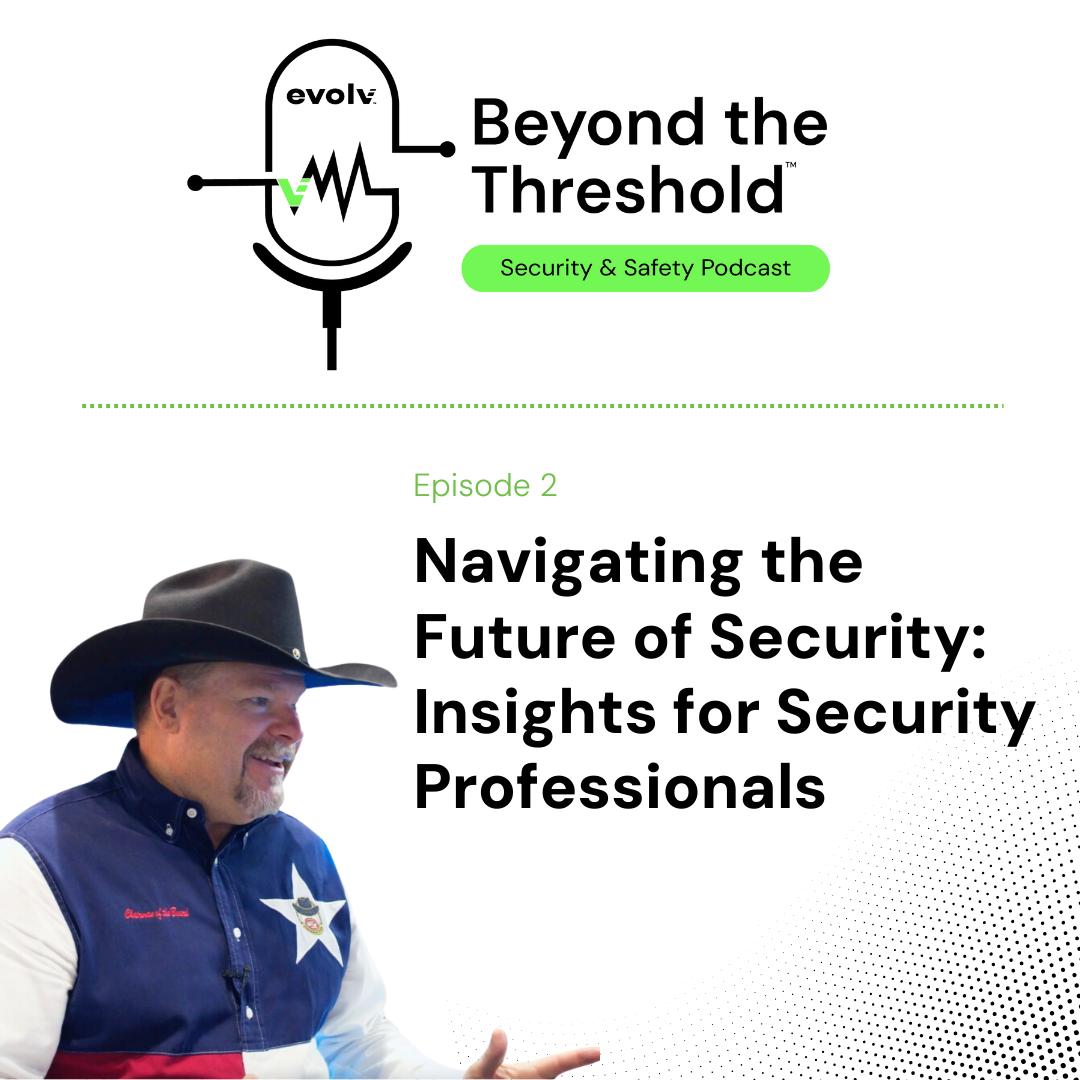
Welcome to Beyond the Threshold™, the podcast where we explore the evolving landscape of security across schools, sports, healthcare, cities, and beyond. Every episode, we dive into the challenges and innovations that shape how we protect our communities.
This episode was recorded during GSX Orlando twenty twenty four and hosted by Evolv co founder Anil Chitkara. He's joined with Chuck Andrews, founder of the Professional Security Network group, Friends of Chuck.
Chuck. Yeah. It's great to see you. Good to see you.
First of all, another great Texas Night on Sunday.
Well, that Tell us about Texas Night. Oh my gosh. Well, first off, thank you guys for title sponsorship two years in a row. Yeah.
We greatly appreciate Evolv coming and stepping up. It was tremendously successful. Sold out. Sold out.
Absolutely sold out. So that's all you gotta say.
Yeah. And I think it's having been there last year and this year, it's such a great way to get started for the conference. People are excited. They're coming into town. They're seeing people they haven't seen for a while.
Yeah.
Right?
Seeing some new technologies a little bit, right, a little taste before we really started the show.
Absolutely. And, boy, what a great kickoff it was. Everybody looks forward to it. Now the lines were long Yep.
And I let everybody know. Right? It was gonna be crazy. But, yeah, I think this is something everybody looks forward to every year.
And, again, thank you guys for doing that.
Absolutely. No. We we we're proud to do it. We appreciate it. Most importantly, getting security people together.
So one of the things I'm interested in is you've been doing Texas night for ten or eleven years. You've been in the security industry for a number of decades. Yes. What have you seen over time?
If you think back to some of the earlier days, then maybe post nine eleven, and then today, sort of how have things changed over time?
Well, listen. Guns, gates, and guards are still around, but we're evolving, if you will, to bigger and better things. Yeah. And look.
Technology, it has to be incorporated in everything that we're doing. Two letters going on, all the buzz, AI. Yep. Artificial intelligence.
Putting that information, putting it forward, putting it on the front of the camera Yeah. Right? So good decisions can be made. We're gonna continue to see technology in leaps and bounds.
The velocity is gonna look like this, and people are gonna have to incorporate that into their security strategy and plans going forward.
Right. And you walk around the show floor. There's a lot of AI as you said. How do we figure out which ones are sort of real AI doing solving real problems for customers and stuff that's just marketing?
In my world, it's about where the rubber meets the road, testing and research, and then application for different environments, different groups, campuses, assets. You actually have to go out there and test it and make sure that it's doing what it's supposed to do in that particular atmosphere. That's my recommendation to people.
Right. And as we think about the threats and how they're changing, certainly, there's a lot of discussion with the election and the potential violence related to that during or even after. What does the threat environment look like for these venues? These are schools. These are hospitals. These are sports stadiums, organizations, events. Can you give us a picture?
That is that's a whole day conversation. But let me say this. So the world is becoming less tolerant. And when there's less tolerance, people want to act out, if you were. We're going to see more and more of that. I will just make that forecast and prediction right now.
Things are changing so fast. People don't like change. And depending on which side of the fence that you are on, people are going to react and react emotionally.
One of the reasons the security industry is booming the way that it is is to help address that through prevention, right, and proper reaction or some type of mediation right in the middle of what's going to happen or potentially happen. We're gonna see more and more of this as as it's happening because the world's changing quickly. And I'm about to say not in a good way. Right.
So it's a dynamic world. Threats are changing.
It's happening very quickly. So as a chief security officer, as a head of security for an organization, how do they look at all this technology, think about the people they have, and think about these threats and decide where to prioritize?
Because it is growing fast, but there's only so many resources and only so much Listen.
We gotta go back to research and testing, testing, testing.
Take look. If if if I was a chief security officer, so I can say this. What did I do? I had different groups and vendors and technologies come to me and writing everybody wants their stuff, right, to be purchased by the chief security officer.
That chief security officer, in my case, would take this and actually pilot it and test it to make sure that it works for the environment. Let it prove itself out. I call it the great bake off. Right?
Yeah. Because everyone has a little piece, a little different nuances to what they need. But, again, research and testing, research and testing. I'm big on that.
We think the best organizations, the best customers are the most informed. Fully understand what our technology does, the other technologies do, and understand what the fit is for them. Right? Not every technology fits everywhere.
So Correct. Exactly where you're getting. Test, evaluate, talk to others, other customers, other security professionals, local law enforcement. What's worked?
What have you seen? Really to understand and be fully informed when they decide to do something. Because it is important. It's another layer.
It's another set of expense. It impacts either security team or others as well.
Yeah. Very you're spot you're spot on. I can't say that enough. A bake off is the only way to go.
It's always successful because, listen, walk the walk and talk the talk as we say in Texas. So put it out there and let's test it and let's see. Right? But you're right.
CSOs need information.
And they don't have a whole lot of time, but they need to invest the time to make sure it's the right tool to protect their people and their assets.
So now let's talk about security professionals, security operators, the individuals.
They're, faced with all these challenges.
They wanna continue to be at the forefront of security. What's your advice for them on what kinds of information to look at, what kinds of skills to build? Like, how do they advance their own capabilities as an individual security operator or security professional?
So, obviously, there's education, there's experience, and then there's credentials, right, as part of that. So depending on which vertical or discipline they wanna work in in the security industry dictates the type of certification that they want to actually pursue and be able to apply in their new role, whatever role that happens to be at. You know, ASIS, IFPO, and other organizations offer these certifications that people can take advantage of so they can grow, right, to do the things that they want to do in the security industry. That's my recommendation where you start is there's two examples of organizations you should look at for those certifications.
Now I wanna turn a little bit to you. So you have a book that's out. It's gotten very popular.
You have a foundation. I wanna hear about each of those. And why do you think the book is being popular? What messages are really resonating with people out there?
So I think the book is popular because first off, it's only a hundred pages, so it's an easy read. Yep. Right? And the things that I wrote in there are actionable.
The name of the book is Yes, sir. SIRs and acronyms, Strategy, intelligence, and relationships. That's everything that's happening right here. And if you're in business, doesn't matter which side you're on and you wanna become the very best security person that you can become or become an influencer, these are the things you need to apply.
Strategy requires intelligence.
Relationships give you the intelligence to make the strategy. Everything is interoperable. This is why the book has been very popular. Great.
And then you do a lot of good work, a lot of foundation work, a lot of good for others. Do you That's right.
A little bit about what you're trying to do there and and how others can help.
So there's groups like the ASIS Foundation that you can get involved with and other communities within ASIS.
I happen to sit on the gratitude initiative, which is outside of the security industry, but we help all the children of law enforcement as well as military around the world. Something very unique. And as the chairperson of that advisory board, these things are important to me of the many groups and boards that I sit on in order to give back in everything that we do.
Good. And we're gonna wrap up this show this week, but it's not the end. There's more coming. What do you see coming in the US? What do you see coming internationally? What are you excited about over the next year?
Well, I'm excited about something I'm very biased about because I'm doing something never done in the world. I'm doing the world's first hashtag security cruise twenty twenty five. Alright. That's gonna happen in October of twenty twenty five.
Nobody's ever done it. So we're gonna put everybody on a ship out of the port of Galveston, and off we go into international waters to make great friends and networking, relationships, and training and education, and they're gonna get CEUs for that. That's what I'm excited about. SIR model.
The follow of the SIR model.
Love it.
Yeah. Absolutely. Awesome. And anything internationally, Chuck?
So, yeah, I think coming up, you're gonna find Friends of Chuck in Dublin, Ireland for the twenty twenty five ASIS International European Conference.
I will be there. I'm looking forward to being there. I love going to Europe and being able to participate and get different perspectives of how security is managed and handled and approached. So I encourage people, get outside of your borders and see how they're doing things somewhere else, and then bring that knowledge back. Long time ago in nineteen eighty five, I had the opportunity to study in Germany and West it was West Germany at the time, and I got to study the criminal justice systems of five different countries and bring that knowledge back. I attribute that to a lot of my success because it gave me perspective, contrast, and context different from what we're doing in the US, and it opens your mind to new opportunities to do your job better in security.
Keep on learning. Keep on hearing. Always. Holding that into your own security.
It's a lifelong evergreen process learning. Right.
Over the years, we've seen government and the public sector really focus on certain aspects of security. We've also seen the private sector focus on certain aspects of security. Why is it important for these two to work together, and what can come of that if there's a true collaboration?
So listen. We're all in it for the same end game, protecting the community, the public, businesses, assets, all of us together. It's incredibly important that law enforcement and private security work together and collaborate. Big part of that is communication.
Right? And be able to work together because in the end, we have the exact same objective. We have to have more of that. And with the rise of security and its growth right now, it's almost force measuring law enforcement to work with security and collaborate.
And whether it's an event, a major event of the case, as the case would be, or it could be something that is going on in the government sponsored or community event, you're still gonna have security. Remember, for every one uniform officer, there's probably a hundred uniform security officers. So who is the benefactor? Where does the responsibility that lays with the government agency to make sure they're collaborating on the private with private security out there in the field and working together.
This is critical. Very critical.
Both at the local level, local law enforcement Yep. And state and federal level.
Local, county, state, federal, and then all the other groups, constables, offices, everybody working together. There's sixteen thousand something law enforcement agencies in the United States, and each one of them needs to really set up a report. ASIS has actually worked on this to set up, you know, law enforcement private security initiative.
I'm gonna give you a good example. So in Harris County in Houston, we have something called LEAPS, law enforcement and private security. So the sheriff's office, actually put a program together free of charge and brought in any security officer in the entire county. That is thousands and thousands. Bring them in and train them exactly what we're talking about. And they end up getting credentials to wear on their uniform. Security officer who's usually on scene before a sheriff's deputy or police officer makes a scene, teaches them what to do, what not to do, how to communicate.
This is the kind of thing that we have to formally put together as an example. Great. Chuck, thank you. Yes.
Thank you for the opportunity to be directly working with you, but more importantly, all the good work you do to keep everybody safe. We really do appreciate it.
You're very welcome, and thank you again for being the title sponsor for Texas Night 2024. Absolutely.
Thank you for listening to Beyond the Threshold.
If you enjoyed this conversation, be sure to subscribe and share the podcast with others who care about creating safer communities.
Stay tuned for more expert insights and thought provoking discussions in our next episode.
Until then, thanks for going beyond the threshold with us. Stay safe.
