


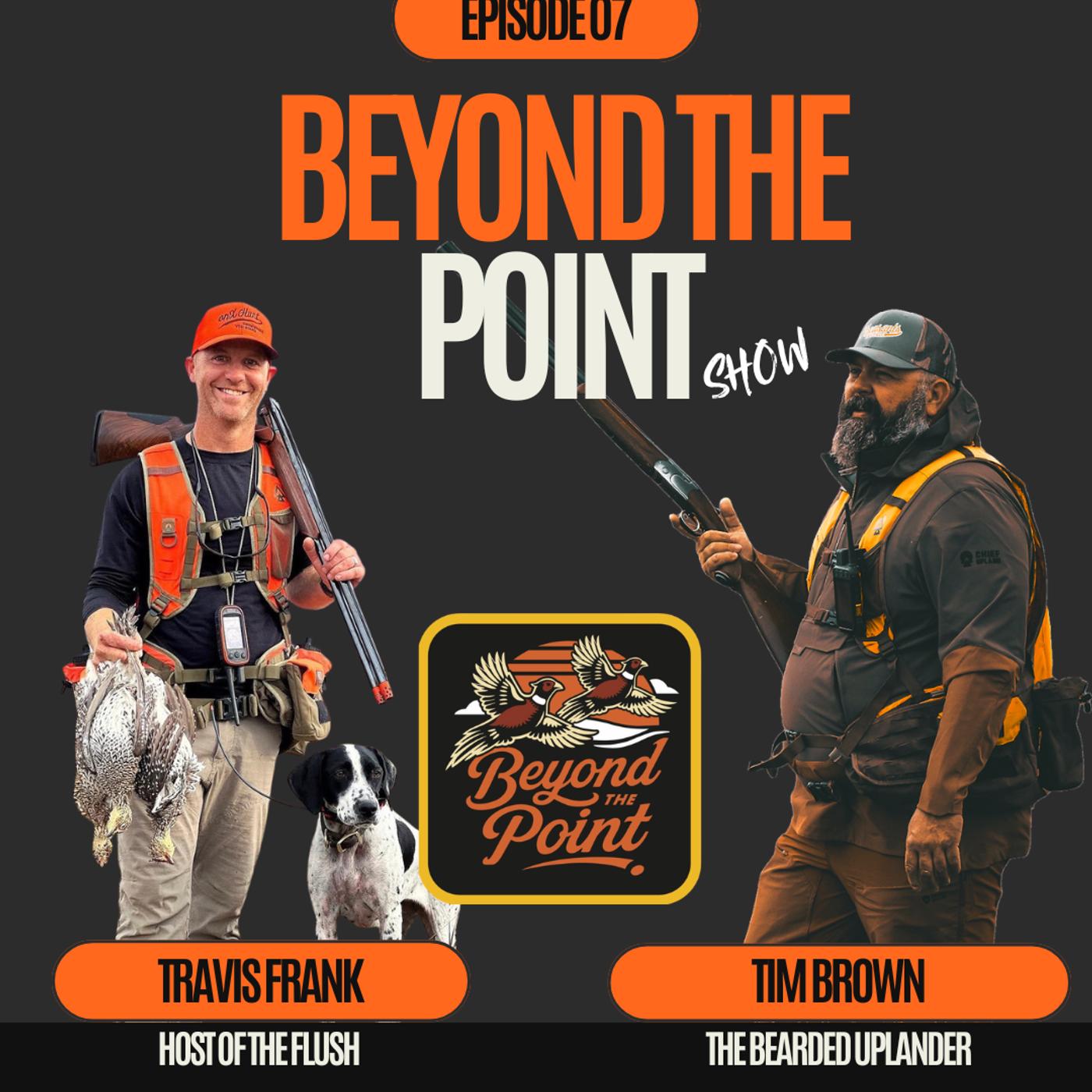
Tim Brown: Hey guys, hope everybody's having a good time. Tim Brown, the bearded uplander here. Before we get into this episode with Travis Frank, the host of one of the hosts of The Flush, I wanted to thank everybody for coming over to the Patreon page and showing the love. we're gonna have some cool things that are coming to the Patreon page. One, my pheasant counts for northwest Iowa. Two, each month, somebody's gonna get in. Or somebody's gonna win something free. Everybody that's a Patreon member, no matter which tier you're on, you're gonna get in for the giveaway and somebody's gonna win something every month. I don't know if it's gonna be something from me. It could be something from, you know, the partners that I have. I I'm just gonna surprise somebody with something cool each month. And yeah, so just go over to Patreon slash the bearded uplander company and go ahead and subscribe to that. And you know what? Season's almost here, guys. We're getting there. Here comes the episode I did with Travis. I start I started it already, but yeah, we can we can get.
Travis Frank: to? okay. We're already recording.
Tim Brown: We can get Yeah, I recorded it just to have a little backfill if we need to. But yeah, welcome everybody back to the Beyond the Point show. I'm your host, Tim Brown. Good Lord, my phone's going off. And I've got a really good friend of mine on Travis Frank from the flush. He really doesn't need any introduction. Everybody knows him. He's our
Travis Frank: That's not true.
Tim Brown: he's our favorite pheasant hunting host. Not Scott, it's not Scott. It's definitely not Scott.
Travis Frank: Well, I don't know if pheasant hunting hosts is the right way because we just got
Tim Brown: That's true, that's true.
Travis Frank: some listener mail the other day saying why don't you
Tim Brown: no.
Travis Frank: guys hunt pheasants anymore? What the hell? Alex, you have it over there.
Tim Brown: Are you kidding me?
Travis Frank: I don't have that exact one, but I have the one this subject of this mail Tim is not sure if you listen to the episode from last week, but it says it's your fault. You at least owe me an explanation. That was a subject. That
Tim Brown: my goodness.
Travis Frank: was a different one. But that's the subject. Well, because RoosterTales, they expect it to be all as in hunting, which and
Tim Brown: sure.
Travis Frank: then I had to explain it's it's called RoosterTales. But that was back when the the show was a spinoff of pheasants forever television, which we changed the name of that show to the flush. And then we didn't change Brewster Tales. So the the gentleman that wrote in was disappointed that we were hunting sharp tail grouse and Hungarian partridge and rough grouse and he had still yet to see a pheasant hunting episode for shows into the season. And there's pheasant hunting as well, but not
Tim Brown: Yeah.
Travis Frank: strictly pheasant hunting.
Tim Brown: So when you guys are doing that, like when you guys are sitting down and brainstorming, does that ever come into like your guys's head when you're figuring out what hunts you want to do? Like, we got to have so many be this we got to have so maybe this or you guys just go for whatever is entertaining and whatever you think is going to be, you know, good to watch.
Travis Frank: Well, the flush is on a it's on the outdoor channel. So that's a national network. Anybody can watch it anywhere in the country. And then it's also on wild TV up in Canada. So my goal is always to produce a season of variety that we can touch north, south, east, west and places in
Tim Brown: Right.
Travis Frank: between. Obviously, we're in Minnesota here, heavy bird country, Minnesota, Dakotas, Iowa, Kansas, in Montana. I mean, those are kind of like your, your core areas. So we want to focus a fair out on our core areas, but also get out and find, you know, bird hunting adventures that exist in Maine and Florida and in Arizona and Alaska and places in between so
Tim Brown: Yeah.
Travis Frank: that we're we're showing a variety of birds, a variety of places a little something for everybody, we hope. And the variety has been a key for our viewers they tell us because I'm always asking people like what do want to watch? What do you want to see? And they like pheasants. They really like ruff grouse. They like the variety of seeing some of the other birds in some pretty cool places. You know, so the the mixes is something that we aim for. Plus, our
Tim Brown: Right.
Travis Frank: hunting season is so short. I mean, it's coming up here, but we can only be in one place at one time. So, you know, we can't do a ton of October, November places, just because there's only certain days in October, November.
Tim Brown: Yeah.
Travis Frank: So we spread it out starting in September, all the way through January, we film.
Tim Brown: Yeah. What makes you think that, you know, everybody wants to see Ruff Grouse just because it's the king? It's legitimately probably the hardest bird to get on film.
Travis Frank: the most widely it is Yeah, it's hard to get on film but it is the most widely distributed upland game bird in North America. And that means that people have access to hunt for that bird all over
Tim Brown: Right.
Travis Frank: the place in North America, East, North, all through Canada, and mountains in the West. Obviously here in Minnesota, Wisconsin, Michigan, and we have a lot of bird hunters in Minnesota, Wisconsin and Michigan. And they like to see the king and they like to hunt the king. So it's a very, very popular bird. And the other part about that bird Let's be honest, most people know where a pheasant is going to live. If you've got corn and soybeans, and there's a strip of grass and cattails in between it, there's going be pheasants in there.
Tim Brown: 100%.
Travis Frank: you don't always know where the king is going to be. And so there's a fascination with that bird that people want to understand more about it. And so if we're going to produce a show on it, they're going to be watching closely to try to learn
Tim Brown: Right?
Travis Frank: something. I do the exact same thing. I am I am my own audience. I want to see what's going on out there so I can learn a little bit too. And if it's a show that I'm not producing, I'm watching it to see how the dogs are running the habitat that they're they're picking. Peasants are pretty dumb. Well, they're not dumb, but they're they're pretty
Tim Brown: There's
Travis Frank: they're like not dumb. That's the wrong word. But pheasants are pretty predictable. Yes, predictable. And
Tim Brown: Predictable. Yeah.
Travis Frank: a rough grouse from sunrise to noon to sunset is going to be a different place at all times. And that's is so intriguing about that bird. And I think that's why when you do get one in hand. there's something different about it. mean, it just, I can't explain it.
Tim Brown: 100 % it's it if you if nobody's ever done it it is it is one of the most challenging hunts and You know me being a rather large individual Where you have to go to get those birds in your state in, Wisconsin? Probably Canada is the same. I've never hunted them up there, but it is tight quarters This extremely tight court there's sometimes
Travis Frank: Yeah, there's just two ways to do it.
Tim Brown: it's yeah, there's sometimes it's tight quarters, right?
Travis Frank: There's two ways to do it. You can trail hunt, where you just walk a trail or some people drive a trail and
Tim Brown: Yeah.
Travis Frank: of your of your ATV. It's almost like the grouse will jump up on a log or you'll see that movement off to the side so people can essentially get out and you can shoot them. Or
Tim Brown: Yep.
Travis Frank: you can run dogs and hunt behind a dog and typically You could walk a trail with the dog and try to stay on the trail. But I've learned to find the most gross I'm getting pretty far off the trail most of the time I might I might take that trail to get to a certain cut that I think is going to be best. But once I get to that cut, then I'm really focusing on that, that edge that habitat. And it can change a little bit throughout the year based on the food sources. Rough growths, mean, they'll be eating acorns. They'll like they're just they're they're so unpredictable. And it makes it so
Tim Brown: Yeah.
Travis Frank: sweet when your bell stops and you get a little buzz and you look at your watch and it says 87 yards daisies on point. And you walk up there and it's thick. And you see this white dog just frozen amongst the
Tim Brown: Yes.
Travis Frank: aspens and you're like, gosh, where's that bird? It's here somewhere. By the time you got there, you don't know if the bird stayed or if it walked up a little bit. And you move forward all of a No, no.
Tim Brown: I had no shot at that one. He picked the one way he could get out. Yeah.
Travis Frank: No shot. Yes. Yes, exactly. And they always wait for you to duck under a branch or a limb where you can't possibly be ready. I always tell people
Tim Brown: It's like the
Travis Frank: that, you know, that I'm taken with, I mean, when the bird goes, I go, you see it? They go, Yeah. Why didn't you shoot? That's all you're gonna get. That is all you're gonna get. Yeah, yeah.
Tim Brown: Yeah, you're only going to get a split second. Yeah, they are. And and when you do get one, the reward of being able to eat that bird is absolutely fantastic. They I would say that they're the they're the best. I from what I've eaten. Bluegrass is bluegrass is pretty close.
Travis Frank: Yep, they're delicious. Yep. Yeah, I think a blue girls. Yeah, blue. Yep, they're pretty close. And they're bigger. So that's nice.
Tim Brown: They're just a, they're just a larger, they're just a larger rough grouse really is what they are. It's kind of what it looks like anyway. Yeah, that's
Travis Frank: Mm hmm. Yep. Yep. Yep.
Tim Brown: I'm pretty excited about Utah. We're going out there first off and I'm pretty excited from what I saw when I was out there 4th of July and how many birds there
Travis Frank: What are you excited about? What do mean? What'd see?
Tim Brown: was a bunch of birds, a bunch of clutches of birds. We didn't even get,
Travis Frank: Sweet.
Tim Brown: we didn't even get 50 yards out of the truck. And a blue had, I don't know, she had five, six, maybe. And she flew up in the tree and the little ones were just scurrying around on the ground. She was trying to keep our attention up in the tree. And we're like, well, that's good. We don't need to walk any farther. Let's turn around and go back to the truck went over the hill and there was a rough grouse and she had, I don't know how many she had closer to 10.
Travis Frank: Nice.
Tim Brown: And she was doing the, we, we were, I kind of had an idea that she was playing it off. Like she was hurt. You know, she was sticking around and she was giving the young ones enough time to get out, but she was acting like she was hurt. I'd never heard a grouse make those noises she made. I sent the, I sent the video to Olin Schlager and he goes, yeah, that's exactly what she was doing. He goes mine, mine and the pin do that all the time, make those noises. And I'm like, wow. I didn't, it was weird. It was a weird noise, but so that was another 50, 60 yards in. we're like, okay, we're done. We don't need to really mess around anymore. We know. You know, that these few valleys that we're in are good. So no fires,
Travis Frank: again.
Tim Brown: no fires so far and there's no sheep grazing it.
Travis Frank: Have you ever hunted for those birds?
Tim Brown: Yeah. I went last year for the first time with Ben Proctor, B Pro kennels. Went out there and hunted with him. Saw some moose. Got into some birds, but it was, it was pretty rough. There was a lot of sheep grazing up there where we were at. So that's the only bad thing. Like they eat everything down to nothing and you know, the birds just move on. Well, if you're not up there every you know, every weekend you're not going to know what valleys have been eaten, you know, so. But we just went over
Travis Frank: Yeah, very cool.
Tim Brown: the next one. It was cool. It was a good, it was a good time. So that's what we're, that's where we're starting off. Where are you going to start off this year?
Travis Frank: I'm heading to Alaska in September for maybe
Tim Brown: Yeah, I saw that.
Travis Frank: the greatest adventure that I'll ever go on in life. mean, I
Tim Brown: Ha ha ha ha.
Travis Frank: I'm really excited about it. It's it's going to be a do it do it ourself kind of adventure. I had I've hunted in Alaska before and it's one of the most unbelievable places that I've ever stepped foot. it's so massive. It's so awe inspiring in every direction. And then when you add the element of bird hunting to it, it just it just kind of takes everything to another level. It's not as unattainable as I thought, you know, being down here in Minnesota, I think you
Tim Brown: Sure.
Travis Frank: you think about Alaska and you're like, gosh, it's untouchable, you know, I'll never be able to go do it. Well, once I did it once I realized it is actually doable. And unlike flying up there and going moose hunting or some big game hunt where you need an outfitter. You can do this. We can do this. Tim, you could do
Tim Brown: Right.
Travis Frank: it too, you know? So we're, we've got 10 days and we're, we're filming multiple shows up there. We produced The Flush and Rooster Tales, but we also produced a show for Onyx Hunt called Game Day. Onyx Hunt Game Day and So Ben Bredegin and I, who have been buddies for many years, we live right next to each other pretty much, about
Tim Brown: Yeah.
Travis Frank: a quarter mile apart in the same town. And so he works with Onyx Hunt and we're gonna go on a pretty good adventure together to a that neither of us have ever stepped foot. We've done some research we've been looking on the on aerials and in trying to figure out a game plan but until you're actually there. You're not really sure how it's going to go and the essence of
Tim Brown: Exactly.
Travis Frank: this hunt is to really show us going to a place so wild so incredible and then having to figure it out on our own. Nobody else is going to take us up there. Nobody's going to show us the way and I like it this this way myself.
Tim Brown: Absolutely. And you know, that's kind of what I preach to people all the time when they ask me, you know, what do I look for in that I go, this is your like, this is where your base is what you need to do. And then just figure it out. It's so much more enjoyable when you just figure it out on your own, right? That's what you guys are doing.
Travis Frank: yeah, the reward is sweet. especially when you have to work for it. You know, I don't want it to be too easy. I don't like it when it's
Tim Brown: Yeah.
Travis Frank: too easy, which is probably why I think the the king the rough grouse is the top of my favorite list of birds to hunt just because it's not
Tim Brown: sure.
Travis Frank: easy and and I like it that way and and pheasants are tough in their own way. I mean, they're smart though. They'll hold they'll run they'll out fool even the best bird dog on a given day. So when you do put one in the bag,
Tim Brown: Mm-hmm.
Travis Frank: especially on public land, I mean, there's something special about that and not diminishing that hunt at all but I just I don't know I mean there's something about a place where it makes you feel small you know and Alaska
Tim Brown: Yeah.
Travis Frank: does that and there are I think six different species of birds upland birds that are on our list when we're going up there. We'll see if we knock each one off the list. I have harvested all three ptarmigan out of Alaska before so I don't have a particular you know like Alaska slam in mind. However, I was hunting with some locals that they hike into some of these remote places up there before Eric Locker, who's actually from Iowa.
Tim Brown: He's from Iowa. Yeah.
Travis Frank: Yeah. And then Evan with row who's from Alaska up there. But those boys hunt just like we do where they'll just get in the truck and they'll go drive and park and hike and you're talking miles and miles through some pretty nasty
Tim Brown: Yeah.
Travis Frank: cover and pretty extreme places to get to where the birds even live for the hunt even begins you sometimes can be already spent.
Tim Brown: Right.
Travis Frank: You know, so it pushes your body, it pushes your mind a little bit. And I like that idea. you know, to start the season to go to a place like that. It's gonna be it's gonna be hopefully
Tim Brown: You're gonna have a hard time keeping up for the rest of the season to keep up with something like that. That'll be fun. That'll be fun.
Travis Frank: Yeah, sort of sort of but there's certain parts of every hunting season. I'm sure you feel this way too. That it's like, I look forward to maybe it's opening day or whatever, you know, like for me, MEA in Minnesota, it's a it's a break from school. I don't know if they do that everywhere around the country. But in Minnesota,
Tim Brown: I know, what is it?
Travis Frank: it's a teacher's break where it's like they have these big workshops for teachers. And so kids always get that Thursday and Friday off and it's in the middle of October and they the state of Minnesota has even implemented a youth deer hunt over that same time period now. And so Thursday, Friday, Saturday, Sunday, youth deer hunters can go into the into the field with firearms and hunt when it would otherwise be just archery only for everybody else. So it's
Tim Brown: Sure.
Travis Frank: a special youth season. We go up to northern Minnesota to my buddies. farm and his cabin up there and there's like six of us dads and our kids and we hunt everything from deer, ducks, geese, rough grouse, sharp tail grouse, woodcock. Sandhill crane and it is the
Tim Brown: everything.
Travis Frank: best it is the best five days of the fall. just absolutely love experiencing it through the eyes of all these kids. There's about a dozen kids. A lot of them are hunting now. Some of them started coming before they could shoot and now there are quite a few that are hunters will break up will do grouse in the morning and sharp tails and then somebody else sit for deer. So I mean that to me is like a highlight of this season regardless
Tim Brown: Sure.
Travis Frank: of how an Alaska adventure goes. I look forward to that. couple days, you know, and then heading
Tim Brown: Yeah, you know, go ahead.
Travis Frank: out to North Dakota is something I live for. I've done that for, I don't know, 30 years now. And it's
Tim Brown: Yeah.
Travis Frank: just, if I don't make it out there, I get really sad, you know, and it's just a special
Tim Brown: Yeah.
Travis Frank: place that I can go back to. And then I still like the great adventures of places that I've never been on top of it.
Tim Brown: Sure, You were talking about your kids and that, you know, how do you balance managing those expectations and then, but still keeping that experience fun rather than like, know, overwhelming for them. You you take your boys all the time and your girls and, you
Travis Frank: Mm-hmm.
Tim Brown: know, how do you do that balancing act?
Travis Frank: Well, I don't know. The short answer is, yeah,
Tim Brown: That's a tough question, isn't it? Yeah.
Travis Frank: I think I'm still learning. I don't know that I'm doing it right. I will say though that I'm really glad I started bringing them young. My kids have been coming out hunting and fishing with me since they were, you know, three years old, four years old. Heck, last year, I shot a pheasant with my my daughter in a backpack carrier on my shoulder. And she had she had
Tim Brown: That was one of my favorite episodes.
Travis Frank: while she had agreed to wear the earmuffs. And I didn't do I didn't shoot when we filmed that episode with the family. But I did this with just her and one of my boys in a local WMA by my house. Now that episode you're talking about, I didn't carry a gun while carrying her. Yeah, yeah.
Tim Brown: No, you didn't care. Yeah, you didn't carry it at all.
Travis Frank: But but anyway, bringing the kids out really young. It just it shows them that this is attainable and they start to ask questions and learn things and I've learned to change my expectations quite a bit. So you asked I think about setting expectations. I don't have any and I try to just look for whatever that day is going to bring for the kids. I've learned that getting ready is a part of it and not trying to just push through. to get to the bird, the bird, the bird, you know, like that's
Tim Brown: Right?
Travis Frank: what I want, obviously. But now it's more so about, okay, we're gonna get ready and we're on the tailgate and who's gonna wear this and you know, just little, little details and we've got the gun ready and who's hunting and where do we think the birds might be out here? And when we see one, we stop, we talk about it. If we get one, celebration. You know,
Tim Brown: yeah.
Travis Frank: it's so much different than if I were just going out there and yeah, I'm gonna hold that bird in hand and then put it in my vest and, you know, appreciate that moment. But when it's with the kids, it's a real celebration. We accomplished something great that day. And that can be it. If we want to call it right there, we did what we came to do. We may leave them wanting more and that's a good thing. I believe the worst thing we can do when we're getting the kids going and out there hunting or fishing is that we can spend too much time and we end up leaving them with it's too hot or I'm too cold or I don't want to do that again. That was painful. like you leave them on a high note. The chances are pretty good that they're going to want to come back.
Tim Brown: Right. Yeah. I, know, with this, the, the Turkey season and that was taken some, some kids that have never gone before. It's the same thing, right? You wouldn't like, we had to embrace the suck a little bit this year because they missed a few
Travis Frank: Yeah.
Tim Brown: and it was, it was our season was cold. Like second season that weekend was extremely cold and they just weren't doing what they were doing, you know, that, that they should have been doing and just keeping them entertained was. was a feat on itself. And then when after the you know, after they harvest a bird with the high point, because you know, you only shoot one they were like, all right, I'm ready to do this again. So like you
Travis Frank: Mm-hmm.
Tim Brown: get the hooks in just a little bit on them. And it goes a long way, right? It's
Travis Frank: absolutely.
Tim Brown: just, you know, and then how did you know? Or did your son like your oldest son when he was deciding, like, did he tell you like, Dad, I'm ready to carry the gun, I'm ready to harvest the bird or you know, is that how it was?
Travis Frank: You know. You know. Yeah, you just know. based on him coming with his desire to want to be out there, him asking questions. And then you know, we started with a BB gun. We started
Tim Brown: Right.
Travis Frank: with a daisy red rider BB gun. I don't remember how old he was maybe four or five and ding, hitting cans and then he got a little bit older and he wanted to try the next thing up and he was asking questions and you can kind of tell if if they're ready for it. This kid was and
Tim Brown: Right?
Travis Frank: pretty soon he goes, Can I try this shotgun? And
Tim Brown: Right.
Travis Frank: so I put the lightest load possible in
Tim Brown: What?
Travis Frank: a little youth model 20 gauge shotgun. fit his arm once his arms were long enough. I said, Yeah, we can try that. So he shot his first turkey when he was six. And he that first shot that he took at practice. Shooting at a target. It kind of, you know, it was an yeah, yeah,
Tim Brown: Rocked him. Yeah.
Travis Frank: it was an eye opening thing. But I held on to him tight and I made sure that the kick didn't hurt. And he looked at me he goes, Can I do it again? It was like, Yep. Yep.
Tim Brown: Yep, he's done. He's hooked. We got him.
Travis Frank: Yep, and he fired probably five or six shells and I knew that he was comfortable and then we started to just practice a little bit more and there's a turkey target and where do we aim on it? And he'd already been in the blind with me and other kids that I'd taken out prior. So he'd seen these birds, he'd heard them, the gobbles, you know, watched them come into the decoy strutting, the heart pounding and the shot go off for whoever he watched for a couple years there. And, you know, I believe that he could do it, but I knew his heart was going to explode the minute that first turkey came in
Tim Brown: Yeah.
Travis Frank: and it did. And yeah, he got it. the story, I mean, basically what happened is a Tom came in full strut goblin his head off just like picture perfect. And his heart was pounding so, so fast. He I, you know, was leaning right next to him. It was nine yards in front of us on top of the the Jake decoy. And when it rose its head up, I said, put it right on the bottom of its neck, middle of its neck, you know, the balls put it on the red balls.
Tim Brown: Yeah, yeah.
Travis Frank: And he fired. And I bet he shot two feet over the top of that bird's head, maybe three. And and the Tom just stopped for a second. And then all of a sudden it turned and and kept on pounding away on that Jake. And I said, reload. And we put another shell in and his second shot. I bet he shot four feet over the top of that bird. He was so excited. Third shot again. mean, and he goes, Dad, you do it. You do it. I just I'll never forget it. I go, no, this is your turkey. And I grabbed another shell out while this time nine yards away, mind you,
Tim Brown: just
Travis Frank: just stood there, did another circle and jumped back on the decoy to start beating it up again. This would never happen to me, you know, but I put a
Tim Brown: Never.
Travis Frank: fourth shell in. I said with voice just like this, Weston, take a deep breath. You can do this. Put it right back on him. And I held him so tight, squeezed them and he shouldered it and the four shot dropped it and the crowd and the crowd goes wild, you know? And so his
Tim Brown: That's crazy.
Travis Frank: heart beat. I mean, you could just feel it. And I felt that the first time he took a shot at a deer, and I was holding onto him to steady him because he was shaking that much. And, you know, it was a good shot. He dropped his first deer in its tracks. And that kid is
Tim Brown: Yes.
Travis Frank: an amazing hunter. He's one of my favorite people to hunt with right now. He's 12. He's shot ducks, geese, doves, grouse, pheasant. partridge and he's just unbelievable at just thinking through like a hunter would you know he's he's
Tim Brown: Right.
Travis Frank: very smart and watching him figure it out is so fun it is
Tim Brown: That's.
Travis Frank: it's so fun and it started so early just to bring it all back full circle it started early by just bringing him with and giving him the chance and I do talk to a lot of other parents that they say I can't wait from to get my kid out there In the back of my mind, I'm always thinking, why are you waiting? He doesn't have
Tim Brown: Right.
Travis Frank: he or she does not have to shoot to go with you know, in these trips that these these people are going on. I get it. We go with our buddies. It's a it's a tradition. We've been doing it forever. It's a great break. We all need to have that time away to enjoy our passions. But every time I I leave without them, I just think that's a That's an opportunity that my kids could have had to experience something really great. And maybe
Tim Brown: Yes.
Travis Frank: that's the connection that that hooks them for the rest of their life. If I waited until they were 12 or 13 to go, you know, I hear a lot of people say I'm waiting for my kid to have firearm safety training. OK, that's that's fine. But maybe they could still be a part of your adventure, your hunt, your your camp life, things
Tim Brown: Now.
Travis Frank: that you're doing. And they don't have to be pulling the trigger.
Tim Brown: Right.
Travis Frank: But they could still find a real appreciation for those wild places and the birds
Tim Brown: Right.
Travis Frank: that you're hunting out there too. So take them. Don't wait. You don't know if they're
Tim Brown: Yeah, take him.
Travis Frank: going to have some other passion that is going to consume them by the time they're 12 or 13 or 14 and they might not want to do it then. I don't know. I don't
Tim Brown: Yeah.
Travis Frank: know if that's right or wrong or me to say I'm never going to tell somebody how to raise your parents but I've seen what it what it does to introduce children to what outdoor activities hunting and fishing early on, make them short experiences, they're going to be different than it would be if it was me and you go on hunting Tim together. But man, they're they're great.
Tim Brown: 100%. Well, and you know, like you said, the one thing that could hook them, like when you were out on that hunt last year with your family and the amount of, of waterfall that was in the air, that right there
Travis Frank: Yeah.
Tim Brown: could have done it. You know what I mean? Like just watching that spectacle could have made them want to pursue, you know, going after ducks and geese too. You know what I mean? You just never
Travis Frank: that while there's
Tim Brown: know.
Travis Frank: you don't there's a lot of people in this world that will never see the fall migration. They'll see some ducks fly overhead, they'll see some geese fly overhead, you know, a couple dozen in a flock. But to see the migration where 100,000 birds get up and fly over the top of you in the sky is deafening. You know, like that's a powerful thing. They'll see it on
Tim Brown: Yes. Yes.
Travis Frank: planet Earth or on TV, but to actually go and stand underneath it. When when I took my family out there, I had a couple of goals in mind and to hunt was part of it. But we timed it so that I was hoping that I could. introduced them to the migration, my wife, my mom came with and all
Tim Brown: Yeah.
Travis Frank: four of my kids, both my girls, and my boys, and the boys were the only two that were going to be hunting and my wife. But the girls were along as well. And my mom too. I mean, she's heard me talk about it for so long, but she's never seen it. I said, Mom, we're doing a family trip. Well, you want to come with and
Tim Brown: All right. Let's.
Travis Frank: she was all in. So we went to Central North Dakota, Western third of the state. you know, north of Bismarck, west of Bismarck and, and
Tim Brown: Yep.
Travis Frank: yeah, we stayed at Indian Hills Lodge, which is right on Lake Sakakawea. And there's a huge migration that goes through that area. And I had to drive around to find it. To be honest, I had to find the birds, but I found a roost area of snow geese. And my plan was that night we're going to hunt that WMA. near the water where there was a roost of a I don't know was maybe 5000 10,000 birds something like that. With the hope said at night they get up and go feed. And sure enough, we did walk kind of that shoreline down and when they got up, it was just that awe inspiring moment. And they still talk about it. They still do.
Tim Brown: Yes. Yes.
Travis Frank: And even my little girls like wow. you know, and
Tim Brown: Yeah.
Travis Frank: look on their faces as it all happened. The other thing I was hoping was that we'd see a moose and right after that, we saw moose tracks in the sand on the beach. And my kids whole foot would sink down almost to their knee in the tracks
Tim Brown: yeah.
Travis Frank: that those that moose left in. Then my son goes, Dad, look, you just see this rack sticking up above the grass and the moose stood up and I'm like, you can't even paint this picture any better if you ever did. And
Tim Brown: Yeah.
Travis Frank: by the way, we also did get a first pheasant for my wife, a Hungarian partridge for my son Cash. That was his first upland bird ever. And my son shot a rooster. I think I got maybe two birds myself when I took my daughter off my backpack. So in total, I want to say we maybe got like six birds over the course of three days of hunting in short shifts.
Tim Brown: Sure.
Travis Frank: You know, but that was different. It was all public land. that we hunted and I had some ideas of where I wanted to go. And then you start to see the birds get up and they keep flying. Well, you got a little 10 year old legs and an eight year old legs out there walking. And that that half a mile to that next little patch of grass where they landed. Holy cow, that's that's pushing it for those kids.
Tim Brown: yeah.
Travis Frank: So we got one bird the first morning and we had a tailgate lunch, we ate it and you know, like that was a celebration moment. That was
Tim Brown: Sure.
Travis Frank: a big deal. And then the lunch, so they got to eat it. We ate it right there out on the prairie. Ducks were flying by, geese were flying by. It was a nice enough October day or might have been November, October, I don't know, end of October. And just that moment was was part of the whole experience. One bird, you know. If you and I went out to North Dakota and we got just one bird, we probably would have said, don't know, it's
Tim Brown: Yeah.
Travis Frank: not really what I came for. But that's exactly what I wanted with those kids. And I'm so grateful we got to one. It's pretty cool.
Tim Brown: But you know, anymore with the, you know, you and I have, we've shot a lot of birds in our lifetime and it like, I guarantee we would be laughing so hard on a hunt that you or I are on more than, you know, the experience and the fun of hanging out with your buddy is kind of the same as like with not, the same as with your family. That's way more important, but like, I don't judge it by birds anymore. I would rather us cut up and have a good time and maybe get that one or two birds. then, you know, we. get more morrow, you know what I mean? Like when Tyler and I were out on the grasslands, it was the same thing. I'm sure he told you of all the stuff that happened in that hunt. You know,
Travis Frank: Mm-hmm. Mm-hmm.
Tim Brown: me locking my, my gun in the, in the dog box and, forgetting SD cards and just, you know, just our usual stupid things that we do. And, you know, the fun that we have of all of that stuff is, is huge in my book anymore. I like the experience stuff, man. It just.
Travis Frank: Yeah, I it's the experience for sure. And I think everybody can relate in some ways. Everyone has their own reasons why they like to go hunt and
Tim Brown: Yeah.
Travis Frank: we still love watching. Heck, I took Daisy out for a rip just the other morning and just to watch her out there run through the grass and
Tim Brown: Yeah.
Travis Frank: start the early season training. you know, it's... Once August hits, I feel a little bit better about running out there. Some of the birds are quite old. Some of those pheasants are quite
Tim Brown: Yeah.
Travis Frank: old already, and some of them are a little bit younger. You can see that there was a later hatch on some of them, but just
Tim Brown: Yep.
Travis Frank: watching that dog work and then,
Tim Brown: yeah.
Travis Frank: you know, pick up the scent and just the tells that every dog has. And, you know, I know Daisy when she's on a bird and just how different that tail is moving and all of sudden, whoosh. rock solid
Tim Brown: This is.
Travis Frank: and you walk in and there it goes and it's still I every time Tim I love it I just
Tim Brown: every time.
Travis Frank: I just love it every single time
Tim Brown: every time and it isn't crazy how you can watch like your dog like the in the evolving of your dog from when they were little to what they are now with the tells and that you know what I mean like okay
Travis Frank: Mm-hmm.
Tim Brown: I know exactly what she's doing I know exactly how he's gonna work this piece of cover you know
Travis Frank: Yeah.
Tim Brown: and just it's dude there isn't I don't I've never done drugs before but I can tell you right now 100 % this is better than any drug
Travis Frank: You
Tim Brown: 100%. I've never done one in my life, I will guarantee that this is better than any drug.
Travis Frank: Well, every time it happens, you want it again. So I guess there's some sort of an addiction, you know, to wanting that. And
Tim Brown: Yeah. Yeah.
Travis Frank: I could hunt from opening day to the last day of season. And I'd still want to go out the next day after. I mean, I still want it
Tim Brown: Yep, absolutely.
Travis Frank: that bad after all these years. And that's that's something that a lot of people I I'm sad that it doesn't, that you know, like not everybody can experience that and understands that. I know it's special for us and your listeners obviously care deeply about it too. So we can all probably relate in our own ways to why we just cannot get enough of the heart.
Tim Brown: This just it. I don't I don't like you say you just can't explain it. It just overwhelms you. I love it. I absolutely love it.
Travis Frank: Yes, sir.
Tim Brown: What? You said that you, know, you started doing your, know. Training a little bit for the dog, what do you what do you start with? Are you are you constantly doing swimming? Are you just walking or are you going out and letting her just go full rip?
Travis Frank: We've been swimming for a few weeks now pretty regularly and trying to just build up a little bit of endurance. We do have some time off. mean I've got four young kids and I can't just focus 100 percent of my attention to dog training year round. And I think it's OK to give her a little bit of a break. She takes a heavy load which is why I need to add another one to my pack here soon. But.
Tim Brown: I was so excited when you said that earlier. thought for sure there was another one coming to the Frank house and it didn't happen. Dang it.
Travis Frank: Well, we did we did we did pick up a puppy this weekend and that that time with that little puppy in my wife's arms and my daughter's arms and
Tim Brown: Hehehehehe
Travis Frank: my kids my boys arms like they all want it real bad and I think that just secured a new puppy coming to our house I really do think so yeah but
Tim Brown: I like it. Yep, I like it.
Travis Frank: yep But back to the training part, know, now that summer's getting here, the one thing I've had hard time with before is, my first hunt in Wyoming two years ago, early September, Daisy just ran her pads off the moment we got out there. And it's hard to replicate that terrain, that rocky mountainous
Tim Brown: Yeah.
Travis Frank: terrain that we were in. So I suppose like running more gravel roads and things like that, it's a little bit hard for me to do that. So I think that's the downside from what I do for training, but you know, like I got her out and she did a quick 10 mile run or maybe it was like eight and half, nine miles, something like
Tim Brown: Sure.
Travis Frank: that. But get up early when it's still cool. I mean, cause it's still going to be in the eighties right now.
Tim Brown: Yeah.
Travis Frank: She's totally fine in the sixties, fifties and sixties. She can run, bring water and you know, just getting her back out there and
Tim Brown: Yeah.
Travis Frank: letting her do her thing. First bird was a rooster. She got a little too close and it bumped and she flushed it. She came to complete stop. I never said a word. I walked up to her, just gave her rub on the back, choked the tail a little bit, said, good girl. And I released her. She froze rock solid, beautiful point on the next 10. And I flushed him right off of her point and I never said a word to her. And I mean, that to me looks like she's been after it and training hard for several months. She didn't forget anything. Dogs are incredible, right? She did not forget
Tim Brown: Right. Right. They are, aren't they?
Travis Frank: anything. And she was Yeah, I mean, if if I were hunting, I could have shut my limit off of her real easily that morning. But I'm to continue running her not that I need to you know, necessarily reinforce that she needs to work on anything. It's more so I just want to build up a little bit more stamina. And I want her to kind of go through it a little bit. I do want to Yeah, yep,
Tim Brown: Stamina, cardio, all that stuff, yeah.
Travis Frank: yep, exactly. Get back into hunting forum, I guess it and it's good for me to I've been biking, I've been pretty active with my kids always, but I've been biking with them lately, and I'll put on 810 miles and feel good about that afterwards doing some workouts here at the house as well just so that I'm ready because I don't know how far away from another human being I'm going to be in Alaska and I don't want
Tim Brown: Yeah, right.
Travis Frank: to put myself in a position where I can't get myself back out and
Tim Brown: Yeah, you don't ever want to push that SOS button at all, right?
Travis Frank: Yeah, I never have and I hope I never have to. But I'm going to try to do a little bit more pad work on the dogs I think before we get into some of that terrain. The beauty of Alaska is actually that it's the most joyous when when you're hunting where some of the willow ptarmigan live. It is like walking on 70s shag carpet where you know they that
Tim Brown: Really?
Travis Frank: thick foam underneath it where when you take a step it just like it's like walking on pillows almost. That's
Tim Brown: Really?
Travis Frank: what the tundra is like. It is
Tim Brown: Okay.
Travis Frank: it is so soft sort of like a soft bog kind of feel when you step
Tim Brown: Sure.
Travis Frank: on it. It's almost like you're walking on these pillows the whole time. So that part of it I'm not too worried about her hurting her paws but it's just when we get up. above the tundra into the rocks the rock tarmac and live in some pretty unbelievable
Tim Brown: Nasty stuff.
Travis Frank: rock. And so making sure that her pads are okay. My dog Daisy has a tendency to come out fire and just gosh, too much.
Tim Brown: She does, she does have that tendency. remember when you were down here and she was still pretty young when we hunted together down here, wasn't she?
Travis Frank: I think that was our first year. Yep. That was tough. It's tough.
Tim Brown: Yeah, cuz Mac. Yeah, cuz it was Max cuz it was Max second birthday when we were hunting. Yeah. And yeah, she she has a lot of get up and go to her. There's no doubt about it. But she's
Travis Frank: Mm-hmm.
Tim Brown: a great dog in the house. She's just a just a sweetheart in house. She doesn't care. Yep.
Travis Frank: Yeah, no, she's good. But I just want to make sure that she's a little bit more conditioned or pause or a little bit ready for that kind of train. And then and
Tim Brown: Yeah.
Travis Frank: we're hunting. I mean, we don't really take off a ton of time. We just you know, spring and early summer. They just kind of lay around and be lazy. And then she's you know, we're out running around doing stuff. It's not like she lays all day every day.
Tim Brown: Yeah.
Travis Frank: I she's laying in my office right now on the pad.
Tim Brown: Right.
Travis Frank: But even when we're at home, she's doing these laps and you know,
Tim Brown: yeah.
Travis Frank: Just keeping busy.
Tim Brown: Yeah. That, that's the thing. Like you just don't want them to get too, too lazy. Like Mac had that thing in January and I probably went a little too long with being a spoiled, spoiled dad. You know, he had that seed in him and, it actually, we got lucky and it come out of side and, he, I'd, I'd maybe let him be a little too lazy, a little too long. One of my friends was down here and she's like, he's fat. You need to get him
Travis Frank: Mm-hmm.
Tim Brown: out and get him into shape. And I'm like, yeah. So we've been walking quite a bit all summer long. Well, when it's not, you know, 105 during the morning, like the other day it was July, the end of July, it was 88 degrees out at 6 AM and it was 105 field temp. The corn was doing the sweat, you know, so it was like, man,
Travis Frank: Mm-hmm.
Tim Brown: we're going to take this week and not really do a whole lot, but swim. So yeah, you just got to get your dogs and yourself into somewhat shape. mean, I'm still going to breathe hard no matter how you, you know, look at it. I'm always going to breathe hard on the camera.
Travis Frank: you
Tim Brown: There's just no way around it. But yeah, so
Travis Frank: man. Are you seeing on your I don't want to give away your your numbers. I don't want to give away your numbers
Tim Brown: We can talk about it a little bit.
Travis Frank: for your Patreon episode. But I mean, are you grading it an A plus plus an A plus a triple plus?
Tim Brown: It's good. We'll just say that it's really, really good. I mean, it's
Travis Frank: Okay.
Tim Brown: the one day that I went out was the most birds that I've ever counted in one day.
Travis Frank: There it is, Our producer over there, Al, he's
Tim Brown: Yeah, it was pretty good.
Travis Frank: listening in right You gave away all his secrets, what the heck, I know. I just spoiled this episode for all of his followers.
Tim Brown: The only, now the only problem that we have is Iowa has so much CRP coming out this year that if we have a bad winter this year, it's going to tank. It's going to probably tank the numbers pretty good. There's,
Travis Frank: Yep.
Tim Brown: I think, I can't remember the numbers, but it's in the millions of acres that are going to come out.
Travis Frank: That's devastating.
Tim Brown: Yeah, and that's the thing that we need to keep up. I mean, the I will program needs to be funded. It's been since 2010 that the voters of Iowa have have tried to get them to fund this. We passed it, put it in our state's constitution that three-eighths of a penny goes directly to conservation. And they haven't funded it. So
Travis Frank: What do mean? They didn't pass it?
Tim Brown: So it passed, but the stipulation was the next time that the sales tax increases, that's when it takes effect. Well, we haven't increased our sales tax and nobody wants to because of how it all looks in the political realm of things, right? So nobody's passed jumping the
Travis Frank: Well, so you you've
Tim Brown: sales tax.
Travis Frank: I'm kind of confused. So you're you're public voted to pass this
Tim Brown: Yep.
Travis Frank: tax increase to tax yourselves to give back.
Tim Brown: Well, no, we didn't vote for the tax increase, we voted for the program. So it only takes effect when they raise the sales tax. So we're still waiting on them to raise the sales tax, even one penny, we're getting three eights, which equals roughly $250 million a year to conservation.
Travis Frank: Yep. Minnesota did that back in 2008. And it's been a massive blessing to this state in the outdoor spaces. It's it's not just hunting it's it's on lakes and waters but it's the outdoor fund
Tim Brown: Yes.
Travis Frank: and it is I mean it is our our taxpayers saying we want to vote on this and pass this to tax ourselves. to invest in our outdoors. And I believe it Yeah, it was 2008 when it started. And I'm amazed that more states don't do it. I think a lot of people value the outdoors. But the thing is, you guys down in Iowa, I mean, 97 % of your state is privately owned. So you're talking about only 3 % of your land that you are going to be working on here. And I think
Tim Brown: Well, no, this sees, the program that they're, that they're doing is going to aid private landowners also. So like they can put in walk-in areas, they can put set aside and have it be a, an IHAP property or, you know, they get funding
Travis Frank: Sure, got it.
Tim Brown: from this also. So it just puts more habitat on the ground. I mean, hopefully it goes to the program that is the IHAP where you you know, you put your ground into the CRP and then you open it up for hunting, right? Or recreation of any kind, you know, so we're really pushing
Travis Frank: Yeah, well.
Tim Brown: really hard on our governor candidates to like, what are we going to do? Are we going to make it a point to fund this? Are we going to make it a point to make this happen? So and that would help with our water quality issues that we have going on. That would help with all of all of the stuff. You know, you get your saturated buffers, you're going to get you know, the strips down the creek, know, saturated buffers are going to help with the nitrate pulling out of the tile coming down to the creek. So that's a big thing in the state of Iowa right now. Huge, the water quality issue. So I hope it works. I hope it works. So
Travis Frank: Yep. Yeah. Well, I sure hope that you guys can. Yeah.
Tim Brown: but you know, I was talking with my good friend, Joey, I mean, it's it takes, you know, Eventually, it's going to take people our age, my age, your age, even even big Al's age to like step up and be like, okay, now we have to step up and we need to take over and maybe we need to run for political offices and change things the way that we want to change instead of the same old same old, right? So
Travis Frank: Yeah, I mean, we can talk about this stuff for so long. But until things start changing, we're just going to be talking about it and wishing
Tim Brown: Yep.
Travis Frank: we'd have done something years ago. And that's a that's a hard thing. Because most of your land almost all of it is privately owned. So you're asking people to make changes on their own property. And that's a that's a hard
Tim Brown: Yep. And,
Travis Frank: thing to do.
Tim Brown: and I don't know if it's, if it needs to be like asking them to change everything, but just get them to listen to a few things, you know, get them to listen to filter strips and stuff like that, and actually do some research on the stuff that like there's farmers in South Dakota that are doing this stuff that it's actually their bottom line is getting higher. Like they're, they're making more money with less product, less fertilizer, less pesticides, less everything. And it doesn't take that much of a step. But the way that farming practices are now, it's gotten really, really easy. Farming is pretty easy if you just want corn and beans. And there's ways to do it with just,
Travis Frank: The recipe is pretty simple, right?
Tim Brown: yep, the ways to do it that just takes a little more, you know, a little more work can benefit in the long run, but you just got to put a little more work into it, right? So it's It's just getting people to listen. And in my area, I've got a few guys that are willing to listen. I mean, you just have to have the want to go talk to these guys and say, hey, there might be a better way for you to increase your bottom line.
Travis Frank: Right. was out in Western Minnesota this weekend and drive in the vehicle lot traveling to different places and I just. would look at these beautiful corn fields and beautiful soybean fields and it's corn and beans in Western Minnesota almost entirely. You get a little bit of other crop but 99 % of it is corn and beans. And you just look at how perfectly manicured every single row is. And I remember my parents talking about pulling weeds and walk in the rows. And I couldn't imagine right now seeing people out in our fields pulling weeds. There's not a weed out there right now. And it's not because there's not and you know, people pulling it out. It's just everything has been sprayed. And it's hard
Tim Brown: Yeah.
Travis Frank: to fathom what we're spraying onto those fields to keep them where only soybeans will grow there. That is it.
Tim Brown: Mm-hmm.
Travis Frank: And only corn is going to grow in this one. And that is it. There is nothing else. They are perfect rows. Every single one of them and everywhere you look every field is just perfect. And it's just
Tim Brown: Yep.
Travis Frank: like how much are we putting on the ground in the plants? And what effect is that happening? It's just
Tim Brown: Yeah. At what cost are we doing all of this? it just,
Travis Frank: Right.
Tim Brown: you know, and, I don't begrudge any farmer forever trying to make a living and make as much money as they possibly can. I'm never going to say that at all. Right. But when I see guys farming hillsides that, that they don't have to worry about if the, if the crop is bad because they have insurance, their crop insurance is so a certain way. They don't have to worry about it. They can kill. They can still farm it. And, I took a loss on that piece, but crop insurance is going to take care of it. And I don't know what the stipulations are of all that, but like, I see some of the most. like hillsides, you know, I live pretty close to the Los Hills. You've been down here with me hunting. Some of them
Travis Frank: Mm-hmm. Mm-hmm.
Tim Brown: Hills should not be farmed. At least
Travis Frank: Right.
Tim Brown: it should be pasture ground, you know, and maybe
Travis Frank: Yeah.
Tim Brown: that's the way we go. Like we. incentivize people to have more cattle on the ground because we need more beef, like have them a program to where you can turn it back into pasture ground. I would much rather it be a pasture than be cornfield, at least the least the dirt is going to stay in the place that's supposed to be, you know. It's just, it's just a change, right?
Travis Frank: Right? Well, I think maybe AI could AI could really help change the way I mean, it already is a major part of farming. I think there's more to learn about it where it could analyze property and say like, it analyzes this full section. And it tells you these are the best, best pieces and it can just basically I think every farmer wants to earn as much as they can offer the property they want to maximize it. But there are definitely
Tim Brown: Right.
Travis Frank: places where you're not going to maximize. You're going to lose right there. And those are
Tim Brown: Yes.
Travis Frank: probably the places that are going to have great impact on water quality and on potential wildlife habitat. Those are the places
Tim Brown: Yep.
Travis Frank: where maybe there should not be seeds and sprays going down. All the costs going into planting it, spraying it. harvesting, you know, there's not much there. It's just like, a I should be able to tell every farmer, this is this is where you farm, this is where you don't this is where, you know, we're having an impact. I would think that people are getting a lot of that information. But I do think that there are a lot of people that still are not. And, and they and they
Tim Brown: I, yeah. I mean, average,
Travis Frank: could
Tim Brown: average age of a farmer in Iowa, I think is over 80 years old or like average, not average age,
Travis Frank: Really?
Tim Brown: but older, older farmers are staying in farming a lot longer, like eighties, seventies and eighties. They're still farming because it's easy. I mean, you don't, got the guy, you got the co-op coming to spray for you. You've got, you know, them putting anhydrous in for you. All you got to do is plan it and pick it. You know, that's.
Travis Frank: Which what a what?
Tim Brown: All you gotta do.
Travis Frank: gosh. There's nothing like driving big machines. I just
Tim Brown: It's...
Travis Frank: love I would give anything to be a farmer. Honestly, I love big machines and driving them.
Tim Brown: I love. I love farming. I love doing it. I love helping my friends out. I love doing it and don't get me wrong. It needs to be done. There's just, know, you, you drive so much and then when you're in the combine with them and like you said, that screen tells them what their yields are in these fields. And then you see the screen with 10 % of it is red, which is not good. You know, they're not getting any grain to come in the combine. like why are and it's consistently doing it every year. Why are we why aren't we doing something with that you know.
Travis Frank: Yeah. Well.
Tim Brown: And it's just, it just, you just got to keep talking to them. That's all it is, right? You just got to keep talking to them, not telling them, but talking to them about it, you know, maybe look into this, maybe look into this, right?
Travis Frank: Well, I don't know what to say. I mean, we've been talking about it for so long, Tim, that I don't it's almost like sometimes you get numb to some of it, I guess.
Tim Brown: I know right? I know. We just keep trying. Yeah.
Travis Frank: I guess. in order for change to happen, usually there has to be a catastrophe that forces change. Right now. We've never had it easier. Let's be honest. Americans have
Tim Brown: 100%.
Travis Frank: never had it easier than we do right now today.
Tim Brown: 100%.
Travis Frank: And so do you see change happening?
Tim Brown: Not a lot. Might be going the other way actually might be changing the other way. So, but we just can't give up. We just got to keep doing it. Right. Just keep talking about it. Hopefully. I want to talk to about something changed gears completely. Okay. Your,
Travis Frank: Please.
Tim Brown: your last podcast, you and Tyler got in a little bit of a heated, heated discussion.
Travis Frank: Please don't remind us.
Tim Brown: And I want to come back and I want to give you props because everybody that I talked to is the same as you. Every biologist that I talked to is the same as what you said. That once she hatches that egg, it's done. pheasants, mind you, this is what we're talking about.
Travis Frank: Well, you should probably tell people what the argument was about.
Tim Brown: You know what? I want you, you know what? want Big Al to tell it.
Travis Frank: Well, I just want to clarify. I was trying to steer. I saw no end in sight. I was trying to steer the
Tim Brown: Ugh.
Travis Frank: conversation away from that. My argument was and I don't know how this came up, but we got on to hands because we were talking about field reports on the flush
Tim Brown: Yeah.
Travis Frank: podcast and we had a variety of friends on just giving us firsthand reports and somehow we got onto the topic because we were talking to Steve Hall. I think, Tim, we brought up Tim in the conversation. And that's how that
Tim Brown: I would imagine.
Travis Frank: Well, he was saying he saw a hatch or saw a hen that had that had some look like she had just had to Yeah.
Tim Brown: Yeah. He saw some that, that had multiple sizes. Yep.
Travis Frank: So the then Tyler mentioned something about a hen if she loses her chicks will re nest and have another hatch. And I think that's how it got I don't remember exactly. But so
Tim Brown: Yeah, that's how it's that's how it started.
Travis Frank: as long as I have been producing the flush podcast and the television shows there's certain myths that biologists talk about and the number one myth that a biologist in our space continues to say is that a lot of people think that if a hen pheasant has chicks, and she loses her chicks, that she will then re nest a second nesting. And that's different than if she loses her eggs. So a hen pheasant who lays eggs and sits on those eggs, and she loses her eggs before they hatch, she will then re nest up to two more times. So there's a potential for three attempts from a hen pheasant. But the biologists that I've talked to, all of them have said the same thing, which is once an egg hatches, cracks, whatever it is, in this hen's brain, changes from sitting hen to mother mode. She's now a mother. She does not go back to sitting again, she will not lay eggs again. And so Tyler was saying that he doesn't think that's exactly accurate that he doesn't believe that to be fully true, that potentially a hen would lose her chicks. Let's say a chick is born. So they've got all these chicks and then there's a wet rain and three days later, they all die. And she
Tim Brown: Right.
Travis Frank: would she would then go back into mom mode. And so I just we got into this heated argument because I'm like, Tyler, every biologist that I ever said, and then he went back and forth saying, you can't tell me that in in nature, it doesn't happen. And I just said, Tyler, do you know? Can you prove that a hen pheasant has ever re nested after having chicks on the ground? And he said, well, we've we've seen some hens and I'm like, can you prove that that hen isn't a different one that came out with chicks later on? And he goes, well, no. And I'm like, that's I guess, I don't want to make assumptions that a hen is
Tim Brown: Right.
Travis Frank: just going to go back. And I said, this is a myth that We have, I've had so many viewers or listeners on our podcast reach out whenever we start talking. My goal is always to just be accurate. And so is Tyler's. He said that he had a couple of,
Tim Brown: yeah, absolutely.
Travis Frank: he said that he had a couple of biologists on that that do believe that a hen will re nest if she loses her chicks. So we went back and forth on this for a while. Things got a little heated as it can when you have friends that
Tim Brown: yeah.
Travis Frank: are both passionate about something. I just wanted to make sure that I'm giving the information that I believe is accurate out there. And he was
Tim Brown: Yeah.
Travis Frank: fighting for the same thing. had actually afterwards, we had some biologists, Tex, both Tyler and I on a group chat to put in their own opinions on it.
Tim Brown: Yeah.
Travis Frank: And so I don't know if we actually got anywhere. be honest, Tim,
Tim Brown: Yep.
Travis Frank: I stick with the same thing that until somebody shows me a hen that goes out and re-nests after losing her chicks, not her eggs, her chicks, that then I'll tell you like, that's awesome. But until then, I
Tim Brown: Right.
Travis Frank: don't think, I don't think I'm going to change the way that I feel about it. Some very, some biologists that this is what they do with the head of chief. conservation officer Ron Leathers from Pheasants River. bird nerd. The head bird nerd himself. This is his argument. said we have not documented it. So we do document that a hen will lay eggs again if she loses those eggs, but we've not documented a hen renesting after losing the chicks. So
Tim Brown: After losing the chicks, yeah.
Travis Frank: I'm gonna stick with that, I've had nobody prove otherwise and that's
Tim Brown: Yeah.
Travis Frank: just the way I feel about it. Other birds, yes. And I'm not gonna say that a hen won't latch onto other chicks. mean, we know that they will be a hen to, let's say another hen is killed and there are chicks, those chicks could come over. I'm not going to say that it hasn't happened where a hen will re-nest after. I think the wild animals are incredible at surviving. I do think it's possible, but the rarity of that happening doesn't make me feel like I want to say that, hey, it's okay if we have that hard rain. She's going to go back and re-nest again afterwards.
Tim Brown: No.
Travis Frank: I don't feel like the majority of those birds out there are going to be able to go do that. The rare case is not enough for me to... to tell people that are listening to our show
Tim Brown: Yeah.
Travis Frank: and entrusting us with that information out there. I'm just trying to give accurate information, that's all.
Tim Brown: absolutely, absolutely. And you know, when you get to razz your buddies a little bit more to it, it makes it a little more entertaining. I think...
Travis Frank: Excuse me and Tyler Tyler and I get along really well and we fight about other things all the time too. So I didn't
Tim Brown: yeah. yeah.
Travis Frank: want to pretend like we couldn't have a fight on on the show. People could weigh in on it. Yeah. You know, it's really funny when they're
Tim Brown: It's so good. It was so good.
Travis Frank: fighting because Tyler and Travis are such different sizes. It feels like David and Goliath, you know. Yeah, yeah, there you go. gosh.
Tim Brown: We I think of the Looney Tunes, the Looney Tunes cartoon with the little dog and you're who's who's going to be spike in this situation. It's going to be Travis.
Travis Frank: Yeah, yeah, that's
Tim Brown: Hey, that's you know what, though?
Travis Frank: fine. That's fine. I think good good conversation between friends is is fun for people to listen to. And I get in arguments. I've probably gotten arguments with you before Tim and probably all of my other hunting buddies,
Tim Brown: Yeah!
Travis Frank: we believe in something and we're like, well, here's why. And then we go back and forth a little bit. And
Tim Brown: Yeah, you yelled at me for bending your sight on the time that you come down here. You yelled at me for turning your sight. Yeah. That's so good. Well,
Travis Frank: Yeah, you're still on that. Dang it. Yeah. Yeah, that was, you know, you look great on that show. And I look like a fool. Good for you, Tim. Yeah, yeah.
Tim Brown: that was a good weekend. We had to we had to fight some wind. That's about the only bad thing that happened. That's for sure. But anyway, so. get out of here. You were the one.
Travis Frank: No big deal. Nobody's nobody got hurt except for my feelings. That's okay. Yeah.
Tim Brown: I can't shoot the birds for you anymore than I did that day. I did, I kinda did shoot really well that day.
Travis Frank: Yeah, you did great. were you were amazing. Yep. My goal is to always make the people that I'm hunting with on TV look better than than I and I did that very well for you. I'm not prepared for it. Yep.
Tim Brown: Should, Al, you got your boots on Al, you got your boots on cause the it's getting deep in here. It's getting deep in here. I could talk to you every, every day about this stuff. So, we're to get
Travis Frank: Likewise.
Tim Brown: off of here and, hunting season's right around the corner guys and we're ready.
Travis Frank: Thanks for having us.
Tim Brown: Go watch the flush episode. How many episodes you guys got left? Four?
Travis Frank: Mmmmm
Tim Brown: Three? Three or four? Anyway. Yeah.
Travis Frank: I don't know actually. Six, seven, eight, I don't know. if you missed it, they're gonna air again
Tim Brown: again.
Travis Frank: October, November, December. The whole season runs again on the Outdoor Channel. Then they all go on our YouTube page. yep. Next year? That'll be the first of January. Then we can start
Tim Brown: Yep. January it starts, right? Yeah.
Travis Frank: uploading them and streaming them. But we still have probably six, seven. We're close to halfway through a season. 13 episodes. We're about halfway through and Yeah, we're looking forward to getting back out in the field and filming them. If anybody listening right now has an idea that they think would be cool to see on the flush, we're always looking for our next great adventure. And you can reach me by reaching out to any of our social pages or our website.
Tim Brown: He's always looking to go chase birds somewhere. So, with that being said, everybody, we'll see you next time. Stay beyond the point.
