

درباره این اپیزود
Transcript: A supernova is the violently explosive death of a star with the corresponding release of radiant energy, a flood of neutrinos, and the creation and ejection of heavy elements into space, the most spectacular phenomena in astronomy. Supernovae can occur in two basically different ways. In one way an isolated massive star has a core which is beyond the Chandrasekhar limit, and it collapses further to cause an explosion and leave a stellar remnant. A star with an initial mass of about six times the mass of the Sun will leave a core about 1.1 solar masses. A star about eight times the mass of the Sun will leave a core of 1.4 solar masses, the Chandrasekhar limit, and so stars more massive than eight times the mass of the Sun as they begin their lives will die as supernovae called Type I Supernovae. The second type of supernovae, Type II Supernovae, occur in binary systems where a more massive star is in orbit around a white dwarf just below the Chandrasekhar limit. As mass is transferred in the binary system from the more massive star onto the white dwarf, and as the white dwarf exceeds the Chandrasekhar limit, it explodes in a well regulated way. So the luminosity of Type II Supernovae is a well determined number.
انگلیسی
ایالات متحده آمریکا
رونوشت 🔗
Are you the producer of this podcast?
Add a podcast transcript
Need Audio-to-Text?
Transcribe with Listen411 in Just 60 Seconds
جستجوی اپیزودهای گذشته
اپیزودهای قبلی 16. Stars 3 را جستجو کن.
قسمت های دیگر در این پادکست
Transcript: A light beam is deflected slightly by gravity. According to E = mc2 any photon has energy, and so it has equivalent mass. Therefore, a mass acting on a photon will bend it. A better way to think of it is that the mass causes a distortion of space, so the photon is following the disto…
Transcript: If you throw an object up into the air it will eventually slow down and fall back to Earth. The object is losing kinetic energy by trying to climb out through the gravitational field of the Earth. Photons also lose energy as they climb out of the pit of gravity. This effect is called…
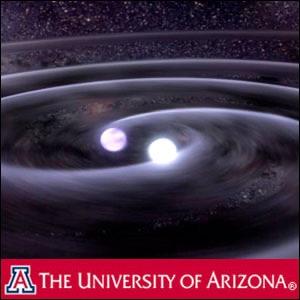
Transcript: Any change in a gravitational field or gravitational configuration causes ripples in space time to be emitted. These disturbances which travel at the speed of light are called gravity waves or gravitational radiation. Pulsars slow down slightly in their periods, and this corresponds t…
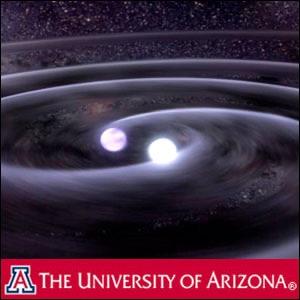
Transcript: Collapsed stellar objects offer the best chance to test Einstein’s Theory of General Relativity. General Relativity is based on the idea that acceleration due to gravity is not distinguishable from acceleration due to any other force. The consequence of this idea is that gravity disto…
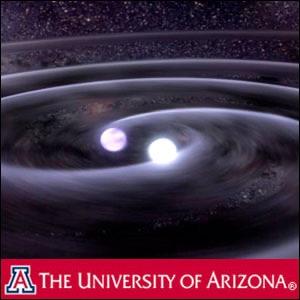
Transcript: A fundamental prediction of General Relativity is the fact that time slows down in strong gravitational fields. The ultimate test of this idea would be to observe someone falling into a black hole carrying a clock. In theory, the clock would slow down and come to a complete halt as th…
سلب مسئولیت: پادکست و آثار هنری تعبیه شده در این صفحه متعلق به Dr. Christopher D. Impey, Professor, Astronomy است که متعلق به صاحب آن است و به Listen Notes، Inc وابسته یا تایید نشده است.
ویرایش
از کمک شما برای بروز نگهداشتن پایگاهدادههای پادکست سپاسگزاریم
