


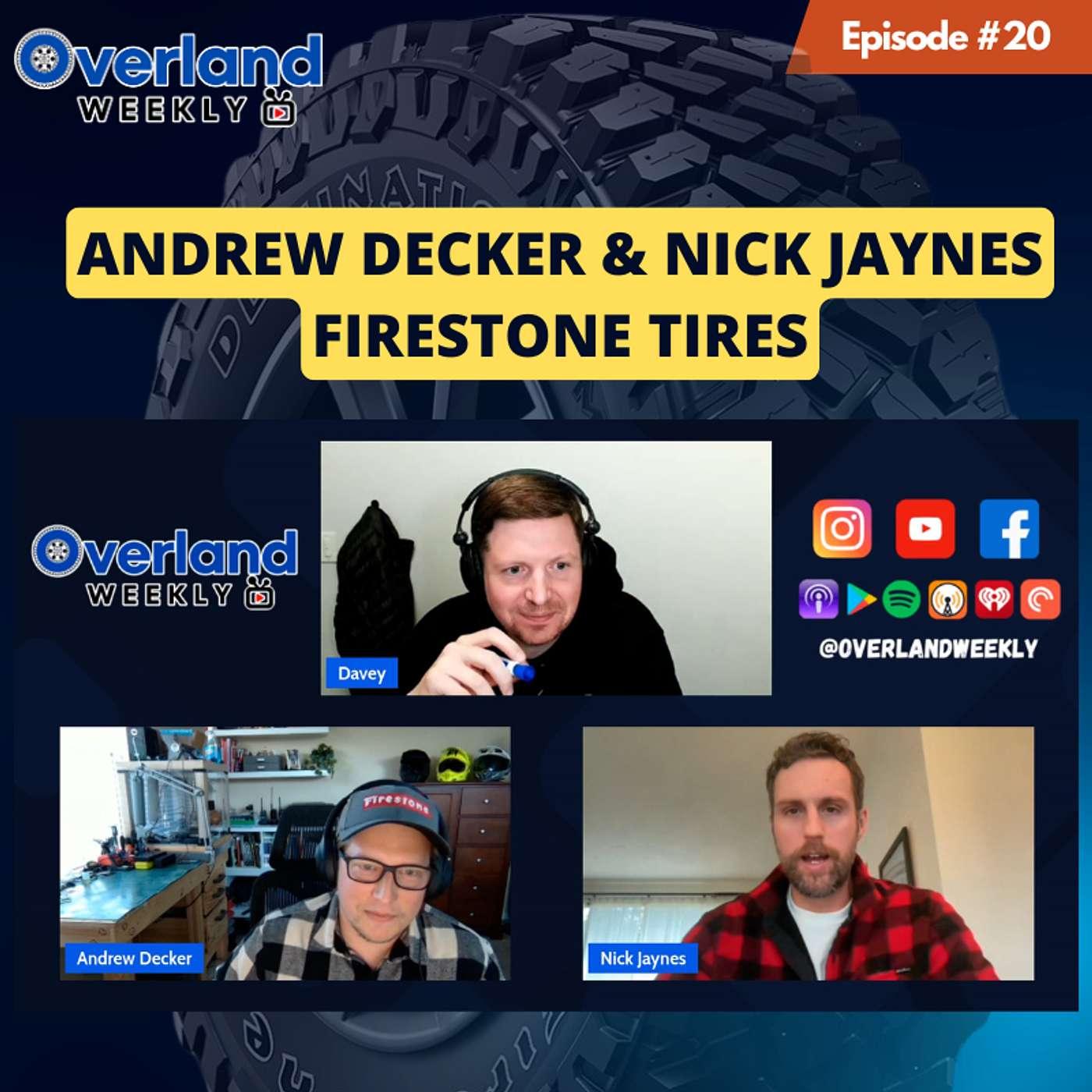
WEBVTT
00:00:13.480 --> 00:00:17.120
Ladies and gentlemen, welcome back.
00:00:17.144 --> 00:00:20.859
This is Overland Weekly, episode number 20.
00:00:20.885 --> 00:00:22.039
My name is Davey.
00:00:22.065 --> 00:00:27.920
I am your host for this episode, and I've got a couple of guests with me today.
00:00:27.945 --> 00:00:31.300
I have Mr. Andrew Decker and Mr. Nick Jaynes.
00:00:31.324 --> 00:00:32.780
Welcome, gentlemen.
00:00:32.804 --> 00:00:36.659
Thanks for having us.
00:00:32.804 --> 00:00:36.659
Yeah, absolutely.
00:00:36.685 --> 00:00:42.295
Andrew is a lead applications engineer.
00:00:36.685 --> 00:00:42.295
Is that the correct title?
00:00:42.320 --> 00:00:42.479
Yeah.
00:00:42.505 --> 00:00:47.880
Is it Bridgestone, Firestone or Bridgestone Americas now?
00:00:47.905 --> 00:00:50.219
I want to make sure I get this right.
00:00:50.244 --> 00:00:55.020
Bridgestone Americas, and then Firestone and Bridgestone are brands.
00:00:55.045 --> 00:00:56.880
Got you.
00:00:55.045 --> 00:00:56.880
All right.
00:00:57.119 --> 00:01:10.769
Then nick is the founder of Differential Communications, which is an overland and off-road public relations firm who happens to have Firestone as a client.
00:01:10.799 --> 00:01:13.980
You guys are based in the Pacific Northwest, correct?
00:01:14.004 --> 00:01:15.540
That's right.
00:01:14.004 --> 00:01:15.540
Yes, sir.
00:01:15.564 --> 00:01:16.930
Awesome.
00:01:16.959 --> 00:01:25.379
So this came together by my friend, Aubrey Swinson, who some of you guys in this part of the country may know.
00:01:25.405 --> 00:01:33.930
Aubrey works for Firestone as his day job, and he's got 100 series that he wheels a lot of events around here.
00:01:33.959 --> 00:01:37.319
And Aubrey said, You really need to get somebody from some Firestone on.
00:01:37.344 --> 00:01:40.480
And Firestone introduced me to nick and nick to Andrew.
00:01:40.504 --> 00:01:45.120
And then nick said, Well, hey, if you're going to talk off-roading in tires, I like that too.
00:01:45.144 --> 00:01:46.655
So can I come on and join you?
00:01:46.680 --> 00:01:48.849
And I said, Yeah, absolutely.
00:01:46.680 --> 00:01:48.849
The more, the merrier.
00:01:48.879 --> 00:01:52.640
So that's how we've assembled this group today.
00:01:52.665 --> 00:01:57.930
And yeah, if you haven't guessed, today's topic is all things tires.
00:01:57.959 --> 00:02:05.060
So it is It's just a couple of days before Thanksgiving as we're recording this.
00:02:05.084 --> 00:02:12.800
We've had a very mild fall here, and now it's starting to feel like winter may be coming.
00:02:12.824 --> 00:02:22.254
For me, that's the signal that it's trail season and camping and all those things that go with it and a lot of events coming up.
00:02:22.280 --> 00:02:23.199
What about you guys?
00:02:23.224 --> 00:02:28.960
Do you all have any rides or anything on the horizon in the next couple of months?
00:02:29.759 --> 00:02:33.780
Well, Well, this weekend, my friends and I are going out.
00:02:33.805 --> 00:02:35.610
We're going to go snow wheeling.
00:02:35.639 --> 00:02:44.500
And up here, I don't know about where you guys live, but here in Oregon, you can buy a five dollar tag and go get your own Christmas tree from the National Forest.
00:02:44.525 --> 00:02:47.180
Oh, that's cool.
00:02:44.525 --> 00:02:47.180
We go to the mountains and do that.
00:02:47.205 --> 00:02:50.974
We don't have National Forest, and we don't have snow.
00:02:51.000 --> 00:02:52.039
Well, we don't have snow yet.
00:02:52.064 --> 00:02:56.259
We might get three inches in a couple of months, and everybody will freak out.
00:02:56.284 --> 00:02:57.759
But yeah.
00:02:58.240 --> 00:02:59.610
What about you, Andrew?
00:02:59.639 --> 00:03:00.819
Yeah.
00:03:00.844 --> 00:03:08.500
Being here in central Tennessee, now it's the time for a break from the heat, so it's time to get out there.
00:03:08.525 --> 00:03:12.500
My wife and I will probably be out camping or riding our dirt bikes.
00:03:12.525 --> 00:03:16.419
It is definitely time to get out and hit the trails and enjoy the woods.
00:03:16.444 --> 00:03:17.599
Nice.
00:03:18.400 --> 00:03:29.719
Guys, before we dive into tires, why don't you both give us just a rundown of your rig or rigs that you like to get out there and wheel?
00:03:29.745 --> 00:03:32.199
Nick, I'll let you kick it off.
00:03:29.745 --> 00:03:32.199
Oh, gosh.
00:03:32.224 --> 00:03:35.840
Well, I don't know if we have time for all of my rigs.
00:03:35.865 --> 00:03:37.639
We take up the whole show.
00:03:37.664 --> 00:03:40.639
We'll go with a couple of your primaries.
00:03:37.664 --> 00:03:40.639
Primaries?
00:03:40.664 --> 00:03:42.180
Okay.
00:03:42.205 --> 00:03:47.680
Gosh, the two in my driveway right now, and then I guess I'll go one in the garage and make it pretty quick.
00:03:47.705 --> 00:03:52.414
I got a 22 Ford Ranger that's fairly well built up.
00:03:52.439 --> 00:03:55.419
I don't know if you want me to go into all the specs and all the details.
00:03:55.444 --> 00:04:03.259
But the one next to it, the 23 Superduty with the 7.3 Godzilla Gasoline big block V8.
00:04:03.284 --> 00:04:10.520
That's an extra cab, FX4 that I removed the entire bed and replace it with a mitts, Alloy tray and canopy.
00:04:10.544 --> 00:04:12.219
Oh, nice.
00:04:12.245 --> 00:04:13.419
Yeah, that's clean.
00:04:13.444 --> 00:04:23.740
Yeah, that's the long distance, long term expedition rig, and that's riding on Firestone destination MT2 and 37 inch by twelve and a half, 17.
00:04:23.764 --> 00:04:28.420
And that's it pretty much an unstoppable super capable camping rig.
00:04:28.444 --> 00:04:33.660
And then I've got a 79 Scout 2 that I'm rebuilding in my garage.
00:04:33.685 --> 00:04:35.134
That's behind those.
00:04:35.160 --> 00:04:37.660
But it has no interior right now, so I won't be taking that this weekend.
00:04:37.685 --> 00:04:42.360
A lot of scout buzz and excitement lately with the new one coming out.
00:04:42.384 --> 00:04:46.420
They unveiled it just down the road from where I am now, that new one.
00:04:46.444 --> 00:04:51.535
So, yeah, it looks exciting.
00:04:51.560 --> 00:04:53.339
It looks a lot more exciting than some of the EVs we've seen.
00:04:53.365 --> 00:04:55.519
So I'm anxious to see how that plays out.
00:04:55.759 --> 00:05:04.720
Yeah, I don't want to hijack it too long, but I think I was worried they weren't going to stay to the vibe, the essence of the truck.
00:05:04.745 --> 00:05:07.540
And I think they really did that, at least in esthetics.
00:05:07.564 --> 00:05:09.420
Yeah.
00:05:07.564 --> 00:05:09.420
That's exciting.
00:05:09.444 --> 00:05:11.939
Well, they got me hooked because I put a deposit down.
00:05:11.964 --> 00:05:13.079
Oh, okay.
00:05:13.105 --> 00:05:14.480
See, we didn't even plan this.
00:05:14.504 --> 00:05:18.319
This is becoming a scout show now.
00:05:19.759 --> 00:05:21.980
So you're all in, Andrew.
00:05:22.004 --> 00:05:32.574
Yeah, I like the serial EV concept, the range extender, being able to actually not have range anxiety.
00:05:32.600 --> 00:05:38.500
I think it would be cool, especially if you're get out in the woods, you don't have to worry about finding a fast charger or whatever.
00:05:38.524 --> 00:05:42.295
You can still just carry gas cans with you if you needed to.
00:05:42.319 --> 00:05:44.560
I'm really excited about those new gasoline engines.
00:05:44.584 --> 00:05:46.180
It seems I don't think it's going to be the wave of the future.
00:05:46.204 --> 00:05:49.814
I mean, there's gas stations everywhere.
00:05:46.204 --> 00:05:49.814
It's amazing.
00:05:49.839 --> 00:05:51.079
There's no rangeings ahead of you.
00:05:51.105 --> 00:05:53.860
It's just such a novel concept.
00:05:53.884 --> 00:05:57.160
Is that crazy, guys?
00:05:57.720 --> 00:06:00.420
All right.
00:06:00.444 --> 00:06:04.699
You put a deposit down for the Scout.
00:06:04.725 --> 00:06:07.480
What's your current or past rig, Andrew?
00:06:07.504 --> 00:06:12.300
Current rig is a 2009 GX 470.
00:06:12.324 --> 00:06:19.379
It's pretty much stock, at least underneath, but it's got skid plates, rock sliders.
00:06:19.404 --> 00:06:26.699
I did a DIY shelf sleeping platform in the back.
00:06:26.725 --> 00:06:35.779
It's got a roof rack with awning and stuff on top, but it's the rig that gets my wife and I where we want to go and then to the coffee shop afterwards.
00:06:35.805 --> 00:06:38.019
And it's on Firestone destination MT2.
00:06:38.045 --> 00:06:41.620
So it definitely doesn't look like a mall Crawler.
00:06:41.644 --> 00:06:48.220
Well, those GXs are a heck of a value for truck, especially that generation.
00:06:48.245 --> 00:07:09.139
And shout out to our friend Patrick Perry from Perry Parts that just swapped the rear-end in his GX, put the new modified rear-end, removed the 8-inch, and has the 9.5-inch under there after he broke the 8-inch for the third time last time we were out.
00:07:09.165 --> 00:07:11.800
There is a solution now.
00:07:09.165 --> 00:07:11.800
He's got it up on his blog.
00:07:11.824 --> 00:07:17.740
If you're a GX guy, go to a Perry Parts and read up on the Axel Swap.
00:07:17.764 --> 00:07:19.420
All right.
00:07:19.444 --> 00:07:24.500
Well, diving into our actual topic for the day to be addressed.
00:07:24.524 --> 00:07:31.480
I told the guys, I said, I think our audience is is pretty intelligent.
00:07:31.504 --> 00:07:36.560
Maybe I'm giving them too much credit, but I think we got some pretty smart listeners.
00:07:36.584 --> 00:07:42.600
I don't want to make this too basic, and I want to try to get into some of the nitty-gritty.
00:07:42.625 --> 00:07:49.120
But let's start at a foundational knowledge level, Andrew.
00:07:50.879 --> 00:07:57.860
Let's start with a modern radial tire versus a bias apply tire.
00:07:57.884 --> 00:08:08.839
I'm a little bit older than you, I grew up right at the tail end of bias apply still being a common thing in not just heavy equipment, but in any tires.
00:08:08.865 --> 00:08:11.480
Now people are just used to radial tires.
00:08:11.504 --> 00:08:16.100
But break that down for us and what the differences are there.
00:08:16.125 --> 00:08:16.519
Yeah.
00:08:16.545 --> 00:08:22.699
So the difference is between a biased and a radial is pretty much how the tires put together.
00:08:22.725 --> 00:08:26.100
Biased is one of the original tire technologies.
00:08:26.125 --> 00:08:37.019
It was originally fabric, which was cotton fabric that was coated in rubber, and there were layers of those put on, and they were actually put on at an angle or a bias.
00:08:37.044 --> 00:08:38.940
So that's where the name comes from.
00:08:38.965 --> 00:08:47.059
And there were several layers of those needed, many, many layers in order to get the strength, especially for heavier vehicles.
00:08:47.085 --> 00:08:51.059
And so they were thick, they were heavy.
00:08:51.085 --> 00:09:02.620
They were very much a balloon shape early on before a melted bias became a thing, which is when you start getting your low profile wheels, which are nowhere near as low profile as what we have now.
00:09:02.644 --> 00:09:13.379
But then with the advent of radials, what tire manufacturers were able to do were take cords and go directly from one beat to another at a 90 degree angle.
00:09:13.404 --> 00:09:18.679
So if you look at an X ray of the tire, it aligns up with a radius line, hence radial.
00:09:19.679 --> 00:09:30.460
Uses a lot more modern materials, usually nylon or polyester cords, sometimes steel, depending on the application.
00:09:30.485 --> 00:09:42.899
And so there's a lot less material, because you usually have two, maybe three body plies in a radial rather than six, eight, 10 or more in a bias plie tire.
00:09:42.924 --> 00:09:44.879
So they're a lot lighter.
00:09:44.904 --> 00:09:46.340
They generate less heat.
00:09:46.365 --> 00:09:53.860
They have better rolling resistance, which especially heat is a big enemy of vulcanized rubber.
00:09:53.884 --> 00:10:00.299
So they're able to run faster and handle that heat, that speed.
00:10:00.325 --> 00:10:07.860
So radials are obviously very much the go to for current passenger cars and stuff like that.
00:10:07.884 --> 00:10:17.259
But Bias still has their place, especially in agriculture and large Earth moving equipment, where they're carrying absolutely immense loads at really low speeds.
00:10:17.284 --> 00:10:24.700
So they're not generating that heat, and they're able to use that strength of the Bias Play tire to carry those loads.
00:10:24.725 --> 00:10:25.960
Got you.
00:10:26.559 --> 00:10:28.120
Yeah.
00:10:29.000 --> 00:10:34.220
How about Let's talk a little bit about pressure.
00:10:34.245 --> 00:10:50.100
If you are new to off-roading or overlanding, this always seems to confuse new folks that we like to let air out of the tires before the day even begins.
00:10:50.125 --> 00:11:00.279
But talk a little bit about air pressure and how that works on different terrains with different tire types.
00:11:00.679 --> 00:11:08.740
Yeah, so airing down, especially, is a little bit of a touchy subject, I guess, coming from a tire manufacturer.
00:11:08.764 --> 00:11:10.440
It's interesting fact.
00:11:10.465 --> 00:11:13.100
We do all of our off-road testing at Placard.
00:11:13.125 --> 00:11:16.299
We don't air down for doing off-road testing.
00:11:16.325 --> 00:11:18.779
It just removes one more variable.
00:11:18.804 --> 00:11:23.580
I always try to tell people, use airing down as a tool in your toolbox.
00:11:23.605 --> 00:11:32.240
If you immediately drive onto dirt, shift into four low, triple locked, air down, and And then you get stuck.
00:11:32.360 --> 00:11:35.059
You don't have anything left unless you have a winch.
00:11:35.085 --> 00:11:39.320
So there are some benefits to airing down.
00:11:39.345 --> 00:11:41.700
It adds a little bit of comfort, bump absorption.
00:11:41.725 --> 00:11:46.279
So on rougher, rockier trails, it can be useful for that.
00:11:46.304 --> 00:11:47.659
It saves your back.
00:11:47.684 --> 00:11:53.019
But one thing to keep in mind is the air is what actually carries the load in a tire.
00:11:53.044 --> 00:11:55.940
It is what gives that tire its spring rate.
00:11:55.965 --> 00:11:58.980
And it's also what dissipates the heat inside the tire.
00:11:59.004 --> 00:12:04.740
So the more The more air you let out, the more heat it will generate, then it'll be able to dissipate it.
00:12:04.764 --> 00:12:06.919
So you need to really bring the speeds down.
00:12:07.200 --> 00:12:09.980
And always have a way to air back up.
00:12:10.004 --> 00:12:12.340
Don't air down if you don't have a compressor.
00:12:12.365 --> 00:12:14.200
So that's a given.
00:12:14.225 --> 00:12:19.174
If even just a little bit of time on the highway at really low pressures.
00:12:19.200 --> 00:12:21.419
I mean, you can damage that tire internally and not know it.
00:12:21.445 --> 00:12:24.019
And that damage doesn't get healed.
00:12:24.044 --> 00:12:26.100
It's compounding.
00:12:26.125 --> 00:12:40.080
So I don't really have a line in the sand of what you should air down It's very application and situationally dependent, but just some things to keep in mind is you let the air down, you better slow down.
00:12:40.200 --> 00:12:41.720
Yeah.
00:12:40.200 --> 00:12:41.720
No, absolutely.
00:12:41.745 --> 00:12:43.519
A speed has to go along with that.
00:12:43.544 --> 00:12:54.299
And like you said, I understand it from a manufacturer's perspective.
00:12:54.325 --> 00:13:05.200
I'm the guy that I'm going to drop to 15 or 16 as soon as I'm at the trailhead, but that suits the terrain that I'm tackling as well.
00:13:05.225 --> 00:13:14.259
If you're tackling different terrain or if you're in sand or if you're in snow, it's going to be a totally different story than if you're rock crawling somewhere.
00:13:14.284 --> 00:13:16.934
Yeah, absolutely.
00:13:16.960 --> 00:13:18.960
I'll just jump in and say- Yeah, go ahead, nick.
00:13:18.985 --> 00:13:27.360
We've heard people say that airing down to 18 doubles your traction and things like that.
00:13:27.384 --> 00:13:46.480
There's just so many misnoms and misunderstandings out there that I think, especially if you're thinking, and I can't speak for other tires, but obviously, Andrew has proved in his testing that your tire is very, very capable at the standard placard recommended pressure.
00:13:46.559 --> 00:13:47.335
So, yeah, right.
00:13:47.360 --> 00:13:52.840
I mean, to his point, and he's actually changed a lot of my thinking on it, too, because I was like you.
00:13:52.865 --> 00:13:56.259
I was whacking it down to 15 as soon as we turned on the dirt.
00:13:56.284 --> 00:14:03.139
But obviously mechanical and personal sympathy, you want to a little bit more cushion when you're hitting rocks and runs and things like that.
00:14:03.164 --> 00:14:08.460
But now I don't think of it as, oh, my God, I'm not going to get anywhere without this.
00:14:08.485 --> 00:14:13.000
And it's sidewall size and temperature outside and the material.
00:14:13.024 --> 00:14:21.700
It's just like there's so many dang variables So if anyone is giving you, if they have a printout on a little card of the rules fairing down their line to you, right?
00:14:21.725 --> 00:14:24.279
We can agree on that.
00:14:24.304 --> 00:14:26.975
And no, I don't think it doubles your traction.
00:14:27.000 --> 00:14:27.919
I wish that was the case.
00:14:27.945 --> 00:14:32.820
That'd be awesome if you could It's just double the traction.
00:14:32.845 --> 00:14:36.559
Yeah, it's definitely around here with our terrain.
00:14:36.585 --> 00:14:41.460
It's a big comfort thing, especially if you're picking up the pace on the rocks a little bit more.
00:14:41.485 --> 00:14:46.860
When I take my GX up to land between the lakes up on the Kentucky border.
00:14:46.884 --> 00:14:50.934
There's a lot of small baseball-sized rocks and stuff like that.
00:14:50.960 --> 00:14:52.240
I let a little bit of pressure out.
00:14:52.264 --> 00:14:57.200
I won't go down super far, but it's definitely a comfort thing.
00:14:57.399 --> 00:15:15.679
Along with that, Well, let's just talk about the element in the room as far as terrain and an all-terrain tire versus a mud tire versus an all-season tire.
00:15:16.519 --> 00:15:26.460
I'm of the opinion, and this is Davie's opinion, and a manufacturer may disagree, that an all-terrain tire means all terrains except mud.
00:15:26.485 --> 00:15:36.100
Because from personal experience, when you get in Alabama mud or red clay down in Georgia with an all terrain, it just doesn't clean out.
00:15:36.125 --> 00:15:38.820
It's just going to be slick as snot.
00:15:38.845 --> 00:15:51.200
But is there an all terrain on the market that is truly that, that can truly go from the mud to the dry and perform well in both?
00:15:51.225 --> 00:15:54.080
Or is it always a give and take?
00:15:54.679 --> 00:16:00.539
It's definitely a balancing act with the all terrains.
00:16:00.565 --> 00:16:07.100
Yeah, I agree down here in the Southeast, you get in that real heavy clay mud, it's going to pack up any tire.
00:16:07.125 --> 00:16:12.600
Even some MTs just get absolutely turned into mud balls.
00:16:13.279 --> 00:16:25.600
We have seen an expansion of ATs or all terrain tires that start to bring to that traditional gap of ATs to MTs from hybrid terrain, rugged terrain, whatever you want to call it.
00:16:26.759 --> 00:16:32.639
But again, it's a balancing act of making it tire more aggressive, but also keeping the road manners.
00:16:33.039 --> 00:16:41.639
And one of the big trade offs is if you want a tire to be good in mud, you want it to eject that mud from the pattern and re-expose those lugs.
00:16:41.720 --> 00:16:44.700
But that's the opposite of what you want to do for snow.
00:16:44.725 --> 00:16:52.095
In snow, you want the pattern to hold some snow because the best traction in snow is snow on snow.
00:16:52.120 --> 00:16:54.720
Now, not completely covering it, but packing the groups up.
00:16:54.745 --> 00:16:57.840
That's what good winter tires do.
00:16:58.480 --> 00:17:03.759
So if a tire is good at ejecting things from the pattern, it's not going to hold any snow, so it won't necessarily be good in the snow.
00:17:03.784 --> 00:17:06.880
So there's a lot of balancing.
00:17:06.920 --> 00:17:10.809
The Firestone Destination XT, I think, strikes a really good balance.
00:17:10.839 --> 00:17:14.599
It does most of what our MT does.
00:17:14.920 --> 00:17:16.680
And nick can definitely attest to it.
00:17:16.704 --> 00:17:19.880
He's driven both through pretty much everything.
00:17:20.079 --> 00:17:29.180
It just it might take a little more skill to drive the XT through some deep stuff or some extra tools that maybe the MT2 would just walk right through.
00:17:29.204 --> 00:17:32.740
But It does quite a bit.
00:17:32.765 --> 00:17:34.740
And we test over in North Carolina.
00:17:34.765 --> 00:17:39.740
So we're very familiar with the red clay that's over in Carolina.
00:17:39.765 --> 00:17:43.575
Yeah, he just did some testing, too.
00:17:43.599 --> 00:17:45.400
And I don't know if we're allowed to talk about that yet.
00:17:45.424 --> 00:17:50.049
But one of the great things about having Decker on the team is super knowledgeable.
00:17:50.079 --> 00:17:55.799
He's also out there every year retesting the tires and putting them against competitors.
00:17:55.825 --> 00:18:01.295
And I just saw his data and the XT did very well in the mud It always does.
00:18:01.319 --> 00:18:01.799
It always has.
00:18:01.825 --> 00:18:05.529
Even against new competitors, it really stands out.
00:18:05.559 --> 00:18:06.799
I can speak from my experience.
00:18:06.825 --> 00:18:18.049
We just had some of our brand ambassadors, Talon, Si, and Michael Webber from Overland Under Budget out in East Carolina for a week.
00:18:18.079 --> 00:18:21.720
And every single truck, there was six trucks with us.
00:18:21.744 --> 00:18:25.049
Every truck but Micas was on the MT2.
00:18:25.079 --> 00:18:26.529
He was on XT.
00:18:26.559 --> 00:18:33.700
And we were down in some Canyon lands, and it rained, and The Earth out there turns in like Vaseline when it rains.
00:18:33.724 --> 00:18:35.329
So it was actually pretty hairy.
00:18:35.359 --> 00:18:40.049
But he is a ranger, a 2019 ranger.
00:18:40.079 --> 00:18:43.815
Yeah, the wrecked one, I think that he's back together.
00:18:43.839 --> 00:18:44.480
Yeah, exactly.
00:18:44.505 --> 00:18:50.289
And he went everywhere that we went in the MT2s without skipping a beat.
00:18:50.319 --> 00:18:52.119
And talent had actually, as it started raining.
00:18:52.144 --> 00:18:53.839
I was like, Man, I got on the radio.
00:18:53.865 --> 00:18:55.200
I'm so glad I have the MT2s.
00:18:55.224 --> 00:18:57.200
I was like, Well, you'll see.
00:18:57.224 --> 00:19:01.220
You're about to see how well the XT does in in the mud.
00:19:01.244 --> 00:19:07.900
And Decker always puts it to me, unless it's the deep stuff, you want the MT, the max traction.
00:19:07.924 --> 00:19:13.039
But when it's not super deep, the XT has never skipped a beat for us.
00:19:13.920 --> 00:19:19.569
Well, let's talk a little bit about that testing if we can.
00:19:19.599 --> 00:19:21.660
Andrew, what about...
00:19:21.684 --> 00:19:23.799
Just walk us through that process.
00:19:23.825 --> 00:19:34.809
When a manufacturer tests a tire, I want to know both in the lab, and in the field what that looks like.
00:19:34.839 --> 00:19:35.079
Yeah.
00:19:35.105 --> 00:19:48.619
So the lab, which our development center here in the Americas is in Akron, Ohio, the labs that they have there, a lot of what they do is regulatory certification stuff.
00:19:48.644 --> 00:19:57.839
So they'll, Certify load rating, speed rating, all the DOT certs that go along with getting that DOT stamp on the sidebar.
00:19:58.400 --> 00:20:06.740
And they'll even do stuff noise testing in some of the anechoic chambers that we have there, the completely silent rooms that have all the microphones.
00:20:06.765 --> 00:20:19.619
And then we have some outdoor lab proving ground things where we'll do, control wet handling, dry handling, just stopping distances, that stuff.
00:20:19.644 --> 00:20:22.220
And they're all very controlled environments.
00:20:22.244 --> 00:20:32.529
And then what I do a lot of is we'll take our off-road tires out to the National Forest, like I said, over in North Carolina.
00:20:32.559 --> 00:20:35.009
We test with overland experts.
00:20:35.039 --> 00:20:37.140
So shout out to the OEX crew.
00:20:37.164 --> 00:20:40.295
Great group of people to work over there with.
00:20:40.319 --> 00:20:44.660
They've got their private property, but we also test in the forest on some of the trails.
00:20:44.684 --> 00:20:47.380
And we just really try to do real-world testing.
00:20:47.404 --> 00:21:00.089
So we'll go out, we'll take two identical 100 Series Land Cruisers, put tires on them, and test them back to back against a list of metrics that we have that we've developed over the years.
00:21:00.119 --> 00:21:16.180
And we'll even try to get some real world feedback by seeding tires out to media and other power users to be able to get maybe long term use data from people who use the products all the time.
00:21:16.204 --> 00:21:25.049
And then we do our winter testing in Steemboat Springs, Colorado at the Bridgestone Winter Driving School, as well as up in the UP, up in Michigan.
00:21:25.079 --> 00:21:32.160
So we're, again, trying to test worst case, real world environments where our tires are put in a service.
00:21:33.720 --> 00:21:42.089
So before a tire goes into service or goes for sale, what is that timeline like?
00:21:42.119 --> 00:21:43.974
Is it a year?
00:21:44.000 --> 00:21:45.279
Is it six months, two years?
00:21:45.305 --> 00:21:51.640
How long does a tire have to go through testing before you guys say, Okay, this is ready?
00:21:52.440 --> 00:21:56.569
The design cycle is really long for some of our products.
00:21:56.599 --> 00:22:01.240
It's several years, sometimes of 10.
00:22:01.400 --> 00:22:10.940
And in that, there is initial design and development that's all on the computer, that stuff.
00:22:10.964 --> 00:22:15.980
And then we have a couple of years of testing prototypes.
00:22:16.005 --> 00:22:23.759
And then by the time I get it, it's pretty mature and ready to be production spun up.
00:22:23.785 --> 00:22:28.289
And that can take a while as well.
00:22:28.319 --> 00:22:36.859
So by the time I get it, I have a product, or I'm doing benchmarking of our current products against new competitors as well.
00:22:36.884 --> 00:22:38.420
Got you.
00:22:36.884 --> 00:22:38.420
Okay.
00:22:38.444 --> 00:22:45.049
So you're getting it towards the end of the design cycle, so to speak.
00:22:45.079 --> 00:23:00.539
But can you give an overview of what that cycle looks like from, I'm assuming, the early sketches, new ideas to the final product?
00:23:00.565 --> 00:23:03.180
Does it go through?
00:23:03.204 --> 00:23:06.559
I'm assuming we're not starting on pen and paper now.
00:23:06.585 --> 00:23:14.660
I'm assuming there's some type of 3D modeling, and then it goes into a prototype and then that thing.
00:23:14.684 --> 00:23:17.039
I'm not sure about all of our design engineers.
00:23:17.065 --> 00:23:20.000
There may be some that still do napkin sketches.
00:23:20.025 --> 00:23:21.640
If it works.
00:23:20.025 --> 00:23:21.640
Yeah.
00:23:21.664 --> 00:23:24.809
Yeah.
00:23:21.664 --> 00:23:24.809
I mean, computers are a big part of it.
00:23:24.839 --> 00:23:30.049
A lot of modeling softwares being able to do that.
00:23:30.079 --> 00:23:33.619
We're not breaking new ground as an industry, really.
00:23:33.644 --> 00:23:43.289
So for our company, we're replacing old products or trying to fill holes in our portfolio when we decide to come up with a new product.
00:23:43.319 --> 00:23:47.259
And then we'll look at the competitive landscape, what are there other companies doing?
00:23:47.285 --> 00:23:53.500
What have the requirements changed in the segment we're trying to go after?
00:23:53.525 --> 00:23:56.894
What are the customers requiring out of these tires now?
00:23:56.920 --> 00:24:00.180
Because it might have been different than when we introduced the last product.
00:24:00.204 --> 00:24:05.519
Especially for all terrains, everybody was much more mild.
00:24:05.545 --> 00:24:09.539
Now people want slightly more aggressive, and they want them to be the do all tires.
00:24:09.565 --> 00:24:11.809
So it's changed.
00:24:11.839 --> 00:24:15.660
And then our design engineers, like I said, they'll start iterating.
00:24:15.684 --> 00:24:19.660
They'll do a first pass, they'll build some prototypes, they'll keep iterating.
00:24:19.684 --> 00:24:27.900
And during all of this, we'll have our designers also take into account what the esthetic of the tire needs to look like.
00:24:27.924 --> 00:24:36.259
And eventually, everybody signs off on it and it starts getting industrialized and spun up for production.
00:24:32.785 --> 00:24:36.259
Got you.
00:24:36.285 --> 00:24:37.640
Okay.
00:24:39.960 --> 00:24:41.119
We talked a little bit.
00:24:41.144 --> 00:24:46.940
We were talking about pressure, and we were talking about heat, and those things.
00:24:46.964 --> 00:24:51.460
So for a lot of folks, they do...
00:24:51.484 --> 00:24:54.900
A lot of people have a daily driver that's doing double duty, right?
00:24:54.924 --> 00:25:01.539
They're wheeling it on the weekend and they're driving it to work Monday morning, and they've got to find that that balance.
00:25:01.565 --> 00:25:10.019
Do you have any insider tips for maximizing the life of a tire that's living a double life?
00:25:10.045 --> 00:25:12.859
Because that's not easy on a tire.
00:25:12.884 --> 00:25:14.900
No, it's definitely not easy for sure.
00:25:14.924 --> 00:25:18.329
Especially the way some of us drive off road.
00:25:18.359 --> 00:25:26.049
So the biggest thing is inflation pressure and rotation, rotation on the vehicle.
00:25:26.079 --> 00:25:33.049
So proper inflation pressure is going to keep that tire contact patch the correct shape on the pavement.
00:25:33.079 --> 00:25:38.140
It's going to help reduce your regular wear and give you as much wear life as possible.
00:25:38.164 --> 00:25:45.319
And then regular rotation, every oil change, 5,000, 7,000 miles, however, something like that.
00:25:45.359 --> 00:25:50.255
Is especially important, especially for deep tread tires, your MTs and stuff like that.
00:25:50.279 --> 00:26:01.700
Rotating those regularly, getting them rolling in a different direction on the other side of the vehicle helps even out any irregular wear you might have and just really helps get them as much wear life as you can.
00:26:01.724 --> 00:26:02.480
I'm crazy.
00:26:02.505 --> 00:26:08.640
I rotate my tires every 2,500 miles just because I want to keep my MTs as smooth as possible.
00:26:08.664 --> 00:26:11.359
You are crazy.
00:26:12.000 --> 00:26:14.079
I'm impressed.
00:26:12.000 --> 00:26:14.079
We'll put it that way.
00:26:14.105 --> 00:26:16.240
That's dedication.
00:26:16.359 --> 00:26:19.799
I think, touching on since you said you're...
00:26:19.825 --> 00:26:37.740
I don't want to go too far into the weeds, but if you said I believe you that your audience is smart, I think maybe, Andrew, it might be interesting to go a little more in-depth because of an example that I found across all my different rigs because they're all modified, none are running the same size tire, the same size wheel.
00:26:37.765 --> 00:26:42.839
And each tire requires different pressure for the application and the low grading, too.
00:26:42.865 --> 00:26:51.400
And so even Andrew, we were talking through one of my applications, the vehicle requires the...
00:26:51.424 --> 00:26:59.049
Placard requires a much higher pressure than you might want to run on the MT2s that I have on that vehicle.
00:26:59.079 --> 00:27:04.940
And his warning to me was, well, you can do it, but they might start what cupping is the wear-toe?
00:27:04.964 --> 00:27:06.319
Yeah, heel, toe, cupping.
00:27:06.345 --> 00:27:15.140
There's a lot of names for the irregular wear where you can see either the pattern get wavy or one block higher than the next.
00:27:15.164 --> 00:27:15.480
Yeah.
00:27:15.505 --> 00:27:29.039
If you're not running close to or exactly placard size, which probably very few of us are, determining what that actual pressure needs to be is something that we've got tables.
00:27:29.065 --> 00:27:32.839
There's industry books that have load and inflation tables.
00:27:32.865 --> 00:27:39.359
Based off of the load the tire is going to carry, you can determine what the inflation pressure needs to be.
00:27:40.480 --> 00:27:44.460
And that's going to be unique for everybody's application.
00:27:44.484 --> 00:27:51.569
There's ways to figure out, especially if you go from a P-metric tire, even on an F-150, it comes with P-metric.
00:27:51.599 --> 00:28:02.720
Going to an LT, you might need to do a little bit of math to figure out what that new pressure needs to be because the load and inflation curves aren't the same for P-metric versus LT.
00:28:02.759 --> 00:28:11.779
For folks that may not know, Andrew, break down the difference between a P-metric or passenger tire and an LT tire.
00:28:11.805 --> 00:28:15.259
So they're really just two sizing schemes.
00:28:15.285 --> 00:28:21.119
P, yes, usually stands for passenger, but you see it on some half-ton truck, F150 Silverado, stuff like that.
00:28:21.144 --> 00:28:23.539
It's the OE size.
00:28:23.565 --> 00:28:28.569
And then LT is light truck is what it stands for.
00:28:28.599 --> 00:28:38.539
So The big difference is between them, LT usually is able to carry much higher loads, but it requires a lot higher pressures.
00:28:38.565 --> 00:28:42.420
So on next super duty, the pressures are 80 PSI.
00:28:42.444 --> 00:28:44.619
You can't do that in a P-metric tire.
00:28:44.644 --> 00:28:48.089
You have to have an LTE to do those pressures.
00:28:48.119 --> 00:28:52.700
So it's two different sizing standards is what it is.
00:28:52.724 --> 00:28:54.119
Got you.
00:28:54.559 --> 00:29:09.220
I think along with this part of the conversation, let's talk about balancing, about tire and wheel balancing, and your thoughts on that, especially...
00:29:09.244 --> 00:29:23.960
I grew up where guys were trying to balance these big 40 and 44-inch groundhogs or interco's or whatever it was, and they were putting everything from golf balls to buckshot in the tire.
00:29:23.984 --> 00:29:31.049
And nowadays, balancing beads are the, I don't want to say the rage, but you hear about that a lot right now.
00:29:31.079 --> 00:29:40.319
Talk to us about liquid balancing versus speed balancing versus now we've got advanced road force balancing.
00:29:40.345 --> 00:29:43.759
How do all those play out?
00:30:07.570 --> 00:30:16.430
The the correct way, I guess, and the industry accepted way is to do spin balancing.
00:30:16.455 --> 00:30:23.390
Whether you do just spin balancing, which modern machines can get stuff really, really close just through spin.
00:30:23.414 --> 00:30:33.910
But then you also have road force, which is Hunter's technology, where it'll push on the tire, measure the spring rate as the tire rolls around.
00:30:33.934 --> 00:30:44.910
It'll try to account for that by strategically placed weights, or it'll tell you to dismount the tire, turn it however many degrees and remount it.
00:30:42.170 --> 00:30:44.910
It's called force matching.
00:30:44.934 --> 00:30:51.570
And that will get it as perfect as possible.
00:30:53.529 --> 00:31:01.424
The bigger tires, 35s and up, they're going to require a lot of weight regardless of what you do, just because you've got the weight.
00:31:01.450 --> 00:31:02.850
The thread is the heaviest part.
00:31:02.875 --> 00:31:04.049
It's the farthest away.
00:31:04.075 --> 00:31:08.529
It's going to cause the most vibration if it's not even.
00:31:09.250 --> 00:31:13.570
And especially if you run like, beat locks, like good luck getting them balanced.
00:31:13.610 --> 00:31:22.390
So that's where the advent of the balance speeds and stuff like that people are trying to say, well, it'll move around as the tire moves around.
00:31:22.414 --> 00:31:24.570
And I came from the Commercial side.
00:31:24.595 --> 00:31:31.470
I was a field engineer dealing with semi truck and bus tires for a number of years with Bridgeton when I first started.
00:31:31.495 --> 00:31:34.870
And balanced media is all the rage in that industry.
00:31:34.894 --> 00:31:40.710
People take the big bag, they'll throw it in when they mount the tire, call it done.
00:31:40.735 --> 00:31:47.490
But anything you put in the tire has the potential to damage the inside of the tire, especially golf balls and buckshot and stuff like that.
00:31:47.515 --> 00:31:54.070
I've actually seen golf balls melted to the inside of a tire because it generates so much heat as that thing slings around.
00:31:54.095 --> 00:31:59.130
So definitely don't do that if you have other options.
00:31:59.330 --> 00:32:01.549
The physics might be there for the balanced media.
00:32:01.575 --> 00:32:04.779
I'm still going to use weights when I can.
00:32:04.809 --> 00:32:07.930
I trust my Balancer that I have.
00:32:09.490 --> 00:32:21.210
So moral of the story, Andrew doesn't advise it, but if you do put golf balls in, film it and put it on Instagram so the rest of us can see it.
00:32:22.090 --> 00:32:22.779
All right.
00:32:22.809 --> 00:32:33.850
We're talking about vehicle weight, and that's obvious that that plays a factor in tires and towing and the load plays a factor in that.
00:32:33.875 --> 00:32:37.549
What about suspension setups?
00:32:37.575 --> 00:33:04.850
When somebody's building out an off-road rig or a double duty overlanding rig, and maybe they're changing to a lighter suspension setup, are there factors in how they need to think about the total, I guess you could say, total package between the suspension and their relationship with their wheel and tire choices, particularly the weight of the wheels and tires?
00:33:07.450 --> 00:33:13.830
That one's a little hard because once you start getting into modified, especially heavily modified vehicles, it really starts...
00:33:13.855 --> 00:33:15.350
It's becoming a whole system.
00:33:15.375 --> 00:33:19.890
You have to become a systems engineer almost to tie everything back together.
00:33:20.650 --> 00:33:25.870
Obviously, if you can run tires that work that are lighter and lighter wheels.
00:33:25.894 --> 00:33:30.890
Unsprung weight is minimize that as much as you can.
00:33:30.970 --> 00:33:35.025
But going to 40s, you're not going to minimize anything.
00:33:35.049 --> 00:33:35.730
Each corner weighs 200.
00:33:35.755 --> 00:33:37.670
You start worrying about an extra five pounds.
00:33:37.695 --> 00:33:40.230
Each corner weighs 250 pounds.
00:33:40.255 --> 00:33:42.150
You can't get around that.
00:33:42.174 --> 00:33:47.065
The big thing when selecting your tires is what's the actual weight of the vehicle?
00:33:47.090 --> 00:33:48.630
Because they're what's carrying the weight.
00:33:48.654 --> 00:33:51.630
Your suspension actually isn't carrying the weight the tires are.
00:33:51.654 --> 00:34:00.110
So you need to a tire that's properly rated for what your rig weighs, plus the gear and people that you're going to carry.
00:34:00.134 --> 00:34:10.969
Yeah, I guess that's where I was going with that is people think a lot about the suspension as they're adding weight and adding rooftop tents and adding drawers and all these things to the set up.
00:34:10.994 --> 00:34:18.019
But the tires are where the weight meets the road, so to speak, not just the suspension.
00:34:18.049 --> 00:34:20.610
So it's another thought.
00:34:20.634 --> 00:34:24.144
Your suspension suspends your vehicle above the tires.
00:34:24.170 --> 00:34:26.259
So what's actually carrying the load is the tires.
00:34:26.289 --> 00:34:36.050
And going from stock size to load range E tires doesn't magically mean your Tacoma can carry 5,000 pounds.
00:34:38.250 --> 00:34:46.340
Where do you stand on the wide versus skinny debate?
00:34:46.369 --> 00:34:49.789
I personally like the pizza cutter look.
00:34:49.815 --> 00:34:57.470
And I think it is a lot of a It's an esthetic choice for a lot of it.
00:34:57.494 --> 00:35:03.210
Obviously, the wider you go, the more float you're going to get, which is why they're called flotation tires.
00:35:03.235 --> 00:35:08.590
They were originally developed for AG and forestry, where they don't want that soil compaction.
00:35:08.615 --> 00:35:12.289
They actually wanted the vehicles to float over very soft ground.
00:35:13.050 --> 00:35:29.650
A narrower tire will give you a better clearance and stuff like that because it's not as wide, but it will give you a longer contact patch, which might help in whatever application If you're looking to maximize your forward drive, a longer contact patch might actually be beneficial.
00:35:29.675 --> 00:35:42.670
Yeah, that's the argument of our friend Ky from a Tinkers Design that's been on the show that I think surprised a lot of people is the data of the longer contact patch.
00:35:42.695 --> 00:35:48.150
If you think about it, people have been doing it for a very long time with winter tires.
00:35:48.175 --> 00:35:54.950
When you downsize a winter tire, usually you go taller and skinnier because you want that 4F traction.
00:35:54.974 --> 00:35:57.950
You want that longer contact patch.
00:35:57.974 --> 00:36:12.110
Well, if you look at, we go back 80 years and you look at those World War II jeeps, you look at the Willies, I mean, those tires, they couldn't have been 8 inches ride on those tires then.
00:36:12.135 --> 00:36:15.329
Yeah, interesting.
00:36:18.050 --> 00:36:23.750
We've talked a little bit about this, but temperature swings.
00:36:23.775 --> 00:36:46.409
If you've got a tire that you need to perform when it's 110 in the summer and then maybe you're going out next way and it's getting really cold in the winter, do you Have you any advice for managing tire performance in extreme heat or extreme cold?
00:36:46.970 --> 00:36:47.730
Yeah.
00:36:47.755 --> 00:36:53.010
So the thing is you need to set your pressures, cold.
00:36:53.409 --> 00:36:56.470
Cold When we talk about cold tire, that's relative.
00:36:56.494 --> 00:37:01.070
If it's Death Valley, cold tire will probably be close to 90 degrees.
00:37:01.095 --> 00:37:10.304
But what we define as a cold tire is something that hasn't been driven more than a mile or has been sitting for more than three hours.
00:37:10.329 --> 00:37:12.150
And that's the time to set your pressure.
00:37:12.175 --> 00:37:18.110
You don't want to set it after you just drove from New York to LA.
00:37:18.135 --> 00:37:21.590
You don't want to adjust your pressures after that.
00:37:21.615 --> 00:37:38.750
So if you're You're driving in a situation where you go from really hot to really cold to the point where you've lost a bunch of pressure, and if you use pressure gage or you have your TPMS on your dash, you're probably going to want to top them up in the middle of that trip.
00:37:38.775 --> 00:37:46.970
But definitely don't let air out of a hot tire after you've been driving on the road, trying to, quote, correct it.
00:37:47.409 --> 00:37:52.309
It will naturally grow in pressure, and it's designed to do that.
00:37:52.335 --> 00:37:58.210
So it's After the tire cools down, then you can adjust it.
00:38:01.090 --> 00:38:24.090
Back on the off-road front, talk to us a little bit about side walls, because that seems to be a big topic of debate amongst the manufacturers or the strength of the side walls, especially for somebody that's actually going to get out and put those things on some rocks.
00:38:24.115 --> 00:38:37.269
And I've noticed across the board in the last 10 years that Sidewall Street seems to have improved, and maybe there's a new technology or a new compound or something that's going on there.
00:38:37.295 --> 00:38:42.730
But yes, granted, as soon as I say that, I'll probably rip one open here the next time I go out.
00:38:42.755 --> 00:38:50.380
But it seems like they're more abrasion and impact resistant, more forgiving than they used to be.
00:38:50.409 --> 00:38:57.110
What is it that makes a really good off-road site a sidewall in a tire?
00:38:57.135 --> 00:39:01.550
It's mainly the progress that's been made in material science.
00:39:01.575 --> 00:39:13.860
Like you're saying, yes, from years past, we have made leaps and bounds forward with compound and material You might not think about it, but tire technology moves pretty quickly.
00:39:13.889 --> 00:39:22.650
Being inside, an insider to the industry and within a manufacturer, the compounding and stuff, it does move along fairly quickly.
00:39:22.675 --> 00:39:32.269
And we have made some good strides towards cut chip resistance and stuff like that, stronger fabrics that we put in the tires.
00:39:32.295 --> 00:39:39.710
And that's allowed us to make side walls that don't have to be three inches thick in order to survive rubbing up against a rock.
00:39:39.735 --> 00:39:44.380
Some of the side walls out there now are quite thin, but also quite robust.
00:39:44.409 --> 00:39:51.380
And I think a big thing that comes down to that is a lot of the rubbers and stuff that we put in there now.
00:39:51.409 --> 00:39:51.849
Yeah.
00:39:51.875 --> 00:39:59.650
I mean, that was one thing that the bias tires were always known for was a little more strength on that sidewall.
00:39:59.675 --> 00:40:01.849
There's just more layers there.
00:39:59.675 --> 00:40:01.849
Exactly.
00:40:01.875 --> 00:40:15.470
But now, with, like you said, the material science updates, it seems like the radials are starting to give you that same streak without having to actually be 10 layers thick or whatever it is.
00:40:15.494 --> 00:40:24.429
But one of the other misnoms, I guess, is the adding body plies does not necessarily mean your sidewall is stronger.
00:40:21.715 --> 00:40:24.429
Two versus It's three.
00:40:24.454 --> 00:40:32.590
There might be a little bit of strength there, but I haven't seen many cuts in a sidewall that stop at that last layer.
00:40:32.615 --> 00:40:34.710
If they're going through, it's going through.
00:40:34.735 --> 00:40:42.950
And since all the cords are all laying in the same direction, There's probably an area where it's just pure rubber going right to the inside.
00:40:42.974 --> 00:40:47.309
So something will slip right in there and slip between all three body plies.
00:40:47.335 --> 00:40:52.409
I do think it's worth jumping in, and Dave, you may know this, but I think a lot of the folks we encounter still don't.
00:40:52.434 --> 00:41:00.789
I even saw it in a news story from one of our competitors, Tire, bragging about 14 plywood.
00:41:00.815 --> 00:41:03.170
It's not.
00:41:00.815 --> 00:41:03.170
It's not.
00:41:03.195 --> 00:41:11.425
We had a woman pop a Tire on her P, F150, a P-metric tire in the tow truck cars.
00:41:11.450 --> 00:41:13.510
Well, it's only because these are only four plywood.
00:41:13.534 --> 00:41:14.809
You need those 10 plywood.
00:41:14.835 --> 00:41:17.025
And I was like, well, guess what, girl?
00:41:17.050 --> 00:41:18.289
I'm going to have got some news for you.
00:41:18.315 --> 00:41:21.630
You don't even have four.
00:41:21.655 --> 00:41:23.250
Yeah, I was just going to say that.
00:41:23.275 --> 00:41:25.990
It's It's not like toilet paper is what we're saying here, guys.
00:41:26.014 --> 00:41:32.170
No.
00:41:26.014 --> 00:41:32.170
So the Ply rating is a holdover from bias.
00:41:32.970 --> 00:41:40.030
When someone says a 10 Ply rated tire, that used to actually be a bias tire with 10 10 plies.
00:41:40.054 --> 00:41:44.990
Now 10 Ply is equivalent to a load range E.
00:41:45.014 --> 00:41:53.130
We use load range and load rating as a more accurate representation of what a tire is able to carry in the radial space now.
00:41:53.155 --> 00:42:03.510
So It's a bit of an archaic way of saying it, but yeah, we've got 10 plie rated tires, and they've got two sidewall plies.
00:42:03.534 --> 00:42:04.970
I see.
00:42:05.210 --> 00:42:12.610
It's a bit of an older holdover, and some people get them confused because they use the same nomenclation.
00:42:12.635 --> 00:42:17.570
That's why I always talk about load rating whenever I talk about how much a tire can carry.
00:42:18.050 --> 00:42:25.090
And I like to get it out there because people will think they're coming off of a 10-ply tire, you name whatever it says on the side, the brand.
00:42:25.289 --> 00:42:30.409
And then they go, look at the Firestone Destination XT, fabulous all terrain tire.
00:42:30.434 --> 00:42:33.510
Well, this is only two-ply.
00:42:30.434 --> 00:42:33.510
I can't go from 10 to 2.
00:42:33.534 --> 00:42:36.224
Like, well, you don't actually have 10.
00:42:36.250 --> 00:42:37.289
So I just want people...
00:42:37.315 --> 00:42:43.849
I feel like it's misleading Well, the digital Firestone goes with the industry standard.
00:42:43.875 --> 00:42:50.550
People are still looking backwards the 1950s with their their marketing on the sidewall and making an unfair comparison in the marketplace.
00:42:50.575 --> 00:42:51.510
So I like to...
00:42:51.534 --> 00:42:54.690
Sorry if I got my soapbox here for a second.
00:42:54.715 --> 00:42:59.429
No, I think, hey, you got to question the marketing guys, right?
00:42:59.454 --> 00:43:16.380
How about you still see, you don't see this as much, but You do see in some off-road tires, directional tires versus asymmetrical tires.
00:43:16.409 --> 00:43:19.490
What's the advantage, disadvantage there?
00:43:19.514 --> 00:43:22.470
Why do you see some tires built that way?
00:43:22.494 --> 00:43:26.450
Yes, like you said, I don't see a lot of directional.
00:43:26.474 --> 00:43:32.380
I can only think of one asymmetric tire off the top of my head.
00:43:32.409 --> 00:43:39.809
A lot of the directional stuff you see in the import brands that go on your brodozers.
00:43:40.570 --> 00:43:44.230
But, yeah, I mean, directional and asymmetric patterns, they have their place.
00:43:44.255 --> 00:43:53.590
Directional, where the tires designed to roll in a specific direction allows the engineers to be able to design that for aftraction.
00:43:53.615 --> 00:44:01.510
You see that, I guess a good example would be like tractor pulls as the most extreme version of a directional off-road tire.
00:44:01.534 --> 00:44:06.250
It's meant to do one thing, and that's put the power to the ground in one direction.
00:44:06.889 --> 00:44:11.269
An asymmetric, it allows you to do the same thing, but laterally.
00:44:11.295 --> 00:44:15.630
It allows you to tune inside and outside of the contact patch.
00:44:15.655 --> 00:44:23.190
You see it a lot in high performance tires, where the outside shoulder will be a lot wider than everything else.
00:44:23.215 --> 00:44:34.409
So it's really in what the goals of the tire are and what they feel the design engineers feel will meet that goal.
00:44:34.970 --> 00:44:50.869
I think seeing a lot of symmetrical, same side to side, rolling in either direction off road tires, what that allows you to have is consistent traction in every direction, no matter which way you load it, it's going to act the same.
00:44:50.894 --> 00:44:55.010
It also helps with your regular wear, because now you It can rotate around the vehicle.
00:44:55.034 --> 00:44:56.889
It can roll either way with a directional tire.
00:44:56.914 --> 00:44:59.545
You can only swap it front to back.
00:44:59.570 --> 00:45:02.090
As symmetric, you have to be careful what way you mount it.
00:45:02.115 --> 00:45:04.349
Make sure you don't mount it backwards, stuff like that.
00:45:04.375 --> 00:45:13.710
So symmetrical in the off road space, I think, is definitely why everyone's gone that way is because of those reasons.
00:45:13.735 --> 00:45:17.309
It's predictable and easier on the user.
00:45:17.335 --> 00:45:18.769
Got you.
00:45:20.610 --> 00:45:27.829
One thing I wanted to ask you about, which I think is controversial subject is sipping.
00:45:27.855 --> 00:45:34.769
We see a lot of guys go on YouTube and see guys talk about sipping their tires.
00:45:34.795 --> 00:45:39.289
Again, this may be terrain dependent on what part of the country you're in and that thing.
00:45:39.315 --> 00:45:51.829
But is sipping something that people, in your opinion, should be considering doing to their own tires, or should they trust the engineers and the factory sipping that's there?
00:45:51.855 --> 00:46:00.190
I would hope they would trust We pour a lot of R&D dollars and resources into designing our stuff.
00:46:00.215 --> 00:46:04.190
And I have to say, do not modify your tires.
00:46:04.215 --> 00:46:12.130
Not only is it can avoid any warranty, but it's not safe to do.
00:46:12.809 --> 00:46:17.900
We put features there or not there for a reason.
00:46:17.929 --> 00:46:25.030
And cips, a lot of people will be like, oh, well, I need more biting edges, and that's why they'll a tire.
00:46:25.054 --> 00:46:29.070
And that does help on some smooth surfaces.
00:46:29.095 --> 00:46:33.950
You look at winter tires, they're very heavily cipped to help with snow traction.
00:46:33.974 --> 00:46:35.409
And that's what cips do.
00:46:35.434 --> 00:46:41.929
They give you a void for water and snow to evacuate out of the contact patch.
00:46:42.369 --> 00:46:49.210
But with the advent of 3D cips, where there's actual...
00:46:49.235 --> 00:46:53.730
The cip is not just a blade that goes straight into the tire.
00:46:53.755 --> 00:46:55.789
It actually has some geometry in there.
00:46:55.815 --> 00:46:59.349
It looks like an interlocking Waffle iron, essentially.
00:46:59.375 --> 00:47:07.190
And what that allows is it allows you to have that void and all that at advantage is of having all those types.
00:47:07.215 --> 00:47:15.900
But then under high loads, that 3D geometry will lock together, and it will allow the block to maintain some rigidity.
00:47:15.929 --> 00:47:20.050
So we do all that in simulations and all that stuff.
00:47:20.075 --> 00:47:25.670
So you go take a hot knife to our tires, it just makes us cry.
00:47:25.695 --> 00:47:28.130
All right.
00:47:25.695 --> 00:47:28.130
So you heard it from the source.
00:47:28.155 --> 00:47:33.590
No golf balls, no hot knives per decer on your tires.
00:47:33.615 --> 00:47:39.530
It's also another holdover, I think, from it feels like the '70s to me, especially Especially up north.
00:47:39.554 --> 00:47:42.429
I know that was a big thing from back in the day.
00:47:42.454 --> 00:47:46.829
I used to see it back in my commercial days.
00:47:46.855 --> 00:47:57.664
There was a bus company up in Vermont that they would sipe their tires, and the tires would get absolutely destroyed with your regular wear after just one season.
00:47:57.690 --> 00:47:59.769
But the guy was adamant, and he did it himself.
00:47:59.795 --> 00:48:03.090
And I was just like, please don't do this.
00:48:03.115 --> 00:48:04.900
But he just kept doing it.
00:48:04.929 --> 00:48:10.970
I have a friend up in Montana who has gotten another brand's MTs for years and then ciped them.
00:48:10.994 --> 00:48:15.170
And he said, well, I wanted to get him some empty twos.
00:48:15.195 --> 00:48:17.289
And he said, I don't know.
00:48:15.195 --> 00:48:17.289
I want to cip these.
00:48:17.315 --> 00:48:19.329
And I'm like, you don't need it.
00:48:19.355 --> 00:48:23.349
Trust me, with new compounds, especially, it's not the 1970s anymore.
00:48:23.375 --> 00:48:31.530
Especially our MT2s are so good in the wet and the snow, especially compared to modern competitors, but even certainly old stuff.
00:48:32.010 --> 00:48:37.670
He likened it to, well, you get a Corvette, you're going to soup up that LS.
00:48:37.695 --> 00:48:39.090
I said, that's not the same.
00:48:39.115 --> 00:48:42.869
It's like when Homer on the Simpsons put speed holes in the hood of his car.
00:48:42.894 --> 00:48:45.690
Speed holes?
00:48:42.894 --> 00:48:45.690
Yeah, speed holes.
00:48:45.715 --> 00:48:47.230
You're ruining me.
00:48:47.255 --> 00:48:51.630
It's not the same as tuning an LS.
00:48:51.655 --> 00:48:54.869
Trust the engineer, please.
00:48:54.894 --> 00:49:08.869
Well, you're talking about the 3D side thing and maybe things that you don't see to the eye that are engineered into the thread pattern.
00:49:08.894 --> 00:49:13.170
I mean, it's easy to look at a tire and go, oh, this has big lugs.
00:49:13.195 --> 00:49:17.900
This must be a really good mud tire because it's got such deep lugs.
00:49:17.929 --> 00:49:35.450
But are there other less obvious factors in Tread design nowadays, modern Tread design that you may not notice if you're just looking at a tire with the eyeball that you can educate us on?
00:49:35.929 --> 00:49:40.030
Well, nick hit on it.
00:49:40.054 --> 00:49:47.625
The one that you can't see, and it's really hard to differentiate is the compound of what it's made out of.
00:49:47.650 --> 00:49:49.530
Yeah, you can have treads that look chunky.
00:49:49.554 --> 00:49:51.170
You're like, oh, that must be a good mud tire.
00:49:51.195 --> 00:49:54.470
It's got a real tight interlocking pattern.
00:49:54.494 --> 00:50:02.389
That's going to be good for good traction or good snow traction because of all the biting edges or whatever.
00:50:02.414 --> 00:50:10.429
But yet the compound, especially, like I said, the strides that we've made in our rubber technology, really has driven forward.
00:50:10.454 --> 00:50:18.070
You could have very similar tires with similar tred patterns.
00:50:18.095 --> 00:50:22.510
But if you've got different compounds, they could act drastically different.
00:50:22.534 --> 00:50:25.170
So That's one of the things.
00:50:25.195 --> 00:50:32.230
And it's, again, really hard for the consumer to differentiate because they don't know what's in the rubber.
00:50:28.755 --> 00:50:32.230
They don't know what's good.
00:50:32.255 --> 00:50:38.329
They have to rely on reviews, which isn't really standardized across the industry.
00:50:38.355 --> 00:50:43.110
It's not even counting what you find on YouTube.
00:50:43.135 --> 00:50:50.869
But one of the other things to look for is full depth features.
00:50:50.894 --> 00:51:01.110
So if those cips or the slots and the roofs will actually go all the way down to where the tires considered worn out, so they won't wear away.
00:51:01.135 --> 00:51:06.190
And you lose some of those features which could degrade performance over the tires life.
00:51:06.215 --> 00:51:15.950
If you find full depth types or full depth features that will help maintain some of that new tire performance as the tire wears on.
00:51:15.974 --> 00:51:17.369
Got you.
00:51:17.970 --> 00:51:19.110
Okay.
00:51:19.135 --> 00:51:37.550
Andrew, you were talking about load ratings, and we understand load ratings when you're talking about the weight of the load, whether it be in a pickup truck bed or whether it be that you're towing something.
00:51:37.575 --> 00:51:48.809
But let's talk about the load ratings on a tire and how that helps or hurts in an off-road scenario.
00:51:49.170 --> 00:52:05.289
It would seem from a layperson that a heavier load rating is presumably going to be a stronger tire from a like a sidewall perspective.
00:52:05.315 --> 00:52:08.450
But maybe that's maybe that is or maybe that isn't the case.
00:52:08.474 --> 00:52:10.030
But there's always a trade off.
00:52:10.054 --> 00:52:17.010
So what's your thoughts on on load rating when you're looking at a truck or a tire that you're going to wheel?
00:52:18.650 --> 00:52:30.190
So in the past, yes, the higher load ratings would probably adversely the effect ride quality because the tire would have to have more material or thicker material.
00:52:30.215 --> 00:52:49.970
But with modern science and materials that we've put into the tire, we've been able to make stronger tires with the same amount of material, more or less, which allows you to not trade off that ride quality even at the higher load ratings.
00:52:50.450 --> 00:52:53.490
Now, getting a higher load rating than what you need isn't necessarily bad.
00:52:53.514 --> 00:52:58.184
Bad, but it doesn't magically increase your payload.
00:52:58.210 --> 00:53:03.070
You just need to keep in mind that there may be some ride quality degradation going to a higher load rating.
00:53:03.095 --> 00:53:10.349
And with a higher load rating, the tire is stronger because it's meant to hold more inflation pressure.
00:53:10.375 --> 00:53:14.550
The maximum inflation between a load range C and a load range E is different.
00:53:14.575 --> 00:53:18.470
Load range E will hold more pressure, so it does actually have to be stronger.
00:53:18.494 --> 00:53:21.070
But that doesn't necessarily mean it's more durable.
00:53:21.095 --> 00:53:27.030
The sidewall is not more puncture resistant because it can now carry more 80 PSI or whatever.
00:53:27.054 --> 00:53:32.170
I'm wearing a Firestone hat, but I'll throw Bridgestone some love.
00:53:32.195 --> 00:53:38.710
Our new douler, AT Ascent, is an incredibly comfortable tire on the road, even when it's a load range E.
00:53:38.735 --> 00:53:47.470
It's one of the best tires I've ever driven on when it comes to highway manners for a really capable AT tire.
00:53:47.494 --> 00:53:54.110
So it's like the perfect example of you don't have to trade off comfort for load carrying capacity.
00:53:54.135 --> 00:53:57.470
Got you.
00:53:57.494 --> 00:54:07.630
Yeah, because it has been a trade off, and especially we talked about a truck that you're wheeling on the weekend and going to work.
00:54:07.655 --> 00:54:15.010
But then if you throw, it's a vehicle that you're also towing with, there's a whole third aspect that you got to think about that.
00:54:15.034 --> 00:54:21.900
And if you can find a tire that covers all three of those and does it comfortably, that's pretty impressive.
00:54:21.929 --> 00:54:27.409
It's the Goldilocks It's a mythical tire that does everything really well.
00:54:27.434 --> 00:54:33.730
And it also probably would last 100,000 miles, but everything's a trade-off, unfortunately.
00:54:37.250 --> 00:54:42.210
This just came to mind when You talked about lasting 100,000 miles.
00:54:42.570 --> 00:55:08.309
Talk to us from an engineer's perspective about the age of tires, about the DOT rating as as tire age, because you will inevitably meet somebody that's running a 20-year-old set out on the trail that swears up and down, there's nothing wrong with these tires.
00:55:08.335 --> 00:55:10.050
They're not dry rotted.
00:55:10.075 --> 00:55:13.970
I can't see anything wrong with them.
00:55:14.170 --> 00:55:16.210
I know you've got a thought on that, Andrew.
00:55:16.235 --> 00:55:17.704
Go ahead.
00:55:17.730 --> 00:55:18.929
Yeah, you can probably see on my face.
00:55:18.954 --> 00:55:22.610
I'm getting my eyes starting to twitch.
00:55:23.050 --> 00:55:30.710
So The entire age is, or at least what the acceptable age out limit is, is basically by manufacturer.
00:55:30.735 --> 00:55:39.510
Bridgestone aligns with JATMA, which is the Japanese Tire Manufacturers Association, and we draw the line at 10 years.
00:55:39.534 --> 00:55:43.450
When a tire reaches 10 years, it should be taken out of service.
00:55:43.474 --> 00:55:44.570
It needs to be replaced.
00:55:44.929 --> 00:55:50.789
When you get to five years, it should be inspected by a tire professional.
00:55:50.815 --> 00:56:07.170
And that includes possibly dismounding it and taking look at the inside because as air permeates from being in the tire and out, as well as UV rays and ozone from the outside, it can degrade the tire internally, where you can't actually see it.
00:56:07.195 --> 00:56:12.670
So it might not have the weather checking or the ozone cracking, but it could be degrading.
00:56:12.695 --> 00:56:20.150
And you can tell by older tires, they do feel harder because that's the ozone aging the rubber.
00:56:20.175 --> 00:56:24.470
So consult your tire manufacturer.
00:56:24.494 --> 00:56:27.610
Don't run it over 10 years.
00:56:27.730 --> 00:56:29.389
It's not worth the risk.
00:56:29.414 --> 00:56:33.269
Also, check your spare tires because usually those are very old.
00:56:33.295 --> 00:56:37.190
There are many folks that are guilty of that.
00:56:37.215 --> 00:56:43.590
It's not a contest to see who can keep their original spare the longest.
00:56:43.615 --> 00:56:45.289
No.
00:56:47.650 --> 00:56:48.650
All right.
00:56:48.675 --> 00:56:59.570
Well, you've talked about some of just the modern things as far as is material science and 3D modeling and that thing over the last few years.
00:56:59.595 --> 00:57:14.809
Are there any trends or advancements that you're excited about that maybe we don't see in production yet, but we'll see over here for the next few years, especially in the off-road scene?
00:57:15.409 --> 00:57:26.050
I think we're already seeing it, but I'm excited to see where these hybrid rugged terrain, middle of the road, not an AT, but not quite MT segment goes.
00:57:26.570 --> 00:57:30.429
Jack of all trades, tire used to be a master of none.
00:57:30.454 --> 00:57:32.670
Right.
00:57:30.454 --> 00:57:32.670
Yeah, that was my opinion.
00:57:32.695 --> 00:57:48.269
But with improving compounds, like I've said, construction techniques and materials, the design that all the design tools that the manufacturers have at their disposal, it's now instead of become two buckets, AT and MT, it's now more of a spectrum.
00:57:48.295 --> 00:57:50.990
It's what do you want out of the tire?
00:57:51.014 --> 00:57:56.309
And it's really been able to get closer to that Goldilocks tire.
00:57:56.335 --> 00:58:01.030
But that's what I'm really excited to see is how far can this get pushed?
00:58:01.054 --> 00:58:03.585
Can you have one tire that does it all?
00:58:03.610 --> 00:58:05.130
I think that's what they need to call it.
00:58:05.155 --> 00:58:07.710
If they get it figured out, it needs to be the Goldilocks line.
00:58:07.735 --> 00:58:09.900
That's the market.
00:58:09.929 --> 00:58:11.929
Goldilocks MTs.
00:58:14.610 --> 00:58:16.070
All right.
00:58:16.095 --> 00:58:17.409
Well, one more question.
00:58:17.434 --> 00:58:36.730
Is there anything in your profession, and you've been doing this a while, that that you think are common myths that people believe about tires, or maybe how they handle tire decisions that you'd like to debunk?
00:58:37.929 --> 00:58:39.110
There's a lot out there.
00:58:39.135 --> 00:58:46.110
We could probably do a whole podcast just on debunking tire myths, and maybe we could do that.
00:58:46.135 --> 00:58:58.550
But I think one of the things is there's a lot of groupthink, and people get in echo chambers in a forum or they've been a diehard one brand forever.
00:58:58.575 --> 00:59:01.369
And you need to see what else is out there.
00:59:01.394 --> 00:59:14.510
And take every review you see with a grain of salt, because like nick has said, there's a lot of misconceptions about load rating and plywood rating versus what the actual tire is made out of.
00:59:14.534 --> 00:59:15.990
They're not the same.
00:59:16.014 --> 00:59:20.090
Adding plis does not necessarily mean it's more durable.
00:59:22.170 --> 00:59:27.070
And then airing down There's a lot of misconceptions around airing down.
00:59:27.095 --> 00:59:34.550
You can be very conservative like me and the way we do our testing where you never really let anything out of the tire.
00:59:34.575 --> 00:59:42.389
But depending on what you go up, you might need to let air out in order to get that tire to conform around the the obstacle or whatever.
00:59:42.414 --> 00:59:50.750
But you're not going to double your contact patch by taking 10 pounds out of the tire, running 10 pounds in your tire.
00:59:50.775 --> 00:59:52.389
That's just not how it works.
00:59:52.414 --> 01:00:00.769
So I would like to see more people just try to learn more and learn from the people who actually build these products.
01:00:00.795 --> 01:00:04.210
And we try to do that as Bridgestone.
01:00:04.235 --> 01:00:09.710
We try to educate as much as we can, but just being able to think through it.
01:00:09.735 --> 01:00:13.590
And I don't think tires are really that complicated.
01:00:13.615 --> 01:00:17.650
So people try to make a mountain out of a mole hill sometimes.
01:00:17.809 --> 01:00:18.990
Yeah.
01:00:19.014 --> 01:00:23.650
Well, I appreciate you guys coming on and talking through this.
01:00:23.675 --> 01:00:36.050
And Like you said, I know we only scratch the surface, but I think you've provided some insight, and you've definitely provided some food for thought for a lot of us that have been doing this for several years.
01:00:36.075 --> 01:00:47.630
It's easy to get in a rut and believe what you've always believed or make the same decision you did before where the data and the science maybe will tell you something different nowadays.
01:00:47.655 --> 01:00:50.210
That's been good.
01:00:50.769 --> 01:00:57.990
Before I let both of you go, though, we have to go through our rapid fire wrap-up questions.
01:00:54.595 --> 01:00:57.990
Oh, boy.
01:00:58.014 --> 01:01:04.650
Yeah.
01:00:58.014 --> 01:01:04.650
All right, Andrew, we'll start with you.
01:01:04.809 --> 01:01:12.210
First question, what is your favorite, your go to off-road trail snack?
01:01:13.530 --> 01:01:18.470
I'm going to have to say Twizzler's licorice nibs.
01:01:18.494 --> 01:01:22.530
Oh, that's a very specific Twizzler licorice nibs.
01:01:22.554 --> 01:01:24.945
Those are the little- Yeah, the A little short ones.
01:01:24.970 --> 01:01:26.230
Short ones?
01:01:24.970 --> 01:01:26.230
The little white-size ones, yeah.
01:01:26.255 --> 01:01:27.829
Okay.
01:01:27.855 --> 01:01:32.744
Now, do you turn down full-size Twizzlers if you can't get the nibs?
01:01:32.769 --> 01:01:34.650
Yeah, I'll go to something else if I don't have nibs.
01:01:34.675 --> 01:01:37.070
Oh, wow.
01:01:34.675 --> 01:01:37.070
Okay.
01:01:37.095 --> 01:01:38.429
All right.
01:01:38.454 --> 01:01:41.730
All right, nick, what do you got?
01:01:42.170 --> 01:01:44.769
Oh, I'm going to go in the similar candy.
01:01:44.795 --> 01:01:48.730
I'll go peach rings.
01:01:49.570 --> 01:01:51.889
Peach rings?
01:01:49.570 --> 01:01:51.889
Like the old school ones?
01:01:51.914 --> 01:01:54.470
Yeah, yeah, yeah Yeah.
01:01:54.494 --> 01:01:55.750
Awesome.
01:01:54.494 --> 01:01:55.750
Okay.
01:01:55.775 --> 01:01:57.490
This is interesting.
01:01:57.514 --> 01:01:59.789
I don't know if we had anybody go candy first.
01:01:59.815 --> 01:02:01.610
So okay.
01:02:02.289 --> 01:02:04.900
The Firestone crowd is on the candy.
01:02:04.929 --> 01:02:06.750
You got a sweet tooth.
01:02:06.775 --> 01:02:10.110
All right.
01:02:10.135 --> 01:02:19.630
Andrew, if you could only listen to one artist or one album while you're out on the trail for the day, what are you queuing up?
01:02:19.655 --> 01:02:20.889
That's an easy one.
01:02:20.914 --> 01:02:22.970
Meteora by Lincoln Park.
01:02:23.210 --> 01:02:24.670
Meteora?
01:02:23.210 --> 01:02:24.670
By Lincoln Park.
01:02:24.695 --> 01:02:28.210
Okay.
01:02:24.695 --> 01:02:28.210
Didn't even have to think about it.
01:02:29.369 --> 01:02:33.470
Nick, what you got?
01:02:29.369 --> 01:02:33.470
Whalen Jennings, Dreaming My Dreams.
01:02:33.494 --> 01:02:35.230
Oh, okay.
01:02:35.255 --> 01:02:37.269
Little old school country.
01:02:37.295 --> 01:02:38.690
Nice.
01:02:38.809 --> 01:02:40.025
All right.
01:02:40.050 --> 01:02:45.050
There's not much of that left in Nashville, but that's a whole another rant for another show.
01:02:45.075 --> 01:02:48.490
Yeah, I could go on about that.
01:02:49.570 --> 01:02:52.470
All right.
01:02:49.570 --> 01:02:52.470
Important question here.
01:02:52.494 --> 01:02:55.710
Andrew, DeWalt or Milwaukee?
01:02:55.735 --> 01:02:57.030
Team Yellow.
01:02:57.054 --> 01:02:59.849
There we go.
01:02:57.054 --> 01:02:59.849
I like that answer.
01:02:59.970 --> 01:03:01.550
Don't beat yourselves up.
01:03:01.575 --> 01:03:05.409
It's okay to be wrong.
01:03:05.570 --> 01:03:07.490
He's got the red and black jacket on.
01:03:07.514 --> 01:03:11.970
All right.
01:03:12.929 --> 01:03:17.769
All right, here's a new one.
01:03:17.795 --> 01:03:21.950
Andrew, first vehicle that you ever owned?
01:03:21.974 --> 01:03:23.505
This one was...
01:03:23.530 --> 01:03:24.570
It It was my first car.
01:03:24.595 --> 01:03:27.429
It was a 1989 Ford Tempo.
01:03:27.454 --> 01:03:32.170
It had 20,000 miles on it when I got it because I got it from my great grandmother.
01:03:32.409 --> 01:03:34.269
Oh, nice.
01:03:32.409 --> 01:03:34.269
Okay.
01:03:34.295 --> 01:03:38.170
The mythical inherited low mile.
01:03:34.295 --> 01:03:38.170
Oh, yeah.
01:03:38.195 --> 01:03:44.190
It did sit in the garage for 15 years before I got it.
01:03:44.215 --> 01:03:47.130
And I bet you put a new set of tires on it before you drove it.
01:03:47.155 --> 01:03:49.869
I didn't know anything about tires back then.
01:03:49.894 --> 01:03:53.869
Did you put a sub in the trunk?
01:03:53.894 --> 01:03:57.269
No, but it did replace all four speakers.
01:03:57.295 --> 01:04:00.110
Those paper cones, it just deteriorated.
01:04:00.135 --> 01:04:01.670
Yeah.
01:04:01.695 --> 01:04:03.110
Nick, what was your first one?
01:04:03.135 --> 01:04:08.309
1983 Volvo 245 Turbo Wagon.
01:04:08.335 --> 01:04:09.849
Nice.
01:04:10.130 --> 01:04:11.690
Nice.
01:04:10.130 --> 01:04:11.690
The tank.
01:04:11.715 --> 01:04:12.130
Yeah.
01:04:13.490 --> 01:04:15.250
All right.
01:04:15.275 --> 01:04:19.630
Wrapping up another controversial topic here.
01:04:19.655 --> 01:04:23.610
Roof top tent or ground tent?
01:04:23.650 --> 01:04:25.230
Can I say hammock?
01:04:25.255 --> 01:04:29.269
Oh, wow.
01:04:25.255 --> 01:04:29.269
Door number three with the hammock.
01:04:29.295 --> 01:04:31.110
Okay.
01:04:31.135 --> 01:04:33.150
Yeah, we'll take hammock.
01:04:33.175 --> 01:04:36.530
That would be my choice.
01:04:33.175 --> 01:04:36.530
I'm a rooftop 10 guy myself.
01:04:36.849 --> 01:04:39.010
All right, you're in.
01:04:36.849 --> 01:04:39.010
Okay.
01:04:39.034 --> 01:04:41.250
All right.
01:04:41.275 --> 01:04:44.510
Well, again, gentlemen, this has been fun.
01:04:44.534 --> 01:04:55.130
We may have to continue this and do Decker's top 10 tire myths to be debunked as part two.
01:04:50.715 --> 01:04:55.130
I like that.
01:04:55.490 --> 01:05:00.769
I might have to not wear the branded merchandise for that.
01:05:00.795 --> 01:05:02.110
Okay.
01:05:00.795 --> 01:05:02.110
All right.
01:05:02.135 --> 01:05:05.710
That's fair enough.
01:05:02.135 --> 01:05:05.710
Corporate, you can stop listening now.
01:05:05.735 --> 01:05:09.250
But no, good deal.
01:05:09.275 --> 01:05:16.309
I appreciate you guys making the time, and we will call this one a wrap.
01:05:16.335 --> 01:05:18.289
Thank you again.
01:05:16.335 --> 01:05:18.289
Thank you very much.
01:05:18.315 --> 01:05:25.650
Thank you.
01:05:31.490 --> 01:05:32.490
Thank you.
