
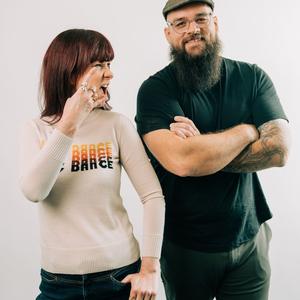

MrBenBurns: My first ever client paid me 50 bucks for a logo. Well, I they would have, I never actually took the money. And Stephanie's first paying client gave her $300 to design an entire room. And she had to cut out every chandelier by hand in Photoshop to pull it off. Rough starts. But both of those projects shaped how we run our businesses today. Hey. My name is Ben Burns. I'm a designer, entrepreneur, and father of the year. 11 years in a row. I'm here with my co-founder, lettering artist, Stephanie Owens, and together we run Maker Division, coursework, coaching, and community for creatives building a business around the work they love. Today we swap first client stories and then get into what AI is actually taking from creatives, why profit matters more than a big top line, and how to find your next income stream. But first, It's birthday month around here. I turn 40 years old this month. I know, I know. So we are throwing the birthday bash with workshops dropping one at a time over the next few weeks, each open for just a few days. Catch up on every drop by signing up for the dispatch, our weekly newsletter at makerdivision.com forward slash the dispatch. All right, let's talk first clients. Alright, well I realized that I've told the story of my first client before and I had never heard yours. And I was wondering if we could like dig into that. Because I I've written my story down. It's it's on emails and stuff. so I can recap it, but I realized that like I don't even know if you had a if it was for photography or interior design or Or l like what skill
Stephanie: Yeah.
MrBenBurns: was your first client project for? Like walk me through that 'cause I'm I I don't know. I I've never heard this one.
Stephanie: gosh, I have to think back if anyone actually paid me to do photography work. I don't think they did. I think I did a lot of like pro bono, like, okay, so fun. not really a client, but probably my first like piece of personal work that got attention, I guess, was a friend of mine when I was in photography school, he was venturing into the world of drag and so I was taking photos of him and he is now RuPaul's makeup artist his name is Raven yeah
MrBenBurns: No way. That's amazing.
Stephanie: wild he was actually the last person that I ran into when I was leaving California I just saw him randomly at the mall and I was like David there you are need to tell you I'm moving But the photography work that I did for him, he gave me this CD for my birthday one year. and I was like, what is this? And it was like the mix CD of the San Francisco Pride Week. like this the official CD of it. And I was like, this is cool, but why are you giving this to me for my birthday? And he's like, just open it. And I opened it and it was filled with a bunch of the of The work that I did of him, which was cool. Not paid, but that was really fun. but I think my first paid client, because Nathan had stuff, my husband, he had clients that he worked with on and off. But I think for me it was an interior design project. And I was on this platform called Laurel and Wolf. Have you heard of that?
MrBenBurns: Mm mm. It sounds very like
Stephanie: So it's like
MrBenBurns: two thousand and six though.
Stephanie: it was like two thousand fifteen. So so it was
MrBenBurns: Okay.
Stephanie: maybe a little late to the game, but it was like a semi like a marketplace, like an upwork situation, but it was more so of you put in your brief, like from the client end, you would put in like what you're looking to have designed, and it was all virtual. And this is what got me along the route of being a virtual interior designer because I was Doing this while I was still teaching, and I thought, okay, this would be a cool way to get my feet wet to see if I like working with clients, or if like, should I have my own business, or should I take my interior design knowledge and like work for someone else and quit teaching and get another job as a designer? So basically, the end client would submit what they're looking for, and it really wasn't. great for the designer. You had to create a mood board of what you you basically were competing for the job. And you had to, yeah, you had to keep like you it's
MrBenBurns: Wow. So it's like a it's like a marketplace of pitches.
Stephanie: Yes. Yeah. And so
MrBenBurns: Ha ho ho
Stephanie: and I you had to you had to like you had to submit, you had to get approved to be a designer in the community. So there was some vetting and you had to really know Photoshop. That was kind of the big the big thing was you definitely had to know Photoshop back then because I don't think Canva
MrBenBurns: Sure.
Stephanie: was was you couldn't really do it with Canva at that point. I don't know if you could now, probably with the remove background tool, but I remember the first the first person who I won the the job, it was this really eclectic living room. she had this photograph of of Franklin Delanore Roosevelt that had to go over the mantle of the fireplace. It was very kind of quirky and fun. And I quickly became on the platform the one that was winning all of the quirky and fun projects. I didn't I didn't do much beige or anything like that, but eventually they were just they got to the point where you then had to select your furniture from their catalog. It's because they were getting affiliate kickback for it. And it just wasn't really good for designers. So I decided, well, I'm gonna take this knowledge of delivering interiors virtually and create my own studio from it. And That's when I started learning the business side of things and marketing. but the pay was awful. It was horrible.
MrBenBurns: Yeah.
Stephanie: Because it was a flat fee, unlimited revisions, the client just needed to be happy. And then there was like a premium tier where you had to earn your way into premium tier and have a premium tier designer. And then people could choose that they wanted a premium tier designer that that's the pool that they would be looking at, you know, submissions from. And I was in that premium tier, but I think you only got like two hundred dollars more f and that
MrBenBurns: no.
Stephanie: that was it. And yeah, we're talking like in 2015 for for one room, I think I made like three hundred dollars for the the full spec design. Yeah, for a design and
MrBenBurns: For a whole design? Whoa.
Stephanie: a f and And a floor plan and all the links to shop. And I wasn't getting any kickback on any of those links. I wasn't allowed to sell things wholesale at like at a at a markup, which is a like my grandfather was an interior designer. And so I knew all the ins and outs of how to price things, but I wasn't allowed to do that. It was very there's a lot of gatekeeping and and then they implemented the you can only shop from our library, and that's because they
MrBenBurns: Mm.
Stephanie: were getting They were getting the extra money there. And I was just like, no, this is not good for interior designers. It was a fun little experiment. but and then they went out of business like shortly, shortly after. No, no.
MrBenBurns: Is that I was gonna ask, is that platform still around? 'Cause yikes.
Stephanie: I think I think there's still some around like that, but after the experience, I was just like, one, my style of interiors. It just wasn't very like the the type of people that wanted that, there wasn't a lot of them on that platform, especially the more that they went down the the the road of picking the furniture in a library of that was theirs. Like once I started going through the library
MrBenBurns: yeah.
Stephanie: of what was available, I was like, you mean I can't shop on Etsy anymore and find weird, cool stuff that people like my people would want. And so I just saw that. there was no room for me there anymore. So I left and started my own virtual interior design business where I was able to market my own particular style and get the clients that wanted that style. And then the company just kind of disappeared. It like overnight. It was like an
MrBenBurns: Wow.
Stephanie: overnight they just sh they just shut it down. Yeah. But they I think there's other sites like it may be still around. I think Havenly might still be around, but I don't know if Havenly is doing the compete for the client thing like Laurel and Wolf was. But it was a thing. It was a thing. But it was it was a fun experiment.
MrBenBurns: Yeah. Wow, that's that's crazy. It's and it's crazy how quickly those things those things fold too because I I did a lot of work for upwork when I was like first starting the leg of my career that actually worked where I was able to go full time with my studio and I did I did it
Stephanie: That's why I asked so it's like like a like a paying client, like someone who
MrBenBurns: Heah.
Stephanie: actually gave me money?
MrBenBurns: Yeah, because I I did a a ton of of upwork and I remember that the goal was to do enough work so that Upwork would be happy with their commission because it was outrageous, like 15 to 20% of the job. In those days it was it was called Odesk. And then get the client off of that platform as soon as possible, breaking all the terms of service. I mean like you know
Stephanie: Mm-hmm. I did it too. I absolutely did that. I I ended up turning a client from Laurel and Wolf. Laurel and Wolf's gone, so I can just like say it out right now. I ended up turning a client from Laurel and Wolf because I immediately would go down the Instagram, like little rap, try to find all my clients and be like, Hi, it's
MrBenBurns: Right, exactly.
Stephanie: me. I would love to keep in contact with you afterwards. So I can get like photographs of the space because that was something that we like interior designers need great photographs of their of the spaces, right? And so
MrBenBurns: Mm-hmm.
Stephanie: I went down that that rabbit hole too. And one who paid me like $300 to do her her bedroom or something like that, she then bought a new house. I designed the entire house off of Laurel and Wolf. And her mom bought a new house. I designed that entire house completely off of Laurel and Wolf. And we're talking multiple 10-figure projects, both of those houses.
MrBenBurns: Yeah.
Stephanie: So I was able to really turn like someone who was just like, this is a fun little experiment into, you know, it's kind of where I got my first interior design clients was cheating.
MrBenBurns: Yeah, no, and it like it legitimately breaks the terms of service for a lot of those websites because they lay claim to that relationship and they want to get their peace, which I can't stand. It just it just really bugs me that they expect to make that much money off of creative's hard work. but yeah, I did the same thing. It's like as quick as you can get off the platform.
Stephanie: it's it's it's awful for creatives.
MrBenBurns: You know, like let's do it.
Stephanie: But I also felt that the platform Laurel and Wolf was bad for the end client as well in the long run because, well, one, they just closed up shop and I'm sure there were some people that had already paid them. Like I don't know how that worked behind the scenes. But once they started gatekeeping what the interior designers were allowed to source, that's not a good service to the client. Because it's like, what if the client really wants something else? I'm like, well, I can't
MrBenBurns: Mm.
Stephanie: put that in your plan because Laurel and Wolf won't let me. And a lot of my clients came to me because they wanted weird, they wanted different, but they also wanted things that you couldn't find online. And that's where I learned how to sell, you know, things that are only available to interior designers through wholesale relationships to clients. And I'm just not a fan of of the marketplaces. I think that, you know, I think in the division curriculum we use it as like a if you are in desperate need, do it. But don't
MrBenBurns: Mm-hmm.
Stephanie: build your don't build your business model around those types of marketplaces because they're not good, they're not good for creatives.
MrBenBurns: Yeah, yeah. I remember I also did one I think it was called Crew back in the day. It was like Crew dot co or crew dot io. And this one was this one was different because to get into Crewe as a creative, you had to go through this lengthy application process. There was a portfolio review, there were several interviews, and then you were part of a small pool and their job was to go find great projects and then feed you great projects. And so we're talking like 10 figures, or not 10 figures, $10,000 and up. Yeah. No. This is like $10K and up.
Stephanie: Woo, Ben's a baller. Like sign me up.
MrBenBurns: You know? So it was like it was a totally different experience because I had an account rep at crew. It was almost like having an agent, to be honest.
Stephanie: Mm, yeah.
MrBenBurns: Cause I could email
Stephanie: Mm-hmm.
MrBenBurns: my person at the platform and let know like how this job was going. We had to pull out of a job once because we screwed up and we needed to get the the you know company taken care of with a different service provider. And
Stephanie: Mm.
MrBenBurns: they were great through that whole thing. And I remember feeling like number one, they actually cared because they would check in throughout the project and they would provide you know, conflict resolution. They were they were actually giving me a service, so I didn't mind. I think it was like ten or fifteen percent that they were charging. but the cool thing was was that
Stephanie: Mm. Which is if if if you're thinking of it like they're your business manager, you know, that's not that bad.
MrBenBurns: It's really not. Yeah. And
Stephanie: No.
MrBenBurns: the top line was so much, you know, s it was such good quality projects that like even though I saw, you know, hey, this is a we're paying these people a thousand dollars for this for this gig or two thousand dollars for this gig. There was so much meat on the bone that it it didn't matter. and the experience was was really really rewarding. But funny enough, they got acquired by Unsplash, the stock photography company, and then they just disappeared.
Stephanie: Mm.
MrBenBurns: I don't know what happened to them, but they just like poof gone. I think two thousand sixteen or seventeen. Yeah.
Stephanie: They just Kaiser Sosead they just kaiser Sose themselves into into thin air. You said Fush gone and I had to, you know, it's my favorite movie.
MrBenBurns: Pretty much, yeah. Yeah.
Stephanie: I wonder what happened there because I think that it would be great if there was that kind of place for creatives where you could go and apply and basically they're your business manager and they help you get projects. But all I see lately is just platforms that are taking advantage of creatives and it's like a a race to the bottom.
MrBenBurns: Yes. Yeah. And I think that if I had to guess, like I have no knowledge of why they disappeared, but I mean imagine if your only job was to find client work. You know what I mean? Like, that would be That's a tall order. That's a tall order for creatives who have the portfolio
Stephanie: Mm.
MrBenBurns: and, you know, the experience and the connections and stuff like that. And so if you have a pool of a thousand creatives that you need to feed, I imagine that that's a
Stephanie: Yeah.
MrBenBurns: that's a that's a lot of work putting putting work in front of them.
Stephanie: That's a it's a little different. It's a little different than having an agent because agents know how many how many artists they can take on. They know not to have artists that will be competing with one another. So
MrBenBurns: Mm-hmm.
Stephanie: I like the model, but the logistics of it does sound quite tricky. Cause you and I have even I mean, this is not happening, so don't get excited, everyone, but you and I have talked about like we could turn, we could like turn maker division into an agency, but then it there's a lot of c
MrBenBurns: Into a studio, yeah.
Stephanie: there's yeah, there's a lot of conflict of interest amongst our designers, right? Who would get who would get certain projects because there's
MrBenBurns: Mm-hmm.
Stephanie: overlap in style, there's overlap in industry. So it's a cool concept, but just not a huge fan of marketplaces in general. And it's why we
MrBenBurns: Yeah, yeah.
Stephanie: try to get them people off of them immediately, but it's it's there for you if you if you really need it.
MrBenBurns: I wonder I imagine that there's there's some of this going on right now. but your what was it Laurel and what was the
Stephanie: Lor Laurel and Wolf. Sounds so fancy.
MrBenBurns: Laurel and Wolf. It does sound fancy. But it does sound like that like twenty ten era everybody had an ampersand and then two random words.
Stephanie: It wasn't. Mm-hmm. Mm-hmm. Mm-hmm. tens.
MrBenBurns: the fact that like everybody had to pitch to get to get work. I mean the amount of work that goes into those pitches where you're photoshopping everything, unreal, number one.
Stephanie: Mm.
MrBenBurns: Number two, I can't help thinking and being a little terrified that there's gonna be a marketplace that pops up that's similar to that that requires a pitch. nowadays because it's so easy to generate something. It's so easy to like, you know rock up to
Stephanie: Mm.
MrBenBurns: Chat GPT and plug something in and go like, show me this brand. I'm I'm hopeful that this doesn't happen right now. But I I can't help but wondering if technology is gonna enable the pitch again, which would suck.
Stephanie: I think this also it it just adds to the race to the bottom idea that you and I have
MrBenBurns: Mm-hmm.
Stephanie: been talking about, but also that we've seen just from working with creatives as we do. It's AI is taking the place of a lot of design work. But it's that low end design work. It's the production work. It's the clients that don't have a lot of money to begin with. What else have you seen? Because I know what I know what I've
MrBenBurns: Yeah.
Stephanie: experienced from my own household and with our division members. But so let's compare notes there on like what is taking the place that that race to the bottom idea of of AI and is it taking anything from the top from what we've seen? Not theory, but just from what we've seen.
MrBenBurns: You know, I haven't spoken to anyone who's losing high paying jobs to AI right now. So like
Stephanie: I haven't either.
MrBenBurns: when when I think about like a deal won or lost and the reasons, it's like there's a big difference in you carry this deal all the way through your pipeline and then you get to the end and that lead just like ghosts. Or you just don't,
Stephanie: Mm.
MrBenBurns: you know, they're like, hey, the project died or something like that. Huge difference. between that and then somebody going, we're just gonna go with AI. I haven't s
Stephanie: Mm.
MrBenBurns: I haven't heard of that happening at the higher end of the budgets, you know, anything like five figures plus.
Stephanie: Except maybe with retainers, which can over time lead to a a large amount of money. But we've seen some
MrBenBurns: Yeah.
Stephanie: retainers go away because of AI.
MrBenBurns: Yeah. But then on the on the lower end, it's like I've seen a lot of folks lose low paying jobs to AI and have the lead tell them that like, hey, we're just gonna use AI tools for this, or they hire them for a nice paying, you know, design gig in order to train their AI, which in
Stephanie: To tree.
MrBenBurns: effect works them out of a job.
Stephanie: Yeah.
MrBenBurns: But then there's a couple of people who are really focused on like production level work that I've seen encountering, you know, price objections where the the lead is like, it's out of my budget right now. And they're able to work with the lead's low budget because the
Stephanie: Mm, mm.
MrBenBurns: creative themselves are using the AI tools to improve their. workflow and speed where they do a lot of the like the thinking and the creative part the old fashioned way and then they crank all the production work and the development and all that kind of stuff through AI tools. And
Stephanie: Mm-hmm.
MrBenBurns: so they're able to like work with lower budgets and profit from them. Now I mean we're pretty much aligned with this. It's like we want to see creatives make money. But I think it's a really cool snapshot of like how the new technology is a double edged sword where it's like it's probably gonna start
Stephanie: Mm.
MrBenBurns: cutting away that lower end, but we can also use it to reduce the time that we spend on the grunt work, you know?
Stephanie: Yeah, and I think that it gets back to yes, we want creatives to make money, but more so we want them to be profitable. I think there's a difference between making money and being profitable. I made $90,000 in our studio in six months in 2020 while I was also working at a full-time teaching job. And that money surpassed my teaching salary. And I stopped working mid-year because I had an event happen in my life that I wanted to take some time and refigure the business and move forward because I knew it was working and I knew I could quit my teaching job. But I just wanted to make sure after, you know, some bad bad things happened that I wanted to, you know, it was 2020, remember? I just wanted to make sure that we were moving forward in a direction that I wanted the studio to move forward in. And because I had made $90,000. A prominent biznes coach online. not a friend of Maker Division. She told me, you don't have a real business until you make $100,000. And I was just like, excuse me. Okay, sit down from your ivory tower and like let's talk about what's profitable. Right? I was like, it doesn't matter how much I make, it's a real business. Shut the fuck up. I was so pissed that I was like, I never want to talk to you again. And so when we say make money, yes, I just hope the era of you have to make six figures or It's not worth my time to take on a project that's not $10,000. I'm like, if it's profitable, if the person you talked to was making one or two thousand dollars for a project and it became profitable by utilizing AI and now he's able to take on more projects, rock on. You're running a profitable
MrBenBurns: Yeah. Yeah.
Stephanie: business. That's what we should be talking about, more than just because like those $300 interior design projects were not. profitable at all because there was no there was no you know remove background button in Photoshop back in 2015. I was pen I was pen tooling Sputnik chandeliers. If you don't know what a Sputnik
MrBenBurns: Oof.
Stephanie: chandelier is go Google it. I have one. I'm looking at it right now and I have it's like it looks like Sputnik.
MrBenBurns: It's like this It's like take your fingers and then put them mash them all together and that's what it looks like.
Stephanie: Looks like you're about to do some sort of like fun thing
MrBenBurns: Yeah.
Stephanie: with your fingers. It was not profitable, but you can have a lower paying job and make it profitable. You just need more of them. So there's no but
MrBenBurns: think I I wrote about that.
Stephanie: you you sure did. It was a little salty. Your email
MrBenBurns: Yeah.
Stephanie: this week. I was like, Ben is going there. More of this.
MrBenBurns: Yeah.
Stephanie: Ha ha
MrBenBurns: I I I wrote about it as like, yeah, you know, in order to get my attention, a project has to be twenty K just to just to like pique my interest. however,
Stephanie: That's because you know your numbers.
MrBenBurns: true, but I will also do something for five hundred bucks. So it's like it just depends, you know. If it's a if it's a five hundred dollar like, hey, I want you to come in and and do some critiques. on our brand or some fractional creative
Stephanie: Absolutely.
MrBenBurns: direction for two hours, right? It's like I I would do that deal all day long. But if
Stephanie: Mm.
MrBenBurns: you know com if you compare that to like a fifty thousand dollar project that takes your full attention
Stephanie: Mm-hmm.
MrBenBurns: away for a full year, obviously, you know, that that ROI is is just it's totally radically different. So that top line number is just it's half of the equation.
Stephanie: And I think that's when we get into other income streams. We can't look at what we make from a single client project that takes us away from our business for months. because when you were working on the Mode project, it was concurrent with us establishing maker division. And you were having you may not want to admit it, but you were having a hard time.
MrBenBurns: No, it's a lot.
Stephanie: having that that much focus on like brand new business, baby business, and a large branding project. It was a lot.
MrBenBurns: Mm-hmm.
Stephanie: But when you have other income streams, we can't look at pricing the same way. It's totally different and not as easy to calculate sometimes. But
MrBenBurns: Yeah.
Stephanie: I think that having those other income streams, sometimes those save the day. Right? Those little
MrBenBurns: Mm-hmm.
Stephanie: five hundred dollars those little five hundred dollar things here, or if I if we have a a sponsorship, if I'm doing like an Adobe sponsorship, sometimes that little extra money every month, it's like, that's nice to have. It's just a nice little bonus. And sometimes it saves the month. And so
MrBenBurns: Mm-hmm.
Stephanie: I've always been a fan of client work is great, but what else can the studio become?
MrBenBurns: Yeah, when did that start
Stephanie: And I've I've done that.
MrBenBurns: like
Stephanie: Immediately. Immediately.
MrBenBurns: Yeah, was gonna ask, like when when did that start coming around for you? Cause I think that that's a realization that you made 'cause I I I haven't diversified my revenue streams until I don't know, maybe the last ten years. Like when I was running a studio,
Stephanie: Mm.
MrBenBurns: it didn't didn't even cross my mind. I was just trying to get as much clients through the door as possible. So when did the when did the diversification of revenue streams come in for you?
Stephanie: It was the same time. It was the same time because that 2015 is also the year. Yeah. It was earlier that year. So late 2015, I started with online and interior design services. Now none of this makes sense together unless you know me as like solo studio center of a creative bubble of income streams. Earlier that year. I went on a paid press trip to the United Kingdom for Agatha Christie's 125th birthday celebration. I was the Agatha Christie master teacher and I was paid to go. thank you. I was
MrBenBurns: Ha ha ha.
Stephanie: paid to go to Europe to basically cover the Agatha Christie Festival, and so I was paid a flat rate, it was all inclusive. I also got a per diem. So that was another chunk of revenue. And then I started writing curriculum for her publisher, HarperCollins. And so anytime a major movie Release came out like Murder on the Orient Express or Death on the Nile. They hired me to write curriculum guides to coincide with the movie release. It was the year of Miss Marple one year, so they had me do a bunch of stuff for Miss Marple. And so I've always been very interested in how else can I make money? And
MrBenBurns: Mm-hmm.
Stephanie: sometimes it doesn't always make sense in one business. And I think that's okay, And then that's why the Laurel and Wolf experiment, it was still very good for me because out of it, I realized that I didn't want to leave teaching to have another job. I wanted to leave teaching to work for myself because I saw the possibilities of it. And then, you know, when I was an interior designer, I started having like this signature service of designing people's home offices for them around their brand. And so I was really getting into brand and then. Then Nathan and I started working with branding clients. And from there I had, you know, kind of one-off calls with people who couldn't afford the full service. But then I also had a little course for interior designers, how to get clients from Instagram that I sold, you know, a few a month. And then I ended up having a little membership where that was filled with interior designers that paid a small fee every every month to get like a little masterclass from me on like how to blog for your interior design business, how to let's talk about SEO for your interior design business and a lot of branding stuff. And I had the YouTube channel. Funny enough, I was also because I had a a video on style guides. And this is before I knew you.
MrBenBurns: Really?
Stephanie: You did not have this you did not have the style guide kit out. So I did not steal this from Ben Burns trademark.
MrBenBurns: Ha ha
Stephanie: I did not know who you were at the time, but I had a video on YouTube about style guides for brands. And I was approached by Skillshare to teach a class on style guides. And I turned it down because little old me didn't want to teach online.
MrBenBurns: wow. And that was that was when Skillshare was that was their heyday in those days. Yeah. Wow.
Stephanie: Yeah, that was it was in between 2015, 2000 2020. It was probably around 2018 when Skillshare
MrBenBurns: Mm-hmm.
Stephanie: approached me. But I turned it down one because I was super busy I also didn't want to do like the production and everything. It just did not seem like appealing to me at all. how much I've grown into that, but I just at that time I didn't want to teach online. I had I had done it so much with like the Instagram course and and I was just like, Is this really what I wanna do is more teaching? And then I ended up doing this with you. But it it made sense and I'm happy with with this decision. But at that point I was just like, I'm I I need a break from teaching. But I've just always been very interested in the possibilities of what else, my creative can do and my creative can be, you know, actually craft or things that I cook up in my brain like I did with Agatha Christie. But and then licensing just kind of knocked on our door one day and that
MrBenBurns: Yeah.
Stephanie: I d we hadn't we had no idea what that was. And I think a lot of it was just chasing what we're passionate about. Like there is a reason I am the Agatha Christie master teacher. It's because I'm obsessed with Agatha Christie novels. Like there was
MrBenBurns: Mm.
Stephanie: no one going out of that interview who was gonna get it other than me. Like they told me afterwards, they were like, it was obvious that you live and breathe Agatha Christie, and you were the only person that this could go to. So I think of a lot of it has just always been chasing what I'm really interested in. But then also making work and seeing
MrBenBurns: Mm-hmm.
Stephanie: what the opportunities are. Some like some of these things, like I couldn't have Planned to become the Agatha Christie master teacher. I didn't even know it was a thing. It was just always
MrBenBurns: Yeah.
Stephanie: just thinking about what else is possible and leaning into the things that I really love. And I know you have a very different, you know, trajectory when when it comes to your income streams. Where
MrBenBurns: Yeah.
Stephanie: your were yours a little more strategic? Because mine was just like, what do people want? there's an opportunity. I should go do that.
MrBenBurns: I mean, I just didn't I didn't know enough about the internet to really maximize much or even know that a lot of this stuff was possible back in the day. So I just focused on client
Stephanie: Mm.
MrBenBurns: work. It's like the client work that I did when I was an intern, I remember seeing some contracts come through and just being absolutely blown away how much. This little tiny creative agency in Columbia, South Carolina was making working with these massive entertainment brands. and there I was making seven seven dollars and twenty-five cents an hour. You know, like I I just couldn't believe it. I just absolutely couldn't believe it. and so that that that was my north star. I just always remembered that and seeing how much money people were making from, you know. Bringing in client work. So that was that was my whole focus. and I remember the first client that I ever had. it's really fuzzy for me to I can't remember exactly how I got them, how I like got the lead, but I think it was on Craigslist.
Stephanie: No.
MrBenBurns: I think that they the We did
Stephanie: Did you meet up in a parking lot at midnight with a gun? Were you were you packing?
MrBenBurns: No. No. Okay, so this was I was probably s eighteen or nineteen years old at this point and I was
Stephanie: Okay, so you were young at you were young and reckless and foolish.
MrBenBurns: Yeah. Well maybe it would maybe I was twenty. But I I I was in my first internship with this agency. I was still in university. I think I was a sophomore or a junior. And I remember like this was right after I had just learned Illustrator. And that was my assignment for the first three months of my internship, was just to learn Illustrator. Cause I could figure out Photoshop. But then After I learned the pen tool, and after I learned, like, yeah, so this is what Vector is, this is what raster is, then I was like, logos. I gotta do logos. And I'm relatively sure,
Stephanie: You had the bug.
MrBenBurns: yeah, I'm relatively sure that I went on Craigslist and found this this lead who was looking for a logo for her ultimate frisbee team. And I like right.
Stephanie: that's awesome.
MrBenBurns: She had a a a grand budget of like fifty dollars or something. It was like very very minimal.
Stephanie: I was gonna say this is definitely a less than a hundred dollar logo, yeah.
MrBenBurns: Yep. and I remember like working at this agency, I had very, very little to do with actual branding projects in the beginning. Like they would come through and our art department was really small compared to the rest of the team. So they had like seven or eight account reps. They had the founding team, they had the bookkeeper, and then they had a whole fulfillment warehouse because we did a lot of like physical campaigns. But in the creative department, it was the creative director, a senior graphic designer, and then me. That was it. That was the whole team. And so we were doing all of the work for all twelve of those account reps and all of like managing all of the print and all that kind of stuff. The branding jobs, the actual like really true creative stuff never really trickled down to me until I was at least a year in. And then I could like throw my options on the table to be absolutely ripped apart. As well, they should, because they, you know, I sucked in those days. And so like the opportunity to have this one client where it was like it
Stephanie: Yeah.
MrBenBurns: was all mine. I had complete creative control. And I was watching my creative director and that senior graphic designer handle this stuff and and tried to follow what I thought that they were doing through the process. And I I remember like getting ready for this meeting. We were gonna meet at a coffee shop and have coffee together. And I was like trying to find the most creative thing. Yeah,
Stephanie: Wow, you were taking this very seriously, Ben. Wow.
MrBenBurns: because I was like, this is my first real design project. I'm gonna I was gonna
Stephanie: Mm-hmm.
MrBenBurns: do it justice, you know? So I was like in my closet and I remember my girlfriend at the time going like what are you doing? I'm like, I'm trying to find something to make me look creative, you know, like a designer with a capital D. And I think I wore like Chucks and then a pair of glasses because
Stephanie: You say ch
MrBenBurns: Chuck Taylor's, yeah.
Stephanie: Yeah, I was gonna say you d you absolutely wore chucks. I I v envisioned it. I was like, when you said I have to be a designer with a capital D, I like, Chucks.
MrBenBurns: Yeah. And I I wore a pair of glasses that were like two prescriptions old because I was wearing contacts at that point. And I was just
Stephanie: Ha ha.
MrBenBurns: like, I really want to be a designer, you know? I had my Jack Bauer bag, my sling bag and a and a little notebook and so we met and I just like I was like, Okay, so what logo do you want? And she was like, What do you mean? She had no concept of like what she actually wanted. Long story short, I mean that that project ended up being just it never ended. I I think it it got to the point where I c I had done so many revisions and worked so hard at that fifty dollar logo project that at the end the
Stephanie: Mm.
MrBenBurns: season was over and the team had disbanded by the time like we were even close to being finished. And
Stephanie: Ho ho ho ho ho ho They're like we don't even play Frisbee anymore. We all we all now
MrBenBurns: Right.
Stephanie: are moms of five year olds.
MrBenBurns: So I remember her like wanting to pay me and I I don't think I even accepted it. but i I just at that point I recognized that like you know it was my fault, obviously, because I was kind of expecting her to be to behave like my creative director was behaving with me in the office.
Stephanie: Mm,
MrBenBurns: You know, I expected
Stephanie: mm.
MrBenBurns: to be handed a brief, to be given really good critique, to be taught like how to see something and then, you know, shown references on what they were looking for. I had a great creative director in my early career. and that just doesn't happen because clients they'd be clienting, you know what I mean? Like that's it.
Stephanie: Which is funny because sometimes you're saying you wanted the client to come to you with direction. But most of the time that's not what we hear people say they want. They want the client to not come to them with direction at all. And I actually really
MrBenBurns: Right.
Stephanie: love it when client I actually really love it when clients come with direction because I don't have to pull everything out of them. And I also don't have to like shot in the dark. Is this what you like?
MrBenBurns: Mm-hmm.
Stephanie: Like I like
MrBenBurns: Yeah.
Stephanie: it when people come to me with with an idea because one, it shows me that they've been thinking about it and they're really into the process. And I think I said this in your project branding workshop when you asked me to do a video on art direction for brands,
MrBenBurns: Mm-hmm.
Stephanie: for branding projects, is I said something like, I actually really like it when my clients are enthusiastic about the design process and want to be a part of it. And I don't get mad at them because if they want to be a part of the process, they're kind of paying me
MrBenBurns: Right.
Stephanie: for that privilege. And like
MrBenBurns: Yeah.
Stephanie: zero ego about it. You want to be a part of the process? Absolutely. And I think part of it that for me comes from maybe my I'm thinking about it for the first time, maybe my interior design background. Because when I started designing for others, I was designing their homes and their offices. And they needed
MrBenBurns: Mm-hmm.
Stephanie: to be, they needed to buy into that. They needed to feel like they belonged with the design that I was giving them. And maybe I've just always felt that way when I transitioned from interior design into branding design, that they needed to and especially because I do a lot, I don't do corporate work. I do a lot of like kind of cool, kind of fringe interest and personal brand work. Like I want them to be excited about it. I want them to be happy
MrBenBurns: Mm-hmm.
Stephanie: and to feel like they can live with it. And when I think of the first two branding clients that Nathan and I had, one of them is Dixie, she's a division member, she still uses her branding. And another, Leanne, she's an image consultant, all these years later, still uses everything. And it's because
MrBenBurns: That's cool.
Stephanie: they were part of the process. And it's very much them and they they've embraced that identity design that we created for them. So I love
MrBenBurns: Mm-hmm.
Stephanie: it when clients come to me with ideas. Cause if they don't, I'm sort
MrBenBurns: I do too.
Stephanie: of like, What are we? you you have no idea what you want. Okay, you've thought about you've but you've been doing some deep thinking about this. I like clients
MrBenBurns: Yeah, and I
Stephanie: with a point of view.
MrBenBurns: I I also think that there's a big difference between having a point of view and being overbearing though. 'Cause I can't stand an overbearing client.
Stephanie: Yes, I c no, me neither. Those are the those are probably
MrBenBurns: But like if dude, if you
Stephanie: the worst.
MrBenBurns: if you rock up with a Pinterest board, I'm into it. You know what I mean? Like show me. That's that's amazing. But I
Stephanie: Right. Mm-hmm. And if they don't, I actually go and I have them make me one. I'm like, just give me something. Cause like, even if I look at the Bloom House that we did last year, her mood board is not what we ended up going with, but at least I had a starting point. The mood
MrBenBurns: Mm. Mm-hmm.
Stephanie: board was very much what she thought she wanted. But as I was talking with her through Discovery, I just kept picking up on things she would say. Like she thought she wanted something very folk. But she kept going back to her trip to Scotland and the castles and the heraldry. And then she would send me these random pictures of her in castles. And I was just like, I think she's subconsciously telling me that she wants this to be like very Art Nouveau meets. medieval castle. And so when I
MrBenBurns: Mm-hmm.
Stephanie: showed her that mood board before we got going on the logo, when I showed her the expected one, the mood board that was basically just a cleaned up art directed version of her Pinterest board, she was like, okay. And then I showed her the one that I was like I'm I'm drawing it. I'm going out on a limb because she kept sh kept talking about these things. When I showed it to her, Like the kind of Art Nouveau medieval one she did And like she just got a big smile and I was like, Yep, I knew it. That's actually what she wanted. So just because a client comes to you with ideas doesn't mean that they're dead set on those ideas and that you can't push those ideas into a different direction. It's a starting point.
MrBenBurns: yeah. Yeah, for sure. And you know, I think in that in that first project, like this was not a priority for this person. They had very little vision.
Stephanie: Yeah.
MrBenBurns: There was a team of decision makers that didn't, you know, weigh in on the process. And so there was a like a literal frisbee team.
Stephanie: A literal team, a literal team.
MrBenBurns: Yeah. So it's just a it was a great first project because I learned a ton. but I think like since that point, I personally have been hyper focused on process because like I knew and not in the moment, because I don't I think I was too young to know, too inexperienced to know. but I knew in that with that scenario that what failed there was process. It was not asking the right questions, it was not putting the work in the right order. You know, it was it was failing to get the decision makers in the room. And so like since then I have been hyper focused on process. It was the engine to try and get me to work faster when I, you know, came back to my creative career and started doing more work on upwork
Stephanie: Mm-hmm.
MrBenBurns: and freelancing full time and stuff like that. The name of the game was do the work as fast as possible. Otherwise I'm losing money. And If I didn't do the work as fast as possible, the client wouldn't be happy, upwork wouldn't be happy, I wouldn't be happy. And so I had to figure out a way to get buy-in to understand like what the what the heck my clients were talking about. And it's just it's funny because like as I look back, it's like, yeah, that's That's where that obsession came from. It was like a requirement in
Stephanie: Mm.
MrBenBurns: order to build this business that I thought I'd I wanted to build. A focus on process, a focus on efficiency, and going deep into just a massive volume of client work. That's that's why
Stephanie: And
MrBenBurns: I've created all the stuff that I have, you know?
Stephanie: Yeah. So I would say that your your income stream path, it started with client work. Mine started with client work. But yours was very much more like your thing with client work was your process.
MrBenBurns: Mm-hmm.
Stephanie: And that naturally like yours, and I know none of this is like a great, like a nice linear path because you also became a narcotics. Officer and
MrBenBurns: yeah. Yeah.
Stephanie: all there's a lot of there's a lot of little detours, but like if we just look at from client to other income streams, it's been pretty pretty linear for you. And for me, it's it's more about like what do I feel like making? Let's try making that
MrBenBurns: Mm-hmm.
Stephanie: and let's try making that. and then there's licensing as a thing? That's cool. And no, I can teach a little course on this, and and now I can have a community about this. It's it's more of like what what's tickling my fancy? in this season of life.
MrBenBurns: It also like it's really interesting to me that like diversification of income streams has been since day one. But also like a lot of the like your starts with with the creative businesses, they were side hustles initially, right?
Stephanie: Yes, until I took client work to full time. And then
MrBenBurns: Full time, right.
Stephanie: yeah. And I think that I think that having the full-time job and I think we could replace full-time job with full-time income. I think having a full-time income, whether it's from your current clients or from you know anything else, having a full-time income allowed me to take that path of what do I want to experiment with and get off the ground next? And
MrBenBurns: Mm-hmm.
Stephanie: and it was client services for me to begin with. And then from there, client services were up on the ground. So then it was like, okay, what's next? And because of the opportunities that I had, it became education. And now
MrBenBurns: Mm-hmm.
Stephanie: that I have education. Now it's like, okay, what is the next path? And I I don't want to go back to what I had, you know, over 10 years ago, where it's like, I'm gonna try a little bit of that and a little bit of that and a little bit of that and see what sticks. Now it's it's much more focused in terms of okay, client services, got that. We've got education, got that. And now that education has allowed me to take on fewer. clients, which I think is okay as long as I'm still, you know, dipping my toes in client services, because I don't want to be talking out of theory. I don't want to be talking out of a book. I want to be talking to all of you out of experience. But then now I'm like, okay, what's the next thing that I really want to get off the ground? And that for me is sponsorships and my book. It's kind of like a dual play. But I think
MrBenBurns: Mm-hmm.
Stephanie: that's the trap that A lot of people get into when they're thinking about income streams, is they don't have a full-time income stream yet. So they pick and choose, like they dabble in this and they dabble in this and they dabble in this. And you really do. I feel like there is a level of focus that is required to have one full-time income around something.
MrBenBurns: Yeah. Yeah.
Stephanie: And whatever that may be, and for me in the beginning, it was my teaching job. I had that, and so I was able to kind of play with the other income streams. And then when I decided, okay, client services is obviously the one that's making me the most money and will allow me to leave the job because that's what I wanted, then I was still playing. I was still playing,
MrBenBurns: Mm-hmm.
Stephanie: and then I was offered the opportunity. To teach with you. And I was just like, okay, that will be my next focus because it makes the most sense. And then after that, I think there was still a little element of play. Cause
MrBenBurns: Mm-hmm.
Stephanie: after last year, when you and I, you know, we we went full time with Maker Division together, I was still like, okay, now what do I want the next one to be? And then now this year I'm like, I absolutely know which one it is. This is the one that I'm going to move towards next. Where for you I d and I'm not saying this in a in a bad way, but I don't know how much play there is, or if it's just like okay, I didn't wanna didn't wanna call you a
MrBenBurns: Zero Homie homie don't play. No.
Stephanie: That's so sad. I wish you would. Then there's the artist in me that's like, How are you having fun? But I know you are, because it's it's you're doing what you love, which is that straight path of processes and systems. And now you're working on Watson, which is now your playground. I would say Watson is the one thing that you've decided. Okay, you've got client services, you've got education. It's all about layering them on because. Ben, if you were to work on anything else right now, one, I would be flying to South Carolina to s actually no, I would just call I would just call Elise. I would
MrBenBurns: Wow
Stephanie: just call Elise. I'd be like, can you just find a shoe and chuck it at him
MrBenBurns: No.
Stephanie: on my behalf? Like, there's just n you
MrBenBurns: Yeah.
Stephanie: don't have the capacity. And there, if you want to make meaningful money from an income stream, and like I said, sometimes those little income streams happen. And you and I love those because it's like, that's saved, that saved the month. But in terms of like really focusing on an income stream and making it work and becoming the next income stream of your business, there is a level of focus there. And I think you've chosen yours, I've chosen mine. And once those are up and running, it's then time to layer in another.
MrBenBurns: Mm-hmm.
Stephanie: But and I don't think it can be like a What's tickling my fancy or like I am the process person? That is that is my path.
MrBenBurns: Yeah, and I think that the the interesting thing is that We have both garnered this not only experience but probably expertise in different areas of we'll call it just career or entrepreneurship or just I don't know life. But like in
Stephanie: Life. We're experts at life.
MrBenBurns: yeah, in business it's like
Stephanie: We're not.
MrBenBurns: no the the solve For me, the thing that that I knew that I needed to engineer and to focus on and perfect was was process. And so a lot of things layered on top of that, like you said. And for you, it was I have this thing that I love to do. How can I make money from it? And it's just interesting
Stephanie: Mm.
MrBenBurns: now that the things that we help people with, you know, it's the The questions
Stephanie: Mm-hmm.
MrBenBurns: that we naturally gravitate towards, the the products that we create and launch are so well within our wheelhouse. You know, you talk about income streams, you talk about branding, right? Attracting clients with a with a brand that means something to you. whereas I'm like, how do we profit from this and how do we engineer our process so that we're efficient and profitable, you know?
Stephanie: Mm-hmm. Yeah.
MrBenBurns: It's just it really is interesting to me to see our journeys, how we're able to help people through the the, you know, lived experience that we've had, and how things kinda stack up.
Stephanie: Yeah, I would say that my wheelhouse is kind of encompassed with this idea of creative identity and who I am as not just a creative but a a person. And I think that bleeds through to the the business side of everything that I teach
MrBenBurns: Mm-hmm.
Stephanie: and including lead generation. Those of you that are not inside of the division might be a little shocked to hear that I'm the person that takes lead when it comes to how do we get work. But I think it all comes down to creative identity. Even when I'm teaching how to write a cold email, it should be infused with creative identity. It should be can
MrBenBurns: Mm-hmm.
Stephanie: it can should it should it it should encompass who you are as a person and feel like it's coming from a person and not a robot. It should be a warm email that is sent cold. And you, while you are a lovely human. And you have interests and you have a you do have a creative identity. I am slowly pulling it out of you after working
MrBenBurns: Ha ha
Stephanie: with you for so many years. you really focus on the process and the profitability, but I think that it's it's it it kind of comes down to like what we talked about. couple episodes ago of like what kind of studio should you build? Should it be a problem solving one? Should it be an artistic one? Should it be a blend of both? And it really comes down to you and
MrBenBurns: Mm-hmm.
Stephanie: what your what your strengths are and what you're drawn to and the type of business and life that you want to have. But for me, I couldn't do what you're doing because there's There's just a big part of me because of how I was raised and how I was raised to not have an identity as a human at all. To you know, and when I broke away from that, I just went on this journey of self. And for me,
MrBenBurns: Mm.
Stephanie: I I need to be a part of the work that I do. And and that
MrBenBurns: Mm-hmm.
Stephanie: I think that that's true with maker division, it's true with with. The solo studio work that I do inside of Gold Sheep, my studio with my husband. And the studio that you and I and my husband are creating together. It's like when I work on a project, I'm gonna be pulled into that project because there's a Steph's thumbprint deserves to be on this project in some way. or
MrBenBurns: Yeah.
Stephanie: it's just not, it's just not something I'm interested in. And I know that sounds very selfish, but. If you if you're raised to not have an identity at all, then it you realize how important it is to have an identity and be seen
MrBenBurns: Mm.
Stephanie: as as valuable. but for you, you love the process and I'm very glad that you're here.
MrBenBurns: Yeah. And I think that
Stephanie: I'm like, you need a sort you need a spreadsheet. Ben, open your spreadsheet. Spreadsheet away.
MrBenBurns: Yeah, and and that's not to say that, you know, we're any less creative or anything like that. It's just like
Stephanie: No.
MrBenBurns: it's it's interesting to see where we gravitate towards, especially when we we're we're solving members' problems, you know, because like the moment like just just today we had somebody bring up a a pricing issue and there was some limiting beliefs around there and it was just like Man, I leaned in so quick. You know what I mean?
Stephanie: Mm-hmm. You also got that spreadsheet out fast. I was like, he has that.
MrBenBurns: Yeah.
Stephanie: I was like, that's already open on his computer. I guarantee you. Yeah.
MrBenBurns: Yeah. It's it it's why I made it, you know what I mean? It's why I I I turned it into a little app. So yeah.
Stephanie: Yeah. And I think that's when we're when we are coaching people and we're helping people figure out their next income stream in particular because it's a a very popular topic right now. it's more so of like, okay, let's figure out what kind of creative you are. Are you the one that's problem solving forward or are you more art forward and your own creative identity forward and neither one is wrong? It just helps us guide you. It helps us guide you
MrBenBurns: Yeah.
Stephanie: on the right path of okay, what's next for you? Because if everyone is telling you, everyone needs to build an app right now, apparently. That's what the internet is saying. If you're not building an app, who even are you? And meanwhile, I'm like, I'm gonna go make a margarita and film it and make a title treatment
MrBenBurns: Mm.
Stephanie: for it and set it to a crumbin song, and that's what I'm working on today. So it's
MrBenBurns: Yeah.
Stephanie: It's very much it's important to filter out the noise of what everyone is saying, what we should be doing, and really get to the root of who are you in your business? Who are you as a creative? And that's gonna drive a lot of because I think both are equally important. Your identity as a creative in your business, whether you lean heavily on to the you of it or the problem solving of it, that's really important to know. But also the processes, very important. They're both important. And that's where just like blanket advice on the internet is a pet peep of mine. Ask me all about it.
MrBenBurns: Yeah. Yeah. Yeah, I think I think that that's to say what you said in in a slightly different way, it's you have to look for the thing that makes you lean in. And there's an
Stephanie: Yes.
MrBenBurns: important distinction there because like if you take all the things that you should do and throw them away, and then take all the things that you're leaning away from and throw them away. What are you leaning towards? You know what I mean? Like what
Stephanie: Mm.
MrBenBurns: really motivates you to get up and do something? And that's the thing you should go into. Some people call it passions. I don't like that word. because I think that that word, at least for me, it has a bunch of baggage and pressure. Interest. I like interest.
Stephanie: Hmm. That's a limiting belief And there there you go. What makes you tick?
MrBenBurns: Yep. Exactly.
Stephanie: as a human. That's think of it think of it that way. Let us know about your first client in the comments. Everyone's gonna be like minus
MrBenBurns: Yeah.
Stephanie: fifty thousand dollars. I'm gonna be like, sit down. You went
MrBenBurns: Ha ha ha.
Stephanie: to art center, didn't you? All right. That was fun.
MrBenBurns: See ya everybody. That's the episode. A $50 logo I never got paid for, a $300 room with hand cut chandeliers, and somehow we both built careers out of this. If one thing sticks from today, make it this. The top line is only half the equation. Know your numbers and follow the thing that makes you lean in. We want to hear your first client's story too. Good, bad, or unpaid. Just drop it in the comment section below. one last thing. The birthday bash is happening right now and each drop is only open for a few days. It is our birthday, and these are our gifts to you. Just sign up for the dispatch at makerdivision.com forward slash the dispatch so you hear about every single drop while it's still open. Thank you for hanging out with us, and I can't wait to see you next time.
Stephanie: Yeah.
MrBenBurns: was your first client project for? Like walk me through that 'cause I'm I I don't know. I I've never heard this one.
Stephanie: gosh, I have to think back if anyone actually paid me to do photography work. I don't think they did. I think I did a lot of like pro bono, like, okay, so fun. not really a client, but probably my first like piece of personal work that got attention, I guess, was a friend of mine when I was in photography school, he was venturing into the world of drag and so I was taking photos of him and he is now RuPaul's makeup artist his name is Raven yeah
MrBenBurns: No way. That's amazing.
Stephanie: wild he was actually the last person that I ran into when I was leaving California I just saw him randomly at the mall and I was like David there you are need to tell you I'm moving But the photography work that I did for him, he gave me this CD for my birthday one year. and I was like, what is this? And it was like the mix CD of the San Francisco Pride Week. like this the official CD of it. And I was like, this is cool, but why are you giving this to me for my birthday? And he's like, just open it. And I opened it and it was filled with a bunch of the of The work that I did of him, which was cool. Not paid, but that was really fun. but I think my first paid client, because Nathan had stuff, my husband, he had clients that he worked with on and off. But I think for me it was an interior design project. And I was on this platform called Laurel and Wolf. Have you heard of that?
MrBenBurns: Mm mm. It sounds very like
Stephanie: So it's like
MrBenBurns: two thousand and six though.
Stephanie: it was like two thousand fifteen. So so it was
MrBenBurns: Okay.
Stephanie: maybe a little late to the game, but it was like a semi like a marketplace, like an upwork situation, but it was more so of you put in your brief, like from the client end, you would put in like what you're looking to have designed, and it was all virtual. And this is what got me along the route of being a virtual interior designer because I was Doing this while I was still teaching, and I thought, okay, this would be a cool way to get my feet wet to see if I like working with clients, or if like, should I have my own business, or should I take my interior design knowledge and like work for someone else and quit teaching and get another job as a designer? So basically, the end client would submit what they're looking for, and it really wasn't. great for the designer. You had to create a mood board of what you you basically were competing for the job. And you had to, yeah, you had to keep like you it's
MrBenBurns: Wow. So it's like a it's like a marketplace of pitches.
Stephanie: Yes. Yeah. And so
MrBenBurns: Ha ho ho
Stephanie: and I you had to you had to like you had to submit, you had to get approved to be a designer in the community. So there was some vetting and you had to really know Photoshop. That was kind of the big the big thing was you definitely had to know Photoshop back then because I don't think Canva
MrBenBurns: Sure.
Stephanie: was was you couldn't really do it with Canva at that point. I don't know if you could now, probably with the remove background tool, but I remember the first the first person who I won the the job, it was this really eclectic living room. she had this photograph of of Franklin Delanore Roosevelt that had to go over the mantle of the fireplace. It was very kind of quirky and fun. And I quickly became on the platform the one that was winning all of the quirky and fun projects. I didn't I didn't do much beige or anything like that, but eventually they were just they got to the point where you then had to select your furniture from their catalog. It's because they were getting affiliate kickback for it. And it just wasn't really good for designers. So I decided, well, I'm gonna take this knowledge of delivering interiors virtually and create my own studio from it. And That's when I started learning the business side of things and marketing. but the pay was awful. It was horrible.
MrBenBurns: Yeah.
Stephanie: Because it was a flat fee, unlimited revisions, the client just needed to be happy. And then there was like a premium tier where you had to earn your way into premium tier and have a premium tier designer. And then people could choose that they wanted a premium tier designer that that's the pool that they would be looking at, you know, submissions from. And I was in that premium tier, but I think you only got like two hundred dollars more f and that
MrBenBurns: no.
Stephanie: that was it. And yeah, we're talking like in 2015 for for one room, I think I made like three hundred dollars for the the full spec design. Yeah, for a design and
MrBenBurns: For a whole design? Whoa.
Stephanie: a f and And a floor plan and all the links to shop. And I wasn't getting any kickback on any of those links. I wasn't allowed to sell things wholesale at like at a at a markup, which is a like my grandfather was an interior designer. And so I knew all the ins and outs of how to price things, but I wasn't allowed to do that. It was very there's a lot of gatekeeping and and then they implemented the you can only shop from our library, and that's because they
MrBenBurns: Mm.
Stephanie: were getting They were getting the extra money there. And I was just like, no, this is not good for interior designers. It was a fun little experiment. but and then they went out of business like shortly, shortly after. No, no.
MrBenBurns: Is that I was gonna ask, is that platform still around? 'Cause yikes.
Stephanie: I think I think there's still some around like that, but after the experience, I was just like, one, my style of interiors. It just wasn't very like the the type of people that wanted that, there wasn't a lot of them on that platform, especially the more that they went down the the the road of picking the furniture in a library of that was theirs. Like once I started going through the library
MrBenBurns: yeah.
Stephanie: of what was available, I was like, you mean I can't shop on Etsy anymore and find weird, cool stuff that people like my people would want. And so I just saw that. there was no room for me there anymore. So I left and started my own virtual interior design business where I was able to market my own particular style and get the clients that wanted that style. And then the company just kind of disappeared. It like overnight. It was like an
MrBenBurns: Wow.
Stephanie: overnight they just sh they just shut it down. Yeah. But they I think there's other sites like it may be still around. I think Havenly might still be around, but I don't know if Havenly is doing the compete for the client thing like Laurel and Wolf was. But it was a thing. It was a thing. But it was it was a fun experiment.
MrBenBurns: Yeah. Wow, that's that's crazy. It's and it's crazy how quickly those things those things fold too because I I did a lot of work for upwork when I was like first starting the leg of my career that actually worked where I was able to go full time with my studio and I did I did it
Stephanie: That's why I asked so it's like like a like a paying client, like someone who
MrBenBurns: Heah.
Stephanie: actually gave me money?
MrBenBurns: Yeah, because I I did a a ton of of upwork and I remember that the goal was to do enough work so that Upwork would be happy with their commission because it was outrageous, like 15 to 20% of the job. In those days it was it was called Odesk. And then get the client off of that platform as soon as possible, breaking all the terms of service. I mean like you know
Stephanie: Mm-hmm. I did it too. I absolutely did that. I I ended up turning a client from Laurel and Wolf. Laurel and Wolf's gone, so I can just like say it out right now. I ended up turning a client from Laurel and Wolf because I immediately would go down the Instagram, like little rap, try to find all my clients and be like, Hi, it's
MrBenBurns: Right, exactly.
Stephanie: me. I would love to keep in contact with you afterwards. So I can get like photographs of the space because that was something that we like interior designers need great photographs of their of the spaces, right? And so
MrBenBurns: Mm-hmm.
Stephanie: I went down that that rabbit hole too. And one who paid me like $300 to do her her bedroom or something like that, she then bought a new house. I designed the entire house off of Laurel and Wolf. And her mom bought a new house. I designed that entire house completely off of Laurel and Wolf. And we're talking multiple 10-figure projects, both of those houses.
MrBenBurns: Yeah.
Stephanie: So I was able to really turn like someone who was just like, this is a fun little experiment into, you know, it's kind of where I got my first interior design clients was cheating.
MrBenBurns: Yeah, no, and it like it legitimately breaks the terms of service for a lot of those websites because they lay claim to that relationship and they want to get their peace, which I can't stand. It just it just really bugs me that they expect to make that much money off of creative's hard work. but yeah, I did the same thing. It's like as quick as you can get off the platform.
Stephanie: it's it's it's awful for creatives.
MrBenBurns: You know, like let's do it.
Stephanie: But I also felt that the platform Laurel and Wolf was bad for the end client as well in the long run because, well, one, they just closed up shop and I'm sure there were some people that had already paid them. Like I don't know how that worked behind the scenes. But once they started gatekeeping what the interior designers were allowed to source, that's not a good service to the client. Because it's like, what if the client really wants something else? I'm like, well, I can't
MrBenBurns: Mm.
Stephanie: put that in your plan because Laurel and Wolf won't let me. And a lot of my clients came to me because they wanted weird, they wanted different, but they also wanted things that you couldn't find online. And that's where I learned how to sell, you know, things that are only available to interior designers through wholesale relationships to clients. And I'm just not a fan of of the marketplaces. I think that, you know, I think in the division curriculum we use it as like a if you are in desperate need, do it. But don't
MrBenBurns: Mm-hmm.
Stephanie: build your don't build your business model around those types of marketplaces because they're not good, they're not good for creatives.
MrBenBurns: Yeah, yeah. I remember I also did one I think it was called Crew back in the day. It was like Crew dot co or crew dot io. And this one was this one was different because to get into Crewe as a creative, you had to go through this lengthy application process. There was a portfolio review, there were several interviews, and then you were part of a small pool and their job was to go find great projects and then feed you great projects. And so we're talking like 10 figures, or not 10 figures, $10,000 and up. Yeah. No. This is like $10K and up.
Stephanie: Woo, Ben's a baller. Like sign me up.
MrBenBurns: You know? So it was like it was a totally different experience because I had an account rep at crew. It was almost like having an agent, to be honest.
Stephanie: Mm, yeah.
MrBenBurns: Cause I could email
Stephanie: Mm-hmm.
MrBenBurns: my person at the platform and let know like how this job was going. We had to pull out of a job once because we screwed up and we needed to get the the you know company taken care of with a different service provider. And
Stephanie: Mm.
MrBenBurns: they were great through that whole thing. And I remember feeling like number one, they actually cared because they would check in throughout the project and they would provide you know, conflict resolution. They were they were actually giving me a service, so I didn't mind. I think it was like ten or fifteen percent that they were charging. but the cool thing was was that
Stephanie: Mm. Which is if if if you're thinking of it like they're your business manager, you know, that's not that bad.
MrBenBurns: It's really not. Yeah. And
Stephanie: No.
MrBenBurns: the top line was so much, you know, s it was such good quality projects that like even though I saw, you know, hey, this is a we're paying these people a thousand dollars for this for this gig or two thousand dollars for this gig. There was so much meat on the bone that it it didn't matter. and the experience was was really really rewarding. But funny enough, they got acquired by Unsplash, the stock photography company, and then they just disappeared.
Stephanie: Mm.
MrBenBurns: I don't know what happened to them, but they just like poof gone. I think two thousand sixteen or seventeen. Yeah.
Stephanie: They just Kaiser Sosead they just kaiser Sose themselves into into thin air. You said Fush gone and I had to, you know, it's my favorite movie.
MrBenBurns: Pretty much, yeah. Yeah.
Stephanie: I wonder what happened there because I think that it would be great if there was that kind of place for creatives where you could go and apply and basically they're your business manager and they help you get projects. But all I see lately is just platforms that are taking advantage of creatives and it's like a a race to the bottom.
MrBenBurns: Yes. Yeah. And I think that if I had to guess, like I have no knowledge of why they disappeared, but I mean imagine if your only job was to find client work. You know what I mean? Like, that would be That's a tall order. That's a tall order for creatives who have the portfolio
Stephanie: Mm.
MrBenBurns: and, you know, the experience and the connections and stuff like that. And so if you have a pool of a thousand creatives that you need to feed, I imagine that that's a
Stephanie: Yeah.
MrBenBurns: that's a that's a lot of work putting putting work in front of them.
Stephanie: That's a it's a little different. It's a little different than having an agent because agents know how many how many artists they can take on. They know not to have artists that will be competing with one another. So
MrBenBurns: Mm-hmm.
Stephanie: I like the model, but the logistics of it does sound quite tricky. Cause you and I have even I mean, this is not happening, so don't get excited, everyone, but you and I have talked about like we could turn, we could like turn maker division into an agency, but then it there's a lot of c
MrBenBurns: Into a studio, yeah.
Stephanie: there's yeah, there's a lot of conflict of interest amongst our designers, right? Who would get who would get certain projects because there's
MrBenBurns: Mm-hmm.
Stephanie: overlap in style, there's overlap in industry. So it's a cool concept, but just not a huge fan of marketplaces in general. And it's why we
MrBenBurns: Yeah, yeah.
Stephanie: try to get them people off of them immediately, but it's it's there for you if you if you really need it.
MrBenBurns: I wonder I imagine that there's there's some of this going on right now. but your what was it Laurel and what was the
Stephanie: Lor Laurel and Wolf. Sounds so fancy.
MrBenBurns: Laurel and Wolf. It does sound fancy. But it does sound like that like twenty ten era everybody had an ampersand and then two random words.
Stephanie: It wasn't. Mm-hmm. Mm-hmm. Mm-hmm. tens.
MrBenBurns: the fact that like everybody had to pitch to get to get work. I mean the amount of work that goes into those pitches where you're photoshopping everything, unreal, number one.
Stephanie: Mm.
MrBenBurns: Number two, I can't help thinking and being a little terrified that there's gonna be a marketplace that pops up that's similar to that that requires a pitch. nowadays because it's so easy to generate something. It's so easy to like, you know rock up to
Stephanie: Mm.
MrBenBurns: Chat GPT and plug something in and go like, show me this brand. I'm I'm hopeful that this doesn't happen right now. But I I can't help but wondering if technology is gonna enable the pitch again, which would suck.
Stephanie: I think this also it it just adds to the race to the bottom idea that you and I have
MrBenBurns: Mm-hmm.
Stephanie: been talking about, but also that we've seen just from working with creatives as we do. It's AI is taking the place of a lot of design work. But it's that low end design work. It's the production work. It's the clients that don't have a lot of money to begin with. What else have you seen? Because I know what I know what I've
MrBenBurns: Yeah.
Stephanie: experienced from my own household and with our division members. But so let's compare notes there on like what is taking the place that that race to the bottom idea of of AI and is it taking anything from the top from what we've seen? Not theory, but just from what we've seen.
MrBenBurns: You know, I haven't spoken to anyone who's losing high paying jobs to AI right now. So like
Stephanie: I haven't either.
MrBenBurns: when when I think about like a deal won or lost and the reasons, it's like there's a big difference in you carry this deal all the way through your pipeline and then you get to the end and that lead just like ghosts. Or you just don't,
Stephanie: Mm.
MrBenBurns: you know, they're like, hey, the project died or something like that. Huge difference. between that and then somebody going, we're just gonna go with AI. I haven't s
Stephanie: Mm.
MrBenBurns: I haven't heard of that happening at the higher end of the budgets, you know, anything like five figures plus.
Stephanie: Except maybe with retainers, which can over time lead to a a large amount of money. But we've seen some
MrBenBurns: Yeah.
Stephanie: retainers go away because of AI.
MrBenBurns: Yeah. But then on the on the lower end, it's like I've seen a lot of folks lose low paying jobs to AI and have the lead tell them that like, hey, we're just gonna use AI tools for this, or they hire them for a nice paying, you know, design gig in order to train their AI, which in
Stephanie: To tree.
MrBenBurns: effect works them out of a job.
Stephanie: Yeah.
MrBenBurns: But then there's a couple of people who are really focused on like production level work that I've seen encountering, you know, price objections where the the lead is like, it's out of my budget right now. And they're able to work with the lead's low budget because the
Stephanie: Mm, mm.
MrBenBurns: creative themselves are using the AI tools to improve their. workflow and speed where they do a lot of the like the thinking and the creative part the old fashioned way and then they crank all the production work and the development and all that kind of stuff through AI tools. And
Stephanie: Mm-hmm.
MrBenBurns: so they're able to like work with lower budgets and profit from them. Now I mean we're pretty much aligned with this. It's like we want to see creatives make money. But I think it's a really cool snapshot of like how the new technology is a double edged sword where it's like it's probably gonna start
Stephanie: Mm.
MrBenBurns: cutting away that lower end, but we can also use it to reduce the time that we spend on the grunt work, you know?
Stephanie: Yeah, and I think that it gets back to yes, we want creatives to make money, but more so we want them to be profitable. I think there's a difference between making money and being profitable. I made $90,000 in our studio in six months in 2020 while I was also working at a full-time teaching job. And that money surpassed my teaching salary. And I stopped working mid-year because I had an event happen in my life that I wanted to take some time and refigure the business and move forward because I knew it was working and I knew I could quit my teaching job. But I just wanted to make sure after, you know, some bad bad things happened that I wanted to, you know, it was 2020, remember? I just wanted to make sure that we were moving forward in a direction that I wanted the studio to move forward in. And because I had made $90,000. A prominent biznes coach online. not a friend of Maker Division. She told me, you don't have a real business until you make $100,000. And I was just like, excuse me. Okay, sit down from your ivory tower and like let's talk about what's profitable. Right? I was like, it doesn't matter how much I make, it's a real business. Shut the fuck up. I was so pissed that I was like, I never want to talk to you again. And so when we say make money, yes, I just hope the era of you have to make six figures or It's not worth my time to take on a project that's not $10,000. I'm like, if it's profitable, if the person you talked to was making one or two thousand dollars for a project and it became profitable by utilizing AI and now he's able to take on more projects, rock on. You're running a profitable
MrBenBurns: Yeah. Yeah.
Stephanie: business. That's what we should be talking about, more than just because like those $300 interior design projects were not. profitable at all because there was no there was no you know remove background button in Photoshop back in 2015. I was pen I was pen tooling Sputnik chandeliers. If you don't know what a Sputnik
MrBenBurns: Oof.
Stephanie: chandelier is go Google it. I have one. I'm looking at it right now and I have it's like it looks like Sputnik.
MrBenBurns: It's like this It's like take your fingers and then put them mash them all together and that's what it looks like.
Stephanie: Looks like you're about to do some sort of like fun thing
MrBenBurns: Yeah.
Stephanie: with your fingers. It was not profitable, but you can have a lower paying job and make it profitable. You just need more of them. So there's no but
MrBenBurns: think I I wrote about that.
Stephanie: you you sure did. It was a little salty. Your email
MrBenBurns: Yeah.
Stephanie: this week. I was like, Ben is going there. More of this.
MrBenBurns: Yeah.
Stephanie: Ha ha
MrBenBurns: I I I wrote about it as like, yeah, you know, in order to get my attention, a project has to be twenty K just to just to like pique my interest. however,
Stephanie: That's because you know your numbers.
MrBenBurns: true, but I will also do something for five hundred bucks. So it's like it just depends, you know. If it's a if it's a five hundred dollar like, hey, I want you to come in and and do some critiques. on our brand or some fractional creative
Stephanie: Absolutely.
MrBenBurns: direction for two hours, right? It's like I I would do that deal all day long. But if
Stephanie: Mm.
MrBenBurns: you know com if you compare that to like a fifty thousand dollar project that takes your full attention
Stephanie: Mm-hmm.
MrBenBurns: away for a full year, obviously, you know, that that ROI is is just it's totally radically different. So that top line number is just it's half of the equation.
Stephanie: And I think that's when we get into other income streams. We can't look at what we make from a single client project that takes us away from our business for months. because when you were working on the Mode project, it was concurrent with us establishing maker division. And you were having you may not want to admit it, but you were having a hard time.
MrBenBurns: No, it's a lot.
Stephanie: having that that much focus on like brand new business, baby business, and a large branding project. It was a lot.
MrBenBurns: Mm-hmm.
Stephanie: But when you have other income streams, we can't look at pricing the same way. It's totally different and not as easy to calculate sometimes. But
MrBenBurns: Yeah.
Stephanie: I think that having those other income streams, sometimes those save the day. Right? Those little
MrBenBurns: Mm-hmm.
Stephanie: five hundred dollars those little five hundred dollar things here, or if I if we have a a sponsorship, if I'm doing like an Adobe sponsorship, sometimes that little extra money every month, it's like, that's nice to have. It's just a nice little bonus. And sometimes it saves the month. And so
MrBenBurns: Mm-hmm.
Stephanie: I've always been a fan of client work is great, but what else can the studio become?
MrBenBurns: Yeah, when did that start
Stephanie: And I've I've done that.
MrBenBurns: like
Stephanie: Immediately. Immediately.
MrBenBurns: Yeah, was gonna ask, like when when did that start coming around for you? Cause I think that that's a realization that you made 'cause I I I haven't diversified my revenue streams until I don't know, maybe the last ten years. Like when I was running a studio,
Stephanie: Mm.
MrBenBurns: it didn't didn't even cross my mind. I was just trying to get as much clients through the door as possible. So when did the when did the diversification of revenue streams come in for you?
Stephanie: It was the same time. It was the same time because that 2015 is also the year. Yeah. It was earlier that year. So late 2015, I started with online and interior design services. Now none of this makes sense together unless you know me as like solo studio center of a creative bubble of income streams. Earlier that year. I went on a paid press trip to the United Kingdom for Agatha Christie's 125th birthday celebration. I was the Agatha Christie master teacher and I was paid to go. thank you. I was
MrBenBurns: Ha ha ha.
Stephanie: paid to go to Europe to basically cover the Agatha Christie Festival, and so I was paid a flat rate, it was all inclusive. I also got a per diem. So that was another chunk of revenue. And then I started writing curriculum for her publisher, HarperCollins. And so anytime a major movie Release came out like Murder on the Orient Express or Death on the Nile. They hired me to write curriculum guides to coincide with the movie release. It was the year of Miss Marple one year, so they had me do a bunch of stuff for Miss Marple. And so I've always been very interested in how else can I make money? And
MrBenBurns: Mm-hmm.
Stephanie: sometimes it doesn't always make sense in one business. And I think that's okay, And then that's why the Laurel and Wolf experiment, it was still very good for me because out of it, I realized that I didn't want to leave teaching to have another job. I wanted to leave teaching to work for myself because I saw the possibilities of it. And then, you know, when I was an interior designer, I started having like this signature service of designing people's home offices for them around their brand. And so I was really getting into brand and then. Then Nathan and I started working with branding clients. And from there I had, you know, kind of one-off calls with people who couldn't afford the full service. But then I also had a little course for interior designers, how to get clients from Instagram that I sold, you know, a few a month. And then I ended up having a little membership where that was filled with interior designers that paid a small fee every every month to get like a little masterclass from me on like how to blog for your interior design business, how to let's talk about SEO for your interior design business and a lot of branding stuff. And I had the YouTube channel. Funny enough, I was also because I had a a video on style guides. And this is before I knew you.
MrBenBurns: Really?
Stephanie: You did not have this you did not have the style guide kit out. So I did not steal this from Ben Burns trademark.
MrBenBurns: Ha ha
Stephanie: I did not know who you were at the time, but I had a video on YouTube about style guides for brands. And I was approached by Skillshare to teach a class on style guides. And I turned it down because little old me didn't want to teach online.
MrBenBurns: wow. And that was that was when Skillshare was that was their heyday in those days. Yeah. Wow.
Stephanie: Yeah, that was it was in between 2015, 2000 2020. It was probably around 2018 when Skillshare
MrBenBurns: Mm-hmm.
Stephanie: approached me. But I turned it down one because I was super busy I also didn't want to do like the production and everything. It just did not seem like appealing to me at all. how much I've grown into that, but I just at that time I didn't want to teach online. I had I had done it so much with like the Instagram course and and I was just like, Is this really what I wanna do is more teaching? And then I ended up doing this with you. But it it made sense and I'm happy with with this decision. But at that point I was just like, I'm I I need a break from teaching. But I've just always been very interested in the possibilities of what else, my creative can do and my creative can be, you know, actually craft or things that I cook up in my brain like I did with Agatha Christie. But and then licensing just kind of knocked on our door one day and that
MrBenBurns: Yeah.
Stephanie: I d we hadn't we had no idea what that was. And I think a lot of it was just chasing what we're passionate about. Like there is a reason I am the Agatha Christie master teacher. It's because I'm obsessed with Agatha Christie novels. Like there was
MrBenBurns: Mm.
Stephanie: no one going out of that interview who was gonna get it other than me. Like they told me afterwards, they were like, it was obvious that you live and breathe Agatha Christie, and you were the only person that this could go to. So I think of a lot of it has just always been chasing what I'm really interested in. But then also making work and seeing
MrBenBurns: Mm-hmm.
Stephanie: what the opportunities are. Some like some of these things, like I couldn't have Planned to become the Agatha Christie master teacher. I didn't even know it was a thing. It was just always
MrBenBurns: Yeah.
Stephanie: just thinking about what else is possible and leaning into the things that I really love. And I know you have a very different, you know, trajectory when when it comes to your income streams. Where
MrBenBurns: Yeah.
Stephanie: your were yours a little more strategic? Because mine was just like, what do people want? there's an opportunity. I should go do that.
MrBenBurns: I mean, I just didn't I didn't know enough about the internet to really maximize much or even know that a lot of this stuff was possible back in the day. So I just focused on client
Stephanie: Mm.
MrBenBurns: work. It's like the client work that I did when I was an intern, I remember seeing some contracts come through and just being absolutely blown away how much. This little tiny creative agency in Columbia, South Carolina was making working with these massive entertainment brands. and there I was making seven seven dollars and twenty-five cents an hour. You know, like I I just couldn't believe it. I just absolutely couldn't believe it. and so that that that was my north star. I just always remembered that and seeing how much money people were making from, you know. Bringing in client work. So that was that was my whole focus. and I remember the first client that I ever had. it's really fuzzy for me to I can't remember exactly how I got them, how I like got the lead, but I think it was on Craigslist.
Stephanie: No.
MrBenBurns: I think that they the We did
Stephanie: Did you meet up in a parking lot at midnight with a gun? Were you were you packing?
MrBenBurns: No. No. Okay, so this was I was probably s eighteen or nineteen years old at this point and I was
Stephanie: Okay, so you were young at you were young and reckless and foolish.
MrBenBurns: Yeah. Well maybe it would maybe I was twenty. But I I I was in my first internship with this agency. I was still in university. I think I was a sophomore or a junior. And I remember like this was right after I had just learned Illustrator. And that was my assignment for the first three months of my internship, was just to learn Illustrator. Cause I could figure out Photoshop. But then After I learned the pen tool, and after I learned, like, yeah, so this is what Vector is, this is what raster is, then I was like, logos. I gotta do logos. And I'm relatively sure,
Stephanie: You had the bug.
MrBenBurns: yeah, I'm relatively sure that I went on Craigslist and found this this lead who was looking for a logo for her ultimate frisbee team. And I like right.
Stephanie: that's awesome.
MrBenBurns: She had a a a grand budget of like fifty dollars or something. It was like very very minimal.
Stephanie: I was gonna say this is definitely a less than a hundred dollar logo, yeah.
MrBenBurns: Yep. and I remember like working at this agency, I had very, very little to do with actual branding projects in the beginning. Like they would come through and our art department was really small compared to the rest of the team. So they had like seven or eight account reps. They had the founding team, they had the bookkeeper, and then they had a whole fulfillment warehouse because we did a lot of like physical campaigns. But in the creative department, it was the creative director, a senior graphic designer, and then me. That was it. That was the whole team. And so we were doing all of the work for all twelve of those account reps and all of like managing all of the print and all that kind of stuff. The branding jobs, the actual like really true creative stuff never really trickled down to me until I was at least a year in. And then I could like throw my options on the table to be absolutely ripped apart. As well, they should, because they, you know, I sucked in those days. And so like the opportunity to have this one client where it was like it
Stephanie: Yeah.
MrBenBurns: was all mine. I had complete creative control. And I was watching my creative director and that senior graphic designer handle this stuff and and tried to follow what I thought that they were doing through the process. And I I remember like getting ready for this meeting. We were gonna meet at a coffee shop and have coffee together. And I was like trying to find the most creative thing. Yeah,
Stephanie: Wow, you were taking this very seriously, Ben. Wow.
MrBenBurns: because I was like, this is my first real design project. I'm gonna I was gonna
Stephanie: Mm-hmm.
MrBenBurns: do it justice, you know? So I was like in my closet and I remember my girlfriend at the time going like what are you doing? I'm like, I'm trying to find something to make me look creative, you know, like a designer with a capital D. And I think I wore like Chucks and then a pair of glasses because
Stephanie: You say ch
MrBenBurns: Chuck Taylor's, yeah.
Stephanie: Yeah, I was gonna say you d you absolutely wore chucks. I I v envisioned it. I was like, when you said I have to be a designer with a capital D, I like, Chucks.
MrBenBurns: Yeah. And I I wore a pair of glasses that were like two prescriptions old because I was wearing contacts at that point. And I was just
Stephanie: Ha ha.
MrBenBurns: like, I really want to be a designer, you know? I had my Jack Bauer bag, my sling bag and a and a little notebook and so we met and I just like I was like, Okay, so what logo do you want? And she was like, What do you mean? She had no concept of like what she actually wanted. Long story short, I mean that that project ended up being just it never ended. I I think it it got to the point where I c I had done so many revisions and worked so hard at that fifty dollar logo project that at the end the
Stephanie: Mm.
MrBenBurns: season was over and the team had disbanded by the time like we were even close to being finished. And
Stephanie: Ho ho ho ho ho ho They're like we don't even play Frisbee anymore. We all we all now
MrBenBurns: Right.
Stephanie: are moms of five year olds.
MrBenBurns: So I remember her like wanting to pay me and I I don't think I even accepted it. but i I just at that point I recognized that like you know it was my fault, obviously, because I was kind of expecting her to be to behave like my creative director was behaving with me in the office.
Stephanie: Mm,
MrBenBurns: You know, I expected
Stephanie: mm.
MrBenBurns: to be handed a brief, to be given really good critique, to be taught like how to see something and then, you know, shown references on what they were looking for. I had a great creative director in my early career. and that just doesn't happen because clients they'd be clienting, you know what I mean? Like that's it.
Stephanie: Which is funny because sometimes you're saying you wanted the client to come to you with direction. But most of the time that's not what we hear people say they want. They want the client to not come to them with direction at all. And I actually really
MrBenBurns: Right.
Stephanie: love it when client I actually really love it when clients come with direction because I don't have to pull everything out of them. And I also don't have to like shot in the dark. Is this what you like?
MrBenBurns: Mm-hmm.
Stephanie: Like I like
MrBenBurns: Yeah.
Stephanie: it when people come to me with with an idea because one, it shows me that they've been thinking about it and they're really into the process. And I think I said this in your project branding workshop when you asked me to do a video on art direction for brands,
MrBenBurns: Mm-hmm.
Stephanie: for branding projects, is I said something like, I actually really like it when my clients are enthusiastic about the design process and want to be a part of it. And I don't get mad at them because if they want to be a part of the process, they're kind of paying me
MrBenBurns: Right.
Stephanie: for that privilege. And like
MrBenBurns: Yeah.
Stephanie: zero ego about it. You want to be a part of the process? Absolutely. And I think part of it that for me comes from maybe my I'm thinking about it for the first time, maybe my interior design background. Because when I started designing for others, I was designing their homes and their offices. And they needed
MrBenBurns: Mm-hmm.
Stephanie: to be, they needed to buy into that. They needed to feel like they belonged with the design that I was giving them. And maybe I've just always felt that way when I transitioned from interior design into branding design, that they needed to and especially because I do a lot, I don't do corporate work. I do a lot of like kind of cool, kind of fringe interest and personal brand work. Like I want them to be excited about it. I want them to be happy
MrBenBurns: Mm-hmm.
Stephanie: and to feel like they can live with it. And when I think of the first two branding clients that Nathan and I had, one of them is Dixie, she's a division member, she still uses her branding. And another, Leanne, she's an image consultant, all these years later, still uses everything. And it's because
MrBenBurns: That's cool.
Stephanie: they were part of the process. And it's very much them and they they've embraced that identity design that we created for them. So I love
MrBenBurns: Mm-hmm.
Stephanie: it when clients come to me with ideas. Cause if they don't, I'm sort
MrBenBurns: I do too.
Stephanie: of like, What are we? you you have no idea what you want. Okay, you've thought about you've but you've been doing some deep thinking about this. I like clients
MrBenBurns: Yeah, and I
Stephanie: with a point of view.
MrBenBurns: I I also think that there's a big difference between having a point of view and being overbearing though. 'Cause I can't stand an overbearing client.
Stephanie: Yes, I c no, me neither. Those are the those are probably
MrBenBurns: But like if dude, if you
Stephanie: the worst.
MrBenBurns: if you rock up with a Pinterest board, I'm into it. You know what I mean? Like show me. That's that's amazing. But I
Stephanie: Right. Mm-hmm. And if they don't, I actually go and I have them make me one. I'm like, just give me something. Cause like, even if I look at the Bloom House that we did last year, her mood board is not what we ended up going with, but at least I had a starting point. The mood
MrBenBurns: Mm. Mm-hmm.
Stephanie: board was very much what she thought she wanted. But as I was talking with her through Discovery, I just kept picking up on things she would say. Like she thought she wanted something very folk. But she kept going back to her trip to Scotland and the castles and the heraldry. And then she would send me these random pictures of her in castles. And I was just like, I think she's subconsciously telling me that she wants this to be like very Art Nouveau meets. medieval castle. And so when I
MrBenBurns: Mm-hmm.
Stephanie: showed her that mood board before we got going on the logo, when I showed her the expected one, the mood board that was basically just a cleaned up art directed version of her Pinterest board, she was like, okay. And then I showed her the one that I was like I'm I'm drawing it. I'm going out on a limb because she kept sh kept talking about these things. When I showed it to her, Like the kind of Art Nouveau medieval one she did And like she just got a big smile and I was like, Yep, I knew it. That's actually what she wanted. So just because a client comes to you with ideas doesn't mean that they're dead set on those ideas and that you can't push those ideas into a different direction. It's a starting point.
MrBenBurns: yeah. Yeah, for sure. And you know, I think in that in that first project, like this was not a priority for this person. They had very little vision.
Stephanie: Yeah.
MrBenBurns: There was a team of decision makers that didn't, you know, weigh in on the process. And so there was a like a literal frisbee team.
Stephanie: A literal team, a literal team.
MrBenBurns: Yeah. So it's just a it was a great first project because I learned a ton. but I think like since that point, I personally have been hyper focused on process because like I knew and not in the moment, because I don't I think I was too young to know, too inexperienced to know. but I knew in that with that scenario that what failed there was process. It was not asking the right questions, it was not putting the work in the right order. You know, it was it was failing to get the decision makers in the room. And so like since then I have been hyper focused on process. It was the engine to try and get me to work faster when I, you know, came back to my creative career and started doing more work on upwork
Stephanie: Mm-hmm.
MrBenBurns: and freelancing full time and stuff like that. The name of the game was do the work as fast as possible. Otherwise I'm losing money. And If I didn't do the work as fast as possible, the client wouldn't be happy, upwork wouldn't be happy, I wouldn't be happy. And so I had to figure out a way to get buy-in to understand like what the what the heck my clients were talking about. And it's just it's funny because like as I look back, it's like, yeah, that's That's where that obsession came from. It was like a requirement in
Stephanie: Mm.
MrBenBurns: order to build this business that I thought I'd I wanted to build. A focus on process, a focus on efficiency, and going deep into just a massive volume of client work. That's that's why
Stephanie: And
MrBenBurns: I've created all the stuff that I have, you know?
Stephanie: Yeah. So I would say that your your income stream path, it started with client work. Mine started with client work. But yours was very much more like your thing with client work was your process.
MrBenBurns: Mm-hmm.
Stephanie: And that naturally like yours, and I know none of this is like a great, like a nice linear path because you also became a narcotics. Officer and
MrBenBurns: yeah. Yeah.
Stephanie: all there's a lot of there's a lot of little detours, but like if we just look at from client to other income streams, it's been pretty pretty linear for you. And for me, it's it's more about like what do I feel like making? Let's try making that
MrBenBurns: Mm-hmm.
Stephanie: and let's try making that. and then there's licensing as a thing? That's cool. And no, I can teach a little course on this, and and now I can have a community about this. It's it's more of like what what's tickling my fancy? in this season of life.
MrBenBurns: It also like it's really interesting to me that like diversification of income streams has been since day one. But also like a lot of the like your starts with with the creative businesses, they were side hustles initially, right?
Stephanie: Yes, until I took client work to full time. And then
MrBenBurns: Full time, right.
Stephanie: yeah. And I think that I think that having the full-time job and I think we could replace full-time job with full-time income. I think having a full-time income, whether it's from your current clients or from you know anything else, having a full-time income allowed me to take that path of what do I want to experiment with and get off the ground next? And
MrBenBurns: Mm-hmm.
Stephanie: and it was client services for me to begin with. And then from there, client services were up on the ground. So then it was like, okay, what's next? And because of the opportunities that I had, it became education. And now
MrBenBurns: Mm-hmm.
Stephanie: that I have education. Now it's like, okay, what is the next path? And I I don't want to go back to what I had, you know, over 10 years ago, where it's like, I'm gonna try a little bit of that and a little bit of that and a little bit of that and see what sticks. Now it's it's much more focused in terms of okay, client services, got that. We've got education, got that. And now that education has allowed me to take on fewer. clients, which I think is okay as long as I'm still, you know, dipping my toes in client services, because I don't want to be talking out of theory. I don't want to be talking out of a book. I want to be talking to all of you out of experience. But then now I'm like, okay, what's the next thing that I really want to get off the ground? And that for me is sponsorships and my book. It's kind of like a dual play. But I think
MrBenBurns: Mm-hmm.
Stephanie: that's the trap that A lot of people get into when they're thinking about income streams, is they don't have a full-time income stream yet. So they pick and choose, like they dabble in this and they dabble in this and they dabble in this. And you really do. I feel like there is a level of focus that is required to have one full-time income around something.
MrBenBurns: Yeah. Yeah.
Stephanie: And whatever that may be, and for me in the beginning, it was my teaching job. I had that, and so I was able to kind of play with the other income streams. And then when I decided, okay, client services is obviously the one that's making me the most money and will allow me to leave the job because that's what I wanted, then I was still playing. I was still playing,
MrBenBurns: Mm-hmm.
Stephanie: and then I was offered the opportunity. To teach with you. And I was just like, okay, that will be my next focus because it makes the most sense. And then after that, I think there was still a little element of play. Cause
MrBenBurns: Mm-hmm.
Stephanie: after last year, when you and I, you know, we we went full time with Maker Division together, I was still like, okay, now what do I want the next one to be? And then now this year I'm like, I absolutely know which one it is. This is the one that I'm going to move towards next. Where for you I d and I'm not saying this in a in a bad way, but I don't know how much play there is, or if it's just like okay, I didn't wanna didn't wanna call you a
MrBenBurns: Zero Homie homie don't play. No.
Stephanie: That's so sad. I wish you would. Then there's the artist in me that's like, How are you having fun? But I know you are, because it's it's you're doing what you love, which is that straight path of processes and systems. And now you're working on Watson, which is now your playground. I would say Watson is the one thing that you've decided. Okay, you've got client services, you've got education. It's all about layering them on because. Ben, if you were to work on anything else right now, one, I would be flying to South Carolina to s actually no, I would just call I would just call Elise. I would
MrBenBurns: Wow
Stephanie: just call Elise. I'd be like, can you just find a shoe and chuck it at him
MrBenBurns: No.
Stephanie: on my behalf? Like, there's just n you
MrBenBurns: Yeah.
Stephanie: don't have the capacity. And there, if you want to make meaningful money from an income stream, and like I said, sometimes those little income streams happen. And you and I love those because it's like, that's saved, that saved the month. But in terms of like really focusing on an income stream and making it work and becoming the next income stream of your business, there is a level of focus there. And I think you've chosen yours, I've chosen mine. And once those are up and running, it's then time to layer in another.
MrBenBurns: Mm-hmm.
Stephanie: But and I don't think it can be like a What's tickling my fancy or like I am the process person? That is that is my path.
MrBenBurns: Yeah, and I think that the the interesting thing is that We have both garnered this not only experience but probably expertise in different areas of we'll call it just career or entrepreneurship or just I don't know life. But like in
Stephanie: Life. We're experts at life.
MrBenBurns: yeah, in business it's like
Stephanie: We're not.
MrBenBurns: no the the solve For me, the thing that that I knew that I needed to engineer and to focus on and perfect was was process. And so a lot of things layered on top of that, like you said. And for you, it was I have this thing that I love to do. How can I make money from it? And it's just interesting
Stephanie: Mm.
MrBenBurns: now that the things that we help people with, you know, it's the The questions
Stephanie: Mm-hmm.
MrBenBurns: that we naturally gravitate towards, the the products that we create and launch are so well within our wheelhouse. You know, you talk about income streams, you talk about branding, right? Attracting clients with a with a brand that means something to you. whereas I'm like, how do we profit from this and how do we engineer our process so that we're efficient and profitable, you know?
Stephanie: Mm-hmm. Yeah.
MrBenBurns: It's just it really is interesting to me to see our journeys, how we're able to help people through the the, you know, lived experience that we've had, and how things kinda stack up.
Stephanie: Yeah, I would say that my wheelhouse is kind of encompassed with this idea of creative identity and who I am as not just a creative but a a person. And I think that bleeds through to the the business side of everything that I teach
MrBenBurns: Mm-hmm.
Stephanie: and including lead generation. Those of you that are not inside of the division might be a little shocked to hear that I'm the person that takes lead when it comes to how do we get work. But I think it all comes down to creative identity. Even when I'm teaching how to write a cold email, it should be infused with creative identity. It should be can
MrBenBurns: Mm-hmm.
Stephanie: it can should it should it it should encompass who you are as a person and feel like it's coming from a person and not a robot. It should be a warm email that is sent cold. And you, while you are a lovely human. And you have interests and you have a you do have a creative identity. I am slowly pulling it out of you after working
MrBenBurns: Ha ha
Stephanie: with you for so many years. you really focus on the process and the profitability, but I think that it's it's it it kind of comes down to like what we talked about. couple episodes ago of like what kind of studio should you build? Should it be a problem solving one? Should it be an artistic one? Should it be a blend of both? And it really comes down to you and
MrBenBurns: Mm-hmm.
Stephanie: what your what your strengths are and what you're drawn to and the type of business and life that you want to have. But for me, I couldn't do what you're doing because there's There's just a big part of me because of how I was raised and how I was raised to not have an identity as a human at all. To you know, and when I broke away from that, I just went on this journey of self. And for me,
MrBenBurns: Mm.
Stephanie: I I need to be a part of the work that I do. And and that
MrBenBurns: Mm-hmm.
Stephanie: I think that that's true with maker division, it's true with with. The solo studio work that I do inside of Gold Sheep, my studio with my husband. And the studio that you and I and my husband are creating together. It's like when I work on a project, I'm gonna be pulled into that project because there's a Steph's thumbprint deserves to be on this project in some way. or
MrBenBurns: Yeah.
Stephanie: it's just not, it's just not something I'm interested in. And I know that sounds very selfish, but. If you if you're raised to not have an identity at all, then it you realize how important it is to have an identity and be seen
MrBenBurns: Mm.
Stephanie: as as valuable. but for you, you love the process and I'm very glad that you're here.
MrBenBurns: Yeah. And I think that
Stephanie: I'm like, you need a sort you need a spreadsheet. Ben, open your spreadsheet. Spreadsheet away.
MrBenBurns: Yeah, and and that's not to say that, you know, we're any less creative or anything like that. It's just like
Stephanie: No.
MrBenBurns: it's it's interesting to see where we gravitate towards, especially when we we're we're solving members' problems, you know, because like the moment like just just today we had somebody bring up a a pricing issue and there was some limiting beliefs around there and it was just like Man, I leaned in so quick. You know what I mean?
Stephanie: Mm-hmm. You also got that spreadsheet out fast. I was like, he has that.
MrBenBurns: Yeah.
Stephanie: I was like, that's already open on his computer. I guarantee you. Yeah.
MrBenBurns: Yeah. It's it it's why I made it, you know what I mean? It's why I I I turned it into a little app. So yeah.
Stephanie: Yeah. And I think that's when we're when we are coaching people and we're helping people figure out their next income stream in particular because it's a a very popular topic right now. it's more so of like, okay, let's figure out what kind of creative you are. Are you the one that's problem solving forward or are you more art forward and your own creative identity forward and neither one is wrong? It just helps us guide you. It helps us guide you
MrBenBurns: Yeah.
Stephanie: on the right path of okay, what's next for you? Because if everyone is telling you, everyone needs to build an app right now, apparently. That's what the internet is saying. If you're not building an app, who even are you? And meanwhile, I'm like, I'm gonna go make a margarita and film it and make a title treatment
MrBenBurns: Mm.
Stephanie: for it and set it to a crumbin song, and that's what I'm working on today. So it's
MrBenBurns: Yeah.
Stephanie: It's very much it's important to filter out the noise of what everyone is saying, what we should be doing, and really get to the root of who are you in your business? Who are you as a creative? And that's gonna drive a lot of because I think both are equally important. Your identity as a creative in your business, whether you lean heavily on to the you of it or the problem solving of it, that's really important to know. But also the processes, very important. They're both important. And that's where just like blanket advice on the internet is a pet peep of mine. Ask me all about it.
MrBenBurns: Yeah. Yeah. Yeah, I think I think that that's to say what you said in in a slightly different way, it's you have to look for the thing that makes you lean in. And there's an
Stephanie: Yes.
MrBenBurns: important distinction there because like if you take all the things that you should do and throw them away, and then take all the things that you're leaning away from and throw them away. What are you leaning towards? You know what I mean? Like what
Stephanie: Mm.
MrBenBurns: really motivates you to get up and do something? And that's the thing you should go into. Some people call it passions. I don't like that word. because I think that that word, at least for me, it has a bunch of baggage and pressure. Interest. I like interest.
Stephanie: Hmm. That's a limiting belief And there there you go. What makes you tick?
MrBenBurns: Yep. Exactly.
Stephanie: as a human. That's think of it think of it that way. Let us know about your first client in the comments. Everyone's gonna be like minus
MrBenBurns: Yeah.
Stephanie: fifty thousand dollars. I'm gonna be like, sit down. You went
MrBenBurns: Ha ha ha.
Stephanie: to art center, didn't you? All right. That was fun.
MrBenBurns: See ya everybody. That's the episode. A $50 logo I never got paid for, a $300 room with hand cut chandeliers, and somehow we both built careers out of this. If one thing sticks from today, make it this. The top line is only half the equation. Know your numbers and follow the thing that makes you lean in. We want to hear your first client's story too. Good, bad, or unpaid. Just drop it in the comment section below. one last thing. The birthday bash is happening right now and each drop is only open for a few days. It is our birthday, and these are our gifts to you. Just sign up for the dispatch at makerdivision.com forward slash the dispatch so you hear about every single drop while it's still open. Thank you for hanging out with us, and I can't wait to see you next time.
