WEBVTT
00:00:00.000 -->
00:01:08.000Jennifer Lawson:
00:01:08.000 -->
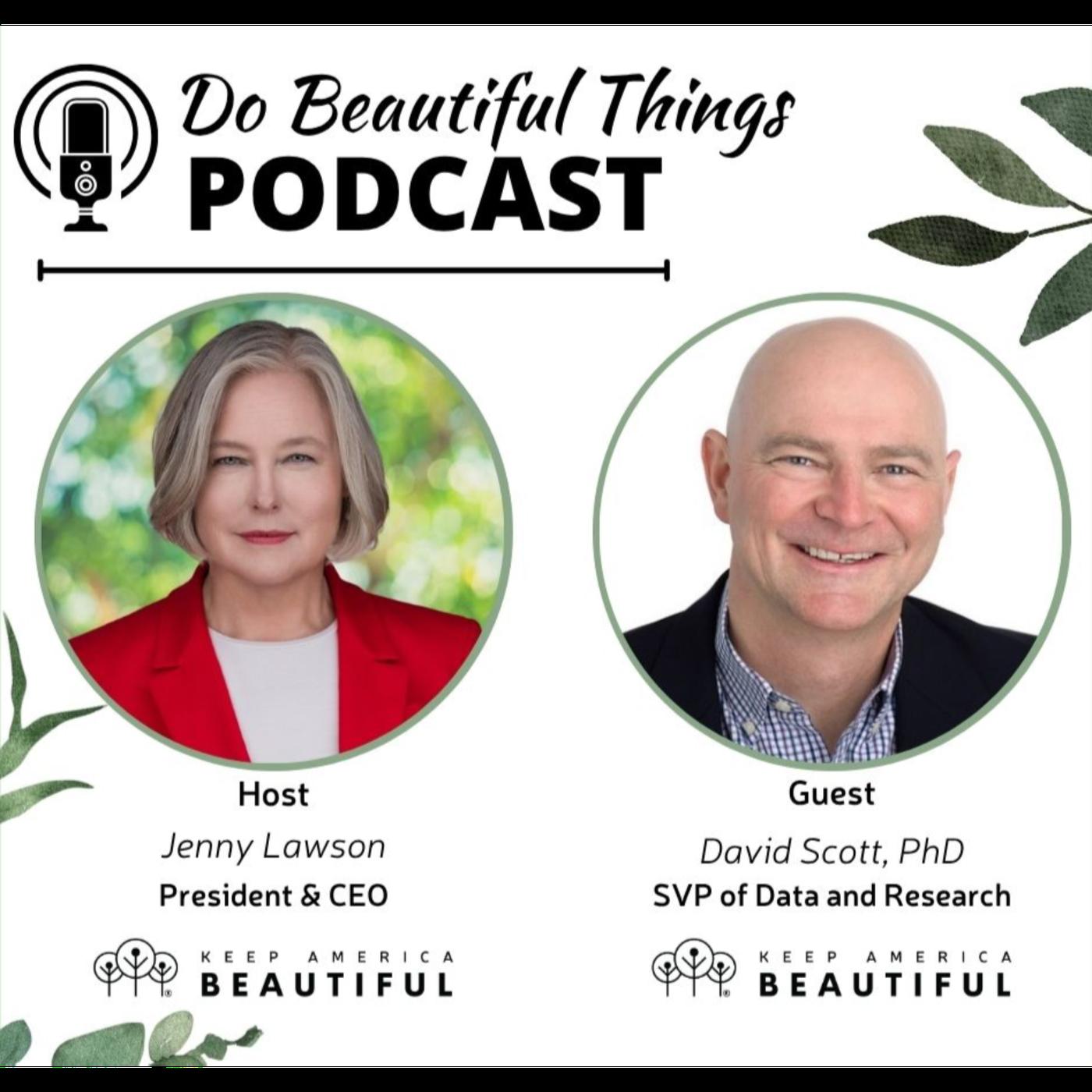
00:01:57.000Welcome to Do Beautiful Things. I'm your host, Jenny Lawson, President and CEO of Keep America Beautiful. On this podcast, we explore all the ways, big or small, that people are stepping up to end litter, rethink recycling, and create cleaner, greener and more beautiful communities. You'll hear from change makers, industry experts, community leaders, and everyday doers who are showing that when we unite to care for the places we love, we can make a real difference. We for each other and for the planet we share. So let's get inspired, let's get connected, and let's do beautiful things. Thanks for coming back to our ongoing conversation about the 2026 National Litter Study. Today's episode will pick up a conversation that we started last week as we unearth the findings from the most recent study and take a look at at causes and effects of litter across the country.
Jennifer Lawson:
00:01:57.000 -->
00:02:52.000One of the things I'm really looking forward to coming out of this study is to start to surface where solutions are working. Like how are people tackling these issues? Because if you think about what a coastal area looks like, that vegetated area, you're not sending as willing as they might be volunteers into those wet, craggy areas, right? Like we're going to have to figure out and surface to where people are figuring out how to really manage those areas most effectively. Because there is a significant amount of litter. You may not have the number right in front of you, but what was the coastal area count?
David Scott, PhD:
00:02:52.000 -->
00:03:27.000Well, in total, it was comparatively a smaller number. So waterways is 14.2 billion pieces of litter. In coastal areas, it was 2.4 billion pieces. However, there are far fewer miles of coastline than there are surface waterways. So when we look at it on a per mile basis, and that's a metric that we use to keep America beautiful. On average, across the US we estimate that there are nearly 17,000 pieces of litter per mile along the coastline, compared to only 1300 pieces of litter per mile along surface waterways. So it's just on a massive scale. And because roadways have street sweeping, right, roadways have lots of traffic that blows litter somewhere else.
David Scott, PhD:
00:03:27.000 -->
00:03:52.000But we do have a pretty effective mitigation strategy in street sweeping and sending people out to take care of sidewalks. In the areas around roadways, if they're local roads, there is no street sweeping along the coastline. When the litter gets there, it is often there until it degrades. And some things will biodegrade. If it's an organic product, it will biodegrade. But other products, things made out of plastics, don't biodegrade, Right. They will degrade and they will become smaller and smaller, but they will not biodegrade. They will not just disappear.
Jennifer Lawson:
00:03:52.000 -->
00:04:47.000Yeah, it's really interesting, right, that there are many challenges to the solution. And all of the great. And I mean, I just want to celebrate all of the great beach cleanups that happen around the country on probably a daily basis. Somewhere in the US they're not capturing this coastal litter, by and large, isn't. Tell me more about that.
David Scott, PhD:
00:04:47.000 -->
00:05:25.000The amount of, you know, beaches represent under 10% of the total coastal area of the U.S. whereas vegetated areas, over 70%, armored areas, you know, where governments have built up big barriers to prevent erosion and things like that. That's another 10%. So if we only look at beaches, we have an incomplete and in some ways inaccurate representation of what litter looks like. Because when we go to beaches, right, we recreate, we bring the products and tools of recreation with us. Those are the sorts of things that we see when we go out there and count litter along the way in beaches. Whereas when you go to the salt marshes and the mangroves, you are going to find a much more. Actually, the litter looks like a.
David Scott, PhD:
00:05:25.000 -->
00:05:43.000Much more like it does along waterways and roadways than it does along the beaches. We see a lot more plastic litter than we do in those other places and in the marshes and places like that. We see a lot of glasses. We see, unfortunately, a distressing amount of construction debris of things that have just been perhaps illegally dumped, whatever it might be. Like I said before, and I can't reiterate enough, so often when litter gets to these places, it gets really, really hard to get it out there. That's why prevention is so, so critical, as well as cleanup and mitigation.
Jennifer Lawson:
00:05:43.000 -->
00:06:26.000While we're sort of on that topic of prevention and cleanup, tell me about the invisible majority of litter. Right? Then the hands quotes, which is that 85% of all litter is very small.
David Scott, PhD:
00:06:26.000 -->
00:07:35.000That's right. It is one of the constant challenges of our work. Anybody who's ever been involved in a cleanup is one of the things that we love to say, right, Is when you go out there and you get involved in this work and you try to take care of your community, once you see litter, you cannot unsee litter. It is. It's really powerful. It's a powerful education tool. That being said, so often when we have the opportunity to bring people together to go out and take care of their community, and that might include cleaning up litter, they often miss the small stuff. It is easy to walk down the street and see the beverage container, to see the chipped bag, to see the, the cardboard box.
David Scott, PhD:
00:07:35.000 -->
00:08:10.000People are much less likely to see, you know, the stuff we call small litter, stuff under 4 inches in size and 85, like you said, 85% of that of the litter in America is under 4 inches in size. So as we think about solutions, having people being very aware of managing waste appropriately. That's not a particularly sexy phrase, managing waste appropriately, but it's what we need to take to manage the small litter problem because some of that stuff will stay there for a very long time because of the fact that it's small. And as we have mentioned before, if it doesn't get cleaned up, if it doesn't get picked up, if it doesn't get prevented in the first place, it doesn't just disappear. And if we really want to be serious about the real concerns we have about microplastics and about keeping our natural environments and our communities and are waterways safe and healthy, we have to pay attention to that stuff at least as much as we're paying attention to the bigger stuff.
Jennifer Lawson:
00:08:10.000 -->
00:08:47.000You're right. Right. Like totally 100% agree with where you're going. And the research also has a bright spot in it for that small litter, which is the surprising long term decline, 62% since 2020 and 90% since 20,000 and 2009 of the decline in cigarette butt litter. Now I know Americans are smoking less, but is that where it's all coming from or tell me what that's all about.
David Scott, PhD:
00:08:47.000 -->
00:10:00.000Yeah, it's definitely not only from the decline in smoking rates that is a contributing factor for sure. But we're seeing, you know, a 62% decline here in the last five years. So there's more going on. Right. And that's what you always see at system level, more systemic challenges. Right. Is there are multiple causes and multiple factors at play. So what we do know is half that's happening is there has been an increase in the communities that we, you know, are involved in, in the work that people are doing to put solutions into place.
David Scott, PhD:
00:10:00.000 -->
00:10:10.000That is, yes, it is about educating smokers to dispose of their products properly. That includes giving them the right infrastructure to do that. So giving them cigarette disposal containers so that they can dispose of their product, which is a solution that we understood through our research. You know, smokers didn't want to put their still warm cigarette butts in trash containers. And when we put together that education and we put together their infrastructure and servicing those bins so they don't overflow in the communities where we Deploy our cigarette litter prevention and recycling program in those areas where we deploy the program, we see over a 50% decrease in cigarette butt litter in those places. So it is testament to the fact that we have solutions that we just need to do continue the work to deploy those solutions in communities across America and tell people that their behavior makes a difference. In this case a positive difference. If you are disposing of your cigarette but properly in a liberal container that you keep with you or you know, in the proper bin, these things make a difference.
David Scott, PhD:
00:10:10.000 -->
00:11:08.000And when you do things, organizations, corporations, people and governments all work together in the same direction, you start to see system level change like we see here
Jennifer Lawson:
00:11:08.000 -->
00:11:42.000as we kind of come into the last little area of conversation. Right. There are also areas that are on the rise. And I think these to me, as we think about what's next for keep America Beautiful, these are the areas where that sort of thoughtful solutioning and listening to and understanding both behaviors and then developing interventions that really address those behaviors. Right. We're seeing a rise in cardboard. And you know, I've noticed, right, I have noticed that the packaging companies are really starting to try and evolve packaging. But it's crazy that cardboard is, you know, up 50% in, in the litter counts that we did when it is the most recyclable, easily recyclable packaging that's out there, right? It is, it is high 90s Percentage of ability to recycle cardboard again, right.
Jennifer Lawson:
00:11:42.000 -->
00:11:55.000So no excuses. We've got to get people getting their cardboard properly recycled, right. Plastic water bottles is the other. And I know the industry is working on it, but there is still a lot of opportunity to make changes that improve outcomes for getting recycling and infrastructure and alternative packaging into place. For water bottles. I myself am a fan of the Melkarton water bottles. I think those work great. E cigarettes.
Jennifer Lawson:
00:11:55.000 -->
00:12:35.000And then there's like bigger things, right? So there's the tire and vehicle debris, right? Up 36%. That is not the little stuff. That's the big visible litter. What's going on there?
David Scott, PhD:
00:12:35.000 -->
00:13:28.000Let me also frame the vehicle entire data pointing some of the factors that we know are, you know, influence where litter comes from. Right? And litter is by definition unmanaged waste. And we know that traffic patterns impact where litter emerges. And that's just whether there's more human behavior, there will be more waste. That's just, you know, it's not, you know, the dynamics of which can vary. But that is one factor at play. And another one is the products that people are using. If people use more of a product, we expect to see more of it in the waste stream in general and in the litter stream by association.
David Scott, PhD:
00:13:28.000 -->
00:14:21.000Tires and vehicle debris. I think there's a couple of things going on. One is road models traveled are up in the past five years. So that speaks to the traffic feature of the data. And that's somewhere where we hope to get a lot smarter in coming years. Modeling out how traffic impacts litter in America. And we think we have the data and the technologies emerging to help us be able to do that, but then sort of the solutions and the policies that can help here, there's still work to be done. So, for instance, when there is a crash, so often the authorities are just trying to get the vehicles out of the road, right? They're trying to get the road reopened, get everybody to a safe place, and that's it.
David Scott, PhD:
00:14:21.000 -->
00:14:43.000But what's often left behind is the detritus. It's the blown out tire tread, it's the plastic. You know, so much of cars these days, the body is plastic. You know, it's just strewn across the roadways and by association, our communities. So putting in place a policy that asks, for instance, the people servicing those areas to clean up the area, you know, give a quick sweep before moving on. It has a minimal impact on the time to solve the issue at hand, but it has a pretty big systemic impact on the problem. You know, those sorts of solutions can be applied to many, many different products. You know, a data point that I sometimes use is there's over 10,000 new consumer products introduced into the mass market on an annual basis.
David Scott, PhD:
00:14:43.000 -->
00:15:39.000Every single one of those has a different consumer behavior. And so being thoughtful about what proper disposal looks like, educating everybody in the system how to manage their responsibilities, it's really important. And tires and vehicle debris are a relevant example there.
Jennifer Lawson:
00:15:39.000 -->
00:15:48.000David, thank you. This has been a fascinating conversation. There's so much rich information in that litter study. I invite people to go check it out. At kab.org, learn more about litter across the country in your part of the country, along our coasts and waterways. And we will spend the weeks and months and years bringing both the data, but also convening folks to get this last mile or last 32 billion pieces of solution in place. I have a big vision that we can tackle this to a point where it's managed and that we don't need to do another liter study because we have somehow managed to pick it all up. So I appreciate you joining us today.
Jennifer Lawson:
00:15:48.000 -->
00:15:50.000Thank you for your years of research and effort in bringing the 202526 literature study to the table.
David Scott, PhD:
00:15:50.000 -->
00:16:44.000Thank you very much.
Jennifer Lawson:
00:16:44.000 -->
00:16:52.000Thank you again, Dr. David Scott, for your partnership and leadership and for joining us to today to talk about the keep America Beautiful 2026 National Litter Study. It's a reminder that data can do more than describe a problem. It can point us towards better solutions. Yes, litter is down since 2020, and that is something to build on. But the study also shows us where new challenges are emerging, how shifts in shopping habits, products and transportation show up literally on the ground, and why prevention has to keep evolving. If you want to learn more about the National Litter Study and how you can be a part of the solution in your community, please Visit us@kab.org Thanks for listening and as always, take care. Stay inspired and keep doing beautiful things.
Jennifer Lawson:
00:16:53.000 -->
00:16:57.000See you in the next episode.