

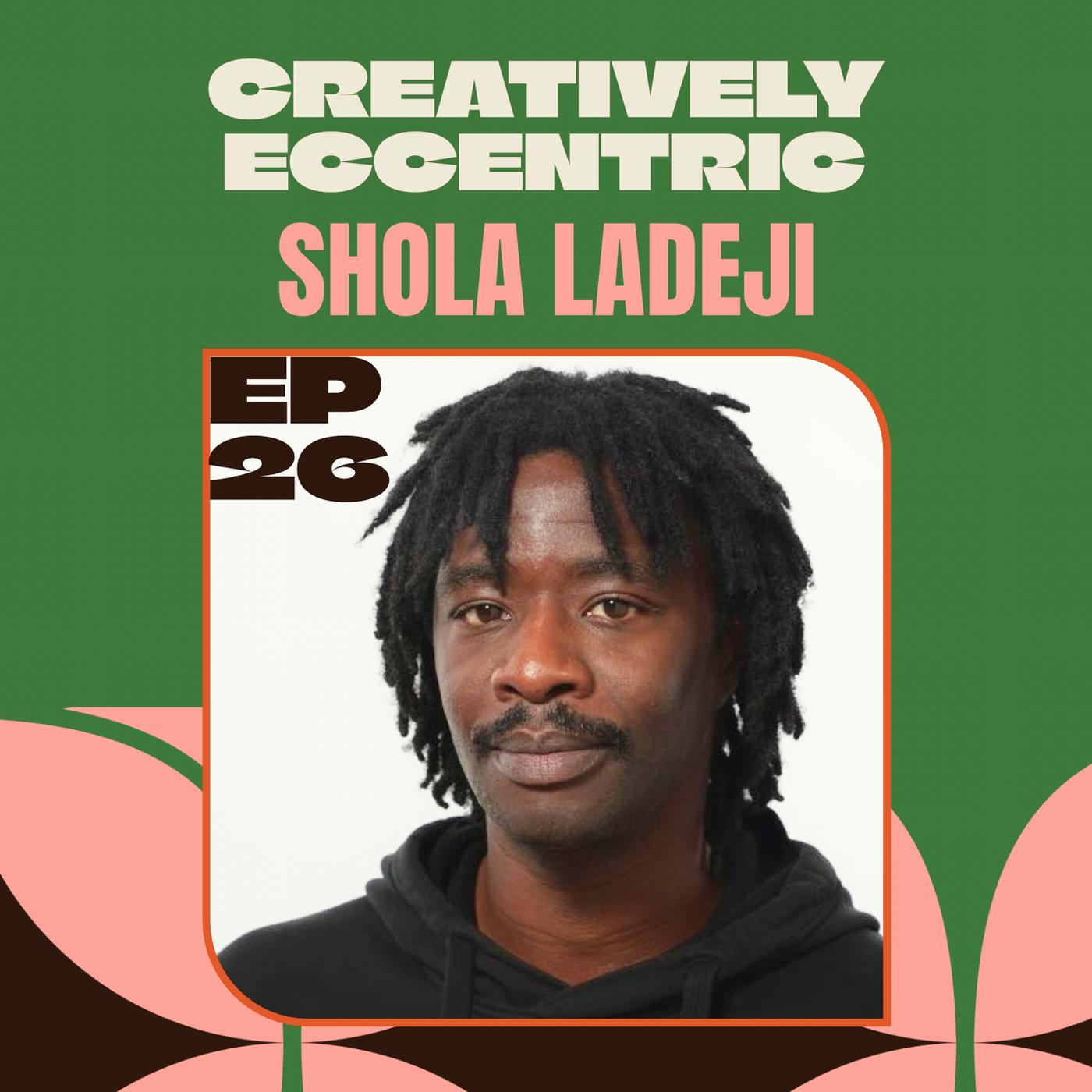
Shola: I am Shola Ladeji. I am a graphic designer who sort of like pivots in between research and strategy. So yeah, in short, that's what I do. stand where you are like don't chase Work that's not for you.
Heather Ebanks: Mm-hmm.
Shola: one pattern that I'm glad I kind of got rid of really quickly being a freelancer was like, so-and-so is interested in working with me. I'd really follow through. I wasn't doing like due diligence. wasn't even properly pricing things, what I would say is like, don't chase...
Heather Ebanks: Mm.
Shola: that's not going to work out. And what I mean by that is if someone's low boiling you, it feels weird. So you're going to feel weird while you're working the job. The work's not going to be great. Therefore it's not going to make your portfolio. It's not going to sell you for any more jobs. And it's going to waste your time as well.
Heather Ebanks: Yeah. Hmm. Mm. Mm-hmm. I'm joined by Sholo Ladegi, designer, strategist, publisher, mentor, and one of those creatives who proves that there is no single right way into this industry. Scholar moves through the creative world differently, no rigid blueprint, no obsession with visibility, no performing productivity for the internet, just curiosity, instinct, sharp thinking, and a willingness to build things on his own terms. His work sits at the intersection of culture, design, strategy, and conversation. from shaping visual identities and mentoring emerging creatives to helping building platforms like Access Magazine that ask bigger questions about taste value and who gets seen in the first place. But what makes Scholler's story interesting isn't just the work, it's the way he got there. A non traditional route into design, rejection, reinvention, learning in public, figuring things out without the safety net of certainty. in this conversation we talk about learning upwards through failure, while the industry rewards saminess more than originality, the power of being a generalist, and why doing the opposite might actually be the smartest creative decision you can make. We explore outsider thinking, creative resilience, taste, south worth, and what happens when you stop chasing permission and start trusting your own direction instead.
Shola: So my full name is Olu Shola Ladeji. I'm named after my dad. Yeah, I'm named after my dad and actually all my friends, well not all my friends, sorry, all my family call me Junior. So yeah, actually I'm just Shola to the rest of the world, but yeah.
Heather Ebanks: It was beautiful. Yeah. Yeah. Yeah, wonderful. There's a question that I love to ask my guests when they come on to the podcast. When you hear the words, old voices, messy journeys, zero apologies, which part of your journey does that resonate with the most?
Shola: I came into design to like as that statement actually defines my whole journey of coming into design, because actually I fell into design through kind of something else not working out. And so I found my perseverance
Heather Ebanks: Mm. so how did you, were you educated or you just kind of learnt as you go along
Shola: I think there's levels to like the education isn't there. So I went and did a like sort of short three month intensive course. And it was like, go and make something of yourself, you know, so I had a bit more than like completely self starting. But yeah, I didn't get that three, four years amount of time. So somewhere in between.
Heather Ebanks: Yeah. Mm-hmm. Yeah. I think you described your journey, it one that zigzags? what was the moment you felt like a detour at the time, that now feels essential to you?
Shola: probably that decision to like sort of like start learning graphic design. So I would say, yeah, I would say my career has like zigzagged through through just trying things out, right? I think I think that's quite normal. But yeah, for me, I was like really having an existential moment before I before I found out that design was what it was my calling. So yeah, I would say
Heather Ebanks: Mm. Mm-hmm.
Shola: like no disrespect to my last job that I used to work in, I can remember sort of feeling it viscerally like when I was doing something else. Do you know what mean? So I used to do the music at a like a sort of like fine dining, I guess, dinner and dance club called Part Chinois. So I used to be the sort of live music coordinator there. I can, so I can viscerally remember like doing my job and just thinking like thinking that I wanted to do this instead. Yeah.
Heather Ebanks: Yeah. Cool. You So you've done a lot of different types of work and different styles and, different career paths. That non-traditional background, did you realise that maybe you weren't fitting in in those roles? And in some ways, do think that was an advantage to come from a different, background of career?
Shola: Yeah, think, do you know what, to be honest, the real context here is I actually grew up wanting to be a straight strategist and I know a bit earlier I said, I'm now pivoting into research and strategy. That's always been where my heart is. Like I'm kind of an introverted, deep thinking type. I like to think about information in other ways.
Heather Ebanks: right. Hmm
Shola: not just visual and for me it was like I was I had knocked on every door in Adland with like a with a kind of like mock folio if you like of work no visuals and I think it was it was like obviously I was getting completely aired like no one gave me a shot and so after about a year and a half of that I said you know what I'm just gonna learn how to do the visuals
Heather Ebanks: Yeah. it sounds like you said you were more like a multi hyphenate. Do you feel like people in the industry who are doing a bit of everything maybe call it a generalist. do you think that people are identifying that or accepting that kind of way of working in regards to being a designer? It's not just one, one niche.
Shola: Absolutely. I think that's articulated so well. think the market's been forced into doing that, quite frankly. You know, like, you can't just be, yeah, you really do, and I do think, though, that there is one part of that that has always existed, right, which I've only just started to get a bit more, which is like, people hire people, don't they? So, like, that's the other, like, bit of being a generalist, sell yourself
Heather Ebanks: Mmm, yeah. Mm. Yeah, yeah.
Shola: I've never had a problem doing this. Like I'm shoulder first and then I do design. You might get a bit of research. You might get a bit of strategy. I just happen to do design, but the main thing I'm selling is me. And I feel, I feel like I was doing that. but you're right. I see more digital traction around this conversation of like, it's design, like more of a generalist thing and like, less for, yeah, it's less about just pushing pixels. Isn't it? It's like, do I.
Heather Ebanks: Mm. Mm-hmm. Mm. Mm. Yeah.
Shola: Do I want to sit next to you for eight hours on a tough brief, you know, on a last minute brief? So yeah, I would say you're right. I think it's moved more in my favour.
Heather Ebanks: Yeah. definitely. and I think, it's probably something that's impossible these days know, you have your grandparents did one job and that was it. And you think you have to, especially, you know, unfortunately, there's a lot of things going on in the industry, like, people have been let go and redundancy. So you have to be flexible and, and some people just automatically end up being generalists in design. So yeah, definitely.
Shola: Sure. Yeah.
Heather Ebanks: And I think being sometimes that can be in your favor, as you said, but sometimes some people think that might be a disadvantage as well. And do you think some people might treat you like an outsider in that you're not a professional a generalist in your design.
Shola: Yeah, yeah. And I mean, that's, really taking me back now. You're kind of taking me back to that I trained in 2018, 18, 19. And yeah, that is very much what it was like. was like, oh, it was so tough to get in because you're, it just felt like I had to be, I had to be specialised in something from the jump. So,
Heather Ebanks: Mm-hmm. Yeah.
Shola: Yeah, it took a while to find my feet. by the way, I did go away and you're getting the rejection letters and you're getting the feedback as well, which is really important. And it's kind of intuitively making sense. I've got to find my niche here. So yeah, that also did happen for me. I did learn that, okay, I've got to go for one specific, I've got to find out what I love doing.
Heather Ebanks: Hmm. Yeah, yeah. Hmm.
Shola: for me that was like I love InDesign so yeah I do love the whole suite and the whole I loved I do love everything but InDesign type setting yeah that's my thing
Heather Ebanks: Mm. Mm. Wonderful. Yeah, because I was looking at some of the work that you do, you work for a magazine, called? Access?
Shola: Yeah, so there's Access Magazine. That's the latest one. That's, really excited about this magazine. It's really nice because I've been able to design it from front to back. And I've been lucky enough to just work with like a couple of people, which is, yeah, just a dream project, actually. But yeah, it was actually came around like really last minute. So
Heather Ebanks: Mm. Mm-hmm. Yeah. Mm-hmm. Mm.
Shola: That was like, I think we've got 265 pages in there and that was all done in like three weeks.
Heather Ebanks: Cool. You definitely be using InDesign a lot with when you're creating that. So that's probably your dream job.
Shola: yeah. my goodness. I couldn't like honestly that was yeah, I'd probably say that's been my favorite job. Yeah.
Heather Ebanks: obviously working in the industry, you've picked up other, skills And I've definitely noticed that you're working with a lot with other creators and I think you've done a lot of like, and judging. Can you tell me more about that?
Shola: Yeah, my gosh, that's been really fun. And I guess I'll start off by saying that this is not how it goes in my life, okay? So like no one's ever asked me to judge anything before last year. So I'm gonna act like I've been here before, but at the same time, like for everyone, it's like, you know, I definitely wanna come across as like, like I need to say how grateful I am to all the people that have helped make this possible.
Heather Ebanks: Yeah.
Shola: because people really have gone the extra mile to know my story and just platform me appropriately. you what mean? yeah, I felt it felt really good to do the I judged the PEN Awards pipeline we were judging the student category of last year's PEN Awards. So
Heather Ebanks: Mm.
Shola: all the wonder kids that often come in talent, like really, really strong work, which yeah, it was just nice. was really nice also to obviously, because we were getting work from all around the world is what I want to say. So some of the more I was seeing, it was just really interesting to.
Heather Ebanks: Mm. Yeah.
Shola: you know, were judging work from, not even just because I'm African, like we were seeing work, it was from Africa, from Asia, we seeing work from everywhere, but having like that diverse jury board was just beautiful. Like you could see how it was sort of like delivering, delivering outcomes, delivering fairer outcomes in real time, like I was actually there. So, you know, like...
Heather Ebanks: Cool. Yeah. Mm. Hmm. Yeah.
Shola: sometimes isn't it you're talking about something which has like certain there's a cultural cache to it which someone used to talk about for people to understand things and like yeah I don't know it was just nice to yeah it's nice to like I found my value in there as well like sort of yeah
Heather Ebanks: Hmm. Yeah. So you said you had a there's a mixed diverse category of different people coming into what they were judging.
Shola: yeah, Chloe Templeman, who is, is a regular, well, less now, but does lecture at D &AD sometimes, she's the one that sort of recommended me to, to be honest, Juri, yeah.
Heather Ebanks: Yeah. So how did that come about? Did you apply for it or did they search you out?
Shola: Do you know what? Yeah, so that's the other thing. I'm, so I did, I worked, I sat right next to Chloe Templeman at Palfisher doing a bit of work experience around this time last year, like sort of January, 2025. Went there to go and work for about, actually just over three months. And yeah, just had an amazing time. I probably will talk about that in another question. That was an absolutely beautiful time in my life.
Heather Ebanks: Mm.
Shola: But then I'm like, I worked another job after that, but then basically I'm on holiday. I'm actually bit burnt out and I'm on holiday. And yeah, I just get the phone call. I'm literally on the beach in Spain. Yeah, absolutely. And she was like, yeah, I think you're gonna wanna come back. Yeah, because I've made this opportunity for you.
Heather Ebanks: Dream.
Shola: It was really, she has my gratitude for that, definitely. It was like an affirming moment, definitely.
Heather Ebanks: Yeah, sounds. Yeah. Yeah. Brilliant. And obviously you was going back to like you, you worked with young creatives and you know, judging their work and their talent. Do you see, from your perspective, see any the same mistakes keep coming up again and again, when it comes to new emerging talent? And how do you spot? How do they or how do you give them advice? to prevent them from making those same mistakes.
Shola: I love that question because, know, I really, I always told myself, like, you know, when I was young as well, I'm not evergreen anymore. So I always told myself, I'm gonna, maybe my utility is just to do that. Do you know what mean? Maybe, maybe like,
Heather Ebanks: Hmm.
Shola: my salvation is not necessarily about me. Maybe it's in that way, like, you know, maybe it's about that nugget that you give someone, you know, that saves them X amount of years. So I take that really seriously actually, like, sort of speaking up when I see something that I know is going left.
Heather Ebanks: Mm. Mm. Mm-hmm.
Shola: you know, or maybe
Heather Ebanks: Mm-hmm.
Shola: just requires a bit of, bit of, you know, and the one that regularly does come up, like to your question is like, not being disenfranchised, you know, like I felt disenfranchised for a long time, but do know what, one thing about me is I, that I haven't talked about yet, but I actually went to go and work on a building site. You know, I just kind of knocked it, not completely knocked it on the head. I just kind of relegated it in my priorities.
Heather Ebanks: Yeah. huh. Hmm.
Shola: and I went out to go and work, do you know what mean? And I think it's quite, I think for, yeah, especially when you're a designer and you are behind the screen, you just need to be doing something. So, not that you asked me, but like, think, to your question, it's a really interesting question because like, that's one that I find regularly comes up, like, because we've all got to pay our bills, right? And I just, I don't like to see people.
Heather Ebanks: Mm. Mm-hmm. Mm. Mm-hmm.
Shola: not paying their bills, not being able to maintain relationships, can't take a holiday, it affects your whole life. So I'm very much about don't let this creative pursuit stop you from living your life and showing up for your people, et et cetera, et cetera. The net positive of doing that is it might not feel like it's more than your dream, but it is, it is.
Heather Ebanks: Mm. Hmm. Hmm. Mm. Mm-hmm. Yeah, yeah.
Shola: And so I'm always like, you know, I never say that in like kind of a like prescriptive way, like, cause I have that, I guess I do meet people on their level and like, you know, so I'm thinking about even friends and family, know, like I'm like, cause I even have, I even have some of my aunties calling me about their children, like, listen, you know, like my son, my son,
Heather Ebanks: Yeah. Yeah. All right.
Shola: because they're worried, you know, and I think for every parent as well. I remember my parents, it's like, is this, are you going to be able to like, off this? You know? So, yeah, it's funny how that, that I really love that question because I would say that's like quite high up there in, in ways that I want to be useful. Yeah.
Heather Ebanks: Mmm. Yeah. Mm. Yeah. And I think it's a tricky one with whatever generation you're in, definitely with the younger creatives who are trying to find their way. There's a lot, of noise out there and you get advice coming from all angles. And also at the same time, you're trying to find your way, trying to be a creative that is interesting and unique, et cetera, and stand out amongst the crowd. But at the same time, you're trying to, survive and pay the bills. It's a tricky balancing act. I think you mentioned something about avoiding and creating what you call it slop in a world that rewards like speed and volume. How can you block out that noise and focus on something that's meaningful and so it doesn't end up being slop?
Shola: Yeah, think, I mean, in design, I really think it's about, finding what you love, like find what you love, what your interest is, like whether that's, you know, just find what you're interested in and that that work will come like you will, and you'll enjoy doing it. I think this is advice I'm trying to take for myself at the moment.
Heather Ebanks: Hmm. Mm.
Shola: like to lean even more into like, because I've seen like, I explained the magazine projects with you, like, didn't feel like work. So I'm trying to like lean even more into that. And yeah, just, just, you know, if I if I'm going to make a self initiated work, like rather than do something which is commercially like, you know, you know, like do something that I actually believe in, even if like, it's not that popular. I think you'll you'll
Heather Ebanks: Mm. Mm-hmm. Mm-hmm. Yeah.
Shola: You'll more on your feet more times,
Heather Ebanks: Definitely. I think I've seen this a few times on people have talked about, designs and work on projects that, and with clients as well, that you want to work with. You don't want to be creating work that and attracting the wrong audience or the wrong clientele. yeah, like I said, we'll take time, but yes, it's definitely a tricky one. yeah, it will pay off in the end. Definitely.
Shola: yeah, it's, you've got to, you've really got to go to it. I would say, yeah, it's such an interesting time for me in terms of that. Yeah, definitely. And yeah, I will send you some self-initiated projects that are in the pipeline at the moment. Yeah, because yeah, I've been, I haven't really been hot on self-initiated work for a number of like years now. You know, but.
Heather Ebanks: Cool. Hmm.
Shola: actually I've found that I'm able to work for free if you like, if I'm really invested. So I've got back into that. Yeah, yeah. I'll send you some stuff.
Heather Ebanks: Yeah, cool. Yeah, I think it's also important to do your own personal projects and it keeps you motivated and keeps you going. So yeah, they're just as important. So what's been the kind of the toughest part of, your creativity that, that you've been dealing with and how have you got through those hard times when it hasn't been? know, forthcoming regards to ideas.
Shola: Probably like the time spent out of work, there was, I said, I went to Shillington. And, and that is very much, wow, you really get out what you put in. But even after, even if you put in like an incredible amount, like, like I said, you're, you're competing with some sharks in there, like people that have been studying for years. Probably
Heather Ebanks: Mm. Mm. Mm.
Shola: bit more green as well, which is probably a bit more, attractive to the employer. So it's really tough. And I would say those moments where you're just you wait for that, waiting for that email. Those are obviously the hardest parts. I mean, there was like quite, quite a long section of that just after you graduate, people that have gone to that school go through, which was like, yeah, I mean,
Heather Ebanks: Mm-hmm. Yeah. Mm-mm. Mm-hmm.
Shola: you really do have to keep on dreaming. it's, and I'm sure this goes for every intensive course, but it's more obvious with design. you can literally look at any design course anywhere, check the cohort a couple of years later, three years later, and see who's like still there, a lot of people just learn design, obviously, and then to use in their job and like.
Heather Ebanks: Mm-hmm. Mm. Hmm.
Shola: or go and do something else and that's completely fine but it is like to actually have that staying power is like really important and for me yeah when I've had those moments where I'm like is this really gonna work have I done the right thing yeah I like to yeah I like to get away
Heather Ebanks: Yeah. Hmm.
Shola: So after Shillington, I had about five months, nothing, no work, really low about it and really questioning my creativity actually. And then I needed a break. I just knew I needed a break.
Heather Ebanks: Yeah.
Shola: I was just looking into Andalusia, all kinds of stuff. And I just applied for a job. I just applied for a job in Sevilla. And the phone rang like a few days later. So I managed to like grab a internship in Sevilla, working for a husband and wife studio. And they made fire-blown glass jewelry pieces, like these really lovely painted pieces of jewelry.
Heather Ebanks: Mm-hmm. Yeah. Wow. Mm.
Shola: And I did that for a low stiff end for like just over three months. I was just in southern Spain and yeah, I obviously didn't do it for money or anything but that I remember that time really sorted me out and gave me a different, a new lease of life if you like, yeah.
Heather Ebanks: Mm. that sounds like you took the initiative and yeah, you would never know what you would have, you never achieved if you didn't, took up that offer. So sounds like great.
Shola: Yeah, yeah. And it really just, I think that's something I try to, so to answer your question as well a more is like, go, I actually, that's a really special place for me now. Like, you know, I kind of like made friends there. And like since, I guess since then, I just like, my passport is full of stamps from there. Like I'm always there. And if I like being a freelancer as well, sometimes I take my work there.
Heather Ebanks: Right. Yeah. Mm. Cool.
Shola: sometimes I do have a low period, whether that's emotionally, creatively, or just literally low workload. And I'll go out there and just recharge my batteries. But it's not put my feet up and just rest. I make a lot of work out there. Or sometimes I'll think about the work and bring it back and do it here. So it really is a place of
Heather Ebanks: Mm. Mm. Yeah.
Shola: maybe it's a habit thing, but yeah, I do like Southern Spain.
Heather Ebanks: Mm. if someone is entering the industry today, what would you tell them not to chase? Mm.
Shola: don't chase for jobs when Like learn learn how to say like learn how to just I mean to be literal like stand where you are like don't chase Work that's not for you. you know
Heather Ebanks: Mm-hmm. Hmm.
Shola: one pattern that I'm glad I kind of got rid of really quickly being a freelancer was so-and-so is interested in working with me. And like, I'd really follow through. I wasn't doing like due diligence. wasn't even properly pricing things, you know? So what I would say is like, don't chase...
Heather Ebanks: Mm.
Shola: something that's not going to work out. And what I mean by that is if someone's low boiling you, it feels weird. So you're going to feel weird while you're working the job. The work's not going to be great. Therefore it's not going to make your portfolio. It's not going to sell you for any more jobs. And it's going to waste your time as well.
Heather Ebanks: Yeah. Hmm. Mm. Mm-hmm.
Shola: Don't ever feel, don't ever play yourself, like stand where you are, and know your worth. And that will stop you from from chasing the wrong jobs, I think,
Heather Ebanks: Mm-hmm. Mm. Definitely great advice there. so if someone wanted to find you and support you in your business and what you do, how would they do that?
Shola: There are things in the pipeline. are things in the pipeline. So right now, I guess website address. It's just shola.world. I just use LinkedIn. I haven't had Instagram for about six years, but actually might fire that up a bit. yeah, legos confidential.
Heather Ebanks: Mm-hmm.
Shola: which is a completely different persona. I paint a lot, I make music, and I've started to do that again. So, Legos Confidential, it might be up by the time this goes out, I'm not sure. But yeah.
Heather Ebanks: Mm-hmm. Cool. Of course, I'll put all that information in the show notes so that people can find you.
Heather Ebanks: Mm-hmm.
Shola: one pattern that I'm glad I kind of got rid of really quickly being a freelancer was like, so-and-so is interested in working with me. I'd really follow through. I wasn't doing like due diligence. wasn't even properly pricing things, what I would say is like, don't chase...
Heather Ebanks: Mm.
Shola: that's not going to work out. And what I mean by that is if someone's low boiling you, it feels weird. So you're going to feel weird while you're working the job. The work's not going to be great. Therefore it's not going to make your portfolio. It's not going to sell you for any more jobs. And it's going to waste your time as well.
Heather Ebanks: Yeah. Hmm. Mm. Mm-hmm. I'm joined by Sholo Ladegi, designer, strategist, publisher, mentor, and one of those creatives who proves that there is no single right way into this industry. Scholar moves through the creative world differently, no rigid blueprint, no obsession with visibility, no performing productivity for the internet, just curiosity, instinct, sharp thinking, and a willingness to build things on his own terms. His work sits at the intersection of culture, design, strategy, and conversation. from shaping visual identities and mentoring emerging creatives to helping building platforms like Access Magazine that ask bigger questions about taste value and who gets seen in the first place. But what makes Scholler's story interesting isn't just the work, it's the way he got there. A non traditional route into design, rejection, reinvention, learning in public, figuring things out without the safety net of certainty. in this conversation we talk about learning upwards through failure, while the industry rewards saminess more than originality, the power of being a generalist, and why doing the opposite might actually be the smartest creative decision you can make. We explore outsider thinking, creative resilience, taste, south worth, and what happens when you stop chasing permission and start trusting your own direction instead.
Shola: So my full name is Olu Shola Ladeji. I'm named after my dad. Yeah, I'm named after my dad and actually all my friends, well not all my friends, sorry, all my family call me Junior. So yeah, actually I'm just Shola to the rest of the world, but yeah.
Heather Ebanks: It was beautiful. Yeah. Yeah. Yeah, wonderful. There's a question that I love to ask my guests when they come on to the podcast. When you hear the words, old voices, messy journeys, zero apologies, which part of your journey does that resonate with the most?
Shola: I came into design to like as that statement actually defines my whole journey of coming into design, because actually I fell into design through kind of something else not working out. And so I found my perseverance
Heather Ebanks: Mm. so how did you, were you educated or you just kind of learnt as you go along
Shola: I think there's levels to like the education isn't there. So I went and did a like sort of short three month intensive course. And it was like, go and make something of yourself, you know, so I had a bit more than like completely self starting. But yeah, I didn't get that three, four years amount of time. So somewhere in between.
Heather Ebanks: Yeah. Mm-hmm. Yeah. I think you described your journey, it one that zigzags? what was the moment you felt like a detour at the time, that now feels essential to you?
Shola: probably that decision to like sort of like start learning graphic design. So I would say, yeah, I would say my career has like zigzagged through through just trying things out, right? I think I think that's quite normal. But yeah, for me, I was like really having an existential moment before I before I found out that design was what it was my calling. So yeah, I would say
Heather Ebanks: Mm. Mm-hmm.
Shola: like no disrespect to my last job that I used to work in, I can remember sort of feeling it viscerally like when I was doing something else. Do you know what mean? So I used to do the music at a like a sort of like fine dining, I guess, dinner and dance club called Part Chinois. So I used to be the sort of live music coordinator there. I can, so I can viscerally remember like doing my job and just thinking like thinking that I wanted to do this instead. Yeah.
Heather Ebanks: Yeah. Cool. You So you've done a lot of different types of work and different styles and, different career paths. That non-traditional background, did you realise that maybe you weren't fitting in in those roles? And in some ways, do think that was an advantage to come from a different, background of career?
Shola: Yeah, think, do you know what, to be honest, the real context here is I actually grew up wanting to be a straight strategist and I know a bit earlier I said, I'm now pivoting into research and strategy. That's always been where my heart is. Like I'm kind of an introverted, deep thinking type. I like to think about information in other ways.
Heather Ebanks: right. Hmm
Shola: not just visual and for me it was like I was I had knocked on every door in Adland with like a with a kind of like mock folio if you like of work no visuals and I think it was it was like obviously I was getting completely aired like no one gave me a shot and so after about a year and a half of that I said you know what I'm just gonna learn how to do the visuals
Heather Ebanks: Yeah. it sounds like you said you were more like a multi hyphenate. Do you feel like people in the industry who are doing a bit of everything maybe call it a generalist. do you think that people are identifying that or accepting that kind of way of working in regards to being a designer? It's not just one, one niche.
Shola: Absolutely. I think that's articulated so well. think the market's been forced into doing that, quite frankly. You know, like, you can't just be, yeah, you really do, and I do think, though, that there is one part of that that has always existed, right, which I've only just started to get a bit more, which is like, people hire people, don't they? So, like, that's the other, like, bit of being a generalist, sell yourself
Heather Ebanks: Mmm, yeah. Mm. Yeah, yeah.
Shola: I've never had a problem doing this. Like I'm shoulder first and then I do design. You might get a bit of research. You might get a bit of strategy. I just happen to do design, but the main thing I'm selling is me. And I feel, I feel like I was doing that. but you're right. I see more digital traction around this conversation of like, it's design, like more of a generalist thing and like, less for, yeah, it's less about just pushing pixels. Isn't it? It's like, do I.
Heather Ebanks: Mm. Mm-hmm. Mm. Mm. Yeah.
Shola: Do I want to sit next to you for eight hours on a tough brief, you know, on a last minute brief? So yeah, I would say you're right. I think it's moved more in my favour.
Heather Ebanks: Yeah. definitely. and I think, it's probably something that's impossible these days know, you have your grandparents did one job and that was it. And you think you have to, especially, you know, unfortunately, there's a lot of things going on in the industry, like, people have been let go and redundancy. So you have to be flexible and, and some people just automatically end up being generalists in design. So yeah, definitely.
Shola: Sure. Yeah.
Heather Ebanks: And I think being sometimes that can be in your favor, as you said, but sometimes some people think that might be a disadvantage as well. And do you think some people might treat you like an outsider in that you're not a professional a generalist in your design.
Shola: Yeah, yeah. And I mean, that's, really taking me back now. You're kind of taking me back to that I trained in 2018, 18, 19. And yeah, that is very much what it was like. was like, oh, it was so tough to get in because you're, it just felt like I had to be, I had to be specialised in something from the jump. So,
Heather Ebanks: Mm-hmm. Yeah.
Shola: Yeah, it took a while to find my feet. by the way, I did go away and you're getting the rejection letters and you're getting the feedback as well, which is really important. And it's kind of intuitively making sense. I've got to find my niche here. So yeah, that also did happen for me. I did learn that, okay, I've got to go for one specific, I've got to find out what I love doing.
Heather Ebanks: Hmm. Yeah, yeah. Hmm.
Shola: for me that was like I love InDesign so yeah I do love the whole suite and the whole I loved I do love everything but InDesign type setting yeah that's my thing
Heather Ebanks: Mm. Mm. Wonderful. Yeah, because I was looking at some of the work that you do, you work for a magazine, called? Access?
Shola: Yeah, so there's Access Magazine. That's the latest one. That's, really excited about this magazine. It's really nice because I've been able to design it from front to back. And I've been lucky enough to just work with like a couple of people, which is, yeah, just a dream project, actually. But yeah, it was actually came around like really last minute. So
Heather Ebanks: Mm. Mm-hmm. Yeah. Mm-hmm. Mm.
Shola: That was like, I think we've got 265 pages in there and that was all done in like three weeks.
Heather Ebanks: Cool. You definitely be using InDesign a lot with when you're creating that. So that's probably your dream job.
Shola: yeah. my goodness. I couldn't like honestly that was yeah, I'd probably say that's been my favorite job. Yeah.
Heather Ebanks: obviously working in the industry, you've picked up other, skills And I've definitely noticed that you're working with a lot with other creators and I think you've done a lot of like, and judging. Can you tell me more about that?
Shola: Yeah, my gosh, that's been really fun. And I guess I'll start off by saying that this is not how it goes in my life, okay? So like no one's ever asked me to judge anything before last year. So I'm gonna act like I've been here before, but at the same time, like for everyone, it's like, you know, I definitely wanna come across as like, like I need to say how grateful I am to all the people that have helped make this possible.
Heather Ebanks: Yeah.
Shola: because people really have gone the extra mile to know my story and just platform me appropriately. you what mean? yeah, I felt it felt really good to do the I judged the PEN Awards pipeline we were judging the student category of last year's PEN Awards. So
Heather Ebanks: Mm.
Shola: all the wonder kids that often come in talent, like really, really strong work, which yeah, it was just nice. was really nice also to obviously, because we were getting work from all around the world is what I want to say. So some of the more I was seeing, it was just really interesting to.
Heather Ebanks: Mm. Yeah.
Shola: you know, were judging work from, not even just because I'm African, like we were seeing work, it was from Africa, from Asia, we seeing work from everywhere, but having like that diverse jury board was just beautiful. Like you could see how it was sort of like delivering, delivering outcomes, delivering fairer outcomes in real time, like I was actually there. So, you know, like...
Heather Ebanks: Cool. Yeah. Mm. Hmm. Yeah.
Shola: sometimes isn't it you're talking about something which has like certain there's a cultural cache to it which someone used to talk about for people to understand things and like yeah I don't know it was just nice to yeah it's nice to like I found my value in there as well like sort of yeah
Heather Ebanks: Hmm. Yeah. So you said you had a there's a mixed diverse category of different people coming into what they were judging.
Shola: yeah, Chloe Templeman, who is, is a regular, well, less now, but does lecture at D &AD sometimes, she's the one that sort of recommended me to, to be honest, Juri, yeah.
Heather Ebanks: Yeah. So how did that come about? Did you apply for it or did they search you out?
Shola: Do you know what? Yeah, so that's the other thing. I'm, so I did, I worked, I sat right next to Chloe Templeman at Palfisher doing a bit of work experience around this time last year, like sort of January, 2025. Went there to go and work for about, actually just over three months. And yeah, just had an amazing time. I probably will talk about that in another question. That was an absolutely beautiful time in my life.
Heather Ebanks: Mm.
Shola: But then I'm like, I worked another job after that, but then basically I'm on holiday. I'm actually bit burnt out and I'm on holiday. And yeah, I just get the phone call. I'm literally on the beach in Spain. Yeah, absolutely. And she was like, yeah, I think you're gonna wanna come back. Yeah, because I've made this opportunity for you.
Heather Ebanks: Dream.
Shola: It was really, she has my gratitude for that, definitely. It was like an affirming moment, definitely.
Heather Ebanks: Yeah, sounds. Yeah. Yeah. Brilliant. And obviously you was going back to like you, you worked with young creatives and you know, judging their work and their talent. Do you see, from your perspective, see any the same mistakes keep coming up again and again, when it comes to new emerging talent? And how do you spot? How do they or how do you give them advice? to prevent them from making those same mistakes.
Shola: I love that question because, know, I really, I always told myself, like, you know, when I was young as well, I'm not evergreen anymore. So I always told myself, I'm gonna, maybe my utility is just to do that. Do you know what mean? Maybe, maybe like,
Heather Ebanks: Hmm.
Shola: my salvation is not necessarily about me. Maybe it's in that way, like, you know, maybe it's about that nugget that you give someone, you know, that saves them X amount of years. So I take that really seriously actually, like, sort of speaking up when I see something that I know is going left.
Heather Ebanks: Mm. Mm. Mm-hmm.
Shola: you know, or maybe
Heather Ebanks: Mm-hmm.
Shola: just requires a bit of, bit of, you know, and the one that regularly does come up, like to your question is like, not being disenfranchised, you know, like I felt disenfranchised for a long time, but do know what, one thing about me is I, that I haven't talked about yet, but I actually went to go and work on a building site. You know, I just kind of knocked it, not completely knocked it on the head. I just kind of relegated it in my priorities.
Heather Ebanks: Yeah. huh. Hmm.
Shola: and I went out to go and work, do you know what mean? And I think it's quite, I think for, yeah, especially when you're a designer and you are behind the screen, you just need to be doing something. So, not that you asked me, but like, think, to your question, it's a really interesting question because like, that's one that I find regularly comes up, like, because we've all got to pay our bills, right? And I just, I don't like to see people.
Heather Ebanks: Mm. Mm-hmm. Mm. Mm-hmm.
Shola: not paying their bills, not being able to maintain relationships, can't take a holiday, it affects your whole life. So I'm very much about don't let this creative pursuit stop you from living your life and showing up for your people, et et cetera, et cetera. The net positive of doing that is it might not feel like it's more than your dream, but it is, it is.
Heather Ebanks: Mm. Hmm. Hmm. Mm. Mm-hmm. Yeah, yeah.
Shola: And so I'm always like, you know, I never say that in like kind of a like prescriptive way, like, cause I have that, I guess I do meet people on their level and like, you know, so I'm thinking about even friends and family, know, like I'm like, cause I even have, I even have some of my aunties calling me about their children, like, listen, you know, like my son, my son,
Heather Ebanks: Yeah. Yeah. All right.
Shola: because they're worried, you know, and I think for every parent as well. I remember my parents, it's like, is this, are you going to be able to like, off this? You know? So, yeah, it's funny how that, that I really love that question because I would say that's like quite high up there in, in ways that I want to be useful. Yeah.
Heather Ebanks: Mmm. Yeah. Mm. Yeah. And I think it's a tricky one with whatever generation you're in, definitely with the younger creatives who are trying to find their way. There's a lot, of noise out there and you get advice coming from all angles. And also at the same time, you're trying to find your way, trying to be a creative that is interesting and unique, et cetera, and stand out amongst the crowd. But at the same time, you're trying to, survive and pay the bills. It's a tricky balancing act. I think you mentioned something about avoiding and creating what you call it slop in a world that rewards like speed and volume. How can you block out that noise and focus on something that's meaningful and so it doesn't end up being slop?
Shola: Yeah, think, I mean, in design, I really think it's about, finding what you love, like find what you love, what your interest is, like whether that's, you know, just find what you're interested in and that that work will come like you will, and you'll enjoy doing it. I think this is advice I'm trying to take for myself at the moment.
Heather Ebanks: Hmm. Mm.
Shola: like to lean even more into like, because I've seen like, I explained the magazine projects with you, like, didn't feel like work. So I'm trying to like lean even more into that. And yeah, just, just, you know, if I if I'm going to make a self initiated work, like rather than do something which is commercially like, you know, you know, like do something that I actually believe in, even if like, it's not that popular. I think you'll you'll
Heather Ebanks: Mm. Mm-hmm. Mm-hmm. Yeah.
Shola: You'll more on your feet more times,
Heather Ebanks: Definitely. I think I've seen this a few times on people have talked about, designs and work on projects that, and with clients as well, that you want to work with. You don't want to be creating work that and attracting the wrong audience or the wrong clientele. yeah, like I said, we'll take time, but yes, it's definitely a tricky one. yeah, it will pay off in the end. Definitely.
Shola: yeah, it's, you've got to, you've really got to go to it. I would say, yeah, it's such an interesting time for me in terms of that. Yeah, definitely. And yeah, I will send you some self-initiated projects that are in the pipeline at the moment. Yeah, because yeah, I've been, I haven't really been hot on self-initiated work for a number of like years now. You know, but.
Heather Ebanks: Cool. Hmm.
Shola: actually I've found that I'm able to work for free if you like, if I'm really invested. So I've got back into that. Yeah, yeah. I'll send you some stuff.
Heather Ebanks: Yeah, cool. Yeah, I think it's also important to do your own personal projects and it keeps you motivated and keeps you going. So yeah, they're just as important. So what's been the kind of the toughest part of, your creativity that, that you've been dealing with and how have you got through those hard times when it hasn't been? know, forthcoming regards to ideas.
Shola: Probably like the time spent out of work, there was, I said, I went to Shillington. And, and that is very much, wow, you really get out what you put in. But even after, even if you put in like an incredible amount, like, like I said, you're, you're competing with some sharks in there, like people that have been studying for years. Probably
Heather Ebanks: Mm. Mm. Mm.
Shola: bit more green as well, which is probably a bit more, attractive to the employer. So it's really tough. And I would say those moments where you're just you wait for that, waiting for that email. Those are obviously the hardest parts. I mean, there was like quite, quite a long section of that just after you graduate, people that have gone to that school go through, which was like, yeah, I mean,
Heather Ebanks: Mm-hmm. Yeah. Mm-mm. Mm-hmm.
Shola: you really do have to keep on dreaming. it's, and I'm sure this goes for every intensive course, but it's more obvious with design. you can literally look at any design course anywhere, check the cohort a couple of years later, three years later, and see who's like still there, a lot of people just learn design, obviously, and then to use in their job and like.
Heather Ebanks: Mm-hmm. Mm. Hmm.
Shola: or go and do something else and that's completely fine but it is like to actually have that staying power is like really important and for me yeah when I've had those moments where I'm like is this really gonna work have I done the right thing yeah I like to yeah I like to get away
Heather Ebanks: Yeah. Hmm.
Shola: So after Shillington, I had about five months, nothing, no work, really low about it and really questioning my creativity actually. And then I needed a break. I just knew I needed a break.
Heather Ebanks: Yeah.
Shola: I was just looking into Andalusia, all kinds of stuff. And I just applied for a job. I just applied for a job in Sevilla. And the phone rang like a few days later. So I managed to like grab a internship in Sevilla, working for a husband and wife studio. And they made fire-blown glass jewelry pieces, like these really lovely painted pieces of jewelry.
Heather Ebanks: Mm-hmm. Yeah. Wow. Mm.
Shola: And I did that for a low stiff end for like just over three months. I was just in southern Spain and yeah, I obviously didn't do it for money or anything but that I remember that time really sorted me out and gave me a different, a new lease of life if you like, yeah.
Heather Ebanks: Mm. that sounds like you took the initiative and yeah, you would never know what you would have, you never achieved if you didn't, took up that offer. So sounds like great.
Shola: Yeah, yeah. And it really just, I think that's something I try to, so to answer your question as well a more is like, go, I actually, that's a really special place for me now. Like, you know, I kind of like made friends there. And like since, I guess since then, I just like, my passport is full of stamps from there. Like I'm always there. And if I like being a freelancer as well, sometimes I take my work there.
Heather Ebanks: Right. Yeah. Mm. Cool.
Shola: sometimes I do have a low period, whether that's emotionally, creatively, or just literally low workload. And I'll go out there and just recharge my batteries. But it's not put my feet up and just rest. I make a lot of work out there. Or sometimes I'll think about the work and bring it back and do it here. So it really is a place of
Heather Ebanks: Mm. Mm. Yeah.
Shola: maybe it's a habit thing, but yeah, I do like Southern Spain.
Heather Ebanks: Mm. if someone is entering the industry today, what would you tell them not to chase? Mm.
Shola: don't chase for jobs when Like learn learn how to say like learn how to just I mean to be literal like stand where you are like don't chase Work that's not for you. you know
Heather Ebanks: Mm-hmm. Hmm.
Shola: one pattern that I'm glad I kind of got rid of really quickly being a freelancer was so-and-so is interested in working with me. And like, I'd really follow through. I wasn't doing like due diligence. wasn't even properly pricing things, you know? So what I would say is like, don't chase...
Heather Ebanks: Mm.
Shola: something that's not going to work out. And what I mean by that is if someone's low boiling you, it feels weird. So you're going to feel weird while you're working the job. The work's not going to be great. Therefore it's not going to make your portfolio. It's not going to sell you for any more jobs. And it's going to waste your time as well.
Heather Ebanks: Yeah. Hmm. Mm. Mm-hmm.
Shola: Don't ever feel, don't ever play yourself, like stand where you are, and know your worth. And that will stop you from from chasing the wrong jobs, I think,
Heather Ebanks: Mm-hmm. Mm. Definitely great advice there. so if someone wanted to find you and support you in your business and what you do, how would they do that?
Shola: There are things in the pipeline. are things in the pipeline. So right now, I guess website address. It's just shola.world. I just use LinkedIn. I haven't had Instagram for about six years, but actually might fire that up a bit. yeah, legos confidential.
Heather Ebanks: Mm-hmm.
Shola: which is a completely different persona. I paint a lot, I make music, and I've started to do that again. So, Legos Confidential, it might be up by the time this goes out, I'm not sure. But yeah.
Heather Ebanks: Mm-hmm. Cool. Of course, I'll put all that information in the show notes so that people can find you.
