

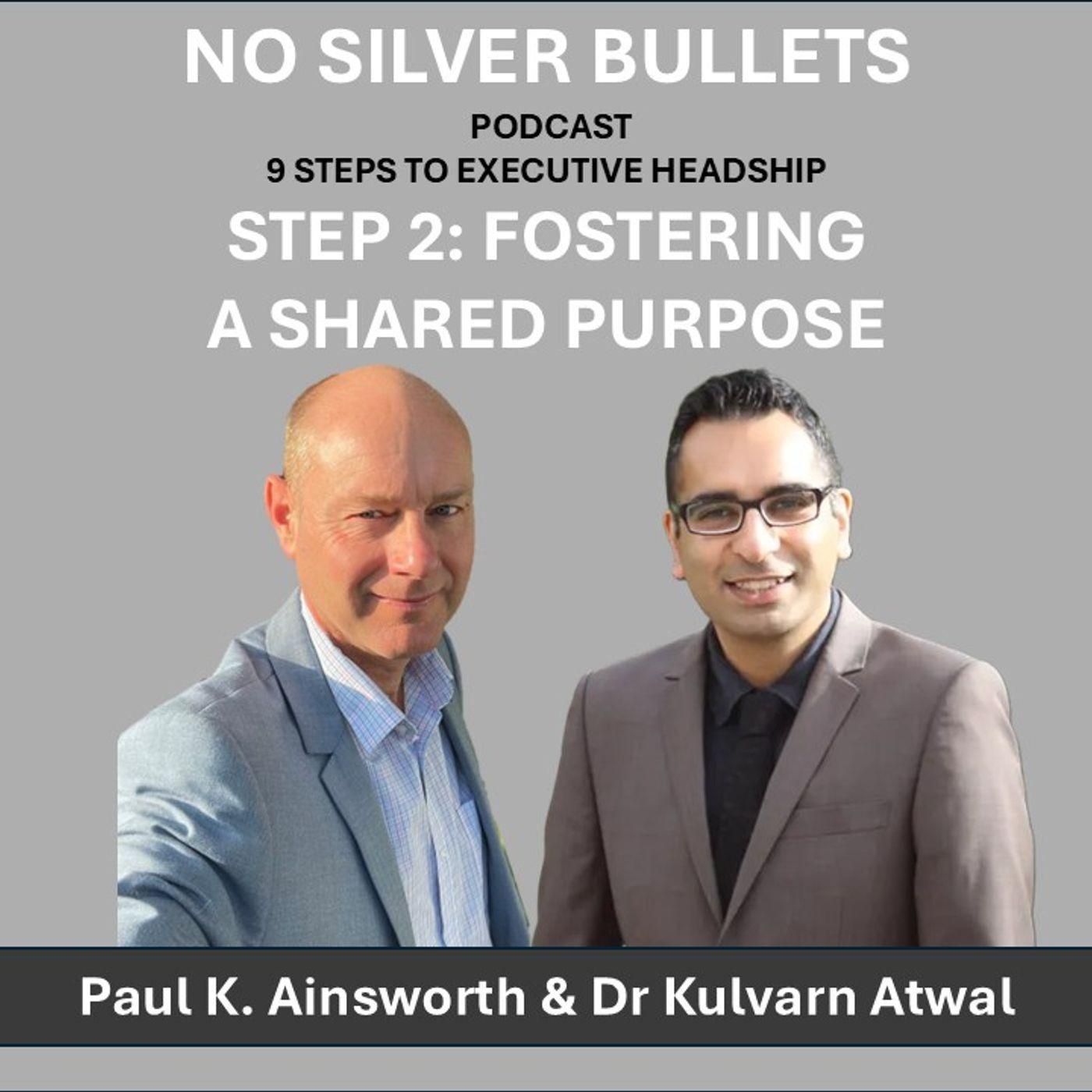
Paul Ainsworth: Those are the insightful and authentic words of Dr. Culvarn Atwell, Executive Head of Highlands and Uphol primary school in London. In this fascinating conversation, Culvarn explains how you can foster a shared purpose across schools as step two of the nine steps to executive eduction. This episode was recorded in November 2025 prior to the publication of the white paper. Hello, I'm Paul Ainsworth and welcome to the No Silver Bullets podcast. And in this series, we are focusing on the nine steps to executive headship. I am delighted to be joined by Dr. Kulvarn Atwell. Kulvarn is the executive headteacher of Highlands Primary School and Uphall Primary School located in the London Borough of Redbridge. ⁓ I have been so fortunate to visit Kulvarn and see his two wonderful schools and I can't wait to go again. Please like, subscribe and share with your colleagues. Now let's listen to more of Colvarn's thoughts. I've also had the pleasure of listening to Kulvarn at the SecEd and Headteacher Update annual pupil conference. He's always a great listener and he regularly features on the Headteacher Update podcast. Hello Kulvarn
Kulvarn: Hi and thanks for inviting me Paul.
Paul Ainsworth: It's brilliant to have you, Kulvarn I'm really looking forward to our conversation, which is going to be on step two, which is fostering a shared purpose for your community. So without further ado, let's jump straight in. What does a shared purpose mean to you working in a federation of two large primary schools in London?
Kulvarn: I think for me shared purpose is almost more important than anything else when you're working across a large organisation or across multiple organisations. I was presenting at a school in Bawtham Forest this week after school and they were talking about how do you ensure consistency and were talking about monitoring and checking the children's books and I said that I'm more interested in consistency of values. And they said, what do you mean? And I said, well, if your values are aligned and you have a shared understanding of what you see your purpose to be. So one of the slides was, what is your purpose as an educator? What do you want to achieve? And so if you've got ⁓ a learning community, whether it's one school or multiple schools, in which you have a really strong understanding of your shared purpose and shared values. then the consistency will replicate that because our actions are influenced by our values. And so I think the mistake we sometimes make is we focus on what we see, which are the actions. We want it to all look consistent and the same. But what we need to do is start with the values, which are what are the conditions for learning? What do we want our school to feel like? And it's... It's easier to do it in one school because of the context and people have a shared experience and they have chosen to work at that school. It's still not straightforward, it's easier. The challenge is then to replicate that and it has to start, if you're an executive, you have to be very clear in living out your values. So it's no good saying one thing, the difference between your espoused theories and your theories in action. You might say, we are a really inclusive school and every child matters, but your actions might not reflect that. So this is really important in terms of modelling how we talk to each other and how we talk to our children. And then if that filters through the layers of leadership and their interactions with parents and members of staff with children, if they are consistent, they will then reflect that shared purpose. The only other thing I would add is the opportunities across the learning communities within the partnership to replenish, renew, reflect and re-energise what that shared purpose looks like because we might say well we have to cut spending, have to cut learning coaches, we've got less resources, we've got higher levels of send but your values don't change but how you are going to put those values into action despite the challenges. can't be me telling everybody else, it has to be through dialogue. for example, I spoke to our learning leaders who are our year group leaders and I said, these are the challenges. And I was asked, what would you like to see from us? I said, just understanding, that's it. Just a shared understanding that actually we are all facing these challenges together. And that just, again, your communication and your language reflects that purpose.
Paul Ainsworth: I'm always struck, Alvan, in every time I speak to you and how deeply you hold your values and how important they are to your role, you know, ⁓ as a school leader and a community leader. And that just resonates in everything that you say. So you've been kind of executive head for a number of years now. And I want to try and help those people who have maybe newer to the role than you. So first of all, could you just go back to what do you think of those key skills of an executive head? What made it different when you moved from being headteacher of your single school to be executive headteacher of the two large schools that you look after?
Kulvarn: So I was actually exec head for a year prior to the two schools that I'm working with now. just a little bit of history, I took my first headship in 2012 and then in 2018 I was invited by the local authority to take on a second school that was struggling. Now one thing that helped me is they were very clear in what they... what they wanted to see and what the areas of development that this other school needed to focus on. So that helps. So the first challenge is you're already well established in one school and you're a stranger in the second. So what you don't do is you don't just go into this second school and say, ⁓ at Highlands we do this, ⁓ at Highlands we do this, ⁓ at Highlands our curriculum is this. And I remember listening to Steve Mumby from the National College talk about respecting the context, don't ride in on your horse as a saviour, actually spend more time listening. And I spent a lot of time in those first two months talking. I will have an individual meeting with each member of staff to get to understand them. And as much as possible, I will... respect the context that I've been invited into. So it could be as little as you've got two different phonics schemes and they're both as effective. Why change it? Do not unsettle unnecessarily. And ⁓ there's always a balance because there's a feeling of this is your first child and suddenly, you know, this is... your child's been your favourite and now you've got a second child. It feels a little bit like you almost have to really work hard in that second school to build trust, particularly if a school's been struggling and you have to consider where your time will be best spent. So if I felt I had a really well established leadership team at Highlands, then did I need to work harder to ensure visibility at school too? Where was I going to be in the mornings? on which school gate was I needed. And then the key thing there is where some exact head struggle is. maintaining the standards in the first school while attempting to raise standards in the second. So it's very much about lots of time spent with professional dialogue with individual members of staff, particularly at school too, listening to colleagues and spending lots of time in classrooms, meeting lots of children, because you can almost not live off that trust in the first school, but you can. manage it in a different way. You just have to ensure that the team in your first school are happy to take the additional responsibility, are being challenged but in an environment of emotional security. And what it then becomes over time is it becomes like one school. Not in terms of the families necessarily, but in terms of aims, curriculum eventually. Like for example, in the two schools I lead now, we've got the same, broadly the same curriculum, but we do Spanish at one school and French at the other, which is fine. We do Read Write Ink at one school and a different phonics program at another, but the values are the same. So it's really about not doing change for change sake, but what was good leadership in one school is good leadership in the second. If you're working really well with your leaders in school one and you learn to do that in school two, the final thing is where you've got opportunities for for cross learning, cross working, and then eventually people working across the two rather than just yourself, it brings that sense of shared purpose. so yeah, lots of work, lots of time, lots of the things you would do as a leader of a single school, but just replicated across. don't overcomplicate it.
Paul Ainsworth: Really great advice already, Colvane. again, that experience that ⁓ got just comes through in every word that you say. You've talked a little bit about school one and school two, and I've had the pleasure of visiting ⁓ your two schools. So could you... I think listeners will be surprised when you tell us about the scale of your two primary schools. So you just talk a little bit about Highlands and Uphall School and just give the listeners... a sense of the scale that you work as an executive headteacher.
Kulvarn: Yeah, so as I said I joined Highlands Primary School in September 2012 and it was in an Ofsted category at the time. I ⁓ was appointed in March but was the greatest required improvement in June so if it had been the other way around they might not have employed me. So we did a lot of work at Highlands to raise standards and really create a really strong and expansive and cohesive learning community. So that's the other thing is it's a challenge leading a second school if your first school you know has significant areas that require improvement because it will creak. So by the time we were invited by the local authority to take on uphaul primary which was just before the pandemic. UPPLE was in considerable difficulty and it's a five-form entry primary school in the most disadvantaged ward. So 70 % of our children are living in the 30 % most disadvantaged households according to London criteria. We have a very mobile population. just over 50 % of our children will go all the way through from one to six, the rest join and leave at different points. And it had already been in requires improvement and I wasn't there long enough to get it out of a second requires improvement, which the listeners will know that that would lead to a recommendation of academisation. Now, I don't know if we're the only school, but one of very few schools who actually... My argument was, if you can find a partner or a leader who can do better than we can, then we'll step aside. But if not, just let us carry on with the work that we're doing. And so this is where you're in a situation of significant challenge. And what you've got to realise as a leader, whether it's a single school or multiple schools, is the single most important factor that impacts upon children's learning experiences in schools, if you take out the influence of the home, is the quality of teaching. And the biggest factor that impacts upon the quality of teaching is the quality of teacher learning. So the amount of time I spend, or leader spend focusing on teacher professional learning, is the best way to impact upon student outcomes. And so the other thing is the danger in schools that are really struggling, and I've had... been struggling for years is to try and do sticking plasters. But I believe in architectural leadership, I believe in building structures that will be sustainable even if there are like this morning high winds or challenges or changes, those structures are in place that we don't wobble and so my job When you've been asked to go into a school or you've been successful, then you have more leeway where people will say, well, I can say, you've asked me to go in there and I want to do things that are going to lead to quality change over time. So give me the time and space to do that. And so, yes, it's a challenge, but the more work you do with the practitioners and the more you work with leaders who are absolutely aligned. It's as simple as if any leader across the two schools was asked the same question, would they be able to come up with the same answer? Not a model answer, but an answer which is impacted by their values. And I'm really pleased to say that both schools were inspected. And we don't do it for Ofsted, but if you're in an Ofsted category, you can't just say, we don't do anything for You've got to take pressure off practitioners, but you've also got to meet those statutory needs. Both schools were inspected. last year, highly successful inspections and for a double RI school to then be graded outstanding for leadership management and behaviour and actual personal development is a pretty significant achievement but the big achievement at UPHOL last year, 77 % of our disadvantaged children achieved the expected standard in reading, writing and maths combined. which is higher than the average for advantaged students in this country. And there were a lot of disadvantaged. And we have high numbers of Romania Roma traveller children who are the lowest performing. 7 % of Roma children in this country achieve a level four, grade four in English and maths. And we had some of our Roma children were in high or greater depth, whatever you want to describe it for, reading and maths. So in those metrics for disadvantaged, they surpassed the figures for advantage in reading, writing, maths, expected, combined, enhanced reading, writing, maths and combined.
Paul Ainsworth: It is just you do phenomenal things and you really skipped over and I've got to go back and say a five form entry primary school with seven years in. So if you want to just do the sums listeners, if you've got 25 children per form, you're talking of almost 900 children. And if it's full, you're over thousand pupils in an area of significant disadvantage. that was a double R.I. school that is now achieving the results that Kulwan's saying. And I've got to say it's a school built on love. I've visited the school. It's happy staff. It's happy children. There is a buzz in the school. It is leading in the right way. So that is just phenomenal, Kulwan. So I'm sure everybody is just sat in awe at what you've achieved, of what you and I know you would say. what your team has achieved.
Kulvarn: Yeah, and I think the thing is that I think that's important because my doctoral research and my background is in teacher learning. So that's that's my key thing. But I am concerned about staff well-being. I am concerned about staff retention. I did read something this morning. One in three head teachers are leaving within five years. This is a challenge. And one of the inspectors at UP Hall last year said that the biggest takeaway is she's never seen such a happy team of staff. Bearing in mind that they'd been working in a double RRI school. And I think the key thing to think there is you're absolutely right as a leader. You shouldn't feel isolated. You shouldn't feel that you're on your own. And the strength comes with the team. The other point about...
Paul Ainsworth: Hmm. Hmm.
Kulvarn: exec leadership is just to remember that sometimes, and I say this to, like, if you're a face leader of year three and four, it's never going to be equal. The need from year three is never going to be the same, equal to year four. So if you need to do some extra work with the year four parents or some extra groups for the year four children, you do it. And so experience gives you that understanding of, Apple needs more visibility for me. The parents need, because one parent, mean, ⁓ you wouldn't believe it. When you go to a school that's been struggling for so long and parents are angry, you know, some of our middle class parents, any parents that could take their kids out did and put them into another school, which you would do because that's what those Ofsted reports indicate. And on the first week, this parent, it was in my face. I thought he was gonna hit me. All he said is last year my child had eight different teachers over the course of the year and all I could say to him is I don't want your child to have eight different teachers but I can't do anything about last year. I can only focus on this year and interestingly that's the same dad who will be Father Christmas in our grotto at the Winter Wonderland which is taking place on the 12th of December. yeah, remember that the one school may need you more and That's your professional judgement to ensure that you're raising standards but not dropping standards in the other schools. So that's really about finding a balance.
Paul Ainsworth: So let's continue with that theme then. There are lots of barriers to building that shared purpose across two or more schools and you've highlighted one of them there. There is a difference in standards of performance and you're expected as executive head teacher to increase the standards in that school. Over your years, what do you think have been the barriers to building that shared purpose across the Highlands and up all school and how have you worked to overcome that?
Kulvarn: I think one of the things is, feels, you're the only one that spends that much time across the two schools firstly. You might have ⁓ a finance school business leader, but they're not really, with all due respect, interacting with the children. So back office is not the same, right? But there definitely was a feeling of the poor relation. You don't want up all staff feeling, oh, they're coming over and telling us what to do. And you don't want the Highlands thinking, oh, oh, you know, our headteachers not here. We're not getting the support we need because our pulls so low. And I think what that requires is a lot over communication, a lot of modeling of sharing. This is where we are and this is what our aims are. and where you get opportunities, and I remember starting with the early years, where you get the opportunity for someone to lead across two settings, or even coach the leaders across two settings, the challenge is, the more distant you are from something or someone, the less likely you are to have empathy. So someone gave the example, if you've never met an asylum seeker, it's easy to sort of demonize the group in a way that, well actually I don't... I've never met an asylum seeker so I don't know what their experiences are. So where you can get opportunities for staff to work across that begins to break down some of those barriers and give people opportunities. It could be the year group leaders to work alongside. It does require resources in terms of cover but where you've got people doing shared planning, shared pupil voice, shared book looks. subject leaders, particularly under the last framework, lots of work with subject leaders, and you'll suddenly find that there are strengths at Up Hall that can be shared across. And one of those strengths? Music at Up Hall. Right? The choir at Up Hall. We put our choirs together and they perform together. trying to, there's almost sometimes unconscious barriers. because some of the staff have never been to Uphall and then when they found out that other people have been going to Uphall it was like, oh I'd like to go over to Uphall. The other value of being an exec lead is where you might want to move staff around. So for example, we call our TA's learning coaches. So we have some learning coaches who have gone from Highlands to Uphall and vice versa. So you can be really flexible with... the staff team, particularly because inclusion needs go up and down, don't they? You've suddenly got some new children that need some additional support. And it gives professional learning opportunities. Say for example, Highlands is a really established leadership team and have been successful over a period of time and there's not so much movement, but you still want people to feel challenged and to be motivated and to develop. All of a sudden... you've got opportunities at another school. And now we're at a point where we're two schools which are almost equally successful, it works the other way too. Things like student teachers. So we will have student teachers and we will ask the teacher training providers can they do cross placements across the two schools. And the more you work together, the more you can a, reduce the barriers. but not in any way disrespect the context of each school. The other thing is that governors, they might get a bit uneasy about losing their head teacher. I heard about a school that has been working together for two years, although the term soft federation isn't official, but people use that term, but governors don't want to go into a hard federation because they... They want to retain their individual sort of uniqueness as a school. But I believe that it's perfectly possible to skillfully retain the school's individual identities, their individual uniforms, their individual context, maybe things they've traditionally always done, whilst having that overarching shared purpose of collaboration because... One of the challenges we have in this country that schools are set up in competition with each other. Now you're going to have this exceptional judgement. You basically have to demonstrate you're better than everybody else at this. That you can then get an exceptional judgement and it's worthy of being shared with others. Now why am I going to wait four years to share practice with others when I can collaborate long before that? The other thing that I would say For you Paul, why this is such a timely topic is that there's every possibility that the school's white paper in the new year is going to recommend that every school is in a partnership. Not necessarily a trust, but in a partnership. Which is going to mean that there's more and more people doing the role that I'm describing to you today.
Paul Ainsworth: And I think that's really interesting, isn't it? And I'm delighted by that because I feel that many head teachers can feel lonely in standalone schools, whether that's local authority and single academy or standalone academy trusts. I think it's really important that we work across the sector. So if you take yourself right back to the beginning when you were first asked to work with with Uphall School, how did you work with the leaders across the two schools so that
Kulvarn: Yeah.
Paul Ainsworth: they were positive about the federation because there must have been lots of fears and anxiety at that time. So how did you reassure those leaders and reinforce ⁓ that this is a positive move, the two schools working together?
Kulvarn: Well I think from Highlands they were very much behind it. They were really keen to develop themselves and work with another school. And we had spent some time supporting the school before we moved to a full federation. I think the bigger challenge was Uphall because they'd been through so, if you really understand the context, they'd been through so much change. so many different initiatives, direction, they've been told that they're not good enough, which is what RRI means, doesn't it? For so long, that sometimes you lose your sense of purpose. You're going to another school, you're seeing the displays in a certain way, you say, we're all changing our displays, or we're all using this scheme for maths. And honest to God, Paul, the first day, I was actually appointed on December the 9th, which was which will be coming up six years and it was a horrible gloomy December morning and I met with the the leadership team and I said to them I'm not going to meet any kids until January. I'm just going to spend the next two weeks getting to know you and talking to the staff team. So I set up individual meetings with every member of every member of staff for 10 minutes. to say, know, tell me about yourself. talk about your journey and tell me what you love about your job. I wanted it to be really positive that it wasn't that this person has been sent in to improve us. And then I actually had to say to the team that everybody needs to relax. And they said, what do mean? I said, you're too stressed out and it's getting through to the kids. And being stressed is not going to help you do. what is a really complex and challenging day job. Teaching is tough, right? The other thing is that we're not gonna tell you to do everything that we do at Highlands. I might show you some of the stuff you do and you're gonna have a think about whether or not you'd like to do that here. And we're gonna develop over time. And I'm gonna work with you and we're gonna work together and I'm gonna listen to you. And this is some of the stuff that I've heard. So once people feel that they've been listened to, then you do feel that, well, at least I can talk to this person, or at least this person's gonna get to know us. The next thing they'll see is how you talk to kids and how you talk to parents. Bearing in mind, in every school, there are members of staff who are also parents. And over time, the last thing you can do, you can't go into school and say, trust me, because that'll probably make people trust you less. And trust comes from a series of interactions between you and an individual in which mutual needs are met. And when I think when people see that you're putting the kids first and you're doing that January 1st assembly and you're saying that this is what we want to do and these are our school values and this is what we believe in and this is what UPW stands for, then over time people will align themselves with those values because who doesn't, you know, very few people... don't want to do a good job in school. People don't come to school to damage children, they? They don't come to school to be really bad at teaching literacy. They want to do well and my job is to support them. So I'd be very hands on, I'd go to planning sessions and I would say, I'd say, well what do you think? know, what would you like to see happen to improve writing? And if everyone's saying to me, we can't stand this math scheme. I'm not teaching it. So it's like they're not getting it and it's moving too fast and we're spending all our time sticking stuff in the books and I said well why do we need to do it and then people say ⁓ we were happy with White Rose and it's like right okay what are the quick wins we can do and then what are the long-term aims and what are we going to develop but I think a really key thing is that you're putting the children first. because that's what teachers want and that's what parents want. And then if you're taking responsibility for perhaps in a school that's a double RI, you get a lot of stick from parents. And the other thing I say to the staff is you have safeguarding, right? But that means 99.9 % of parents want to be good parents and want to do their best for their kids, right? They might not just always communicate in the best way, but they do want their best and they do want to be acknowledged and they do want to be listened to. So it's that visibility layer. What they don't want is that this is a person that's so distant that they're locked in their office. And that's really, really important as to managing your time. Don't set meetings immediately before school when you can go around and chat to a few members of staff. Be there when the parents come in. Because once they've seen you, they don't need to see you again for the rest of the day, they've seen you. So how you manage your time in such a way where you're maximising your time in a way that impacts most positively on students, which is through their teachers, is really powerful. The other thing is you're not going to turn the tank around. overnight and I think that's a mistake and that goes again to Steve Mumby. This idea that became prevalent in the 2000s, hero heads coming in turning and the best way to judge yourself is and I always think this is it keeps me on my toes and I think about it with all documentation appraisals and everything. If God forbid something happened to me today and someone else walked in They would see that everything is done properly, the T's are crossed, the I's are dotted. Everything is sort of ahead of schedule. They can look at the school learning plan. There's no skeletons in the cupboard. There's no grievances. There's nothing there that someone cannot think, well, everything was done properly. And that is really about managing your time. And if that means you're using admin. or you're sending someone else to this meeting in your place because you can easily get drawn into these network meetings, local authority, head teaching, when they're just sharing information, when actually you're best served being with your community who really need you. So really thinking carefully about it.
Paul Ainsworth: You've given some great advice in that in that answer. I was going to ask you what would your advice be to a new or aspiring executive head teacher? But you've just covered off some brilliant things there. You know, being present at the start of the school day to see parents so important, being around early doors when people are getting themselves ready to reassure them, have systems and structures and be organized. as you know, as I look at, you know, at yourself on the screen. can see a tidy office with those pin boards behind you all nicely arranged. That idea of if you know could somebody come in and take over from you and if we expect our teachers to be organised we've got to we've got to model that haven't we? You know and I see that
Kulvarn: Yeah. Yeah and the thing I would add to that Paul is that it's so important, like yesterday I had a list of things to do and it got to like one o'clock and I hadn't done any of them and I was really perfectly relaxed about that because everything I would have done would have been the right thing to do at that time and you wouldn't believe what some of those things are. One of them is one of our Roma families, nine children have been rehoused but they don't want to change their school so I know that they get a bus quite far and the young girl in year five left her bag on the bus. now a mum's not going to be able to communicate or find that bag. I can, I can phone the bus company, I can describe the bag and at that moment in time that I know it's saying I'm maybe over-egging it but that could be life-changing for that girl because she must then realise that someone is there for me. So it's like my duty to make sure that she's looked after and I've checked with her again this morning so that she knows we're still looking for it. And the reason I can do that is because the tasks that I would have set for yesterday are tasks that are required to be completed by next Wednesday or next Thursday. Because as long as you're not... leaning things to the last minute, what that then does is you're not panicking in challenging situations or if there's staff absence or you need to speak to the office team. And if you're relaxed, then it sends a feeling of calmness across the institution. The other piece of advice I would give you if you're a head exec or any role in leadership, don't forget to be yourself. don't forget to be yourself. Don't try to be... It's a bit like when I was a first student teacher and the teacher I was with, she just made it look so effortless that she would give these cues and the children would just immediately do exactly that. And then the first time when I was on my own, I tried to use the same... I tried to be her and the kids were like... They didn't respond to me at all. And I realized it was because... It's a bit like I was a first student teacher and the teacher I was with, she just made it look so effortless that she would give these cues and the children would just do exactly that. And then first time when I was on my own, I tried to use the same... I to be her and the kids were like... They didn't respond to me at all. it was unnatural so I needed to use my own cues so whatever I'm going to say to get children to focus and listen had to be mine and the challenge sometimes with leadership is that you feel you have to be a different type of person whereas you're much better off being authentic and letting your own personality come through. the challenge sometimes with leadership is that you feel you have to be a different ⁓ type of person whereas you're better off being authentic and letting your personality come through. because every head exec started as a teacher. I don't think, I certainly didn't, I don't think people come into the profession to become a head teacher, they're teachers, they're trained to be teachers and somewhere along the line they may fall into leadership or someone taps them on the shoulder. The other thing I would say is don't rush for any of them. Don't rush to become a head teacher. If you want to be a head teacher, take time to look at those areas of practice or expertise that maybe you haven't had as much experience on. So for me, when I was a deputy, I spent more time focusing on early years because I was a Key Stage 2 teacher. Or if you haven't been a SENCO, which a lot of heads haven't, is maybe focus on inclusion for a period of time. And the other thing is once you're a head teacher, really, really... work hard to be the headteacher you want to be before you take that opportunity to lead across more than one school. Because this industry has a way of finding you out if you haven't... And the other thing is be honest. So if someone comes to you and says, I need you to tell me how to do this, and you say, be honest and say, look, well, I've not actually had that question before and I'm not experienced, but what I'm going to do... is I'm going to take some advice and then I'll sit down with you and identify the best course of action because you're never going to know, even right now I don't know everything. So I think that's really important too.
Paul Ainsworth: really wise words and it is interesting isn't it? We find it difficult to remember where we were at the beginning so we can't remember those first few days of being a teacher. We can't remember necessarily those first two days of being a senior leader and then we become a head teacher or an executive head teacher or a director of education and you just feel not as competent as you were in your previous job and it's part of it is
Kulvarn: Yeah.
Paul Ainsworth: is giving yourself permission, isn't it, to work through that and work with the colleagues that you've got. And you're so right. Don't rush. Don't don't don't rush. Don't rush into that executive headship. Take your time to build your skills, to work with people, to see different schools, talk to different executive heads and then do the job. Don't rush.
Kulvarn: Yeah. Yeah. Agreed.
Paul Ainsworth: So what's next for you and your Federation? I know that you've written books in the Paschal Varn and you've obviously got your doctorate as well. And the Federation has done so well in terms of Ofsted and pupil outcomes. What's next for you and your schools?
Kulvarn: Hmm. I think it's interesting that at UP Paul, because there's a, over time, the proportion of people that... were hired directly by you or during your tenure just increases because it's just natural, right? So we do a lot of with student teachers, we lot of VCTs. And one of the young men who was in his third year of teaching and happened to be the co-maths lead, which other people get surprised about as well, but people need opportunities, said to me, what are you going to do now? And I couldn't see it coming, right? And I thought to me, I said to him straight away, I'm going enjoy it. And he said, what? He says, well, what was the point of me working for five years to get our school to where it is now to then think, ⁓ what am going to do next? I'm going to enjoy not having to work in an RRI school, not having to spend. And unfortunately, and I heard Martin Oliver speak last week, and he admitted that It's easy for Ofsted to say don't do anything different or don't just do what you normally do. In reality, you can't because there's so much at stake. And so I want to enjoy this partnership and where we are. I want to take opportunities to share our practice. So in the last few weeks, I've actually been doing quite a lot of work with Barkin and Dagenham, which is another local authority, and Waltham Forest I was in this week, sharing our practice on or a C and having an impact across white schools. I'll wait to see what the white paper says but if the hardest job Paul is the first three years. For me that is the hardest part is the first three years. Getting to know a community, building trust, building the structures, developing the curriculum, everything else. But what I think we can do is... If the school's work paper is saying that schools need to work in partnership, then what I would like to do is invite schools to join the Federation in an appropriate way because you can expand too quickly. I've seen that elsewhere. There are obviously financial challenges that schools are facing, challenges with supporting children with SEND. So anything that I would do, two things, it would have to be... at the right pace, okay, so it might be a third school, but equally, and I know this about myself and someone else said this about me because I have been in positions where people have asked me to maybe put my hat in the ring for a director of education, I can't be too far away from kids. So my energy comes from, and we were talking off air beforehand, weren't we, about the best time of year in primary school is Christmas time. I need to have that feeling that I'm directly with children. So any opportunity where I can maybe expand the partnership but in a way that isn't, is going to continue that standard of raising standards in one school and maintaining in the two that we have. But also ensuring I'm not too distant from kids would be my aim really because the other thing to remember about as a head or exec is Don't forget what gives you energy. So if there are some activities like preparing the finance report for governors when you know that it's getting harder and harder or doing restructures, which is incredibly difficult, think about what gives you energy. What are the things that give you energy? For me, teaching gives me energy, so am I making sure that I get opportunities to teach? assemblies give me energy or working with teacher professional learning gives me energy. Make sure you've got enough opportunities in the week the things that give you that energy that you can then draw upon.
Paul Ainsworth: ⁓ thanks, Colvan. And that idea of enjoying your job, was listening to Gareth Southgate on an interview this week as well, and he said he knew the time to leave England management was when he stopped enjoying that semi-final win. I think we need to think about enjoying the job and, as you said, looking for the ways that give us energy. You've been so generous with your time, Colvan. You've given us so much extra advice on
Kulvarn: Yeah.
Paul Ainsworth: not only step two fostering assured purpose but on just so many aspects of executive headship. Just thank you, thank you for your time. I know people will really enjoy listening to this and I know that I'll really enjoy writing it up in the book as well. So if you get the opportunity to listen to Kulvarn speak, you know, take that opportunity. He's written some books which you can find, you can follow him on Twitter as The Thinking School but Just thank you so much, Corvarn, for your words of wisdom. I've really enjoyed our conversation.
Kulvarn: You're very welcome, Paul. Thank you.
Kulvarn: Hi and thanks for inviting me Paul.
Paul Ainsworth: It's brilliant to have you, Kulvarn I'm really looking forward to our conversation, which is going to be on step two, which is fostering a shared purpose for your community. So without further ado, let's jump straight in. What does a shared purpose mean to you working in a federation of two large primary schools in London?
Kulvarn: I think for me shared purpose is almost more important than anything else when you're working across a large organisation or across multiple organisations. I was presenting at a school in Bawtham Forest this week after school and they were talking about how do you ensure consistency and were talking about monitoring and checking the children's books and I said that I'm more interested in consistency of values. And they said, what do you mean? And I said, well, if your values are aligned and you have a shared understanding of what you see your purpose to be. So one of the slides was, what is your purpose as an educator? What do you want to achieve? And so if you've got ⁓ a learning community, whether it's one school or multiple schools, in which you have a really strong understanding of your shared purpose and shared values. then the consistency will replicate that because our actions are influenced by our values. And so I think the mistake we sometimes make is we focus on what we see, which are the actions. We want it to all look consistent and the same. But what we need to do is start with the values, which are what are the conditions for learning? What do we want our school to feel like? And it's... It's easier to do it in one school because of the context and people have a shared experience and they have chosen to work at that school. It's still not straightforward, it's easier. The challenge is then to replicate that and it has to start, if you're an executive, you have to be very clear in living out your values. So it's no good saying one thing, the difference between your espoused theories and your theories in action. You might say, we are a really inclusive school and every child matters, but your actions might not reflect that. So this is really important in terms of modelling how we talk to each other and how we talk to our children. And then if that filters through the layers of leadership and their interactions with parents and members of staff with children, if they are consistent, they will then reflect that shared purpose. The only other thing I would add is the opportunities across the learning communities within the partnership to replenish, renew, reflect and re-energise what that shared purpose looks like because we might say well we have to cut spending, have to cut learning coaches, we've got less resources, we've got higher levels of send but your values don't change but how you are going to put those values into action despite the challenges. can't be me telling everybody else, it has to be through dialogue. for example, I spoke to our learning leaders who are our year group leaders and I said, these are the challenges. And I was asked, what would you like to see from us? I said, just understanding, that's it. Just a shared understanding that actually we are all facing these challenges together. And that just, again, your communication and your language reflects that purpose.
Paul Ainsworth: I'm always struck, Alvan, in every time I speak to you and how deeply you hold your values and how important they are to your role, you know, ⁓ as a school leader and a community leader. And that just resonates in everything that you say. So you've been kind of executive head for a number of years now. And I want to try and help those people who have maybe newer to the role than you. So first of all, could you just go back to what do you think of those key skills of an executive head? What made it different when you moved from being headteacher of your single school to be executive headteacher of the two large schools that you look after?
Kulvarn: So I was actually exec head for a year prior to the two schools that I'm working with now. just a little bit of history, I took my first headship in 2012 and then in 2018 I was invited by the local authority to take on a second school that was struggling. Now one thing that helped me is they were very clear in what they... what they wanted to see and what the areas of development that this other school needed to focus on. So that helps. So the first challenge is you're already well established in one school and you're a stranger in the second. So what you don't do is you don't just go into this second school and say, ⁓ at Highlands we do this, ⁓ at Highlands we do this, ⁓ at Highlands our curriculum is this. And I remember listening to Steve Mumby from the National College talk about respecting the context, don't ride in on your horse as a saviour, actually spend more time listening. And I spent a lot of time in those first two months talking. I will have an individual meeting with each member of staff to get to understand them. And as much as possible, I will... respect the context that I've been invited into. So it could be as little as you've got two different phonics schemes and they're both as effective. Why change it? Do not unsettle unnecessarily. And ⁓ there's always a balance because there's a feeling of this is your first child and suddenly, you know, this is... your child's been your favourite and now you've got a second child. It feels a little bit like you almost have to really work hard in that second school to build trust, particularly if a school's been struggling and you have to consider where your time will be best spent. So if I felt I had a really well established leadership team at Highlands, then did I need to work harder to ensure visibility at school too? Where was I going to be in the mornings? on which school gate was I needed. And then the key thing there is where some exact head struggle is. maintaining the standards in the first school while attempting to raise standards in the second. So it's very much about lots of time spent with professional dialogue with individual members of staff, particularly at school too, listening to colleagues and spending lots of time in classrooms, meeting lots of children, because you can almost not live off that trust in the first school, but you can. manage it in a different way. You just have to ensure that the team in your first school are happy to take the additional responsibility, are being challenged but in an environment of emotional security. And what it then becomes over time is it becomes like one school. Not in terms of the families necessarily, but in terms of aims, curriculum eventually. Like for example, in the two schools I lead now, we've got the same, broadly the same curriculum, but we do Spanish at one school and French at the other, which is fine. We do Read Write Ink at one school and a different phonics program at another, but the values are the same. So it's really about not doing change for change sake, but what was good leadership in one school is good leadership in the second. If you're working really well with your leaders in school one and you learn to do that in school two, the final thing is where you've got opportunities for for cross learning, cross working, and then eventually people working across the two rather than just yourself, it brings that sense of shared purpose. so yeah, lots of work, lots of time, lots of the things you would do as a leader of a single school, but just replicated across. don't overcomplicate it.
Paul Ainsworth: Really great advice already, Colvane. again, that experience that ⁓ got just comes through in every word that you say. You've talked a little bit about school one and school two, and I've had the pleasure of visiting ⁓ your two schools. So could you... I think listeners will be surprised when you tell us about the scale of your two primary schools. So you just talk a little bit about Highlands and Uphall School and just give the listeners... a sense of the scale that you work as an executive headteacher.
Kulvarn: Yeah, so as I said I joined Highlands Primary School in September 2012 and it was in an Ofsted category at the time. I ⁓ was appointed in March but was the greatest required improvement in June so if it had been the other way around they might not have employed me. So we did a lot of work at Highlands to raise standards and really create a really strong and expansive and cohesive learning community. So that's the other thing is it's a challenge leading a second school if your first school you know has significant areas that require improvement because it will creak. So by the time we were invited by the local authority to take on uphaul primary which was just before the pandemic. UPPLE was in considerable difficulty and it's a five-form entry primary school in the most disadvantaged ward. So 70 % of our children are living in the 30 % most disadvantaged households according to London criteria. We have a very mobile population. just over 50 % of our children will go all the way through from one to six, the rest join and leave at different points. And it had already been in requires improvement and I wasn't there long enough to get it out of a second requires improvement, which the listeners will know that that would lead to a recommendation of academisation. Now, I don't know if we're the only school, but one of very few schools who actually... My argument was, if you can find a partner or a leader who can do better than we can, then we'll step aside. But if not, just let us carry on with the work that we're doing. And so this is where you're in a situation of significant challenge. And what you've got to realise as a leader, whether it's a single school or multiple schools, is the single most important factor that impacts upon children's learning experiences in schools, if you take out the influence of the home, is the quality of teaching. And the biggest factor that impacts upon the quality of teaching is the quality of teacher learning. So the amount of time I spend, or leader spend focusing on teacher professional learning, is the best way to impact upon student outcomes. And so the other thing is the danger in schools that are really struggling, and I've had... been struggling for years is to try and do sticking plasters. But I believe in architectural leadership, I believe in building structures that will be sustainable even if there are like this morning high winds or challenges or changes, those structures are in place that we don't wobble and so my job When you've been asked to go into a school or you've been successful, then you have more leeway where people will say, well, I can say, you've asked me to go in there and I want to do things that are going to lead to quality change over time. So give me the time and space to do that. And so, yes, it's a challenge, but the more work you do with the practitioners and the more you work with leaders who are absolutely aligned. It's as simple as if any leader across the two schools was asked the same question, would they be able to come up with the same answer? Not a model answer, but an answer which is impacted by their values. And I'm really pleased to say that both schools were inspected. And we don't do it for Ofsted, but if you're in an Ofsted category, you can't just say, we don't do anything for You've got to take pressure off practitioners, but you've also got to meet those statutory needs. Both schools were inspected. last year, highly successful inspections and for a double RI school to then be graded outstanding for leadership management and behaviour and actual personal development is a pretty significant achievement but the big achievement at UPHOL last year, 77 % of our disadvantaged children achieved the expected standard in reading, writing and maths combined. which is higher than the average for advantaged students in this country. And there were a lot of disadvantaged. And we have high numbers of Romania Roma traveller children who are the lowest performing. 7 % of Roma children in this country achieve a level four, grade four in English and maths. And we had some of our Roma children were in high or greater depth, whatever you want to describe it for, reading and maths. So in those metrics for disadvantaged, they surpassed the figures for advantage in reading, writing, maths, expected, combined, enhanced reading, writing, maths and combined.
Paul Ainsworth: It is just you do phenomenal things and you really skipped over and I've got to go back and say a five form entry primary school with seven years in. So if you want to just do the sums listeners, if you've got 25 children per form, you're talking of almost 900 children. And if it's full, you're over thousand pupils in an area of significant disadvantage. that was a double R.I. school that is now achieving the results that Kulwan's saying. And I've got to say it's a school built on love. I've visited the school. It's happy staff. It's happy children. There is a buzz in the school. It is leading in the right way. So that is just phenomenal, Kulwan. So I'm sure everybody is just sat in awe at what you've achieved, of what you and I know you would say. what your team has achieved.
Kulvarn: Yeah, and I think the thing is that I think that's important because my doctoral research and my background is in teacher learning. So that's that's my key thing. But I am concerned about staff well-being. I am concerned about staff retention. I did read something this morning. One in three head teachers are leaving within five years. This is a challenge. And one of the inspectors at UP Hall last year said that the biggest takeaway is she's never seen such a happy team of staff. Bearing in mind that they'd been working in a double RRI school. And I think the key thing to think there is you're absolutely right as a leader. You shouldn't feel isolated. You shouldn't feel that you're on your own. And the strength comes with the team. The other point about...
Paul Ainsworth: Hmm. Hmm.
Kulvarn: exec leadership is just to remember that sometimes, and I say this to, like, if you're a face leader of year three and four, it's never going to be equal. The need from year three is never going to be the same, equal to year four. So if you need to do some extra work with the year four parents or some extra groups for the year four children, you do it. And so experience gives you that understanding of, Apple needs more visibility for me. The parents need, because one parent, mean, ⁓ you wouldn't believe it. When you go to a school that's been struggling for so long and parents are angry, you know, some of our middle class parents, any parents that could take their kids out did and put them into another school, which you would do because that's what those Ofsted reports indicate. And on the first week, this parent, it was in my face. I thought he was gonna hit me. All he said is last year my child had eight different teachers over the course of the year and all I could say to him is I don't want your child to have eight different teachers but I can't do anything about last year. I can only focus on this year and interestingly that's the same dad who will be Father Christmas in our grotto at the Winter Wonderland which is taking place on the 12th of December. yeah, remember that the one school may need you more and That's your professional judgement to ensure that you're raising standards but not dropping standards in the other schools. So that's really about finding a balance.
Paul Ainsworth: So let's continue with that theme then. There are lots of barriers to building that shared purpose across two or more schools and you've highlighted one of them there. There is a difference in standards of performance and you're expected as executive head teacher to increase the standards in that school. Over your years, what do you think have been the barriers to building that shared purpose across the Highlands and up all school and how have you worked to overcome that?
Kulvarn: I think one of the things is, feels, you're the only one that spends that much time across the two schools firstly. You might have ⁓ a finance school business leader, but they're not really, with all due respect, interacting with the children. So back office is not the same, right? But there definitely was a feeling of the poor relation. You don't want up all staff feeling, oh, they're coming over and telling us what to do. And you don't want the Highlands thinking, oh, oh, you know, our headteachers not here. We're not getting the support we need because our pulls so low. And I think what that requires is a lot over communication, a lot of modeling of sharing. This is where we are and this is what our aims are. and where you get opportunities, and I remember starting with the early years, where you get the opportunity for someone to lead across two settings, or even coach the leaders across two settings, the challenge is, the more distant you are from something or someone, the less likely you are to have empathy. So someone gave the example, if you've never met an asylum seeker, it's easy to sort of demonize the group in a way that, well actually I don't... I've never met an asylum seeker so I don't know what their experiences are. So where you can get opportunities for staff to work across that begins to break down some of those barriers and give people opportunities. It could be the year group leaders to work alongside. It does require resources in terms of cover but where you've got people doing shared planning, shared pupil voice, shared book looks. subject leaders, particularly under the last framework, lots of work with subject leaders, and you'll suddenly find that there are strengths at Up Hall that can be shared across. And one of those strengths? Music at Up Hall. Right? The choir at Up Hall. We put our choirs together and they perform together. trying to, there's almost sometimes unconscious barriers. because some of the staff have never been to Uphall and then when they found out that other people have been going to Uphall it was like, oh I'd like to go over to Uphall. The other value of being an exec lead is where you might want to move staff around. So for example, we call our TA's learning coaches. So we have some learning coaches who have gone from Highlands to Uphall and vice versa. So you can be really flexible with... the staff team, particularly because inclusion needs go up and down, don't they? You've suddenly got some new children that need some additional support. And it gives professional learning opportunities. Say for example, Highlands is a really established leadership team and have been successful over a period of time and there's not so much movement, but you still want people to feel challenged and to be motivated and to develop. All of a sudden... you've got opportunities at another school. And now we're at a point where we're two schools which are almost equally successful, it works the other way too. Things like student teachers. So we will have student teachers and we will ask the teacher training providers can they do cross placements across the two schools. And the more you work together, the more you can a, reduce the barriers. but not in any way disrespect the context of each school. The other thing is that governors, they might get a bit uneasy about losing their head teacher. I heard about a school that has been working together for two years, although the term soft federation isn't official, but people use that term, but governors don't want to go into a hard federation because they... They want to retain their individual sort of uniqueness as a school. But I believe that it's perfectly possible to skillfully retain the school's individual identities, their individual uniforms, their individual context, maybe things they've traditionally always done, whilst having that overarching shared purpose of collaboration because... One of the challenges we have in this country that schools are set up in competition with each other. Now you're going to have this exceptional judgement. You basically have to demonstrate you're better than everybody else at this. That you can then get an exceptional judgement and it's worthy of being shared with others. Now why am I going to wait four years to share practice with others when I can collaborate long before that? The other thing that I would say For you Paul, why this is such a timely topic is that there's every possibility that the school's white paper in the new year is going to recommend that every school is in a partnership. Not necessarily a trust, but in a partnership. Which is going to mean that there's more and more people doing the role that I'm describing to you today.
Paul Ainsworth: And I think that's really interesting, isn't it? And I'm delighted by that because I feel that many head teachers can feel lonely in standalone schools, whether that's local authority and single academy or standalone academy trusts. I think it's really important that we work across the sector. So if you take yourself right back to the beginning when you were first asked to work with with Uphall School, how did you work with the leaders across the two schools so that
Kulvarn: Yeah.
Paul Ainsworth: they were positive about the federation because there must have been lots of fears and anxiety at that time. So how did you reassure those leaders and reinforce ⁓ that this is a positive move, the two schools working together?
Kulvarn: Well I think from Highlands they were very much behind it. They were really keen to develop themselves and work with another school. And we had spent some time supporting the school before we moved to a full federation. I think the bigger challenge was Uphall because they'd been through so, if you really understand the context, they'd been through so much change. so many different initiatives, direction, they've been told that they're not good enough, which is what RRI means, doesn't it? For so long, that sometimes you lose your sense of purpose. You're going to another school, you're seeing the displays in a certain way, you say, we're all changing our displays, or we're all using this scheme for maths. And honest to God, Paul, the first day, I was actually appointed on December the 9th, which was which will be coming up six years and it was a horrible gloomy December morning and I met with the the leadership team and I said to them I'm not going to meet any kids until January. I'm just going to spend the next two weeks getting to know you and talking to the staff team. So I set up individual meetings with every member of every member of staff for 10 minutes. to say, know, tell me about yourself. talk about your journey and tell me what you love about your job. I wanted it to be really positive that it wasn't that this person has been sent in to improve us. And then I actually had to say to the team that everybody needs to relax. And they said, what do mean? I said, you're too stressed out and it's getting through to the kids. And being stressed is not going to help you do. what is a really complex and challenging day job. Teaching is tough, right? The other thing is that we're not gonna tell you to do everything that we do at Highlands. I might show you some of the stuff you do and you're gonna have a think about whether or not you'd like to do that here. And we're gonna develop over time. And I'm gonna work with you and we're gonna work together and I'm gonna listen to you. And this is some of the stuff that I've heard. So once people feel that they've been listened to, then you do feel that, well, at least I can talk to this person, or at least this person's gonna get to know us. The next thing they'll see is how you talk to kids and how you talk to parents. Bearing in mind, in every school, there are members of staff who are also parents. And over time, the last thing you can do, you can't go into school and say, trust me, because that'll probably make people trust you less. And trust comes from a series of interactions between you and an individual in which mutual needs are met. And when I think when people see that you're putting the kids first and you're doing that January 1st assembly and you're saying that this is what we want to do and these are our school values and this is what we believe in and this is what UPW stands for, then over time people will align themselves with those values because who doesn't, you know, very few people... don't want to do a good job in school. People don't come to school to damage children, they? They don't come to school to be really bad at teaching literacy. They want to do well and my job is to support them. So I'd be very hands on, I'd go to planning sessions and I would say, I'd say, well what do you think? know, what would you like to see happen to improve writing? And if everyone's saying to me, we can't stand this math scheme. I'm not teaching it. So it's like they're not getting it and it's moving too fast and we're spending all our time sticking stuff in the books and I said well why do we need to do it and then people say ⁓ we were happy with White Rose and it's like right okay what are the quick wins we can do and then what are the long-term aims and what are we going to develop but I think a really key thing is that you're putting the children first. because that's what teachers want and that's what parents want. And then if you're taking responsibility for perhaps in a school that's a double RI, you get a lot of stick from parents. And the other thing I say to the staff is you have safeguarding, right? But that means 99.9 % of parents want to be good parents and want to do their best for their kids, right? They might not just always communicate in the best way, but they do want their best and they do want to be acknowledged and they do want to be listened to. So it's that visibility layer. What they don't want is that this is a person that's so distant that they're locked in their office. And that's really, really important as to managing your time. Don't set meetings immediately before school when you can go around and chat to a few members of staff. Be there when the parents come in. Because once they've seen you, they don't need to see you again for the rest of the day, they've seen you. So how you manage your time in such a way where you're maximising your time in a way that impacts most positively on students, which is through their teachers, is really powerful. The other thing is you're not going to turn the tank around. overnight and I think that's a mistake and that goes again to Steve Mumby. This idea that became prevalent in the 2000s, hero heads coming in turning and the best way to judge yourself is and I always think this is it keeps me on my toes and I think about it with all documentation appraisals and everything. If God forbid something happened to me today and someone else walked in They would see that everything is done properly, the T's are crossed, the I's are dotted. Everything is sort of ahead of schedule. They can look at the school learning plan. There's no skeletons in the cupboard. There's no grievances. There's nothing there that someone cannot think, well, everything was done properly. And that is really about managing your time. And if that means you're using admin. or you're sending someone else to this meeting in your place because you can easily get drawn into these network meetings, local authority, head teaching, when they're just sharing information, when actually you're best served being with your community who really need you. So really thinking carefully about it.
Paul Ainsworth: You've given some great advice in that in that answer. I was going to ask you what would your advice be to a new or aspiring executive head teacher? But you've just covered off some brilliant things there. You know, being present at the start of the school day to see parents so important, being around early doors when people are getting themselves ready to reassure them, have systems and structures and be organized. as you know, as I look at, you know, at yourself on the screen. can see a tidy office with those pin boards behind you all nicely arranged. That idea of if you know could somebody come in and take over from you and if we expect our teachers to be organised we've got to we've got to model that haven't we? You know and I see that
Kulvarn: Yeah. Yeah and the thing I would add to that Paul is that it's so important, like yesterday I had a list of things to do and it got to like one o'clock and I hadn't done any of them and I was really perfectly relaxed about that because everything I would have done would have been the right thing to do at that time and you wouldn't believe what some of those things are. One of them is one of our Roma families, nine children have been rehoused but they don't want to change their school so I know that they get a bus quite far and the young girl in year five left her bag on the bus. now a mum's not going to be able to communicate or find that bag. I can, I can phone the bus company, I can describe the bag and at that moment in time that I know it's saying I'm maybe over-egging it but that could be life-changing for that girl because she must then realise that someone is there for me. So it's like my duty to make sure that she's looked after and I've checked with her again this morning so that she knows we're still looking for it. And the reason I can do that is because the tasks that I would have set for yesterday are tasks that are required to be completed by next Wednesday or next Thursday. Because as long as you're not... leaning things to the last minute, what that then does is you're not panicking in challenging situations or if there's staff absence or you need to speak to the office team. And if you're relaxed, then it sends a feeling of calmness across the institution. The other piece of advice I would give you if you're a head exec or any role in leadership, don't forget to be yourself. don't forget to be yourself. Don't try to be... It's a bit like when I was a first student teacher and the teacher I was with, she just made it look so effortless that she would give these cues and the children would just immediately do exactly that. And then the first time when I was on my own, I tried to use the same... I tried to be her and the kids were like... They didn't respond to me at all. And I realized it was because... It's a bit like I was a first student teacher and the teacher I was with, she just made it look so effortless that she would give these cues and the children would just do exactly that. And then first time when I was on my own, I tried to use the same... I to be her and the kids were like... They didn't respond to me at all. it was unnatural so I needed to use my own cues so whatever I'm going to say to get children to focus and listen had to be mine and the challenge sometimes with leadership is that you feel you have to be a different type of person whereas you're much better off being authentic and letting your own personality come through. the challenge sometimes with leadership is that you feel you have to be a different ⁓ type of person whereas you're better off being authentic and letting your personality come through. because every head exec started as a teacher. I don't think, I certainly didn't, I don't think people come into the profession to become a head teacher, they're teachers, they're trained to be teachers and somewhere along the line they may fall into leadership or someone taps them on the shoulder. The other thing I would say is don't rush for any of them. Don't rush to become a head teacher. If you want to be a head teacher, take time to look at those areas of practice or expertise that maybe you haven't had as much experience on. So for me, when I was a deputy, I spent more time focusing on early years because I was a Key Stage 2 teacher. Or if you haven't been a SENCO, which a lot of heads haven't, is maybe focus on inclusion for a period of time. And the other thing is once you're a head teacher, really, really... work hard to be the headteacher you want to be before you take that opportunity to lead across more than one school. Because this industry has a way of finding you out if you haven't... And the other thing is be honest. So if someone comes to you and says, I need you to tell me how to do this, and you say, be honest and say, look, well, I've not actually had that question before and I'm not experienced, but what I'm going to do... is I'm going to take some advice and then I'll sit down with you and identify the best course of action because you're never going to know, even right now I don't know everything. So I think that's really important too.
Paul Ainsworth: really wise words and it is interesting isn't it? We find it difficult to remember where we were at the beginning so we can't remember those first few days of being a teacher. We can't remember necessarily those first two days of being a senior leader and then we become a head teacher or an executive head teacher or a director of education and you just feel not as competent as you were in your previous job and it's part of it is
Kulvarn: Yeah.
Paul Ainsworth: is giving yourself permission, isn't it, to work through that and work with the colleagues that you've got. And you're so right. Don't rush. Don't don't don't rush. Don't rush into that executive headship. Take your time to build your skills, to work with people, to see different schools, talk to different executive heads and then do the job. Don't rush.
Kulvarn: Yeah. Yeah. Agreed.
Paul Ainsworth: So what's next for you and your Federation? I know that you've written books in the Paschal Varn and you've obviously got your doctorate as well. And the Federation has done so well in terms of Ofsted and pupil outcomes. What's next for you and your schools?
Kulvarn: Hmm. I think it's interesting that at UP Paul, because there's a, over time, the proportion of people that... were hired directly by you or during your tenure just increases because it's just natural, right? So we do a lot of with student teachers, we lot of VCTs. And one of the young men who was in his third year of teaching and happened to be the co-maths lead, which other people get surprised about as well, but people need opportunities, said to me, what are you going to do now? And I couldn't see it coming, right? And I thought to me, I said to him straight away, I'm going enjoy it. And he said, what? He says, well, what was the point of me working for five years to get our school to where it is now to then think, ⁓ what am going to do next? I'm going to enjoy not having to work in an RRI school, not having to spend. And unfortunately, and I heard Martin Oliver speak last week, and he admitted that It's easy for Ofsted to say don't do anything different or don't just do what you normally do. In reality, you can't because there's so much at stake. And so I want to enjoy this partnership and where we are. I want to take opportunities to share our practice. So in the last few weeks, I've actually been doing quite a lot of work with Barkin and Dagenham, which is another local authority, and Waltham Forest I was in this week, sharing our practice on or a C and having an impact across white schools. I'll wait to see what the white paper says but if the hardest job Paul is the first three years. For me that is the hardest part is the first three years. Getting to know a community, building trust, building the structures, developing the curriculum, everything else. But what I think we can do is... If the school's work paper is saying that schools need to work in partnership, then what I would like to do is invite schools to join the Federation in an appropriate way because you can expand too quickly. I've seen that elsewhere. There are obviously financial challenges that schools are facing, challenges with supporting children with SEND. So anything that I would do, two things, it would have to be... at the right pace, okay, so it might be a third school, but equally, and I know this about myself and someone else said this about me because I have been in positions where people have asked me to maybe put my hat in the ring for a director of education, I can't be too far away from kids. So my energy comes from, and we were talking off air beforehand, weren't we, about the best time of year in primary school is Christmas time. I need to have that feeling that I'm directly with children. So any opportunity where I can maybe expand the partnership but in a way that isn't, is going to continue that standard of raising standards in one school and maintaining in the two that we have. But also ensuring I'm not too distant from kids would be my aim really because the other thing to remember about as a head or exec is Don't forget what gives you energy. So if there are some activities like preparing the finance report for governors when you know that it's getting harder and harder or doing restructures, which is incredibly difficult, think about what gives you energy. What are the things that give you energy? For me, teaching gives me energy, so am I making sure that I get opportunities to teach? assemblies give me energy or working with teacher professional learning gives me energy. Make sure you've got enough opportunities in the week the things that give you that energy that you can then draw upon.
Paul Ainsworth: ⁓ thanks, Colvan. And that idea of enjoying your job, was listening to Gareth Southgate on an interview this week as well, and he said he knew the time to leave England management was when he stopped enjoying that semi-final win. I think we need to think about enjoying the job and, as you said, looking for the ways that give us energy. You've been so generous with your time, Colvan. You've given us so much extra advice on
Kulvarn: Yeah.
Paul Ainsworth: not only step two fostering assured purpose but on just so many aspects of executive headship. Just thank you, thank you for your time. I know people will really enjoy listening to this and I know that I'll really enjoy writing it up in the book as well. So if you get the opportunity to listen to Kulvarn speak, you know, take that opportunity. He's written some books which you can find, you can follow him on Twitter as The Thinking School but Just thank you so much, Corvarn, for your words of wisdom. I've really enjoyed our conversation.
Kulvarn: You're very welcome, Paul. Thank you.
