


WILLIAM WANKER: Hello and welcome. I'm William Wonker, and you are listening to Dignify Audio, a podcast brought to you by Human Dignity Projects and Dignify magazine, both of which I co-created and co-curate with Pamela Kelly. Today we are speaking with our extremely talented friend Royce Epstein. Royce is the Senior Director of Design Insights for Mohawk Group. Thirty plus year veteran in architecture and the design industry, Royce has extensive experience practicing in design firms and working in product development for carpet and textiles. Royce shares her passion and vision for design, cultural trends, and the meaning of materials in a broad context. As both historian and futurist, she has a unique purview into the design industry, always putting design in context and Trying to find significance in cultural shifts and how they shape the language of design. Constantly on the watch for new trends in all aspects of culture, Royce also feeds this insight to her industry's touch points as a designer, trend forecaster, educator, lecturer, and writer. Her specific interests are in environmental and social sustainability, materials, and using strategic design. Thinking for positive impacts. Quite a career and range of interests, I would say. So thank you for joining us, Royce. I'm so looking forward to this conversation. Thanks, William. It's really a pleasure to be here and talk to you about all the things related to designing. Well, we just provided some insight into your background, but please, in your own words, give us a sense of who you are and what about your background brought you to this place today. So as you mentioned, I work at Mohawk Group. I'm senior director of design and I do focus on what we call design insights. So that is inclusive of trend forecasting, for example. I am really our primary storyteller at Mohawk Group and I connect design to culture at large. I have been working in the A and D, which is the architecture and interior design industry, for over 30 years. And the first 20, 21 years or so, I was a commercial interior designer. And then the last 14 years or so I've been working in product development, as you mentioned, in Crippa and Textiles. I've also been a teacher of design at the university level for about a third of my career. But my background really started in art history. And from that, I learned the importance of context. I think that is my favorite word. Everything that is created has a context. And we need to understand that so we can appreciate the things around us, but also see the meaning. in the things around us like objects and more importantly in my world, buildings and the objects that inhabit buildings. So while I am a historian and specifically an art historian by training, I'm also a futurist. I care about the future and I want to understand history so that we can design for a better future. So that's a lot of what I like to talk about. Well that sounds like you're the perfect person to have this conversation. And To sort of extend on that very first start. You've been doing some work lately exploring knowledge, technique, and creativity in both the physical and digital place and practices of design and craft, especially in the service, as you said, of making something new for society. So what drove that particular interest in this project? Well, first of all, every year at Mohawk Group, I author what we call our color and design vision. And this is a big overarching narrative for the company. And it serves as a cultural forecast for the design community. But for us internally, it's actually a roadmap for our product designers as they are developing new products and new collections. So every year I have a new theme and I try to build the themes on top of each other every year so that they are connected because everything in culture typically is connected and it's not like we just drop something and move to the next. We keep building on different ideas. So this year I wanted to explore the idea of making. And we always talk about making. The maker movement has been going on for hundreds and hundreds of years, but it evolves. And right now I think we're living in a moment where things like AI and robots and digital fabrication and automation are really transforming every creative discipline. So rather than asking whether technology is going to replace human creativity, and I understand a lot of people are afraid of that, I wanted to change the thought process and really ask questions about how might technology actually expand craft. So that's what I've been looking at with this theme this year. And as I was doing my research, I kept returning to this Greek concept called techne. And it is kind of a funny word because the word tech is in there. But obviously it's an ancient Greek word that is all about how true making combines a bunch of different things. You have to have knowledge, you have to have skill, you have to have a purpose. But then craft is what is injected or bridges those other things to create the thing, right? So it became a perfect framework because it does remind us that innovation has always been about that relationship between human creativity and the tools that we use. And of course, AI is just one tool of many that we have in our arsenal for creativity. So ultimately, the theme isn't really about technology, even though it's called techne, it's really about humanity and it's about how we continue to create meaningful things in our rapidly changing world. But again, in the context of today. So that's techne in a nutshell. And then you use the word or phrase rather, purposeful making. How does that relate and what does that mean? mean specifically to you? Well, as I mentioned a second ago, we've been watching the return of the maker movement and remember I don't know what year it was, but sometime in the 2000s, Maker Movement came back really strong. Craft beer became popular. All these things about trying to know the source of something and knowing that it's made by humans and not mass produced, right? And that I think was an antidote to our screens and touching screens and looking at screens all day and spending so much of our lives involved with digital Technology, but digital technology has definitely now entered the practice of craft. So that's different now than it was, you know, 15 years ago, for example. It's really part of our makers toolkit. And it is changing people's perceptions of craft. So I think in certain circles, craft is no longer defined only by the hand. I know a lot of people are hanging on to, I call it craft core, where people just want to understand that something was made by hand and they prefer that. And there's a lot of good reasons. for that. But we have to acknowledge that technology can aid craft and aid the maker. And that includes things like coding and algorithms and robotics. 3D printing is a great example of that. AI assisted design. And I do think this is going to be the biggest tension of the near future. That's something I talk about a lot is tension in design. So this will be a big tension. The question I think for all of us is really what is the value to society, right? Like some people argue that value is it whether something is handmade or machine made. I mentioned before some people prefer things that are handmade and assign a lot of value to that. But I think as designers, we're always trying to improve people's lives, tell meaningful stories, and solve problems in a very thoughtful, impactful way. So that is the value, I guess, of design when we create something. So There are people too, I think, who will argue that, okay, well, we're fighting to keep our humanity alive and making with our hands is like obviously the most important expression of that. And I'm not going to argue with that. I agree that we need to maintain our humanity. But again, this is where the tension gets introduced. So this is effectively the merging of hand and machine and why you believe it's so promising. And you gave the example of Etsy, but this is also entering the commercial space. Can you give us some examples or how can people think of why they should not be afraid of moving across segments of the society where people are working specifically as an individual or companies are starting to work in this same space? Yeah, I mean that's a great question. Throughout history, of course, every new technology has been met with some kind of uncertainty, if not disdain, right? The sewing machine is a good example. The Jacquard Lamb from my own textile world. People were like, that's gonna completely ruin the textile industry. If you studied art history, you've read a lot about how photography was looked down upon because it copied what an artist could do, right? Even computers, obviously, were all viewed as threats to our creativity. And I have some really good examples because I started in the architecture a space in the early nineties before we had AutoCAD and before we had computers every day to work on, before the internet. It worked for Michael Graves, it was a wonderful experience working in a studio like that. And Michael was the perfect leader because he really cared about craft and design together using the technology of the day, which we didn't quite have we didn't really have AutoCAD quite yet. And everybody was Drafting by hand, for example. And one of my favorite stories of that time is, you know, we were designing a hotel and it took the team weeks to draw hundreds and hundreds of exterior windows that were round for this building. And Michael went to Europe and showed the client the drawings of the facade and they hated the round window windows and wanted them all to be redrawn as conventional rectilinear windows and came back to the studio and everybody had to spend weeks like. Erasing the windows and redrawing the windows. Now, with AutoCAD, you could literally do that in minutes. So to me, that's a really good example of is that really taking away anything from this hand of Michael Graves. The hand came in in different ways, right? In renderings, for example, certainly in model making, we had a full staff making models. So there's different ways that you can assign the creativity and that element of humanity, but have tools that are digital help. do sort of the everyday labor that is more time consuming and that gives you back time to be more human. So I don't get too worried about this issue because I know and I've seen it firsthand having gone through or lived through the beginning of that digital revolution in my own industry at firsthand. If you want to look at what artists are doing today, and we're seeing, for example, ceramic artists using robotic arms to create forms, even architects. I have some thoughts about that, which we can talk about in a bit, but They're creating forms that would be impossible by hand alone. And textile designers are combining traditional weaving with computational design, really pushing the envelope. We're seeing furniture makers using CNC routing machines. I mean, that's been around for a while now, but that helps execute designs while still relying on our human judgment. Like we need our human eye for determining is the proportion right? Are we choosing the right materials, the finishing, right? There's still elements of the job that require that human sensibility. So technology doesn't really eliminate craftsmanship, but in my mind, it helps elevate it because the human is still providing that judgment, that emotion, and more importantly, the intention. And again, like this is something I really care about design. You can't just make stuff to make stuff. Everything has to be made with intention. So it's critical thinking that is related to the work and that is what makes it human, no matter how much a machine helped make it. Yeah, that's really interesting. I think that's right. And what a memory you just brought back to me. Michael Graves, one of the my favorite architects and his building in Portland that he did that they thought over over and over and over again and how much time that must have taken. And when I was at Stanford Publishing Institute, we went to look at this one point five million dollar machine that you didn't have to cut and form magazines by hand that It would do it. And then what happened? Within a year, PageMaker came out and then wiped that technology. And then there was Cork and all these other technologies that keep bringing us more and more tools to use as as you say as humans in what we want to accomplish. Yeah. And when technologies come to the masses, it also allows for DIY, which is phenomenal. There's h zine culture and things that perhaps would not have been so flourishing in the nineties and early two thousands if we didn't have that kind of technology come out in the marketplace. Where you can just do it at home on your desktop computer. And even returning to your point of intention, I mean this viewpoint or this approach that you're describing is really bringing together some bigger concepts, localization, aside from the technological innovation. There's repurposing and the whole sort of environmental consciousness, isn't it? Absolutely. Technology is allowing us To produce things more locally, manufacture more efficiently, reduce waste, use materials. Like you're not relying solely on one manufacturer who owns this kind of technology, which was kind of your point you were just making about the publishing materials. I think when you can make things locally, you can now also make things with local materials, including indigenous materials, bio-based materials that you create yourself or waste-based materials. And we're seeing a lot of designers investigate these kinds of things in much smarter ways than just sort of vast. produced items that we're all familiar with that you can get on Amazon and Walmart and all of that. So one of my favorite designers that's doing this, his Dutch, his name is Dirk Vanderkooy, and he's using plastic waste to create furniture and lighting. And one of his earliest projects that I think is super cool, he went to a landfill in the Netherlands and he just looked around to see what he could find and he saw too many refrigerators. So in his mind that was a shame people are throwing out all these refrigerators. And what's inside refrigerators? A ton of plastic. So he took all that plastic back to his studio and he melted it down. He colored it in its molten state, and then he extruded it from a tall robotic arm into a chair. This chair is called the Chubby chair. It's in the Momo and it's kind of a a famous chair now. It literally looks like it was squeezed through a toothpaste tube and it's completely revered in the A and D industry. And I think more importantly, it's really a great example of what can be done. This was probably a student project that Dirk started with and turned into an industry for himself. and he's been designing other things. He makes light fixtures out of melted audio CDs, which is amazing because they're translucent, all kinds of tables. And he even uses the waste from that process in his studio. So it's like a third layer of waste that he then is also making things out of. So the goal is to figuring out how to use technology in smarter ways. And again in local ways. So he's looking at his local landfill and he's looking at what can be removed from the waste stream locally in his town and also in the Netherlands. And then using a robotic arm because obviously a lot of 3D printers are very small. I don't think people realize how small they are. And when you get one, it usually comes with plastic. And nobody wants to make things from version plastic. A lot of people want to use materials that are already in the cycle of the streams that we have, waste streams, and trying to divert that. So That's exactly what he did here. So it was very thoughtful and very intentional, this project. And then of course it's launched his business, which is amazing. As for digital fabrication, it also makes customization really possible outside of the limits of mass production because you can solve for real time challenges too, certainly within the supply chain. I've seen so many design projects that use 3D printed or metal furniture joinery, for example, to work with discarded materials to create furniture. I've seen manufacturers who make like desk chairs and they can outsource parts. Let's say you need casters, but then maybe you can't get them because of the geopolitical situations we have going on around the world right now. COVID, of course, caused a lot of supply chain problems, the economy fluctuating and now of course the war in the Middle East. So There's a lot of situations that are affecting even manufacturers who are making furniture like in Michigan, right? And they're like, Okay, well, I can't get my casters, so now what? Do I have to make them myself and how do I do that? So big manufacturers have to rely on these kinds of solutions, but then somebody small who's not a big manufacturer, somebody like Dirk, can just be like, Okay, well, I'm gonna make something and can just 3D print it. Or use a robotic arm in a in a larger scale way to do that. So that's pretty cool. And I think at the same time, designers are rediscovering regional materials, local crafts, and figuring out how to incorporate that into a more circular design practice. So it's kind of an exciting time right now to see what people are figuring out. Some designers are using ancient and indigenous materials and also wisdom, but using contemporary capabilities. And that's pretty exciting. So this is some of the things that we're interested in, what we're doing with. human dignity and living a dignified existence that expands the notion of who we are. And in thinking about indigenous populations and the work they do, or native populations, however you'd like to refer to them, the issue seems to be sometimes tension between the cultural tradition and the newer methods and space in which artists and craftspeople tend to move. So joining the craft traditions with newer technology might this not be in some way the ability to merge memory, which I associate more with the cultural traditions and imagination of the newer artist to move cultural traditions forward in more responsible ways. Yeah, I definitely think that's what's happening right now. I mean, every craft tradition typically contains generations of accumulated knowledge that gets passed down and it's seen as a rite of passage, right? And we're s that many young people do not want to work in the same traditions as their family members. So this is a really big challenge. I think the digital age has caused a lot of that. Urbanization has caused a lot of that. People want to move to cities and work for Google, right? Like nobody wants to be home learning about pottery. And that's a shame because that's how we lose those cultural traditions. So in one way, technology doesn't have to be the thing that leads you away from your traditions, from your heritage or your family or your community, it can give us new ways of continuing that. So one way to think about technology is it gives us new ways of also preserving, reinterpreting and evolving that knowledge rather than simply replicating it. So this is some where where I think AI is a good tool where you can actually document every kind of thing that ever existed, right? It becomes a living library so that these things don't get lost. To time, especially if there is no younger generations that want to bring it forward. I do think though that there are a lot of designers working in this hybrid way. And some of the most exciting word tonight, I think, is honoring cultural heritage while using contemporary tools to make it more relevant for today's world. And then I think also embrace new audiences that are interested in this combination of sort of older knowledge with these new techniques, if you want to call it that. I think a really amazing example of this is the work of Ronald Real. He's an architect out in the Bay Area. And I was recently in New Mexico and I went to Taos to see the Unearthing Futures exhibit at the Harwood Museum. And I already knew about Ronald for quite a bit. I've read a lot about him and written a little bit about him. And he is reimagining Adobe as a material for architecture, which I think is incredible. He's also creating a relationship between humans and this ancient material of the earth. And when I say humans, I mean humans of the past with humans of today, but also designing architecture for the future. So this is where it gets really exciting. Anyway, Ronald contributed to this exhibition house with a series of 3D printed Adobe forms. And these were huge. They're like giant walls that curve and they were like squeezed out of a an extrusion machine. That's basically what this robotic arm does. And these forms became the entrance to the building. And then inside they showed you how they were made. And these were built live for the exhibit with this robotic fabrication so that people could see how they were made and how it's relevant to the rest of the exhibit, which talked about the material itself as Adobe, which if people don't know, the soil for this entire exhibit and his project, whereas from northern New Mexico and Southern Colorado. And of course, it has very literal connection to the very complex history of the region and between the cultures. that were there natively and the cultures that settled there and he is helping to kind of use that material to reimagine the new future. So it is complex, it but it's super cool. I hope everybody can look up his work and just get an idea of of what he's doing. and to me that's just one of many, many examples of people working this way today. do you have another example I think people know about Virgil Ortiz at least in in New Mexico. I live in the northeast part of the US and I'm not sure if Virgil has exhibited out here or not, but I certainly know about Virgil's work and he's a good example of someone who learned his community's pottery traditions and grew up in that, but then took it in a very contemporary direction because he is interested in AI and he's interested in storytelling about the future. So your listeners should look him up as well. I think he's another another person who's doing that kind of work in a really cool way. Yeah, and Virgil is pretty widely known across the globe and he's using social media and he's now working on film, all about discussing the Pueblo revolt here, which is a huge issue for the communities here in New Mexico and history and reteaching that history to next generations. He's really quite amazing. I'm glad you mentioned next generations because a lot of this is about that, to get back to the earlier question, right? We don't want to lose the craft knowledge that has been in communities all around the world. So how does that get brought forward? And I think technology in all its different ways it can serve can help do that. So let's spin this a little bit in how algorithms and AI not only play in this approach, but how do you as craftspeoples, educators, how do companies protect themselves in this world of AI. We talk about digital watermarks and things like that, but there must be a larger conversation going on right now about what it means to own something who contributes to it. What are the implications in terms of revenue, revenue streams, sharing of wealth, et cetera? Wow. Well, I'm not really a business person in that realm. So it's hard to talk about the ramifications of all of that legally and financially. And I do understand there's tremendous pushback on AI. And and I see a lot of circles, especially on social media, which if you make a poster for a concert for a band using AI, like the band will drop out if they're against AI. That's how contentious it's gone. So I think everybody has different personal opinions. I think companies have positions. Certainly if you are a corporation in corporate America and beyond, you have shareholders, you care about the bottom line. And if AI can help your business function more efficiently, then of course that's something that companies want to pursue and have every right to pursue. And you have a choice if you want to work for that company or not, right? I think where it gets more murky is as an artist or a craftsperson or a designer choosing how much you want to use that kind of technology in your work. And again, I'm gonna stand on the hill of it's a tool. Now that doesn't mean you should have the tool do everything for you and then you pass it off as your own work, right? That's not how we use tools. And again, I want to remind everybody a pencil is a tool, aluminum is a tool, CAD software is a tool, right? So it's just changing our perspective. If we can think about how to apply the value of AI as a tool, then I think it becomes more helpful. And Yes, we do have to adjust our skill sets to work with AI to allow it to help us, but we still have to maintain our human qualities. And again, I I'll be on that hill too, talking about that. I think AI can be powerful and help us explore iterations and possibilities of things. It can recognize patterns, right? It can accelerate repetitive tasks, like the drawing the window example that I made earlier. But AI doesn't possess the things that we possess as humans, like curiosity, empathy. Ethics. That's why the the ethics question I think is so big because AI is gonna do what it learns and I think as humans we have to apply those ethics so it doesn't go off the rails. But it also doesn't have or possess lived experience. So these are the things that we own and we as humans have to maintain those qualities in our work. So again, think of it as AI is not really an author. You're the author. It's maybe it's a collaborator or just a tool. And if you treat it as just a tool, you're not giving it the power that people seem to be giving it. And I think that's part of the issue today. We're giving it a lot of power. And we don't need to do that. It can just be a tool. So I think and maybe I sound naive, but I'm looking at this in a very practical way, which, you know, I am a Capricorn. So it's like very practical. I think by allowing us as designers to maybe spend less time generating endless variations. I mean to me that's a that's a godsend, right? Why wouldn't we want to have help like iterating? If you're working in a design firm You're working with a fee and a budget, and so your client doesn't have endless months for you to like draw endless iterations. So this is where it does help the bottom line and it does help businesses. So this is an example of like where a business could get better and you could spend more time doing the more design direction or design type work that puts the humanity back into the project because you're spending less time, you know, generating endless whatever. So Again, if you're a designer working with that AI, you still have to ask like better questions. You have to make stronger decisions. You've got to focus on that human experience. I hope I answered that question. Yeah, and it's interesting. There's been so much of a trend where everyone is saying you're gonna lose fifty percent of the jobs, you're gonna do all of this stuff. And some of the newer research is now showing that may not be the case right now. That it's a slow burn and a slow build. And a lot of the companies that are now using AR are actually using it to help their own employees add value to their practice and do higher thinking. So again, it's more as a tool. And to the second point of what you were talking about, I was listening to someone today and they were discussing what was going on in terms of fear about AI and stuff. And They were saying basically you can buy the electricity, computers can be built, talent can be bought, but judgment has to be developed by the humans and trust has to be earned, which again placed on us on people, not machines, which is sort of an interesting way of looking at things. Another concept you were talking about or had been talking about in some of your work is soft logic with its offering of design collaboration. That seems really interesting through its attempt to bring forth meaning within a design community. So again, how does this relate to design it's been as it's been practiced across time, as well as in our more contemporary settings? So the idea of soft logic emerged from my techne research. So it's really my term to describe human-centered design. that's really an ethos that we apply to our design work as designers, but we're blending craft with technology and our design work also with community. So really thinking more from a social lens, right? H can we cultivate connection through this design work that we're doing. I spent so many years as an interior designer designing under this sort of scope of fee and budget and how many hours are dedicated to a project. It's fairly corporate, the interior design world anyway, and architecture world. And you know, you deliver a project with the set sort of guidelines and your client is usually the owner and you're giving the owner what they want. But that's not necessarily the perfect design response or the response that is good for the community or even the end users. Good design and really great design takes the larger audience, the user audience, the community audience into the thought process and is solving for not just the people working at the corporation, but everybody who's touching that community around there. So to me, this is where soft logic comes in. This is really about that kind of human interjection and really, I guess, designing for the collective, if you will. And it is rooted in co-creation and and what people call participatory design. It values emotional well being as much as the functional outcome. A lot of design is about function and about beauty and that coming together. But we're in a whole nother era now where we really need to be designing. For all kinds of people with all the things they bring to their spaces they're in all day, whether it's a school or an office or a public space. So if we as designers can draw from our larger ecosystem of tools that we have, like making and even the digital fabrication world, to expand what we can make for larger communities, I think that helps and involve those people too. I love when a project has community art on the project, right? And opens up a building for the community to use, for example. So these are all really great, great ways to do that. If you have this sort of soft logic mindset, and again, these are just my words, craft is merging with infrastructure at every scale. So you're designing objects, you're designing homes, you're designing communities, you're designing large urban systems that are much more resilient. And tactile. And when I say tactile, I mean available to everybody. And I think soft logic can champion, again, thoughtful making. And when we talk about sustainability, like repair and reimagining community as belonging, because in so many communities there isn't belonging, right? And can we also talk about care? culture of care was actually a theme that I had a number of years ago. And it really struck me as how do we embed care in design at every level? So this is also builds on that idea. Like, can we embed care into our broader design focus. And of course, this is all very optimistic and, you know, maybe very Pollyanna of me, but I do believe it's possible. We just have to do it as designers. We can't just say yes to the client and collect the check. We have to question what the program is for the project and can we embed more humanity into it. So at its core, I think it sees craft number one as a tool for the greater good, preserving heritage, enabling local production, strengthening social bonds. But also giving individuals a sense of identity and shared purpose with your project that you're working on. And I think that's the ultimate way to do design. Well, this is interesting because it gives a clear response, right, to globalization and the dependence upon large global supply chains. But it's also sort of turning and taking a different look at individualization and localization because it doesn't go to the opposite extreme. It sort of moderates itself based upon the purpose and the intention and the particular place in which all this design and work is taking place. So you sort of have a framework for moving towards the mean, or am I missing something? No, I think you're right. If designers accept this, not just in architecture and interiors, but all levels of design, whether you're designing cars or you're designing refrigerators or telephones, whatever it is you're designing, I think we are seeing a more balanced model of design where people are having a more human centric approach. And I think that's because, you know, for those of us who do study cultural shifts and trends, we are seeing that our digital era has really done a number on all of us. You know, we have tremendous amounts of depression and high rates of suicide among young people. And a lot of that is due to other reasons other than just the digital age. But, you know, social media has a lot to do with isolation and making us feel anti-community. So I think that designers, because we do design for people and the functionality of things in people's lives, we have to understand what people want and how people operate throughout their day. And the more that we can move towards this balanced model. And again, I see it. Like we are, all industries are doing this, you know. We're not quite there yet. There's still gonna be companies that design for profit and that's all they care about, right? But I think the more that companies really understand that maybe it's not good to have a phone that allows you to stream twenty four seven. And we're even seeing that. Nokia is putting out dumb phones down, which is amazing. They're new, but they're based on old models. So you can't stream. And I think they realize because it's done so much harm to people. So I think there is a way and a place and a means to still have globalization. I mean, these these trends are happening globally. People are feeling isolated all over the world from the same phenomenon. We can have human centered design in every type of design industry. I do think, and we talked about this a little bit earlier too, when we talk about using digital tools like 3D printing, for example, this allows people to make things where it's actually needed. So maybe if I want to have a dumb phone and maybe I don't want to have it made by a major manufacturer and you're smart enough to make your own phone, you can 3D print the parts that you need to make it, right? or maybe there's a small group of designers who are doing that for a project. And I see this all the time. I'm always looking at the work of design university. students from all over and it's amazing how creative and resilient they are and they know these issues. They're living these issues and they're trying to figure out what is the design landscape of the future and how do we have to design knowing that we have inherited all of the stress and trauma and you know whatever word you want in there. We're living in very strange times. And I think most designers get into design knowing that like they want to create something hopeful that will help change how people live. So again, that's my optimistic take off. Well, again, I think that's it. It's hopeful. And it's not Pollyanna, as you said. It's really interesting and I could just keep going on with questions and questions because of the insights that you provide into this sort of space. But I think we should probably end on that hopeful note and bring you back at another time to discuss more. So thank you, thank you for joining us today, Royce. you're very welcome. I enjoyed speaking with you, William. It was really a fascinating conversation. And if people want to reach out and contact you, how might they do so? So you can go to Mohawk Group's website. You can go to Mohawk Group's Instagram. So that's Mohawk Group dot com. You can go to at Mohawk Group on Instagram. My personal Instagram is Madame Duchamp. There's an underscore between those two words. And I'm on LinkedIn t under my name, so you can find me there. And I'm always lecturing. They're traveling, speaking. So hopefully if you're interested in these topics, especially if you're in the A and D community, happy to present lectures at your firm, happy to meet people and just learn and and talk about these things all the time. I'm very lucky that I have lots of wonderful design industry friends like you and Pamela and others who share the same interests and we have really fascinating conversations about the future. And with that, let me say thanks to our audience for listening and we look forward to connecting again across the airwaves as we continue to explore human dignity and living a dignified human existence through the ideas and innovations of yet other designers, artists, craftspeople, heads of companies and nonprofits, and political commentators via Dignify Audio. To find a list of past and future podcasts, please go to humandignityprojects.org. All podcasts of which are distributed through Spotify, Apple, and YouTube. And make sure you also catch the latest edition of Dignify magazine or catch up on past issues by visiting the same human dignityprojects. org. Thank you again, Royce, and thank you for listening. I'm William Walker and this is Dignify Audio.
ACERCA DE ESTE EPISODIO
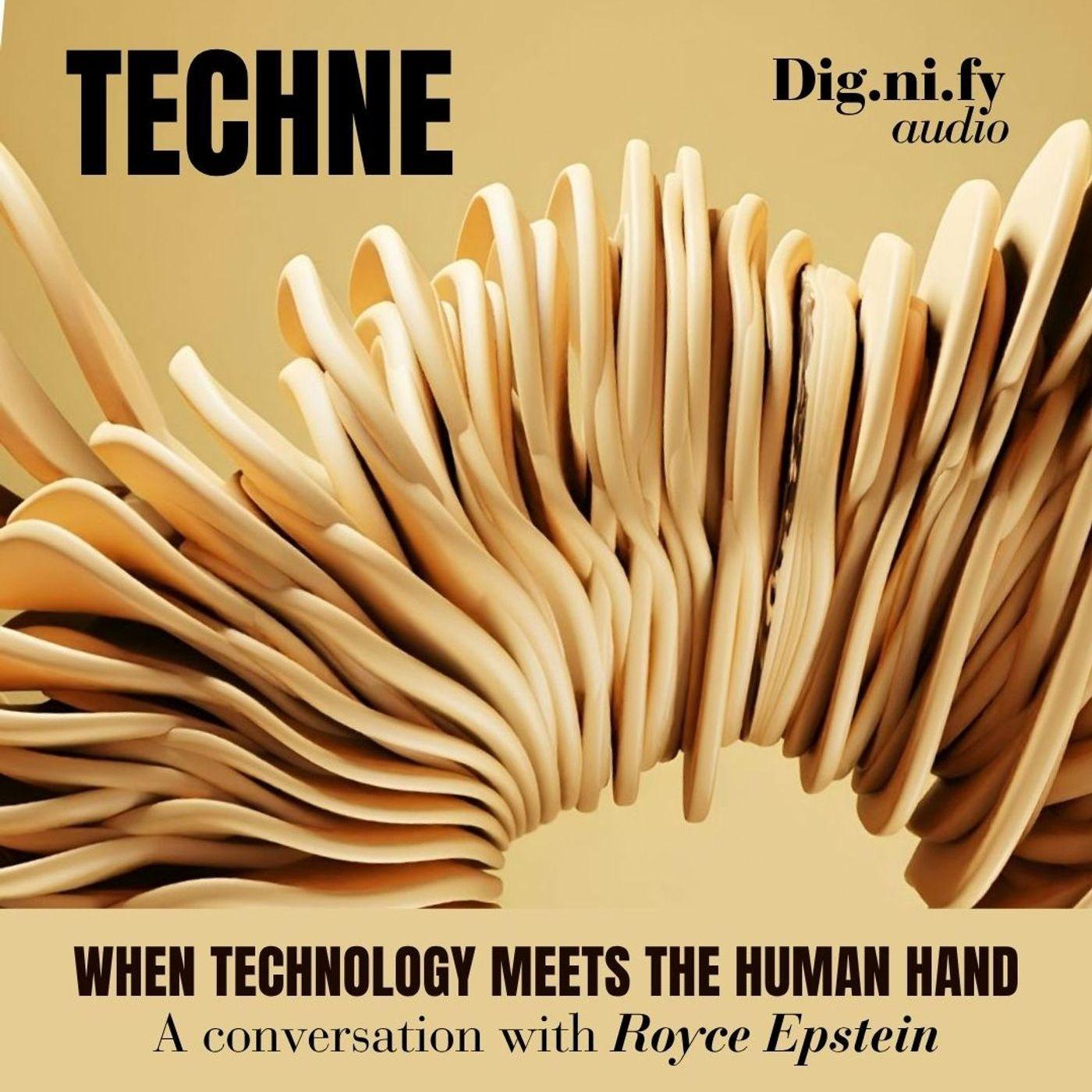
In conversation with Royce Epstein, Senior Director, Design Insights for Mohawk Group, we explore an idea as old as making itself: technology isn't the opposite of craft. It has always been part of it.
Returning to the ancient Greek idea of techne—the art, craft and skill of making—Royce explores the enduring relationship between human creativity and the tools we create.
As our digital tools become increasingly powerful, perhaps the more important question isn't what technology can make—but what we choose to make with it.
SOUND ON
Listen to Dignify Audio at HumanDignity Projects.org or LinkIn bio.
#DignifyAudio #Techne #HumanCreativity #Craft #Technology #Design #Innovation #HumanDignity
Inglés
Estados Unidos
TRANSCRIPCIÓN 🔗
BUSCAR EPISODIOS ANTERIORES
Buscar episodios anteriores de dig.ni.fy audio.
Descargo de responsabilidad: El podcast y el arte incluidos en esta página son de WILLIAM WANKER, que es propiedad de su propietario y no está afiliado ni respaldado por Listen Notes, Inc.
EDITAR
Gracias por ayudar a mantener actualizada la base de datos de podcasts.
