


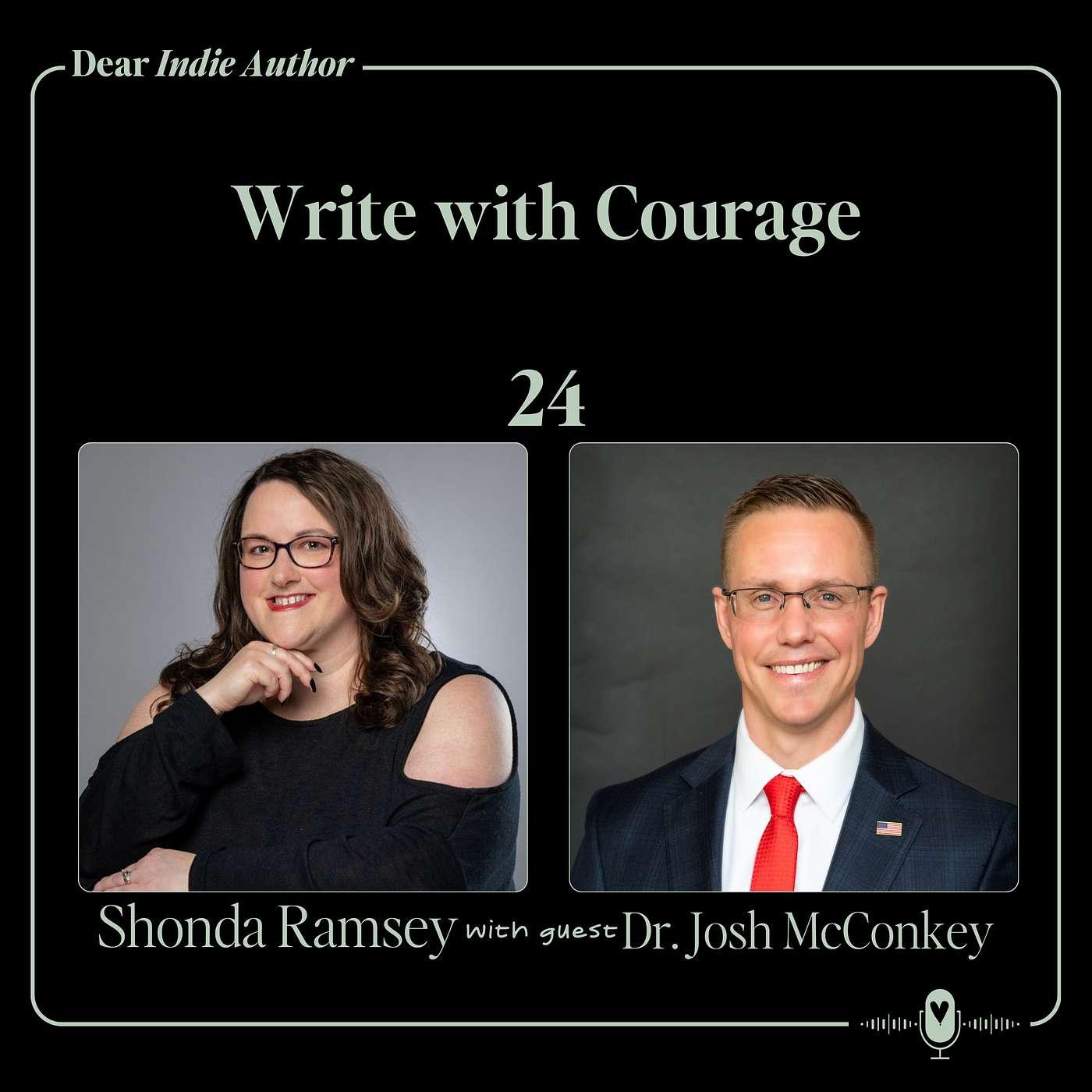
Shonda Ramsey:
0:00
Shonda. Hi, I'm Shonda Ramsey, your host and fellow indie author. Are you overwhelmed at the thought of publishing your book by yourself? Has fear kept you frozen in place, unable to write even the first word of your book, not knowing the steps you need to take shouldn't stop you from writing. That's why I've asked for help from some amazing industry professionals, published authors and others who are in the same situation as you to share their knowledge on the self publishing process. Welcome to Dear indie author, where we inspire creative independence and every writer. Hey, everyone. It's Shonda. I am here with my friend Josh. Hi, Josh. How are you doing today? Hello. I would like to get started with some rapid fire icebreaker questions. Are you ready for those? I am ready. All right, what is your favorite riding, snack, riding snack.
Josh:
0:59
I've got trail mix. So just a mix of, like, nuts with some raisins and some M M's in there.
Shonda Ramsey:
1:06
Perfect. Do you like fall or winter better? Fall? Fall? Yeah. Are you a comedy or drama person? Love
Josh:
1:16
both. If I have a choice, I would do comedy. I like to laugh. My job is very, very serious, so I need some comedy. Comedy
Shonda Ramsey:
1:23
Love that. What is your favorite writing spot?
Josh:
1:27
For me, it was, well, I was on the road, so I travel a lot for work, and just I found that those environments just were kind of quiet, completely by myself with the minimal distractions. Was the best
Shonda Ramsey:
1:39
awesome. I like that. What is the best writing advice you've ever received?
Josh:
1:44
Best Writing advice would just make it happen. So just find the time. Plug away at it. You know, if you believe enough in your ideal, in your book, you just, you just have to finish it. Just Just do it. So many people contemplate, gosh, it's going to take so much time. Should I do do it? Shouldn't I just Just do it? I like
Shonda Ramsey:
2:05
that. Are you someone who prefers to write it out or type it up?
Josh:
2:09
Type my handwriting, my head, right? I'm a doctor. Is very bad, so I have to type. I legitimately can't read some of my own handwriting sometimes. So definitely have to have to type it.
Shonda Ramsey:
2:21
That's awesome. So that stigma holds true. Then the doctor writing is the worst. Do you like to write in silence or with music?
Josh:
2:31
You know, I write in silence. I just my mind works a little bit better. I prefer, prefer to do things with music, just because it makes the time pass a little faster. But I was definitely more productive when it's silent. It's just the way my mind works. I get distracted.
Shonda Ramsey:
2:44
Yeah, no, I like that. Do you like iPhone or Android? Better? IPhone? Yeah, that's like, the million dollar question. I feel like that's,
Josh:
2:54
yep, I'm an iPhone guy, yeah.
Shonda Ramsey:
2:56
What is the biggest adventure you've ever been on? For
Josh:
2:59
me, I've had a lot of wild adventures in the military. The tour, the combat tour in Iraq, was just a life changing event for me, just for many reasons. Just, you know, being dropped into a combat zone and shooting down helicopters all around you. I was there when they shot they shot down one of our helicopters the first day. Heck out there. So some life changing events that that's definitely the biggest wow.
Shonda Ramsey:
3:24
What is the favorite place that you've ever visited?
Josh:
3:28
New Zealand. I moved down there in 2,001st time, where there was 2008 at 2008 so I got married in New Zealand. My first son, Luca, was born in New Zealand. We We love
Shonda Ramsey:
3:40
the country. Wow. Who was your favorite mentor? Favorite mentor
Josh:
3:44
of just someone that I've looked up to and really kind of helped me establish, like, how I was going to lead and be a leader. If anyone has read, read the books or watched the HBO mini series band of brothers so Richard Winters, the commander, the initial the it was the first of the second commander of Easy Company from the 101st airborne. Just tremendous leadership skills. And the more you read about him, just as an amazing like a real hero.
Shonda Ramsey:
4:10
Yeah, definitely. I've actually seen that. Yeah, very good. Yeah. It is. What is one word to describe your book? Hopefully inspirational. I like that. That's great. Well, welcome. I am so glad that you're here with me, and I would love if you could just start by telling us a little bit about yourself.
Josh:
4:28
Well, Dr Josh McConkey, I carry a lot of titles. I'm like the MacGyver doctor, so you know, I'm a colonel and a commander in the US Air Force now, award winning, best selling author. I had played soccer for a while. I was goalkeeper Rotorua United when I was down there, but my time in Iraq is just I'm so thankful to be alive, like literally be alive, that I try to take advantage of as many opportunities as I can, and that really kind of is what I'm all about. I
Shonda Ramsey:
4:58
love that can. You tell us a little bit more about your book. Be the weight behind the spear.
Josh:
5:04
Yeah. So be the weight behind the spear. It's my leadership ethos. And you know, as a military commander, you know, I'm in charge of 100 men and women, some of the best war fighting, medics in the United States, Air Force. And that the book is really a culmination of that ethos. So I want people, it's a call to action. So I want them to engage their communities. I want them to understand that one like the best resource we have in America is people, by far and away, coaches, teachers, volunteers, mentors, like families. That's what makes America awesome. I've got to work with real heroes, like men and women in combat, some special operations like real heroes. And each one of these people has a coach or a teacher or a family member that gave them the amazing confidence to do what they do. And that's what makes, you know, America special. So this book is just teaching people that what they do really matters, and then how they can contribute to be the weight behind the spear in America.
Shonda Ramsey:
6:07
I love that. I think that that is incredible. Actually, what inspired you to write it
Josh:
6:13
so over the past few years, you know, just about the year or two before writing the book, there was a lot of changes in America, you know, the whole COVID debacle that we all went through, and it just one of the stranger, the strangest moment in my life. You know, I'm 47 years old, like as an American, but the repercussions of some of the decisions made, you know, not to get like political at all, but, you know, shutting out an entire generation of Americans that are right in those critical years of development, like so these kids, you know, there was two or three years where they were shut out of schools, shut out of churches, you know, they already had some difficulty communicating, because they like that whole iPhone generation. They've never known the world without iPads and iPhones. So you then just shut them out of all that. I see the results of that. So I'm an emergency doctor, I see the increased rates of anxiety and depression and suicide, and every time I sit down with the family and have to tell them that one of their loved ones, like their son, their daughter, had died, it is hard. And I've been doing this job for 20 some years, it just gets worse. And so there's a huge mental health crisis that I felt needed to be addressed. And on the same line there as an emergency. As a commander in the military, I see the same group of individuals, like these kids, 18 to 25 years old. Man, it's a similar issue for our military. You know, the lack in some basic leadership and communication skills and and lack of resiliency, like they don't overcome the most simplest things, and they quit so easy, I was really concerned, and so I've diagnosed the problem, and my prescription was writing this book. It was just as much therapeutic for me as it has. I'm hoping be that inspirational book for other people. It's been very well received, so I feel super blessed. It's won a bunch of awards, and yeah, for a first time author, it's better than I could have hoped for.
Shonda Ramsey:
8:10
That's amazing. I want to ask you about the title, because to me, your title is very intriguing. So what does be the weight behind the spear mean in the context of leadership and business.
Josh:
8:21
So, you know, to when I described that you have the tip of the spear. So the introduction in the book really kind of walks you through what's the tip of the spear. So these, you know, I've worked with special operations. You know, some of the you know, men that I've got to work with on those special operation teams. One of them was literally on the team that rescued those kids in Thailand in 2018 they were stuck in the caves. Yeah. And, you know, some of those types of individuals are the ones that jumping out at helicopters and taking down a guy like Bin Laden, right? That's right, that's the that's the real tip of the spear. These guys are amazing heroes, freak athletes, just, just amazing individuals. Well, I can't do that, right? I cannot. I don't take lives. I save lives. I'm a doctor. So how can I contribute? And what can we have others contribute? Because we can't all do those things, but you can be the weight behind that tip of the spear. So coaches, teachers, volunteers, families, and as I wrote the book, and I just reflected on myself and the people that had been the way behind my spear man had such great stories from my teachers and my wrestling coaches growing up that after writing the book, I've sought these people out. I found them on social media, on Facebook, I was inducted into the Hall of Fame in my hometown a couple years ago and got to see some of those teachers and gosh, it's so important you don't realize that those little things that you do, and you know, when you're that weight behind the spear for other people, it's just so powerful, like people need to know that what they do every day matters.
Shonda Ramsey:
9:58
Yes, I agree. That's. Amazing. Your background is incredibly diverse, and it spans from emergency medicine, military service and now authorship. So how have these experiences shaped your perspective on leadership and mentorship? So I've
Josh:
10:13
been very fortunate to learn from some great leaders. You know, I joke a little bit, but I'm very fortunate to have learned what not to do from some very bad leaders. Yeah, and sometimes it's hard to define leadership, but everybody knows a bad leader, right? So just don't be that. And so I've learned for some fantastic leaders. Coach K, you know, the Duke basketball coach, gave a very good leadership lecture when I was a professor at Duke University in our emergency medicine residency program. Just an incredible book his so his leadership book is very good, and learning not to micromanage, you know, just very simple things, and don't ask people to do what you're not wanting to do yourself. So that was, you know, major winters. He had a retirement Lieutenant Colonel winters, you know, from Easy Company and Band of Brothers. And Band of Brothers, just those leadership points man, just amazing individuals. So I feel very fortunate to be able to learn from those types of people, even just reading history. And then there's just don't do the stuff the bad ones do. Yeah,
Shonda Ramsey:
11:17
I like that. Can you share a pivotal moment from your career, personal life that significantly influenced your approach to leadership when
Josh:
11:25
I was straight out of residency, so young, very green, like a rookie attending and you come out of residency where you're just a little bit sheltered. So the early 2000s is where you start to see this crazy shift in our healthcare system with the opioid epidemic. So this is the oxycodone Oxycontin, you know, them pushing all of these, you know, high potency, dangerous narcotics for very simple things. And they actually had, you know, the pharmaceutical companies that lied to everybody, oh, these aren't addictive, you know, we do. They knew the entire time I was attending for about six months, and I worked in Omaha, Nebraska for a few months. They punted me over to a facility in Council Bluffs, Iowa that had just a horrific drug problem, huge addiction problem, and the worst example of just failure and leadership that I saw that really kind of shaped, you know, on the healthcare and medicine side of things, I had a medical director sit me down and ask me to write more narcotic prescriptions. So basically, when you have a facility that's so used to just handing it out by candy, they were bribing people to get patient satisfaction scores like literally. So he wasn't getting a regional director bonus, because I don't give those things for people that don't need them because they have high abuse potential. And I saw so many overdoses, he sat me down and he tried to leave us all patronizing like, hey, you know they're only hurting themselves. So, you know, I need you to write more narcotic prescriptions. I was, I was I was, I was flabbergasted. I was, I was like, scared. Like, what do I do? Knowing what I know now I report, I would have reported him immediately to the DEA, yeah, but you know, back then, you're just young, you don't know, like, he's gonna fire me if I say something. So I just refused to work there again and kept working in Omaha. But that to have a director of an entire group of individuals like literally sit down a young, impressionable and tending and just ask him to write more dangerous drugs was disgusting. And literally, a day or two after he had asked me that I watched a 30 year old woman who had overdosed on the drugs that he prescribed coming into the emergency department, had to intubate her. She went to the ICU. She almost died. No, she stopped breathing. And her eight year old daughter was in the room, and she walked up, and she's grabbing my white coat, like, Is my mommy gonna be okay? And I just, I couldn't take it, like, oh, only hurting herself, huh? Oh, what about this eight year old daughter? Right here. She was there with grandma. You know, I've seen those things, and it's just such horrific leadership, just a terrible human being. Yeah, so that really changes how you have an outlook on things. Yeah,
Shonda Ramsey:
14:12
it does definitely, as a first time author, what were some of the biggest challenges you faced in writing and publishing
Josh:
14:20
your book just getting published, had absolutely no idea. I've practiced for 20 years as a physician. You know, I had 20 years of military service at that point, literally booking things up on Google. How do I do this? You know? What's a query letter? You know? How about how do you do a pitch and just find just submitting and failing many, many, many times, trying to get these big publishers first, which just is not realistic. I know that now, but put so much time into, you know, putting query letters and things to people that I really probably had no business. I really felt good about the book, but, you know, until you get that to a publishing company. They get some real professional like editing and and those types of things. I I was very fortunate finding someone local here in North Carolina to help me out with that, but it where I probably spun my wheels for for months and months. I mean, well, over six months trying to find something to publish.
Shonda Ramsey:
15:14
Wow. How did you balance your demanding career and personal life while working on your book? It
Josh:
15:19
was very difficult, but I think finding that that venue for me to be productive in writing, just doing it on the road. So I had a job where I traveled up to Nebraska for work, and that's where I did all my writing. So I tried to be as productive as possible. Kind of isolated myself off, walled myself off in a little apartment for, you know, weeks at a time when I'm in and just take advantage of that solitude. Because when I'm home, things are crazy busy, you know, I've got military duties pulling me one way. I've got three kids, you know, going to events and making sure they're making their lunches, you know, brush your teeth, just, just hunting down three kids and just getting things done everyday life. My wife is amazing, Elsa, so she, you know, we're a good team. You know, it's very difficult being being a single parent, for sure, but you know, the two of us have had managed to to get that done, and while I'm on the road, that's about the only time I could write. Yeah,
Shonda Ramsey:
16:14
did you when you were on the road writing, did you come up with like, a routine, or any, like, specific way that you like to write, like a style or an organizational thing that you did to keep on track
Josh:
16:26
just doing an outline, you know, starting with that, because I kind of had the general premise and the ideas. So for me, trying to write a book on on leadership and motivating people, you know, I kind of just broke it up to those four sections. I did the outline and then tried to come up with some stories or leadership traits for each chapter. So, you know, the first section of the book is how to be the way behind the spear is put some good examples on good leadership. The second section is how to not be the way behind the sphere, you know, bad leadership. Please, don't do these things with some examples. And then the third was just, you know, examples that shaped the kind of who I am as a person and my weight through the military and through healthcare experiences. And then the very last section was my weight. And just got to tell some stories on family and and how that had that just tremendous impact on me being who I am as a human being and as a leader. So the outline format, and then just coming up with sections, and it took shape after that,
Shonda Ramsey:
17:26
putting it together. I like that. Did you draw on any specific experiences from your military or medical career when writing the book? Yeah,
Josh:
17:33
so all of the, you know, the first chapter really starts with, you know, just the leadership mean, me being dropped into Iraq, and just what a jolt and what a shock to that system was. It really changed my entire thought process. So before, you know, I was actually married previously, and, you know, working as a physician, and just life seemed to be all about, you know, how big your house is going to be, and what kind of stuff you could buy. And you know that that's on me I made. I made a poor decision all right, in with the first relationship. So in Iraq, I found out very quickly that none of that matters. So nobody cares how big your house is, nobody cares what kind of car you drive. They don't and nobody cares how much money you make. You're gonna die here. It doesn't matter, like nobody cares. They're shooting down helicopters. I was there for the surge, so they shot down eight helicopters in a two week span. They killed the flight surgeon ernal All good couple weeks before I got there. I show up in theater. I'm literally in Iraq for like less than 24 hours, and they shoot down one of our helicopters. Oh, oh, this was a bad this, this, I immediately regret this decision. You know, the Ron Burgundy, like, Oh, what have I done? Like, I'm, I'm totally gonna die here. And I called my cousin Zach, and he just had some great words of wisdom. He's a special operator, right? Because it was a combat controller, and then 18 Delta like, green Bray. He's like, listen, like you're you're in it now, and you might die. I mean, do you want to you kind of just cry about it and kind of cry yourself to sleep at night, or do you want to just pony up? It's gonna be the craziest adrenaline rush of your life if you die, man, you're getting shot down in a medevac helicopter saved, like, flying into the face of death to save lives. Like, dude, there's no better honor. Like, you got to die of something. I mean, you die 50 years of some crazy cancer. Get hit by some drunk a hole, you know, might as well die in another back helicopter. I'm like, All right, so once you don't care about dying anymore. I mean, you can kind of move on with life, but that's a huge life change. I mean, it's really changes who we are. Wow,
Shonda Ramsey:
19:48
that's incredible. What advice would you give to aspiring authors who are hesitant to take the plunge into writing and self publishing?
Josh:
19:56
They need to know that there are much. Worse authors out there, all right, you, if you put your mind to it, and it's not like, Oh, if you put your mind to it, you can do anything, yes, but there are a lot of other people that are way worse writers than you, that are out there writing books. So what you have to say matters, and you can have a significant impact. They just get out there and do it and see what happens. You cannot, you cannot fear failure. So failure is a fantastic motivator. It's fantastic. This is what I tell my residents all the time, like that, fear of failure will keep you reading at night. It will keep you learning more. You know that don't, don't fail. Like just, just get out there and do it, and you know, you're going to make sure that it's, it's the best book it can be, and then surround yourself with good people like find good people, you know, be a good evaluator of talent. Find a good editor. You know, find other authors and other independent authors, bounce ideas off them. Just, just get out there and do it. There's, there's way worse books out there, I promise you, yeah,
Shonda Ramsey:
21:00
there is, that's great advice. Can you talk about some of the lessons you learned from the independent publishing route? You
Josh:
21:08
know, just the whole process of seeking out publishers and getting published, you know, getting it accepted, whether that one of the hybrid publishing routes or with independent publishing the boy, there's so many scammers out there that, you know, you get out and you, you talk to a couple of people, or you get onto some list serves. I'm not sure how they even find out getting your name, but you just get one of them, and then you just get pummeled with all of these scams like, Oh, we're going to help you get published. And they, they play on on egos, and they tell you the book is the best thing that they've ever read, you know, but you know, it's, we're gonna, we're gonna need 2000 here. We're gonna need, yeah, yeah. Man, once they start asking you for money. I mean, they, they really prey on on some first time, like independent authors, people that just don't know the system and how things are supposed to work. And, man, there were just so many of them. I guess. You know, the number one tip that I have is, and I learned this after several mistakes. But if there is going to be any kind of upfront money, make sure you put it on, on on a credit card. And the reason is, you can do a chargeback on that card. People don't know about that. Yeah. So when you, when you sign up for a service, and they promise they're gonna do this, this and that use your credit card. There's basically, it's like insurance. So when they ignore you, and you haven't heard from them for six months, and they promise you the audiobook that never gets done, Yeah, guess what? You know, charge back, call up that credit card, get that charge back, and then you have their attention immediately, like, yeah, oh my goodness. So you have our attention now, because they just string you along. So do it? Do it on a credit card, call your company and do a chargeback.
Shonda Ramsey:
22:48
I like that. Yep, that's definitely an important thing to do. I think that you know as myself, being an indie author too, running into scammers is pretty much par for the course. I feel like and people will always promise you the world and under, deliver or never deliver. And so then, yeah, you always have to kind of pivot and do things again. So I always try to recommend that you interview the people that you are going to potentially be working with as well make sure you ask them key questions to try to get to the root of what it is that they're actually offering you to make sure that they are legit and do your research. There's always great places to find. I know there's a website to writer, beware. They do a lot,
Josh:
23:33
and I did find that, yeah, and just like the book, with the the story of the audiobook. So the the initial publisher, you know, the hybrid had they strung me along. They charged, I think,$7,000 to do an audio book. And after three months, not much, after six months, almost a year, like, like, what is going on? Like, it can't possibly they just excuse, excuse, and then just kind of radio signs to kind of ignore you. So I ended up going to a book camp, Ted and Gabby all Zach put a shout out for those guys. So I went to a book camp and just figured out how easy it is to do an audio book. Just sign up on ACX, audition some people, and just pick somebody, and they do the audiobook, and they find an audio engineer. I mean, they walk you through the steps. It was super easy. I did my charge back, got the $7,000 back, and then I think it was like less than $2,000 to have the audio book completely done within a month on ACX, and they had strung me along for almost a year. I'm like, oh, man, I wish I would have known this. I just yeah, no idea you have no no,
Shonda Ramsey:
24:39
yeah, sometimes you just don't well, thanks for sharing that for you know that'll help other people. I know actually, audiobooks is one thing that people ask me about all the time, and so I think that it's, it's great to know that there are actual places that you can go and do that, especially if you're not able to do it yourself, too. I think. That's a that's an important thing, is finding someone who can,
Josh:
25:03
yeah, I did the intro and knowing now, like I've started to do some voiceover work as well. I should have just done the whole thing myself. I I just had no idea it was not as difficult as I thought it was going to
Shonda Ramsey:
25:13
be. Yeah, yeah. What is the biggest lesson that you learned in self publishing?
Josh:
25:18
Yeah, just, just how to avoid the scammers and just pick up on that. I mean, there's so many phone calls and emails, wow. It just I had no idea there was a world of people out there just taking advantage of people. My goodness,
Shonda Ramsey:
25:32
definitely, and they hide in places that you wouldn't think they would be hidden too. For sure, are there any upcoming projects or initiatives that you're excited about sharing with us. Yes,
Josh:
25:44
so the book, you know, be the weight behind the spear. I'm trying to put that into action, so I've started a nonprofit organization, the weight behind the spear foundation. So it's nonprofit. We got our IRS 501 c3 recognition, and we're really trying to get out there and promote community engagement and volunteerism. And right now we're raising money for western North Carolina. So hurricane Helene right there, the end of September, just destroyed entire communities in western North Carolina. I live outside of Raleigh, here in North Carolina, and it's, it's just devastating. I was out there a couple of weeks ago, and the places that we had, like, eaten at and stayed at and visited many times in the past, if you want to build more village, yeah, just completely destroyed. I mean, you can watch the videos and see pictures online, very, very heart wrenching. So, you know, just wonderful arty people out there, and they need help. So this is a long term project, so this is going to be years and decades to rebuild, and some of it can't be rebuilt at all. So, you know, just I've started a nonprofit organization. I love
Shonda Ramsey:
26:47
that. That's amazing. It's really neat how you're tying that into your book, too. I think that that's great. Can you share where people can find you?
Josh:
26:57
So wait behind the spear.com. So W, E, I, G, H, T is in like, physical weight, weight behind the spirit.com I have socials as well. You know, Instagram, X and Twitter, Facebook, LinkedIn. Instagram is probably, I think, 27,000 followers on there. That's probably the one that's most active. That's Josh McConkey. MD, okay,
Shonda Ramsey:
27:18
great. Is there anything else you'd like to share with the audience, or any final thoughts? Yeah,
Josh:
27:22
no, just to what you do every single day matters. You know what you were putting down? You know, there's, there's there's novelists, there's fiction, non fiction, you know, the outlets like for me, I read the Harry Potter, Harry Potter series for the first time in Iraq. And, I mean, it probably saved me, because I would have lost my mind. I needed that release, you know. So those are critically important, just those stories that you can absorb into that's just, I love reading books. And on the non fiction side of things, you're, you know, whether it's writing about historical writing or memoirs or inspirational, motivational, you're writing for people to learn something, and it makes a difference, and you pay that forward. So, you know, just get out. Get out there. What you do every day matters.
Shonda Ramsey:
28:03
Love that. I'd love for you to share the letter that you wrote for our audience.
Josh:
28:08
Yes, so and I wrote down some of that. The the actual letter is very short, but just, you know, not being afraid to get out there and just jump right in. It's like seek or swim. So when you, when you're writing a book, you know, you always get concerned about, like the failure and It's sink or swim. I promise you, you will swim. All right, there are way worse authors out there. You are a great author. Put just, just, just do it because you're going to sink or swim. You have a fight or flight response inside you, you will swim. I promise you just get out there and do
Shonda Ramsey:
28:44
it. Thanks for listening. I'm your host, Shonda Ramsey, for the show notes and links, head over to Shondaramsey.com and don't forget to join in on the conversation on socials. Be sure to subscribe so you don't miss a show and write a review wherever you listen to podcasts until next time. Always remember, every writer deserves to see their words in print.
