
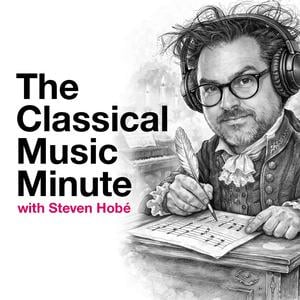

ÜBER DIESE EPISODE
Tonality was challenged, rhythm reinvented, and technology introduced entirely new sounds. During the 20th century, classical music expanded in more directions than ever before.
Your support helps bring more musical stories to life!
👉 Support The Classical Music Minute ☕ Why not buy me a coffee? 🤓
Love classical music? There's more to discover.
Join me on Substack at The Classical Music Minute. Or download the Classical Minute app for iPhone.
Englisch
Vereinigte Staaten
TRANSKRIPT 🔗
Are you the producer of this podcast?
Add a podcast transcript
Need Audio-to-Text?
Transcribe with Listen411 in Just 60 Seconds
VERGANGENE FOLGEN SUCHEN
Vorhandene Folgen von The Classical Music Minute durchsuchen.
WEITERE EPISODEN IN DIESEM PODCAST
Send us Fan Mail
Why would an opera aria finish—and then send the singer straight back to the beginning? Discover the da capo aria, a Baroque form that turned repetition into an opportunity for singers to improvise, ornament, and show off their artistry—all in just sixty seconds.
Support the show
L…
Send us Fan Mail
Sad songs were popular long before modern playlists. Meet John Dowland, the Elizabethan composer and virtuoso lutenist who transformed melancholy into some of the most hauntingly beautiful music of his age—all in just sixty seconds.
Support the show
Love classical music? There&apos…
Send us Fan Mail
From Gregorian chant to polyphony, the Medieval era saw some of Western music’s most important developments—including the growth of musical notation and increasingly complex composition.
Support the show
Love classical music? There's more to discover.
If you enjoyed this episo…
Send us Fan Mail
Prisoners, secret identities, political oppression—and a daring rescue just in time. Discover how the revolutionary spirit of Europe inspired the rescue opera, a dramatic genre that gave us works such as Beethoven’s Fidelio—all in just sixty seconds.
Support the show
Love classical…
Send us Fan Mail
Stravinsky wasn't always the revolutionary behind The Rite of Spring. Discover how the ancient Greek ideal of Apollo—order, clarity, balance, and restraint—helped shape his Neoclassical music and a very different side of his creativity, all in just sixty seconds.
Love classica…
Rechtliche Hinweise: Der auf dieser Seite eingebettete Podcast und das Bildmaterial stammen von Steven Hobé, Composer & Host, das Eigentum seines Eigentümers ist und nicht mit Listen Notes, Inc. verbunden ist oder von diesen unterstützt wird.
BEARBEITEN
Vielen Dank, dass Sie uns helfen, die Podcast-Datenbank auf dem neuesten Stand zu halten.
