
ÜBER DIESE EPISODE
Abstract
We introduce Natural Language Autoencoders (NLAs), an unsupervised method for generating natural language explanations of LLM activations. An NLA consists of two LLM modules: an activation verbalizer (AV) that maps an activation to a text description and an activation reconstructor (AR) that maps the description back to an activation. We jointly train the AV and AR with reinforcement learning to reconstruct residual stream activations. Although we optimize for activation reconstruction, the resulting NLA explanations read as plausible interpretations of model internals that, according to our quantitative evaluations, grow more informative over training.
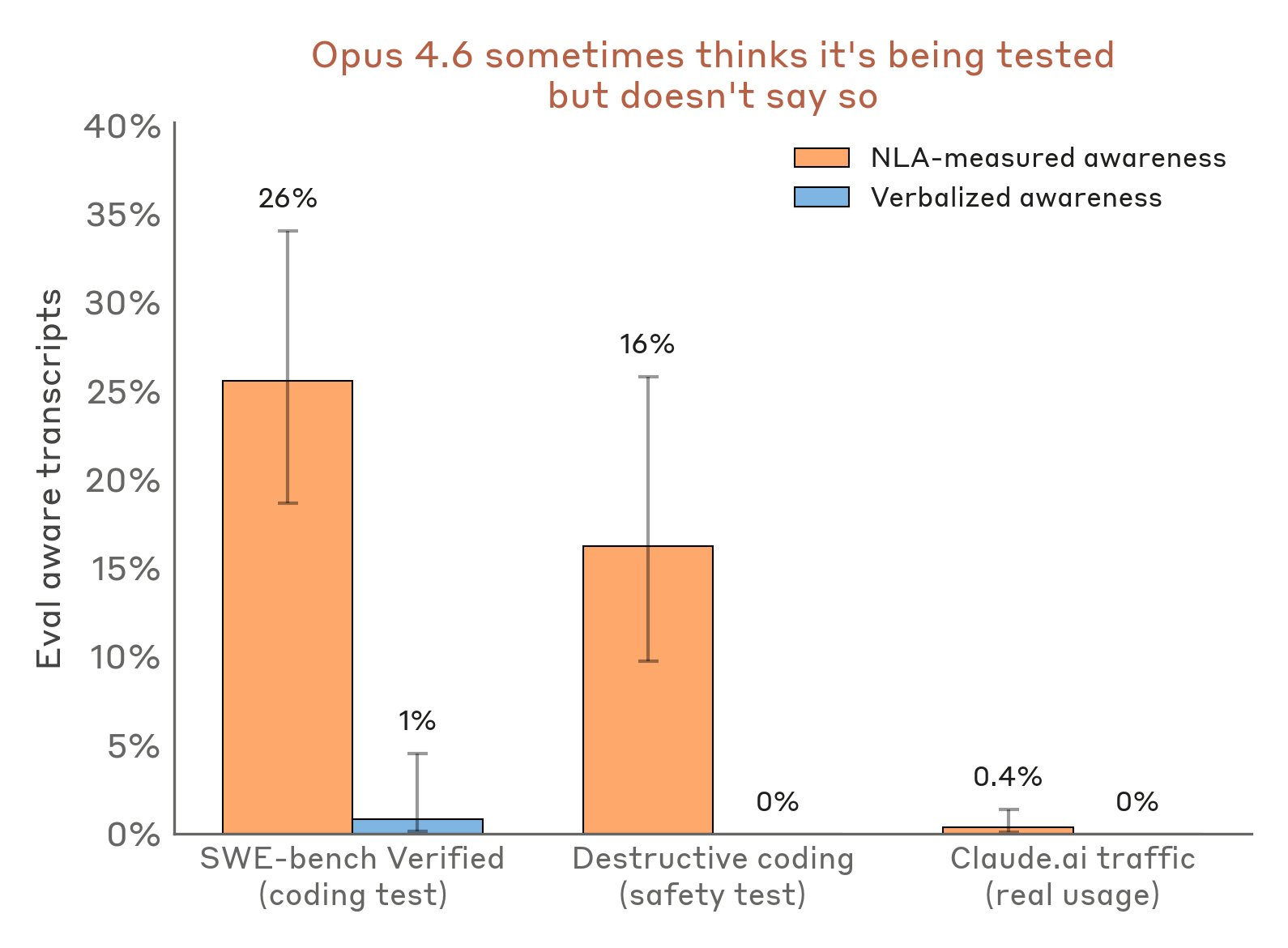
We apply NLAs to model auditing. During our pre-deployment audit of Claude Opus 4.6, NLAs helped diagnose safety-relevant behaviors and surfaced unverbalized evaluation awareness—cases where Claude believed, but did not say, that it was being evaluated. We present these audit findings as case studies and corroborate them using independent methods. On an automated auditing benchmark requiring end-to-end investigation of an intentionally-misaligned model, NLA-equipped agents outperform baselines and can succeed even without access to the misaligned model's training data.
NLAs offer a convenient interface for interpretability, with expressive natural language explanations that we can directly read. To support further work, we release training code and trained NLAs [...]
---
Outline:
(00:15) Abstract
[... 6 more sections]
---
First published:
May 7th, 2026
Source:
https://www.lesswrong.com/posts/oeYesesaxjzMAktCM/natural-language-autoencoders-produce-unsupervised
---
Narrated by TYPE III AUDIO.
---
We introduce Natural Language Autoencoders (NLAs), an unsupervised method for generating natural language explanations of LLM activations. An NLA consists of two LLM modules: an activation verbalizer (AV) that maps an activation to a text description and an activation reconstructor (AR) that maps the description back to an activation. We jointly train the AV and AR with reinforcement learning to reconstruct residual stream activations. Although we optimize for activation reconstruction, the resulting NLA explanations read as plausible interpretations of model internals that, according to our quantitative evaluations, grow more informative over training.
We apply NLAs to model auditing. During our pre-deployment audit of Claude Opus 4.6, NLAs helped diagnose safety-relevant behaviors and surfaced unverbalized evaluation awareness—cases where Claude believed, but did not say, that it was being evaluated. We present these audit findings as case studies and corroborate them using independent methods. On an automated auditing benchmark requiring end-to-end investigation of an intentionally-misaligned model, NLA-equipped agents outperform baselines and can succeed even without access to the misaligned model's training data.
NLAs offer a convenient interface for interpretability, with expressive natural language explanations that we can directly read. To support further work, we release training code and trained NLAs [...]
---
Outline:
(00:15) Abstract
[... 6 more sections]
---
First published:
May 7th, 2026
Source:
https://www.lesswrong.com/posts/oeYesesaxjzMAktCM/natural-language-autoencoders-produce-unsupervised
---
Narrated by TYPE III AUDIO.
---
Englisch
Vereinigte Staaten
TRANSKRIPT 🔗
Are you the producer of this podcast?
Add a podcast transcript
Need Audio-to-Text?
Transcribe with Listen411 in Just 60 Seconds
VERGANGENE FOLGEN SUCHEN
Vorhandene Folgen von LessWrong (Curated & Popular) durchsuchen.
WEITERE EPISODEN IN DIESEM PODCAST

“Claude Mythos Preview is, on essentially every dimension we can measure, the best-aligned model that we have released to date by a significant margin.” – Claude Mythos Preview system card “Mythos 5 consistently continues attacking under many edits to the compaction, even in settings where it corr…
I'm part of a team of 26 researchers that recently released a 212-page paper proposing a new plan for pausing AI, the "hardwired pause." The paper is called "The Feasibility of a Hardwired Pause of Frontier AI Training." Our analysis suggests that, under this hardwired paus…
Image by Claude Opus 5.5 using Python (NumPy and Pillow) This is written in my free time and personal capacity. Two Frames In AI safety, there are a couple of tensions at the heart of the field, which are interrelated. Talent: we are talent-constrained and must recruit. But jobs and fellowships tur…
METR recently released a report estimating that Anthropic is getting an overall 1.7x acceleration in AI capability progress as a result of AI accelerating their work. As many have noted (see e.g. Ajeya's post), this 1.7x acceleration implies that research is being sped up by much more than 1.7…
I’m pretty interested in conveying the costs of letting AI development proceed unchecked to the general public. In relation to this, I feel like I run into a lot of disagreements with people around me. Misc very quickly written points on which my own impression has seemed very different from others…
Rechtliche Hinweise: Der auf dieser Seite eingebettete Podcast und das Bildmaterial stammen von LessWrong, das Eigentum seines Eigentümers ist und nicht mit Listen Notes, Inc. verbunden ist oder von diesen unterstützt wird.
BEARBEITEN
Vielen Dank, dass Sie uns helfen, die Podcast-Datenbank auf dem neuesten Stand zu halten.