

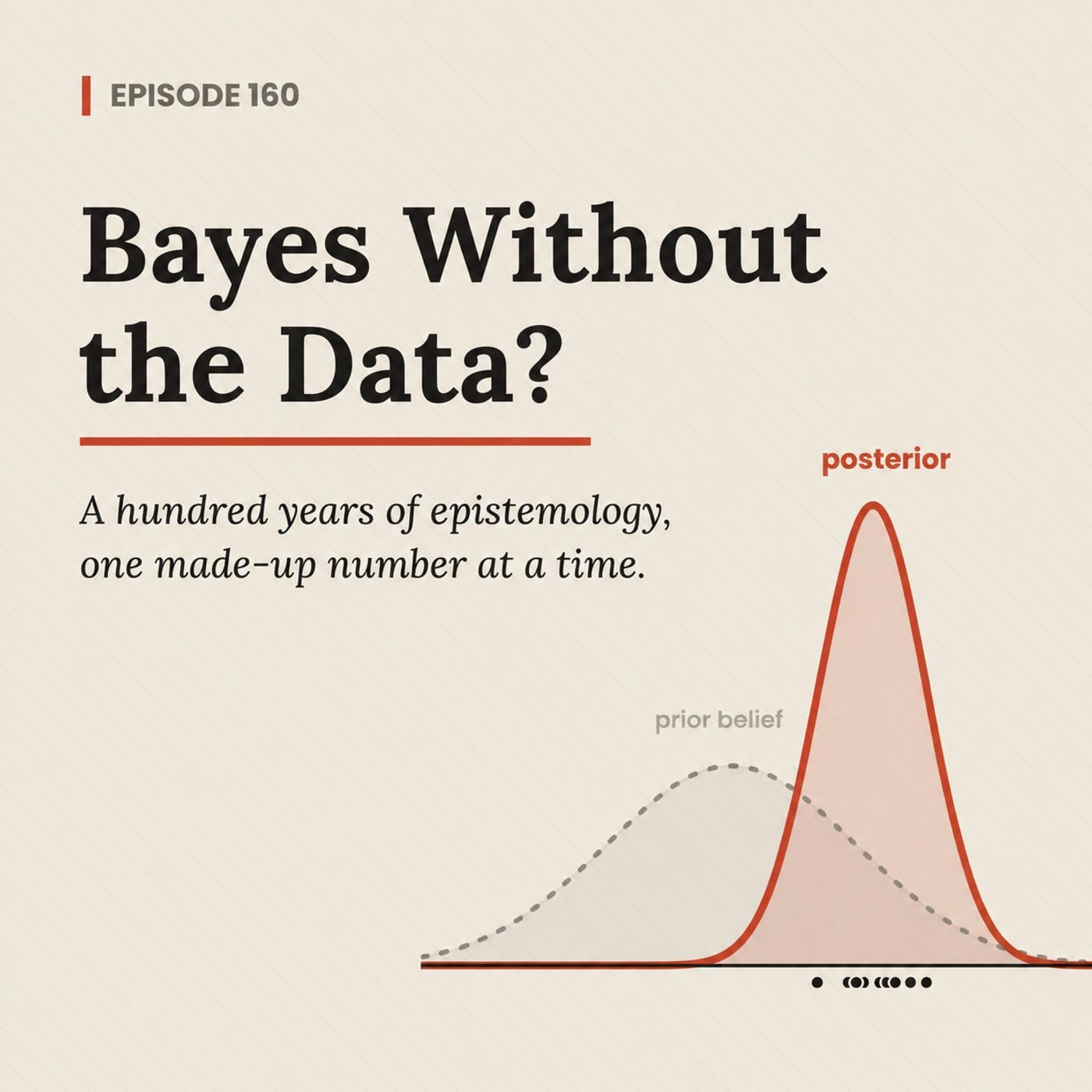
speaker-0: It's just the equations. ⁓ how that actually works in practice and why some philosophers, particularly ones that come out of ⁓ Oxford these days, ⁓ why that they consider that to be a valid move, where all other statisticians, Bayesian or frequentists, would say, Hold on, if you are drawing a scatter plot and you do a line of best fit on an empty whiteboard with no dots, you're just doing lines on a whiteboard, how is that a model? So the answer to your question, ⁓ At a surface level, is that Bayesian epistemology is what happens when you take Bayes' theorem way too seriously and you forget about the data. ⁓ and then you start coming up with numbers and you kind of ⁓ convince yourself that these numbers are legitimate because you're calling them probabilities, when in fact they're made up, they're made up out of your head, and you then are making decisions based on ⁓ made-up numbers which you've called the probability. Now, ⁓ if there was someone who was a Bayesian epistemologist on this podcast, they would strongly disagree with my ⁓ description of this. ⁓ And so ⁓ from their perspective, which we sh we can maybe steel man in in in a bit here, they have a different story to tell. ⁓ so I I I do want to be clear to the audience that I'm giving a biased ⁓ accounting. ⁓ and so maybe I'll I'll pause there to let you kind of ⁓ poke and prod at some of the stuff I said, but but it is an interesting question. Why are some ⁓ philosophy departments okay with using probabilistic estimates that don't come from any data? And the answer to that is due to A hundred years of literature that can all be kind of considered to be Bayesian epistemology.
speaker-1: Mm-hmm. Mm-hmm. Okay. Yeah, thanks. That's a very clear ⁓ it's very clear ⁓ explanation of of the difference. ⁓ I really find that interesting. So I spend most of my time thinking about statistics and models and not not so much about philosophy and epistemology. But so I do have a few questions. It and I I'll mainly ref try and rephrase what you told me to make sure I understood. So please let me know if I didn't. The main thing that ⁓ bothers you about epist patient epistemology is that is in the scenarios where you don't have data to update your beliefs. Is that correct?
speaker-0: ⁓ I would frame that as that's the most immediate example of the problems with Bayesian epistemology. That's one that I think a listener can ⁓ grok without having to talk about Cox's theorem or why, for example, we ⁓ conflate ⁓ probability distribution with the psychological phenomenon of having beliefs in the first place. ⁓ there's questions to about why that connection even makes sense. ⁓ so there's a lot of philosophical reasons why I don't think it's gonna work. ⁓ but I like to start with a clear example of of how it can get us into trouble. ⁓ and so I guess my my ⁓ my comments there is that that's just the tip of the iceberg. But ⁓ but that's one one reason because I think it can ⁓ trick people into making decisions that are poorly informed because they're using a lot of math. And ⁓ and using a lot of math is not sufficient. to making a good decision. But Bayes theorem s divorced from the data when it's just Bayes theorem, that I think can be quite ⁓ enticing to people ⁓ and it can lead them lead them astray. So yeah, that would be
speaker-1: Yes, so I do I do fully agree with the dangers of basically math washing. I and it's used a lot in in politics and and basically like people who want to convince you of something they think is true and then they just try to ⁓ to just shoe in what they already believe into a math package to give it the ⁓ the illusion of objectivity. what
speaker-1: Mm-hmm. Mm-hmm. Okay. Yeah, thanks. That's a very clear ⁓ it's very clear ⁓ explanation of of the difference. ⁓ I really find that interesting. So I spend most of my time thinking about statistics and models and not not so much about philosophy and epistemology. But so I do have a few questions. It and I I'll mainly ref try and rephrase what you told me to make sure I understood. So please let me know if I didn't. The main thing that ⁓ bothers you about epist patient epistemology is that is in the scenarios where you don't have data to update your beliefs. Is that correct?
speaker-0: ⁓ I would frame that as that's the most immediate example of the problems with Bayesian epistemology. That's one that I think a listener can ⁓ grok without having to talk about Cox's theorem or why, for example, we ⁓ conflate ⁓ probability distribution with the psychological phenomenon of having beliefs in the first place. ⁓ there's questions to about why that connection even makes sense. ⁓ so there's a lot of philosophical reasons why I don't think it's gonna work. ⁓ but I like to start with a clear example of of how it can get us into trouble. ⁓ and so I guess my my ⁓ my comments there is that that's just the tip of the iceberg. But ⁓ but that's one one reason because I think it can ⁓ trick people into making decisions that are poorly informed because they're using a lot of math. And ⁓ and using a lot of math is not sufficient. to making a good decision. But Bayes theorem s divorced from the data when it's just Bayes theorem, that I think can be quite ⁓ enticing to people ⁓ and it can lead them lead them astray. So yeah, that would be
speaker-1: Yes, so I do I do fully agree with the dangers of basically math washing. I and it's used a lot in in politics and and basically like people who want to convince you of something they think is true and then they just try to ⁓ to just shoe in what they already believe into a math package to give it the ⁓ the illusion of objectivity. what
