


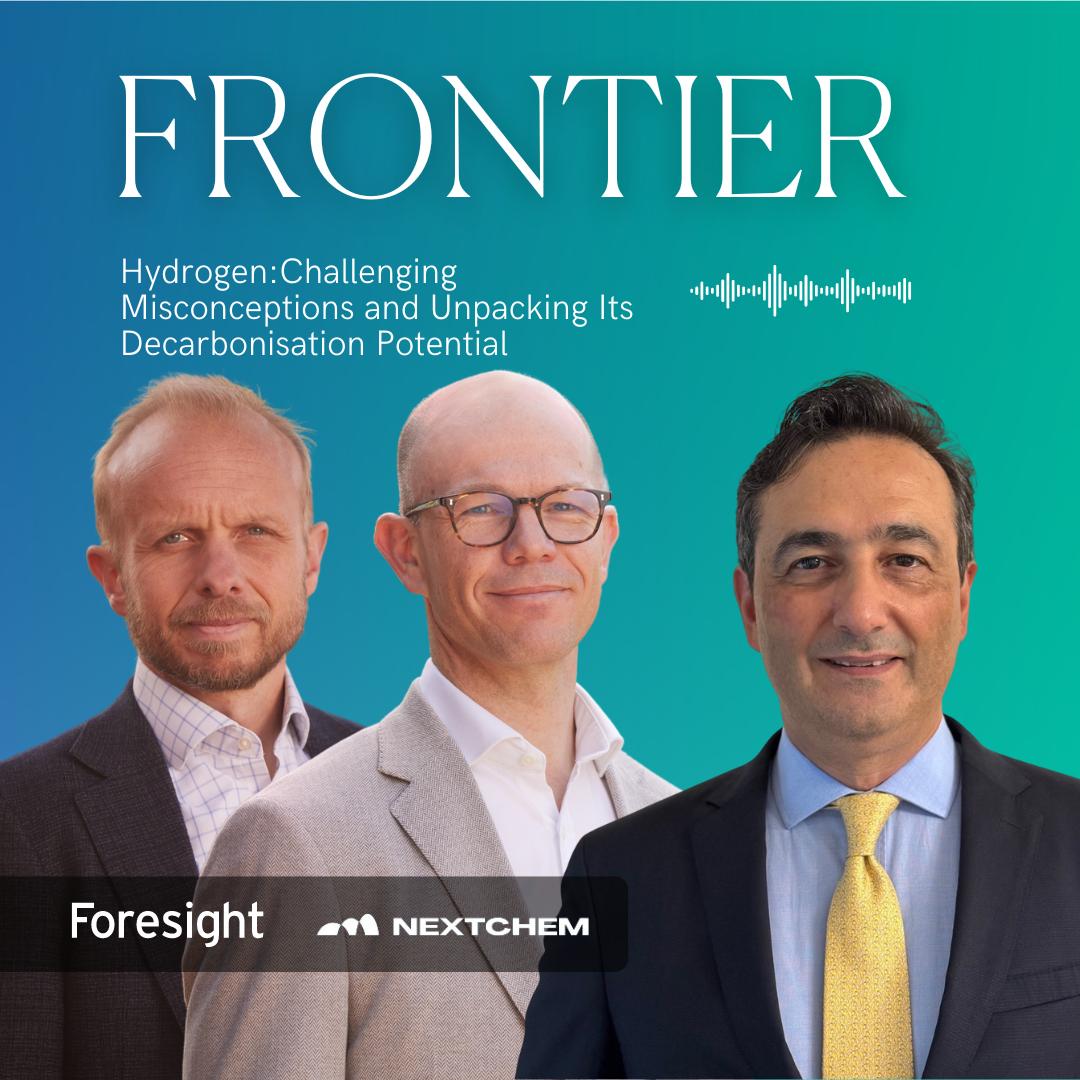
(00:03.288)
Welcome to Frontier, an investment podcast by Foresight, where we discuss strategies, trends and challenges shaping private market funds.
(00:14.318)
Hello everyone, my name is Chris Holmes. I'm a partner in the infrastructure team at Foresight. I'm joined by my colleague, Dan Wells. This is the Frontier podcast by Foresight, an investment podcast where we discuss strategies, trends and challenges shaping institutional investments today. Welcome, Dan. Another episode has come around pretty quickly. Hi, Chris. Yeah, super excited about this. We covered the world of food and nature last week and now on to...
Now onto hydrogen, so another decent topic to get our teeth into. Indeed, a very meaty topic in itself. But I was just reflecting on the last podcast and what a fantastic insight that was with Anthony and the incredible things we learned about nature restoration, soil health. I think it was really a fascinating topic to delve into. And actually, funny enough, I was cycling, as you well know, on the weekend. I was actually up in southwest Scotland in Calloway in South Asia.
a very small but welcoming town of the Gatehouse of Fleet, I hadn't heard of before, but I'll certainly go back. was racing in the British Gravel Championships, which was a fantastic event to be part of. mean, firstly, amazing part of the world. I would highly recommend it for anybody who's got a bit of time to wind their way up to Scotland. Secondly, think cycling along the gravel trails bring plenty of spare inner tubes. That was certainly one thing that befell me on those few days.
But thirdly, think most importantly, that area sits within a UNESCO biosphere reserve, which actually I didn't know too much about until I read up about it, seeing a notice in the area. And I think it's one of around 720 in the world, but only seven in the UK. it's really fascinating to hear what those reserves are about. They're all about improving the relationship between people and their local environment. The one in...
Galloway in South Ayrshire covers almost 10 ,000 square kilometres. It's home to 95 ,000 people all working together to improve their lives, obviously, but also caring for the natural environment. thought that was a great aspiration for people within these reserves. What was it like cycling through the area? Did you get much of a chance to appreciate that or are you more focused on not falling off your bike at that time?
(02:35.854)
I tried to look up as much as I could. yeah, stunning, stunning scenery. Wonderful forest to cycle through. Yeah, exactly. Well, I think, I mean, for those, for those listeners maybe outside the UK or haven't had the chance to visit Scotland, is worth saying that that coast, the West Coast is particularly beautiful and there are some particularly kind of stunning examples of what, you know, what wilderness kind of looks like, you know, or as close to wilderness as we get to.
in the UK. I had the pleasure myself actually of being up on the West Coast back in May. I took my family up to an estate a bit further north where you were. So this is up in Argyle, basically Tavey Alloch, which is an estate that's run by an organization called Highlands Rewilding. Full disclosure, that's an organization I've been a supporter of and actually invested in for some time myself. But it was the first time I got to visit kind of what the work they're doing there.
and take our three boys up as well. And it was an incredible experience to see what's happening, to see the challenge in terms of nature restoration, that a lot of these sceneries are really, they are magical, but also can be quite sort of sparse in Scotland. There are big areas where it's essentially just kind of moorland. And obviously what we're learning is that that's not how it used to be. It used to be much more abundant ecosystems. A lot of the problems are to do essentially with
with deer and sheep essentially just changing those into those areas that used to be actually kind of temperate rainforests into effectively kind of green deserts. One thing that really struck us was actually the contrast between walking through some of the more recent kind of, what I say more recent in the last 40 year kind of conifer plantations, which are basically kind of mono species.
And essentially, if you look at them or walk into them, they are very dead in terms of ecosystems. There's no light can get through there. They're very dry underground, underfoot. And there's nothing there apart from the trees. And the contrast with then walking through an ancient temperate rainforest up there, which we know there are fragments of them on the West Coast, is extraordinary. know, the abundance, the massive mosses and lichens and sapiches it supports. So that was definitely a reflection.
(04:55.956)
I had and there is going to be lots of great work happening. The other reflection I had though, Chris, was that restoring nature kind of has to happen hand in hand with restoring communities as well. This is a point that I know that George Monbiot has made this point in a book called Feral he wrote a few years ago, which is that it's great for us to be creating these more kind of abundant ecosystems, but nature and humans kind of have to to sort of coexist together.
reading up on UNESCO after you flagged it. I know that's a key objective from their perspective as well is kind of balancing those different perspectives. Yeah, indeed. So I highly recommend any of our listeners to go and visit one of the many biospheres around the world. I think you'll certainly be fascinated by what you see. Definitely. And Chris, one other point then probably to bring in is in terms of recent news that the EU nature restoration law came into effect in August this year.
And that really is big and important context, obviously, to nature restoration itself. And from a foresight perspective, nature -based solutions and natural capitalism is a key part of the future in our sustainable investment themes. But it also does impact energy as well. So coming now onto clean energy. Clean energy has a large land footprint. A lot of land will be taken up with solar, wind, and other forms of renewable power generation.
And there's a lot that can be done in terms of nature restoration around around clean energy. And that's probably a good way to move towards our discussion topic today, Chris. Fantastic. It's my great pleasure to introduce our guest on the podcast today, Adamo Skrenke. Adamo, you're very much a hydrogen expert in my eyes, well over 20 years of experience in the sector. You know, have
experience in many fantastic companies. But you are now working for Nexgem, leading their work in hydrogen, carbon capture and e -fuels. Welcome on board, Ademo. We're certainly looking forward to the conversation, but perhaps you might want to introduce yourself far better than I have and perhaps give a little bit of background in terms of what you've been working on over the last few years and how you're observing the hydrogen sector. obviously, hydrogen is the topic.
(07:16.417)
for our podcast today, a topic very close to my heart, as you know, Adamo, and very much looking forward to our conversation. Thank you very much. Thank you. And very happy to have also this introduction for Dan and Chris. You know, I really enjoy the chat you had together because I think it's really important that we put together the humanity and the nature and the world together. You know, we always say the world will not survive. You know, there is no planet B, of course. The world will survive.
problem is probably the humanity. you are talking, it was a good teaser because I don't know the North Scotland and I will find a way to go there. Of course, with using SAF as an airplane, also not putting too much CO2. But it's a good teaser and it's so important that we go back to the roots, as you said. It's very important that we live together. Living together is a very important thing. And as you said, Dan, also one point I like very much.
You talk about the energy. And I think the energy is something that is a key for humanity and for society. Because when you have energy, would say you have everything. And no, I'm going to introduce after that, but I wanted to give a few words. You my name is Adamo Screnci, is an Italian name. I was born in Lille, know, north of France. I am French and I've been working for German company and everything. So I feel really European.
And I had the opportunity to understand a little bit why I am born in North of France. Because of energy. You know, am an energy migration result. Because North of France is very strong, know, North and Belgium. Because of coal. And the coal brings prosperity, jobs and everything. And we have been seeing in the last 100 years, migration because of energy. And I believe we will see again.
because there will be movement if you need to make investment. And you need to compensate that with renewable energy, energy access, cost, but also well -being of population and not to move too much population because there will be migration either because of energy, but also because of climate, because you touched on that point. know, some lands are changing. So it's important that we put all that together. Of course, it's a little bit of philosophy, I would say.
(09:42.829)
But it's important to have this and to try to see what can we do in terms of, of course, industry, business, society development. So myself, Chris, if you want to give me, I can give you a few words about my background. I am an electrochemical engineer, this kind of specific animal that is playing with electricity and chemistry. They are not so much. I started in 1988 to work on hydrogen, was 35 years ago. And then I went through different...
a company like Air Liquide, I founded McPhee Energy, which I put IPO, I worked for the French government and worked for the German government. I've been at the initiative of a lot of associations. I founded Hydrogen Europe, for example. I was also involved in the Hydrogen Council, so a lot of different associations around the globe, which I like very much. I am very enthusiastic about the energy and also the part of hydrogen. I bring, I try to bring what could make sense. It's not easy to understand.
and to have the crystal ball, but what could make sense for the decarbonization and supporting the society. Recently, I joined Nextgame one year ago, and we are very, I would say, crossing the figure, very successful by some acquisition, by a lot of new projects in the decarbonization, in the CO2, in the biofuel, in the e -fuel, growing with the big team internationally. So I'm very happy to initiate and to push and to accelerate
every initiative and I'm very happy to be here with you today, Chad, about what could be hydrogen. Fantastic. I'm certainly looking forward to that, to Damo. And your comment there around energy and its location, I think is quite pertinent. think certainly what we're seeing here today is that with the huge growth in renewable energy generation is causing us a lot of
concern about how we redistribute that to areas where it's most needed, whether that's for populations or whether that's for industry. And certainly, one of the topics we've touched on before is the roadblocks to enable that to happen and whether that's pipelines, whether that's grid, but even whether that's storage to enable that transportation of that energy to where it's needed.
(11:59.245)
And I think it's a really interesting topic to see how hydrogen can play a role in that. It's a topic that's received a lot of attention over very recent years. think, obviously, at Foresight, we've been tracking the sector for a number of years now. I think we're very encouraged by how it can play a role in decarbonizing everything from transport, industry, power, and how it can have, you
many different derivatives as well. We talked a little bit there, he touched on ESAF as well, which is a topic in itself. So I think we're really encouraged by that. We're also very encouraged by seeing national policies come through, followed by specific legislation that's really driving this sector, giving investors a lot of confidence that now really is the right time to be investing into these projects. And we can perhaps touch on in our discussion with Amo.
some of the differences we're seeing around the world, whether that's a CFD regime in the UK, whether that's an import subsidy in Japan, whether that's demand side regulation that we're seeing in Europe, but there's many different ways to stimulate the hydrogen economy, which I think is a fascinating topic to delve into. And I think perhaps it might be worth to give us a feel for our
our listeners' interests as well before we delve into the conversation. We did put a poll on our LinkedIn page a few days ago just to garner some thoughts from those who do follow us. And the question was, given the increasing focus on hydrogen as a clean energy solution, what would you view as an investor as the key consideration when investing in hydrogen? So the four answers we gave were technology readiness,
infrastructure development, regulatory and policy environment, and market demand and adoption. And by far the most clicked on answer was market demand and adoption, followed by infrastructure and development. And I think that's no surprise at that moment to hear that the response is coming through. A few topics which I like very much the discussion also, Chris, you say.
(14:21.581)
You say one word at the beginning, you say today, there is no question about renewable. But just think 25 years ago. I was there and I was pushing for a solar plant, solar production. And why? Because I believe this is good for humanity because everybody has a little bit of sun, everybody has a little bit of wind, and everybody can have access to some energy. And this is good for more stability in terms of world, you know, because energy is one of the best and worst
tool, you know that, we are fighting for energy since we are on Earth. So to develop renewables where you have access somewhere, and we are not inventing something new, or a sensor, we are living where there was good quality of life, a little bit of sun, sometimes some wind, to use the energy of the wind to do something like the windmill, etc. We are not inventing. So I think renewable now it's on the everybody agenda, and this is good, but it took us some time to do that.
to accelerate. see a big acceleration in last couple of years, honestly. Why? Because we see the break -even in the price and we see, okay, the price is not everything, only the price. The price of energy is not everything. The cost of energy is not everything. You have to consider into the economics or into the calculation a lot of other benefits, population, local production, autonomy of access to energy and we see what are the results of that. So this is something that is very important, in fact.
We take it for granted today, but if we look back, we understand what we did. Then, because energy is driving all the other activities. When you say hydrogen, the last couple of years, there was little bit of too much excitement because, of course, hydrogen is so wonderful. Hydrogen can do a lot of things. But then after that, you need to put priorities.
in terms of what we can do. Of course, hydrogen can drive a car. Of course, with hydrogen we can heat a boiler or whatever. Of course, you can do in gas, etc. You can do so many things because hydrogen is the first molecule needed to do everything you when you need to burn, when you need to produce chemicals, ammonia, whatever. You need the hydrogen as a first molecule. Did this question arise 25 years ago?
(16:46.605)
I was thinking about what could do hydrogen, what could be the role of hydrogen. I said, you know, the hydrogen could be the link between electrons and chemicals. And this was something special. When I talk about that 20 years ago, people were saying, I don't know, it's a little bit strange, you know, because we are doing everything to produce electrons. And so electrons is the end.
in end, it's grail, it's finished, when you have electrons, it's done. You don't need any more because it's the best product on the world. I agree in a certain way. But by developing new technology, cheaper technology in producing electricity, which is an asset you can valorize in different terms, you can imagine that tomorrow it will take time. We can produce more things with electrons and becoming a raw material. And I invented 20 years ago the world.
power to x. That is now widely used, say, power to x, which in some people mindset, mine was totally not clear. I will correct also one point. are talking here about hydrogen as energy. Hydrogen is not an energy source. It's just a vector between different energies. So it's not a source, excepted the small quantity of what we call the gold or the white hydrogen that could
think about finding somewhere, why not? But it's not an energy source. It's just linking two networks of energy together, which is very, very important because it creates flexibility, it creates time displacement and space displacement. And these also, these are the two main important topics for energy.
I will give another word there where I say, you know, why it's important to displace energy in time and in space, because you cannot tell the people to move around the globe everywhere. So you need to bring energy there in time and there in space. hydrogen is by far the best friend of renewable because having access to renewable that you do not control, you can make energy
out of that, of course, with a certain efficiency to bring energy in another place and in another time. This is important. Going back to your pool, of course, the market demand is important because if you have the market demand, you can create the business case. But I would say, what do we need to do to create the market demand? Because today there is only a market demand, a kind of willingness. You everybody say, OK, I want to decarbonize. Of course.
I want to reduce my CO2 footprint. I want to use green or low carbon solution. Of course, everybody is willing to do that. But how to make it real, to make business case out of that, to finance that project? Because if we just work on the willingness of people which is there, and also some maybe pioneer or early adopters that are ready to invest a little bit of money,
to do this kind of project, it will not be enough. It cannot be mainstream. So we need to unlock the first one. And I go back to my comparison to the renewable. What make the renewable successful? Because I remember in France 20 years ago, PV production was in the range of 600 euro per megawatt, 6 -0 -0. And today it's 4 -0.
Of course, maybe everybody made some mistake because we supported industry from abroad, whatever, you know, but at least we understand how to make it happen to divide it by more than 10 by 15, the cost of this energy. So we need to replicate in a certain way the same thing here with hydrogen in a different way also not to lose also jobs and capabilities.
But we need to replicate and we need to incentivate first the early movers. We need to give them a benefit, otherwise they will not do. And if we don't start, we will never reach the end game. So this is important. So I think creating the market, of course, but the first market will be created from my point of view a lot by regulation. The regulation can activate the market, the first market, I would say. And the regulation has to have in mind that we want to
(21:21.769)
support this or this this market because we believe in a certain horizon, on a certain quantity, it will be economics, economical. Because we don't have to forget, I would say, the three lemma from the energy. We need to have economical energy. It has to be economical. It has to be available. And today, the third parameter, it has to be sustainable.
You need to balance these three parameters. And you cannot take only one of that or two of that because it's not good. This is what we did, in fact, in the past. Available and cheap? OK, oil. It's very cheap and available. So and it was good. I don't say it was not good. It was good for the society. We grow, we develop the well -being, the life expectation, et cetera. But now we have to put a little bit of sustainability inside it. Not too much because otherwise we kill.
everything, which is not good, but we have to take this into the equation.
Dan, I was going jump in with couple of questions and thank you. I think that's a great way to of outline the landscape of hydrogen today. You touched on the last couple of years and the kind of discussion cycle we've been through, the kind of realization of the power of hydrogen and the role it can play in the broader energy transition and its kind of multiple applications.
And that kind of evolving into a more sort of detailed nuanced understanding of that, of yes, it can do lots of things. So what's then the hierarchy? What's the merit order? Do you think, I'm going to ask you two questions at once here. Do you think that kind of like the current discussion is now accurately reflecting what that merit order kind of really looks like? Do you think there is a good understanding of where hydrogen really makes sense and where it doesn't make sense?
(23:25.621)
And I was going to ask a second question about then, which also links into just what hydrogen is being used for and how it's being produced. Is it more important to cite hydrogen production where the cheapest form of energy is? So is it about the supply side? Or is it more about the demand? Is it more important to be citing hydrogen production near?
where the demand actually is, because I think that kind of goes to the of the heart of some of the roles that hydrogen is playing in the economy. Yeah, thank you. These are also a lot of good questions. First point, of course, we know more today than five years ago, because we know a little bit more about the, you know, the market of hydrogen was in a few people. When I was starting doing hydrogen, I said 30 years ago, I knew everybody in the hydrogen market in the world.
You know, were a bunch of crazy guys that developed that. I was working with Toyota to develop the Mirai. I was working with Tisen to develop the Electrolizer. The Electrolizer company were a couple of companies. The market of Electrolisies in the world, still 10 years ago was 300 million euro peanuts, know, 300 million euro worldwide as a market of Electrolizer. I knew every factory in the world. I knew every player. So this was still three years ago. I say four years ago, five years ago. And still I know because it's going.
And then became, I think, too much hype. know, there have been a pressure to put hydrogen everywhere. And I think we are paying all the community a little bit that because three or five years ago, you were putting hydrogen on your company and you raised 100 million euros, 300 million euros. You have seen all the valuation of the company. So we need to learn for that. Honestly, I was not happy at that period of time, personally, because I say it's becoming too much and everybody is jumping.
And 90 % of these guys do not understand what is hydrogen, how to handle that, and what it's for. this is a little bit of, of course, we know more now, and we put some priorities. And we know a little bit the priority market. I will give you some example after that, where I was at the initiative of that, when I was believing that this market could make sense. But of course, this market makes sense also.
(25:50.571)
with some support of regulation at the beginning and some early adapters. As I said, you need to find a good equilibrium. And again, I will give you another example of that it's not only an Excel table because we are not at the stage where you can make the Excel table like the PV. I have the land, it cost me that. I have the feed -in tariff, it cost me that. We are not there because it's a little bit more complex in terms of
technology in terms of maturity, in terms of market. And also it's driven by policy of the country. I give you another small example to illustrate that. When I was a citizen group in Germany, being an Italian father and mother, but with a French passport, I went to Australia to develop citizen group in Australia for renewable and hydrogen. And the people, just by joking, were talking, said, you are Italian, French, German.
Again, will say I am European, but there in France and Italy and Germany, of course for the electricity, you have the same system, of course, because you are so small, know, Italy, France and Germany are small countries compared to Australia. And of course not. Why we have 80 % nuclear in France? Why? Is it because it's cheaper? Is it because... No, you know that, It's also sometimes some political decisions that make
some choice. So you need to understand that political decision also that can impact the choice of one or other energy. So this is to tell you that depending on the... which is normal, know, we also... each country is a little bit fighting against the other, you know, on the international level by job, by whatever. So you need to consider what are your assets, what is your legacy in your country to valorize as much as you can.
You know, so this in turn to the equation. So for example, if we say, because I was the one of the first that made green steel 20 years ago, as dreaming about say, what is the best reduction agent in the world? Hydrogen, of course, this is the best reduction agent. Why don't we reduce iron ore with hydrogen? 20 years ago was a little bit crazy because where do you find the hydrogen or do you that, et cetera, if you use natural gas to make the hydrogen make no sense and you have the CO2. So it was, but it was the kind of discussion we started to have.
(28:15.569)
I say, if you have a steel plant or iron ore, you have assets that you can valorize. If you don't have and you need to import everything, maybe it makes no sense. So it depends on the geography of your asset, of your wellness. So that's why I say we know and think we have a good view of what are the priority markets, but it can move a little bit depending on if you are in Sweden or if you are in Spain or if you are in
North Sea, where we have wind, we have sun, etc. So there are several parameters that can be felt. But basically we know. And first, for me, the priority, we are producing 100 million tons of hydrogen in the world. Used in four main applications. Let's start to do that. Methanol, ammonia, and I will tell you a small story about the story of ammonia that makes you also think about it. Refinery, steel.
These are the four priorities. Okay, let's decarbonize. It's 800 million tons of CO2 that you can avoid. 800 million tons of CO2 is just the CO2 emission of a country like Germany. It's not so small. Let's start doing what is possible. And then after that, we can invent new markets, develop a new application. Because as a human sometimes, and especially when it's driven by R &D, you try to solve the most difficult now.
But let's try to make what is possible now before doing what is very complicated. So there are some priorities there. So this is our... And you see automatically the priority. And I will finish with the ammonia story. The first time we produce ammonia, you know how we produce the ammonia in Norway? The first production of molecule of ammonia was made with an electrolyzer with hydrogen and with nitrogen from the air. Then, because renewable energy was cheap in Norway,
There was a lot of aluminum and they invented North Skyro. And this is how it has been made at the beginning. But then everybody say, I'm not going to use electricity to crack or to split the water molecule to make hydrogen because my electricity is made by fossil in all the world. So I go directly from fossil to ammonia. And then all the market of ammonia became from gas, gas or coal or whatever, because it was the most...
(30:41.247)
efficient and cheapest way to do it because CO2 was not an issue. Now we are just reinventing, making ammonia with hydrogen from electrolysis and CO2 from nitrogen from the air is just what we did several, several decades ago to produce the green ammonia. So these are the priority of the market. Then you said demand, supply, et cetera. The second question, where do I put my production? Do I have a
Decentralized production, decentralized offer, uses, etc. There will be a little bit of everything of course, but again I give you an example. What makes the big success of oil?
I don't know what you have in mind. My point of view is that, of course cheap and whatever, but you can move for free in time and horizon. It costs you nothing to bring oil from the Middle East to Japan. Almost nothing, you know. And it costs you nothing to store it for one month or one year, at limit. And this is the biggest value of the energy. Not the value of the barrel, you know, or the oil itself.
It does not have a big impact. How much does cost to extract the oil or the electricity? What is more important is that I can use at that point, at that time. And you know I give you another small example to illustrate that. If you look at your gate, I don't know in UK but in France. In France, when I am at home, I pay my electricity 200 euros per megawatt hour. 2, 0, 0. Between 1 .70 to 2 at home. Personal, you know.
In the production plant, it's 40.
(32:27.533)
Which is one of the most competitive, Why should I pay 40 at the production? What costs 40? Because I pay for one and one. I can go home at 6, I want to have a shower, I have the shower. I want to watch the TV, I watch the TV. So you pay for all the rest. And this is going to be bigger and bigger. know, there will be a big, big change because renewable will be marginal. Costs of electricity of renewable will be marginal.
But what will cost is where and when I use that energy. And this is where hydrogen is the only solution to give that service, to bring the energy where and when. Then another small point on the hydrogen production. Today, I would say 95%, something like that, of the hydrogen is produced where it's used, or it's used where it's produced.
It's the big challenge for the edge, we need to transport and to store. It's better than electricity, of course, but cheaper than to store and to transport electricity. Let's say five to 10 times cheaper, but still more expensive than all the other. So this is a challenge, know, transportation and storage. When you look at technology, when I'm also part of a think tank, R &D platform, I say...
It's not the production today. know how to produce hydrogen and it was not my point of view. Electrolysis is important because it's a big block and a very expensive part of the chain. But storing and transporting hydrogen is still a challenge. I've been participating in making the liquid hydrogen ship in Japan from Japan to Australia. know that. Everything is possible, at economical cost, competitive cost, it's still a challenge there.
Pipeline, I've been one that started maybe, you know, European nitrogen backbone with gas and oil. I was one that said, let's try to put pipeline because pipeline is cheaper to transport and it's not something technically complicated to do, but it takes some time, you know, have the investment. So this is a big challenge, transport and storage. So that's why for the moment, I would say we need to focus on product that can be transported and stored easily. Ammonia.
(34:52.749)
200 million tons you can transport, can sell. Methanol, steel, etc. And you start to decarbonize in that way. Of course, there will be some local production somewhere because you have assets and you have renewable and you want to produce for yourself. I think the big project, and I look for example at the Neom where I was the initiative of that in Saudi, to say let's think big, to have a big impact. We need to produce something that is transportable.
And there's an interesting comment there about the big projects, Adamo, because I think if you look at it through the eyes of our clients, our investors who are seeking confirmation that this sector really is investable, looking for the confidence in the market that comes from the regulation that you talked about, some of the subsidy regimes which differ across different countries, but also the application of this new energy vector.
that has many different derivatives, many different uses, has challenges around transportation and storage, all of which are surmountable, of course, but it comes with the need for infrastructure and it comes with the need for market demand and adoption as our listeners have voted for in terms of their key considerations. And I do wonder whether we should be perhaps focusing on
on the winds in the sector, are perhaps the sensible size projects that get this market underway, that prove not what is a concept, we know it works, but proves the market and the landscape, the platform that's been created across different geographies and gets this market underway, gets money flowing into this sector, brings confidence that these projects can be built.
do have users, do have a business case that supports strong returns to the market. perhaps a question to you, Damo, how would you see the types of projects that perhaps you're involved in, in terms of size, scale, ambition, which ones do you think we should be focusing more on? Yeah, this is what I was trying to say. I told you the market area, know, steel, ammonia, methanol, SAF.
(37:17.325)
These are the no regret market to do today. So this area, there is a lot to do and a large project. have seen H2 green seed in Sweden, I'm sure you know, this kind of project gravity in France, Neom in Saudi for ammonia, these kind of projects are the size of it. Of course, it will take some time to go that scale. And I think the minimum size was in the range of several hundreds of megawatts you need to put.
to make a reasonable size of equipment for 400 tons per day of ammonia that can be still a small plant decentralized. When you get an optimum between transporting the ammonia or making locally and going into an area. So we see a lot of these kind of projects that are close to the financial closure. Again, they're still struggling a little bit, of course, because the economics are not there. Because why?
There is no price for CO2. If you really want to do that, there will be a price for that. There will be a price. It cannot be free. And we need to accelerate that. And this is driven by the tax and the mandate or the obligation to incorporate these kind of green things. Of course, this is only the beginning. But this is also important to involve the final off -taker of that. Same for the flight, for the airplane, et cetera. We can involve, and this is the...
beginning that we can start. And you can see the market that are willing to kickstart this project. And these projects are existing. There are a lot of these projects that are existing. And it's interesting how the cost of this drive to sustainability that we've got falls on our shoulders, whether that's through subsidies provided by government, which is obviously funded ultimately by the taxpayer, whether that's demand side regulation through carbon taxes, which again,
will trickle its way down to the end consumer or whether it's businesses or us as a consumer saying, well, I want a sustainable product. I'm prepared to pay a premium. It's all driving this market. But it is quite a complex landscape to navigate, I think, when you look at it from a global perspective and also foresight having presence across the world, UK, Europe, Australia, seeing different regimes and different countries that are perhaps targeted to different sectors, perhaps.
(39:42.599)
We see a subsidy regime in the UK, which is very much designed to make users indifferent about whether they pay for natural gas or pay for hydrogen. We see a fantastic piece of demand side regulation in Europe and countries in particular like Germany very much in the forefront of that. We have policies in Japan that are actually
prepared to subsidize projects outside of the country as long as they're importing the hydrogen to Japan. And I think in Australia, there are some great pieces of regulation that are centered around national use, local use to decarbonize their heavy polluting industry. from your role at AMO, obviously a global company, your role is certainly linked to that. Are there any countries that you would say are most exciting, are most advanced and perhaps you see?
taking the lead in perhaps my earlier comment about giving this sector the confidence that it's investable and we can all take confidence it's got a very serious role to play in decarbonizing the economy. Yeah, you make a small resume of what has been done in the last couple of years, which is good. Three, five years ago, there was almost nothing.
And we started with the Red 3, we started with FNBO, as you say, the mandate, the ERA, etc. Because I think also countries understood it's important for their country to bring jobs and to be more sustainable in the future. So they understand that. Today, would say, it is a little bit so different in different organizations, different countries. So you need to understand which is quite complex every regulation to pick where you need to make the first investment.
with a long -term commitment from a government that says, OK, my investment is not going to be stranded in two or three years, but can really live the life. So I think we are just at the beginning of that kind of regulation, but incentive or support to the energy and the companies. I think it's very positive, I would say, for a certain point of view. The last three years were very positive with the commitment, with the first roadmap.
(42:02.669)
etc. I was writing the first roadmap for hydrogen in France in 2015 and everybody was mining at the time, you 2015, 10 years ago. And then after that you see, I think now 80 roadmap. Roadmap is the first step. Then after that you need to implement that roadmap and not only hydrogen. think we don't need to make an hydrogen, we need to make an energy roadmap or energy transition incentive. So to answer your question, it's not clear today, of course. It's not clear. You need to read
And you need to focus on the country that are leader. As an investor and a project developer, this is what we need to be there to support because this will ultimately be profitable for everybody. This is the kind of mindset we need to understand. Where are the places that have more resources in renewable that can be kind of well for the world to transport and what do we need to transport? And there are a lot of considerations there.
At one point, I saw maybe I like to say also is that we need to have a global vision of the energy or countries and also to think big. You know, what is not good is to give a little bit of incentive and there without knowing where to do, you need to have an impact. We need to make something with an impact. And this is important. You know, it's not just opportunistic to make a project because we need to make a project, but we need to have an impact.
I think we need to divide the project into one that is more related to R &D development technology, which is fine, because we need always to invest in R &D and technology. And that impact is certainly something which we're looking forward to seeing in practice. Adam, I think we're coming to the end of our time. been a wonderful discussion to hear about your insights into what we are.
as a sector really excited about here at Foresight, I think it's got a very meaningful role to play in mitigating climate change, achieving our net zero ambitions in due course, obviously a long way to go in terms of developing this sector. there are certainly many green shoots there and we look forward to seeing more projects taking their final investment position, getting constructed, proving what we all know will happen in due course. And it's great to hear your reflection. So thank you very much for your time.
(44:27.789)
Thank you for listening. I hope it was nice and interesting. I really enjoyed the intro, of course, Dan and Chris. I'm just waiting to visit Scotland, for sure. I certainly highly recommend that, Dan. It's been a great podcast, think, number three, and I think we've suddenly touched on a wonderful topic there. Lots to think about and to action in due course. Yeah, thank you very much, Zajamal. That's been a...
fantastic overview of the hydrogen landscape as it stands right now and as Chris says, what's critical now is to see some capital flowing into these projects, building up scale and we'll get more visibility on the crucial role that hydrogen is playing in the energy transition. So thank you very much for your time. I agree. Thank you everybody.
(45:37.261)
Important information. This video is issued by Foresight Group LLP Foresight on 10 September 2024. Foresight is authorised and regulated by the Financial Conduct Authority. Foresight's registered office is at the Shard 32 London Bridge Street, London SE1 9SG. This video has not been approved as a financial promotion for the purpose of Section 21 of the Financial Services and Markets Act 2000.
This video is not to be reproduced, distributed or any of its contents without the prior consent of foresight. This video is for information and discussion purposes only and may not be used for the purpose of and does not constitute an offer to sell or the solicitation of an offer to acquire any securities. Viewers should not constitute the contents of this video as a financial, legal, accounting, tax or investment advice. If are in any doubt about the contents of this video and or what action you should take, you should seek advice from an independent financial advisor
authorised on the Financial Services and Markets Act 2000.
to full or complete. No reliance may be placed on any purpose on the information or opinions present in this video for their accuracy and completeness. The value of investments and any income from them may go down as well as up, and past performance is not reliable indicator of future performance and is not guaranteed till is at risk. This video contains forward -looking statements. In some cases, forward -looking statements can be identified by the user of terms such as believes, estimates, anticipates, projects, expects, intends, may,
will, seeks or should, or variations thereof, or by discussions of strategy plans, objectives, goals, future events or intentions. By their nature, forward -looking statements involve risk and uncertainty because they relate to future events and circumstances. Actual outcomes and results may differ materially from any outcomes or results expressed or implied by such forward -looking statements. All information contained in this video is subject to updates, revision and amendment.
