


ÜBER DIESE EPISODE
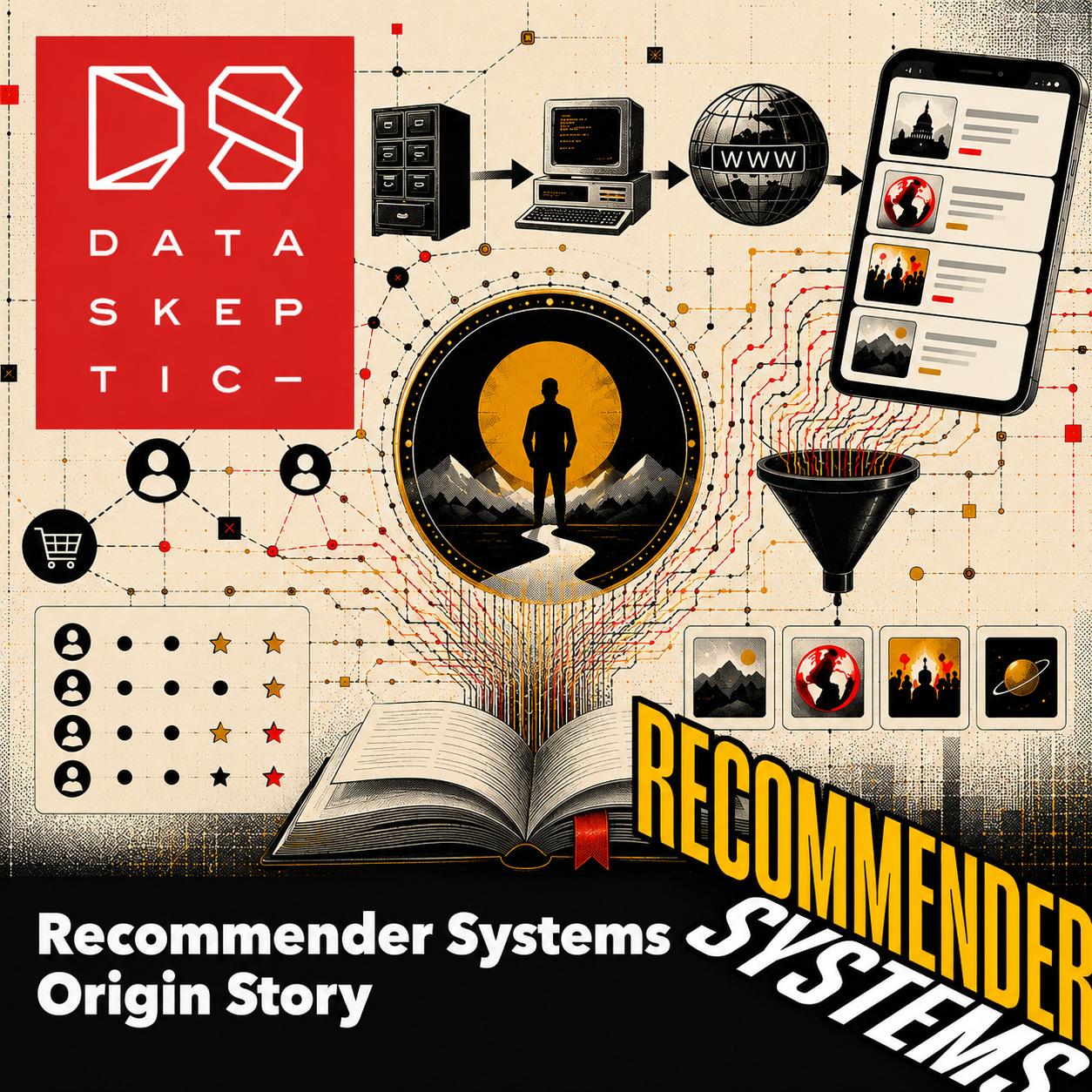
Where did recommender systems come from, and how do we know when they're actually working? In part one of Data Skeptic's three-part Recommender Systems finale, Kyle traces the field from collaborative filtering and the Netflix Prize to matrix factorization and modern approaches, while exploring why accuracy alone can't capture what makes a recommendation useful, surprising, or meaningful.
Englisch
Vereinigte Staaten
TRANSKRIPT 🔗
Are you the producer of this podcast?
Add a podcast transcript
Need Audio-to-Text?
Transcribe with Listen411 in Just 60 Seconds
VERGANGENE FOLGEN SUCHEN
Vorhandene Folgen von Data Skeptic durchsuchen.
WEITERE EPISODEN IN DIESEM PODCAST
Aaron Payne, an MBA student at Georgia Tech studying business analytics and a Senior Insights Analyst at Chick-fil-A, joins Kyle Polich to talk about turning analytics into decisions that matter. They unpack a real-world forecasting project with Comfama in Colombia, including messy data realities, …

How can researchers audit recommendation systems when the algorithms are hidden from view? Hieu Le joins Kyle Polich to discuss Auto-Like, a reinforcement learning framework that systematically explores how platforms like TikTok personalize content feeds. The conversation covers recommendation tran…

What if you could simply tell a recommendation system what you want instead of relying on likes, dislikes, and watch history? Kyle Polich talks with Fuyuan Lyu about the DPR framework, which combines large language models and traditional recommender systems to give users direct control over recomme…
News recommendation algorithms influence far more than what stories we click—they can shape our understanding of the world. In this episode, Kyle Polich speaks with Andreea Iana about responsible AI, filter bubbles, multilingual news recommendation, and her open-source NewsRecLib framework for eval…
Kyle Polich sits down with Yashar Deldjoo, research scientist and Associate Professor at the Polytechnic University of Bari, to explore how recommender systems have evolved and why trustworthiness matters. They unpack key dimensions of responsible AI, including robustness to adversarial attacks, pr…
Rechtliche Hinweise: Der auf dieser Seite eingebettete Podcast und das Bildmaterial stammen von Kyle Polich, das Eigentum seines Eigentümers ist und nicht mit Listen Notes, Inc. verbunden ist oder von diesen unterstützt wird.
BEARBEITEN
Vielen Dank, dass Sie uns helfen, die Podcast-Datenbank auf dem neuesten Stand zu halten.
