
Chapter 5. Wall Street’s National Banks

Patrick Newman traces the National Banking System from Salmon P. Chase’s wartime bond sales and initially hostile relations with New York financiers through the pyramid of bankers’ balances that concentrated reserves on Wall Street. He follows J. P. Morgan and George Baker’s First National Bank, th…
Chapter 11. Wall Street’s World Reserve Currency
The Great War wrecked European finance and opened the door for the dollar to displace the pound. Patrick Newman follows Thomas Lamont and Paul Warburg’s ambitions for an imperial banking system, the Federal Reserve’s first inflationary boom and bust in the Depression of 1920 to 1921, and the 1920s …
Chapter 3. Cartelizing the Railroads
Competition among the trunk lines meant lower rates and better service, so the railroads tried pools to stop it—and the pools kept collapsing, because without government coercion some member always defected with a secret rebate. Patrick Newman shows how the Interstate Commerce Commission supplied t…
Foreword
Thomas Sargent places Patrick Newman in a tradition of American historians—Charles Beard, Forrest McDonald, Richard Hofstadter, and Murray Rothbard—who compress data and look for patterns in how the state is designed and managed. He draws the dividing line between those who read bad policy as unint…
Chapter 2. Railroading the Nation
A transcontinental railroad was unprofitable on market terms—“1800 miles of railroad through an uninhabited country”—but attractive once Congress supplied land and subsidies. Patrick Newman follows the four Sacramento merchants who saw the opportunity and the Republicans who justified it as a warti…
Chapter 1. The Republican Ascendancy
Patrick Newman shows how liberty-minded reformers, once holding the levers of power, were pulled toward favoritism of their own—beginning with Jefferson, who could not refuse five hundred million acres. He traces the 1850s scramble over land grants, bailouts, and transcontinental subsidies, the sla…
Chapter 4. The Failure to Monopolize
Beginning with the Morrill Tariff of 1861, Patrick Newman documents protection sought and monopoly repeatedly denied. Market competition kept defeating attempts to corner markets—real GDP rose 184 percent between 1870 and 1890 while retail prices fell 30 percent and real wages rose—driving establis…
Acknowledgements
Patrick Newman describes this volume as the second act in a three-act play, the bridge connecting the country’s founding to the modern America of the present generation.
He thanks Hunter Lewis for underwriting publication costs, the Mises Institute and the reviewers who read the manuscript.
Is the 2030 Great Depression Forecast Realistic? An Economist Weighs In

In this month's Market Insights Broadcast, Aaron Tuttle, CFA®, CFP®, CLU®, ChFC®, Chief Executive Officer, and Chris Arends, CFA®, CMT®, CAIA®, Chief Investment Officer, are joined by Dr. Patrick Newman, Assistant Teaching Professor of Economics at the University of Tampa and Murray N. Rothbard Res…
Ep 191: Can Crony Capitalism be Fixed with Patrick Newman of Mises Institute
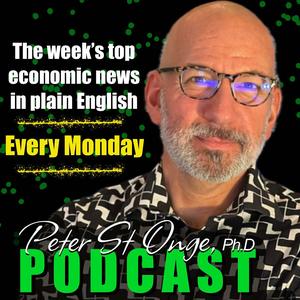
This week I sat down with economic historian Patrick Newman of the University of Tampa and Rothbard Fellow at the Mises Institute.We talk about the rise of crony capitalism, why DOGE and the GOP Congress didn’t make a dent, and how it drives young voters into the arms of Socialism. Then we talk thr…
PODCAST SØGEMOTOR
Du kan bruge vores hjemmeside til at søge efter3,822,708podcasts og195,605,884episoder efter personer, steder eller emner.

I have no special talent. I am only passionately curious, and
I listen to podcasts.
‐ Albert "Llamacorn" Einstein
REDIG
Tak fordi du hjælper med at holde podcast-databasen opdateret.
