
OM DENNE EPISODE
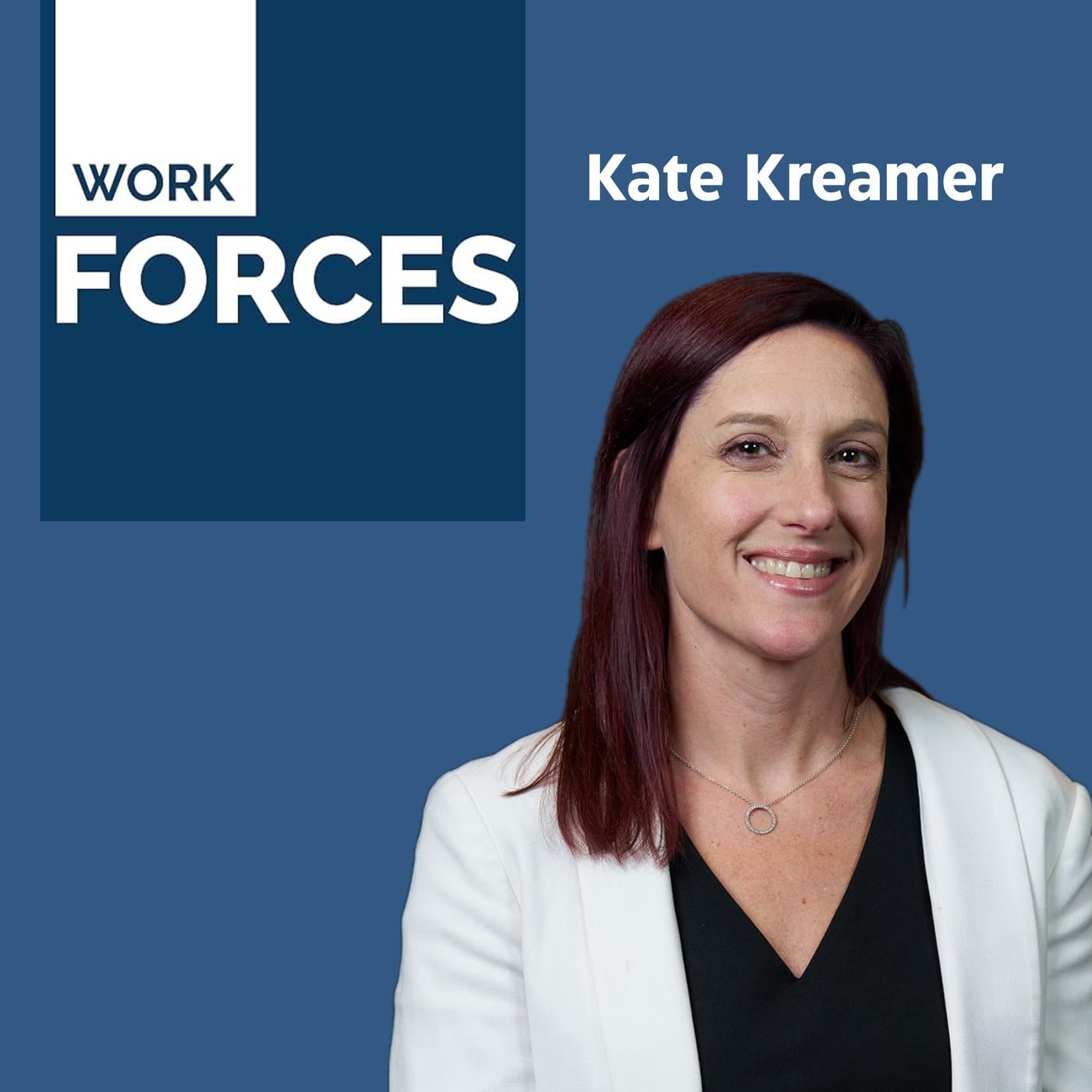
Kate Kreamer, Executive Director of Advance CTE, the longest-standing national nonprofit representing state leaders responsible for secondary, postsecondary, and adult career and technical education, discusses what it actually takes to build CTE systems that are rigorous, relevant, and ready to scale. Kate makes the case for two-way academic integration, arguing that while CTE programs have long been expected to reinforce core academics, there has never been a reciprocal expectation that core academic teachers draw on labor market data and career competencies to make their instruction more relevant. The conversation explores the perennial challenge of employer engagement, why the field keeps having the same conversation about advisory committees without cracking the code on co-design and co-investment, and what models like the U.S. Chamber of Commerce Foundation's Talent Pipeline Management program are doing differently. Kate also examines the growing role of intermediaries in building and sustaining strong career pathways, why sustainability remains the field's biggest unanswered funding question, and why the single most important thing educators, employers, and policymakers can do is go see a modern CTE program in action before drawing any conclusions about what it is or isn't.
Transcript
Julian Alssid: Welcome to the Work Forces podcast. I'm Julian Alssid.
Kaitlin LeMoine: And I'm Kaitlin LeMoine, and we speak with innovators who are shaping the future of work and learning.
Julian Alssid: Together, we unpack the complex elements of workforce and career preparation and offer practical solutions that can be scaled and sustained.
Kaitlin LeMoine: This podcast is an outgrowth of our Work Forces consulting practice. Through weekly discussions, we seek to share the trends and themes we see in our work and amplify impactful efforts happening in higher education, industry, and workforce development all across the country. We are grateful to Lumina Foundation for its past support during the initial development and launch of this podcast, and invite future sponsors of this effort. Please check out our Work Forces podcast website to learn more. And so with that, let's dive in.
Julian Alssid: As we continue season seven, career and technical education keeps coming up as a thread across our work and our conversations on this podcast. There's real momentum in the field right now, and with that momentum comes some genuinely hard questions about quality, consistency, and how to build systems that work for every student.
Kaitlin LeMoine: And those questions, along with the answers to them, look very different depending on where you sit. What they look like at the state policy level, where the decisions about standards, funding, and employer engagement, among other key factors, actually get made, is something we've been wanting to dig into more deeply on this show for some time.
Julian Alssid: Which is exactly why we're so glad to have today's guest with us. Kate Kreamer is the Executive Director of Advance CTE, the longest-standing national nonprofit representing state leaders responsible for secondary, post-secondary, and adult career and technical education across the country. Kate first joined Advance CTE in 2013 and was appointed executive director by the board in 2023, bringing with her a background that includes work at Achieve, Third Way, and the Progressive Policy Institute. Kate, welcome to Work Forces. We're so glad to have you with us.
Kate Kreamer: Thank you, Julian and Kaitlin. Glad to be here.
Kaitlin LeMoine: Thank you so much for being with us. And as we dive in, we would love to give you the floor to tell us a bit more about your background and the path that led to your current role as Executive Director of Advance CTE.
Kate Kreamer: Great. Well, thank you. Well, I like many people that work in the education sector, my parents were in education. My father was a chemistry teacher turned building and then district level administrator. My mother was a librarian turned library director. So it's in my DNA, and the value is just inherent in everything I did growing up, and just kind of a core expectation that education is the grounding of what really brings your future. But I also was very aware, and increasingly became aware, kind of in high school, of the opportunities created by my parents, including moving out of New Haven, where my father went to high school and taught, actually, but chose to move to a suburb when they had my brother and myself, in large part because of the schools, and that always, you know, and the challenges he had in New Haven that were very different than the challenges we had in my suburban school, kind of recognized this is actually not something that everyone has access to in the right way, and was something that kind of woke something up and raised some questions for me. And I kind of found public policy, which is a random thing to find, but I found it really in my undergraduate. I was studying urban regional studies, and that had a lot of economic development, public policy, and environmental science behind it, and that's when I kind of married the two. This idea of public policy, education, economic development—didn't know that was going to be a part of my career, but it does make sense. I mean, that was what I was really interested in. So I moved right to DC. I fell in love with DC as a kid, knew I wanted to do public policy in college, started directly in grad school and an internship, and this was right in the middle to late aughts when college readiness was really taking off as a conversation, and it really struck me. I'm a very practical, pragmatic person. This idea of high school reform at this point, but this idea that high school is this pivot point between K-12 and whatever comes next, that just resonated. Why would high school be the end when it really is the connector across these systems? So I ended up working at Achieve, as you mentioned. Spent seven years there, and that was an organization that really led college readiness efforts. They were behind the Common Core, the PARCC assessments, Next Generation Science Standards. But I really loved that content, and also worked with state leaders across all those sectors: K-12, postsecondary, workforce, governors' offices, private industry. And in that, I really saw the power of state leadership and a shared agenda. But as I was going along, it was my dream job when I ended up there as an early 20-something-year-old, but we were talking academic preparation for college and careers. We really weren't trying to tackle the technical or even those transferable skills. And it probably was Perkins IV, which was reauthorized in 2006, where, as happens when you have major federal legislation, it starts a national conversation. So people started talking about CTE and Perkins. And I kind of started digging in, and that's when I met my predecessor at Advance CTE and started working with the Association for Career and Technical Education and others, and just fell in love with it and became the champion and voice within that organization. Was able to do some really cool work around applied math and how you're applying math across different CTE areas. Did these Math at Work brochures where 50,000 of them were sent out, actually demonstrating that you do need math in careers, but also got to write papers and do a whole bunch of work. I was really appreciative that where there was opportunity and space, the organization let me pursue my passion. But when I had the chance in 2013 to move and do CTE full time, I jumped right at it. I've spent 13 years at Advance CTE. The organization has changed dramatically, the field has changed dramatically, the environment has changed dramatically, and it's been really exciting. Obviously I'm still here after all these years, so I still have that passion for the work and the opportunities, most importantly, that it provides learners across the country.
Julian Alssid: Well, it's so great, Kaitlin, when we get past the canned bio to the actual story. It's really great to hear your story. It's an excellent segue, especially given your background. Advance CTE has made a strong push on academic integration in CTE, making the case that connected learning and academic preparation belong together rather than in separate tracks, which is how they've been treated in many places historically. Apart from you, or including you, what's driving that conversation now, and where do you see the field heading?
Kate Kreamer: Yeah, I think there are a couple things to that. This has been something that I've been really passionate about. A lot of the work I did in my last organization was around bringing CTE and core academics together as the way in, but there hasn't been a lot of momentum. In recent years, a lot of that was very standards-based, and people got a little burned out on standards after Common Core and didn't really want to lean in here. But where we are right now, the real difference is there is now a shared understanding that all learners should have opportunities for career-connected learning or some sort of career readiness engagement experiences. That was not really the case 10 years ago, where we were saying every student should have career advising, work-based learning, and be ready for a full range of postsecondary options. That national conversation and momentum has really shifted, in part because CTE has momentum, is getting more visibility, has amazing outcomes, and more learners want that engagement and relevance—which is not a new thing, but in this moment with COVID, the cost of higher ed, and the changing workforce, it's more prescient than ever before. We also have a growing body of research that supports what those of us in the field have known: learners want relevance. You're seeing a lot of data from Gen Z and younger learners asking for that in much more explicit ways. In this attention economy, we have to pay attention to that, because if we're not actually meeting that, we are losing that generation and their engagement. So while we would love for everyone to be on a CTE pathway, we recognize that's not likely or even possible. The question then is, how do we ensure that the authentic real-world experiences fostered through CTE can happen across the curriculum? To do this, you need two-way integration. And we're very explicit: this is two-way. CTE has had a responsibility for reinforcing core academics—literacy, numeracy, science. It's in our accountability system under Perkins. We can argue how well that's going, but that's been an expectation. There's never been an expectation going the other way. How are core academics pulling out what industry says they need? How are you aligning your lessons and projects to real-world, authentic efforts? How are you taking those durable or transferable skills—collaboration, communication, time management—and pulling them forward, helping students explicitly understand the skills they are gaining, whether in a core academic or CTE classroom? The blurring of those lines between academic and technical puts us in a better position from the CTE side to lean in and ask for that partnership because of where we are in the broader education ecosystem, the resources going into it, and the bipartisan support we have. This is potentially the time to make our move. Now, what it's going to take is a much bigger challenge. We're tackling it in two ways. One, we need more voices at the national level championing this. It cannot just come from CTE or the career side of the house. We need folks in core academics saying this is important and partnering to make content more relevant. I think you're seeing the math community trying to push on this relevance, and we can push them further to connect to careers and durable skills. And the truth of the matter is, we need better structures at the state and local level to enable this level of collaboration and interdisciplinary work. It takes time, mindset, and space to actually plan it. We see this at the local level where so much comes down to a building administrator wanting to do it, but at the state level, state agencies are not structured in any way for this type of collaboration across content areas. We think there's some low-hanging fruit in building relationships at the state level that could be modeled at the local level.
Kaitlin LeMoine: Yeah, absolutely. As we were talking, I was making a note about the practical aspect of making this work happen. So I'm so happy, Kate, that that's where you went automatically—what do we do about this? There are so many levers to pull, and so much of this is about making space for collaboration, conversations, and training. For many people, this is a different way of operating across all these systems. How do we build that kind of capacity across groups and individuals to bring this work to life? So I appreciated you going in that direction because it's a real set of challenges.
Kate Kreamer: It's a real challenge. It's just not how most buildings are set up. You've kind of always heard that CTE is off in the other wing, and while some of that is changing, that doesn't mean you've got common planning time or the right signal. We put out a report at the beginning of this year with a repository around two-way academic integration, looking at what's out there from a state level in terms of policies, PD, technical assistance, curricular resources, and crosswalks. We found a decent amount, but it was all on CTE reinforcing academics. We found scant examples of PD supports for core academic teachers in this area. I heard an anecdotal story where someone said they invited core academic teachers to meetings with CTE and economic development leaders to see labor market data, understand career trends, and hear what industry is asking for. They could then contextualize it in their classrooms, but normally they aren't in those conversations or comprehensive needs assessments. It's never been the expectation, and it's not about adding one more thing on, but providing motivation and understanding of where CTE is going and how they can contribute. It has to be a full, two-way partnership.
Kaitlin LeMoine: Yeah, and like you're saying, it provides that additional context as to why these shifts are happening and what's driving them. You referenced a number of these challenges. One area we'd love to look at more closely is getting employers to the table in meaningful ways—not just as advisors, but as co-designers and co-investors. What models are you seeing that work well, and what does it take to make them sustainable and scale them?
Kate Kreamer: Yeah, if I had the answers, I'd be much richer. It's such a good question, and it's at the heart of this. Last spring, Advance CTE, with support from over 40 national organizations, released a shared vision for the future of CTE called CTE Connects, or the Connected Path, where we centered this issue and challenged the field and ourselves to try something different. We held a summit last fall to understand where we are and where we need to go. This issue of employer engagement and partnership is not new—it is the challenge. What struck me was that we are having the same conversation and asking the same questions as 10 or 20 years ago. We haven't really evolved the conversation, and we can't keep having the same one. While we've made progress because CTE has risen in prominence, by no means have we cracked this. To build something at scale, first we need clearer and more consistent signals from employers at the sector or career cluster level. Associations can play a role here, but right now you're still getting one-off, local input from individual employers, which is burdensome on both employers and schools. Where can you pull employers together, ideally at the state level, to give a consistent signal of the most important knowledge, skills, and technology? One really good model is the U.S. Chamber of Commerce Foundation's Talent Pipeline Management (TPM) program. They bring together employers within a sectoral or occupational grouping and force them to align: "You're all hiring for a technician, so let's agree on the most important competencies." They condense 20 different requests into the top five crucial competencies, put that into one system, and signal to community colleges, CTE programs, and workforce bootcamps what is actually needed. That clear signal is paramount, and we don't have enough of it at scale. Second, we need employers to do more than just give upfront input on a business advisory committee once every two years. How are they engaging in instruction, looking at what instruction looks like, giving feedback, and elevating what works? How are they organizing themselves to give consistent information? That co-investment and co-ownership is missing. Third, industry needs to engage much more rapidly as technology evolves. Curriculum can't move that fast, but having industry come in to co-teach or guest-teach on specific brand-new technologies brings real-time relevance. States are creating spaces for this. Bloomberg Philanthropies is also testing pilots in healthcare and skilled trades focused on front-end, articulated partnerships between education and industry that co-design the entire experience. We're keeping an eye on those lessons learned. Scaling this into every community and state remains the real challenge. Lastly, when big workforce development investments happen, community colleges and workforce organizations are brought in, but K-12 CTE is rarely invited to those tables. That is a missed opportunity for an aligned, single conversation across secondary, postsecondary, and workforce levels.
Julian Alssid: It's funny because this conversation has been going on for a long time, and we haven't cracked the right balance for a working relationship with employers that can respond in real time. You touched on the role of intermediaries when mentioning the Chamber's TPM program. There's a lot of attention now on how intermediaries fit into the CTE system, specifically looking at building a true K-through-career continuum. Can you speak to what's going on in that realm regarding intermediaries building and sustaining strong pathways?
Kate Kreamer: Yes, this has definitely been a growing topic. When we talked about intermediaries 10 or 15 years ago, it was a much narrower lens than what they are now. Advance CTE learned a lot about the power of intermediaries through our involvement in the New Skills Ready Network, a five-year investment JPMorgan Chase made in six communities to build out career pathway systems where regional intermediaries served as the lead hub. There are two big models of intermediaries. One is the convener or regional hub, looking across K-12, postsecondary, workforce, public, private, and labor sectors to take a holistic collective impact approach. The other, more traditional role is the operational connector that manages work-based learning experiences directly between institutions and employers, taking the administrative burden off both sides. Intermediaries have grown because this work is hard, complicated, expensive, and there isn't enough capacity in the system. Districts and postsecondary institutions are tapped out. The question is how to fund these intermediaries sustainably. Currently, they are heavily reliant on philanthropy, which is not a permanent solution. Indiana did a one-time $5 million investment for seed funding for regional intermediaries, which was an interesting model to get things started. But how do they sustain themselves long-term? Once intermediaries compete for federal or state education dollars, tensions rise. Industry gets a lot of talent from these systems and often isn't investing their fair share back into the workforce system. Organizations like chambers that already serve industry are better positioned for sustainability, whereas other non-profits struggle to find dedicated funding sources.
Kaitlin LeMoine: I believe a recent blog post on your site talked about community colleges playing that intermediary role as well. Looking to community colleges as local, regional hubs can help de-silo these efforts.
Kate Kreamer: Yes, I think they can and should do more, especially with K-12. A lot of their existing relationships with K-12 focus on dual enrollment or recruitment, but they have a huge role to play in setting the table for co-designed programs with industry. Local workforce boards also serve as intermediaries. It's about leveraging who in your community has the trust and relationships to bring people together. There's no one-size-fits-all approach. It needs to be coordinated by someone trusted. When done well, like Boston Private Industry Council's work accelerating career pathways in Boston Public Schools, an intermediary with deep trust can drive progress far faster than the system could on its own.
Julian Alssid: As we're talking, so much of this requires training, resources, and capacity, especially when so many organizations are hard-pressed financially and time-wise. So, putting in a plug for more resources in education and workforce development.
Kate Kreamer: You might as well throw Perkins into the mix! Our federal investment in CTE is $1.4 billion, which goes down to local levels and is a drop in the bucket compared to other federal education or workforce funding. People say, "Use Perkins for apprenticeships, intermediaries, or academic integration." Those are all allowable uses, but there aren't enough resources, leading to protectionism where schools first need to buy equipment, fix facilities, and run basic PD. There's rarely anything left over. State agencies and institution staffs are shrinking too. While it's a challenge, more money would certainly be great!
Kaitlin LeMoine: In an effort to bring this conversation full circle, Kate, given that our podcast is called Work Forces, what would you recommend to educators, employers, or policymakers who want to become forces in expanding access to high-quality CTE?
Kate Kreamer: First and foremost, if you haven't seen a CTE program recently, go see one in action. Call a local high school or community college, or reach out to your state director to take you on a tour. There is still a major perception gap around what CTE is today versus what it used to be. People ask if it's in school or out of school, or assume it's only traditional trades. It includes cybersecurity, healthcare, engineering, and advanced manufacturing. I can advocate and make the case every day, but until you go and see modern CTE in person, it is hard to fully believe it.
Julian Alssid: In addition to going to see it, how can our listeners learn more about your work and follow Advance CTE?
Kate Kreamer: Look us up at careertech.org, where you can sign up for updates and our legislative policy emails. We put out a lot of great resources. You can also find Advance CTE and Kate Kreamer on LinkedIn, where we elevate our work, our members' work, and broader field efforts.
Kaitlin LeMoine: Great. Well, thank you so much for taking the time to speak with us today, Kate. It's been such an insightful conversation, and we look forward to staying connected and watching your work unfold.
Kate Kreamer: Thank you so much again. I look forward to that as well.
Julian Alssid: Thank you, Kate.
Kaitlin LeMoine: We hope you enjoyed today's conversation and appreciate you tuning in to Work Forces. Thank you to our listeners and guests for their ongoing support, and especially thanks to our producer Dustin Ramsdell. If you are interested in sponsoring the podcast or want to check out more episodes, please visit workforces.info/podcast. You can also find Work Forces wherever you regularly listen to your favorite podcasts. If you enjoyed this episode, please subscribe, like, and share it with your colleagues and friends. And if you are interested in learning more about the Work Forces consulting practice, please visit workforces.info/consulting for more details about our multi-service practice.