
OM DENNE EPISODE
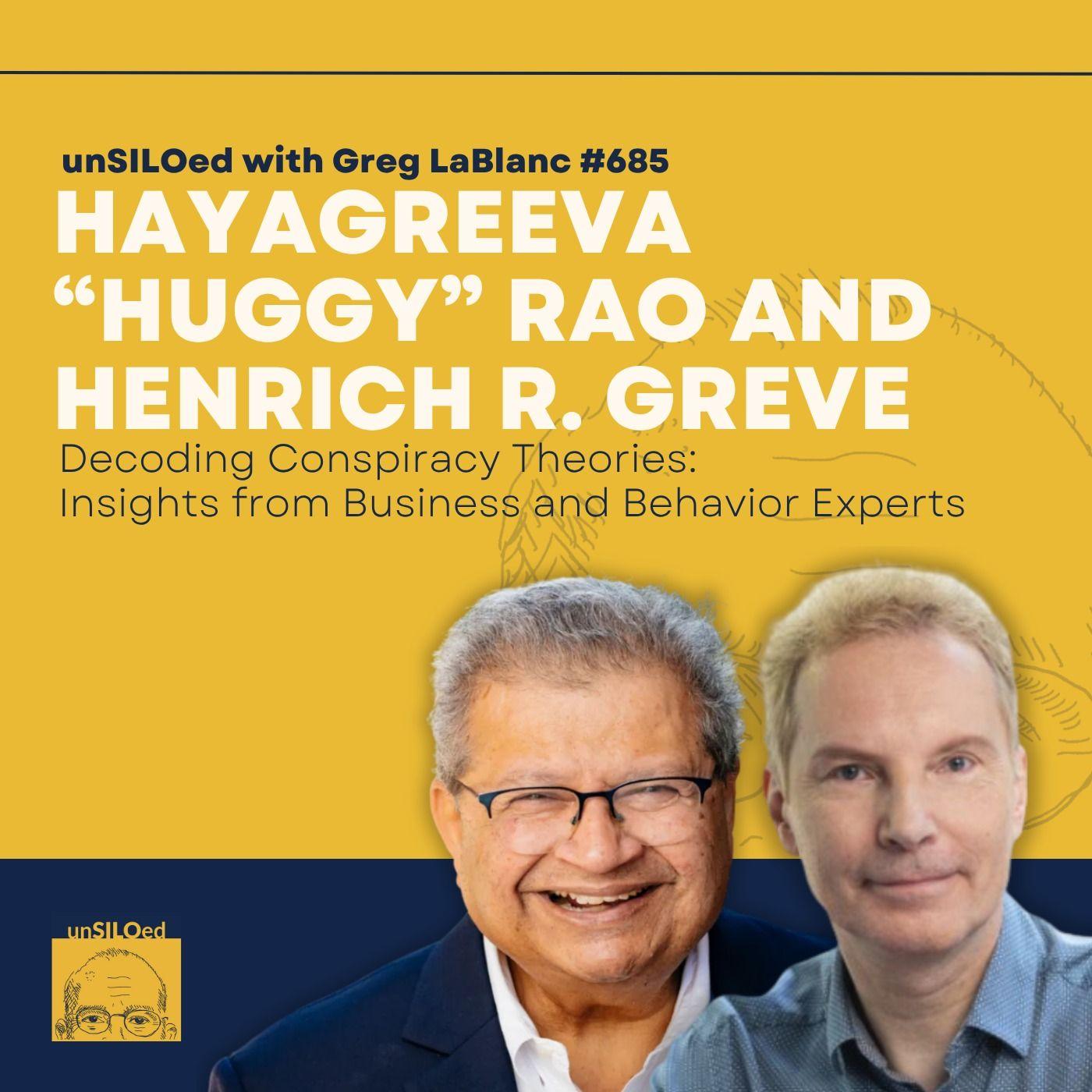
Huggy Rao is the Atholl McBean Professor of Organizational Behavior and Human Resources at Stanford University’s Graduate School of Business and Henrich Greve is the Rudolf and Valeria Maag Chaired Professor in Entrepreneurship at INSEAD. They are also co-authors of the new book Ctrl+Alt+Doubt: Decoding the Language of Online Conspiracy Talk.
Greg, Henrich, and Huggy discuss their new book and the language of online conspiracy talk. They describe entering the topic via research on managerial talk, the 1857 Indian mutiny rumor, and pandemic effects on collective action, then the COVID-era “distributed doubt.”
Huggy and Henrich define conspiracy theories as elaborate, non-falsifiable narratives where lack of evidence is treated as proof, including “gateway” claims like COVID false positives. Rather than pathologizing believers, they analyze online talk as a social coordination mechanism and cultural toolkit involving bricolage, which is recombining semantically proximate words and narratives, within crowded “rabbit holes.” They propose that platforms shape but don’t determine discourse. For managers, they recommend early rumor monitoring, “prebuttals,” and credibility-preserving communication, noting shrinking executive authority and the risks of manufacturing threat for innovation.
*unSILOed Podcast is produced by University FM.*
Episode Quotes:Why should leaders always get ahead of conspiracy theories?
40:18 [Henrich R. Greve]: I think an important thing about leaders and organizations is that, I mean, they have the advantage that often the conspiracy theories are initiated by things that they did, all right? Because in society, events just happen, and so conspiracy theories just burst out of the blue. In firms, there is some sort of leadership initiative, and conspiracy theories can be traced back to it. And so, knowing this, there are certain conversations that have to happen before the initiative, during the initiative, just to make sure that there is understanding spread about why is this happening. So, that's the inoculation phase. And actually, it's a privilege of management that they should know that conspiracy can happen whenever something big and unexplained is announced.
Conspiracy theories can create communities
11:22 [Hayagreeva “Huggy” Rao]: Conspiracy theories are coordination mechanisms for people to engage in the digital commons, so to speak. You don't have pubs and taverns, but you have microblogs and the like, and that's kind of what people do. They use it as a coordination device to create groups and so on and so forth. But the thing that struck us, and we use this imagery, is they're not exactly paranoid.
Great leaders awaken pride, not paranoia
44:54 [Hayagreeva “Huggy” Rao]: The real job of leaders, and perhaps I'm oversimplifying grossly, is you actually want to make your employees feel capable. If you want to make them feel capable, peddling conspiracy theories is perhaps not the best kind of first step to start with. Instead, what you want them to do is, how can you have an impact? What is it you can do? Those kinds of things become important. And what all of that leads to is actually awakening pride. But before you awaken pride, you have to show that you care for it.
Show Links:Recommended Resources:
- Spanish Flu
- Conspiracy Theory
- Arrow's Impossibility Theorem
- Cognitive Dissonance
- Consistency
- Ann Swidler
- Bricolage
- Levi Strauss
- Pizzagate Conspiracy Theory
- McCarthyism
- The Functions of the Executive
- Matthew Ridgway
Guest Profile:
- Hayagreeva Rao | Faculty Profile at Stanford Business School
- Hayagreeva Rao | LinkedIn Profile
- HuggyRao.com
- Henrich R. Greve | INSEAD Profile
- Henrich R. Greve | LinkedIn Profile
- HenrichGreve.com
Guest Work:
- Hayagreeva Rao | Amazon Author Page
- Henrich R. Greve | Amazon Author Page
- Ctrl+Alt+Doubt: Decoding the Language of Online Conspiracy Talk
- Scaling Up Excellence: Getting to More Without Settling for Less
- The Friction Project: How Smart Leaders Make the Right Things Easier and the Wrong Things Harder
- Network Advantage: How to Unlock Value From Your Alliances and Partnerships
- Organizational Learning from Performance Feedback: A Behavioral Perspective on Multiple Goals: A Multiple Goals Perspective
- Organizational Learning from Performance Feedback: A Behavioral Perspective on Innovation and Change
If you enjoyed this show, here are some other unSILOed episodes you may like:
- 366: Robert Sutton - Dissecting Workplace Friction: A Deep Dive
- 200: Robert Cialdini - The Golden Age of Persuasion
Hosted by Simplecast, an AdsWizz company. See pcm.adswizz.com for information about our collection and use of personal data for advertising.