WEBVTT
00:00:00.239 -->
00:00:02.000Most people do think of strategy that way.
00:00:02.319 -->
00:00:03.680Developing a new strategy.
00:00:04.000 -->
00:00:05.280Strategic blind spots.
00:00:05.519 -->
00:00:06.799When strategy meets reality.
00:00:06.959 -->
00:00:08.960Strategy and innovation in the strategy world.
00:00:09.279 -->
00:00:10.640Drive their strategic goals.
00:00:10.880 -->
00:00:13.519And welcome back to Strategy Meets Reality Podcast.
00:00:14.880 -->
00:00:17.199Welcome back to Strategy Meets Reality Podcast.
00:00:17.280 -->
00:00:19.359It's great to have you again.
00:00:20.000 -->
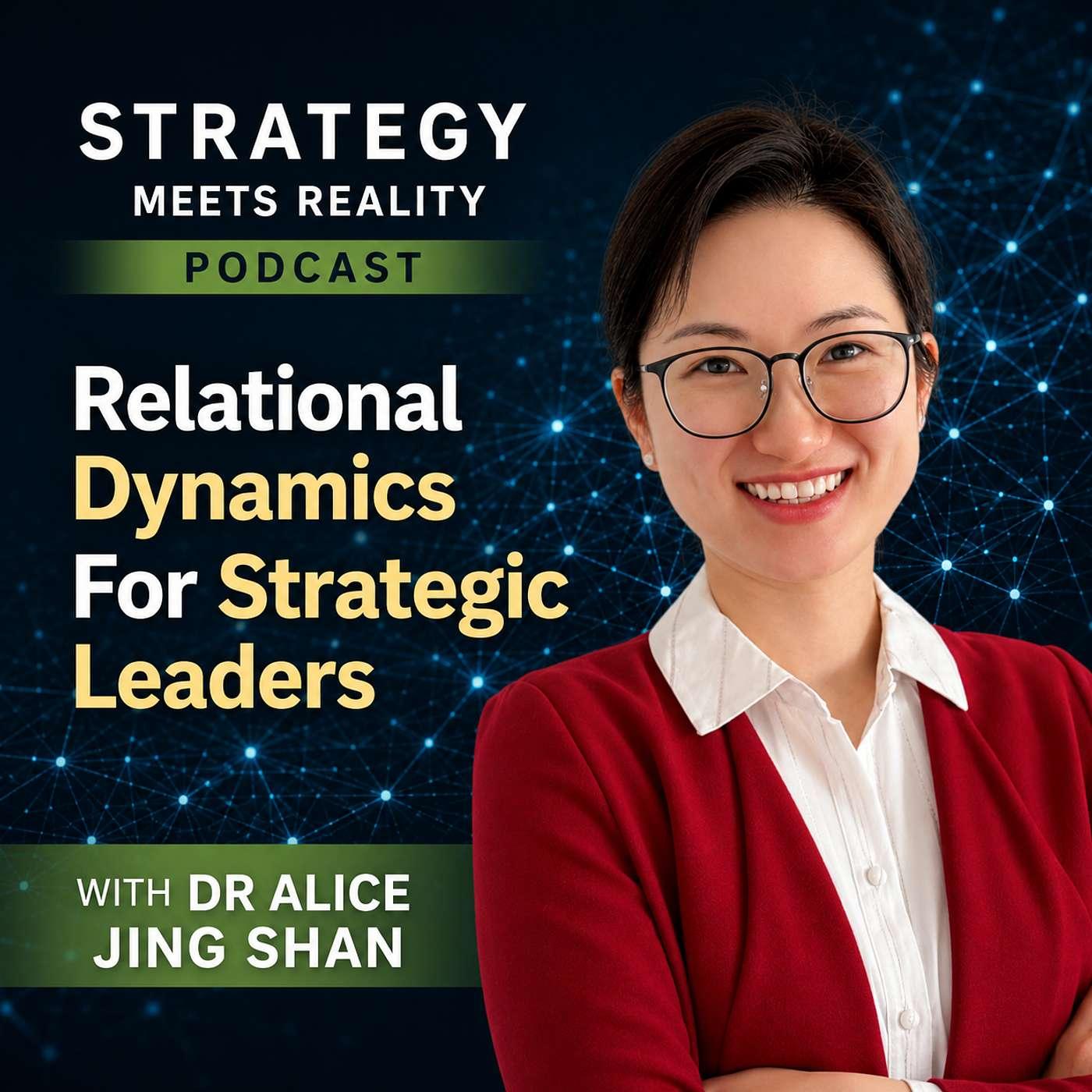
00:00:22.399I'm absolutely delighted to be joined by Dr.
00:00:22.480 -->
00:00:23.679Alice Ying Shan.
00:00:24.480 -->
00:00:26.879Joining me all the way from Edinburgh.
00:00:27.839 -->
00:00:31.039And I'm delighted to have Alice on.
00:00:31.920 -->
00:00:41.200I hunted you down and I've tried to get you uh convince you to come on, and finally you've agreed and you've come on.
00:00:41.280 -->
00:00:42.719So it's absolutely fantastic.
00:00:42.799 -->
00:00:43.439So welcome.
00:00:43.520 -->
00:00:45.200Thank you for joining us, Alice.
00:00:45.520 -->
00:00:45.920Thank you.
00:00:46.079 -->
00:00:46.640Thank you, Mike.
00:00:46.799 -->
00:00:47.920Happy to be here.
00:00:48.320 -->
00:00:48.880Perfect.
00:00:49.119 -->
00:01:00.240So for the listeners that haven't had the privilege of seeing your work um online on Substack, which I'll um link and LinkedIn, which I'll link in show notes.
00:01:00.399 -->
00:01:04.799Please could you give a bit of background about yourself and a bit of context about what you've been up to lately?
00:01:05.359 -->
00:01:05.680Sure.
00:01:06.000 -->
00:01:07.680Hi everyone, I'm Alice.
00:01:07.840 -->
00:01:09.599I publish in English as Dr.
00:01:09.680 -->
00:01:12.879Alice Jing Shan, and my Chinese name is Shenjing.
00:01:13.040 -->
00:01:22.159I am a person who observes and writes about how human systems hold together, come apart, and evolve under pressure.
00:01:22.400 -->
00:01:27.439So this is the question I keep returning to in my work, my writing, and my life.
00:01:27.599 -->
00:01:37.439And my own work moves across areas such as language, education, culture, organizations, and increasingly these days, artificial intelligence.
00:01:37.680 -->
00:01:47.120They may seem like separate fields, but I see them as interrelated sites where the same underlying dynamics keep appearing.
00:01:47.280 -->
00:01:56.959And I trace these reoccurring patterns through relational dynamics, which is my original lens for understanding system trajectories.
00:01:57.280 -->
00:02:11.120In the age of AI, or what I call the age of AIR, I believe the questions I've been working on and returning to for many years is becoming increasingly urgent and relevant for all of us.
00:02:11.280 -->
00:02:13.599And thank you very much, Mike, for having me here today.
00:02:14.000 -->
00:02:14.879Oh no, it's a pleasure.
00:02:15.039 -->
00:02:17.120And that's what I'd like to dig in.
00:02:17.199 -->
00:02:21.520There's a lot I want to discuss from strategies to tactics to AI.
00:02:21.680 -->
00:02:27.360But first, as you mentioned it, do you mind giving just a bit of context about relational dynamics?
00:02:28.080 -->
00:02:39.280So relational dynamics is something I've been working on for a while, but perhaps consolidated finally in the past year or so.
00:02:39.520 -->
00:02:57.919So it's an umbrella term, umbrella frame that I work within which I worked, I worked, uh I proposed ontology called ontology of relational dynamics, with a core claim that reality is relational dynamics under constraint over time.
00:02:58.240 -->
00:03:05.280And because it's a solid, I think an ontology which um answers the question, what is reality?
00:03:05.520 -->
00:03:20.080And that naturally is upstream and downstream, it can guide a lot of different ways of understanding how knowledge is generated and how we apply different methods to understand different domains.
00:03:20.240 -->
00:03:30.159So an easy way of understanding it is um relational dynamics is my kernel, is my operating system, and everything else is application.
00:03:30.639 -->
00:03:31.280I like it.
00:03:31.520 -->
00:03:34.479You you got a really key thing in there about relational.
00:03:34.800 -->
00:03:48.240Now I've just had this, so um, I'm just fresh off a call with a client this morning, and um they done um a great PowerPoint, you know, with listeners know my contempt for PowerPoints, but um this was lovely.
00:03:48.400 -->
00:04:01.120But they what they've done is they sh they had a lot of information there about the market, about these competitors are doing this, um, we're doing this, but there was nothing that was relational.
00:04:01.439 -->
00:04:11.039So they were talking about their their opportunities, but none of none of it was relational to yeah, but in comparative to what and to who.
00:04:11.520 -->
00:04:18.160So they had all these competitors all around saying that they're doing this, they're doing this, but what's the relation?
00:04:18.879 -->
00:04:20.560Where is where is it going?
00:04:20.720 -->
00:04:38.800And I thought that when you think about relational dynamics, thinking about actually what what's the interfaces, what's the connections, where is that going on a sort of default trajectory, or how could that be not interfered with, but how can we shape that trajectory?
00:04:39.279 -->
00:04:41.759This is very interesting and very common.
00:04:42.000 -->
00:04:52.639You see um organizations talking about certain market and they look at other opponents, what other people are doing, and there's really multi multifold here.
00:04:53.040 -->
00:05:01.120First of all, I think the relation is not just relation to other people in the field, it's a relation to the field itself.
00:05:01.360 -->
00:05:09.519And in society, in human systems, very often we forget that the field is changing itself very much and a nested field.
00:05:09.680 -->
00:05:20.800So a market is never just a static market, the market can change and your whole industry can just disappear very quickly, especially these days with artificial intelligence.
00:05:21.040 -->
00:05:33.519So the fact that if your eyes are only on what other people similar to your company are doing, I think essentially they're already losing contact with reality.
00:05:33.759 -->
00:05:39.600And we should talk more about, you know, strategy meets reality, because I really like the title.
00:05:39.759 -->
00:05:42.959It rejects the idea that reality is static.
00:05:43.199 -->
00:05:45.360Reality is changing all the time.
00:05:45.600 -->
00:05:51.680And one thing about strategy in my working frame is that strategy is field level awareness.
00:05:51.920 -->
00:06:01.199So you're in coherence, you're reading the field, whereas tactic is more like executive uh executive move motion.
00:06:01.360 -->
00:06:04.720So you look at who is doing what when.
00:06:04.879 -->
00:06:06.639So this is more tactical.
00:06:07.040 -->
00:06:25.600Of course, you need to look at what other opponents are doing, but if you lose sight of, for instance, your your own goal, what is the relationship between the people in your own company that can bring to the table and your relationship to the field, then perhaps you're already limiting yourself.
00:06:25.839 -->
00:06:33.120And important, I think one thing we can also see, we talk about a little bit, uh we talk a little bit about sports.
00:06:33.360 -->
00:07:01.120And I really like to use sports as an or metaphor when we talk about strategy, because a lot of people, they don't have to be theorists to understand that strategies apply in sports, and we all have like a physical interaction, doesn't matter if we are the players or the audience, we have this physical understanding, embodied understanding of how strategies are applied on the field, in the field.
00:07:01.360 -->
00:07:12.800So if you're only looking at what your opponents are doing, then essentially you're forgetting your own team and you're forgetting and one strategy doesn't work for obviously every team.
00:07:12.959 -->
00:07:26.480And you need to work with the weather, you need to work with the media, you need to work with so many other elements, and that is the beauty of I suppose um human systems, because it's so complex, but that's also what makes it so difficult.
00:07:26.800 -->
00:07:27.920Yeah, yeah, yeah.
00:07:28.160 -->
00:07:37.920And I I remember like when we we met up for a pre-chat before the show, um, and I was talking about, you know, everyone uses strategy now.
00:07:38.000 -->
00:07:41.439It's just like it's just a term it's just thrown around in organizations.
00:07:41.759 -->
00:07:50.560And you said um, you know, from your from your sort of heritage and your background that strategy is quite a quite a serious word.
00:07:50.800 -->
00:07:51.360Yeah, yeah.
00:07:51.759 -->
00:07:52.319Yeah, yeah.
00:07:52.560 -->
00:07:59.040It's not one that's just thrown around as easy as it probably is um in a lot of sort of Western organizations.
00:07:59.519 -->
00:08:05.360Yeah, so strategies where I come from, first of all, it's something that feels quite big and grand.
00:08:05.519 -->
00:08:16.319And I suppose a lot of people also perhaps make the mistake, in my opinion, of distinct uh the distinction between these two terms.
00:08:16.480 -->
00:08:19.519Some people think it's long-term versus short term.
00:08:19.759 -->
00:08:20.160Yeah.
00:08:20.399 -->
00:08:26.879And or think strategy is somehow more elaborate, but I think it doesn't really work like that.
00:08:27.120 -->
00:08:35.279So I think, so from a relational dynamics perspective, strategy is not only about choosing a goal or destination.
00:08:35.440 -->
00:08:42.480It is a way of staying coherently with a moving field and moving reality.
00:08:43.360 -->
00:08:45.039So I'll give you an example.
00:08:45.200 -->
00:09:06.240So strategy is something that needs to be tested by constraints, timing, emotions, power dynamics, organizational memories, incentive structures, human emotions, our our language and communication capacity limits, you know, these are the things that are at the field level.
00:09:06.480 -->
00:09:09.039And tactics are the exact move.
00:09:09.120 -->
00:09:10.639So who does what when.
00:09:10.799 -->
00:09:12.960So these are very different levels.
00:09:13.120 -->
00:09:15.360It's not to say strategies are better than tactics.
00:09:15.519 -->
00:09:19.039For something to work, you need both strategy and tactics.
00:09:19.360 -->
00:09:29.360But if we don't get the distinction right, I think a warning or the danger is that you can see people very busy.
00:09:29.519 -->
00:09:34.720You can see organizations are trying to be really, really productive by doing a lot of things.
00:09:34.960 -->
00:09:42.080Doesn't matter if it's organizational individuals, we're just busy, busy, but we're not actually making any strategic advance.
00:09:42.240 -->
00:09:44.320We're just running in circles.
00:09:44.480 -->
00:09:52.960And that can be very dangerous because, as I said, these days things are moving so quickly, and um we need to keep an eye on the field.
00:09:53.279 -->
00:09:53.759Yes.
00:09:54.080 -->
00:10:09.360And and I think that's an important connection that is is often missing in that strategic thinking is that we we come up with an idea, we then set our functions to do stuff, and then we then try to optimize the parts.
00:10:09.519 -->
00:10:11.919So we get that function, you just be really good at this.
00:10:12.000 -->
00:10:19.440And but what we're not looking at is that what what is the strategic effect that the whole is having on the external environment?
00:10:19.759 -->
00:10:25.759And then with that, then how's that changing our understanding uh as you put it the field?
00:10:26.080 -->
00:10:27.360So now we've done that.
00:10:27.600 -->
00:10:31.120How has the field responded to our intervention?
00:10:31.279 -->
00:10:36.320And then also what's changing in the field from our last assumptions?
00:10:36.559 -->
00:10:42.240There doesn't seem to be that full look to go, well, we've done this, what's happened, or this is happening now.
00:10:42.559 -->
00:10:44.720Is what we're doing still relevant?
00:10:45.039 -->
00:10:45.360Yeah.
00:10:45.519 -->
00:10:55.600And in in Chinese, actually, we have an idiom called Zhu Xantanbing, which literally means discussing warfare on a piece of paper.
00:10:56.480 -->
00:11:08.879It describes the kind of wishful thinking strategy that sounds clever in abstraction or nice in documentation, but fails the moment it touches reality.
00:11:09.200 -->
00:11:09.840Oh, I love that.
00:11:10.000 -->
00:11:11.679I'm gonna have to I'm gonna have to learn that.
00:11:12.000 -->
00:11:14.879I'll send you I'll send you the link uh to some, yeah.
00:11:15.039 -->
00:11:16.480I I send you the phrase, yeah.
00:11:16.720 -->
00:11:17.679Yeah, that'd be great.
00:11:18.399 -->
00:11:19.519The only one I'll learn.
00:11:20.080 -->
00:11:21.679I'm not great with languages.
00:11:21.840 -->
00:11:32.879Um but yeah, and I and I I've exactly right, and I think there's this whole point with reality um that gets um missed.
00:11:33.039 -->
00:11:59.120I think that's why I created you know when strategy meets reality um podcast, in the fact that um it's only really until you start to engage with that reality will you will you know how things respond, and really we must always realize as well is that our perspective of reality is always going to be limited, and there's always going to be darkness that we don't know.
00:11:59.279 -->
00:11:59.600Yeah.
00:11:59.919 -->
00:12:07.679And we have to keep interacting, but it doesn't mean um and I wrote about this not long ago saying that basically there's there's there's always a gap.
00:12:07.840 -->
00:12:19.200It's the gap in strategy, it never closes because there's always our assumption, there's always how it meets reality, and there's always going to be a gap between those two that we're we're constantly managing, doesn't mean it fails.
00:12:19.519 -->
00:12:20.320Yeah, yeah, yeah.
00:12:20.399 -->
00:12:21.440That's a very good point.
00:12:21.600 -->
00:12:23.039And you're absolutely right.
00:12:23.200 -->
00:12:24.320There's always a gap.
00:12:24.559 -->
00:12:31.840And that's why I think eventually it pushes me to the point where I was trying to think what is reality.
00:12:32.159 -->
00:12:32.559Yeah.
00:12:32.879 -->
00:12:36.320I I think most people just don't think about it, which is fine.
00:12:36.399 -->
00:12:37.840You know, everybody needs a hobby.
00:12:38.080 -->
00:12:39.440That was my hobby.
00:12:39.840 -->
00:12:51.440And the reason why I think relational dynamics under constraint over time is powerful because I basically compressed it to two variables.
00:12:51.679 -->
00:12:58.000So you've got relational dynamics and you have constraint and over time, those are two dimensions.
00:12:58.320 -->
00:13:04.320So I'm trying to include as many things as possible, but not flattening the nuances.
00:13:04.639 -->
00:13:08.320And um, like we talked about, a lot of people don't think about relations.
00:13:08.480 -->
00:13:11.919They think um things are just things.
00:13:12.480 -->
00:13:28.000But um very often, especially in complex systems and in human systems, we don't are we're not just things, we exist because there is some sort of relation that brings us together, and that needs to come first, I think.
00:13:28.240 -->
00:13:29.519And then the dynamics.
00:13:29.679 -->
00:13:37.759And I mean, obviously we can see as we grow older, we are interacting with different people, different organizations, bigger and bigger, our connections.
00:13:37.919 -->
00:13:44.799So it's easy to see the dynamics, it's easy to see the changes of an organization, of a country, of an individual.
00:13:45.120 -->
00:13:53.360But I think it's important to not lose sight of what makes us meaningful in the first place, which is the um relation.
00:13:54.080 -->
00:13:55.360Yes, yeah, yeah.
00:13:55.600 -->
00:13:59.360Um I have to revert back to the idea of structural coupling.
00:13:59.679 -->
00:14:00.000Yes, yes.
00:14:07.360 -->
00:14:09.039We are related, we are coupled.
00:14:09.120 -->
00:14:11.840Yes, um, and it's really important to realise.
00:14:12.240 -->
00:14:17.919But you you also mentioned really two critical things in strategy, I think, are overlooked.
00:14:18.080 -->
00:14:20.720One is constraint and the other is time.
00:14:21.519 -->
00:14:24.559Um, especially time over constraints.
00:14:24.799 -->
00:14:33.279I think people are starting to think about constraints, probably not in the same way that we we think about it, but time is definitely something that is never looked.
00:14:33.360 -->
00:14:46.480I've never gone uh looked at a strategy document, and the only mention of time is like 2031 or something, you know, five, ten years in into the that's the only time that they mention time.
00:14:47.039 -->
00:14:51.279There's no mention of time around tempo and speed that we need to do things.
00:14:51.360 -->
00:14:56.799You know, our window of opportunity is open for this, so we need to think about our internal tempo.
00:14:57.039 -->
00:14:57.919Can we meet that?
00:14:58.240 -->
00:15:02.080But I think time is something that is is seriously overlooked.
00:15:02.480 -->
00:15:03.360Yes, it is.
00:15:03.600 -->
00:15:09.600So in my own framework, uh time is one of the four key criteria.
00:15:09.840 -->
00:15:14.559So I think in English you have a saying called the right time, right place, and right people.
00:15:15.039 -->
00:15:15.919Yeah, yeah, yeah, yeah.
00:15:16.320 -->
00:15:19.679Chinese always have a saying, it's very similar.
00:15:19.840 -->
00:15:25.840So you can see that timing is always, always part of the strategy, part of what makes something excellent.
00:15:26.080 -->
00:15:32.799But timing in my working frame, I think it's also about threshold.
00:15:33.279 -->
00:15:41.519So it's about when you gauge accumulated conditions, do they meet a threshold?
00:15:41.679 -->
00:15:44.159For instance, let's see a football pitch.
00:15:44.240 -->
00:15:51.440Okay, I'm not like very, very big on football uh in terms of vocabulary, but I do like to talk about football and watch them.
00:15:51.679 -->
00:15:56.399You can have an excellent player who is a great sprinter, right?
00:15:56.559 -->
00:15:59.200But he can't just be running around the whole time.
00:15:59.440 -->
00:16:03.120You know, he needs to preserve his energy when the time is right.
00:16:03.279 -->
00:16:11.120It's a very straightforward idea that you can't just have somebody who is great at doing something keep doing something the whole time.
00:16:11.279 -->
00:16:12.799Timing is very, very important.
00:16:13.120 -->
00:16:15.840So it's the same with organization.
00:16:16.159 -->
00:16:20.639You can strike or you can launch only when the timing is right.
00:16:20.879 -->
00:16:26.480But the timing is tricky because many people might use calendar time.
00:16:26.799 -->
00:16:31.120So the more flattened calendar time or physical time.
00:16:31.360 -->
00:16:39.120Whereas I think more realistically, we should be looking at calendar time as well as what I call developmental time.
00:16:39.679 -->
00:16:43.679So developmental time is looking at the conditions really.
00:16:43.919 -->
00:16:46.399Is it are we ready to do something?
00:16:46.960 -->
00:16:52.879Instead of thinking, oh, there's a rule book according to this company that succeeded last year.
00:16:53.039 -->
00:16:57.679They said by month number, by the fourth month, you should be able to do something.
00:16:57.840 -->
00:17:03.519That is fundamentally not a very good strategy because the timing, the threshold has not met.
00:17:03.840 -->
00:17:08.240So it's very important, I think, to think about timing in terms of the threshold.
00:17:08.559 -->
00:17:17.119And also just because your company is ready, your organization is ready, doesn't mean the market is ready, doesn't mean the interface is ready.
00:17:17.279 -->
00:17:23.599So for instance, you can have a brilliant, you know, theory or your brilliant uh product ready.
00:17:23.680 -->
00:17:27.359But if there's no interface, like I said, no interface, no entry.
00:17:27.440 -->
00:17:29.839So you gotta somehow work on the interface.
00:17:30.000 -->
00:17:39.039If there isn't one, then you need to build the interface so that somebody or something can hold, can have that capacity to hold.
00:17:39.119 -->
00:17:41.039So it's all very coherent.
00:17:41.279 -->
00:17:44.160They all need to move at the same same time.
00:17:44.240 -->
00:17:44.640Yeah.
00:17:45.039 -->
00:17:45.440Yes.
00:17:45.680 -->
00:17:46.960Um, yeah, it's really important.
00:17:47.359 -->
00:17:49.920And that's the classic with uh Netflix.
00:17:50.400 -->
00:17:57.839They they had the idea they moved, but the the environment or the interface wasn't ready.
00:17:58.160 -->
00:18:02.880So they had to hold back and then they relaunched when it was ready.
00:18:03.200 -->
00:18:06.960So it's a really classic case around the the the timing point.
00:18:07.279 -->
00:18:10.480But what you put is uh interfaces are quite interesting.
00:18:10.720 -->
00:18:15.039So you know, would you be able to explore more about um sort of interfaces?
00:18:15.680 -->
00:18:25.279Uh so interface here is not like a technical term, even though it can get very technical and operationalized and very much computerized these days.
00:18:25.519 -->
00:18:32.960But interface essentially um in my working frame is when something is made available to another.
00:18:33.279 -->
00:18:36.960So it's not just a medium, uh, it's not static.
00:18:37.279 -->
00:18:47.519Interface is where something is made available to another, but interface can also change, can also make uh play a role.
00:18:47.839 -->
00:18:53.839So for instance, a more like let's say a static interface would be here's an example.
00:18:54.000 -->
00:18:58.640In our previous house, we wanted to build a glass house.
00:18:58.880 -->
00:19:00.960So a glass house in our garden.
00:19:01.279 -->
00:19:05.599And I had never had any construction experience in my life.
00:19:05.920 -->
00:19:08.240So I thought you just build a glass house.
00:19:08.319 -->
00:19:10.559We had the money, we had the land, we had the manpower.
00:19:10.880 -->
00:19:14.400And um obviously you need something called decking.
00:19:14.720 -->
00:19:15.920Yes, yeah, yeah, yeah.
00:19:16.240 -->
00:19:17.119I didn't know that.
00:19:17.279 -->
00:19:31.759And it turns out that uh the amount of time and energy and working with the weather to build the decking took us forever because we didn't have an interface to hold the new structure we would like to build to attach to our house.
00:19:31.920 -->
00:19:39.839And also after we build it, so after we did the decking and we had the how uh glass house, that took the glass building glasshouse was so quickly.
00:19:40.319 -->
00:19:44.319It was very quick, it just came out of nowhere with the proper help.
00:19:44.480 -->
00:19:49.119But the decking took forever, and we never once got compliment on the decking.
00:19:49.200 -->
00:19:59.039It was always the glass house, and that was interesting because so many people don't look at the foundation where they make something possible, they look at the final product.
00:19:59.279 -->
00:20:16.880Um and I think that's also a strategic um probably a blind spot, thinking that just because you've got the resources, you've got the things ready, but you maybe lose sight um in the field that something is missing.
00:20:17.359 -->
00:20:30.880And in a more human system term, I would say that our eyes, our ears, these are all interfaces because they are the places where light is made available to our um brain.
00:20:31.039 -->
00:20:33.920They're you know how sounds made available to our brain.
00:20:34.079 -->
00:20:36.240So these are all interfaces.
00:20:36.640 -->
00:20:42.160And um also for human interaction, language is very much interf interface.
00:20:42.319 -->
00:20:48.480We wouldn't be able to communicate our thoughts without the medium of language.
00:20:49.039 -->
00:20:54.400But also language is tricky here because language itself plays a role.
00:20:54.559 -->
00:20:55.839So it's not transparent.
00:20:56.240 -->
00:21:05.200You see, it's not during this uh conversation there are times that we misunderstand each other, we have to negotiate, we have to explain ourselves.
00:21:05.440 -->
00:21:14.880So it's constantly there's tension and friction, and that's what makes it so interesting because people because language is so dynamic.
00:21:15.039 -->
00:21:21.359It's one of the most, most overlooked but stable interface in human society.
00:21:22.079 -->
00:21:22.319Yes.
00:21:22.640 -->
00:21:42.720But with now artificial intelligence, especially large language models, one of my proposals is that we look at uh language, we rethink language as interface because it has entered um because the computers now have entered human systems.
00:21:42.880 -->
00:21:45.680So the language itself has become hybrid.
00:21:45.759 -->
00:21:49.119It's both computer language and human system language.
00:21:49.279 -->
00:21:53.519So we should not look at these models as just computers or machines.
00:21:53.759 -->
00:22:04.880They have um taken on human communication interfaces, which makes a huge difference in terms of our interaction and understanding of them.
00:22:05.279 -->
00:22:05.680Yeah.
00:22:05.920 -->
00:22:10.160And I think that takes a a completely different approach than what we're used to.
00:22:10.319 -->
00:22:10.480Yeah.
00:22:10.720 -->
00:22:31.359Because you know, I I'm English, so I have the privilege of going to most countries and not needing to worry about different languages because most people will try and and normally if um and it's the same in organizations, but if I go somewhere and they don't understand me, my my response then is is thinking, oh I just need to be clearer and louder.
00:22:31.839 -->
00:22:33.440And you go clearer and louder.
00:22:33.519 -->
00:22:36.480So I just repeat what I've just said but clearer and louder.
00:22:36.640 -->
00:22:47.680And I think that's how traditionally we've tried to bridge that interface with language is that if people don't understand us obviously the answer is just more clarity.
00:22:48.079 -->
00:22:52.640So we just repeat the same things but just try and be clearer or or simpler.
00:22:52.880 -->
00:23:10.640But I think what you're talking about and correct me if I'm wrong is there's more of a an understanding an interpretation that needs to happen which I don't think that we really spend time thinking about we just think well if they've not understood me I just need to do it more.
00:23:10.880 -->
00:23:26.079I need to amplify more and you hear it you hear a lot of in organizations that you should just communicate communicate communicate some more and eventually people will understand but I believe I definitely believe in more and more that is not true.
00:23:26.480 -->
00:23:41.279Yeah I think you're really onto something and for people who've worked with organizations I think we all intuitively know that or uh communication is not just saying more or having more meetings there's something more nuanced in it.
00:23:41.519 -->
00:23:55.680And in my PhD I proposed a framework called oral participation an iceberg model of oral participation where I broke down the communication to different parts.
00:23:55.839 -->
00:24:15.279So we talked about in our previous meeting we talked about even though I think in complex systems there are so many interrelated parts there are still parts that we can take them apart and see what is leading to what so that is the structured sequence and structured coupling we're talking about.
00:24:15.519 -->
00:24:18.960And I think we shouldn't give up just because it's so complicated.
00:24:19.119 -->
00:24:20.960We should track the dynamics.
00:24:21.200 -->
00:25:09.839So in that oral uh in that iceberg of oral participation model I proposed um different elements in communication in terms of what I call the knowing so that's the cognitive capacity the feeling so that's the psychological readiness and there's the doing so do you have the linguistic vocabulary to say it and there's also of course the social contextual relationship so do I feel confident comfortable to speak out next to you and also there's the external surroundings for example are we having this communication in a classroom in a meeting or in a pub you know it all changes the relationship of that particular communication.
00:25:10.079 -->
00:25:24.079So if an employee is not being honest with you or is not being comfortable speaking up maybe the best approach is not to try to have more you know serious meetings with them one-on-one.
00:25:24.480 -->
00:25:33.920It's maybe it's not helpful and maybe try change the location and try to think about maybe there's much more nuance in that relationship.
00:25:34.079 -->
00:25:50.640And the power dynamics is always an interesting one because for instance you talked about yourself being a native English speaker and I also spend a lot of time researching the dynamics between native English speakers and non-native English speakers.
00:25:50.880 -->
00:25:58.640It's it's very interesting because I think it was my supervisor actually Nicola Galloway who proposed the term shared non-nativeness.
00:25:58.799 -->
00:26:14.880It refers to the solidarity or the common understanding of people who are non-native English speakers and we tend to be perhaps more tolerant to each other's verbal issues in verbal communication.
00:26:15.039 -->
00:26:30.880We tend to use more strategies, more creative in terms of the way we play with words whereas there is this implicit um power dynamics between the the speech between a native speaker and a non-native speaker.
00:26:31.039 -->
00:26:44.880It's not that people come in with a force of authority it's something that you may be telling yourself that I'm not speaking here as a native speaker I feel a little bit inferior even though you could be a domain expert.
00:26:45.039 -->
00:28:10.559So that is very very important to remember especially now we're all involved in this frequent intercultural communication and I think um yeah it's something to be aware self-aware yeah when we have this kind of communication I remember having so when I was at um Sanders I was instructor at Sanders and in my platoon of officer cadets I had um I had uh mainly English obviously um because they were the British Academy but we had foreign cadets so I had a Qatari a Bahrainian and I had a um a German national and I remember having to stop my platoon one day and just get them to imagine imagine you were in this foreign um academy and everyone was speaking a foreign language how would you feel what would you want from people you know your fellow cadets around you to consider when you're doing that because it almost became they almost came blind to the fact that they were even though they knew they were the foreign cadets but I think it was blind about the sort of paradigm the the language and the ease of our language but not even the not the ease of our language but obviously to each other but it's also the cloakism of our language is that we have several things that meet that sound the same that mean different things.
00:28:10.799 -->
00:28:29.359Yeah yeah yeah yeah and I think that was a good pause for them to rethink about you know how they approach that and that power dynamics in the in the language but how how do you think this is changing or adapting with AR This is so interesting.
00:28:29.599 -->
00:28:51.279So because now we are on to self-aware that just because you're very fluent in a language doesn't necessarily mean you're more competent, I suppose, because you could be a native speaker in this language without actually more framework more reference to a bigger world so to speak.
00:28:51.599 -->
00:29:05.039And in that sense I think from very early age or early in my work I've noticed that fluency does not necessarily mean registration or fluency does not necessarily mean you're very good.
00:29:05.200 -->
00:29:07.279It just means that somebody can talk talk talk.
00:29:07.519 -->
00:29:28.000And AI has really accelerated to an extreme because before we we can't compute we can't process information that quickly and therefore you still need some time to generate meaning and we have more clues to interpret somebody like their text and stuff.
00:29:28.240 -->
00:29:49.119But now with AI I'm not even talking about the most advanced model I'm just talking about like let's say ChatGPT it can produce such large amounts of text so quickly so fluently but also talking nonsense it really takes the fluency does not necessarily mean registration to the next level.
00:29:49.359 -->
00:29:54.640Some people call it hallucination I think a hallucination is not created by artificial intelligence.
00:29:54.880 -->
00:30:09.200Humans do that all the time but it takes it to the next level where you can see that just because it's largely produced it's um produced really quickly doesn't sometimes it doesn't really mean very much.
00:30:09.440 -->
00:30:22.799And that also I think we can see a lot for example on LinkedIn a lot of people producing large quantity of things that are not very deep not very useful not very fruitful.
00:30:23.039 -->
00:30:51.599And I actually have a very interesting observation lately we're talking about non-nativeness feeling a bit in inferior feeling a little bit insecure for example with your sentence structure with the spelling and stuff I've noticed that some people are saying I'm trying to make typos just to show that I'm an authentic human or I'm trying to write not so perfect because I want to preserve that authenticity of being human.
00:30:51.759 -->
00:32:30.799And I think this is so interesting it's everything is the opposite of what I was being taught because our model was trying to sound like native speakers trying to write like native speakers trying to be correct trying to behave like large language models basically you've got people do the uh reverse it's almost like saying you go to McDonald's and you're so tired of everything tastes the same you want something that is specially made for you from a home kitchen kind of yeah but it it's true no I find this in my right and I I said to you before I've not engaged it because a lot of that but um I've heard people put up stuff of like going up you tell it was AI written and it's use words like coherence and stuff I was like coherence is like a is like a standard word for us you know we're definitely what we talk about coherence is really important words um you know you can't use alignment um it's not the same thing and it's just like it was all these different words and I'm like wow I use those words yeah yeah and I'm thinking Jesus what's what's going on and I you can tell quite easily when when when people are but it's it's a very difficult thing to navigate at the moment and there was something that you said that was really important in in that far I got sidetracked with the the words and it was it the confidence you talk about the fluency but it's also the confidence that happened so I I was with some clients and we we were running a bit of experimentation and it was quite interesting because they had their analysts.
00:32:30.960 -->
00:33:21.519So analysts went off and they were looking at the external environment looking for things that we we wanted to prod and understand a bit more about and we done the same with AI except for the problem is is when when we were getting a large text back from the AI it was very confident so you can't tell but when the analyst done it and the analyst work was just as good probably not as large volume but you know really good and clear but the difference was is that when the analyst spoke back about the findings you can tell by the way they communicated where the confidence was in certain areas so we could get that back where with with AI found it was quite flat in the sense that you can't tell there's no the the confidence is there that everything is okay and I think that's more worrying.
00:33:21.920 -->
00:33:55.279When you said uh the analysts were they talking back as in in verbal form or like or they typing it was both so we had verbal and we had the presentation so we could tell not only I suppose that's pretty that's a really good question actually because a lot of it I was listening to verbal so I could tell a lot where but even in the report back you can tell you where some bits are a bit lacking some a bit more and you can then prod and go well what's happening here where when we got the stuff back from AI it was very good.
00:33:55.519 -->
00:33:58.960But I was just like whoa I don't know where to start with this.
00:33:59.279 -->
00:34:33.760Yeah it's just very interesting so I've been obser uh observing that as well for human that's what I meant by the language interface is one of the most stable and most long-lasting enduring human interface because it's part of the interfaces embedded in many many interfaces of human bodies we use our senses our different senses at least five senses if not six or more and together we have this coherent understanding of the person who's in front of us which I call social modeling.
00:34:34.000 -->
00:34:50.719For instance I am speaking confidently and comfortably with you but I pause and that's where the attention goes the energy goes and you can see while I'm thinking about it maybe there's something more here or maybe because I am uncertain.
00:34:50.960 -->
00:34:59.360So it's more natural it's just how people used to talk as how the language is supposed to talk is supposed to be used.
00:34:59.519 -->
00:35:13.360And let's put it maybe not the most statistical correct way, but maybe we put 5% or less in the actual words we use but the overall senses of how how the words come out.
00:35:13.599 -->
00:35:27.119Let's say if I am talking to you but my body language is like really really shrinking and I look uncomfortable, unconfident and then you know that something's not right here, even though I could be using the exact same words.
00:35:27.440 -->
00:35:42.239And my worry with this overobsession without fully understanding that how language works is we flatten the whole the multi-dimension of communication to just a text form.
00:35:42.559 -->
00:35:52.559And you can easily see how an email is interpreted by 10 different employees in 10 different ways because they don't see the person behind it.
00:35:52.880 -->
00:36:10.960And when documents or meeting summaries are produced a large volume high speed a lot of this real communication nuances or the original intention can be all flattened and that can have a lot of consequences.
00:36:11.360 -->
00:36:11.920Yeah.
00:36:12.239 -->
00:36:25.360Yeah I think I think that's the the point we try and get at especially with strategy when we're trying to communicate that clear intent so that people have the framework to be able to deploy the tactics to be able to do what they need to do.
00:36:27.119 -->
00:36:40.480So if we focus only very much on the language side you you quickly find out that language um in these models without the understanding of the field can easily drift.
00:36:40.719 -->
00:36:51.360So not all drifts are bad because sometimes drift can also create um lead to creativity but I my point is we need to make sure the drifts are transparent.
00:36:51.519 -->
00:37:02.079We need to know that when something is drifting from its original intent I actually have a visual aid here with my children's toys love that.
00:37:02.400 -->
00:37:11.679So if let's say you have an idea that is like this and because I'm given a speech I am going to make it a bigger idea because it sounds better.
00:37:14.159 -->
00:37:34.480During the meeting or during the briefing I forgot part of the idea because this is how real communication works right I forgot part of idea so only this much came out but we've still got 10 more minutes so I think I'm gonna add a bit more but because it's didn't come out so fluently it it's like this bit.
00:37:34.719 -->
00:37:35.039Okay.
00:37:35.199 -->
00:37:41.280So it starts to you you see it starts to change and then the audience or my employee they heard this bit.
00:37:41.440 -->
00:37:44.639So they think oh I I remember it's this shape.
00:37:44.880 -->
00:37:59.199So when they go home maybe it looked like this and it just starts to like change change change and maybe you have other employees or other people who's listening and it's like a different language right so you you just keep changing it.
00:37:59.280 -->
00:38:12.320And my whole point is that you see like the original idea can easily drift and of course when you move to a different language and things get even more crazy because you don't find the exact words.
00:38:12.480 -->
00:38:22.400So things start to curve they start to curve and they start to start to shape into things that you didn't expect to to happen.
00:38:22.559 -->
00:38:31.760And then there's also all of these let's say the the framework and the organizational framework we have a model but it has to fit with our framework.
00:38:31.920 -->
00:38:41.199So you have all these things around it and very very soon if you don't pay enough attention a simple idea can drift into something that's completely different.
00:38:41.360 -->
00:38:47.920Not to say this is not cute but not to say this is not useful but obviously very different from the original intent.
00:38:48.159 -->
00:39:07.119And I think that's what we need to really pay attention to these tools or what I call not just tools they are they're actually complex adaptive systems because as we're sleeping as we're doing our thing um AI is constantly changing and we need to be very mindful of that.
00:39:07.280 -->
00:39:20.400I'm not against AI I just think we need to understand these are not tools these are changing systems changing complex systems so I would rather think of them as condition rather than tools.
00:39:20.800 -->
00:39:38.239Yes I agree and and sometimes people think I'm anti-AI I'm not it's it's just that there's a lot of to consider like what you've eloquently put and the fact I always say about the recursive levels and different horizons and stuff so you need to be really careful when you bring that into businesses.
00:39:38.480 -->
00:39:44.559But what you've highlighted there about the I love that by the way um yeah I love the it that's perfect.
00:39:45.360 -->
00:39:56.159What you're you're demonstrating with those shapes changing is the same if we go back to where we started our original conversation at the start about the external environment and how we're coupled with it.
00:39:56.480 -->
00:40:20.719Is that your your intent your idea is is not being delivered by you uh as the the strategic leader is being delivered by the the parts of the organisation yes and we need to ensure that that intent is is really clearly understood because their actions are going to determine if we're going to have that effect on the external environment that we so wish to have.
00:40:20.880 -->
00:40:21.039Yeah.
00:40:21.199 -->
00:41:04.800And it's often people don't look as I was saying before they don't look back to go actually is is from the idea from our hypothesis our assumption that we had to our intent to the actions that people have done through the tactics is the culmination of those tactics now influencing the external environment in the way that we wanted to and you imagine just in your demonstration there that whole chain of events there's there's so many variables in there and that's why it's so important that we're very clear about what is our intent, what is the effect that we're hoping to see and what's happening so we can then see where things are going well or or not so well.
00:41:05.119 -->
00:41:22.000Yeah I'm laughing right here because I'm just thinking about World Cup as we speak and in football or in basketball very often you see this in in the field where you have five players on a team or 11 doesn't matter you have a clear strategy.
00:41:22.239 -->
00:41:33.280Everybody seems to understand the strategy but in complex systems we have a saying the collective is not just things adding up it's the more than the addition it's the structured coupling.
00:41:33.440 -->
00:42:47.360So how you position the how you position the the players really matters right it doesn't matter you tell them it's a strategy but you have to have the tactics who's standing what passing the ball to who and in that sense sometimes we also have in that case we also have a foreign or a foreign coach who don't who doesn't speak the same language as the and see like how how many layers can can the strategies or the tactics lost in translation uh because it's not it's not just a coach's idea it the ideas can be changed so many times and maybe the team members are talking about their tactics their strategies as they go so I think that's why sports is so much fun because you see so many small incidences where people's interpretation and their emotion and audiences you know spectators reactions everything come into play um it's what I meant by strategy is the field level because you you need to understand everything is changing and you can't not have the same strategy playing this team versus that team.
00:42:47.599 -->
00:42:48.719Every team is different.
00:42:48.800 -->
00:43:03.840So your strategy needs to change in relation to who you're playing against right so I think this is this is a great example of combining the language element as well as the strategic um tactical element and the World Cup as we speak.
00:43:04.159 -->
00:43:35.280Yes it it it's really fascinating when you you go that but um I always you you I like the word you use flattening we try to flatten everything down into the most simplest form um and you see this a lot with you know what's your what's your winning aspiration and then you know that's sort of it and what's your sort of priorities there I think they miss a lot of the the dynamics uh the relations that happen or or need to happen.
00:43:35.840 -->
00:44:06.559That's also the danger of only looking at the successful stories I think because the successful stories it's very often just a slice of reality slice of truth or maybe the end game the tail of that trajectory whereas if you look at a lot of failures I like to look at failure modes because they fail in so many different ways but you can learn so much and that is Also, the danger of adopting, let's say, a framework, a model, because you expect reality to work that way.
00:44:06.800 -->
00:44:13.599But very often, I like to say models are at best a representation of a version of reality.
00:44:13.920 -->
00:44:22.719And a model was only proposed under certain constraints, certain conditions, and very easily they they just don't work.
00:44:22.880 -->
00:44:39.119So if you go in thinking that this is our model, this is our plan, it needs to work, and then you come up with more models, more what I call consumptive virtue to stick to that original plan, very soon you might find yourself in not a very comfortable position.
00:44:39.920 -->
00:44:40.239No.
00:44:40.559 -->
00:44:51.280And I get that I was I was speaking to someone a few weeks back and I said, So when do you know that you need to re-look at your strategy?
00:44:53.039 -->
00:44:58.239And um their answer was next year when we have our strategy refresh.
00:44:58.400 -->
00:45:02.800And I was just like, wow, okay, that's not really what I was expecting.
00:45:03.039 -->
00:45:11.360But that that is just um, you know, I'll say it's not an extreme because I know some that probably won't look for five years, but that's the problem.
00:45:11.440 -->
00:45:24.320They put so much energy in this view, you see it, they put a lot of energy in this view of trying to get market analysis now and do that, and they they put a lot of energy in it to then basically come up with an idea and they leave it.
00:45:24.880 -->
00:45:41.679They don't have any of those sort of feedback loops to go, well, how how do we know, you know, what's changing the external environment, what what is constraints may um appear that will mean that actually what we were going to do is not viable.
00:45:41.920 -->
00:45:51.840So, how do we then know that, you know, what what do we know about the tempo and the the speed in which we need to be able to get ourselves ready to execute for the right time, the right interfaces.
00:45:52.000 -->
00:45:53.840If we miss that opportunity, what does that mean?
00:45:54.000 -->
00:46:06.159I think there's not really that ongoing orientation that needs to happen, that constant view of the internal, external, what's happening, what's the relationship, and and how do we continuously move to our advantage.
00:46:06.480 -->
00:46:15.119Yeah, and on that point, there's also I've written about it, in complex human systems, nothing stays local, really.
00:46:15.280 -->
00:46:16.480Nothing stays local.
00:46:16.719 -->
00:46:22.800Everything has some sort of real some sort of reaction, one leads to another.
00:46:22.960 -->
00:46:24.800So nothing stays local.
00:46:24.960 -->
00:46:26.800There's always a global effect.
00:46:27.039 -->
00:46:38.000Maybe in loosely coupled systems you don't see it so obvious, but in tightly coupled systems, you see very quickly one thing leads to another, leads to another.
00:46:38.159 -->
00:46:49.039And in Chinese, we have a beautiful, a little bit dramatic saying, but very beautiful saying called, which literally means pull one hair and your whole body moves.
00:46:49.679 -->
00:46:50.400Yeah, yeah, yeah.
00:46:50.639 -->
00:47:04.400Yeah, because you know it's like one thing, it's a tiny, tiny localized movement, but your whole body moves, which is a very, you know, uh interesting way of describing the dynamics in complex systems.
00:47:04.719 -->
00:47:05.199Yeah.
00:47:05.840 -->
00:47:09.679And I see this in um we we use sports analy analogy.
00:47:10.000 -->
00:47:33.360So I use Formula One, as I've got Max was tapping behind me looking at me, um, is that you see that, and this is why I like Formula One so much, because you you see the strategy, um, and this is the thing earlier you were saying about is not necessarily long term because their strategy is normally very short term, um, and it's track by track relational to the track.
00:47:33.440 -->
00:47:47.119Um, but when you're saying about pull one hair and then everything happens, you only saw it this week that there was one thing where Lewis Hamilton went into the pit early, and everyone else had to react to that.
00:47:48.000 -->
00:47:56.320So everyone's strategy that they thought they were doing, or the tactics they thought they were doing, um suddenly had to change because something that they didn't think was gonna happen actually happened.
00:47:56.880 -->
00:48:02.800And just that one action causes a reaction around, which then means they've reacted to that.
00:48:02.960 -->
00:48:05.679Now the the trajectory they were going has changed.
00:48:06.159 -->
00:48:06.639Yeah, exactly.
00:48:06.960 -->
00:48:09.280So it's is it's quite interesting when you look at that.
00:48:09.679 -->
00:48:29.119And where you have a good team, for instance, if you have a good team, a healthy organization that is developing the the space, the pace they're developing, and they have the structure to hold that pace, and then you naturally see if something happens, the whole organization has this coherence to move together.
00:48:29.440 -->
00:48:35.679But uh very often we see, for example, an organization expanding or having a successful line.
00:48:35.760 -->
00:48:43.599So they go, go, go, they have this momentum, but actually the structure is not ready for that to keep up.
00:48:43.760 -->
00:48:54.079And that's when a lot of things can go wrong, and they don't understand why we were successful in launching that product, but not the whole line or whole 10 products or in 10 areas.
00:48:54.239 -->
00:49:06.159I think often it leads back to because the capacity, the structure, the holding capacity or the coherence is not there yet for them to move together.
00:49:06.400 -->
00:49:14.079It's almost like in the field where one talented footballer is already in possession of the ball and he just go, go, go.
00:49:14.159 -->
00:49:16.639But the whole team is already still behind.
00:49:16.800 -->
00:49:32.480They need to work together coherently to move forward, which is also why it explains why in soci in our organizations, including football and basketball, basketball teams, we really like talents.
00:49:32.639 -->
00:49:35.280We like elites, elite and superstars.
00:49:35.760 -->
00:49:40.480But very often when they go to play, they somehow suck.
00:49:40.719 -->
00:49:43.039They somehow don't really shine.
00:49:43.199 -->
00:49:59.039And when we don't understand why, I think it's because partly is because organizations hire them and then don't have the holding capacity, don't have the team that can create the condition for the superstars to work.
00:49:59.280 -->
00:50:05.920And obviously in World Cup, you see people who are playing the playing the leagues and they're super superstars.
00:50:06.239 -->
00:50:25.920But when they come to train with their own national teams, they haven't got a good understanding of the strategies or have enough time for the tactical, you know, systems to work coherently and therefore they don't win or they don't perform as well as we would expect them to work.
00:50:26.079 -->
00:50:28.639And we see that a lot across domains.
00:50:28.800 -->
00:50:39.199Doesn't matter it's in governance or in management, in education, in um business, economics, or football, it's across the board.
00:50:39.440 -->
00:50:48.079We want talents, but we don't have the structure to create the conditions to let the talents shine.
00:50:48.320 -->
00:51:06.400And another thing about this trap is that because talents are so good, they're so used to behav performing so well, so they take on additional stress on themselves, or they feel like why can't they they beat themselves up for not performing well?
00:51:06.559 -->
00:51:13.440And that has a whole lot of you know consequences on their um well-being and other relations.
00:51:13.679 -->
00:51:17.920They may be resentful to uh other um players, other team members.
00:51:18.159 -->
00:51:23.599So it it's a lot of um a lot of consequences of not understanding the dynamics.
00:51:23.920 -->
00:51:24.400Yes.
00:51:24.800 -->
00:51:28.239You saw that in uh England rugby with Marcus Smith.
00:51:28.320 -->
00:51:35.360In Harlequins, he had the structure around him to have that flair and that speed and that capacity to adapt quickly.
00:51:35.519 -->
00:51:43.840When he went to England, it was almost all that was not there, it was very quite slow and mechanistic, and um everything had to be planned.
00:51:43.920 -->
00:51:46.960Um, and that's not where you know, that's not where he shined in.
00:51:47.119 -->
00:51:56.800And yeah, you could tell that especially that last part about him beating himself up about his performance, you could really see that, and it's sort of the compound effect of that made more errors.
00:51:57.039 -->
00:52:05.679Um and you see this with with a lot of organizations and overcoming to time, but you see it where they optimise for those parts.
00:52:06.400 -->
00:52:16.639Optimize for then they're not really thinking about the the coherent nature about well how how do we how do we get the the effects from the whole?
00:52:16.800 -->
00:52:25.360So how do we make the whole um a service for the effect rather than let's just optimize and hope then that the the effect will come by the optimized parts?
00:52:25.679 -->
00:52:29.599Yeah, local optimization just it just doesn't work in a long line.
00:52:30.159 -->
00:52:30.320Yeah.
00:52:31.119 -->
00:52:31.760I love that.
00:52:32.000 -->
00:52:33.760Thank you for coming on, Alice.
00:52:33.920 -->
00:52:39.440Before you go though, what would you like to leave our listeners to think about from this episode?
00:52:40.320 -->
00:52:41.760What what I like?
00:52:42.000 -->
00:52:50.800Um I think so part of the the interview we haven't fully um I think explored is um AI.
00:52:51.199 -->
00:53:06.800And the question I would our I would love our audience to think about is that in the age of AI, are we still in relationship with reality or are we just getting better at responding to the representation of reality?
00:53:07.519 -->
00:53:23.599Um yeah, that that was um I think that would be a question I would encourage everybody to think because we're so used to using different software, different um different um tools or different um AI products.
00:53:23.760 -->
00:53:26.400Are we losing contact with the field?
00:53:26.559 -->
00:53:28.480That's my that would be my question.
00:53:29.199 -->
00:53:29.679Wow.
00:53:30.719 -->
00:53:32.159There's a lot there to think about.
00:53:32.719 -->
00:53:45.760I'm already thinking, I'm I'm already buzzing away thinking around, you know, our our own bias that we put into what we're asking, you know, and plus it's um it's eagerness and confidence to give us response.
00:53:46.159 -->
00:53:52.880Actually, are we I think we're spending a lot of time optimizing and not going actually testing those assumptions.
00:53:53.280 -->
00:54:03.920Yeah, and if you think about the representation, because all the products that we're interacting, what we call AI, they're essentially based on certain models.
00:54:04.079 -->
00:54:10.559And models like we talked about are at best a representation of reality, which is constantly changing.
00:54:10.719 -->
00:54:19.519So if we take the models result as repr um as reality, then we can see things already drifting from the beginning.
00:54:20.159 -->
00:54:20.559Wow.
00:54:20.719 -->
00:54:29.360I mean that's a lot for them to go and actually you know for the audience if you're listening, you have to think about that and please get in touch and share your thoughts.
00:54:29.440 -->
00:54:30.960And I'll share that with Alice as well.
00:54:31.119 -->
00:54:32.000She'll see it.
00:54:32.159 -->
00:54:37.199Um yeah, maybe we'll we'll get Alice back on for a uh QA.
00:54:37.519 -->
00:54:42.400Um and we get people and we can explore, give you the opportunity to ask Alice the questions.
00:54:42.639 -->
00:54:44.719So, but thank you so much for coming on.
00:54:44.800 -->
00:54:46.400I've really enjoyed this episode.
00:54:46.960 -->
00:54:55.519And for the audience, if you've enjoyed it, please like, share, and subscribe, um, and share to people that may have also um get great value from Alice's work.
00:54:55.599 -->
00:54:59.280So, once again, Alice, thank you so much for coming on and being a guest.
00:54:59.679 -->
00:55:01.039Very happy to be here today.
00:55:01.280 -->
00:55:02.239Thank you, everybody.
00:55:02.480 -->
00:55:03.679Bye everyone.