
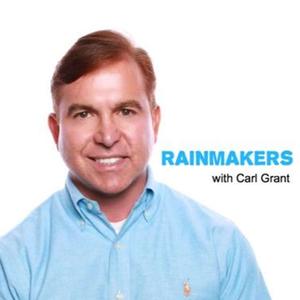

WEBVTT
00:00:07.259 --> 00:00:16.320
Welcome to Rainmakers. I am here with Nick spiller. He is a fundraising coach with funding camps. And he is a podcast host of beta business. Welcome, Nick.
00:00:17.609 --> 00:00:18.839
Hey, Carl. Thanks for having me.
00:00:19.320 --> 00:00:34.439
You bet. So when I met you, you were managing the investor relations for capital factory in Austin, Texas. And you were just about to launch out on your own to do your own business, which, to me seemed like kind of a scary thing.
00:00:35.159 --> 00:00:44.039
young guy starting a family and and talk about that whole journey going from having a paycheck to to doing your own thing and how that worked.
00:00:45.210 --> 00:00:51.179
Well, the first thing I'd say is when we when we actually first met, we were captaining my brand new boat.
00:00:53.039 --> 00:01:00.780
You showed me how to do business development, Austin style, taking me on a boat business development lunch that that was the Cool, cool stuff.
00:01:01.530 --> 00:02:09.840
Right? Yeah, so go, pandemic hit, and it was hidden stuff at that capital factor. You know, it's tough everywhere. And we were a co working business with 150 employees and folks all across the state. And yeah, we had to rethink things. And for me, when things shut down is had a lot of extra time. And you got out on the lake and, you know, bought that boat. And I ended up, you know, really spent a lot of time with interesting people like you on the lake, as well as other investors and entrepreneurs. And really just, I think, more than anything, when I was kind of taking the dive into my own startup, my own venture, I felt the confidence in the timing, my confidence in the timing within the world around me was just right. And, you know, I think it's sad when things like pandemics happen. And you know, in early anytime at the site, society breaks down, it's really tough situation, I think it presents a lot of opportunities for entrepreneurs, to rebuild on in new and better ways, right.
00:02:06.959 --> 00:02:27.569
And so that was really the big message. And it's really, for me, it started. There's 31. And there's 30 million small businesses out there, the venture capital industry supports about 10,000 of them at any one time, which is actually really profound and new in our economy, relatively speaking.
00:02:22.919 --> 00:02:39.509
And I really feel there's a huge opportunity to, you know, help a couple million more companies get financed and grow a little faster, and ultimately, you know, provide livelihoods in a sustainable and enjoyable way.
00:02:40.080 --> 00:02:44.340
And even kind of maybe address some of the things in the workforce you're seeing today.
00:02:42.300 --> 00:02:51.930
There's not not a lot of engagement that these big, more traditional companies, kind of rethinking that through financing small businesses and startups.
00:02:52.889 --> 00:02:57.569
Yes, I will admit, I have taken your boat lunch idea.
00:02:57.719 --> 00:03:24.090
I've taken many people, actually, I built upon that boat idea. I have nautical networking events, I think you attended one of them. Oh, yeah. It's become a way to turn something I like doing into something I call work. So and it's been great for business. So So talk to us about the how this works. How do you find these entrepreneurs? How do you build relationships with them, talk about the relationships you've built with the investors and how you put it all together.
00:03:25.830 --> 00:03:29.340
I can put it simply, it's a two step process.
00:03:29.340 --> 00:04:21.329
It's it's me entrepreneurs. And really, if you're into startups, and just eager, especially your your your students are in your early days, and your career entrepreneur is very open to having coffee meetings with a lot of people and I think that's a good thing. And but what really has helped me is doing that consistently, you know, every week now I'm talking to 10 new entrepreneurs, and really have a goal to per day, I'm gonna meet usually through different different avenues, then at the end of it, introduce them to each other. And by introducing them to each other, usually through events, or even just direct introductions, you create a community and that's really what I've used technology for business development, right?
00:04:21.360 --> 00:04:37.470
Yeah. Because it because it takes this more scalable than meeting with everyone one on one and if I go meet, you know, 40 entrepreneurs in a week or even a month, I can't really develop relationships and sustain relationships with all of them.
00:04:37.500 --> 00:05:09.060
But if I can create a community around that by giving them all to know each other and like each other, you know, and I still kind of part of that is the community leader in the connector. It seems to work really well and that's what I focused on. I'm, I'm one up in the Lake Travis business development game and we sold out a barge party this weekend on Sunday we got 50 people come on all entrepreneurs and investors going to spend a couple hours on on the lake and they double decker bars, they have out their VIP Marina.
00:05:10.139 --> 00:05:15.810
It's a great idea.
00:05:10.139 --> 00:05:41.279
So yeah, I meet about that many, maybe 45 entrepreneurs a month, and it is hard to manage. And so relationships are key. You know, once you keep that up many, many years in a row, you know, you're quickly overwhelmed. Especially when these entrepreneurs go, and they start new businesses, they have new needs, and they're and you're the guy that you know, you're their trusted adviser.
00:05:38.100 --> 00:05:51.930
How do you envision yourself managing this network of relationships and the investor relationships, you probably have an investor relationships that rival mine and and I know how hard it is for me. So how are you going to do it?
00:05:53.730 --> 00:07:16.889
Yeah, it's a good question. One thing I've adopted in the last six months is very rigorous CRM regimen. And I'm I'm on HubSpot, I got pretty much everybody I know. And every conversation I have, including this one, I'll log in there. And I can go in there and see Carl, and seek out my notes of the whole relationship. And that's really helpful because it's, it's Yeah, there's this concept of Dunbar's number where you can only have 150 real relationships as a human being, we just don't have the capacity to support more than that. And so yeah, I think CRM is one really good technology to stay in touch with people over time, because it's in the startup world. And I think probably business broadly, these relationships have orbits where, you know, you might engage with someone for three to six months and have an awesome project and it goes well, or maybe three to six years. And same thing. And, you know, there's this pause in the relationship, because you just go off in different parts of the ecosystem. And then, you know, somewhere down the line, you're at the table again, together, and you're working together. And it's super helpful to have those those nodes and even looking at that monthly or quarterly basis, it can be super helpful to remember, you know, everything and then you can have more genuine conversations and really connect and keep things going in a way that might be harder to do otherwise.
00:07:17.610 --> 00:07:35.279
Yeah, that's something I guess I wish I would have done 20 years ago. But so yeah, fast forward, I've got about 15,000, LinkedIn contacts, these are people I actually actually met and, and you're saying only 150 of them can be active at any given time. And so
00:07:37.920 --> 00:07:56.730
There's a challenge to the theory, I was put forward by Bob Metcalf was, is a professor of innovation at University of Texas, here in Austin, he's retiring this year, he's been a great addition, I was lucky enough to take his class, the first year, he had it. And I asked him about this.
00:07:56.730 --> 00:08:52.169
And I'm like, Yeah, I read this, you know, idea of Dunbar's number, he knew exactly what it was. And he said, I have a theory, I'm challenging this with social media. And I think the CRM technology might be an extension of that, or challenging this with the internet as a tool to expand Dunbar's number. I was talking about this yesterday morning with a group of basic technologists and, you know, kind of the general consensus is really, there's like, there's layers and within Dunbar's number, and there's like, your, your 20, inner circle friends, then there's, you know, like the 50, you know, outer layer, trusted confidant, but not, you know, not your family and best friends. And then there's another, you know, 75 people that you really trust, and you're close with. And really, I mean, everyone looked around, like, I don't know, if social media really has helped me create more real relationships.
00:08:47.549 --> 00:08:59.519
And I don't know if it really gets so I don't think any of us felt like we had over 150 authentic genuine relationships.
00:08:56.070 --> 00:09:09.779
So I think there's really just an extra layer that social media has been put put on it. So that's my, my theory on that we actually I think a lot about, you know, can you expand that that number?
00:09:10.740 --> 00:10:14.024
Yeah, I mean, I, I'm able to stay present with way more than I could, if I didn't have social media, you know, so I used to up until about four months ago, I used to touch every LinkedIn contact at least once a year, just to make sure that they were, you know, remembered who I was wish them Happy birthday, congratulate them on something. And I had to stop. Because what happened was, when I was doing that, Nick, every one of them would reach out to me and want to catch up and do a call or introduce me to somebody or tell me about the new company. And that was great, but but you can only handle so much of that. And so, I pause that for now I may resume and again. But I you know, you can get to a point where you're overwhelmed. And then you do a podcast. So let's talk about your podcast. Obviously, you're doing my podcast right now. I'm doing this I'm doing this more to gather intelligence than I am to actually have a thriving podcast, I'm finding out how others do what I do. And I'm learning from that. And eventually I'm going to write a book. So that's what I'm doing.
00:10:14.082 --> 00:10:19.049
What are you? Why are you doing your podcast? And and what are you getting out of it?
00:10:20.549 --> 00:10:27.899
Well, I was invited to join beta business by my no partner, green curtain who I met was at Capital factory.
00:10:27.899 --> 00:11:06.840
And we worked on half a dozen deals or so that ended up no longer doing very well. So we have a good relationship. And a big thing for me, rolling out of capital factory, and this would be as if I was working at any venture fund, or really any startup is, I want to just have my own third party voice on everything. And I wanted to get out there and really say, whatever the hell I wanted to, and, you know, if you're an investor relations lead for someone who's managing nine funds with a couple 100 investors like that, that's not your life, right? Like, I can't go out there and just, you know, throw through my opinions around is not my best best interest.
00:11:06.840 --> 00:11:47.730
And so So yeah, I think the podcast is really attracted to me for that reason I get to weigh in on the startup community, which I think there's just a lot of dogma in the startup community. And, you know, these these one size fit all pieces of advice have perpetuated throughout the accelerators. And, you know, there's a lot of people really just giving advice, where they probably shouldn't, and maybe more so like giving advice before they've really dug into a company and dug into the motives of an entrepreneur. And yeah, so we started beta business as a way to really demystify the startup world, and even just break apart the lexicon in words like liquidation preference and convertible note and CRM, right?
00:11:47.730 --> 00:12:39.870
Like, by the way, if anyone's listening, you don't know what CRM is, it's customer relationship management, you know, so just little things like that, that I think can really help entrepreneurs and they get to the table with entrepreneurs, people like you that have been in the industry for 30, 40 year, or really have kind f established the whole lexic n and industry, right and incom, but get up to speed quickly, a d not have that be a barrier o getting funded and getti g things done. Because I thi k there's ultimately this, th s communication barrier betwe n the, you know, the baby boom r generation, the millennials, a d then you got the Gen Z peop e coming on. And it's lik, because of the internet, we a l really communicate and thi k think differently. So So yea, that's a lot of what we're doi g with data business. And it', it's really become my my prima y thing. I'm going to record f r four podcast episodes today. A d we see it growing into a sort f ESPN for startup
00:12:40.950 --> 00:12:50.039
That's cool. So talk to me about the startups that you're working with, Are these your traditional venture, bankable startups are these the harder to place startups?
00:12:50.039 --> 00:13:41.777
I say, it's the startups on the bubble, you know, and there's the super hot deals that everyone's trying to get into. And those are great, and they'll get funded. But I found like, you know, I can kind of, maybe get some people into those deals, and that's cool, but it can really move the needle. The startups I try to coach are great founders who have a solid business with good traction, and just really haven't fundraised before and aren't familiar with the game, they don't have an investor and large cap table that can guide them through the process. And yeah, I partner with them, essentially, as a consultant to get them to that point where they have that first good investor that's gonna take take them under their wing, is that an angel investor? It depends on most often is an angel investor.
00:13:37.812 --> 00:14:23.849
It could also be a customer and a lot of sense. Like, you know, some of the companies, I mean, the big, big idea I talked about with founders, and you know, I don't push it on them, but say, Hey, you know, you can go out there and try to raise from a big seed fund and, you know, raise 2 million, 6 million valuation andeven be great, you start limiting your optionality on the other end of the venture, when you really start swinging for the fences. And so I kind of encourage founders to think about alternative ways to finance their company, to where you might leave an you know, an early exit on the table that still makes you a millionaire and still makes your investors a two to 3x return on their money.
00:14:23.910 --> 00:14:39.029
I think there's nothing there's kind of like base it's become a derogatory term where, to me, I think basics are a way for first time entrepreneurs to put some money in their pocket and get back up to the plate and try to try to hit a home run.
00:14:39.029 --> 00:14:41.639
Do you help them get an exit to now?
00:14:41.639 --> 00:14:44.610
Yeah, I really want to get into that one day.
00:14:44.610 --> 00:14:51.480
Okay, so what what kind of companies are you looking for? Are you looking for companies in Texas or across the United States or anywhere
00:14:53.519 --> 00:15:45.298
Across the United States, I'd say Texas, certainly about love everything about the ecosystem and is My my base companies that really are exciting to me are usually have some sort of strong revenue angle and haven't raised a ton of money. And so they're I think there's a lot of really good sass companies out there that really want you broadly speaking, most of them will not be unicorns, but they could easily be taken from one to 15 million in revenue, or 10 million in revenue, and then sold for 20 or 30 million having raised maybe two or 3 million along the way. And and yeah, so like, kind of setups like that really interested me and kind of ultimately what I'm looking for.
00:15:45.298 --> 00:15:52.078
So Nick, how do people find you on social media on to reach out to you on the podcast?
00:15:52.078 --> 00:16:02.023
Yeah, LinkedIn is where I'm most accessible. You reach out to me there write me a note. Let me know what you're up to. I read every message I get.
00:15:58.727 --> 00:16:16.710
And you can check out the podcast at beta your business comm and sign up for email updates. And we also Yeah, we do live events like the barge party I mentioned we're doing this weekend and I got about five or six events on on tap for the fall as long as we're able to host them.
00:16:18.000 --> 00:16:26.220
Well, Nick spiller, founder of stripe funding camps and host of beta business.
00:16:22.860 --> 00:16:28.529
Thanks for joining me. I really enjoyed it.
00:16:27.419 --> 00:16:28.529
Thanks Carl, see you on the lake!
00:00:07.259 --> 00:00:16.320
Welcome to Rainmakers. I am here with Nick spiller. He is a fundraising coach with funding camps. And he is a podcast host of beta business. Welcome, Nick.
00:00:17.609 --> 00:00:18.839
Hey, Carl. Thanks for having me.
00:00:19.320 --> 00:00:34.439
You bet. So when I met you, you were managing the investor relations for capital factory in Austin, Texas. And you were just about to launch out on your own to do your own business, which, to me seemed like kind of a scary thing.
00:00:35.159 --> 00:00:44.039
young guy starting a family and and talk about that whole journey going from having a paycheck to to doing your own thing and how that worked.
00:00:45.210 --> 00:00:51.179
Well, the first thing I'd say is when we when we actually first met, we were captaining my brand new boat.
00:00:53.039 --> 00:01:00.780
You showed me how to do business development, Austin style, taking me on a boat business development lunch that that was the Cool, cool stuff.
00:01:01.530 --> 00:02:09.840
Right? Yeah, so go, pandemic hit, and it was hidden stuff at that capital factor. You know, it's tough everywhere. And we were a co working business with 150 employees and folks all across the state. And yeah, we had to rethink things. And for me, when things shut down is had a lot of extra time. And you got out on the lake and, you know, bought that boat. And I ended up, you know, really spent a lot of time with interesting people like you on the lake, as well as other investors and entrepreneurs. And really just, I think, more than anything, when I was kind of taking the dive into my own startup, my own venture, I felt the confidence in the timing, my confidence in the timing within the world around me was just right. And, you know, I think it's sad when things like pandemics happen. And you know, in early anytime at the site, society breaks down, it's really tough situation, I think it presents a lot of opportunities for entrepreneurs, to rebuild on in new and better ways, right.
00:02:06.959 --> 00:02:27.569
And so that was really the big message. And it's really, for me, it started. There's 31. And there's 30 million small businesses out there, the venture capital industry supports about 10,000 of them at any one time, which is actually really profound and new in our economy, relatively speaking.
00:02:22.919 --> 00:02:39.509
And I really feel there's a huge opportunity to, you know, help a couple million more companies get financed and grow a little faster, and ultimately, you know, provide livelihoods in a sustainable and enjoyable way.
00:02:40.080 --> 00:02:44.340
And even kind of maybe address some of the things in the workforce you're seeing today.
00:02:42.300 --> 00:02:51.930
There's not not a lot of engagement that these big, more traditional companies, kind of rethinking that through financing small businesses and startups.
00:02:52.889 --> 00:02:57.569
Yes, I will admit, I have taken your boat lunch idea.
00:02:57.719 --> 00:03:24.090
I've taken many people, actually, I built upon that boat idea. I have nautical networking events, I think you attended one of them. Oh, yeah. It's become a way to turn something I like doing into something I call work. So and it's been great for business. So So talk to us about the how this works. How do you find these entrepreneurs? How do you build relationships with them, talk about the relationships you've built with the investors and how you put it all together.
00:03:25.830 --> 00:03:29.340
I can put it simply, it's a two step process.
00:03:29.340 --> 00:04:21.329
It's it's me entrepreneurs. And really, if you're into startups, and just eager, especially your your your students are in your early days, and your career entrepreneur is very open to having coffee meetings with a lot of people and I think that's a good thing. And but what really has helped me is doing that consistently, you know, every week now I'm talking to 10 new entrepreneurs, and really have a goal to per day, I'm gonna meet usually through different different avenues, then at the end of it, introduce them to each other. And by introducing them to each other, usually through events, or even just direct introductions, you create a community and that's really what I've used technology for business development, right?
00:04:21.360 --> 00:04:37.470
Yeah. Because it because it takes this more scalable than meeting with everyone one on one and if I go meet, you know, 40 entrepreneurs in a week or even a month, I can't really develop relationships and sustain relationships with all of them.
00:04:37.500 --> 00:05:09.060
But if I can create a community around that by giving them all to know each other and like each other, you know, and I still kind of part of that is the community leader in the connector. It seems to work really well and that's what I focused on. I'm, I'm one up in the Lake Travis business development game and we sold out a barge party this weekend on Sunday we got 50 people come on all entrepreneurs and investors going to spend a couple hours on on the lake and they double decker bars, they have out their VIP Marina.
00:05:10.139 --> 00:05:15.810
It's a great idea.
00:05:10.139 --> 00:05:41.279
So yeah, I meet about that many, maybe 45 entrepreneurs a month, and it is hard to manage. And so relationships are key. You know, once you keep that up many, many years in a row, you know, you're quickly overwhelmed. Especially when these entrepreneurs go, and they start new businesses, they have new needs, and they're and you're the guy that you know, you're their trusted adviser.
00:05:38.100 --> 00:05:51.930
How do you envision yourself managing this network of relationships and the investor relationships, you probably have an investor relationships that rival mine and and I know how hard it is for me. So how are you going to do it?
00:05:53.730 --> 00:07:16.889
Yeah, it's a good question. One thing I've adopted in the last six months is very rigorous CRM regimen. And I'm I'm on HubSpot, I got pretty much everybody I know. And every conversation I have, including this one, I'll log in there. And I can go in there and see Carl, and seek out my notes of the whole relationship. And that's really helpful because it's, it's Yeah, there's this concept of Dunbar's number where you can only have 150 real relationships as a human being, we just don't have the capacity to support more than that. And so yeah, I think CRM is one really good technology to stay in touch with people over time, because it's in the startup world. And I think probably business broadly, these relationships have orbits where, you know, you might engage with someone for three to six months and have an awesome project and it goes well, or maybe three to six years. And same thing. And, you know, there's this pause in the relationship, because you just go off in different parts of the ecosystem. And then, you know, somewhere down the line, you're at the table again, together, and you're working together. And it's super helpful to have those those nodes and even looking at that monthly or quarterly basis, it can be super helpful to remember, you know, everything and then you can have more genuine conversations and really connect and keep things going in a way that might be harder to do otherwise.
00:07:17.610 --> 00:07:35.279
Yeah, that's something I guess I wish I would have done 20 years ago. But so yeah, fast forward, I've got about 15,000, LinkedIn contacts, these are people I actually actually met and, and you're saying only 150 of them can be active at any given time. And so
00:07:37.920 --> 00:07:56.730
There's a challenge to the theory, I was put forward by Bob Metcalf was, is a professor of innovation at University of Texas, here in Austin, he's retiring this year, he's been a great addition, I was lucky enough to take his class, the first year, he had it. And I asked him about this.
00:07:56.730 --> 00:08:52.169
And I'm like, Yeah, I read this, you know, idea of Dunbar's number, he knew exactly what it was. And he said, I have a theory, I'm challenging this with social media. And I think the CRM technology might be an extension of that, or challenging this with the internet as a tool to expand Dunbar's number. I was talking about this yesterday morning with a group of basic technologists and, you know, kind of the general consensus is really, there's like, there's layers and within Dunbar's number, and there's like, your, your 20, inner circle friends, then there's, you know, like the 50, you know, outer layer, trusted confidant, but not, you know, not your family and best friends. And then there's another, you know, 75 people that you really trust, and you're close with. And really, I mean, everyone looked around, like, I don't know, if social media really has helped me create more real relationships.
00:08:47.549 --> 00:08:59.519
And I don't know if it really gets so I don't think any of us felt like we had over 150 authentic genuine relationships.
00:08:56.070 --> 00:09:09.779
So I think there's really just an extra layer that social media has been put put on it. So that's my, my theory on that we actually I think a lot about, you know, can you expand that that number?
00:09:10.740 --> 00:10:14.024
Yeah, I mean, I, I'm able to stay present with way more than I could, if I didn't have social media, you know, so I used to up until about four months ago, I used to touch every LinkedIn contact at least once a year, just to make sure that they were, you know, remembered who I was wish them Happy birthday, congratulate them on something. And I had to stop. Because what happened was, when I was doing that, Nick, every one of them would reach out to me and want to catch up and do a call or introduce me to somebody or tell me about the new company. And that was great, but but you can only handle so much of that. And so, I pause that for now I may resume and again. But I you know, you can get to a point where you're overwhelmed. And then you do a podcast. So let's talk about your podcast. Obviously, you're doing my podcast right now. I'm doing this I'm doing this more to gather intelligence than I am to actually have a thriving podcast, I'm finding out how others do what I do. And I'm learning from that. And eventually I'm going to write a book. So that's what I'm doing.
00:10:14.082 --> 00:10:19.049
What are you? Why are you doing your podcast? And and what are you getting out of it?
00:10:20.549 --> 00:10:27.899
Well, I was invited to join beta business by my no partner, green curtain who I met was at Capital factory.
00:10:27.899 --> 00:11:06.840
And we worked on half a dozen deals or so that ended up no longer doing very well. So we have a good relationship. And a big thing for me, rolling out of capital factory, and this would be as if I was working at any venture fund, or really any startup is, I want to just have my own third party voice on everything. And I wanted to get out there and really say, whatever the hell I wanted to, and, you know, if you're an investor relations lead for someone who's managing nine funds with a couple 100 investors like that, that's not your life, right? Like, I can't go out there and just, you know, throw through my opinions around is not my best best interest.
00:11:06.840 --> 00:11:47.730
And so So yeah, I think the podcast is really attracted to me for that reason I get to weigh in on the startup community, which I think there's just a lot of dogma in the startup community. And, you know, these these one size fit all pieces of advice have perpetuated throughout the accelerators. And, you know, there's a lot of people really just giving advice, where they probably shouldn't, and maybe more so like giving advice before they've really dug into a company and dug into the motives of an entrepreneur. And yeah, so we started beta business as a way to really demystify the startup world, and even just break apart the lexicon in words like liquidation preference and convertible note and CRM, right?
00:11:47.730 --> 00:12:39.870
Like, by the way, if anyone's listening, you don't know what CRM is, it's customer relationship management, you know, so just little things like that, that I think can really help entrepreneurs and they get to the table with entrepreneurs, people like you that have been in the industry for 30, 40 year, or really have kind f established the whole lexic n and industry, right and incom, but get up to speed quickly, a d not have that be a barrier o getting funded and getti g things done. Because I thi k there's ultimately this, th s communication barrier betwe n the, you know, the baby boom r generation, the millennials, a d then you got the Gen Z peop e coming on. And it's lik, because of the internet, we a l really communicate and thi k think differently. So So yea, that's a lot of what we're doi g with data business. And it', it's really become my my prima y thing. I'm going to record f r four podcast episodes today. A d we see it growing into a sort f ESPN for startup
00:12:40.950 --> 00:12:50.039
That's cool. So talk to me about the startups that you're working with, Are these your traditional venture, bankable startups are these the harder to place startups?
00:12:50.039 --> 00:13:41.777
I say, it's the startups on the bubble, you know, and there's the super hot deals that everyone's trying to get into. And those are great, and they'll get funded. But I found like, you know, I can kind of, maybe get some people into those deals, and that's cool, but it can really move the needle. The startups I try to coach are great founders who have a solid business with good traction, and just really haven't fundraised before and aren't familiar with the game, they don't have an investor and large cap table that can guide them through the process. And yeah, I partner with them, essentially, as a consultant to get them to that point where they have that first good investor that's gonna take take them under their wing, is that an angel investor? It depends on most often is an angel investor.
00:13:37.812 --> 00:14:23.849
It could also be a customer and a lot of sense. Like, you know, some of the companies, I mean, the big, big idea I talked about with founders, and you know, I don't push it on them, but say, Hey, you know, you can go out there and try to raise from a big seed fund and, you know, raise 2 million, 6 million valuation andeven be great, you start limiting your optionality on the other end of the venture, when you really start swinging for the fences. And so I kind of encourage founders to think about alternative ways to finance their company, to where you might leave an you know, an early exit on the table that still makes you a millionaire and still makes your investors a two to 3x return on their money.
00:14:23.910 --> 00:14:39.029
I think there's nothing there's kind of like base it's become a derogatory term where, to me, I think basics are a way for first time entrepreneurs to put some money in their pocket and get back up to the plate and try to try to hit a home run.
00:14:39.029 --> 00:14:41.639
Do you help them get an exit to now?
00:14:41.639 --> 00:14:44.610
Yeah, I really want to get into that one day.
00:14:44.610 --> 00:14:51.480
Okay, so what what kind of companies are you looking for? Are you looking for companies in Texas or across the United States or anywhere
00:14:53.519 --> 00:15:45.298
Across the United States, I'd say Texas, certainly about love everything about the ecosystem and is My my base companies that really are exciting to me are usually have some sort of strong revenue angle and haven't raised a ton of money. And so they're I think there's a lot of really good sass companies out there that really want you broadly speaking, most of them will not be unicorns, but they could easily be taken from one to 15 million in revenue, or 10 million in revenue, and then sold for 20 or 30 million having raised maybe two or 3 million along the way. And and yeah, so like, kind of setups like that really interested me and kind of ultimately what I'm looking for.
00:15:45.298 --> 00:15:52.078
So Nick, how do people find you on social media on to reach out to you on the podcast?
00:15:52.078 --> 00:16:02.023
Yeah, LinkedIn is where I'm most accessible. You reach out to me there write me a note. Let me know what you're up to. I read every message I get.
00:15:58.727 --> 00:16:16.710
And you can check out the podcast at beta your business comm and sign up for email updates. And we also Yeah, we do live events like the barge party I mentioned we're doing this weekend and I got about five or six events on on tap for the fall as long as we're able to host them.
00:16:18.000 --> 00:16:26.220
Well, Nick spiller, founder of stripe funding camps and host of beta business.
00:16:22.860 --> 00:16:28.529
Thanks for joining me. I really enjoyed it.
00:16:27.419 --> 00:16:28.529
Thanks Carl, see you on the lake!
